
Optimal Planning Method of Wind Farms Considering Spatiotemporal Frequency Characteristics Under Uncertain Disturbances

Abstract
1. Introduction
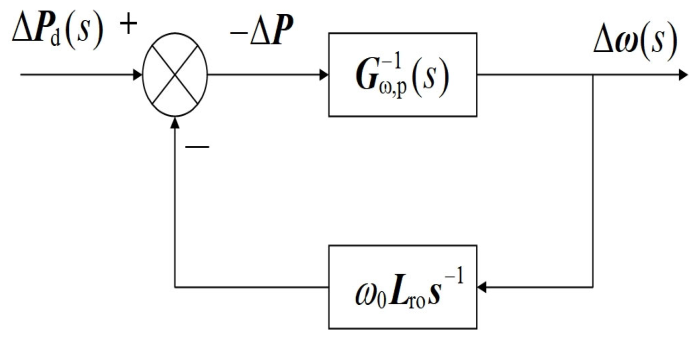
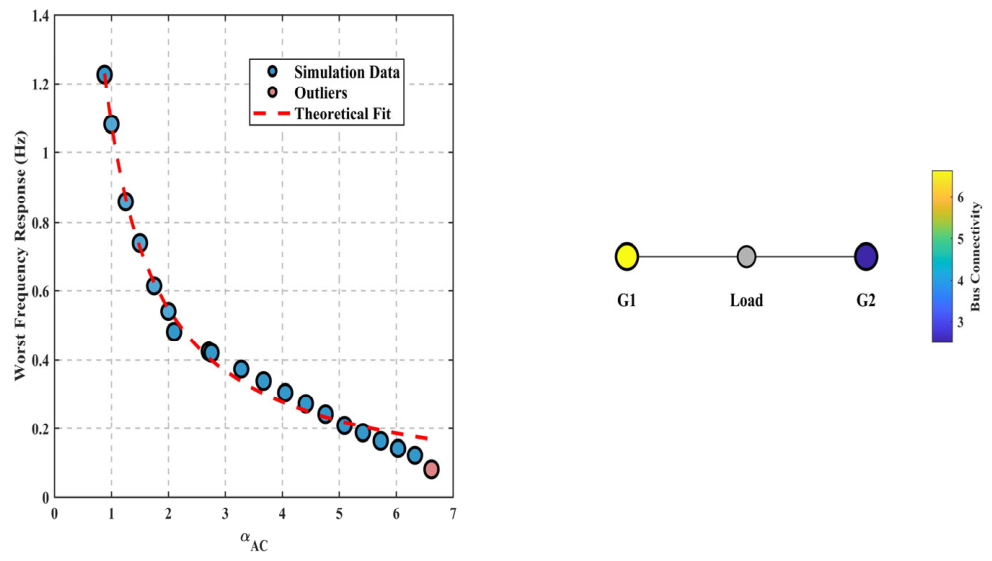
- A theoretical upper bound evaluation index of frequency response oriented towards uncertain disturbances is constructed. Based on the closed-loop transfer function and norm theory, the theoretical upper bound of frequency response under uncertain disturbances is derived, and algebraic connectivity is extracted as the core characterization parameter, revealing the inherent influence mechanism of network topology on the worst-case frequency response.
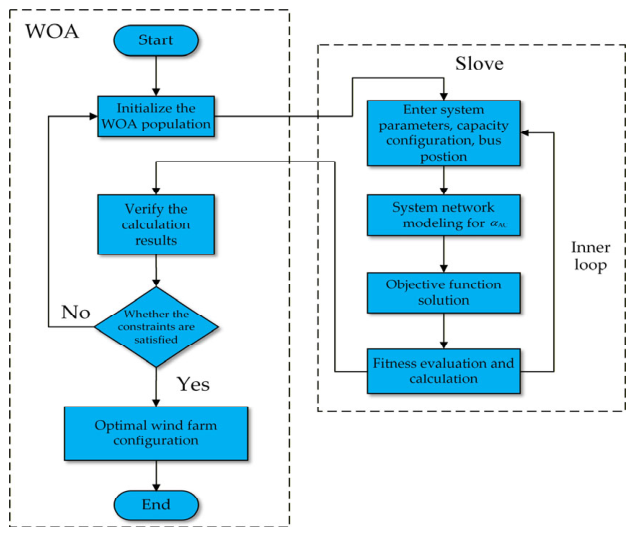
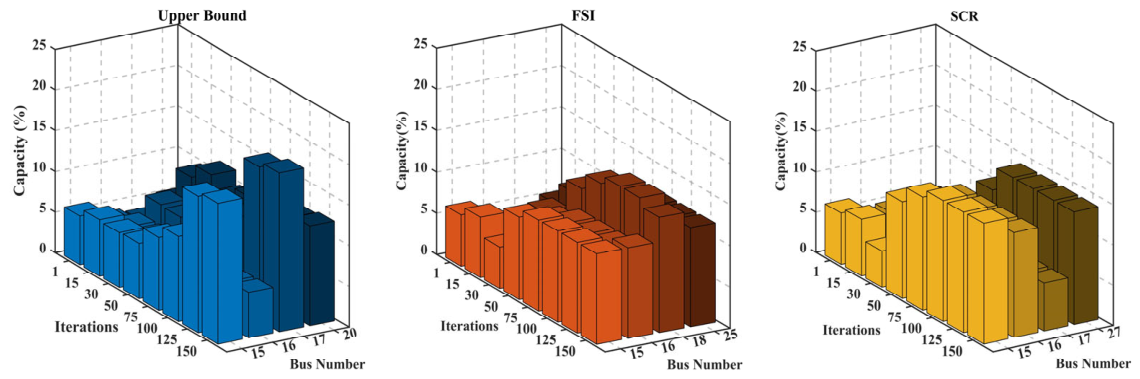
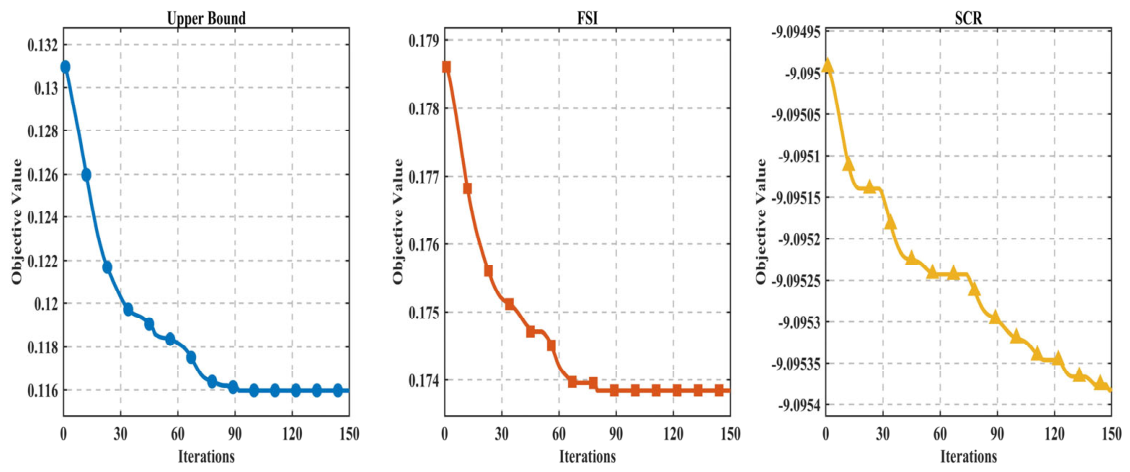
- An optimal wind farm siting and sizing planning method based on the theoretical frequency response upper bound constraint is proposed. Instead of relying on predefined deterministic scenarios, the proposed method embeds the index into the planning model as a core security constraint to prevent local frequency limit violations caused by uncertain disturbances.
2. System Modeling
3. Evaluation Method for Frequency Response Boundaries of Systems Under Uncertain Disturbances
3.1. Derivation of Upper Bound Response Index
3.2. Spatial Frequency Response Boundary Evaluation Method
4. Optimal Planning of Wind Farms Based on Frequency Response Evaluation Index
4.1. Optimization Model Construction
4.1.1. System Constraints
4.1.2. Capacity Allocation and Location Constraints
4.1.3. Renewable Equipment Constraints
4.2. Solving Method for Optimization Planning Based on Whale Optimization Algorithm
- (1)
- Initialization phase
- (2)
- Iterative optimization phase
- (3)
- Termination and output phase
5. Simulation Results
5.1. Two-Machine System
5.1.1. Upper Bound Index Validity Verification
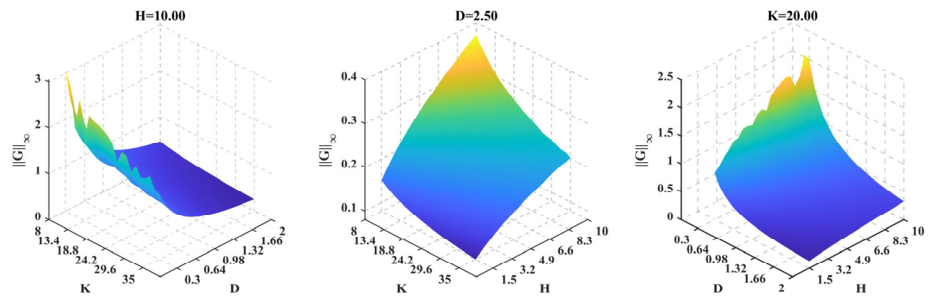
5.1.2. System Parameter Sensitivity Analysis
5.2. IEEE 39-Bus System
5.2.1. Validity Verification
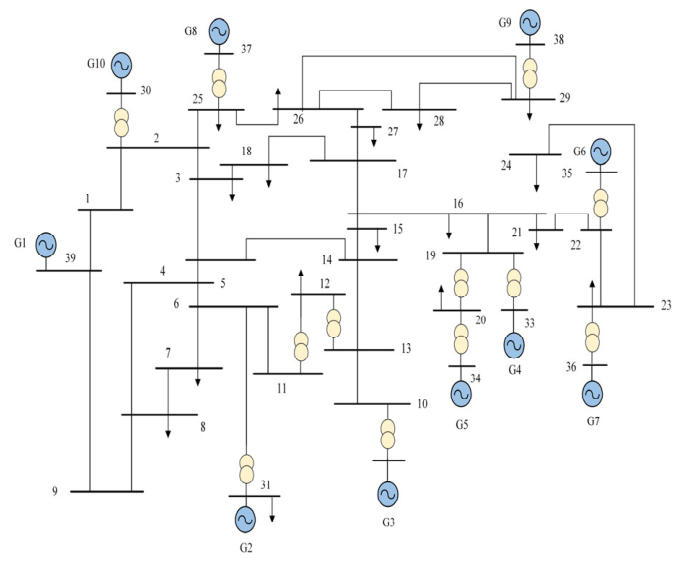
- (1)
- Load weight: select the vicinity of the system load center;
- (2)
- System topology: consider the network connectivity and power flow distribution characteristics;
- (3)
- Typical scenarios: represent the common wind farm integration mode in actual projects. This configuration ensures that the analysis results can reflect the actual system characteristics and provide a basis for subsequent optimization analysis.
5.2.2. Comparison of Planning Results Under Different Evaluation Indices
5.2.3. Discussion on Results Considering Topological Structure Changes
6. Discussion
6.1. Physical Mechanism of Topological Enhancement
6.2. Validity Under Complex Disturbances
6.3. Computational Efficiency and Robust Control
6.4. Scalability and Limitations in Realistic Grids
7. Conclusions
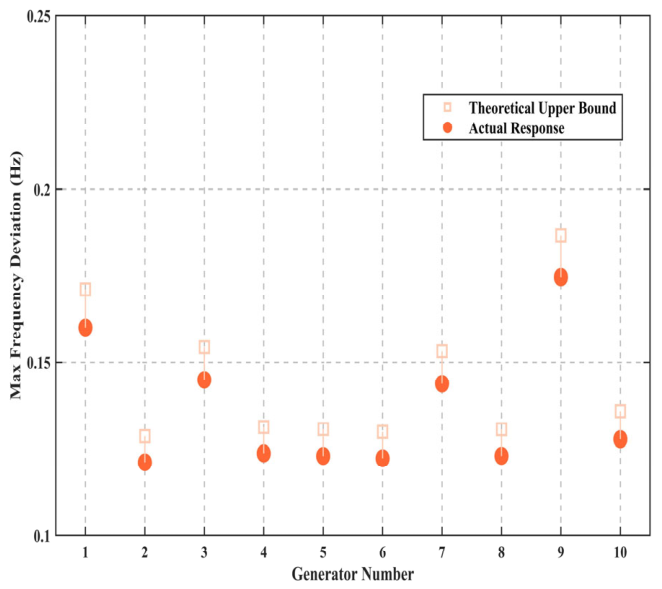
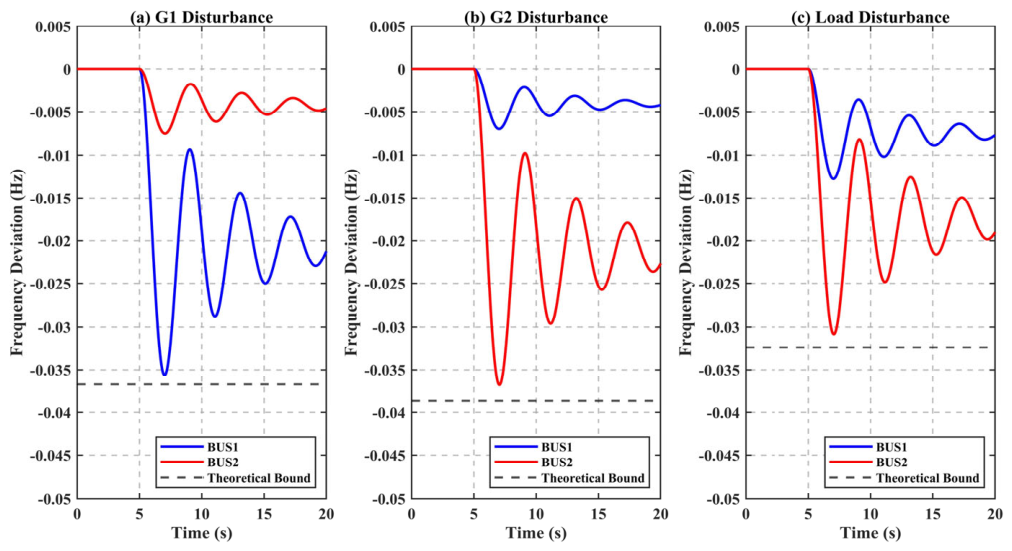
- The proposed upper bound index can effectively quantify the worst-case frequency deviation under uncertain disturbances. Simulation results show that this theoretical upper bound can strictly cover the actual dynamic frequency responses under different disturbance locations. The relative error between the estimated value and the actual maximum frequency deviation is only about 3.2%, providing an evaluation basis for preventing local frequency limit violations.
- A spatial frequency response evaluation method based on algebraic connectivity is proposed. Based on graph theory and control theory, this method integrates the physical topological characteristics of the network with the dynamic parameters of the system, quantifying the impact of spatial uncertain disturbances on frequency dynamics from a global structural perspective. The proposed method effectively overcomes the limitations of traditional single-scenario evaluations, easily identifying weak links in the network that are prone to inducing local frequency limit violations, and providing an evaluation basis for wind farm spatial layout optimization.
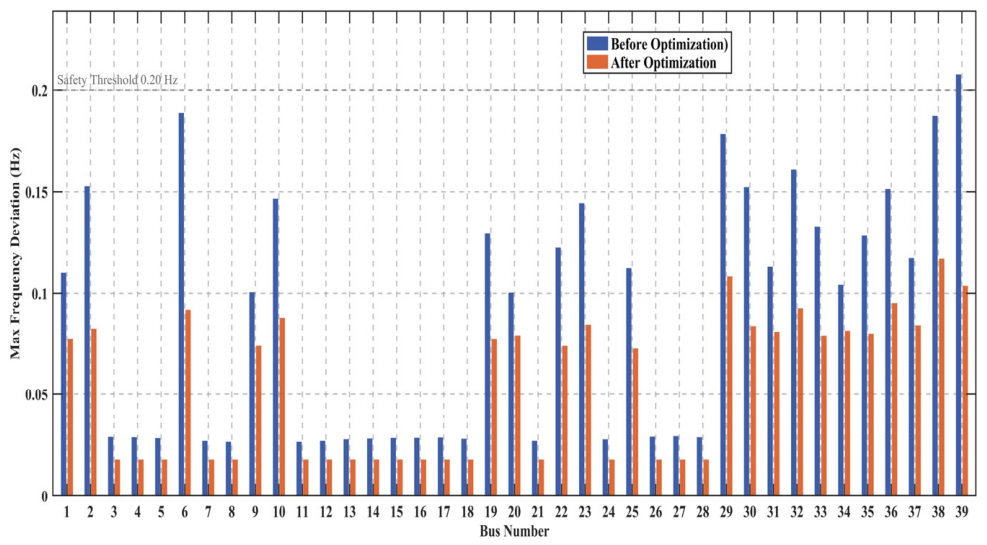
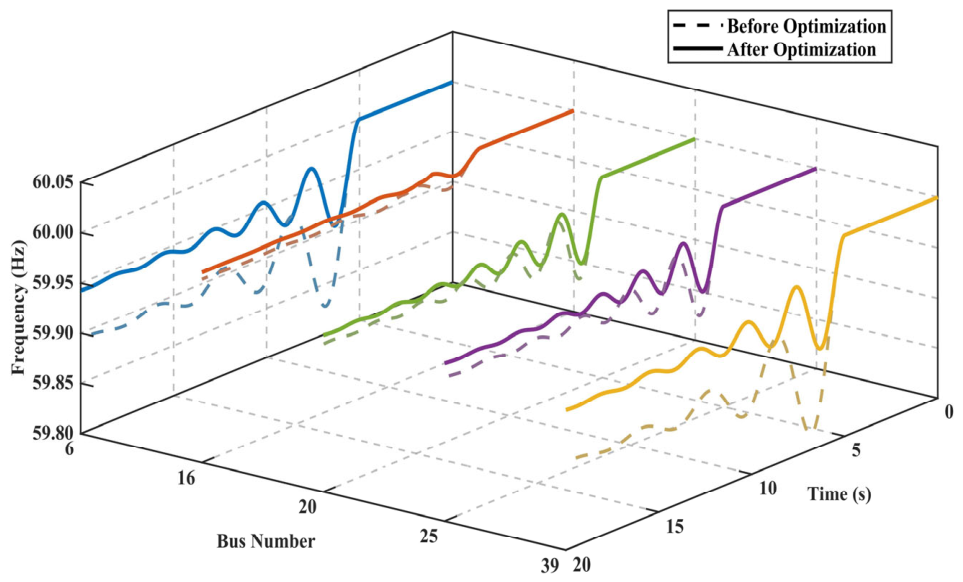
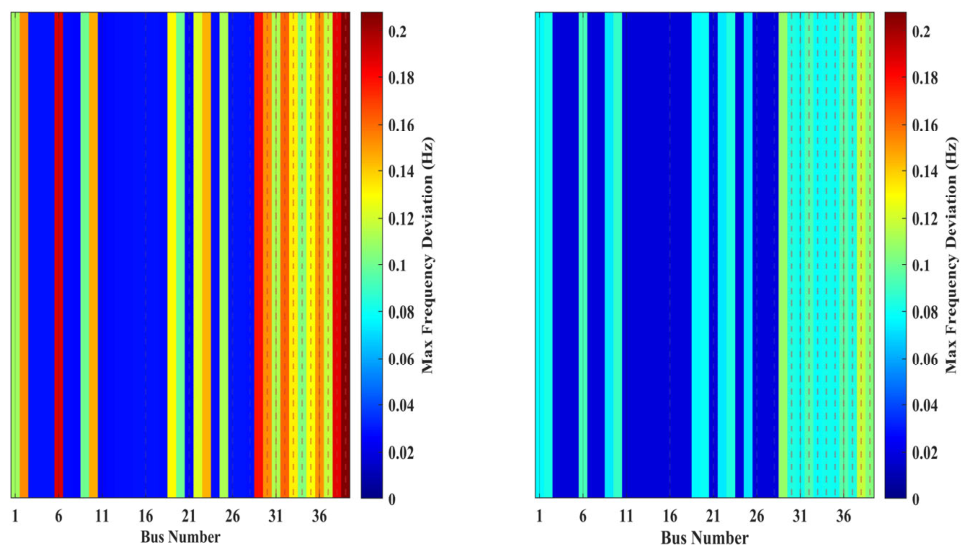
- The proposed wind farm optimal planning method can effectively avoid local frequency limit violation risks under uncertain disturbances, thereby fundamentally enhancing the overall frequency security baseline of the system from the network structural perspective. Simulation results show that, when a 1.2 p.u. active-power disturbance is applied at each bus individually, the average maximum frequency deviation is reduced by 36.78% relative to the unoptimized siting-and-sizing scheme, with optimized values in 0.0173–0.1174 Hz. Furthermore, when facing preset topology-change scenarios, the maximum frequency deviation achieves an average reduction of 7.03%, significantly enhancing the adaptability of the system.
Supplementary Materials
Author Contributions
Funding
Data Availability Statement
Conflicts of Interest
Appendix A

| Equipment Number | Nominal Power (MW) | Inertia Constant (s) |
|---|---|---|
| G 1 | 1000 | 5 |
| G 2 | 520.81 | 4.5 |
| G 3 | 650 | 4.7 |
| G 4 | 632 | 4.6 |
| G 5 | 508 | 4.5 |
| G 6 | 650 | 4.6 |
| G 7 | 560 | 4.5 |
| G 8 | 540 | 4.5 |
| G 9 | 830 | 4.8 |
| G 10 | 250 | 4.2 |
| Total | 6140.81 | 45.9 |
| Parameter | Unit | Value |
|---|---|---|
| Rated Apparent Power | MVA | 5.0 |
| Rated Active Power | MW | 4.87 |
| Rated Voltage | V | 575 |
| Number of Pole Pairs | / | 2 |
| Inertia Constant | s | 5.04 |
| Damping Factor | / | 0.01 |
| Stator Resistance | p.u. | 0.01 |
| Stator Reactance | p.u. | 0.1 |
| Magnetizing Inductor | p.u. | 2.9 |
| Rotor Resistance | p.u. | 0.005 |
| Rotor Reactance | p.u. | 0.156 |
| Position | Max Deviation | Position | Max Deviation | Position | Max Deviation |
|---|---|---|---|---|---|
| 1 | 0.0771 | 16 | 0.0185 | 31 | 0.0809 |
| 2 | 0.0825 | 17 | 0.0182 | 32 | 0.0929 |
| 3 | 0.0184 | 18 | 0.0181 | 33 | 0.0790 |
| 4 | 0.0181 | 19 | 0.0772 | 34 | 0.0814 |
| 5 | 0.0181 | 20 | 0.0791 | 35 | 0.08 |
| 6 | 0.0921 | 21 | 0.0186 | 36 | 0.0954 |
| 7 | 0.0183 | 22 | 0.0737 | 37 | 0.084 |
| 8 | 0.0184 | 23 | 0.0843 | 38 | 0.1174 |
| 9 | 0.0738 | 24 | 0.0173 | 39 | 0.1040 |
| 10 | 0.0878 | 25 | 0.0724 | ||
| 11 | 0.0178 | 26 | 0.0182 | ||
| 12 | 0.0180 | 27 | 0.0179 | ||
| 13 | 0.0177 | 28 | 0.0180 | ||
| 14 | 0.0181 | 29 | 0.1086 | ||
| 15 | 0.0184 | 30 | 0.0837 |
| Symbol | Mathematical Type | Unit |
|---|---|---|
| Absolute value | p.u. | |
| Eigenvalue | dimensionless | |
| Eigenvalue | dimensionless | |
| Constant | dimensionless | |
| Composite Scalar | dimensionless | |
| Constant | dimensionless | |
| 2-norm (Vector norm) | p.u. | |
| Infinity norm | dimensionless | |
| Constant | s | |
| Constant | dimensionless | |
| Constant | dimensionless |
References
- Atwa, Y.M.; El-Saadany, E.F. Optimal Allocation of ESS in Distribution Systems With a High Penetration of Wind Energy. IEEE Trans. Power Syst. 2010, 25, 1815–1822. [Google Scholar] [CrossRef]
- Dreidy, M.; Mokhlis, H.; Mekhilef, S. Inertia Response and Frequency Control Techniques for Renewable Energy Sources: A Review. Renew. Sustain. Energy Rev. 2017, 69, 144–155. [Google Scholar] [CrossRef]
- Tian, G.; Wang, F. Data-Driven Load Frequency Control for Multi-Area Power System Based on Switching Method under Cyber Attacks. Algorithms 2024, 17, 233. [Google Scholar] [CrossRef]
- Zhang, P.; Xiao, D.; Hua, D.; Chen, H.; Tang, Y. Dynamic Frequency Security Constraints Unit Commitment for High Shares of Renewables Power Systems. Distrib. Util. 2025, 42, 90–99. [Google Scholar] [CrossRef]
- Zhang, Z.; Zhang, N.; Du, E.; Kang, C. Review and Countermeasures on Frequency Security Issues of Power Systems With High Shares of Renewables and Power Electronics. Proc. CSEE 2022, 42, 1–25. [Google Scholar] [CrossRef]
- Roy, T.K.; Oo, A.M.T. Virtual Inertia and Damping-Based Cascaded Control Approach for Enhancing Load Frequency Control in Low-Inertia Multi-Area Power System. J. Eng. 2025, 2025, e70054. [Google Scholar] [CrossRef]
- Evald, P.J.D.d.O.; Schmitz, L.; de Andrade, J.M.; Viglus, F.J.; Lazzarin, T.B. Towards the Future Low-Inertia Power Systems: A Review on Grid-Forming Inverter Control-Advances, Challenges, and Opportunities. Renew. Sustain. Energy Rev. 2026, 235, 116948. [Google Scholar] [CrossRef]
- Reza, M.; Sudarmadi, D.; Viawan, F.A.; Kling, W.L.; Van Der Sluis, L. Dynamic Stability of Power Systems with Power Electronic Interfaced DG. In Proceedings of the 2006 IEEE PES Power Systems Conference and Exposition; IEEE: Atlanta, GA, USA, 2006; pp. 1423–1428. [Google Scholar]
- Bin, Z.; Xue, Y. A Method to Extract Instantaneous Features of Low Frequency Oscillation Based on Trajectory Section Eigenvalues. J. Mod. Power Syst. Clean. Energy 2019, 7, 753–766. [Google Scholar] [CrossRef]
- Wang, G.; Wang, C.; Shahidehpour, M. Neural Network Applications in Hybrid Data-Model Driven Dynamic Frequency Trajectory Prediction for Weak-Damping Power Systems. IEEE Trans. Power Syst. 2023, 39, 3227–3239. [Google Scholar] [CrossRef]
- Zhao, T.; Wang, J.; Yue, M. A Barrier-Certificated Reinforcement Learning Approach for Enhancing Power System Transient Stability. IEEE Trans. Power Syst. 2023, 38, 5356–5366. [Google Scholar] [CrossRef]
- Tavora, C.; Smith, O.J.M. Characterization of Equilibrium and Stability in Power Systems. IEEE Trans. Power Appar. Syst. 1972, PA91, 1127–1130. [Google Scholar] [CrossRef]
- Wen, Y.; Li, W.; Huang, G.; Liu, X. Frequency Dynamics Constrained Unit Commitment with Battery Energy Storage. IEEE Trans. Power Syst. 2016, 31, 5115–5125. [Google Scholar] [CrossRef]
- Liu, B.; Chen, Z.; Zhou, T.; Li, Y. Review and Prospects on Equivalent Inertia Estimation, Requirement, and Optimization for New Type Power Systems. High Volt. Eng. 2025, 51, 1251–1268. [Google Scholar]
- Gao, H.; Xin, H.; Huang, L.; Li, Z.; Huang, W.; Wu, C.; Ju, P. Common-Mode Frequency in Converter-Integrated Power Systems: Definition, Analysis, and Quantitative Evaluation. IEEE Trans. Power Syst. 2022, 37, 4846–4860. [Google Scholar] [CrossRef]
- Ma, N.; Xie, X.; Sun, Y.; Wang, H. Analysis of Frequency Space-Time Distribution Characteristics of Power Systems with Renewables. High Volt. Eng. 2024, 50, 406–413. [Google Scholar] [CrossRef]
- Ma, N.; Wang, D. Extracting Spatial-Temporal Characteristics of Frequency Dynamic in Large-Scale Power Grids. IEEE Trans. Power Syst. 2019, 34, 2654–2662. [Google Scholar] [CrossRef]
- Doerfler, F.; Chertkov, M.; Bullo, F. Synchronization in Complex Oscillator Networks and Smart Grids. Proc. Natl. Acad. Sci. USA 2013, 110, 2005–2010. [Google Scholar] [CrossRef]
- Liu, J.; Wang, C.; Bi, T. Node Equivalent Inertia Index for Temporal-Spatial Frequency Dynamics of Renewable Energy Power System and Its Applications. Proc. CSEE 2023, 43, 7773–7789. Available online: https://iopscience.iop.org/article/10.1088/1742-6596/2565/1/012040/meta (accessed on 27 May 2026).
- Zhang, Z.; Zhou, M.; Wu, Z.; Liu, S. A Frequency Security Constrained Scheduling Approach Considering Wind Farm Providing Frequency Support and Reserve. IEEE Trans. Sustain. Energy 2022, 13, 1086–1100. [Google Scholar] [CrossRef]
- Liu, J.; Wang, C.; Zhao, J.; Bi, T. RoCoF Constrained Unit Commitment Considering Spatial Difference in Frequency Dynamics. IEEE Trans. Power Syst. 2023, 39, 1111–1125. Available online: https://ieeexplore.ieee.org/abstract/document/10032780 (accessed on 27 May 2026). [CrossRef]
- Zhang, C.; Liu, L.; Cheng, H.; Zhang, S. Frequency-Constrained Generation Expansion Planning with Frequency Support from Wind Farm. In Proceedings of the 2020 IEEE/IAS Industrial and Commercial Power System Asia (I&CPS Asia); IEEE: New York, NY, USA, 2020; pp. 668–674. [Google Scholar]
- Li, H.; Qiao, Y.; Lu, Z.; Zhang, B. Frequency-Constrained Stochastic Planning Towards a High Renewable Target Considering Frequency Response Support From Wind Power. IEEE Trans. Power Syst. 2021, 36, 4632–4644. [Google Scholar] [CrossRef]
- Liu, H.; Ma, H.; Xiong, Z. Virtual Inertia Configuration Based on Voronoi Diagram and Center of Gravity Interpolation. Autom. Electr. Power Syst. 2020, 44, 6493. [Google Scholar] [CrossRef]
- Altaf, A.; Kumar, M.; Biswas, D.; Mahadeva, R.; Patole, S.P. Virtual Inertia Controller Design Based on Mixed Sensitivity Constraint H∞ Approach for Load Frequency Regulation of Islanded AC Microgrid. IEEE Access 2024, 12, 102328–102336. [Google Scholar] [CrossRef]
- Hu, S.; Yang, J.; Wang, Y.; Zhao, Y. Inertia and Primary Frequency Response Requirement Assessment for High-Penetration Renewable Power Systems Based on Planning Perspective. Sustainability 2023, 15, 16191. [Google Scholar] [CrossRef]
- Bertsimas, D.; Litvinov, E.; Sun, X.A.; Zhao, J.; Zheng, T. Adaptive Robust Optimization for the Security Constrained Unit Commitment Problem. IEEE Trans. Power Syst. 2013, 28, 52–63. [Google Scholar] [CrossRef]
- Jabr, R.A. Robust Transmission Network Expansion Planning With Uncertain Renewable Generation and Loads. IEEE Trans. Power Syst. 2013, 28, 4558–4567. [Google Scholar] [CrossRef]
- Fernando, P.; Enrique, M. Global Analysis of Synchronization Performance for Power Systems: Bridging the Theory-Practice Gap. IEEE Trans. Autom. Control. 2020, 65, 3007–3022. [Google Scholar] [CrossRef]
- Ju, P.; Zheng, Y.; Jin, Y.; Qin, C.; Jiang, Y.; Cao, L. Analytic Assessment of the Power System Frequency Security. IET Gener. Transm. Distrib. 2021, 15, 2215–2225. [Google Scholar] [CrossRef]
- Gao, H.; Zi, P.; Huang, L.; Xie, H. Optimal Frequency Control of Grid-Connected Power Electronic Devices with Energy Constraints. Autom. Electr. Power Syst. 2020, 44, 9–22. [Google Scholar]
- Xiao, S.; Liao, S.; Zhang, X.; Zheng, X.; Deng, B. H∞ Control of DC Bus Voltage in Uncertain AC/DC Microgrid with Time Delays. Electr. Power Autom. Equip. 2024, 44, 184–189. [Google Scholar]
- Dey, R.; Ghosh, S.; Ray, G.; Rakshit, A. H∞ Load Frequency Control of Interconnected Power Systems with Communication Delays. Int. J. Electr. Power Energy Syst. 2012, 42, 672–684. [Google Scholar] [CrossRef]
- de Abreu, N.M.M. Old and New Results on Algebraic Connectivity of Graphs. Linear Algebra Its Appl. 2007, 423, 53–73. [Google Scholar] [CrossRef]
- Kuruzov, I.A.; Rogozin, A.V.; Chezhegov, S.A.; Kupavskii, A.B. Robust Algebraic Connectivity. Program. Comput. Softw. 2023, 49, 525–534. [Google Scholar] [CrossRef]
- Ellens, W.; Kooij, R.E. Graph Measures and Network Robustness. arXiv 2013, arXiv:1311.5064. [Google Scholar] [CrossRef]
- Alves, E.; Bergna-Diaz, G.; Brandao, D.; Tedeschi, E. Sufficient Conditions for Robust Frequency Stability of AC Power Systems. IEEE Trans. Power Syst. 2020, 36, 2684–2692. [Google Scholar] [CrossRef]
- Mirjalili, S.; Lewis, A. The Whale Optimization Algorithm. Adv. Eng. Softw. 2016, 95, 51–67. [Google Scholar] [CrossRef]
- Hasanien, H.M. Whale Optimisation Algorithm for Automatic Generation Control of Interconnected Modern Power Systems Including Renewable Energy Sources. IET Gener. Transm. Distrib. 2018, 12, 607–614. [Google Scholar] [CrossRef]
- Zhou, T.; Zhang, T.; Liu, L.; Gu, W.; Guo, M.; Zheng, J. AGC Frequency Regulation Performance Evaluation Index Considering Disturbed Operating Conditions. In Proceedings of the 2020 12th IEEE PES Asia-Pacific Power and Energy Engineering Conference (APPEEC); IEEE: Nanjing, China, 2020; pp. 1–5. [Google Scholar]
- Bryant, J.S.; McGrath, B.; Meegahapola, L.; Sokolowski, P. Small-Signal Stability Analysis of Voltage Source Inverters Operating under Low Short-Circuit Ratios. In Proceedings of the 2021 IEEE Madrid PowerTech; IEEE: Madrid, Spain, 2021; pp. 1–6. [Google Scholar]
- Damanik, O.; Sakinci, O.C.; Grdenic, G.; Beerten, J. Evaluation of the Use of Short-Circuit Ratio as a System Strength Indicator in Converter-Dominated Power Systems. In Proceedings of the 2022 IEEE PES Innovative Smart Grid Technologies Conference Europe (ISGT-Europe); IEEE: Novi Sad, Serbia, 2022; pp. 1–5. [Google Scholar]








| Configuration | ||
|---|---|---|
| Before optimization | 0.2327 | 37.4512 |
| After optimization | 2.7729 | 39.8135 |
| Generator | Absolute Value of Eigenvalue | Eigenvector Components | Allocation Ratio | |
|---|---|---|---|---|
| G1 | 4.429 | [−0.9982, −0.0221] | 0.4488 | 0.21424 |
| G2 | 3.564 | [−0.0685, − 0.9976] | 0.5512 | 0.21818 |
| Location | Actual (Hz) | Theoretical (Hz) |
|---|---|---|
| G1 | 0.0356 | 0.0367 |
| G2 | 0.0368 | 0.0386 |
| Load | 0.0320 | 0.0325 |
| System Plane | Margin Change Amplitude | Standard Deviation | Percentage of Feasible Region |
|---|---|---|---|
| D-K(H = 10.0) | 9.080 | 1.796 | 99.3% |
| H-K(D = 2.5) | 0.982 | 0.223 | 23.1% |
| H-D(K = 20.0) | 7.680 | 1.404 | 86.6% |
| Index | ObjValue | AvgFreDev | |
|---|---|---|---|
| Upper bound | 0.1156 | 0.1082 | 3.7556 |
| FSI | 0.1743 | 0.1821 | 3.3080 |
| SCR | 9.0264 | 0.1893 | 3.1097 |
| Index | Site | Capacity Ratio (%) |
|---|---|---|
| Upper bound | [15, 16, 17, 20] | [17.42, 5.63, 19.66, 12.30] |
| FSI | [15, 16, 18, 25] | [12.65, 12.05, 16.90, 13.41] |
| SCR | [15, 16, 17, 27] | [17.01, 15.28, 6.46, 16.25] |
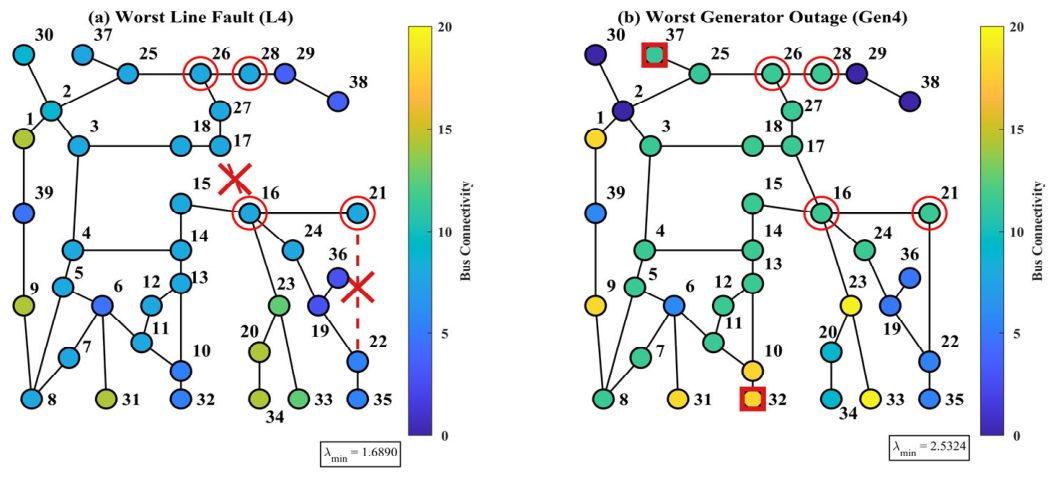
| Scenario Type | Number | Faulty Component | Impact Characteristics |
|---|---|---|---|
| Line Outrage | L1 | Bus 16–17 | load center |
| Line Outrage | L2 | Bus 21–22 | generator unit and load area |
| Line Outrage | L3 | Bus 26–27 | southern region and load center |
| Line Outrage | L4 | Bus 16–17 Bus 21–22 | dual line simultaneous outrage |
| Generator Outage | Gen1 | Bus 32 | load support capacity decreases |
| Generator Outage | Gen2 | Bus 35 | inertia drops sharply |
| Generator Outage | Gen3 | Bus 37 | decrease in reserve consumption |
| Generator Outage | Gen4 | Bus 32 Bus 37 | system capacity decreases significantly |
| Scenario | Deviation | RoCoF | |
|---|---|---|---|
| L1 | −12.97 | 5.58 | 4.08 |
| L2 | −14.09 | 6.51 | 5.02 |
| L3 | −14.71 | 7.47 | 5.95 |
| L4 | −16.78 | 8.22 | 6.84 |
| Gen1 | −13.26 | 5.77 | 4.09 |
| Gen2 | −14.60 | 6.71 | 5.03 |
| Gen3 | −14.15 | 7.51 | 5.95 |
| Gen4 | −17.04 | 8.46 | 6.86 |
| Rank | Outrage Line | Actual Max Dev (Hz) | Upper Bound (Hz) | |
|---|---|---|---|---|
| / | Base case | 6.6157 | 0.1210 | 0.1270 |
| 1 | Line 126 | 2.8012 | 0.1946 | 0.3000 |
| 2 | Line 127 | 2.8162 | 0.1921 | 0.2984 |
| 3 | Line 104 | 3.0361 | 0.2153 | 0.2768 |
| 4 | Line 96 | 3.4520 | 0.2351 | 0.2434 |
| 5 | Line 54 | 4.0209 | 0.2320 | 0.2460 |
| … | … | … | … | … |
| 176 | Line 140 | 6.6147 | 0.1213 | 0.1271 |
| 177 | Line 59 | 6.6123 | 0.1216 | 0.1272 |
Disclaimer/Publisher’s Note: The statements, opinions and data contained in all publications are solely those of the individual author(s) and contributor(s) and not of MDPI and/or the editor(s). MDPI and/or the editor(s) disclaim responsibility for any injury to people or property resulting from any ideas, methods, instructions or products referred to in the content. |
© 2026 by the authors. Licensee MDPI, Basel, Switzerland. This article is an open access article distributed under the terms and conditions of the Creative Commons Attribution (CC BY) license.
Share and Cite
Quan, S.; Zheng, D.; Cai, H.; Wang, K. Optimal Planning Method of Wind Farms Considering Spatiotemporal Frequency Characteristics Under Uncertain Disturbances. Algorithms 2026, 19, 435. https://doi.org/10.3390/a19060435
Quan S, Zheng D, Cai H, Wang K. Optimal Planning Method of Wind Farms Considering Spatiotemporal Frequency Characteristics Under Uncertain Disturbances. Algorithms. 2026; 19(6):435. https://doi.org/10.3390/a19060435
Chicago/Turabian StyleQuan, Shunan, Di Zheng, Hui Cai, and Kang Wang. 2026. "Optimal Planning Method of Wind Farms Considering Spatiotemporal Frequency Characteristics Under Uncertain Disturbances" Algorithms 19, no. 6: 435. https://doi.org/10.3390/a19060435
APA StyleQuan, S., Zheng, D., Cai, H., & Wang, K. (2026). Optimal Planning Method of Wind Farms Considering Spatiotemporal Frequency Characteristics Under Uncertain Disturbances. Algorithms, 19(6), 435. https://doi.org/10.3390/a19060435