Article

Shapeless Intuitionistic Fuzzy Sets and Their Application in Decision Making

Department of Industrial Engineering, Galatasaray University, Çırağan Caddesi No: 36, Beşiktaş, 34349 İstanbul, Türkiye
Algorithms 2026, 19(6), 432; https://doi.org/10.3390/a19060432
Submission received: 4 April 2026 / Revised: 8 May 2026 / Accepted: 14 May 2026 / Published: 27 May 2026
(This article belongs to the Section Algorithms for Multidisciplinary Applications)

Abstract

Objects in nature tend to occupy the minimum volume (or minimum area in two-dimensional space). In decision making processes, decisions involve the grouping of decision points within a given environment, and the existence of a closed-form representing this group decision is noteworthy. Current group decision-making models often rely on arithmetic and geometric operators, neglecting the inherent spatial information embedded within the decision space. When the structure formed by decision groups is associated with a convex structure representing it that occupies the least volume or area; the decision-making structure also needs to be re-evaluated geometrically in addition to operations in the literature. In this context, this article is a novel perspective on the introduction of the Shapeless Intuitionistic Fuzzy Set (S-IFS) which is an extension of intuitionistic fuzzy sets. The operations and structure of these sets, which are a new extension with the convex structure formed by the IF decision points, are examined. A numerical micromobility risk assessment case is presented to demonstrate the application of S-IFS in multi criteria decision making procedures. To compare S-IFS with the literature, a new score function has also been proposed to Circular Intuitionistic Fuzzy Set (C-IFS) with the perspective of the proposed fuzzy set. The effect of including the uncertainty in the geometric structure of group decisions into the result is clearly revealed by comparing the point group decisions of IFS, the circle covering group decisions of C-IFS, and the convex group decisions occupying the smallest area in two dimensions of the proposed S-IFS. This article aims to lead the examination of the geometric structure of fuzzy sets in group decisions, the inclusion of uncertainty in decision-making processes in a geometric sense, and the structure of group decisions in n-dimensions according to convex and concave formations for future studies.

1. Introduction

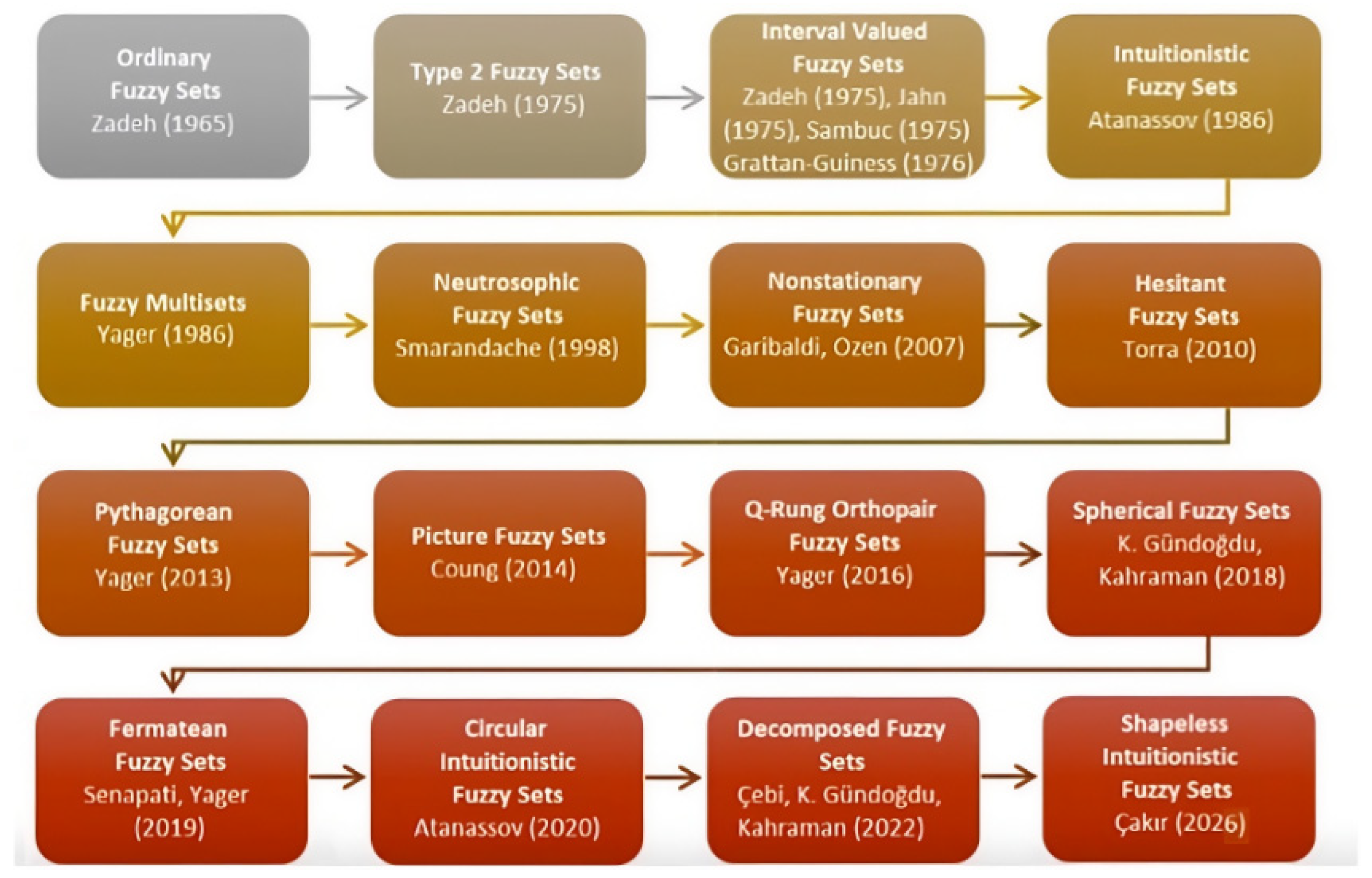
In light of the introduction of Ordinary Fuzzy Sets by Zadeh in 1965 [1,2], a new field was opened in the decision-making literature. Fuzzy expressions, which can be valued between [0–1] and can correspond to linguistic expressions, began to be expressed with the concept of membership degree. Then, Atanassov [3] suggested a new extension which is called Intuitionistic Fuzzy Sets (IFS), the state of not being a member could also be expressed. Since then, the field has witnessed a surge in fuzzy set extensions, accompanied by diverse applications across various domains. Figure 1 visually traces the evolution of some prominent fuzzy sets developed thus far.
Intuitionistic Fuzzy Sets incorporate both membership and non-membership degrees, alongside a hesitancy degree that fills the remaining space to 1 [3]. The definition interval for each value is [0–1]. The area in the coordinate plane where the domain is located is called the Intuitionistic Fuzzy Interpretation Triangle (IFIT). To further enhance the expressiveness of these sets, Atanassov [4] introduced Interval-valued IF (IVIF) numbers, where the domain remains the same but each degree is represented by an interval, allowing for flexibility and uncertainty. Most recently, Atanassov [15,16] proposed Circular Intuitionistic Fuzzy Sets (C-IFS) in 2020, offering a novel geometric representation for grouping IF decisions.
Compared to its predecessors, Circular Intuitionistic Fuzzy Sets (C-IFS) exhibit several distinctive features. Firstly, C-IF numbers are formed by the combination of IF numbers. It is clear that a C-IF number is not a single decision, but the group decision set. More specifically, the issue that has not been discussed in the literature before is that Atanassov approached these sets as a “circle covering problem” [14,18]. In a group decision consisting of IF sets, a center point is obtained from these IF decision points, and the circle with the smallest radius r , using the Euclidean distance, that includes all the decisions is drawn around the center. This is based on the idea of a regular shape occupying the smallest volume in space (or area in two dimensions). In this manner, a structure consisting of decisions made of IF sets creates a new and more ambiguous structure with its own formal space, containing its own uncertainty, as in IVIFS. This perspective holds significant meaning, as the field created by decision points must also be included in the uncertainty.
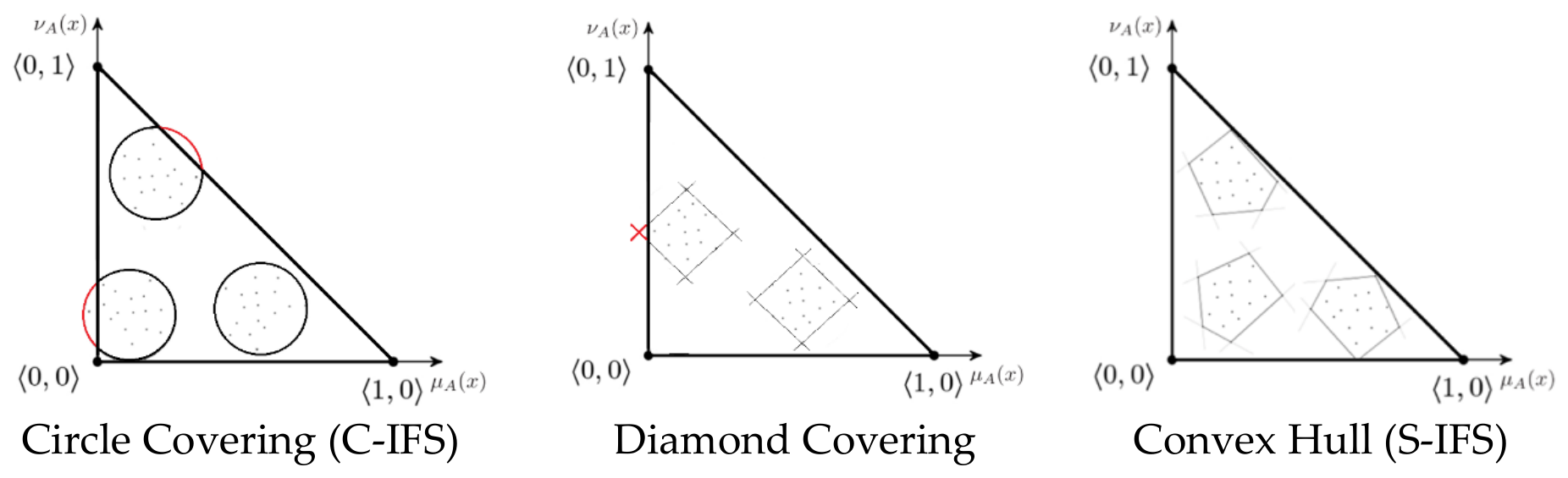
Decision-making processes, which are mostly formed by matrix combinations in the literature, using only arithmetic-geometric aggregation operations, reduce all decision points to a single common decision point. From a geometrical point of view, it should be suggested that this grouping be considered as a “convex hull problem” by expanding Atanassov’s approach to C-IF sets. As in the original definition, a convex hull is the smallest convex polygon containing all the given points. Thus, the circle that includes the outermost decision point is prevented from covering other decision points that are not located in that boundary. The more angular structure is established in the grouping, the less area occupied by the points, and the uncertainty of the grouping points can only be expressed by the area enclosing them. Unlike C-IFS, the entire area of the formed convex hull remains within IFIT, which we refer to as “shapeless” as illustrated in Figure 2.
Note that the circle covering problem could not be extended to a diamond covering problem. Because the diamond covering problem uses rectilinear distance [18], it creates a rectangle by making ± 45 ° degree angles with axis at each of the decision points. As in C-IFS, another blank area, also at a distance r from the center, is included in the group decision. Both approaches suffer from the inclusion of irrelevant space within the group decision, potentially misrepresenting the underlying decision structure. (It is worth noting that, during the review process of this article, an extension of IFS, termed the Diamond Fuzzy Set (D-IFS) [19], was introduced. Atanassov’s circular coverage principle is reformulated in D-IFS as Lozenge coverage. Nevertheless, we do not consider D-IFS as a foundational set in the present study. The only foundational sets compatible with the shapeless extension and discussed in this work are the original IFS and the C-IFS. Although this set appears to be a subset of our “shapeless” extension, its formal structure does not align with the requirements of the Shapeless IFS framework.)
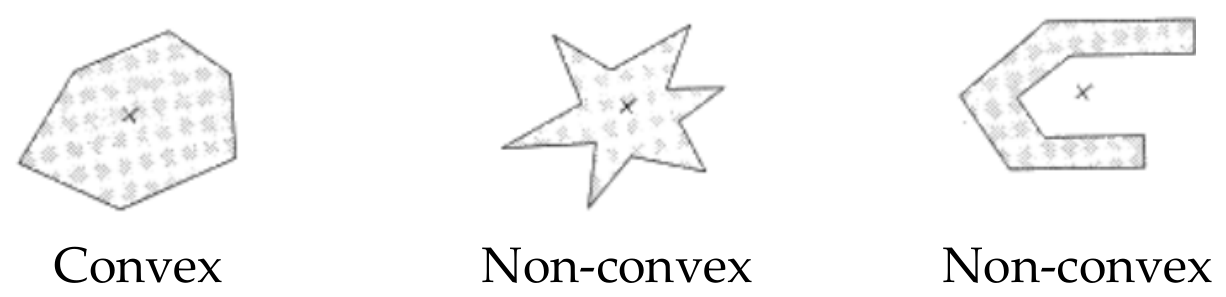
It should be clarified why this set is not called “Convex-IFS” and why “Shapeless” is not dealing with a non-convex (concave) polygon set. “Convex-IFS” numbers have taken a place in the literature in several research [20,21]. But in the definition of the Convex IFS set, the membership function itself is convex function and non-membership function is concave function. The opposite is true for Concave-IFS [20]. In this study, a structure is proposed for group decision making points formed by IFS numbers. Here, “Shapeless” refers to convex polygon which can form irregular or regular. Since it has a regular shape, Circular IFS belongs to a subset of Shapeless IFS. The membership and non-membership values are still a point in each decision. Therefore, “Shapeless” is determined as a new name. Non-convex polygon status of S-IFS should also be examined. However, from a group decision-making perspective, the center of a non-convex structure may lie outside the polygon as given in Figure 3. This can be considered as an outside opinion, not as a result of decision points. On the other hand, convex polygon is more meaningful as it will contain both all decision points and their aggregation. Non-convex (concave) polygon version of Shapeless IFS can also be discussed and developed on a solid theoretical basis in future studies.
By presenting a new fuzzy set, this article contributes to the fuzzy decision-making literature with a new perspective. Developing Atanassov’s definition of C-IFS (using regular shape), it is proposed to express the convex area occupied by the group decision with an irregular convex polygon. While operating with irregular shapes introduces increased complexity, this approach offers several advantages. Firstly, it more accurately captures the uncertainty inherent in group decisions by minimizing the enclosed area, thus reducing the inclusion of irrelevant regions within the decision space. Secondly, the paper outlines a set of operators and procedures specifically designed for S-IFS application within decision-making processes, further demonstrating its practical utility. The effectiveness of this approach is also validated through a numerical case study.
Following this introduction, the paper is structured as follows: Section 2 introduces the structure of Shapeless Intuitionistic Fuzzy Sets (S-IFS), including relevant background information and outlining essential operations. Section 3 explains the use of S-IFS on decision making process step by step. To implement S-IFS into MCDM procedures, Section 4 applies new procedure on a micromobility risk case. Section 5 gives results and discusses the procedure. Finally, Section 6 concludes the research by summarizing the key contributions and offering potential avenues for future exploration related to S-IFS.

2. Structure of Shapeless Intuitionistic Fuzzy Sets

Zadeh [1] and Atanassov [3] laid the groundwork for expressing ambiguity with the fuzzy sets they introduced. This section establishes the theoretical and geometrical framework for Shapeless Intuitionistic Fuzzy Sets (S-IFS), a novel extension introduced to the existing landscape of Intuitionistic Fuzzy Sets (IFS) and Circular Intuitionistic Fuzzy Sets (C-IFS). The definitions are given below, and the theoretical and geometrical explanations of S-IFS are discussed in detail.
Definition 1
([3]). Let  X = x 1 , x 2 , , x n  be a universe of discourse, an IFS  A  in X is given by
A = < x , μ A x , v A x > x X
where  μ A : X 0 , 1  and  v A : X 0 , 1  with the conditions  0 μ A x + v A x 1 , x X . These numbers are the membership degree μ A x ” and “ v A x non-membership degree of the element x to the set  A , respectively.
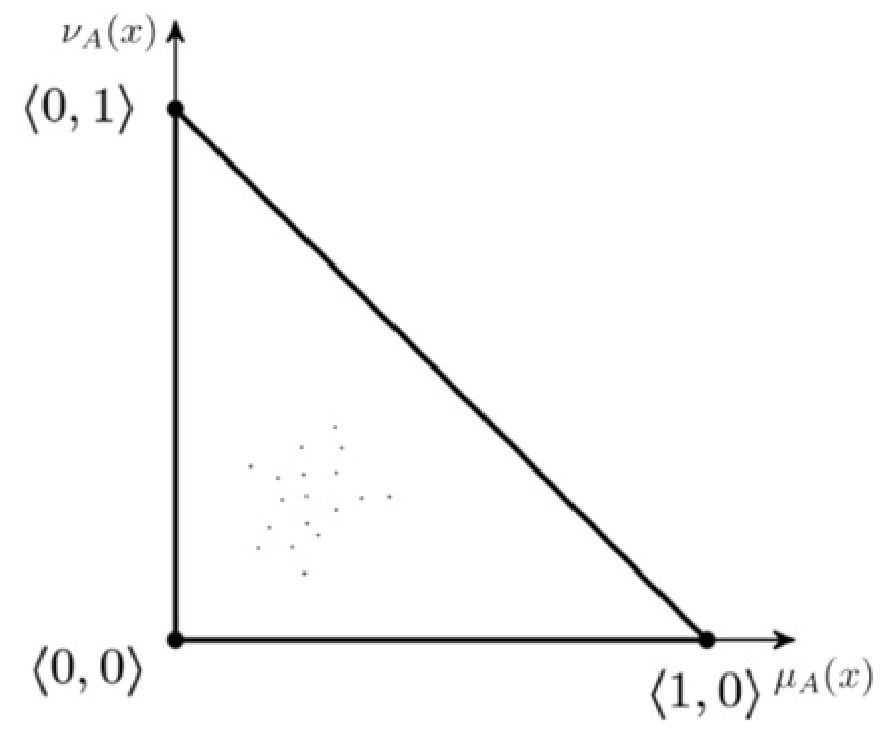
The intuitionistic fuzzy numbers are illustrated in Figure 4.
Definition 2
([6,7]). Let E be a fixed universe, and a generic element a C-IFV  C r  in E is denoted by x;  C r = {< x : μ C x , v C x ; r >, x E } is the form of an object that is the C-IFS, where the functions “ μ , v : E 0 , 1 ” define respectively the membership function and the non-membership function of the element x E  to the C-IF set with the condition:
0 μ C x + v C x 1 and     r 0 , 2
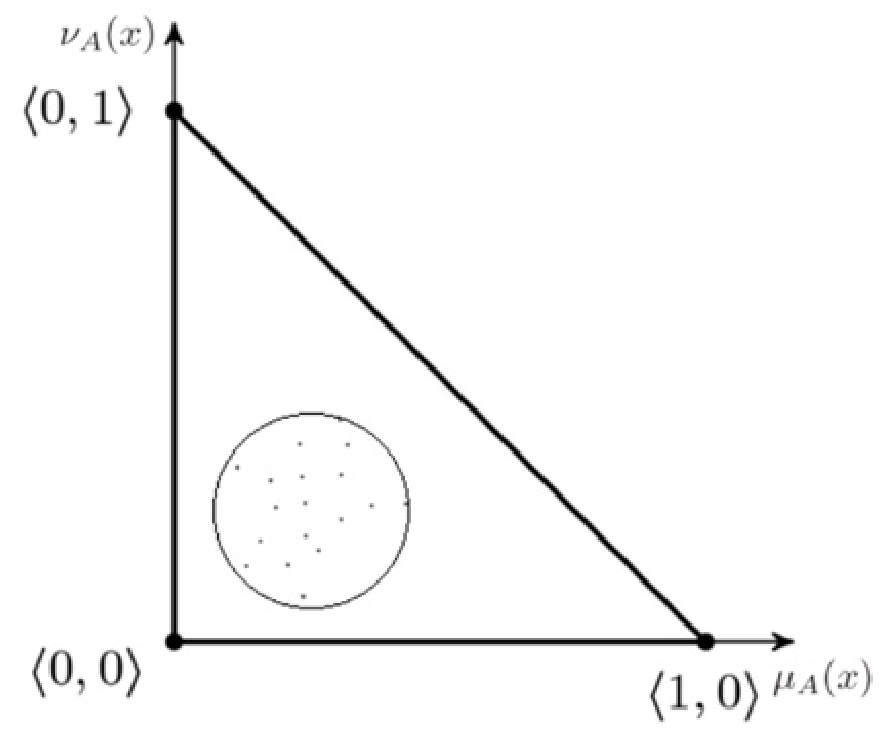
where r is the radius of the circle around each element  x E .The indeterminacy function can be also defined as  π C x = 1 μ C x v C x .
The geometrical presentation of C-IFS is in Figure 5.
In light of the definitions above, the definition of newly proposed Shapeless Intuitionistic Fuzzy Set is given below.
Definition 3.
Let  E  be a fixed universe and  A  is its subset. The set
A d , S = < x , < μ A x , v A x > ; d , S > x E
where  0 μ A x + v A x 1 , d 0 , 2  is the diameter (maximum width) and  S 0 , 0.5  is the area of the convex polygon verticed by each element  x E  is called Shapeless Intuitionistic Fuzzy Set (S-IFS). Membership degree  μ A : E 0 , 1 , non-membership degree  v A : E 0 , 1  and degree of indeterminacy  π A : E 0 , 1  with  π A = 1 μ A v A  are of element  x E  to a fixed set  A E .
Here, the subset A R n is called convex if and only if, for any pair of points in A, all points along the line segment that connects them are contained in A. More precisely, this means that for any x 1 , x 2 A and λ 0 , 1 .
λ x 1 + 1 λ x 2 A
Thus, interpolation between x 1 and x 2 always yields points in A [22].
A boundary representation of A is an n-sided polygon, which can be described using vertices and edges. Every vertex corresponds to a “corner” of the polygon, and every edge corresponds to a line segment between a pair of vertices. The polygon can be specified by a sequence, μ A x 1 , v A x 1 , μ A x 2 , v A x 2 , …, μ A x n , v A x n of n points in R 2 , given in counterclockwise order [22].
An edge of the polygon is specified by two points, such as μ A x 1 , v A x 1 and μ A x 2 , v A x 2 . Consider the equation of a line that passes through μ A x 1 , v A x 1 and μ A x 2 , v A x 2 . An equation can be determined of the form a μ A x + b v A x + c = 0 , in which a , b , c R are constants that are determined from μ A x 1 , v A x 1 , μ A x 2 , v A x 2 , f : R 2 R be the function given by f μ A x , v A x = a μ A x + b v A x + c [20].
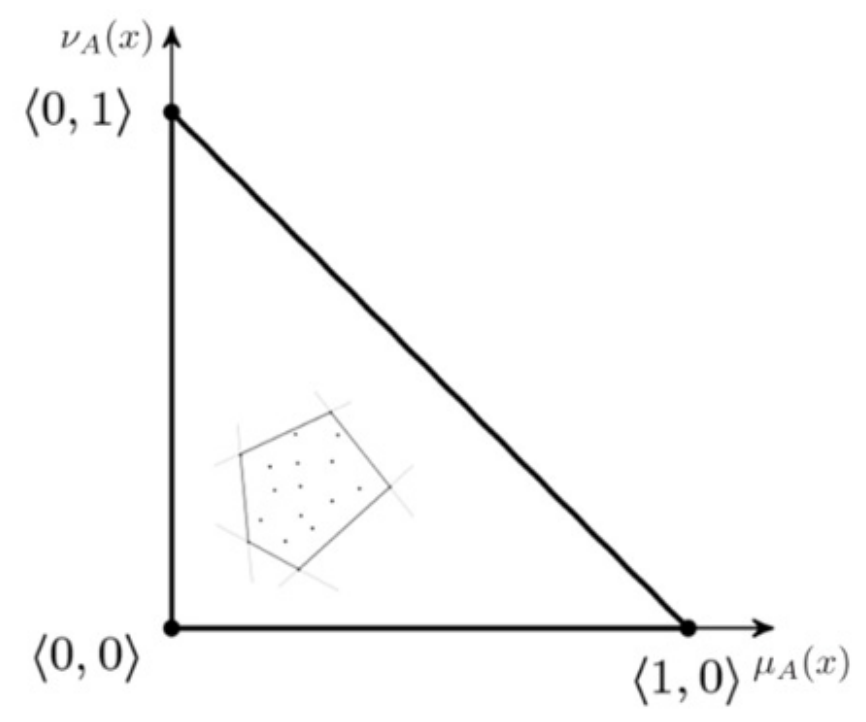
Note that f μ A x , v A x < 0 on one side of the line, and f μ A x , v A x > 0 on the other. (In fact, f may be interpreted as a signed Euclidean distance from μ A x , v A x to the line.) The sign of f μ A x , v A x indicates a half-plane that is bounded by the line. Without loss of generality, assume that f μ A x , v A x is defined so that f μ A x , v A x < 0 for all points to the left of the edge from ( μ A x 1 , v A x 1 ) to ( μ A x 2 , v A x 2 ) (if it is not, then multiply f μ A x , v A x by −1) [22]. The geometrical illustration of an example S-IFS is given in Figure 6.
For enhanced clarity and understanding, S-IFS should have its own representation. Considering the IFS and C-IFS notation, the notation of this set should point to the convex hull with an IF point < μ A x , v A x > , diameter (or diagonal or radius for regular convex polygon) d and an area S . By definition, the convex hull of an IF set is the smallest convex polygon that contains all the points of dataset. The IF point < μ A x , v A x > represents the aggregation of all IF decisions at convex hull. If the aggregation point is found with the centroid method, this point is equal to the center of the polygon. However, the IF point used to express the Shapeless IF number does not have to be the center of the polygon. Depending on the aggregation operator, this IF point may correspond to the centroid of the convex polygon. The diameter d indicates the maximum distance between two points in C-IFS. This is important because grouping is amorphous (shapeless) and necessary to account for the dataset. However, since the shape may be irregular, the diameter does not have to pass through the center or the IF point, which may vary depending on the aggregated function. The area S refers to the field of the convex hull, which is smallest convex polygon consists of grouping the IF dataset.
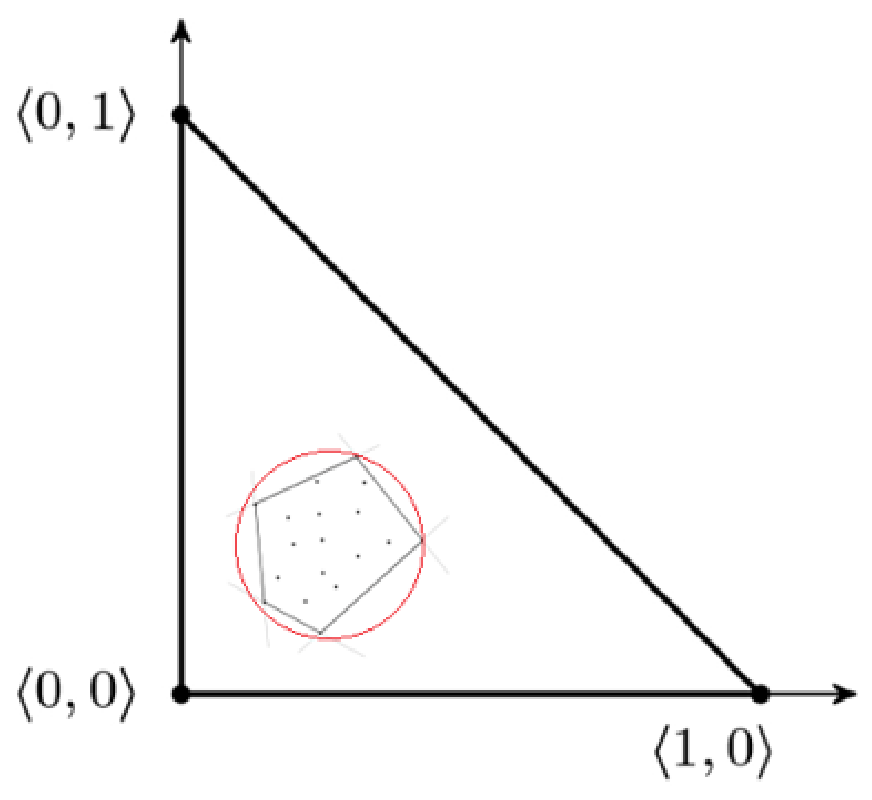
Note that unlike C-IFS, in S-IFS the entire area of the convex shape always remains inside IFIT. It does not go out of the domain, there is no need to break the shape. Consequently, for the same dataset, S-IFS occupies a smaller area compared to C-IFS due to its strict adherence to the actual set boundaries. In other words, S-IFS eliminates artificial geometric expansion introduced by circular coverage, and may result in a tighter representation depending on data distribution. Figure 7 visually depicts this advantageous aspect by contrasting the geometrical illustrations of C-IFS and S-IFS generated from the same data.
Let < a i , 1 , b i , 1 > , < a i , 2 , b i , 2 > , is a set of IF pairs. The S-IFS O i is calculated from p a i r s where i is the number of the IFS and k i is the number of IF pairs in each set. The aggregated point of IF p a i r s   < μ A x , v A x > can be calculated by some pre-defined operators. According to the case, various operators should be selected from literature. Arithmetic average, weighted average, centroid and two existing arithmetic operators on IFS are given to aggregate IF pairs [14] and assign it as IF point of S-IFS O i as follows:
Definition 4
([14]). Let  < a i , 1 , b i , 1 > , < a i , 2 , b i , 2 > ,  is a set of IF pairs. The S-IFS  O i  is calculated from IF  p a i r s  where i is the number of the IFS and  k i  is the number of IF pairs in each set. The arithmetic average of  t h e   s e t  is as follows:
O i = < μ A x , v A x > = < j = 1 k i a i , j k i , j = 1 k i b i , j k i >
Definition 5
([14]). Let  < a i , 1 , b i , 1 > , < a i , 2 , b i , 2 > ,  is a set of IF pairs and  W i = w i , 1 , , w i , k i  is the set of the weights of IF pairs where  w i , j 0 , 1  and  j = 1 k i w i , j = 1 , and  k i  is the number of IF pairs in each set. The S-IFS  O i  is calculated from  p a i r s  where i is the number of the IFS. The weighted arithmetic average of  t h e   s e t  is as follows:
O i = < μ A x , v A x > = < j = 1 k i w i , j a i , j , j = 1 k i w i , j b i , j >
Definition 6
([14]). Let  < a i , 1 , b i , 1 > , < a i , 2 , b i , 2 > ,  is a set of IF pairs. The S-IFS  O i  is calculated from IF  p a i r s  where i is the number of the IFS and  k i  is the number of IF pairs in each set. The centroid of  t h e   s e t  is as follows:
O i = < μ A x , v A x > = < j = 1 k i a i , j + a i , j + 1 a i , j b i , j + 1 a i , j + 1 b i , j 6 S i , j = 1 k i b i , j +   b i , j + 1 a i , j b i , j + 1 a i , j + 1 b i , j 6 S i >
The formula to calculate S i is given in Definition 10 with Equation (11).
Definition 7
([21]). Let  < a i , 1 , b i , 1 > , < a i , 2 , b i , 2 > ,  is a set of IF pairs. Then, their aggregated value which is the  O i  point of S-IFS by using the IF weighted averaging (IFWA) operator is also an IF value:
O i = I F W A W i < a i , 1 , b i , 1 > , < a i , 2 , b i , 2 > , = < 1 j = 1 n 1 a i , j w i , j , j = 1 n b i , j w i , j >
where  W i = w i , 1 , , w i , n  is the weighting vector of IF pairs with  w i , j 0 , 1  and  j = 1 n w i , j = 1 .
Definition 8
([21]). Let  < a i , 1 , b i , 1 > , < a i , 2 , b i , 2 > ,  is a set of IF pairs. Then, their aggregated value which is the  O i  point of S-IFS by using the IF weighted geometric (IFGA) operator is also an IF value:
O i = I F G A W i < a i , 1 , b i , 1 > , < a i , 2 , b i , 2 > , = < j = 1 n a i , j w i , j , 1 j = 1 n 1 b i , j w i , j >
where  W i = w i , 1 , , w i , n  is the weighting vector of IF pairs with  w i , j 0 , 1  and  j = 1 n w i , j = 1 .
Note that the calculated IF point of a S-IFS is not basically arithmetic mean of coordinates. There are many aggregation functions for fuzzy numbers in the literature. Some are arithmetic mean, geometric mean, weighted aggregations, and there are many methods where different operators are suggested [23]. For C-IFS, which also consists of IFS numbers, Atanassov found the center with the arithmetic mean. The author of this article has shown in her study [14] that different aggregation functions can be used for C-IFS. These aggregations in the convex structure formed in Shapeless IFS are also acceptable.
It should be argued that for C-IF, since a circle is drawn with respect to a determined center, it is not a matter of discussion where the center is pointed. A center is formed according to the selected aggregation operator, and a circle is drawn according to the distance from this point to the farthest decision point. This center is also the centroid of the circular convex shape of C-IFS.
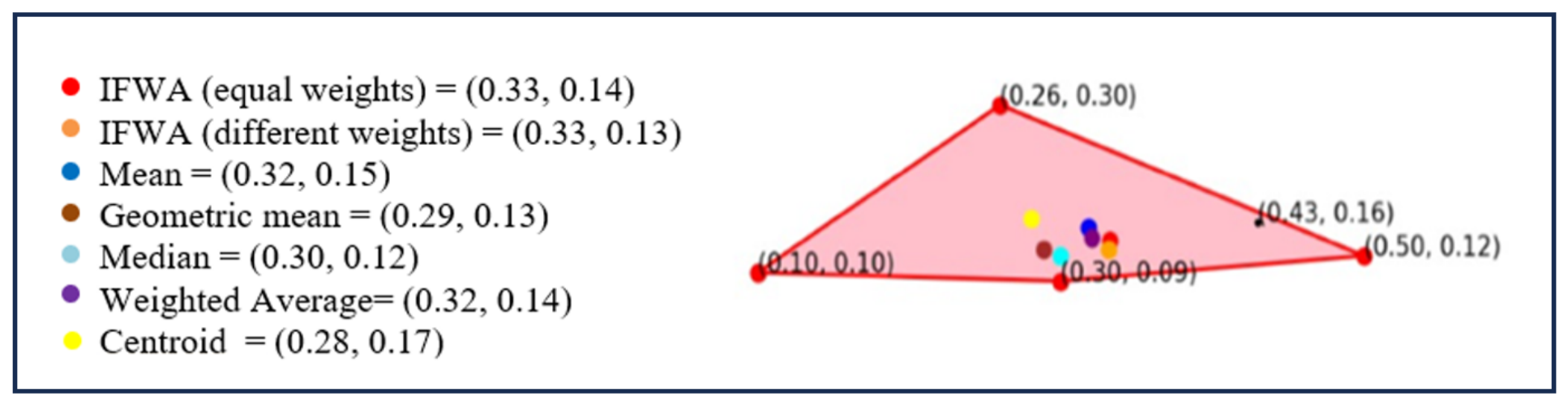
However, in S-IFS, a convex shape independent of the center emerges. A polygon has its own area. Hence, it is necessary to look at the effect of the entire area within the polygon, not just the values of the decision points. Therefore, in addition to the aggregation methods suggested for IF group decision making in the [14] article, the centroid of the convex polygon can also be considered center. Since it has already considered the convex polygon as a group decision and its uncertainty, the center of gravity of the convex structure will contain this uncertainty. However, it is crucial to acknowledge that not all decision points reside solely at the polygon’s vertices. Similar to C-IFS, they can be scattered throughout the interior or concentrated in specific regions. In such a case, using centroid may not be considered valid. Therefore, the choice of method for establishing the representative IF point for an S-IF number ultimately rests with the practitioner. Figure 8 illustrates various aggregation scenarios to further clarify this concept.
Definition 9.
Let  < a i , 1 , b i , 1 > , < a i , 2 , b i , 2 > ,  is a set of IF pairs. i is the number of the IFS and  k i  is the number of IF pairs in each set. The diameter  d i  of the S-IFS  A i  formed by this IF pairs is obtained by Euclidean distance as follows:
d i = max a i , j a i , l 2 + b i , j b i , l 2     j , l { 1 , , k i }
Definition 10.
Let  < a i , 1 , b i , 1 > , < a i , 2 , b i , 2 > ,  is a set of IF pairs, where i is the number of the IFS and  k i  is the number of IF pairs in each set. The area  S i  of the convex hull  A i  whose vertices are formed by these IF pairs, is calculated using the shoelace formula as follows:
S i = 1 2 | j = 1 k i a i , j b i , j + 1 a i , j + 1 b i , j   |
where  a i , k i + 1 , b i , k i + 1 ) = ( a i , 1 , b i , 1  and the vertices are ordered either clockwise or counterclockwise.
Thus, the Shapeless Intuitionistic Fuzzy Set (S-IFS) is constructed as follows:
A d i , S i = < O i ; d i , S i > = < μ A i , v A i > ; d i , S i >
Definition 11.
As S-IFS is an extension of IFS and C-IFS, it can evolve into IFS and C-IFS in certain circumstances. (IFS, C-IFS, S-IFS, respectively)
A = A 0 = A 0 , 0 = < x , μ A x , v A x ; 0 , 0 > x E
It is also possible to convert a S-IFS to a C-IFS; however, this transformation requires the underlying dataset to be infinite. The key reason for this requirement is that a finite set of points can only generate a polygonal structure, whereas a continuous structure such as a circle can only emerge as the limit case of an infinite number of vertices. In other words, when the number of elements increases without bound, the discrete geometric representation gradually loses its angular structure and converges to a smooth boundary.
Therefore, the geometric representation of the system can evolve from an n-sided convex polygon into a circle as the number of vertices approaches infinity with uniform distribution. It is important to emphasize that although a circle can be considered as a limiting geometric object, it is not a polygon in the classical Euclidean sense because polygons are defined by a finite number of straight edges and vertices. In contrast, a circle has no edges or vertices and is defined by a continuous curvature.
The following theorem formalizes this limiting transformation:
A r = A d , π r 2 = < x , μ A x , v A x ; d , π r 2 > x E   i f   f   n u m b e r   o f   v e r t i c e s and vertices are uniformly distributed on a circle   w i t h   r = d 2
To prove it, [24] for X = x i k i = 1 R d , P is the linear combination of X that is defined as follows:
P = C H X = i = 1 k λ i x i i = 1 k λ i = 1 , 0 λ i 1
where each x i = x 1 i , x 2 i , , x d i is a d-dimensional vector in the feature space, and λ i is the coefficient of the linear combination. P has k elements P = x i k i = 1 known as vertices set. The sequence of regular k -gons converges to a circle in the Hausdorff sense as k . In this case, the interior angle between the pairs of the nearest neighbors of a regular convex hull with k vertices becomes θ = 180 360 k , then l i m k θ = 180 .
Definition 12.
A score  ( S S I F S )  and an accuracy  H S I F S  function for S-IFS are proposed. Let  A d A , S A = < O A ; d A , S A >  be an S-IF value. A score function  S S I F S  and an accuracy function  H S I F S  of the S-IFV are defined as follows:
S S I F S A = μ A v A d A S A   where   S S I F S A ( , + ) , d 0 , 2 , S 0 , 1 2
H S I F S A = μ A + v A d A S A   where   H S I F S A [ 0 , + ) , d 0 , 2 , S 0 , 1 2
It is clear to say that as d and S get larger, the uncertainty of the group decision increases, and the decisions show a dispersed distribution. Two convex polygons with the same area have a more stable group decision structure whose d is smaller. The same perspective is true for S. Therefore, both the diameter and the area measure are used in the score calculation. In case the areas of irregular shapes are the same, which one is more ambiguous can be decided according to the diameter.
It is necessary to specify all possible situations that may arise in the score and accuracy functions, since S-IFS numbers are defined over sets of intuitionistic fuzzy pairs. In cases where the score function becomes unbounded, this indicates a transition toward degenerate or highly concentrated geometric structures, which are assigned the highest rank due to their minimal uncertainty. If multiple structures exhibit unbounded behavior, they are further compared according to the proposed structural convergence scenarios.
Case 1: If d = 0 ,   t h e n   S = 0 and
l i m d 0 , S 0 μ A v A d A S A = d i v e r g e s +
l i m d 0 , S 0 μ A + v A d A S A = d i v e r g e s +
If d = 0, then all vertices of the polygon of S-IF are at the same point, that is, it has no area. In this case the number is reduced from S-IFS to IF. Therefore, score values are found with IF metrics [23].
S I F S A = μ A v A   where   S I F S A 1 , 1 , d = 0 , S = 0
H I F S A = μ A + v A       where   H I F S A 0 , 1 , d = 0 , S = 0
Case 2: If d 0   a n d   S = 0 ,   t h e n
l i m S 0 μ A v A d A S A   = d i v e r g e s   +
l i m S 0 μ A + v A d A S A   = d i v e r g e s   +
If d is non-zero but the area of the polygon of S-IF is zero, it turns out that all the vertices of the polygon are on a linear line. In this case, it is not correct to say that it is exactly an S-IFS, as a single line segment cannot form a polygon on its own. There is no such fuzzy set definition in the literature. Thus, a new topic of discussion has been opened in this field and should be emphasized in future studies, but the following formula can be used to compare.
S S I F S A = μ A v A d A   where   S S I F S A , + ,   d 0 , 2 ,   S = 0
H S I F S A = μ A + v A d A   where   H S I F S A 0 , + ,   d 0 , 2 ,   S = 0
Case 3: If d 0   a n d   S 0 ,   t h e n Equations (16) and (17) are valid.
Remark: If structures belonging to different cases above appear in an evaluation, it is not recommended to compare them directly for ranking purposes. Instead, the data belonging to each case should be ranked within their own groups, and the groups should be ordered as Case 1 ≻ Case 2 ≻ Case 3. This is because the most pessimistic certain decision point ((<0, 1> for IFS) is placed above the most optimistic uncertain decision (i.e., a decision with a cloud of uncertainty). In other words, point decisions are more definite, line segments are more ambiguous, and polygons with area are even more ambiguous. However, this may also be regarded as a philosophical point of view, and, therefore, the results corresponding to a point, a line segment, and a polygon structure should not be ordered directly. These cases are presented to include all possible scenarios in the literature. Ideally, S-IFS procedures are constructed within Case 3 because S-IFS is defined by a polygon and, therefore, must be a structure with both diameter and area. The other cases may also be investigated if necessary.
Definition 13.
Let  A 1 = < μ A 1 , v A ; d A 1 , S A 1 >  and  A 2 = < μ A 2 , v A 2 ; d A 2 , S A 2 >  be two S-IFSs. Then, the ranking rule is defined as follows:
  • If  S S I F S A 1 S S I F S A 2 , then  A 1 A 2 .
  • If  S S I F S A 1 = S S I F S A 2 , then
    If  H S I F S A 1 H S I F S A 2 , then  A 1 A 2 .
    If  H S I F S A 1 = H S I F S A 2 , then  A 1 = A 2 .
Definition 14.
Let  A 1 = < μ A 1 , v A 1 ; d A 1 , S A 1 >  and  A 2 = < μ A 2 , v A 2 ; d A 2 , S A 2 >  be two S-IFSs and  < a A 1 , 1 , b A 1 , 1 > , < a A 1 , 2 , b A 1 , 2 > ,  and  < a A 2 , 1 , b A 2 , 1 > , < a A 2 , 2 , b A 2 , 2 > ,  are their sets of IF pairs. i is the number of the IFS and  k A i  is the number of IF pairs in each set. Then, some distances of two S-IFS are calculated as follows:
Intuitionistic Fuzzy Hamming Distance
H 2 A 1 , A 2 = 1 2 i j = 1 k A i a A 1 , j a A 2 , j + b A 1 , j b A 2 , j
Intuitionistic Fuzzy Euclidean Distance
E 2 A 1 , A 2 = 1 2 i j = 1 k A i a A 1 , j a A 2 , j 2 + b A 1 , j b A 2 , j 2 1 2
It is not necessary to propose a different IFS distance function than in the literature [16,25,26]. Note that the formulation calculates the distance by summing the distances of all the points in the data set. This is a shape-independent summation formula. There is no need to include radius or diameter. This is a formula that can be valid regardless of geometric shape (also in convex-concave or n-dimensional environment).
Atanassov [16] suggested the use of radius C-IFS distance formula in his study. But it should be noted that all the values in the dataset are C-IF values and each dataset has a fixed radius. Again, the radius is not needed when only search at the distance of two C-IF numbers. Likewise, for S-IFS, the above formula is sufficient since the values in the dataset are IF. Because it consists of irregular convex polygons, S-IFS cannot assume that any dataset contains constant diameter data.
Definition 15.
Let  A 1 = < μ A 1 , v A 1 ; d A 1 , S A 1 >  and  A 2 = < μ A 2 , v A 2 ; d A 2 , S A 2 >  be two S-IFNs. Some arithmetic operations including union, intersection, addition, and multiplication are introduced in the followings:
A 1 m i n A 2 = { < x , min μ A 1 x , μ A 2 x , max v A 1 x , v A 2 x ; min d A 1 , d A 2 , min S A 1 , S A 2 > | x E
A 1 m a x A 2 = { < x , min μ A 1 x , μ A 2 x , max v A 1 x , v A 2 x ; max d A 1 , d A 2 , max S A 1 , S A 2 > | x E
A 1 m i n A 2 = { < x , max μ A 1 x , μ A 2 x , min v A 1 x , v A 2 x ; min d A 1 , d A 2 , min S A 1 , S A 2 > | x E
A 1 m a x A 2 = { < x , max μ A 1 x , μ A 2 x , min v A 1 x , v A 2 x ; max d A 1 , d A 2 , max S A 1 , S A 2 > | x E
A 1 m i n A 2 = { < x , μ A 1 x + μ A 2 x μ A 1 x μ A 2 x , v A 1 x v A 2 x ; min d A 1 , d A 2 , min S A 1 , S A 2 > | x E
A 1 m a x A 2 = { < x , μ A 1 x + μ A 2 x μ A 1 x μ A 2 x , v A 1 x v A 2 x ; max d A 1 , d A 2 , max S A 1 , S A 2 > | x E
A 1 m i n A 2 = { < x , μ A 1 x μ A 2 x , v A 1 x + v A 2 x v A 1 x v A 2 x ; min d A 1 , d A 2 , min S A 1 , S A 2 > | x E
A 1 m a x A 2 = { < x , μ A 1 x μ A 2 x , v A 1 x + v A 2 x v A 1 x v A 2 x ; max d A 1 , d A 2 , max S A 1 , S A 2 > | x E
Definition 16.
The complement of the S-IFS number  A 1 = < μ A 1 , v A 1 ; d A 1 , S A 1 >  is defined based on the complement of the C-IFS number [15] as follows:
A 1 C = < v A 1 , μ A 1 ; d A 1 , S A 1 >
Complement   operation   preserves   geometric   uncertainty   structure .
In order to compare the S-IFS proposed over the C-IFS idea, the following definition proposes a new score function for C-IFS in addition to the existing score (or defuzzification) functions in the literature [14].
Definition 17.
According to the Definition 12, the S-IFS perspective can be applied to the C-IFS score function. Since the C-IFS score [14] in the literature is suggested on a point-based, “not area-based”, comparison of S-IFS and C-IFs would be more meaningful. Note that when r = 0, C-IFS reduced to IFS.
S C I F S A = μ A v A 2 r π r 2 where     S C I F S A 0 , + , r   0 , 2
It is well known that the diameter of circle is d = 2r and the area of a circle is S A = π r 2 .

3. S-IFS on Decision Making Process

This section presents a step-by-step exposition of the novel Shapeless Intuitionistic Fuzzy Multi-Criteria Decision-Making (MCDM) procedure, aiming to illustrate its practical application within decision-making contexts. The methodology aims to determine the rank order of the alternatives according to the criteria and the reviews of decision-makers.
In the literature, decision points are aggregated and usually reduced to a single decision point in fuzzy group decision making processes. Compliance is commented on by considering the consistency of the data, and then it is reduced to one single decision point. However, it is possible to include the distribution of these group decisions in the decision process. The two most distant ideas have an impact on the coherence of group stability. For example, even after consistency check, more divergent group decisions and more convergent group decisions may produce the same center result. It is necessary to include the uncertainties within the groups themselves in the process. In this sense, the C-IFS numbers proposed by Atanassov is a preliminary study to include the convex structure formed by the decisions in fuzzy group decision-making processes as a circle [15]. Circular intuitionistic fuzzy set, which is based on a solid foundation and theory, has been included in MCDM procedures in recent years and has taken its place in group decision making literature. Since S-IFS is presented as an extended version of the C-IFS idea, practical and theoretical studies on C-IFS [27,28,29,30,31,32,33,34,35,36,37,38,39,40,41,42,43] are important for assessing the validity of S-IFS, some of which are listed in Table 1.
This study introduces and demonstrates the application of Shapeless Intuitionistic Fuzzy Sets (S-IFS), a novel extension of Intuitionistic Fuzzy Sets (IFS) and Circular Intuitionistic Fuzzy Sets (C-IFS). Unlike its predecessors, S-IFS offers a more nuanced representation of group decision uncertainty by utilizing convex polygons. The following steps outline the proposed S-IF Multi-Criteria Decision-Making (S-IF MCDM) methodology in a step-by-step manner, offering a practical framework for decision-makers. While this procedure is compatible with hybridization with other MCDM models, it is suitable for both criteria weighting and alternative ranking processes.
Step 1: Define the case. Consider “ A = { A 1 , A 2 , , A m } ” is the alternative set, “ C = { C 1 , C 2 , , C n } ” is the criteria set and “ D = { D 1 , D 2 , , D k } ” is the set of decision-makers. Let “ W C = { W C 1 , W C 2 , , W C n } ” is the weight vector of criteria where W C i 0 and Σ W C i = 1 and “ W D = { W D 1 , W D 2 , , W D k } ” is the weight vector of criteria where W D j 0 and Σ W D j = 1 . These weight vectors are determined by decision-makers.
Step 2: Collect intuitionistic fuzzy decision matrices ||DM|| from decision-makers.
Note that the use of fixed linguistic terms in the literature is not recommended for this procedure. Because, in general, the ( μ A i + v A i ) value of all expressions is equal to a constant number, so all evaluations are placed on a linear line. This is not significant in the context of group uncertainty. In addition, at least three unequal views are needed to create a polygon for S-IFS. Therefore, the number of DMs cannot be less than three and there must be at least three different numerical views for any decision pair for this procedure.
Step 3: Obtain the aggregated IF decision matrix using an operator by Equation (8). (Equations (5)–(9) are also suitable).
Step 4: According to the criteria weights, calculate aggregated decision D of alternatives using an operator by Equation (8). (For stability, choose the same operator as in Step 3).
Step 5: Calculate the diameter and area of each aggregated decision D by Equations (10) and (11) from aggregated IF decision matrix and revise the aggregated decision D with diameter and area (S-IFS).
Step 6: Calculate score values by Equations (16) and (17) and rank the alternatives. If score values are to be used for weighting in addition to ranking, they can be normalized.
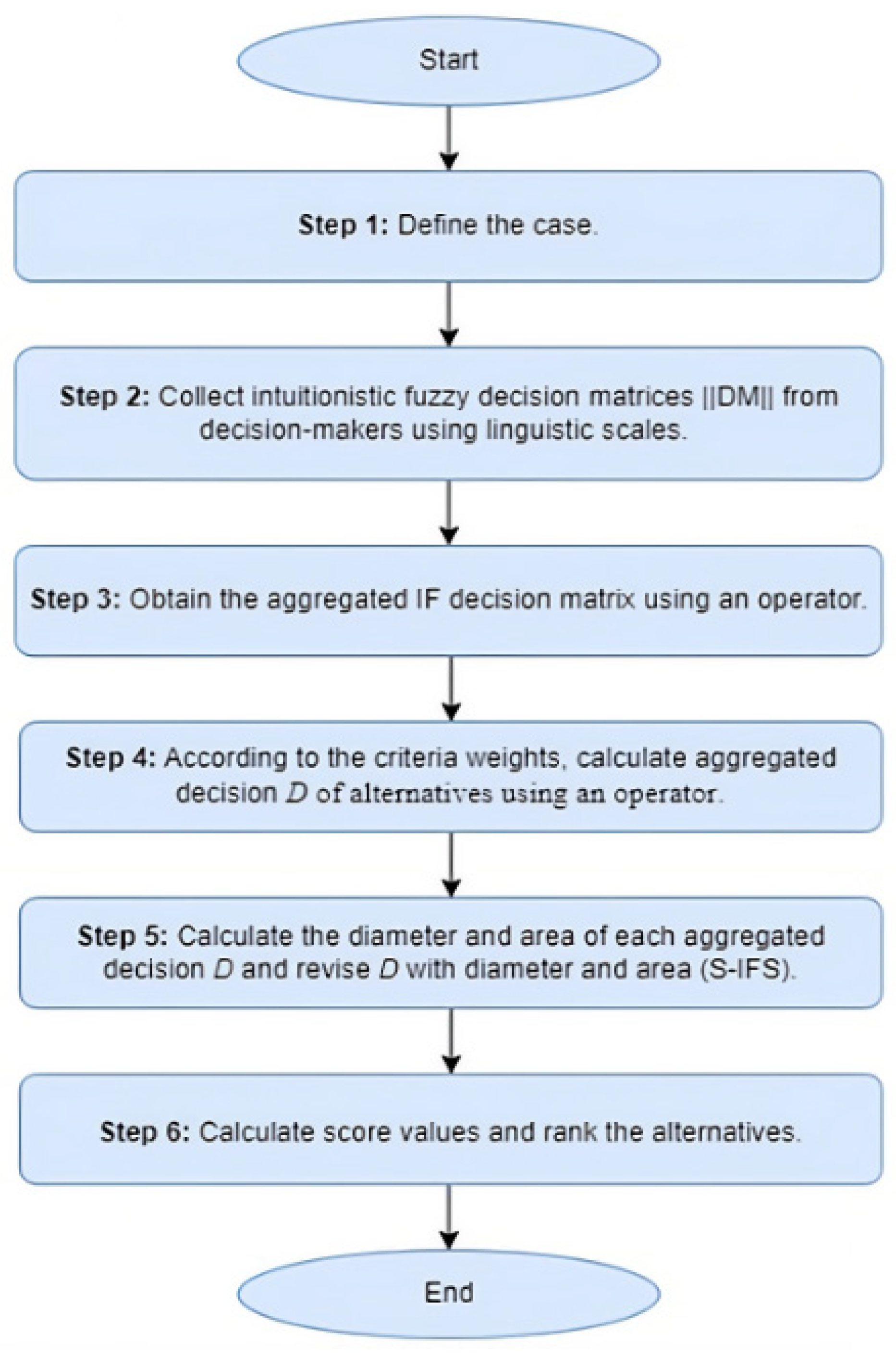
The procedure of multi criteria decision making based on S-IFS is illustrated in Figure 9.

4. Numerical Example

To realize a decision-making procedure for S-IFS, as a current controversial issue, a survey is conducted to investigate whether the use of micromobility vehicles according to regions is risky or not. Despite their sustainability benefits in lowering emissions and fostering carbon neutrality, the integration of micromobility vehicles within existing urban environments presents safety challenges in certain regions, particularly when interacting with larger vehicles and pedestrians [47].
The assessments for different numbers of groups for each region ( R i ) are gathered and, in this evaluation, let the region’s risk-free status for vehicles represent membership ( μ i ) , risky status as non-membership ( v i ) and the abstentions represent indeterminacy degree ( π i = 1 μ i v i ) [48]. In order to rank alternative regions, procedure of S-IFS proposed in the previous section is applied step by step as follows:
Step 1: Five regions R = R 1 , R 2 , R 3 , R 4 , R 5 were chosen to investigate the factors contributing to risk in areas where micromobility vehicles are commonly used. Three experts D M = { D M 1 , D M 2 , D M 3 } were asked to evaluate the regions according to the criteria they determined and to indicate the weights of criteria. The criteria set is “ C = { C 1 , C 2 , C 3 , C 4 , C 5 } ” with C 1 : Integration with public transport alternatives, C 2 : Fleet management, C 3 : Energy efficiency, C 4 : Accessibility to area, C 5 : Speed level with W C 1 = 0.1 , W C 2 = 0.20 , W C 3 = 0.15 , W C 4 = 0.30 , W C 5 = 0.25 . All D M ’s are of equal weight.
Step 2: Collect intuitionistic fuzzy decision matrices ||DM|| from decision-makers evaluates the five regions according to the five criteria using linguistic scales as in Table 2.
Step 3: The aggregated IF decision matrix is obtained using an operator by Equation (8) with equal DM weights as follows:
                                                              C 1                                                       C 2                                                         C 3                                                         C 4                                                               C 5                                           D M I F W A = R 1 R 2 R 3 R 4 R 5 < 0.507 ,   0.288 > < 0.562 ,   0.262 > < 0.602 ,   0.215 > < 0.346 ,   0.342 > < 0.481 ,   0.215 > < 0.670 ,   0.159 > < 0.562 ,   0.292 > < 0.829 ,   0.144 > < 0.569 ,   0.317 > < 0.617 ,   0.159 > < 0.562 ,   0.262 > < 0.316 ,   0.330 > < 0.476 ,   0.271 > < 0.670 ,   0.159 > < 0.670 ,   0.182 > < 0.379 ,   0.200 > < 0.829 ,   0.159 > < 0.637 ,   0.247 > < 0.448 ,   0.311 > < 0.584 ,   0.182 > < 0.528 ,   0.262 > < 0.584 ,   0.252 > < 0.569 ,   0.229 > < 0.346 ,   0.262 > < 0.518 ,   0.271 >
Step 4: According to the criteria weights W C , the aggregated decision D of alternatives using an operator by Equation (6) is calculated as follows:
D I F W A = R 1 R 2 R 3 R 4 R 5 < 0.486 ,   0.265 > < 0.644 ,   0.218 > < 0.579 ,   0.217 > < 0.613 ,   0.220 > < 0.497 ,   0.257 >
Step 5: The diameter and area of each aggregated decision D by Equations (10) and (11) from aggregated IF decision matrix, and the aggregated decision D with diameter d R i and area S R i (S-IFS) is revised as follows:
D I F W A = R 1 R 2 R 3 R 4 R 5 < 0.486 ,   0.265 ; 0.286 ,   0.012 > < 0.644 ,   0.218 ; 0.312 ,   0.018 > < 0.579 ,   0.217 ; 0.393 ,   0.010 > < 0.613 ,   0.220 ; 0.452 ,   0.029 > < 0.497 ,   0.257 ; 0.238 ,   0.005 >
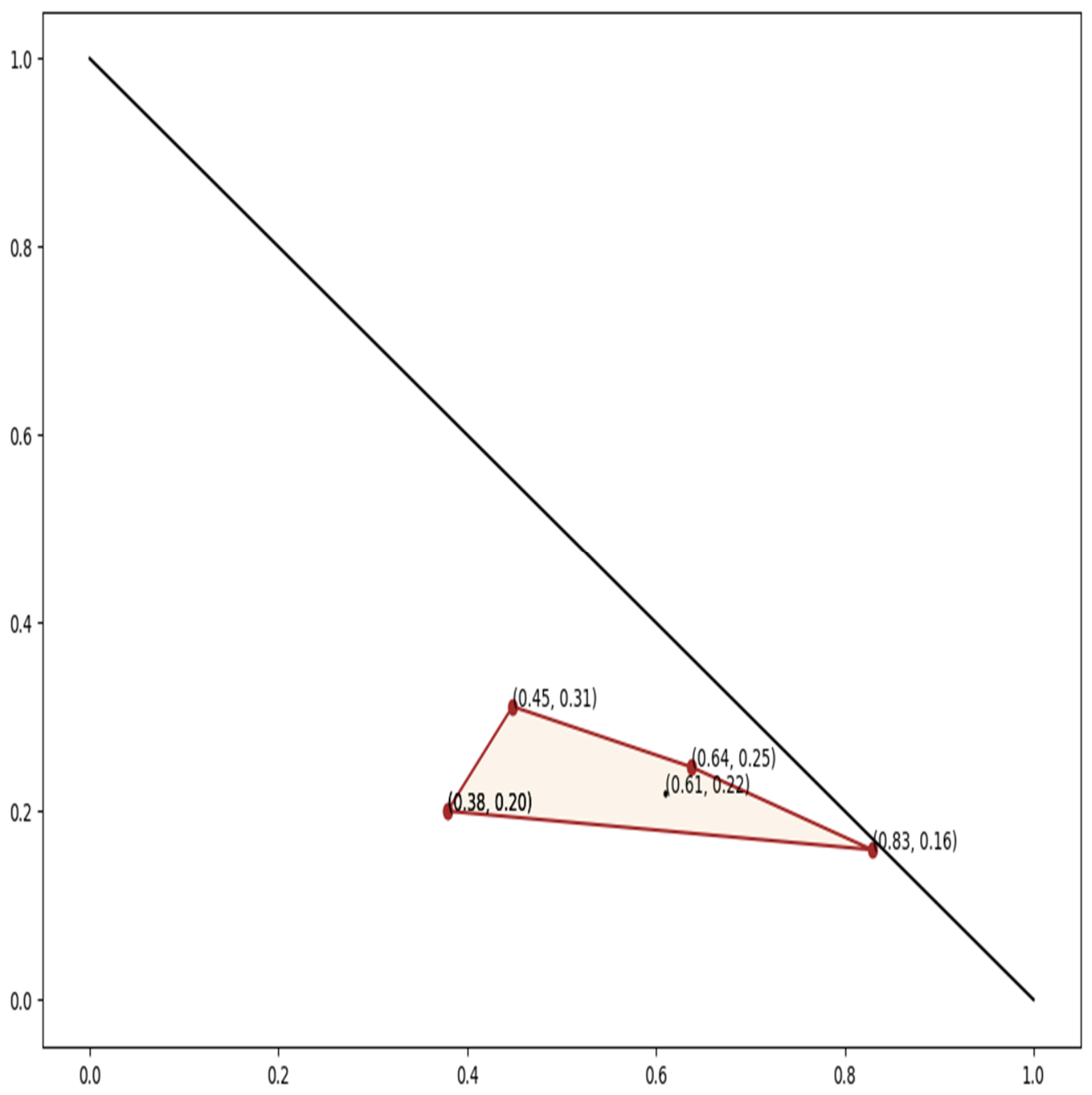
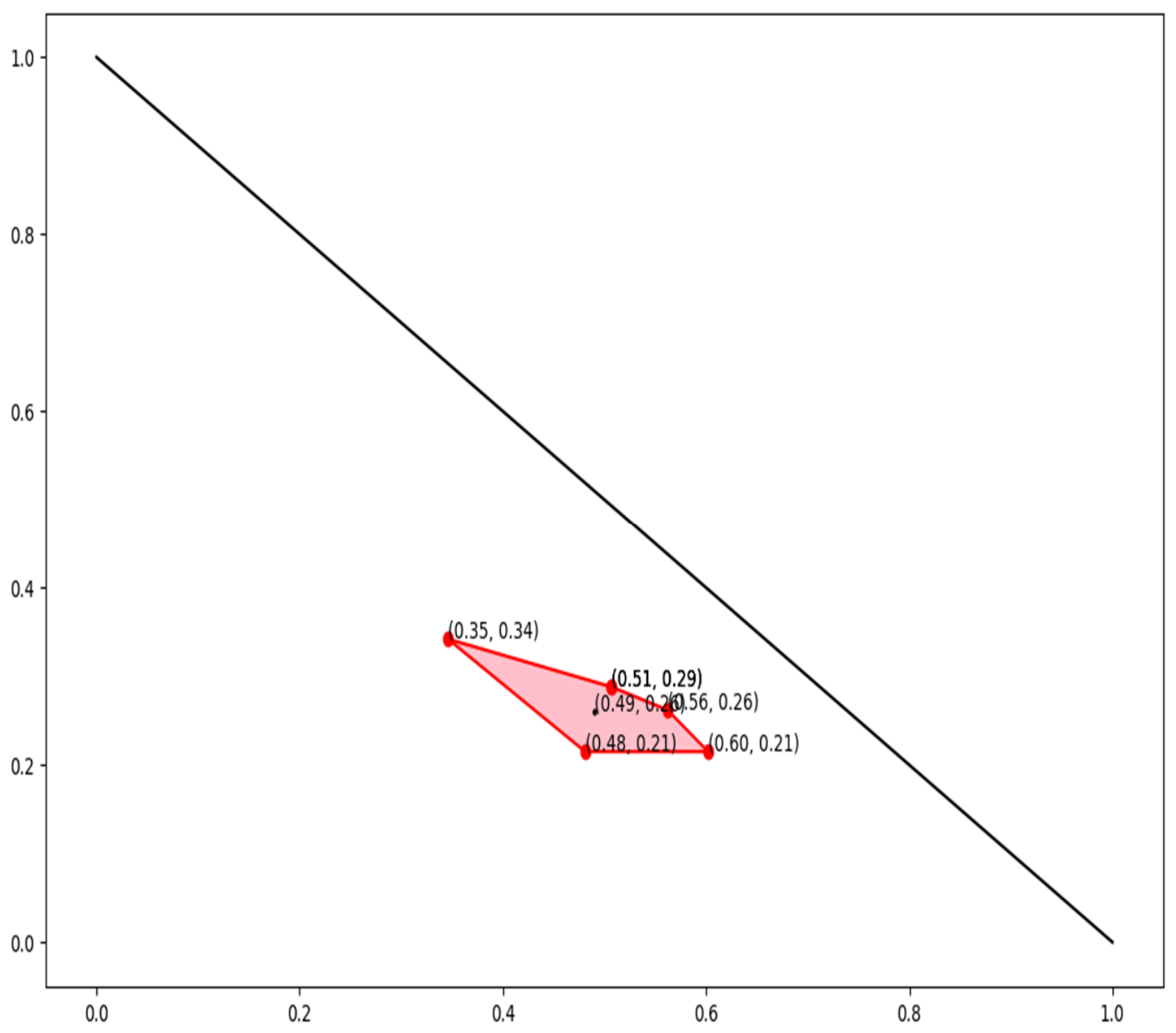
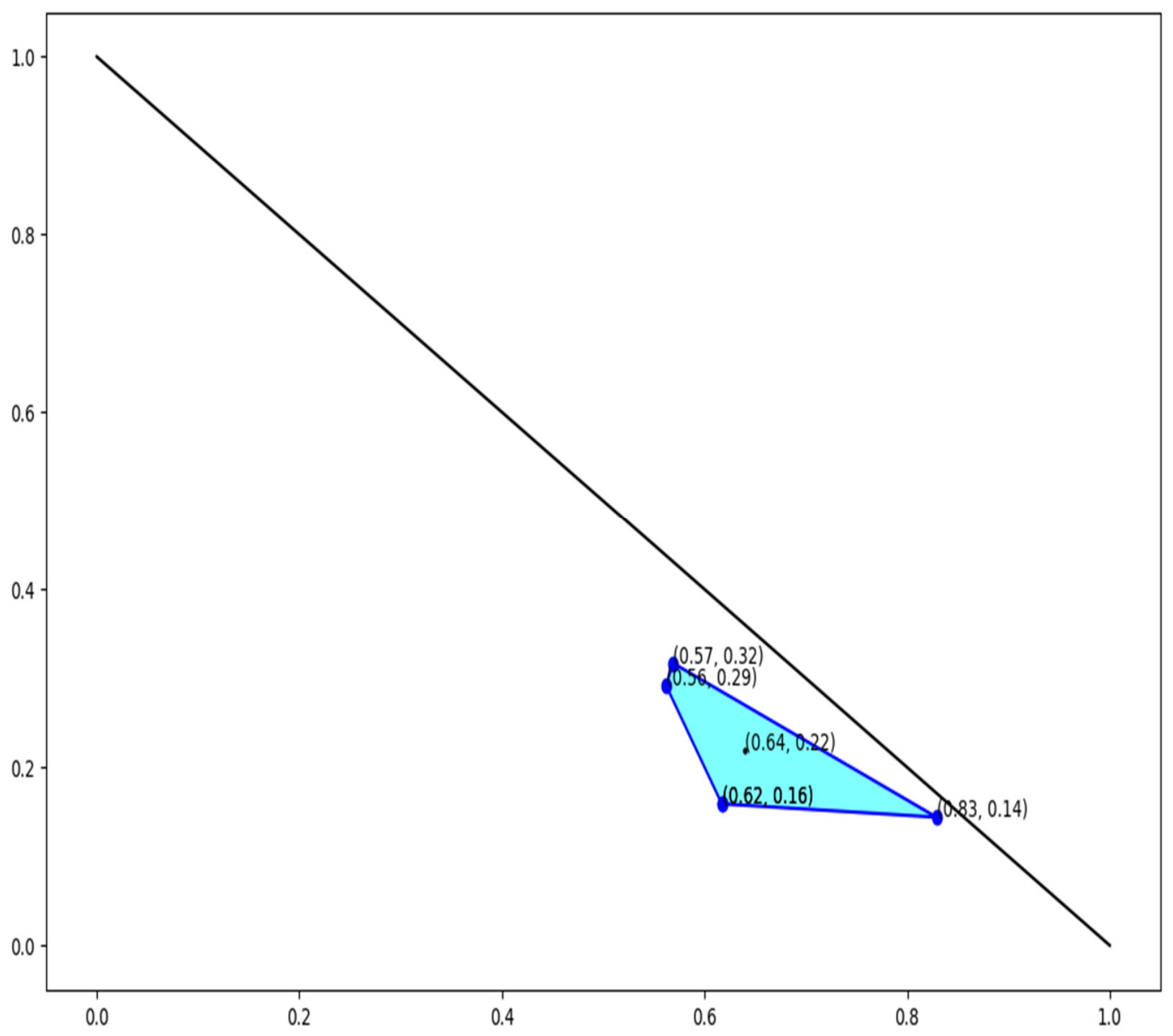
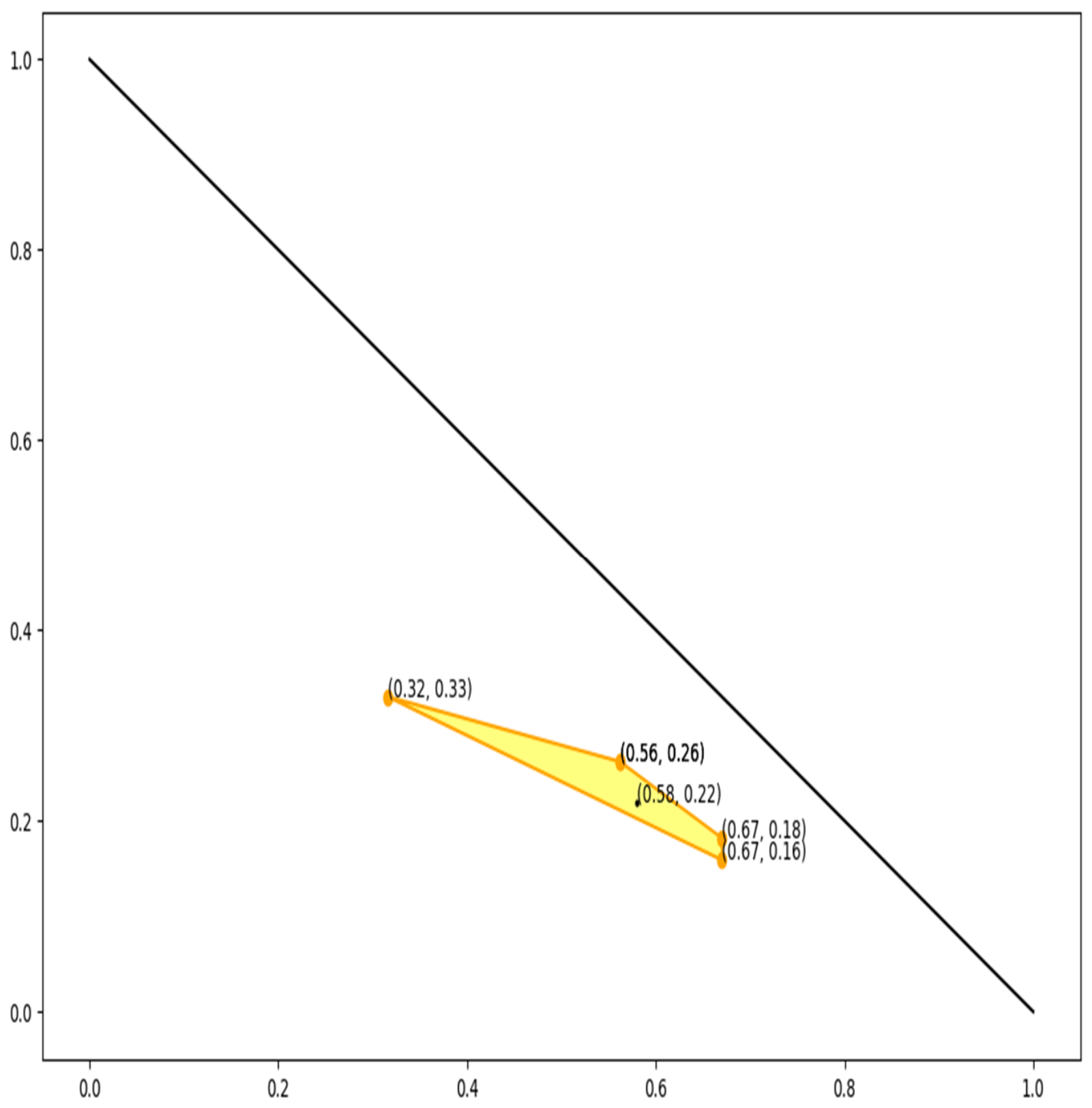
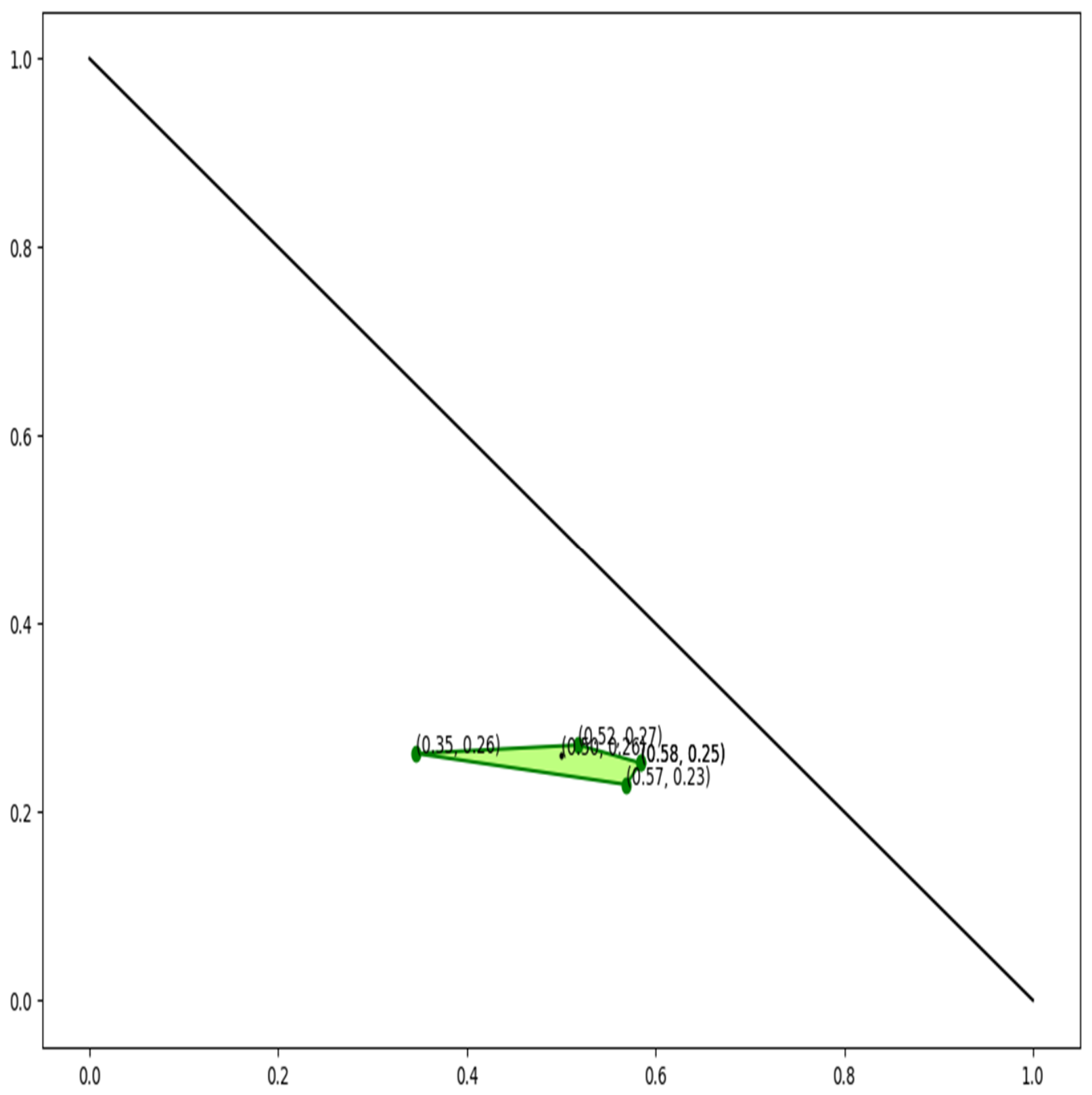
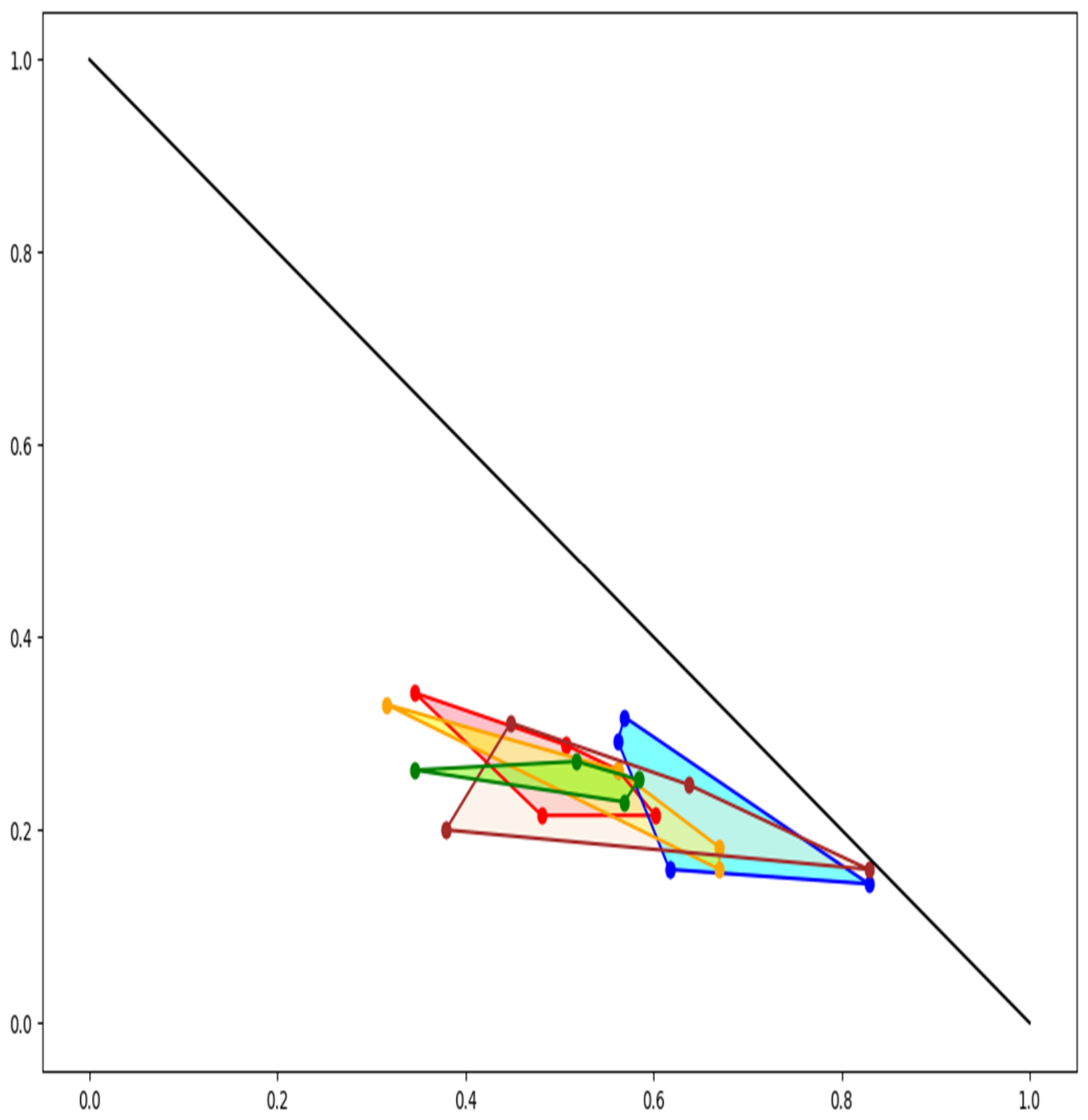
Each S-IFS decision of R i is also illustrated as in Figure 10, Figure 11, Figure 12, Figure 13, Figure 14 and Figure 15.
Step 6: The score values are obtained by Equations (16) and (17) as in Table 3. The ranking of the alternatives is R 5 R 3 R 2 R 1 R 4 from D I F W A .

5. Results and Discussion

This section compares and discusses the application results of the proposed S-IF MCDM procedure in the Section 4 with different operators and different methods placed in literature.

5.1. Comparison of Aggregation Operators in S-IF MCDM

As detailed in Section 3 and Section 4, various aggregation functions can be applied to IF numbers to calculate the representative O i point of an S-IFS. It’s crucial to note that this point, where different operators yield distinct results, is not considered the center of the S-IFS. The centroid method can be employed to accurately determine the polygon’s center.
Previously, the author of this article [14] performed some comparisons of I F W A and I F W G operators for C-IF MCDM in her study. Likewise, a comparison of the effects of different operators for S-IF MCDM is given in Table 4. All steps are applied as in Section 3 for given dataset in Section 4, only the aggregation operator is changed. Therefore, the Table 5 contains the results of different sets for comparison purposes only.
Since there is no change in the dataset, the convex hull shape of S-IFS is not change even if the O i point is different in the results of all operators. Therefore, the area and diameter values of the S-IFS final decisions remained constant. Due to the change of the O i point, there have been changes in the score values. As seen in Table 4, in scenarios where the weights of decision makers are equal, the rankings are similar. The IF points found with the centroid method do not give similar results to other operators due to the irregular structure of the group decision shape. If a regular shape were formed, a similar order would be obtained, and it would produce values close to the results of other operators. Similar ranking results are obtained in scenarios where decision maker weights are not equal. Increasing inconsistencies between the decisions lead to an increase in diameter and area.
The conclusion to be drawn is this: in the use of S-IFS, the shape formed by IF decision points can have a regular or irregular shape. As the convex hull becomes irregular, the aggregated IF points found with the centroid method produce different results compared to other arithmetic and geometric operators. Arithmetic and geometric operators obtain similar results because they consider the numerical data of the IF decision values, regardless of the structure of the shape. Here, the method to be used to find the IF point for S-IFS belongs to the practitioner. This comparison only shows the differences that may occur. The centroid method can be chosen to see the effect of the geometric shape, or similar results can be obtained by choosing arithmetic and geometric operators. It is normal for arithmetic and geometric operators to produce similar results for the same dataset as in IFS and C-IFS, indicating that the definition of S-IFS works. The choice of operator is left to the practitioner, depending on dataset characteristics and procedural needs.
This analytical distinction shows that dispersion of decision points directly influences both diameter and area, thereby strengthening the interpretation of group uncertainty. A smaller convex hull area in S-IFS indicates reduced irrelevant uncertainty compared to C-IFS, while larger diameters naturally reflect inconsistency among decision-makers. This geometric manifestation of inconsistency does not invalidate the set but provides a transparent measure of group divergence. Practitioners may introduce thresholds for diameter size depending on context, which adds flexibility to the framework.

5.2. Comparison S-IF MCDM with IF MCDM and C-IF MCDM

The dataset given in Section 4 has been applied to the procedures in the author’s study [14] comparing IF MCDM and C-IF MCDM. Notably, the three procedures share a similar structural framework, while the underlying score calculation methods differ based on the specific set utilized. Table 5 presents a comparative analysis of the results obtained from applying the IFWA aggregation operator within IF MCDM, C-IF MCDM, and S-IF MCDM procedures. This comparison highlights the distinct score generation approaches across the methods.
Examining the aggregated decisions from all three methods reveals that the IF points are identical. This is expected since both C-IFS and S-IFS are built upon IFS, sharing the same foundational IF points. However, the methods diverge in their representation: C-IFS relies solely on the radius, while S-IFS incorporates both the diameter and area of the convex hull. At this point, it makes sense to compare the diameters and areas of the C-IFS, which consists of the smallest circle (regular shape) covering all points in the data set, with the areas of the S-IFS, which consists of the smallest convex polygon (regular or irregular polygon) covering all points in the data set. Table 5 presents a comprehensive overview of the values extracted from the results matrix for this comparative analysis.
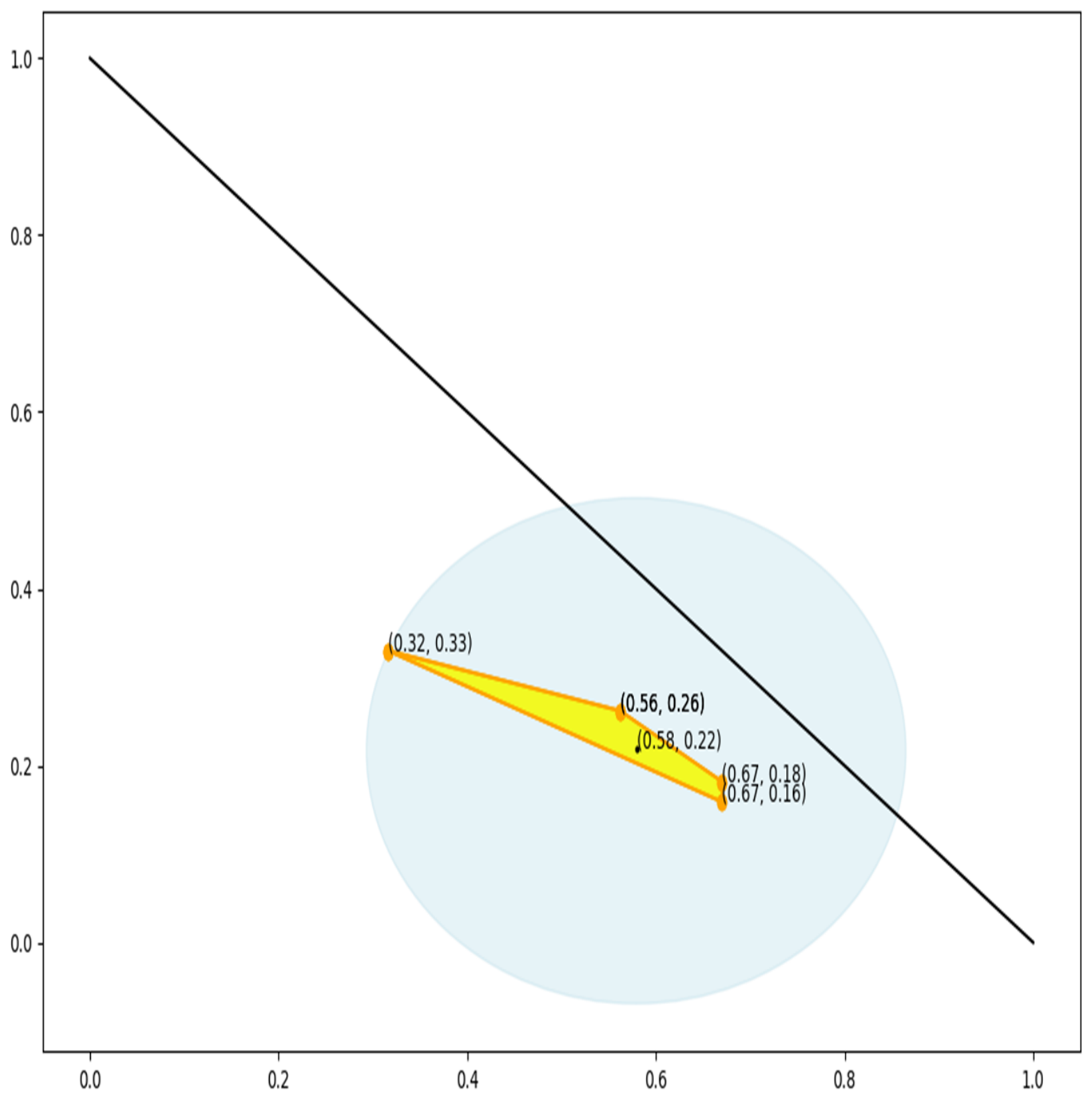
Table 6 demonstrates that the area occupied by S-IFS is smaller than that of C-IFS. This aligns with Figure 7, which visually depicts the reduced area encompassed by the decision set in S-IFS. Intuitively, a smaller area signifies lower uncertainty, as seen in Figure 16 where the expansive area of C-IFS significantly reduces its score value and impacts its ranking.
Ensure procedures account for uncertainty within the appropriate boundaries defined by the decision group. Extraneous regions outside this scope should be excluded to prevent misleadingly high uncertainty levels.
Considering Table 5 and Table 6 as analysis; while IF-MCDM and C-IF MCDM produce similar results, the C-IF MCDM and S-IF MCDM procedures proposed in this article produce similar results. This is significant, because although the C-IF MCDM models available in the literature have a geometric structure containing a circle, they do not use diameter and area in calculations. In fact, point or distance-based functions are used, as in IF-MCDM. However, the functions proposed in this study, where diameter and area affect the result, produce different results than point-based calculations. While IF-MCDM and C-IF MCDM ultimately point to only a single decision point, the C-IF MCDM and S-IF MCDM procedures proposed in this article incorporate the domain uncertainty into the point result. In this respect, it is meaningful that the rankings are different. Because in the proposed sets and procedures, the uncertainty of the group decision is clearly integrated into the system.
It is a matter of debate which set and method are more valid. Philosophically, the set and procedure presented in this article preserve uncertainty until the final stage and incorporate it into more phases of the process. In this sense, S-IFS is meaningful if uncertainty in group decision-making is intended to be preserved and non-group decision areas are excluded from the system. This does not imply that the previous methods are invalid; rather, the newly proposed set and methods provide a more comprehensive means of expressing uncertainty through the conceptual framework of the previous methods.

6. Conclusions

This study contributes to the field of fuzzy sets by proposing novel definitions and functions that introduce Shapeless Intuitionistic Fuzzy Sets (S-IFS) and demonstrate their application in decision-making processes. The author highlights the influence of grouping of decision points and their resulting shape on the final ranking. S-IFS, an extension of Intuitionistic Fuzzy Sets (IF), leverages the principle of identifying the convex structure with the smallest area enclosing the decision points to represent the collective decision to better accuracy.
This article establishes the formal definition of Shapeless Intuitionistic Fuzzy Sets (S-IFS) and introduces its key features. To facilitate comparative analysis, a novel score function, aligning with the perspective of S-IFS, is proposed for C-IFS, considered the closest existing fuzzy set. The proposed S-IF MCDM procedure is applied to the micromobility risk case study, alongside established IF-MCDM and C-IF MCDM procedures from the literature. Geometrically, S-IFS reduces the extra surface area occupied by C-IFS. S-IFS can express the geometric structure formed by group decisions in a regular or irregular but more precise way. The divergence cases (point > line > polygon) have been explicitly explained as geometric outcomes, not contradictions with decision theory, showing that S-IFS accommodates all possible group decision structures. As seen in the numerical case, MCDM evaluation with S-IFS numbers is more meaningful from a philosophical perspective than MCDM evaluation with C-IFS, as it adds the uncertainty in the group decision to the system by using diameter and area. By analyzing the results obtained from the same data, a crucial distinction is revealed. Unlike its predecessors, S-IFS incorporates the group uncertainty generated by decision-makers, leading to a more nuanced reflection of the collective decision. Therefore, it is expected that most decision-making procedures with which C-IFS can be integrated can also be adapted to S-IFS, thus pointing to a new gap in the literature.
This study highlights the potential of Shapeless Intuitionistic Fuzzy Sets (S-IFS) for group decision-making, but acknowledges limitations. While currently recommended for point decisions (e.g., IFS) in two dimensional (e.g., C-IFS), the concept can be extended to multidimensional environments (e.g., S-IFS). When the decision structure is point, area, volumetric, etc., group decision-making methods can be suggested by creating a convex polygon, convex polyhedron, or convex polytope (n-polytope) covering these decisions for each new dimension. Though calculations become more complex, this dimensional expansion holds promise for richer interpretations of fuzzy sets. Expanding the scope from two dimensional to n-dimensional environments opens exciting vision for future research in geometric interpretations of fuzzy sets. Investigating the computational complexity and developing efficient procedures for large-scale or high-dimensional S-IFS is a promising direction for future research. This study acknowledges that scalability and robustness are essential. While the introductory case is deliberately small, S-IFS can be extended to scalable datasets, and inconsistency among decision-makers is reflected geometrically rather than structurally.
In addition to the development of n-dimensional decision structure studies, it is recommended to introduce the extensions that are accessible and developable in point decisions such as “Shapeless Neutrosophic Fuzzy Set, Shapeless Pythagorean Fuzzy Set, Shapeless Hesitant Fuzzy Set, Shapeless q-rung Orthopair Fuzzy Set, …” based on [7,8,9,10,11] to the literature as a future study direction. This would enrich the existing literature and broaden the applicability of the “Shapeless” concept.
As mentioned in Section 1, non-convex structures can be investigated in addition to the proposed perspective in this study. It is noteworthy that scenarios where the constructed non-convex polygon excludes the aggregation point require further research and a robust theoretical foundation to ensure valid interpretations. This remains as an open topic within the literature, necessitating further exploration and debate.
To conclude, this research can shed light on new frontiers of the “Shapeless” idea, including its connections to other fuzzy sets and its integration into diverse decision-making approaches (such as AHP, TOPSIS, VIKOR, SERA, MEREC, WASPAS, COPRAS, ELECTREE, V-PARS, PODER, etc.) with different type of datasets. This pursuit encompasses various problem contexts to showcase the full potential of Shapeless Intuitionistic Fuzzy Sets.


Funding

This work has been supported by the Scientific Research Projects Commission of Galatasaray University.

Data Availability Statement

The original contributions presented in this study are included in the article.

Acknowledgments

During the preparation of this manuscript, the author did not used any tool. The author has reviewed and edited the output and take full responsibility for the content of this publication.

Conflicts of Interest

The author declares no conflicts of interest.

References

  1. Zadeh, L.A. Fuzzy sets. Inf. Control 1965, 8, 338–353. [Google Scholar] [CrossRef]
  2. Zadeh, L.A. The concept of a linguistic variable and its application to approximate reasoning—Part I. Inf. Sci. 1975, 8, 199–249. [Google Scholar] [CrossRef]
  3. Atanassov, K.T. Intuitionistic fuzzy sets. Fuzzy Sets Syst. 1986, 20, 87–96. [Google Scholar] [CrossRef]
  4. Atanassov, K.T.; Gargov, G. Interval valued intuitionistic fuzzy sets. Fuzzy Sets Syst. 1989, 31, 343–349. [Google Scholar] [CrossRef]
  5. Yager, R.R. On the theory of bags. Int. J. Gen. Syst. 1986, 13, 23–37. [Google Scholar] [CrossRef]
  6. Senapati, T.; Yager, R.R. Fermatean fuzzy sets. J. Ambient Intell. Humaniz. Comput. 2020, 11, 663–674. [Google Scholar] [CrossRef]
  7. Smarandache, F. Neutrosophy: Neutrosophic Probability, Set, and Logic: Analytic Synthesis & Synthetic Analysis; American Research Press: Gallup, NM, USA, 1998. [Google Scholar]
  8. Garibaldi, J.M.; Ozen, T. Uncertain fuzzy reasoning: A case study in modelling expert decision making. IEEE Trans. Fuzzy Syst. 2007, 15, 16–30. [Google Scholar] [CrossRef]
  9. Torra, V. Hesitant fuzzy sets. Int. J. Intell. Syst. 2010, 25, 529–539. [Google Scholar] [CrossRef]
  10. Yager, R.R. Pythagorean fuzzy subsets. In Proceedings of the 2013 Joint IFSA World Congress and NAFIPS Annual Meeting (IFSA/NAFIPS), Edmonton, AB, Canada, 24–28 June 2013; IEEE: Piscataway, NJ, USA, 2013; pp. 57–61. [Google Scholar] [CrossRef]
  11. Yager, R.R. Generalized orthopair fuzzy sets. IEEE Trans. Fuzzy Syst. 2017, 25, 1222–1230. [Google Scholar] [CrossRef]
  12. Cường, B.C. Picture fuzzy sets. J. Comput. Sci. Cybern. 2015, 30, 409–420. [Google Scholar] [CrossRef]
  13. Kutlu Gündoğdu, F.K.; Kahraman, C. Spherical fuzzy sets and spherical fuzzy TOPSIS method. J. Intell. Fuzzy Syst. 2019, 36, 337–352. [Google Scholar] [CrossRef]
  14. Çakır, E.; Taş, M.A. Circular intuitionistic fuzzy decision making and its application. Expert Syst. Appl. 2023, 225, 120076. [Google Scholar] [CrossRef]
  15. Atanassov, K.T. Circular intuitionistic fuzzy sets. J. Intell. Fuzzy Syst. 2020, 39, 5981–5986. [Google Scholar] [CrossRef]
  16. Atanassov, K.T.; Marinov, E. Four distances for circular intuitionistic fuzzy sets. Mathematics 2021, 9, 1121. [Google Scholar] [CrossRef]
  17. Arslan, Ö.; Karakurt, N.; Cem, E.; Cebi, S. Risk analysis in the food cold chain using decomposed fuzzy set-based FMEA approach. Sustainability 2023, 15, 13169. [Google Scholar] [CrossRef]
  18. Moradi, E.; Bidkhori, M. Single facility location problem. In Facility Location: Concepts, Models, Algorithms and Case Studies; Drezner, Z., Hamacher, H.W., Eds.; Springer: Berlin, Germany, 2009; pp. 37–68. [Google Scholar]
  19. Khan, M.B.; Deaconu, A.M.; Tayyebi, J.; Spridon, D.E. Diamond intuitionistic fuzzy sets and their applications. IEEE Access 2024, 12, 176171–176183. [Google Scholar] [CrossRef]
  20. Cheng, Z.; Panzi, X.; Sen, W.; Xiaozhen, L. (s, t]-Intuitionistic convex fuzzy sets. In Fuzzy Information and Engineering 2010: Volume I; Springer: Berlin, Germany, 2010; pp. 75–84. [Google Scholar]
  21. Saha, S.; Debnaty, P. Intuitionistic fuzzy φ-convexity and intuitionistic fuzzy decision making. Int. J. Eng. Sci. Technol. 2018, 10, 173–179. [Google Scholar] [CrossRef]
  22. LaValle, S.M. Geometric representations and transformations. In Planning Algorithms; Cambridge University Press: Cambridge, UK, 2006; pp. 81–126. [Google Scholar]
  23. Xu, Z. Intuitionistic fuzzy aggregation operators. IEEE Trans. Fuzzy Syst. 2007, 15, 1179–1187. [Google Scholar] [CrossRef]
  24. Hamidzadeh, J.; Moradi, M. Incremental one-class classifier based on convex–concave hull. Pattern Anal. Appl. 2020, 23, 1523–1549. [Google Scholar] [CrossRef]
  25. Atanassov, K.T. On Intuitionistic Fuzzy Sets Theory; Springer: Berlin, Germany, 2012. [Google Scholar]
  26. Atanassov, K.T. Intuitionistic Fuzzy Sets: Theory and Applications; Springer: Heidelberg, Germany, 1999. [Google Scholar]
  27. Çakır, E.; Taş, M.A.; Ulukan, Z. A new circular intuitionistic fuzzy MCDM: A case of Covid-19 medical waste landfill site evaluation. In Proceedings of the 2021 IEEE 21st International Symposium on Computational Intelligence and Informatics (CINTI), Budapest, Hungary, 18–20 November 2021; IEEE: Piscataway, NJ, USA, 2021; pp. 143–148. [Google Scholar]
  28. Otay, I.; Kahraman, C. A novel circular intuitionistic fuzzy AHP & VIKOR methodology: An application to a multi-expert supplier evaluation problem. Pamukkale Univ. J. Eng. Sci. 2022, 28, 194–207. [Google Scholar]
  29. Çakır, E.; Taş, M.A.; Ulukan, Z. Circular intuitionistic fuzzy sets in multi-criteria decision making. In Proceedings of the International Conference on Theory and Application of Soft Computing, Computing with Words and Perceptions; Springer: Berlin, Germany, 2021; pp. 34–42. [Google Scholar]
  30. Kahraman, C.; Otay, I. Extension of VIKOR method using circular intuitionistic fuzzy sets. In Intelligent and Fuzzy Techniques for Emerging Conditions and Digital Transformation: Proceedings of the INFUS 2021 Conference; Springer: Berlin, Germany, 2022; Volume 2, pp. 48–57. [Google Scholar]
  31. Alkan, N.; Kahraman, C. Circular intuitionistic fuzzy TOPSIS method: Pandemic hospital location selection. J. Intell. Fuzzy Syst. 2022, 42, 295–316. [Google Scholar] [CrossRef]
  32. Kahraman, C.; Alkan, N. Circular intuitionistic fuzzy TOPSIS method with vague membership functions: Supplier selection application context. Notes Intuitionistic Fuzzy Sets 2021, 27, 24–52. [Google Scholar] [CrossRef]
  33. Çakır, E.; Taş, M.A. Circular intuitionistic fuzzy analytic hierarchy process for remote working assessment in COVİD-19. In Proceedings of the International Conference on Intelligent and Fuzzy Systems; Springer: Berlin, Germany, 2022; pp. 589–597. [Google Scholar]
  34. Khan, M.J.; Kumam, W.; Alreshidi, N.A. Divergence measures for circular intuitionistic fuzzy sets and their applications. Eng. Appl. Artif. Intell. 2022, 116, 105455. [Google Scholar] [CrossRef]
  35. Çaloğlu Büyükselçuk, B.; Sarı, Y.C. The best whey protein powder selection via VIKOR based on circular intuitionistic fuzzy sets. Symmetry 2023, 15, 1313. [Google Scholar] [CrossRef]
  36. Çakır, E.; Demircioğlu, E. Circular intuitionistic fuzzy PROMETHEE methodology: A case of smart cities evaluation. In Proceedings of the International Conference on Intelligent and Fuzzy Systems; Springer: Berlin, Germany, 2023; pp. 353–361. [Google Scholar]
  37. Fetanat, A.; Tayebi, M. Sustainability and resilience-oriented prioritization of oil and gas produced water treatment technologies: A novel decision support system under circular intuitionistic fuzzy set. Geoenergy Sci. Eng. 2023, 221, 211379. [Google Scholar] [CrossRef]
  38. Chen, T.Y. A circular intuitionistic fuzzy evaluation method based on distances from the average solution to support multiple criteria intelligent decisions involving uncertainty. Eng. Appl. Artif. Intell. 2023, 117, 105499. [Google Scholar] [CrossRef]
  39. Otay, İ.; Onar, S.Ç.; Öztayşi, B.; Kahraman, C. A novel interval valued circular intuitionistic fuzzy AHP methodology: Application in digital transformation project selection. Inf. Sci. 2023, 647, 119407. [Google Scholar] [CrossRef]
  40. Garg, H.; Ünver, M.; Olgun, M.; Türkarslan, E. An extended EDAS method with circular intuitionistic fuzzy value features and its application to multi-criteria decision-making process. Artif. Intell. Rev. 2023, 56, 3173–3204. [Google Scholar] [CrossRef]
  41. Chen, T.Y. An advanced approach to multiple criteria optimization and compromise solutions under circular intuitionistic fuzzy uncertainty. Adv. Eng. Inform. 2023, 57, 102112. [Google Scholar] [CrossRef]
  42. Ashraf, S.; Chohan, M.S.; Muhammad, S.; Khan, F. Circular intuitionistic fuzzy TODIM approach for material selection for cryogenic storage tank for liquid nitrogen transportation. IEEE Access 2023, 11, 123456–123467. [Google Scholar] [CrossRef]
  43. Alsattar, H.A.; Mourad, N.; Zaidan, A.A.; Deveci, M.; Qahtan, S.; Jayaraman, V.; Khalid, Z. Developing IoT sustainable real-time monitoring devices for food supply chain systems based on climate change using circular intuitionistic fuzzy set. IEEE Internet Things J. 2023, 11, 26680–26689. [Google Scholar]
  44. Alkan, N.; Kahraman, C. Continuous intuitionistic fuzzy sets (CINFUS) and their AHP&TOPSIS extension: Research proposals evaluation for grant funding. Appl. Soft Comput. 2023, 145, 110579. [Google Scholar] [CrossRef]
  45. Khan, M.J.; Ding, W.; Jiang, S.; Akram, M. Group decision making using circular intuitionistic fuzzy preference relations. Expert Syst. Appl. 2025, 270, 126502. [Google Scholar] [CrossRef]
  46. Shahin, V.; Alimohammadlou, M.; Pamucar, D. An interval-valued circular intuitionistic fuzzy MARCOS method for renewable energy source selection. Spectr. Decis. Mak. Appl. 2026, 3, 243–268. [Google Scholar] [CrossRef]
  47. Çakır, E.; Çağrı Tolga, A. Vector based preference aided ranking system (V-PARS): Application on micromobility modes in Paris. IEEE Access 2024, 12, 177533–177552. [Google Scholar] [CrossRef]
  48. Çakır, E. Micromobility-Case-Dataset. Available online: https://github.com/esrckr/micromobility-case-dataset?utm_source=chatgpt.com (accessed on 8 May 2026).
Figure 1. Well-known extensions of fuzzy sets [1,2,3,4,5,6,7,8,9,10,11,12,13,14,15,16,17].
Algorithms 19 00432 g001
Figure 2. Geometric illustration of boundaries of circle covering, diamond covering and convex hull in IFIT.
Algorithms 19 00432 g002
Figure 3. Examples of centroid points for some convex and non-convex polygons.
Algorithms 19 00432 g003
Figure 4. Geometrical presentation of some intuitionistic fuzzy numbers.
Algorithms 19 00432 g004
Figure 5. Geometrical representation of a circular intuitionistic fuzzy number.
Algorithms 19 00432 g005
Figure 6. Geometrical representation of an example shapeless intuitionistic fuzzy number.
Algorithms 19 00432 g006
Figure 7. Geometrical representation of comparison of C-IFS (red) and S-IFS (black) generated from the same dataset.
Algorithms 19 00432 g007
Figure 8. Geometrical representation of different aggregations for the same IF dataset (<0.10,0.10>, <0.26,0.30>, <0.30,0.09>, <0.43,0.16>, <0.50,0.12>).
Algorithms 19 00432 g008
Figure 9. Procedure of multi criteria decision making based on S-IFS.
Algorithms 19 00432 g009
Figure 10. Geometric illustration of S-IF decision in IFIT for region R 1 .
Algorithms 19 00432 g010
Figure 11. Geometric illustration of S-IF decision in IFIT for region R 2 .
Algorithms 19 00432 g011
Figure 12. Geometric illustration of S-IF decision in IFIT for region R 3 .
Algorithms 19 00432 g012
Figure 13. Geometric illustration of S-IF decision in IFIT for region R 4 .
Algorithms 19 00432 g013
Figure 14. Geometric illustration of S-IF decision in IFIT for region R 5 .
Algorithms 19 00432 g014
Figure 15. Geometric illustration of S-IF decisions in IFIT for all regions.
Algorithms 19 00432 g015
Figure 16. Geometric illustration of comparison C-IF decision and S-IF decision in IFIT for region R 3 .
Algorithms 19 00432 g016
Table 1. Some IF and C-IF MCDM in the literature.
Ref.AuthorYearResearch
[27]E. Çakır,
M.A. Taş,
Z. Ulukan
2021A new circular intuitionistic fuzzy MCDM: A case of COVID-19 medical waste landfill site evaluation
[28]İ. Otay
C. Kahraman
2022A novel circular intuitionistic fuzzy AHP & VIKOR methodology: an application to a multi-expert supplier evaluation problem
[29]E. Çakır,
M.A. Taş
Z. Ulukan
2021Circular intuitionistic fuzzy sets in multi criteria decision making
[30]C. Kahraman
İ. Otay
2022Extension of VIKOR method using circular intuitionistic fuzzy sets
[31]N. Alkan
C. Kahraman
2022Circular intuitionistic fuzzy TOPSIS method: Pandemic hospital location selection
[14]E. Çakır
M.A. Taş
2023Circular Intuitionistic Fuzzy Decision Making and Its Application
[32]C. Kahraman
N. Alkan
2021Circular intuitionistic fuzzy TOPSIS method with vague membership functions: Supplier selection application context
[33]E. Çakır
M.A. Taş
2022Circular intuitionistic fuzzy analytic hierarchy process for remote working assessment in COVID-19
[34]M.J. Khan
W. Kumam
N.A. Alreshidi
2022Divergence measures for circular intuitionistic fuzzy sets and their applications
[35]E. Çaloğlu Büyükselçuk
Y.C. Sarı
2023The Best Whey Protein Powder Selection via VIKOR Based on Circular Intuitionistic Fuzzy Sets
[36]E. Çakır,
E. Demircioğlu
2023Circular Intuitionistic Fuzzy PROMETHEE Methodology: A Case of Smart Cities Evaluation
[37]A. Fetanat
M. Tayebi
2023Sustainability and resilience-oriented prioritization of oil and gas produced water treatment technologies: A novel decision support system under circular intuitionistic fuzzy set
[44]N. Alkan, C. Kahraman2023Continuous intuitionistic fuzzy sets (CINFUS) and their AHP&TOPSIS extension: Research proposals evaluation for grant funding
[19]M.B. Khan, A.M. Deaconu, J. Tayyebi, D.E. Spridon2024Diamond Intuitionistic Fuzzy Sets and Their Applications: Medical diagnosis case study
[45]M.J. Khan, W. Ding, S. Jiang, M. Akram2025Group decision making using circular intuitionistic fuzzy preference relations
[46]V. Shahin, M. Alimohammadlou, D. Pamucar2026An Interval-Valued Circular Intuitionistic Fuzzy MARCOS Method for Renewable Energy Source Selection
Table 2. Intuitionistic fuzzy decision matrices from decision-makers.
D M 1 C 1     C 2     C 3     C 4     C 5     W C 1 : 0.1 W C 2 : 0.2 W C 3 : 0.15 W C 4 : 0.3 W C 5 : 0.25
R 1 R 2 R 3 R 4 R 5 < 0.4 ,   0.3 > < 0.3 ,   0.6 > < 0.7 ,   0.2 > < 0.5 ,   0.2 > < 0.6 ,   0.1 > < 0.6 ,   0.2 > < 0.7 ,   0.25 > < 0.9 ,   0.1 > < 0.6 ,   0.4 > < 0.3 ,   0.4 > < 0.3 ,   0.6 > < 0.2 ,   0.3 > < 0.4 ,   0.5 > < 0.8 ,   0.1 > < 0.7 ,   0.3 > < 0.5 ,   0.1 > < 0.9 ,   0.1 > < 0.6 ,   0.3 > < 0.2 ,   0.6 > < 0.4 ,   0.2 > < 0.7 ,   0.2 > < 0.4 ,   0.4 > < 0.5 ,   0.2 > < 0.3 ,   0.2 > < 0.8 ,   0.1 >
D M 2 C 1     C 2     C 3     C 4     C 5     W C 1 : 0.1 W C 2 : 0.2 W C 3 : 0.15 W C 4 : 0.3 W C 5 : 0.25
R 1 R 2 R 3 R 4 R 5 < 0.5 ,   0.4 > < 0.4 ,   0.3 > < 0.3 ,   0.5 > < 0.2 ,   0.4 > < 0.3 ,   0.5 > < 0.7 ,   0.1 > < 0.6 ,   0.2 > < 0.5 ,   0.3 > < 0.6 ,   0.2 > < 0.8 ,   0.1 > < 0.8 ,   0.1 > < 0.2 ,   0.4 > < 0.4 ,   0.2 > < 0.7 ,   0.1 > < 0.6 ,   0.2 > < 0.4 ,   0.2 > < 0.5 ,   0.4 > < 0.8 ,   0.1 > < 0.3 ,   0.5 > < 0.4 ,   0.3 > < 0.3 ,   0.3 > < 0.7 ,   0.2 > < 0.2 ,   0.6 > < 0.5 ,   0.3 > < 0.2 ,   0.4 >
D M 3 C 1     C 2     C 3     C 4     C 5     W C 1 : 0.1 W C 2 : 0.2 W C 3 : 0.15 W C 4 : 0.3 W C 5 : 0.25
R 1 R 2 R 3 R 4 R 5 < 0.6 ,   0.2 > < 0.8 ,   0.1 > < 0.7 ,   0.1 > < 0.3 ,   0.5 > < 0.5 ,   0.2 > < 0.7 ,   0.2 > < 0.3 ,   0.5 > < 0.9 ,   0.1 > < 0.5 ,   0.4 > < 0.6 ,   0.1 > < 0.4 ,   0.3 > < 0.5 ,   0.3 > < 0.6 ,   0.2 > < 0.4 ,   0.4 > < 0.7 ,   0.1 > < 0.2 ,   0.4 > < 0.9 ,   0.1 > < 0.4 ,   0.5 > < 0.7 ,   0.1 > < 0.8 ,   0.1 > < 0.5 ,   0.3 > < 0.6 ,   0.2 > < 0.8 ,   0.1 > < 0.2 ,   0.3 > < 0.3 ,   0.5 >
Table 3. Scores of alternative regions.
Alternative RegionScore of D I F W A Normalize of Score
R 1 65.670.138
R 2 77.880.164
R 3 90.000.189
R 4 30.510.064
R 5 212.100.445
Table 4. Results of S-IF MCDM procedure for different aggregation operators.
EquationAggregated Decision D (S-IFS)ScoresRanking
Equation (5) W D = { 0.33 ,   0.33 ,   0.33 }
W C = 0.1 ,   0.2 ,   0.15 ,   0.3 ,   0.25
D A A = R 1 R 2 R 3 R 4 R 5 < 0.473 ,   0.307 ; 0.254 ,   0.009 > < 0.620 ,   0.237 ; 0.278 ,   0.017 > < 0.513 ,   0.273 ; 0.390 ,   0.016 > < 0.533 ,   0.267 ; 0.418 ,   0.039 > < 0.467 ,   0.287 ; 0.234 ,   0.008 >
R 1 R 2 R 3 R 4 R 5 69.88 80.13 39.51 16.17 99.62 R 5 R 2 R 1 R 3 R 4
Equation (6) W D = { 0.30 ,   0.45 ,   0.25 }
W C = 0.1 ,   0.2 ,   0.15 ,   0.3 ,   0.25
D W A = R 1 R 2 R 3 R 4 R 5 < 0.426 ,   0.332 ; 0.212 ,   0.004 > < 0.609 ,   0.243 ; 0.193 ,   0.0171 < 0.538 ,   0.246 ; 0.416 ,   0.016 > < 0.514 ,   0.292 ; 0.401 ,   0.037 > < 0.441 ,   0.297 ; 0.220 ,   0.010 >
R 1 R 2 R 3 R 4 R 5 100.10 176.46 42.70 15.11 62.39 R 2 R 1 R 5 R 3 R 4
Equation (7) W D = { 0.33 ,   0.33 ,   0.33 }
W C = 0.1 ,   0.2 ,   0.15 ,   0.3 ,   0.25
D c e n t r o i d = R 1 R 2 R 3 R 4 R 5 < 0.348 ,   0.322 ; 0.254 ,   0.009 > < 0.619 ,   0.238 ; 0.278 ,   0.017 > < 0.495 ,   0.282 ; 0.390 ,   0.016 > < 0.570 ,   0.279 ; 0.418 ,   0.039 > < 0.422 ,   0.289 ; 0.234 ,   0.008 >
R 1 R 2 R 3 R 4 R 5 10.90 79.64 35.07 17.65 73.60 R 2 R 5 R 3 R 4 R 1
Equation (8) W D = { 0.33 ,   0.33 ,   0.33 }
W C = 0.1 ,   0.2 ,   0.15 ,   0.3 ,   0.25
D I F W A = R 1 R 2 R 3 R 4 R 5 < 0.486 ,   0.265 ; 0.286 ,   0.012 > < 0.644 ,   0.218 ; 0.312 ,   0.018 > < 0.579 ,   0.217 ; 0.393 ,   0.010 > < 0.613 ,   0.220 ; 0.452 ,   0.029 > < 0.497 ,   0.257 ; 0.238 ,   0.005 >
R 1 R 2 R 3 R 4 R 5 65.67 77.88 90.00 30.51 212.10 R 5 R 3 R 2 R 1 R 4
Equation (9) W D = { 0.33 ,   0.33 ,   0.33 }
W C = 0.1 ,   0.2 ,   0.15 ,   0.3 ,   0.25
D I F W G = R 1 R 2 R 3 R 4 R 5 < 0.458 ,   0.287 ; 0.250 ,   0.009 > < 0.648 ,   0.209 ; 0.252 ,   0.012 > < 0.581 ,   0.209 ; 0.443 ,   0.010 > < 0.589 ,   0.235 ; 0.418 ,   0.032 > < 0.489 ,   0.266 ; 0.226 ,   0.003 >
R 1 R 2 R 3 R 4 R 5 72.22 148.46 80.22 26.13 361.54 R 5 R 2 R 3 R 1 R 4
Equation (8) W D = { 0.30 ,   0.45 ,   0.25 }
W C = 0.1 ,   0.2 ,   0.15 ,   0.3 ,   0.25
D I F W A = R 1 R 2 R 3 R 4 R 5 < 0.417 ,   0.334 ; 0.235 ,   0.009 > < 0.573 ,   0.268 ; 0.287 ,   0.020 > < 0.493 ,   0.269 ; 0.415 ,   0.021 > < 0.478 ,   0.304 ; 0.450 ,   0.046 > < 0.397 ,   0.302 ; 0.241 ,   0.012 >
R 1 R 2 R 3 R 4 R 5 39.05 52.30 26.15 8.33 32.51 R 2 R 1 R 5 R 3 R 4
Equation (9) W D = { 0.30 ,   0.45 ,   0.25 }
W C = 0.1 ,   0.2 ,   0.15 ,   0.3 ,   0.25
D I F W G = R 1 R 2 R 3 R 4 R 5 < 0.393 ,   0.352 ; 0.204 ,   0.004 > < 0.584 ,   0.254 ; 0.202 ,   0.013 > < 0.491 ,   0.260 ; 0.425 ,   0.021 > < 0.464 ,   0.316 ; 0.418 ,   0.040 > < 0.391 ,   0.311 ; 0.250 ,   0.016 >
R 1 R 2 R 3 R 4 R 5 44.99 125.14 25.89 8.75 19.85 R 2 R 1 R 3 R 5 R 4
Table 5. Comparison of the results of IF MCDM, C-IF MCDM, and S-IF MCDM procedures.
Fuzzy
MCDM
Procedure
Aggregated Decision D ScoresNorm. ScoreRank
I F   M C D M [14] W D = { 0.33 ,   0.33 ,   0.33 }
W C = 0.1 ,   0.2 ,   0.15 ,   0.3 ,   0.25
D I F W A = R 1 R 2 R 3 R 4 R 5 < 0.486 ,   0.265 > < 0.644 ,   0.218 > < 0.579 ,   0.217 > < 0.613 ,   0.220 > < 0.497 ,   0.257 >
R 1 R 2 R 3 R 4 R 5 0.221 0.427 0.362 0.394 0.240 R 1 R 2 R 3 R 4 R 5 0.134 0.260 0.220 0.240 0.146 R 2 R 4 R 3 R 5 R 1
C I F   M C D M [14] W D = { 0.33 ,   0.33 ,   0.33 }
W C = 0.1 ,   0.2 ,   0.15 ,   0.3 ,   0.25
λ = 0.7
D I F W A = R 1 R 2 R 3 R 4 R 5 < 0.486,0.265 ; 0.160 > < 0.644,0.218 ; 0.199 > < 0.579,0.217 ; 0.286 > < 0.613,0.220 ; 0.236 > < 0.497,0.257 ; 0.151 >
Note: λ represents the manager’s pessimistic or optimistic point of view and is in the range of [0, 1]. If  λ  is 0.5, the ranking result should be same with IF MCDM [14].
R 1 R 2 R 3 R 4 R 5 0.104 0.180 0.175 0.176 0.108 R 1 R 2 R 3 R 4 R 5 0.140 0.242 0.235 0.237 0.146 R 2 R 4 R 3 R 5 R 1
C I F   M C D M [14]
(by new score function proposed
in this article, Equation (37))
W D = { 0.33 ,   0.33 ,   0.33 }
W C = 0.1 ,   0.2 ,   0.15 ,   0.3 ,   0.25
D I F W A = R 1 R 2 R 3 R 4 R 5 < 0.486 ,   0.265 ; 0.160 > < 0.644 ,   0.218 ; 0.199 > < 0.579 ,   0.217 ; 0.286 > < 0.613 ,   0.220 ; 0.236 > < 0.497 ,   0.257 ; 0.151 >
R 1 R 2 R 3 R 4 R 5 8.612 8.644 2.455 4.791 11.080 R 1 R 2 R 3 R 4 R 5 0.242 0.243 0.069 0.135 0.311 R 5 R 2 R 1 R 4 R 3
C I F   M C D M
(proposed in this article)
W D = { 0.33 ,   0.33 ,   0.33 }
W C = 0.1 ,   0.2 ,   0.15 ,   0.3 ,   0.25
D I F W A = R 1 R 2 R 3 R 4 R 5 < 0.486 ,   0.265 ; 0.286 ,   0.012 > < 0.644 ,   0.218 ; 0.312 ,   0.018 > < 0.579 ,   0.217 ; 0.393 ,   0.010 > < 0.613 ,   0.220 ; 0.452 ,   0.029 > < 0.497 ,   0.257 ; 0.238 ,   0.005 >
R 1 R 2 R 3 R 4 R 5 65.67 77.88 90.00 30.51 212.10 R 1 R 2 R 3 R 4 R 5 0.138 0.164 0.189 0.064 0.445 R 5 R 3 R 2 R 1 R 4
Table 6. Diameter and area comparison of results of C-IF MCDM and S-IF MCDM procedures.
Fuzzy MCDM ProcedureAggregated Decision D DiameterArea
C I F   M C D M [14]
(by new score function proposed
in this article, Equation (37))
W D = { 0.33 ,   0.33 ,   0.33 }
W C = 0.1 ,   0.2 ,   0.15 ,   0.3 ,   0.25
D I F W A = R 1 R 2 R 3 R 4 R 5 < 0.486 ,   0.265 ; 0.160 > < 0.644 ,   0.218 ; 0.199 > < 0.579 ,   0.217 ; 0.286 > < 0.613 ,   0.220 ; 0.236 > < 0.497 ,   0.257 ; 0.151 >
d R 1 d R 2 d R 3 d R 4 d R 5 0.320 0.398 0.573 0.471 0.302 S R 1 S R 2 S R 3 S R 4 S R 5 0.080 0.124 0.258 0.174 0.072
π = 3.1415926535898
C I F   M C D M
(proposed in this article)
W D = { 0.33 ,   0.33 ,   0.33 }
W C = 0.1 ,   0.2 ,   0.15 ,   0.3 ,   0.25
D I F W A = R 1 R 2 R 3 R 4 R 5 < 0.486 ,   0.265 ; 0.286 ,   0.012 > < 0.644 ,   0.218 ; 0.312 ,   0.018 > < 0.579 ,   0.217 ; 0.393 ,   0.010 > < 0.613 ,   0.220 ; 0.452 ,   0.029 > < 0.497 ,   0.257 ; 0.238 ,   0.005 >
d R 1 d R 2 d R 3 d R 4 d R 5 0.286 0.312 0.393 0.452 0.238 S R 1 S R 2 S R 3 S R 4 S R 5 0.012 0.018 0.010 0.029 0.005
Disclaimer/Publisher’s Note: The statements, opinions and data contained in all publications are solely those of the individual author(s) and contributor(s) and not of MDPI and/or the editor(s). MDPI and/or the editor(s) disclaim responsibility for any injury to people or property resulting from any ideas, methods, instructions or products referred to in the content.