4.2. Time Domain Response Analysis
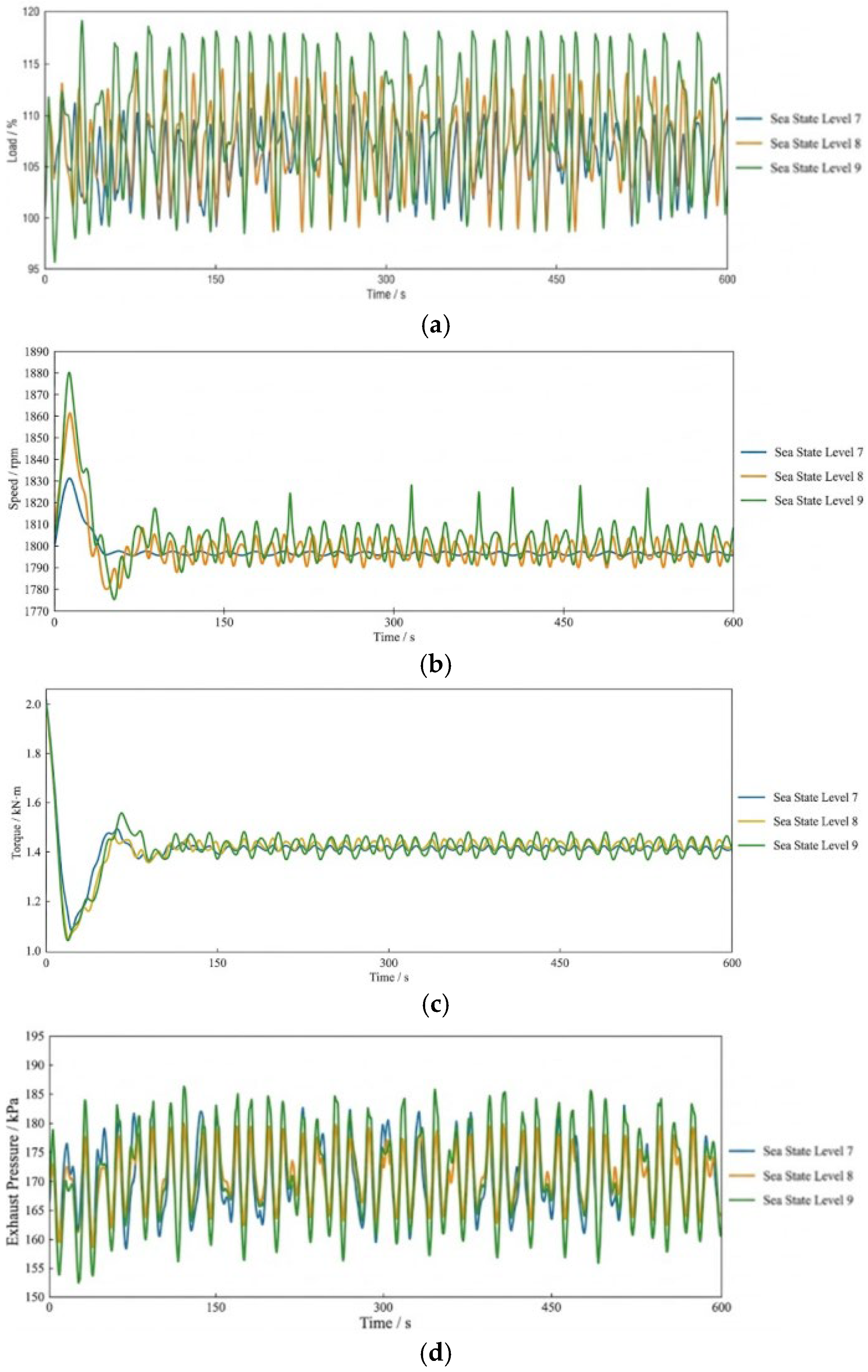
Figure 7 shows the temporal variation in engine parameters under different sea state levels.
Figure 7a shows the comparison curve of engine load response under different sea conditions. Research has shown that engine load fluctuates periodically with waves, and the amplitude of the fluctuation is positively correlated with the level of sea conditions. At level 7 sea conditions, the load fluctuation range is 95% to 108.5%, with an average of about 102%; under level 8 sea conditions, the load range has expanded to 94~113.2%, with an average increase of about 104%; and under level 9 sea conditions, the load fluctuates violently between 96.2% and 118.5%, and frequently exceeds the rated power, entering an overloaded operating state. The fundamental reason for this phenomenon is that as the significant wave height and wind speed increase, the additional wave resistance increases nonlinearly, and the longitudinal and vertical motion of the ship intensifies. The inflow velocity of the propeller undergoes significant periodic changes, resulting in a significant increase in the instantaneous peak value of the propeller load torque.
Figure 7b shows the comparison curve of engine speed response under different sea conditions. Research has shown that the engine speed response exhibits a clear reverse adjustment characteristic with the load. When the load suddenly increases, the propeller torque instantly increases, and the engine output torque cannot immediately follow due to the inertia of the turbocharger and the delay of the governor integration, resulting in negative torque surplus, shaft deceleration, and speed decrease; on the contrary, when the propeller is lifted out of the water due to wave action, causing a sudden decrease in load, the engine output torque lags behind and falls back, forming a positive torque surplus, and the speed rapidly increases. The speed fluctuation range under level 7 sea conditions is 1780–1850 r/min, which expands to 1780–1870 r/min under level 8 sea conditions, and further intensifies to 1780–1880 r/min under level 9 sea conditions. The intensification of speed fluctuations not only increases the regulation burden of the speed control system but also reflects the serious interference of frequent water inflow and outflow of propellers on the dynamic stability of the shaft system under high sea conditions.
This is because when the load suddenly increases, the propeller’s immersion depth increases due to wave action, and when the inflow conditions improve, the propeller’s load torque instantly increases. Due to the limitation of the fuel injection system and turbocharger inertia on the engine output torque, it cannot instantly follow load changes, resulting in the engine output torque being less than the propeller load torque, the net torque being negative, the shaft system decelerating, and the speed decreasing. When the load suddenly decreases and the propeller is lifted out of the water or enters a shallow immersion state, the load torque of the propeller decreases sharply, while the output torque of the engine remains at a high level due to the lag of the integral effect of the governor, forming a positive torque surplus where the output torque of the engine is greater than the load torque of the propeller, accelerating the shaft system and increasing the speed.
Figure 7c shows the comparison curve of engine torque response under different sea conditions. Research has shown that engine torque and load fluctuations maintain a highly positive response. The peak torque at level 7 sea conditions is about 2.0 kN·m, while at level 8 sea conditions, it rises to about 2.1 kN·m. Although the peak torque at level 9 sea conditions has not significantly increased (about 2.1 kN·m), the frequency of fluctuations has significantly increased. The main reason for the limited peak torque is the intervention of the smoke limiter in the engine’s electronic control system: when the fuel injection volume increases rapidly but the intake volume is insufficient, the control system actively limits the circulating fuel supply to prevent excessive carbon smoke emissions caused by a low air-fuel ratio. Therefore, the peak torque does not increase infinitely under level 9 sea conditions, but the high-frequency torque alternation may increase the mechanical stress on the crankshaft, suggesting a potentially higher risk of fatigue damage. Nevertheless, a full fatigue life assessment would require detailed stress analysis and material-specific S-N curves, which are beyond the scope of this 0D system-level model. Hence, this statement is intended as a qualitative engineering warning rather than a quantitative fatigue prediction.
Figure 7d shows the comparison curve of engine exhaust pressure response under different sea conditions. Research has shown that exhaust pressure exhibits non-monotonic changes with increasing sea condition levels. Under level 7 sea conditions, the exhaust pressure fluctuates steadily between 163 and 188 kPa, synchronized with the load, reflecting the normal release of exhaust energy. At level 8 sea conditions, the discharge pressure rapidly increases to 162–287 kPa, with a peak lag of about 0.5–1.0 s behind the load peak. The physical mechanism of this leap lies in the sudden increase in fuel injection during high loads, but the turbocharger cannot synchronously increase the air supply due to rotor inertia, resulting in a severe decrease in air-fuel ratio and exacerbating post-combustion phenomena. The incompletely burned fuel may continue to oxidize and release heat in the exhaust pipe, potentially forming a ‘secondary combustion’ effect, which could contribute to the observed abnormal rise in exhaust pressure. However, due to the limitations of the 0D modeling approach (e.g., no spatial resolution in the exhaust manifold), this interpretation remains tentative and should be validated with higher-fidelity simulations or experimental measurements. At the same time, high-frequency pressure oscillations indicate that the compressor is approaching the surge boundary. At level 9 sea conditions, the discharge pressure drops to 155–184 kPa, with a peak significantly lower than that of level 8. This is because under extreme sea conditions, frequent water discharge from the propeller leads to a sudden drop in load, and the electronic control system quickly reduces the circulating fuel injection through the smoke limiter, suppressing the afterburning intensity; simultaneously, intense alternating loads cause the engine to remain in a non-steady state for a long time, resulting in a decrease in average exhaust energy. However, the frequency of pressure fluctuations significantly increases, reflecting the intensification of load alternation. In summary, the response of exhaust pressure to sea conditions reveals the dual risks of post-combustion and surge in the turbocharging system under medium to high sea conditions, as well as the pressure drop characteristics after fuel supply limitation under extreme sea conditions.
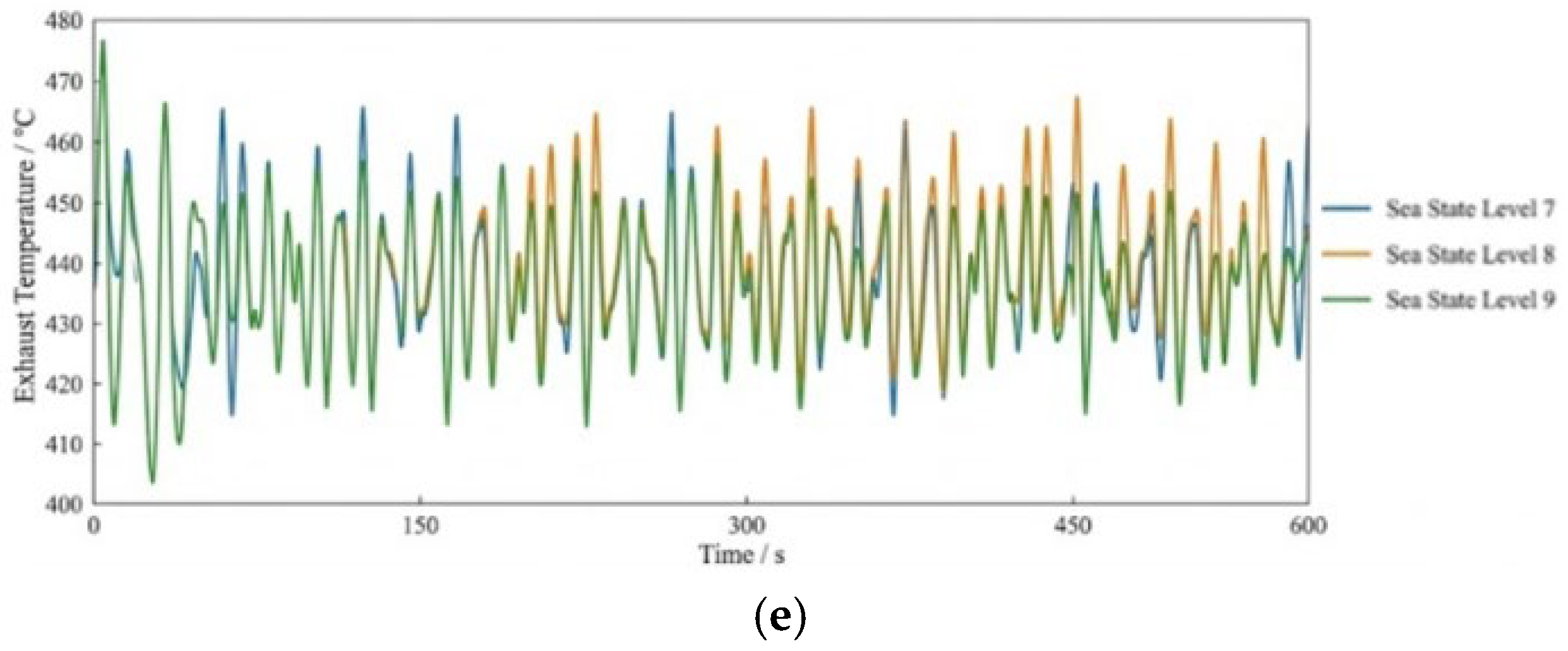
Figure 7e shows the comparison curve of engine exhaust temperature response under different sea conditions. The study shows that the exhaust temperature follows the load positively, but the fluctuation amplitude increases significantly with the increase in sea condition level. Under level 7 sea conditions, the exhaust temperature fluctuates between 410 and 476 °C, with a lag load of about 2–3 s, due to the thermal inertia of the exhaust system. Under level 8 sea conditions, the temperature fluctuation range of the discharge expands to 403~476 °C, the lower limit decreases to 403 °C, and a “secondary peak” lasting for 5~8 s appears after the load peak. The physical mechanism of this phenomenon is that when the load suddenly increases, the fuel injection quantity increases instantaneously, but the turbocharger lags behind, resulting in insufficient intake and a decrease in air-fuel ratio. Some fuel continues to burn in the later stage of expansion and in the exhaust pipe, forming afterburning, which keeps the exhaust temperature high even after the fuel injection quantity is reduced. The upper limit is constrained by the smoke limiter and cooling system and has not exceeded 476 °C. Under level 9 sea conditions, the range of temperature fluctuations in emissions further expands to 385~472 °C, with the lower limit dropping to 385 °C and the upper limit slightly decreasing. The significant decrease in the lower limit is due to the extreme load drop caused by frequent water discharge from the propeller: the load torque instantly disappears, the governor quickly reduces the fuel injection amount, the combustion in the cylinder is almost interrupted, and the exhaust temperature drops sharply. The upper limit cannot exceed level 7 sea conditions, which is also limited by the smoke limiter protection logic. The exhaust temperature curve shows more high-frequency and small amplitude fluctuations under level 9 sea conditions, reflecting the randomness of load changes and combustion instability. The fluctuation amplitude of exhaust temperature can be an important indicator for evaluating transient air-fuel ratio imbalance and combustion stability.
4.3. Frequency Domain Characteristics
The frequency domain simulation of the engine aims to reveal the dynamic response characteristics of the system to periodic excitations. Its core objectives include: identifying the natural frequencies and modes of the structure, and avoiding resonance dangerous speeds; obtaining frequency response function, evaluating vibration transmission path and isolation performance; based on feature frequency separation of excitation sources, achieving precise traceability of NVH problems; extracting power spectral density as an input condition for fatigue life estimation; and simultaneously providing amplitude frequency and phase frequency characteristics for active control systems, ensuring closed-loop stability.
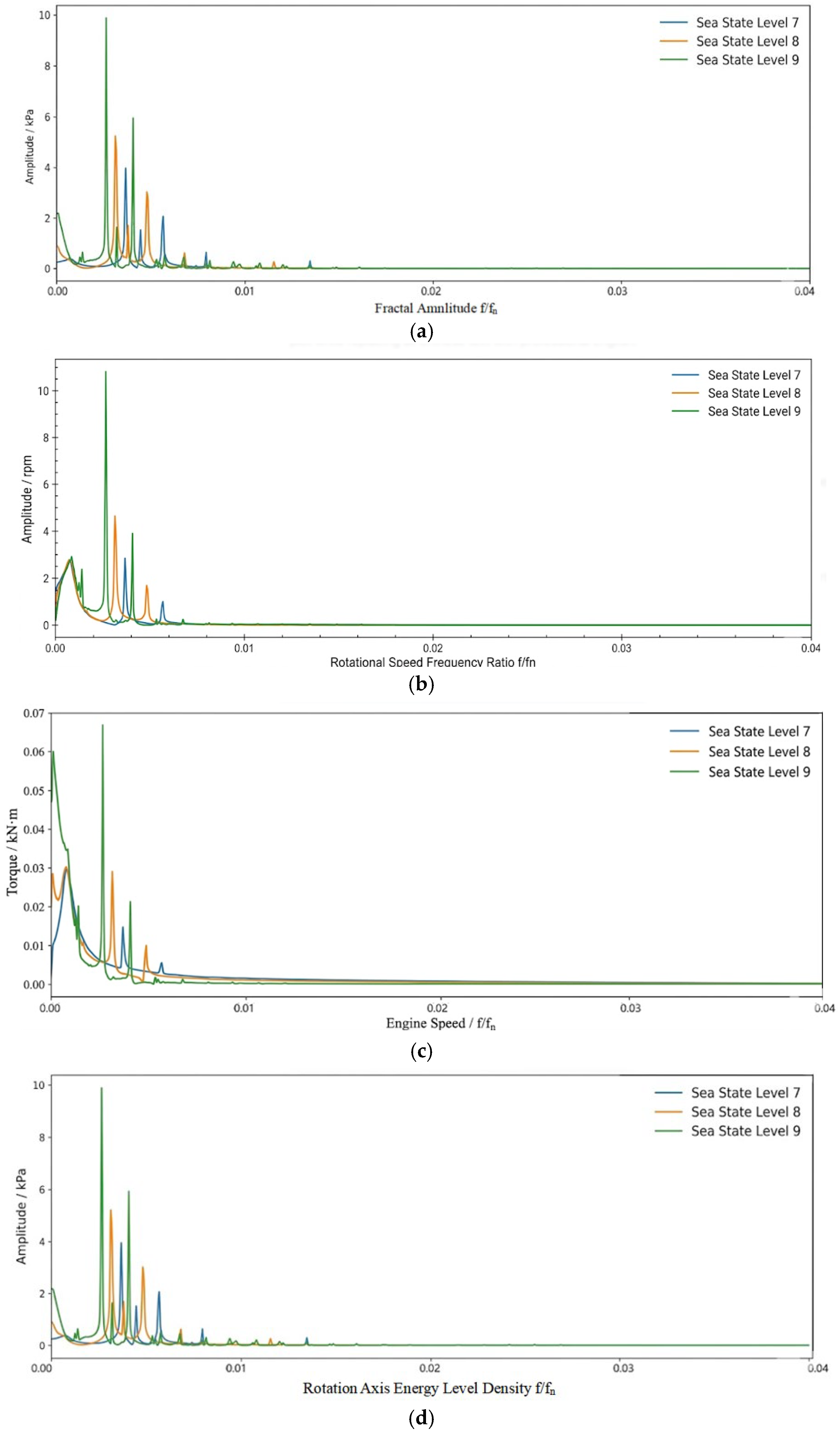
Figure 8a shows the comparison curve of engine torque frequency ratio under different sea conditions. The research shows that under the conditions of seven, eight and nine sea conditions, the engine load fluctuates greatly under the condition of low frequency ratio and slightly under the condition of high frequency. When the frequency ratio is greater than 0.01, it basically maintains a stable state. At a low frequency ratio, the fluctuation amplitude increases with the increase in sea breeze level, and the main peak value is concentrated in the low frequency band, and the amplitude increases synchronously with the sea state level. The load fluctuation amplitude increases nonlinearly with the sea state level, and the main peak value amplitude is about 12% under the 9-level sea state, 2 times of the 7-level sea state, and 1.5 times of the 8-level sea state, indicating that the engine combustion process is aggravated by the load fluctuation with the increase in wind level under high sea state. It reflects the nonlinear coupling effect of wave and ship pitching motion. The broadening trend of the load spectrum shows that the load borne by the power system under high sea conditions no longer presents a single frequency feature, but contains richer low-frequency modulation components, which puts forward higher requirements for the fatigue assessment of the shafting.
Figure 8b shows the comparison curve of engine speed frequency ratio under different sea conditions. The research shows that under the conditions of seven, eight and nine sea conditions, the fluctuation of engine load speed is relatively large under the condition of low frequency ratio, and small under the condition of high frequency. When the frequency ratio is greater than 0.01, it basically maintains a stable state. At a low frequency ratio, the fluctuation amplitude increases with the increase in sea breeze level, and the speed fluctuation amplitude increases nonlinearly with the sea state level. The main peak value of level 9 sea state is about 3.7 times that of level 7 and 2.3 times that of level 8. This result shows that the increase in wave height not only enlarges the amplitude of speed fluctuation but also significantly enhances the energy injection of low-frequency disturbance, and the speed regulation system is facing more severe speed maintenance challenges in high sea conditions.
Figure 8c shows the comparison curve of engine torque frequency ratio under different sea conditions. The research shows that under the conditions of seven, eight and nine sea conditions, the engine load torque fluctuates greatly under the conditions of low frequency ratio and small under the conditions of high frequency. When the frequency ratio is greater than 0.01, it basically maintains a stable state. At a low frequency ratio, the fluctuation amplitude increases with the increase in sea breeze level, the main peaks are concentrated in the low frequency band, the amplitude increases synchronously with the sea state level, and the amplitude of subharmonic wave increases synchronously with the sea state level, reflecting the nonlinear characteristics of wave load (enhanced coupling effect on torque). The nonlinear load effect of a dynamic system under high sea state cannot be ignored. The appearance of subharmonic means that the torsional load on the shaft system no longer presents a simple sinusoidal form, but contains more complex periodic impact components, which has important warning significance for the fatigue life assessment of the crankshaft.
Figure 8d shows the comparison curve of engine exhaust pressure frequency ratio under different sea conditions. The research shows that under the sea conditions of level 7, 8 and 9, the exhaust pressure energy is also concentrated in the low frequency band, and the main peak frequency is consistent with the load. It is verified that the exhaust pressure is mainly controlled by the combustion state in the cylinder and the release rate of exhaust energy. However, the exhaust pressure spectrum shows unique characteristics in the 8-level sea state: the amplitude of the main peak is about 1.8 times higher than that in the 7-level sea state, and there is an obvious secondary peak in the intermediate frequency band with the frequency ratio of about 0.02~0.03. Combined with the abnormal rise of the exhaust pressure peak in the level 8 sea state in the time domain (
Figure 7d) and the phenomenon of high-frequency small amplitude oscillation, it can be inferred that the medium frequency component corresponds to the flow instability characteristics of the compressor surge precursor. When the load fluctuates violently, the exhaust energy pulse will impact the turbine periodically, and the turbine speed will fluctuate, which will cause the compressor operating point to cross the stable boundary and induce pressure medium frequency oscillation. Under the 9-level sea state, due to the frequent intervention of the smoke limiter to reduce the fuel injection, the average exhaust energy decreased, and the main peak value of the pressure spectrum fell back to the level close to the 7-level sea state, but the spectral width increased slightly, reflecting the strong unsteady characteristics of the combustion process. The above analysis shows that the frequency domain characteristics of exhaust pressure can be used as an effective index to monitor the transient stability of the turbocharger.
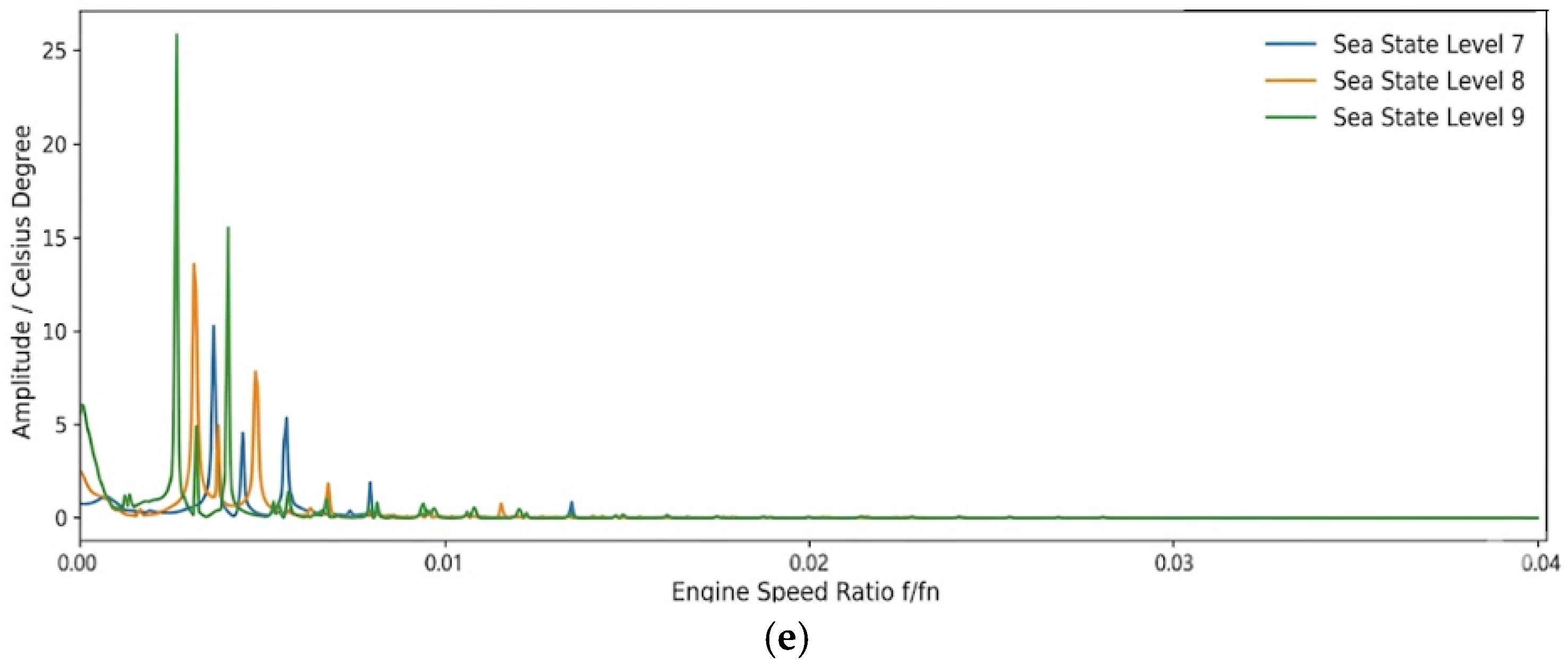
Figure 8e shows the comparison of exhaust gas temperature frequency ratio under different sea conditions. Unlike exhaust pressure, the temperature spectrum exhibits a broader low-frequency peak with no distinct intermediate-frequency component. The main peak amplitude increases by approximately 35% from Sea State 7 to Sea State 9, but the spectral shape remains similar across conditions, indicating that temperature responds more slowly and filters out higher-frequency excitations due to thermal inertia of the exhaust system components.