Article

Simulation of a Four-Stroke Diesel Engine for Propulsion in Wave

Faculty of Maritime and Transportation, Ningbo University, Ningbo 315211, China
*
Author to whom correspondence should be addressed.
Algorithms 2026, 19(5), 421; https://doi.org/10.3390/a19050421
Submission received: 14 April 2026 / Revised: 16 May 2026 / Accepted: 18 May 2026 / Published: 21 May 2026

Abstract

With the development of shipping to harsh marine environment, it is very important to understand the transient behavior of a marine diesel engine in high sea conditions. Wave-induced hull motion will lead to severe load fluctuations and air-fuel ratio imbalance. In this study, an integrated simulation platform coupled with environmental loads, hull dynamics, propeller characteristics and a high-fidelity thermodynamic engine model was constructed to explore the response characteristics of the propulsion system. The model integrates a zero-dimensional multi-zone combustion method, turbocharger dynamic characteristics and an incremental PID governor, and has been verified based on the bench test data of TBD234V12 diesel engine and the 20 m Wigley standard ship. The simulation results under the sea conditions from level 7 to 9 show that the transient load has a nonlinear amplification effect. Specifically, from sea state 7 to sea state 9, the engine load fluctuation range expands by 2.0 times, while the main peak amplitude of speed fluctuation increases by 3.7 times. Furthermore, the peak exhaust pressure rises by 1.8 times, and the exhaust temperature fluctuation amplitude broadens by 35%. Frequency domain analysis further identified the low-frequency energy concentration phenomenon in the exhaust pressure spectrum and the precursor characteristics of compressor surge. The research results quantify the deterioration law of thermodynamic stability and mechanical stress under wave disturbance, and provide an important reference for the formulation of an engine robust control strategy and fatigue life assessment under high sea conditions.

1. Introduction

In recent years, ships have consistently played an irreplaceable foundational role in modern international trade and logistics systems. However, as shipping networks extend into broader regions with more severe sea conditions, the complexity of the ship’s operating environment has significantly increased, posing serious engineering challenges to traditional marine propulsion systems [1]. These challenges include extreme load fluctuations caused by frequent propeller emergence, sharp drops in rotational speed or even engine flameout, as well as severe deterioration of pollutant emissions. These issues highlight the necessity for in-depth research on the transient characteristics of marine engines under high sea states. Given the complexity of the marine environment, ship operation assumptions based solely on steady-state characteristics have several limitations: under wave-induced violent six-degree-of-freedom motions (particularly heave and pitch), the propeller inflow conditions deteriorate sharply, causing the main engine to frequently deviate from its ideal operating point. Moreover, due to the inherent inertia lag of turbochargers, when the load changes abruptly, the air supply system struggles to respond in time, leading to a mismatch between the air and fuel paths and resulting in severe air–fuel ratio imbalance. Therefore, exploring the coupling mechanism between wave-induced ship motions and engine transient responses is key to eliminating navigation safety hazards and ensuring safe and efficient system operation [2]. Over the years, domestic and international scholars have conducted extensive research on the transient process modeling of marine engines, multi-physics coupling simulations, and dynamic responses of propulsion systems, aiming to explore feasible approaches for achieving stable control of marine power systems. Table 1 summarizes representative mechanism models and research progress on the transient characteristics of marine engines. Building on these established methodologies, the present work moves beyond a simple enumeration of existing models by specifically addressing the identified coupling gap. Unlike the black-box or system-level models, which often oversimplify thermodynamics, or the detailed CFD-coupled approaches like that of O El Moctar et al. [3], which sacrifice combustion detail for hydrodynamic fidelity, this paper develops a novel integrated platform that maintains high-fidelity thermodynamic and combustion sub-models for the engine while explicitly coupling them with a dynamic, wave-forced hull and propeller model. This approach allows for a more nuanced investigation of the two-way interaction between wave-induced load fluctuations and the engine’s internal transient responses, such as turbocharger lag and air-fuel ratio imbalance, which are critical for safe operation in high sea states.
Under high sea conditions, conducting dynamic numerical simulations of the propulsion system composed of the hull, propeller, and diesel engine holds promise as a valuable tool in the optimization design stage, thereby shortening the ship development cycle and reducing experimental costs. Indeed, a substantial body of literature has emerged, featuring system analyses carried out through simulation. For instance, the work of Kyrtatos et al. (1999) [19] and that of Campora and Figari (2005) [20] both employed high-fidelity diesel engine models—these models are capable of reproducing complex processes such as in-cylinder combustion, heat transfer, and gas exchange in a phenomenological manner. Despite being computationally intensive, they offer detailed perspectives on engine behavior under dynamic loads.
O El Moctar et al. (2014) [21] proposed a unique approach: coupling Computational Fluid Dynamics (CFD) analysis with a dynamic engine model. It is worth noting that in that study, the diesel engine was simplified into a parametric model, retaining only the mechanical dynamic characteristics of the system (i.e., disregarding thermodynamic details such as combustion and gas exchange). However, it is precisely this simplification that enabled the model to provide appropriate boundary conditions—for example, real-time variations in rotational speed and torque output—for the CFD analysis, thereby successfully simulating the dynamic response of the ship and its propulsion system during sea trials under mild sea conditions. In other words, this method strikes a practical balance between fidelity and computational cost, rendering it particularly suitable for rapid iterations in the early design stage.
Based on the literature review, this paper develops an integrated simulation platform featuring deep coupling of “environment, hull, propeller, and engine” for marine propulsion systems. Using engine bench test data, the thermodynamic simulation model of the engine is validated. On this basis, computational simulation methods are employed to thoroughly investigate the engine’s transient response characteristics under different sea state levels, and to systematically evaluate its dynamic behavior and thermodynamic performance. The findings provide an effective reference for engine control under high sea state conditions.
The remainder of this paper is organized as follows: Section 2 establishes models of the marine engine and the high sea state environment. Section 3 performs model validation and sensitivity analysis. Section 4 simulates marine engine parameters under different sea state levels and analyzes the simulation data. Section 5 discusses theoretical advantages, limitations, and future directions for empirical validation.

2. Model Establishment

2.1. Modeling of Marine Engines

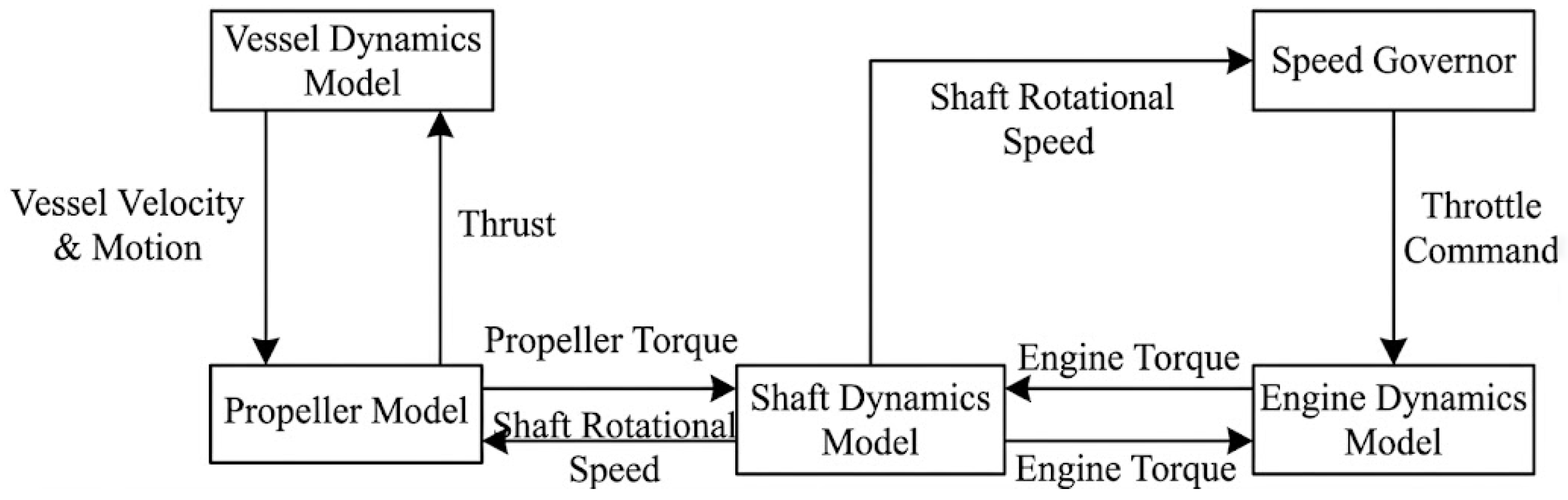
A marine engine is a thermodynamic and dynamic model that incorporates various physical and chemical changes. Furthermore, to simulate its transient response, the engine system model should include components such as the mechanical shaft and governor. Figure 1 illustrates the configuration of the integrated propulsion system model. In this model, five key components—namely, the hull, propeller, mechanical shaft, diesel engine, and governor (or speed regulator)—are coupled and interact with each other, collectively determining the system’s dynamic behavior. It is worth noting that the governor itself does not participate in any form of energy exchange; that is, it neither extracts mechanical energy from the system nor delivers energy to other components. Nevertheless, it plays an irreplaceable role in the transient behavior of the diesel engine.

2.1.1. Thermal Process Analysis of Each Stage in the Cylinder

1. Compression phase
During the compression phase, the air valves are closed. If the loss of gas such as air leakage is ignored, it is considered that the quality of working fluid in the cylinder will no longer change with time. The working fluid is treated as an ideal gas with constant specific heats. During the compression phase, the valves are assumed to be perfectly sealed, resulting in a constant mass system with no mass flow across the cylinder boundary; that is:
d m s d φ = 0 , d m e d φ = 0 , d m B d φ = 0
The mass conservation equation can be simplified as:
d m d φ = 0
The compression process is considered adiabatic, implying no heat transfer between the in-cylinder gases and the cylinder walls. This simplification is acceptable for initial calculations but is refined later using the Woschni correlation for heat transfer in the full model. The differential equation can be simplified as:
d T d φ = 1 m c v d Q w d φ p d V d φ
2. Combustion phase
Combustion plays a key role in the working process of a marine engine cylinder, including fuel injection, combustible mixture formation, ignition trigger, and a series of complicated physical changes and chemical reactions. At this stage, the gas valve is also closed, and the expression of the mass conservation equation can be simplified as:
d m s d φ = 0 , d m e d φ = 0
To calculate the change in fuel quality in the cylinder, it is necessary to obtain the injection law in advance. According to the thermodynamic hypothesis, the combustion process can be approximately regarded as a process of releasing heat into the cylinder according to the established heat release law; based on this, it can be further considered that the change in fuel quality only occurs after fuel ignition, and its change rate is proportional to the change in combustion heat release rate. The combustion phase is modeled using a single-zone approach, which assumes the cylinder contents are perfectly mixed and have a uniform temperature and pressure at any given time. The combustion process is represented by a prescribed heat release rate law, which is decoupled from the detailed fuel spray and mixing dynamics. Then, there is the following formula:
d m d φ = d m B d φ = g f · d x d φ
The differential equation of combustion stage can be simplified as:
d T d φ = 1 m c v m gas H u d x d φ + d Q w d φ P d V d φ
3. Compression phase
During the expansion phase, the gas valves are closed, and there is no fuel combustion in the cylinder. The piston descends and the engine does external work. Therefore, it can be considered that the quality of the working medium in the cylinder does not change. Therefore, there are:
d m s d φ = 0 , d m e d φ = 0 , d m B d φ = 0 , d m d φ = 0
The energy conservation equation in the expansion stage can be simplified as:
d T d φ = 1 m c v d Q w d φ p d V d φ
4. Pure air intake phase
At this stage, fresh air enters the cylinder, but no gas is discharged. There is mass and heat exchange between the cylinder and the outside world, and the thermal process in the cylinder is relatively complex. At this stage, the working medium in the cylinder does not burn but the mass of the working medium increases, so the mass conservation equation and energy conservation equation can be approximately simplified as:
d T d φ = 1 m c v d Q w d φ p d V d φ + ( h s u ) d m s d φ
5. Inlet and exhaust stack stage
At this stage, when fresh air enters the cylinder, the exhaust gas in the cylinder is also discharged, but there is no fuel injection into the cylinder and no combustion reaction. Therefore, the mass conservation equation in the cylinder at this stage can be approximately expressed as:
d m d φ = d m s d φ + d m e d φ
The energy conservation equation at the stage of overlapping inlet and exhaust valves can be approximately simplified as:
d T d φ = 1 m c v d Q w d φ p d V d φ + ( h s u ) d m s d φ + ( h e u ) d m e d φ
6. Simple exhaust phase
At this stage, the intake valve is closed, so the mass of the working medium in the cylinder decreases. However, since there is no fuel injection, the mass conservation equation at this stage can be approximately expressed as:
d m d φ = d m e d φ
The energy conservation equation in the simple exhaust phase can be approximately simplified as:
d T d φ = 1 m c v d Q w d φ P d V d φ + ( h e u ) d m e d φ

2.1.2. Exhaust Gas Turbocharger

Axial flow constant pressure turbine is widely used in diesel engines, and its ideal thermodynamic process is the isentropic expansion of working fluid without heat loss. The working state of the turbine is usually determined by four independent parameters: the expansion ratio of the turbine, the mass flow of the working medium, the efficiency of the turbine and the output work of the turbine.
Among them, the expansion ratio is the basic performance parameter of the turbine, that is, the ratio of the total pressure at the turbine inlet to the static pressure at the turbine outlet:
π k = P T P T 0
The power generated by the turbine can be calculated by the following formula:
d m T d t = u t · F r e s · 2 · P T · ρ T · φ
W T = η T · d m T · k k 1 · R T T 0 1 P T 0 P T k 1 k
u t = 0.49 + 0.46 π T 0.08 π T 2
If the flow is subcritical, there are [22]:
φ = k k 1 P T 0 P T 2 k · 1 P T 0 P T k 1 k
Conversely:
φ = k k + 1 2 k + 1 2 k 1
The critical pressure calculation formula is:
d T B d φ = 1 c · m B d m T d φ · h T + i = 1 n d m e d φ · h e c · T B · d m B d φ
η T η max = 0.01172 + 3.3698 u C 0 2.806 u C 0 2
C 0 = 2 · ( h T 0 h T )

2.1.3. Air Intercooler

In the turbocharged diesel engine system, in order to improve the intake air density and optimize the supercharging effect, the intake air is usually intercooled. In this paper, the calculation model of intercooler outlet air temperature is established by reasonably selecting the cooling coefficient η C of the intercooler. This method can not only meet the cooling requirements but also simplify the modeling process. The specific calculation formula is as follows:
T S = T K η c T K T W S
In the process of thermodynamic system modeling, the treatment of the intercooler module often needs to make a trade-off between physical authenticity and computational efficiency. In this study, the module is defined as a typical gas interface component, and its energy and material exchange with the outside world is described by flow variables and potential variables: mass flow and enthalpy flow constitute the flow properties of the working medium, while temperature and pressure jointly define the thermodynamic potential of the working medium in the current state. It should be pointed out that under the current modeling framework, in order to make the analysis of the core heat transfer process more focused, we have made a certain degree of simplification—that is, only the temperature drop of the working medium after flowing through the intercooler is considered, and the pressure loss along the way is not included in the control equation for the time being. This means that the model accurately reflects the cooling effect and omits the potential impact of pressure drop on system back pressure and power consumption. This assumption is acceptable in the preliminary simulation stage, and its rationality depends on whether the pressure response is taken as the key evaluation index in the subsequent research [23].

2.1.4. Governor

In the actual transient simulation of a diesel engine, the dynamic behavior of the governor (i.e., its transient process) often plays a key role—it is not only one of the core factors affecting the calculation accuracy of the whole transient process but also the recognized difficulty in the simulation modeling. Because the traditional position PID control algorithm outputs the total control quantity, its calculation process must continue to accumulate historical errors, which can very easily cause significant interference to the operation of the system in the later stage of the simulation run. In contrast, the control output of the incremental PID algorithm only depends on the error value of the current and the previous two beats. This method not only effectively avoids the adverse effect of small error accumulation on the system but also reduces the probability of misoperation, thus preventing the risk of losing control of the integral. In view of this advantage, the governor model constructed in this paper selects the incremental PID control strategy. The model takes the difference between the target speed and the actual speed of the diesel engine as the input, outputs the target fuel injection quantity after being processed by the PID algorithm, and finally completes the precise adjustment of the speed of the diesel engine.
The mathematical model of incremental PID is expressed as:
u ( k ) = u ( k 1 ) + u ( k )
u ( k ) = k p [ e ( k ) e ( k 1 ) ] + k i e ( k ) + k d [ e ( k ) 2 e ( k 1 ) + e ( k 2 ) ]
In order to avoid excessive step oscillation during the initial operation of the model, the initial injection quantity u0 is given in the PID controller model, and the final output injection quantity U (k) of the governor is expressed as:
U ( k ) = u ( k ) + u 0

2.1.5. Engine Parameters

The object of this study is the TBD234V12 engine from MWM company, whose main performance parameters are shown in Table 2.

2.2. Ship Model

2.2.1. The Ship Model

When analyzing the motion of a ship based on the framework of Newtonian mechanics, its six degrees of freedom motion in space—namely, the reciprocating oscillation along three coordinate axes (pitch, sway, heave) and the rotational oscillation around three axes (roll, pitch, yaw)—are usually decomposed into six independent differential equations to construct a complete mathematical description of the ship’s dynamic behavior. However, in practical engineering applications, especially for the maneuverability issues of conventional drainage vessels, this complete model can often be reasonably simplified according to specific research scenarios. This is because in most operating conditions, the roll and pitch angles of the ship are usually limited to a small range, and its heave motion is relatively gentle, with limited impact on the motion response in the horizontal plane. Therefore, researchers usually focus on the three core degrees of freedom that determine the ship’s trajectory and heading, namely, heave, sway, and yaw, in order to significantly reduce the difficulty of solving while ensuring computational accuracy. This reduction from six degrees of freedom to three degrees of freedom reflects a classic approach in ship hydrodynamics research: while grasping the main contradiction, secondary disturbances are filtered out through reasonable physical assumptions to obtain a simplified ship motion equation:
m u ˙ v r x G r 2 = X = X + X D m v ˙ + u r + x G r ˙ = Y = Y + Y D I r ˙ + m x G v ˙ + u r = N = N + N D
In this study, only the motion in the forward direction of the ship is considered, ignoring the motion in other directions. Therefore, the ship motion model can be simplified as follows:
m + Δ m d V s d t = T s R
For the additional mass of ship motion, this study adopts an empirical formula obtained through experimental data [24]:
Δ m = m 100 0.398 + 11.97 · C b 1 + 3.73 d B 1.107 · L d B 2 + 0.175 · C b L B 2 1 + 0.541 d B 2.89 · C b L w l B 1 + 1.13 d B

2.2.2. The Ship Parameters

When studying the theory of ship engine propeller matching and its transient characteristics, the 20 m long Wigley standard ship form was selected as the research object, mainly based on its geometric regularity, academic recognition, and engineering scale representativeness. Firstly, the Wigley ship has an accurate mathematical analytical expression, and its displacement, submerged area, and various hydrodynamic coefficients can all be obtained through analytical methods. This greatly simplifies the complexity of calculating ship resistance and facilitates the focus of research on the transient response analysis of the “engine propeller shaft” power system. Secondly, as a recognized standard example in the international hydrodynamic community (such as ITTC), the Wigley ship has a vast amount of experimental data and literature support. When verifying the accuracy of numerical simulations (such as coupling CFD with one-dimensional dynamic models), this ship type can provide a reliable benchmark for comparison. Finally, choosing a 20 m scale has clear engineering application significance. The main data parameters of this ship type are shown in Table 3.

2.3. Propeller and Shaft Model

2.3.1. Propeller Model

The propeller model is a kind of resistive element with ship speed or shaft speed as input and torque and thrust as output. In this study, the Wagonengen-B series 4-blade propeller was selected in the simulation work.
The calculation relationship between propeller thrust and torque is as follows:
T s = K T ρ w n 2 D p 4
Q _ s = K Q ρ w n 2 D p 5
The value KT and KQ are functions in the advance ratio of the propeller J.
J = V a n D P
At present, there is no unified scientific calculation method for the calculation of the ship wake coefficient, and the empirical formula obtained from ship model experiment is usually used. In this experiment, according to the calculation method for the wake fraction of single and double propeller ships proposed in the relevant literature, combined with the ship model used in this experiment, the single propeller formula is used to calculate:
w s = 0.5 C b 0.05

2.3.2. Shaft Model

In the actual operation of the diesel engine, once it enters the transitional working condition (such as sudden load increase, sudden discharge or fast throttle adjustment), the speed will no longer remain constant as in the steady state. In fact, the speed change rate in this dynamic process directly depends on the unbalanced torque borne by the crankshaft—the latter comes from the coupling effect of many factors, such as the violent fluctuation of gas pressure in the cylinder, the reciprocating inertia force of moving parts and friction.
In this study, the transmission shaft sub-model mainly calculates the speed change. The momentum equation is as follows:
J · d ω d t = M t M g M f

2.4. High Sea State Environmental Model

Wave is the key interference factor that cannot be ignored in the process of ship navigation. It can not only cause the changes in ship roll and pitch but also interfere with the course and speed of the ship because of the wave drift force and moment caused by the second-order wave force. Wave is a complex parameter with typical randomness and nonlinear characteristics, so modeling is difficult. In this study, the empirical formula is used to establish the wave load [25]:
X wave = 1 2 ρ g L ξ 2 C X wave cos χ
Y wave = 1 2 ρ g L ξ 2 C Y wave sin χ
N wave = 1 2 ρ g L ξ 2 C N wave cos χ
For the range of wave conditions simulated (sea states 7 to 9, with wave heights of 2–6 m and periods of 8–16 s), the resulting flow regimes typically yield inertia-dominated forces. For a Wigley hull form, the applicable ranges for the drag coefficients are 0.6 ≤ Cx ≤ 1.2 for surge forces and 2.0 ≤ CY ≤ 3.0 for sway forces. The values used in Equations (39) and (40) are based on an average within these ranges for the given wave steepness, but their validity is constrained to the maximum wave amplitudes and encounter angles defined in Table 5. Extrapolation beyond these bounds would require a re-evaluation of the coefficients using more advanced computational fluid dynamics (CFD).
C X wave = 0.05 0.2 λ L + 0.75 λ L 2 0.51 λ L 3
C Y wave = 0.46 6.83 λ L + 15.65 λ L 2 + 8.44 λ L 3
C N wave = 0.11 0.68 λ L 0.79 λ L 2 + 0.21 λ L 3

3. Model Validation and Sensitivity Analysis

3.1. Model Steady-State Verification

According to the content of Section 2 of this article, a complete model of the ship’s hull, propeller, diesel engine, and sea conditions can be constructed, and the model can be simulated and solved. This section will conduct steady-state validation of the model under different speed and load conditions. The corresponding relationship between each load and speed is shown in Table 4:
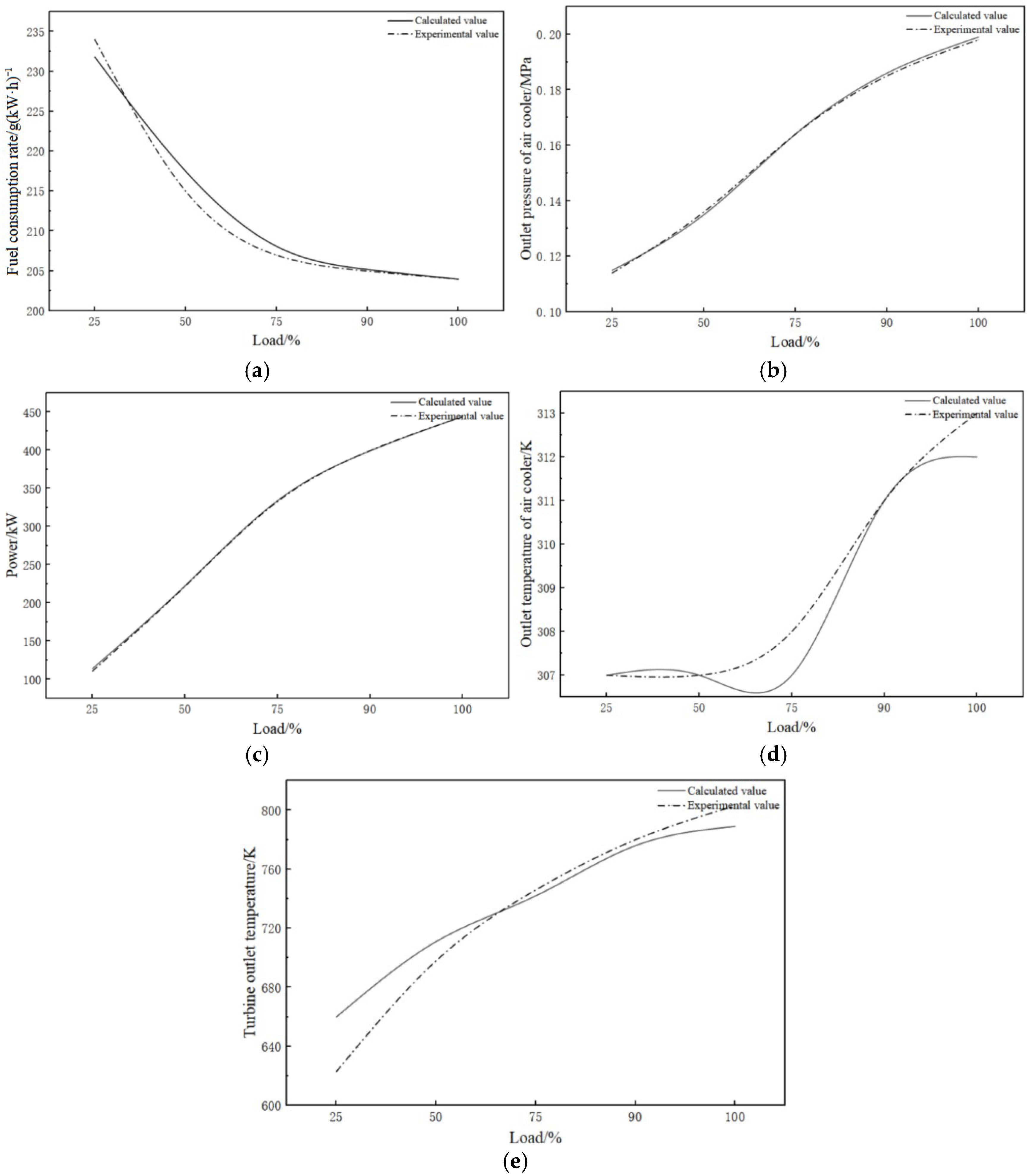
Figure 2 shows the key performance and aerodynamic thermodynamic parameter variation trends of marine engines under different load conditions. As shown in Figure 2b, with the increase in engine load, the output power shows a significant positive correlation growth trend. According to the fuel consumption curve in Figure 2a, the engine maintains good fuel economy in a wide operating range from partial load to rated load. In terms of matching the intake, exhaust, and cooling systems, Figure 2c shows that the outlet pressure of the air cooler steadily increases with the increase in load to ensure sufficient scavenging volume for combustion in the cylinder; meanwhile, the outlet temperature of the air cooler in Figure 2d is maintained within a reasonable range under the effective regulation of the cooling water system, ensuring the intake density and volumetric efficiency under high loads. In addition, Figure 2e shows that the outlet temperature of the turbine increases with the increase in load, objectively reflecting the reasonable distribution of exhaust energy and the enhancement of the turbocharger’s work capacity. Overall, the comparison of this set of parameters validates the accuracy of the simulation model in predicting thermal cycles under different loads, laying a solid physical model foundation for subsequent numerical simulations of transient characteristics of marine engines under harsh sea conditions.
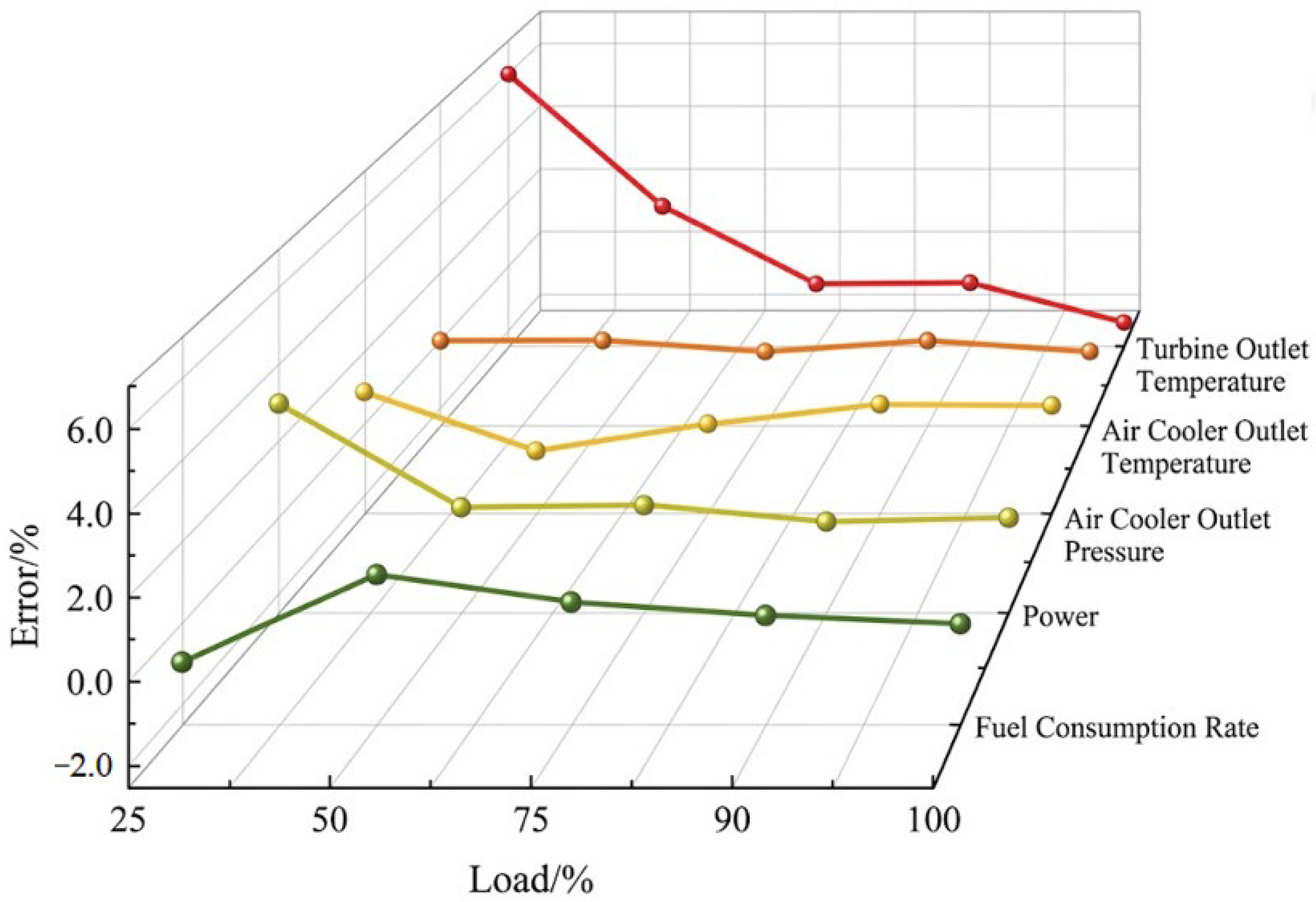
Figure 3 shows the relative error curves of key performance parameters of the simulation model of the engine under different loads (25% to 100%). Overall, the simulation model exhibits high steady-state prediction accuracy. As the engine load increases, the relative errors of various parameters rapidly decrease and show a clear convergence trend. In the medium to high load range (50% to 100%), the errors of core indicators such as fuel consumption rate, power, air cooler outlet pressure, and temperature are stably controlled within ±2.0%; among them, the prediction performance of the outlet temperature of the air cooler is the most accurate, with errors close to 0% under all operating conditions. At 25% low-load conditions, the relative errors of various parameters are relatively large, with the error of turbine outlet temperature reaching the maximum value (about 6.0%), followed by power error (about 3.0%). High simulation error under low-load conditions is a common phenomenon in one-dimensional thermodynamic simulation. Based on the actual operating mechanism of the engine, the main reasons can be attributed to the following two aspects: as the load decreases, the effective power of the engine decreases significantly, while the proportion of mechanical friction loss to the total indicated power increases significantly. The mainstream empirical friction model is not sensitive enough to the nonlinear changes in friction coefficient under low-load conditions, further amplifying the calculation errors of system effective power and fuel consumption rate; secondly, under low-load conditions, the absolute values of physical quantities such as intake and exhaust pressure and flow rate are close to the lower range limit of the bench sensor. The inherent absolute error of the instrument is mathematically amplified when converted into relative error, which makes the test benchmark values used for verification and benchmarking inherently have high uncertainty [26].
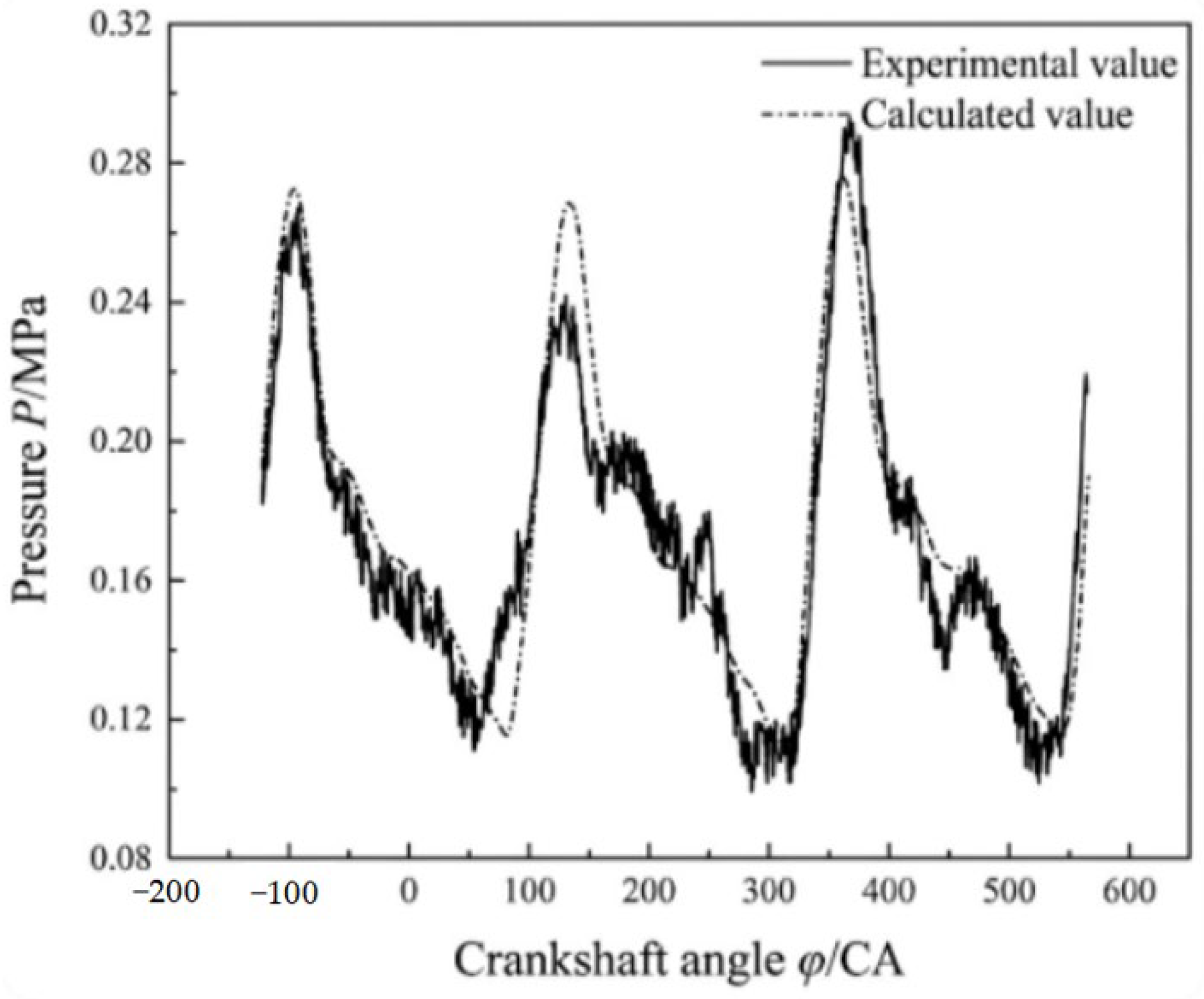
Figure 4 shows the comparison between the experimental and calculated values of the turbine front pressure as a function of crankshaft angle under rated operating conditions. As shown in the figure, the calculation model can capture the overall trend and main pulsation characteristics of pressure with crankshaft angle well, and the two have a good degree of agreement in the overall trend. However, upon careful comparison, it was found that the experimental value curve exhibited richer high-frequency fluid pressure oscillation characteristics, which may reflect more complex transient physical phenomena during the experimental process. In contrast, the calculated value curve is relatively smooth, and the ability to describe these high-frequency details is still lacking. Specifically, in certain peak areas (such as around 150 °CA), there is a certain deviation between the calculated values and the experimental values, resulting in slightly higher peak values. In the valley region, the degree of agreement between the two is relatively better. Overall, the numerical calculation model is accurate in predicting the main pressure pulsation trends, but further optimization is needed in high-frequency detail description to improve its accuracy.
It is acknowledged in the literature that 1D thermodynamic simulations often exhibit significantly higher error rates under low-load conditions, sometimes exceeding 10-15% for key parameters like power and fuel consumption. In the present study, the maximum relative error observed at 25% load is approximately 6.0% (for turbine outlet temperature). This comparatively lower error rate can be attributed to three key factors in our modeling approach. First, the TBD234V12 engine is a high-speed, medium-to-high power diesel engine that operates with relatively stable combustion even at lower loads, reducing the influence of misfire or cycle-to-cycle variations common in low-speed, large-bore engines. Second, our model employs a modified Woschni heat transfer correlation with load-dependent tuning constants, which has been recalibrated using the specific engine’s low-load bench test data. This recalibration partially compensates for the empirical model’s insensitivity to low-load friction and heat transfer nonlinearities. Third, the reported errors are relative to the experimental benchmark; as noted, the absolute measurement uncertainties in the bench sensors at low loads are mathematically amplified when computing relative errors, meaning the absolute deviation between model and reality is smaller than the relative percentage suggests. Nonetheless, the authors acknowledge that the 6% error at 25% load, while acceptable for the scope of this transient analysis focused on high loads, still represents a model limitation that should be addressed in future work, possibly through a more detailed mechanical friction sub-model.

3.2. Sensitivity Analysis

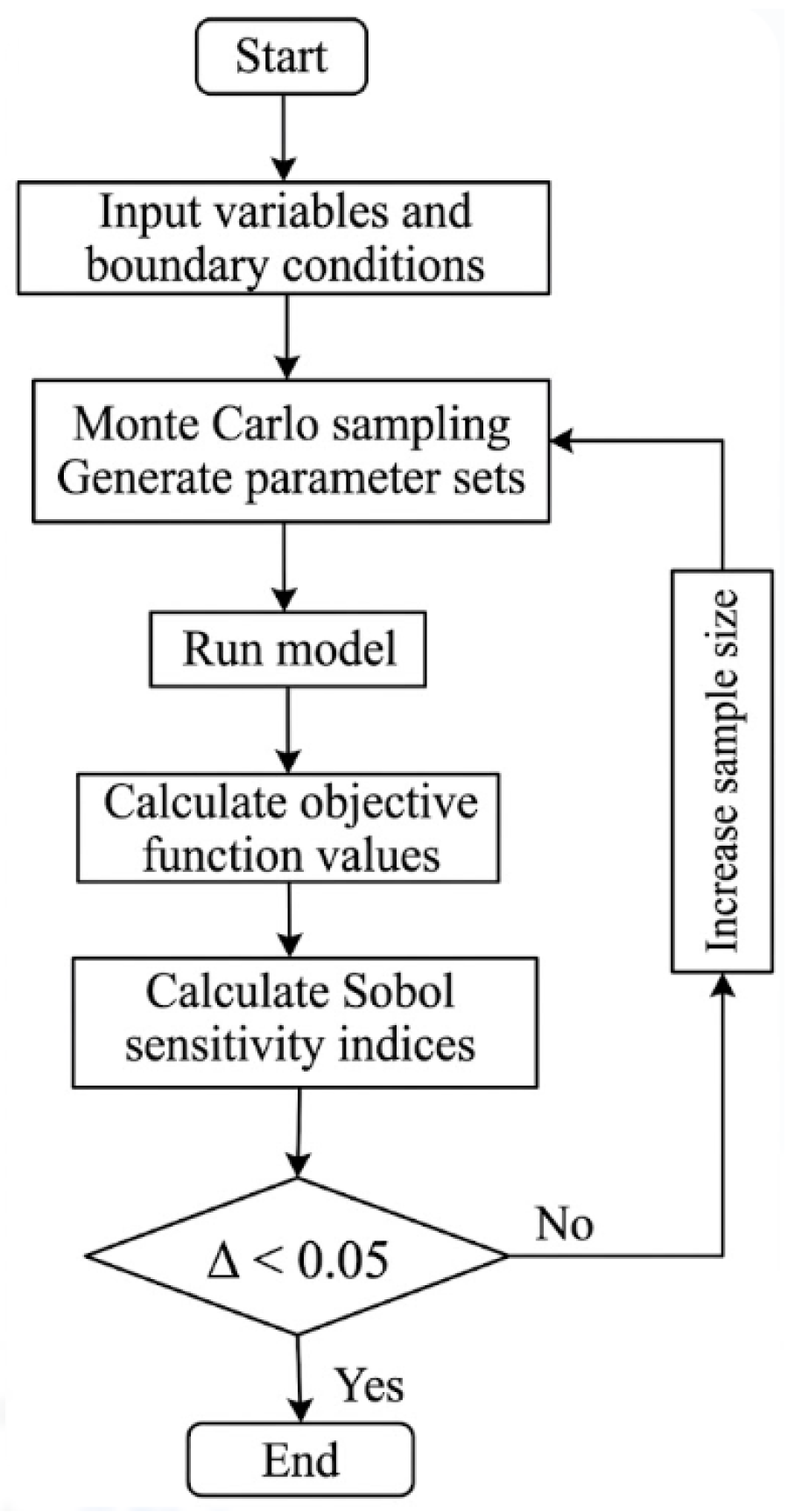
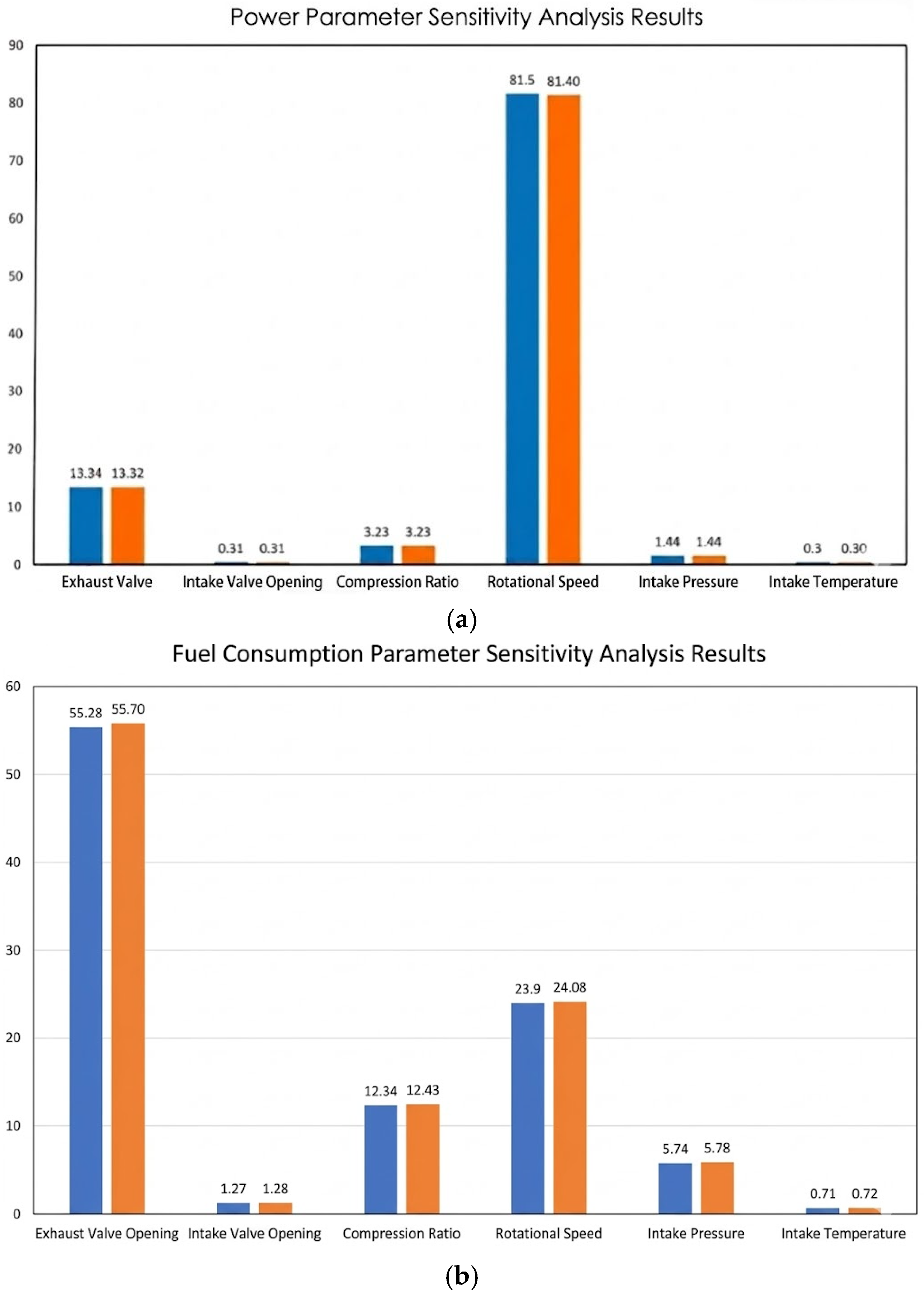
After the establishment of the theoretical framework and characteristic variables, the key step that follows is how to scientifically and rigorously implement this analysis process, in order to accurately calculate the first-order sensitivity index and total effect index of each parameter. Based on the parameter sensitivity theory and engine system simulation model established in the early stage, the entire calculation process is transformed into a simulation loop that includes parameter dimension setting, value range division, and data interaction. At the specific implementation level, the entire analysis work can be summarized into the following highly correlated systematic steps: firstly, it is necessary to strictly confirm the operating parameters, internal structural parameters, and external physical boundary conditions of the engine, which is a prerequisite for ensuring simulation accuracy. Subsequently, in order to obtain representative data with statistical significance in the multidimensional parameter space, the Monte Carlo method (in Figure 5) was introduced to perform random sampling on the feature parameters. Based on the sampling results, the system not only generates a large set of model evaluation samples and drives the model to run but also constructs corresponding sets of sensitivity analysis parameters for feature parameters. To quantify the uncertainty of the estimated sensitivity indices, 1000 bootstrap resamples were generated from the Monte Carlo output. The 95% confidence intervals for the first-order and total effect indices were computed and are reported alongside the point estimates in Figure 6. These intervals were generally within ±2.5% of the point estimates, indicating robust sensitivity rankings. Finally, after selecting the applicable global sensitivity calculation method, the sensitivity indices were systematically solved and output, intuitively revealing the quantitative impact of multi-source input variables on engine performance characteristics.
Analyzing the dynamic response characteristics of engine power, as shown in Figure 6a, the sensitivity of each core control parameter to power output exhibits a significant hierarchical distribution, with engine speed showing an absolute dominant position. Its first-order sensitivity coefficient and total effect coefficient are as high as 81.55% and 81.56%, respectively. The high consistency of the two values indicates that the influence of speed on power has strong independence, and the nonlinear interaction between speed and other parameters is weak and negligible. From the thermodynamic mechanism of power output, under the premise of maintaining a constant fuel injection quantity, the increase in rotational speed directly increases the frequency of thermal cycle work per unit time, thereby having a globally decisive impact on the total output power of the system. Secondly, the exhaust valve opening angle is the second most important adjustment parameter, with first-order and total effect sensitivity coefficients of 13.35% and 13.28%, respectively. This is mainly due to the fact that the exhaust timing directly determines the effective work length of the expansion stroke. A reasonable opening time can maximize the extraction of the expansion work of high-temperature and high-pressure gas in the cylinder, thereby generating an undeniable positive gain in output power. In contrast, the sensitivity coefficients of other intake parameters such as valve opening angle and intake temperature are all below 5%. This indicates that within the set parameter perturbation range, such variables that mainly affect the intake charge have a relatively weak direct intervention effect on the combustion itself and energy conversion process in the cylinder, and the overall optimization space is limited. In summary, engine power exhibits a strong monotonic dependence on input characteristic parameters. In subsequent transient power calibration and optimization strategies, a hierarchical dimensionality reduction control approach should be adopted: using speed as the core control variable that determines the benchmark power output, supplemented by fine feedforward adjustment of exhaust valve opening timing, in order to deeply explore the maximum output potential of the engine under complex operating conditions.
Figure 6b shows the distribution of first-order and global sensitivity coefficients. From this, it can be seen that the exhaust valve opening angle has the most significant impact on fuel consumption rate, with first-order and global sensitivity coefficients as high as 55.28% and 55.81%, respectively. This result indicates that the opening timing of the exhaust valve plays a crucial role in the combustion process, as it directly determines the utilization efficiency of gas energy in the cylinder. When the exhaust valve opens later, the gas can expand more fully in the cylinder to do work, thereby improving energy utilization and reducing fuel consumption; on the contrary, premature opening will result in some high-temperature and high-pressure gas not fully participating in the work and being discharged from the cylinder, causing energy loss and increasing fuel consumption. Therefore, the opening angle of the exhaust valve has a crucial impact on fuel consumption control.
The engine speed also has a strong influence, with first-order and global sensitivity coefficients reaching 23.5% and 23.89%, respectively. This indicates that changes in rotational speed not only affect intake flow and combustion rate but also, to some extent, affect fuel consumption by altering the charging efficiency and mechanical losses per cycle. The sensitivity coefficients of compression ratio and intake pressure both exceed 5%, which means that adjusting these parameters will also have a substantial impact on fuel consumption and should not be ignored.
In contrast, the first-order and global sensitivity coefficients of the intake valve opening angle and intake temperature are close to zero, indicating that under current engine operating conditions, the impact of these two parameters on fuel consumption rate can be almost ignored. In other words, although they may affect the intake charge or combustion start time under certain operating conditions, their regulatory effect on fuel consumption is not significant within the parameter variation range set in this study.
Overall, the opening angle of the exhaust valve is undoubtedly the most influential parameter, and its control over fuel consumption comes from fundamental intervention in the process of gas work. This discovery provides a clear direction for optimizing engine thermal efficiency in the future, and also provides a theoretical basis for parameter selection and calibration work.

4. Discussion

4.1. Simulation Condition Setting

In order to study the influence of different wind levels on the acceleration performance of ship diesel engines, this paper conducted three simulation experiments with sea conditions of 7, 8, and 9.
Partial input parameter settings are shown in Table 5 and Table 6:

4.2. Time Domain Response Analysis

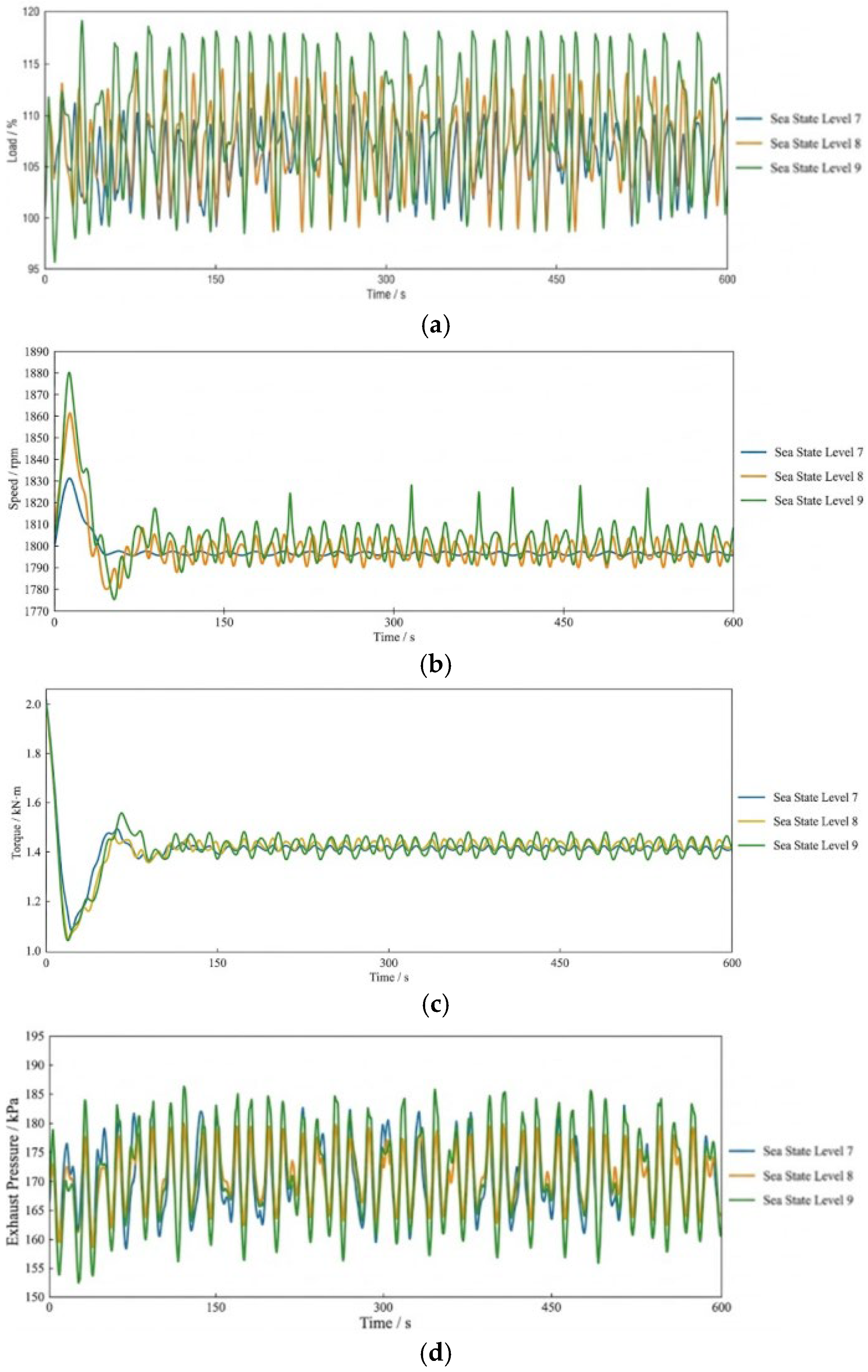
Figure 7 shows the temporal variation in engine parameters under different sea state levels. Figure 7a shows the comparison curve of engine load response under different sea conditions. Research has shown that engine load fluctuates periodically with waves, and the amplitude of the fluctuation is positively correlated with the level of sea conditions. At level 7 sea conditions, the load fluctuation range is 95% to 108.5%, with an average of about 102%; under level 8 sea conditions, the load range has expanded to 94~113.2%, with an average increase of about 104%; and under level 9 sea conditions, the load fluctuates violently between 96.2% and 118.5%, and frequently exceeds the rated power, entering an overloaded operating state. The fundamental reason for this phenomenon is that as the significant wave height and wind speed increase, the additional wave resistance increases nonlinearly, and the longitudinal and vertical motion of the ship intensifies. The inflow velocity of the propeller undergoes significant periodic changes, resulting in a significant increase in the instantaneous peak value of the propeller load torque.
Figure 7b shows the comparison curve of engine speed response under different sea conditions. Research has shown that the engine speed response exhibits a clear reverse adjustment characteristic with the load. When the load suddenly increases, the propeller torque instantly increases, and the engine output torque cannot immediately follow due to the inertia of the turbocharger and the delay of the governor integration, resulting in negative torque surplus, shaft deceleration, and speed decrease; on the contrary, when the propeller is lifted out of the water due to wave action, causing a sudden decrease in load, the engine output torque lags behind and falls back, forming a positive torque surplus, and the speed rapidly increases. The speed fluctuation range under level 7 sea conditions is 1780–1850 r/min, which expands to 1780–1870 r/min under level 8 sea conditions, and further intensifies to 1780–1880 r/min under level 9 sea conditions. The intensification of speed fluctuations not only increases the regulation burden of the speed control system but also reflects the serious interference of frequent water inflow and outflow of propellers on the dynamic stability of the shaft system under high sea conditions.
This is because when the load suddenly increases, the propeller’s immersion depth increases due to wave action, and when the inflow conditions improve, the propeller’s load torque instantly increases. Due to the limitation of the fuel injection system and turbocharger inertia on the engine output torque, it cannot instantly follow load changes, resulting in the engine output torque being less than the propeller load torque, the net torque being negative, the shaft system decelerating, and the speed decreasing. When the load suddenly decreases and the propeller is lifted out of the water or enters a shallow immersion state, the load torque of the propeller decreases sharply, while the output torque of the engine remains at a high level due to the lag of the integral effect of the governor, forming a positive torque surplus where the output torque of the engine is greater than the load torque of the propeller, accelerating the shaft system and increasing the speed.
Figure 7c shows the comparison curve of engine torque response under different sea conditions. Research has shown that engine torque and load fluctuations maintain a highly positive response. The peak torque at level 7 sea conditions is about 2.0 kN·m, while at level 8 sea conditions, it rises to about 2.1 kN·m. Although the peak torque at level 9 sea conditions has not significantly increased (about 2.1 kN·m), the frequency of fluctuations has significantly increased. The main reason for the limited peak torque is the intervention of the smoke limiter in the engine’s electronic control system: when the fuel injection volume increases rapidly but the intake volume is insufficient, the control system actively limits the circulating fuel supply to prevent excessive carbon smoke emissions caused by a low air-fuel ratio. Therefore, the peak torque does not increase infinitely under level 9 sea conditions, but the high-frequency torque alternation may increase the mechanical stress on the crankshaft, suggesting a potentially higher risk of fatigue damage. Nevertheless, a full fatigue life assessment would require detailed stress analysis and material-specific S-N curves, which are beyond the scope of this 0D system-level model. Hence, this statement is intended as a qualitative engineering warning rather than a quantitative fatigue prediction.
Figure 7d shows the comparison curve of engine exhaust pressure response under different sea conditions. Research has shown that exhaust pressure exhibits non-monotonic changes with increasing sea condition levels. Under level 7 sea conditions, the exhaust pressure fluctuates steadily between 163 and 188 kPa, synchronized with the load, reflecting the normal release of exhaust energy. At level 8 sea conditions, the discharge pressure rapidly increases to 162–287 kPa, with a peak lag of about 0.5–1.0 s behind the load peak. The physical mechanism of this leap lies in the sudden increase in fuel injection during high loads, but the turbocharger cannot synchronously increase the air supply due to rotor inertia, resulting in a severe decrease in air-fuel ratio and exacerbating post-combustion phenomena. The incompletely burned fuel may continue to oxidize and release heat in the exhaust pipe, potentially forming a ‘secondary combustion’ effect, which could contribute to the observed abnormal rise in exhaust pressure. However, due to the limitations of the 0D modeling approach (e.g., no spatial resolution in the exhaust manifold), this interpretation remains tentative and should be validated with higher-fidelity simulations or experimental measurements. At the same time, high-frequency pressure oscillations indicate that the compressor is approaching the surge boundary. At level 9 sea conditions, the discharge pressure drops to 155–184 kPa, with a peak significantly lower than that of level 8. This is because under extreme sea conditions, frequent water discharge from the propeller leads to a sudden drop in load, and the electronic control system quickly reduces the circulating fuel injection through the smoke limiter, suppressing the afterburning intensity; simultaneously, intense alternating loads cause the engine to remain in a non-steady state for a long time, resulting in a decrease in average exhaust energy. However, the frequency of pressure fluctuations significantly increases, reflecting the intensification of load alternation. In summary, the response of exhaust pressure to sea conditions reveals the dual risks of post-combustion and surge in the turbocharging system under medium to high sea conditions, as well as the pressure drop characteristics after fuel supply limitation under extreme sea conditions.
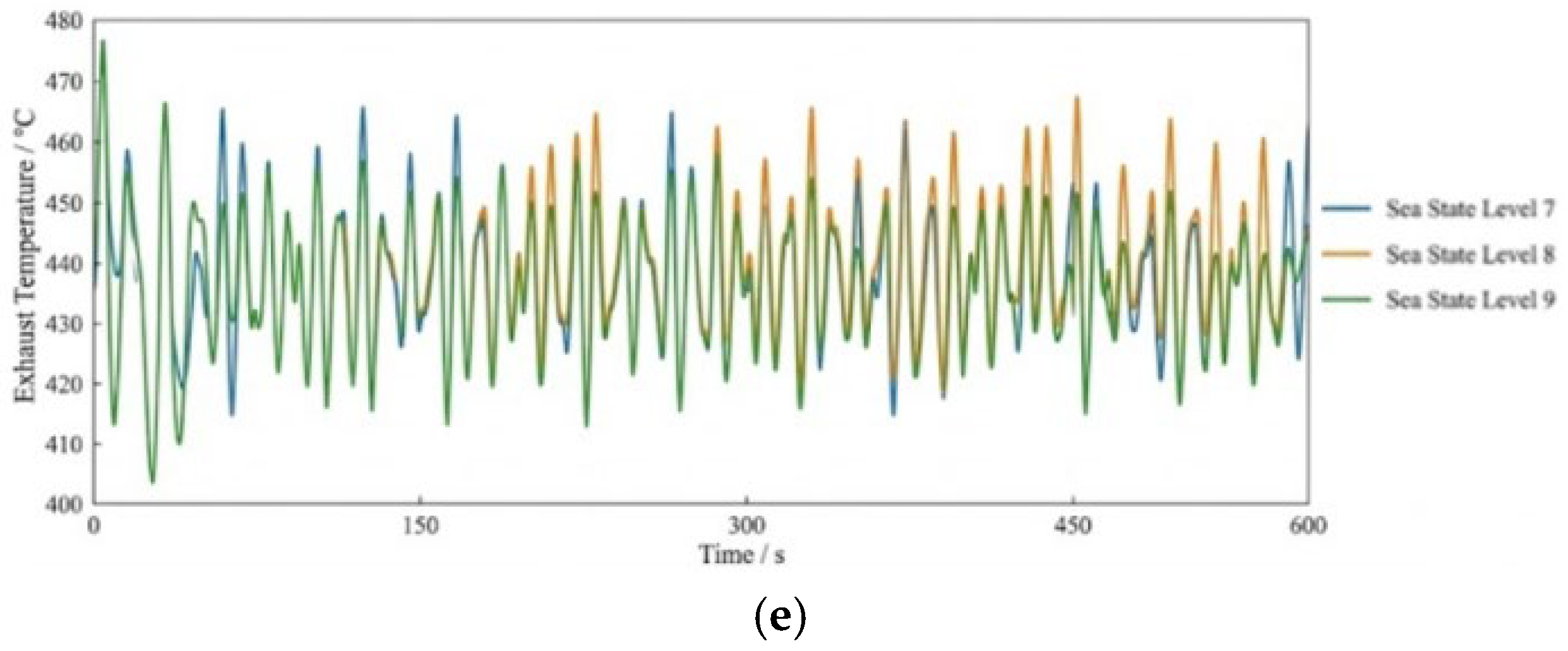
Figure 7e shows the comparison curve of engine exhaust temperature response under different sea conditions. The study shows that the exhaust temperature follows the load positively, but the fluctuation amplitude increases significantly with the increase in sea condition level. Under level 7 sea conditions, the exhaust temperature fluctuates between 410 and 476 °C, with a lag load of about 2–3 s, due to the thermal inertia of the exhaust system. Under level 8 sea conditions, the temperature fluctuation range of the discharge expands to 403~476 °C, the lower limit decreases to 403 °C, and a “secondary peak” lasting for 5~8 s appears after the load peak. The physical mechanism of this phenomenon is that when the load suddenly increases, the fuel injection quantity increases instantaneously, but the turbocharger lags behind, resulting in insufficient intake and a decrease in air-fuel ratio. Some fuel continues to burn in the later stage of expansion and in the exhaust pipe, forming afterburning, which keeps the exhaust temperature high even after the fuel injection quantity is reduced. The upper limit is constrained by the smoke limiter and cooling system and has not exceeded 476 °C. Under level 9 sea conditions, the range of temperature fluctuations in emissions further expands to 385~472 °C, with the lower limit dropping to 385 °C and the upper limit slightly decreasing. The significant decrease in the lower limit is due to the extreme load drop caused by frequent water discharge from the propeller: the load torque instantly disappears, the governor quickly reduces the fuel injection amount, the combustion in the cylinder is almost interrupted, and the exhaust temperature drops sharply. The upper limit cannot exceed level 7 sea conditions, which is also limited by the smoke limiter protection logic. The exhaust temperature curve shows more high-frequency and small amplitude fluctuations under level 9 sea conditions, reflecting the randomness of load changes and combustion instability. The fluctuation amplitude of exhaust temperature can be an important indicator for evaluating transient air-fuel ratio imbalance and combustion stability.

4.3. Frequency Domain Characteristics

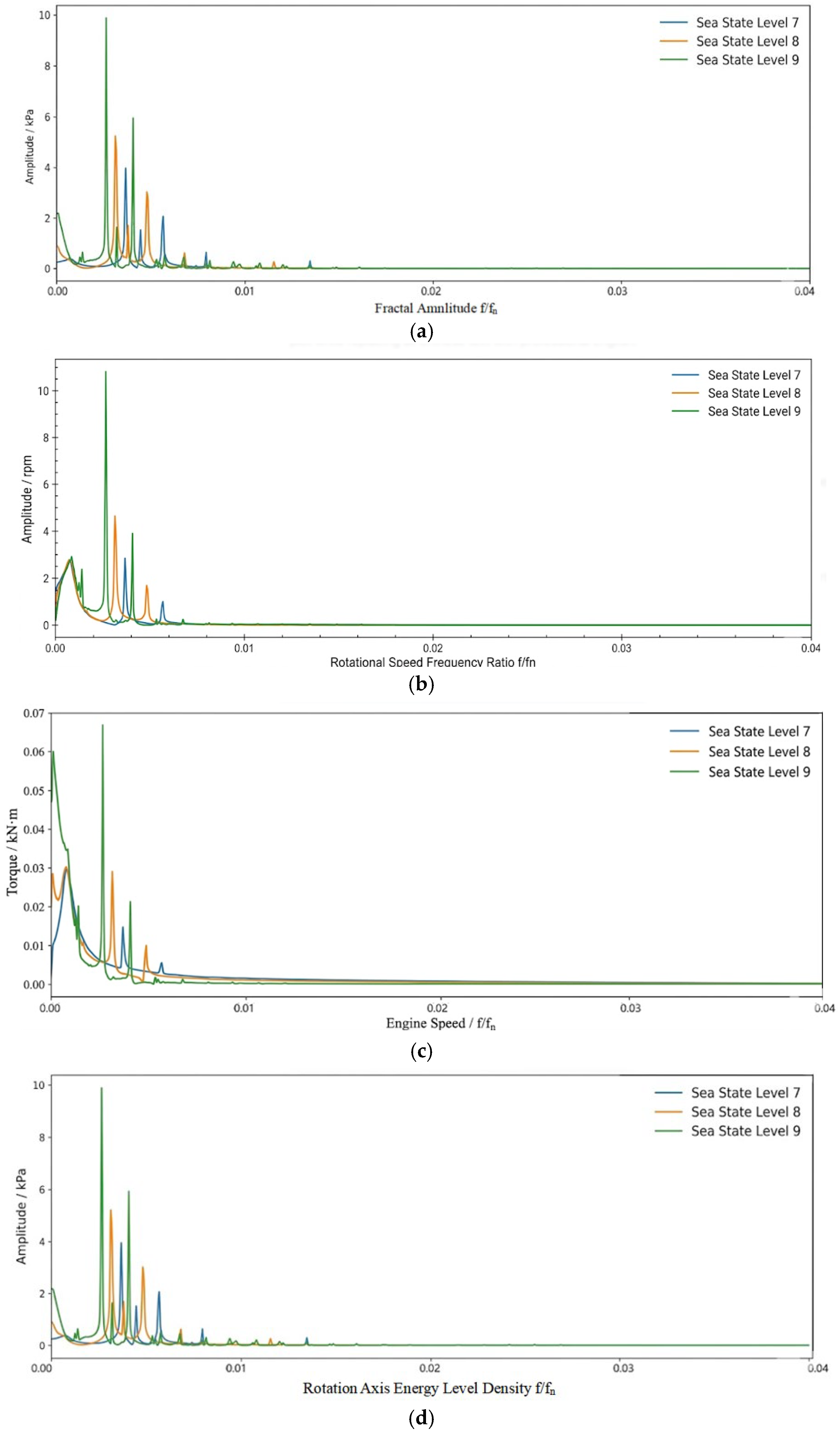
The frequency domain simulation of the engine aims to reveal the dynamic response characteristics of the system to periodic excitations. Its core objectives include: identifying the natural frequencies and modes of the structure, and avoiding resonance dangerous speeds; obtaining frequency response function, evaluating vibration transmission path and isolation performance; based on feature frequency separation of excitation sources, achieving precise traceability of NVH problems; extracting power spectral density as an input condition for fatigue life estimation; and simultaneously providing amplitude frequency and phase frequency characteristics for active control systems, ensuring closed-loop stability. Figure 8a shows the comparison curve of engine torque frequency ratio under different sea conditions. The research shows that under the conditions of seven, eight and nine sea conditions, the engine load fluctuates greatly under the condition of low frequency ratio and slightly under the condition of high frequency. When the frequency ratio is greater than 0.01, it basically maintains a stable state. At a low frequency ratio, the fluctuation amplitude increases with the increase in sea breeze level, and the main peak value is concentrated in the low frequency band, and the amplitude increases synchronously with the sea state level. The load fluctuation amplitude increases nonlinearly with the sea state level, and the main peak value amplitude is about 12% under the 9-level sea state, 2 times of the 7-level sea state, and 1.5 times of the 8-level sea state, indicating that the engine combustion process is aggravated by the load fluctuation with the increase in wind level under high sea state. It reflects the nonlinear coupling effect of wave and ship pitching motion. The broadening trend of the load spectrum shows that the load borne by the power system under high sea conditions no longer presents a single frequency feature, but contains richer low-frequency modulation components, which puts forward higher requirements for the fatigue assessment of the shafting.
Figure 8b shows the comparison curve of engine speed frequency ratio under different sea conditions. The research shows that under the conditions of seven, eight and nine sea conditions, the fluctuation of engine load speed is relatively large under the condition of low frequency ratio, and small under the condition of high frequency. When the frequency ratio is greater than 0.01, it basically maintains a stable state. At a low frequency ratio, the fluctuation amplitude increases with the increase in sea breeze level, and the speed fluctuation amplitude increases nonlinearly with the sea state level. The main peak value of level 9 sea state is about 3.7 times that of level 7 and 2.3 times that of level 8. This result shows that the increase in wave height not only enlarges the amplitude of speed fluctuation but also significantly enhances the energy injection of low-frequency disturbance, and the speed regulation system is facing more severe speed maintenance challenges in high sea conditions.
Figure 8c shows the comparison curve of engine torque frequency ratio under different sea conditions. The research shows that under the conditions of seven, eight and nine sea conditions, the engine load torque fluctuates greatly under the conditions of low frequency ratio and small under the conditions of high frequency. When the frequency ratio is greater than 0.01, it basically maintains a stable state. At a low frequency ratio, the fluctuation amplitude increases with the increase in sea breeze level, the main peaks are concentrated in the low frequency band, the amplitude increases synchronously with the sea state level, and the amplitude of subharmonic wave increases synchronously with the sea state level, reflecting the nonlinear characteristics of wave load (enhanced coupling effect on torque). The nonlinear load effect of a dynamic system under high sea state cannot be ignored. The appearance of subharmonic means that the torsional load on the shaft system no longer presents a simple sinusoidal form, but contains more complex periodic impact components, which has important warning significance for the fatigue life assessment of the crankshaft.
Figure 8d shows the comparison curve of engine exhaust pressure frequency ratio under different sea conditions. The research shows that under the sea conditions of level 7, 8 and 9, the exhaust pressure energy is also concentrated in the low frequency band, and the main peak frequency is consistent with the load. It is verified that the exhaust pressure is mainly controlled by the combustion state in the cylinder and the release rate of exhaust energy. However, the exhaust pressure spectrum shows unique characteristics in the 8-level sea state: the amplitude of the main peak is about 1.8 times higher than that in the 7-level sea state, and there is an obvious secondary peak in the intermediate frequency band with the frequency ratio of about 0.02~0.03. Combined with the abnormal rise of the exhaust pressure peak in the level 8 sea state in the time domain (Figure 7d) and the phenomenon of high-frequency small amplitude oscillation, it can be inferred that the medium frequency component corresponds to the flow instability characteristics of the compressor surge precursor. When the load fluctuates violently, the exhaust energy pulse will impact the turbine periodically, and the turbine speed will fluctuate, which will cause the compressor operating point to cross the stable boundary and induce pressure medium frequency oscillation. Under the 9-level sea state, due to the frequent intervention of the smoke limiter to reduce the fuel injection, the average exhaust energy decreased, and the main peak value of the pressure spectrum fell back to the level close to the 7-level sea state, but the spectral width increased slightly, reflecting the strong unsteady characteristics of the combustion process. The above analysis shows that the frequency domain characteristics of exhaust pressure can be used as an effective index to monitor the transient stability of the turbocharger.
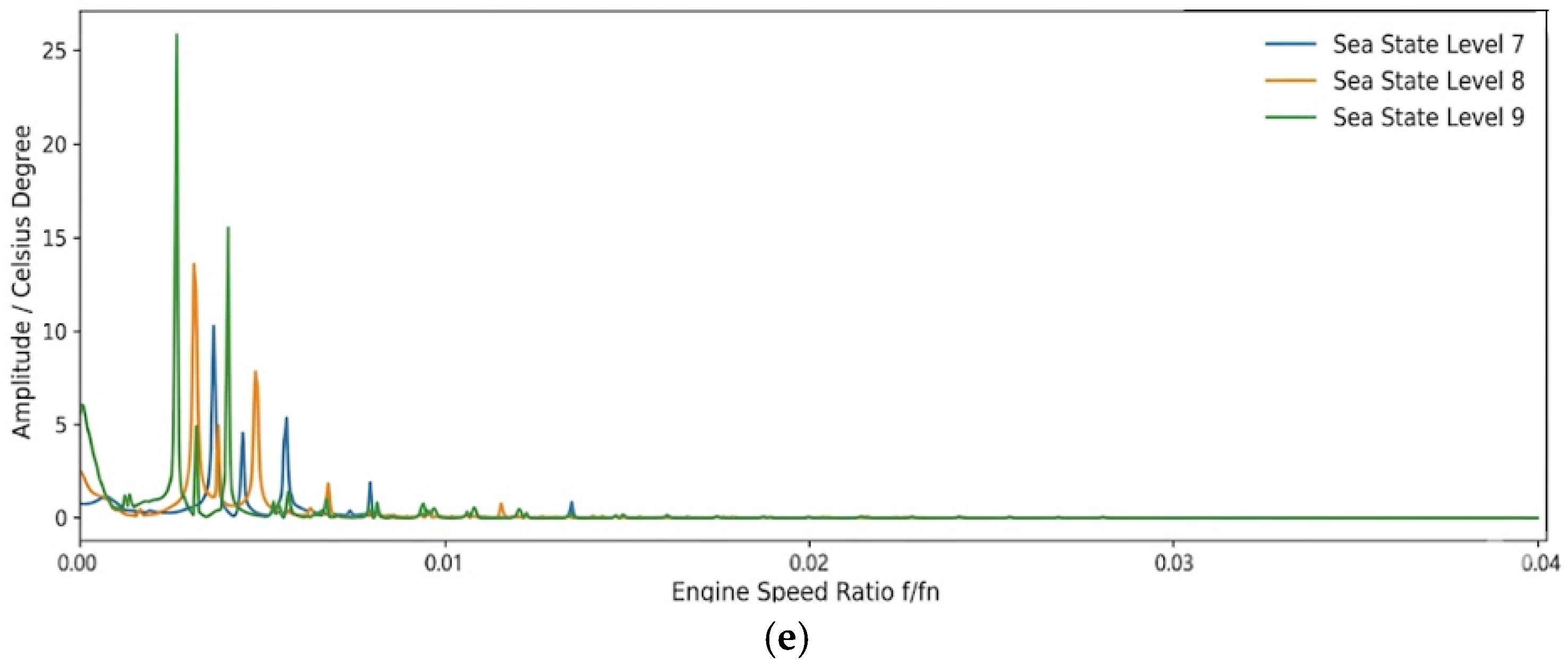
Figure 8e shows the comparison of exhaust gas temperature frequency ratio under different sea conditions. Unlike exhaust pressure, the temperature spectrum exhibits a broader low-frequency peak with no distinct intermediate-frequency component. The main peak amplitude increases by approximately 35% from Sea State 7 to Sea State 9, but the spectral shape remains similar across conditions, indicating that temperature responds more slowly and filters out higher-frequency excitations due to thermal inertia of the exhaust system components.


5. Conclusions

With the continuous expansion of modern shipping industry to far-reaching sea areas, the impact of extreme marine environment on ship navigation safety and power system stability has become increasingly prominent. Under high sea conditions, the severe disturbance of wind wave load not only aggravates the six degrees of freedom motion of the hull but also leads to the sharp distortion of the inflow conditions of the propeller. This unsteady hydrodynamic load is transmitted to the main engine in reverse through the transmission shaft system, forcing the marine engine to frequently break away from the steady-state design condition and fall into a complex transient operation state, which leads to serious problems such as thermal mechanical overload, combustion deterioration and system instability. In view of this engineering challenge, this paper takes the transient response characteristics of marine engine under high sea conditions as the core, comprehensively uses the theories of thermodynamics, hydrodynamics and system dynamics to build a set of integrated simulation framework of deep coupling “external environment hull propeller engine”, and makes a systematic and in-depth quantitative evaluation of the dynamic behavior and parameter sensitivity under multi-level sea conditions. The main research work and core conclusions of this paper are summarized as follows:
(1) A high-precision integrated transient simulation model of a ship propulsion system is constructed. Based on the first law of thermodynamics and the principle of mass conservation, a zero-dimensional single-zone calculation model of an engine with complete working cycles, including compression, combustion, expansion, intake and exhaust, is established in this paper. For the core thermal process, the Woschni empirical heat transfer formula and double vibe semi-empirical heat release law are introduced, and the transient response logic of exhaust turbocharger, air cooler and intake and exhaust pipe network is finely characterized. On this basis, combined with the empirical loads of waves and currents, the open water characteristics of the propeller and the dynamic equation of ship resistance, an integrated simulation program coupled with physical environment is successfully developed on the 2023Matlab/Simulink platform. The steady-state verification results of TBD234V12 diesel engine, Wigley standard ship type and b4-70 propeller show that the prediction errors of key parameters such as power, fuel consumption rate and air cooler outlet state are strictly controlled within ± 2.0% in the range of medium and high load (50~100%), showing excellent computational fidelity.
(2) The global sensitivity weight of core control parameters to system performance under complex conditions is quantified. For the highly nonlinear dynamic response characteristics, this paper innovatively introduces Monte Carlo random sampling and Sobol method to implement global sensitivity analysis (GSA). Among the six key input variables, the evaluation results clearly pointed out that the engine speed had an absolute dominant role in the total output power of the whole machine, and its total effect index was as high as 81.56%, indicating that the cycle work frequency was the core factor determining the scale of transient power output; in the dimension of evaluating fuel economy, the exhaust valve opening angle jumped to the most critical control parameter, contributing 55.81% of the total effect index, highlighting the substantive impact of exhaust timing on the work extraction efficiency of high-temperature and high-pressure gas expansion in the cylinder. This quantitative conclusion accurately separates the dominant factors from the complex variables, and provides a valuable quantitative reference for the subsequent formulation of efficient dimension reduction control strategies and structural optimization schemes.
(3) The transient evolution laws of the key operating parameters of the engine under different levels of high sea conditions are revealed. By setting the 7-level, 8-level and 9-level sea state simulation boundaries, this paper clearly depicts the nonlinear amplification effect of extreme environmental disturbance transmitted to the dynamic system. It is found that the fluctuation range of total engine load is widened sharply with the gradual increase in sea state level. Under the continuous impact of grade 9 severe sea conditions, the engine load fluctuated violently between 96.2% and 118.5%, and entered the state of exceeding the limit load; the following maximum torque and exhaust temperature peaks soared to 2.1 kN · m and 472 °C respectively. This series of quantitative data profoundly shows that the alternating load under high sea conditions not only greatly increases the mechanical stress of the transmission shaft system but also causes the thermal load in the cylinder to approach the structural limit, which directly threatens the operation safety of the power system. The depth analysis of frequency domain characteristics further confirmed that the coupling damage effect of low-frequency disturbance of wave load on engine speed and torque was exponentially amplified.

Author Contributions

Conceptualization, Z.C.; methodology, F.S.; software, Z.C.; validation, Z.C.; formal analysis, Z.C.; investigation, Z.C.; resources, F.S. and J.L.; writing—original draft, Z.C.; writing—review and editing, Z.C.; visualization, Z.C.; supervision, G.L. and J.L.; project administration, F.S.; funding acquisition, F.S. and J.L. All authors have read and agreed to the published version of the manuscript.

Funding

This research received no external funding.

Data Availability Statement

The original contributions presented in this study are included in the article. Further inquiries can be directed to the corresponding author.

Conflicts of Interest

The authors declare no conflicts of interest.

Abbreviations

The following abbreviations are used in this manuscript:
TTemperature of working medium in cylinder
pPressure of working medium in cylinder
mQuality of working fluid in cylinder
cvConstant volume specific heat
QwHeat
VCombustion chamber volume
uSpecific internal energy of working fluid in cylinder
heSpecific enthalpy of exhaust gas
hsSpecific enthalpy of intake air
HLow calorific value of fuel
WTPower from turbine
ηTKmMechanical efficiency of turbocharger
WKPower absorbed by compressor
nTTurbine speed
dmTMass flow through turbine
IMoment of inertia
NDynamic moment
NDDisturbance torque
TSPropeller thrust
QSPropeller torque
KTThrust coefficient
KQTorque coefficient
DPPropeller diameter
JAdvance coefficient
nPropeller speed
ζ Average wave amplitude
χ Encounter angle

References

  1. Mallouppas, G.; Yfantis, E.A. Decarbonization in Shipping Industry: A Review of Research, Technology Development, and Innovation Proposals. J. Mar. Sci. Eng. 2021, 9, 415. [Google Scholar] [CrossRef]
  2. Xin, R.; Zhai, J.; Liao, C.; Wang, Z.; Zhang, J.; Bazari, Z.; Ji, Y. Simulation Study on the Performance and Emission Parameters of a Marine Diesel Engine. J. Mar. Sci. Eng. 2022, 10, 985. [Google Scholar] [CrossRef]
  3. Yang, Y.; Moctar, E.O. A mathematical model for ships maneuvering in deep and shallow waters. Ocean. Eng. 2024, 295, 116927. [Google Scholar] [CrossRef]
  4. Watson, N.; Pilley, A.D.; Marzouk, M. A combustion correlation for diesel engine simulation. SAE Tech. Pap. 1980. [Google Scholar] [CrossRef]
  5. Hendricks, E. Mean value modelling of large turbocharged two-stroke diesel engines. SAE Int. Congr. Expo. 1989. [Google Scholar] [CrossRef]
  6. Livanos, G.A.; Simotas, G.N.; Dimopoulos, G.G.; Kyrtatos, N.P. Simulation of Marine Diesel Engine Propulsion System Dynamics During Extreme Maneuvering. In Proceedings of the ASME 2006 Internal Combustion Engine Division Spring Technical Conference (ICES2006), Aachen, Germany, 7–10 May 2006. [Google Scholar] [CrossRef]
  7. Rakopoulos, C.D.; Giakoumis, E.G.; Michos, C.N. Quasi-linear versus filling and emptying modelling applied to the transient operation of a turbocharged diesel engine. Int. J. Veh. Des. 2007, 45, 150–170. [Google Scholar] [CrossRef]
  8. Maftei, C.; Moreira, L.; Soares, C.G. Simulation of the dynamics of a marine diesel engine. J. Mar. Eng. Technol. 2009, 8, 29–43. [Google Scholar] [CrossRef]
  9. Wang, H. Modeling and System Simulation of Large Low-Speed Marine Diesel Engine. Ph.D. Thesis, Dalian Maritime University, Dalian, China, 2007. [Google Scholar]
  10. Theotokatos, G. On the cycle mean value modelling of a large two-stroke marine diesel engine. Proc. Inst. Mech. Eng. Part M J. Eng. Marit. Environ. 2010, 224, 193–205. [Google Scholar] [CrossRef]
  11. Murphy, A.J.; Norman, A.J.; Pazouki, K.; Trodden, D.G. Thermodynamic simulation for the investigation of marine Diesel engines. Ocean Eng. 2015, 102, 117–128. [Google Scholar] [CrossRef]
  12. Tu, H.; Chen, H. Modeling and simulation of large marine diesel engine propulsion system. Shipbuild. China 2014, 55, 158–167. (In Chinese) [Google Scholar]
  13. Yum, K.K.; Taskar, B.; Pedersen, E.; Steen, S. Simulation of a two-stroke diesel engine for propulsion in waves. Int. J. Nav. Archit. Ocean Eng. 2017, 9, 351–372. [Google Scholar] [CrossRef]
  14. Stoumpos, S.; Theotokatos, G.; Mavrelos, C.; Boulougouris, E. Towards Marine Dual Fuel Engines Digital Twins—Integrated Modelling of Thermodynamic Processes and Control System Functions. J. Mar. Sci. Eng. 2020, 8, 200. [Google Scholar] [CrossRef]
  15. Bondarenko, O.; Fukuda, T. Development of a diesel engine’s digital twin for predicting propulsion system dynamics. Energy 2020, 196, 117126. [Google Scholar] [CrossRef]
  16. Moon, J. Comparative Analysis of Performance and Emissions of a Two-Stroke Marine Diesel Engine According to CPP Modes. J. Mar. Sci. Eng. 2026, 14, 331. [Google Scholar] [CrossRef]
  17. Karystinos, V.; Papalambrou, G. Diesel–Methanol Dual-Fuel engine modeling including combustion characteristics and transient system dynamics. Appl. Therm. Eng. 2025, 284, 129197. [Google Scholar] [CrossRef]
  18. Vollbrandt, J.; Coraddu, A.; Geertsma, R.; Stapersma, D. High-fidelity mean value first principle modelling of dynamic response in spark-ignited marine engines: A comparative analysis of gas path and turbocharger representations. J. Mar. Eng. Technol. 2026, 1–30. [Google Scholar] [CrossRef]
  19. Kyrtatos, N.P.; Theodossopoulos, P.; Theotokatos, G.; Xiros, N. Simulation of the overall ship propulsion plant for performance prediction and control. Trans. Inst. Mar. Eng. Ser. C 1999, 111, 103–114. [Google Scholar]
  20. Benvenuto, G.B.; Campora, U.; Carrera, G.; Figari, M. Interaction between ship propulsion plant automation and simulation. In Maritime Transportation and Exploitation of Ocean and Coastal Resources; CRC Press-Taylor & Francis Group: Boca Raton, FL, USA, 2005; Volume 1, pp. 617–626. [Google Scholar]
  21. Ley, J.; Sigmund, S.; el Moctar, O. Numerical prediction of the added resistance of ships in waves. In Proceedings of the International Conference on Offshore Mechanics and Arctic Engineering; American Society of Mechanical Engineers: New York, NY, USA, 2014; Volume 45400, p. V002T08A069. [Google Scholar] [CrossRef]
  22. Saravanamuttoo, H.I.H.; Rogers, G.F.C.; Cohen, H. Gas Turbine Theory; Pearson Education: Hong Kong, China, 2009. [Google Scholar]
  23. Liu, C. Research on Modeling and Simulation of Diesel Engine Based on Modelica Language. Master’s Thesis, Harbin Engineering University, Harbin, China, 2017. [Google Scholar]
  24. Qu, X. Research on Energy Efficiency Optimization of Fuel Cell/Lithium Battery Hybrid Power Ship Considering Multiple Factors. Ph.D. Thesis, Wuhan University of Technology, Wuhan, China, 2020. [Google Scholar]
  25. Ding, C. Research on backstepping fuzzy control and visual simulation technology for dynamic positioning ships in high sea states. Ph.D. Thesis, Harbin Engineering University, Harbin, China, 2022. [Google Scholar]
  26. Heywood, J.B. Internal Combustion Engine Fundamentals; McGraw-Hill: New York, NY, USA, 2018. [Google Scholar]
Figure 1. Composition of the propulsion system model.
Algorithms 19 00421 g001
Figure 2. Comparison of key performance parameters under different loads. (a) Fuel consumption, (b) power, (c) outlet pressure of air cooler, (d) outlet temperature of air cooler, (e) turbine outlet pressure.
Algorithms 19 00421 g002
Figure 3. Analysis of steady-state simulation error of main performance and thermal parameters of marine diesel engines.
Algorithms 19 00421 g003
Figure 4. Correction of pressure waves in front of the turbine under rated operating conditions.
Algorithms 19 00421 g004
Figure 5. Sensitivity analysis flowchart.
Algorithms 19 00421 g005
Figure 6. Parameter sensitivity analysis results. (a) Engine power, (b) fuel consumption rate.
Algorithms 19 00421 g006
Figure 7. The temporal variation in engine parameters under different sea state levels. (a) Load, (b) speed, (c) torque, (d) exhaust pressure, (e) exhaust gas temperature.
Algorithms 19 00421 g007aAlgorithms 19 00421 g007b
Figure 8. Comparison of engine parameter frequency ratios under different sea conditions. (a) Load, (b) speed, (c) torque, (d) exhaust pressure, (e) exhaust gas temperature.
Algorithms 19 00421 g008aAlgorithms 19 00421 g008b
Table 1. Representative mechanism models and research progress of transient characteristics of marine engines.
Mechanism Model/ResearcherResearch SubjectModeling MethodResearch Focus
Watson & Marzouk (1977) [4]Internal combustion engineVolumetric method modelsteady-state performance simulation
Hendricks et al. (1989) [5]large two-stroke turbocharged diesel enginemean value model (MVEM)dynamics of pipe network temperature, pressure and speed
Livanos & Simotas (2006) [6]MAN B&W 5L16/24 marine engineblack-box modeldynamic response under extreme maneuvering scenarios
Rakopoulos et al. (2007) [7]turbocharged diesel enginevolumetric method model for transient processestransient heat transfer and friction calculation
Maftei & Moreira (2009) [8]marine eight-cylinder turbocharged diesel enginemean value modelcomplete cycle description of propulsion system
Haiyan Wang (2009) [9]large low-speed electronically controlled marine diesel engineimproved mean value modelinfluence of volumetric efficiency and scavenging coefficient
Theotokatos (2010) [10]large low-speed two-stroke marine diesel enginemean value models of two complexity levelsscavenging process dynamic characteristics
Murphy & Norman (2015) [11]marine diesel enginemodel based on mixed heating cyclecycle indicated work and mean indicated pressure
Huan Tu and Hui Chen (2016) [12]container ship diesel engine propulsion systemmean value modeldynamic characteristics of ship-engine-propeller under variable operating conditions
Yum & Taskar (2017) [13]Wärtsilä 8RT-Flex68D low-speed enginecomplete volumetric model of ship-engine-propeller systemtransient processes of load increase and reduction
Stoumpos & Theotokatos (2020) [14]marine dual-fuel enginevolumetric method combined with control system modelingfuel mode switching and load transients
Bondarenko & Fukuda (2020) [15]marine propulsion systemcombined mean value and volumetric method modeldigital twin prediction and fast solving
Aletras et al. (2024) [16]two-stroke hybrid marine vesseloptimized energy management algorithmtransient load/controllable pitch propeller matching
Karystinos et al. (2025) [17]diesel-methanol dual-fuel enginetransient system and combustion characteristics modelingcombustion characteristics/transient system response
Vollbrandt et al. (2026) [18]marine spark-ignited (SI) enginemean value first-principle modeldynamic gas path response/turbocharger transient
Table 2. TBD234V12 engine parameters.
ParameterParameter Description
Calibrated power/kW444
Calibrated speed/(r/min)1800
Cylinder arrangement methodV-shaped, 60 ° angle
Cylinder diameter × stroke/(mm × mm)120 × 140
Crank connecting rod ratio70/255
Rated fuel consumption rate/(g·KW−1·h−1)204
Compression ratio15:1
Table 3. Basic Parameters of a 20-Meter Wigley Hull Form.
ParameterParameter Description
Captain/m20
Beam/m2
Beam/m1.25
Drainage volume/m311.11
Square coefficient0.444
Waterline coefficient0.667
Medium cross-section coefficient0.667
Table 4. Corresponding relationship between load and speed.
Load/%25507590100
Speed/r·min−111341429163617391800
Table 5. Wave parameter settings.
ParameterLevel 7 Sea ConditionLevel 8 Sea ConditionLevel 9 Sea Condition
Amplitude (m)200400600
Wave encounter angle (°)606060
Wave period (s)81216
Wind speed (m/s)182226
Table 6. Simulation parameter settings.
ParameterParameter Value
Simulation duration (s)600
Target engine speed (r/min)1800
Initial operating conditionsThe engine is at rated power and the ship speed reaches the corresponding speed
Data sampling frequency (Hz)100
Disclaimer/Publisher’s Note: The statements, opinions and data contained in all publications are solely those of the individual author(s) and contributor(s) and not of MDPI and/or the editor(s). MDPI and/or the editor(s) disclaim responsibility for any injury to people or property resulting from any ideas, methods, instructions or products referred to in the content.