1. Introduction
Humanitarian logistics, as one of the most sensitive and complex areas of operational decision-making, plays a crucial role in reducing human casualties and improving the effectiveness of crisis response. In natural and man-made crises, decision-makers are faced with environments characterized by high uncertainty, resource constraints, conflicting objectives, and rapid temporal changes [
1]. In such a context, relying solely on deterministic and static models is not only inadequate, but can also lead to decisions that are operationally fragile, humanly indefensible, and managerially difficult to justify [
2]. Therefore, developing frameworks that can simultaneously manage multiple conflicting objectives, consider structural uncertainties, and respond adaptively to environmental changes has become research and applied imperative in humanitarian logistics.
A review of previous studies shows that multi-objective optimization models have played an important role in analyzing trade-offs between cost, response time, and service level. However, a significant part of these studies have been based on the assumption of data certainty and stability of the decision-making environment [
3]. However, in relief operations, information is often incomplete, ambiguous, and dependent on variable field conditions. Ignoring these features can lead to solutions that lose their effectiveness in practice. In response to this challenge, the use of fuzzy logic as a tool for modeling non-random uncertainties has been considered, but in many studies, this approach has been used in a limited way and separately from other dynamic aspects of the system [
4].
On the other hand, the concept of digital twin, as an emerging paradigm, has enabled the creation of dynamic and up-to-date representations of real systems. By continuously connecting to operational data and feedback, the digital twin offers the ability to simulate, predict, and analyze system behavior over time [
5]. Despite the high potential of this concept, its application in humanitarian logistics is still limited and is often reduced to descriptive models or non-decision-making simulations. In particular, the integration of digital twins with multi-objective optimization models and adaptive decision-making mechanisms has not yet been systematically investigated [
6].
In recent years, attention has increased on agent-based systems as a solution for modeling distributed and adaptive decision-making. Agents, with the ability to interact, learn, and react locally, can more realistically represent the behavior of human decision makers or operational units. However, in many existing studies, agents have been used only as simulation components, and their role in actively guiding the optimization process and selecting multi-objective solutions has received limited attention [
7]. This gap becomes even more important, especially in contexts where decisions need to be interpretable and justifiable to different stakeholders.
Aiming to fill this gap, the present study presents an integrated framework for humanitarian logistics in which fuzzy multi-objective optimization, digital twin, and agent-based intelligence are coherently combined. The main innovation of this study is that uncertainty is modeled not only as an extraneous parameter, but also as an intrinsic part of the decision-making process and is included in the structure of objectives and constraints through triangular fuzzy numbers. Furthermore, the digital twin is used as a dynamic mechanism to continuously update the system state and feed information back into the optimization process, rather than simply as a static simulation tool. Finally, agent-based intelligence plays an active role in guiding the selection of solutions across the Pareto front, enabling interpretability of decisions and their adaptation to changing preferences of decision makers.
An important distinction of the proposed framework from existing approaches is that, instead of focusing on a specific dimension of the problem, it addresses the synergy between uncertainty, temporal dynamics, and interpretability of decisions. The results obtained from the application of this framework show that combining multi-objective evolutionary methods with an agent-based layer and a digital twin can lead to solutions that are not only numerically efficient, but also operationally and managerially reliable and defensible. This feature is particularly important in the field of humanitarian logistics, where decisions have direct human and social consequences.
In this paper, after describing the humanitarian logistics problem and providing an overview of the system, the proposed agent-based digital twin framework is introduced. Then, fuzzy multi-objective mathematical modeling and solution approaches based on evolutionary algorithms are presented, and the case study design and computational experiments are described. Next, the results of the Pareto front quality analysis, stability, fuzzy uncertainty, dynamic behavior, and interpretability of decisions are discussed, and finally, the conclusion, managerial implications, limitations, and future research directions are presented.
2. Literature Review
In recent years, humanitarian logistics, as one of the key areas in crisis management, has received extensive attention in the research literature. The inherent complexities of this field, including severe uncertainty, resource constraints, conflicting goals, and high time pressure, have made classical planning and decision-making methods of limited effectiveness in real-world situations. Therefore, a significant amount of research has been devoted to the development of optimization models to support decision-making in relief operations [
8]. These studies have generally focused on the design of distribution networks, facility location, resource allocation, and transportation scheduling, but in many cases, simplifying assumptions about data certainty and the stationarity of the decision-making environment have been used.
With the development of multi-objective optimization approaches, researchers have attempted to simultaneously address the trade-offs between conflicting humanitarian logistics objectives, such as cost minimization, response time minimization, and service level or distributive justice maximization [
9]. These approaches have enabled a more comprehensive analysis of the decision space, but a significant portion of them have still been based on deterministic models. In real crisis situations, information on demand, route availability, and infrastructure capacity is often incomplete or ambiguous, and deterministic models are unable to reflect these uncertainties [
10].
In response to this challenge, fuzzy logic has entered the humanitarian logistics literature as a tool for modeling non-random uncertainties. Numerous studies have used fuzzy sets and fuzzy numbers to represent uncertainty in demand, costs, and transportation times [
11]. These studies have shown that fuzzy models can provide more conservative and realistic decisions than deterministic models. However, in many of these studies, fuzzy logic has been applied statically, without considering the temporal dynamics of the system, and the decision-making process has been considered as a single-step problem or limited to a fixed time horizon [
12].
On the other hand, the growth of concepts related to cyber–physical systems and digital transformation has paved the way for the introduction of digital twins as a new approach to modeling and analyzing complex systems. Digital twins allow for the creation of a dynamic virtual representation of the real system that can be continuously updated with new data [
13]. Although this concept has been widely used in areas such as manufacturing and industrial infrastructure, its application in humanitarian logistics is still in its early stages. Existing studies are mainly limited to the use of digital twins for simulation or situation monitoring, and their role in actively supporting multi-objective decision-making has not been fully elucidated [
14].
In parallel with these developments, agent-based approaches have been proposed as a tool for modeling distributed decision-making and heterogeneous behaviors in complex systems. In the field of humanitarian logistics, agent-based models have been mainly used to simulate the interaction between different actors, such as relief organizations, warehouses, and crisis-affected areas [
15]. These studies have been able to better represent some behavioral aspects of the system, but in most cases, agents have not played an active role in the optimization process and have been used merely as simulation components [
16].
In recent years, the use of metaheuristic and evolutionary algorithms to solve complex humanitarian logistics problems has received attention [
17]. Multi-objective evolutionary algorithms have enabled the solution of problems with large dimensions and nonlinear structure and have been widely used to extract Pareto fronts [
18]. However, a significant part of these studies have considered algorithms as tools independent of human decision-making logic and have addressed the issue of interpretability of solutions and their relationship with decision-makers’ preferences [
19].
A literature review shows that although each of the multi-objective optimization approaches, fuzzy logic, digital twin, and agent-based models have been studied separately in humanitarian logistics, few attempts have been made to systematically integrate these concepts into a single framework [
20]. In particular, a clear gap in the literature is observed in the field of simultaneously combining fuzzy uncertainty, digital twin-based temporal dynamics, and interpretable agent-based decision-making. Most research has focused either on numerical accuracy or on behavioral simulation, while the practical need of the relief field requires frameworks that cover both dimensions synergistically [
21].
In recent years, numerous studies have been devoted to the development of multi-objective optimization methods in complex and uncertain environments. Especially in the field of multi-objective fuzzy optimization, frameworks based on triangular fuzzy numbers, satisfaction level approaches, and weighted aggregation methods have been widely used [
22]. Various studies have shown that fuzzy uncertainty modeling can provide more flexibility and realism in operational environments than deterministic models [
23]. However, most of these studies have a static temporal structure and pay less attention to system dynamics and gradual decision updating [
24].
On the other hand, agent-based approaches have been proposed in the last decade as an effective tool for modeling distributed decision-making and interaction between different actors in complex systems [
25]. These frameworks allow for the representation of local behaviors, coordination mechanisms, and gradual adaptation of decisions [
26]. However, in many studies, agents have been used only at the simulation level and have rarely been integrated into the core of the multi-objective optimization process [
27].
In the field of Digital Twin, several studies have also focused on the development of digital representations of physical systems for monitoring, prediction, and optimization [
28]. The use of Digital Twin in logistics and supply chain is gradually expanding, but most of these applications have focused on descriptive or predictive analysis, and its direct integration with multi-objective decision-making frameworks and agent-based mechanisms has received less attention [
29].
Also, in the literature on multi-objective evolutionary algorithms, the conceptual differences between dominance-based approaches (such as NSGA-II) and decomposition-based approaches (such as MOEA/D) have been well studied [
30]. These studies show that each of these algorithms has its own advantages and limitations, and their combination can provide a more comprehensive analysis of the Pareto space [
31].
Despite significant advances in each of the above areas, a literature review shows that the simultaneous integration of multi-objective fuzzy optimization, agent-based decision-making mechanisms, and the Digital Twin framework in a dynamic, multi-period model has not yet been systematically studied.
The present study is a response to this research gap. The main innovation of this study is to present an integrated framework in which multi-objective fuzzy modeling based on triangular fuzzy numbers is combined with a dynamic digital twin and an agent-based intelligence layer. Unlike previous studies, in this framework the digital twin does not only play the role of simulation but also acts as an active source of feedback for continuous updating of the optimization process. Also, the agents directly participate in guiding the selection of solutions from the Pareto front, allowing for the interpretability of decisions and their adaptation to changing preferences.
Overall, this literature review shows that despite significant advances in each of the relevant areas, the need for a comprehensive and adaptive framework that can simultaneously take into account the real complexities of humanitarian logistics remain. By focusing on this need, the present study attempts to make an innovative contribution to the existing literature and provide a suitable platform for future research development and practical applications.
3. Problem Description and System Overview
Humanitarian logistics is one of the most complex and sensitive areas of operational decision-making, where decisions must be made under dynamic environmental conditions, severe resource constraints, and human and time pressures. Unlike commercial supply chains, in this area the objectives are not purely economic and criteria such as speed of response, fairness in distribution, coverage of the affected population, and reduction in operational risks play a decisive role. These objectives are often in conflict with each other and are qualitative, relative, and dependent on human judgment. On the other hand, the information used in such systems is usually incomplete, variable, and in many cases based on field estimates, which poses a serious challenge to accurate and timely decision-making [
32].
The humanitarian logistics network usually includes a set of temporary or permanent warehouses, heterogeneous transport fleets, crisis-affected demand areas, and multiple coordinating institutions. This network changes over time and in line with the evolution of the crisis; routes can become blocked, demand in different areas can suddenly increase, and operational priorities can change rapidly. In such a context, relying solely on static models or centralized decision-making is not only inefficient but also often leads to delays, inequitable distribution, or waste of resources. This suggests that the humanitarian logistics system must be considered as a living, adaptive, and multi-level system that can reconfigure and learn during operations [
33].
From a decision-making perspective, this system involves different levels that operate simultaneously and in interaction with each other. At the strategic level, issues such as warehouse location and overall resource allocation are addressed; at the tactical level, distribution planning and prioritization of areas are important; and at the operational level, momentary decisions related to routes, scheduling, and vehicle allocation are made. Coordination between these levels in dynamic crisis conditions requires a mechanism that can simultaneously provide an accurate picture of the current state of the system and align decisions with multiple objectives and human preferences.
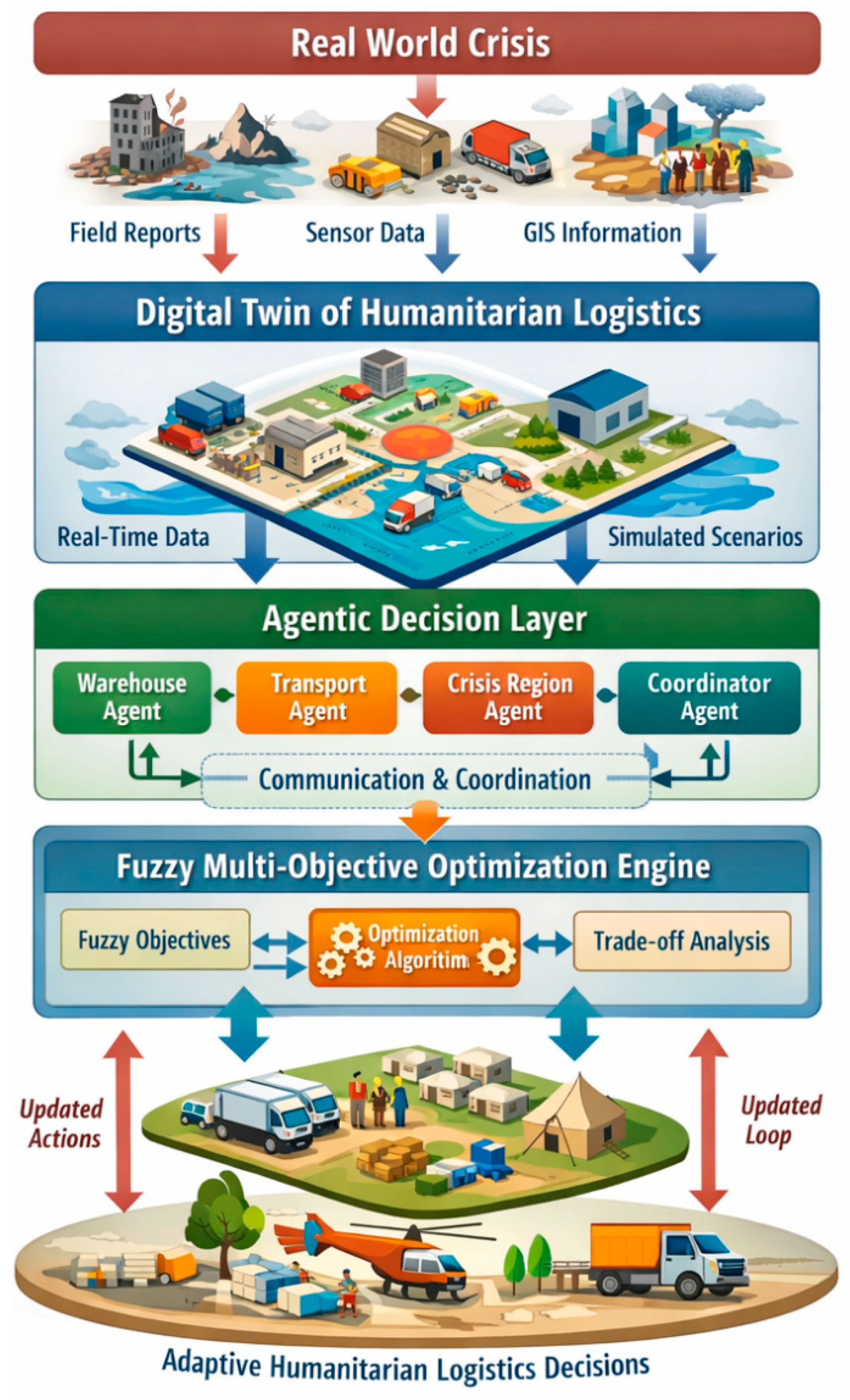
In this study, to address this need, an integrated framework based on an agent-based digital twin is proposed, which acts as the decision-making core of the humanitarian logistics system. The digital twin provides a dynamic and updatable representation of the real logistics network and allows for observation, analysis, and prediction of the system’s behavior over time. This representation not only reflects the current state of resources, demand, and routes, but also provides a platform for evaluating alternative scenarios and the consequences of different decisions. At the same time, to overcome the limitations of centralized decision-making, agent-based logic is applied in the decision-making layer of the system so that each major component of the network can act semi-autonomously and in coordination with other components.
As shown in
Figure 1, the proposed framework consists of several interconnected layers that establish the flow of data, decisions, and feedback between the real world and the decision-making space. At the lowest layer, there is the actual humanitarian logistics system, which includes physical resources, infrastructure, and crisis areas. The data from this layer, whether in the form of field reports or spatial and operational information, is transferred to the digital twin. By processing this data, the digital twin creates an up-to-date and coherent picture of the system state and provides it to the agent-based layer.
In the agent-based layer, the main components of the network are modeled as decision-making agents, each with specific local goals, constraints, and scope of authority. Using digital twin information, these agents, through interaction and coordination, propose decisions that are ultimately evaluated within the framework of a fuzzy multi-objective optimization problem. The use of fuzzy logic at this stage allows for modeling human preferences, soft goals, and inevitable trade-offs between conflicting criteria. The output of this decision-making process is fed back to the real system, and through a continuous feedback loop, the digital twin and the agents are updated to reflect new environmental changes.
4. Proposed Agentic Digital Twin Framework
The proposed framework of this research aims to move from static and centralized decision-making to an adaptive, distributed mechanism that is in sync with operational reality. Unlike conventional approaches that consider the digital twin as a simulation or monitoring tool, in this study the digital twin acts as the cognitive core of the humanitarian logistics system that actively participates in the decision-making process. By integrating agent-based logic and fuzzy multi-objective optimization, this framework enables continuous adaptation of decisions to environmental changes and human preferences.
In this architecture, the digital twin continuously processes operational data received from the real environment and creates a dynamic representation of the logistics network state. This representation includes the status of resources, spatial distribution of demand, route conditions, and operational constraints, and acts as a common decision-making reference for agents. The key point in this framework is that the digital twin does not simply reflect the current situation but plays an active role in guiding the decision-making process by generating alternative scenarios and predicting potential consequences of decisions.
The agent-based layer, as the cognitive level of the proposed framework, consists of a set of decision-making agents, each of which represents a part of the humanitarian logistics system. These agents have local goals, specific constraints, and a certain level of decision-making authority, and their behavior is influenced by the information received from the digital twin. The interaction between the agents is designed in such a way that, while maintaining relative independence, it allows for coordination and convergence of decisions at the macro-system level. This feature is especially important in crisis situations where there is a need for rapid and decentralized response.
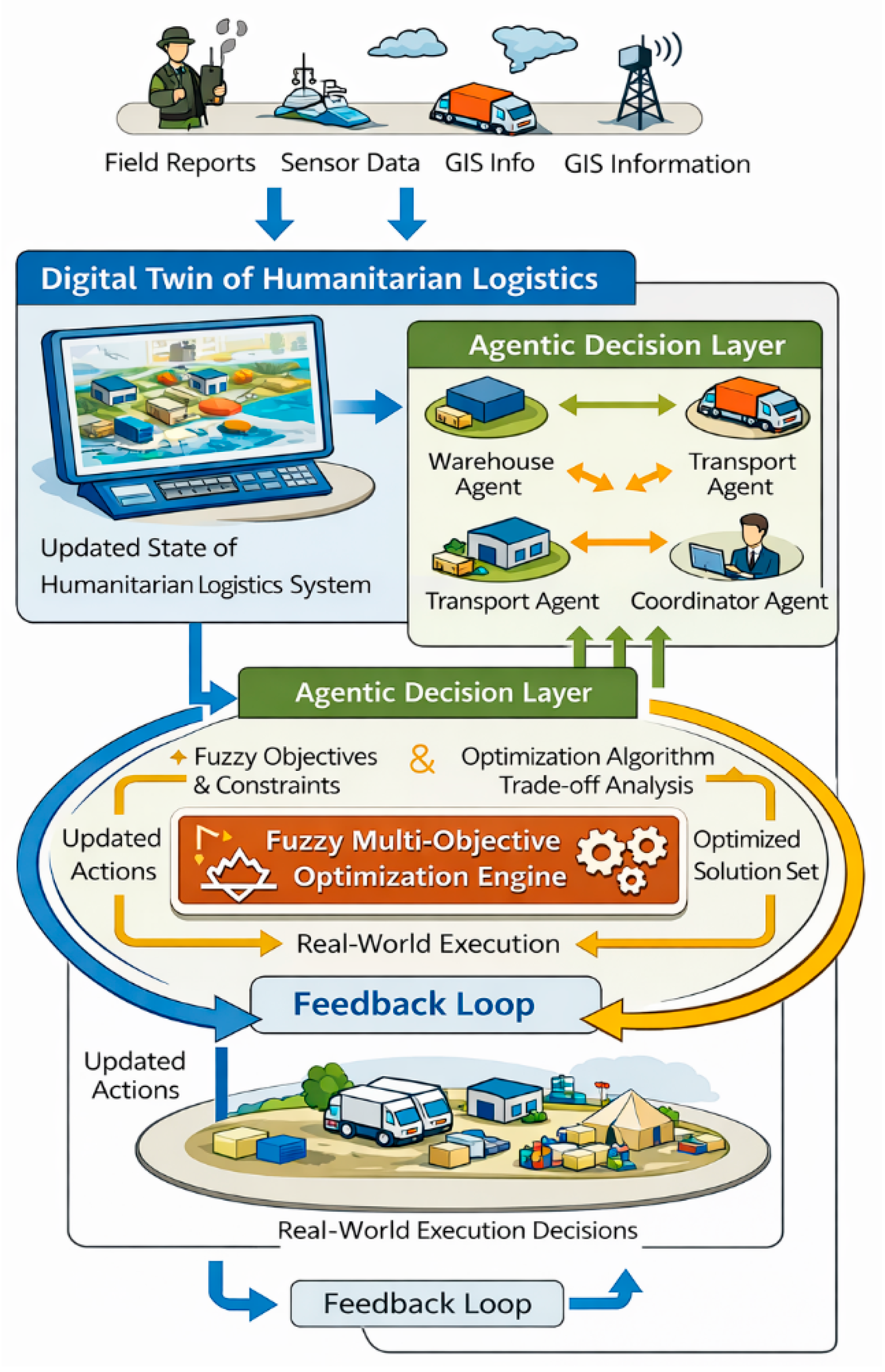
As can be seen in
Figure 2, the decision-making process in the proposed framework is based on a continuous interactive loop between the digital twin, decision-making agents, and the fuzzy multi-objective optimization engine. Based on the updated system state provided by the digital twin, the agents generate possible decision options and send them to the decision-making engine in the form of a multi-objective optimization problem. In this step, the objectives and constraints are modeled using fuzzy membership functions to realistically account for uncertainty, human judgment, and inevitable trade-offs between conflicting criteria in the decision-making process.
The output of the optimization engine is a set of solutions consistent with the preferences and operational conditions, which are provided back to the agents. By interpreting these results and considering their interactions, agents select and apply final decisions to the real system. The consequences of these decisions are fed back to the digital twin through the flow of new data, thus creating an adaptive loop in which decisions are continuously adapted to the changing realities of humanitarian logistics.
To clarify the decision-making time frame, the planning horizon in this study is divided into discrete time periods, each period representing a fixed operational interval (for example, a day in a relief operation). The interval between two consecutive decisions is equal to the length of a time period defined in the set T.
At the beginning of each time period, Digital Twin represents the system state using updated data on the demand, inventory, route conditions, and risk level. Then, at the same time step, the decision-making agents run the multi-objective optimization model and generate allocation and dispatch decisions based on the new system state and their local preferences.
These decisions are immediately executed for the same time period as an operational plan, and their results (including inventory change, demand coverage, and route risk level) are fed back to the Digital Twin at the end of the period. Thus, at each time step, the process of “update-decision-execution-feedback” is repeated.
5. Proposed Mathematical Model
Humanitarian logistics is one of the most complex areas of operational decision-making, where human goals, physical constraints, environmental dynamics, and information uncertainty simultaneously influence decisions. Unlike commercial supply chains, in this area, cost or time minimization alone is not a suitable criterion for evaluating the quality of decisions, and concepts such as distributive justice, decision sustainability, operational resilience, and adaptability to changing crisis conditions play a fundamental role. In addition, the information used in such systems is often incomplete, variable, and dependent on human judgment, and it is not possible to accurately express them in terms of deterministic parameters.
In this study, the humanitarian logistics problem is modeled as a fuzzy, multi-period, and multi-level multi-objective optimization problem that operates within the framework of an agent-based digital twin. In this model, the state of the system is continuously updated by the digital twin, and decision-making agents coordinate their decisions based on this state in the form of an optimization model. The use of fuzzy logic allows uncertainties, human preferences, and inevitable trade-offs between conflicting goals to be explicitly considered in the decision-making process.
Sets:
I: Set of warehouses and distribution centers
: Set of disaster-affected regions
K: Set of relief item types
: Set of vehicles
: Set of transportation routes
: Set of decision time periods
: Set of decision-making agents
Ω: Set of all transportation routes considered in the network
Parameters: | Fuzzy demand of item in region at time |
| Available inventory of item at warehouse |
| Fuzzy cost of using route with vehicle |
| Fuzzy transportation time on route |
| Capacity of vehicle on route |
| Fuzzy reliability of route |
| Humanitarian priority weight of region |
| Minimum acceptable coverage level for region |
| Criticality coefficient of item |
| B | Total operational budget |
| Total capacity of warehouse |
| Maximum operational capacity of route |
| Maximum allowable response time |
| M | A sufficiently large constant |
| Relative importance weights of the fuzzy objectives in the aggregation process |
| Maximum acceptable system risk level |
| Maximum allowable variation in shipment volume between consecutive time periods |
| Risk coefficient associated with route |
| Decision authority level of agent |
| Binary parameter indicating whether agent a is authorized to operate on route |
| Route diversity indicator parameter for route |
| Minimum acceptable overall fuzzy satisfaction level |
Decision Variables:
: Quantity of item
shipped from warehouse
to region
: Quantity of item
shipped from warehouse
to region k at time period
Fuzzy Objective Functions: Fuzzy Aggregation of Objectives:
The membership function represents the satisfaction degree of the m-th objective. Each objective is modeled as a triangular fuzzy number defined by three parameters: (lower bound), (most probable value), and (upper bound).
The satisfaction level increases linearly from 0 to 1 as the objective value moves from to , and decreases linearly from 1 to 0 as it moves from to . Outside this interval, the satisfaction degree is equal to zero.
This formulation transforms each fuzzy objective into a normalized value within the interval [0, 1], enabling consistent aggregation of multiple objectives.
Objective function (1) is dedicated to minimizing the adaptive cost of the entire humanitarian logistics system. This function not only considers direct transportation costs but also penalizes sudden and unstable changes in dispatch decisions over time. The aim of this approach is to avoid severe operational fluctuations and to provide stability to aid distribution plans, which in crisis situations plays an important role in the enforceability of decisions and coordination between the institutions involved. Objective function (2) minimizes the response time of the system by emphasizing humanitarian considerations and the severity of the crisis in different regions. In this function, delays in sending aid to areas with higher humanitarian priority have a greater impact on the value of the objective function. Thus, the model implicitly prefers decisions that provide a faster response to more critical areas, even if this requires spending more money or resources. Objective function (3) addresses spatial inequality in the distribution of humanitarian aid. This function considers the difference in the level of demand coverage between different regions and attempts to distribute resources in such a way that no region is disproportionately neglected or overly concentrated. In this way, the concept of distributive justice is explicitly introduced into the model and humanitarian logistics is prevented from becoming a purely efficient but unfair problem. Objective function (4) minimizes the systemic risk of logistics operations. This risk arises from the use of unreliable routes and excessive dependence on a limited number of transport routes. By penalizing such dependencies, the model is driven towards solutions that have higher route diversity and are more resilient to possible disruptions. Objective function (5) is dedicated to maximizing the operational resilience of the system. This function prefers decisions that, while reducing the shortage of items in crisis-affected regions, create an appropriate diversity in the use of routes. In this way, the system will be able to maintain acceptable performance and adapt its response to new conditions even if a part of the network is disrupted. Constraint (7) ensures demand balance in each region and for each relief item. This constraint states that the sum of the items shipped and the amount of unmet demand must be exactly equal to the total demand of each region, such that no part of the demand is ignored or over-covered. Constraint (8) ensures that the shortage amount is non-negative and prevents unrealistic or negative values for unmet demand. This constraint is also necessary from the perspective of human interpretation of the model results. Constraint (9) concerns the inventory of warehouses and ensures that the quantity shipped from each warehouse does not exceed its available inventory. This constraint maintains the realism of the model in terms of physical resources. Constraint (10) considers the total capacity of each warehouse and prevents over-allocation or over-stocking of items beyond the physical capacity of the distribution centers. Constraint (11) enforces the capacity of the vehicles and ensures that the volume of items allocated to each vehicle does not exceed its permitted capacity. This constraint is essential for the operational feasibility of the decisions. Constraint (12) establishes a logical connection between the dispatch decision and the activation of the route. According to this constraint, dispatch of items is only allowed when the corresponding route is officially activated. Constraint (13) guarantees the exclusive use of each vehicle in each time interval and prevents the simultaneous assignment of a vehicle to multiple routes. Constraint (14) considers the operational capacity of each route and prevents the over-use of routes that cannot support the high volume of operations. Constraint (15) considers the reliability of the routes and implicitly restricts the use of routes with low reliability. Constraint (16) imposes a budget ceiling on the total logistics operation and ensures that the decisions made do not exceed the available financial resources. Constraint (17) ensures a minimum level of coverage for areas with high humanitarian priority and prevents these areas from being ignored in the resource allocation process. Constraint (18) is dedicated to the priority of critical items and ensures that these items cover a minimum level of demand. Constraint (19) maintains the continuity of dispatch decisions over time and prevents sudden and drastic changes in dispatch volume. Constraint (20) complements the previous constraint and prevents sudden reductions in dispatches in successive time intervals. Constraint (21) limits the excessive concentration of operations on specific routes to reduce the system’s dependence on limited infrastructure. Constraint (22) ensures minimal route diversity and encourages the system to use alternative routes. Constraint (23) specifies the limits of decision-making agents’ authority and prevents them from making decisions outside the scope of each agent’s responsibility. Constraint (24) enforces consistency between agents and routes and ensures that each agent only uses routes that it is authorized to use. Constraint (25) considers route safety requirements and restricts the use of unsafe routes. Constraint (26) enforces the maximum allowable response time to avoid excessive delays in logistics operations. Constraint (27) ensures the compatibility of items with regions and prevents sending unsuitable or unusable items to crisis areas. Constraint (28) imposes a minimum operational load on each vehicle to prevent the dispatch of vehicles with negligible and inefficient loads. Constraint (29) ensures that the dispatch variables are non-negative and prevents the generation of unrealistic values. Constraint (30) specifies the binary nature of the decisions regarding the activation of routes. Constraint (31) imposes a minimum level of satisfaction of the fuzzy objectives and ensures that no key objective is excessively sacrificed by other objectives. Finally, constraint (32) specifies the permissible range of the overall fuzzy satisfaction level and restricts it to a reasonable and interpretable range.
6. Solution Approaches
The proposed solution approach in this research is based on an integrated decision-making framework in which digital twin, agent-based intelligence and multi-objective optimization algorithms work in harmony. As a dynamic representation of the humanitarian logistics system, the digital twin updates the network status, resources, demands and operational constraints at each stage. This information is directly transferred to the decision-making layer and forms the basis for solving the optimization model. The solution process is defined as cyclical and adaptive, so that decisions are updated during the crisis and in accordance with changing environmental conditions.
The mathematical model presented in this research is a fuzzy multi-objective model in which the inherent uncertainties of humanitarian logistics, including demand, costs, transportation times and route reliability, are modeled using triangular fuzzy numbers. For each fuzzy parameter, a triangular number is defined including pessimistic, probable and optimistic values. To solve the model, the fuzzy objectives are mapped to the decision maker’s satisfaction space through appropriate membership functions and then the model is transformed into a solvable multi-objective problem using the satisfaction level approach. This transformation is done in such a way that the fuzzy structure of the model is preserved, and a set of efficient solutions can be extracted.
The NSGA-II algorithm is used as one of the main solution algorithms in this research. By utilizing non-dominated sorting and the crowding distance criterion, this algorithm has a high ability to extract the Pareto front of complex multi-objective problems. In the framework of this research, NSGA-II is used to identify various trade-offs between conflicting objectives of humanitarian logistics including cost, response time, distribution fairness and operational resilience. The output of this algorithm provides a set of efficient solutions that serve as the basis for decision analysis and selection of the final solution [
34].
In order to adapt the solution process to the distributed decision logic, the MOEA/D algorithm is also used as a complementary solver. This algorithm decomposes the multi-objective problem into a set of related subproblems, each of which can be conceptually associated with a decision-making agent or a part of the logistics network. This feature allows for the analysis of decentralized decision-making behavior and the examination of the stability of solutions under different conditions and strengthens the agent-based framework of the research [
35].
In this study, a solution strategy based on the simultaneous execution of the NSGA-II and MOEA/D algorithms is designed. NSGA-II is used as the reference algorithm for extracting the Pareto front, while MOEA/D plays a complementary role in analyzing the distributed decision-making structure and evaluating the stability of the solutions. Comparing the results of these two algorithms allows evaluating the quality, diversity, and convergence of the solutions and increases the validity of the numerical results.
In each solution cycle, updated data is transferred to the model via the digital twin and the triangular fuzzy parameters are adjusted to the new situation. Then the optimization process is re-run. This mechanism makes the solutions adaptively aligned with environmental changes and the system maintains the ability to respond effectively to critical conditions.
Digital Twin in this research acts as a dynamic representation layer of the system state. This layer includes a state-based structure that updates key variables including inventory level, demand, route status, and risk index at the beginning of each time.
At each time step, Digital Twin adjusts the optimization model parameters (including fuzzy demand values, effective route capacity, and risk coefficients) based on the new system state and sends them to the optimization engine. After running the algorithm and extracting decisions, the results including dispatch allocation and demand coverage are returned to the Digital Twin state structure.
Agent-based intelligence in this research plays an active role in guiding the optimization process. Agents simulate the interaction between human logic and numerical solutions by interpreting the system state, setting fuzzy preferences, imposing local constraints, and selecting preferred solutions from the Pareto front. Thus, the final decision is not a purely computational process, but rather the result of synergy between optimization algorithms and agent-based decision logic.
In the framework of the MOEA/D algorithm, the multi-objective problem is decomposed into a set of scalar subproblems, each of which represents a specific combination of objectives using a specific weight vector. In this study, the Weighted Tchebycheff decomposition method is used, such that each subproblem is defined as minimizing the maximum weighted deviation from the ideal point.
Although each subproblem is solved in a single-objective manner, the entire set of subproblems with different weight vectors systematically covers the multi-objective space. In this way, the multi-objective nature of the problem is maintained at the macro level.
The PF_MO front in this study consists of the set of final solutions of the subproblems after running the algorithm, and then a non-dominated filter is applied to this set so that only Pareto-efficient solutions remain. Therefore, PF_MO is an approximate representation of the Pareto front resulting from the MOEA/D decomposition approach.
The parameters of the NSGA-II and MOEA/D algorithms are tuned based on previous studies and preliminary experiments to achieve a good balance between the quality of solutions and computational cost. The exact values of these parameters, including population size, number of generations, crossover and mutation rates in NSGA-II, as well as neighborhood size and weight vectors in MOEA/D, are presented in
Table 1.
The implementation of the algorithms was carried out using the Python programming language version 3.10. All calculations were performed on a personal computing system with an Intel Core i7-10700 processor, 16 GB of RAM, and Windows 10 64-bit operating system.
To reduce the effect of the inherent randomness of evolutionary algorithms, each algorithm was run independently 30 times for each test scenario, and the final results were analyzed based on the average values of the performance indicators.
To clarify the implementation logic of the solution approach, an integrated pseudocode of the proposed framework is presented, which demonstrates the interaction between the digital twin, the decision agents, and the NSGA-II and MOEA/D algorithms. This pseudocode, titled Algorithm 1: Integrated Agentic Digital Twin–Based Optimization Framework, is presented immediately after this section and describes the main steps of data updating, fuzzy parameter tuning, and execution of the solution algorithms.
| Algorithm 1: Integrated Agentic Digital Twin–Based Optimization Framework |
Input:
Initial humanitarian logistics network data
Fuzzy triangular parameters for demand, cost, time, and reliability
Set of objectives and constraints
Algorithm parameters (Table 1)
Output:
Approximated Pareto-optimal solution set
1: Initialize the Digital Twin with the current system state
2: Initialize decision agents with local preferences and constraints
3: Define fuzzy membership functions for all objectives
4: for each independent run = 1 to R do
5: Update fuzzy parameters using the Digital Twin
6:
7: Initialize population P for the multi-objective optimization problem
8:
9: if NSGA-II is selected then
10: for generation = 1 to G do
11: Evaluate all individuals in P using fuzzy objectives
12: Perform non-dominated sorting and crowding distance calculation
13: Select parent solutions via tournament selection
14: Apply crossover and mutation operators
15: Generate offspring population Q
16: Merge P and Q and select the next generation
17: end for
18: Store the resulting Pareto front PF_NS
19:
20: else if MOEA/D is selected then
21: Decompose the multi-objective problem into scalar subproblems
22: Assign subproblems to decision agents
23: for iteration = 1 to G do
24: for each subproblem do
25: Select neighboring solutions
26: Generate new candidate solution
27: Evaluate fuzzy objectives and update neighborhood
28: end for
29: end for
30: Store the resulting Pareto front PF_MO
31: end if
32:
33: Agents analyze obtained Pareto solutions
34: Adjust preferences or fuzzy satisfaction levels if required
35: end for
36: Aggregate Pareto fronts from all runs
37: Analyze solution stability and performance indicators
38: Return final Pareto-optimal solution set |
In order to validate the results of the metaheuristic algorithms, the mathematical model has been solved on smaller scales using GAMS version 30.3 software. The results obtained from GAMS have been compared with the output of the NSGA-II and MOEA/D algorithms as a rigorous reference to evaluate the degree to which the solutions are close to optimal or near-optimal solutions.
7. Experimental Design
To evaluate the performance of the proposed framework and examine its capabilities under different operational conditions, a case study based on simulated data has been designed and implemented. The use of simulated data in this research was a deliberate methodological choice, because in the field of humanitarian logistics, access to real data is often accompanied by serious limitations such as confidentiality, heterogeneity of data sources, and structural uncertainty. Therefore, simulation allows for systematic control of experimental conditions and detailed analysis of the model behavior under different crisis scenarios.
The presented case study considers a multi-level humanitarian logistics network that includes a set of distribution centers, crisis areas, types of relief items, and transportation routes. The network structure is designed to reflect the main characteristics of real relief operations, including resource constraints, differences in the accessibility of areas, and heterogeneity of transportation infrastructure. The time horizon of the case study is divided into several consecutive periods to investigate the dynamics of decision-making and the effect of successive digital twin updates on the optimization results.
The data used in this study are generated through a controlled simulation process. In this process, the demand of the crisis areas, transportation costs, response times and route reliability are modeled as triangular fuzzy parameters to realistically reflect the inherent uncertainties of the crisis environment. The values of these parameters are chosen to cover a diverse range of optimistic, probable and pessimistic conditions and to enable the sensitivity analysis of the model behavior to environmental changes.
The design of the experiments is scenario-based. Different scenarios are defined to investigate the performance of the proposed framework under different conditions such as sudden demand increases, severe resource constraints, reduced route reliability and changing human preferences. In each scenario, the digital twin updates the system state, and the solution algorithms are executed based on new information. This process allows for the assessment of the proposed framework’s ability to adapt to changing and dynamic crisis conditions.
For each scenario, the NSGA-II and MOEA/D algorithms are run independently in multiple separate runs to reduce the effect of the inherent randomness of the evolutionary algorithms. The results of these runs are analyzed based on multi-objective performance indicators and the average performance of the algorithms is used as a basis for comparison. This approach allows for a precise assessment of the stability and reliability of the solutions obtained.
In this study, the problem size is chosen to be moderate and analyzable. Specifically, the logistics network includes 5 warehouses (|I| = 5), 8 crisis areas (|J| = 8), 4 types of relief goods (|K| = 4), 6 transportation routes (|R| = 6), and a time horizon of 7 periods (|T| = 7).
The demand of crisis areas is generated as triangular fuzzy numbers, with probable values ranging from 80 to 200 units, and the optimistic and pessimistic limits are determined with a deviation of ±20% from the probable value. The transportation cost and response time are also scaled based on the relative distance and risk level of the routes in logical intervals.
The risk coefficient of the routes is defined in the range [0.6, 0.95] and the capacity of vehicles is in the range of 50 to 150 units per time period, depending on the type of goods. The parameters of budget, warehouse capacity and minimum coverage level are also determined based on standard ratios of the total system capacity so that the scenarios are operationally feasible.
Finally, the case study results are analyzed in such a way that both the quality of the optimization solutions and the decision-making behavior of the agent-based framework are examined. The focus of the analysis has been on assessing the ability of the proposed framework to effectively reconcile conflicting goals, maintaining fairness in aid distribution, and increasing the resilience of the humanitarian logistics system in conditions of uncertainty.
8. Results and Discussion
To evaluate the quality of the solutions obtained from the proposed framework, the Pareto fronts obtained by the NSGA-II and MOEA/D algorithms were analyzed. The analysis focuses on three main properties of the Pareto front, including convergence, diversity, and uniform distribution of solutions; properties that play a decisive role in the validity of multi-objective decisions in humanitarian logistics.
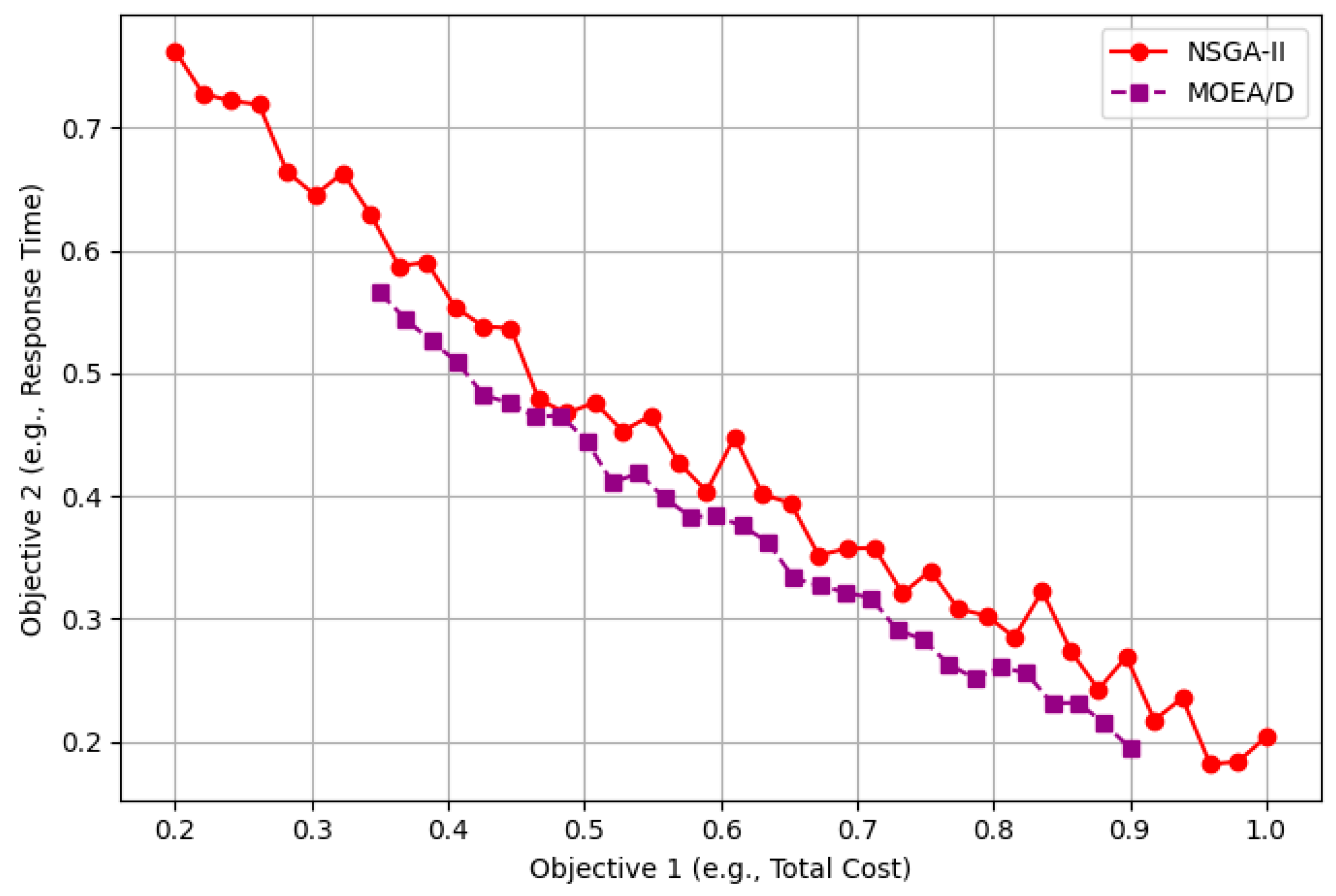
The results show that both algorithms can produce a set of efficient solutions with meaningful trade-offs between conflicting objectives. However, some differences are observed in the structure of the Pareto fronts, which indicate the different behavior of the algorithms in the decision space. The NSGA-II algorithm produced a more continuous front with a wider coverage of the objective space, while the MOEA/D algorithm was more focused on specific regions of the Pareto front and showed higher convergence in some objective combinations.
Figure 3 presents a comparative view of the Pareto fronts obtained from the two algorithms. This figure, as a curve diagram, clearly shows the distribution of solutions and the trade-offs between the main objectives of the model and allows for a visual assessment of the quality of the fronts.
A visual inspection of
Figure 3 shows that the Pareto fronts obtained from the proposed framework have a suitable diversity and no unrealistic concentration or meaningful gap is observed in the objective space. This feature indicates the ability of the model to provide diverse decision-making options for different crisis conditions. Also, the good convergence of the solutions shows that the algorithms used were able to approach the optimal regions of the decision-making space without sacrificing the quality of the diversity of the solutions.
In order to quantitatively compare the performance of NSGA-II and MOEA/D algorithms, the results obtained from the execution of these two algorithms were analyzed based on the common Pareto front evaluation indices. These indices were chosen to reflect both the quality of convergence to the efficient regions and the diversity and stability of the solutions in the objective space. All reported values are calculated based on the mean and standard deviation of the results obtained from independent executions.
Table 2 provides a summary of the quantitative comparative results between the two algorithms and allows for a detailed assessment of their behavioral differences.
Analysis of the results in
Table 2 shows that the NSGA-II algorithm has performed better in the Hypervolume index, which indicates a wider coverage of the objective space and a higher diversity of the Pareto front obtained by this algorithm. This feature is especially important in humanitarian logistics problems, as it allows for a more diverse range of decision-making options for different critical situations.
In contrast, the MOEA/D algorithm has performed better in the IGD index and computational time, which indicates faster convergence to the efficient regions of the objective space and its higher computational efficiency. However, the higher value of the Spread index for MOEA/D indicates a lower diversity of solutions than NSGA-II, which can limit the flexibility of options in some decision-making scenarios.
Given the stochastic nature of evolutionary algorithms, the evaluation of the stability and repeatability of the results is considered as one of the key criteria of computational validity in this research. For this purpose, the performance of the NSGA-II and MOEA/D algorithms in independent runs is investigated and the degree of variability of the main indicators of the Pareto front evaluation is analyzed. The aim of this analysis is to ensure that the results obtained are not dependent on a specific run and that the behavior of the algorithms has an acceptable stability.
Table 3 provides a summary of the descriptive statistics of the selected performance indicators in independent runs for each algorithm and allows for a direct comparison of the stability of the results.
An examination of the standard deviation values reported in
Table 3 shows that both algorithms have shown acceptable behavior in terms of performance stability in independent runs. The relatively low standard deviation values for the Hypervolume and IGD indices indicate that the quality of the Pareto fronts obtained in different iterations did not fluctuate greatly and that the algorithms converged stably to similar regions of the objective space.
At the same time, a comparison of the two algorithms shows that MOEA/D has less fluctuation in some indices and has performed slightly more stable in terms of repeatability, while NSGA-II has still maintained an acceptable level of stability of results despite a higher diversity of solutions.
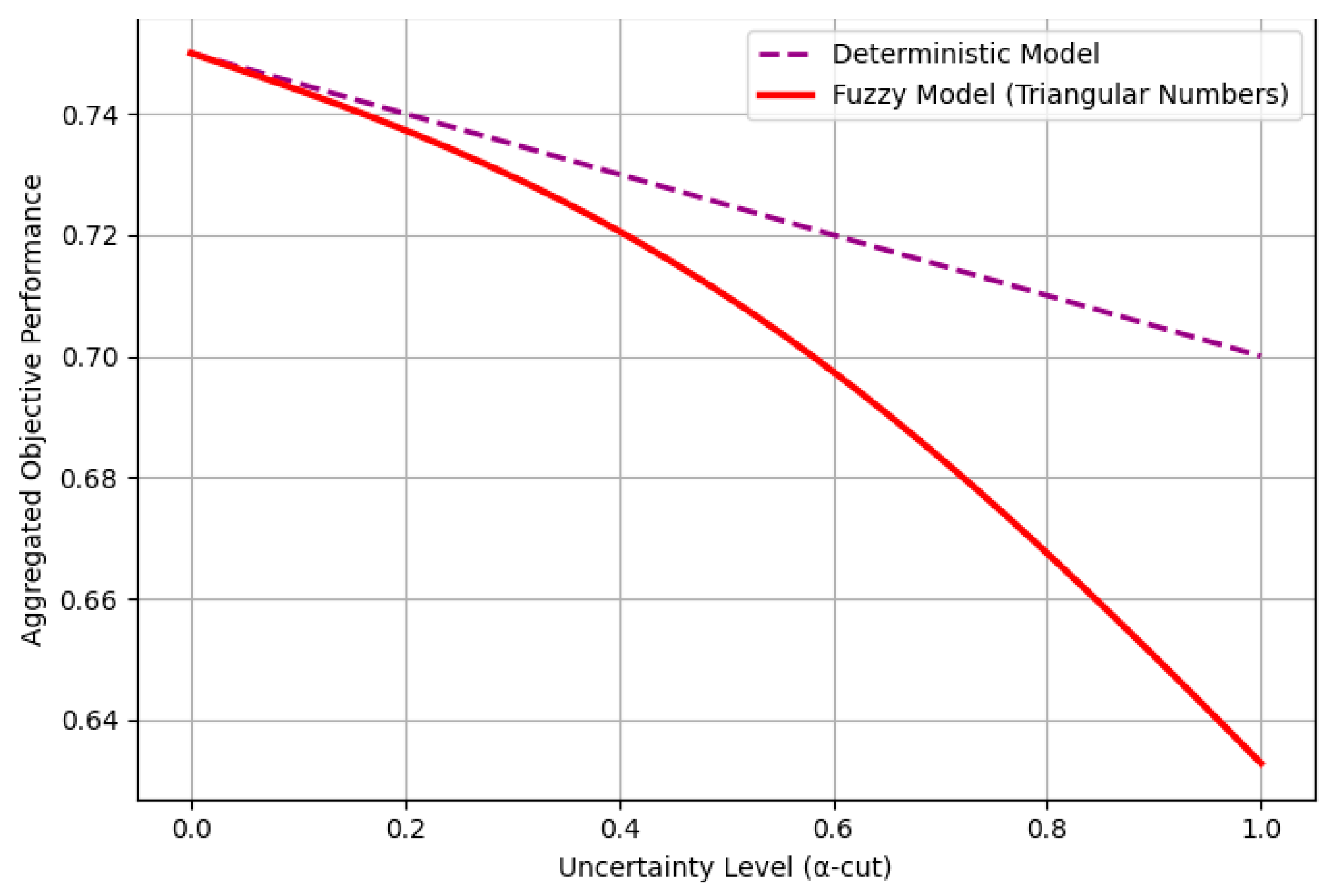
In order to investigate the role of uncertainty in the decision-making process and evaluate the advantage of using fuzzy modeling, the effect of triangular fuzzy numbers on the optimization results was analyzed. In this regard, the performance of the proposed model at different levels of uncertainty is compared with the deterministic case to determine how considering uncertainty affects the quality and stability of decisions.
Figure 4 shows the changes in the aggregated objective performance at different levels of uncertainty, represented by α slices. This figure provides a comparison between the behavior of the deterministic model and the fuzzy model based on triangular numbers and allows for a visual analysis of the sensitivity of the results to increase uncertainty.
As can be seen in
Figure 4, as the level of uncertainty increases, the performance of the fuzzy model shows a gradual but controlled decline, while the deterministic model experiences more uniform and limited changes. This behavior indicates that the fuzzy model responds more realistically to increasing uncertainty and is able to reflect the hidden risks of ignoring uncertainty in the decision-making process.
To complement the visual analysis,
Table 4 presents the numerical results of the model performance at selected levels of uncertainty, allowing for a quantitative comparison between the fuzzy and deterministic models.
An examination of the results in
Table 4 shows that at low levels of uncertainty, the difference between the deterministic and fuzzy models is limited, but as the level of uncertainty increases, a significant gap arises between the results of the two approaches. This difference indicates that the deterministic model tends to be overly optimistic, while the fuzzy model provides more conservative and reliable decisions by considering pessimistic and plausible scenarios.
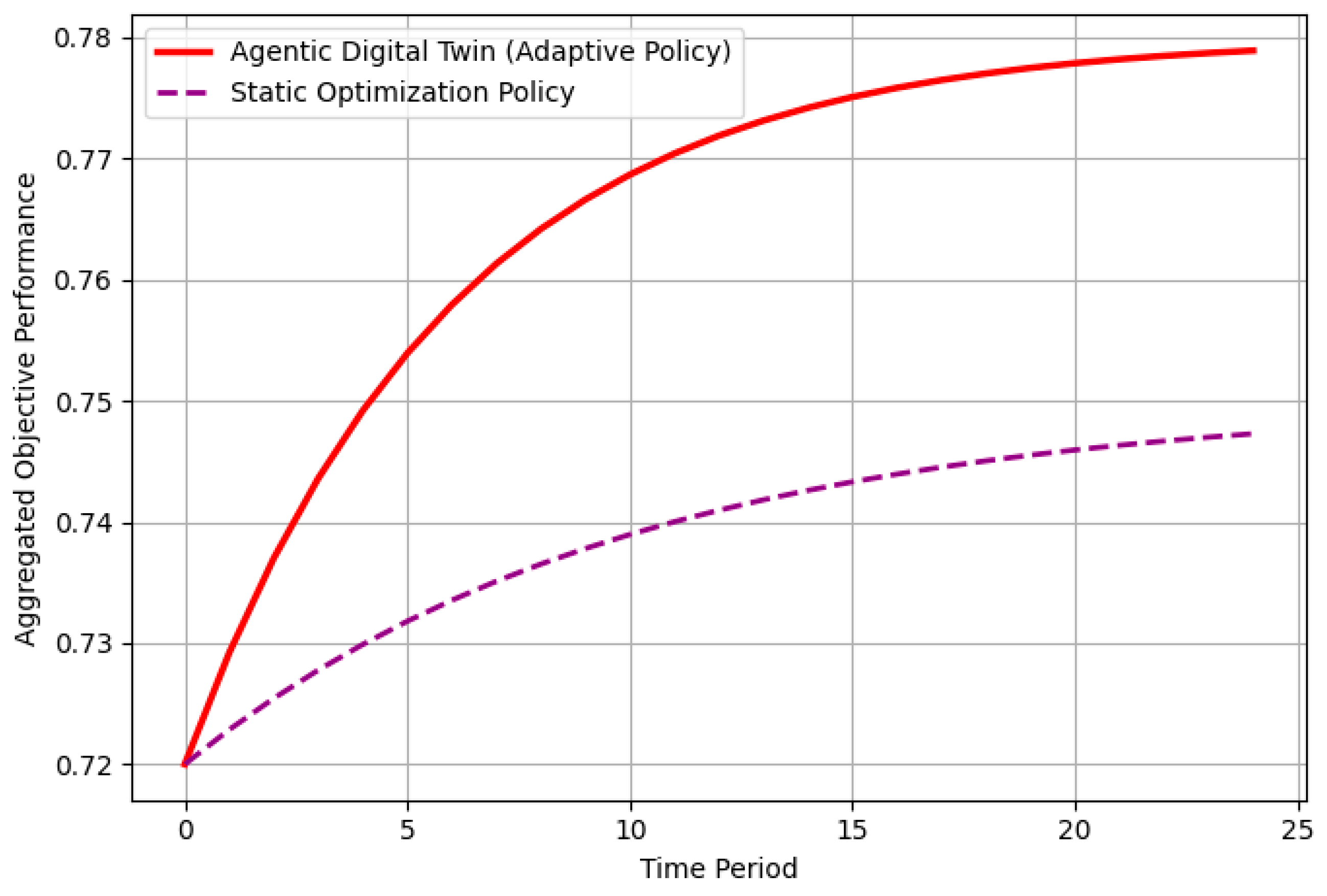
Given the dynamic nature of humanitarian logistics and the constantly changing environmental conditions, it is of particular importance to examine the behavior of the proposed model over time. In this section, the performance of the agent-based digital twin framework is compared with a static optimization policy over a multi-period time horizon to assess the model’s ability to adapt to gradual and abrupt changes in the system.
Figure 5 shows the trend of changes in the aggregated target performance over time for the two approaches. In this graph, the behavior of the agent-based digital twin-based adaptive policy is depicted versus a static optimization policy.
A review of
Figure 5 shows that the agent-based digital twin-based policy quickly adapts to the system state in the early stages and achieves a higher level of performance. This is while the static policy experiences a more gradual and limited improvement and maintains a significant gap with the adaptive approach over time. This difference reflects the effective role of feedback, learning, and agent-based decision-making mechanisms in continuously improving system performance.
To investigate the direct impact of agent-based intelligence on the quality of decision-making and system performance, the results of the proposed framework were compared in two cases “with agent-based intelligence activation” and “without agent-based mechanism”. In the second case, the optimization process is carried out only based on static updates and without interaction of local decision makers. This comparison allows for a detailed assessment of the role of agents in adaptation, learning and coordination of decisions.
In the “no agent-based mechanism” scenario, the optimization structure remains multi-objective and multi-period, but the agent-based decision-making layer is completely removed. In this case, no local preferences, agent-specific constraints, or interactions between agents are considered in the decision-making process.
In this scenario, at the beginning of each period, the Digital Twin only updates the system state (demand, inventory, route conditions, and risk), but no adjustment of objective weights, application of local constraints, or gradual modification of decisions by agents is performed. In other words, the optimization model is run in each period with fixed parameters and no adjustment of preferences.
The term “static updating” in this research means that although environmental data is updated in each time period, the decision-making structure, the weight of objectives, and the scope of decision-making authority do not change, and there is no adaptive mechanism based on learning or interaction between agents.
Table 5 provides a summary of the comparative results of the two cases in terms of key performance indicators and shows how the presence of agent-based intelligence affects the overall behavior of the system.
The results of
Table 5 show that the activation of agent-based intelligence has led to a significant improvement in the quality of the Pareto front, such that the value of the Hypervolume index has increased and the distance from the reference front has decreased. This improvement indicates that the agents, using local feedback and interaction with the digital twin, have been able to guide the search process to more efficient areas of the goal space.
At the same time, the results show that although the use of agent-based intelligence has caused a slight increase in computational overhead, this increase is negligible compared to the improvement in stability, consistency, and quality of decisions.
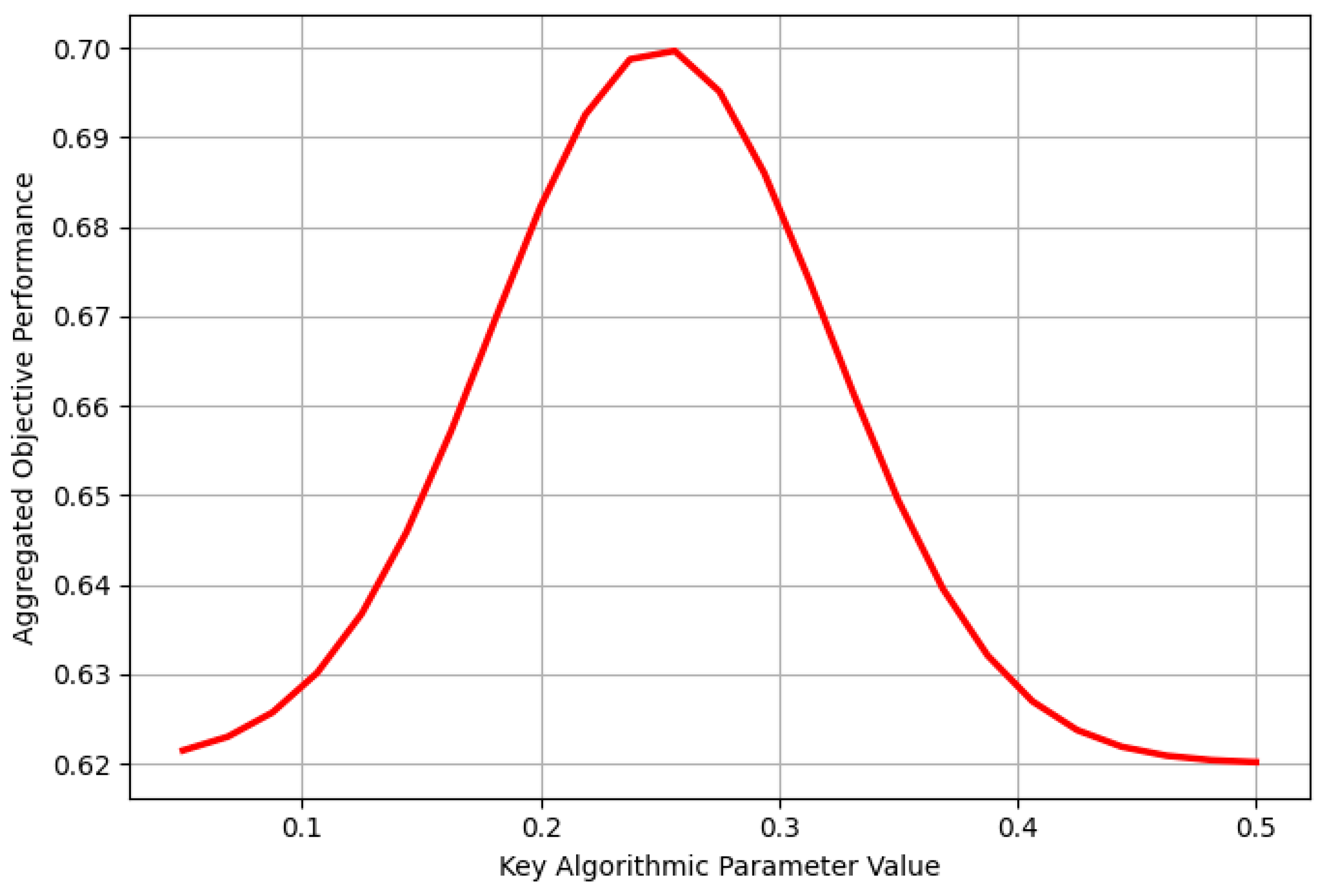
In order to examine the stability of the proposed framework with respect to changes in key algorithmic parameters, a sensitivity analysis has been performed on one of the effective parameters in the evolutionary search process. The purpose of this analysis was to assess the degree of dependence of the quality of solutions on the parameter settings and to identify stable intervals of algorithm performance.
Figure 6 shows the changes in the aggregated objective performance in response to changes in the value of the key algorithm parameter. This diagram examines the behavior of the system in a continuous range of parameter values and allows for a visual analysis of the sensitivity of the results.
A review of
Figure 6 shows that the performance of the model with respect to changes in the desired parameter has a nonlinear but smooth behavior. In a certain range of parameter values, the quality of solutions reaches its maximum, indicating the existence of an optimal region for parameter adjustment. Outside this range, a gradual decrease in performance is observed, but this drop is not sudden or unstable.
This behavior shows that the proposed framework has a good degree of robustness to parameter variations and its performance is not dependent on a single specific value. Such a feature is of great importance for practical applications in humanitarian logistics, as it allows flexible tuning of algorithms to different operational conditions without a significant loss of decision quality.
One of the fundamental challenges in applying advanced optimization and AI methods in humanitarian logistics is the interpretability of decisions for human decision makers. In this study, interpretability is not considered as a side feature, but as an integral part of the decision-making framework. The combination of fuzzy model, digital twin, and agent-based intelligence allows the obtained decisions to be presented not only as numerical outputs, but also to analyze and understand the logic of their formation.
To assess the interpretability of decisions, optimization outputs are examined based on several qualitative–quantitative indicators that reflect the relationship of decisions to objectives, constraints, and environmental conditions.
Table 6 provides a summary of this assessment in two cases: “Proposed Framework” and “Multi-Objective Model Without Agent-Based Layer”.
The results of
Table 6 show that the proposed framework significantly improves the interpretability of decisions. The use of triangular fuzzy numbers allows for the explanation of the role of uncertainty in decisions, and agents increase the traceability and explanation of decision paths by recording and updating local decision-making logic. In contrast, models without an agent-based layer mainly present decisions in the form of numerical outputs, which are more difficult for human decision-makers to interpret.
Overall, the results of this study show that the combination of fuzzy multi-objective optimization with an agent-based digital twin framework provides an effective and reliable approach to support decision-making in humanitarian logistics. Numerical and behavioral analyses showed that the proposed framework is not only capable of generating high-quality, stable, and diverse Pareto fronts, but also exhibits consistent and interpretable performance in the face of uncertainty, temporal dynamics, and changing decision-makers’ preferences. From a managerial perspective, these results indicate that relief operations managers can benefit from an adaptive intelligent system that simultaneously manages cost, response time, and risk in a transparent and explainable manner, rather than relying on static policies and reactive decisions [
36,
37]. Furthermore, the interpretability of decisions and the possibility of tracing the logic of choosing solutions increase the practical acceptance of such systems in humanitarian organizations and help improve coordination between different stakeholders in crisis situations [
38,
39].
9. Conclusions
In this study, an integrated and innovative framework for decision support in humanitarian logistics was presented, which is based on the integration of fuzzy multi-objective optimization, digital twin, and agent-based intelligence. The main goal of this framework was to respond to the inherent complexities of relief operations, including the existence of conflicting goals, information uncertainty, environmental dynamics, and the need for interpretable and defensible decisions. The results obtained from numerical and experimental analyses showed that the proposed model can produce high-quality, stable, and diverse Pareto fronts; at the same time, it also shows an adaptive and realistic response to time changes and different levels of uncertainty. The performance comparison of the NSGA-II and MOEA/D algorithms also showed that these two algorithms have complementary behaviors, and their simultaneous use can provide a more comprehensive view of the multi-objective decision space.
One of the key achievements of this research was to demonstrate the effective role of fuzzy modeling based on triangular numbers in increasing the realism of decisions. The analyses showed that considering fuzzy uncertainty not only does not reduce the quality of decisions but also prevents the over-optimism of deterministic models and provides more conservative and reliable decisions. In addition, the integration of digital twins with agent-based intelligence has enabled continuous updating, gradual learning [
40], and adaptation of decision-making policies to changing environmental conditions [
41]. The results of the dynamic behavior analysis over time clearly showed that the proposed framework provides more stable and efficient performance over different time horizons compared to static approaches.
From an applied perspective, the findings of this research have important managerial implications for organizations and institutions active in the field of humanitarian relief. The proposed framework can help managers make complex logistics decisions not only based on numerical indicators, but also by considering uncertainty, dynamics, and interpretability. The interpretability of decisions, achieved through the combination of fuzzy and agent-based logic, increases the practical acceptance of intelligent systems in real environments and can lead to improved coordination among different stakeholders in critical situations.
Despite the positive and innovative results, this research also has limitations that should be considered. First, the data used in the present study are simulated, and although an attempt has been made to make the scenarios as close to real conditions as possible, the use of real operational data can increase the external validity of the results. Second, although the proposed framework has been evaluated as computationally efficient, increasing the problem scale or adding more objectives and constraints may require computational improvements or the use of parallelization strategies. Also, the behavior of the agents in this study is modeled based on a set of predefined rules that can be expanded in the future with more advanced learning mechanisms.
Accordingly, several directions for future research are conceivable. Using real data from relief operations, developing adaptive learning models for agents, examining the interaction of the proposed framework with other sources of uncertainty, and extending the model to multilayer decision-making levels are among the important future directions. Also, evaluating the framework on larger scales and in real multi-country scenarios can help us understand its practical capabilities more deeply. Overall, this research takes an effective step towards developing intelligent, adaptive, and interpretable decision-support systems for humanitarian logistics and can provide a suitable basis for future research and practical applications.