
A Security Framework for Resilient Smart Grids Based on Self-Organizing Graph Neural Cellular Automata

Abstract
1. Introduction
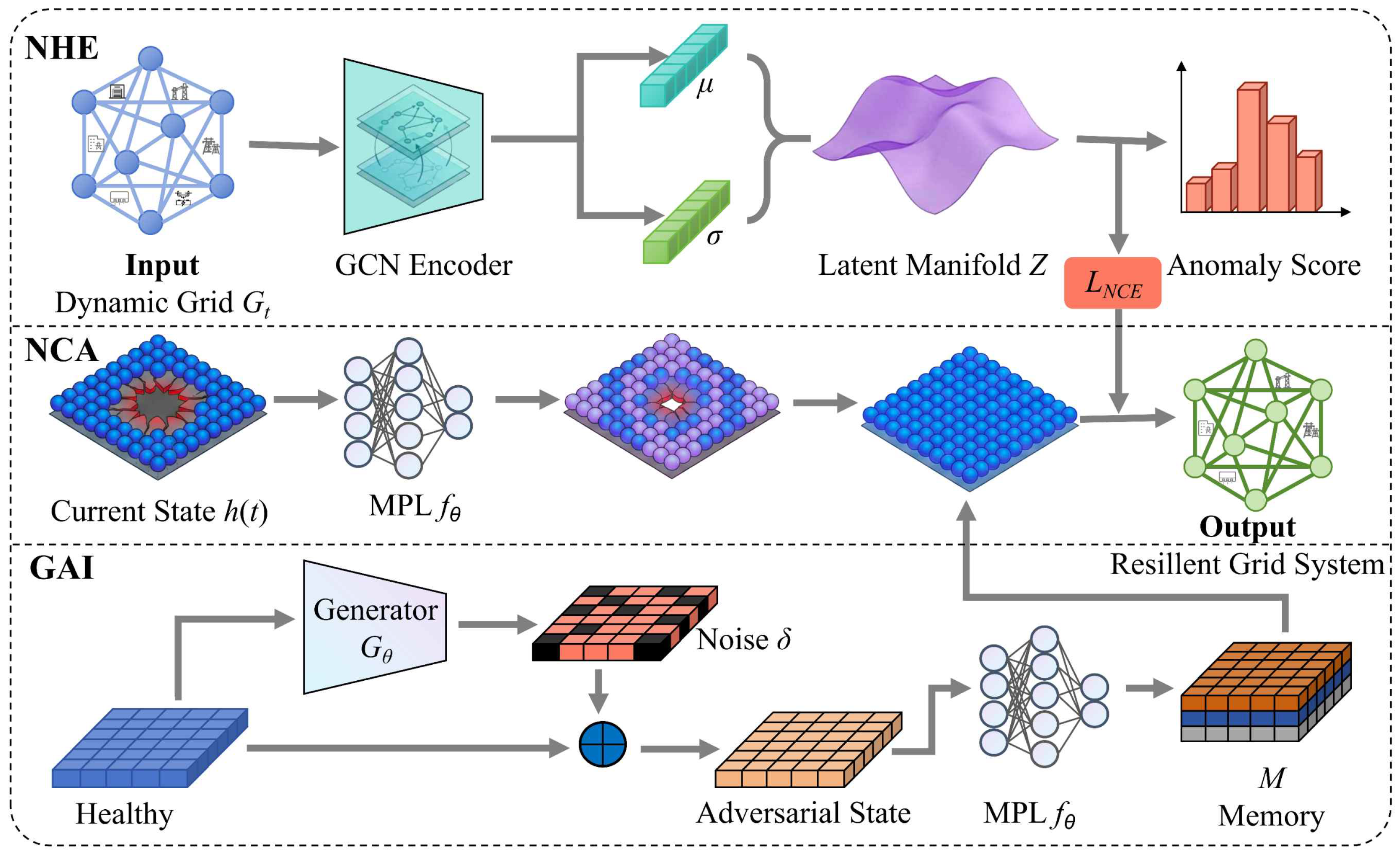
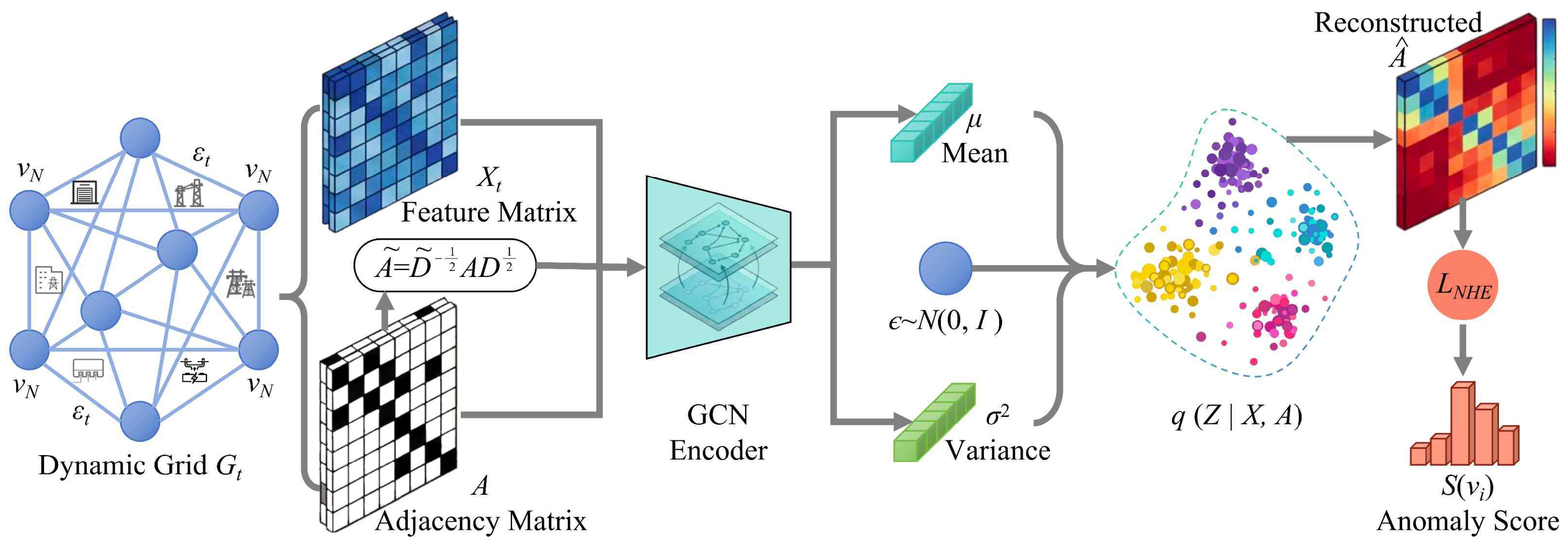
- We proposed a systemic Neural Homeostatic Embedding (NHE) mechanism that integrates variation graph auto-encoders to construct a differentiable health manifold, shifting anomaly detection from static threshold to dynamic unsupervised perception.
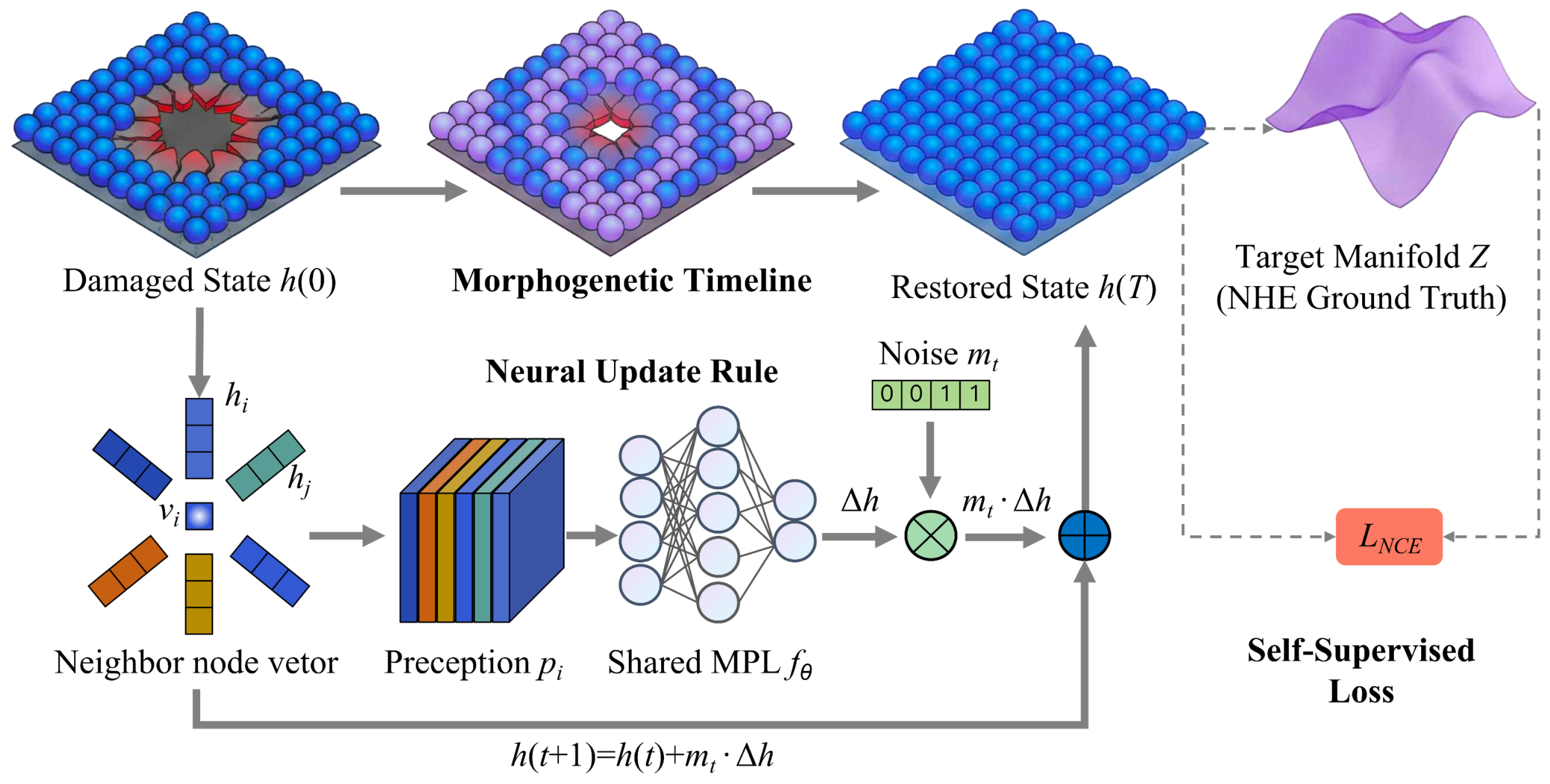
- We designed a topology-independent Neural Cellular Automata (NCA) engine that adapts shared-weight local rules to specific grid physics, enabling the first decentralized self-healing capability for cyber-physical state restoration.
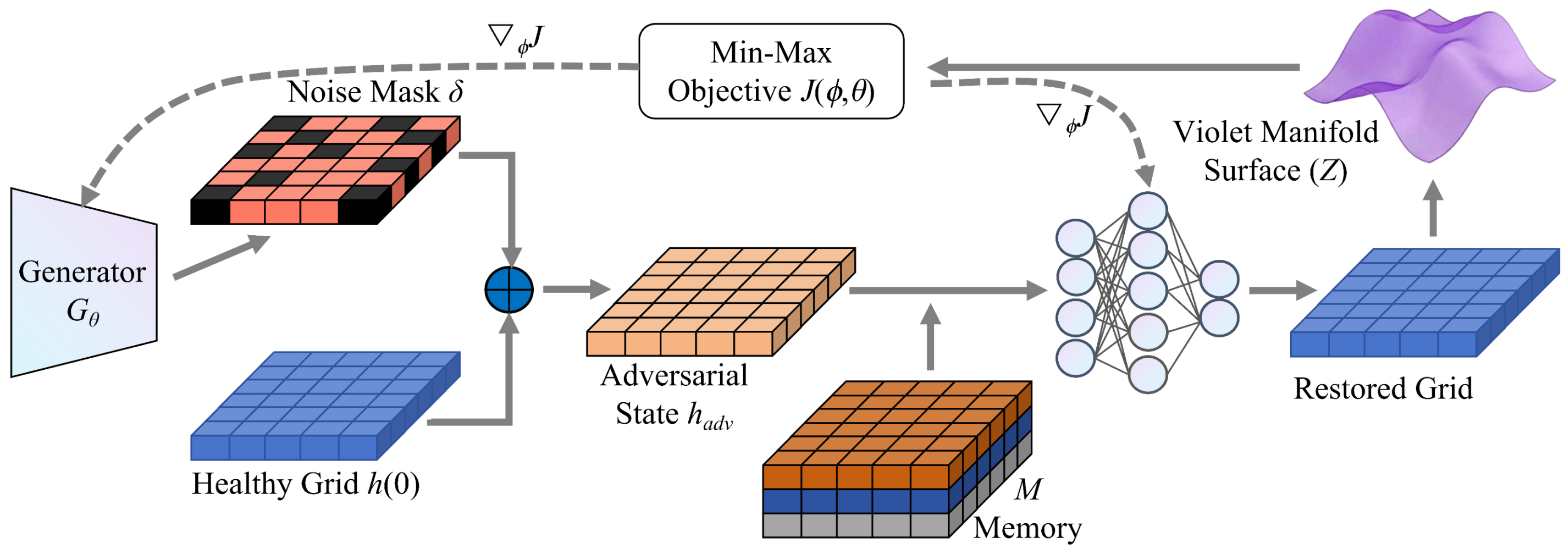
- We introduced the Generative Adversarial Immunity (GAI) strategy that orchestrates a co-evolutionary game between the NCA and an Attack Generator, synthesizing these components into a closed-loop active defense system.
2. Related Work
2.1. Authentication and Cryptographic Protocols in Resource-Constrained Smart Grids
2.2. Decentralized Architectures: Post-Quantum, Blockchain, and Bio-Inspired Security
2.3. Research Motivation
3. Method
3.1. Neural Homeostatic Embedding Mechanism
3.2. Neural Cellular Automata Engine
3.3. Generative Adversarial Immunity Strategy
3.4. Loss Function
4. Experiments and Analysis
4.1. Experimental Environment and Evaluation Metrics
4.2. Datasets and Comparative Models
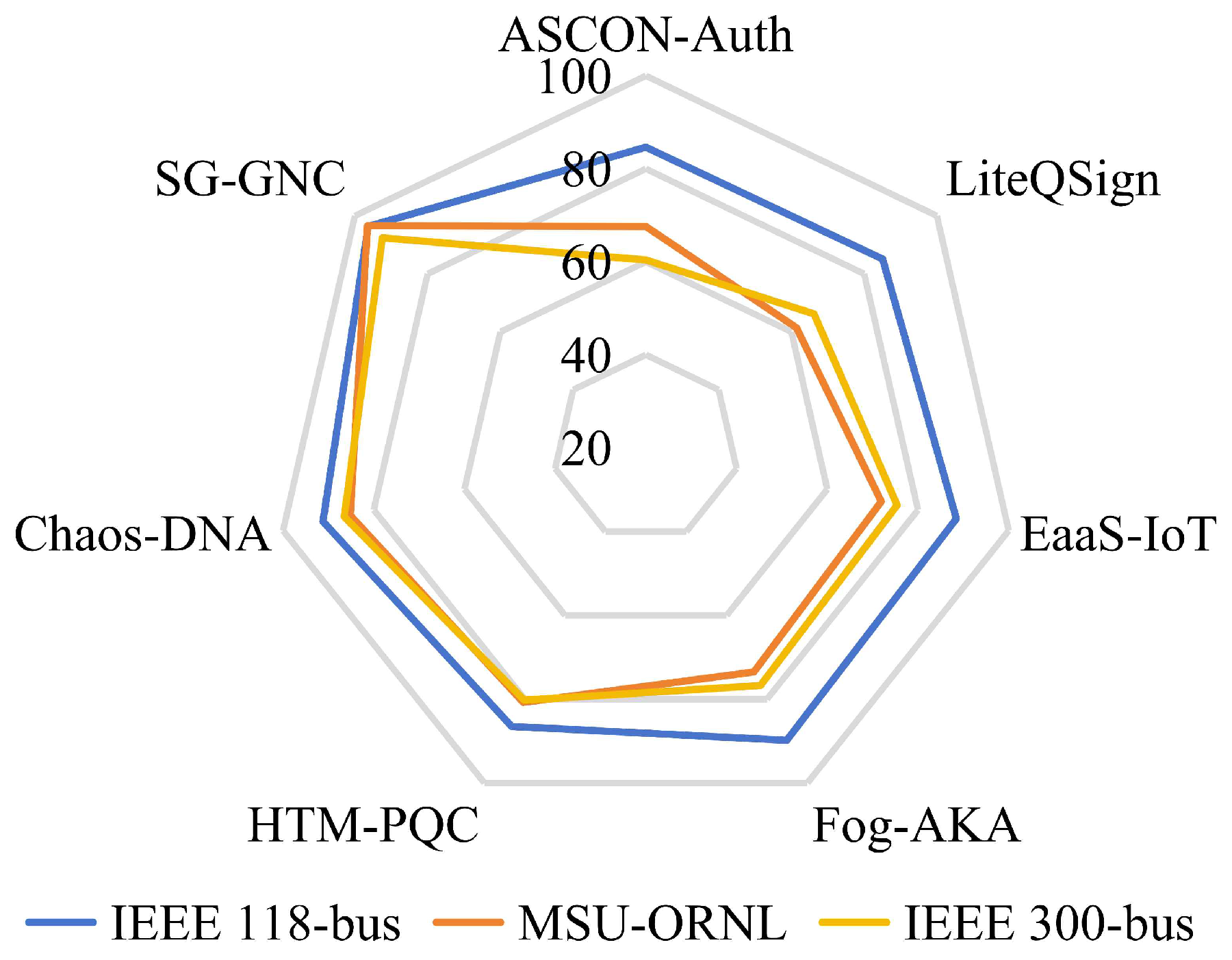
- IEEE 118-bus Dataset [46]. This dataset includes topological information (adjacency matrices) of the IEEE 118-node system alongside node state data (voltage, phase angle) under both normal operation and FDI attacks. It is highly suitable for training the SG-NCA engine and facilitates detection accuracy comparisons with existing graph-dependent benchmarks such as GCN and GAT models.
- IEEE 300-bus Dataset [47]. This dataset contains a standard power system test case consisting of 300 nodes, 69 generators, and 411 branches. Featuring a highly grid-based topology and elevated dimensionality, this dataset provides a rigorous testing platform for decentralized self-healing mechanisms.
- MSU-ORNL Dataset [48]. Comprising network traffic logs and physical process data from real SCADA systems, this dataset covers various attack modes, including DoS and command injection. It serves to validate the generalization capability and anti-fragility of the proposed method when confronting realistic and complex network-layer attacks.
- HTM-PQC [41]. Integrating Hypergraph Theory with Post-Quantum Cryptography, this model enhances key resistance via topological associations, serving as a benchmark for verifying topological independence and key evolution.
- LiteQSign [38]. A lightweight post-quantum signature scheme optimizing IoT resource usage, this model is employed to benchmark the edge-side computational efficiency and efficacy of the SG-NCA engine.
- Fog-AKA [30]. Utilizing a fog-based Multi-TA model for low-latency authentication, this protocol is selected to demonstrate the superior communication latency of the proposed decentralized architecture over hierarchical structures.
- EaaS-IoT [49]. Employing CP-ABE-based cloud offloading to mitigate IoT computational bottlenecks, this architecture serves as a baseline to contrast local defense effectiveness against centralized cloud reliance.
- Chaos-DNA [44]. Combining chaotic maps and DNA coding for multimedia security, this model is utilized to validate the robustness of the Generative Adversarial Immunity strategy in processing high-entropy data.
- PUF-V2G [16]. Leveraging Physical Unclonable Functions for physical capture resistance, this scheme is used to assess the capability of SG-NCA to achieve hardware-level security through software mechanisms.
- ASCON-Auth [50]. Utilizing ultra-lightweight primitives for efficient privacy protection, this protocol serves as a baseline to verify the operational efficiency of the NHE mechanism on resource-constrained nodes.
- GCN-IDS [51]. Utilizing deep graph learning for multi-class DDoS detection, this model leverages traffic interaction graphs to improve attack differentiation capabilities. It serves as a baseline for assessing the proposed framework’s precision in classifying diverse, complex cyber threats against standard graph-based learning approaches.
- GAT-IDS [52]. Integrating Graph Attention Networks (GATs) with temporal GRU modules, this hierarchical framework explicitly models spatio-temporal grid dependencies to detect FDI. It is selected as a state-of-the-art baseline to verify the proposed method’s robustness in maintaining cyber-physical state consistency under dynamic topologies.
4.3. Performance Analysis of Anomaly Detection in Multi-Source Heterogeneous Environments
4.4. Analysis of Adversarial Immunity and Dynamic Topological Robustness
5. Discussion
5.1. Edge-Side Computational Efficiency and Convergence Analysis
5.2. Decentralized Morphogenesis and Self-Healing Reconstruction Quality Evaluation
5.3. Analysis of the Impact of Stability Regularization Coefficient
5.4. Empirical Convergence Analysis of Generative Adversarial Immunity
5.5. Ablation Experiments
6. Conclusions
Author Contributions
Funding
Data Availability Statement
Acknowledgments
Conflicts of Interest
References
- Abdelkader, S.; Amissah, J.; Kinga, S.; Mugerwa, G.; Emmanuel, E.; Mansour, D.E.A.; Bajaj, M.; Blazek, V.; Prokop, L. Securing Modern Power Systems: Implementing Comprehensive Strategies to Enhance Resilience and Reliability against Cyber-Attacks. Results Eng. 2024, 23, 102647. [Google Scholar] [CrossRef]
- Rekeraho, A.; Cotfas, D.T.; Cotfas, P.A.; Bălan, T.C.; Tuyishime, E.; Acheampong, R. Cybersecurity Challenges in IoT-based Smart Renewable Energy. Int. J. Inf. Secur. 2024, 23, 101–117. [Google Scholar] [CrossRef]
- Mishra, N.; Hafizul Islam, S.; Zeadally, S. A Survey on Security and Cryptographic Perspective of Industrial-Internet-of-Things. Internet Things 2024, 25, 101037. [Google Scholar] [CrossRef]
- Sumalatha, N.; Baskaran, K. An Efficient Multiuser Threshold–Based Dynamic Cipher Puzzle with Secure Key Generation for DoS Attacks in Smart Grid Applications. Trans. Emerg. Telecommun. Technol. 2025, 36, e70204. [Google Scholar] [CrossRef]
- Rana, S.; Parast, F.K.; Kelly, B.; Wang, Y.; Kent, K.B. A Comprehensive Survey of Cryptography Key Management Systems. J. Inf. Secur. Appl. 2023, 78, 103607. [Google Scholar] [CrossRef]
- Vasani, V.; Prateek, K.; Amin, R.; Maity, S.; Dwivedi, A.D. Embracing the Quantum Frontier: Investigating Quantum Communication, Cryptography, Applications and Future Directions. J. Ind. Inf. Integr. 2024, 39, 100594. [Google Scholar] [CrossRef]
- Urooj, S.; Lata, S.; Ahmad, S.; Mehfuz, S.; Kalathil, S. Cryptographic Data Security for Reliable Wireless Sensor Network. Alex. Eng. J. 2023, 72, 37–50. [Google Scholar] [CrossRef]
- Thabit, F.; Can, O.; Aljahdali, A.O.; Al-Gaphari, G.H.; Alkhzaimi, H.A. Cryptography Algorithms for Enhancing IoT Security. Internet Things 2023, 22, 100759. [Google Scholar] [CrossRef]
- Bhushan, B.; Kumar, A.; Agarwal, A.K.; Kumar, A.; Bhattacharya, P.; Kumar, A. Towards a Secure and Sustainable Internet of Medical Things (IoMT): Requirements, Design Challenges, Security Techniques, and Future Trends. Sustainability 2023, 15, 6177. [Google Scholar] [CrossRef]
- Ma, Y.; Li, X.; Shi, W.; Cheng, Q. STCLA: An Efficient Certificateless Authenticated Key Agreement Scheme for the Internet of Vehicles. IEEE Trans. Veh. Technol. 2024, 73, 4830–4841. [Google Scholar] [CrossRef]
- Vijay Anand, R.; Alagiri, I.; Jayalakshmi, P.; Brahmam, M.G.; Abdullah, A.B. Lattice Homomorphic Assisted Privacy Preserving Electronic Health Records Data Transmission in Internet of Medical Things Using Blockchain. Trans. Emerg. Telecommun. Technol. 2025, 36, e70070. [Google Scholar] [CrossRef]
- Gu, Z.; Xie, R.; Liu, H.; Liu, Y.; Wang, X.; Zhang, H.; Gao, J.; Si, L.; Chen, S.; Ding, J. Dual-Band Complex-Amplitude Metasurface Empowered High Security Cryptography with Ultra-Massive Encodable Patterns. Nanophotonics 2024, 13, 3915–3924. [Google Scholar] [CrossRef] [PubMed]
- Wang, W.; Shi, J.; Guan, N.; Shi, J. Logistic Map Image Cryptography Scheme Based on Chaotic Quantum Boson Sampling. Adv. Quantum Technol. 2025, 8, 2400579. [Google Scholar] [CrossRef]
- Zhang, F.; Guo, Y.; Pu, M.; Chen, L.; Xu, M.; Liao, M.; Li, L.; Li, X.; Ma, X.; Luo, X. Meta-Optics Empowered Vector Visual Cryptography for High Security and Rapid Decryption. Nat. Commun. 2023, 14, 1946. [Google Scholar] [CrossRef] [PubMed]
- Sharma, G.; Joshi, A.M.; Mohanty, S.P. sTrade: Blockchain Based Secure Energy Trading Using Vehicle-to-Grid Mutual Authentication in Smart Transportation. Sustain. Energy Technol. Assess. 2023, 57, 103296. [Google Scholar] [CrossRef]
- Yu, S.; Park, K. PUF-based Robust and Anonymous Authentication and Key Establishment Scheme for V2G Networks. IEEE Internet Things J. 2024, 11, 15450–15464. [Google Scholar] [CrossRef]
- Garms, L.; Paraïso, T.K.; Hanley, N.; Khalid, A.; Rafferty, C.; Grant, J.; Newman, J.; Shields, A.J.; Cid, C.; O’Neill, M. Experimental Integration of Quantum Key Distribution and Post-quantum Cryptography in a Hybrid Quantum-safe Cryptosystem. Adv. Quantum Technol. 2024, 7, 2300304. [Google Scholar] [CrossRef]
- Xu, F.; Ma, X.; Zhang, Q.; Lo, H.K.; Pan, J.W. Secure Quantum Key Distribution with Realistic Devices. Rev. Mod. Phys. 2020, 92, 025002. [Google Scholar] [CrossRef]
- Mehic, M.; Michalek, L.; Dervisevic, E.; Burdiak, P.; Plakalovic, M.; Rozhon, J.; Mahovac, N.; Richter, F.; Kaljic, E.; Lauterbach, F.; et al. Quantum Cryptography in 5G Networks: A Comprehensive Overview. IEEE Commun. Surv. Tutor. 2024, 26, 302–346. [Google Scholar] [CrossRef]
- Rubio García, C.; Rommel, S.; Takarabt, S.; Vegas Olmos, J.J.; Guilley, S.; Nguyen, P.; Tafur Monroy, I. Quantum-Resistant Transport Layer Security. Comput. Commun. 2024, 213, 345–358. [Google Scholar] [CrossRef]
- Konstantopoulou, E.; Athanasiou, G.; Sklavos, N. Review and Analysis of FPGA and ASIC Implementations of NIST Lightweight Cryptography Finalists. ACM Comput. Surv. 2025, 57, 1–35. [Google Scholar] [CrossRef]
- Perazzo, P.; Vallati, C. Tiny Keys Hold Big Secrets: On Efficiency of Pairing-Based Cryptography in IoT. Internet Things 2025, 30, 101489. [Google Scholar] [CrossRef]
- Adeniyi, A.E.; Jimoh, R.G.; Awotunde, J.B. A Systematic Review on Elliptic Curve Cryptography Algorithm for Internet of Things: Categorization, Application Areas, and Security. Comput. Electr. Eng. 2024, 118, 109330. [Google Scholar] [CrossRef]
- Popoola, O.; Rodrigues, M.A.; Marchang, J.; Shenfield, A.; Ikpehai, A.; Popoola, J. An Optimized Hybrid Encryption Framework for Smart Home Healthcare: Ensuring Data Confidentiality and Security. Internet Things 2024, 27, 101314. [Google Scholar] [CrossRef]
- Eledlebi, K.; Alzubaidi, A.; Damiani, E.; Puthal, D.; Mateu, V.; Zemerly, M.J.; Al-Hammadi, Y.; Yeun, C.Y. Bio-Integrated Hybrid TESLA: A Fully Symmetric Lightweight Authentication Protocol. IEEE Internet Things J. 2024, 11, 37421–37436. [Google Scholar] [CrossRef]
- Tanveer, M.; Alasmary, H. LACP-SG: Lightweight Authentication Protocol for Smart Grids. Sensors 2023, 23, 2309. [Google Scholar] [CrossRef] [PubMed]
- Thakor, V.A.; Razzaque, M.A.; Darji, A.D.; Patel, A.R. A Novel 5-Bit S-box Design for Lightweight Cryptography Algorithms. J. Inf. Secur. Appl. 2023, 73, 103444. [Google Scholar] [CrossRef]
- Kook, S.; Kim, K.; Ryu, J.; Lee, Y.; Won, D. Lightweight Hash-Based Authentication Protocol for Smart Grids. Sensors 2024, 24, 3085. [Google Scholar] [CrossRef]
- Irshad, A.; Usman, M.; Chaudhry, S.A.; Naqvi, H.; Shafiq, M. A Provably Secure and Efficient Authenticated Key Agreement Scheme for Energy Internet-Based Vehicle-to-Grid Technology Framework. IEEE Trans. Ind. Appl. 2020, 56, 4425–4435. [Google Scholar] [CrossRef]
- Wei, L.; Cui, J.; Zhong, H.; Bolodurina, I.; Liu, L. A Lightweight and Conditional Privacy-Preserving Authenticated Key Agreement Scheme with Multi-TA Model for Fog-Based VANETs. IEEE Trans. Dependable Secur. Comput. 2023, 20, 422–436. [Google Scholar] [CrossRef]
- Abbasi, I.A.; Jan, S.U.; Alqahtani, A.S.; Khan, A.S.; Algarni, F. A Lightweight and Robust Authentication Scheme for the Healthcare System Using Public Cloud Server. PLoS ONE 2024, 19, e0294429. [Google Scholar] [CrossRef] [PubMed]
- Rosa, P.; Souto, A.; Cecílio, J. Light-SAE: A Lightweight Authentication Protocol for Large-Scale IoT Environments Made with Constrained Devices. IEEE Trans. Netw. Serv. Manag. 2023, 20, 2428–2441. [Google Scholar] [CrossRef]
- Mutlaq, K.A.A.; Nyangaresi, V.O.; Omar, M.A.; Abduljabbar, Z.A.; Ma, J.; Al Sibahee, M.A.; Aldarwish, A.J.Y.; Ali, A.H. Blockchain Assisted Signature and Certificate Based Protocol for Efficient Data Protection and Transaction Management in Smart Grids. PLoS ONE 2025, 20, e0318182. [Google Scholar] [CrossRef] [PubMed]
- Zahoor, A.; Mahmood, K.; Saleem, M.A.; Badar, H.M.S.; Le, T.V.; Das, A.K. Lightweight Authenticated Key Agreement Protocol for Smart Power Grid Systems Using PUF. IEEE Open J. Commun. Soc. 2024, 5, 3568–3580. [Google Scholar] [CrossRef]
- Aquina, N.; Cimoli, B.; Das, S.; Hövelmanns, K.; Weber, F.J.; Okonkwo, C.; Rommel, S.; Škorić, B.; Tafur Monroy, I.; Verschoor, S. A Critical Analysis of Deployed Use Cases for Quantum Key Distribution and Comparison with Post-Quantum Cryptography. EPJ Quantum Technol. 2025, 12, 51. [Google Scholar] [CrossRef] [PubMed]
- Chawla, D.; Mehra, P.S. A Roadmap from Classical Cryptography to Post-Quantum Resistant Cryptography for 5G-enabled IoT: Challenges, Opportunities and Solutions. Internet Things 2023, 24, 100950. [Google Scholar] [CrossRef]
- Zeng, C.; He, D.; Feng, Q.; Peng, C.; Luo, M. The Implementation of Polynomial Multiplication for Lattice-Based Cryptography: A Survey. J. Inf. Secur. Appl. 2024, 83, 103782. [Google Scholar] [CrossRef]
- Shim, K.A. On the Suitability of Post-Quantum Signature Schemes for Internet of Things. IEEE Internet Things J. 2024, 11, 10648–10665. [Google Scholar] [CrossRef]
- Mansoor, K.; Afzal, M.; Iqbal, W.; Abbas, Y.; Mussiraliyeva, S.; Chehri, A. PQCAIE: Post Quantum Cryptographic Authentication Scheme for IoT-based e-Health Systems. Internet Things 2024, 27, 101228. [Google Scholar] [CrossRef]
- Khan, M.A.; Javaid, S.; Mohsan, S.A.H.; Tanveer, M.; Ullah, I. Future-Proofing Security for UAVs with Post-Quantum Cryptography: A Review. IEEE Open J. Commun. Soc. 2024, 5, 6849–6871. [Google Scholar] [CrossRef]
- Meng, L.; Fu, Y.; Zheng, F.; Wang, M.; Ma, Z.; Dong, J.; Lin, J. HTM-PQC: Hardening Cryptography Keys under the Trend of Post-Quantum Cryptography Migration on Industrial Internet. IEEE Trans. Ind. Inform. 2025, 21, 3504–3514. [Google Scholar] [CrossRef]
- Mutlaq, K.A.A.; Nyangaresi, V.O.; Omar, M.A.; Abduljabbar, Z.A.; Abduljaleel, I.Q.; Ma, J.; Al Sibahee, M.A. Low Complexity Smart Grid Security Protocol Based on Elliptic Curve Cryptography, Biometrics and Hamming Distance. PLoS ONE 2024, 19, e0296781. [Google Scholar] [CrossRef] [PubMed]
- Dhar, S.; Khare, A.; Dwivedi, A.D.; Singh, R. Securing IoT Devices: A Novel Approach Using Blockchain and Quantum Cryptography. Internet Things 2024, 25, 101019. [Google Scholar] [CrossRef]
- Singh, A.K.; Chatterjee, K.; Singh, A. An Image Security Model Based on Chaos and DNA Cryptography for IIoT Images. IEEE Trans. Ind. Inform. 2023, 19, 1957–1964. [Google Scholar] [CrossRef]
- Mougkogiannis, P.; Ghadafi, E.; Adamatzky, A. Bio-Inspired Cryptography Based on Proteinoid Assemblies. PLoS ONE 2025, 20, e0324761. [Google Scholar] [CrossRef] [PubMed]
- Morris, T.; Gao, W. Industrial Control System Traffic Data Sets for Intrusion Detection Research. In Infrastructure Protection VIII; Butts, J., Shenoi, S., Eds.; Springer: Berlin/Heidelberg, Germany, 2014; pp. 65–78. [Google Scholar] [CrossRef]
- IEEE Power and Energy Society. IEEE 300-Bus System. 2024. Available online: https://www.ee.washington.edu/research/pstca/ (accessed on 16 October 2024).
- Zimmerman, R.D.; Murillo-Sánchez, C.E.; Thomas, R.J. MATPOWER: Steady-State Operations, Planning, and Analysis Tools for Power Systems Research and Education. IEEE Trans. Power Syst. 2011, 26, 12–19. [Google Scholar] [CrossRef]
- Javadpour, A.; Ja’fari, F.; Taleb, T.; Zhao, Y.; Yang, B.; Benzaïd, C. Encryption as a Service for IoT: Opportunities, Challenges, and Solutions. IEEE Internet Things J. 2024, 11, 7525–7558. [Google Scholar] [CrossRef]
- Zeng, D.; Badshah, A.; Tu, S.; Waqas, M.; Han, Z. A Security-Enhanced Ultra-Lightweight and Anonymous User Authentication Protocol for Telehealthcare Information Systems. IEEE Trans. Mob. Comput. 2025, 24, 4529–4542. [Google Scholar] [CrossRef]
- Saunders, B.; de Grande, R.; Carvalho, G.; Woungang, I. Deep graph learning for DDoS detection and multi-class classification IDS. In Proceedings of the 2024 IEEE International Conference on Cyber Security and Resilience (CSR), London, UK, 2–4 September 2024; IEEE: Piscataway, NJ, USA; 2024, pp. 96–100. [Google Scholar] [CrossRef]
- Zhang, H.; Cheng, J.; Bai, X.; Wang, D.; Gao, R.; Fan, B. A Hierarchical Spatio-Temporal Graph Attention Network for False Data Injection Attack Detection in Smart Grids. Processes 2026, 14, 507. [Google Scholar] [CrossRef]



| Component | Specification | Parameter | Value |
|---|---|---|---|
| CPU | Intel Xeon Gold 6530 (4.00 GHz) | State Dimension K | 64 |
| GPU | NVIDIA GeForce RTX 4090 | Evolution Steps T | 32 |
| OS | Ubuntu 20.04 LTS | Update Probability p | 0.5 |
| Python 3.7 | PyTorch Geometric 2.0 | Penalty Coefficient |
| Model | Dataset | Accuracy (%) | Precision (%) | Recall (%) | F1-Score (%) |
|---|---|---|---|---|---|
| PUF-V2G | IEEE 118-bus | 85.90 ± 0.25 | 93.50 ± 0.22 | 74.20 ± 0.30 | 82.74 ± 0.28 |
| IEEE 300-bus | 84.50 ± 0.28 | 91.80 ± 0.25 | 72.50 ± 0.32 | 81.02 ± 0.29 | |
| ASCON-Auth | IEEE 118-bus | 86.35 ± 0.21 | 94.80 ± 0.18 | 75.10 ± 0.25 | 83.81 ± 0.23 |
| IEEE 300-bus | 85.10 ± 0.24 | 93.20 ± 0.20 | 73.40 ± 0.28 | 82.12 ± 0.25 | |
| LiteQSign | IEEE 118-bus | 87.10 ± 0.20 | 96.20 ± 0.15 | 76.50 ± 0.22 | 85.22 ± 0.19 |
| IEEE 300-bus | 85.80 ± 0.23 | 94.50 ± 0.18 | 74.80 ± 0.26 | 83.50 ± 0.22 | |
| Chaos-DNA | IEEE 118-bus | 88.50 ± 0.19 | 87.40 ± 0.21 | 86.15 ± 0.20 | 86.77 ± 0.18 |
| IEEE 300-bus | 87.20 ± 0.22 | 86.10 ± 0.24 | 84.90 ± 0.23 | 85.50 ± 0.21 | |
| Fog-AKA | IEEE 118-bus | 90.25 ± 0.18 | 91.15 ± 0.16 | 86.80 ± 0.19 | 88.92 ± 0.17 |
| IEEE 300-bus | 88.90 ± 0.20 | 89.80 ± 0.19 | 85.40 ± 0.21 | 87.55 ± 0.19 | |
| EaaS-IoT | IEEE 118-bus | 91.80 ± 0.15 | 92.35 ± 0.14 | 88.50 ± 0.16 | 90.38 ± 0.15 |
| IEEE 300-bus | 90.20 ± 0.18 | 90.80 ± 0.17 | 87.10 ± 0.19 | 88.92 ± 0.18 | |
| HTM-PQC | IEEE 118-bus | 93.45 ± 0.14 | 95.10 ± 0.12 | 89.25 ± 0.15 | 92.08 ± 0.13 |
| IEEE 300-bus | 91.80 ± 0.17 | 93.50 ± 0.15 | 87.80 ± 0.18 | 90.56 ± 0.16 | |
| GCN-IDS | IEEE 118-bus | 95.20 ± 0.18 | 94.85 ± 0.16 | 94.50 ± 0.17 | 94.67 ± 0.15 |
| IEEE 300-bus | 93.15 ± 0.22 | 92.80 ± 0.20 | 92.40 ± 0.23 | 92.60 ± 0.21 | |
| GAT-IDS | IEEE 118-bus | 97.45 ± 0.12 | 97.10 ± 0.11 | 97.05 ± 0.13 | 97.08 ± 0.12 |
| IEEE 300-bus | 96.10 ± 0.15 | 95.90 ± 0.14 | 95.80 ± 0.16 | 95.85 ± 0.15 | |
| SG-GNC | IEEE 118-bus | 98.65 ± 0.12 | 98.42 ± 0.09 | 98.15 ± 0.11 | 98.28 ± 0.10 |
| IEEE 300-bus | 97.82 ± 0.12 | 97.15 ± 0.11 | 96.90 ± 0.13 | 97.02 ± 0.12 |
| Model | Time Complexity | Inference (ms) | Throughput (S/s) | Params (MB) | Train Time (s/ep) | Train Mem (MB) |
|---|---|---|---|---|---|---|
| EaaS-IoT | N/A (Cloud) | 128.50 | 780 | N/A | N/A | N/A |
| Fog-AKA | 45.60 | 2190 | 5.20 | N/A | N/A | |
| HTM-PQC | 32.40 | 3085 | 12.65 | 2.45 | 850 | |
| Chaos-DNA | 22.15 | 4515 | 8.40 | N/A | N/A | |
| GAT-IDS | 18.20 | 6200 | 4.50 | 1.15 | 1280 | |
| LiteQSign | 14.20 | 7040 | 1.85 | N/A | N/A | |
| GCN-IDS | 11.50 | 9500 | 2.10 | 0.42 | 450 | |
| SG-GNC | 9.45 | 10,580 | 3.82 | 0.68 | 320 | |
| ASCON-Auth | 0.85 | 117,650 | 0.15 | N/A | N/A |
| Model | MSE () | MAE () |
|---|---|---|
| HTM-PQC | 13.40 | 12.10 |
| Fog-AKA | 5.62 | 5.95 |
| EaaS-IoT | 3.88 | 4.12 |
| GCN-IDS | 2.85 | 3.10 |
| GAT-IDS | 1.95 | 2.25 |
| SG-GNC | 0.82 | 1.15 |
| Configuration | Modules | IEEE 118-Bus | IEEE 300-Bus | MSU-ORNL | |||
|---|---|---|---|---|---|---|---|
| MSE () ↓ | F1 (%) ↑ | MSE () ↓ | F1 (%) ↑ | Acc (%) ↑ | F1 (%) ↑ | ||
| Baseline | GCN | 12.60 | 88.60 | 15.40 | 86.50 | 85.50 | 86.20 |
| Individual | NHE | 9.50 | 91.05 | 11.20 | 89.50 | 87.50 | 88.00 |
| NCA | 6.10 | 89.20 | 7.80 | 87.50 | 86.50 | 87.00 | |
| GAI | 11.80 | 90.50 | 14.50 | 88.50 | 89.00 | 89.50 | |
| Pairwise | NHE + NCA | 1.62 | 96.50 | 2.15 | 95.80 | 86.20 | 87.15 |
| NHE + GAI | 8.45 | 94.20 | 9.10 | 92.50 | 93.80 | 94.10 | |
| NCA + GAI | 5.20 | 91.50 | 6.85 | 90.10 | 90.40 | 90.85 | |
| Proposed | SG-GNC | 0.82 | 98.28 | 1.15 | 97.02 | 96.55 | 94.56 |
Disclaimer/Publisher’s Note: The statements, opinions and data contained in all publications are solely those of the individual author(s) and contributor(s) and not of MDPI and/or the editor(s). MDPI and/or the editor(s) disclaim responsibility for any injury to people or property resulting from any ideas, methods, instructions or products referred to in the content. |
© 2026 by the authors. Licensee MDPI, Basel, Switzerland. This article is an open access article distributed under the terms and conditions of the Creative Commons Attribution (CC BY) license.
Share and Cite
Hou, R.; Zhang, Y.; Li, S.; He, Y.; Zhang, P. A Security Framework for Resilient Smart Grids Based on Self-Organizing Graph Neural Cellular Automata. Algorithms 2026, 19, 195. https://doi.org/10.3390/a19030195
Hou R, Zhang Y, Li S, He Y, Zhang P. A Security Framework for Resilient Smart Grids Based on Self-Organizing Graph Neural Cellular Automata. Algorithms. 2026; 19(3):195. https://doi.org/10.3390/a19030195
Chicago/Turabian StyleHou, Rongxu, Yiying Zhang, Siwei Li, Yeshen He, and Pizhen Zhang. 2026. "A Security Framework for Resilient Smart Grids Based on Self-Organizing Graph Neural Cellular Automata" Algorithms 19, no. 3: 195. https://doi.org/10.3390/a19030195
APA StyleHou, R., Zhang, Y., Li, S., He, Y., & Zhang, P. (2026). A Security Framework for Resilient Smart Grids Based on Self-Organizing Graph Neural Cellular Automata. Algorithms, 19(3), 195. https://doi.org/10.3390/a19030195