
Article

Sideslip Angle Estimation for Electric Vehicles Based on Adaptive Weight Fusion: Collaborative Optimization of Robust Observer and Kalman Filter
1
School of Automotive, Anyang Vocational and Technical College, Anyang 455000, China
2
Automotive Engineering Research Institute, Jiangsu University, Zhenjiang 212013, China
3
School of Mechanical and Electrical Engineering, Suzhou Polytechnic University, Suzhou 215000, China
*
Author to whom correspondence should be addressed.
Algorithms 2026, 19(3), 189; https://doi.org/10.3390/a19030189
Submission received: 7 January 2026 / Revised: 5 February 2026 / Accepted: 17 February 2026 / Published: 3 March 2026

Abstract

Accurate estimation of vehicle sideslip angle is vital for the stability and safety of four-wheel independent drive electric vehicles (4WIDEVs), but it faces challenges, including model uncertainties caused by tire yaw stiffness variations and system delays. This paper proposes a novel adaptive fusion strategy that combines the dynamic robust observer (DRO) and the improved adaptive square-root unscented Kalman filter (ASUKF). The DRO is designed based on a two-degrees-of-freedom vehicle model and ensures stability through linear matrix inequalities (LMIs), effectively handling parameter uncertainties and time delays; the ASUKF utilizes a three-degrees-of-freedom model and the magic formula tire model, combined with Sage–Husa adaptive filtering, to address the nonlinear tire dynamics. The key innovation of this paper is the introduction of a fuzzy-rule-based adaptive weighting mechanism that dynamically adjusts the fusion weights of the DRO and ASUKF in real time, thereby exploiting their complementary advantages under uncertainty and nonlinear conditions. The simulation and experimental validations demonstrate that this method significantly improves estimation accuracy, reducing the estimation error of vehicle sideslip angle by an average of 9.36%, and maintains robust performance and dynamic adaptability in various conditions, providing a reliable solution for the real-time state estimation of intelligent electric vehicles.

1. Introduction

Research on accurate estimation of vehicle dynamic states constitutes a critical focus within automotive engineering, primarily because it provides the necessary feedback for motion control algorithms and active safety applications [1,2]. The accuracy and reliability of state estimation directly determine the capability of vehicle control systems to acquire critical information and execute appropriate decisions, underscoring their substantial research significance and application value [3,4,5]. Among these states, vehicle sideslip angle is a key determinant of vehicle control but eludes direct measurement by standard vehicle instrumentation, presenting a significant estimation challenge. Its estimation remains a critical and challenging problem that has been the focus of extensive research [6,7,8].
4WIDEVs have demonstrated significant advantages, with their unique distributed drive architecture. In terms of vehicle handling performance, the independent torque vectoring capability of each in-wheel motor enables the generation of a direct yaw moment, thereby enhancing the precision of vehicle stability control, especially under extreme operating conditions. In terms of energy management, energy consumption can be reduced based on an optimal torque distribution strategy. From a spatial layout perspective, the elimination of traditional transmission systems improves the integration of the chassis platform, thereby providing greater freedom for chassis design. Furthermore, the multi-motor configuration offers inherent fault tolerance, guaranteeing sustained driving capability in the event of single-motor failure, which significantly improves system reliability. These features make 4WIDEVs an ideal execution platform for intelligent connected vehicles, laying the foundation for the development of advanced chassis control systems. 4WIDEVs possess richer information sources and more convenient information collection methods, but their unique rapid response ability also brings new challenges to the accuracy and reliability of vehicle state estimation. Using their multi-source information in combination with their vehicle dynamics characteristics is the key direction to create a breakthrough in the current technology for developing a state estimation method suitable for the characteristics of 4WIDEVs [9,10,11]. Reference [9] proposed a method for estimating vehicle parameters and road-bump severity, which plays an important role in optimizing vehicle dynamics characteristics and controlling comfort. Reference [10] presented a novel estimation method that integrates sliding-mode observation, a neural network, and Kalman filtering algorithms, and has been shown to achieve excellent estimation performance. Reference [11] proposed a state estimation method for 4WIDEV chassis control, demonstrating the effectiveness and significance of the integration of vehicle state estimation, control, and motion control design.
The algorithms applied for sideslip angle calculation can currently be summarized as Kalman filtering algorithms [12,13], nonlinear synthetic observation algorithms [14,15,16,17], integrated observation methods based on vehicle characteristics [18,19,20], information fusion observation methods [21,22,23,24,25,26], and robust observation algorithms [27,28,29]. Among the above methods, Kalman filtering is recognized as an effective and applicable estimation algorithm. Song presented a sensor fusion estimation method with the integration of a robust sliding-mode estimator and an extended cubature Kalman filter [12]. Liu improved estimation accuracy under the influence of high nonlinearity and strong noise by combining the advantages of particle filtering and Kalman filtering [14]. These studies indicate that many researchers have combined vehicle dynamics characteristics with estimation system requirements to enhance vehicle sideslip estimation performance through the in-depth development of Kalman filtering algorithms, including the application of advanced filtering forms, noise feature statistics, and adaptive gain matrix design. Such developments represent one of the key directions for advancing vehicle state estimation technology.
Existing estimation methods can be classified into four major categories based on their underlying model principles. The kinematic model-based methods [22] mainly employ technologies such as combined GNSS/INS navigation, which have the advantage of not relying on tire dynamics parameters and thus exhibit broad applicability. However, they have the limitation of a sharp decline in estimation accuracy when satellite signals are blocked. The dynamic model-based methods [18,21] fully utilize the vehicle mechanism characteristics. Among them, observer-based methods focus on the design of model robustness, while Kalman filtering-based methods aim to achieve optimal state estimation. However, both are sensitive to model accuracy and parameter changes. To integrate the advantages of different methods, the kinematic–dynamic hybrid model method [3,30] effectively improves robustness under complex conditions such as sensor failure or model mismatch through the information complementation mechanism. In recent years, data-driven neural networks and machine learning methods [16,20,31] have demonstrated strong nonlinear fitting capabilities, significantly reducing reliance on explicit physical models. However, their interpretability, generalization ability, and real-time performance remain challenges in practical engineering applications. Overall, current research shows a trend from a single model to multi-source fusion, and from mechanism-driven to data- and mechanism-driven. However, how to design an adaptive fusion mechanism that synergistically optimizes the advantages of different methods and achieves high-precision and robust estimation in all working conditions remains an urgent frontier direction to be explored in depth.
Concurrently, the observer’s robustness against model uncertainties must be enhanced to cope with the challenges posed by diverse driving scenarios and varying road conditions [32,33,34]. For instance, Reference [33] points out that cross-winds in high-speed scenarios can have an uncertain impact on state estimation results, and the robustness of the observer should be carefully considered under model uncertainty. It is known that not only parameter perturbation but also time delay can introduce uncertain disturbances [35,36,37]. Reference [37] studied the longitudinal and lateral coupling-coordination control problem of vehicles under the influence of tire nonlinearity. Under such conditions, the dynamic coupling, parameter variation, and actuator delay issues all affect the stability control effect, thus reflecting the significance of obtaining precise vehicle states under the influence of multiple factors. Consequently, the development of robust observers that concurrently address these dual challenges holds considerable research importance and practical utility [38,39]. Reference [39] presents a new hierarchical state estimation architecture, which addresses the problem of delayed interconnection.
Although these methods have made progress in their respective fields, the challenge of how to jointly address the three challenges of model uncertainty, time delay, and tire nonlinearity within a unified framework remains an unsolved problem that current research has failed to overcome. First, most studies tend to focus on addressing a single type of challenge: improved strategies based on Kalman filtering (such as in References [8,12,13,14]) can effectively handle nonlinearity, but they lack robustness against model parameter uncertainties and system time delays; whereas the design of robust observers (such as in References [28,29,30,38,39]) can ensure stability under model mismatch and time delays, the assumption of linear tire models limits the estimation accuracy in the nonlinear region of tire force saturation. Second, few studies can jointly address the combined challenge of model uncertainty (including parameter perturbations and time delays) and tire nonlinear dynamics that are coupled with each other within a unified framework. Finally, existing fusion methods mostly use fixed weights, which are difficult to adapt to the dynamic changes of vehicle states and road conditions [22,23,24,25,26,27].
In the current era of electric and intelligent vehicle development, with the enrichment of on-board sensor equipment, the increase of data processing capability [40,41], and the improvement of electronic communication capability, the improvement of state estimation accuracy through comprehensive processing of multimodal information and the fusion of redundant data represents an important research direction and holds significant value [31,42]. Therefore, the problem this study aims to solve is to develop an adaptive adjustment fusion estimation architecture that can not only utilize the advantages of robust observers to deal with uncertainties and time delays, but also leverage the high-precision characteristics of nonlinear filters in the nonlinear regions of tires, thereby achieving robust and accurate estimation over the entire operating conditions.
In this paper, motivated by the aforementioned analysis, an adaptive sideslip angle fusion estimation strategy combining the advantages of an improved adaptive Kalman filter and a robust observer is proposed. (1) To mitigate the adverse effects of uncertainty and delay in sideslip angle estimation, a DRO for sideslip angle computation is presented. Considering practical driving scenarios, the disturbance of tire cornering stiffness and the system delay are integrated into the vehicle dynamic model, and a dynamic robust observer is designed for simultaneous estimation of vehicle states, in which the observation gain matrix and feedback gain matrix are calculated by solving a series of LMIs. (2) To increase the accuracy of the estimation system for the tire nonlinear working conditions, the vehicle model with three degrees of freedom and the magic-formula-based tire model are established, and the vehicle sideslip angle estimator is designed by combining ASUKF. (3) To synthesize the advantages of the above two observation methods and improve the overall estimation precision and applicability of the vehicle under model uncertainty, time delay and tire nonlinear conditions, a fusion strategy for vehicle sideslip angle estimation is designed based on adaptive weight.

2. Model of 4WIDEV

2.1. 2-DOF Vehicle Dynamic Model Considering Linear Tire Model

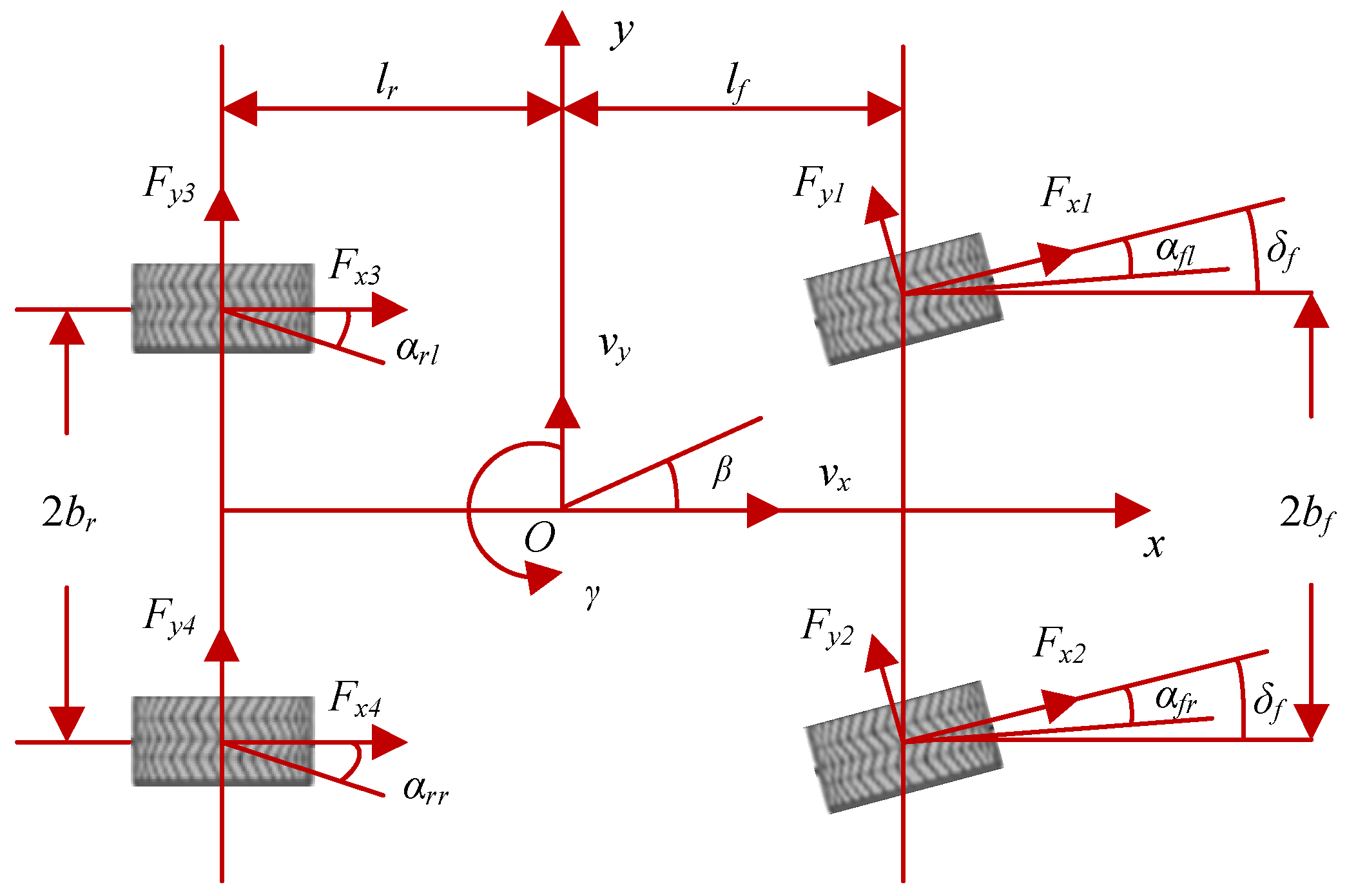
A schematic diagram illustrating the force analysis of the vehicle is shown in Figure 1. The modeling process begins with the development of a 2-DOF vehicle model, which captures the essential longitudinal and lateral dynamics. The dynamic coordinate system is defined with its origin at the vehicle’s center of mass. The x-axis is aligned with the direction of travel, while the y-axis is perpendicular to it within the horizontal plane, thereby neglecting vertical motions. Additionally, the tires are assumed to exhibit identical characteristics. It is worth noting that Figure 1 presents a simplified schematic, primarily intended to visualize the force balance relationships in the longitudinal and lateral planes. This visualization aids in the subsequent derivation of the 2-DOF dynamic equations. This schematic focuses on core mechanical elements, such as tire lateral force and external yaw moment, to highlight the research focus on longitudinal and transverse dynamic state estimation in this paper. Under the condition of a small front-wheel steering angle and the assumption of a constant longitudinal vehicle speed, the 2-DOF vehicle dynamics model is formulated by the following equations:
m v x β ˙ = F y f F y r m v x γ ,
I z γ ˙ = l f F y r l r F y r + Δ M z ,
where vx is the longitudinal velocity, vy is the velocity, γ is the vehicle yaw rate, β is the vehicle sideslip angle, m is the vehicle mass, Iz is the inertia moment, lf and lr respectively represent the distance from the vehicle centroid to the front or rear axle, and Fyf and Fyr respectively represent the generalized tire forces of the front or rear axle, i.e., Fyf = Fy1 + Fy2, Fyr = Fy3 + Fy4, ΔMz is the external yaw moment and is obtained as
Δ M z = ( F x 2 F x 1 ) b f cos δ + F x 1 + F x 2 l f sin δ + ( F x 4 F x 3 ) b r ,
where bf,r is the half wheel base, δ is the front-wheel steering angle, Fxj (j = 1, 2, 3, 4) is the longitudinal force of the relevant tire. The lateral tire forces Fyf and Fyr are expressed as
F y f = C f α f , F y r = C r α r ,
where Cf and Cr respectively represent the generalized tire cornering stiffness of the front and rear axles. The tire slip angle is
α f = δ f l f γ / v x β α r = l r γ / v x β .
Then, the 2-DOF vehicle dynamics model is deduced as
x ˙ = A x + B u ,
where x = β γ T , u = δ Δ M z T , A = C f + C r m v x 1 l f C f l r C r m v x 2 l r C r l f C f I z l f 2 C f + l r 2 C r v x I z , B = C f m v x 0 l f C f I z 1 I z .

2.2. 3-DOF Vehicle Dynamic Model Considering Nonlinear Tire Model

Utilizing the principles of multi-body dynamics coupling, a comprehensive vehicle model integrating three degrees of freedom in longitudinal, lateral, and yaw motions was developed. The schematic of this model is depicted in Figure 1. This model employs an onboard inertial coordinate system centered at the vehicle’s center of mass. The x-axis is defined along the longitudinal symmetry plane, pointing forward, while the y-axis is perpendicular to the x-axis within the horizontal plane, with the leftward direction designated as positive. According to the standard right-hand rule, it is stipulated that the positive direction of all planar rotation angles and moments is counter-clockwise, and vector components conform to the coordinate axis convention. For computational simplicity, the mechanical characteristics of all tires are assumed to be identical. The wheels are numbered 1 to 4, denoting the left-front, right-front, left-rear, and right-rear positions, respectively. By establishing the longitudinal moment balance equation, lateral moment balance equation, and yaw moment balance equation, a vehicle dynamics equation system that considers three-dimensional motion coupling is thus established. Consequently, the established 3-DOF model provides an effective framework for characterizing the vehicle’s attitude variations and dynamic response under a wide range of complex operating scenarios. Therefore, the 3-DOF model is
v ˙ x = γ v y + 1 m F x 1 + F x 2 cos δ F y 1 + F y 2 sin δ + F x 3 + F x 4 ,
v ˙ y = γ v x + 1 m F x 1 + F x 2 sin δ + F y 1 + F y 2 cos δ + F y 3 + F y 4 ,
I z γ ˙ = F x 1 + F x 2 l f sin δ ( F y 3 + F y 4 ) l r + F y 1 + F y 2 l f cos δ + ( F y 1 F y 2 ) b f sin δ ( F x 1 F x 2 ) b f cos δ ( F x 3 F x 4 ) b r ,
where Fxj and Fyj (j = 1, 2, 3, 4) are the longitudinal and lateral forces of the jth tire, respectively, bf and br are the half treads of the front wheels and rear wheels, respectively. The tire force is obtained by the magic formula; the longitudinal and lateral tire force [20] is obtained as
F x , y = D sin { C arctan [ B α E ( B α arctan ( B α ) ) ] } ,
where B, C, D, E are corresponding tire model parameters, and α is the tire sideslip angle. The vertical tire force is obtained as
F z 1 = l r ( m g 2 l + m a y h 2 b f l ) m a x h 2 l F z 2 = l r ( m g 2 l m a y h 2 b f l ) m a x h 2 l F z 3 = l f ( m g 2 + m a y h 2 b r l ) + m a x h 2 l F z 4 = l f ( m g 2 m a y h 2 b r l ) + m a x h 2 l ,
where Fz1, Fz2, Fz3, and Fz4 are the vertical tire forces, h is the CoG height, and g is the gravity acceleration. The tire side slip angle is expressed by
α 1 = δ arctan v y + l f γ v x + b f γ / 2 α 2 = δ arctan v y + l f γ v x b f γ / 2 α 3 = arctan v y l r γ v x + b r γ / 2 α 4 = arctan v y l r γ v x b r γ / 2 .

3. Fusion Estimation Strategy Based on Adaptive Weight

3.1. Vehicle Sideslip Angle Estimation by Dynamic Robust Observer

3.1.1. 2-DOF Vehicle Model with Parameter Uncertainty and Delay

The preceding analysis assumes the tire cornering stiffness to be a fixed parameter. The variations in vehicle operating conditions and the influence of unmodeled disturbances introduce nonlinearities into the vehicle dynamics, resulting in time-varying tire cornering stiffness. To enhance the sideslip angle estimator and concurrently improve the effectiveness of estimation results, the vehicle model is converted into a linear parameter-varying model. In light of the longitudinal vehicle speed vx changing with time, the accessory parameters of vx are denoted as ρ 1 t = 1 / v x and ρ 2 t = 1 / v x 2 . Then, the theoretical model in (6) is
x ˙ = A ρ x + B ρ u ,
where A ( ρ ) = C f + C r m ρ 1 1 l f C f l r C r m ρ 2 l r C r l f C f I z l f 2 C f + l r 2 C r I z ρ 1 , B ( ρ ) = C f m ρ 1 0 l f C f I z 1 I z .
The true cornering stiffness will deviate from its nominal value when the tire is cornering. At this time, it can be written as
C f 0 = 1 2 ( C f max + C f min ) C r 0 = 1 2 ( C r max + C r min ) ,
where C f max and C f min represent the maximum and minimum of C f , and C r max and C r min respectively represent the maximum and minimum of C r . Thus, the tire cornering stiffness can be represented as
C f = C f 0 + N f C f ˜ C r = C r 0 + N r C r ˜ ,
where C f ˜ = C f max C f 0 , C r ˜ = C r max C r 0 , and Nf and Nr represent the time-varying parameters with the condition of N f 1 and N r 1 . In general, it can be simplified as N f = N r . Then, the tire cornering stiffness is obtained as
C k = C k 0 + N k C k ˜ ( k = f , r ) ,
where Nk is the nominal parameter, with the condition of N k 1 , Ck0 being the nominal tire cornering stiffness with the condition of C k 0 = ( C k max + C k min ) / 2 . On this basis, A ( ρ ) and B ( ρ ) are denoted as
A ( ρ ) = A 0 + Δ A 0 B ( ρ ) = B 0 + Δ B 0 ,
where A 0 = C f 0 + C r 0 m ρ 1 1 l f C f 0 l r C r 0 m ρ 2 l r C r 0 l f C f 0 I z l f 2 C f 0 + l r 2 C r 0 I z ρ 1 , B 0 = C f 0 m ρ 1 0 l f C f 0 I z 1 I z , Δ A 0 = N f C f ˜ + N r C r ˜ m ρ 1 1 l f N f C f ˜ l r N r C r ˜ m ρ 2 l r N r C r ˜ l f N f C f ˜ I z l f 2 N f C f ˜ + l r 2 N r C r ˜ I z ρ 1 , Δ B 0 = N f C f ˜ m ρ 1 0 l f N f C f ˜ I z 1 I z . Thus, the vehicle model with parameter uncertainty can be expressed as
x ˙ = ( A 0 + Δ A ) x + ( B 0 + Δ B ) u .
In the vehicle dynamics model, not only uncertainty but also delay should be considered. For 4WIDEVs, the vehicle operating state dynamically varies with the actuation of four in-wheel motors; meanwhile, an inevitable delay exists between the vehicle state and the variation in motor torque. The delay caused by the lag of the mechanical transmission system, marked as hs, is referred to as system state delay in (18).
Due to differences in sampling periods between the on-board sensors, the pseudo-sensors, and the vehicle control system, a delay inevitably exists, which is defined as the signal measurement delay. Assume that the sampling frequency of the vehicle system is fv, then the delay of signal measurement, marked as hm, can be written as hm = Cv/fv (Cv = 0, 1, 2, …). To facilitate the observer design, we simplify the delay of the vehicle system and uniformly denote it as h = h s + h m . It should be noted that this total time delay h encompasses the combined delay effects caused by all factors such as sensor sampling, heterogeneous sampling frequencies, node startup time differences, network transmission, and signal processing. Finally, the vehicle model with parameter uncertainty and delay can be rewritten as
x = A 0 + Δ A 0 x t + A 1 + Δ A 1 x t h + B 0 + Δ B 0 u t + B 1 + Δ B 1 u t h + D 1 w x t = 0 , t h , 0 .
The observed output vector of the vehicle dynamic system is
y = C x .
The controlled output vector of the vehicle dynamic system is
z = D 2 x ,
where t is the sampling instant, w, is the unknown interference. A1, ΔA1, B1, ΔB1, C, D1, and D2 are the real matrices with corresponding dimensions, and C = 0 1 , D 1 = D 2 = 1 1 . ΔA0, ΔA1, ΔB0, and ΔB1 represent the norm-bounded matrix function, and we have Δ A i r = G i F E , i = 0.1 Δ B j t = G j + 2 F E , j + 2 = 0.1 , where F = N k 0 0 N k , Gk, and Ek (k = 0, 1, 2, 3) represent the coefficient matrices.

3.1.2. Problem Formulation

The objective of this subsection is to devise a dynamic observer based on the 2-DOF vehicle model, with the goal of mitigating the adverse effects of parameter perturbations and time delays. The problem formulation consists of designing the following Luenberger-like dynamic observer
x ^ ˙ = A 0 x ^ t + B 0 u t + L y C x ^ t u t = K x ^ t x d ,
to satisfy the objectives below, where x ^ ( t ) represents the state of the vehicle dynamic observer, xd denotes the ideal vehicle stable state, L and K are observation gain and feedback gain, respectively. With given scalar λ and α ( λ > 0 , α > 0 ), objectives 1 and 2 can be expressed as:
Objective 1: When w ( t ) = 0 , the closed-loop vehicle dynamic system is α-uniformly asymptotically stable;
Objective 2: When the vehicle motion condition approaches the quasi-neutral-steer state, it can be known that
z ( t ) 2 λ w ( t ) 2 , t h , 0 ,
where, z ( t ) 2 and w ( t ) 2 express the 2-norm of the signals z(t) and w(t).
Owing to the uncertainty and delay of the vehicle, the pole assignment of the DRO system is difficult to achieve. A necessary and sufficient condition for DRO stability requires that all closed-loop poles reside in the left half of the complex plane. This requirement constitutes a primary focus of the observer design process. We choose the common linear matrix inequality region, which is the left half complex plane bounded by a straight line s : Re ( s ) = α ( α > 0 ) . This explains the meaning of α-uniformly asymptotic stability in Objective 1.

3.1.3. Robust Observer Design and Stability Analysis

Prior to the observer design, the observability of the vehicle system should be verified. Here, the augmented state vector ξ ( t ) = x T ( t ) x ^ T ( t ) T is introduced, aiming to unify the original system and the observer into a closed-loop system and express it as an extended time-delay system. This transformation simplifies the stability analysis from the two coupled subsystems to the proof of the stability of this augmented system. Then, the dynamic equation of the vehicle system about the new state vector ξ ( t ) can be expressed as
ξ ˙ t = A ¯ t ξ t + B ¯ t ξ t h + D ¯ 1 w t z ( t ) = D ¯ 2 ξ ( t ) ξ t = 0 , t h , 0 ,
where A ¯ = A 0 + Δ A 0 B 0 + Δ B 0 K L C A 0 + B 0 K L C , B ¯ = A 1 + Δ A 1 B 1 + Δ B 1 K 0 0 , D ¯ 1 = D 1 0 , and D ¯ 2 = D 2 0 .
The introduction of the linear transformation η (t) aims to linearize the nonlinear matrix terms in the derivative condition of the Lyapunov functional, thereby laying the foundation for the subsequent application of the Schur complement lemma to convert it into a solvable LMI. Denote ξ ( t ) = e α t η ( t ) , t 0 and make a state transformation for the system (24), then the differential equation in (18) can be converted into the following dynamic equations:
η ˙ t = A ¯ + α I η t + e α h B ¯ η t h + e α t D ¯ 1 w t z ( t ) = e α t D ¯ 2 η t η t = 0 , t h , 0 .
It is known that the uniform asymptotical stability of system (25) signifies the same characteristics of system (24).
For the disturbance-free case, it is assumed that there exist the matrices P and Q to make the following LMI hold
A ¯ T P + P A ¯ + 2 α P + e α h P B ¯ B ¯ T P e α h Q < 0 ,
and a Lyapunov–Krasovskii function is introduced as follows.
V ( t , ζ ( t ) ) = ζ T ( t ) P ζ ( t ) + t h t e a h ζ T ( θ ) Q ζ ( θ ) d θ .
According to the inequality in (26) and the Schur theorem, the time derivative of the Lyapunov functional along the trajectories of the unforced system (25) is derived as
V ˙ t , η t = η T t A ¯ T + α I P η t + η T t P A ¯ + α I η t + e α h η T t h B ¯ T P η t + e α h η T t P B ¯ η t h + e α h η T t Q η t e α h η T t h Q η t h = η T t η T t h Θ e α h P B ¯ e α h B ¯ T P e α h Q η t η t h < 0 ,
where Θ = P ( A ¯ + α I ) + ( A ¯ T + α I ) P + e α h Q . On the basis of the Lyapunov–Krasovskii stability theorem, the system (25) is proved to be uniformly asymptotically stable, which signifies that the system (24) is uniformly asymptotically stable. That is, the vehicle system (19) and the observation system (22) are uniformly asymptotically stable. This is consistent with Objective 1 of the observer design.
Then, the inequality (23) in Objective 2 can be further verified. It is assumed that there exist matrices P and Q to satisfy the following augmented LMI condition
Φ Θ + λ 1 D ¯ T 2 D 2 P B ¯ P D 1 ¯ B ¯ T P e α h Q 0 D 1 ¯ T P 0 λ I < 0 .
It is known that the inequality condition of (29) contains that of (26). By means of the above proof procedure of Objective 1, it can be inferred that under the assumptions given in (29), (24) is stable. Then, the objective function of performance evaluation is defined as follows.
J z w = 0 λ 1 z T t z t λ w T t w t d t = 0 λ 1 z T t z t λ w T t w t + V t , ξ t d t lim t ξ T t P ξ t lim t t h t e α h ξ θ Q ξ θ d θ + ξ T 0 P ξ 0 + h 0 e α h ξ θ Q ξ θ d θ .
According to initial conditions, and utilizing (25), (28), (29) and (30), it can be deduced as
J z w 0 λ 1 z T t z t λ w T t w t + V · t , ξ t d t ξ t ξ t h w t T Θ + λ 1 D ¯ 2 T D ¯ 2 P B ¯ P D ¯ 1 B ¯ T P e α h Q 0 D ¯ 1 T P 0 λ I ξ t ξ t h w t < 0 .
Therefore, under the hypothesis in (29), the vehicle system (19) and the observation system (22) are uniformly asymptotically stable, and the inequality (23) is satisfied. Thus, both Objective 1 and Objective 2 are proven. Then, it can utilize the linear matrix inequality (LMI) theory to design the dynamic observer in (22) using the vehicle system model in (19), (20), (21). The key of this work is to obtain the observation gain matrix L and feedback gain matrix K, and satisfy the preceding prescribed objectives 1 and 2.
To convert the robust stability conditions into solvable LMI, the standard method in robust control is adopted in this paper, in which the uncertain terms ΔA and ΔB are decomposed into the form of G, F, and E, and the inequality (32) is applied for processing. By defining the real matrix G, F, E with appropriate dimensions, if F T F I holds, and with any scalar ε > 0 being satisfied, it can be obtained as
G F E + E T F T G T ε G G T + ε 1 E T E .
Here, the robust standard method is adopted to transform the terms involving the unknown uncertainty matrix F into a form that can be handled by LMI, thereby converting the robust stability analysis problem into a convex optimization problem that can be numerically solved. By means of (32), for any scalar ε k (k = 0, 1, 2, 3), we have
Φ Φ 11 P A 1 B 1 0 0 I 0 0 K P D ¯ 1 * Φ 12 0 * * λ I Φ ¯ ,
where Φ 11 = Φ 011 + i = 0 3 ε i P G i 0 G i T 0 P + ε 0 1 E 0 T 0 E 0 0 + ε 2 1 0 K T E 2 T 0 E 2 K , Φ 22 = e α h Q + ε 1 1 [ E 1 T 0 ] [ E 1 0 ] + ε 3 1 [ 0 K T E 3 T ] [ 0 E 3 K ] . To promote the design of DRO, the decomposition-matrix P and P−1 are given by P = Y N N T , P 1 = X M M T , where X , Y , M , N R 2 × 2 , X, and Y are symmetric matrices, and denotes the irrelevant portion for sideslip angle observer design. We have X Y + M N T = I , S = P R , X I I Y 0 , where S = Y N N T and R = I X 0 M T .
The matrix Q is chosen as Q = Q 11 0 0 K T Q 22 K = I 0 0 K T Q 11 0 0 Q 12 I 0 0 K , then, the inequality (31) can be converted into
d i a g I , I 0 0 K T I , I , I , I , I , I , I , I , I , I Θ d i a g { I , I 0 0 K I , I , I , I , I , I , I , I , I , I } < 0 .
Thus, it can be finally concluded that the observer in (22) meets the demands of Objective 1 and Objective 2 for a vehicle system with uncertainty and delay, if there exist symmetrical positive determined matrices X, Y, P and matrices U, V, Z to make LMI (33) and (34) hold for any scalar ε k (k = 0, 1, 2, 3) and matrix Q11, Q22 (Q11 > 0, Q22 > 0):
X I I Y 0
If LMI (35) has feasible solutions, then the observer gain and feedback gain can be obtained by solving
X Y + M N T = I ,
U = K M T V = N L .
By solving LMI (34) and using the Matlab toolbox, the matrices X, Y, Z, U, and V are achieved. Then, matrices M and N can be obtained by (36), and matrices L and K can be obtained by (37) using the Matlab toolbox. Thus, the design of a dynamic sideslip angle observer is completed.

3.2. ASUKF-Based State Estimation

The aforementioned robust observer can handle the detrimental influence of parametric uncertainties on estimation performance, but it employs a linear tire representation. When the tire force enters the saturation zone of its nonlinear characteristics, the accuracy of the estimation results may be compromised. Therefore, leveraging the 3-DOF model and the nonlinear tire characterization, a state estimator based on the Kalman methodology is developed. According to the vehicle dynamic model, the state-space formulation and measurement formulation of the stochastic discrete-time framework are given by
x k + 1 = F x k , u k + w k = A k x x + B k u k + w k y k + 1 = G x k , u k + v k = C k x x + D k u k + v k ,
where F/G denote the state function/observation function respectively, xk is the system state, uk is the system input, yk is the observation state, wk is the process noise sequence, and vk is the observation noise sequence.

3.2.1. Sage-Husa Adaptive Filtering Algorithm

The Sage-Husa adaptive technique constitutes a recursive estimation grounded in maximum a posteriori estimation for linear discrete systems, in which the forgetting factor enables the algorithm to estimate unknown noise in real time. The algorithm steps can be expressed as
(1)
Initialization.
x ^ 0 = E x 0 P 0 = E x 0 x ^ 0 x 0 x ^ 0 T ,
where Q ^ 0 = Q 0 , R ^ 0 = R 0 , Q is the covariance of wk, R is the covariance of vk.
(2)
Iterative update. The time update content can be expressed as
x ^ k = A k / k 1 x ^ k 1 + B k / k 1 u k 1 P k = A k / k 1 P k 1 A k / k 1 T + Q k 1 .
In the measurement update, the estimation of measurement noise statistical characteristics can be expressed as
e k = y k C k x ^ k + D k u k R ^ k = 1 d k R ^ k 1 + d k e k e k T C k P k C k T .
Then, the corrected state value is estimated, and the posterior state variance is solved,
K k = P k C k C k P k C k T + R ^ k 1 x ^ k = x ^ k + K k e k P k = I K k C k P k
Then, the statistical characteristics of the process noise are estimated.
Q ^ k = 1 d k Q ^ k 1 + K k e k e k T K k T + P k A k / k 1 P k 1 A k / k 1 T ,
where d k = 1 b / 1 b k + 1 , and b is the forgetting factor between 0.9 and 1.

3.2.2. Improved ASUKF Combining with Sage-Husa Algorithm

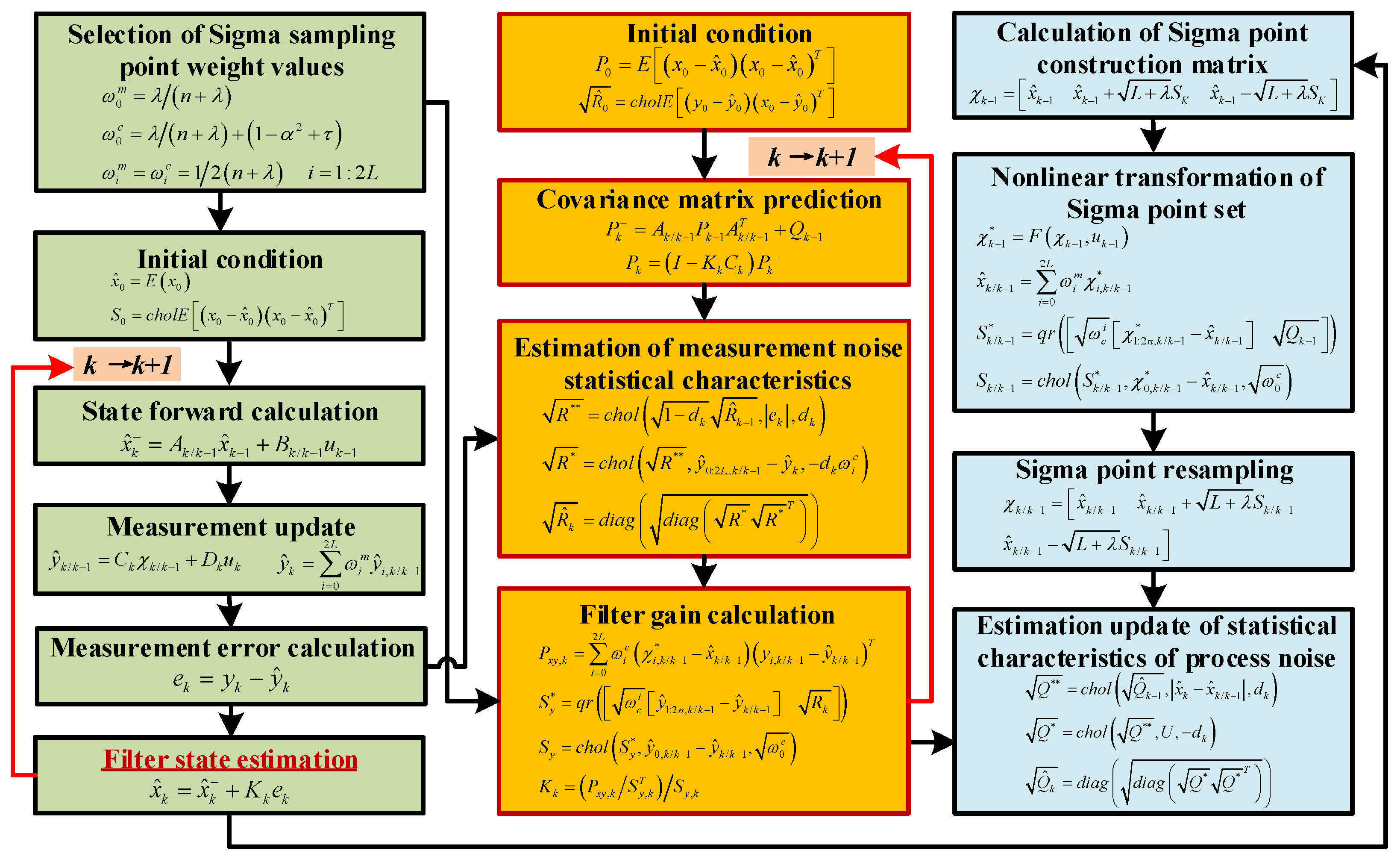
By combining the Sage–Husa adaptive filtering algorithm with the unscented Kalman algorithm, an adaptive square-root unscented Kalman filter is developed, which can be applied to nonlinear systems. The architectural design flowchart of the ASUKF algorithm is shown in Figure 2. The core idea of the square root UKF is not to directly calculate and store the complete covariance matrix, but to propagate and update its square root factors. The designed ASUKF is based on the square root UKF and further integrates the Sage–Husa algorithm to real-time estimate and correct the noise statistical characteristics. This “square-root + adaptive” combination strategy can significantly enhance the robustness and reliability of the algorithm in complex vehicle dynamic scenarios.
The comprehensive computational sequence of the enhanced ASUKF methodology is delineated below.
(1)
Selection of weight value of Sigma sampling point.
ω 0 m = λ / n + λ ω 0 c = λ / n + λ + 1 α 2 + τ ω i m = ω i c = 1 / 2 n + λ i = 1 : 2 L ,
where λ = α 2 n + κ L , L denotes the state dimension, α (10−4 α ≤ 1) describes the extent to which the Sigma point deviates from the status value, λ is the scale parameter of the Sigma point, κ ( κ ≥ 0) is a secondary scaling parameter guaranteeing the positive semi-definiteness of the covariance matrix, and τ is a regulation parameter.
(2)
Initialization.
x ^ 0 = E x 0 S 0 = c h o l E x 0 x ^ 0 x 0 x ^ 0 T ,
where Q ^ 0 = S 0 , R ^ 0 = c h o l E y 0 y ^ 0 x 0 y ^ 0 T .
(3)
Time update. Calculate the Sigma point construction matrix.
χ k 1 = x ^ k 1 x ^ k 1 + L + λ S K x ^ k 1 L + λ S K .
The ensemble of Sigma points undergoes a nonlinear transformation via the state transition function, after which the state estimate and the square-root factor of the forecast error covariance are computed.
χ k 1 * = F χ k 1 , u k 1 x ^ k / k 1 = i = 0 2 L ω i m χ i , k / k 1 * S k / k 1 * = q r ω c i χ 1 : 2 n , k / k 1 * x ^ k / k 1 Q k 1 S k / k 1 = c h o l S k / k 1 * , χ 0 , k / k 1 * x ^ k / k 1 , ω 0 c .
(4)
Measurement update. Sigma point resampling.
χ k / k 1 = x ^ k / k 1 x ^ k / k 1 + L + λ S k / k 1 x ^ k / k 1 L + λ S k / k 1 .
Nonlinear transformation of the Sigma point from measurement equations and calculation of measurement residuals.
y ^ k / k 1 = C k χ k / k 1 + D k u k y ^ k = i = 0 2 L ω i m y ^ i , k / k 1 e k = y k y ^ k ,
The statistical characteristics of estimation measurement noise is updated.
R * * = c h o l 1 d k R ^ k 1 , e k , d k R * = c h o l R * * , y ^ 0 : 2 L , k / k 1 y ^ k , d k ω i c R ^ k = d i a g d i a g R * R * T .
Then, the gain of ASUKF is calculated as
P x y , k = i = 0 2 L ω i c χ i , k / k 1 * x ^ k / k 1 y i , k / k 1 y ^ k / k 1 T S y * = q r ω c i y ^ 1 : 2 n , k / k 1 y ^ k / k 1 R k S y = c h o l S y * , y ^ 0 , k / k 1 y ^ k / k 1 , ω 0 c K k = P x y , k / S y , k T / S y , k .
The corrected state value is estimated as
x ^ k = x ^ k / k 1 + K k e k .
The square root of posterior state variance is solved as
U = K k S y , k S k = c h o l S k / k 1 , U , 1 .
Subsequently, the statistical properties of the process noise are adaptively adjusted.
Q * * = c h o l Q ^ k 1 , x ^ k x ^ k / k 1 , d k Q * = c h o l Q * * , U , d k Q ^ k = d i a g d i a g Q * Q * T .
The ASUKF is developed by enhancing the standard UKF through the incorporation of Sage–Husa’s adaptive philosophy. A key modification involves utilizing the square-root factors of the covariance matrices throughout the recursive estimation steps, rather than the full matrices. This design addresses the problem of filter instability in the classic UKF, which can occur when the error covariance matrix loses positive definiteness owing to computational errors and noisy measurements. As a result, the algorithm achieves greater numerical soundness, leading to superior tracking precision and overall dependability.

3.2.3. Observer Design Using ASUKF

The vehicle dynamic Equations (7)–(9) can be expressed in discrete form as follows
v x , k + 1 = v x , k + v y , k γ k + 1 m 1 T + w k v y , k + 1 = v y , k + v x , k γ k + 1 m 2 T + w k γ k + 1 = γ k + 1 I z 3 T + w k ,
where 1 denotes the tire force Equation (7), 2 denotes the tire force Equation (8), and 3 denotes the tire force Equation (10). Thus, the corresponding Jacobi matrix is obtained as
S k d o n = f x k = 0 γ v y γ 0 v x 0 0 1 .
The measurement equation is defined by γ k = γ k + v k . Therefore, building upon Equation (55), the measurement matrix for the ASUKF, which incorporates tire nonlinearities, is formulated as H k d o n = h x k = 0 0 1 T .
Then, combining the 3-DOF dynamic model and magic formula-based model, the ASUKF-based vehicle state observer is designed, where the state value is defined by x k + 1 = v x , k + 1 v y , k + 1 γ k T , the measurement value is defined by y k = γ , and the input is defined by u k = δ f , k γ k F x f l F x r r F y f l F y r r T . Finally, according to β = v y / v x , the estimation of the vehicle sideslip angle is obtained.

3.3. Vehicle Sideslip Angle Fusion Estimation by Adaptive Weight

In the DRO design process, a 2-DOF vehicle model with a linear tire equation was adopted. This model assumes a linear relationship between tire force and sideslip angle, thereby simplifying the mathematical derivation and reducing computational complexity. However, the force characteristics of tires in reality are not completely linear. In particular, under conditions of a high center of mass or a low adhesion coefficient, tire forces exhibit significant nonlinear characteristics. To address this challenge, DRO introduces a robust observer design method that compensates for parameter uncertainty and time delay issues by optimizing the observer gain. In DRO, the 2-DOF vehicle model is used, and the robust observer is presented to solve the parameter uncertainty and delay. The DRO can better deal with the negative influence of parameter uncertainty and time delay, and has good dynamic tracking performance, but it is hard to accurately describe the characteristics of the nonlinear tire force. The fidelity of the DRO is constrained under significant tire nonlinearities, as its underlying linear tire model fails to accurately capture the tire’s force-generation characteristics in this regime.
At the same time, ASUKF’s design adopted a more complex 3-DOF model to describe tire force characteristics. This design method can more accurately capture the mechanical characteristics of tires, especially under conditions of a high center-of-mass slip angle or a low adhesion coefficient, thereby significantly improving the accuracy of estimation. In order to further promote the estimation performance, ASUKF adopts an improved Kalman filtering algorithm, which effectively reduces the negative feedback of noise interference and model perturbation by optimizing the filtering gain and state update strategy. However, this observer design based on nonlinear tire models also brings high computational complexity. Analysis shows that although ASUKF can achieve higher estimation accuracy when dealing with nonlinear tire problems, its dynamic tracking ability will be affected to some extent due to the increased computational burden. Especially under rapidly changing operating conditions, the estimation results of ASUKF may experience a brief lag phenomenon. The improved Kalman filter algorithm has good estimation performance, and the tire nonlinearity is also considered in the observer design, but the resulting large amount of computation will sacrifice the dynamic correction ability to a certain extent.
Overall, DRO and ASUKF exhibit distinct advantages and limitations. And the nonlinearity of the tires and the longitudinal speed are the most direct factors affecting the estimation accuracy of the two observers. The higher the nonlinearity of the tire, the significantly larger the estimation error of DRO, while ASUKF can better adapt to this nonlinear change. In addition, variations in vx considerably influence the observer’s performance. High-speed driving conditions exacerbate the nonlinear behavior of tires and quicken the vehicle’s dynamic response, thereby posing a greater challenge to the observer’s dynamic tracking capability. Thus, in practical applications, it is necessary to choose a reasonable observer design method based on specific working conditions and performance requirements to achieve the optimal effect of vehicle state estimation.
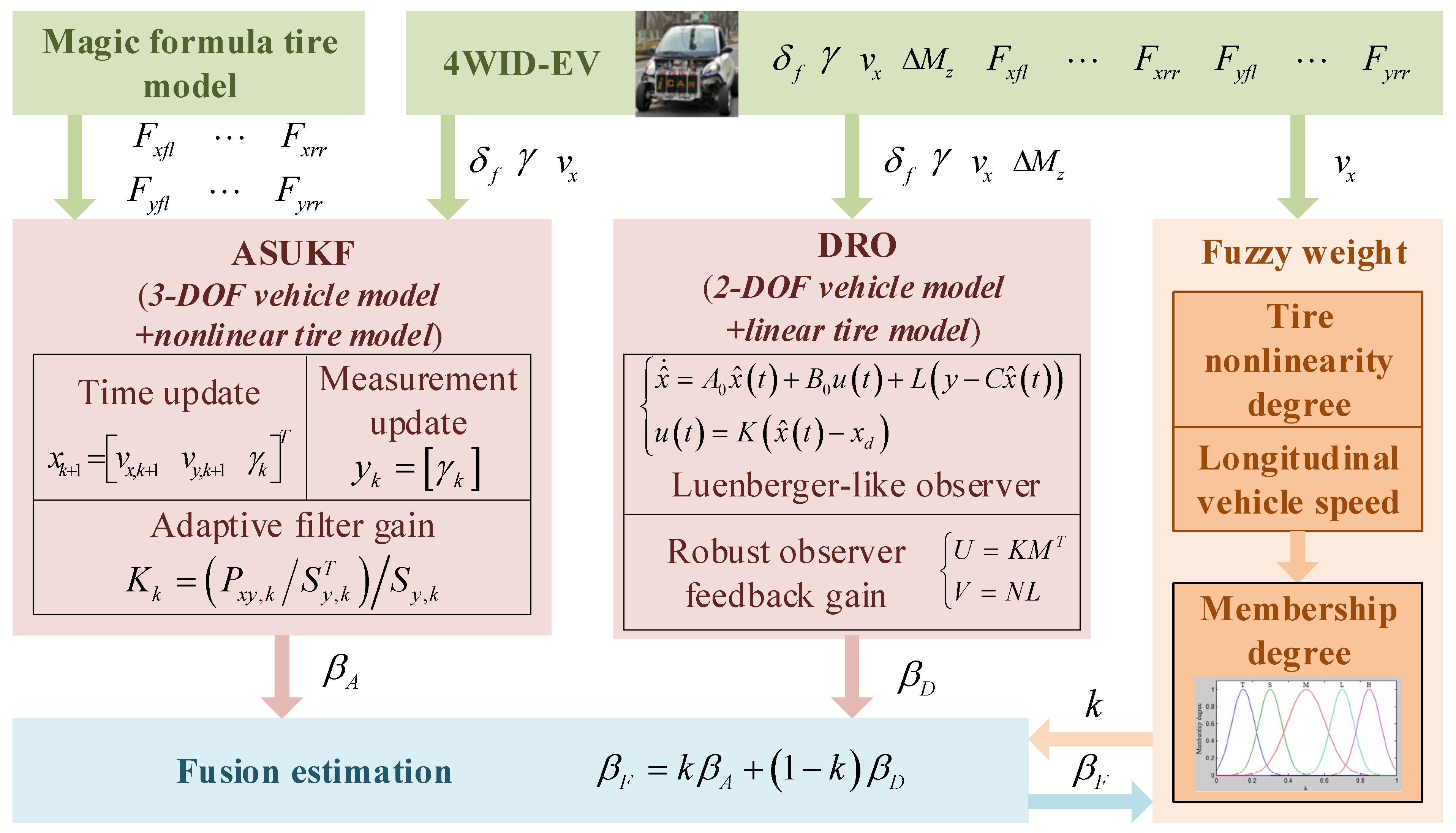
It is thus established that ASUKF is suitable for obtaining accurate information in the case of a high tire nonlinearity degree, while DRO can deal with parameter uncertainty and time delay in the case of linear tires. Thus, the estimation precision of both observers is predominantly determined by the severity of tire nonlinearity and the value of the longitudinal vehicle speed. To unite the advantages of DRO and ASUKF, an adaptive weight-based estimation strategy is presented, illustrated in Figure 3. The nominal tire deviation angle is employed to quantify the severity of tire nonlinearity, and its calculation is given below.
α n = α f + α r = δ f + l f + l r v x γ 2 β ,
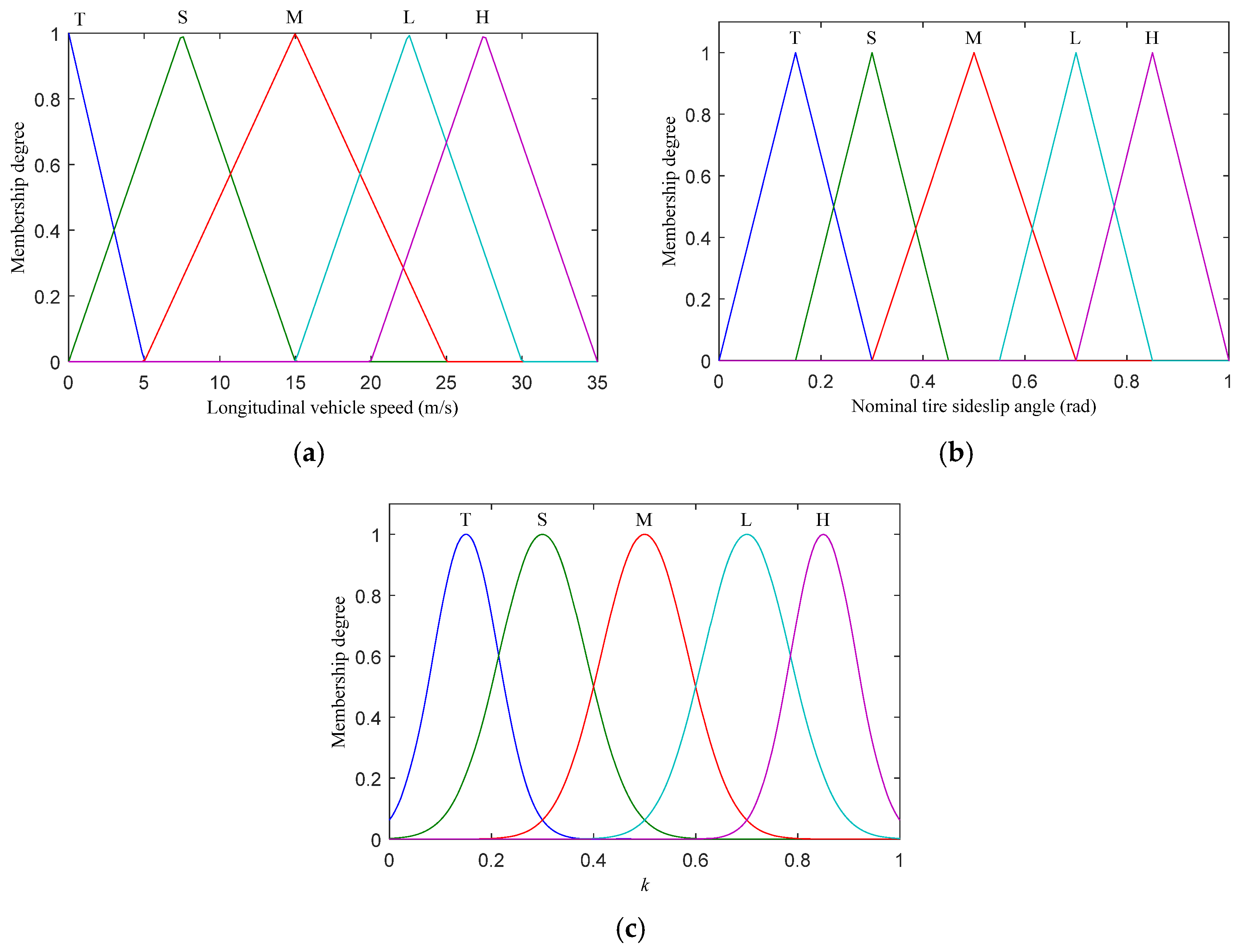
where α n represents the nominal tire sideslip angle. A fuzzy logic-based coordination unit is employed to dynamically allocate the weights between the two observers. This unit takes the reference tire slip angle and the longitudinal speed as its inputs, and generates a real-time adaptive weighting factor as its output. Consequently, the fusion strategy can intelligently balance the contributions of each observer based on immediate driving conditions. The membership functions defining the input and output variables are presented in Figure 4.
The selection of the membership function is based on vehicle dynamics characteristics and a large number of simulation experiments, with the aim of accurately capturing the nonlinear influence of the input variables on the fusion weights. In Figure 4a, the longitudinal vehicle speed is divided into five fuzzy sets: “T (tiny)”, “S (small)”, “M (medium)”, “L (large)”, and “H (high)”. This is because vehicle speed directly affects the linear region of tire force: at low speeds, the nonlinearity of the tires is not obvious, and the DRO performance is better; at high speeds, the tires are more likely to enter the non-linear saturation zone, and the weight of ASUKF needs to be increased. The function employs triangular and trapezoidal membership functions to achieve a balance between sensitivity and computational efficiency. The nominal tire slip angle shown in Figure 4b serves as a direct indicator of the nonlinearity of the tire. The fuzzy set division for this value is also consistent with the division method for the longitudinal vehicle speed. The larger the slip angle, the stronger the tire nonlinearity, and the weight of ASUKF should be higher. The function is designed to cover the typical operating conditions range (−0.1 rad to 0.1 rad), ensuring full adaptability to all operating conditions. The membership function of the output weight coefficient k in Figure 4c is used to smoothly adjust the contributions of DRO and ASUKF. The fuzzy set division is also consistent with the division method of the longitudinal vehicle speed. Its range is set to [0, 1], ensuring a continuous transition of the fusion result between the two. The fuzzy rules are listed in Table 1. Combining the obtained fuzzy weight k, the fused vehicle sideslip angle β F can be obtained as
β F = k β A + 1 k β D .

4. Simulation Results

To evaluate the effectiveness of the proposed fusion framework, a series of co-simulation experiments was conducted under various operational scenarios using the CarSim-Simulink platform. The vehicle parameters used in the simulations are listed in Table 2. In the design process of ASUKF, neither uncertainty nor delay is considered. Since the uncertainty and delay are considered in the robust observer, it can be denoted by C f ˜ = 6000   N / rad , C r ˜ = 4000   N / rad , and h = 0.1   s in simulations and experiments. In addition, the parameters of the magic formula tire model can be expressed as follows: for the front wheels, the stiffness factor is 8.0, the shape factor is 1.4, the peak factor is 6000 N, and the curvature factor is −0.5; for the rear wheels, the stiffness factor is 10.0, the shape factor is 1.4, the peak factor is 4000 N, and the curvature factor is −0.5. In the DRO design, the attenuation rate is 0.5, and the disturbance suppression level is 1.2. In the ASUKF design, the sigma point distribution parameter is 10−3, and the adaptive forgetting factor is 0.98.

4.1. Double Lane Changes (DLC) Manoeuvre with Constant Vehicle Speed

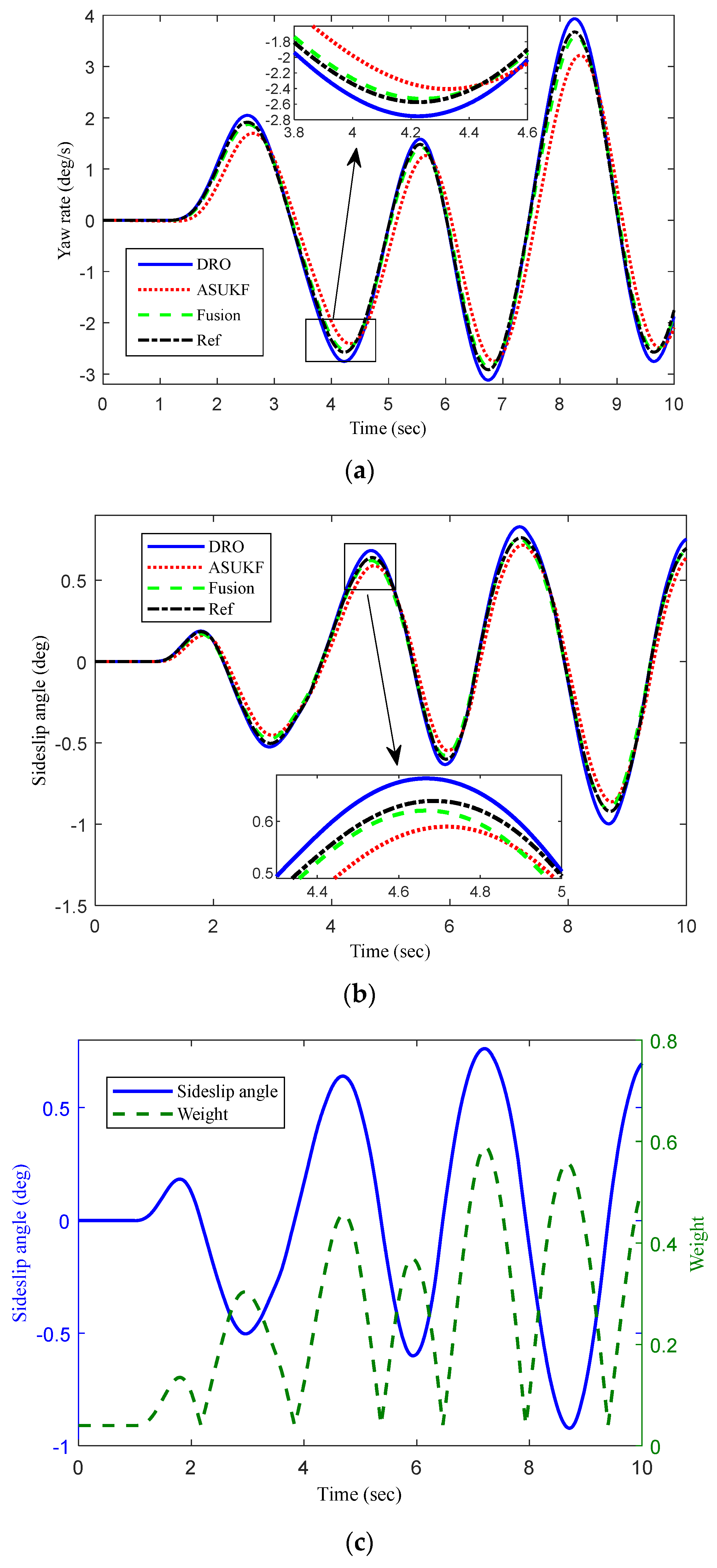
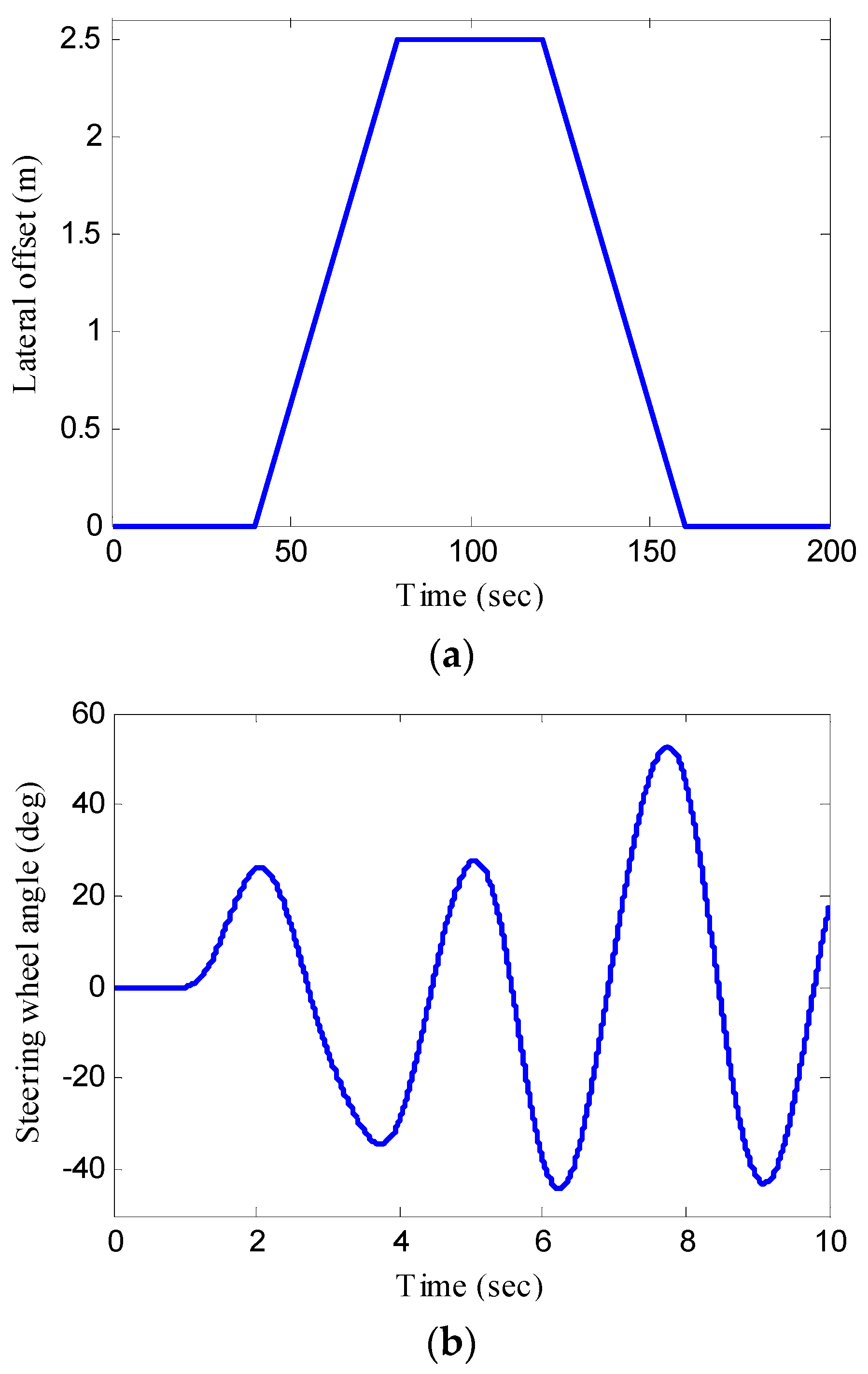
Case study 1 involved a double lane change (DLC) maneuver conducted at a constant longitudinal velocity. The vehicle’s dynamic responses throughout this maneuver are illustrated in Figure 4. The simulation was configured with a road-tire friction coefficient of 1.0, and the vehicle maintained a speed of 20 m/s. The resulting vehicle trajectory and steering wheel angle are presented in Figure 5. A comparative analysis of the state estimation performance under these conditions is provided in Figure 6.
An analysis of Figure 6 reveals that both designed observers demonstrate robust tracking of the vehicle state variations while maintaining satisfactory estimation performance overall. Specifically, the DRO achieves precise real-time estimation of both the yaw rate and the sideslip angle, effectively compensating for the effects of model uncertainty and time delay. Conversely, the ASUKF-based observer exhibits a noticeable latency in its estimates. Under the specified test conditions, characterized by a relatively small vehicle sideslip angle and rapidly changing steering inputs, the DRO delivers superior overall performance. Examination of the fused estimation output confirms that the proposed method successfully leverages the complementary strengths of the two observers, yielding marked advantages in both precision and dynamic response.
A comparison between the weight coefficient and the vehicle sideslip angle reveals a strong correlation in their variation trends. Specifically, an increase in the sideslip angle of the 4WIDEV leads to a greater contribution from the ASUKF within the fused output. This adaptive weighting helps counteract the estimation degradation caused by tire nonlinearity. Conversely, a reduction in the sideslip angle diminishes the influence of the DRO, thereby mitigating the effects of model uncertainty and time delay while enhancing the dynamic response of the estimator. This intelligent coordination validates the satisfactory performance of the proposed fusion framework.
In summary, DRO performs well in dealing with fast dynamic changes and uncertainty problems, while ASUKF has advantages in the estimation accuracy of nonlinear tire models. By dynamically integrating the advantages of both, the proposed method can achieve a favorable balance between accuracy and dynamic performance. The fusion estimation results demonstrate the marked superiority of the proposed fusion estimation approach in terms of both precision and dynamic response. This method significantly improves the dynamic tracking capability while maintaining high accuracy by dynamically integrating the advantages of DRO and ASUKF. This synergistic framework not only mitigates the shortcomings inherent to individual estimators but also facilitates dynamic self-adjustment within the vehicle state estimation system when confronted with intricate operational scenarios, thereby ensuring both the practical applicability and operational reliability of the system.

4.2. J-Turn Manoeuvre Considering Varying Vehicle Speed

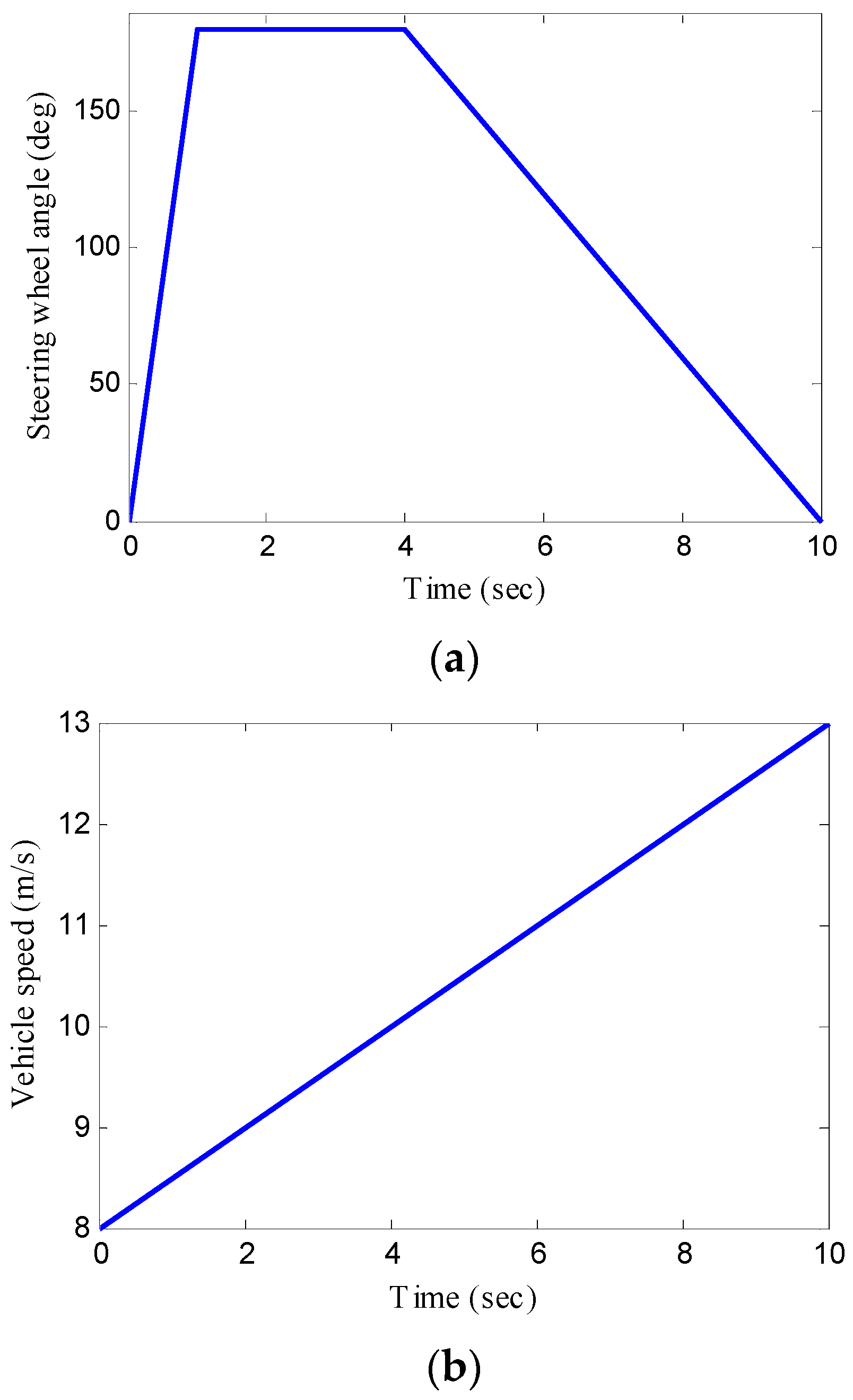
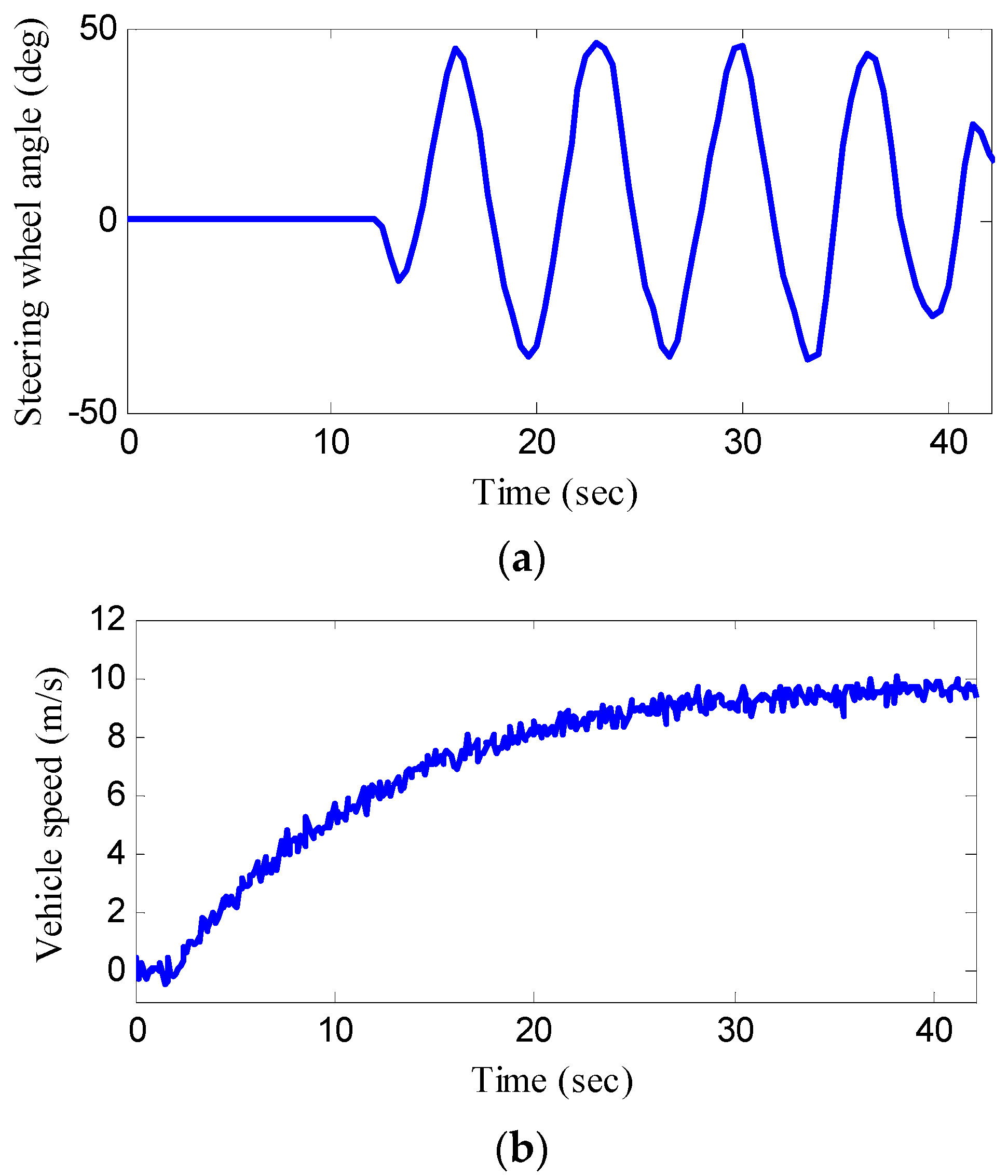
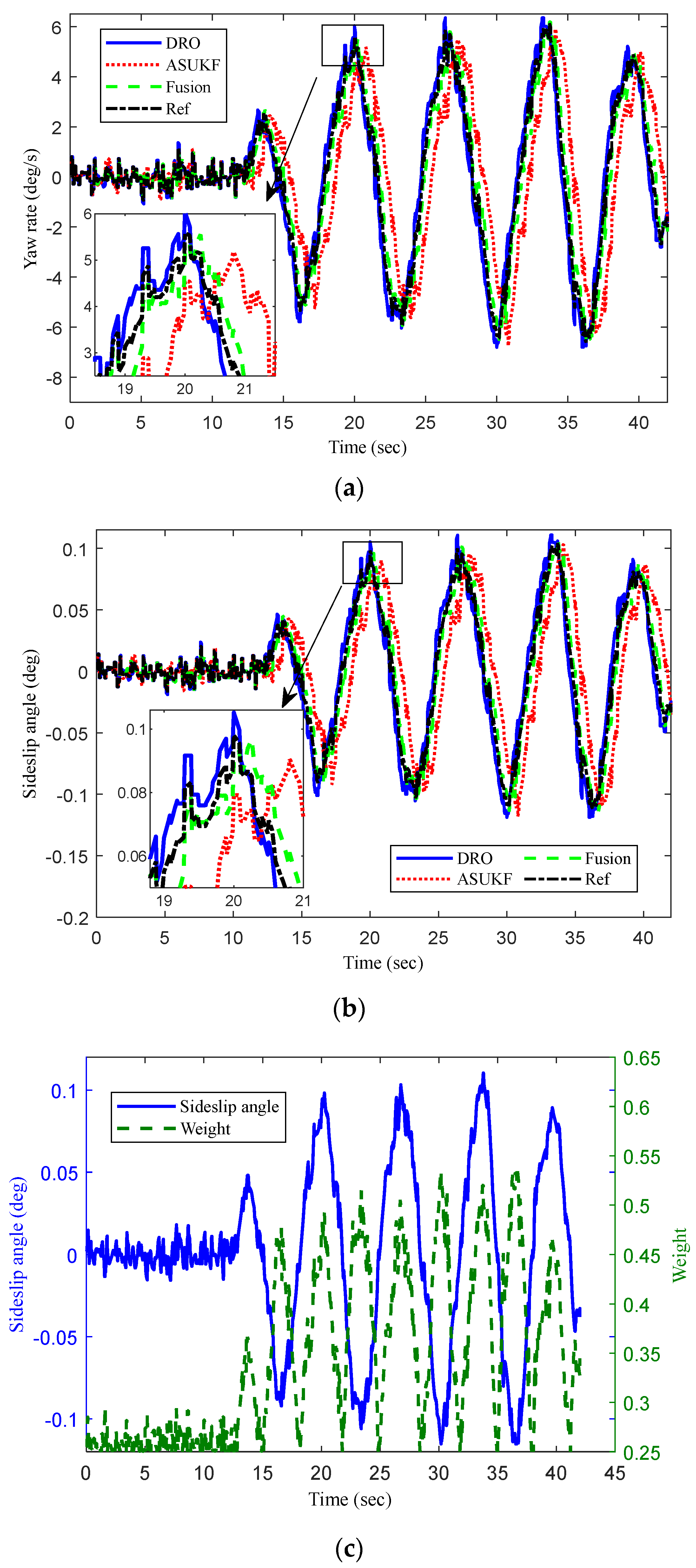
Furthermore, to validate the effect of the proposed estimation method in the situation of severe steering and large tire sideslip angle, a simulation test under a J-turn maneuver is carried out. In this case study, the pavement adhesion parameter is 0.8, and the corresponding steering input and the vehicle’s longitudinal velocity are depicted in Figure 7.
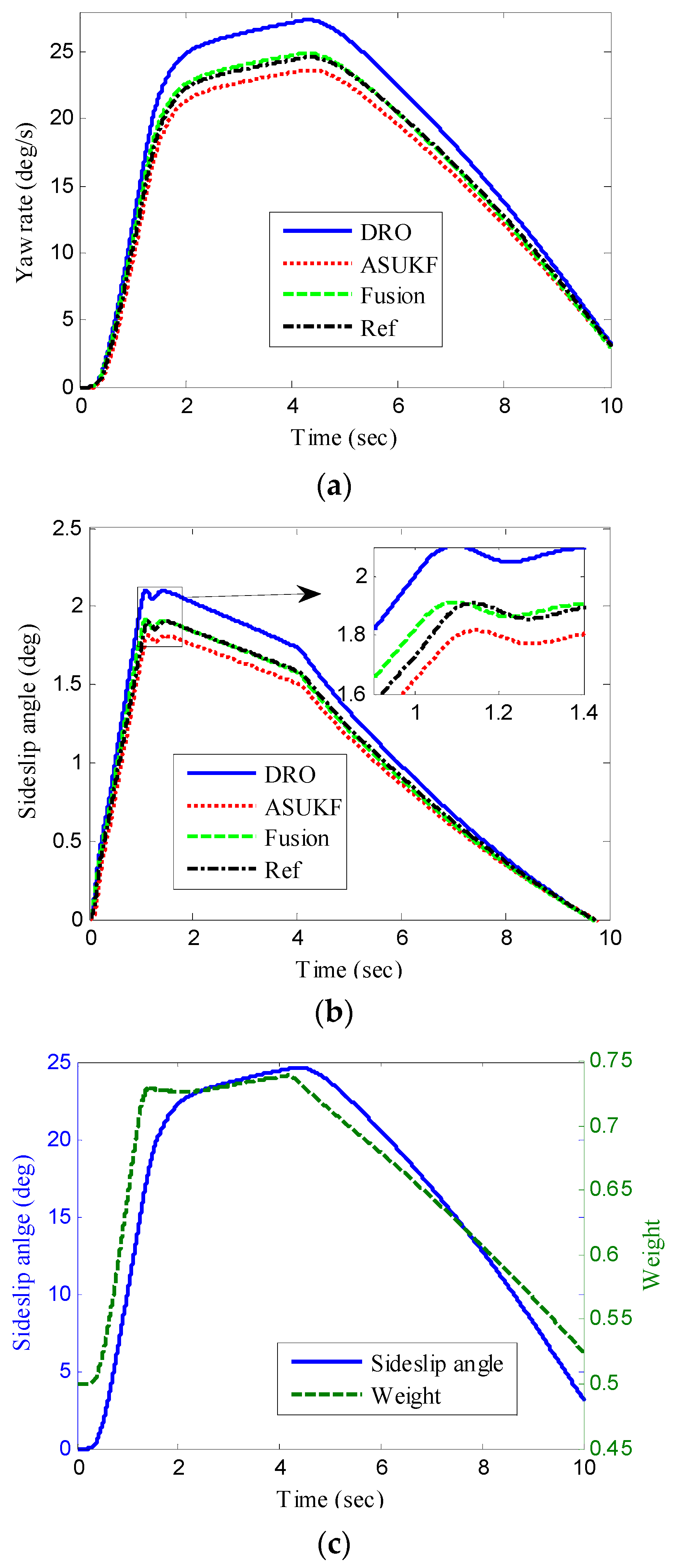
Figure 8 presents a comparative analysis of the estimation outcomes during the J-turn maneuver. Under these aggressive steering conditions, both the vehicle’s yaw rate and sideslip angle attain substantially higher values. In this scenario, the ASUKF observer demonstrates superior performance compared to the DRO. The elevated vehicle velocity challenges the dynamic tracking capability of the DRO, while the larger sideslip angle indicates stronger tire nonlinearity, which further degrades the DRO’s estimation accuracy. Consequently, as Figure 8 illustrates, the ASUKF achieves notably higher overall precision than the DRO in this test. In contrast, the proposed fusion method maintains robust estimation performance, yielding results that exceed the accuracy of both individual observers. Analysis of the adaptive weight coefficient reveals that its value is greater during the J-turn maneuver than in the DLC scenario. This is attributed to the increased steering input exacerbating tire nonlinearity, prompting the fuzzy controller to assign greater weight to the ASUKF. The weight coefficient’s trend remains consistent with the sideslip angle, confirming that the adaptive fusion strategy ensures reliable and timely estimation under severe steering conditions.
By dynamically integrating the advantages of DRO and ASUKF, the fusion framework preserves high-fidelity adaptability even under drastic changes in operating conditions. Further analysis of the trend comparison chart between adaptive weight coefficients and vehicle center of mass lateral deviation angle reveals that in the J-turn steering condition, the weight coefficients are greater than those in the double lane changing condition. The variation trend is basically consistent with the absolute value of the vehicle sideslip angle. This is because the increase in steering angle under J-turn steering conditions leads to an increase in tire nonlinearity. In this condition, the fuzzy logic controller adaptively regulates the weighting factors according to the severity of tire nonlinearity, leading to a proportional allocation that prioritizes the ASUKF. Consequently, the overall variation pattern of these weights remains predominantly governed by the changes in the vehicle’s sideslip angle. The fusion estimation strategy based on adaptive weights can better adapt to the nonlinear changes of tires and maintain good estimation results more accurately and timely under harsh steering conditions.
In summary, an increase in the vehicle sideslip angle indicates that the vehicle is operating in a heightened nonlinear regime. Under these conditions, the ASUKF observer is assigned a greater weight within the fused output, leveraging its inherent proficiency in managing nonlinear dynamics. On the contrary, when the vehicle sideslip angle decreases, the vehicle is in a relatively linear operating condition, and the advantages of DRO are highlighted. Through this dynamic adjustment mechanism, the fusion estimation method achieves adaptive weighting and performance consistency across multiple operating conditions and can satisfy high-precision estimation requirements under large-scale road scenarios and complex dynamic maneuvering conditions.

5. Experimental Verification

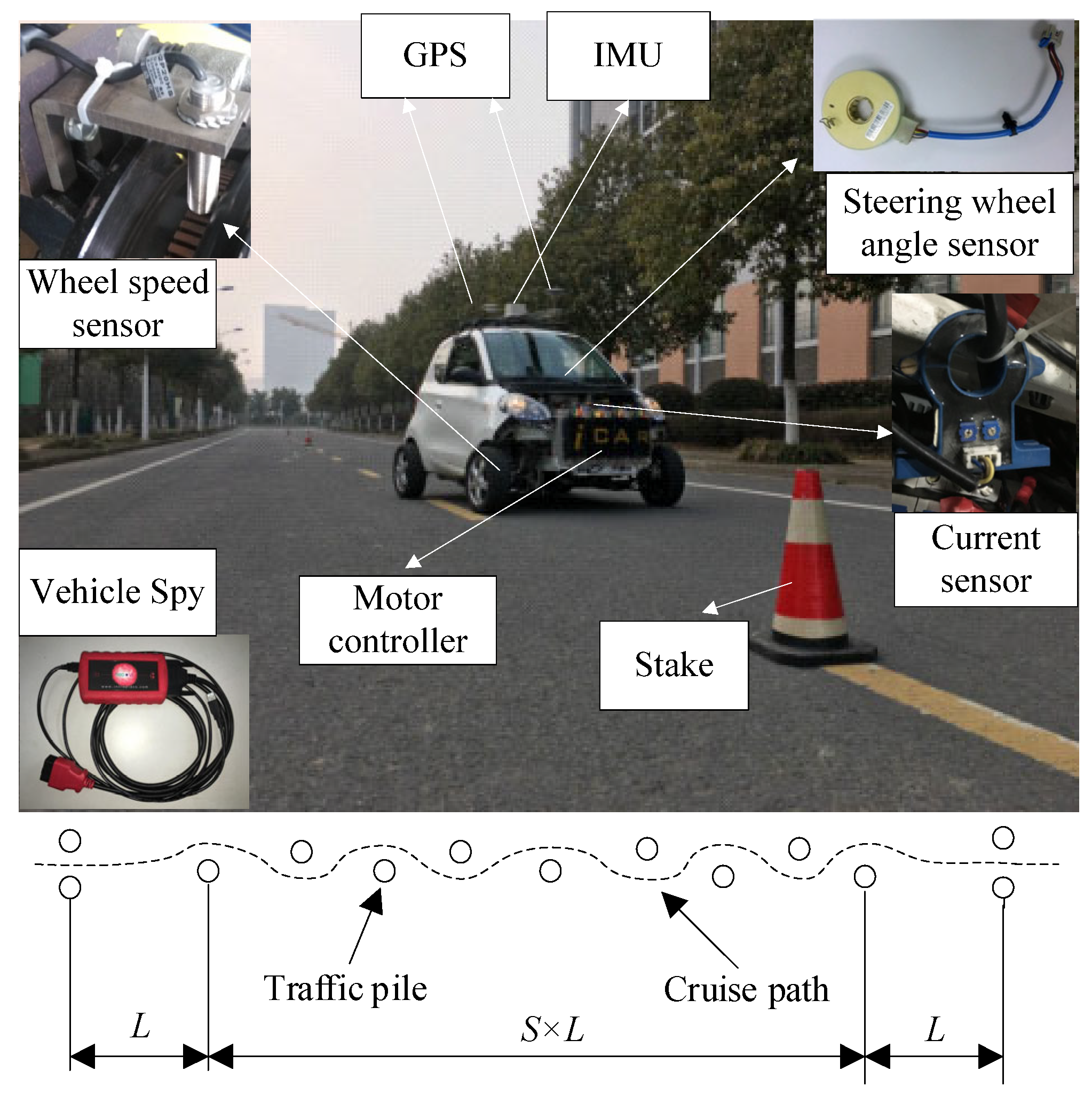
The platform used for the real vehicle road test is a specially modified 4WIDEV. The core feature of this vehicle is that each wheel is directly driven by an independent hub motor, eliminating the traditional engine, gearbox and mechanical differential, thereby achieving independent, precise and rapid control of the torque of each wheel. Virtual simulation serves as the cornerstone of the initial verification, with its findings subsequently validated through physical on-road trials. A straight asphalt road segment on the campus served as the experimental site. Traffic cones were deployed as designated avoidance targets, positioned at 30-m intervals along the lane’s central axis. Prior to testing, the maximum speed was constrained to a preset value by locking the upper limit of the motor control command via a rapid control prototyping system. The driver fully depressed the accelerator pedal, causing the vehicle to accelerate to the preset speed limit and subsequently maintain a constant cruising speed. The vehicle initially traveled in a straight line. Upon approaching an obstacle, the driver executed an avoidance maneuver by providing steering input. A vehicle-mounted RTK-GNSS/INS integrated navigation system was employed to synchronously capture the vehicle’s position, velocity, and attitude data at a sampling frequency of 100 Hz. The steering wheel angle, measured by a sensor, was converted into the corresponding front wheel angle. Simultaneously, the voltage, current, and rotational speed of the four in-wheel motors were acquired in real-time by their respective sensor units.
The SPAN-CPT series tight combined navigation system produced by NovAtel is adopted. This system integrates a tactical-level IMU and GNSS receivers, providing the vehicle global position and orientation with centimeter-level accuracy, including longitude, latitude, and altitude. It also synchronously outputs three-dimensional acceleration, three-dimensional angular velocity, as well as attitude information such as yaw angle, pitch angle, and roll angle at a frequency of 100 Hz. The data from all sensors are collected through the CAN bus and the time synchronization trigger to ensure that the time synchronization accuracy is better than 1 ms. The data are finally aggregated and stored in the onboard industrial control computer installed in the vehicle using the Vehicle SPY 3 software, with a uniform sampling frequency of 100 Hz.
The road test scenario and experimental trajectory are presented in Figure 9. The test was conducted on a flat, dry asphalt road within the university campus. During the test, the vehicle first accelerated along a straight line to the preset speed, then entered the cruise mode. When the vehicle approached the preset obstacle, the driver completed the obstacle avoidance maneuver by inputting through the steering wheel. Throughout the entire process, all sensor data were synchronously recorded for subsequent offline analysis and algorithm verification. The vehicle states in the road test are shown in Figure 10. The comparison of estimation results in the experiment is shown in Figure 11. The state change trend and comparison results of estimated values in the experiment are basically consistent with the simulation test. DRO and ASUKF can basically track the actual vehicle status, and the fusion estimation strategy can further improve estimation accuracy based on the two observers.
To thoroughly evaluate the efficacy of the proposed estimation strategy, the peak relative error EPRE and the root mean square error ERMS serve as quantitative metrics for assessing state estimation performance. The EPRE and ERMS are computed as
E P R E = x ^ i / p x r / p E R M S = 1 N s i = 1 N s x ^ i x i 2 ,
where Ns is the total sampling amount, x p and x ^ p are the peak value of measurement and estimation, x ^ p and x ^ i respectively represent the measurement or estimation. A quantitative comparison of the evaluation metrics (EPRE and ERMS) for the estimated yaw rate and sideslip angle is presented in Table 3 and Table 4. It can be found that the EPRE and ERMS of fusion estimation results are much smaller than those of the other two observers. It can be inferred that the fusion estimation strategy enhances the estimation precision and suppresses the influences from uncertain interferences, delay and tire nonlinearity concurrently. Thus, the presented method has been proven to reach a higher standard in vehicle applications, and its feasibility and effectiveness have been comprehensively validated. By comparing and verifying the double lane, J-turn turning, and actual vehicle snake driving conditions, and taking the average of all state data, a quantifiable improvement of 9.36% in accuracy is achieved by the synthesized framework, outperforming conventional single-observer approaches. It can effectively cope with the comprehensive interference of large-scale complex road conditions and improve the overall estimation accuracy.

6. Conclusions

This paper constructs a dual observer-based framework that takes into account parameter uncertainty, system hysteresis, and tire nonlinearity to estimate the vehicle sideslip angle of 4WIDEVs. A fuzzy fusion DRO and ASUKF strategy is proposed. This strategy dynamically coordinates the advantages of two observers without the need for preset fixed weights and can automatically adjust to changes in operating conditions, achieving global adaptive estimation. The validation results from both simulation and physical testing demonstrate that the integrated framework achieves a 9.36% enhancement in the estimation precision of vehicle sideslip angle relative to individual estimators, thereby confirming its practical efficacy and robustness across diverse operational conditions, and providing reliable state information support for the stability control of intelligent electric vehicles.
The main novel contributions of this thesis are as follows:
(1)
A dual-observer framework that collaboratively optimizes DRO and ASUKF is proposed. To simultaneously address the model uncertainties caused by parameter perturbations and system time delays, as well as the nonlinearity of the tires, a collaborative estimation architecture is designed. Here, DRO theoretically ensures the stability of the observer in the presence of parameter uncertainties and state time delays, while ASUKF can estimate and correct the statistical characteristics of noise in real time, significantly improving the estimation accuracy and numerical stability in highly nonlinear conditions.
(2)
An adaptive weight real-time fusion mechanism based on fuzzy logic is designed. The innovation of this mechanism lies in the fact that the weight coefficients are not preset but are dynamically adjusted online using the nominal steering angle of the front wheel and the longitudinal vehicle speed as fuzzy inputs, through the designed fuzzy rule base. This enables the fusion system to intelligently transition smoothly between DRO and ASUKF, fully leveraging their respective advantages.
The adaptive fusion framework constructed in this study has a theoretical advantage in achieving robust estimation under the coexistence of uncertainty and nonlinearity through the soft switching of the mechanistic model and fuzzy logic. However, the potential of this framework is still limited by the model assumptions in the current implementation. The core limitation lies in its inherent dependence on the physical model, which to some extent constrains its generalization ability and the upper limit of accuracy in all operating conditions, especially in extreme scenarios where the model does not fully cover. Looking to the future, we can further explore the next-generation estimation paradigm of “mechanism-data” deep integration. We can combine this framework with deep learning to utilize the powerful nonlinear mapping ability of neural networks to compensate for or replace the parts that are difficult to precisely model in the model, thereby constructing a more resilient hybrid estimator.

Author Contributions

Conceptualization, X.C. (Xi Chen), K.C. and T.C.; methodology, X.C. (Xi Chen), G.D. and X.C. (Xinlong Cheng); software, K.C., T.C. and G.D.; validation, X.C. (Xi Chen), K.C. and X.W.; writing—original draft preparation, X.C. (Xi Chen), T.C. and G.D.; writing—review and editing, K.C., G.D. and X.W.; visualization, K.C. and X.C. (Xinlong Cheng). All authors have read and agreed to the published version of the manuscript.

Funding

This work was supported by Project of Science and Technology Research Program of Henan Province (No. 252102320161), Key Scientific Research Project of University in Henan Province (No. 26B580001), Henan Province Education Science Planning Project (No. 2024YB0595), National Natural Science Foundation of China (No. 52202472), Opening Foundation of Key Laboratory of Advanced Manufacture Technology for Automobile Parts, Ministry of Education (No. 2023KLMT06), Opening Foundation of Provincial Engineering Research Center for New Energy Vehicle Intelligent Control and Simulation Test Technology of Sichuan (No. XNYQ2024-004).

Data Availability Statement

The original contributions presented in this study are included in the article. Further inquiries can be directed to the corresponding author.

Conflicts of Interest

The authors declare no conflicts of interest.

References

  1. Li, Z.; Zhao, H.; Wang, Y.; Ren, Y.; Chen, Z.; Chen, C. Adaptive event-triggered control for almost sure stability for vehicle platooning under interference and stochastic attacks. ISA Trans. 2023, 138, 120–132. [Google Scholar] [CrossRef] [PubMed]
  2. Viadero-Monasterio, F.; Meléndez-Useros, M.; Jiménez-Salas, M.; López Boada, M.J. Avoiding Lyapunov-Krasovskii Functionals: Simple Nonlinear Sampled–Data Control of a Semi-Active Suspension with Magnetorheological Dampers. Machines 2025, 13, 512. [Google Scholar] [CrossRef]
  3. Chen, T.; Cai, Y.; Chen, L.; Xu, X. Sideslip angle fusion estimation method of three-axis autonomous vehicle based on composite model and adaptive cubature Kalman filter. IEEE Trans. Transp. Electrif. 2024, 10, 316–330. [Google Scholar] [CrossRef]
  4. Viadero-Monasterio, F.; Meléndez-Useros, M.; Lenzo, B.; Boada, B.L. Interval Observer for Vehicle Sideslip Angle Estimation Using Extended Kalman Filters. Machines 2025, 13, 707. [Google Scholar] [CrossRef]
  5. Chen, T.; Cai, Y.; Chen, L.; Xu, X. Trajectory and velocity planning method of emergency rescue vehicle based on segmented three-dimensional quartic Bezier curve. IEEE Trans. Intell. Transp. Syst. 2023, 24, 3461–3475. [Google Scholar] [CrossRef]
  6. Wang, Q.; Zhao, Y.; Xie, W.; Zhao, Q.; Lin, F. Hierarchical estimation of vehicle state and tire forces for distributed in-wheel motor drive electric vehicle without previously established tire model. J. Frankl. Inst. 2022, 359, 7051–7068. [Google Scholar] [CrossRef]
  7. Zhang, Z.D.; Zheng, L.; Wu, H.; Zhang, Z.; Li, Y.; Liang, Y. An estimation scheme of road friction coefficient based on novel tyre model and improved SCKF. Veh. Syst. Dyn. 2021, 60, 2775–2804. [Google Scholar] [CrossRef]
  8. Jia, J.; Wong, P.K.; Li, W.; Li, P.; Xie, Z.; Zhao, J. Event-triggered fuzzy security path following control for autonomous ground vehicles with aperiodic DoS attacks. IEEE Trans. Intell. Transp. Syst. 2025, 26, 12909–12921. [Google Scholar] [CrossRef]
  9. Zhang, Q.; Hou, J.; Hu, X.; Yuan, L.; Jankowski, Ł.; An, X.; Duan, Z. Vehicle parameter identification and road roughness estimation using vehicle responses measured in field tests. Measurement 2022, 199, 111348. [Google Scholar] [CrossRef]
  10. Lio, M.D.; Piccinini, M.; Biral, F. Robust and Sample-Efficient Estimation of Vehicle Lateral Velocity Using Neural Networks With Explainable Structure Informed by Kinematic Principles. IEEE Trans. Intell. Transp. Syst. 2023, 24, 13670–13684. [Google Scholar] [CrossRef]
  11. Henning, K.U.; Speidel, S.; Gottmann, F.; Sawodny, O. Integrated lateral dynamics control concept for over-actuated vehicles with state and parameter estimation and experimental validation. Control Eng. Pract. 2021, 107, 104704. [Google Scholar] [CrossRef]
  12. Song, R.; Fang, Y. Vehicle state estimation for INS/GPS aided by sensors fusion and SCKF-based algorithm. Mech. Syst. Signal Process. 2021, 150, 107315. [Google Scholar] [CrossRef]
  13. Zhao, J.; Li, R.; Zheng, X.; Li, W.; Hu, C.; Liang, Z. Constrained fractional-order model predictive control for robust path following of FWID-AGVs with asymptotic prescribed performance. IEEE Trans. Veh. Technol. 2025, 74, 2692–2705. [Google Scholar] [CrossRef]
  14. Liu, Y.H.; Li, T.; Yang, Y.Y.; Ji, X.W.; Wu, J. Estimation of tire-road friction coefficient based on combined APF-IEKF and iteration algorithm. Mech. Syst. Signal Process 2017, 88, 25–35. [Google Scholar] [CrossRef]
  15. Zhao, J.; Dong, J.; Wong, P.K.; Liu, J.; Pang, T.H.; Yang, Z.; Ma, X.; Xie, Z. Random multiphysics measurement for electro-hydraulic system with hysteresis diagnosis. IEEE Trans. Instrum. Meas. 2025, 74, 1–14. [Google Scholar] [CrossRef]
  16. Deng, H.; Zhao, Y.; Feng, S.; Wang, Q.; Zhang, C.; Lin, F. Torque vectoring algorithm based on mechanical elastic electric wheels with consideration of the stability and economy. Energy 2021, 219, 119643. [Google Scholar] [CrossRef]
  17. Wang, H.; Chen, Y.; Cai, Y.; Chen, L.; Li, Y.; Sotelo, M.A.; Li, Z. SFNet-N: An Improved SFNet Algorithm for Semantic Segmentation of Low-light Autonomous Driving Road Scenes. IEEE Trans. Intell. Transp. Syst. 2022, 23, 21405–21417. [Google Scholar] [CrossRef]
  18. Li, J.; Wu, Z.; Li, M.; Shang, Z. Dynamic measurement method for steering wheel angle of autonomous agricultural vehicles. Agriculture 2024, 14, 1602. [Google Scholar] [CrossRef]
  19. Lu, E.; Xue, J.; Chen, T.; Jiang, S. Robust trajectory tracking control of an autonomous tractor-trailer considering model parameter uncertainties and disturbances. Agriculture 2023, 13, 869. [Google Scholar] [CrossRef]
  20. Ghorbani, M.; Hosseinzadeh, A.; Pirani, M.; Khajepour, A. Robust Transformer-Enhanced Tire Force Estimation: Combining Model-Based Observer and Deep Learning. IEEE/ASME Trans. Mechatron 2026. [Google Scholar] [CrossRef]
  21. Reina, G.; Leanza, A.; Mantriota, G. Model-based observers for vehicle dynamics and tyre force prediction. Veh. Syst. Dyn. 2021, 60, 2845–2870. [Google Scholar] [CrossRef]
  22. Alcala, E.; Puig, V.; Quevedo, J.; Escobet, T.; Comasolivas, R. Autonomous vehicle control using a kinematic Lyapunov-based technique with LQR-LMI tuning. Control Eng. Pract. 2018, 73, 1–12. [Google Scholar] [CrossRef]
  23. Sun, J.; Wang, Z.; Ding, S.; Xia, J.; Xing, G. Adaptive Disturbance Observer-Based Fixed Time Nonsingular Terminal Sliding Mode Control for Path-Tracking of Unmanned Agricultural Tractors. Biosyst. Eng. 2024, 246, 96–109. [Google Scholar] [CrossRef]
  24. Leng, B.; Jin, D.; Xiong, L.; Yang, X.; Yu, Z.P. Estimation of tire-road peak adhesion coefficient for intelligent electric vehicles based on camera and tire dynamics information fusion. Mech. Syst. Signal Process. 2021, 150, 107275. [Google Scholar] [CrossRef]
  25. Xia, X.; Xiong, L.; Lu, Y.S.; Gao, L.T.; Yu, Z.P. Vehicle sideslip angle estimation by fusing inertial measurement unit and global navigation satellite system with heading alignment. Mech. Syst. Signal Process. 2021, 150, 107290. [Google Scholar] [CrossRef]
  26. Li, J.; Shang, Z.; Li, R.; Cui, B. Adaptive Sliding Mode Path Tracking Control of Unmanned Rice Transplanter. Agriculture 2022, 12, 1225. [Google Scholar] [CrossRef]
  27. Jiang, Y.; Meng, H.; Chen, G.P.; Yang, C.N.; Xu, X.J.; Zhang, L.; Xu, H.J. Differential-steering based path tracking control and energy-saving torque distribution strategy of 6WID unmanned ground vehicle. Energy 2022, 254, 124209. [Google Scholar] [CrossRef]
  28. Yang, X.; Wu, C.; He, Y.; Lu, X.Y.; Chen, T. A dynamic rollover prediction index of heavy-duty vehicles with a real-time parameter estimation algorithm using NLMS method. IEEE Trans. Veh. Technol. 2022, 71, 2734–2748. [Google Scholar] [CrossRef]
  29. Park, G. Optimal vehicle position estimation using adaptive unscented Kalman filter based on sensor fusion. Mechatronics 2024, 99, 103144. [Google Scholar] [CrossRef]
  30. Jensen, K.M.; Santos, I.F.; Clemmensen, L.K.H.; Theodorsen, S.; Corstens, H.J.P. Mass estimation of ground vehicles based on longitudinal dynamics using IMU and CAN-bus data. Mech. Syst. Signal Process. 2022, 162, 107982. [Google Scholar] [CrossRef]
  31. Zhang, X.; Xu, X.; Li, J.; Luo, Y.; Wang, G.; Brunauer, G.; Dustdar, S. Observer-based H fuzzy fault-tolerant switching control for ship course tracking with steering machine fault detection. ISA Trans. 2023, 140, 32–45. [Google Scholar] [CrossRef]
  32. Jensen, K.M.; Santos, I.F.; Clemmensen, L.K.H.; Theodorsen, S.; Corstens, H.J.P. Mass estimation of ground vehicles based on longitudinal dynamics using loosely coupled integrate navigation system and CAN-bus data with model parameter estimation. Mech. Syst. Signal Process. 2022, 171, 108925. [Google Scholar] [CrossRef]
  33. Tufano, F.; Lui, D.G.; Battistini, S.; Brancati, R.; Lenzo, B.; Santini, S. Vehicle sideslip angle estimation under critical road conditions via nonlinear Kalman filter-based state-dependent interacting multiple model approach. Control Eng. Pract. 2024, 146, 105901. [Google Scholar] [CrossRef]
  34. Rafael, A.C.; Alessandro, C.V.; Jose, R.A.; Azinheira, A.V.F.; Ely, C.P.; Samuel, S.B. Estimation of vertical, lateral, and longitudinal tire forces in four-wheel vehicles using a delayed interconnected cascade-observer structure. IEEE-ASME Trans. Mech. 2019, 24, 561–571. [Google Scholar]
  35. Chindamo, D.; Lenzo, B.; Gadola, M. On the Vehicle Sideslip Angle Estimation: A Literature Review of Methods, Models, and Innovations. Appl. Sci. 2018, 8, 355. [Google Scholar] [CrossRef]
  36. Li, Z.; Wang, P.; Liu, H.; Hu, Y.; Chen, H. Coordinated longitudinal and lateral vehicle stability control based on the combined-slip tire model in the MPC framework. Veh. Syst. Dyn. 2021, 161, 107947. [Google Scholar]
  37. Wang, Z.J.; Zhou, X.Y.; Wang, J.M. Extremum-Seeking-Based Adaptive Model-Free Control and Its Application to Automated Vehicle Path Tracking. IEEE-ASME Trans. Mechatron. 2022, 27, 3874–3884. [Google Scholar] [CrossRef]
  38. Wang, R.; Zhang, K.; Ding, R.; Jiang, Y.; Jiang, Y. A Novel Hydraulic Interconnection Design and Sliding Mode Synchronization Control of Leveling System for Crawler Work Machine. Agriculture 2025, 15, 137. [Google Scholar] [CrossRef]
  39. Xu, F.X.; Zhou, C.; Liu, X.H.; Wang, J. GRNN inverse system based decoupling control strategy for active front steering and hydro-pneumatic suspension systems of emergency rescue vehicle. Mech. Syst. Signal Process. 2022, 167, 108595. [Google Scholar] [CrossRef]
  40. Zhu, S.; Wang, B.; Pan, S.; Ye, Y.; Wang, E.; Mao, H. Task Allocation of Multi-Machine Collaborative Operation for Agricultural Machinery Based on the Improved Fireworks Algorithm. Agronomy 2024, 14, 710. [Google Scholar] [CrossRef]
  41. Zhou, Z.; Wu, H.; Wang, G.; Wang, Y.; Liu, Y. Uncertainty-Aware Hybrid Estimation Architecture for Generalized Vehicle Lateral State Monitoring. IEEE/ASME Trans. Mechatron 2026. [Google Scholar] [CrossRef]
  42. Chen, T.; Xu, X.; Cai, Y.; Chen, L.; Ke, L. QPSOMPC-based chassis coordination control of 6WIDAGV for vehicle stability and trajectory tracking. J. Frankl. Inst. 2025, 362, 107458. [Google Scholar] [CrossRef]
Figure 1. Vehicle dynamic model.
Algorithms 19 00189 g001
Figure 2. Design architecture flowchart of the ASUKF algorithm.
Algorithms 19 00189 g002
Figure 3. Fusion estimation strategy.
Algorithms 19 00189 g003
Figure 4. Membership degree function. (a) vx, (b) αn, (c) k.
Algorithms 19 00189 g004
Figure 5. Vehicle states during the DLC maneuver. (a) Vehicle location, (b) steering wheel angle.
Algorithms 19 00189 g005
Figure 6. Comparison of estimation results during the DLC manoeuvre. (a) Yaw rate, (b) vehicle sideslip angle, (c) weight coefficient.
Algorithms 19 00189 g006
Figure 7. Vehicle states in the J-turn maneuver. (a) Steering wheel angle, (b) vehicle speed.
Algorithms 19 00189 g007
Figure 8. Comparison of estimation results in the J-turn maneuver. (a) Yaw rate, (b) vehicle sideslip angle, (c) weight coefficient.
Algorithms 19 00189 g008
Figure 9. Road test scenario and experimental trajectory.
Algorithms 19 00189 g009
Figure 10. Vehicle states in the experiment. (a) Steering wheel angle, (b) vehicle speed.
Algorithms 19 00189 g010
Figure 11. Comparison of estimation results in the experiment. (a) Yaw rate, (b) vehicle sideslip angle, (c) weight coefficient.
Algorithms 19 00189 g011
Table 1. Fuzzy rules.
kmλ0
TSMLH
vxTTSMML
STSMLL
MSSMLH
LHMLHH
HMLLHH
Table 2. Vehicle parameters.
SymbolValue and Units
m710 kg
r0.245 m
lf0.795 m
lr0.975 m
bf, br0.775 m
Cf60,000 N/rad
Cr40,000 N/rad
Table 3. Comparisons of EPRE.
ManoeuvreDLCJ-TurnExperiment
Stateγβγβγβ
DRO0.18710.03893.21590.43330.30180.0363
ASUKF0.21550.04141.9970.21360.33020.0381
Fusion0.06870.01370.36020.06950.12190.0182
Table 4. Comparisons of ERMS.
ManoeuvreDLCJ-TurnExperiment
Stateγβγβγβ
DRO0.41110.04960.29670.20060.43070.4114
ASUKF0.38780.04140.23310.19680.45220.3802
Fusion0.06690.06630.04510.03870.29410.2386
Disclaimer/Publisher’s Note: The statements, opinions and data contained in all publications are solely those of the individual author(s) and contributor(s) and not of MDPI and/or the editor(s). MDPI and/or the editor(s) disclaim responsibility for any injury to people or property resulting from any ideas, methods, instructions or products referred to in the content.