1. Introduction
In differential positioning techniques, such as DGPS (Differential Global Positioning System), whether carrier phase observations can achieve centimeter-level or even millimeter-level positioning results critically depends on the ability to resolve integer ambiguities correctly and rapidly. To improve the accuracy of RTK (Real-Time Kinematic) positioning, it is essential to fix the integer ambiguities before the final coordinate computation, making integer ambiguity resolution a key area of current research. The essence of RTK lies in resolving the integer ambiguities of carrier phase observations, which means reliably fixing the float ambiguity parameters to their integer values. Only when the integer ambiguities are successfully resolved can the high-precision advantage of carrier phase observations be fully leveraged to provide positioning services with high reliability and availability [
1,
2].
With the proliferation of multi-frequency, multi-constellation GNSS, the dimensionality and complexity of observation data have increased significantly. Consequently, traditional integer ambiguity resolution methods, such as the LAMBDA algorithm and Partial Ambiguity Resolution (PAR), face challenges in high-dimensional, multi-system, and complex environments. These challenges include an expanded search space, slow convergence speed, and a decreased fixing rate. Furthermore, in complex scenarios such as urban canyons, long baselines, and when using low-cost receivers, factors like observation noise, signal obstruction, and multipath effects further exacerbate the difficulty of resolution [
3]. Therefore, enhancing the efficiency, reliability, and adaptability of integer ambiguity resolution has become a primary research focus in the field of RTK [
4]. Currently, mainstream integer ambiguity resolution methods are represented by the LAMBDA algorithm and its variants, often combined with strategies like Partial Ambiguity Resolution (PAR) and multi-epoch residual testing. Under ideal conditions, these methods can achieve high fixing rates and positioning accuracy. However, in high-dimensional, multi-frequency, multi-constellation, and complex observation environments, the search efficiency and fixing success rate of traditional methods decline markedly, failing to meet the demand for efficient and robust resolution in practical applications. While algorithmic improvements have enhanced search capabilities and optimized subset selection to boost efficiency in high-dimensional scenarios, the problem of limited global optimal search capability persists [
5,
6,
7].
Since integer ambiguity resolution algorithms were first introduced in the 1980s, they have been the subject of continuous and in-depth research by scholars worldwide. In 1981, Counselman and Gourevitch proposed the Ambiguity Function Method (AFM). This method ingeniously bypasses the challenging step of directly solving the integer values of the ambiguities. A notable advantage of AFM is its insensitivity to cycle slips [
7]; however, searching for the global optimal solution is extremely difficult, computationally intensive, and prone to converging on local optima, which can lead to incorrect solutions. In 1989, Hatch introduced the Least-Squares Ambiguity Search Technique (LSAST). This technique uses statistical testing to rapidly eliminate integer candidate sets that are statistically too distant from the float solution, thereby avoiding a blind global search and improving search efficiency [
8]. In 1993, P.J.G. Teunissen proposed the LAMBDA (Least-squares Ambiguity Decorrelation Adjustment) algorithm. This method operates by first obtaining a float solution, then conducting an integer search based on that solution, and finally computing the fixed solution [
9]. The Modified LAMBDA (M-LAMBDA) algorithm, proposed by Chang et al., reduces the computational complexity of the original LAMBDA method through a series of algorithmic-level optimizations without sacrificing optimality [
10].
In recent years, numerous scholars have continued to explore and advance ambiguity resolution methods. A. Brack et al. proposed a Partial Ambiguity Resolution (PAR) technique to improve GPS and BDS RTK positioning, demonstrating that it can achieve a faster time-to-fix compared to Full Ambiguity Resolution [
11]. Liu Xinhua et al. introduced an Improved Ant Colony Optimization [
12] (IACO) algorithm. By introducing a self-feedback factor into the traditional ant colony algorithm, researchers enhanced its optimization capability and increased the success rate of integer ambiguity resolution by 3%. Nevertheless, a disadvantage of this method is the possible shortage of initial pheromone, which may result in prolonged resolution duration. Jiang Nie et al. proposed an improved integer ambiguity decorrelation algorithm. Their approach consists of first sorting the diagonal elements of the covariance matrix in ascending order, and then sorting the diagonal elements of the transformation matrix in descending order. This method optimizes the termination condition of existing algorithms, thus improving the decorrelation effect and the efficiency of ambiguity search. Guo Yingqing et al. suggested adopting a Particle Swarm Optimization (PSO) algorithm integrated with adaptive weights for the integer ambiguity search. Their method selectively carries out semi-random crossover and mutation operations in each generation to help break free from local optima [
13]. Shang Junna et al. proposed a fast integer ambiguity resolution algorithm for DGPS based on an improved Butterfly Optimization Algorithm (BOA) [
14]. Their adjustments remedy the insufficient search ability in the foraging behavior of the original BOA, and adopt a dynamic switching probability to balance the proportion between global and local search, thereby boosting the algorithm’s global search ability and its capacity to break free from local optima [
15] Shouhua Wang et al. proposed a novel lattice ambiguity search algorithm based on the Breadth-First Search (BFS) method. This algorithm employs lattice theory and BFS to locate the optimal lattice point, and narrows the ambiguity search space by computing the Euclidean distance between search variables and the target variable, thus enhancing the success rate of ambiguity resolution [
16].
Recent years have seen various hybrid meta-heuristic approaches for ambiguity resolution. However, most existing hybrid methods adopt a serial or parallel strategy, where operators from different algorithms are simply cascaded or executed alternately. These approaches often retain the original structural limitations of the base algorithms.
In contrast, the proposed HADE-GWO is fundamentally different. It does not merely add DE operators to GWO; rather, it structurally reconstructs the GWO’s position update mechanism. We explicitly abandoned the conventional GWO strategy of converging towards the mean position of the three leaders (, , ). Instead, we integrated the ‘DE/best/1’ strategy as the core evolution engine to strictly follow the global best solution. This deep integration directly addresses the issue of insufficient convergence pressure in high-dimensional ambiguity search spaces.
To solve the problems existing in integer ambiguity resolution—including an excessive search space, low search efficiency, and a propensity to fall into local optima—this paper proposes an integer ambiguity resolution method based on the Hybrid Adaptive Differential Evolution Grey Wolf Optimizer (HADE-GWO) algorithm. Derived from the standard Grey Wolf Optimizer (GWO), this method shortens the ambiguity search time, effectively avoids the algorithm falling into local optima, and enhances the resolution success rate. The feasibility of the proposed method is validated via comparative experiments with the GWO, LAMBDA, and M-LAMBDA algorithms, as well as its application to a practical engineering case study [
17,
18].
2. Analysis of the Carrier Phase Observation Model
In high-precision carrier phase relative positioning, the double-differenced (DD) observation model is typically employed. Assuming that receivers
and
synchronously track satellites
and
, the DD observations are formed by first calculating the single difference (SD) between receivers and subsequently differencing between the two satellites. The resulting equation is expressed as:
where
denotes the carrier phase observation;
represents the true geometric distance between the receiver and the satellite;
is the carrier wavelength;
stands for the unknown integer ambiguity; and
is the double-difference (DD) operator.
The geometric term
in the double-difference equation is a nonlinear function of the rover coordinates. To apply linear estimation algorithms, the equation is linearized via a Taylor series expansion at the approximate coordinates (or a priori coordinates) of the rover. Assuming simultaneous observation of
satellites, a set of
independent double-difference observation equations can be formed. By combining these equations, the following mixed-integer linear model is obtained:
Alternatively, the model including the error term can be expressed as:
where
denotes the vector of double-differenced (DD) observations;
is the corresponding design matrix (or coefficient matrix);
represents the observation error vector;
is the vector of DD integer ambiguities;
denotes the baseline vector; and
is the variance–covariance matrix of the observations.
During the RTK solution process, the carrier phase double-difference observation equations are usually solved by either the Least Squares (LS) or the Extended Kalman Filter (EKF) method. The Least Squares method only takes into account data from the current epoch, thereby breaking the temporal correlation of the data and making the results vulnerable to noise and other types of errors. By contrast, the Extended Kalman Filter connects the states of different epochs through a state equation. It not only considers information from the current epoch but also integrates positioning results from previous epochs, which enables more accurate outcomes. Accordingly, this paper adopts the EKF to iteratively solve the double-difference observation equations. The state vector is defined to include the receiver’s three-dimensional position, velocity, and single-difference integer ambiguities, as depicted in the following equation. To minimize redundant iterations resulting from improper initialization, the result of single-point positioning is utilized as the initial value for the EKF.
Based on the principle of Weighted Least Squares, the goal is to minimize the quadratic form of the residuals:
By taking the partial derivatives of the objective function and setting them to zero, the resulting system of equations can be solved. This yields the float solutions for the baseline coordinates,
, and the ambiguities,
:
In real-time applications, this process is typically realized using a recursive least squares method, namely the Kalman Filter, in which the state vector contains the baseline coordinates and ambiguity parameters. The quality of the float solution is quantified by its variance-covariance (VCV) matrix, which is the inverse of the coefficient matrix from the normal equations, as shown below:
Within the sub-blocks of this matrix, represents the variance–covariance (VCV) matrix of the float baseline solution , while is the VCV matrix of the float ambiguity solution . The sub-matrix , in particular, defines the search space for the subsequent integer search; its size and shape directly affect the efficiency and success rate of the ambiguity resolution. The off-diagonal sub-matrices, and , represent the covariance between the baseline and ambiguity solutions, reflecting the statistical correlation between them.
3. HADE-GWO Algorithm
3.1. Grey Wolf Optimizer (GWO) Algorithm
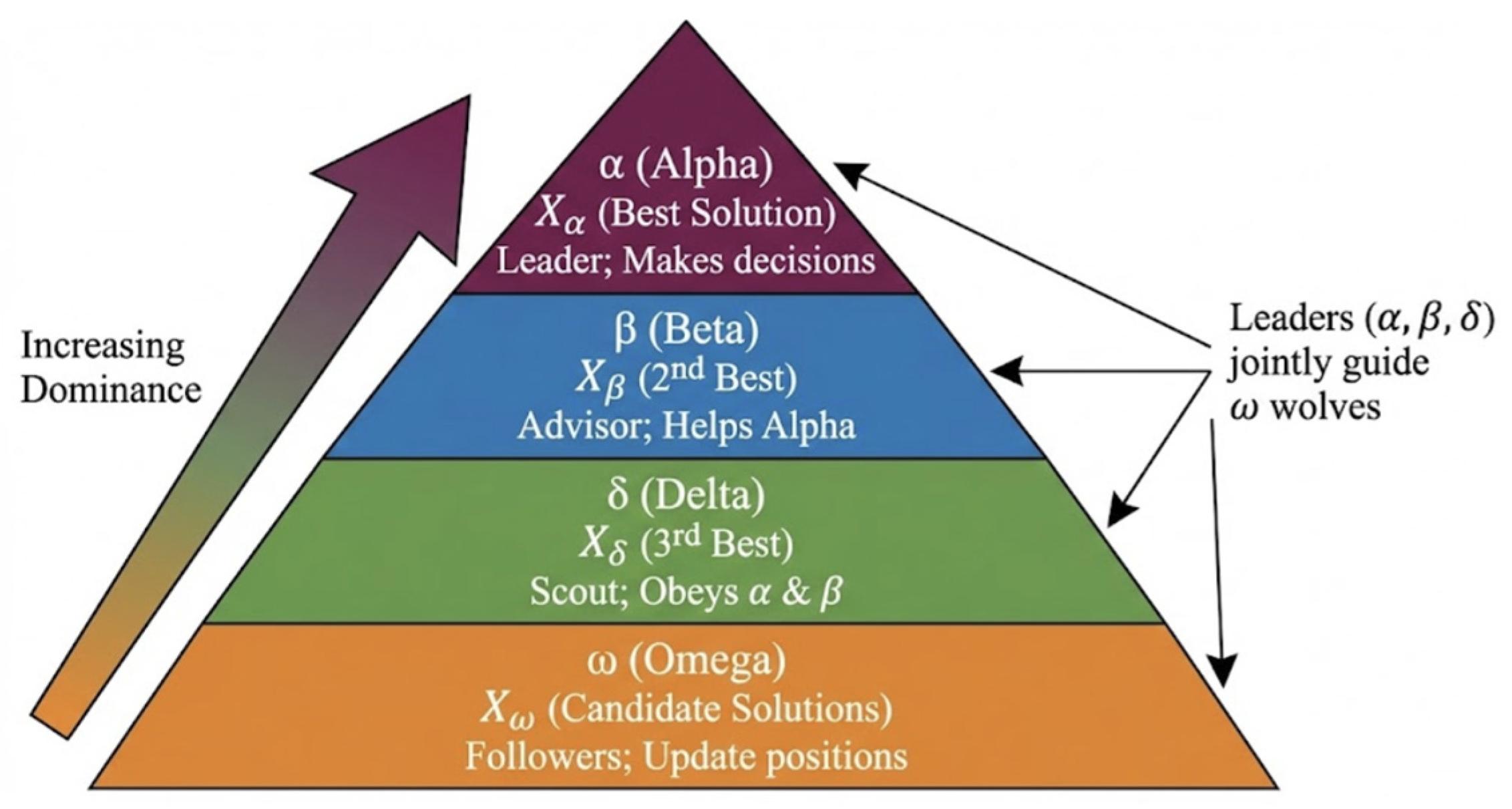
The Grey Wolf Optimizer (GWO) algorithm, put forward in 2014 by Australian scholar Mirjalili et al., mimics the entire social hunting activities of a grey wolf pack—ranging from prey searching, encircling and tracking to final attack. This collective behavior is cleverly mapped onto mathematical optimization problems to achieve a balance between global exploration and local exploitation, thus obtaining the optimal solution to the problem. The hierarchical structure of the wolf pack is demonstrated in
Figure 1 [
19].
The primary process of the standard Grey Wolf Optimizer (GWO) algorithm is listed below:
First, a population of grey wolves (candidate solutions),
, is randomly generated, and the parameters
and
are initialized. The value of
is set to linearly decrease from 2 to 0 over the course of the iterations. The fitness of each wolf is then calculated to establish the leadership hierarchy. The best solution is designated as Alpha (
), the second-best as Beta (
), and the third best as Delta (
). All other solutions are designated as Omega (
). During the entire optimization process, Alpha, Beta, and Delta direct the search direction for the whole wolf pack, including the Omega wolves. The essence of the algorithm lies in hunting behavior, which starts with encircling the prey. The wolves adjust their positions according to the prey’s location, and this behavior is mathematically described by the following equations:
where
represents the current iteration,
is the position vector of the prey,
is the position vector of a grey wolf, and
and
are coefficient vectors that control the encircling behavior.
In the abstract search space, the optimal position of the prey is unknown. Thus, the algorithm assumes that the Alpha, Beta, and Delta wolves possess more accurate knowledge regarding the prey’s potential position. As a result, the remaining wolves (the Omegas) adjust their own positions according to the locations of Alpha, Beta, and Delta. This process is mathematically formulated as follows:
Finally, the position of the current wolf is updated:
3.2. Hybrid Adaptive Differential Evolution Grey Wolf Optimizer Algorithm
Standard GWO updates agent positions based on the average influence of the top three wolves. While effective for general problems, our preliminary analysis shows this ‘consensus-based’ movement lacks the aggressive convergence speed required for real-time RTK ambiguity resolution. Distinct from typical hybrid modifications, our HADE-GWO replaces this averaging mechanism entirely with a directed mutation strategy.
While the Grey Wolf Optimizer (GWO) algorithm possesses the advantages of a simple structure and outstanding performance, there are several potential deficiencies in its underlying mechanism. The algorithm’s excessive dependence on the three optimal solutions—Alpha, Beta, and Delta—to steer the search direction of the entire population makes it vulnerable to premature convergence to a local optimum, especially when dealing with complex problems. In addition, it relies on a linearly decreasing parameter to manage the transition from global exploration to local exploitation. This fixed balance mechanism can result in a significant drop in population diversity in the later phase of the algorithm, which in turn leads to the loss of ability to escape local optima. In addition, this single and centralized information-sharing model impairs the overall optimization efficiency of the population.
To tackle the above-mentioned issues and considering the practical aspects of the integer ambiguity resolution process, this paper presents the HADE-GWO algorithm. HADE-GWO completely reconstructs the position update mechanism, abandoning the conventional strategy of moving towards the mean position of the three leading wolves. Instead, it introduces the DE/best/1 mutation strategy from Adaptive Differential Evolution, renowned for its strong convergence capabilities, as its core engine. Under this strategy, the evolutionary direction of all individuals in the population is directly guided by the position of the current best global solution (the Alpha wolf). This provides the algorithm with a powerful and focused convergence impetus, significantly accelerating the process of approaching the optimal region. The algorithm also incorporates a dynamic, non-linear adjustment mechanism for the scaling factor, F. The value of F linearly decreases from a large initial value, F_max, to a small final value, F_min, as the number of iterations increases. This adaptive mechanism enables the algorithm to perform large-scale exploration in the initial stages and automatically switch to a fine-grained local search in the later stages, thus achieving a smooth transition and intelligent regulation of its search behavior. Lastly, hybrid auxiliary strategies—specifically Lévy Flight and Nelder–Mead Refinement—are incorporated to improve the algorithm’s global exploration capability and its ability to break free from local optima, while also effectively resolving the issue of inadequate precision in the later stages of the algorithm [
20].
3.2.1. Adaptive Differential Evolution (ADE) Algorithm
To address the problem of the GWO algorithm becoming trapped in local optima, this paper introduces an Adaptive Differential Evolution mechanism. This mechanism completely replaces the standard GWO’s guidance formula, which is based on the mean position of the leading wolves. Instead, it efficiently executes the “mutation, crossover, and selection” process of Differential Evolution for the entire population through parallel matrix operations [
21].
For each target individual
in the population, three other individuals (
) are randomly selected such that their indices are mutually exclusive. The corresponding mutant vector,
, is then generated by the following formula:
where
represents the position of an individual in the population, and
is the dynamic scaling factor.
- 2.
Crossover:
Using a binomial crossover strategy, the component
of the trial vector
, corresponding to the
-th dimension of the
-th individual, is generated as follows:
where
is an integer randomly selected from the range of
. This procedure ensures that the trial vector inherits at least one component from the mutant vector.
- 3.
Selection:
First, a boundary check is performed on all newly generated trial vectors (), and their corresponding fitness values () are calculated.
Subsequently, a greedy selection strategy is employed to determine the individuals that will form the population for the next generation
:
The update for the entire population is completed at once, based on a single fitness comparison and the use of logical indexing.
For any individual
in population
that does not improve during the selection process, its control parameters (
and
) are considered ineffective and are subsequently reset according to the following equation:
where
represents a random number uniformly distributed in the interval
.
Conversely, for individuals that successfully produced an improved solution, their effective parameter combinations are retained for the next generation [
22,
23].
3.2.2. Hybrid Auxiliary Strategies
This strategy equips the algorithm with a robust mechanism to break free from local optima. As a robust tool for global exploration, a Lévy flight is triggered when the algorithm detects that the global best solution has stagnated. This involves a long-distance jump in a random direction, which guides the search to a completely new and potentially more promising region of the search space. When this stagnation trigger occurs, a new candidate solution,
, is generated as follows:
where
is the step size control factor,
is a random step vector generated from a Lévy distribution, and
is the Lévy index (typically set to 1.5).
Eventually, the algorithm judges whether the preset number of iterations has been achieved. If this condition is satisfied, the Nelder–Mead algorithm is called to conduct a high-intensity local search on the optimal solution, X_alpha. Should a better solution be obtained through this search process, X_alpha will be updated accordingly [
24,
25].
3.2.3. HADE-GWO Algorithm Procedure
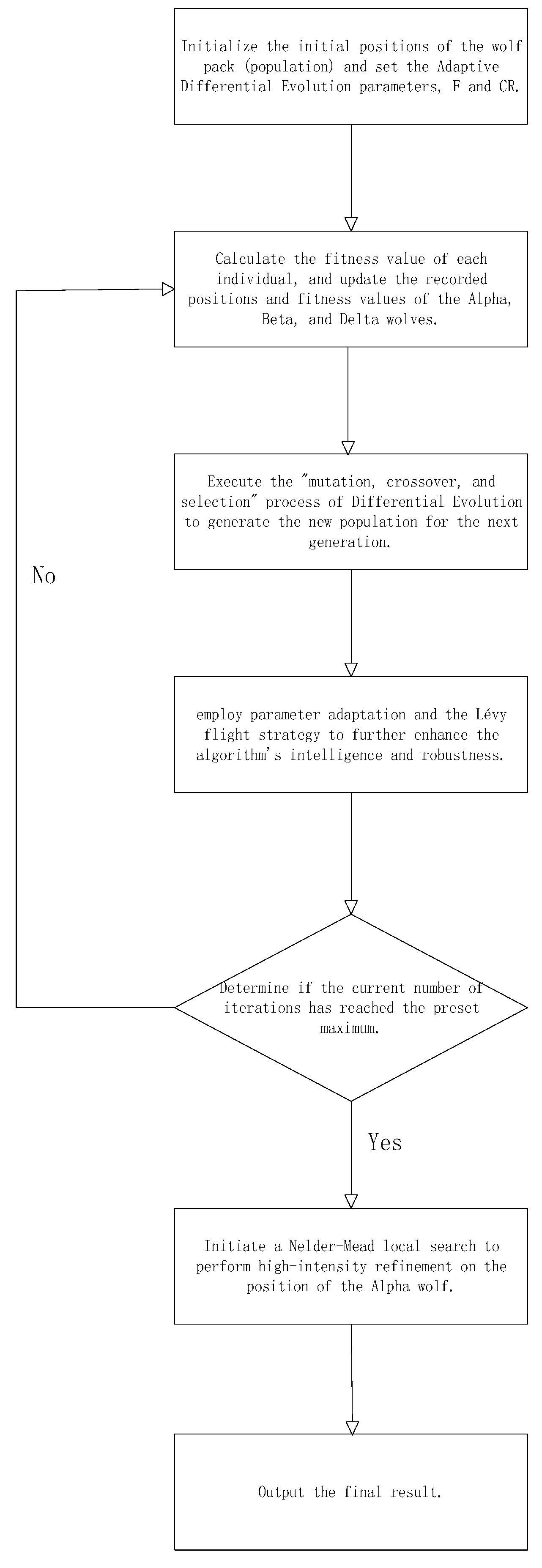
The procedure for integer ambiguity resolution using the HADE-GWO algorithm is as follows:
- (1)
First, the main algorithm parameters are initialized, which include the population size (i.e., the number of wolves), problem dimension, maximum number of iterations, search space boundaries, and stagnation counter for the Lévy flight. In addition, a separate set of Adaptive Differential Evolution parameters is initialized for each individual within the population.
- (2)
The fitness value of each individual in the population is computed and stored in an array. During the entire evaluation process, the algorithm constantly compares these fitness values to recognize and update the recorded positions and fitness levels of the global best (Alpha), second-best (Beta), and third-best (Delta) solutions. This step serves as the decision-making foundation for the subsequent “elite selection” and “individual selection” phases.
- (3)
This stage replaces the standard GWO’s position update formula, which is based on guidance from the mean position of the leading wolves. In its place, the algorithm executes the “mutation, crossover, and selection” process of Differential Evolution for the entire population. This process is realized through a single vectorized matrix operation, which is used to generate the new population for the next generation.
- (4)
Once the new population for the next generation is generated, the parameter adaptation strategy is implemented. This process begins by identifying which individuals failed to improve during the previous “selection” step (i.e., their newly generated solution was not accepted). For these “unsuccessful” individuals, the algorithm resets their corresponding control parameters, forcing them to attempt entirely new and more diverse search behaviors in the subsequent generation. Conversely, individuals that did successfully improve retain their effective parameters. These successful individuals are then subjected to a Lévy flight stagnation check. A new candidate solution is generated via this mechanism, and the Alpha wolf is updated if this new solution is superior.
- (5)
The algorithm checks if the preset number of iterations has been reached. If this condition is met, the Nelder–Mead algorithm is invoked to perform a high-intensity local search on the best solution, X_alpha. If a superior solution is found through this search, X_alpha is updated.
- (6)
Output the final global optimal solution.
The flowchart of the HADE-GWO algorithm is shown in
Figure 2 below.
3.2.4. Computational Complexity Analysis
To assess the computational efficiency of the proposed HADE-GWO, we analyze its time complexity. The complexity primarily depends on the population size (), the problem dimension (), and the maximum number of iterations ().
The computational cost of the standard GWO mainly consists of initialization (), fitness evaluation , and the position update of wolves . Thus, the total complexity of the GWO is .
For the proposed HADE-GWO, the complexity involves additional steps:
Adaptive Differential Evolution (ADE): The mutation and crossover operations are performed for the population, with a complexity of .
Lévy Flight: This is a conditional operation applied primarily to the alpha wolf, contributing approximately .
Nelder–Mead Simplex: This local search is applied only to the best solution at the final stage or periodically, with a complexity of , where is the number of local search steps (usually small).
Consequently, the overall theoretical time complexity of HADE-GWO remains
. Although the inclusion of ADE and auxiliary strategies introduces a slightly larger constant factor compared to the standard GWO, it does not change the order of magnitude. This theoretical analysis aligns with the empirical running times observed in
Section 4 where HADE-GWO shows a marginal increase in execution time but achieves a significantly higher success rate.
3.3. HADE-GWO Algorithm: Performance Experiments and Results Analysis
(1) Test Functions and Performance Metrics
For this study, the CEC2022 benchmark test function suite was used for performance evaluation, as detailed in
Table 1. This suite includes unimodal (CEC01), basic (CEC02–CEC05), hybrid (CEC06–CEC08), and composition (CEC09–CEC12) functions [
26]. The simulation experiments were performed on a system equipped with a Windows 11 64-bit operating system and an Intel(R) Core(TM) i9-14900HX processor, and all algorithms were implemented using MATLAB 2024b. Owing to the stochastic characteristics of optimization algorithms, each experiment was independently executed 30 times, where the maximum number of iterations was set to 500 per run. To quantitatively evaluate the performance of each algorithm, the mean values and standard deviations of the results from these 30 independent runs were computed. The mean value reflects the algorithm’s accuracy in searching for the optimal solution, while the standard deviation denotes the stability of its optimization performance.
(2) Comparison with Other Optimization Algorithms
To verify the optimization performance of the proposed HADE-GWO algorithm, a comparative experiment was carried out with the Particle Swarm Optimization (PSO) algorithm, Firefly Algorithm (FA), and standard Grey Wolf Optimizer (GWO) algorithm. Each algorithm was run 30 times independently; the mean values and standard deviations of the experimental results were calculated and summarized in
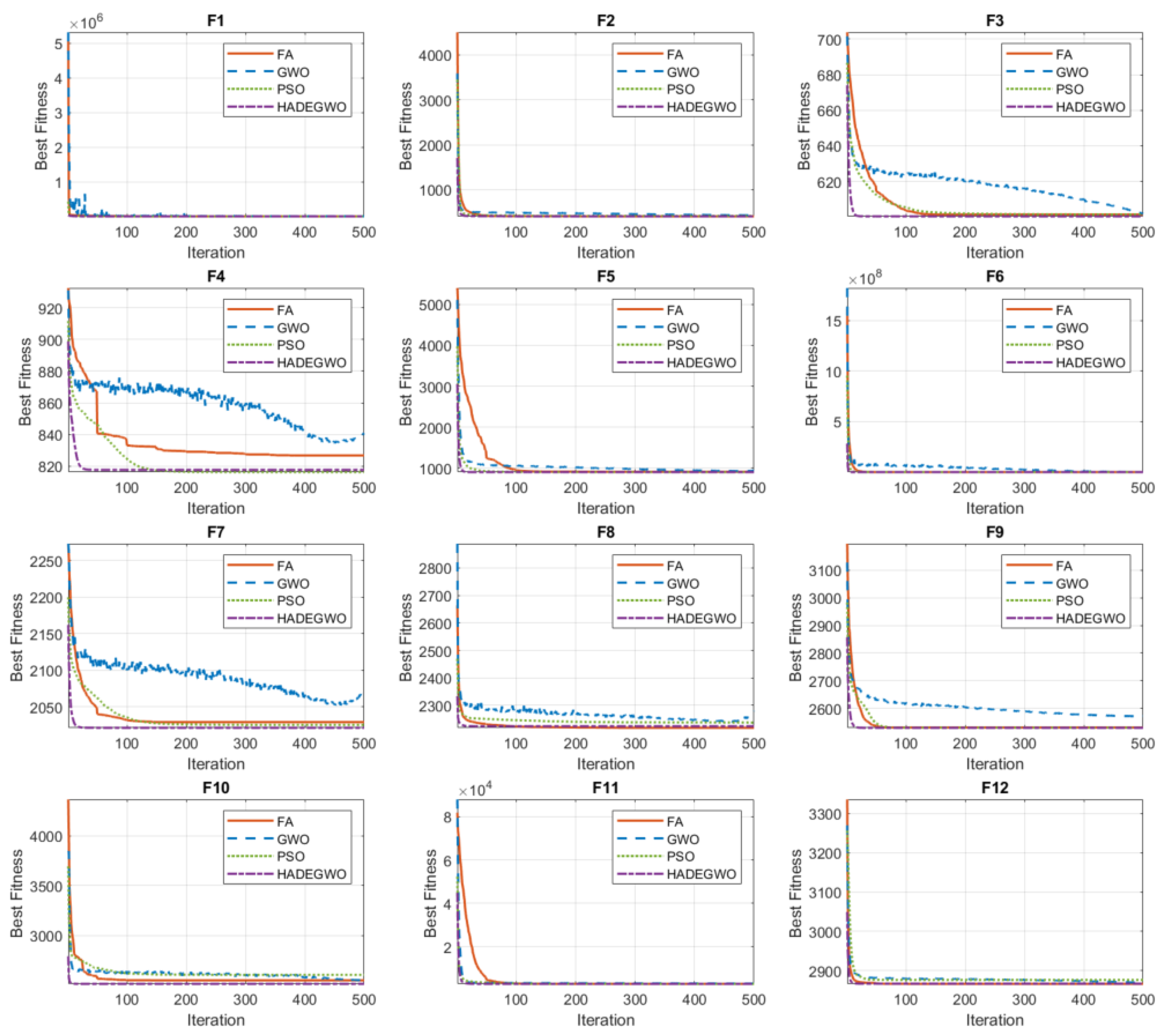
Table 2. In addition, for illustrative purposes, the convergence curve of a single randomly selected run was plotted for each algorithm, which is shown in
Figure 3.
Algorithm Parameter Settings: The primary parameters were configured consistently for all algorithms: the maximum number of iterations was set to 500, and the population size was 30. Specific parameters for each algorithm were set as follows: For PSO: The cognitive coefficient was 1.5, the social coefficient was 2.0, and the maximum particle velocity was 6. For FA: The maximum attractiveness was 2, the light absorption coefficient was 1, and the step-size reduction factor was 0.98. For GWO and HADE-GWO: The pack size was 30. For the HADE-GWO algorithm specifically, the control parameters F and CR were set to 0.5 and 0.8, respectively, and the Lévy index was 1.5 [
27,
28,
29,
30].
As indicated by the mean values and standard deviations presented in
Table 2, HADE-GWO demonstrates superior optimization accuracy and convergence speed on the unimodal function (F01) when compared to PSO, FA, and GWO. Furthermore, its optimization performance on the basic functions (F02–F05) is also shown to be highly stable. For the hybrid (F06–F08) and composition (F09–F12) functions, HADE-GWO again surpasses PSO, FA, and GWO in terms of both optimization accuracy and convergence speed. Notably, while the final results for HADE-GWO and PSO on functions F02 and F10 are very close, the convergence curves in
Figure 3 illustrate that HADE-GWO achieves a faster convergence rate than PSO. Beyond the mean performance, statistical stability is a crucial metric for meta-heuristic algorithms. We incorporated the Standard Deviation (Std.) into
Table 2 to evaluate the robustness of the algorithms across 500 independent runs. The results indicate that HADE-GWO consistently achieves smaller standard deviation values compared to PSO and FA, particularly in high-dimensional composition functions (F09–F12). This statistical evidence suggests that the proposed hybrid mechanism effectively mitigates the randomness inherent in stochastic optimization, ensuring reliable convergence performance.
The HADE-GWO algorithm integrates Adaptive Differential Evolution, the Lévy flight strategy, and the Nelder–Mead method to enhance the robustness and precision of the standard GWO algorithm. These improvements effectively boost the algorithm’s capacity to break free from local optima and reinforce its global search performance.
4. Numerical Simulation and Analysis
4.1. 3D Integer Ambiguity Resolution Experiment
This paper presents a comparative simulation based on a classic experiment from the textbook GPS Surveying and Data Processing [
31]. The simulation is designed to evaluate the performance of the GWO, HADE-GWO, LAMBDA, and M-LAMBDA algorithms. For this test, the three-dimensional double-difference integer ambiguity float solution
and its corresponding variance–covariance matrix
are given as follows:
After applying the HADE-GWO-based integer ambiguity resolution method proposed in this paper to search for the aforementioned float solution, the optimal integer ambiguity solution is obtained, as shown in the following equation:
In the following experiments, we evaluate the algorithm’s performance across different dimensions. The test datasets are categorized by their complexity: the dataset labeled as ‘small.mat’ represents the 3-dimensional ambiguity model, ‘sixdim.mat’ corresponds to the 6-dimensional model, and ‘large.mat’ denotes the 12-dimensional model. These naming conventions are consistent with the provided source code for reproducibility.
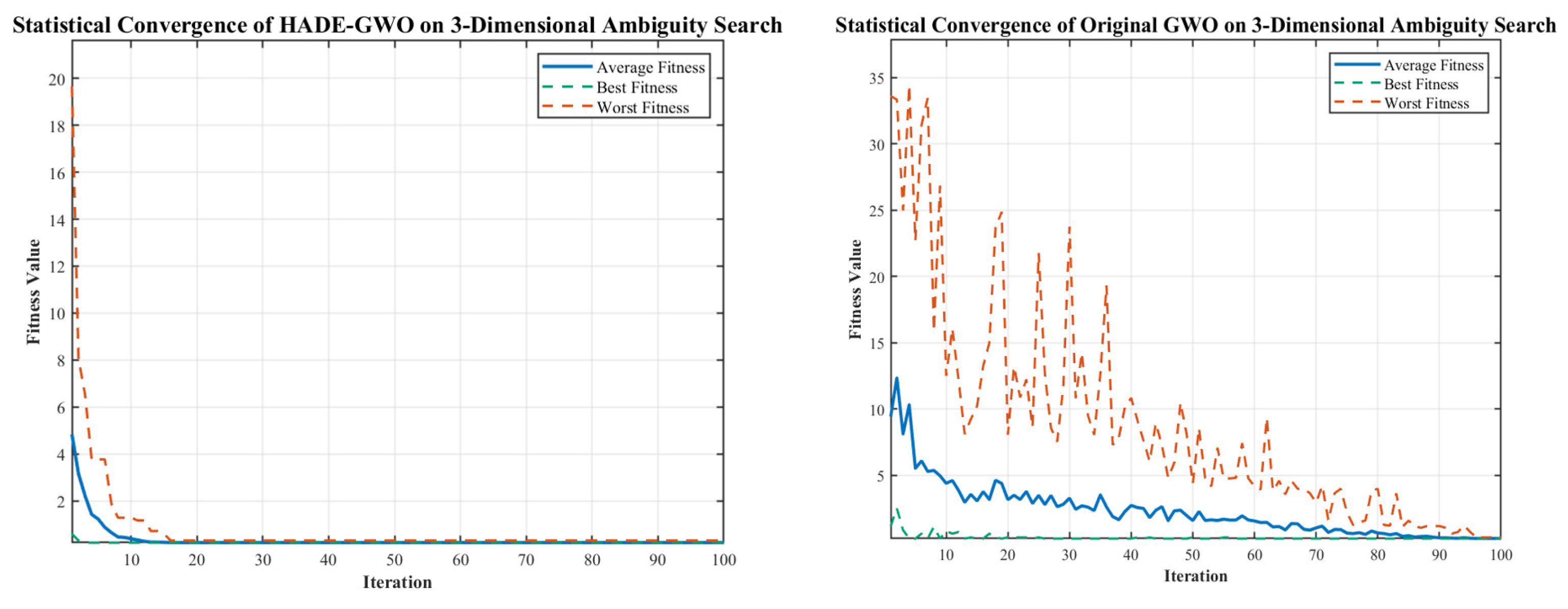
For this experiment, the initial population size was set to 30, the problem dimension was 3, and the maximum number of iterations was 200. To analyze the search performance of the new algorithm, a comparison was made among the GWO, HADE-GWO, LAMBDA, and M-LAMBDA algorithms. The fitness convergence curves for the HADE-GWO and GWO algorithms are presented in
Figure 4. Results from multiple experimental runs demonstrate that the HADE-GWO algorithm, enhanced by the Differential Evolution mechanism, has a strong ability to escape local optima. It is capable of converging to the region of the optimal fitness value within approximately 6 iterations.
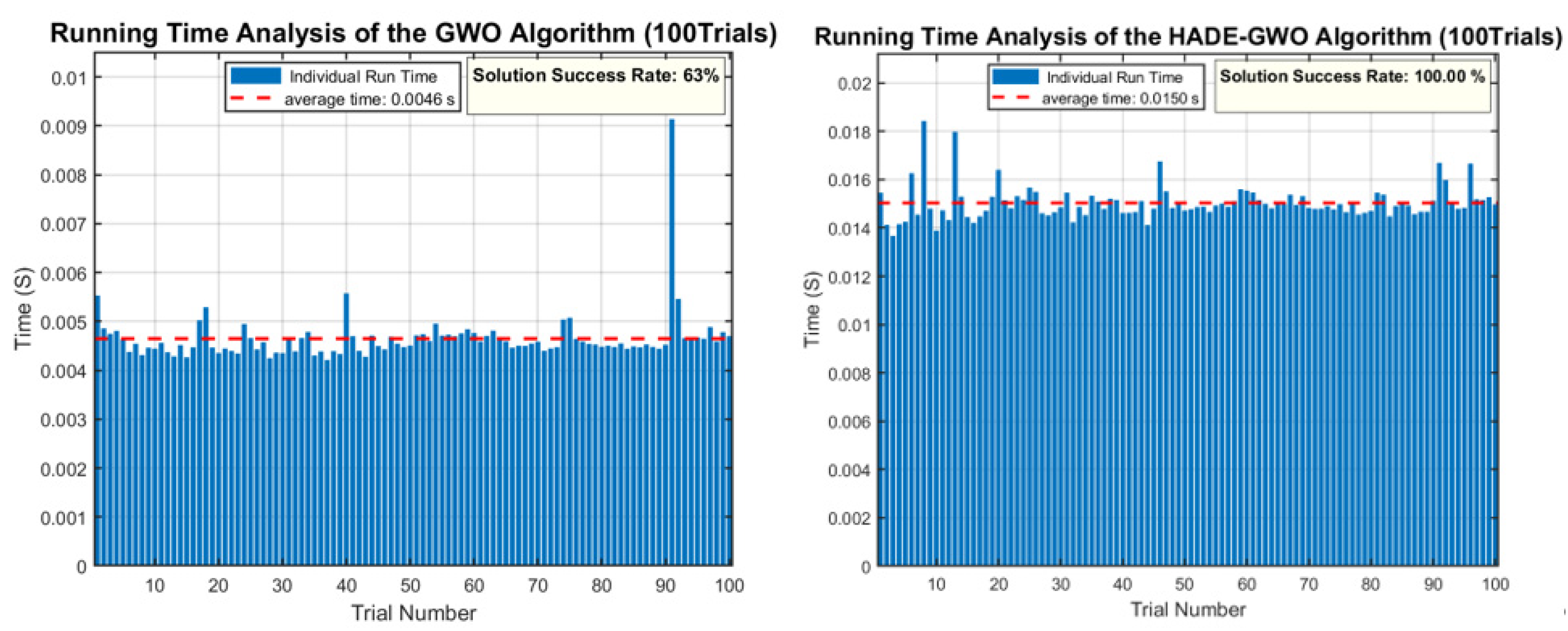
To offer a clearer insight into the computation time of each experimental run, the running times of the GWO and HADE-GWO algorithms are displayed in the bar chart of
Figure 5. A comparison of the running times between these two algorithms shows that the standard GWO algorithm has the shortest computation time, whereas the execution time of the HADE-GWO algorithm is marginally longer.
To perform a comparative analysis of the accuracy and reliability of the four algorithms under a three-dimensional scenario, each algorithm was subjected to 100 independent experimental runs, where the maximum number of iterations was set to 200 per run. The solution outcomes, average computation time, and success rate of each algorithm are summarized in
Table 3.
While the standard GWO algorithm exhibits fast computation speed, it suffers from a relatively low success rate. In contrast, the HADE-GWO algorithm, though slightly slower, achieves a high success rate. When compared with the LAMBDA and M-LAMBDA algorithms, HADE-GWO is superior in terms of computation time while achieving the same high level of success rate as both methods. This indicates that the HADE-GWO algorithm can effectively solve 3-dimensional ambiguity resolution problems.
Although the HADE-GWO algorithm has been shown to solve 3-dimensional ambiguity problems effectively, the increasing application of multi-frequency, multi-constellation systems in practical RTK positioning commonly presents the challenge of high-dimensional ambiguity resolution. Therefore, to assess the algorithm’s capability in such scenarios, a high-dimensional ambiguity resolution experiment was conducted in
Section 3.2.
4.2. High-Dimensional Integer Ambiguity Resolution Experiment
As multiple Global Navigation Satellite Systems (GNSS) continue to develop and be introduced, the number of satellites available for positioning has increased, thereby increasing the complexity of the ambiguity search and resolution process. Consequently, an algorithm’s performance in multi-dimensional integer ambiguity resolution is one of its core performance indicators. For this reason, this paper evaluates the HADE-GWO algorithm through 3-dimensional, 6-dimensional, and 12-dimensional ambiguity resolution experiments. The data used in the 3D experiment is the same as that employed in
Section 4.1, and the float solution matrices for the 6D and 12D cases are provided as follows:
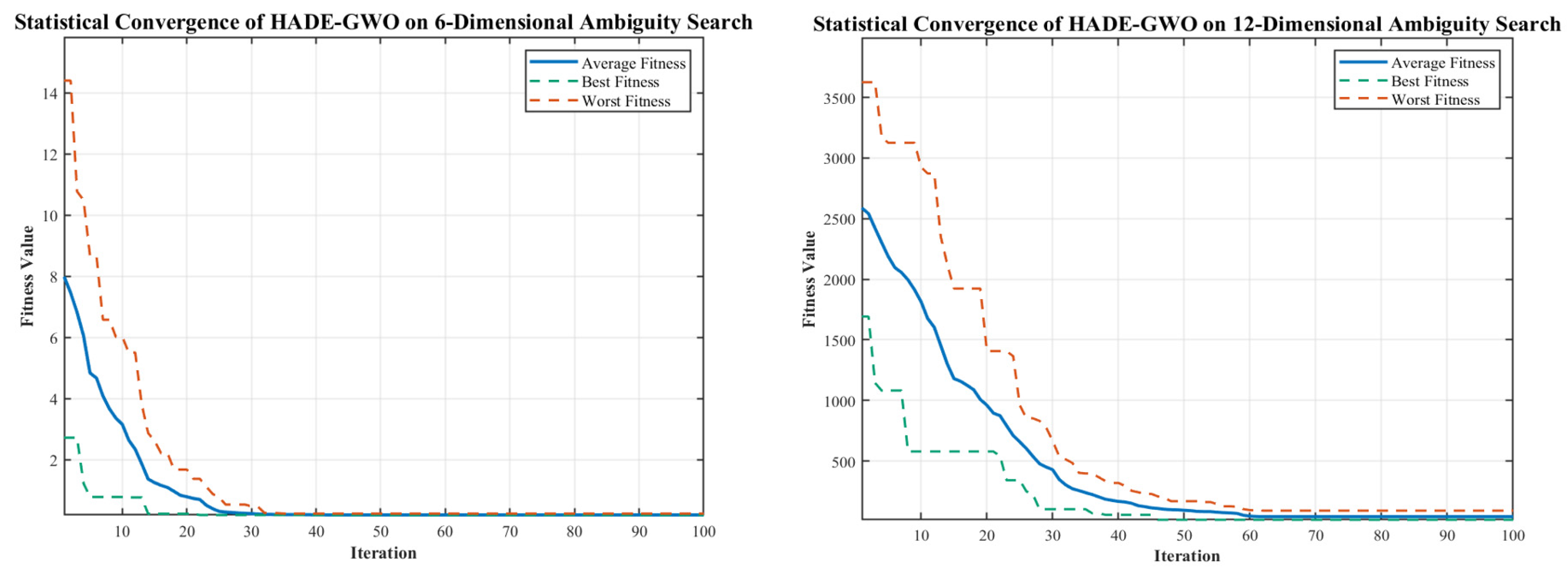
The initial population size was set to 30, and the maximum number of iterations was 100. The fitness convergence curves for the 6-dimensional and 12-dimensional solution processes using the HADE-GWO algorithm are shown in
Figure 6.
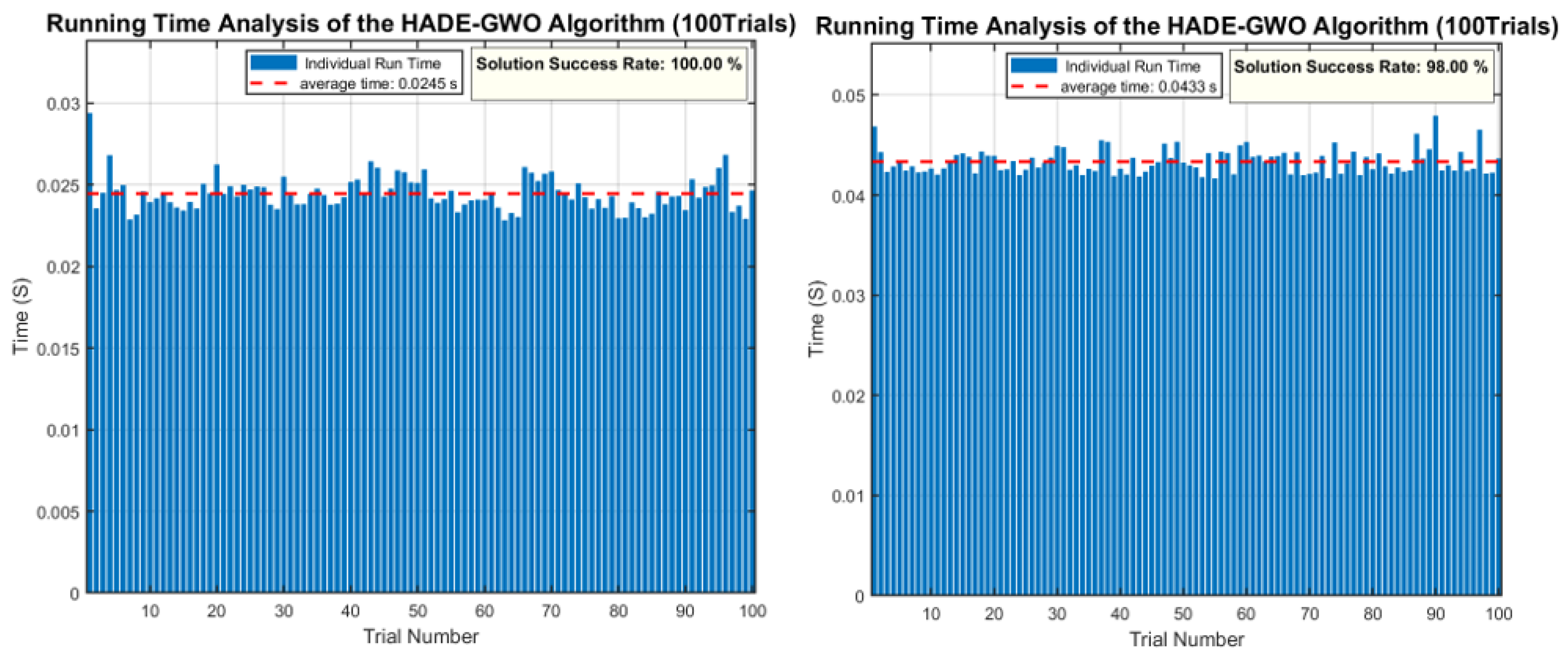
For both the 6-dimensional and 12-dimensional ambiguity resolution problems, the HADE-GWO algorithm demonstrates the ability to escape local optima, even if it becomes temporarily trapped. The computation times for the 6D and 12D runs of the HADE-GWO algorithm are presented in
Figure 7.
With the increase in the dimension of the ambiguity vector, the complexity of the resolution process also rises, resulting in a corresponding growth in computation time. To carry out a comparative analysis of the accuracy and reliability of the HADE-GWO algorithm under different dimensional conditions, 100 independent experiments were conducted for the 3-dimensional (3D), 6-dimensional (6D), and 12-dimensional (12D) ambiguity cases. The maximum number of iterations was set to 200 for each experiment run, and the obtained average computation times as well as success rates are presented in
Table 4.
The results in
Table 4 indicate that as the ambiguity dimensionality increases, the algorithm’s average computation time rises from 0.0156 s for the 3D case to 0.0245 s for the 6D case, and further to 0.043 s for the 12D case. Correspondingly, the resolution success rate decreases from 100% for the 3D and 6D cases to 98% for the 12D case. Thus, while the average computation time increases and the success rate slightly decreases with rising dimensionality, the algorithm’s overall speed and success rate remain sufficient to meet the requirements of practical engineering applications.
4.3. Practical Engineering Application
To validate the effectiveness of the HADE-GWO algorithm, a practical RTK positioning experiment was conducted using real-world engineering data. The data was collected using a Mengxin MXT906b receiver (Shenzhen Beitian Communication Co., Ltd., Shenzhen, China) near the Nam Tha River in Laos, with a total of 3523 epochs recorded over a 3 km baseline. The exact installation positions and operating environments of the experimental equipment are illustrated in
Figure 8.
In this experiment, the positioning solution procedure adopts the double-difference carrier phase observation model presented in
Section 1. The Extended Kalman Filter (EKF) is used for the iterative estimation of the float solution and its corresponding covariance matrix. Following this, the HADE-GWO algorithm is utilized for resolving the integer ambiguities. Eventually, the resolved integer ambiguities are substituted into the observation model to acquire the final positioning result. Through the analysis of the rover station data, a 15° satellite elevation cut-off angle was configured.
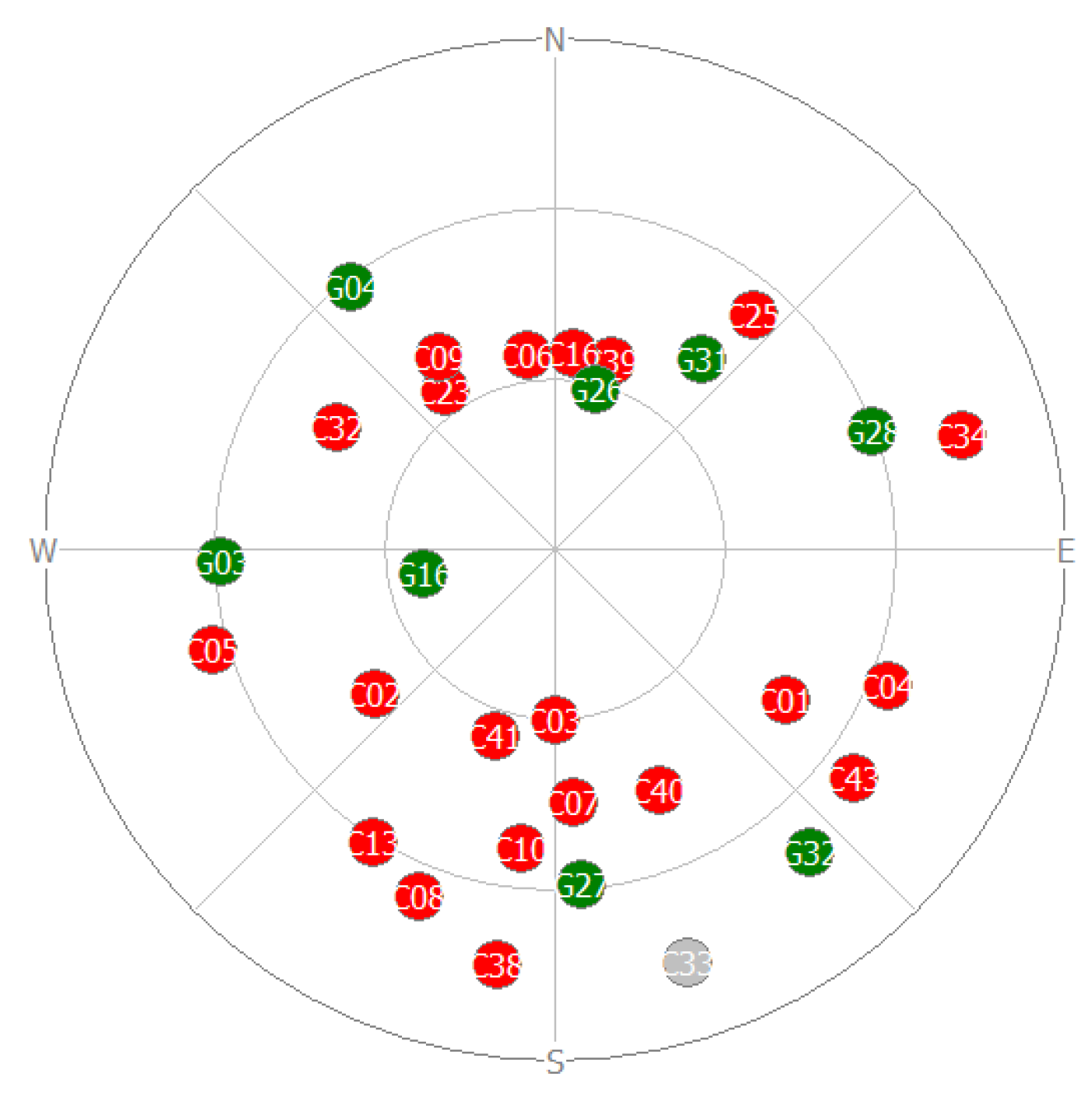
Figure 9 depicts the satellite visibility at the rover station under this configuration.
This experiment utilized multi-constellation single-frequency data from both the GPS and BDS constellations. As shown in
Figure 9, a total of 8 GPS and 22 BDS satellites were visible during the data collection period (Red denotes BDS satellites, while green denotes GPS satellites). Of these 30 visible satellites, 29 were ultimately included in the solution process.
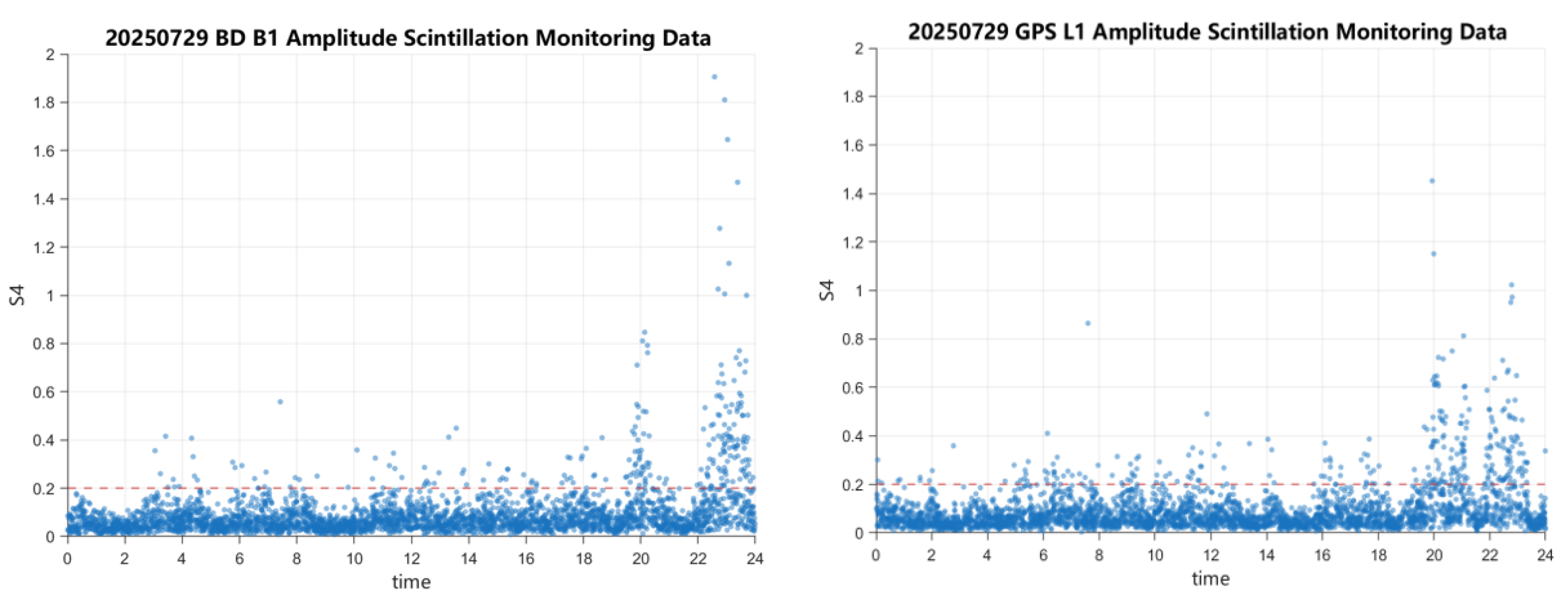
The data used in this experiment were collected during the high-occurrence season of ionospheric scintillation, and a severe ionospheric scintillation event occurred on the collection day. The scintillation indices are presented in
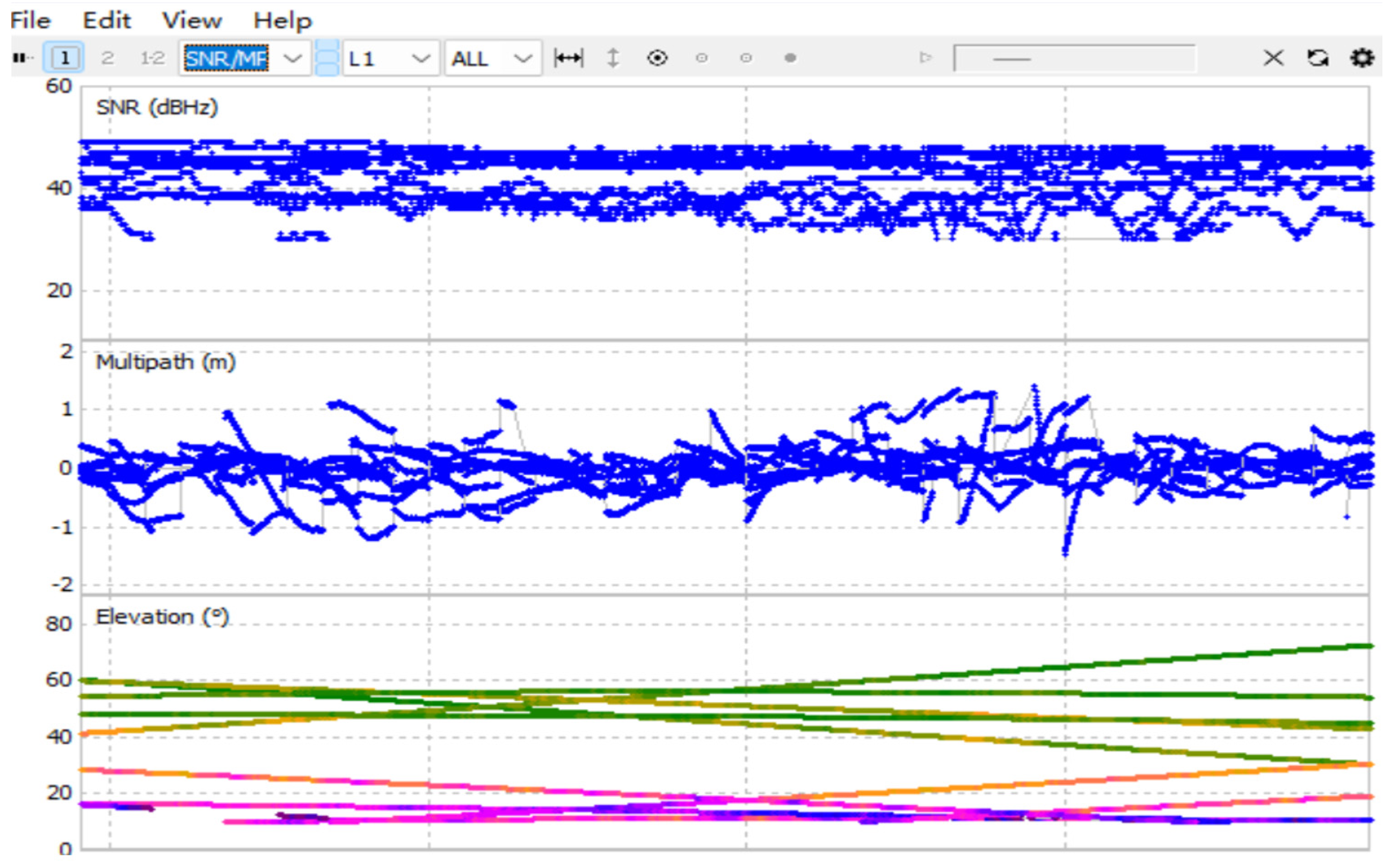
Figure 10. This scintillation event induced severe multipath effects on the positioning data, with the Code Multipath (CM) indices shown in
Figure 11. Severe signal degradation occurred when the Code Multipath index exceeded 1 m; under such a condition, obtaining an RTK fixed solution in a single epoch or a short time frame is nearly impossible. The Kalman filter was prone to divergence or convergence to an incorrect float solution. For this experiment, we selected the time period subject to the most severe impacts of the scintillation event for analysis.
Subsequently, the integer ambiguity is resolved using the HADE-GWO algorithm. As shown in
Table 5, this algorithm processes the solution results of 3523 epochs of single-frequency GPS+BDS data. It is evident that the HADE-GWO algorithm exhibits superior performance in integer ambiguity resolution: compared with the LAMBDA algorithm, it achieves a shorter solving time and an average 6.1% higher success rate.
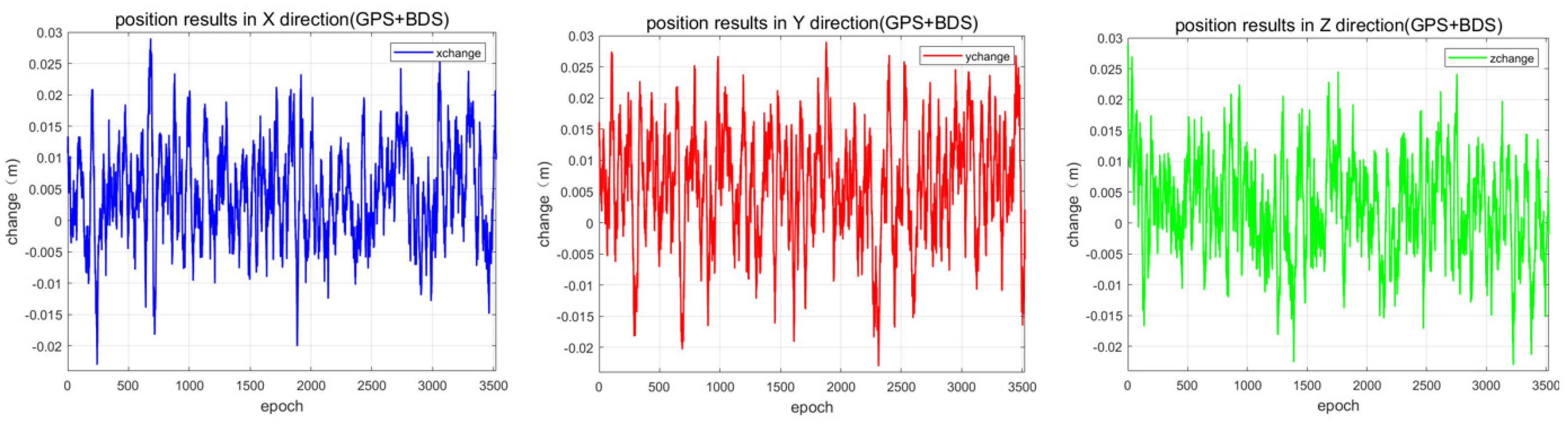
The final results of the RTK positioning experiment conducted using the HADE-GWO algorithm are presented in
Figure 12. As shown in the figure, the positioning errors in the x, y, and z directions are ±0.016 m, ±0.020 m, and ±0.018 m, respectively. This demonstrates that the algorithm successfully achieves centimeter-level positioning accuracy.
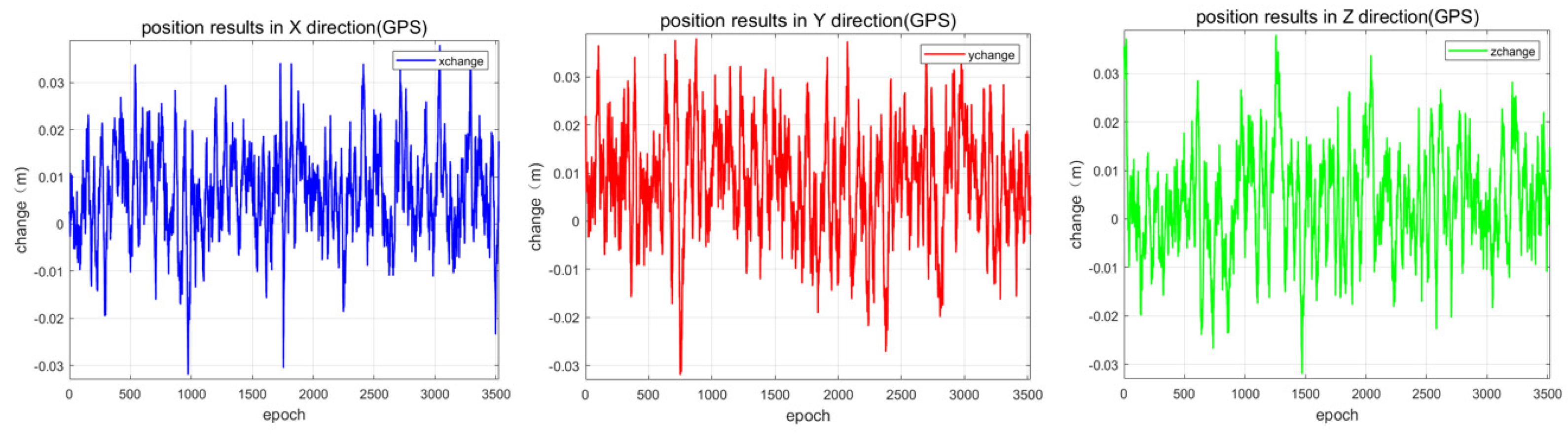
Furthermore, a single-frequency, GPS-only RTK positioning experiment was conducted using the HADE-GWO algorithm. The final results of this experiment are presented in
Figure 13.
In the context of integrated multi-constellation single-frequency models (GPS+BDS), the HADE-GWO method achieves a calculation speed adequate for real-time RTK performance. Moreover, the solution’s stability is underpinned by its high precision and ambiguity resolution success rate. Results confirm that this hybrid approach surpasses the performance of standalone single-frequency systems. Thus, the algorithm effectively satisfies the criteria for various engineering applications, enabling precise real-time navigation across multi-constellation scenarios.
4.4. Comparative Discussion on Ambiguity Resolution Strategies
In high-dimensional RTK scenarios, such as multi-constellation processing, the complexity of the search space increases exponentially. To address this, strategies like Integer Bootstrapping (IB) and Partial Ambiguity Resolution (PAR) are commonly employed. It is essential to clarify the position of the proposed HADE-GWO method in relation to these established strategies.
Integer Bootstrapping is a sequential rounding method that is computationally extremely efficient. However, it does not strictly minimize the integer least-squares (ILS) objective function and often ignores the full correlation between ambiguities. Consequently, its theoretical success rate is lower than that of search-based ILS methods, particularly when the float solution precision is low or correlations are high [
32]. In contrast, HADE-GWO utilizes a global search mechanism that fully accounts for the correlation within the ambiguity search space, thereby offering a higher probability of finding the optimal integer solution than bootstrapping.
Partial Ambiguity Resolution (PAR) strategies improve the fixing rate in challenging environments by selecting a high-quality subset of ambiguities to fix, effectively discarding “poorer” satellites to lower the model dimension. While highly effective for robustness, the subset selection process comes with a trade-off: discarding observations inevitably weakens the geometric strength (PDOP) of the fixed solution and discards potentially useful measurement information.
The HADE-GWO algorithm proposed in this study targets Full Ambiguity Resolution (FAR). The objective is to resolve the complete set of ambiguities directly to maximize the utilization of observation data. The experimental results in the 12-dimensional case (
Section 4.2) demonstrate that HADE-GWO achieved a 98% success rate. This indicates that with the enhanced global search capability provided by the HADE mechanism, it is possible to robustly resolve high-dimensional ambiguities without resorting to subset selection. This approach ensures that the final positioning solution benefits from the strongest possible satellite geometry.
However, it is worth noting that HADE-GWO and PAR are not mutually exclusive. In extremely challenging conditions (e.g., severe multipath or long baselines) where full ambiguity resolution is impossible regardless of the search algorithm, HADE-GWO can effectively serve as the underlying search engine within a PAR framework to further enhance computational efficiency and reliability.
5. Conclusions
Addressing the critical challenge of rapid and accurate integer ambiguity resolution in high-dimensional, multi-constellation GNSS environments, this paper proposed a novel Hybrid Adaptive Differential Evolution Grey Wolf Optimizer (HADE-GWO) algorithm. The innovation of this algorithm lies in its fundamental reconstruction of the standard GWO update mechanism. By replacing the conventional GWO guidance strategy with the “DE/best/1” mutation strategy from Adaptive Differential Evolution (ADE), the algorithm achieves a more powerful and focused convergence. This core mechanism is further enhanced by integrating hybrid auxiliary strategies: a Lévy flight strategy to effectively escape local optima during stagnation, and a Nelder–Mead refinement process to ensure high-precision local search in the final stage. This sophisticated design provides a superior balance between global exploration and local exploitation, mitigating the risk of premature convergence inherent in standard metaheuristic algorithms.
The comprehensive experimental validation confirms the efficacy and superiority of the proposed HADE-GWO algorithm. Performance evaluations on the CEC 2022 benchmark test suite demonstrated that HADE-GWO surpasses standard GWO, PSO, and FA in terms of optimization accuracy, stability, and convergence speed. More critically, in ambiguity resolution simulations, HADE-GWO achieved a 100% success rate in 3D and 6D cases and 98% in the 12D case, matching the reliability of the established LAMBDA and M-LAMBDA algorithms. The most significant finding is that HADE-GWO achieves this high reliability with a markedly reduced computation time, proving its superior efficiency. Its robust performance in high-dimensional (6D and 12D) scenarios further validates its suitability for complex, multi-system applications.
Finally, the practical engineering application using real-world single-frequency GPS+BDS data confirmed the algorithm’s practical viability. The HADE-GWO algorithm successfully resolved ambiguities and achieved centimeter-level positioning accuracy. This level of precision holds profound practical implications for emerging mass-market applications. Specifically, it provides the foundational reliability required for lane-level navigation in autonomous vehicles, precise control in UAV logistics, and real-time deformation monitoring of critical infrastructure, where robust centimeter-level positioning is a prerequisite for operational safety and efficiency. In summary, the HADE-GWO algorithm presents a highly efficient, reliable, and robust alternative for integer ambiguity resolution, offering significant potential for real-time, high-precision GNSS positioning in the challenging context of modern multi-constellation systems. Future work could involve testing the algorithm’s performance on longer baselines and under more complex observation conditions, such as severe multipath or ionospheric scintillation.