
Article

Research on Workshop Dynamic Scheduling Method Considering Equipment Occupation Under Emergency Insertion Order

1
School of Automation, Wuxi University, Wuxi 214105, China
2
Wuxi Key Laboratory of Intelligent Manufacturing Technology for Core Components of High-End Equipment, Wuxi 214105, China
3
Wuxi Weiming Intelligent Technology Co., Ltd., Wuxi 214104, China
4
School of Mechanical Engineering, Jiangnan University, Wuxi 214122, China
*
Author to whom correspondence should be addressed.
Algorithms 2026, 19(2), 156; https://doi.org/10.3390/a19020156
Submission received: 25 December 2025 / Revised: 2 February 2026 / Accepted: 5 February 2026 / Published: 16 February 2026

Abstract

With the increasing demand for personalized services in the market, manufacturing enterprises are facing frequent emergency order insertion and equipment resource shortages, and traditional scheduling methods lack flexibility. This article focuses on the workshop scheduling problem under emergency insertion disturbance, and constructs a dynamic scheduling optimization method considering equipment occupancy status. Firstly, a dynamic scheduling framework is proposed, and a real-time status model is established to monitor emergency insertion and equipment occupancy status in real time. An event-driven dynamic scheduling mechanism is also constructed. Secondly, with the optimization objective of minimizing the maximum completion time, a mixed integer programming model is established, and an improved genetic simulated annealing algorithm is proposed to solve the proposed model. Finally, the proposed method was validated using a standard case set and real production scenarios. The experimental results showed that the solution of the proposed method was better than similar algorithms under three different problem scales. In three emergency insertion scenarios, the proposed method can reduce the disturbance of insertion on the original plan while ensuring equipment utilization, verifying the practicality and effectiveness of the proposed dynamic scheduling method.

1. Introduction

In the context of the transformation of the modern manufacturing industry to intelligence and flexibility, the production scheduling system, as the core of operation management, has a dynamic response ability and optimization level that directly determines the production efficiency and market competitiveness of enterprises. The traditional static scheduling model often fails due to the lack of a real-time adjustment mechanism in the face of common workshop disturbance events such as emergency order insertion and equipment failure, resulting in a series of problems such as reduced equipment utilization, delayed order delivery, and high production costs. In particular, emergency order insertion, as a highly dynamic and high-priority disturbance, not only needs to be quickly integrated into the existing production plan but also needs to fully consider the real-time occupation status of equipment so as to avoid resource conflict and ensure the overall production efficiency. Therefore, it has important theoretical value and urgent practical needs to study the dynamic scheduling method considering the occupation of equipment under emergency order insertion. The development of this research field presents a clear evolution from model construction and algorithm innovation to driving mechanism design. Scholars at home and abroad have carried out multidimensional explorations around related issues. The specific research progress can be summarized as follows:
In terms of scheduling models and optimization methods, scholars have continuously improved the ability of models to depict real scenes by introducing complex constraints and multi-objective frameworks. Rifai et al. [1] studied the multi-objective flow shop scheduling problem with time constraints, while Fu et al. [2] considered both energy consumption and delay. In order to meet the challenge of a time production environment, Meddourence et al. [3] innovatively integrated the distributed arrival time theory into the simulated annealing algorithm. At the same time, algorithm fusion has become the key path to improving the solving efficiency: Qiu et al. [4] enriched the resource scheduling method through the combination of knowledge mining and machine learning, while Huang et al. [5] developed a hybrid genetic algorithm to deal with transportation time constraints. The research of Feng et al. [6], Zhang et al. [7], and Wan et al. [8] brought the total energy consumption, equipment load, delay time, production cost, and other multi-objectives into the optimization scope, responding to the urgent needs of green manufacturing and efficient operation. Liu et al. [9] and Wang et al. [10] jointly modeled the scheduling of automated guided vehicles (AGVs) and equipment scheduling, which reflected the attention to the comprehensive optimization of material flow and information flow in the manufacturing system. At present, the academic research on flexible job shop scheduling has made significant progress, but most of the results focus on multi-objective optimization in a static environment. Therefore, the dynamic scheduling technology that can sense and respond to equipment occupation shows broad application prospects in discrete manufacturing fields such as aerospace, high-end equipment manufacturing, and automotive parts production.
In the aspect of dynamic scheduling mechanisms, the research focus has shifted from static optimization to response mechanism design. Framinan et al. [11] demonstrated the advantages of rescheduling based on event triggering. Yao et al. [12] further proposed a hybrid strategy integrating cycles and events, taking into account efficiency and response sensitivity. With the growing demand for intelligent decision-making, machine learning technology is widely used to extract scheduling knowledge. For example, Jun et al. [13] used random forests to extract scheduling rules from the optimal scheme, while Huang et al. [14] used a machine learning method to identify the bottleneck resource optimization path. Zhao et al. [15] proposed a Q-learning hyper-heuristic algorithm (qlhh_dir) based on dynamic insertion rules for the emergency order insertion problem in the distributed flow shop, which realized the adaptive selection of the underlying heuristic rules. Chen et al. [16] designed the Q-learning gray wolf optimization algorithm (QGWO), which uses the Q-learning operator to adaptively select the local search strategy to balance exploration and development. Li et al. [17] designed a hybrid artificial bee colony algorithm to deal with multiple emergency order scenarios. He et al. [18] used NSGA-III to deal with the multi-constraint order insertion problem. Wang et al. [19] confirmed the advantages of simulated annealing under the aggregation estimation framework through algorithm comparison. On the other hand, Chen et al. [20] systematically evaluated the classical priority rules, while Ozturk et al. [21] extracted special rules from the multi-objective model, reflecting the deepening of the research from “algorithm generation” to “rule precipitation”.
It is noteworthy that the research frontier has extended to the distributed manufacturing environment. The coevolutionary algorithm developed by Pan et al. [22], the processing of sequence-related setting time by Song [23] and Zhang et al. [24], and the knowledge-driven heuristic by Yang et al. [25] all provide new ideas for distributed assembly scheduling. Wang [26] focused on multi-assembly machine configuration, while Zhang [27] built an integrated optimization framework considering plant heterogeneity and batch delivery by introducing a Q-learning mechanism and multi-group collaboration. With production to order (MTO) mode becoming the mainstream, the collaborative optimization of inventory and delay cost has become the focus of academic attention [28,29], promoting the in-depth development of scheduling research to be driven. However, when facing the dynamic scenario of emergency order insertion, the existing scheduling strategy still faces many challenges in dealing with the real-time occupation of equipment: first, the real-time requirement of decision-making is very high, requiring the scheduling system to generate feasible and efficient solutions in a very short time; secondly, the resource constraints are complex and changeable, and the equipment status evolves dynamically with the production process, which increases the difficulty of modeling and solving the scheduling model.
In view of this, the purpose of this study is to build a new method of dynamic job shop scheduling for the emergency order insertion scenario and fully consider the equipment occupation status. The core innovations are as follows: firstly, a dynamic collaborative optimization framework with “real-time occupancy status of equipment” as the decision-making center is constructed. At the level of problem modeling and the solving strategy, the real-time occupancy status of equipment is creatively upgraded from static constraints to the core central variable of dynamic decision-making. A hybrid intelligent optimization mechanism of “global elite” hierarchical collaboration and adaptive escape is proposed. By using its interactive learning ability with the environment, the appropriate equipment is efficiently allocated for the process after the order is inserted. By introducing the adaptive elite retention strategy, the convergence is accelerated under the premise of ensuring the diversity of the population so as to build a hybrid intelligent solution framework with both response speed and optimization quality.
The arrangement of chapters in this paper is as follows: firstly, in Section 2, a dynamic scheduling framework for workshops facing emergency insertion orders and equipment occupation status is proposed, and the problem is described and modeled. Secondly, in Section 3, the core hybrid intelligent algorithm for solving this problem, the improved genetic simulated annealing algorithm (IGSA), is proposed, and its design details are elaborated. Subsequently, in Section 4, through comparative experiments between standard test cases and real-world scenarios, the superiority of the IGSA algorithm and the effectiveness of the proposed dynamic scheduling framework are systematically verified. Finally, in Section 5, a summary of the research conducted in this paper is provided, and future work is prospected.

2. Method

The frequent insertion of urgent orders has become the norm of workshop production and operation. This kind of dynamic disturbance not only disrupts the static scheduling plan made in advance but also causes complex resource competition and conflict due to the limited equipment resources in the workshop. Traditional scheduling methods often lack the ability of real-time perception and the dynamic adjustment of equipment occupancy, resulting in delivery delays, low equipment utilization, poor production stability, and other problems in the face of order insertion. Therefore, this section aims to build a dynamic scheduling framework that can respond to emergency order insertion in real time and finely manage the occupied state of equipment so as to minimize the disturbance of order insertion to the original production system while ensuring production efficiency.

2.1. Design of Workshop Dynamic Scheduling Framework Considering Equipment Occupation Under Emergency Order Insertion

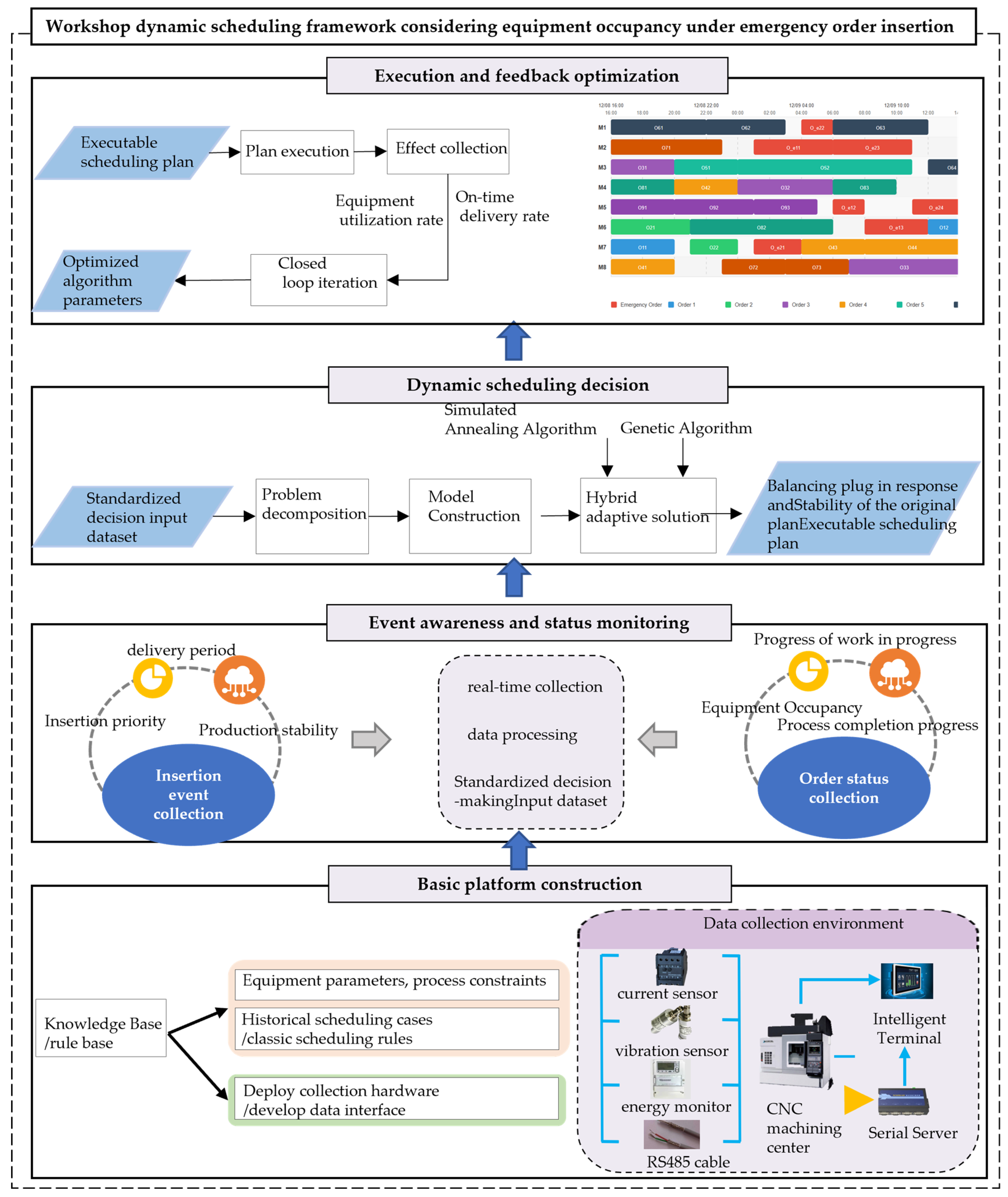
The proposed dynamic scheduling framework uses the closed-loop control logic of “perception decision execution”, and its core is to decompose the complex global dynamic scheduling problem into a series of local deterministic optimization problems based on event triggering. The overall structure of the framework is shown in Figure 1, primarily consisting of four modules: the basic platform construction layer, the event perception and state monitoring layer, the dynamic scheduling decision-making layer, and the scheduling execution and feedback optimization layer. The basic platform construction layer primarily establishes a data collection environment, knowledge base, and rule base, serving as a supporting platform that provides the data foundation and scheduling knowledge rules for the algorithms in the decision engine, which form the basis of system intelligence. The event perception and state monitoring layer act as the “sensory system” of the system, responsible for receiving various production events (such as emergency orders) and collecting real-time state data to provide a basis for decision-making. The dynamic scheduling decision-making layer serves as the “brain” of the system, which is the core of the framework. It first decomposes complex problems, then constructs mathematical models, and finally solves them through a hybrid adaptive solving strategy. The scheduling execution and feedback optimization layer acts as the “execution and learning organ” of the system, responsible for executing the scheduling scheme and feeding back the actual execution results to the learning mechanism, enabling the system to continuously optimize and form a virtuous cycle of “perception-decision-execution-learning”.

2.2. Modeling of the Emergency Order Insertion Event

This part is the interface between the system framework and the workshop environment, which is responsible for capturing all kinds of events, driving the scheduling, and sensing the system status in real time. There are four main types of events triggered by emergency order insertion:
(1) The order event model mainly includes three states: emergency order insertion, arrival, and order cancelation or change. The modeling is as follows:
OE = {EOID, Va1,a2,a3⟩, T1}
where EOID is the identification code of the emergency order; V is the status of the emergency order, a1 is the arrival of the order, a2 is the cancelation of the order, a3 is the change in the order, and T1 is the status collection time. The data collection frequency is 2 times per second, and the collected data will be stored in the temporary database.
(2) Task events include three statuses: task processing start, normal completion, and processing interruption. The modeling is as follows:
TE = {TID, MID, Ww1,w2,w3⟩, T2}
where TID represents the identification code of the task, W represents the status of the task, w1 is the start of processing, w2 is the normal completion, w3 is the processing interruption, and T2 is the status acquisition time.
(3) Processing resource events mainly include three states: equipment idling, equipment processing, and equipment failure. The modeling is as follows:
ME = {MID, S⟨son,soff⟩, Ppid,pname,OID,⋯,pt⟩, B⟨b1,b2,⋯,bn⟩, T3}
where MID refers to the identification code of the machine tool; S represents the on/off of the machine tool; OID represents the identification code of the processed task; P stands for processing information; B represents the fault information of the machine tool; and T3 is the status acquisition time.
(4) System event: A rescheduling trigger based on a fixed time period,
SE = {SID, Tti−1,ti⟩}
where SID refers to the ID of system rescheduling, T is the rescheduling interval time, ti−1 is the trigger time of the last rescheduling, and ti is the trigger time of the current rescheduling.
Figure 1. Overall structure of workshop dynamic scheduling framework considering equipment occupation under emergency order insertion.
Algorithms 19 00156 g001

2.3. Real-Time Monitoring Model for Production Status

Establishing a real-time monitoring model for production status is the cornerstone and premise of the effective operation of the whole dynamic scheduling framework. Its core function is to transform the complex physical production system into digital dynamic information that can be understood and processed by the computing system. At each decision-making moment, the system captures the global state of the scheduling system, which mainly includes the equipment occupation state, task pool state, and system performance state. The update of the state model is not a simple periodic polling but a hybrid mechanism that is “primarily event-driven and secondarily periodic verification”. Event-driven update: When any production event (such as “task completion” or “emergency order arrival”) is captured, the system will immediately trigger an incremental update for the state model. For example, a “task completion” event will immediately release the corresponding equipment, update its status from busy to idle, and update the task pool. This mechanism ensures that the synchronization delay between the state model and the physical workshop is extremely low, which is the core guarantee of “real-time performance”. Periodic complete verification: As a redundant backup and data integrity verification for the event-driven mechanism, the system performs a snapshot collection and comparison of the entire workshop status at a fixed interval to correct model drift that may be caused by event loss or communication delay.
The equipment occupancy status model can accurately describe the real-time status of each equipment, including the current processing task, consumed man hours, estimated completion time, waiting queue length, and task list. It is the core of “equipment occupancy”:
MO = {MOID,OID,t1,t2,bn ⟨o1,o2,⋯⟩,T4}
where MOID is the equipment occupation status number, OID is the current processing task, t1 is the consumed man hour, t2 is the estimated completion time, bn is the waiting queue length and task list, and T4 is the status collection time.
The purpose of establishing the task pool state model is to provide an accurate decision-making basis for dynamic scheduling. It structurally classifies tasks, accurately manages process dependencies and state transitions (such as preemption and release) between tasks, and ensures scheduling feasibility. At the same time, it provides the core input for the optimization algorithm and scheduling rules, serving as the key hub to facilitate the transition from passive response to global intelligent decision-making.
The processing task set identifies whether each task is in a preemptive state:
Q_t: ={QID,S⟨sY,sN⟩,T5}
where QID is the number tasks being processed, S is the preemption status, sY means preemption, and sN means non-preemption.
The schedulable waiting task set includes newly arrived inserted orders and released conventional tasks:
W_t = {WID,O⟨oid,oname,OID⟩,Cc1,c2,⋯,cn⟩,T6}
where WID is the number of schedulable waiting tasks, O is the newly arrived insertion order, and C is the released conventional task.

2.4. Emergency Order Insertion Scheduling Decision Mechanism

The emergency order insertion scheduling decision-making mechanism is the “brain” of the framework, which starts after the event is triggered and is responsible for generating new scheduling instructions. The dynamic scheduling decision-making mechanism proposed in this paper is based on the combination of event triggering and cycle driving mode and carries out rolling optimization and rescheduling according to the real-time running state of the system. At the moment of decision triggering, the scheduling engine retrieves a complete state snapshot at the decision point from the real-time state model. Based on information such as device occupancy queues and task dependencies in this snapshot, a perturbation threshold is calculated. If rescheduling is required, this state snapshot is directly used as the initial condition for the algorithm’s warm start, ensuring that the optimization is based on the latest real-world situation. Its core significance is to promote the production system from a passive response to a disturbance to an optimization system with active adaptive ability so as to continuously ensure the production efficiency, delivery date, and system stability in a changing environment and effectively avoid the operation disorder and benefit loss caused by the rigid plan. As the key intelligent decision-making center connecting “perception” and “execution”, this mechanism gives the system the ability of continuous learning and self-evolution by constructing a closed-loop control structure of “perception → decision → execution → feedback” and finally realizes the profound transformation to an intelligent production system.

2.4.1. Problem Decomposition and Subproblem Generation

Using the approximation idea of stochastic dynamic programming for reference, the original problem is approximately decomposed into a deterministic scheduling subproblem in the current state. The decision scope of this subproblem is limited to the newly arrived emergency order insertion task, the current waiting task set that meets the tight constraint ahead, and the in-process task set on the non-critical path. It focuses on the WIP management, emergency order insertion processing logic, large base order splitting strategy, and parallel operation scheduling in the dynamic production scheduling scenario, which greatly reduces the scale of the problem and improves the decision efficiency.

2.4.2. WIP Management in the Scenario of Urgent Order Insertion

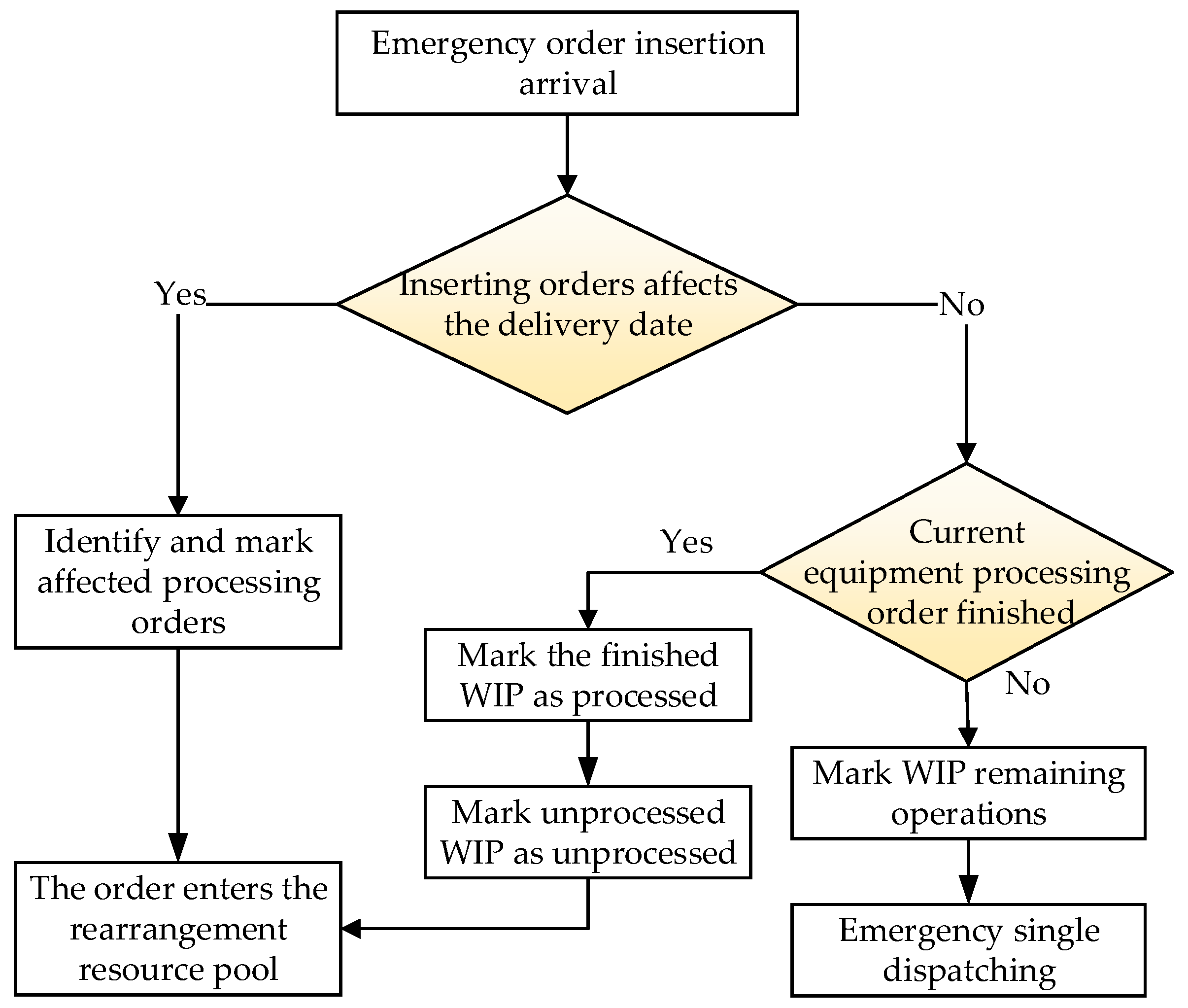
The system needs to support the change in WIP status caused by emergency order insertion, equipment failure, and other disturbances in the production process. When the order is interrupted, the system needs to identify the processed part and the unfinished part and reschedule the unfinished operation as the set of “unfinished work orders”. If the original order is interrupted, the remaining operations will be marked and retained, and the subsequent scheduling can be rescheduled based on this set. If the interruption affects the order delivery date, the system needs to include the affected tasks in the rescheduling range; if not, the original plan can be retained. The work in progress management process in the emergency insertion scenario is shown in Figure 2.

2.4.3. Emergency Order Insertion and Rearrangement Strategy

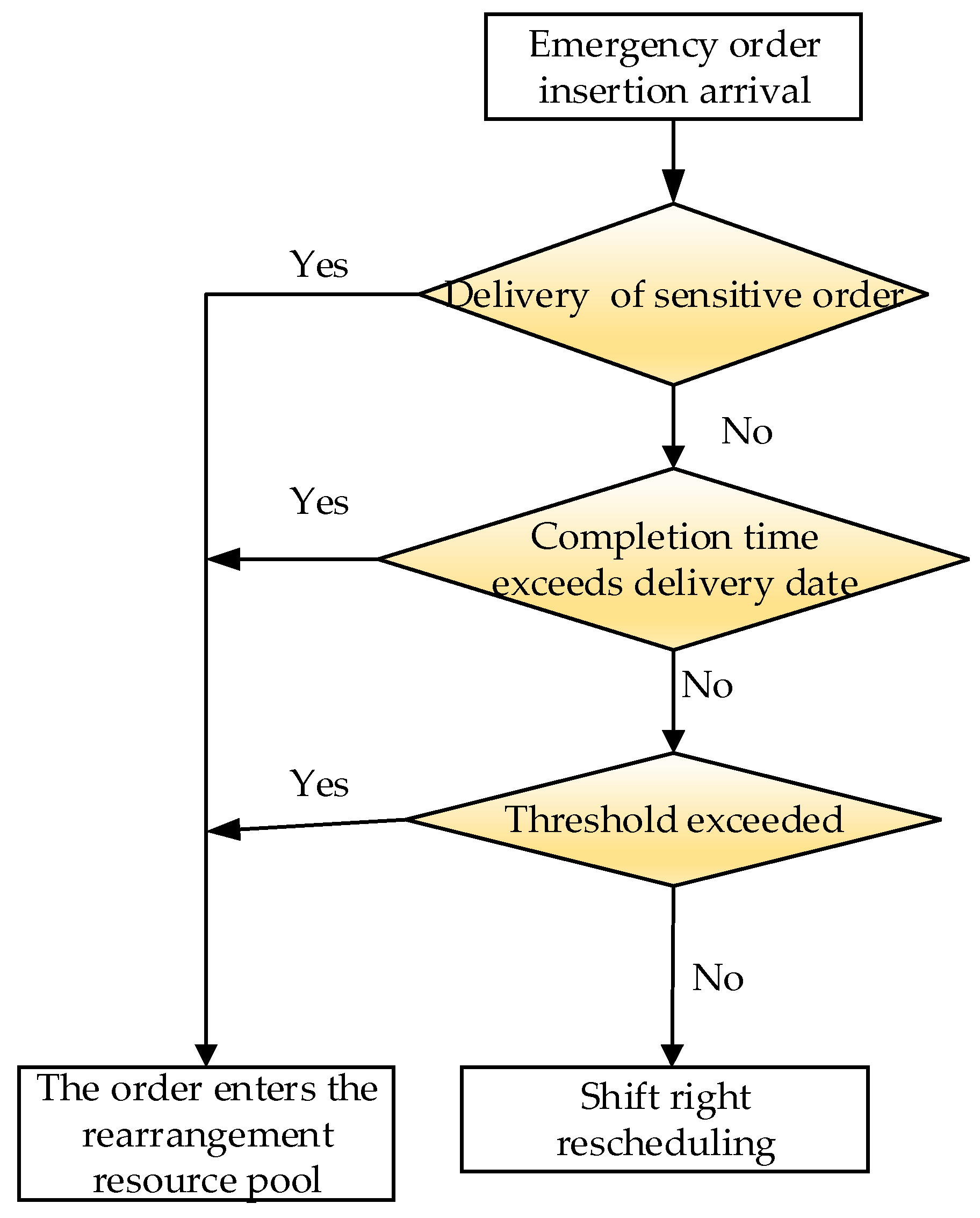
Emergency orders have the highest priority, and all processes will be given the highest priority and given priority over production scheduling. However, Emergency Scheduling inserting orders will lead to the replacement of production line fixtures, increase the auxiliary production time, and extend the production cycle. Therefore, when the emergency order conflicts with the original order process, the scheduling system will handle it according to the following two strategies: Strategy 1: Without considering the production change cost and the stability of the existing plan, the affected process will be directly re discharged into the available equipment resources, which applies to the emergency order sensitive to the delivery date; Strategy 2: On the premise of ensuring the stability of the origin line, minimize the interference to the original plan and only rearrange when necessary. Set the impact threshold of emergency order insertion and use the right shift rescheduling method within the threshold to ensure the continuity of production. If the threshold value is exceeded, the full rescheduling method is used. The threshold value is obtained from Formula (8). Considering the processing time and production change cost, this scheme applies to the scenario with high requirements for the continuity of the production line. In addition, the system needs to record the interference node of the emergency order insertion on the original task, calculate the start time of the affected operation, and translate backward. If the delivery date is exceeded after the translation, rescheduling will be triggered. The process of emergency insertion and rearrangement strategy is shown in Figure 3:
σ = i = 1 N n T i k i = 1 N n A i k + i = 1 N n C i k i = 1 N n W i k
where Nn is the number of processes included in part i; Tik is the processing time of the ith product in manufacturing unit k after emergency order insertion; Aik is the planned processing time of the ith product in manufacturing unit k; Cik is the fixture replacement time of the ith product in manufacturing unit k after emergency order insertion; and Wik is the planned fixture replacement time of the ith product in manufacturing unit k.

3. Mathematical Model and Solution Algorithm

3.1. Problem Description and Mathematical Model

The job shop scheduling problem considering equipment occupation under emergency order insertion can be described as follows: at time 0, there are m parts {J0, J1, J2,…, Jm} waiting for processing on n devices {M0, M1, M2,…, Mn}, and part i contains l process {Oi1, Oi2,…, Oil}. Due to the abnormal status of emergency order insertion in the workshop, the workpiece process and machine tool are affected, thereby affecting the completion time. Therefore, the maximum completion time is used as the objective function for optimization.
F T = min ( max i = 1 n C i )
After a disturbance event occurs in the workshop, each workpiece still needs to be processed in order according to the given processing route and the processing requirements of the workpiece itself after rescheduling. Specific requirements are as follows:
a. Different processes of the same workpiece have a strict processing sequence; that is, the sequence can only be processed if the next process, after the previous process of the same workpiece, is completed.
C T i j S T i j , i 1 , n , j 1 , N i
b. The operation itself needs to meet the processing constraints; that is, each operation can only select one piece of equipment for processing at a time.
k = 1 M i j θ i j k = 1 , i 1 , n , j 1 , N i 1 , k 1 , m
c. Each process performed by the processing equipment must meet the time constraint; that is, the same equipment can only process one process at a time.
C T i j S T i j ( k + 1 ) , i 1 , n , j 1 , N i 1 , k 1 , m
d. The operation itself needs to meet the time constraint; that is, the completion time of the operation is the operation processing start time and completion time.
The sum of
C T i j = S T i j + P T i j , i 1 , n , j 1 , N i 1
r = 1 m x i j r = 1 , i 1 , n , j 1 , N i , r 1 , m
C i = i = 1 N k j = 1 N i n i j k 1 + f i j k t i j k + d i j k + C k ( t ) )
In the formula, nijk is the number of processes required in manufacturing unit K for the jth process of the ith product; Fijk is the nonconforming product rate of the jth process of the ith product in manufacturing unit K; Tijk is the unit processing time required by the jth process of the ith product in manufacturing unit K; Dijk is the unit production preparation time required for the jth process of the ith product in manufacturing unit K; CK (t) is the variation in the fixture replacement time of manufacturing unit K caused by the change in real-time working conditions in the manufacturing workshop; i, j, and k respectively represent the workpiece number, operation number, and equipment number; i is the total number of workpieces; Ni represents the number of operations of the workpiece i; m is the total number of machines; mij is the optional equipment set of operation Oij; θijk is the decision variable 0/1; if operation Oij is processed on equipment Mk, the decision variable is 1, otherwise, it is 0; CTij, STij, and PTij respectively represent the processing end time, start time, and processing time of operation Oij; CTijk and STijk respectively represent the processing end time and start time of operation Oij on equipment Mk; and xijr represents the decision variable for the machine selection of the operation: when the operation Oij selects the machine r, xijr =1, otherwise, xijr =0.

3.2. Design of an Improved Genetic Simulated Annealing Algorithm

In order to efficiently solve the dynamic job shop scheduling problem with equipment occupation under emergency order insertion, an improved genetic simulated annealing hybrid algorithm is designed in this paper. The core idea of the algorithm is to build an optimization framework of hierarchical collaboration and adaptive feedback to overcome the imbalance between global exploration and local development of a traditional single algorithm. The algorithm locates the potential solution space region through the breadth search of genetic operation and uses simulated annealing to carry out probabilistic deep mining and local escape for elite individuals. At the same time, the meta control mechanism is introduced to dynamically adjust the search strategy so as to achieve an efficient and robust solution for complex dynamic scheduling problems.

3.2.1. Overall Framework and Coordination Mechanism

The algorithm uses a master–slave hybrid architecture. In the outer layer, the improved genetic algorithm is used as the main loop, which is responsible for maintaining the population diversity and conducting global exploration. In the inner layer, the simulated annealing algorithm is used as an embedded local searcher to act on the elite individuals generated in each generation. The two cooperate through the elite solution as the information carrier: the genetic algorithm provides a high-quality search starting point for simulated annealing, while simulated annealing feeds back the optimized (or probabilistically disturbed) elite solution to the population, guides the evolution direction, and forms a closed loop of “generation refining feedback”. The mechanism uses GA for parallel and oriented space exploration, SA for serial and probability penetration in-depth development, and then uses the dynamic adaptation layer for real-time scheduling of the search strategy so as to more effectively deal with the high-dimensional, multi-constraint, and dynamic time-varying complex optimization challenges presented by the dynamic scheduling of workshops under emergency orders.

3.2.2. Algorithm Improvement Strategy

In order to improve the performance of the algorithm in dynamic scheduling scenarios, this study introduces three core improvement strategies: problem awareness and adaptive operation, an improved elite retention strategy, and hot start and target reconstruction for emergency order insertion.
(1) Adaptive operation of problem perception
Design a coding scheme based on a hierarchical process and equipment and use matching crossover and mutation operators to ensure the effectiveness of the solution. The crossover operator inherits the superior relative sequence process and equipment allocation fragments of the parent generation as much as possible, and the mutation operator changes the task sequence on the key equipment according to the scheduling bottleneck. At the same time, the algorithm monitors the population diversity in real time and dynamically adjusts the crossover rate and mutation rate. When it detects that the population diversity decreases or the convergence stops, the algorithm will automatically increase the mutation rate and reduce the crossover rate so as to increase the exploratory ability. At the same time, for the process priority or equipment stratification that may exist in the scheduling problem, special operators such as hierarchical crossover and a sequence preserving mutation are used to ensure that the new solution still maintains the basic process feasibility during random changes so that the search process is always carried out in the high-potential area of the feasible region. The adaptive mechanism of simulated annealing parameters is as follows. The initial temperature and cooling rate of annealing are related to the convergence state of the genetic algorithm. For example, in the early exploration stage of the genetic algorithm, a higher temperature can be used for extensive search; in the later stage, the temperature is reduced for fine optimization.
(2) Elite retention strategy embedded in the Metropolis’s criteria
Perform a simulated annealing search on elite individuals, define neighborhood operations (process interchange on critical path, reassign a task to another piece of machinable equipment) with a simulated annealing algorithm as the core, and accept the inferior solution with probability p according to Metropolis’s criteria. The probability calculation method is shown in Equation (16). This mechanism gives the algorithm the ability to probabilistically escape from the local optimal solution and enhances the global convergence:
P = exp ( Δ E / T )
where Δ e is the difference between the objective function value of the new solution and the current solution, and t is the temperature parameter.
(3) Hot start and goal reconstruction for emergency order insertion: When the emergency order insertion event triggers rescheduling, the algorithm initializes the population based on the current optimal scheduling scheme to achieve “hot start” and significantly improve the convergence speed. At the same time, the fitness function is dynamically reconstructed. The fitness function will immediately integrate the weights of the three new objectives of delay time, equipment utilization, and replacement cost, and immediately incorporate the objectives and constraints of new orders to ensure that the optimization direction is consistent with the real-time demand. It inherits the historical optimization results and greatly accelerates the convergence. The fitness function formula is shown in Equation (17):
min E ^ = α D e + β U t + λ C h α + β + λ = 1 D e = 1 ( D min _ D ) ( max _ D min _ D ) 1 U t = ( U min _ U ) ( max _ U min _ U ) 1 C h = 1 ( C min _ C ) ( max _ C min _ C ) 1
where α is the weight of the weighted delay, β is the weight of equipment utilization, λ is the weight of the replacement cost, min_D is the minimum total weighted delay in the current population, max_D is the maximum total weighted delay in the current population, U is the average utilization rate of equipment, min_U is the minimum utilization rate in the current population, max_U is the maximum utilization rate in the current population, min_C is the minimum replacement cost in the current population, and max_C is the maximum replacement cost in the current population.

3.2.3. IGSA Algorithm Process

The algorithm starts with initializing the population and then iterates through the following steps until the termination conditions are met. Through the deep coupling of the mechanism, the design makes the algorithm have both the global parallelism of the genetic algorithm and the local penetration of simulated annealing and provides an effective optimization tool for solving highly dynamic and strongly constrained job shop scheduling problems.
(1)
Individual representation (coding)
A scheduling scheme needs to determine the processing sequence and equipment allocation of each process. It uses double-layer coding and is composed of equal length process sequence chromosomes and equipment allocation chromosomes in parallel. Operation sequence: Based on the arrangement of workpiece numbers, the number of repetitions is the number of workpiece operations. Equipment allocation: Each locus represents the equipment selected for the corresponding process (selected from the set of optional equipment).
Example: Suppose there are two workpieces (J1 has two processes, J2 has one process) and three sets of equipment (M1, M2, and M3). For process O11, {M1, M2} can be selected, for O12, {M2, M3} can be selected, and for O21, {M1, M3} can be selected. A legal individual code is as follows: process sequence chromosome: [J1, J2, J1] (indicates that the processing sequence is O11 → O21 → O12); equipment allocation chromosome: [M1, M3, M2] (M1 for O11, M3 for O21, and M2 for O12)
(2)
Fitness function calculation
Fitness (s) is used to evaluate the quality of scheduling scheme s. The smaller the value, the better. The fitness function formula is shown in Equation (15). De is used to normalize the weighted delay to evaluate the timeliness of orders. Suppose that the completion time of schedule s causes a J1 delay of 2 h and J2 delay of 0 h, and the weighted total delay D = 2. If min_D = 0 and max_D = 10 in the population, De = (2 − 0)/(10 − 0) = 0.2.
Ut is used to normalize equipment utilization and evaluate resource utilization efficiency. The average equipment utilization rate of S is calculated, U = 85%. In the population, min_U = 70%, max_U = 95%, then ut = 1- (0.85 − 0.70)/(0.95 − 0.70) = 0.4 (the smaller the value, the better).
Ch is used to normalize the replacement cost and evaluate the cost caused by the switching of equipment occupancy status. The total replacement cost of s is calculated as c = 150. In the population, min_C = 100, max_C = 300, then Ch = (150 − 100)/(300 − 100) = 0.25. Final fitness: If the weight is set to α = 0.5, β = 0.3, and λ = 0.2, then fitness = 0.50.2 + 0.30.4 + 0.20.25 = 0.27.
(3)
Crossover and mutation operators
In order to ensure the feasibility of offspring, a special operator for problem perception is designed. The crossover operator (taking pox as an example) operates on the chromosome of the operation sequence and inherits the relative order between the parent operations. For example, parent 1 operation sequence: [J1, J2, J1, J2, J1]; parent 2 operation sequence: [J2, J1, J2, J1, J1]. Randomly divide the workpiece set as follows: {J1} reserved group, {J2} non reserved group. Generation of progeny 1: Copy all J1s from parent 1 to the original position and fill the remaining vacancies in J2 in the order of parent 2 to get [J1, J2, J1, J2, J2]. The device assigns chromosomes and directly selects one parent randomly to inherit it as a whole.
Mutation operator (key process neighborhood mutation) operates on the equipment allocation chromosome and changes the equipment selection of key processes to improve scheduling. For example, original equipment allocation [M1, M3, M2] corresponds to operation [O11, O21, O12]. O21 is identified as a key process, and its optional equipment is {M1, M3}. Another piece pf equipment (such as M1) is randomly selected from the optional set to replace M3. Equipment allocation after variation: [M1, M1, M2]. The chromosome of the process sequence remains unchanged.
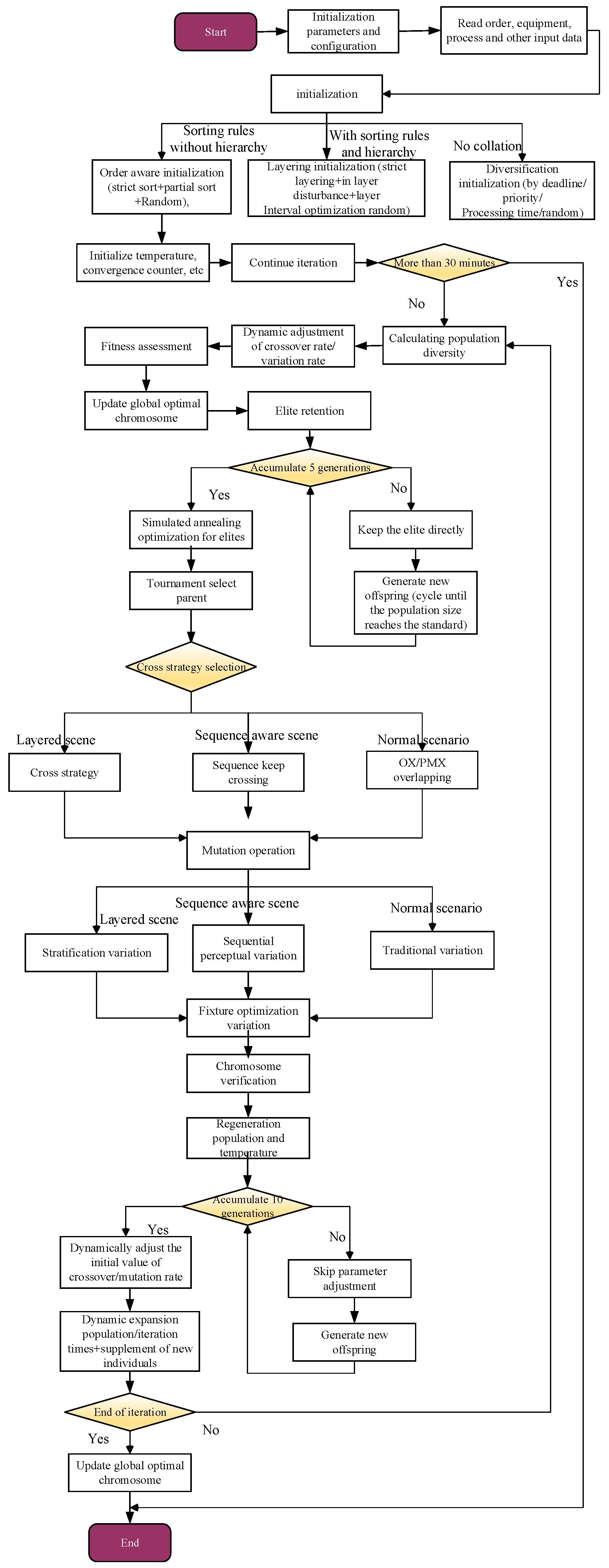
The process of igsa improving the I-GSA algorithm is described as follows, and the process is shown in Figure 4.
Initialization: Read parameters and build priority hierarchy (if there is a collation).
Initialize population: Adopt different initialization strategies (hierarchical initialization, sequential initialization, and diversified initialization) according to whether there are sorting rules and hierarchies.
Enter the main loop of the genetic algorithm until the maximum number of iterations or timeout is reached:
  • Evaluate the fitness of each individual in the population (use forwardscheduler, backwardscheduler, or hybridscheduler to schedule, and then calculate the weighted delay, equipment utilization, and replacement cost).
  • Record the global optimal solution.
  • Population diversity was calculated, and the crossover rate and variation rate were dynamically adjusted.
  • Selection operation (tournament selection).
  • Crossover operation (hierarchical crossover, sequence preserving crossover, or traditional crossover is adopted according to whether there are sorting rules and hierarchies).
  • Mutation operation (use hierarchical mutation, sequence-aware mutation, or traditional mutation according to whether there are sorting rules and stratification).
  • Update population (elite reservation, combined with simulated annealing to optimize the elite).
  • Dynamically adjust parameters (according to the success rate of crossover and mutation).
  • Check premature convergence. If it is stagnant, dynamically expand the population and increase the algebra.
Output the global optimal solution.
To illustrate the algorithm logic more clearly, Algorithm 1 provides a detailed pseudocode description.
The pseudocode of the algorithm proposed in this paper is as follows.
Algorithm 1. IGSA algorithm pseudocode.
   Input: Population size N, maximum generation G_max, initial crossover rate P_c0, initial mutation rate P_m0, initial temperature T0, cooling coefficient α, elite proportion ε, emergency flag emergency_flag
   Output: Optimal scheduling scheme S_best
(1) //Initialization stage
(2) If emergency_flag == True:
(3) Generate initial population from warm start of current running scheduling state
(4) Refactor the fitness function
(5) Otherwise:
(6) Generate an initial population P = {S1, S2, …, S_N} randomly
(7) End if
(8) Calculate the fitness value of each individual in the initial population
(9) S_best (the individual with the best fitness in the population)
(10) //Main loop
(11) For generation = 1 to G_max:
(12) //Genetic operation phase
(13) Calculate population diversity
(14) Dynamically adjust the crossover rate P_c and mutation rate P_m (based on Diversity)
(15) //Selection
(16) P_selected tournament selection(P, k = 2)
(17) //Crossover and mutation
(18) For each pair of parents (S_i, S_j) in P_selected:
(19) If rand() < P_c:
(20) (C_i, C_j) stratified crossover(S_i, S_j)//maintain the feasibility of process sequence and equipment allocation
(21) End if
(22) End for
(23) For each offspring individual C in P:
(24) If rand() < P_m:
(25) Sequence-aware mutation (C)//Perform process exchange or equipment reallocation on the critical path
(26) End if
(27) End for
(28) //Simulated annealing elite optimization phase
(29) Sort P and select the top ε·N elite individuals to form set E
(30) For each elite individual S_elite in E:
(31) Generate a new solution randomly within the neighborhood of S_elite (neighborhood operation: key process exchange, equipment reallocation)
(32) ΔE = f(S_neighbor) − f(S_elite)//Calculate the fitness difference
(33) If ΔE < 0 or rand() < exp(-ΔE/T):
(34) S_elite ← S_neighbor//Accept new solution
(35) End if
(36) If f(S_elite) < f(S_best):
(37) S_best = S_elite//Update the global optimum
(38) End if
(39) End for
(40) //Early convergence detection and handling
(41) If the population convergence stagnates for more than the preset number of generations:
(42) Perform population expansion (inject random new individuals)
(43) Temporarily increase mutation rate
(44) End if
(45) End for
(46) Return S_best

4. Experiments and Results

In order to verify the effectiveness of the proposed algorithm, this section verifies it from two aspects of standard examples and workshop examples through different evaluation indices. The proposed algorithm and the comparison algorithm are implemented using MATLAB-R2021a programming, and numerical simulation experiments are carried out under the same conditions. The main frequency of the test computer CPU is 1.90 GHz and 2.11 GHz, and the memory is 16 GB.

4.1. Performance Evaluation Index

(1)
Optimal value (Best)
The optimal value is the evaluation index that can directly reflect the performance of the algorithm. This case takes minimizing the maximum completion time as the optimization goal, so the smaller the completion time obtained by the algorithm, the better its performance.
(2)
Relative deviation (RE)
The percentage of the difference between the optimal value obtained by the algorithm for the standard example and the lower bound (LB) of the standard example in lb. The smaller the re value, the closer the optimal solution to LB, and the better the performance of the algorithm.
R E = ( C max L B ) / L B × 100

4.2. Standard Example Verification

In order to verify the effectiveness of the proposed local search strategy based on the mobile bottleneck, 18 international standard examples are used for verification and compared with the classic Empire competition algorithm, the hybrid particle swarm optimization algorithm [30] (HPSO), and the genetic algorithm [31] (GA). The parameters of each algorithm are shown in Table 1. Van Hoorn [32] sorted out the lower bound of the benchmark case. This paper refers to the lower bound, LB, of the sorted standard example. Each algorithm was independently run 30 times, and the optimal value (Best), relative error (RE), and average convergence speed (AV(CPU)) of each algorithm are shown in Table 2. The key parameters in the IGSA algorithm have been carefully designed and tuned through experiments to balance the exploration ability and development efficiency of the algorithm, especially in dynamic rescheduling scenarios. The initial crossover rate (P_c0 = 0.85) and mutation rate (P_m0 = 0.15): A higher initial crossover rate helps to quickly exchange excellent gene fragments in the early stages of the algorithm, promoting global exploration; a relatively lower mutation rate avoids premature destruction of the excellent solution structure. The elite ratio (ε = 0.1): Retaining the top 10% elite individuals in the population ensures the inheritance of excellent genes while avoiding the premature loss of population diversity. In dynamic rescheduling, elite individuals often contain historical optimization information, and performing simulated annealing optimization on them can accelerate convergence in the new environment. Simulated annealing parameters (T0 = 1000, α = 0.95): An initial high temperature (T0) ensures that the algorithm has a higher probability of accepting inferior solutions in the early stages, enhancing the global escape capability; a slow cooling rate (α = 0.95) makes the annealing process sufficient, facilitating fine search in the later stages. In dynamic scenarios, when emergency insertion triggers rescheduling, the algorithm adopts a “hot start” and uses the current optimal schedule as the initial solution. At this time, the initial temperature can be appropriately lowered to accelerate the convergence speed and meet real-time requirements. Adaptive adjustment mechanism: the algorithm monitors population diversity in real time and dynamically adjusts P_c and P_m. When diversity decline (convergence stagnation) is detected, the mutation rate is automatically increased, and the crossover rate is decreased to inject new exploration directions. This mechanism is particularly important in dynamic environments, as emergency insertion may completely change the structure of the solution space, requiring the algorithm to quickly adjust its search strategy.
Through the analysis, it can be found that when the problem scale is small (LA01-LA3, LA06-LA08), all algorithms can obtain the lower bound of the optimal solution, which proves that GA and its improved algorithm can effectively solve the problem. When the problem scale is expanded to 1010 scale (LA19), the performance of the algorithm begins to differentiate. The performance of ICA is similar to that of GA: the initial performance of HPSO is optimal, but the performance deteriorates with the increase in problem size. The minimum completion time of the improved algorithm IGSA is better than that of GA. When the problem scale is expanded to 1510 scale (LA22), the proposed IGSA shows obvious advantages over other algorithms. The reason for the above phenomenon is analyzed from the aspect of the strategy optimization mechanism: the performance differences in different algorithms under different problem sizes are mainly due to the balance strategy of their global exploration and local development capabilities. When solving small-scale examples (LA01–LA05, LA06–LA08), due to the relatively simple solution space structure and less local extreme points, genetic algorithm (GA), imperial competition algorithm (ICA), and hybrid particle swarm optimization (HPSO) can effectively converge to the lower bound of the theoretical optimal solution, which verifies the effectiveness of this kind of swarm intelligence algorithm in a simple environment. As the problem scale expands to medium dimensions (such as LA19, 10 × 10), the solution space structure tends to be complex, and the performance of each algorithm begins to differentiate. ICA and GA have some similarities in the search mechanism, and both rely on population iteration and random evolution, so they are similar. Although HPSO shows a faster convergence speed at the initial stage of the iteration by virtue of its memory and guidance search mechanism, with the deepening of the iteration, the population diversity decays rapidly, and it is easy to fall into local optimization, resulting in its performance degradation with the increase in the problem scale. In contrast, the IGSA algorithm proposed in this study embeds a simulated annealing mechanism in the genetic framework so that it can enhance the ability to jump out of local extremum based on inheriting the global exploration ability of GA, and it has shown a better optimization effect than traditional GA on medium-scale problems. When the scale of the problem is further increased (such as LA22, 15 × 10), the dimension of the solution space increases significantly, and the local extreme value distribution is denser, which puts forward higher requirements for the global exploration and local fine search ability of the algorithm. In such complex scenarios, the simulated annealing strategy integrated by igsa can effectively escape from the local optimum through the probabilistic acceptance mechanism of the neighborhood of elite solutions, while the improved elite retention strategy ensures the convergence stability of the search process and the inheritance of excellent solutions, which is significantly better than other comparison algorithms in overall performance. In this study, the operation efficiency (average CPU time) of IGSA, GA, ICA, and HPSO algorithms on the standard example set is compared and analyzed, and the typical trade-off between the computational complexity and solution performance of the algorithm is revealed. Experimental data show that the running time of the algorithm has a clear negative correlation with its mechanism complexity: with its intuitive selection crossover mutation framework, GA has the lowest single generation computing overhead and the fastest running speed; HPSO takes second place in speed because of its simple particle renewal mechanism; ICA has the heaviest computational burden and the slowest speed, because it simulates multi-layer interactions such as imperial competition and assimilation. The running time of the igsa algorithm proposed in this paper is between HPSO and ICA. This is because it embeds the simulated annealing elite optimization layer in the global exploration framework of GA at the cost of increasing the computational cost of each generation in exchange for more refined local development and probabilistic escape ability. This design significantly improves the solution quality and robustness within an acceptable time growth (about 2.5 times that of GA), thus achieving an effective balance between optimization depth and real-time response in dynamic scheduling scenarios.
Formal computational complexity analysis of the algorithm is the key link to evaluate its efficiency and scalability. Now it is analyzed from two aspects of theoretical time complexity and spatial complexity. In terms of theoretical time complexity, let the population size be N, the total number of processes be J, the number of equipment be m, the elite proportion of simulated annealing optimization be ϵ, and the maximum iteration algebra be G. The main costs are fitness evaluation, genetic operation, and simulated annealing elite optimization. For fitness evaluation, N individuals need to be scheduled for simulation in each generation, with a complexity of O (N·J·logM) (depending on the scheduling decoding strategy). The selection, crossover, and variation in genetic operation are linearly correlated with chromosome length (proportional to J), and the complexity of each generation is O (N·J). Simulated annealing elite optimization performs a neighborhood search on ϵ n elite solutions in each generation. The evaluation complexity of a single search is O (J), and the complexity of each generation of this step is O (ϵ N·J). In summary, the time complexity of an igsa single generation is O (N·J·logM), and the total complexity is O (G·N·J·logM). It can be seen that this complexity is of the same order as the standard genetic algorithm, and the increased simulated annealing link does not change the order of complexity. In terms of spatial complexity, the algorithm mainly stores the population (n individuals, each coding length is J) and problem data, and its spatial complexity is O (N·J + M). The results show that the memory consumption of the igsa algorithm is linearly related to the population size and problem size, which belongs to polynomial complexity and is completely manageable under the existing computer system. Compared with its time complexity, spatial complexity usually does not constitute the bottleneck of algorithm application. This analysis is at the same level as the mainstream meta-heuristic algorithms such as the standard genetic algorithm (GA), which further verifies the practicability and scalability of igsa in memory efficiency and is suitable for solving large-scale practical job shop scheduling problems.
To summarize, the IGSA algorithm has shown good robustness and superior search efficiency in dealing with different-scale scheduling problems by organically combining the global parallel search of the genetic algorithm and the controllable inferior solution acceptance mechanism of simulated annealing. It is especially suitable for complex optimization scenarios with high dimensions and multiple extrema, which verifies the effectiveness and advancement of its hybrid strategy in solving job shop scheduling problems.
To verify that the superior performance of the IGSA algorithm is not accidental, parametric statistical tests were introduced. Since the results of the algorithm on different instances may not follow a normal distribution, the Wilcoxon signed-rank test (with a significance level of α = 0.05) was selected as a robust method. The average target values (Mean) obtained from 30 runs of IGSA, GA, ICA, and HPSO for 18 standard test cases were paired and compared, as shown in Table 3. The null hypothesis (H0): There is no significant difference in the average performance between the two algorithms. The alternative hypothesis (H1): There is a significant difference in the average performance between the two algorithms. The test results are shown in the table. The p-values for the comparison between IGSA and GA, ICA, and HPSO are 0.0004, 0.0002, and 0.0011, respectively, all of which are much smaller than 0.05. Therefore, the null hypothesis is rejected, indicating that at a 95% confidence level, the average performance of the IGSA algorithm is significantly better than that of the GA, ICA, and HPSO algorithms on the standard test case set. This rigorous statistical test provides strong mathematical statistical support for the superior performance of the algorithm.

4.3. Workshop Case Verification

The parts processing and scheduling process in a discrete workshop are completed manually, which comes with problems such as wasting resources, low allocation efficiency, a long production cycle, and so on. Therefore, it is necessary to study the configuration of intelligent algorithms to optimize the allocation of manufacturing resources scientifically and efficiently. Taking the discrete manufacturing process data of the workshop as the simulation experiment basis and taking the process route of the parts processed and the machining parameters of the machine tool as the parameter basis of the algorithm, it is simplified to the discrete workshop scheduling problem of 9 × 8, as shown in Table 4. The values in the table are dimensionless, indicating the processing time of each process on the corresponding equipment, and “-” in the table indicates that the process cannot be processed on the corresponding equipment in this column.
In this paper, three scenarios are selected to verify the effectiveness of the workshop dynamic scheduling method considering equipment occupation. The information of order insertion is shown in Table 5. The dynamic scheduling process of the workshop is as follows: when the emergency order insertion occurs, the system will start the rescheduling decision process after judging the emergency order insertion, upload the equipment occupation data to the database, and the dynamic scheduling module will optimize the configuration of the workshop manufacturing resources and output a new resource configuration scheme according to the current task execution and resource status information, which will be transmitted to the intelligent terminal and finally implemented by the workshop entity.
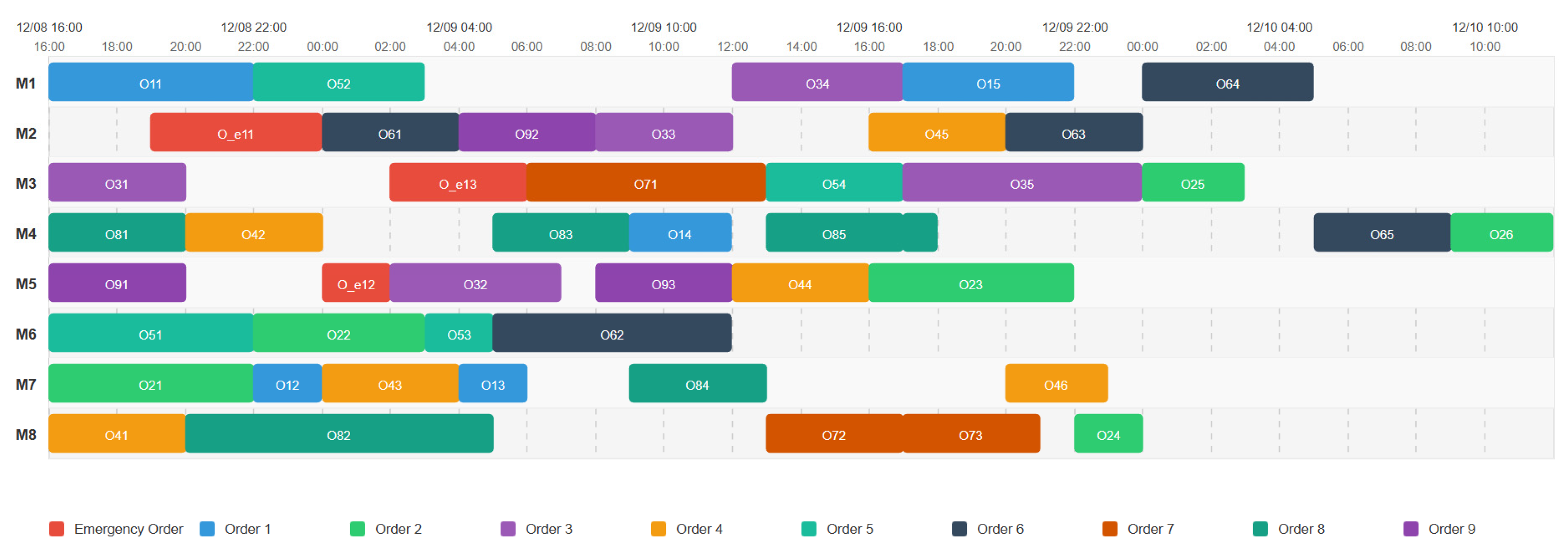
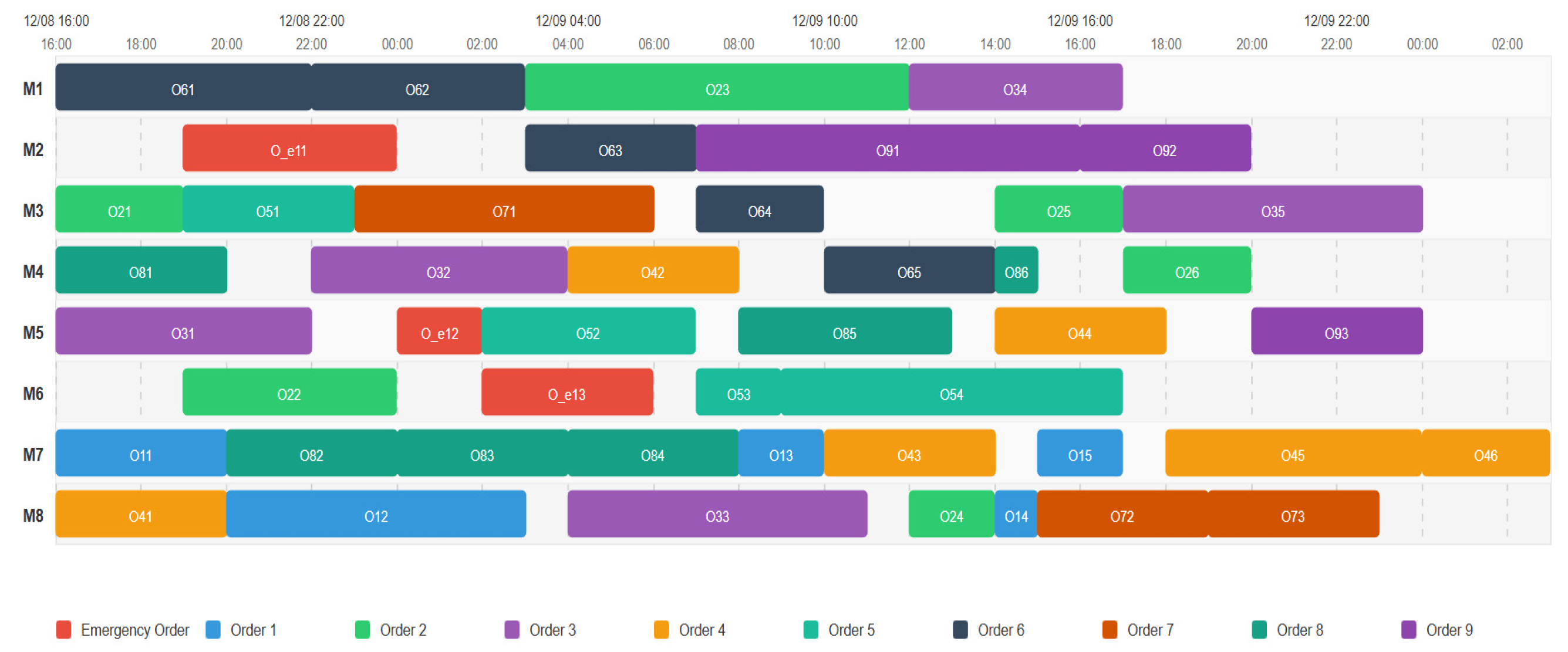
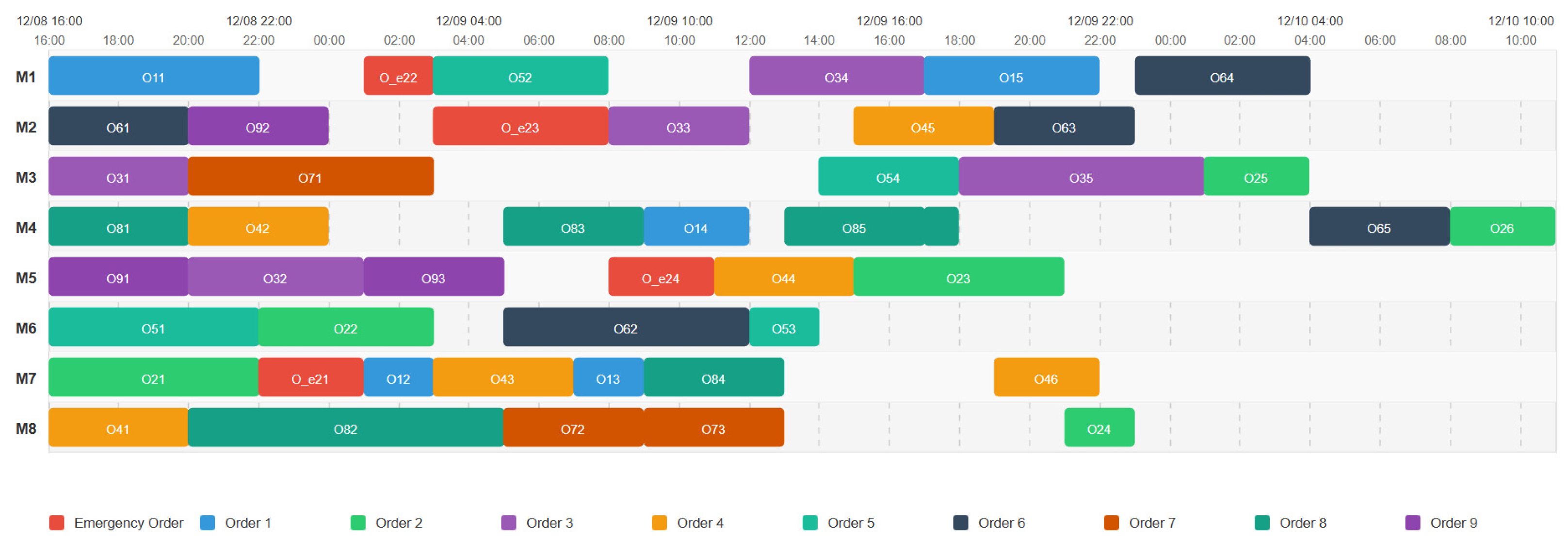
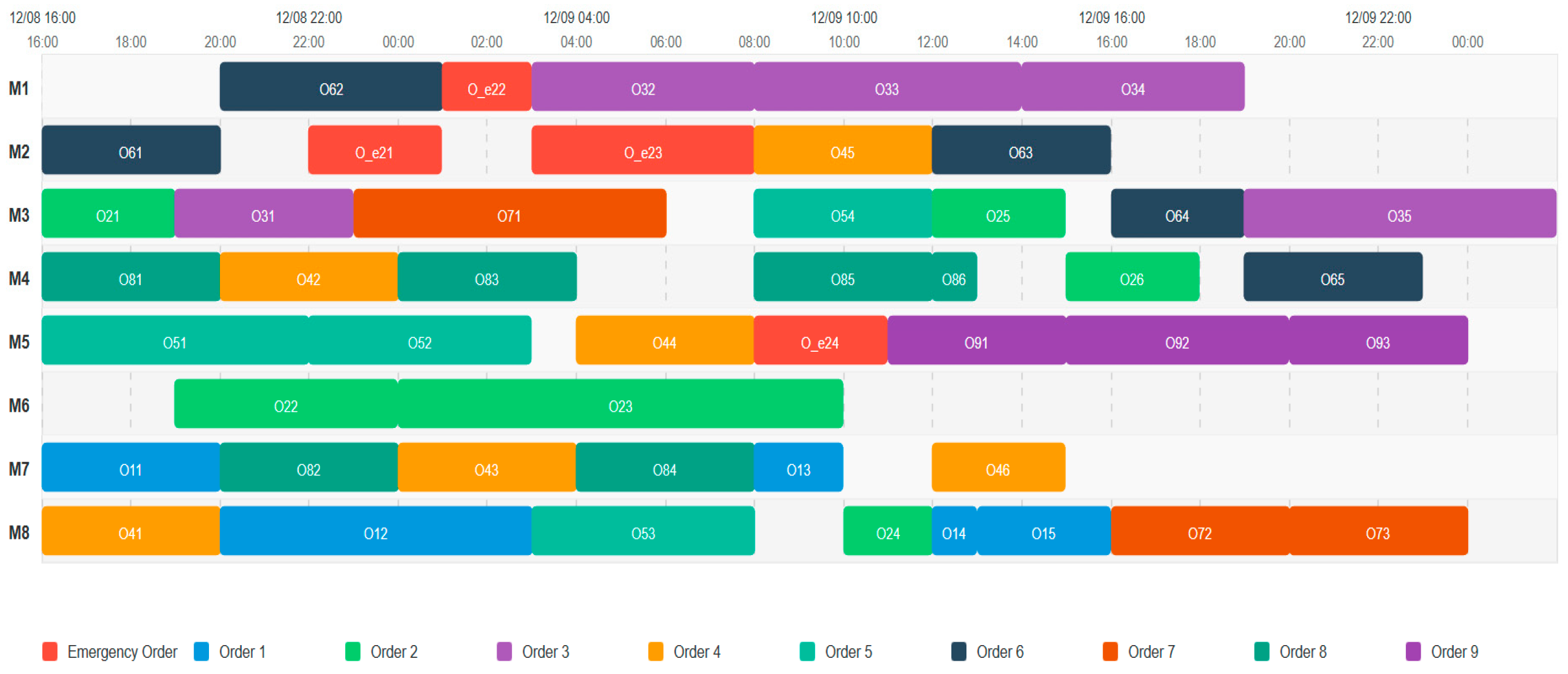
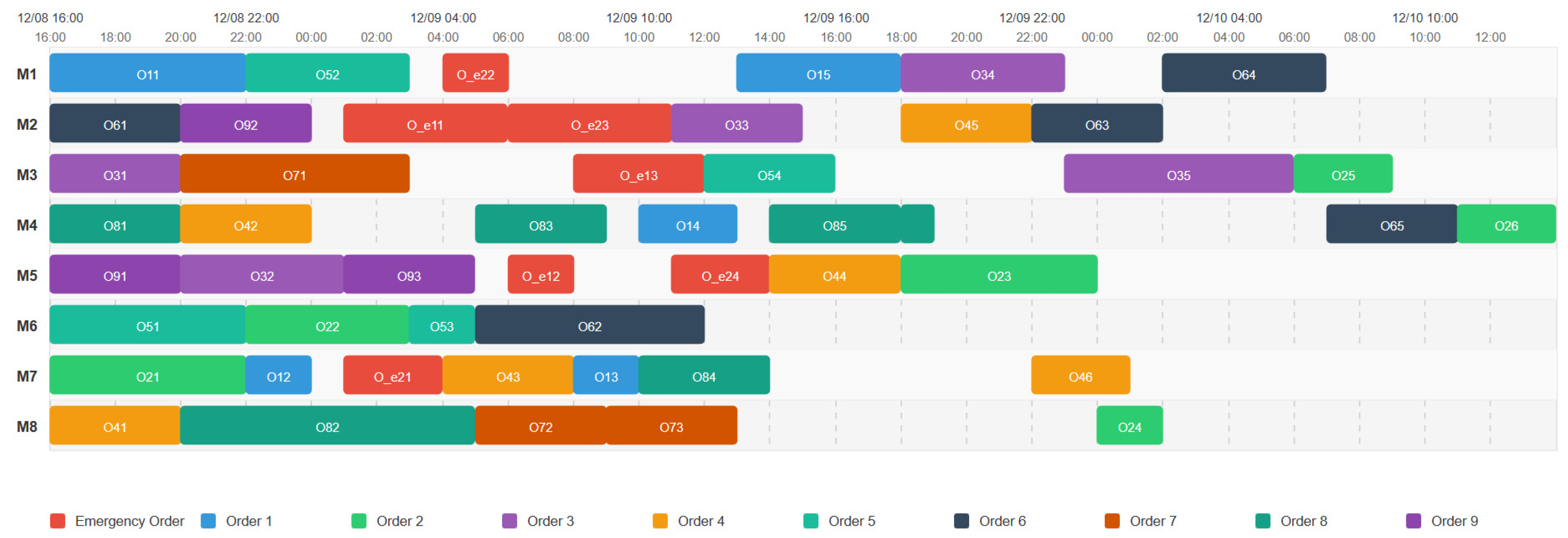
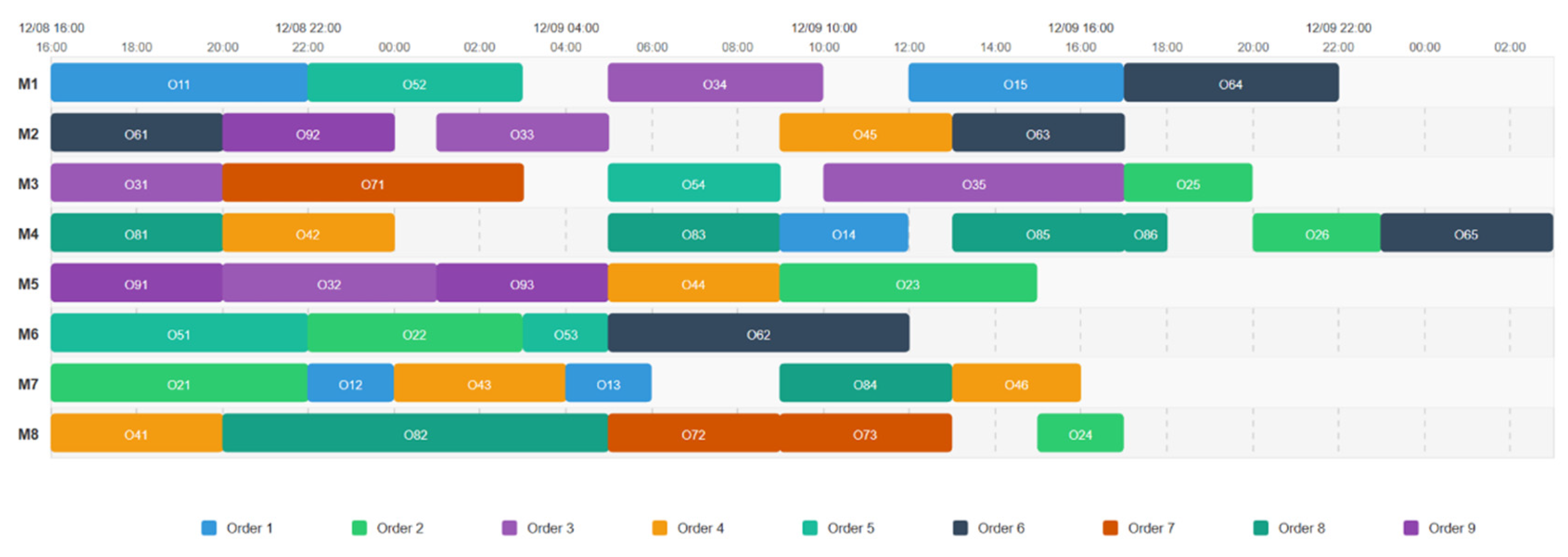
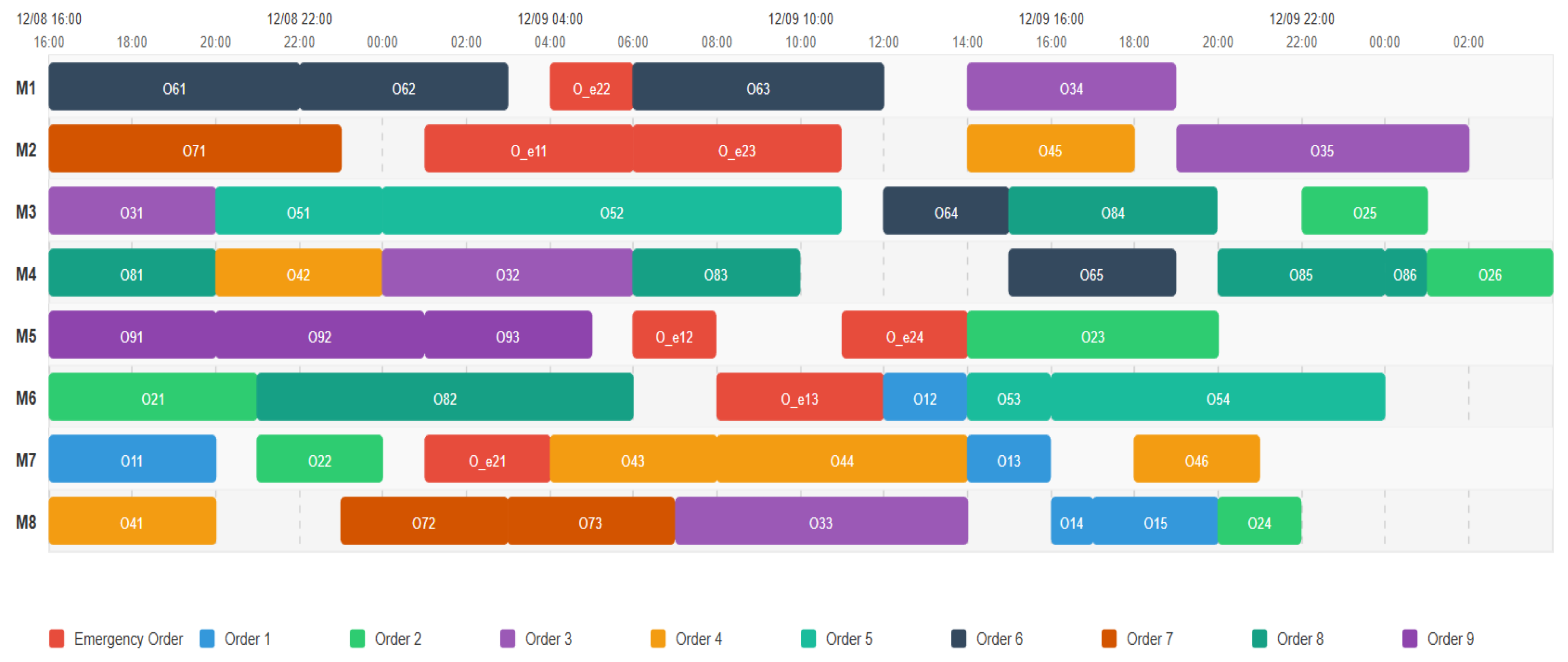
In order to verify the dynamic resource allocation strategy based on the real-time state proposed in this paper, it is compared with the widely used right shift strategy. The specific strategy for shift right processing is as follows: the original configuration scheme remains unchanged, and the available time of directly affected operations and equipment will directly postpone the time required to handle exceptions. For indirectly affected operations, the corresponding time will be postponed according to the constraints of operations and equipment. First, the IGSA algorithm is used to optimize the resource allocation of production tasks without considering the workshop exceptions. The Gantt chart of the initial configuration scheme is shown in Figure 5. The workpieces in the figure are distinguished by different colors. The meaning of the number on the color block is workpiece number–operation number. For example, “O11” corresponds to the first operation of workpiece 1; “O52” corresponds to the second operation of workpiece 5. Emergency order information is shown in Table 6. Emergency order insertion scenario 1 is described as follows: at 19:00, the third hour after the start of processing, the emergency order E1 arrives. E1 includes three processes, namely O_e11, O_e12, and O_e13. To verify the effectiveness of the proposed algorithm, it was compared with the right shift rescheduling scheme. The Gantt chart of the right shift configuration scheme is shown in Figure 6; the Gantt chart of the initial scheduling scheme obtained by emergency check-up rescheduling considering equipment occupation is shown in Figure 7. The emergency order insertion scenario 2 is described as follows: at 22:00, the sixth hour after the start of processing, the emergency order E2 arrives. E2 includes four processes, namely O_e21, O_e22, O_e23, and O_e24. The impact threshold for emergency order E2 was calculated, and the result was 2.16, which is greater than the set threshold of 1.5. Therefore, complete rescheduling should be conducted. To verify the effectiveness of the proposed algorithm, it was compared with the right shift rescheduling scheme. The Gantt chart of the right shift configuration scheme is shown in Figure 8; the Gantt chart of the initial scheduling scheme obtained by emergency check-up rescheduling considering equipment occupation is shown in Figure 9. Emergency order insertion scenario 3 is described as follows: at 1:00, the 9th hour after the start of processing, the emergency orders E1 and E2 arrive, and the initial scheduling scheme is shifted to the right to obtain the Gantt chart of the right shift configuration scheme, as shown in Figure 10; the Gantt chart of the initial scheduling scheme obtained by emergency check-up rescheduling considering equipment occupation is shown in Figure 11.
By comparing the three above emergency order insertion situations, it is found that when an emergency order insertion occurs, the traditional strategy cannot reconfigure resources according to exceptions but can only postpone the production plan. The model in this paper uses the real-time state monitoring method, takes the manufacturing resource occupation status as the constraint condition, and can reasonably adjust the affected processes. In emergency order insertion scenario 1, the maximum completion time of the final scheduling scheme is 36 h, which is 18.18% less than the maximum completion time of 44 h of the right shift strategy. In emergency order insertion scenario 2, the maximum completion time of the final scheduling scheme is 34 h, which is 20.93% less than 43 h of the maximum completion time of the right shift strategy. In emergency order insertion scenario 3, the maximum completion time of the final scheduling scheme is 36 h, which is 22.74% less than the 46 h of the right shift strategy.
It can be seen that, in terms of resource allocation strategy, when the equipment status changes, compared with the right shift strategy, the proposed dynamic configuration strategy can find the sudden change in equipment status in a timely fashion, reschedule to respond to the impact of the emergency order insertion on the original scheduling scheme, and can more comprehensively consider the completion time requirements and equipment occupation status and find a better solution. In addition, with the increase in the complexity of the emergency order checking scenario, the advantage of rescheduling (the increase rate of the maximum completion time) will also increase, which proves that the real-time monitoring of equipment status and the study of vehicle scheduling in the case of emergency order insertion have great practical value.

5. Conclusions

In the face of the dynamic disturbance and production stability challenges caused by the frequent insertion of emergency orders in the modern manufacturing industry, this paper aims to build an efficient and robust scheduling decision-making framework to realize the comprehensive optimization of production efficiency, order delivery, and resource utilization under the disturbance of emergency orders. Around the above objectives, this paper mainly completed the following work: firstly, a three-tier dynamic scheduling framework integrating event awareness, real-time decision-making, and feedback optimization was constructed. Secondly, according to the characteristics of the problem, an improved genetic simulated annealing hybrid intelligent algorithm is designed. The innovation of the algorithm is that the global exploration ability of the genetic algorithm is deeply coupled with the local escape ability of the simulated annealing algorithm through the hierarchical cooperation mechanism, and the adaptive operation and meta control strategy based on problem knowledge are introduced, which significantly improves the search efficiency and the quality of the solution. Finally, a comparative experiment of the system is designed based on the standard test case set (LA Series) and the real insertion scenario, which verifies the effectiveness of the proposed algorithm and framework.
Although this study has achieved some results, it still has limitations, which point out the direction for future work. First, the current research assumes that the information is relatively complete (such as the determination of processing time and zero equipment failure), while the actual production environment is more uncertain. Future work can further consider more complex scenarios in which multi-source disturbances, such as the randomness of processing times, multi-resource constraints (such as manpower and tools), and sudden equipment failures coexist. Secondly, the algorithm framework is currently aimed mainly at the scheduling problem of a single workshop. In the future, it can be extended to the integrated scheduling of cross-workshop and logistics distribution collaboration to optimize the overall performance of the supply chain.
In brief, this study provides a systematic scheme from the theoretical framework to the algorithmic implementation for solving the dynamic job shop scheduling problem under emergency order insertion. With continuous deepening of the digital transformation of the manufacturing industry, intelligent scheduling technology with the ability of self-perception, self-decision, and self-optimization will become the key to enhancing the core competitiveness of the manufacturing industry. The relevant exploration of this work is expected to contribute to this.

Author Contributions

Methodology, X.S.; software, J.H.; validation, T.G. and W.M.; formal analysis, T.G.; investigation, J.Y.; data curation, W.M.; writing—original draft preparation, X.S.; writing—review and editing, J.H.; funding acquisition, X.S. All authors have read and agreed to the published version of the manuscript.

Funding

This research was funded by Jiangsu industry university research project (BY20240828), Jiangsu Provincial Basic Research Program Natural Science Foundation—Youth Fund Project (BK20230173), Basic Research Program of Jiangsu (BK20240316) and General Project of Basic Science (NATURAL SCIENCE) Research in Colleges and Universities of Jiangsu Province (23kjb460031).

Data Availability Statement

The data employed for this study are available on requests. Please contact the corresponding author for further inquire.

Conflicts of Interest

Author Tongtong Gu was employed by the company Wuxi Weiming Intelligent Technology Co., Ltd. The authors declare no conflict of interest.

References

  1. Rifai, A.P.; Mara, S.T.; Sudiarso, A. Multi-objective distributed reentrant permutation flow shop scheduling with sequence-dependent setup time. Expert Syst. Appl. 2021, 183, 115339. [Google Scholar] [CrossRef]
  2. Fu, Y.; Wang, H.; Huang, M. Integrated scheduling for a distributed manufacturing system: A stochastic multi-objective model. Enterp. Inf. Syst. 2019, 13, 557–573. [Google Scholar] [CrossRef]
  3. Meddourene, A.; Bouzouia, B.; Abbou, R. An hybrid SA-DATC approach for JIT open-shop scheduling problem with earliness and tardiness penalties. IFAC-PapersOnLine 2019, 52, 2396–2401. [Google Scholar] [CrossRef]
  4. Qiu, Y.; Ji, W.; Zhang, C. A hybrid machine learning and population knowledge mining method to minimize makespan and total tardiness of multi-variety products. Appl. Sci. 2019, 9, 5286. [Google Scholar] [CrossRef]
  5. Huang, X.; Yang, L. A hybrid genetic algorithm for multi-objective flexible job shop scheduling problem considering transportation time. Int. J. Intell. Comput. Cybern. 2019, 12, 154–174. [Google Scholar] [CrossRef]
  6. Feng, Y.; Lin, Y.; Yang, Z.; Wang, J.; Zhang, J. A two-stage individual feedback NSGA-III for dynamic many-objective flexible job shop scheduling problem. IEEE Trans. Autom. Sci. Eng. 2024, 22, 1673–1683. [Google Scholar] [CrossRef]
  7. Zhang, H.; Qin, C.; Zhang, W.; Zhuang, C.; Liu, J. Energy-saving scheduling for flexible job shop problem with AGV transportation considering emergencies. Systems 2023, 11, 103. [Google Scholar] [CrossRef]
  8. Wan, L.; Cui, X.; Zhao, H.; Chang, K.; Zhang, Q. A novel method for solving dynamic flexible job-shop scheduling problem via DIFFormer and deep reinforcement learning. Comput. Ind. Eng. 2024, 198, 110688. [Google Scholar] [CrossRef]
  9. Liu, J.; Land, M.J.; Bokhorst, J.A.C.; van Donk, D.P. Improving coordination in assembly job shops: Redesigning order release and dispatching. Flex. Serv. Manuf. J. 2023, 35, 669–697. [Google Scholar] [CrossRef]
  10. Wang, J.; Li, Y.; Zhang, Z.; Xu, J. Dynamic integrated scheduling of production equipment and automated guided vehicles in a flexible job shop based on deep reinforcement learning. Processes 2024, 12, 2423. [Google Scholar] [CrossRef]
  11. Framinan, J.M.; Fernandez-Viagas, V.; Perez-Gonzalez, P. Using real-time information to reschedule jobs in a flowshop with variable processing times. Comput. Ind. Eng. 2019, 129, 113–125. [Google Scholar] [CrossRef]
  12. Yao, X.; Zhang, J.; Li, Y.; Lu, Q.; Xu, Z. Towards flexible RFID event-driven integrated manufacturing for make-to-order production. Int. J. Comput. Integr. Manuf. 2018, 31, 228–242. [Google Scholar] [CrossRef]
  13. Jun, S.; Lee, S.; Chun, H. Learning dispatching rules using random forest in flexible job shop scheduling problems. Int. J. Prod. Res. 2019, 57, 3290–3310. [Google Scholar] [CrossRef]
  14. Huang, B.; Wang, W.; Ren, S.; Ji, W. A proactive task dispatching method based on future bottleneck prediction for the smart factory. Int. J. Comput. Integr. Manuf. 2019, 32, 278–293. [Google Scholar] [CrossRef]
  15. Zhao, F.; Liu, Y.; Xu, T.; Wang, L. A reinforcement learning hyper-heuristic algorithm for the distributed flowshops scheduling problem under consideration of emergency order insertion. Appl. Soft Comput. 2024, 167, 112461. [Google Scholar] [CrossRef]
  16. Chen, S.; Zheng, J. A Q-learning grey wolf optimizer for a distributed hybrid flowshop rescheduling problem with urgent job insertion. J. Appl. Math. Comput. 2025, 71, 3645–3670. [Google Scholar] [CrossRef]
  17. Li, X.; Zhao, P.; Du, B.; Guo, J.; Xu, W. Hybrid artificial bee colony algorithm with a rescheduling strategy for solving flexible job shop scheduling problems. Comput. Ind. Eng. 2017, 113, 10–26. [Google Scholar] [CrossRef]
  18. He, X.; Dong, S.; Zhao, N. Research on rush order insertion rescheduling problem under hybrid flow shop based on NSGA-III. Int. J. Prod. Res. 2020, 58, 1161–1177. [Google Scholar] [CrossRef]
  19. Wang, X.; Li, Z.; Chen, Q.; Mao, N.; Hu, X. Meta-heuristics for unrelated parallel machines scheduling with random rework to minimize expected total weighted tardiness. Comput. Ind. Eng. 2020, 145, 106505. [Google Scholar] [CrossRef]
  20. Chen, H.J.; Ding, G.F.; Zhang, J.; Wang, R.J. Research on priority rules for the stochastic resource constrained multi-project scheduling problem with new project arrival. Comput. Ind. Eng. 2019, 137, 106060. [Google Scholar] [CrossRef]
  21. Ozturk, G.; Bahadir, O.; Teymourifar, A. Extracting priority rules for dynamic multi-objective flexible job shop scheduling problems using gene expression programming. Int. J. Prod. Res. 2019, 57, 195–205. [Google Scholar] [CrossRef]
  22. Pan, Q.K.; Gao, L.; Wang, L. An Effective Cooperative Co-Evolutionary Algorithm for Distributed Flowshop Group Scheduling Problems. IEEE Trans. Cybern. 2022, 52, 5999–6012. [Google Scholar] [CrossRef]
  23. Song, H.B.; Lin, J. A genetic programming hyper-heuristic for the distributed assembly permutation flow-shop scheduling problem with sequence dependent setup times. Swarm Evol. Comput. 2021, 60, 100800. [Google Scholar] [CrossRef]
  24. Zhang, G.; Liu, B.; Wang, L.; Xing, K. Distributed Heterogeneous Co-Evolutionary Algorithm for Scheduling a Multistage Fine-Manufacturing System With Setup Constraints. IEEE Trans. Cybern. 2022, 52, 1497–1510. [Google Scholar] [CrossRef]
  25. Yang, Y.; Li, X. A knowledge-driven constructive heuristic algorithm for the distributed assembly blocking flow shop scheduling problem. Expert Syst. Appl. 2022, 202, 117324. [Google Scholar] [CrossRef]
  26. Wang, J.J.; Wang, L. A cooperative memetic algorithm with feedback for the energy-aware distributed flow-shops with flexible assembly scheduling. Comput. Ind. Eng. 2022, 168, 108066. [Google Scholar] [CrossRef]
  27. Zhang, Z.; Tang, Q.; Zhang, L.; Li, Z. A Q-learning-based multi-population algorithm for multi-objective distributed heterogeneous assembly no-idle flowshop scheduling with batch delivery. Expert Syst. Appl. 2025, 263, 125168. [Google Scholar] [CrossRef]
  28. Rahman, H.F.; Janardhanan, M.N.; Poon, C.L.; Noman, H.M. Flowshop scheduling with sequence dependent setup times and batch delivery in supply chain. Comput. Ind. Eng. 2021, 158, 107392. [Google Scholar] [CrossRef]
  29. Zhang, Z.Q.; Hu, R.; Qian, B.; Hu, R.; Xiang, F. A matrix cube-based estimation of distribution algorithm for the energy-efficient distributed assembly permutation flow-shop scheduling problem. Expert Syst. Appl. 2022, 194, 116515. [Google Scholar] [CrossRef]
  30. Gao, L.; Li, X.; Wen, X.; Lu, C.; Wen, F. A hybrid algorithm based on a new neighborhood structure evaluation method for job shop scheduling problem. Comput. Ind. Eng. 2015, 88, 417–429. [Google Scholar] [CrossRef]
  31. Zhang, G.; Hu, Y.; Sun, J.; Zhang, W. An improved genetic algorithm for the flexible job shop scheduling problem with multiple time constraints. Swarm Evol. Comput. 2020, 54, 100664. [Google Scholar] [CrossRef]
  32. Van Hoorn, J.J. The current state of bounds on benchmark instances of the job-shop scheduling problem. J. Sched. 2018, 21, 127–128. [Google Scholar] [CrossRef]
Figure 2. WIP management flow chart under the emergency order insertion scenario.
Algorithms 19 00156 g002
Figure 3. Flow chart of emergency order insertion and rearrangement strategy.
Algorithms 19 00156 g003
Figure 4. Flow chart of improved algorithm.
Algorithms 19 00156 g004
Figure 5. Pre-scheduling Gantt chart.
Algorithms 19 00156 g005
Figure 6. Gantt chart of right shift scheduling in the emergency order insertion scenario 1.
Algorithms 19 00156 g006
Figure 7. Rescheduling Gantt chart for the emergency order insertion scenario 1.
Algorithms 19 00156 g007
Figure 8. Gantt chart of right shift scheduling in the emergency order insertion scenario 2.
Algorithms 19 00156 g008
Figure 9. Gantt chart of rescheduling in the emergency order insertion scenario 2.
Algorithms 19 00156 g009
Figure 10. Gantt chart of right shift scheduling in the emergency order insertion scenario 3.
Algorithms 19 00156 g010
Figure 11. Gantt chart of three rescheduling emergency order insertion scenarios.
Algorithms 19 00156 g011
Table 1. Algorithm parameter information.
AlgorithmParameter Setting
IGSAInitial mutation probability: 0.15; initial crossover probability: 0.85
Elite rate: 0.1; initial temperature: 1000 °C; and cooling rate: 0.95
GAMutation probability: 0.1; crossover probability: 0.9
ICARevolution probability: 0.1; assimilation probability: 0.9
HPSOC1,C2 = 2; inertia factor: 0.9
Table 2. The optimal value (Best), relative error (RE), and average CPU time (Avg. CPU (s)) of the four algorithms.
Data
Set
IGSAGAICAHPSO
BestRE%Avg. CPU (s)BestRE%Avg. CPU (s)BestRE%Avg. CPU (s)BestRE%Avg. CPU (s)LB
LA01666026.36666010.26666033.36666013.21666
LA02655027.65655010.82655034.78655013.85655
LA03597028.93597011.39597036.2597014.48597
LA06926030.22926011.95926037.62926015.12926
LA07890031.51890012.51890039.03890015.76890
LA08863032.79863013.08863040.45863016.39863
LA18848034.08848013.64848041.87848017.03848
LA19842035.37842014.2842043.29842017.67842
LA20902036.659040.2214.779050.3344.71902018.3902
LA229280.1137.949310.4315.339320.5446.13927018.94927
LA249380.3239.239410.64 15.899410.6447.55935019.58935
LA259780.1040.519820.51 16.469820.5148.97977020.21977
LA2712350.0041.812380.24 17.0212380.2450.381235020.851235
LA2812170.0843.0912160.00 17.5812160.0051.81216021.491216
LA2911610.7844.3711641.04 18.1511651.1353.2211681.3922.121152
LA3612700.1645.6612730.39 18.7112760.6354.6412720.3222.761268
LA3713980.0746.9514010.29 19.2714050.5756.0614030.4323.41397
LA4012230.0845.5412250.25 18.3612270.4158.9812240.1622.451222
Table 3. Test results of IGSA compared with three contrasting algorithms.
IGSALogarithm of Sample Pairs (N)Wilcoxon W Statisticp-ValueStatistical Conclusion (α = 0.05)
GA18150.0004Reject the null hypothesis, there is a significant difference.
ICA18110.0002Reject the null hypothesis, there is a significant difference.
HPSO18210.0011Reject the null hypothesis, there is a significant difference.
Table 4. The 9 × 8 question examples.
JobOperationMachining Time (min)
M1M2M3M4M5M6M7M8
Job1O1166-9-1145
O1224--7227
O137410---2-
O14-6103118-1
O155-1246-23
Job2O219937-567
O22578--539
O239---61010-
O241097--952
O258-376-105
O26--434---
Job3O31-114866119
O325-1165-910
O336410-711107
O3458---78-
O351077--9--
Job4O4196-611-74
O427--4-9--
O4365--10949
O44898-4-6-
O45-49-5768
O4610-74-1238
Job5O51-114866119
O525-1165-910
O53-61199255
O547-412581010
Job6O616410-711107
O6258---78-
O6364-107-1110
O64583-97-8
O65-1074-11107
Job7O711077--9--
O7296-611-74
O7310-7611-74
Job8O817--4-9--
O8265--10949
O8375-41094-
O84-65-10949
O858-9457-6
O8665-1-949
Job9O91898-4-6-
O92-49-5768
O93898-46-10
Table 5. Emergency order information.
JobOperationEquipment Processing Time (min)/Fixture Replacement Time (min)
M1M2M3M4M5M6M7M8
E1O_e116/9.35/15.86/7.8-6/13.89/8.99/5.48/8.5
O_e123/16.47/11.44/4.910/14.32/6.57/10.68/14.57/13.5
O_e1310/9.3-4/15.8-9/124/12.75/10.210/14.1
E2O_e21-3/16.54/13.18/11.210/4.77/15.83/12.77/15.1
O_e222/8.33/13.9- -5/9.84/14.6-
O_e237/8.65/16.49/8.47/16.38/15.1-8/5.1-
O_e2410/11.18/9.37/15.29/5.43/510/7.3-5/15
Table 6. Three emergency order insertion scenarios.
SceneInsert OrderOrder Insertion Time (h)
1E13
2E26
3E1, E29
Disclaimer/Publisher’s Note: The statements, opinions and data contained in all publications are solely those of the individual author(s) and contributor(s) and not of MDPI and/or the editor(s). MDPI and/or the editor(s) disclaim responsibility for any injury to people or property resulting from any ideas, methods, instructions or products referred to in the content.