

Research on Workshop Dynamic Scheduling Method Considering Equipment Occupation Under Emergency Insertion Order
Abstract
1. Introduction
2. Method
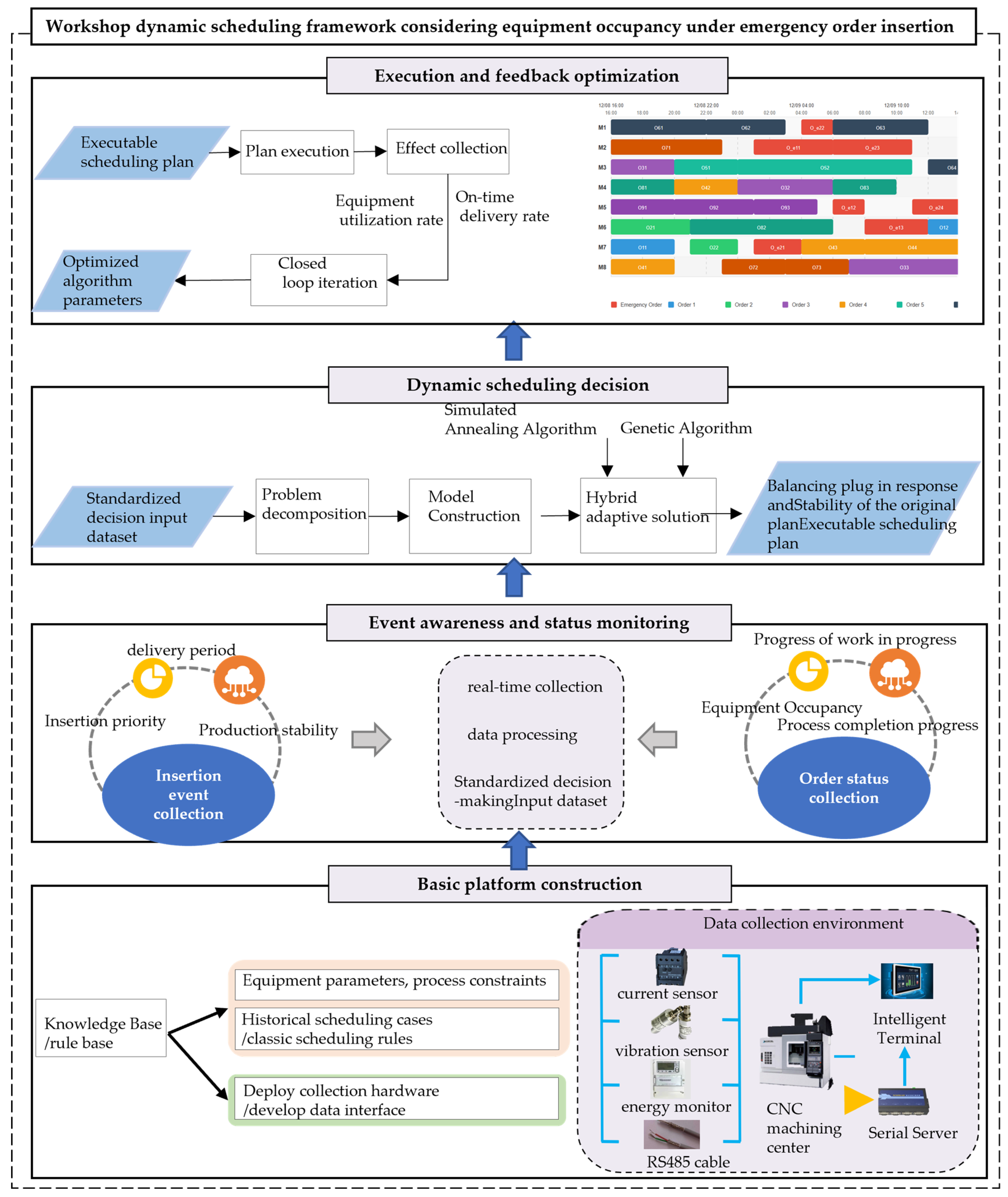
2.1. Design of Workshop Dynamic Scheduling Framework Considering Equipment Occupation Under Emergency Order Insertion
2.2. Modeling of the Emergency Order Insertion Event

2.3. Real-Time Monitoring Model for Production Status
2.4. Emergency Order Insertion Scheduling Decision Mechanism
2.4.1. Problem Decomposition and Subproblem Generation
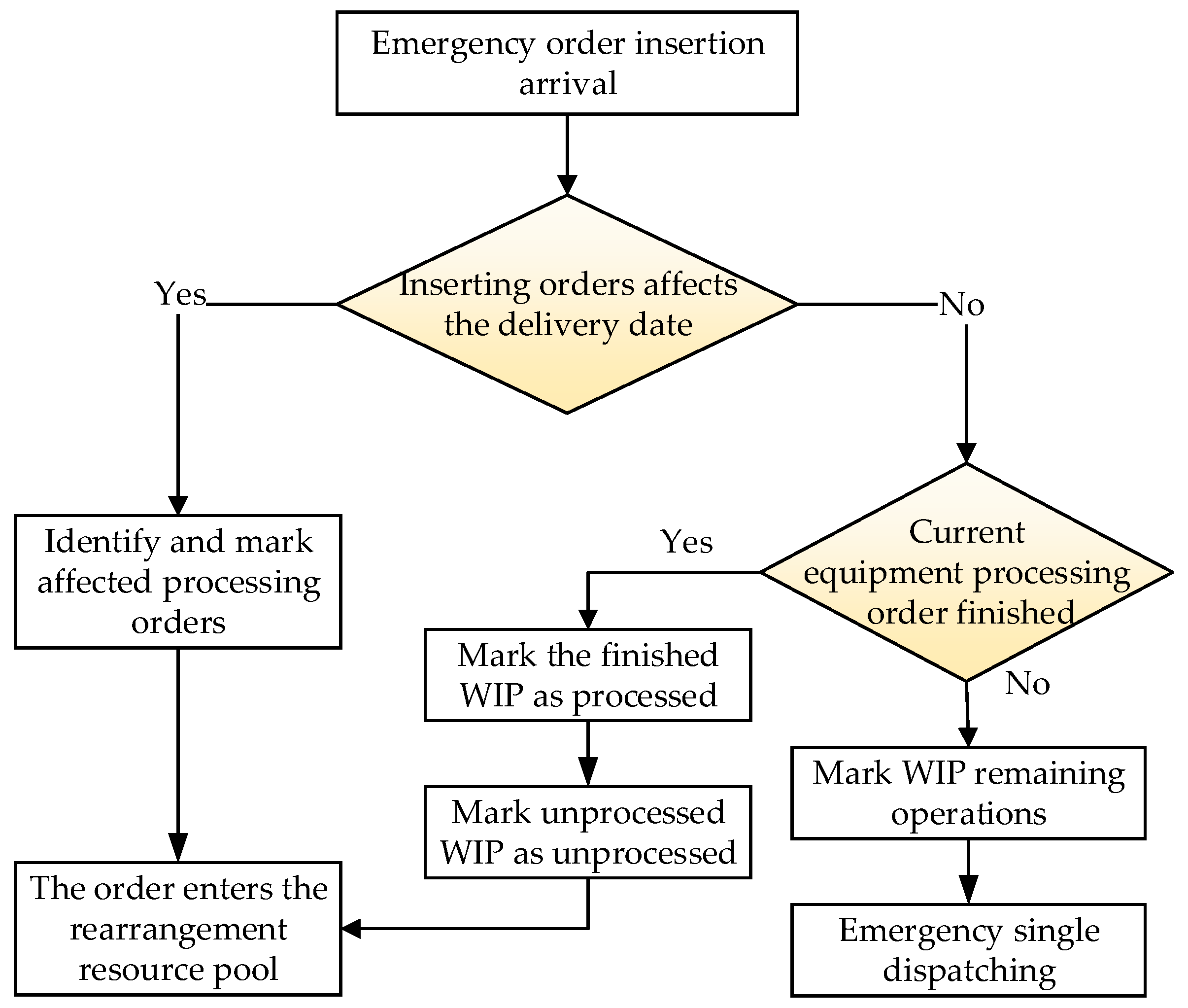
2.4.2. WIP Management in the Scenario of Urgent Order Insertion
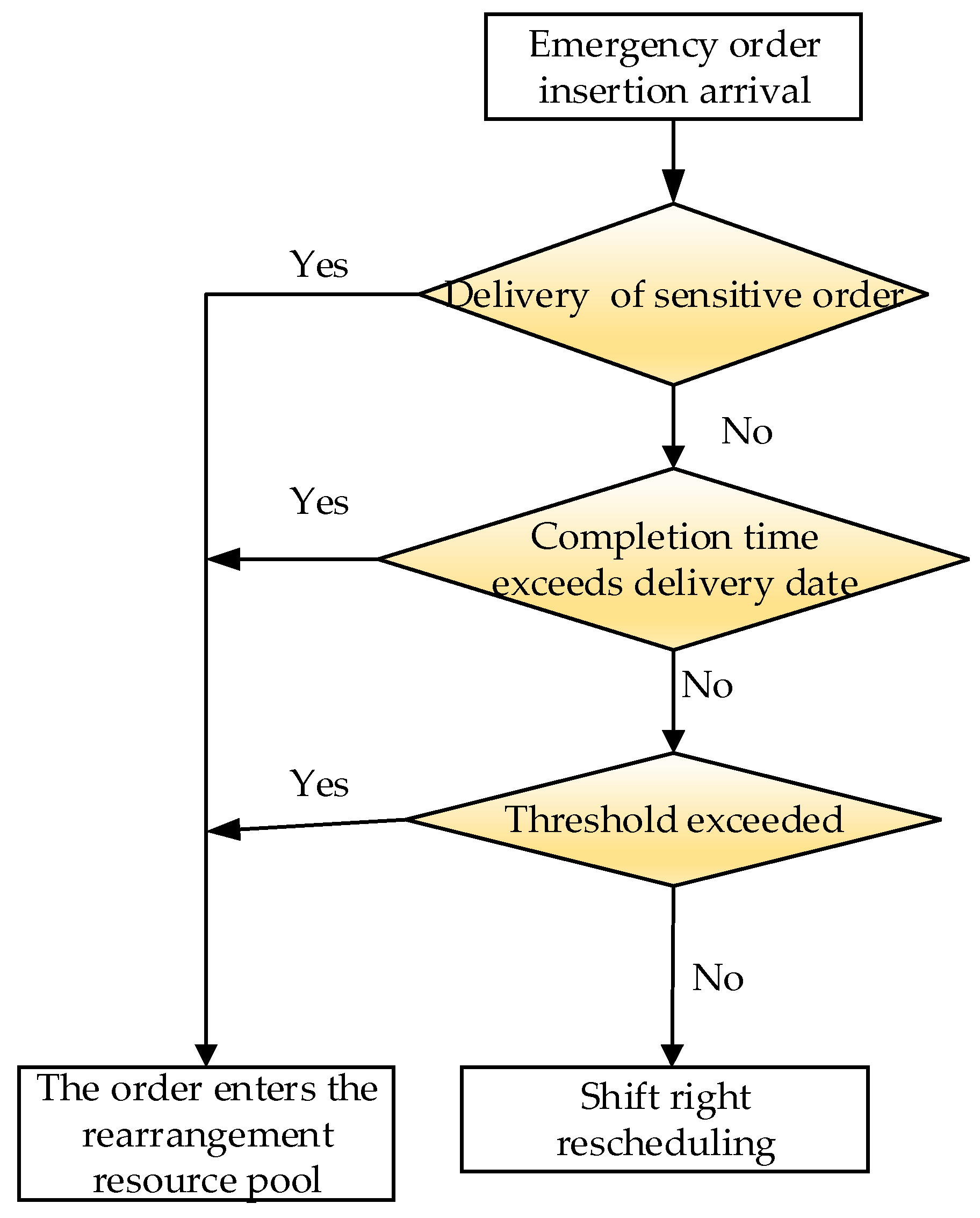
2.4.3. Emergency Order Insertion and Rearrangement Strategy
3. Mathematical Model and Solution Algorithm
3.1. Problem Description and Mathematical Model
3.2. Design of an Improved Genetic Simulated Annealing Algorithm
3.2.1. Overall Framework and Coordination Mechanism
3.2.2. Algorithm Improvement Strategy
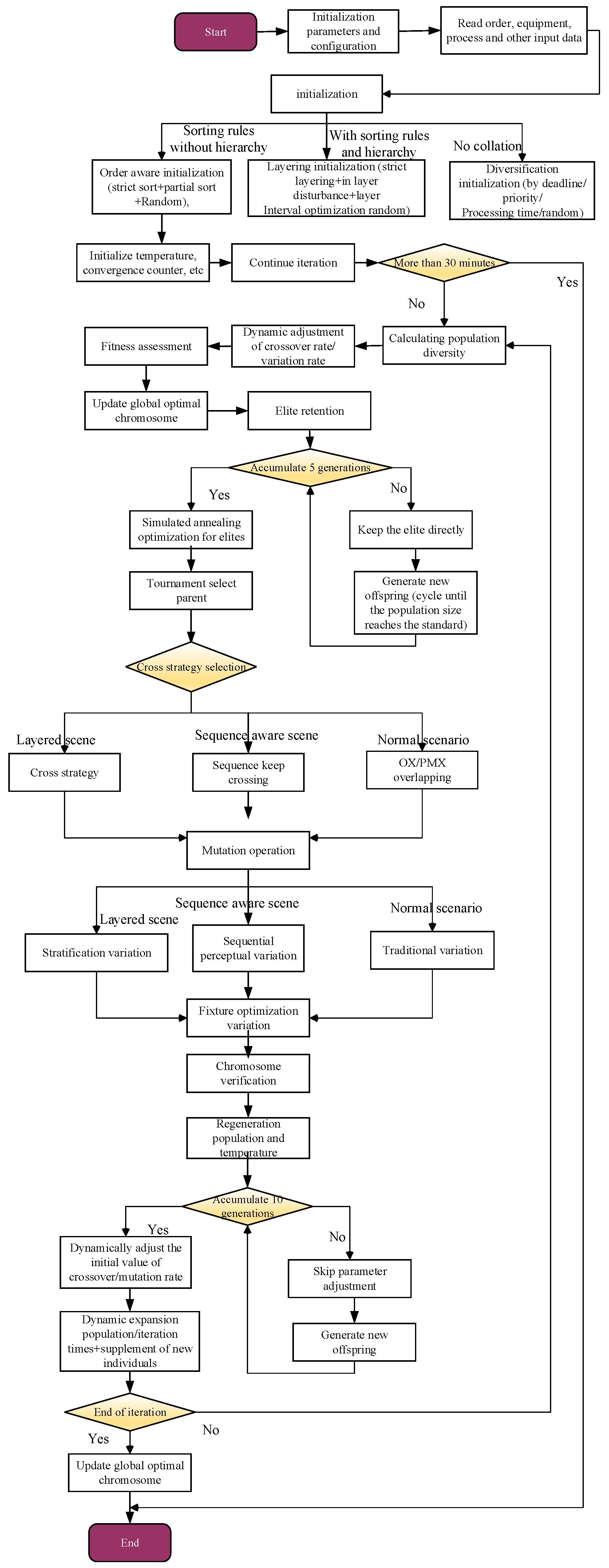
3.2.3. IGSA Algorithm Process
- (1)
- Individual representation (coding)
- (2)
- Fitness function calculation
- (3)
- Crossover and mutation operators
- Evaluate the fitness of each individual in the population (use forwardscheduler, backwardscheduler, or hybridscheduler to schedule, and then calculate the weighted delay, equipment utilization, and replacement cost).
- Record the global optimal solution.
- Population diversity was calculated, and the crossover rate and variation rate were dynamically adjusted.
- Selection operation (tournament selection).
- Crossover operation (hierarchical crossover, sequence preserving crossover, or traditional crossover is adopted according to whether there are sorting rules and hierarchies).
- Mutation operation (use hierarchical mutation, sequence-aware mutation, or traditional mutation according to whether there are sorting rules and stratification).
- Update population (elite reservation, combined with simulated annealing to optimize the elite).
- Dynamically adjust parameters (according to the success rate of crossover and mutation).
- Check premature convergence. If it is stagnant, dynamically expand the population and increase the algebra.
| Algorithm 1. IGSA algorithm pseudocode. |
| Input: Population size N, maximum generation G_max, initial crossover rate P_c0, initial mutation rate P_m0, initial temperature T0, cooling coefficient α, elite proportion ε, emergency flag emergency_flag Output: Optimal scheduling scheme S_best (1) //Initialization stage (2) If emergency_flag == True: (3) Generate initial population from warm start of current running scheduling state (4) Refactor the fitness function (5) Otherwise: (6) Generate an initial population P = {S1, S2, …, S_N} randomly (7) End if (8) Calculate the fitness value of each individual in the initial population (9) S_best (the individual with the best fitness in the population) (10) //Main loop (11) For generation = 1 to G_max: (12) //Genetic operation phase (13) Calculate population diversity (14) Dynamically adjust the crossover rate P_c and mutation rate P_m (based on Diversity) (15) //Selection (16) P_selected tournament selection(P, k = 2) (17) //Crossover and mutation (18) For each pair of parents (S_i, S_j) in P_selected: (19) If rand() < P_c: (20) (C_i, C_j) stratified crossover(S_i, S_j)//maintain the feasibility of process sequence and equipment allocation (21) End if (22) End for (23) For each offspring individual C in P: (24) If rand() < P_m: (25) Sequence-aware mutation (C)//Perform process exchange or equipment reallocation on the critical path (26) End if (27) End for (28) //Simulated annealing elite optimization phase (29) Sort P and select the top ε·N elite individuals to form set E (30) For each elite individual S_elite in E: (31) Generate a new solution randomly within the neighborhood of S_elite (neighborhood operation: key process exchange, equipment reallocation) (32) ΔE = f(S_neighbor) − f(S_elite)//Calculate the fitness difference (33) If ΔE < 0 or rand() < exp(-ΔE/T): (34) S_elite ← S_neighbor//Accept new solution (35) End if (36) If f(S_elite) < f(S_best): (37) S_best = S_elite//Update the global optimum (38) End if (39) End for (40) //Early convergence detection and handling (41) If the population convergence stagnates for more than the preset number of generations: (42) Perform population expansion (inject random new individuals) (43) Temporarily increase mutation rate (44) End if (45) End for (46) Return S_best |
4. Experiments and Results
4.1. Performance Evaluation Index
- (1)
- Optimal value (Best)
- (2)
- Relative deviation (RE)
4.2. Standard Example Verification
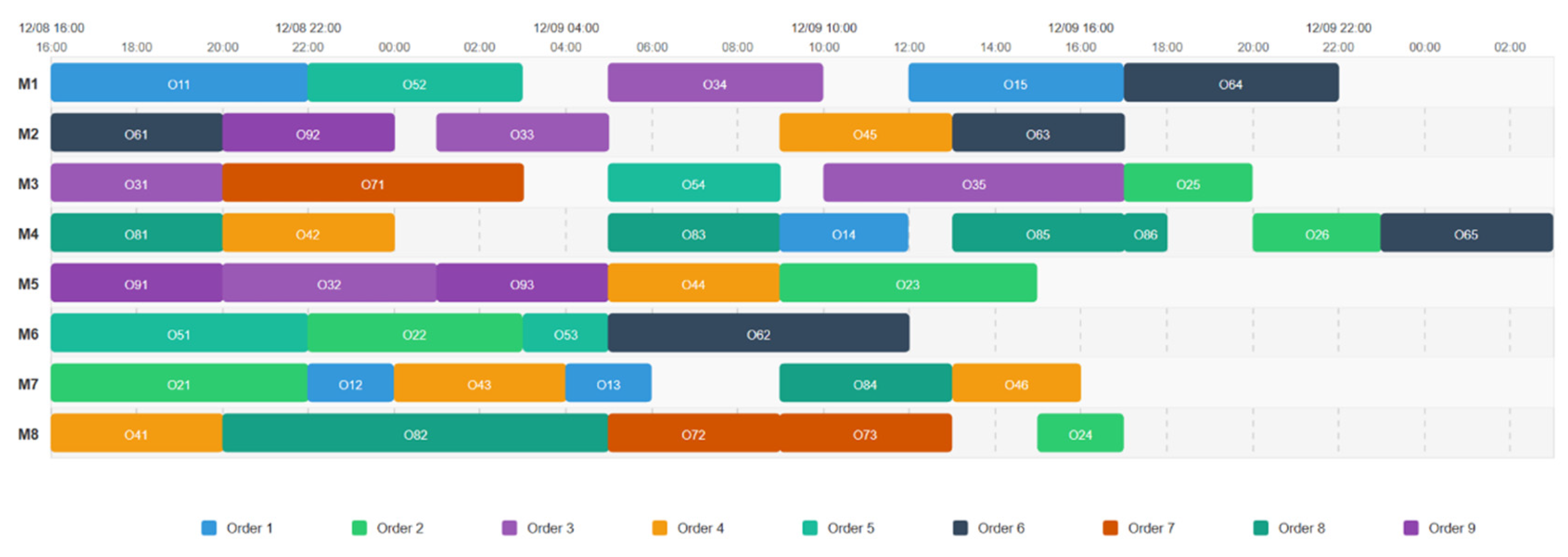
4.3. Workshop Case Verification
5. Conclusions
Author Contributions
Funding
Data Availability Statement
Conflicts of Interest
References
- Rifai, A.P.; Mara, S.T.; Sudiarso, A. Multi-objective distributed reentrant permutation flow shop scheduling with sequence-dependent setup time. Expert Syst. Appl. 2021, 183, 115339. [Google Scholar] [CrossRef]
- Fu, Y.; Wang, H.; Huang, M. Integrated scheduling for a distributed manufacturing system: A stochastic multi-objective model. Enterp. Inf. Syst. 2019, 13, 557–573. [Google Scholar] [CrossRef]
- Meddourene, A.; Bouzouia, B.; Abbou, R. An hybrid SA-DATC approach for JIT open-shop scheduling problem with earliness and tardiness penalties. IFAC-PapersOnLine 2019, 52, 2396–2401. [Google Scholar] [CrossRef]
- Qiu, Y.; Ji, W.; Zhang, C. A hybrid machine learning and population knowledge mining method to minimize makespan and total tardiness of multi-variety products. Appl. Sci. 2019, 9, 5286. [Google Scholar] [CrossRef]
- Huang, X.; Yang, L. A hybrid genetic algorithm for multi-objective flexible job shop scheduling problem considering transportation time. Int. J. Intell. Comput. Cybern. 2019, 12, 154–174. [Google Scholar] [CrossRef]
- Feng, Y.; Lin, Y.; Yang, Z.; Wang, J.; Zhang, J. A two-stage individual feedback NSGA-III for dynamic many-objective flexible job shop scheduling problem. IEEE Trans. Autom. Sci. Eng. 2024, 22, 1673–1683. [Google Scholar] [CrossRef]
- Zhang, H.; Qin, C.; Zhang, W.; Zhuang, C.; Liu, J. Energy-saving scheduling for flexible job shop problem with AGV transportation considering emergencies. Systems 2023, 11, 103. [Google Scholar] [CrossRef]
- Wan, L.; Cui, X.; Zhao, H.; Chang, K.; Zhang, Q. A novel method for solving dynamic flexible job-shop scheduling problem via DIFFormer and deep reinforcement learning. Comput. Ind. Eng. 2024, 198, 110688. [Google Scholar] [CrossRef]
- Liu, J.; Land, M.J.; Bokhorst, J.A.C.; van Donk, D.P. Improving coordination in assembly job shops: Redesigning order release and dispatching. Flex. Serv. Manuf. J. 2023, 35, 669–697. [Google Scholar] [CrossRef]
- Wang, J.; Li, Y.; Zhang, Z.; Xu, J. Dynamic integrated scheduling of production equipment and automated guided vehicles in a flexible job shop based on deep reinforcement learning. Processes 2024, 12, 2423. [Google Scholar] [CrossRef]
- Framinan, J.M.; Fernandez-Viagas, V.; Perez-Gonzalez, P. Using real-time information to reschedule jobs in a flowshop with variable processing times. Comput. Ind. Eng. 2019, 129, 113–125. [Google Scholar] [CrossRef]
- Yao, X.; Zhang, J.; Li, Y.; Lu, Q.; Xu, Z. Towards flexible RFID event-driven integrated manufacturing for make-to-order production. Int. J. Comput. Integr. Manuf. 2018, 31, 228–242. [Google Scholar] [CrossRef]
- Jun, S.; Lee, S.; Chun, H. Learning dispatching rules using random forest in flexible job shop scheduling problems. Int. J. Prod. Res. 2019, 57, 3290–3310. [Google Scholar] [CrossRef]
- Huang, B.; Wang, W.; Ren, S.; Ji, W. A proactive task dispatching method based on future bottleneck prediction for the smart factory. Int. J. Comput. Integr. Manuf. 2019, 32, 278–293. [Google Scholar] [CrossRef]
- Zhao, F.; Liu, Y.; Xu, T.; Wang, L. A reinforcement learning hyper-heuristic algorithm for the distributed flowshops scheduling problem under consideration of emergency order insertion. Appl. Soft Comput. 2024, 167, 112461. [Google Scholar] [CrossRef]
- Chen, S.; Zheng, J. A Q-learning grey wolf optimizer for a distributed hybrid flowshop rescheduling problem with urgent job insertion. J. Appl. Math. Comput. 2025, 71, 3645–3670. [Google Scholar] [CrossRef]
- Li, X.; Zhao, P.; Du, B.; Guo, J.; Xu, W. Hybrid artificial bee colony algorithm with a rescheduling strategy for solving flexible job shop scheduling problems. Comput. Ind. Eng. 2017, 113, 10–26. [Google Scholar] [CrossRef]
- He, X.; Dong, S.; Zhao, N. Research on rush order insertion rescheduling problem under hybrid flow shop based on NSGA-III. Int. J. Prod. Res. 2020, 58, 1161–1177. [Google Scholar] [CrossRef]
- Wang, X.; Li, Z.; Chen, Q.; Mao, N.; Hu, X. Meta-heuristics for unrelated parallel machines scheduling with random rework to minimize expected total weighted tardiness. Comput. Ind. Eng. 2020, 145, 106505. [Google Scholar] [CrossRef]
- Chen, H.J.; Ding, G.F.; Zhang, J.; Wang, R.J. Research on priority rules for the stochastic resource constrained multi-project scheduling problem with new project arrival. Comput. Ind. Eng. 2019, 137, 106060. [Google Scholar] [CrossRef]
- Ozturk, G.; Bahadir, O.; Teymourifar, A. Extracting priority rules for dynamic multi-objective flexible job shop scheduling problems using gene expression programming. Int. J. Prod. Res. 2019, 57, 195–205. [Google Scholar] [CrossRef]
- Pan, Q.K.; Gao, L.; Wang, L. An Effective Cooperative Co-Evolutionary Algorithm for Distributed Flowshop Group Scheduling Problems. IEEE Trans. Cybern. 2022, 52, 5999–6012. [Google Scholar] [CrossRef]
- Song, H.B.; Lin, J. A genetic programming hyper-heuristic for the distributed assembly permutation flow-shop scheduling problem with sequence dependent setup times. Swarm Evol. Comput. 2021, 60, 100800. [Google Scholar] [CrossRef]
- Zhang, G.; Liu, B.; Wang, L.; Xing, K. Distributed Heterogeneous Co-Evolutionary Algorithm for Scheduling a Multistage Fine-Manufacturing System With Setup Constraints. IEEE Trans. Cybern. 2022, 52, 1497–1510. [Google Scholar] [CrossRef]
- Yang, Y.; Li, X. A knowledge-driven constructive heuristic algorithm for the distributed assembly blocking flow shop scheduling problem. Expert Syst. Appl. 2022, 202, 117324. [Google Scholar] [CrossRef]
- Wang, J.J.; Wang, L. A cooperative memetic algorithm with feedback for the energy-aware distributed flow-shops with flexible assembly scheduling. Comput. Ind. Eng. 2022, 168, 108066. [Google Scholar] [CrossRef]
- Zhang, Z.; Tang, Q.; Zhang, L.; Li, Z. A Q-learning-based multi-population algorithm for multi-objective distributed heterogeneous assembly no-idle flowshop scheduling with batch delivery. Expert Syst. Appl. 2025, 263, 125168. [Google Scholar] [CrossRef]
- Rahman, H.F.; Janardhanan, M.N.; Poon, C.L.; Noman, H.M. Flowshop scheduling with sequence dependent setup times and batch delivery in supply chain. Comput. Ind. Eng. 2021, 158, 107392. [Google Scholar] [CrossRef]
- Zhang, Z.Q.; Hu, R.; Qian, B.; Hu, R.; Xiang, F. A matrix cube-based estimation of distribution algorithm for the energy-efficient distributed assembly permutation flow-shop scheduling problem. Expert Syst. Appl. 2022, 194, 116515. [Google Scholar] [CrossRef]
- Gao, L.; Li, X.; Wen, X.; Lu, C.; Wen, F. A hybrid algorithm based on a new neighborhood structure evaluation method for job shop scheduling problem. Comput. Ind. Eng. 2015, 88, 417–429. [Google Scholar] [CrossRef]
- Zhang, G.; Hu, Y.; Sun, J.; Zhang, W. An improved genetic algorithm for the flexible job shop scheduling problem with multiple time constraints. Swarm Evol. Comput. 2020, 54, 100664. [Google Scholar] [CrossRef]
- Van Hoorn, J.J. The current state of bounds on benchmark instances of the job-shop scheduling problem. J. Sched. 2018, 21, 127–128. [Google Scholar] [CrossRef]



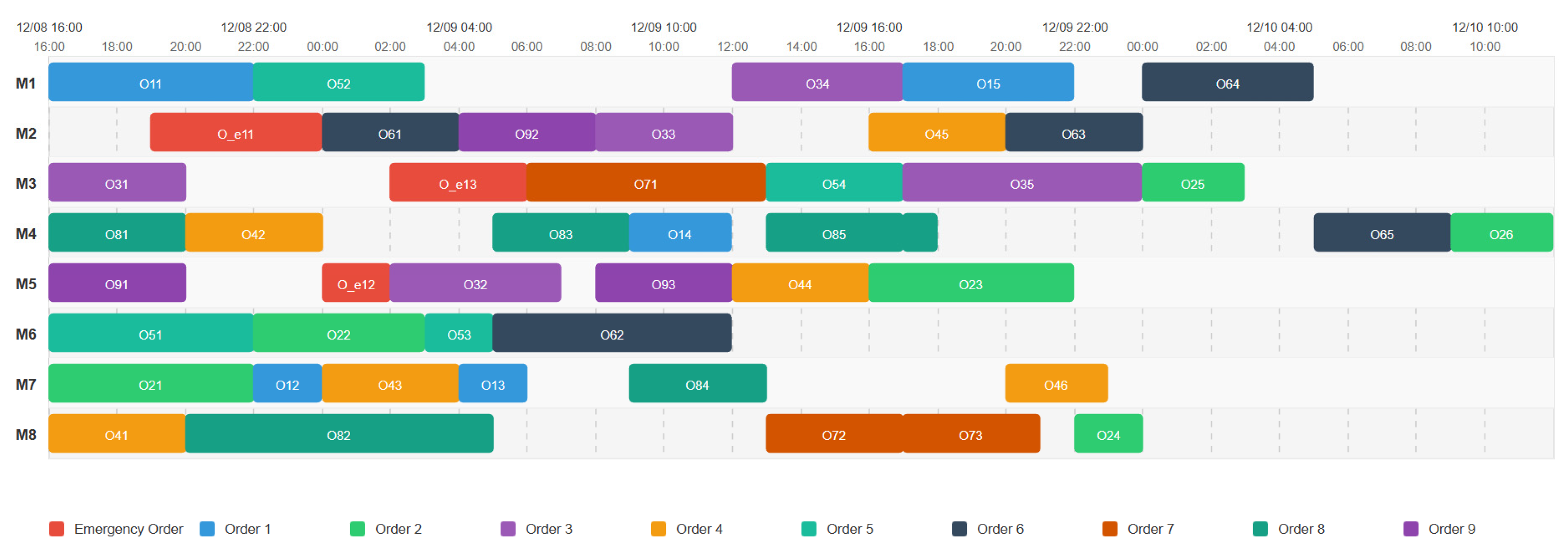
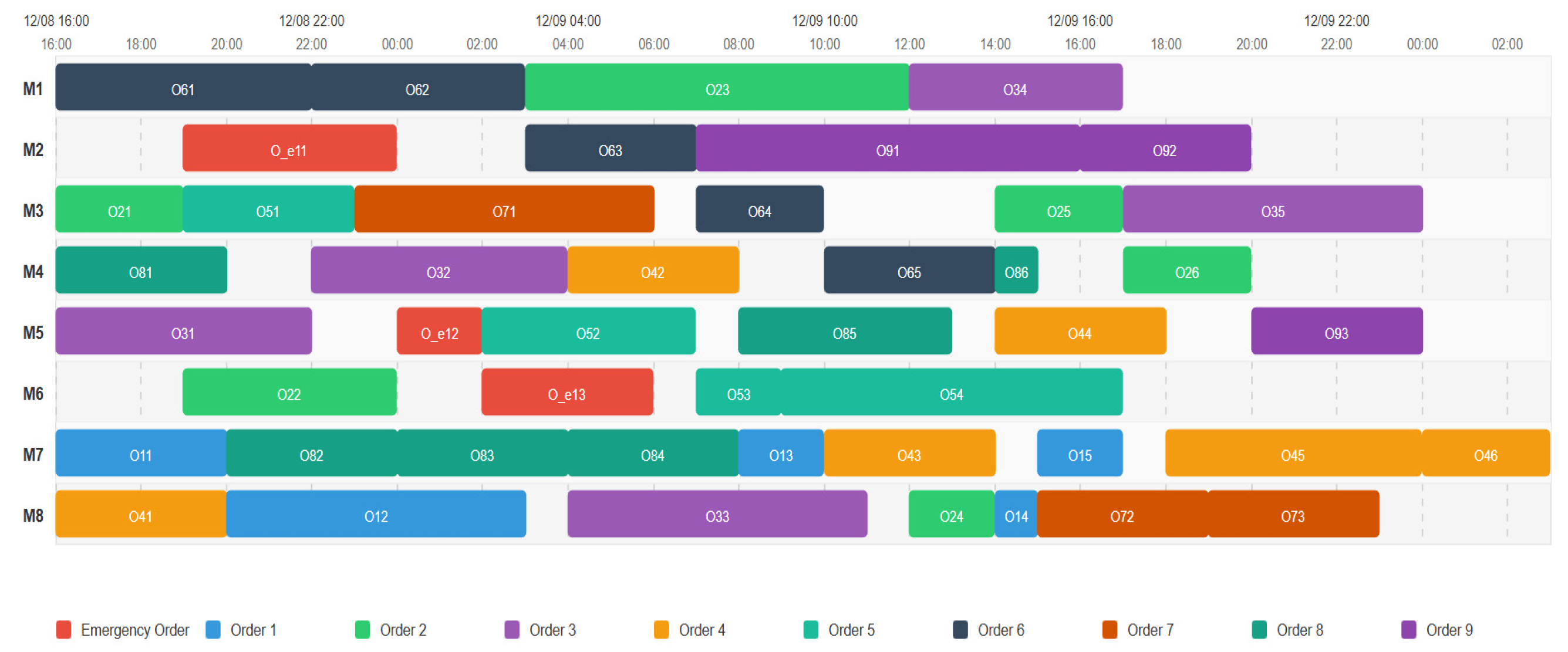
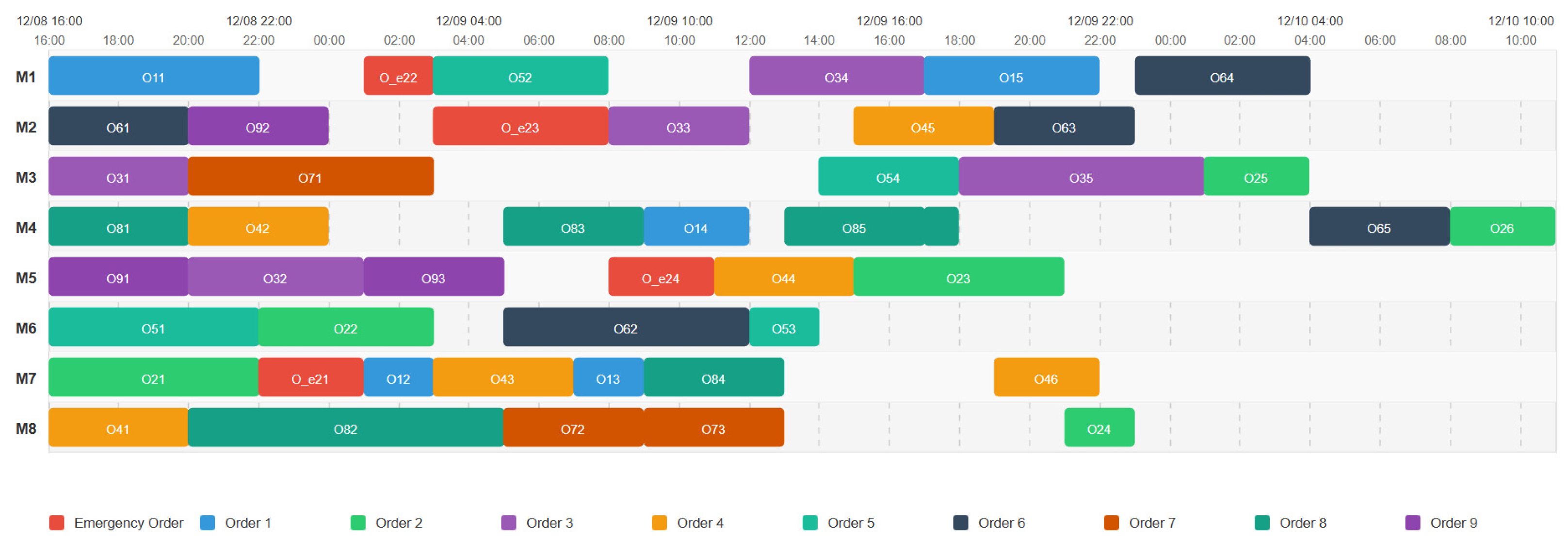
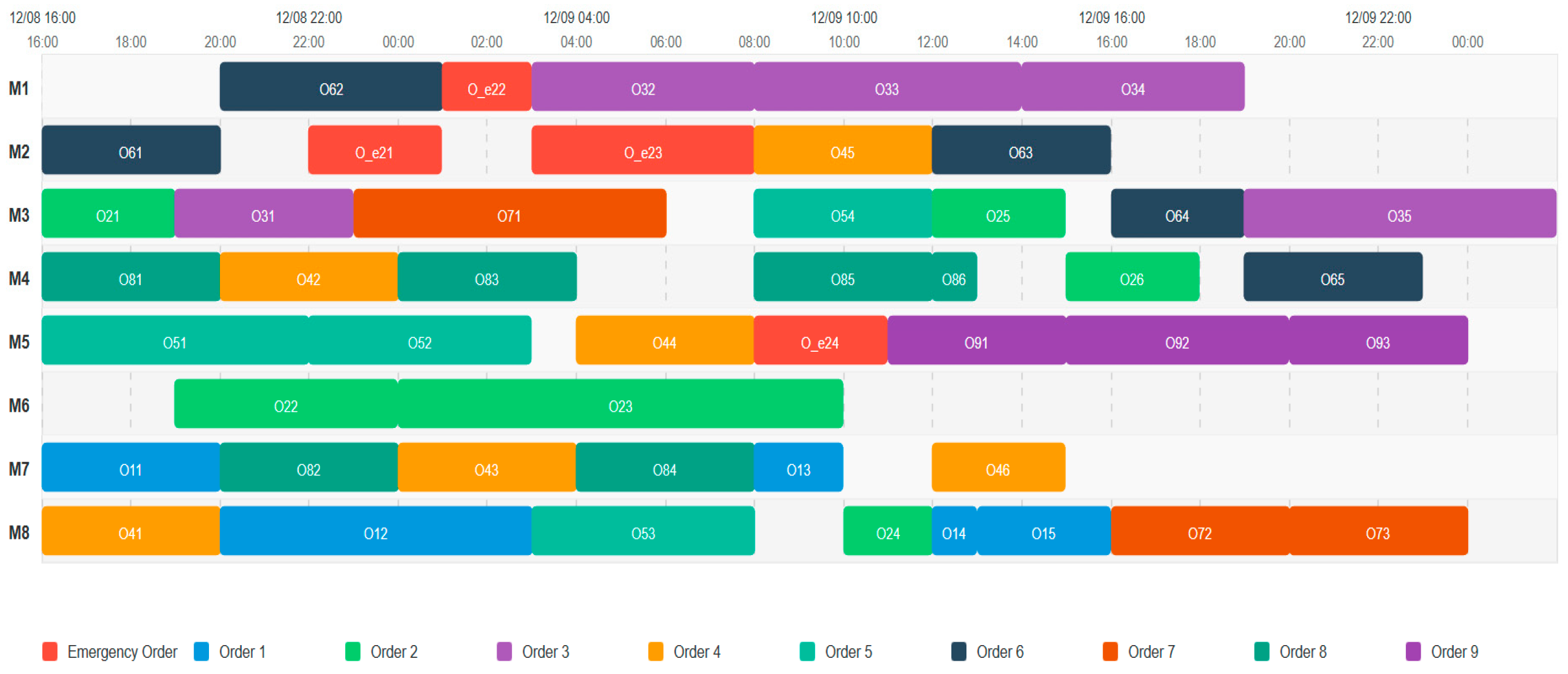
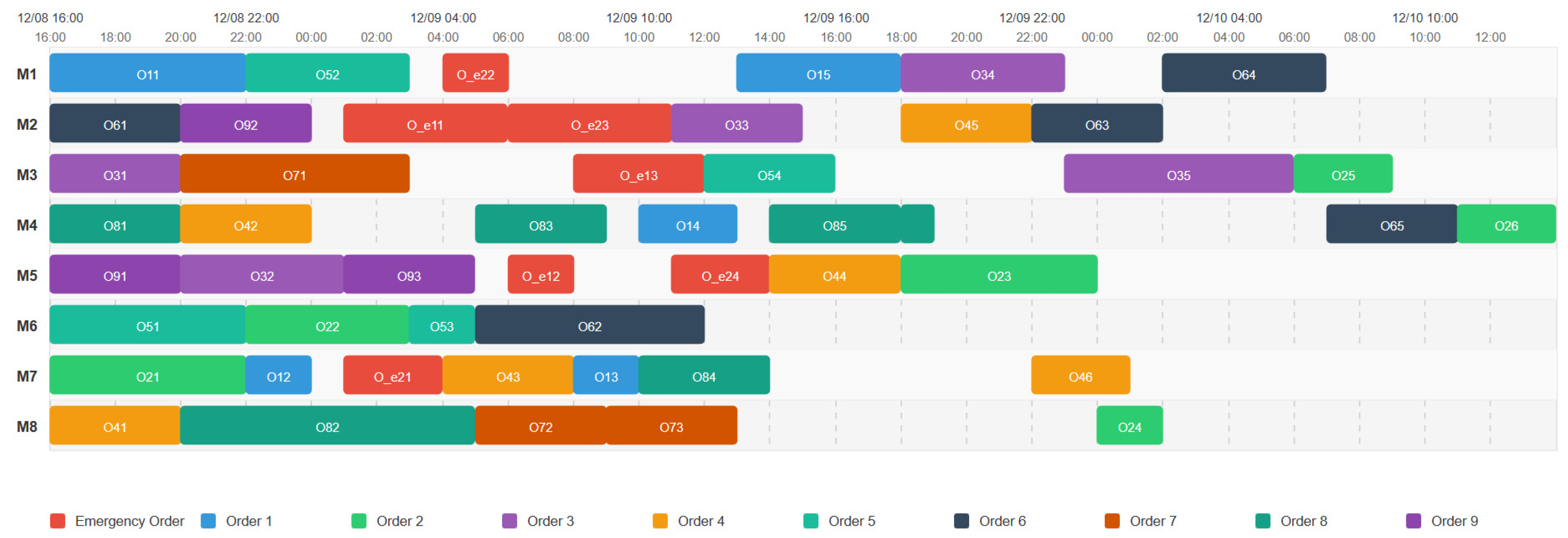


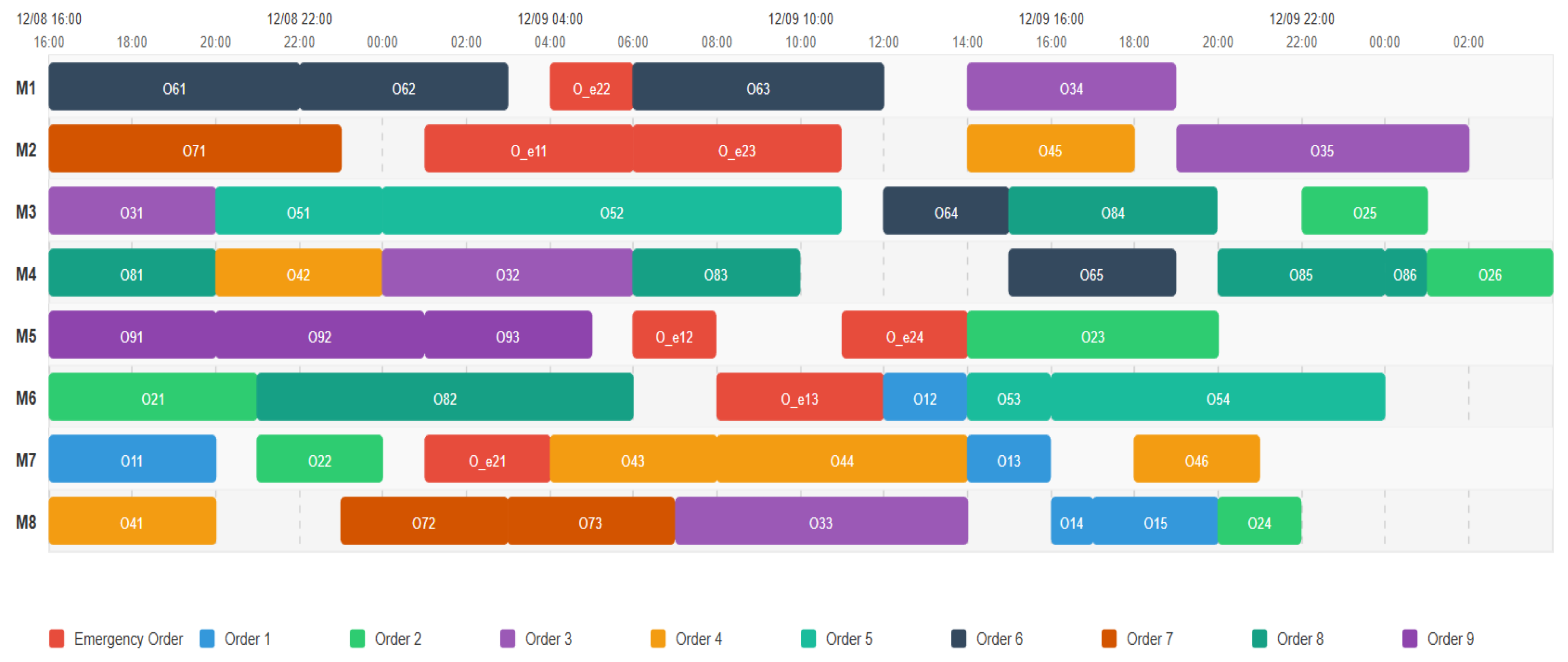
| Algorithm | Parameter Setting |
|---|---|
| IGSA | Initial mutation probability: 0.15; initial crossover probability: 0.85 Elite rate: 0.1; initial temperature: 1000 °C; and cooling rate: 0.95 |
| GA | Mutation probability: 0.1; crossover probability: 0.9 |
| ICA | Revolution probability: 0.1; assimilation probability: 0.9 |
| HPSO | C1,C2 = 2; inertia factor: 0.9 |
| Data Set | IGSA | GA | ICA | HPSO | |||||||||
|---|---|---|---|---|---|---|---|---|---|---|---|---|---|
| Best | RE% | Avg. CPU (s) | Best | RE% | Avg. CPU (s) | Best | RE% | Avg. CPU (s) | Best | RE% | Avg. CPU (s) | LB | |
| LA01 | 666 | 0 | 26.36 | 666 | 0 | 10.26 | 666 | 0 | 33.36 | 666 | 0 | 13.21 | 666 |
| LA02 | 655 | 0 | 27.65 | 655 | 0 | 10.82 | 655 | 0 | 34.78 | 655 | 0 | 13.85 | 655 |
| LA03 | 597 | 0 | 28.93 | 597 | 0 | 11.39 | 597 | 0 | 36.2 | 597 | 0 | 14.48 | 597 |
| LA06 | 926 | 0 | 30.22 | 926 | 0 | 11.95 | 926 | 0 | 37.62 | 926 | 0 | 15.12 | 926 |
| LA07 | 890 | 0 | 31.51 | 890 | 0 | 12.51 | 890 | 0 | 39.03 | 890 | 0 | 15.76 | 890 |
| LA08 | 863 | 0 | 32.79 | 863 | 0 | 13.08 | 863 | 0 | 40.45 | 863 | 0 | 16.39 | 863 |
| LA18 | 848 | 0 | 34.08 | 848 | 0 | 13.64 | 848 | 0 | 41.87 | 848 | 0 | 17.03 | 848 |
| LA19 | 842 | 0 | 35.37 | 842 | 0 | 14.2 | 842 | 0 | 43.29 | 842 | 0 | 17.67 | 842 |
| LA20 | 902 | 0 | 36.65 | 904 | 0.22 | 14.77 | 905 | 0.33 | 44.71 | 902 | 0 | 18.3 | 902 |
| LA22 | 928 | 0.11 | 37.94 | 931 | 0.43 | 15.33 | 932 | 0.54 | 46.13 | 927 | 0 | 18.94 | 927 |
| LA24 | 938 | 0.32 | 39.23 | 941 | 0.64 | 15.89 | 941 | 0.64 | 47.55 | 935 | 0 | 19.58 | 935 |
| LA25 | 978 | 0.10 | 40.51 | 982 | 0.51 | 16.46 | 982 | 0.51 | 48.97 | 977 | 0 | 20.21 | 977 |
| LA27 | 1235 | 0.00 | 41.8 | 1238 | 0.24 | 17.02 | 1238 | 0.24 | 50.38 | 1235 | 0 | 20.85 | 1235 |
| LA28 | 1217 | 0.08 | 43.09 | 1216 | 0.00 | 17.58 | 1216 | 0.00 | 51.8 | 1216 | 0 | 21.49 | 1216 |
| LA29 | 1161 | 0.78 | 44.37 | 1164 | 1.04 | 18.15 | 1165 | 1.13 | 53.22 | 1168 | 1.39 | 22.12 | 1152 |
| LA36 | 1270 | 0.16 | 45.66 | 1273 | 0.39 | 18.71 | 1276 | 0.63 | 54.64 | 1272 | 0.32 | 22.76 | 1268 |
| LA37 | 1398 | 0.07 | 46.95 | 1401 | 0.29 | 19.27 | 1405 | 0.57 | 56.06 | 1403 | 0.43 | 23.4 | 1397 |
| LA40 | 1223 | 0.08 | 45.54 | 1225 | 0.25 | 18.36 | 1227 | 0.41 | 58.98 | 1224 | 0.16 | 22.45 | 1222 |
| IGSA | Logarithm of Sample Pairs (N) | Wilcoxon W Statistic | p-Value | Statistical Conclusion (α = 0.05) |
|---|---|---|---|---|
| GA | 18 | 15 | 0.0004 | Reject the null hypothesis, there is a significant difference. |
| ICA | 18 | 11 | 0.0002 | Reject the null hypothesis, there is a significant difference. |
| HPSO | 18 | 21 | 0.0011 | Reject the null hypothesis, there is a significant difference. |
| Job | Operation | Machining Time (min) | |||||||
|---|---|---|---|---|---|---|---|---|---|
| M1 | M2 | M3 | M4 | M5 | M6 | M7 | M8 | ||
| Job1 | O11 | 6 | 6 | - | 9 | - | 11 | 4 | 5 |
| O12 | 2 | 4 | - | - | 7 | 2 | 2 | 7 | |
| O13 | 7 | 4 | 10 | - | - | - | 2 | - | |
| O14 | - | 6 | 10 | 3 | 11 | 8 | - | 1 | |
| O15 | 5 | - | 12 | 4 | 6 | - | 2 | 3 | |
| Job2 | O21 | 9 | 9 | 3 | 7 | - | 5 | 6 | 7 |
| O22 | 5 | 7 | 8 | - | - | 5 | 3 | 9 | |
| O23 | 9 | - | - | - | 6 | 10 | 10 | - | |
| O24 | 10 | 9 | 7 | - | - | 9 | 5 | 2 | |
| O25 | 8 | - | 3 | 7 | 6 | - | 10 | 5 | |
| O26 | - | - | 4 | 3 | 4 | - | - | - | |
| Job3 | O31 | - | 11 | 4 | 8 | 6 | 6 | 11 | 9 |
| O32 | 5 | - | 11 | 6 | 5 | - | 9 | 10 | |
| O33 | 6 | 4 | 10 | - | 7 | 11 | 10 | 7 | |
| O34 | 5 | 8 | - | - | - | 7 | 8 | - | |
| O35 | 10 | 7 | 7 | - | - | 9 | - | - | |
| Job4 | O41 | 9 | 6 | - | 6 | 11 | - | 7 | 4 |
| O42 | 7 | - | - | 4 | - | 9 | - | - | |
| O43 | 6 | 5 | - | - | 10 | 9 | 4 | 9 | |
| O44 | 8 | 9 | 8 | - | 4 | - | 6 | - | |
| O45 | - | 4 | 9 | - | 5 | 7 | 6 | 8 | |
| O46 | 10 | - | 7 | 4 | - | 12 | 3 | 8 | |
| Job5 | O51 | - | 11 | 4 | 8 | 6 | 6 | 11 | 9 |
| O52 | 5 | - | 11 | 6 | 5 | - | 9 | 10 | |
| O53 | - | 6 | 11 | 9 | 9 | 2 | 5 | 5 | |
| O54 | 7 | - | 4 | 12 | 5 | 8 | 10 | 10 | |
| Job6 | O61 | 6 | 4 | 10 | - | 7 | 11 | 10 | 7 |
| O62 | 5 | 8 | - | - | - | 7 | 8 | - | |
| O63 | 6 | 4 | - | 10 | 7 | - | 11 | 10 | |
| O64 | 5 | 8 | 3 | - | 9 | 7 | - | 8 | |
| O65 | - | 10 | 7 | 4 | - | 11 | 10 | 7 | |
| Job7 | O71 | 10 | 7 | 7 | - | - | 9 | - | - |
| O72 | 9 | 6 | - | 6 | 11 | - | 7 | 4 | |
| O73 | 10 | - | 7 | 6 | 11 | - | 7 | 4 | |
| Job8 | O81 | 7 | - | - | 4 | - | 9 | - | - |
| O82 | 6 | 5 | - | - | 10 | 9 | 4 | 9 | |
| O83 | 7 | 5 | - | 4 | 10 | 9 | 4 | - | |
| O84 | - | 6 | 5 | - | 10 | 9 | 4 | 9 | |
| O85 | 8 | - | 9 | 4 | 5 | 7 | - | 6 | |
| O86 | 6 | 5 | - | 1 | - | 9 | 4 | 9 | |
| Job9 | O91 | 8 | 9 | 8 | - | 4 | - | 6 | - |
| O92 | - | 4 | 9 | - | 5 | 7 | 6 | 8 | |
| O93 | 8 | 9 | 8 | - | 4 | 6 | - | 10 | |
| Job | Operation | Equipment Processing Time (min)/Fixture Replacement Time (min) | |||||||
|---|---|---|---|---|---|---|---|---|---|
| M1 | M2 | M3 | M4 | M5 | M6 | M7 | M8 | ||
| E1 | O_e11 | 6/9.3 | 5/15.8 | 6/7.8 | - | 6/13.8 | 9/8.9 | 9/5.4 | 8/8.5 |
| O_e12 | 3/16.4 | 7/11.4 | 4/4.9 | 10/14.3 | 2/6.5 | 7/10.6 | 8/14.5 | 7/13.5 | |
| O_e13 | 10/9.3 | - | 4/15.8 | - | 9/12 | 4/12.7 | 5/10.2 | 10/14.1 | |
| E2 | O_e21 | - | 3/16.5 | 4/13.1 | 8/11.2 | 10/4.7 | 7/15.8 | 3/12.7 | 7/15.1 |
| O_e22 | 2/8.3 | 3/13.9 | - | - | 5/9.8 | 4/14.6 | - | ||
| O_e23 | 7/8.6 | 5/16.4 | 9/8.4 | 7/16.3 | 8/15.1 | - | 8/5.1 | - | |
| O_e24 | 10/11.1 | 8/9.3 | 7/15.2 | 9/5.4 | 3/5 | 10/7.3 | - | 5/15 | |
| Scene | Insert Order | Order Insertion Time (h) |
|---|---|---|
| 1 | E1 | 3 |
| 2 | E2 | 6 |
| 3 | E1, E2 | 9 |
Disclaimer/Publisher’s Note: The statements, opinions and data contained in all publications are solely those of the individual author(s) and contributor(s) and not of MDPI and/or the editor(s). MDPI and/or the editor(s) disclaim responsibility for any injury to people or property resulting from any ideas, methods, instructions or products referred to in the content. |
© 2026 by the authors. Licensee MDPI, Basel, Switzerland. This article is an open access article distributed under the terms and conditions of the Creative Commons Attribution (CC BY) license.
Share and Cite
Su, X.; Han, J.; Gu, T.; Yu, J.; Ma, W. Research on Workshop Dynamic Scheduling Method Considering Equipment Occupation Under Emergency Insertion Order. Algorithms 2026, 19, 156. https://doi.org/10.3390/a19020156
Su X, Han J, Gu T, Yu J, Ma W. Research on Workshop Dynamic Scheduling Method Considering Equipment Occupation Under Emergency Insertion Order. Algorithms. 2026; 19(2):156. https://doi.org/10.3390/a19020156
Chicago/Turabian StyleSu, Xuan, Jitai Han, Tongtong Gu, Junjie Yu, and Weimin Ma. 2026. "Research on Workshop Dynamic Scheduling Method Considering Equipment Occupation Under Emergency Insertion Order" Algorithms 19, no. 2: 156. https://doi.org/10.3390/a19020156
APA StyleSu, X., Han, J., Gu, T., Yu, J., & Ma, W. (2026). Research on Workshop Dynamic Scheduling Method Considering Equipment Occupation Under Emergency Insertion Order. Algorithms, 19(2), 156. https://doi.org/10.3390/a19020156