
ICCA: Independent Multi-Agent Algorithm for Distributed Jamming Scheduling

 ,
,
Abstract
1. Introduction
- In the face of unknown and dynamic communication power scheduling strategies, reinforcement learning-based algorithms have a long training time and require a large number of interactions. This delays the overall time to achieve jamming and consumes a large amount of energy.
- There is a lack of specific strategies for non-networked distributed jammers to perceive the environment using reconnaissance information and determine the jamming effects.
- There is a lack of applicable mathematical models and strategies, and there is insufficient research on issues such as the superposition, coordination, and usage order of jamming power.
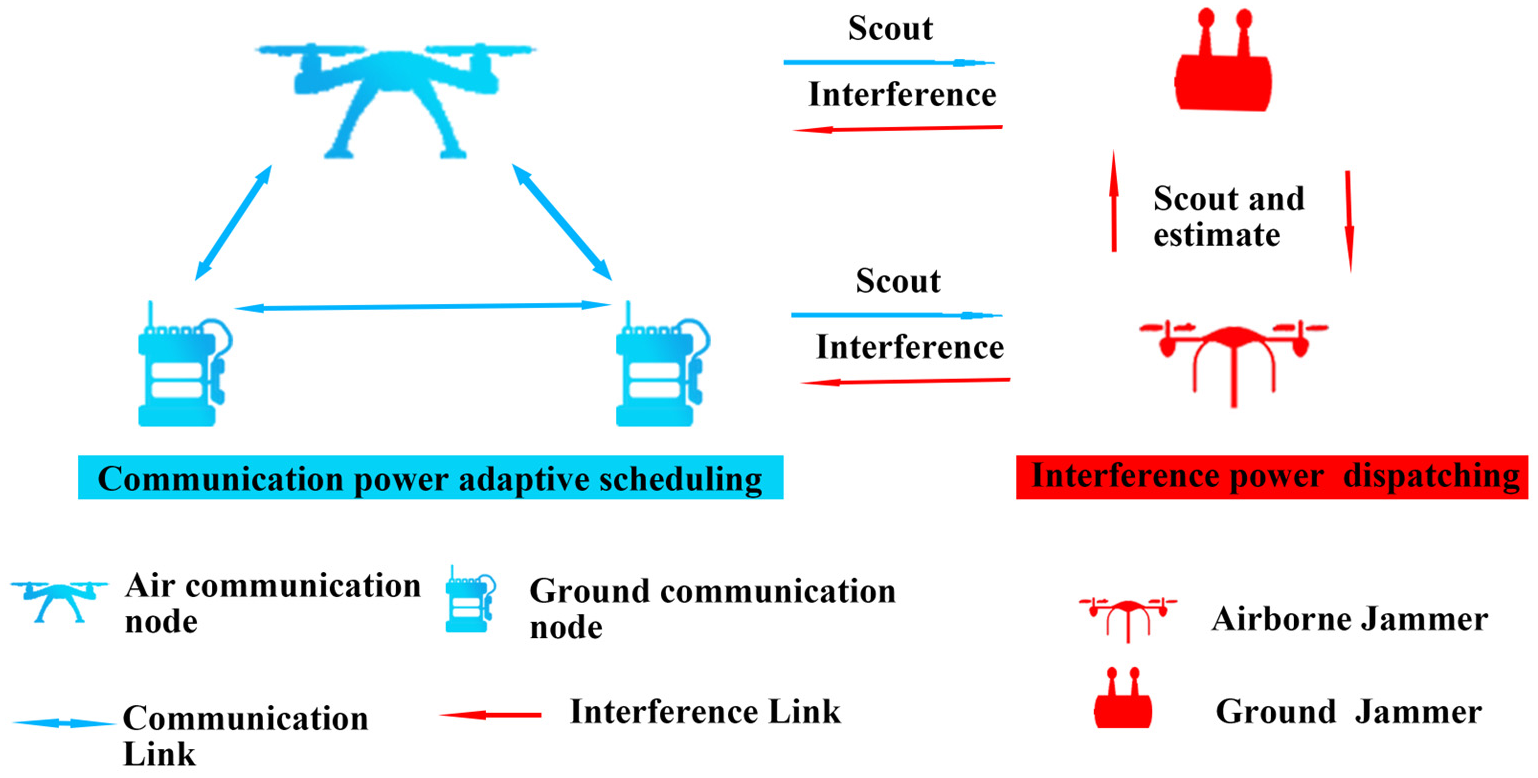
- Based on the detected and prior location information, cognitive and power scheduling strategies for non-networked jammers are designed.
- Considering the requirements of high-speed and overall countermeasures, a deterministic strategy with strong robustness is adopted.
- The OCSR is defined as the normalized temporal ratio between the total sustained full-suppression jamming duration and the partial effectiveness periods (i.e., periods where communication quality degrades above a threshold but remains detectable).
- A simulation experiment for distributed communication countermeasures in a complex electromagnetic environment is designed and solved, and the problem of the indeterminate decision-making order of jammers is identified.
2. Communication Countermeasure Mode
2.1. Mathematical Model of the Air–Ground Communication Network System
2.2. Mathematical Model of Air–Ground Joint Communication Jamming
2.2.1. Quantized Jammer-to-Signal Ratio
2.2.2. Restriction Conditions
2.2.3. System Operating Duration
2.2.4. Overall Communication Suppression Ratio
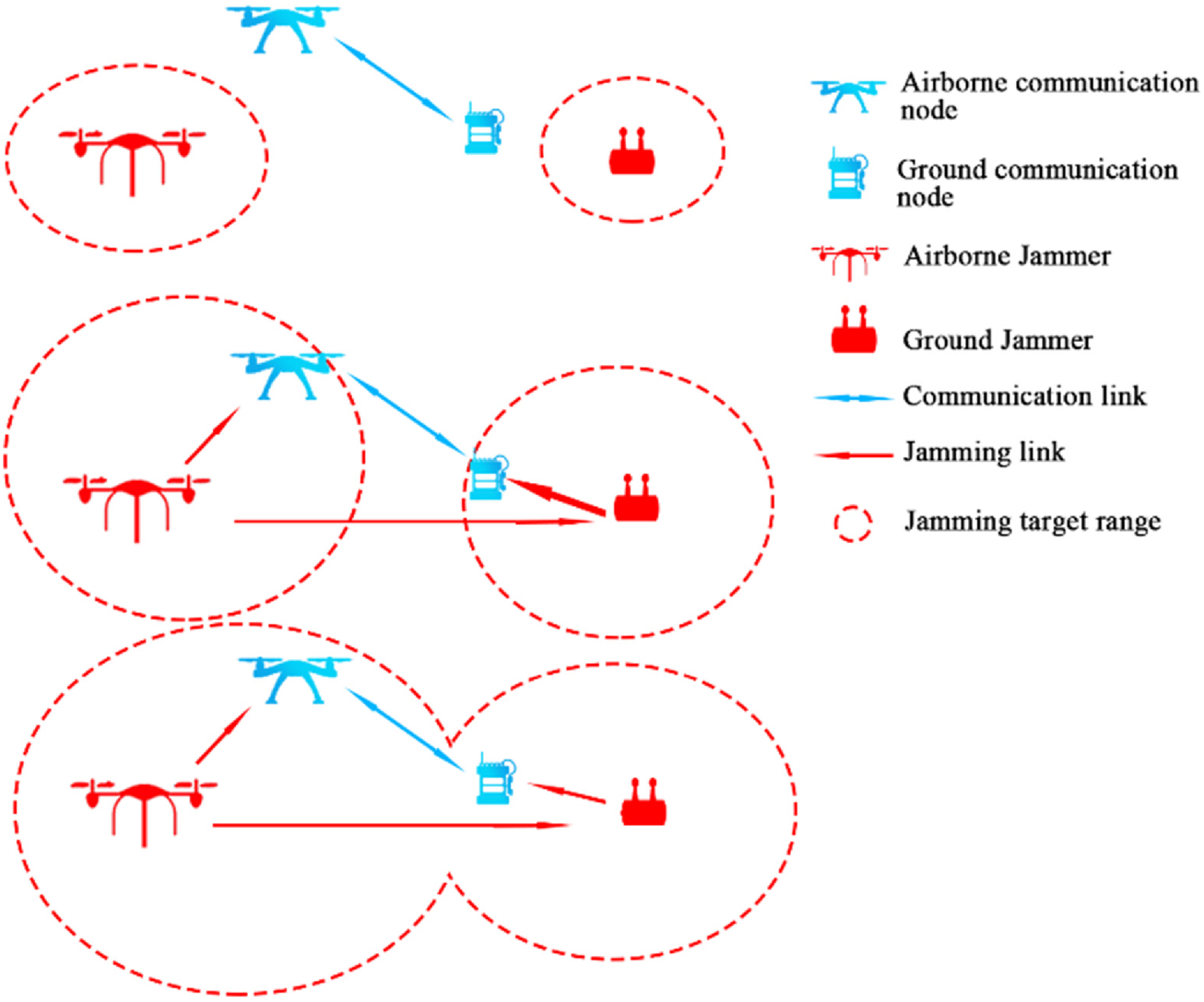
2.2.5. Configurable Range Gradation
2.3. Strategies of the Air–Ground Communication Party
| Algorithm 1 The Initial Communication Power Allocation Method | |
| Input: Communication Party Information | |
| Output: New Communication Party Information | |
| 1: | Select in order, for = 1 to |
| 2: | Search for with as the receiving node (Iterate through all communication links with as the receiving end, aiming to filter out the link with the minimum transmission loss and avoid initial power redundancy caused by improper link selection) |
| 3: | Estimate |
| 4: | Select in order, for = 1 to : |
| 5: | Select in order, for = 1 to : |
| 6: | If , or : |
| 7: | Estimate |
| 8: | If : |
| 9: | |
| 10: | End if |
| 11: | End if |
| 12: | Select in order, for = 1 to |
| 13: | If do not meet the demand for receiving signals: |
| 14: | Search for with as the transmitting node |
| 15: | Estimate |
| 16: | If : |
| 17: | |
| 18: | End if |
| 19: | End if |
| Algorithm 2: Communication Power Scheduling Method for Countering Interference | |
| Input: Communication Party Information | |
| Output: New Communication Party Information | |
| 1: | Select in order, for = 1 to |
| 2: | If = 0: |
| 3: | Adjust the transmitting state in a roulette wheel manner to be, lower than, higher than , and no transmission |
| 4: | End if |
| 5: | If and : |
| 6: | Adjust the transmitting state in a roulette wheel selection method to reduce, increase, maintain , and stop transmitting |
| 7: | End if |
| 8: | If : |
| 9: | = random(, 0) |
| 10: | End if |
2.4. Strategies of the Air–Ground Jamming Party
| Algorithm 3 Estimation Strategy of the Surrounding Electromagnetic Environment | |
| Input: The layout of communication countermeasures and the information of the electromagnetic environment detected | |
| Output: Estimated communication and jamming information | |
| 1: | If the detects the source azimuth and power of the signal from the : |
| 2: | Select in order, for = 1 to |
| 3: | Compare and , and infer the information and distance of |
| 4: | Estimate or |
| 5: | End if |
| 6: | If contains only one communication signal: |
| 7: | If Tier 1: |
| 8: | |
| 9: | End if |
| 10: | End if |
| 11: | Select in order, (signals within the Tier x and have not been detected) |
| 12: | If Tier 2: |
| 13: | Set as the receiving power. |
| 14: | End if |
| 15: | If Tier 3: |
| 16: | Take as the received power, and estimate |
| 17: | End if |
| 18: | Select in order, for = 1 to |
| 19: | Update |
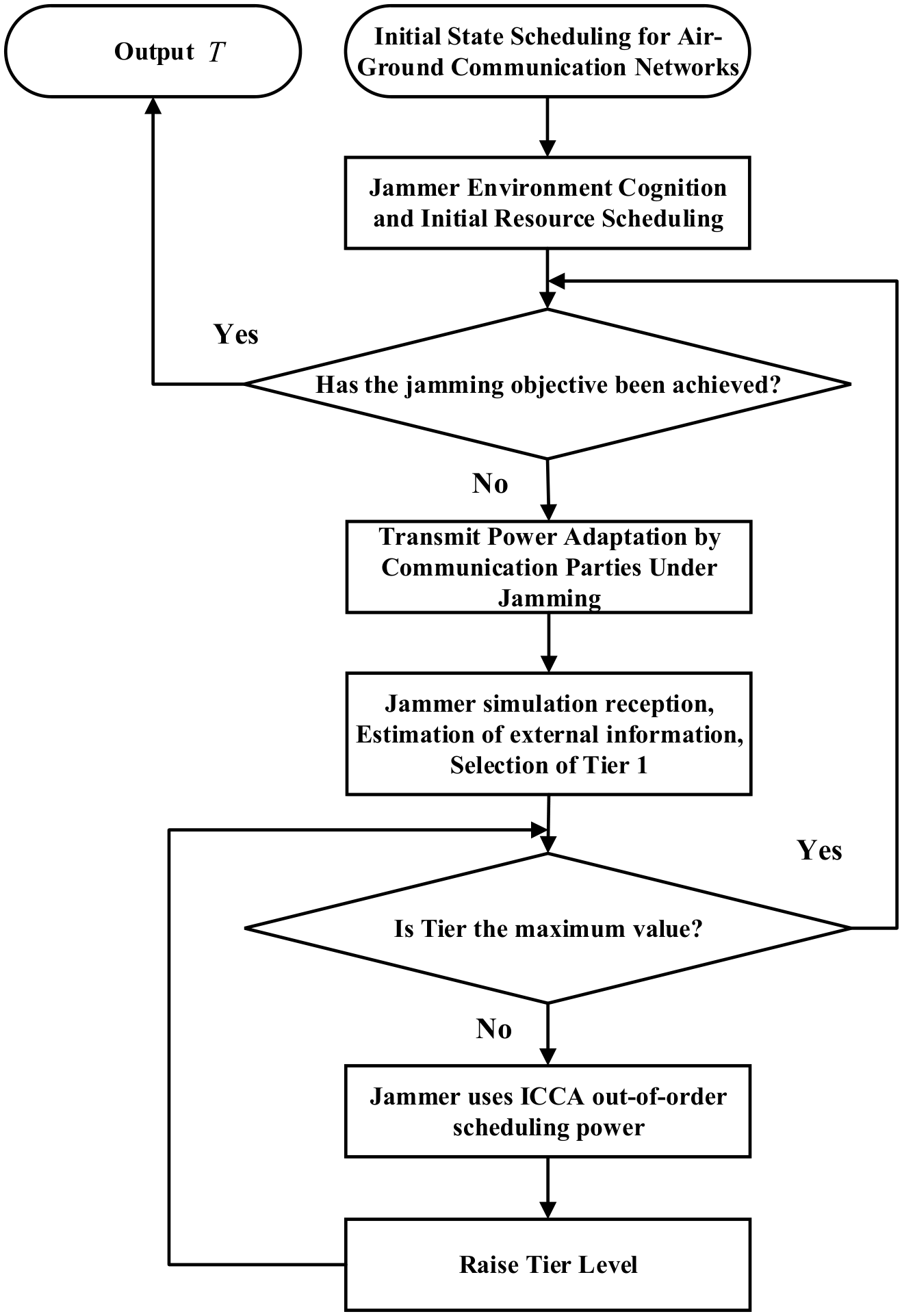
| Algorithm 4: Independent Scheduling Strategy of Jamming Power | |
| Input: Estimated communication information and real-time information of the interfering party | |
| Output: Jammer Power Setting | |
| 1: | Select in order, for = 1 to |
| 2: | Select in order, for = 1 to |
| 3: | If and , Tier x: |
| 4: | Calculate |
| 5: | |
| 6: | End if |
| 7: | Estimate |
| 8: | , update |
| 9: | If the battery power cannot guarantee : |
| 10: | Set the jamming power based on the current battery level |
| 11: | Else: |
| 12: | Set it as |
3. Simulation Experiment
3.1. Parameter Setting of the Simulation Scenario
3.2. Results and Analysis of the Comparative Experiment
4. Conclusions and Future Prospects
Author Contributions
Funding
Data Availability Statement
Acknowledgments
Conflicts of Interest
References
- Jornet, J.M.; Knightly, E.W.; Mittleman, D.M. Wireless communications sensing and security above 100 GHz. Nat. Commun. 2025, 14, 841. [Google Scholar] [CrossRef] [Scilit] [PubMed]
- Shrestha, R.; Guerboukha, H.; Fang, Z.; Knightly, E.; Mittleman, D.M. Jamming a terahertz wireless link. Nat. Commun. 2022, 13, 3045. [Google Scholar] [CrossRef] [Scilit]
- Kong, Z.; Cui, J.; Ding, L.; Huang, T.; Yan, S. Jamming precoding in AF relay-aided PLC systems with multiple eavesdroppers. Sci. Rep. 2024, 14, 8335. [Google Scholar] [CrossRef] [Scilit]
- Wang, X.; Huang, T.; Liu, Y. Resource allocation for random selection of distributed jammer towards multistatic radar system. IEEE Access 2021, 9, 29048–29055. [Google Scholar] [CrossRef] [Scilit]
- Li, S.; Liu, G.; Zhang, K.; Qian, Z.; Ding, S. DRL-Based Joint Path Planning and Jamming Power Allocation Optimization for Suppressing Netted Radar System. IEEE Signal Proc. Lett. 2023, 30, 548–552. [Google Scholar] [CrossRef] [Scilit]
- Zhang, D.; Sun, J.; Yi, W.; Yang, C.; Wei, Y. Joint Jamming Beam and Power Scheduling for Suppressing Netted Radar System. In Proceedings of the 2021 IEEE Radar Conference (RadarConf21), Atlanta, GA, USA, 7–14 May 2021; pp. 1–6. [Google Scholar]
- Lu, D.J.; Wang, X.; Wu, X.T.; Chen, Y. Adaptive allocation strategy for cooperatively jamming netted radar system based on improved cuckoo search algorithm. Def. Technol. 2023, 24, 285–297. [Google Scholar] [CrossRef] [Scilit]
- Xin, Q.; Xin, Z.; Chen, T. Cooperative Jamming Resource Allocation with Joint Multi-Domain Information Using Evolutionary Reinforcement Learning. Remote Sens. 2024, 16, 1955. [Google Scholar] [CrossRef] [Scilit]
- Yao, Z.; Tang, C.; Wang, C.; Shi, Q.; Yuan, N. Cooperative jamming resource allocation model and algorithm for netted radar. Electron. Lett. 2024, 58, 834–836. [Google Scholar] [CrossRef] [Scilit]
- Jin, W.-C.; Kim, K.; Choi, J.-W. Adaptive Jamming Considering Location Information Inaccuracy for Anti-UAV System. In Proceedings of the 2021 ICOIN, Jeju Island, Republic of Korea, 13–16 January 2021; pp. 480–482. [Google Scholar]
- Xiong, M.; Zhuo, J.; Dong, Y.; Jing, X. A layout strategy for distributed barrage jamming against underwater acoustic sensor networks. J. Mar. Sci. Eng. 2020, 8, 252. [Google Scholar] [CrossRef] [Scilit]
- Wu, Z.; Luo, Y.; Hu, S. Optimization of jamming formation of USV offboard active decoy clusters based on an improved PSO algorithm. Def. Technol. 2024, 32, 529–540. [Google Scholar] [CrossRef] [Scilit]
- Wang, H. Research on Anti-Jamming Strategy of IRS Communication Pair Under Information Uncertainty. Master’s Thesis, Nanjing University of Posts and Telecommunications, Nanjing, China, 2022. [Google Scholar]
- Wu, L.; Wang, W.; Ji, Z.; Yang, Y.; Cumanan, K.; Chen, G.; Dobre, O.A. UAV-assisted maritime legitimate surveillance: Joint trajectory design and power allocation. IEEE Trans. Veh. Technol. 2023, 72, 13701–13705. [Google Scholar] [CrossRef] [Scilit]
- Wei, Z.; Wu, W.; Zhan, J.; Zhang, Z. Distributed communication interference resource scheduling using the master-slave parallel scheduling genetic algorithm. Sci. Rep. 2025, 15, 3431. [Google Scholar] [CrossRef] [Scilit]
- Tang, C.; Ding, J.; Zhang, L. LEO satellite downlink distributed jamming optimization method using a non-dominated sorting genetic algorithm. Remote Sens. 2024, 16, 1006. [Google Scholar] [CrossRef] [Scilit]
- Amuru, S.; Buehrer, R.M. Optimal Jamming Against Digital Modulation. IEEE Trans. Inf. Forensics Secur. 2015, 10, 2212–2224. [Google Scholar] [CrossRef] [Scilit]
- Yao, Z.; Liu, T.; Wang, C. Cooperative jamming resource allocation model based on the improved firefly algorithm. In Proceedings of the 2022 6th International Conference on Electronic Information Technology and Computer Engineering, Xiamen, China, 21–23 October 2022; pp. 1719–1724. [Google Scholar]
- Lin, K. Research on Communication and Jamming Integrated Resource Allocation Based on Intelligent Optimization Algorithm. Master’s Thesis, Xidian University, Xi’an, China, 2023. [Google Scholar]
- Wu, T.; Zou, Q.; Yang, Y.; Zhang, X.; Liu, S. A hierarchical comb interference resource allocation algorithm based on greedy strategy and evolutionary algorithm. In Proceedings of the 2022 7th ICSP, Xi’an, China, 15–17 April 2022; pp. 299–303. [Google Scholar]
- Kong, F. Knowledge Based Communication Jamming Decisions. Master’s Thesis, University of Electronic Science and Technology of China, Chengdu, China, 2022. [Google Scholar]
- Wang, S.; Yang, J.; Gao, Y.; Hu, P.; Yang, J. The future is calling. In Cognitive Electronic Warfare: The Intelligent Game in the Electromagnetic Space, 1st ed.; Science Press: Beijing, China, 2024; pp. 89–122. [Google Scholar]
- Sharma, P.; Sarma, K.K.; Mastorakis, N.E. Artificial Intelligence Aided Electronic Warfare Systems—Recent Trends and Evolving Applications. IEEE Access 2020, 8, 224761–224780. [Google Scholar] [CrossRef] [Scilit]
- Liu, Z.; Wang, X.; Kang, W.; Chen, Y. Research on multi-UAV collaborative electronic countermeasures effectiveness method based on CRITIC weighting and improved gray correlation analysis. AIP Adv. 2024, 14, 045340. [Google Scholar] [CrossRef] [Scilit]
- Xiang, P.; Hua, X.; Lei, J.; Yue, Z.; Ning, R.A. Dynamic Adaptive Jamming Power Allocation Method Based on Deep Reinforcement Learning. Acta Electron. Sin. 2023, 5, 1223–1234. [Google Scholar]
- Zhao, C.; Wang, Q.; Liu, X.; Li, C.; Shi, L. Reinforcement learning based a non-zero-sum game for secure transmission against smart jamming. Digit. Signal Process. 2021, 112, 103002. [Google Scholar] [CrossRef] [Scilit]
- Rao, N.; Xu, H.; Jiang, L.; Song, B.; Shi, Y. Allocation Algorithm of Distributed Cooperative Jamming Power Basedon Multi-Agent Deep Reinforcement Learning. Acta Electron. Sin. 2022, 6, 1319–1330. [Google Scholar]
- Amuru, S.; Tekin, C.; van der Schaar, M.; Buehrer, R. Jamming bandits—A novel learning method for optimal jamming. IEEE Trans. Wirel. Commun. 2015, 15, 2792–2808. [Google Scholar] [CrossRef] [Scilit]
- Zhuansun, S.; Yang, J.-A.; Liu, H.; Huang, K. A novel jamming strategy-greedy bandit. In Proceedings of the 2017 IEEE 9th ICCSN, Guangzhou, China, 6–8 May 2017; pp. 1142–1146. [Google Scholar]
- Zhuansun, S.; Yang, J.A.; Liu, H. An algorithm for jamming strategy using OMP and MAB. EURASIP J. Wirel. Commun. Netw. 2019, 2019, 85. [Google Scholar] [CrossRef] [Scilit]
- Zhuansun, S.; Yang, J.; Liu, H.; Huang, K. An algorithm for jamming decision using dual reinforcement learning. J. Xi’an Jiaotong Univ. 2018, 52, 63–69. [Google Scholar]
- Zhou, C.; Ma, C.; Lin, Q.; Man, X.; Ying, T. Intelligent bandit learning for jamming strategy generation. Wirel. Netw. 2023, 29, 2391–2403. [Google Scholar] [CrossRef] [Scilit]
- Rao, N.; Xu, H.; Zhang, Y.; Wang, D.; Jiang, L.; Peng, X. Joint optimization of jamming link and power control in communication countermeasures: A multiagent deep reinforcement learning approach. Wirel. Commun. Mob. Com. 2022, 1, 7962686. [Google Scholar] [CrossRef] [Scilit]
- Li, X.; Cui, Q.; Zhao, B.; Zhang, X.; Jiang, B.; Tao, X. Distributed Multi-Agent Interference Coordination in Native AI Enabled Multi-Cell Networks for 6G. In Proceedings of the 2023 26th International Symposium on WPMC, Tampa, FL, USA, 19–22 November 2023; pp. 8–13. [Google Scholar]
- Li, F.; Xiong, J.; Zhao, X.; Zhao, H.; Wei, J.; Su, M. Wireless communications interference avoidance based on fast reinforcement learning. J. Electron. Inf. Technol. Sin. 2022, 44, 3842–3849. [Google Scholar]
- Niu, Y.; Wan, B.; Chen, C. A centralized multi-user anti-composite intelligent interference algorithm based on improved Q-learning. Electronics 2023, 12, 1803. [Google Scholar] [CrossRef] [Scilit]
- Verguts, T. 9 Reinforcement Learning: The Markov Decision Process Approach; MIT Press: Cambridge, MA, USA, 2021; pp. 133–152. [Google Scholar]
- Yang, H.; Zhang, J. Research on intelligent interference algorithm based on reinforcement learning. Electron. Meas. Technol. 2018, 41, 49–54. [Google Scholar]
- Andersen, M.; Hansson, A. Reinforcement Learning; Wiley: Hoboken, NJ, USA, 2023; pp. 327–349. [Google Scholar]
- Zhou, C.; Lin, X.; Ma, S.; Ying, T.; Man, X. Intelligent Decision-making for Selection of Communication Jamming Channel and Power. J. Electron. Inf. Technol. Sin. 2024, 46, 3957–3965. [Google Scholar]
- Rao, N.; Xu, H.; Qi, Z.; Song, B.; Shi, Y. Allocation method of communication interference resource based on deep reinforcement learning of maximum policy entropy. J. Northwest. Polytech. Univ. 2021, 39, 1077–1086. [Google Scholar] [CrossRef] [Scilit]
- Peng, X.; Xu, H.; Jiang, L.; Rao, N.; Song, B. A deep reinforcement learning communication jamming resource allocation algorithm fused with noise network. J. Electron. Inf. Techn. Sin. 2023, 45, 1043–1054. [Google Scholar]
- Ning, R.; Hu, X.; Song, B. Q-learning intelligent jamming decision algorithm based on efficient upper confidence bound variance. J. Harbin Inst. Technol. Engl. Ed. 2022, 54, 162–170. [Google Scholar]
- Xu, H.; Song, B.; Jiang, L.; Rao, N.; Shi, Y. An Intelligent Decision-making Algorithm for Communication Countermeasure Jamming Resource Allocation. J. Electron. Inf. Techn. Sin. 2021, 43, 3086–3095. [Google Scholar]
- Bailin, S.; Hux, X.; Zisen, Q.; Ning, R.; Peng, P. A Collaborative Communication Jamming Decision Algorithm Based on Deep Reinforcement Learning. Acta Electron. Sin. 2022, 50, 1301–1309. [Google Scholar]
- Liu, Y.; Li, X.; Yang, J.; Yang, J.; Wang, J. SANER-PPO algorithm-based jamming resource allocation for UAV swarm. Control Decis. 2024, 39, 3937–3945. [Google Scholar]
- Zhuansun, S. Research on Reinforcement Learning Based Communication Jamming Strategy Learning Methods. Doctoral Dissertation, National University of Defense Technology, Changsha, China, 2019. [Google Scholar]
- Li, X.; Chen, J.; Ling, X.; Wu, T. Deep Reinforcement Learning-Based Anti-Jamming Algorithm Using Dual Action Network. IEEE Trans. Wirel. Commun. 2023, 22, 4625–4637. [Google Scholar] [CrossRef] [Scilit]
- Jing, X.; Wang, R.; Lei, H.; Liu, H.; Chen, Q. Multi-Agent Discrete Soft Actor-Critic Algorithm-Based Multi-User Collaborative Anti-Jamming Strategy. IEEE Trans. Inf. Forensics Secur. 2025, 20, 5025–5038. [Google Scholar] [CrossRef] [Scilit]
- Li, Y.; Xu, Y.; Li, W.; Li, G.; Feng, Z.; Liu, S.; Du, J.; Li, X. Achieving Hiding and Smart Anti-Jamming Communication: A Parallel DRL Approach Against Moving Reactive Jammer. IEEE Trans. Commun. 2025, 73, 8377–8390. [Google Scholar] [CrossRef] [Scilit]
- Ma, Y.; Liu, K.; Liu, Y.; Wang, X.; Zhao, Z. An Intelligent Game-Based Anti-Jamming Solution Using Adversarial Populations for Aerial Communication Networks. IEEE Trans. Cogn. Commun. Netw. 2025, 11, 1981–1995. [Google Scholar] [CrossRef] [Scilit]
- Liu, S.; Yang, H.; Zheng, M.; Xiao, L.; Xiong, Z.; Niyato, D. UAV-Enabled Semantic Communication in Mobile Edge Computing Under Jamming Attacks: An Intelligent Resource Management Approach. IEEE Trans. Wirel. Commun. 2024, 11, 17493–17507. [Google Scholar] [CrossRef] [Scilit]
- Li, L.; Jing, X.; Lei, H.; Liang, C.; Chen, Q. Distributed Anti-Jamming Strategy Based on Local Knowledge Diffusion and Differential Weighted Fusion Mechanisms. IEEE Trans. Inf. Forensics Secur. 2025, 20, 9054–9067. [Google Scholar] [CrossRef] [Scilit]
- Wei, Z.; Zhan, J.; Han, S.; Wu, M. Introduction. In Air-Ground Joint Distributed Communication Jamming Technology and Practice, 1st ed.; National Defense Industry Press: Beijing, China, 2023; pp. 1–5. [Google Scholar]
- Hua, X.; Jun, W.; Lei, J. Communication Interference Technologies and Methods. In Principles and Applications of Modern Communication Countermeasures, 1st ed.; National Defense Industry Press: Beijing, China, 2022; pp. 403–411. [Google Scholar]
- Rao, N.; Xu, H.; Wang, D.; Qi, Z.; Zhang, Y.; Gu, W.; Peng, X. Efficient jamming resource allocation against frequency-hopping spread spectrum in WSNs with asynchronous deep reinforcement learning. IEEE Sens. J. 2024, 24, 13560–13577. [Google Scholar] [CrossRef] [Scilit]
- Rao, N.; Xu, H.; Qi, Z.; Wang, D.; Peng, X.; Jiang, L. Adaptive jamming decision-making against FHSS communications via inexpert demonstrations assisted meta reinforcement learning. IEEE Commun. Lett. 2024, 29, 105–109. [Google Scholar] [CrossRef] [Scilit]



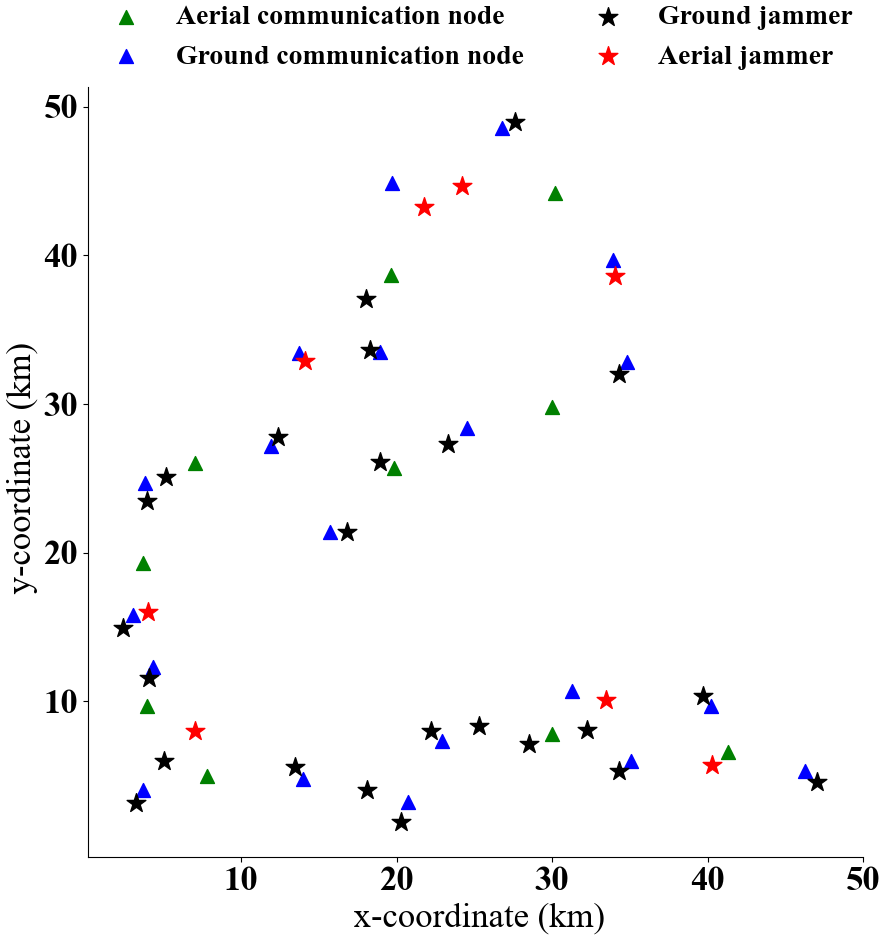
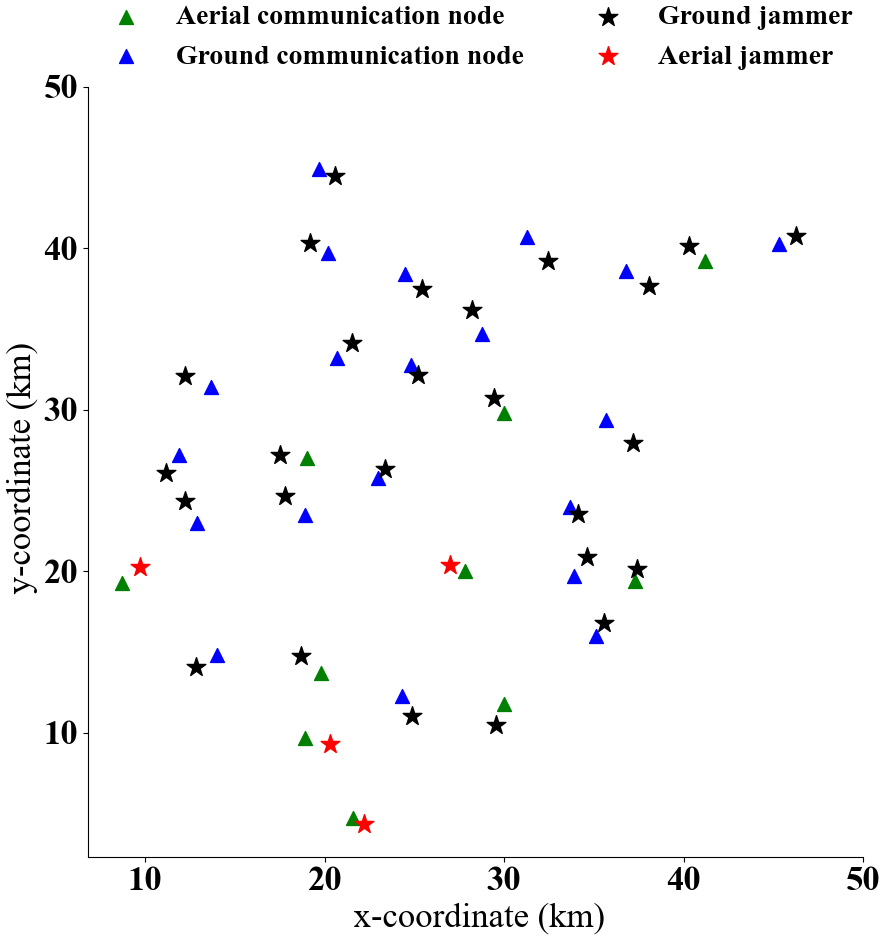
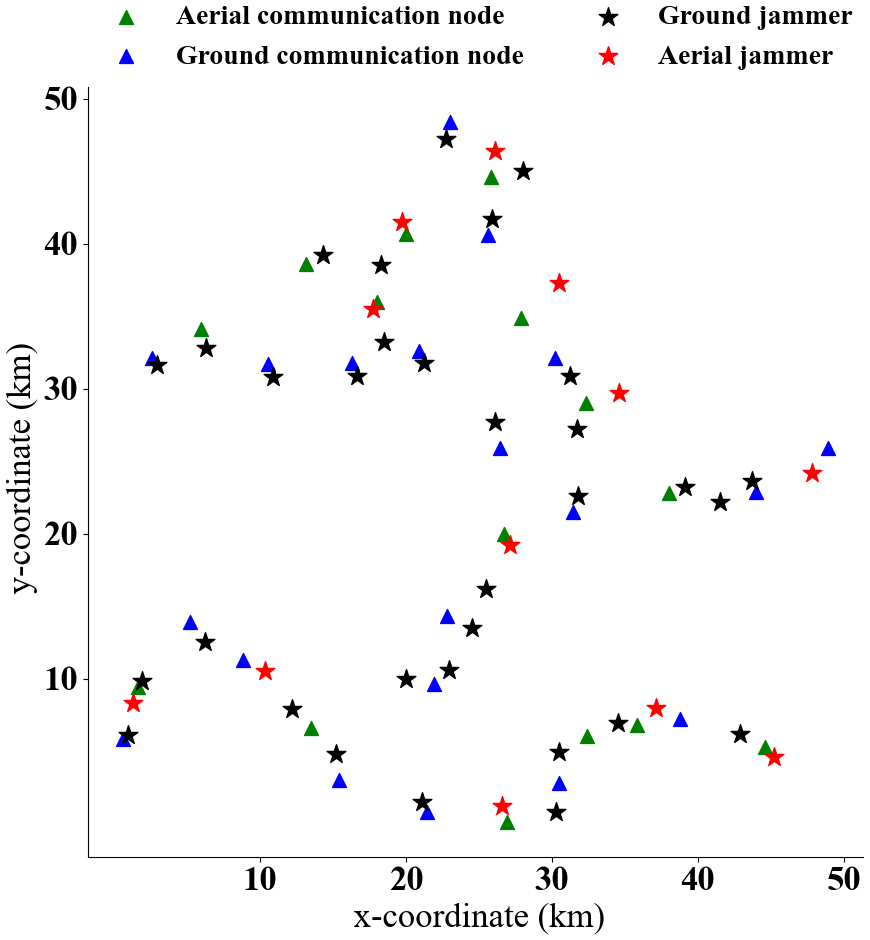
| Scenario 1 | Scenario 2 | Scenario 3 | |
|---|---|---|---|
| Airborne Communication Nodes | 10 | 10 | 15 |
| Ground Communication Nodes | 20 | 20 | 20 |
| Ground jammers | 8 | 26 | 32 |
| Airborne jammer | 24 | 4 | 12 |
| Project | Parameter |
|---|---|
| Maximum transmitting power of airborne communication equipment | 10 dBW |
| Antenna gain of airborne communication equipment | 2 dBi |
| Height of airborne communication equipment | 2000–3000 m |
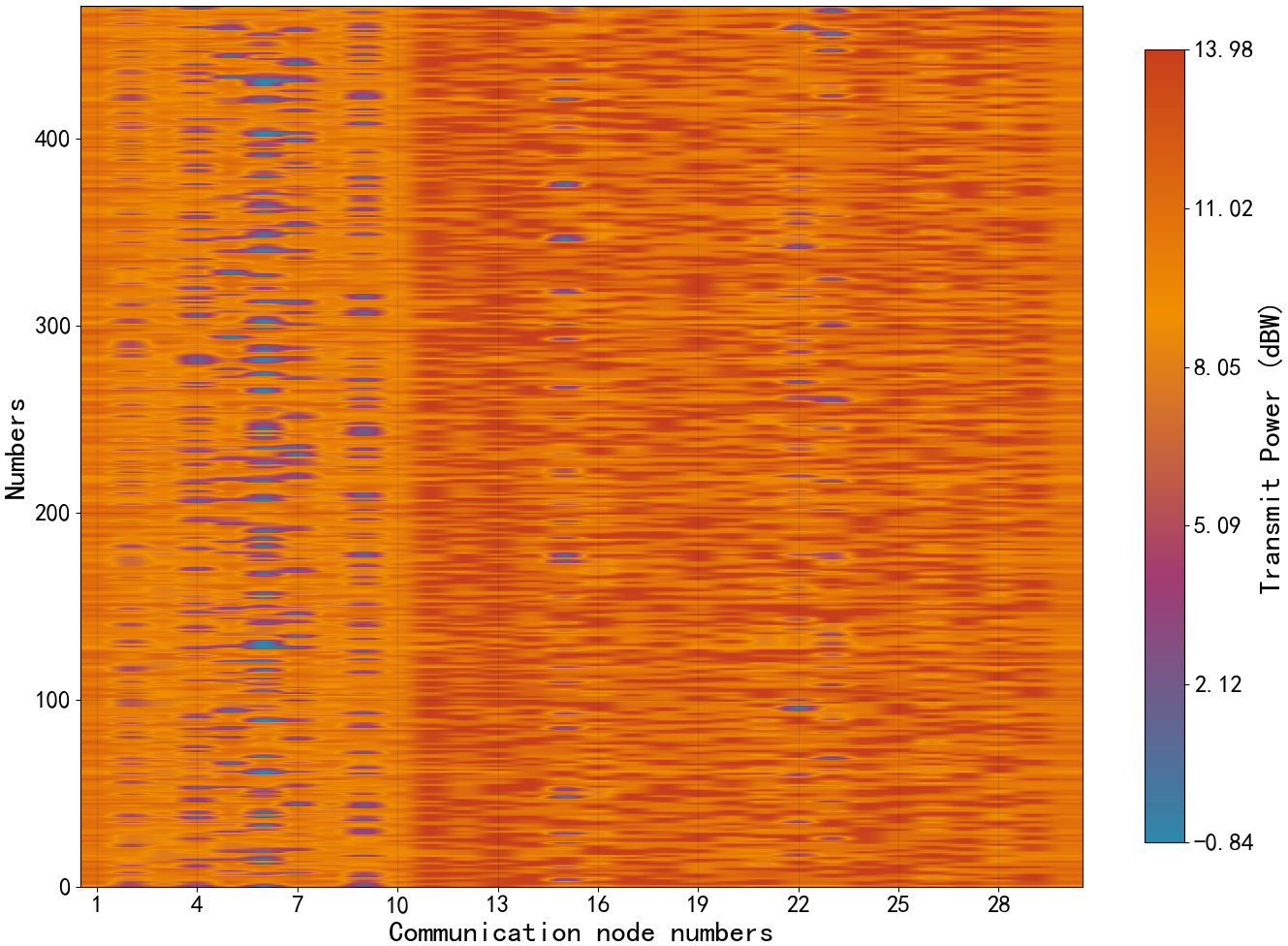
| Maximum transmitting power of ground communication equipment | 13.98 dBW |
| Antenna gain of ground communication equipment | 2.5 dBi |
| Height of ground communication equipment | 10 m |
| Communication frequency band | 600 MHz |
| Receiving sensitivity of communication equipment | −133 dBW |
| Communication link margin | 12 dB |
| Ambient electromagnetic noise | −95–−115 dBW |
| Antenna gain of jammers | 2 dBi |
| Maximum jamming power of airborne jammers | 13 dBW |
| Height of airborne jammers | 300–2000 m |
| Maximum jamming power of ground jammers | 16 dBW |
| Height of ground jammers | 3 m |
| Planar area of the simulation scenario | 50 km × 50 km |
| Attenuation of cables and cable connectors at the communication receiving end | 1 dB |
| Environmental factor for line-of-sight propagation | 3 |
| Environmental factor for two-ray propagation | 3 |
| The jamming-to-signal ratio when the communication quality deteriorates | 1.76 dB [16] |
| The jamming-to-signal ratio for communication interference suppression | 4.77 dB [54] |
| Maximum battery power limit required for normal jamming | 0.95 |
| Operating voltage of jammer batteries | 24 V |
| Battery capacity of airborne jammers | 12 AH |
| Battery capacity of ground jammers | 20 AH |
| Energy consumption of other functions of jammers | 4 W |
| Minimum distance between jammers and communication equipment | 500 m |
| Time limit for the first decision of intelligent optimization algorithms | 10 s |
| Time limit for non-first interference decision | 1 s |
| Communication state adjustment interval | 90 s |
| Angle Recognition Accuracy of Communication Nodes | 0.3 degrees |
| Tier X in scenario 1 | 3 |
| Tier X in scenario 2 | 2 |
| Tier X in scenario 3 | 5 |
| The proportion of communication nodes that are disturbed | 0.9 |
| The minimum distance between jammers and communication nodes [27] | 500 m |
| The flexible update coefficient of MADJPA [27] | 0.01 |
| The number of training episodes of MADJPA [27] | 5000 |
| The number of interactions per episode of MADJPA [27] | 500 |
| The capacity of the experience replay buffer of MADJPA [27] | 217 |
| The discount factor of MADJPA [27] | 0.98 |
| The initial value of the entropy coefficient of MADJPA [27] | 1 |
| Fixed random number seed for Scenario 1 of MADJPA | 36 |
| Fixed random number seed for Scenario 2 of MADJPA | 46 |
| Fixed random number seed for Scenario 3 of MADJPA | 40 |
| The commit hash of the ICCA code | 4a4c29994211a1 e2109bad2f2a75 a9f670634164 |
| Fixed random number seed for Scenario 1 of ICCA | 36 |
| Fixed random number seed for Scenario 2 of ICCA | 46 |
| Fixed random number seed for Scenario 3 of ICCA | 40 |
| Random number generation module | NumPy’s numpy.random submodule |
| Threshold for airborne jammers targeting air–ground communication objectives | [2.8, 5.2, 7.8, 10.4, 15, 20] km |
| Threshold for ground jammers targeting ground communication objectives | [1.7, 3, 4.5, 6, 10, 16] km |
| Threshold for ground jammers targeting airborne communication objectives | [3.1, 6.2, 9.3, 12.4, 15, 20] km |
| Tier X in scenario 1 of ICCA | 3 |
| Tier X in scenario 2 of ICCA | 2 |
| Tier X in scenario 3 of ICCA | 5 |
| Algorithm | ICCA | FPJA | MADJPA | SRSA | GA | |
|---|---|---|---|---|---|---|
| Indicator | ||||||
| Scenario 1 | Training time (95% CI) | None | None | 1.67 ± 0.44 s | None | None |
| Time for each decision (95% CI) | 64.2 ± 9.8 ms | 10.2 ± 1.4 ms | 40.3 ± 14 ms | None | None | |
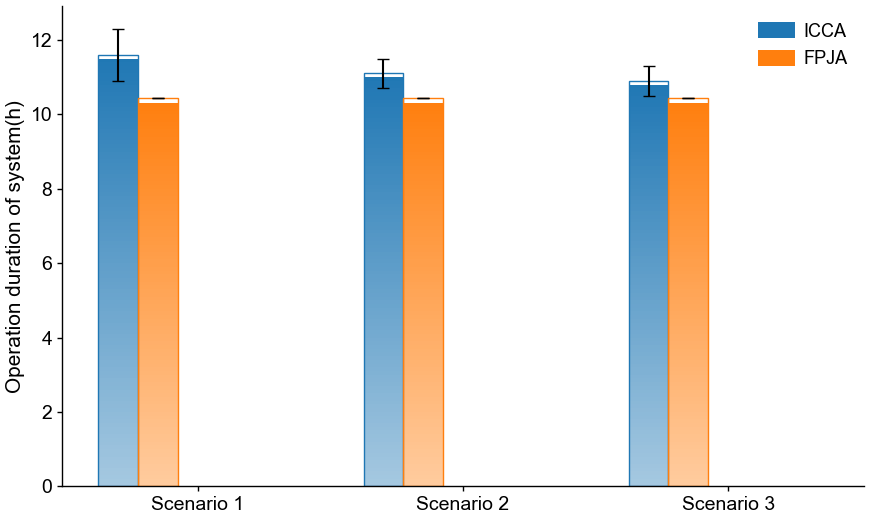
| Operation duration of system (95% CI) | 11.6 ± 0.7 h | 10.4 ± 0 h | 0.02 ± 0.02 h | None | None | |
| OCSR (95% CI) | 0.16 ± 0.12 | 1 ± 0 | 0.92 ± 0.27 | None | None | |
| Scenario 2 | Training time (95% CI) | None | None | 1.73 ± 0.35 s | None | None |
| Time for each decision (95% CI) | 92.2 ± 11.2 ms | 8.8 ± 1.6 ms | None | None | None | |
| Operation duration of system (95% CI) | 11.1 ± 0.4 h | 10.4 ± 0 h | None | None | None | |
| OCSR (95% CI) | 0 ± 0.04 | 1 ± 0 | None | None | None | |
| Scenario 3 | Training time (95% CI) | None | None | 1.79 ± 0.31 s | None | None |
| Time for each decision (95% CI) | 112.6 ± 13.5 ms | 9.71 ± 1.8 ms | None | None | None | |
| Operation duration of system (95% CI) | 10.9 ± 0.4 h | 10.4 ± 0 h | None | None | None | |
| OCSR (95% CI) | 0.05 ± 0.03 | 1 ± 0 | None | None | None |
| Algorithm | ICCA | FPJA | |
|---|---|---|---|
| Indicator | |||
| Scenario 1 | Ground jammer max | 14 AH | 0 AH |
| Ground jammer mean | 5.37 ± 3.67 AH | 0 ± 0 AH | |
| Ground jammer failure ratio | 0.18 | 1 | |
| Air jammer max | 4.55 AH | 1.16 AH | |
| Air jammer mean | 1.19 ± 1.27 AH | 1.16 ± 0 AH | |
| Air jammer failure ratio | 0.1 | 0 | |
| Scenario 2 | Ground jammer max | 15.89 AH | 0 AH |
| Ground jammer mean | 6.6 ± 6.3 AH | 0 ± 0 AH | |
| Ground jammer failure ratio | 0.16 | 1 | |
| Air jammer max | 9.83 AH | 1.16 AH | |
| Air jammer mean | 6.6 ± 4.9 AH | 1.16 ± 0 AH | |
| Air jammer failure ratio | 0 | 0 | |
| Scenario 3 | Ground jammer max | 17.8 AH | 0 AH |
| Ground jammer mean | 5.5 ± 4.9 AH | 0 ± 0 AH | |
| Ground jammer failure ratio | 0.15 | 1 | |
| Air jammer max | 5.2 AH | 1.16 AH | |
| Air jammer mean | 1.1 ± 1.2 AH | 1.16 ± 0 AH | |
| Air jammer failure ratio | 0 | 0 |
Disclaimer/Publisher’s Note: The statements, opinions and data contained in all publications are solely those of the individual author(s) and contributor(s) and not of MDPI and/or the editor(s). MDPI and/or the editor(s) disclaim responsibility for any injury to people or property resulting from any ideas, methods, instructions or products referred to in the content. |
© 2026 by the authors. Licensee MDPI, Basel, Switzerland. This article is an open access article distributed under the terms and conditions of the Creative Commons Attribution (CC BY) license.
Share and Cite
Wu, W.; Wei, Z.; You, H.; Zhang, Z.; Li, C.; Zhan, J.; Zhao, S. ICCA: Independent Multi-Agent Algorithm for Distributed Jamming Scheduling. Algorithms 2026, 19, 73. https://doi.org/10.3390/a19010073
Wu W, Wei Z, You H, Zhang Z, Li C, Zhan J, Zhao S. ICCA: Independent Multi-Agent Algorithm for Distributed Jamming Scheduling. Algorithms. 2026; 19(1):73. https://doi.org/10.3390/a19010073
Chicago/Turabian StyleWu, Wenpeng, Zhenhua Wei, Haiyang You, Zhaoguang Zhang, Chenxi Li, Jianwei Zhan, and Shan Zhao. 2026. "ICCA: Independent Multi-Agent Algorithm for Distributed Jamming Scheduling" Algorithms 19, no. 1: 73. https://doi.org/10.3390/a19010073
APA StyleWu, W., Wei, Z., You, H., Zhang, Z., Li, C., Zhan, J., & Zhao, S. (2026). ICCA: Independent Multi-Agent Algorithm for Distributed Jamming Scheduling. Algorithms, 19(1), 73. https://doi.org/10.3390/a19010073