
Signal Timing Optimization Method for Intersections Under Mixed Traffic Conditions

Abstract
1. Introduction
2. Intersection Queuing Network Model
2.1. Model Description
2.2. Lane Queuing System
2.2.1. Road Section Node Queueing Model
2.2.2. Road Section Feedback Queueing Model
2.3. Regional Road Queue Network Model
3. Intersection Queuing Model with Multiple Classes
3.1. Multi-Class Customer Queueing Model for Road Section
3.2. Service Rate of Multi-Class Customer Queueing System
4. Performance Indicators and Solution Algorithms
4.1. Performance Indicators
4.1.1. Delay Time
4.1.2. Electric Energy Consumption
4.1.3. Fuel Consumption and Emissions
4.2. Solution Algorithms
| Algorithm 1: Recursive algorithm for solving multi-class customer feedback queuing network at intersections. |
| Input: System parameters of multi-class feedback queuing network New energy vehicle penatration: p Initial system state: Path transition probability: External time-varying arrival rate: System parameters of queuing node: Traffic signal control scheme: |
| Output: Performance parameters of the concerned feedback queueing network at any time system state |
| Recursive solution of feedback queuing network |
| For |
| Calculate: |
| End For |
| For |
| For |
| For |
| Calculate |
| End For |
| Calculate: |
| End For |
| For |
| Calculate |
| End For |
| For |
| Calculate: Calculate: Calculate: Calculate: |
| End For |
4.3. Model Verification
4.3.1. Parameter Setting
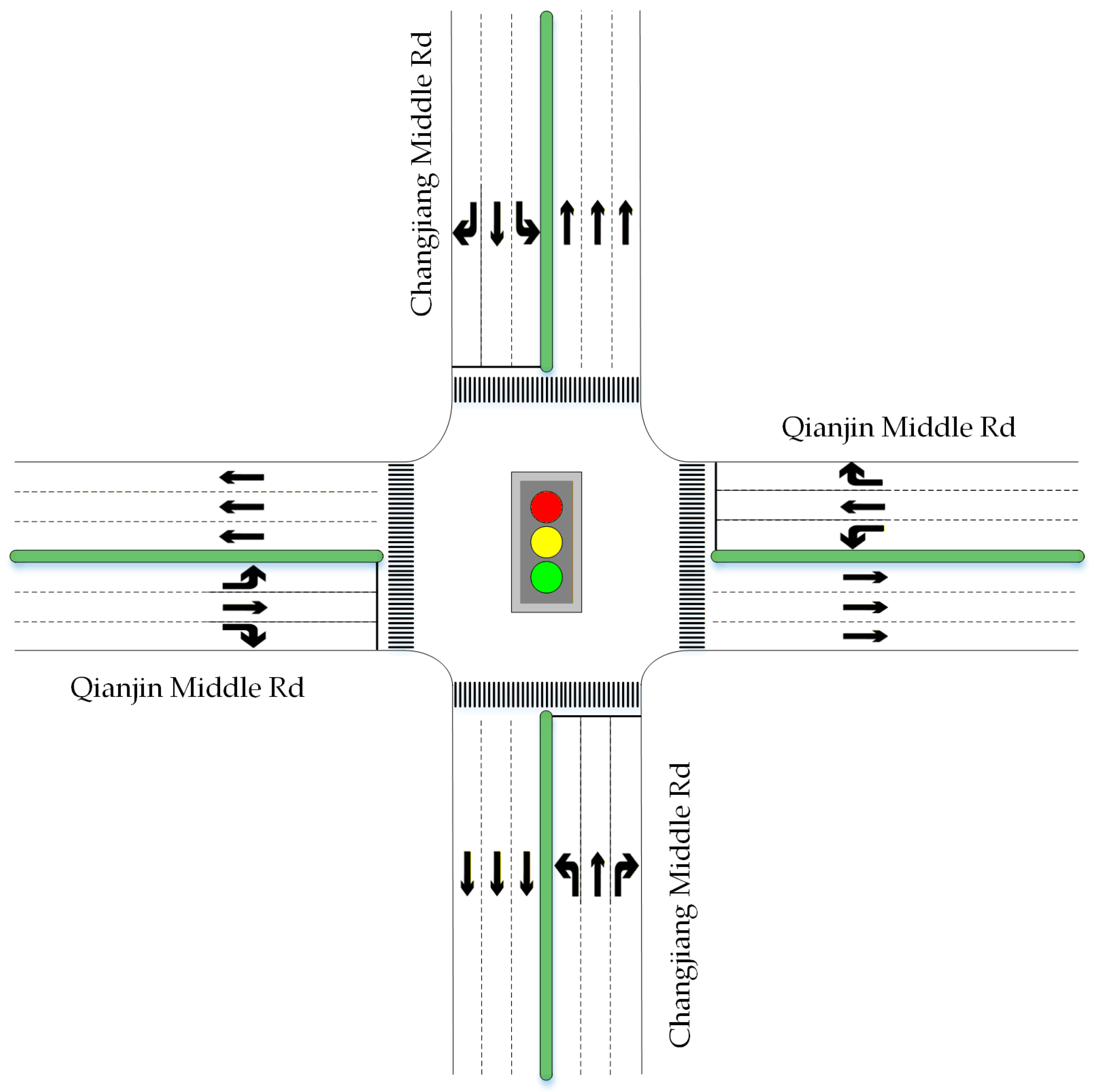
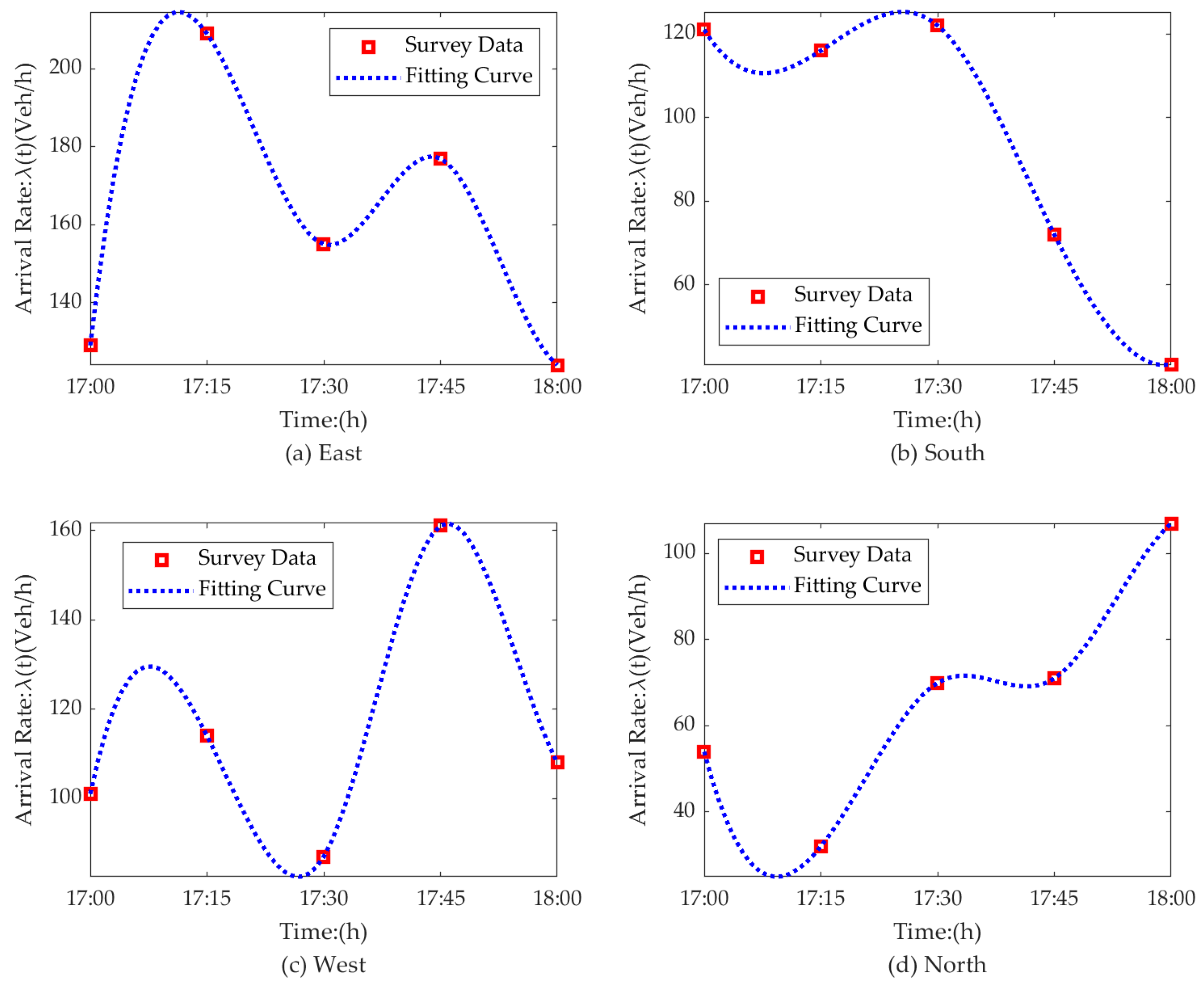
Traffic Survey
- (1)
- Conventional Vehicles (CV): Combining Internal Combustion Engine (ICE) propulsion with human-driven (HDV) characteristics, modeled by the IDM.
- (2)
- New Energy and Connected Vehicles (NECV): Combining electric propulsion with a higher level of automation/connectivity, modeled by the CACC.
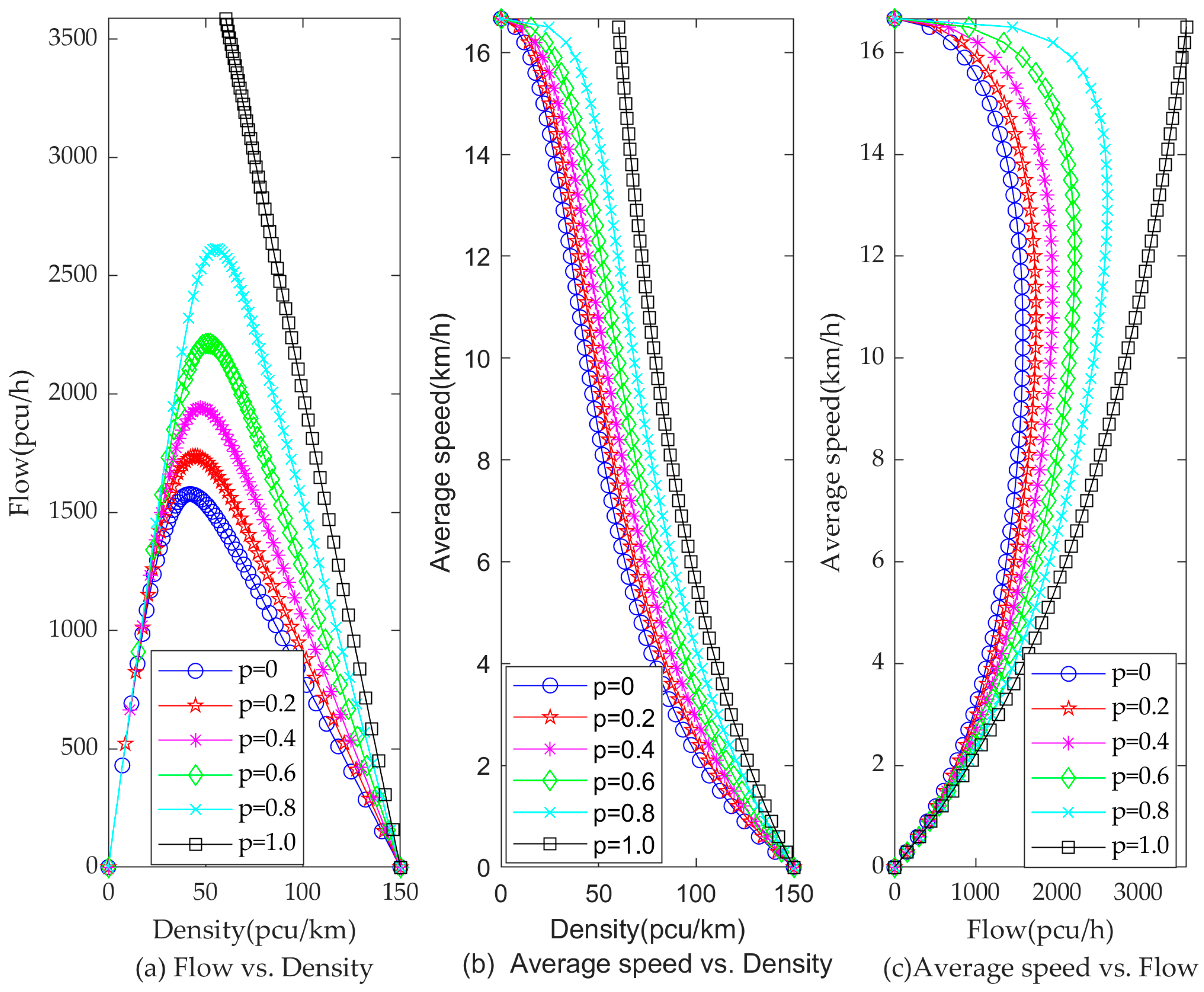
Linkage Between Car-Following Interactions and Queuing Dynamics
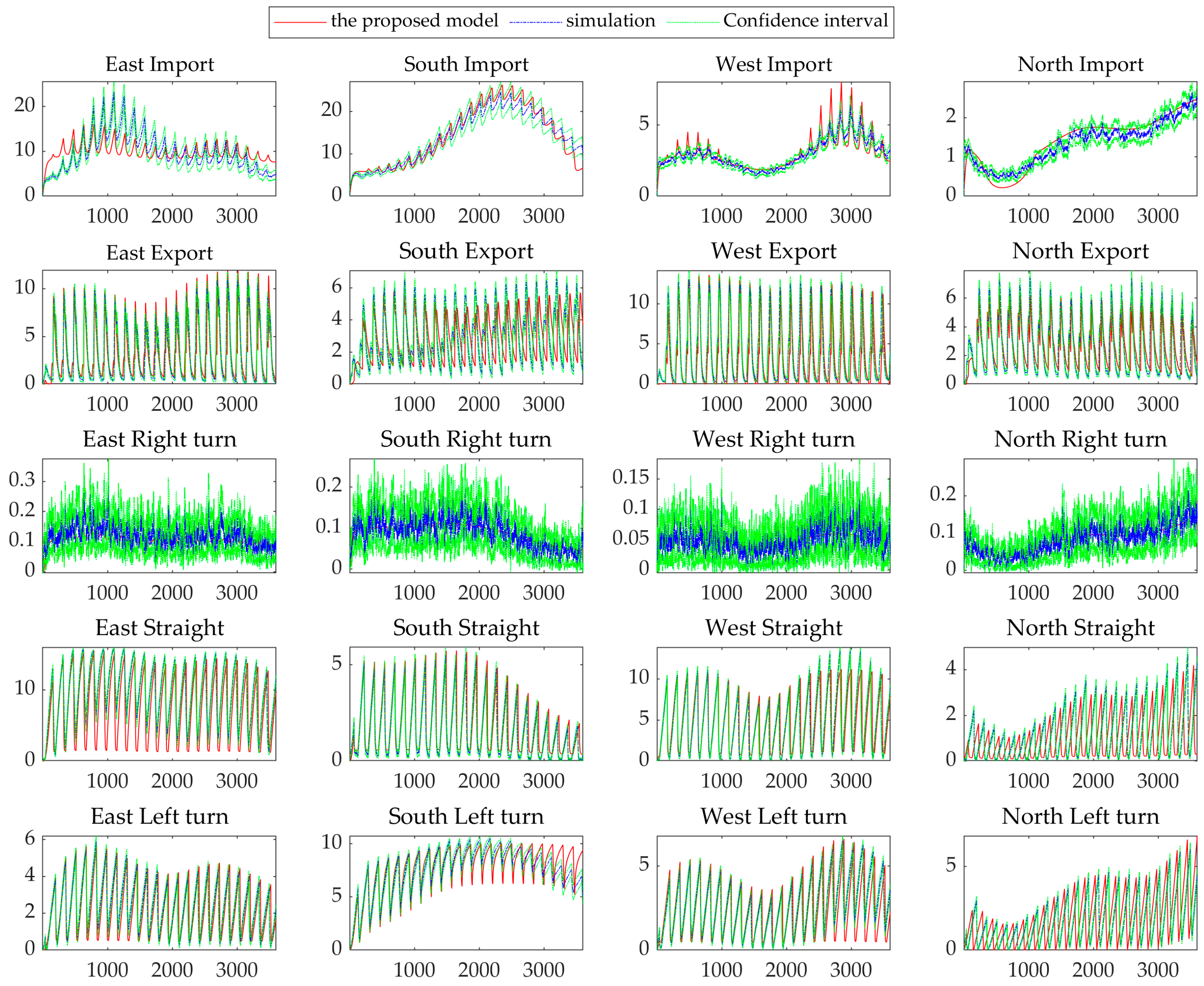
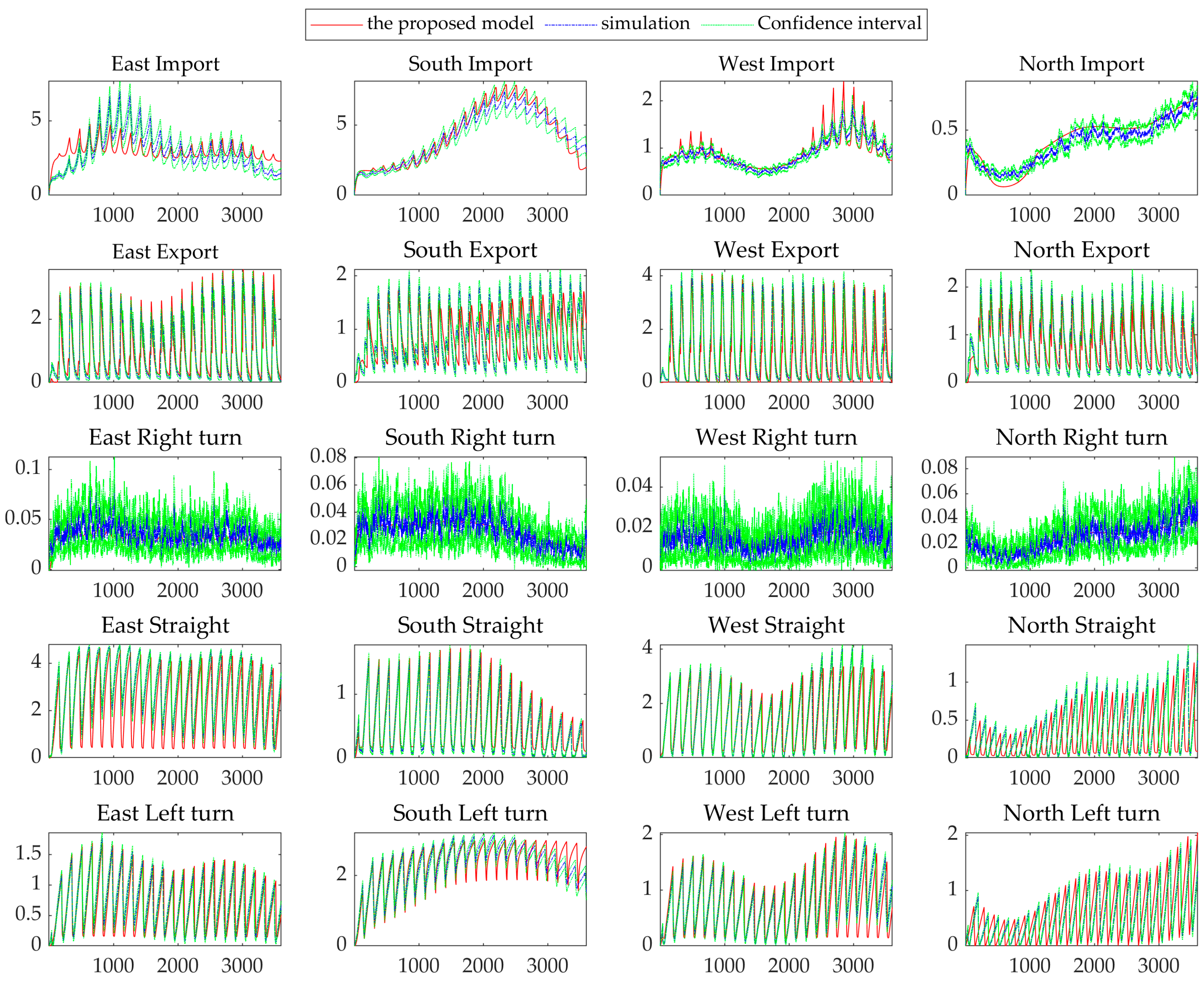
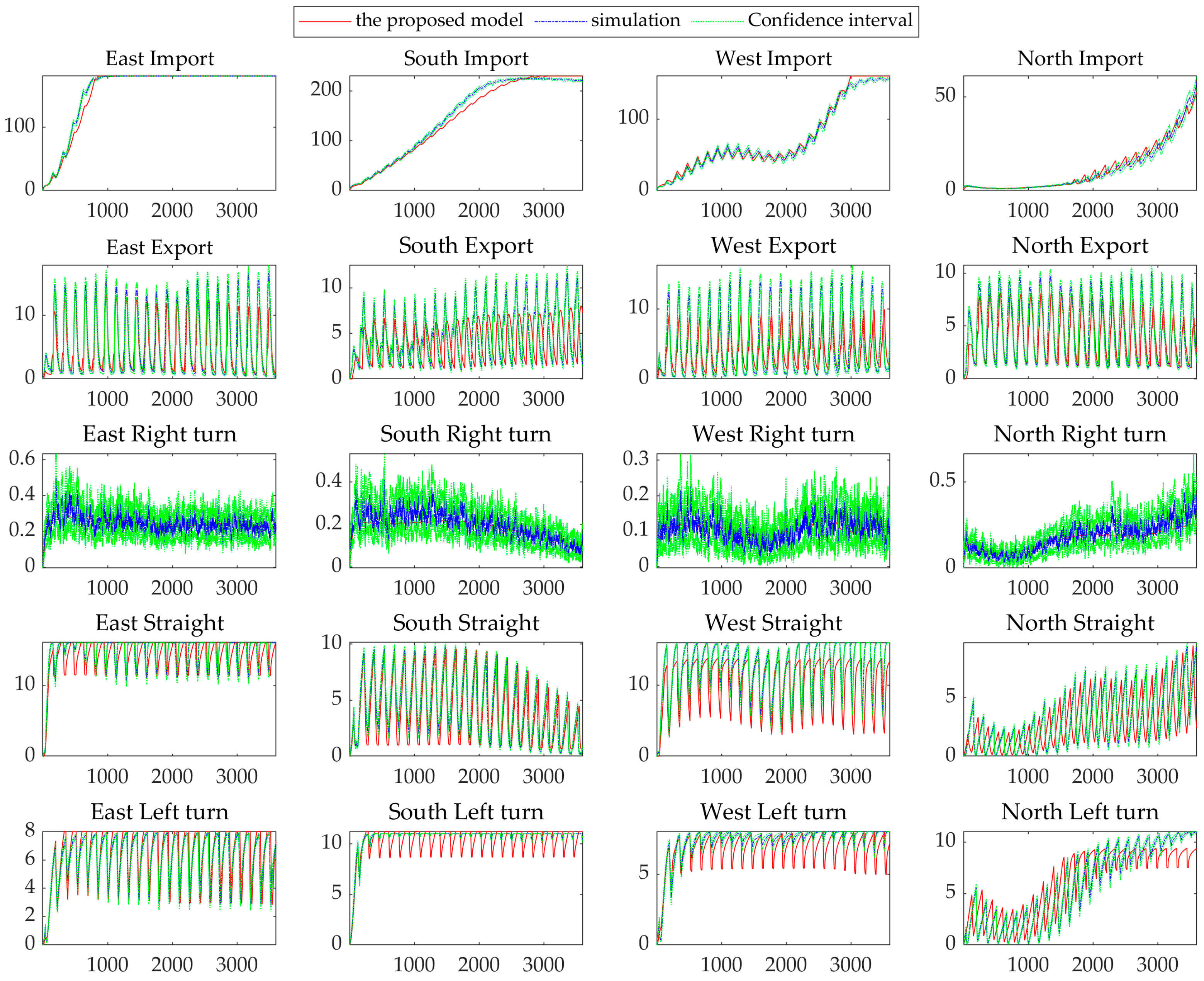
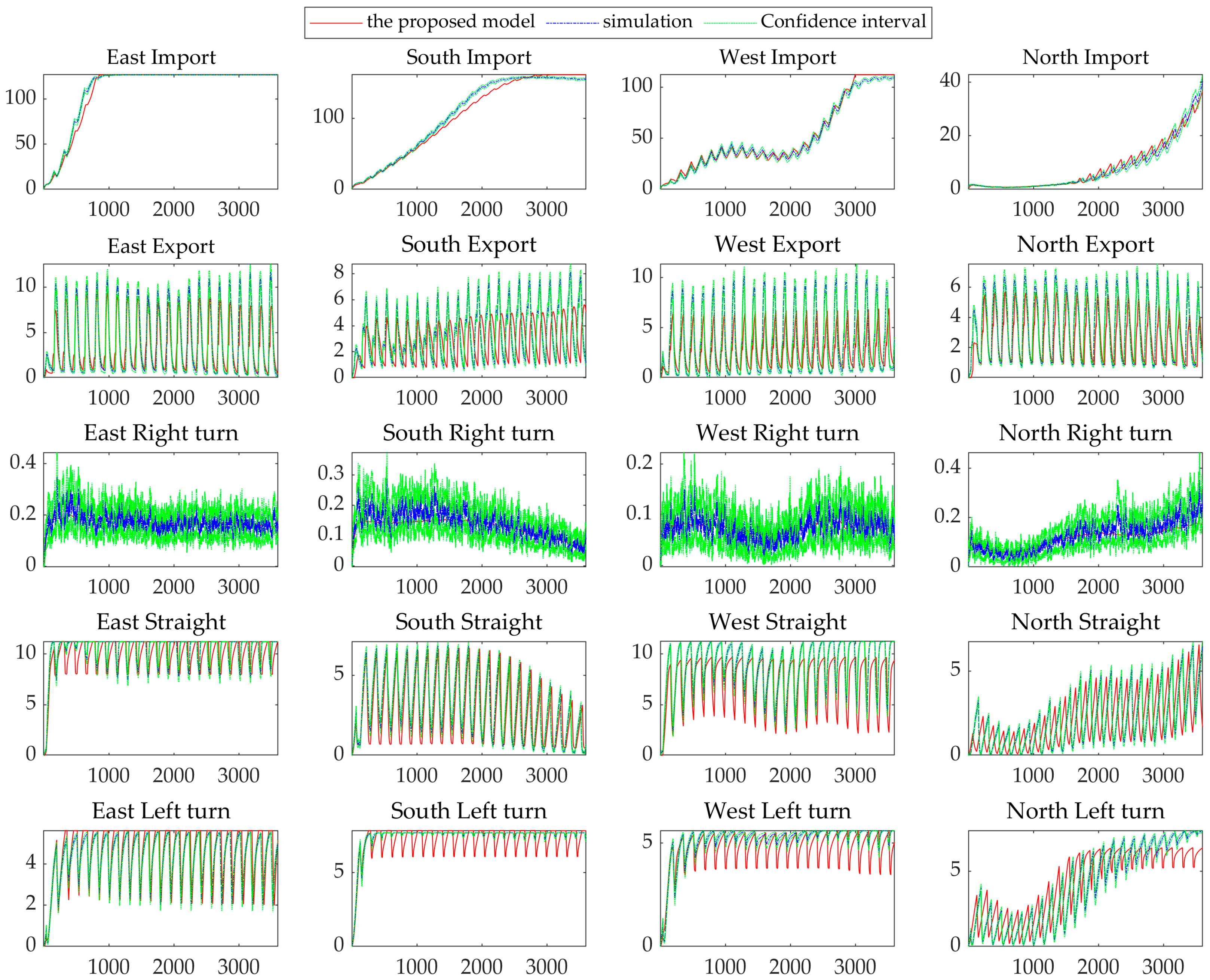
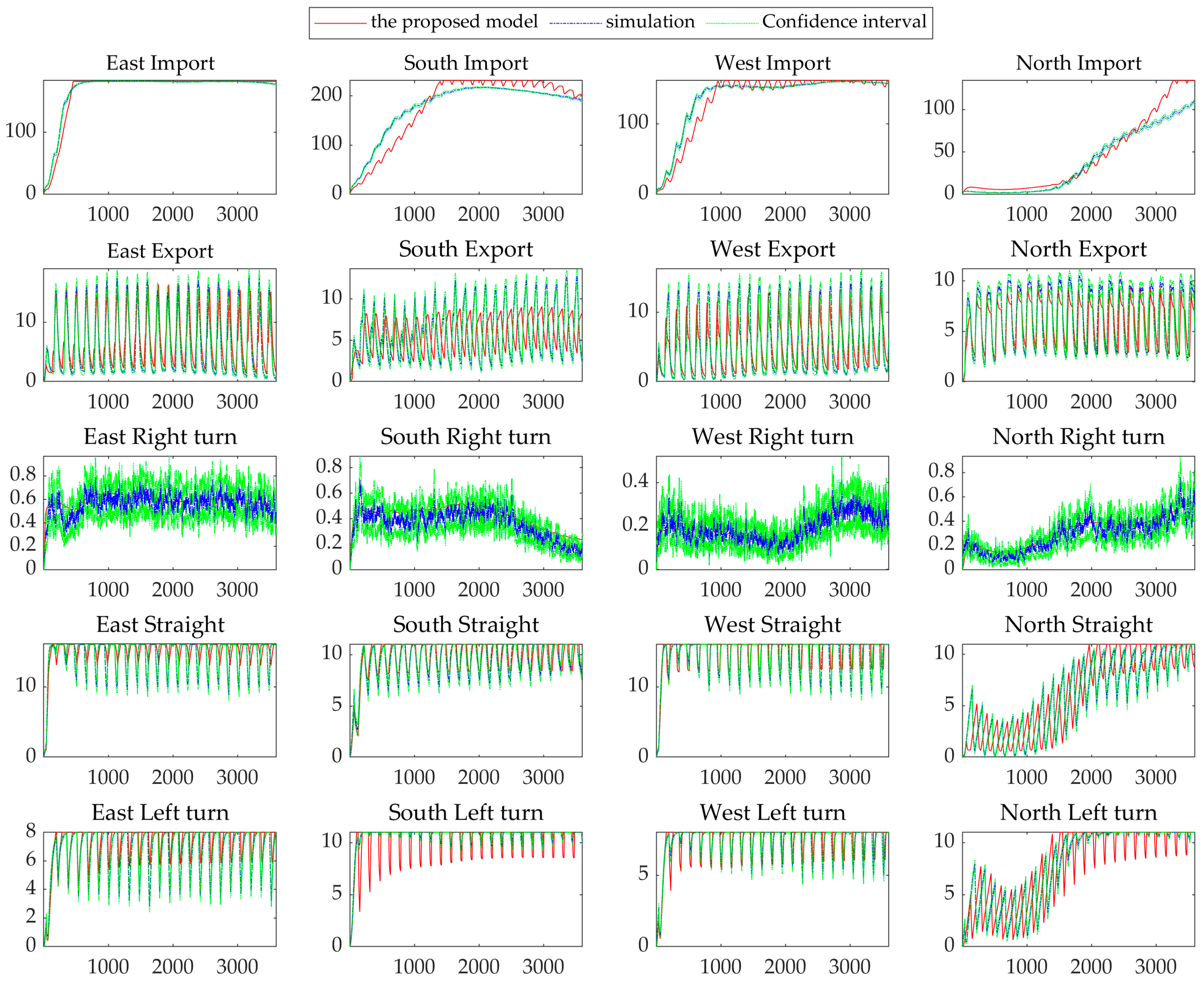
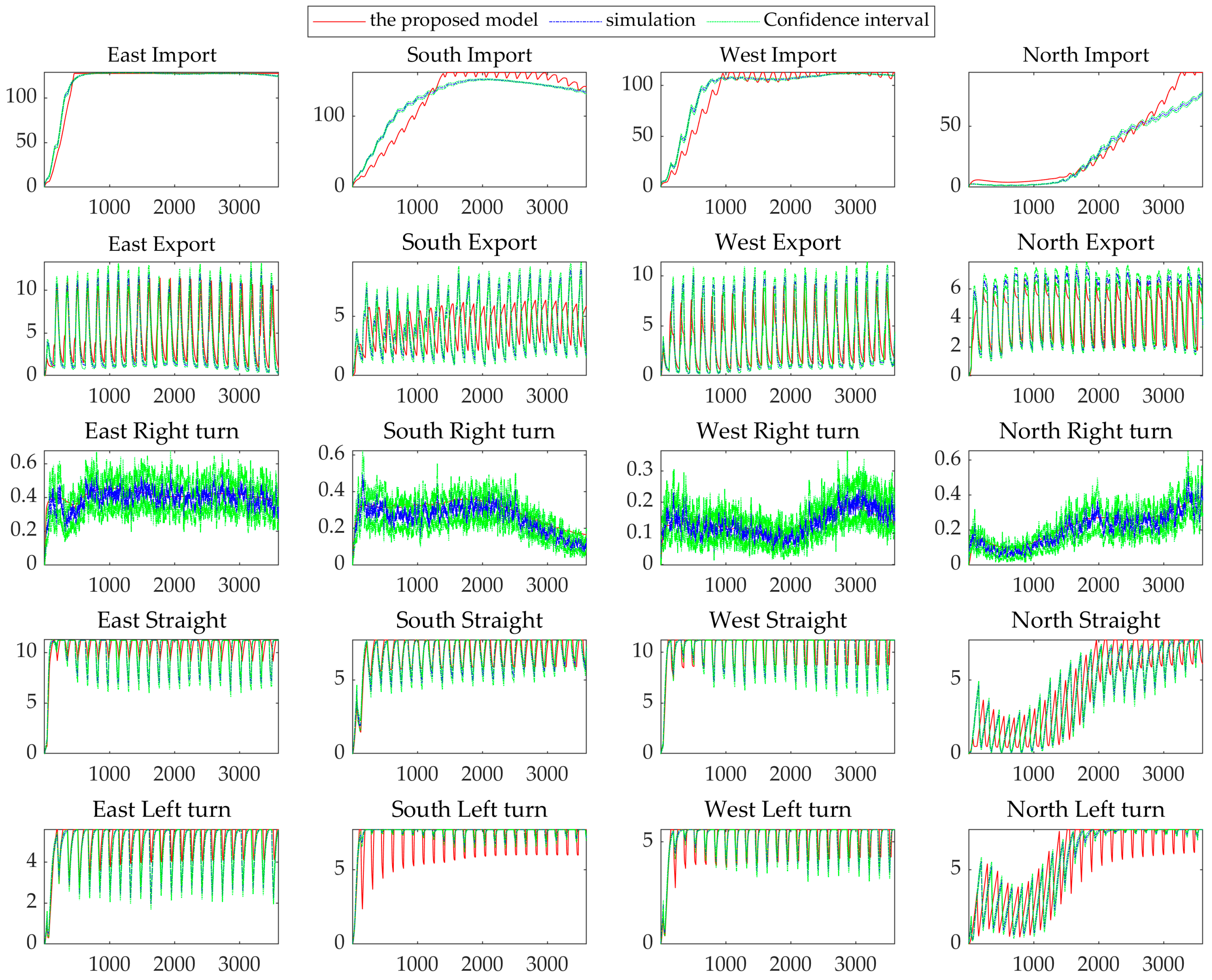
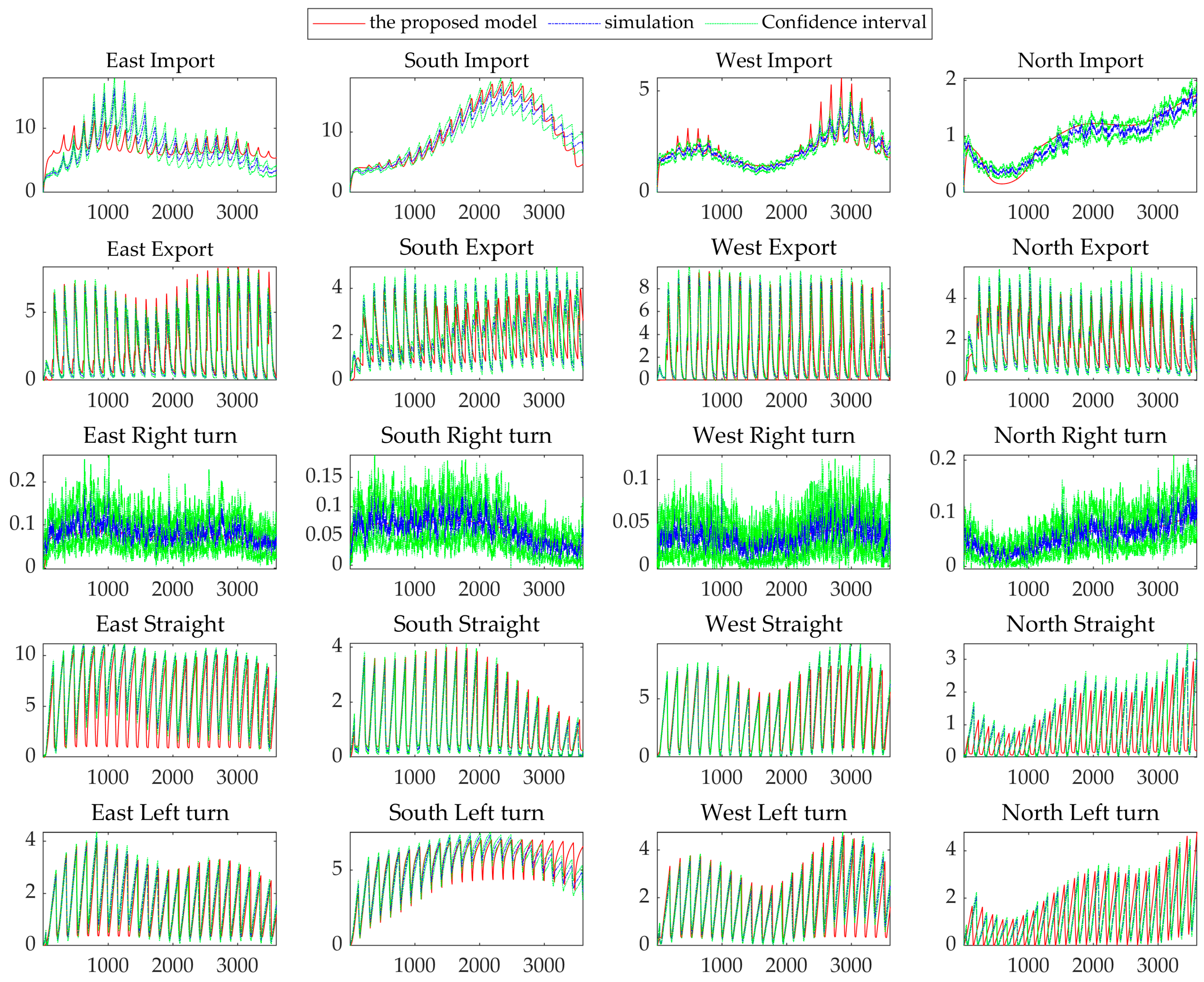
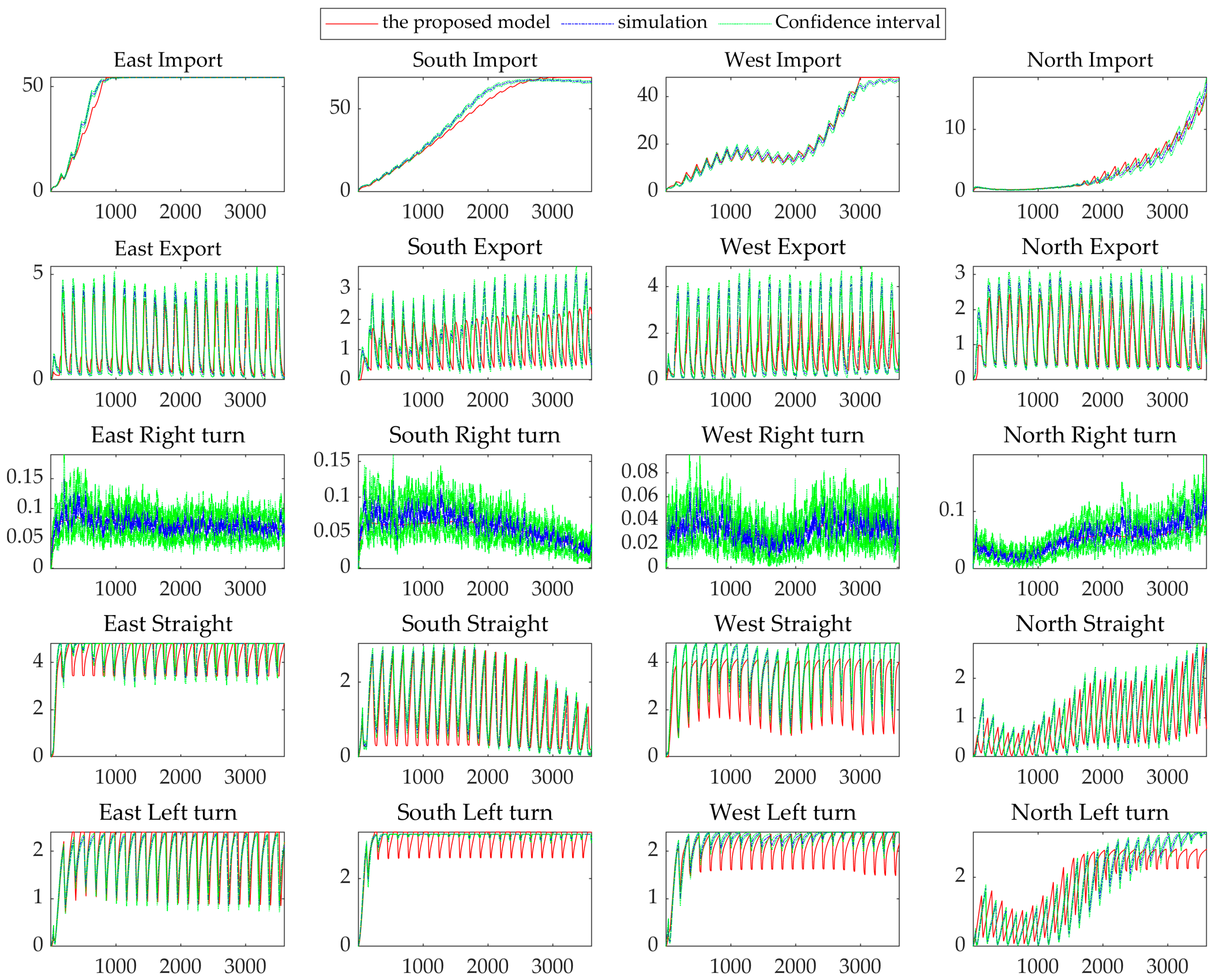
4.3.2. Verification
4.4. Potential of the Model for Handling Anomalous Traffic Conditions
- (1)
- Coping with demand spikes: A key input to the model is the time-varying arrival rate . In the current study, is derived from survey data. To simulate a demand surge, one would simply replace with a spike function (e.g., a step or impulse function) during the incident period . The model would dynamically incorporate the increased vehicle count into the system state via Equations (10) and (18). The resulting queue propagation and dissipation would be captured through the congestion probability and the feedback mechanism . Performance metrics such as average delay would automatically reflect the impact of the surge.
- (2)
- Simulating local incidents (lane closures): This is equivalent to a temporary reduction in the service capacity of the affected road section (node ). In our model, is a fundamental parameter for calculating the service rate (see Equations (1) and (16)). By setting to a lower value during the incident period, the model can automatically simulate the input-output imbalance, upstream congestion (manifested as an increase in ), and potential vehicle rerouting (via adjustments to the transfer probability .
- (3)
- Tolerating sensor failures (data loss): In practical deployment, if certain detectors fail, may not be directly available. The upstream-downstream flow relationship embedded in the model (Equation (18)) can then be leveraged for data imputation or state estimation. For instance, if an entry link detector fails, the estimated output rate from upstream links and historical turning ratios could be used to reconstruct , demonstrating the model’s robustness in a data-driven context.
4.5. Discussion on Model Uncertainty and Robustness
4.5.1. Key Sources of Uncertainty
- (1)
- Input Parameters: The external arrival rates and the new energy vehicle penetration rate p are subject to forecasting errors and temporal fluctuations.
- (2)
- Model Parameters: Calibrated parameters such as the free-flow speed v_i0, the jam density , and the exponents in the speed model (, ) have inherent estimation variances.
- (3)
- Behavioral Models: The car-following parameters (e.g., T in IDM, in CACC) represent average behaviors and exhibit inter-driver variability.
4.5.2. Inherent Robustness Features of the Framework
- (1)
- The feedback mechanism in the queuing network (Equation (10)) allows the model to dynamically absorb fluctuations in demand by adjusting virtual queues, providing a form of built-in disturbance rejection.
- (2)
- The state-dependent service rate automatically adjusts section capacity based on congestion levels, making output metrics less sensitive to fixed parameter errors under congested conditions.
5. Intersection Traffic Signal Optimization Under Mixed Traffic Flow
5.1. Optimization Model
5.1.1. Objective Function
Minimization of Vehicle Delay
Minimization of Electric Vehicle Energy Consumption
Minimization of Fuel Consumption for Fuel-Powered Vehicles
Minimization of Emissions from Fuel-Powered Vehicles
Transformation of Multi-Objective into Single-Objective
5.1.2. Constraints
Green Time Constraint
Cycle Length Constraint
Integer Variable Constraint
5.2. Solution Algorithm
5.2.1. Mesh Adaptive Direct Search Algorithm
| Algorithm 2: MADS Algorithm Workflow |
| Initialization: Set the initial solution for the optimization problem and initialize the iteration counter Iterative Optimization While the stopping criteria are not met Search on the mesh via the search step to find a solution superior to If The search step fails to find a superior solution Search via the poll step on the mesh for a solution superior to End If A solution superior to is found through the search step and the poll step. Record the incumbent solution and coarsen the mesh Else Set and update the mesh End Set the iteration counter and update the solution to Check if the stopping criteria are met End |
5.2.2. Preliminary Benchmark
- (1)
- Experimental Setup:
- (2)
- Results and Analysis:
- (1)
- Solution Quality and Robustness: MADS found better solutions on average (1.4% lower total cost) with significantly lower standard deviation (12.4 vs. 25.8 CNY), demonstrating superior solution quality and stability.
- (2)
- Computational Efficiency: MADS converged using fewer function evaluations on average (1120 vs. 1500), indicating higher search efficiency within the given budget.
5.3. Numerical Example Analysis
5.3.1. Parameter Setting
5.3.2. Comparative Validation Against a Steady-State Benchmark Model
5.3.3. Analysis of Results

- (1)
- The optimization method proposed in this study effectively reduces the average total cost for vehicles at the intersection. The results in Table 9, Table 10 and Table 11 demonstrate that by accounting for the impact of congestion on road service rates, the signal control scheme better adapts to traffic flow characteristics, unleashes the potential of signal timing optimization, and minimizes the total vehicle cost by up to 50%. Furthermore, as traffic congestion intensifies, the optimization efficacy of the model, while slightly diminished, remains above 20%;
- (2)
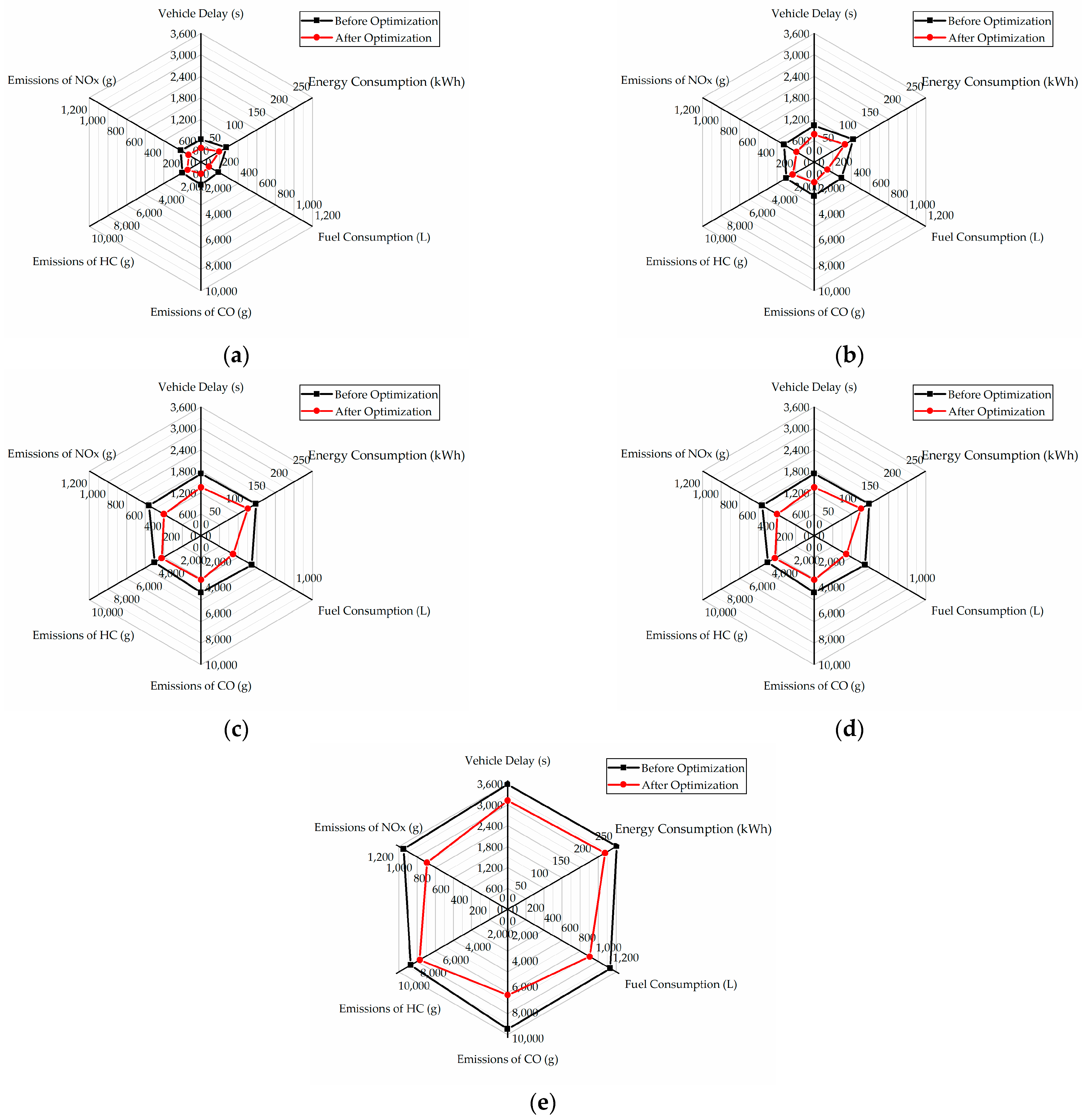
- The multi-objective optimization method proposed in this study effectively coordinates intersection performance metrics, including average vehicle delay, average fuel consumption, and average pollutant emissions. The optimized scheme demonstrates significant reductions in all these metrics—average vehicle delay, average fuel consumption, and average pollutant emissions—with most indicators decreasing by over 20%.
- (1)
- State-Dependent Service Rate Modeling. The proposed model incorporates state-dependent service rates, dynamically capturing the impact of traffic congestion on road capacity. Unlike traditional methods (e.g., Synchro) that assume fixed service rates, this approach allows the signal control strategy to adapt in real-time to fluctuating traffic conditions, thereby significantly reducing delays and costs;
- (2)
- Multi-Objective Coordination Mechanism. By integrating multiple optimization objectives (delay, energy consumption, emissions) into a unified cost function with scientifically calibrated weights (e.g., based on disposable income, energy prices, and environmental taxes), the model effectively balances conflicting goals. This ensures synergistic improvements across all performance metrics rather than isolated gains;
- (3)
- Adaptability to Congestion Levels. Although optimization efficacy slightly decreases under severe congestion (e.g., from 50% to 20% improvement), the model maintains robust performance. This is attributed to its ability to prioritize critical cost components (e.g., delay costs dominating total costs) while still addressing secondary factors (e.g., emissions);
- (4)
- Algorithmic Advantages of MADS. The Mesh Adaptive Direct Search (MADS) algorithm efficiently handles the non-convex, integer-constrained optimization problem. Its global search capability (via search and poll steps) enables escape from local optima, ensuring the solution closely approximates the global optimum even for complex nonlinear systems;
- (5)
- Traffic Flow Physics Alignment. The feedback queuing network model accurately reflects fundamental traffic flow characteristics (e.g., speed-density relationships, acceleration-deceleration patterns), allowing the optimized signal timing to align with actual vehicle behaviors. This reduces unrealistic assumptions and enhances practical applicability;
- (6)
- Economic Incentive Integration. Quantifying delays and emissions into monetary costs (e.g., using disposable income for delay valuation and environmental taxes for emissions) creates a unified optimization framework. This directs the model toward societally optimal outcomes beyond purely engineering metrics.
5.3.4. Sensitivity Analysis
6. Discussion
7. Conclusions and Future Work
7.1. Conclusions
7.2. Future Work
- (1)
- System Resilience and Robustness Testing: As discussed in Section 4.4, a crucial future direction is to apply the proposed model to explicit resilience stress-test scenarios. This includes simulating traffic incidents causing sudden local capacity drops, unforeseen demand pulses during peak hours, or sensor failures. We will define specific performance degradation (e.g., delay growth rate) and recovery metrics (e.g., number of cycles required to return to baseline performance) to quantitatively evaluate the resilience of different signal strategies under extreme conditions.
- (2)
- Fine-Grained Analysis of Vehicle Heterogeneity: While the current study validates the MCFFQN framework with two broadly defined yet representative vehicle classes, the model itself is capable of incorporating a more granular classification. A natural and important extension is to fully decouple attributes like propulsion type and automation level and to systematically evaluate traffic flow performance under all their cross-combinations. This would allow for the isolation of individual technological factors’ contributions to overall system efficiency, energy consumption, and emissions, providing deeper insights for policy and technology deployment.
- (3)
- Uncertainty Quantification and Robust Optimization: Future research will rigorously address parameter and demand uncertainty. This will involve: (i) conducting global sensitivity analysis (e.g., Sobol indices) to identify and rank the most influential parameters on key performance indicators; and (ii) formulating and solving a stochastic or robust optimization version of the signal timing problem, potentially incorporating chance constraints to limit the probability of excessive queue lengths or delays, thereby enhancing the reliability of control strategies under real-world variability.
Author Contributions
Funding
Data Availability Statement
Conflicts of Interest
References
- Zhang, H.; Xu, X.; Huang, J.; Rashed, G.I.R. Optimal Scheduling Strategy for Multi-Type Electric Vehicle Charging Based on Improved GA. In Proceedings of the 6th International Conference on Energy Systems and Electrical Power (ICESEP), Wuhan, China, 21–23 June 2024; pp. 1383–1386. [Google Scholar]
- Bansal, P.; Kockelman, K. Forecasting Americans’ Long-Term Adoption of Connected and Autonomous Vehicle Technologies. Transp. Res. Part A Policy Pract. 2017, 95, 49–63. [Google Scholar] [CrossRef]
- Ard, T.; Guo, L.; Han, J.; Jia, Y.; Vahidi, A.; Karbowski, D. Energy-Efficient Driving in Connected Corridors via Minimum Principle Control: Vehicle-in-the-Loop Experimental Verification in Mixed Fleets. IEEE Trans. Intell. Veh. 2023, 8, 1279–1291. [Google Scholar] [CrossRef]
- Zhang, Z.; Wang, W.; Liang, J.; Zhao, W.; Pan, C. Mixed Platoon Hierarchical Control: Elevating Safety, Stability, and Efficiency in CAV-HV Integration. IEEE Trans. Intell. Transp. Syst. 2025, 26, 8397–8410. [Google Scholar] [CrossRef]
- Liu, X.; Zhao, M.; Wang, L.; Sun, D.; Zhang, Y. Decentralized Hierarchical Trajectory Programming for Mixed Traffic Flow at the Tunnel Entrance Bottleneck Area. IEEE Trans. Veh. Technol. 2024, 73, 16312–16327. [Google Scholar] [CrossRef]
- Agafonov, A.; Yumaganov, A.; Myasnikov, V. Efficiency of Adaptive Traffic Signal Control in a Partially Connected Vehicle Environment. In Proceedings of the IX International Conference on Information Technology and Nanotechnology (ITNT), Samara, Russia, 17–21 April 2023; pp. 1–4. [Google Scholar]
- Weng, S.; Zhang, H.; Wang, Z.; Lv, Y.; Zhou, Q. Optimizing Traffic Signal Phases in Mixed Traffic Flow: A Deep Q-Learning Approach. In Proceedings of the Joint International Conference on Automation-Intelligence-Safety (ICAIS) & International Symposium on Autonomous Systems (ISAS), Xi’an, China, 23–25 May 2025; pp. 1–6. [Google Scholar]
- Hu, Z.; Wang, X.; Wang, Z. Enhancing Urban Intersections Management Through Deep Reinforcement Learning: Superior Control of Autonomous Vehicles in Mixed Traffic Flow. In Proceedings of the IEEE 27th International Conference on Intelligent Transportation Systems (ITSC), Edmonton, AB, Canada, 24–27 September 2024; pp. 3309–3314. [Google Scholar]
- Lei, Y.-Z.; Gong, Y.; Yang, X.T. Unraveling Stochastic Fundamental Diagrams with Empirical Knowledge: Modeling, Limitations, and Future Directions. Transp. Res. Part C Emerg. Technol. 2024, 169, 104851. [Google Scholar] [CrossRef]
- Han, K.; Huang, T.; Fan, W.; Ge, Q.; Dong, S.; Wang, X. Macroscopic Fundamental Diagram with Volume–Delay Relationship: Model Derivation, Empirical Validation and Invariance Property. Transp. Res. Part C Emerg. Technol. 2024, 166, 104739. [Google Scholar] [CrossRef]
- Maiti, N.; Laval, J.A.; Chilukuri, B.R. Universality of Area Occupancy-Based Fundamental Diagrams in Mixed Traffic. Phys. A Stat. Mech. Appl. 2024, 640, 129692. [Google Scholar] [CrossRef]
- Cheng, Q.; Lin, Y.; Zhou, X.; Liu, Z. Analytical Formulation for Explaining the Variations in Traffic States: A Fundamental Diagram Modeling Perspective with Stochastic Parameters. Eur. J. Oper. Res. 2024, 312, 182–197. [Google Scholar] [CrossRef]
- Ahmed, A.; Ngoduy, D.; Adnan, M.; Baig, M.A.U. On the Fundamental Diagram and Driving Behavior Modeling of Heterogeneous Traffic Flow Using UAV-Based Data. Transp. Res. Part A Policy Pract. 2021, 148, 100–115. [Google Scholar] [CrossRef]
- Yao, Z.; Xu, T.; Jiang, Y.; Hu, R. Linear Stability Analysis of Heterogeneous Traffic Flow Considering Degradations of Connected Automated Vehicles and Reaction Time. Phys. A Stat. Mech. Appl. 2021, 561, 125218. [Google Scholar] [CrossRef]
- Zeng, J.; Qian, Y.; Wang, W.; Xu, D.; Li, H. The Impact of Connected Automated Vehicles and Platoons on the Traffic Safety and Stability in Complex Heterogeneous Traffic Systems. Phys. A Stat. Mech. Appl. 2023, 629, 129195. [Google Scholar] [CrossRef]
- Cui, Z.; Wang, X.; Ci, Y.; Yang, C.; Yao, J. Modeling and Analysis of Car-Following Models Incorporating Multiple Lead Vehicles and Acceleration Information in Heterogeneous Traffic Flow. Phys. A Stat. Mech. Appl. 2023, 630, 129259. [Google Scholar] [CrossRef]
- Montanino, M.; Monteil, J.; Punzo, V. From Homogeneous to Heterogeneous Traffic Flows: Lp String Stability under Uncertain Model Parameters. Transp. Res. Part B Methodol. 2021, 146, 136–154. [Google Scholar] [CrossRef]
- Montanino, M.; Punzo, V. On String Stability of a Mixed and Heterogeneous Traffic Flow: A Unifying Modelling Framework. Transp. Res. Part B Methodol. 2021, 144, 133–154. [Google Scholar] [CrossRef]
- Cheng, R.; Lyu, H.; Zheng, Y.; Ge, H. Modeling and Stability Analysis of Cyberattack Effects on Heterogeneous Intelligent Traffic Flow. Phys. A Stat. Mech. Appl. 2022, 604, 127941. [Google Scholar] [CrossRef]
- Li, L.; Gan, J.; Cui, C.; Ma, H.; Qu, X.; Wang, Q.; Ran, B. Potential Field-Based Modeling and Stability Analysis of Heterogeneous Traffic Flow. Appl. Math. Model. 2024, 125, 485–508. [Google Scholar] [CrossRef]
- Ren, W.; Zhao, X.; Li, H.; Fu, Q. Traffic Flow Impact of Mixed Heterogeneous Platoons on Highways: An Approach Combining Driving Simulation and Microscopic Traffic Simulation. Phys. A Stat. Mech. Appl. 2024, 643, 129803. [Google Scholar] [CrossRef]
- Zhao, B.; Ju, Y.; Jiao, S.; Yang, D. A Feedback Queueing Network Model for Traffic Signal Control at Intersections Considering Congestion Propagation in Dynamic Stochastic Environments. PLoS ONE 2025, 20, e0337201. [Google Scholar] [CrossRef] [PubMed]
- Hu, L.; Zhao, B.; Zhu, J.; Jiang, Y. Two Time-Varying and State-Dependent Fluid Queuing Models for Traffic Circulation Systems. Eur. J. Oper. Res. 2019, 275, 997–1019. [Google Scholar] [CrossRef]
- Jain, R.; Smith, J. Modeling Vehicular Traffic Flow Using M/G/C/C State Dependent Queueing Models. Transp. Sci. 1997, 31, 324–336. [Google Scholar] [CrossRef]
- Cheah, J.; Smith, J. Generalized M/G/C/C State Dependent Queueing Models and Pedestrian Traffic Flows. Queueing Syst. 1994, 15, 365–386. [Google Scholar] [CrossRef]
- Smith, J.; Cruz, F. M/G/c/c State Dependent Travel Time Models and Properties. Phys. A Stat. Mech. Appl. 2014, 395, 560–579. [Google Scholar] [CrossRef]
- Chong, L.; Osorio, C. A Simulation-Based Optimization Algorithm for Dynamic Large-Scale Urban Transportation Problems. Transp. Sci. 2018, 52, 637–656. [Google Scholar] [CrossRef]
- Jiang, Y.; Zhu, J.; Hu, L.; Lin, X.; Khattak, A. A G/G(n)/C/C State-dependent Simulation Model for Metro Station Corridor Width Design. Eur. J. Oper. Res. 2016, 50, 273–295. [Google Scholar]
- Osorio, C.; Flötteröd, G.; Zhang, C. A Metamodel Simulation-Based Optimization Approach for the Efficient Calibration of Stochastic Traffic Simulators. Transp. Res. Procedia 2015, 6, 213–223. [Google Scholar] [CrossRef][Green Version]
- Kerbachea, L.; Smith, M. The Generalized Expansion Method for Open Finite Queueing Networks. Eur. J. Oper. Res. 1987, 32, 448–461. [Google Scholar] [CrossRef]
- Yuhaski, S.; Smith, J. Modeling Circulation Systems in Buildings Using State Dependent Queueing Models. Queueing Syst. 1989, 4, 319–338. [Google Scholar] [CrossRef]
- Wang, W.; Tipper, D.; Banerjee, S. A Simple Approximation for Modeling Nonstationary Queues. In Proceedings of the IEEE INFOCOM ’96. Conference on Computer Communications, San Francisco, CA, USA, 24–28 March 1996; Volume 1, pp. 255–262. [Google Scholar]
- Treiber, M.; Hennecke, A.; Helbing, D. Congested Traffic States in Empirical Observations and Microscopic Simulations. Phys. Rev. E 2000, 62, 1805–1824. [Google Scholar] [CrossRef]
- Treiber, M.; Kesting, A. The Intelligent Driver Model with Stochasticity—New Insights into Traffic Flow Oscillations. Transp. Res. Procedia 2017, 117, 613–623. [Google Scholar] [CrossRef]
- Wang, H.; Qin, Y.; Wang, W.; Chen, J. Stability of CACC-Manual Heterogeneous Vehicular Flow with Partial CACC Performance Degrading. Transp. B Transp. Dyn. 2019, 7, 788–813. [Google Scholar] [CrossRef]
- Xu, K.; Tipper, D.; Qian, Y.; Krishnamurthy, P. Time-Dependent Performance Analysis of IEEE 802.11p Vehicular Networks. IEEE Trans. Veh. Technol. 2016, 65, 5637–5651. [Google Scholar] [CrossRef]
- Xu, K.; Tipper, D.; Krishnamurthy, P.; Qian, Y. An Efficient Hybrid Model and Dynamic Performance Analysis for Multihop Wireless Networks. In Proceedings of the International Conference on Computing, Networking and Communications (ICNC), San Diego, CA, USA, 28–31 January 2013; pp. 1090–1096. [Google Scholar]
- Zegeye, S.; De Schutter, B.; Hellendoorn, J.; Breunesse, E.; Hegyi, A. Integrated Macroscopic Traffic Flow, Emission, and Fuel Consumption Model for Control Purposes. Transp. Res. Part C Emerg. Technol. 2013, 31, 158–171. [Google Scholar] [CrossRef]
- Yao, H.; Li, X. Decentralized Control of Connected Automated Vehicle Trajectories in Mixed Traffic at an Isolated Signalized Intersection. Transp. Res. Part C Emerg. Technol. 2020, 121, 102846. [Google Scholar] [CrossRef]
- Li, Y.; Wang, H.; Wang, W.; Xing, L.; Liu, S.; Wei, X. Evaluation of the Impacts of Cooperative Adaptive Cruise Control on Reducing Rear-End Collision Risks on Freeways. Accid. Anal. Prev. 2017, 98, 87–95. [Google Scholar] [CrossRef]
- Milanes, V.; Shladover, S.; Spring, J.; Nowakowski, C.; Kawazoe, H.; Nakamura, M. Cooperative Adaptive Cruise Control in Real Traffic Situations. IEEE Trans. Intell. Transp. Syst. 2014, 15, 296–305. [Google Scholar] [CrossRef]
- Digabel, S. NOMAD: Nonlinear Optimization with the MADS Algorithm. ACM Trans. Math. Softw. 2011, 37, 44. [Google Scholar] [CrossRef]
- Boukouvala, F.; Misener, R.; Floudas, C. Global Optimization Advances in Mixed-Integer Nonlinear Programming, MINLP, and Constrained Derivative-Free Optimization, CDFO. Eur. J. Oper. Res. 2016, 252, 701–727. [Google Scholar] [CrossRef]
- Audet, C.; Dennis, J. Mesh Adaptive Direct Search Algorithms for Constrained Optimization. SIAM J. Optim. 2006, 17, 188–217. [Google Scholar] [CrossRef]
- Xu, H.; Yuan, J.; Berres, A.; Shao, Y.; Wang, C.; Li, W.; LaClair, T.J.; Sanyal, J.; Wang, H. A Mobile Edge Computing Framework for Traffic Optimization at Urban Intersections Through Cyber-Physical Integration. IEEE Trans. Intell. Veh. 2024, 9, 1131–1145. [Google Scholar] [CrossRef]
- Reddy, R.; Lendve, S.; Almeida, L. Energy Efficiency of Mixed Vehicles Influenced by the Driving Behavior and Traffic Signals. In Proceedings of the 12th International Conference on Future Internet of Things and Cloud (FiCloud), Istanbul, Turkey, 11–13 August 2025; pp. 519–524. [Google Scholar]
- Osorio, C.; Yamani, J. Analytical and Scalable Analysis of Transient Tandem Markovian Finite Capacity Queueing Networks. Transp. Sci. 2017, 51, 823–840. [Google Scholar] [CrossRef]
- Chen, X.; Osorio, C.; Santos, B.F. Simulation-Based Travel Time Reliable Signal Control. Transp. Sci. 2019, 53, 523–544. [Google Scholar] [CrossRef]







| Import Road Section | Turn Left | Straight | Turn Right | Export Road Section | ||
|---|---|---|---|---|---|---|
| East | road length (m) | 285 | 50 | 50 | 50 | 335 |
| number of lanes | 4 | 1 | 2 | 1 | 4 | |
| ratio of turning (%) | N/A | 16 | 70 | 14 | N/A | |
| South | road length (m) | 483 | 70 | 70 | 70 | 553 |
| number of lanes | 3 | 1 | 1 | 1 | 3 | |
| ratio of turning (%) | N/A | 47 | 38 | 16 | N/A | |
| West | road length (m) | 253 | 50 | 50 | 50 | 303 |
| number of lanes | 4 | 1 | 2 | 1 | 4 | |
| ratio of turning (%) | N/A | 26 | 65 | 9 | N/A | |
| North | road length (m) | 280 | 70 | 70 | 70 | 350 |
| number of lanes | 3 | 1 | 1 | 1 | 3 | |
| ratio of turning (%) | N/A | 42 | 35 | 23 | N/A |
| Time | East | South | West | North |
|---|---|---|---|---|
| 17:00 to 17:15 | 129 | 121 | 101 | 54 |
| 17:15 to 17:30 | 209 | 116 | 114 | 32 |
| 17:30 to 17:45 | 155 | 122 | 87 | 70 |
| 17:45 to 18:00 | 177 | 72 | 161 | 71 |
| Number | Multiple | ||||||||
|---|---|---|---|---|---|---|---|---|---|
| East | South | West | North | East | South | West | North | ||
| 1 | 1 | 0.5198 | 0.5926 | 0.2487 | 0.5479 | 0.4184 | 0.4574 | 0.1851 | 0.3109 |
| 2 | 2 | 1.0396 | 1.1852 | 0.4973 | 1.0957 | 0.8368 | 0.9148 | 0.3702 | 0.6218 |
| 3 | 3 | 1.5594 | 1.7778 | 0.7461 | 1.6437 | 1.2552 | 1.3722 | 0.5553 | 0.9327 |
| Parameter | Value | Unit |
|---|---|---|
| 120 | km/h | |
| 1.5 | s | |
| 1 | s−1 | |
| 2 | s−1 | |
| 2 | m | |
| 5.0 | m | |
| 4 | N/A |
| Parameter | Value | Unit |
|---|---|---|
| 0.01 | s | |
| 0.45 | N/A | |
| 0.25 | N/A | |
| 0.6 | s |
| Demand Scenario Number | 1 | 2 | 3 | Average | |
|---|---|---|---|---|---|
| Absolute error (pcu) | Overall system state | 0.2301 | 0.8690 | 0.8296 | 0.6429 |
| Intelligent connected vehicle system state | 0.0690 | 0.2607 | 0.2489 | 0.1929 | |
| Human-driven vehicle system state | 0.1611 | 0.6083 | 0.5807 | 0.4500 | |
| Relative error (%) | Overall system state | 6.4241 | 7.8402 | 5.0747 | 6.4463 |
| Intelligent connected vehicle system state | 6.4581 | 7.7736 | 5.1623 | 6.4647 | |
| Human-driven vehicle system state | 6.4097 | 7.8690 | 5.0380 | 6.4389 | |
| Algorithm | Mean Best Total Cost (CNY) | Standard Deviation (CNY) | Average Function Evaluations to Converge | Average Runtime (s) |
|---|---|---|---|---|
| MADS | 905.7 | 12.4 | 1120 | 38.5 |
| GA | 918.3 | 25.8 | 1500 (budget used) | 45.8 |
| Scenario | Performance Metric | Synchro | Proposed Model | Improvement |
|---|---|---|---|---|
| #1 | Avg. Delay (s) | 628.8585 | 392.138 | −37.64% |
| Total Energy (kWh) | 57.0512 | 40.4244 | −29.14% | |
| Total Fuel (L) | 188.7654 | 86.5224 | −54.16% | |
| #3 | Avg. Delay (s) | 1731.934 | 1348.9405 | −22.11% |
| Total Energy (kWh) | 122.7422 | 104.707 | −14.69% | |
| Total Fuel (L) | 547.8256 | 346.3006 | −36.79% | |
| #5 | Avg. Delay (s) | 3584.8697 | 3123.3264 | −12.87% |
| Total Energy (kWh) | 254.2722 | 227.0482 | −10.71% | |
| Total Fuel (L) | 1195.8823 | 957.1958 | −19.96% |
| #1 | #2 | #3 | #4 | #5 | |
|---|---|---|---|---|---|
| Vehicle Delay (s) | 628.8585 | 1023.9897 | 1731.934 | 2507.5614 | 3584.8697 |
| Energy Consumption (kWh) | 57.0512 | 87.4397 | 122.7422 | 179.4114 | 254.2722 |
| Fuel Consumption (L) | 188.7654 | 294.3058 | 547.8256 | 836.4006 | 1195.8823 |
| (g) | 1772.5272 | 2636.041 | 4423.3931 | 6981.6978 | 9312.854 |
| (g) | 1675.2486 | 2509.3512 | 4166.5697 | 6710.571 | 8685.2047 |
| (g) | 219.3792 | 325.0354 | 559.2722 | 815.0247 | 1120.1315 |
| Intersection Total Cost (CNY) | 1929.2419 | 3005.1623 | 5540.0784 | 8453.6878 | 12,057.3681 |
| #1 | #2 | #3 | #4 | #5 | |
|---|---|---|---|---|---|
| Vehicle Delay (s) | 392.138 | 771.4562 | 1348.9405 | 2151.1903 | 3123.3264 |
| Energy Consumption (kWh) | 40.4244 | 68.5363 | 104.707 | 157.2438 | 227.0482 |
| Fuel Consumption (L) | 86.5224 | 143.172 | 346.3006 | 633.7863 | 957.1958 |
| (g) | 907.0668 | 1570.4222 | 3429.9555 | 5016.2112 | 6665.4561 |
| (g) | 1202.4486 | 1922.2762 | 3521.6897 | 5797.071 | 7868.4847 |
| (g) | 134.3934 | 189.2664 | 398.5358 | 597.0636 | 868.3775 |
| Intersection Total Cost (CNY) | 908.4718 | 1511.8237 | 3561.8294 | 6438.1922 | 9676.3169 |
| #1 | #2 | #3 | #4 | #5 | |
|---|---|---|---|---|---|
| Vehicle Delay (s) | −37.64% | −24.66% | −22.11% | −14.21% | −12.87% |
| Energy Consumption (kWh) | −29.14% | −21.62% | −14.69% | −12.36% | −10.71% |
| Fuel Consumption (L) | −54.16% | −51.35% | −36.79% | −24.22% | −19.96% |
| (g) | −48.83% | −40.42% | −22.46% | −28.15% | −28.43% |
| (g) | −28.22% | −23.40% | −15.48% | −13.61% | −9.40% |
| (g) | −38.74% | −41.77% | −28.74% | −26.74% | −22.48% |
| Intersection Total Cost (CNY) | −52.91% | −49.69% | −35.71% | −23.84% | −19.75% |
| Key Weight | Weight Factor | #1 | #2 | #3 | #4 | #5 |
|---|---|---|---|---|---|---|
| ) | 0.25 | 1504.81 | 2434.18 | 4598.27 | 7101.10 | 10,248.76 |
| 0.5 | 1620.56 | 2554.39 | 6260.29 | 7523.78 | 10,851.63 | |
| 1 | 1929.24 | 3005.16 | 5540.08 | 8453.69 | 12,057.37 | |
| 2 | 2102.87 | 3365.78 | 6315.69 | 9721.74 | 14,107.12 | |
| 4 | 2237.92 | 3576.14 | 6814.30 | 10,567.11 | 15,433.43 | |
| ) | 0.25 | 1888.73 | 2948.06 | 5390.50 | 8233.89 | 11,563.02 |
| 0.5 | 1900.30 | 2963.09 | 5423.74 | 8318.43 | 11,792.11 | |
| 1 | 1929.24 | 3005.16 | 5540.08 | 8453.69 | 12,057.37 | |
| 2 | 1944.68 | 3044.23 | 5606.56 | 8597.40 | 12,382.92 | |
| 4 | 1973.61 | 3092.31 | 5739.52 | 8800.29 | 12,599.95 | |
| ) | 0.25 | 1884.87 | 2848.89 | 5168.89 | 7752.03 | 10,972.20 |
| 0.5 | 1906.09 | 2927.03 | 5312.94 | 8064.82 | 11,333.93 | |
| 1 | 1929.24 | 3005.16 | 5540.08 | 8453.69 | 12,057.37 | |
| 2 | 1979.40 | 3128.37 | 5911.26 | 9062.35 | 13,021.96 | |
| 4 | 1987.12 | 3125.37 | 5983.28 | 9383.59 | 13,624.83 |
| Varied Weight (4× Baseline) | Δ Total Cost | Δ Average Delay | Δ Total Electricity Consumption | Δ Total Fuel Consumption |
|---|---|---|---|---|
| (Prioritize Efficiency) | 28.1% | −7.9% | 5.1% | 10.3% |
| (Prioritize Electrification) | 3.6% | 1.8% | −14.4% | 0.7% |
| (Prioritize Fuel Economy) | 12.8% | 2.4% | 1.4% | −13.7% |
Disclaimer/Publisher’s Note: The statements, opinions and data contained in all publications are solely those of the individual author(s) and contributor(s) and not of MDPI and/or the editor(s). MDPI and/or the editor(s) disclaim responsibility for any injury to people or property resulting from any ideas, methods, instructions or products referred to in the content. |
© 2026 by the authors. Licensee MDPI, Basel, Switzerland. This article is an open access article distributed under the terms and conditions of the Creative Commons Attribution (CC BY) license.
Share and Cite
Li, H.; Jiang, Y.; Zhao, B. Signal Timing Optimization Method for Intersections Under Mixed Traffic Conditions. Algorithms 2026, 19, 71. https://doi.org/10.3390/a19010071
Li H, Jiang Y, Zhao B. Signal Timing Optimization Method for Intersections Under Mixed Traffic Conditions. Algorithms. 2026; 19(1):71. https://doi.org/10.3390/a19010071
Chicago/Turabian StyleLi, Hongwu, Yangsheng Jiang, and Bin Zhao. 2026. "Signal Timing Optimization Method for Intersections Under Mixed Traffic Conditions" Algorithms 19, no. 1: 71. https://doi.org/10.3390/a19010071
APA StyleLi, H., Jiang, Y., & Zhao, B. (2026). Signal Timing Optimization Method for Intersections Under Mixed Traffic Conditions. Algorithms, 19(1), 71. https://doi.org/10.3390/a19010071