

GAD-YOLO: A Sight-Distance Adaptive Detection Algorithm for General Aviation Aircraft Skin Damage

Abstract
1. Introduction
- (1)
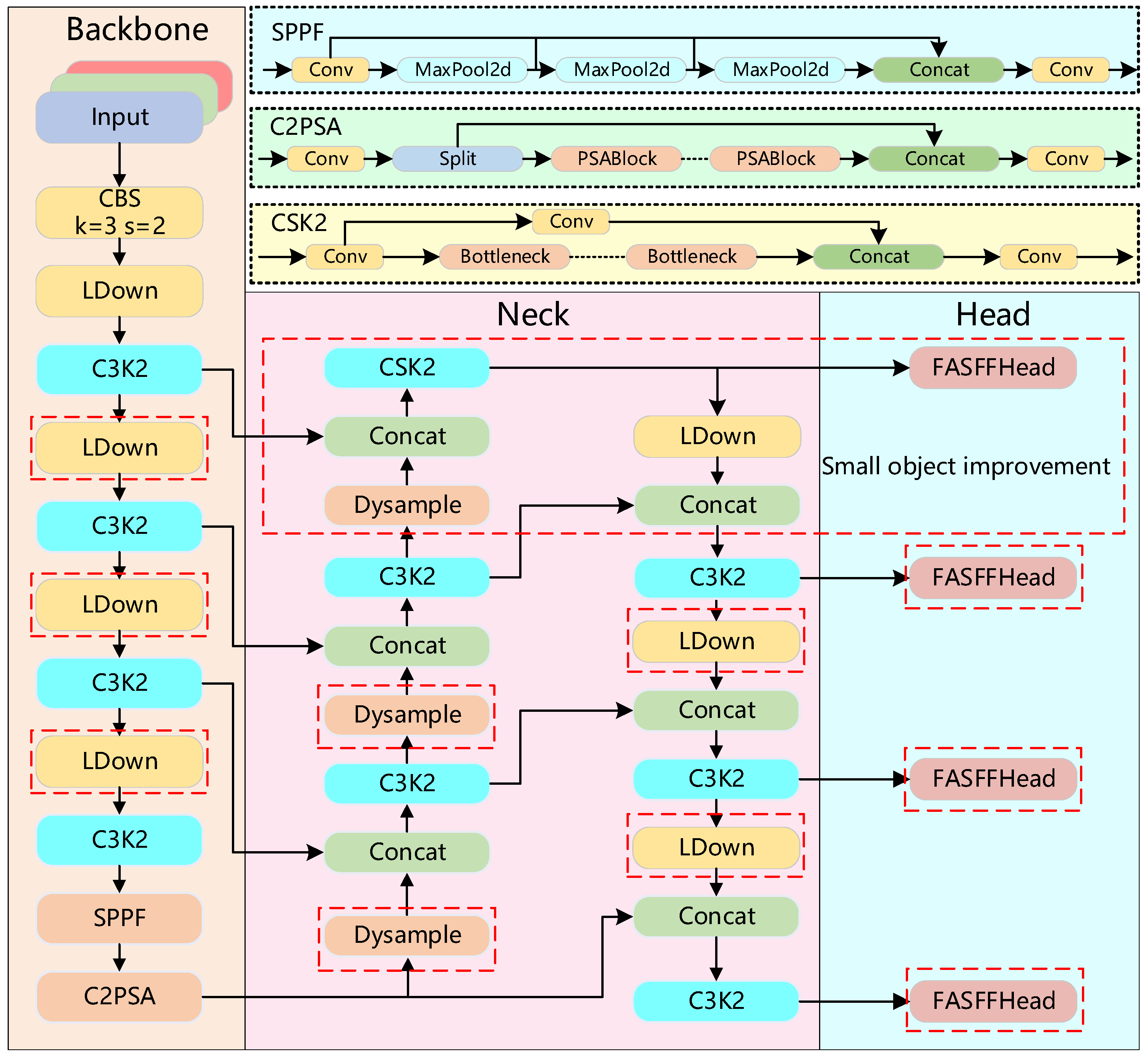
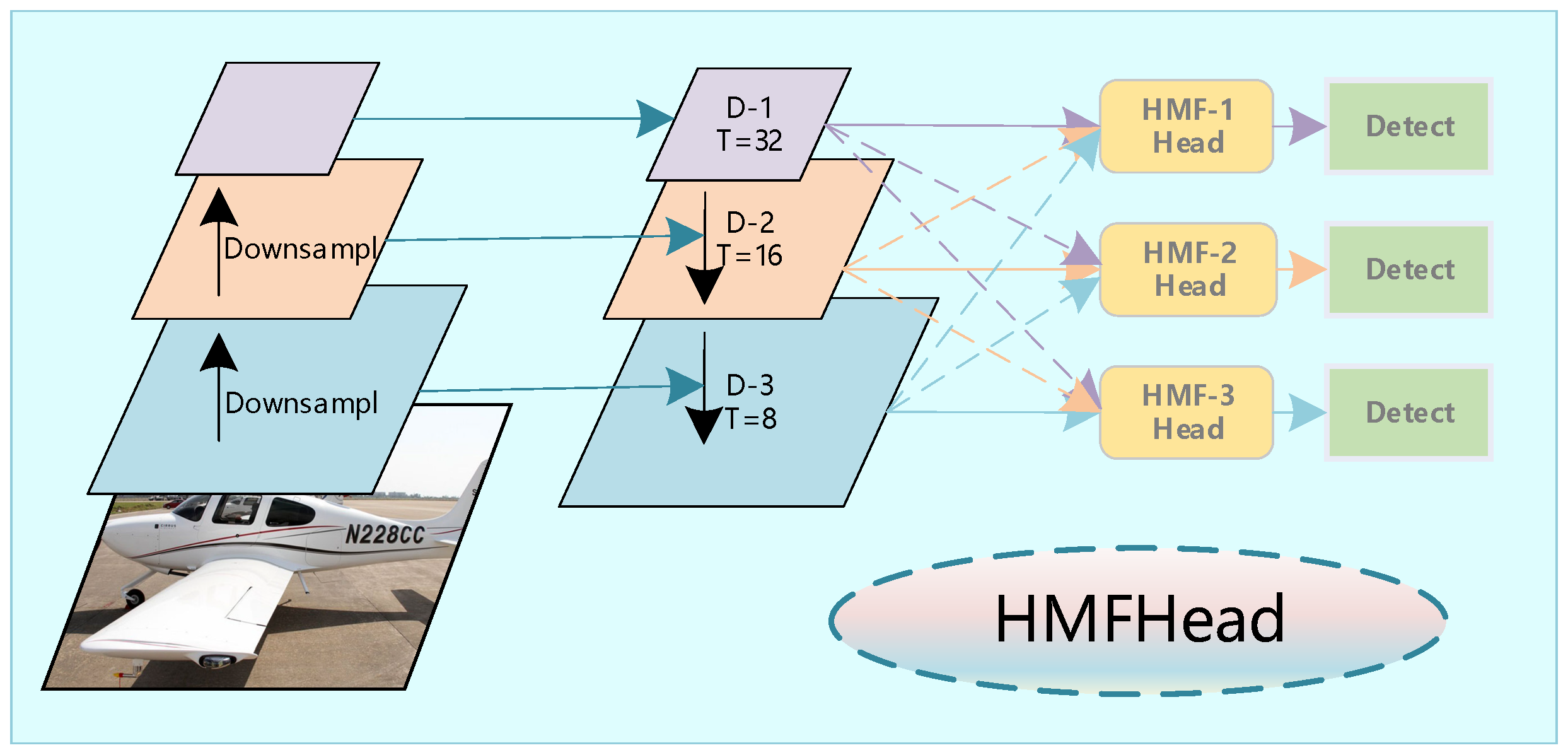
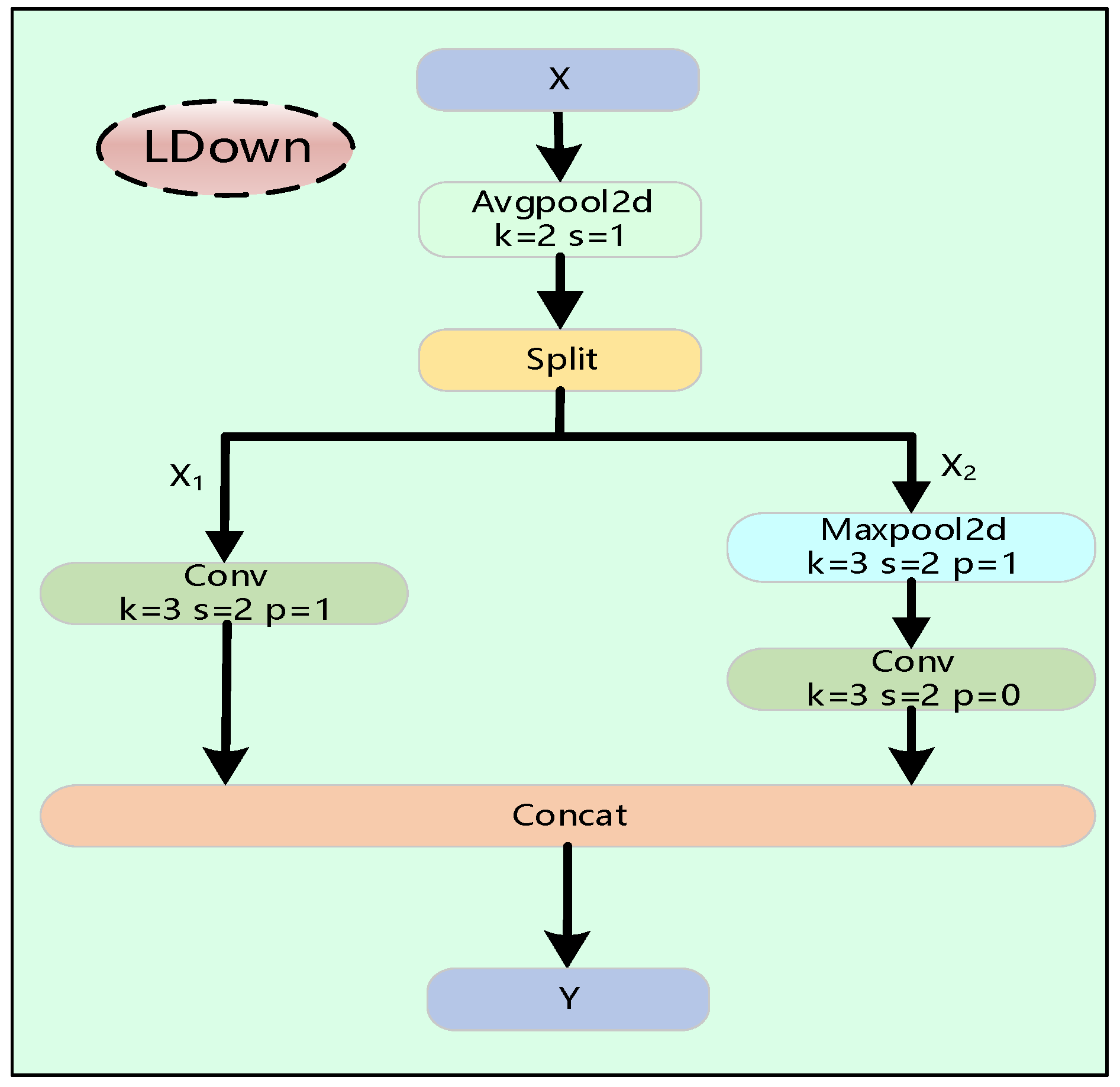
- Novel network architecture: A lightweight LDown downsampling module is designed to improve detail preservation while reducing parameters and computational cost through multi-path feature fusion and an optimized 3 × 3 convolutional kernel. Simultaneously, an HMFHead detection head is introduced to enhance recognition of complex damage features via progressive semantic fusion and edge-aware constraints. Furthermore, a P2 small-target detection layer is added by embedding a high-resolution branch into the shallow network, thereby strengthening detection capability for small targets and fine-grained damage.
- (2)
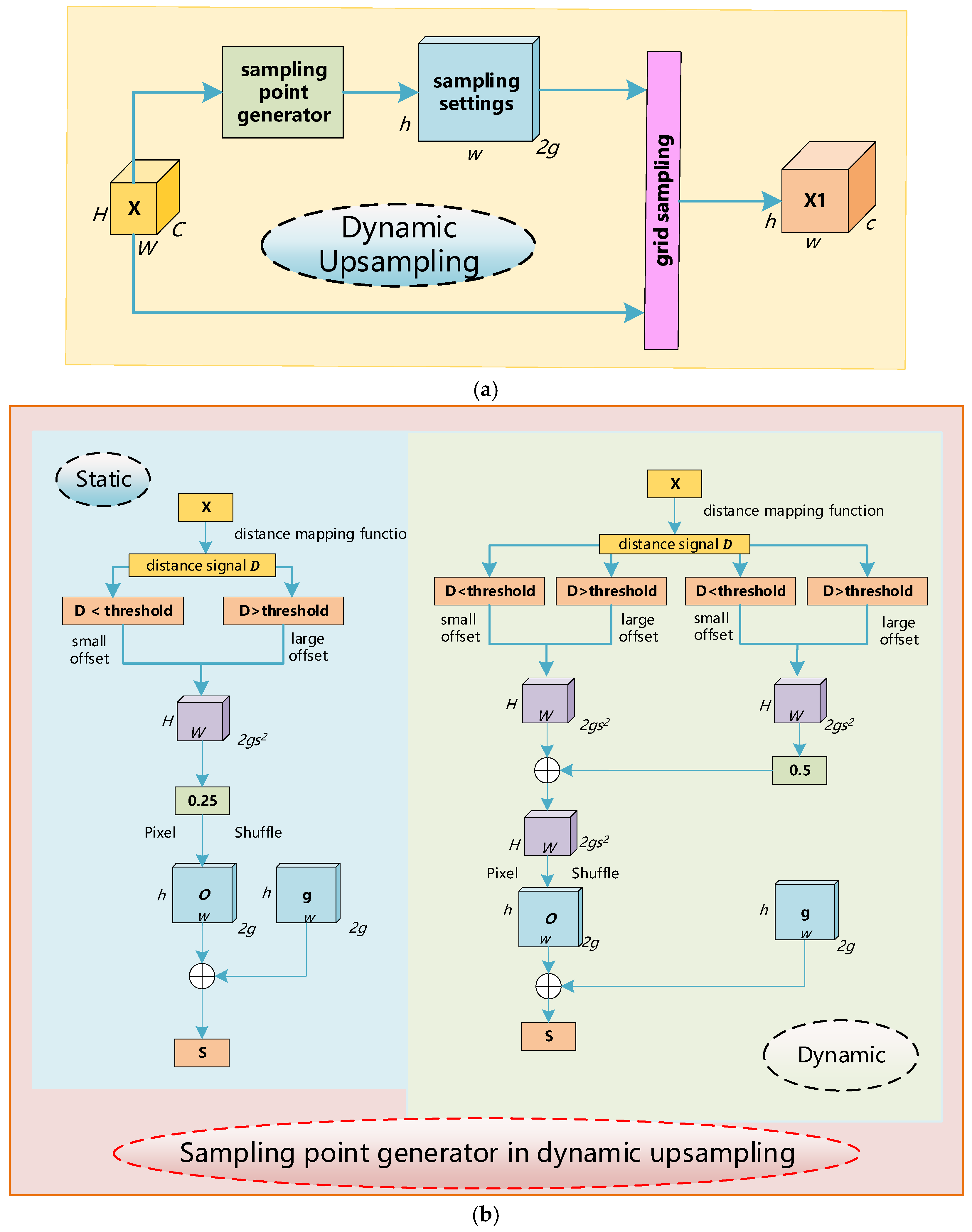
- Distance-aware dynamic sampling: A DySample-based distance-aware convolutional kernel deformation mapping method is proposed. By introducing a dynamic upsampling strategy with learnable distance thresholds and modulation factors, an adaptive balance between close-range local detail preservation and long-range contextual semantic enhancement is achieved, enabling stable aircraft skin damage recognition across multiple sight distances.
- (3)
- The GAD-YOLO model is built: Tailored for general aviation aircraft skin damage detection scenarios and addressing the unique damage characteristics caused by frequent low-altitude training and short-cycle takeoffs and landings, an adaptive and efficient detection model is designed. This model maintains high recognition performance across different sight distances, meets the rapid maintenance needs of general aviation aircraft, and strengthens localization capability for complex damage.
2. Relevant Studies
3. The Proposed GAD-YOLO Algorithm
3.1. GAD-YOLO Overall Architecture
3.2. Enhanced Small Target Detection with a P2 Feature Layer
3.3. The HMFHead for Multi-Scale Feature Aggregation
3.4. The LDown Module for Lightweight and Efficient Downsampling
3.5. Distance-Aware Convolutional Kernel Deformation for Dynamic Sampling
4. Experiments
4.1. Dataset Construction
4.2. Experimental Setup
4.3. Evaluation Metrics
4.4. Ablation Study
4.5. Sight-Distance Experimental Validation
4.6. Comparative Experiment
4.7. Model Generalization Evaluation
5. Conclusions
Author Contributions
Funding
Data Availability Statement
Conflicts of Interest
References
- Yandouzi, M.; Gaydos, S.; Guo, D.; Ghelichi, R.; Jodoin, B. Aircraft skin restoration and evaluation. J. Therm. Spray Technol. 2014, 23, 1281–1290. [Google Scholar] [CrossRef] [Scilit]
- Karaoğlu, U.; Mbah, O.; Zeeshan, Q. Applications of machine learning in aircraft maintenance. J. Eng. Manag. Syst. Eng. 2023, 2, 76–95. [Google Scholar] [CrossRef] [Scilit]
- Liu, Y.; Shan, Y.; Liu, P.; Li, Y. Research on Wing Skin Damage Detection and Positioning Method Based on Ultrasonic Lamb Wave. In Proceedings of the 2024 18th Symposium on Piezoelectricity, Acoustic Waves, and Device Applications (SPAWDA), Dongguan, China, 8–11 November 2024; IEEE: Piscataway, NJ, USA, 2024; pp. 400–404. [Google Scholar] [CrossRef] [Scilit]
- Zhang, X.; Bai, L.; Liang, Y.; Yang, J.; Ai, J.; Ren, C. Surface Defect 3-D Profile Reconstruction Using Eddy Current Pulsed Thermography. IEEE Trans. Ind. Inform. 2024, 20, 10092–10102. [Google Scholar] [CrossRef] [Scilit]
- Viraj, M.A.; Muthugala, J.; Vega-Heredia, M.; Lin, N.H.; Bhagya, S.M.; Samarakoon, P.; Elara, M.R. Adhesion risk assessment of an aircraft inspection robot for improving operator awareness. In Proceedings of the 2022 IEEE/RSJ International Conference on Intelligent Robots and Systems (IROS), Kyoto, Japan, 23–27 October 2022; IEEE: Piscataway, NJ, USA, 2022; pp. 5131–5138. [Google Scholar] [CrossRef] [Scilit]
- Shao, L.; He, J.; Lu, X.; Hei, B.; Qu, J.; Liu, W. Aircraft skin damage detection and assessment from UAV images using GLCM and cloud model. IEEE Trans. Intell. Transp. Syst. 2023, 25, 3191–3200. [Google Scholar] [CrossRef] [Scilit]
- Nguyen, H. Improving Faster R-CNN Framework for Fast Vehicle Detection. Math. Probl. Eng. 2019, 2019, 3808064. [Google Scholar] [CrossRef] [Scilit]
- He, K.; Gkioxari, G.; Dollar, P.; Girshick, R. Mask R-CNN. IEEE Trans. Pattern Anal. Mach. Intell. 2018, 42, 386–397. [Google Scholar] [CrossRef] [Scilit] [PubMed]
- Huang, Z.; Huang, L.; Gong, Y.; Huang, C.; Wang, X. Mask scoring r-cnn. In Proceedings of the IEEE/CVF Conference on Computer Vision and Pattern Recognition, Long Beach, CA, USA, 15–20 June 2019; IEEE: Piscataway, NJ, USA, 2019; pp. 6409–6418. Available online: https://ieeexplore.ieee.org/document/8953609 (accessed on 21 October 2025).
- Liu, W.; Anguelov, D.; Erhan, D.; Szegedy, C.; Reed, S.; Fu, C.Y.; Berg, A.C. SSD: Single shot multibox detector. In Proceedings of the European Conference on Computer Vision, Amsterdam, The Netherlands, 11–14 October 2016; Springer International Publishing: Cham, Switzerland, 2016; pp. 21–37. [Google Scholar] [CrossRef] [Scilit]
- Zhang, H.; Chang, H.; Ma, B.; Shan, S.; Chen, X. Cascade RetinaNet: Maintaining consistency for single-stage object detection. arXiv 2019, arXiv:1907.06881. [Google Scholar] [CrossRef] [Scilit]
- Jiang, P.; Ergu, D.; Liu, F.; Cai, Y.; Ma, B. A Review of Yolo algorithm developments. Procedia Comput. Sci. 2022, 199, 1066–1073. [Google Scholar] [CrossRef] [Scilit]
- Zhou, R.; Xiang, B.; Wu, L.; Hu, Y.; Dou, L.; Huang, K. Research on Intelligent Identification Method for Pantograph Positioning and Skateboard Structural Anomalies Based on Improved YOLO v8 Algorithm. Algorithms 2024, 17, 574. [Google Scholar] [CrossRef] [Scilit]
- Tavares, S.M.O.; De Castro, P.M.S.T. An overview of fatigue in aircraft structures. Fatigue Fract. Eng. Mater. Struct. 2017, 40, 1510–1529. [Google Scholar] [CrossRef] [Scilit]
- Yang, X. Research of General Aviation flight data analysis. In Proceedings of the 2011 International Conference on Electronic & Mechanical Engineering and Information Technology, Harbin, China, 12–14 August 2011; IEEE: Piscataway, NJ, USA, 2011; Volume 9, pp. 4497–4499. Available online: https://ieeexplore.ieee.org/document/6023064 (accessed on 7 January 2026).
- Sun, H.; Feng, Q.; Huang, S.; Li, J.; Peng, L.; Li, S.; Tu, J. Quantification Method for Rivet Hole Cracks in an Aircraft Fuselage Using Guided Waves: A BTBD-Theory-Hybrid Space-Time Cross Fusion SpatNet. IEEE Trans. Ind. Inform. 2025, 21, 3996–4007. [Google Scholar] [CrossRef] [Scilit]
- Yu, A.; Zhang, J.; Dang, W.; Zhang, H. Learning to Upsample Smoke Images via a Deep Convolutional Network. IEEE Access 2019, 7, 138932–138940. [Google Scholar] [CrossRef] [Scilit]
- Zhu, X.B. Aviation rivet classification and anomaly detection based on deep learning. Int. J. Aerosp. Eng. 2023, 2023, 3546838. [Google Scholar] [CrossRef] [Scilit]
- Huang, B.; Ding, Y.; Liu, G.; Tian, G.; Wang, S. ASD-YOLO: An aircraft surface defects detection method using deformable convolution and attention mechanism. Measurement 2024, 238, 115300. [Google Scholar] [CrossRef] [Scilit]
- Zhang, Y.; Wang, W.; Guo, Z.; Ji, Y. Research on oriented surface defect detection in the aircraft skin-coating process based on an attention detector. IET Image Process. 2024, 18, 1213–1228. [Google Scholar] [CrossRef] [Scilit]
- Li, H.; Wang, C.; Liu, Y. YOLO-FDD: Efficient defect detection network of aircraft skin fastener. Signal Image Video Process. 2024, 18, 3197–3211. [Google Scholar] [CrossRef] [Scilit]
- Wang, H.; Fu, L.; Wang, L. Detection algorithm of aircraft skin defects based on improved YOLOv8n. Signal Image Video Process. 2024, 18, 3877–3891. [Google Scholar] [CrossRef] [Scilit]
- Liao, K.C.; Lau, J.; Hidayat, M. Aircraft skin damage visual testing system using lightweight devices with yolo: An automated real-time material evaluation system. AI 2024, 5, 1793–1815. [Google Scholar] [CrossRef] [Scilit]
- Suvittawat, N.; Kurniawan, C.; Datephanyawat, J.; Tay, J.; Liu, Z.; Soh, D.W.; Ribeiro, N.A. Advances in Aircraft Skin Defect Detection Using Computer Vision: A Survey and Comparison of YOLOv9 and RT-DETR Performance. Aerospace 2025, 12, 356. [Google Scholar] [CrossRef] [Scilit]
- Khanam, R.; Hussain, M. YOLOv11: An overview of the key architectural enhancements. arXiv 2024, arXiv:2410.17725. [Google Scholar] [CrossRef] [Scilit]
- Xue, G.; Li, S.; Hou, P.; Gao, S.; Tan, R. Research on lightweight Yolo coal gangue detection algorithm based on resnet18 backbone feature network. Internet Things 2023, 22, 100762. [Google Scholar] [CrossRef] [Scilit]
- Chen, F.; Deng, M.; Gao, H.; Yang, X.; Zhang, D. NHD-YOLO: Improved YOLOv8 using optimized neck and head for product surface defect detection with data augmentation. IET Image Process. 2024, 18, 1915–1926. [Google Scholar] [CrossRef] [Scilit]
- Aşar, E.; Özgür, A. Systematic Review of Steel Surface Defect Detection Methods on the Open Access Datasets of Severstal and the Northeastern University (NEU). Steel 4.0: Digitalization in Steel Industry; Springer: Cham, Switzerland, 2024; pp. 37–72. Available online: https://link.springer.com/chapter/10.1007/978-3-031-57468-9_3 (accessed on 7 January 2026).
- Du, D.; Zhu, P.; Wen, L.; Bian, X.; Lin, H.; Hu, Q.; Zhang, L. VisDrone-DET2019: The vision meets drone object detection in image challenge results. In Proceedings of the IEEE/CVF International Conference on Computer Vision Workshops, Seoul, Republic of Korea, 27 October–2 November 2019; Available online: https://openaccess.thecvf.com/content_ICCVW_2019/html/VISDrone/Du_VisDrone-DET2019_The_Vision_Meets_Drone_Object_Detection_in_Image_Challenge_ICCVW_2019_paper.html (accessed on 7 January 2026).



| Parameter | Setting |
|---|---|
| Input image size | 640 × 640 |
| Training epochs | 50 |
| Batch size | 32 |
| Initial learning rate | 0.001 |
| Learning rate momentum | 0.937 |
| Weight decay coefficient | 0.0005 |
| Warm-up strategy | Linear warm-up |
| Optimizer | SGD |
| Model | P2 | HMF- Head | LDown | Dysample | P/% | R/% | mAP @0.5/% | mAP @0.5:0.95/% | FPS /fps | Params /106 | GFLOPs/M |
|---|---|---|---|---|---|---|---|---|---|---|---|
| 1 | × | × | × | × | 85.4 | 71.0 | 79.9 | 52.1 | 167.2 | 2.6 | 6.4 |
| 2 | √ | × | × | × | 84.3 | 74.8 | 82.3 | 55.6 | 105.9 | 2.9 | 12.5 |
| 3 | × | √ | × | × | 83.7 | 73.8 | 80.6 | 53.9 | 117.2 | 4.0 | 8.6 |
| 4 | × | × | √ | × | 86.5 | 74.6 | 81.9 | 54.7 | 176.1 | 2.1 | 5.3 |
| 5 | × | × | × | √ | 87.3 | 72.2 | 81.2 | 54.3 | 157.3 | 2.6 | 6.5 |
| 6 | √ | √ | × | × | 84.7 | 75.9 | 83.1 | 56.1 | 98.3 | 4.1 | 13.4 |
| 7 | √ | × | √ | × | 85.2 | 74.8 | 83.4 | 57.2 | 110.7 | 3.5 | 9.7 |
| 8 | × | √ | √ | × | 86.8 | 76.2 | 82.8 | 56.4 | 123.4 | 2.8 | 7.1 |
| 9 | √ | √ | √ | × | 87.1 | 78.6 | 85.8 | 58.5 | 119.0 | 3.7 | 12.3 |
| 10 | √ | √ | √ | √ | 87.4 | 80.4 | 86.6 | 59.7 | 125.1 | 3.6 | 12.3 |
| Training Data Setup | P/% | R/% | mAP @0.5/% | mAP @0.5:0.95/% | FPS /fps | Params /106 | GFLOPs /M |
|---|---|---|---|---|---|---|---|
| Original baseline | 72.7 | 59.2 | 63.1 | 38.6 | 171.7 | 2.6 | 6.4 |
| Original improved | 75.2 | 66.4 | 70.6 | 45.1 | 124.3 | 3.6 | 12.3 |
| Augmented baseline | 85.4 | 71.0 | 79.9 | 52.1 | 167.2 | 2.6 | 6.4 |
| Augmented improved | 87.4 | 80.4 | 86.6 | 59.7 | 125.1 | 3.6 | 12.3 |
| Detection Distance/m | Model | Average Confidence Score |
|---|---|---|
| 0.5 | YOLOv11n | 0.79 |
| GAD-YOLO | 0.84 | |
| 1.0 | YOLOv11n | 0.67 |
| GAD-YOLO | 0.73 | |
| 1.5 | YOLOv11n | 0.51 |
| GAD-YOLO | 0.62 |
| Model | P/% | R/% | mAP@0.5/% | mAP@0.5:0.95/% | FPS/fps | Params/106 | GFLOPs/M |
|---|---|---|---|---|---|---|---|
| YOLOv11n | 85.4 | 71.0 | 79.9 | 52.1 | 167.2 | 2.6 | 6.4 |
| YOLOv10n | 82.7 | 69.6 | 77.9 | 50.6 | 138.1 | 2.7 | 8.4 |
| YOLOv9t | 82.0 | 65.1 | 73.8 | 46.7 | 161.7 | 1.8 | 6.7 |
| YOLOv8n | 85.5 | 70.2 | 78.6 | 51.5 | 143.8 | 2.7 | 6.9 |
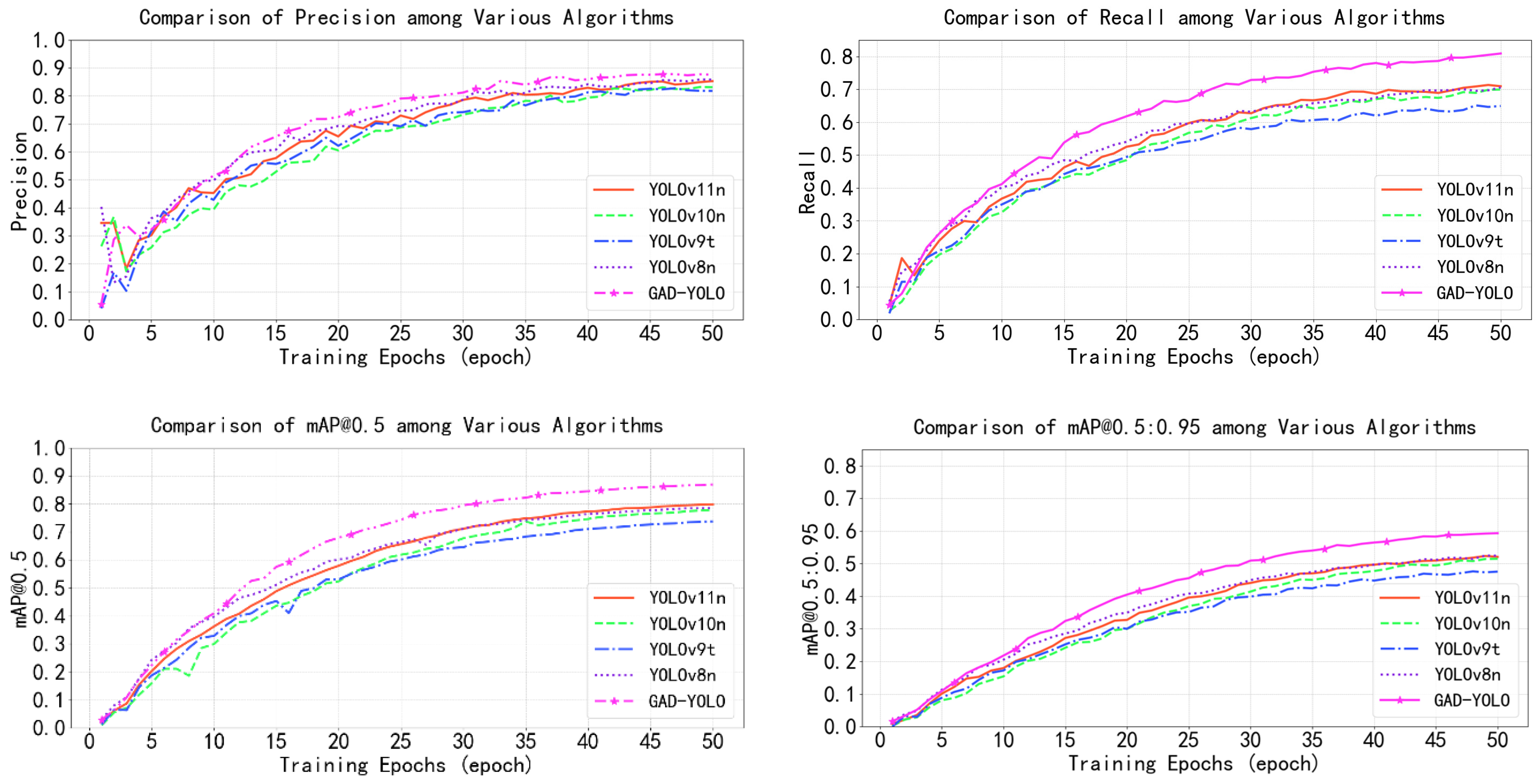
| GAD-YOLO | 87.4 | 80.4 | 86.6 | 59.7 | 125.1 | 3.6 | 12.3 |
| Networks | Model | P/% | R/% | mAP@0.5/% | mAP@0.5:0.95/% |
|---|---|---|---|---|---|
| NEU Surface Defect Dataset | YOLOv11n | 73.5 | 64.3 | 71.9 | 42.8 |
| GAD-YOLO | 75.6 | 67.8 | 74.6 | 44.7 | |
| VisDrone2019-DET Dataset | YOLOv11n | 47.1 | 37.2 | 39.4 | 23.1 |
| GAD-YOLO | 51.3 | 42.5 | 42.8 | 24.9 |
Disclaimer/Publisher’s Note: The statements, opinions and data contained in all publications are solely those of the individual author(s) and contributor(s) and not of MDPI and/or the editor(s). MDPI and/or the editor(s) disclaim responsibility for any injury to people or property resulting from any ideas, methods, instructions or products referred to in the content. |
© 2026 by the authors. Licensee MDPI, Basel, Switzerland. This article is an open access article distributed under the terms and conditions of the Creative Commons Attribution (CC BY) license.
Share and Cite
Wu, T.; Zhong, J.; Wang, Z.; Chen, C.; Xia, Z. GAD-YOLO: A Sight-Distance Adaptive Detection Algorithm for General Aviation Aircraft Skin Damage. Algorithms 2026, 19, 61. https://doi.org/10.3390/a19010061
Wu T, Zhong J, Wang Z, Chen C, Xia Z. GAD-YOLO: A Sight-Distance Adaptive Detection Algorithm for General Aviation Aircraft Skin Damage. Algorithms. 2026; 19(1):61. https://doi.org/10.3390/a19010061
Chicago/Turabian StyleWu, Tao, Jifei Zhong, Zhanhai Wang, Chen Chen, and Zhenghong Xia. 2026. "GAD-YOLO: A Sight-Distance Adaptive Detection Algorithm for General Aviation Aircraft Skin Damage" Algorithms 19, no. 1: 61. https://doi.org/10.3390/a19010061
APA StyleWu, T., Zhong, J., Wang, Z., Chen, C., & Xia, Z. (2026). GAD-YOLO: A Sight-Distance Adaptive Detection Algorithm for General Aviation Aircraft Skin Damage. Algorithms, 19(1), 61. https://doi.org/10.3390/a19010061