Article

An Enhanced Automatic Emergency Braking Control Method Based on Vehicle-to-Vehicle Communication

1
Institute of New Energy Vehicles, Chongqing Technology and Business Institute, Chongqing 401520, China
2
School of Vehicle Engineering, Chongqing University of Technology, Chongqing 400054, China
*
Author to whom correspondence should be addressed.
Algorithms 2026, 19(1), 34; https://doi.org/10.3390/a19010034 (registering DOI)
Submission received: 31 October 2025 / Revised: 27 December 2025 / Accepted: 30 December 2025 / Published: 1 January 2026

Abstract

The automatic emergency braking (AEB) system plays a crucial role in reducing rear-end collisions and is mandatory on certain heavy-duty vehicles, with future regulations extending to passenger cars. However, most current AEB systems are designed based on onboard sensors such as cameras and radar, which may fail to prevent collisions in scenarios where the lead vehicle is already in a collision. To address this issue, this study proposes an enhanced AEB control method based on Vehicle-to-Vehicle (V2V) communication and onboard sensors. The method utilizes V2V communication and onboard sensors to predict obstacles ahead, applying effective braking when necessary. Simulation results in Matlab/Simulink R2022a show that the proposed V2V-based AEB control method reduces the risk of chain collisions, ensuring that the ego vehicle can avoid rear-end collisions even when the lead vehicle is involved in a crash. Three simulation scenarios were designed, where both the subject vehicle and the lead vehicle travel at 120 km/h. The following three distances between the subject vehicle and the lead vehicle were considered: 45 m, 70 m, and 30 m. When the lead vehicle detects an obstacle 30 m ahead and suddenly applies emergency braking, the lead vehicle fails to avoid a collision. In this case, the subject vehicle, equipped only with onboard sensors, is also unable to successfully avoid the crash. However, when the subject vehicle is equipped with both onboard sensors and vehicle-to-vehicle communication, it can prevent a rear-end collision with the lead vehicle, maintaining a vehicle-to-vehicle distance of 1 m, 6.8 m, and 3.1 m, respectively, during the stopping process. This control method contributes to advancing the active safety technologies of autonomous vehicles.

1. Introduction

With the advancement of autonomous driving technology, the application range and importance of AEB (Automatic Emergency Braking) systems are continuously expanding. The automotive AEB system, designed to mitigate or prevent collisions and enhance the safety of both passengers and pedestrians, has its origins in the collision warning systems used in aircraft as early as 1957 [1]. Building on the collision warning theory from the aviation industry, research into collision warning and automatic braking technology began in the late 1980s at major universities and automotive R&D departments around the world. With the rapid development of computer network technology and sensor technologies, automotive AEB systems have matured significantly. In fact, AEB systems are now mandatory in many countries. Furthermore, AEB technology has become one of the key foundations for autonomous driving [2,3,4].
The AEB system primarily comprises three key components: the information acquisition module, the control module, and the actuator module. The system uses onboard sensors, such as cameras or radars, along with the vehicle motion status, to assess the current driving situation. When a potential collision risk ahead is detected, the system first issues a warning to alert the driver to take appropriate action to prevent crash. If the driver fails to respond in time, the control system automatically activates the actuators to apply the brakes, aiming to reduce the severity of the collision or completely avoid it.
The AEB control algorithm is key to the functionality of the AEB system. Previous studies have highlighted two critical aspects of the AEB control algorithm: first, when to apply the brakes, i.e., determining the optimal moment to initiate braking; and second, how to brake, i.e., determining the appropriate braking force [5,6,7]. Research on AEB control algorithms generally focuses on the following approaches: (1) Safe distance models; (2) Time-to-collision (TTC) models; (3) Professional driver fitting (PDF) emergency braking models; and (4) Emergency braking models based on progressive lines or polynomials.
The safe distance model can be categorized into the Mazda model, Honda model, Berkeley model, and Seungwuk Moon model [8,9,10]. The Mazda model takes into account various factors, including the speed of ego vehicle, relative speed between the ego vehicle and the preceding vehicle, maximum deceleration of the ego vehicle, driver reaction time, brake delay, and minimum stopping distance. This comprehensive approach enables more accurate determination of braking distance. However, the formula is relatively complex, requiring significant computational effort, and some parameters may need to be adjusted based on specific vehicle models and driving conditions, limiting its general applicability [8]. The Honda model includes both collision warning and collision avoidance components. Its automatic braking intervention occurs later, which aligns with typical driving habits and minimizes its impact on the driver’s normal operation. However, its relatively short braking distance may lead to delayed response in emergency situations, potentially compromising safety [9]. The Berkeley model is simpler, primarily considering basic factors such as the relative speed between the ego vehicle and the preceding vehicle, driver reaction time, and brake system delay. It is computationally fast, allowing for quick braking decisions. However, it accounts for fewer factors and may not be able to handle complex traffic scenarios. The Seungwuk Moon model calculates the braking distance based on system delay time, braking factors, vehicle speed, and maximum deceleration. The trigger logic is simple and easy to implement, but the parameter values may require extensive experimentation and data support. Furthermore, its adaptability to various driving scenarios and vehicle types needs further validation [10].
The TTC (Time-to-Collision) model assesses collision risks by calculating the time remaining before two vehicles collide, enabling real-time monitoring and evaluation of potential hazards. It provides a clear basis for braking decisions in the time dimension. However, when the relative speed between the two vehicles is zero, the TTC model has no solution, necessitating the establishment of a lower bound. Additionally, the calculation of TTC may be affected by sensor accuracy and algorithmic errors, introducing a degree of uncertainty [11]. Additionally, the TTC model may not be ideal for ensuring vehicle comfort.
In addition, there are professional driver emergency braking models and automatic emergency braking models based on asymptotes or polynomials [12,13]. Compared to the safe distance and TTC models, the PDF model and the asymptote or polynomial-based models can reduce the longitudinal acceleration jerk during braking, improving comfort while ensuring safe collision avoidance. This makes them more acceptable to passengers. Among the four models mentioned, the AEB system typically relies solely on the vehicle’s onboard sensor system, including cameras and radars, for activation. However, these sensor systems have limitations, especially in scenarios such as convoy operations, close-following, and multi-vehicle platooning, where onboard sensors can only perceive direct targets ahead, limiting their ability to meet collaborative requirements. In the event of a rear-end collision with the leading vehicle, the AEB system may fail to avoid the collision, leading to a chain reaction and potentially causing large-scale accidents.
Vehicle-to-Vehicle (V2V) communication, as a key technology in intelligent transportation systems, is rapidly developing and playing an increasingly important role in automatic emergency braking systems [14,15,16,17,18]. Currently, V2V communication mainly utilizes the C-V2X technology, which offers advantages such as low latency, high reliability, and wide coverage. Through the exchange of information between vehicles, V2V communication can overcome the physical limitations of individual vehicle sensors, allowing vehicles to detect potential hazards beyond their sensor range and in blind spots, enabling cooperative automatic emergency braking [19,20,21,22,23]. For example, when two vehicles are aligned longitudinally and the lead vehicle suddenly performs an emergency stop, the following vehicle can receive information about the obstacle ahead via V2V communication, preventing delays in AEB activation caused by the lead vehicle obstructing the sensor’s view. In multi-vehicle convoy scenarios, if the lead vehicle suddenly brakes due to an obstacle, it can broadcast its emergency braking status and the location of the obstacle via V2V. The following vehicles can then receive the warning in advance and intervene in braking, reducing the overall reaction time. Even if the lead vehicle collides, this system can help prevent rear-end chain collisions, significantly improving collision avoidance effectiveness [24,25,26].
In summary, current research on AEB control primarily focuses on sensor-based algorithms, such as multi-objective optimization under different driving styles [27], hierarchical control based on parameter estimation [28,29], and integrated control with other systems, like combining AEB with active suspension to enhance vehicle stability [30]. Additionally, vehicle-in-the-loop testing is used to assess the reliability of AEB systems [31]. However, these studies do not address the potential improvements from vehicle-to-vehicle (V2V) communication. Although current V2V communication faces challenges such as penetration rates and communication reliability [32,33], these issues are expected to be resolved with the development of 6G technology. Building on this, this study proposes an effective integration of onboard sensors and V2V communication as the foundation for AEB system research.
The contribution of this study lies in proposing an enhanced AEB control technology that combines the PDF automatic emergency braking algorithm with V2V communication. This system can prevent chain rear-end collisions even when the leading vehicle is involved in a crash, thereby improving the safety of autonomous driving. The structure of the study is as follows: Section 1 introduces the background; Section 2 outlines the problem to be addressed; Section 3 presents the enhanced AEB control algorithm; Section 4 provides simulation analysis; Section 5 gives some discussion; Section 6 shows economic effect and Section 7 concludes the study.

2. Issues to Be Addressed

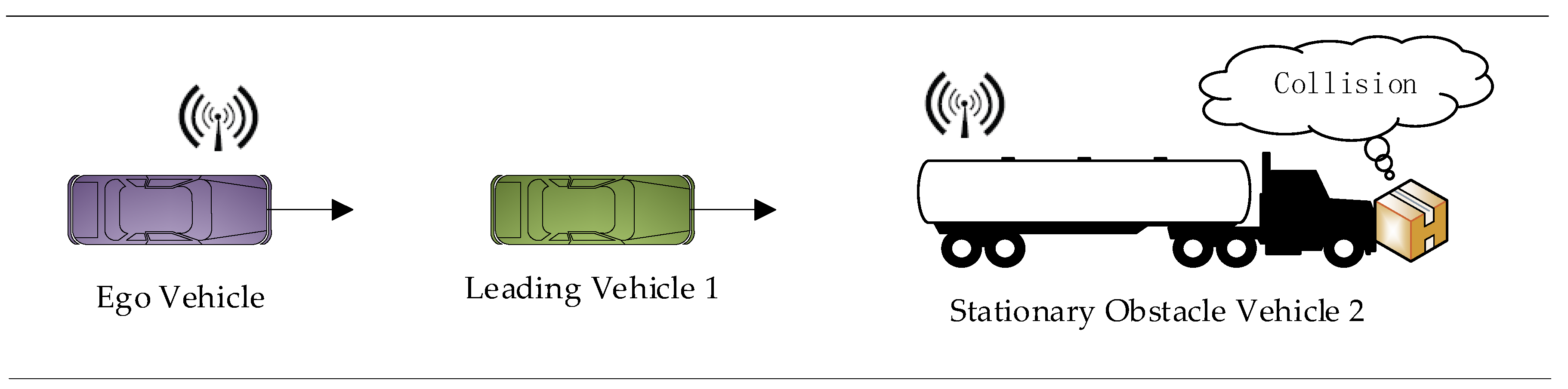
This study aims to address the issue of chain rear-end collisions by proposing an enhanced AEB control method based on vehicle-to-vehicle (V2V) communication. Consider the following scenario: On a foggy day, three vehicles are traveling on a highway. Vehicle 2, the lead vehicle, has been involved in a rear-end collision due to cargo that fell onto the road, and it is now stationary, waiting for assistance. Vehicle 1, due to the weather conditions, notices that Vehicle 2 is stationary 30 m ahead. Meanwhile, the ego vehicle is 45 m behind Vehicle 1. At this moment, Vehicle 2 is stationary, the longitudinal speed of Vehicle 1 is 120 km/h, and the ego vehicle’s longitudinal speed is also 120 km/h. It is assumed that Vehicle 1 can only rely on onboard sensors for collision avoidance, without V2V communication. However, the ego vehicle is capable of collaborative collision avoidance through both onboard sensors and V2V communication. Vehicle 2 is equipped with V2V communication functionality. A schematic of the scenario is shown in Figure 1. This study aims to prevent a collision between the ego vehicle and Vehicle 1 by using a collaborative AEB control method involving both onboard sensors and V2V communication.

3. Enhanced AEB Control Algorithm

3.1. PDF Control Method

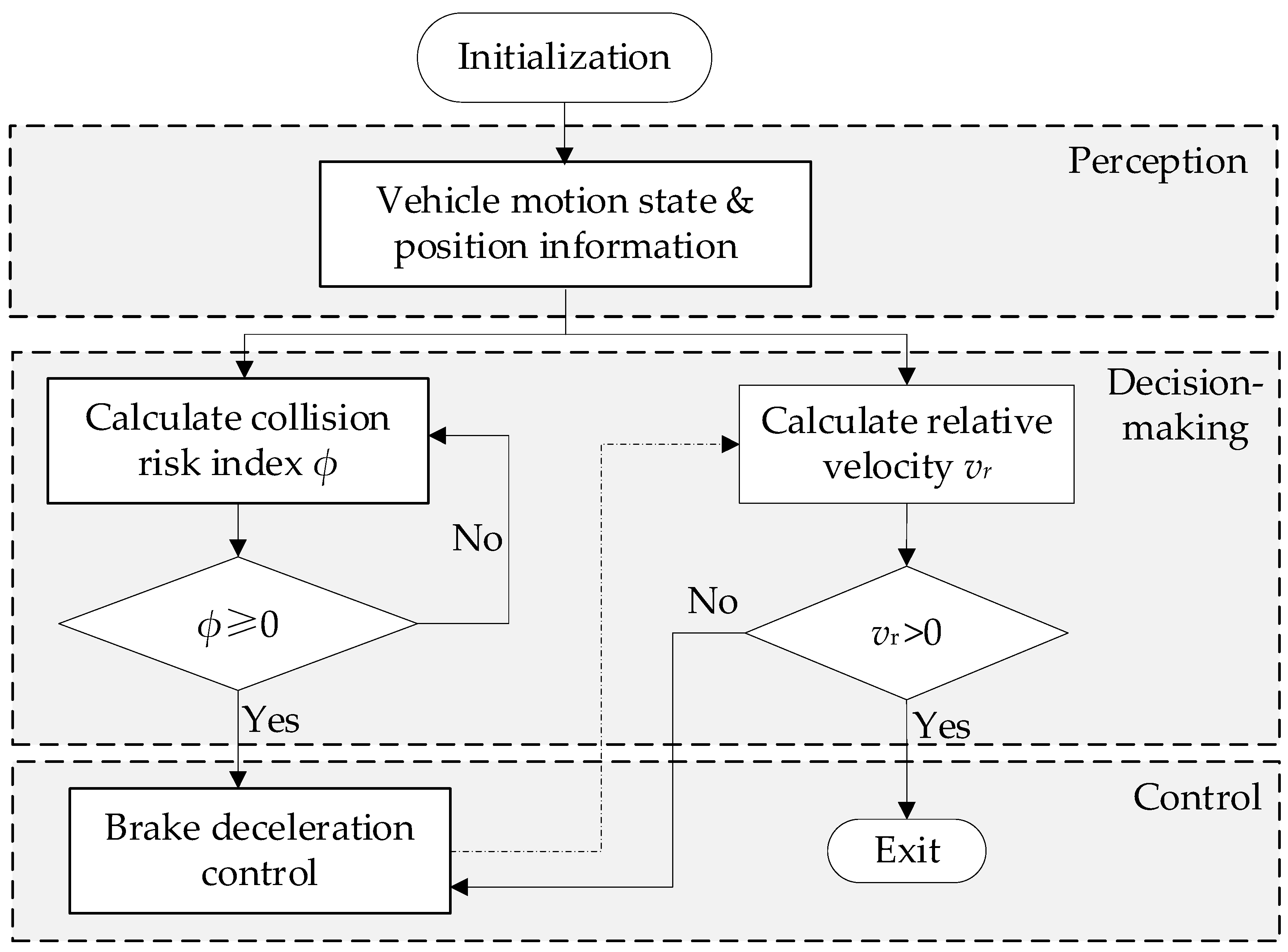
The emergency braking control algorithm based on professional driver primarily involves two key components: the first is determining the optimal initiation time for braking, and the second is applying the appropriate deceleration control strategy. By analyzing the emergency braking behavior of professional drivers through testing, these two aspects can be extracted, fitted, and further refined. This refined data can then be applied to the design of the control algorithm for the automatic emergency braking system. The PDF control logic diagram is illustrated in Figure 2.
Based on the analysis of professional driver behavior, a collision risk index, denoted as ϕ, is introduced in Equation (1). The velocity of the lead vehicle, relative velocity, and the gap between the two vehicles are represented by vL, vr, and d, respectively. An evaluation index, KdB_c, is introduced to quantify the proximity between the two vehicles, expressed in decibels, and can be calculated using Equations (2) and (3). The trigger time for the professional driver’s last-second braking is determined under the condition that ϕ equals zero. The fitting constants for the professional driver fitting (PDF) algorithm are α = 0.2, β = −22.66, and γ = 74.71.
Once the braking trigger time is determined, the vehicle’s longitudinal deceleration can be controlled using Equation (4). In this equation, Pbrake_out represents the longitudinal acceleration output, kp is the feedback gain, and the scalar vrd(t) denotes the desired relatively velocity, as defined in Equation (5). The brake trigger time tbi can be computed using Equation (3). The variable δ(t) is defined in Equation (6), where dconv represents the target converged gap. If vr is zero or negative, automatic braking will be disabled. Further details are provided in [5].
ϕ v L , v r , d = K dB _ c ( α ) β log 10 d γ
K d B _ c = 10 log 10 ( Δ ) sgn ( v r + α v L ) Δ 1 0 Δ < 1
Δ = 4 × 10 7 × v r + α v L d 3
  P brake _ out = k p v r d ( t ) v r ( t )
v r d ( t ) = v r ( t b i ) δ 3 ( t ) exp 3 × 1 δ 3 ( t )
δ ( t ) = d ( t ) d c o n v d ( t b i ) d c o n v
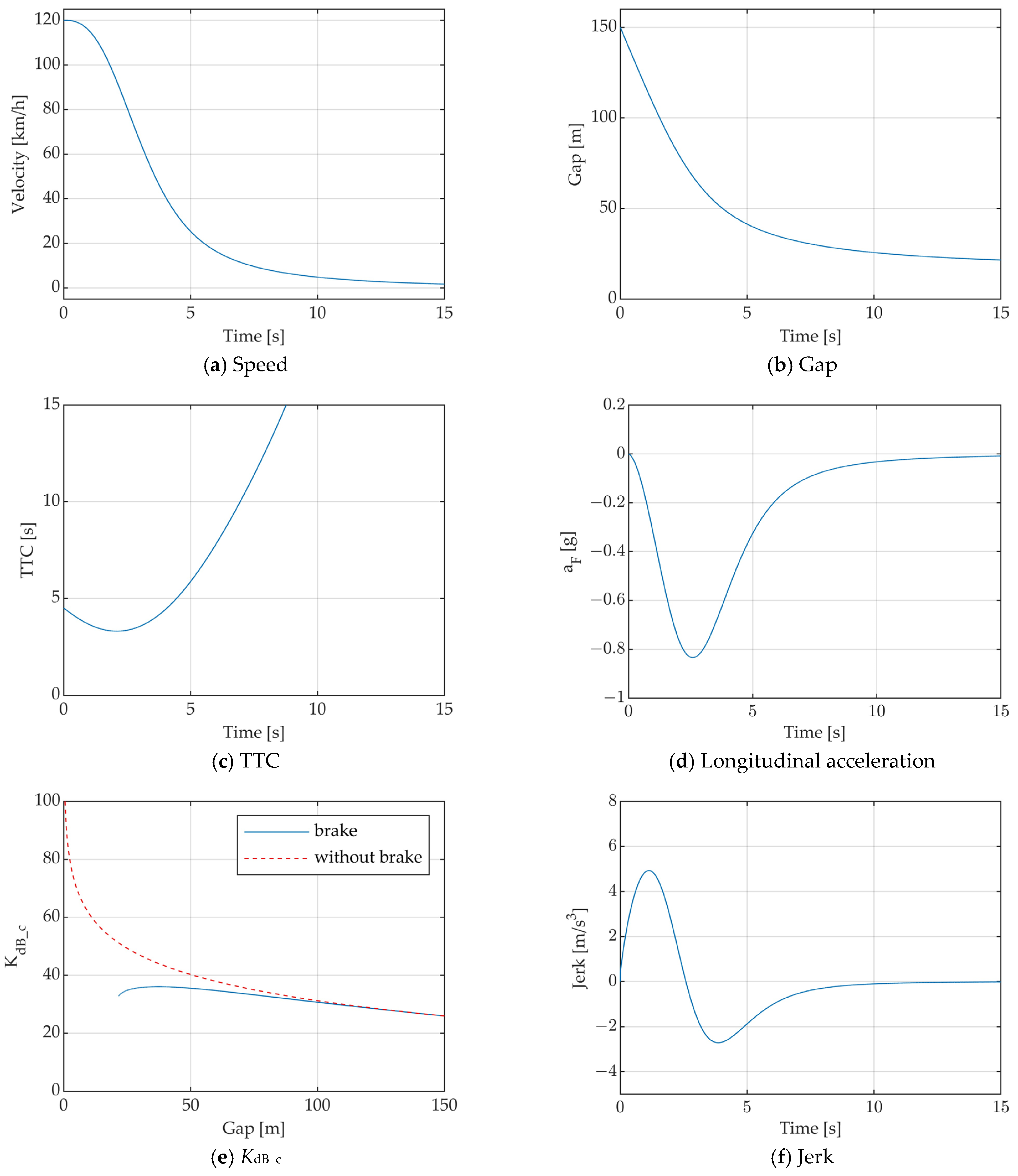
Figure 3 shows the vehicle response of the PDF control system when the ego vehicle, traveling at 120 km/h, approaches a stationary obstacle located 150 m ahead. Figure 3a–f depict the responses of speed, distance, TTC, longitudinal acceleration, KdB_c, and jerk, respectively. It can be observed that the AEB system successfully avoids the collision, with a stopping distance of approximately 21 m. Throughout the braking process, the longitudinal jerk is minimal, and the change in deceleration is smooth. It is worth noting that this AEB control system relies solely on onboard sensors for detection and initiates emergency braking upon detecting the obstacle ahead.

3.2. Proposed Enhanced Control Algorithm

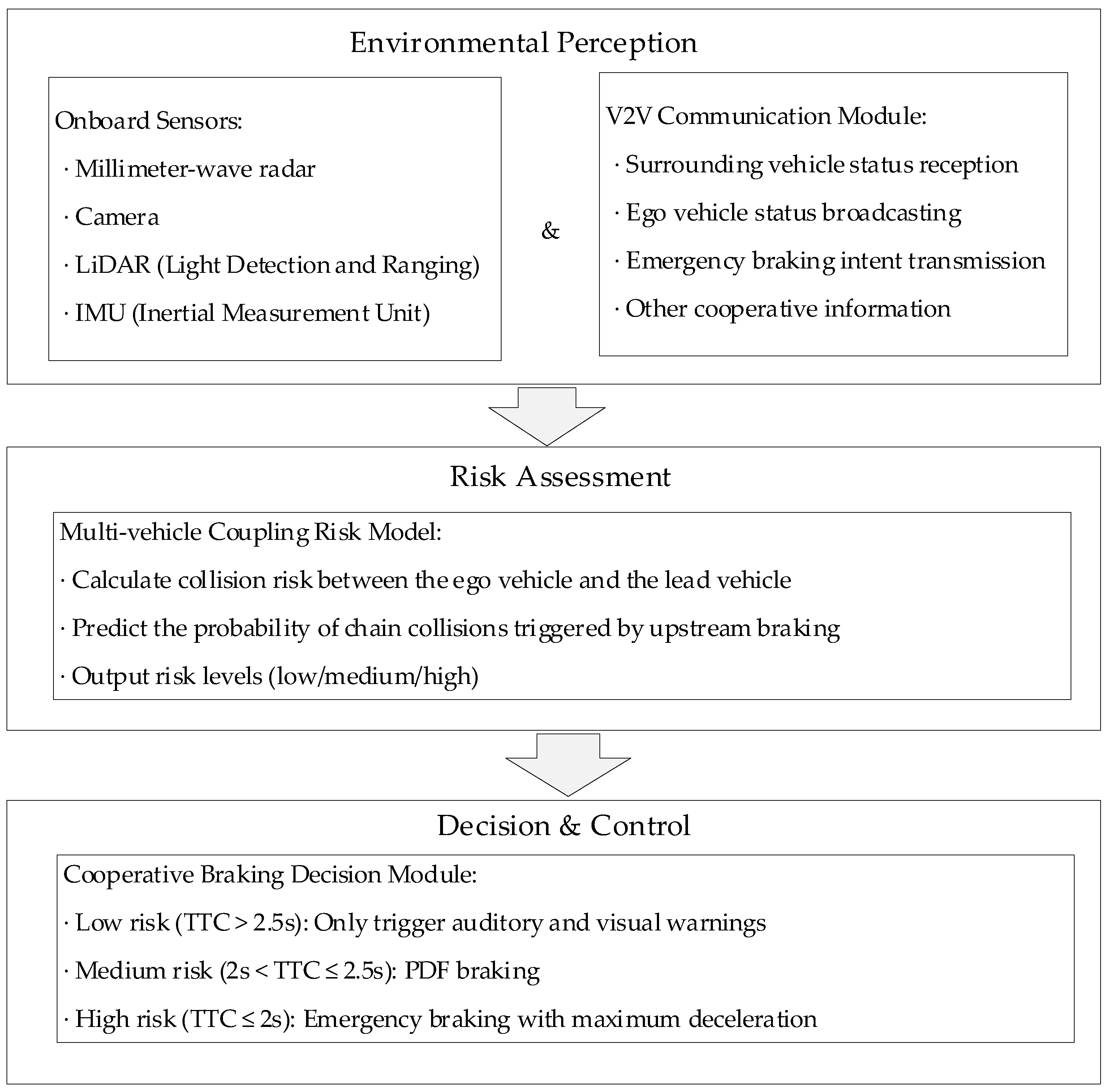
The collaborative AEB control algorithm proposed in this study, which integrates onboard sensors and vehicle-to-vehicle (V2V) communication for cooperative perception, overcomes the limitations of onboard sensor detection and helps prevent chain rear-end collisions. Its specific control framework is shown in Figure 4.
The environmental perception layer captures the full traffic status through local sensing by onboard sensors and remote interaction via V2V communication, overcoming the blind spots of individual vehicle sensors and providing high-precision environmental inputs for risk assessment. The risk assessment layer introduces both lead vehicle collision risk and chain rear-end collision risk. Unlike traditional AEB systems that rely solely on onboard sensors for detecting the vehicle directly ahead, this algorithm utilizes V2V communication to detect all obstacles within the sensor range on the same lane ahead. The decision control layer determines collision avoidance measures based on time-to-collision (TTC). Different measures are taken for low, medium, and high-risk situations. The selection criteria for the TTC threshold can be found in reference [7]. When TTC is greater than 2.5 s, the risk is considered low, and the system only provides an alert. When TTC is between 2 and 2.5 s, the risk is medium, and the PDF-based braking method is applied. When TTC is less than or equal to 2 s, the risk is high, and the system immediately applies maximum deceleration for braking. It is important to note that the TTC calculation here combines both V2V communication and onboard sensors, using the minimum value calculated with respect to the obstacle ahead. For example, in the scenario depicted in Figure 1, assuming the V2V communication range is 200 m, when the ego vehicle is 200 m from the obstacle in front (Vehicle 2), collision information is received. At this point, the TTC is 6 s, indicating a low-risk situation. It is worth noting that the threshold can be adjusted according to the vehicle type and driving style during its practical application.

4. Simulation and Analysis

To validate the control algorithm proposed in this study, a comparative simulation analysis was conducted for AEB control systems with and without vehicle-to-vehicle communication under three different driving scenarios. For simplicity, the simulation analysis is conducted using a point mass vehicle model in Matlab/Simulink R2022a platform. The road friction is assumed to be known, which can be obtained through estimation algorithms or V2X communication.

4.1. Scenario 1

4.1.1. Vehicle-Following Braking (Onboard Sensors)

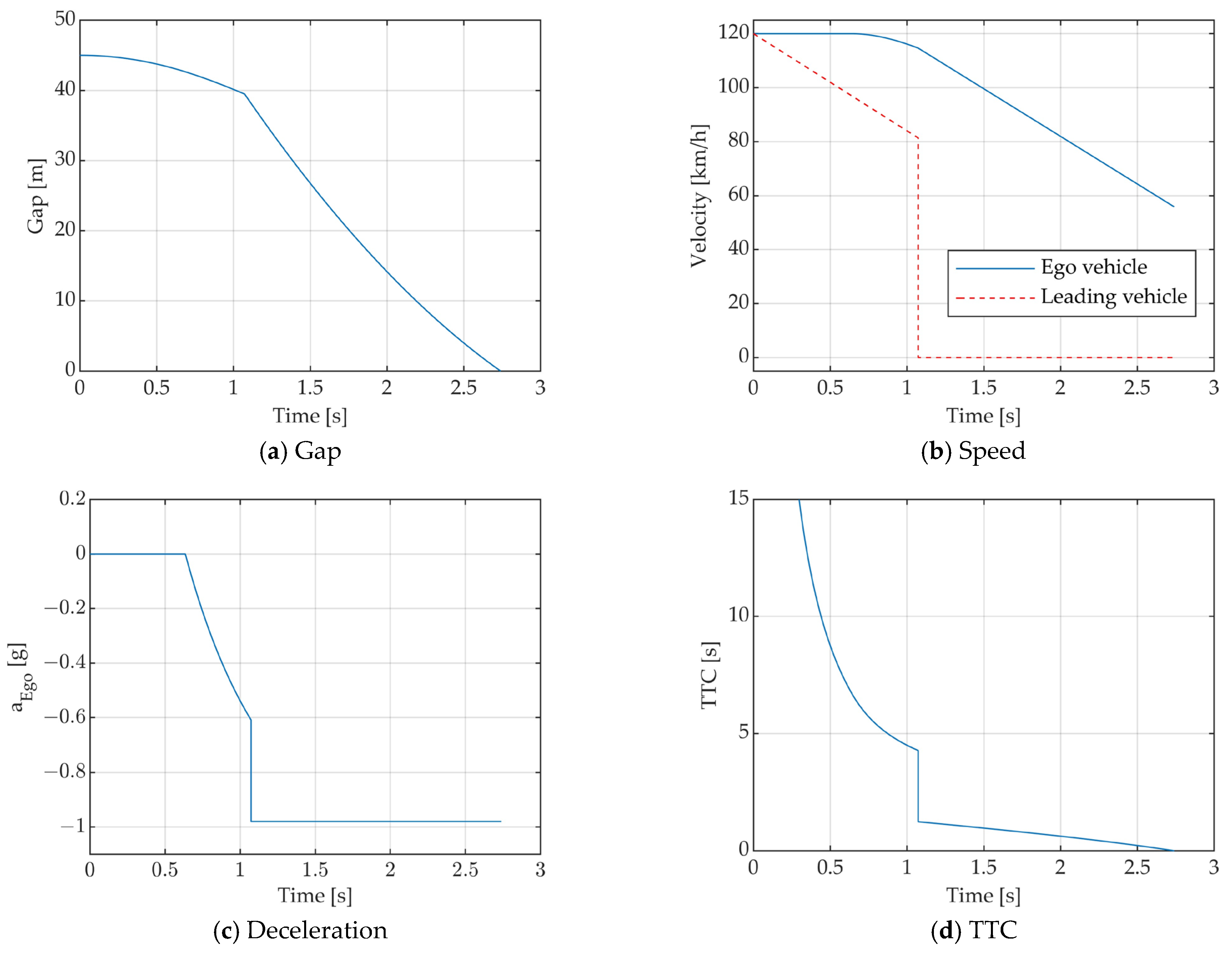
Consider the following driving scenario: Vehicle 1 is traveling at a constant speed of 120 km/h on a flat road with a road friction coefficient of 1. At a given moment, it detects obstacle 2 ahead and initiates braking with a deceleration of 10 m/s2. The longitudinal distance between Vehicle 1 and Obstacle 2 is 30 m. At this time, the ego vehicle is also traveling at 120 km/h, and the longitudinal distance between the ego vehicle and Vehicle 1 is 45 m.
Figure 5 shows the response of the ego vehicle without vehicle-to-vehicle communication. Figure 5a–d illustrate the responses of distance, vehicle speed, deceleration, and TTC, respectively. It can be seen that Vehicle 1 collides with Obstacle 2 after approximately 1.1 s, with a speed of 81 km/h at the time of impact. Since the ego vehicle lacks vehicle-to-vehicle communication and relies solely on onboard sensors for perception, the AEB system makes decisions based on motion state detected by the sensors, such as relative displacement and relative speed. It is evident that the ego vehicle starts decelerating around 0.6 s and reaches maximum deceleration around 1.1 s. The results indicate that, in this scenario, the ego vehicle will collide with Vehicle 1 around 2.7 s, with a collision speed of 56 km/h. Overall, without the V2V communication module, the AEB system relying only on onboard sensors may fail to prevent a chain rear-end collision.

4.1.2. Vehicle-Following Braking (Onboard Sensors & V2V)

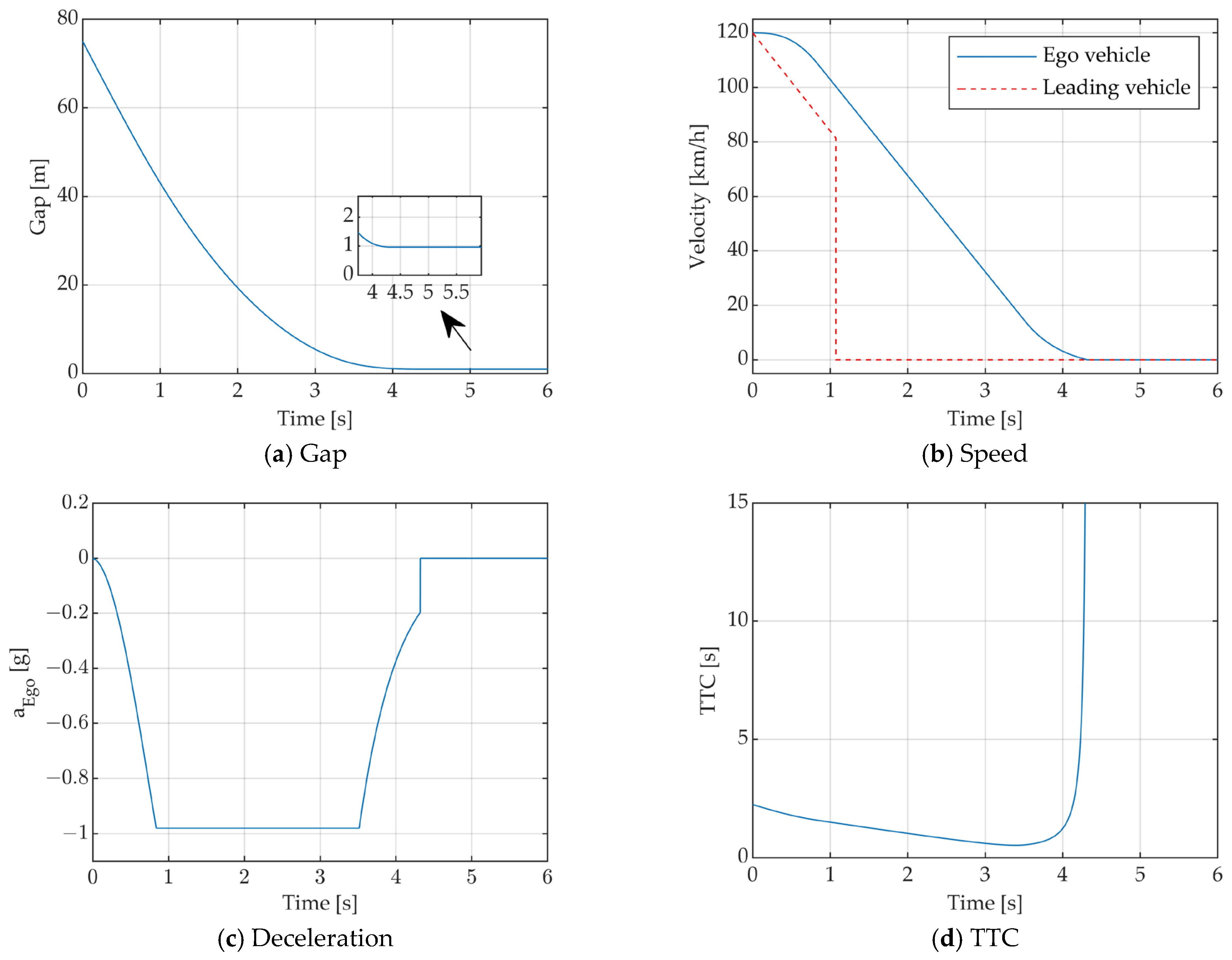
Assume the same driving scenario as in Section 4.1.1. Both the ego vehicle and Vehicle 1 are traveling at a constant speed of 120 km/h, with a longitudinal distance of 45 m between the two. At a given moment, Vehicle 1 detects a stationary obstacle (Obstacle 2) 30 m ahead and initiates braking with a maximum deceleration of 10 m/s2. Unlike in Section 4.1, it is assumed that, when Vehicle 1 starts braking, the ego vehicle receives information about the location of Obstacle 2 via vehicle-to-vehicle communication. The AEB system calculates the TTC value at this point to be 2.25 s, indicating a medium risk. Therefore, the ego vehicle immediately initiates emergency braking and begins braking using the PDF method.
Figure 6 shows the response of the ego vehicle with vehicle-to-vehicle communication. Figure 6a–d illustrate the responses of distance, vehicle speed, deceleration, and TTC, respectively. It can be observed that, with vehicle-to-vehicle communication, the ego vehicle begins emergency braking as soon as the lead vehicle starts braking. At t = 0.8 s, the braking deceleration reaches its maximum value and remains constant. At t = 3.5 s, the deceleration begins to gradually decrease. The ego vehicle comes to a complete stop at t = 4.3 s, with a distance of 1 m from the lead vehicle. Compared to the AEB system relying solely on onboard sensors, the AEB system with vehicle-to-vehicle communication successfully avoids the collision.

4.2. Scenario 2

4.2.1. Vehicle-Following Braking (Onboard Sensors)

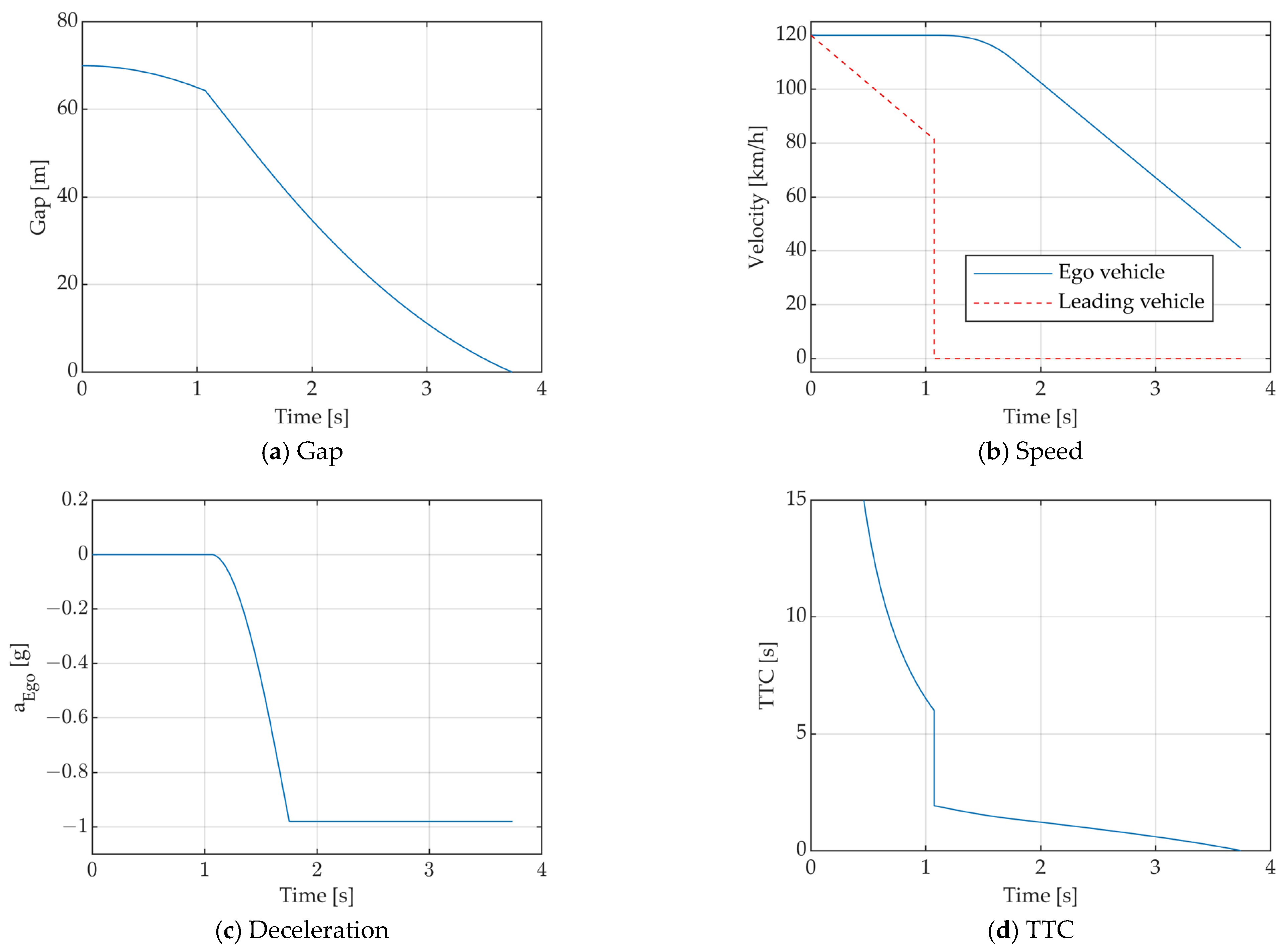
Consider the following driving scenario: Vehicle 1 is traveling at a constant speed of 120 km/h on a flat road with a friction coefficient of 1. Unlike the scenario in Section 4.1, in this case, the ego vehicle is 70 m behind Vehicle 1. At a certain moment, Vehicle 1 detects Obstacle 2 ahead and initiates braking with a deceleration of 10 m/s2. The longitudinal distance between Vehicle 1 and Obstacle 2 remains 30 m. In this scenario, it is assumed that the ego vehicle does not have vehicle-to-vehicle communication and that the AEB system relies solely on onboard sensors.
Figure 7 shows the response of the ego vehicle without vehicle-to-vehicle communication. Figure 7a–d display the responses of distance, vehicle speed, deceleration, and TTC, respectively. It can be seen that Vehicle 1 collides with Obstacle 2 after approximately 1.1 s, with a collision speed of 81 km/h. Since the ego vehicle lacks vehicle-to-vehicle communication and relies solely on onboard sensors for perception, the AEB system makes decisions based on motion state detected by the sensors, such as relative displacement and relative speed. It is evident that the ego vehicle begins decelerating around 1.1 s and reaches maximum deceleration at approximately 1.8 s. The results indicate that, in this scenario, the ego vehicle will collide with Vehicle 1 around 3.7 s, with a collision speed of 41 km/h. Compared to the scenario in Section 4.1, the collision speed here is reduced by 15 km/h. In summary, despite the reduction in collision speed, the AEB system relying solely on onboard sensors still cannot avoid a chain rear-end collision in this scenario due to the lack of vehicle-to-vehicle communication.

4.2.2. Vehicle-Following Braking (Onboard Sensors & V2V)

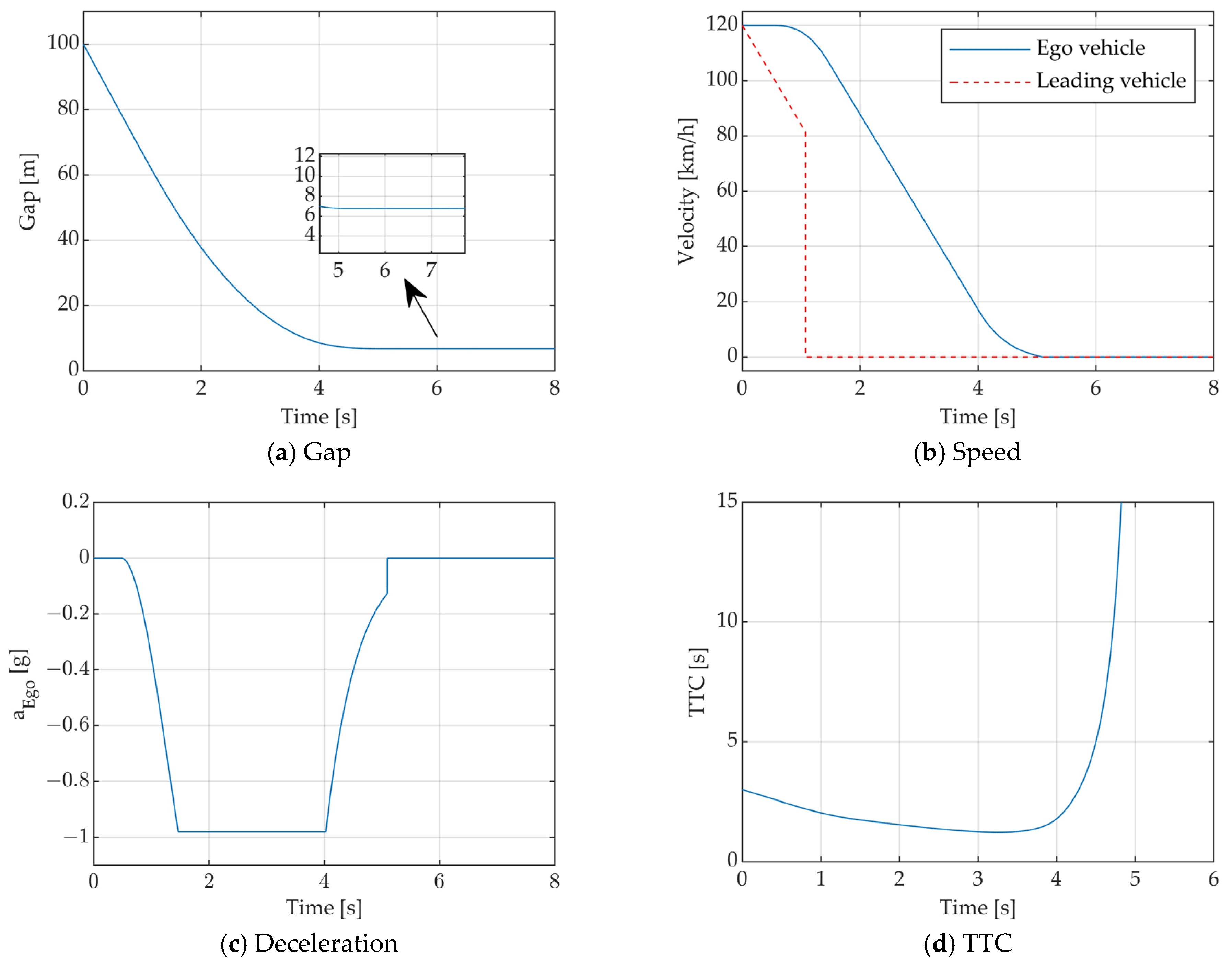
Assume the same driving scenario as in Section 4.1: both the ego vehicle and Vehicle 1 are traveling at 120 km/h, with a longitudinal distance of 70 m between them. The difference in this case is that the ego vehicle’s AEB control system is equipped with vehicle-to-vehicle communication. When Vehicle 1 detects a stationary obstacle (Obstacle 2) 30 m ahead, it begins braking with maximum deceleration. At this point, the ego vehicle receives the location information of Obstacle 2 via vehicle-to-vehicle communication. The AEB system calculates the TTC value to be 3.0 s, indicating a low risk. Therefore, the ego vehicle only triggers an alert and does not initiate emergency braking. When the TTC value decreases to 2.5 s or less, the ego vehicle will begin braking using the PDF method.
Figure 8 shows the response of the ego vehicle with vehicle-to-vehicle communication. Figure 8a–d illustrate the responses of distance, vehicle speed, deceleration, and TTC, respectively. It can be observed that, with vehicle-to-vehicle communication, the ego vehicle maintains its speed for about 0.5 s before starting to decelerate using the PDF method. At t = 1.47 s, the deceleration reaches its maximum value and then remains constant. At t = 4 s, the deceleration begins to gradually decrease. The vehicle comes to a stop at t = 5.1 s, with a longitudinal distance of 6.8 m from the lead vehicle. Compared to the scenario in Section 4.2, the longitudinal distance between the ego vehicle and Vehicle 1 at the time of stopping has increased by 5.8 m. This demonstrates that, in this scenario, the AEB system with vehicle-to-vehicle communication successfully avoids a rear-end collision with the lead vehicle, thereby reducing the risk of chain rear-end collisions.

4.3. Scenario 3: Vehicle-Following Braking (Onboard Sensors & V2V)

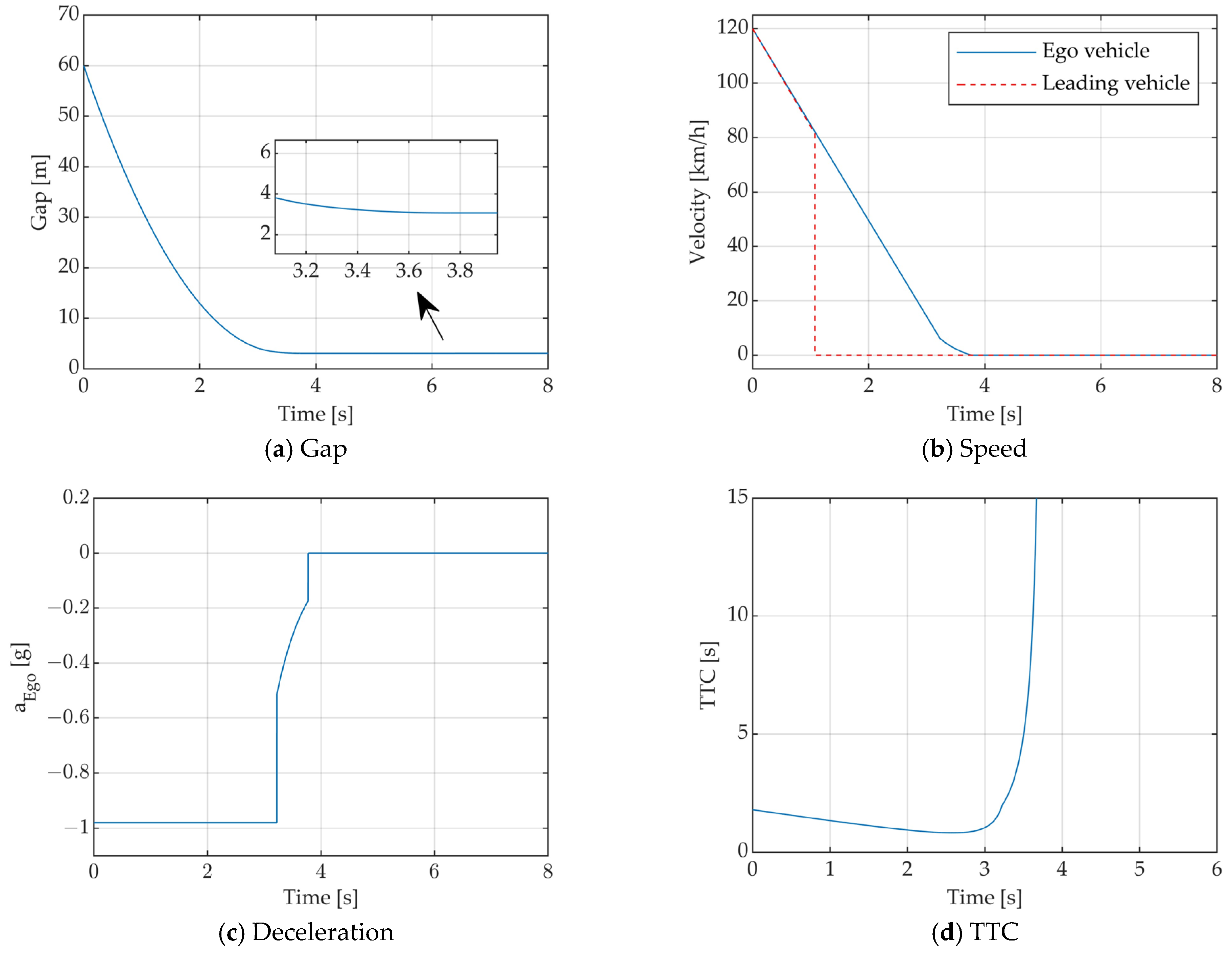
Consider the following driving scenario: Vehicle 1 is traveling at a constant speed of 120 km/h on a flat road with a friction coefficient of 1. Unlike the scenario in Section 4.1, in this case, the ego vehicle is 30 m behind Vehicle 1. At a certain moment, Vehicle 1 detects Obstacle 2 ahead and initiates braking with a deceleration of 10 m/s2. The longitudinal distance between Vehicle 1 and Obstacle 2 is also 30 m. At this point, the ego vehicle receives the location information of Obstacle 2 via vehicle-to-vehicle communication. The AEB system calculates the TTC value to be 1.8 s, indicating a high risk. Therefore, the system immediately initiates braking with maximum deceleration.
As analyzed earlier, in this scenario, the AEB system relying solely on onboard sensors cannot prevent a collision with the lead vehicle. Therefore, the simulation analysis is conducted only for the AEB control system equipped with both onboard sensors and vehicle-to-vehicle communication. Figure 9 shows the response of the ego vehicle with vehicle-to-vehicle communication. Figure 9a–d illustrate the responses of distance, vehicle speed, deceleration, and TTC, respectively. It can be observed that, with vehicle-to-vehicle communication, the AEB system detects the high risk and immediately initiates braking with maximum deceleration. At t = 3.8 s, the vehicle’s speed reaches zero, with a longitudinal distance of 3.1 m from the lead vehicle. This shows that, in this scenario, the AEB system with vehicle-to-vehicle communication is still able to avoid a rear-end collision, thereby reducing the risk of chain rear-end collisions.

5. Discussion

The development of autonomous vehicles is progressing rapidly, with emergency braking serving as a critical last line of defense to ensure safety. Historically, research on automatic emergency braking control algorithms has focused primarily on single-vehicle systems that rely solely on onboard sensors. However, the growing incidence of rear-end collisions exposes the significant limitations of sensor-dependent control systems. Meanwhile, the rapid advancement of vehicle-to-vehicle (V2V) communication technology offers valuable information for autonomous vehicles. V2V communication addresses the physical constraints of onboard sensors, expanding the vehicle’s perception range. When a potential hazard is detected, vehicles can initiate braking actions in advance, thus improving overall driving safety.
Traditional TTC models and safe distance models that rely on onboard sensors, while effective in preventing collisions in certain scenarios, can lead to abrupt braking, significantly impacting passenger comfort. Implementing automatic emergency braking control that mimics professional drivers’ braking behavior is an effective way to improve vehicle safety and passenger comfort. However, the primary objective remains to ensure collision avoidance. This study integrates vehicle-to-vehicle communication and onboard sensors, effectively combining TTC models with professional driver emergency braking patterns. It classifies collision risks into low, medium, and high levels, allowing for the adoption of different collision avoidance measures. Comparative simulation results of AEB control systems with and without V2V communication across three different scenarios demonstrate that incorporating V2V communication into AEB control design can effectively prevent rear-end chain collisions, as shown by Table 1. However, the limitation of this study lies in assuming ideal V2V communication, as issues such as signal delays or interruptions could significantly affect the performance of the AEB system. This remains an important area for future research.

6. Economic Effect

For the Automatic Emergency Braking (AEB) system, the integration of onboard sensors with vehicle-to-vehicle (V2V) communication generates significant economic benefits compared to solutions relying solely on onboard sensors. The core benefits are reflected in three key dimensions: reduced accident-related losses, improved operational efficiency, and optimized lifecycle costs.
From the perspective of direct loss reduction, AEB systems relying solely on onboard sensors face perception delays, which can lead to rear-end collisions and direct costs such as vehicle repairs and component replacements. In contrast, systems integrated with V2V communication can obtain information about the lead vehicle and obstacles in advance. For example, in Scenario 1, collision avoidance is successfully achieved, while in Scenarios 2 and 3, safe stopping is possible, thus avoiding the repair costs associated with collisions and reducing hidden costs such as vehicle structural damage and wear on key components. Additionally, fewer accidents result in significantly reduced insurance claims, and over the long term, this can drive down vehicle insurance premiums, saving ongoing expenses for vehicle owners and fleet operators.
Regarding operational efficiency, systems that rely only on onboard sensors have limited collision avoidance capabilities, requiring vehicles to maintain larger safety distances, which can lead to inefficient use of road resources. On the other hand, the V2V-integrated AEB system can accurately control the safety distance. In Scenario 2, the stopping distance from the lead vehicle is appropriate, while in Scenario 3, safe braking is still achievable at close range, ensuring safety while enhancing road throughput. For commercial operations such as logistics fleets, improved traffic efficiency shortens transport cycles, increases capacity, and indirectly boosts revenue by reducing time costs caused by congestion or accidents.
From a total lifecycle cost perspective, collision incidents shorten vehicle lifespan and increase depreciation. However, the V2V & onboard sensor solution reduces accident frequency, thereby extending vehicle service life and reducing the frequency of vehicle replacements. Furthermore, the system can reduce traffic congestion management costs resulting from accidents, lower road maintenance expenses, and save public expenditures within the social transportation system, creating dual economic benefits at both the individual and societal levels.
In summary, the integration of onboard sensors and vehicle-to-vehicle communication reduces accident losses, improves operational efficiency, and optimizes lifecycle costs, providing multi-dimensional economic benefits for vehicle owners, operators, and the broader transportation network. This makes it highly valuable for widespread implementation.

7. Conclusions

This study proposes an enhanced AEB control method based on Vehicle-to-Vehicle (V2V) communication, which overcomes the physical limitations of onboard sensors. Compared to traditional AEB systems that rely solely on onboard sensors, the proposed enhanced AEB system significantly reduces the risk of chain collisions. The system simulates the emergency braking behavior of a professional driver, performing automatic braking by integrating data from both onboard sensors and V2V communication, greatly enhancing the vehicle’s active safety. Simulation analysis conducted across three different scenarios demonstrates that even in cases where the lead vehicle is involved in a collision, the vehicle equipped with the V2V-based AEB system can still successfully avoid a collision, significantly reducing the risk of chain rear-end crashes. The proposed control method also shows excellent adaptability in adverse weather conditions such as heavy rain or dense fog, where onboard sensors are prone to interference. This helps reduce the risk of rear-end collisions caused by sensor failures, misjudgments, or missed detections. The proposed method is also applicable to convoy control in autonomous vehicle fleets. This study assumes an ideal scenario with no delay or interruption in V2V communication, without considering the stability of the communication system. Future work will explore how the stability of V2V communication affects the performance of the AEB control system.

Author Contributions

Conceptualization, C.H.; methodology, formal analysis, C.H. and F.L.; software, validation, F.L.; writing, C.H. and F.L.; supervision, project administration, F.L. All authors have read and agreed to the published version of the manuscript.

Funding

This work was supported by Science and Technology Research Program of Chongqing Education Commission of China (KJZD-K202404001), National Natural Science Foundation of China (NSFC) Project (52472400) and Chongqing Natural Science Foundation Project (CSTB2024NSCQ-MSX0493).

Data Availability Statement

Data is contained within the article.

Conflicts of Interest

The authors declare no conflicts of interest.

Definitions/Abbreviations

AEBAutomatic Emergency Braking
TTCTime to Collision
V2VVehicle to Vehicle
PDFProfessional Driver Fitting
C-V2XCellular Vehicle to Everything
CCRsCar to Car Rear Stationary

References

  1. Pina, E.I.; Landau, H.J. Operational Requirements for a Collision Warning System. Oper. Res. 1957, 5, 794–814. [Google Scholar] [CrossRef]
  2. Lee, D. A Theory of Visual Control of Braking Based on Information about Time-to-Collision. Perception 1976, 5, 437–459. [Google Scholar] [CrossRef] [PubMed]
  3. Soule, H.; Davis, A.; Krum, A.; Wang, Y.; Ke, R.; Valadez, D.; Sellers, D.; Roberts, S.; Fischer, L.; Lutin, J.M. Risk Mitigation Planning for Revenue Service Testing of Bus Automated Emergency Braking. Transp. Res. Rec. 2021, 2675, 193–200. [Google Scholar] [CrossRef]
  4. Kidd, D.G. Improving the Safety Relevance of Automatic Emergency Braking Testing Programs: An Examination of Common Characteristics of Police-reported Rear-End Crashes in the United States. Traffic Inj. Prev. 2022, 23, 137–142. [Google Scholar] [CrossRef]
  5. Lai, F.; Huang, C. A Study on Automatic Emergency Braking Control Algorithm Based on Professional Drivers’ Braking Behavior. SAE Int. J. Connect. Autom. Veh. 2023, 6, 139–154. [Google Scholar] [CrossRef]
  6. Lai, F.; Huang, C.; Jiang, C. When and How to Apply Automatic Emergency Brakes Based on Risk Perception and Professional Driver Emergency Braking Behavior. SAE Int. J. Veh. Dyn. Stab. NVH 2023, 7, 421–436. [Google Scholar] [CrossRef]
  7. Kodaka, K.; Otabe, M.; Urai, Y.; Koike, H. Rear-End Collision Velocity Reduction System. In Proceedings of the SAE 2003 World Congress & Exhibition, Detroit, MI, USA, 3–6 March 2003. [Google Scholar] [CrossRef]
  8. Doi, A.; Butsuen, T.; Niibe, T. Development of a Rear-End Collision Avoidance System with Automatic Brake Control. JSAE Rev. 1994, 15, 335–340. [Google Scholar] [CrossRef]
  9. Seiler, P.; Song, B.; Hedrick, J. Development of a Collision Avoidance System. In Proceedings of the 1998 SAE International Congress & Exposition, Detroit, MI, USA, 23–26 February 1998. [Google Scholar] [CrossRef]
  10. Bae, J.; Lee, M.; Kang, N. Partial and Full Braking Algorithm According to Time-to-Collision for Both Safety and Ride Comfort in an Autonomous Vehicle. Int. J. Automot. Technol. 2020, 21, 351–360. [Google Scholar] [CrossRef]
  11. Fu, X.; Wan, J.; Wu, D.; Jiang, W.; Ma, W.; Yang, T. Research on Vehicle AEB Control Strategy Based on Safety Time-Safety Distance Fusion Algorithm. Mathematics 2024, 12, 1905. [Google Scholar] [CrossRef]
  12. Kondoh, T.; Yamamura, T.; Kitazaki, S.; Kuge, N.; Boer, E.R. Identification of Visual Cues and Quantification of Drivers’ Perception of Proximity Risk to the Lead Vehicle in Car-Following Situations. J. Mech. Syst. Transp. Logist. 2008, 1, 170–180. [Google Scholar] [CrossRef]
  13. Khayyat, M.; Arrigoni, S.; Cheli, F. Development and Simulation-based Testing of a 5G-Connected Intersection AEB System. Veh. Syst. Dyn. 2022, 60, 4059–4078. [Google Scholar] [CrossRef]
  14. Cho, H.; Kim, G.; Kim, B. Usability Analysis of Collision Avoidance System in Vehicle-to-Vehicle Communication Environment. J. Appl. Math. 2014, 2014, 951214. [Google Scholar] [CrossRef]
  15. Jeon, S.; Lee, J.; Kim, B. A Study on Performance Analysis of V2V Communication Based AEB System Considering Road Friction at Slopes. Int. J. Futur. Gener. Commun. Netw. 2016, 9, 71–80. [Google Scholar] [CrossRef]
  16. Thunberg, J.; Bischoff, D.; Schiegg, F.A.; Meuser, T.; Vinel, A. Unreliable V2X Communication in Cooperative Driving: Safety Times for Emergency Braking. IEEE Access 2021, 9, 148024–148036. [Google Scholar] [CrossRef]
  17. Sidorenko, G.; Plöger, D.; Thunberg, J.; Vinel, A. Emergency Braking with ACC: How Much Does V2V Communicaiton Help? IEEE Netw. Lett. 2022, 4, 157–161. [Google Scholar] [CrossRef]
  18. Prathiba, S.B.; Raja, G.; Kumar, N. Intelligent Cooperative Collision Avoidance at Overtaking and Lane Changing Maneuver in 6G-V2X Communications. IEEE Trans. Veh. Technol. 2022, 71, 112–122. [Google Scholar] [CrossRef]
  19. Li, J.; Xu, R.; Liu, X.; Ma, J.; Chi, Z.; Ma, J. Learning for Vehicle-to-Vehicle Cooperative Perception under Lossy Communication. IEEE Trans. Intell. Veh. 2023, 8, 2650–2660. [Google Scholar] [CrossRef]
  20. Zhou, T.; Liu, W.; Zhang, M.; Jia, J. Optimization of AEB Decision System Based on Unsafe Control Behavior Analysis and Improved ABAS Algorithm. IEEE Trans. Intell. Transp. Syst. 2024, 25, 3152–3165. [Google Scholar] [CrossRef]
  21. Yusuf, S.A.; Khan, A.; Souissi, R. Vehicle-to-Everything (V2X) in the Autonomous Vehicles Domain- A Technical Review of Communication, Sensor, and AI Technologies for Road User Safety. Transp. Res. Interdiscip. Perspect. 2024, 23, 100980. [Google Scholar]
  22. Mo, Y.; Vijay, R.; Rufus, R.; Boer, N.d.; Kim, J.; Yu, M. Enhanced Perception for Autonomous Vehicles at Obstructed Intersections: An Implementation of Vehicle to Infrastructure (V2I) Collaboration. Sensors 2024, 24, 936. [Google Scholar] [CrossRef]
  23. Yi, R.; Yao, Y.; Pu, F.; Zhou, Y.; Wang, X. Cooperative CAV Mandatory Lane-Change Control Enabled by V2I. Commun. Transp. Res. 2024, 4, 100126. [Google Scholar] [CrossRef]
  24. Nyberg, T.; Sánchez, J.M.G.; Narri, V.; Pettersson, H.; Mårtensson, J.; Johansson, K.H.; Törngren, M.; Tumova, J. Share the Unseen: Sequential Reasoning about Occlusions Using Vehicle-to-Everything Technology. IEEE Trans. Control Syst. Technol. 2025, 33, 1418–1431. [Google Scholar] [CrossRef]
  25. Nour, M.; Nour, M.; Zaki, M.H. Integrating Vehicle-to-Infrastructure Communication for Safer Lane Changes in Smart Work Zones. World Electr. Veh. J. 2025, 16, 215. [Google Scholar] [CrossRef]
  26. Abdi, B.; Mirzaei, S.; Adl, M.; Hidajat, S.; Emadi, A. Advancing Vulnerable Road Users Safety: Interdisciplinary Review on V2X Communication and Trajectory Prediction. IEEE Trans. Intell. Transp. Syst. 2025, 26, 2921–2943. [Google Scholar] [CrossRef]
  27. Hong, L.; Chen, Z.; Yang, Z. Multi-objective Optimization of AEB Control Strategy Based on Various Driving Styles. Int. J. Automot. Technol. 2025. [Google Scholar] [CrossRef]
  28. Wang, Z.; Wang, L.; Ma, L.; Sun, Y.; Li, C.; Yang, X. Research on Automatic Emergency Braking Pedestrian System Considering Road Adhesion Coefficient. SAE Int. J. Veh. Dyn. Stab. NVH 2025, 9, 339–355. [Google Scholar] [CrossRef]
  29. Deng, Y.; Zha, Y. A Novel Vehicle Emergency Braking Control Method based on Parameter Estimation. J. Comput. Methods Sci. Eng. 2025, 25, 3425–3442. [Google Scholar] [CrossRef]
  30. Sahin, H. Decision Making for Vehicle Stability with Advanced Emergency Braking and Active Suspension Control. Proc. Inst. Mech. Eng. Part C J. Mech. Eng. Sci. 2025, 239, 9485–9493. [Google Scholar] [CrossRef]
  31. Liu, D.; Huang, W.; Chu, R.; Fan, Y.; Fu, W.; Tang, X.; Li, Z.; Jin, X.; Zhang, H.; Wang, Y. A Comprehensive Performance Evaluation Method Based on Dynamic Weight Analytic Hierarchy Process for In-Loop Automatic Emergency Braking System in Intelligent Connected Vehicles. Machines 2025, 13, 458. [Google Scholar] [CrossRef]
  32. Bazzi, A.; Masini, B.M.; Zanella, A. How Many Vehicles in the LTE-V2V Awareness Range with Half or Full Duplex Radios? In Proceedings of the 2017 15th International Conference on ITS Telecommunications (ITST), Warsaw, Poland, 29–31 May 2017; pp. 1–6. [Google Scholar]
  33. Nour, M.; Zaki, M.H.; Abdel-Aty, M. Assessing the Impact of Vehicle-to-Vehicle Communication on Lane Change Safety in Work Zones. IEEE Open J. Intell. Transp. Syst. 2025, 6, 832–847. [Google Scholar] [CrossRef]
Figure 1. Schematic of test scenario.
Algorithms 19 00034 g001
Figure 2. PDF control logic block diagram.
Algorithms 19 00034 g002
Figure 3. Results of the AEB-equipped vehicle with the PDF control algorithm under CCRs (v0 = 120 km/h & s0 = 150 m).
Algorithms 19 00034 g003
Figure 4. Proposed control logic block diagram.
Algorithms 19 00034 g004
Figure 5. Vehicle response without vehicle-to-vehicle communication.
Algorithms 19 00034 g005
Figure 6. Vehicle response with vehicle-to-vehicle communication.
Algorithms 19 00034 g006
Figure 7. Vehicle response without vehicle-to-vehicle communication.
Algorithms 19 00034 g007
Figure 8. Vehicle response with vehicle-to-vehicle communication.
Algorithms 19 00034 g008
Figure 9. Vehicle response with vehicle-to-vehicle communication.
Algorithms 19 00034 g009
Table 1. Comparison results under three different scenarios.
ScenarioConfigurationInitial Distance Between the Ego Vehicle and the Lead Vehicle (m)Braking Initiation Time (s)Time of Maximum Deceleration (s)Collision/Stopped StateCollision Speed (km/h)Final Gap (m) Result
(1)Only onboard sensors450.61.1Collision occurs at 2.7 s560Collision
Onboard sensors & V2V4500.8Safe stop at 4.3 s01Successful collision avoidance
(2)Only onboard sensors701.11.8Collision occurs at 3.7 s410Collision
Onboard sensors & V2V700.51.47Safe stop at 5.1 s06.8Successful collision avoidance
(3)Only onboard sensors3001.07Collision occurs at 2.1 s68.60Collision
Onboard sensors & V2V3000Safe stop at 3.8 s03.1Successful collision avoidance
Disclaimer/Publisher’s Note: The statements, opinions and data contained in all publications are solely those of the individual author(s) and contributor(s) and not of MDPI and/or the editor(s). MDPI and/or the editor(s) disclaim responsibility for any injury to people or property resulting from any ideas, methods, instructions or products referred to in the content.