
Bilevel Modelling of Metabolic Networks for Computational Strain Design

Abstract
1. Introduction
2. Methods
2.1. Flux Balance Analysis
2.2. Bilevel Model: OptKnock
2.3. Proposed Modelling
2.3.1. M-OptKnock
2.3.2. OptYield
2.3.3. M-OptYield
2.4. Model Reduction and Candidate Selection
2.5. Computational Implementation
3. Results
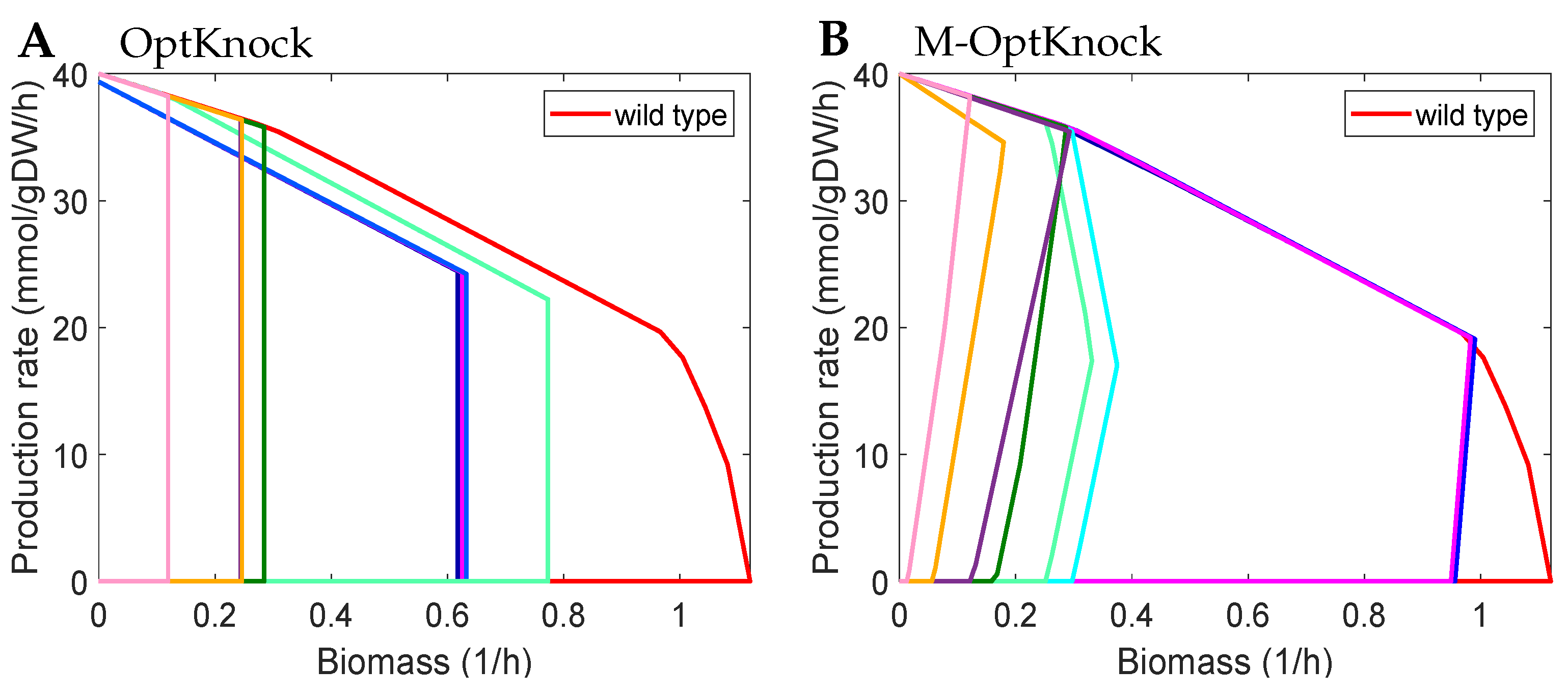
3.1. Multiobjective Modelling of Mutants Helps Achieve Growth-Coupled Design
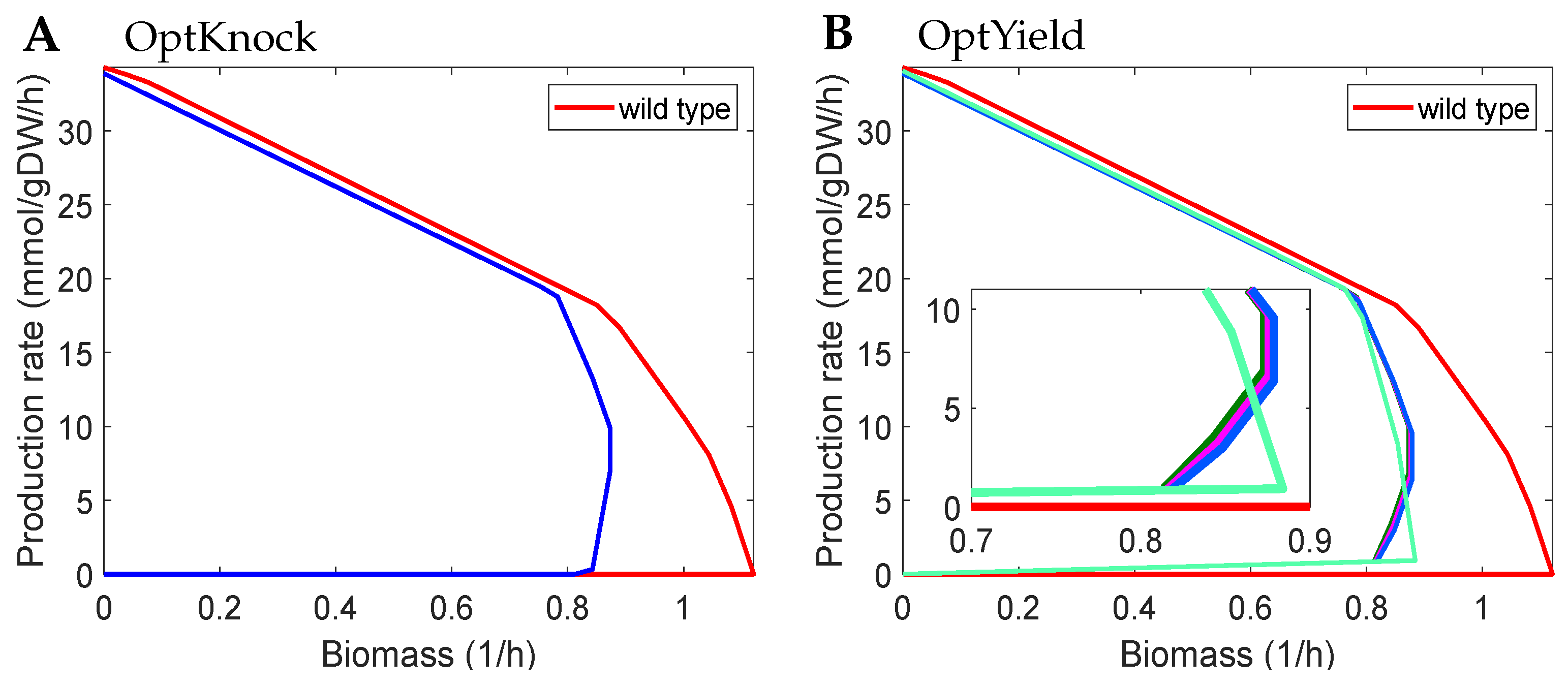
3.2. Yield-Based Modelling Can Identify Design Strategies That Are Different from Rate-Based Modelling
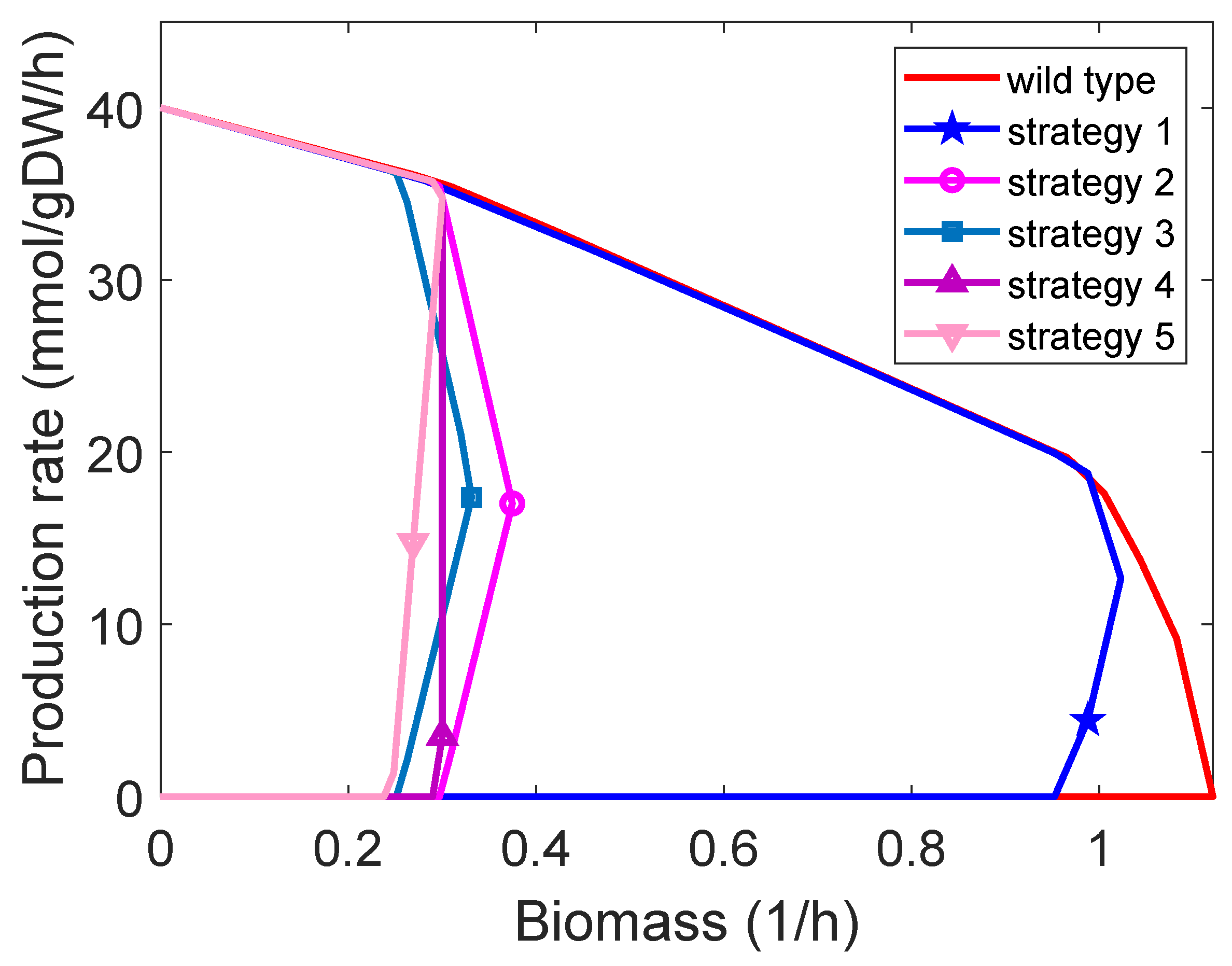
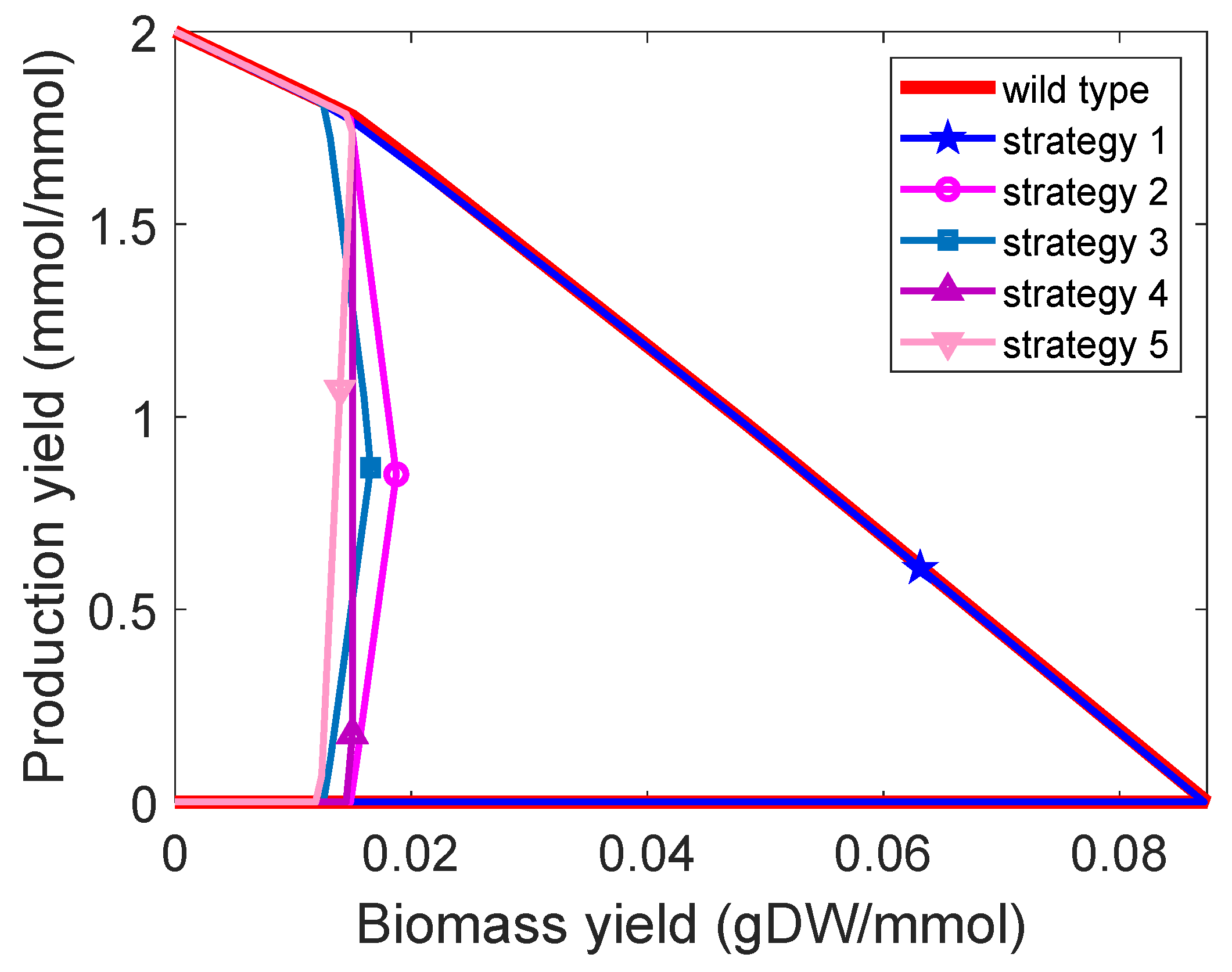
3.3. GRC Design Strategies Are Not Necessarily GYC, and Vice Versa
4. Discussion
Supplementary Materials
Author Contributions
Funding
Data Availability Statement
Conflicts of Interest
Abbreviations
| GEM | Genome-scale metabolic model |
| MCS | Minimum-cut set |
| GYC | Growth yield coupled |
| GRC | Growth rate coupled |
| MILP | Mixed-integer linear program |
Appendix A. Linear Reformulation of Bilevel Models
Appendix A.1. Linear Reformulation of M-OptKnock
Appendix A.2. Linear Reformulation of OptYield
References
- Chae, T.U.; Choi, S.Y.; Kim, J.W.; Ko, Y.S.; Lee, S.Y. Recent advances in systems metabolic engineering tools and strategies. Curr. Opin. Biotechnol. 2017, 47, 67–82. [Google Scholar] [CrossRef] [PubMed]
- Chakraborty, P.; Kumar, R.; Karn, S.; Patel, P.; Gosai, H. Recent trends in metabolic engineering for microbial production of value-added natural products. Biochem. Eng. J. 2025, 213, 109537. [Google Scholar] [CrossRef]
- King, Z.A.; Lu, J.; Dräger, A.; Miller, P.; Federowicz, S.; Lerman, J.A.; Ebrahim, A.; Palsson, B.N.; Lewis, N.E. BiGG Models: A platform for integrating, standardizing and sharing genome-scale models. Nucleic Acids Res. 2015, 44, D515–D522. [Google Scholar] [CrossRef] [PubMed]
- Tarzi, C.; Zampieri, G.; Sullivan, N.; Angione, C. Emerging methods for genome-scale metabolic modeling of microbial communities. Trends Endocrinol. Metab. 2024, 35, 533–548. [Google Scholar] [CrossRef]
- Maia, P.; Rocha, M.; Rocha, I. In silico constraint-based strain optimization methods: The quest for optimal cell factories. Microbiol. Mol. Biol. Rev. 2016, 80, 45–67. [Google Scholar] [CrossRef]
- Lu, J.; Bi, X.; Liu, Y.; Lv, X.; Li, J.; Du, G.; Liu, L. In silico cell factory design driven by comprehensive genome-scale metabolic models: Development and challenges. Syst. Microbiol. Biomanuf. 2023, 3, 207–222. [Google Scholar] [CrossRef]
- Schuetz, R.; Zamboni, N.; Zampieri, M.; Heinemann, M.; Sauer, U. Multidimensional optimality of microbial metabolism. Science 2012, 336, 601–604. [Google Scholar] [CrossRef]
- Burgard, A.P.; Pharkya, P.; Maranas, C.D. Optknock: A bilevel programming framework for identifying gene knockout strategies for microbial strain optimization. Biotechnol. Bioeng. 2003, 84, 647–657. [Google Scholar] [CrossRef]
- Tepper, N.; Shlomi, T. Predicting metabolic engineering knockout strategies for chemical production: Accounting for competing pathways. Bioinformatics 2010, 26, 536–543. [Google Scholar] [CrossRef]
- Pharkya, P.; Maranas, C.D. An optimization framework for identifying reaction activation/inhibition or elimination candidates for overproduction in microbial systems. Metab. Eng. 2006, 8, 1–13. [Google Scholar] [CrossRef]
- Kim, J.; Reed, J.L. OptORF: Optimal metabolic and regulatory perturbations for metabolic engineering of microbial strains. BMC Syst. Biol. 2010, 4, 53. [Google Scholar] [CrossRef]
- Pharkya, P.; Burgard, A.P.; Maranas, C.D. OptStrain: A computational framework for redesign of microbial production systems. Genome Res. 2004, 14, 2367–2376. [Google Scholar] [CrossRef] [PubMed]
- Kim, J.; Reed, J.L.; Maravelias, C.T. Large-Scale bi-Level strain design approaches and mixed-integer programming solution techniques. PLoS ONE 2011, 6, e24162. [Google Scholar] [CrossRef] [PubMed]
- Ranganathan, S.; Suthers, P.F.; Maranas, C.D. OptForce: An optimization procedure for identifying all genetic manipulations leading to targeted overproductions. PLoS Comput. Biol. 2010, 6, e1000744. [Google Scholar] [CrossRef] [PubMed]
- Alter, T.B.; Ebert, B.E. Determination of growth-coupling strategies and their underlying principles. BMC Bioinform. 2019, 20, 447. [Google Scholar] [CrossRef]
- Jensen, K.; Broeken, V.; Hansen, A.S.L.; Sonnenschein, N.; Herrgård, M.J. OptCouple: Joint simulation of gene knockouts, insertions and medium modifications for prediction of growth-coupled strain designs. Metab. Eng. Commun. 2019, 8, e00087. [Google Scholar] [CrossRef]
- Jiang, S.; Otero-Muras, I.; Banga, J.R.; Wang, Y.; Kaiser, M.; Krasnogor, N. OptDesign: Identifying optimum design strategies in strain engineering for biochemical production. ACS Synth. Biol. 2022, 11, 1531–1541. [Google Scholar] [CrossRef]
- Jiang, S.; Wang, Y.; Kaiser, M.; Krasnogor, N. NIHBA: A network interdiction approach for metabolic engineering design. Bioinformatics 2020, 36, 3482–3492. [Google Scholar] [CrossRef]
- Schneider, P.; Mahadevan, R.; Klamt, S. Systematizing the different notions of growth-coupled product synthesis and a single framework for computing corresponding strain designs. Biotechnol. J. 2021, 16, 2100236. [Google Scholar] [CrossRef]
- Apaolaza, I.; Valcarcel, L.V.; Planes, F.J. gMCS: Fast computation of genetic minimal cut sets in large networks. Bioinformatics 2018, 35, 535–537. [Google Scholar] [CrossRef]
- von Kamp, A.; Klamt, S. Enumeration of smallest intervention strategies in genome-scale metabolic networks. PLoS Comput. Biol. 2014, 10, e1003378. [Google Scholar] [CrossRef]
- Klamt, S.; Gilles, E.D. Minimal cut sets in biochemical reaction networks. Bioinformatics 2004, 20, 226–234. [Google Scholar] [CrossRef]
- Banerjee, D.; Eng, T.; Lau, A.K.; Sasaki, Y.; Wang, B.; Chen, Y.; Prahl, J.P.; Singan, V.R.; Herbert, R.A.; Liu, Y.; et al. Genome-scale metabolic rewiring improves titers rates and yields of the non-native product indigoidine at scale. Nat. Commun. 2020, 11, 5385. [Google Scholar] [CrossRef] [PubMed]
- Feist, A.M.; Zielinski, D.C.; Orth, J.D.; Schellenberger, J.; Herrgard, M.J.; Palsson, B.N. Model-driven evaluation of the production potential for growth-coupled products of Escherichia coli. Metab. Eng. 2010, 12, 173–186. [Google Scholar] [CrossRef] [PubMed]
- Shen, F.; Sun, R.; Yao, J.; Li, J.; Liu, Q.; Price, N.D.; Liu, C.; Wang, Z. OptRAM: In-silico strain design via integrative regulatory-metabolic network modeling. PLoS Comput. Biol. 2019, 15, e1006835. [Google Scholar] [CrossRef] [PubMed]
- Patil, K.R.; Rocha, I.; Förster, J.; Nielsen, J. Evolutionary programming as a platform for in silico metabolic engineering. BMC Bioinform. 2005, 6, 308. [Google Scholar] [CrossRef]
- Briones-Báez, M.F.; Aguilera-Vázquez, L.; Rangel-Valdez, N.; Zuñiga, C.; Martínez-Salazar, A.L.; Gomez-Santillan, C. Pitfalls in metaheuristics solving stoichiometric-based optimization models for metabolic networks. Algorithms 2024, 17, 336. [Google Scholar] [CrossRef]
- Choon, Y.W.; Mohamad, M.S.; Deris, S.; Chong, C.K.; Omatu, S.; Corchado, J.M. Gene knockout identification using an extension of bees hill flux balance analysis. BioMed Res. Int. 2015, 2015, 124537. [Google Scholar] [CrossRef]
- Bai, L.; You, Q.; Zhang, C.; Sun, J.; Liu, L.; Lu, H.; Chen, Q. Advances and applications of machine learning and intelligent optimization algorithms in genome-scale metabolic network models. Syst. Microbiol. Biomanuf. 2023, 3, 193–206. [Google Scholar] [CrossRef]
- Lun, D.S.; Rockwell, G.; Guido, N.J.; Baym, M.; Kelner, J.A.; Berger, B.; Galagan, J.E.; Church, G.M. Large-scale identification of genetic design strategies using local search. Mol. Syst. Biol. 2009, 5, 296. [Google Scholar] [CrossRef]
- Gu, D.; Zhang, C.; Zhou, S.; Wei, L.; Hua, Q. IdealKnock: A framework for efficiently identifying knockout strategies leading to targeted overproduction. Comput. Biol. Chem. 2016, 61, 229–237. [Google Scholar] [CrossRef] [PubMed]
- Ohno, S.; Shimizu, H.; Furusawa, C. FastPros: Screening of reaction knockout strategies for metabolic engineering. Bioinformatics 2014, 30, 981–987. [Google Scholar] [CrossRef] [PubMed]
- Liao, W.; Gao, G.; Fan, X.; Wang, H.; He, S.; Xiang, G.; Yan, X.; Lu, H. Efficient cell factory design by combining meta-heuristic algorithm with enzyme constrained metabolic models. bioRxiv 2025, bioRxiv:12.659423. [Google Scholar] [CrossRef]
- Segrè, D.; Vitkup, D.; Church, G.M. Analysis of optimality in natural and perturbed metabolic networks. Proc. Natl. Acad. Sci. USA 2002, 99, 15112–15117. [Google Scholar] [CrossRef] [PubMed]
- Monk, J.M.; Lloyd, C.J.; Brunk, E.; Mih, N.; Sastry, A.; King, Z.; Takeuchi, R.; Nomura, W.; Zhang, Z.; Mori, H.; et al. iML1515, a knowledgebase that computes Escherichia coli traits. Nat. Biotechnol. 2017, 35, 904–908. [Google Scholar] [CrossRef]
- Heirendt, L.; Arreckx, S.; Pfau, T.; Mendoza, S.N.; Richelle, A.; Heinken, A.; Haraldsdóttir, H.S.; Wachowiak, J.; Keating, S.M.; Vlasov, V.; et al. Creation and analysis of biochemical constraint-based models: The COBRA Toolbox v3. 0. Nat. Protoc. 2018, 14, 639–702. [Google Scholar] [CrossRef]
- Gurobi Optimization, L. Gurobi Optimizer Reference Manual, 2018. Available online: https://docs.gurobi.com/projects/optimizer/en/current/index.html (accessed on 3 December 2025).
- Egen, D.; Lun, D.S. Truncated branch and bound achieves efficient constraint-based genetic design. Bioinformatics 2012, 28, 1619–1623. [Google Scholar] [CrossRef]
- McCloskey, D.; Palsson, B.Ø.; Feist, A.M. Basic and applied uses of genome-scale metabolic network reconstructions of Escherichia coli. Mol. Syst. Biol. 2013, 9, 661. [Google Scholar] [CrossRef]
- Sundara Sekar, B.; Seol, E.; Park, S. Co-production of hydrogen and ethanol from glucose in Escherichia coli by activation of pentose-phosphate pathway through deletion of phosphoglucose isomerase (pgi) and overexpression of glucose-6-phosphate dehydrogenase (zwf) and 6-phosphogluconate dehydrogenase (gnd). Biotechnol. Biofuels 2017, 10, 85. [Google Scholar]
- Seol, E.; Ainala, S.K.; Sekar, B.S.; Park, S. Metabolic engineering of Escherichia coli strains for co-production of hydrogen and ethanol from glucose. Int. J. Hydrog. Energy 2014, 39, 19323–19330. [Google Scholar] [CrossRef]
- Jantama, K.; Zhang, X.; Moore, J.C.; Shanmugam, K.T.; Svoronos, S.; Ingram, L.O. Eliminating side products and increasing succinate yields in engineered strains of Escherichia coli C. Biotechnol. Bioeng. 2008, 101, 881–893. [Google Scholar] [CrossRef]
- Derbikov, D.; Novikov, A.; Gubanova, T.; Tarutina, M.; Gvilava, I.; Bubnov, D.; Yanenko, A. Aspartic acid synthesis by Escherichia coli strains with deleted fumarase genes as biocatalysts. Appl. Biochem. Microbiol. 2017, 53, 859–866. [Google Scholar] [CrossRef]
- Zhang, C.; Ji, B.; Mardinoglu, A.; Nielsen, J.; Hua, Q. Logical transformation of genome-scale metabolic models for gene level applications and analysis. Bioinformatics 2015, 31, 2324–2331. [Google Scholar] [CrossRef][Green Version]
- Machado, D.; Herrgård, M.J.; Rocha, I. Stoichiometric representation of gene–protein–reaction associations leverages constraint-based analysis from reaction to gene-Level phenotype prediction. PLoS Comput. Biol. 2016, 12, e1005140. [Google Scholar] [CrossRef]
- Patanè, A.; Santoro, A.; Costanza, J.; Carapezza, G.; Nicosia, G. Pareto optimal design for synthetic biology. IEEE Trans. Biomed. Circuits Syst. 2015, 9, 555–571. [Google Scholar] [CrossRef]
- Taşkin, Z.C. Benders Decomposition. In Wiley Encyclopedia of Operations Research and Management Science; American Cancer Society: Atlanta, GA, USA, 2011. [Google Scholar] [CrossRef]



| Product | Method | Max. Growth Yield | Max. Product Yield | Min. Product Yield |
|---|---|---|---|---|
| acetate | OptKnock | 0 | 0 | 0 |
| M-OptKnock | 0 | 0 | 0 | |
| OptYield | 0.0122 | 1.349 | 1.349 | |
| M-OptYield | 0.0122 | 1.349 | 1.349 | |
| ethanol | OptKnock | 0.006 | 1.9119 | 0 |
| M-OptKnock | 0.0061 | 1.9105 | 1.9028 | |
| OptYield | 0.006 | 1.9119 | 0 | |
| M-OptYield | 0.0062 | 1.9047 | 1.9047 | |
| succinate | OptKnock | 0.0562 | 0 | 0 |
| M-OptKnock | 0.0124 | 0.0911 | 0.0041 | |
| OptYield | 0.0533 | 0.6659 | 0.6659 | |
| M-OptYield | 0.0533 | 0.6659 | 0.6659 | |
| fumarate | OptKnock | 0.0224 | 0.2388 | 0.2388 |
| M-OptKnock | 0.0799 | 0.0833 | 0.0833 | |
| OptYield | 0.0203 | 0.3105 | 0.3105 | |
| M-OptYield | 0.0219 | 0.2555 | 0.2555 |
| Design Strategy | Knockout Set | Growth Rate (1/h) | Min. Prod. (mmol/gDW/h) | Max. Prod. (mmol/gDW/h) |
|---|---|---|---|---|
| strategy 1 | FORtex, PPC, LDH_D | 1.0229 | 12.6709 | 12.6709 |
| strategy 2 | MGSA, EDA, O2tex | 0.3747 | 17.0172 | 17.0172 |
| strategy 3 | PGI, EDA, O2tex | 0.3312 | 17.3629 | 17.3629 |
| strategy 4 | ACtex, HXAtex, O2tex | 0.3001 | 3.5095 | 34.7711 |
| strategy 5 | ACtex, LDH_D, O2tex | 0.3001 | 34.77111 | 34.7711 |
| Design Strategy | Knockout Set | Growth Rate (1/h) | Min. Prod. (mmol/gDW/h) | Max. Prod. (mmol/gDW/h) |
|---|---|---|---|---|
| strategy 1 | TKT2, FE3tex, O2tex | 0.3723 | 17.5742 | 17.5742 |
| strategy 2 | TKT2, PGI, O2tex | 0.3304 | 17.8472 | 17.8472 |
| strategy 3 | ACtex, LDH_D, O2tex | 0.3001 | 34.7711 | 34.7711 |
| strategy 4 | FORtex, LDH_D, O2tex | 0.2928 | 34.4464 | 35.6731 |
| strategy 5 | TKT2, PPC, O2tex | 0.2619 | 18.5785 | 18.5785 |
| Approaches | K = 3 | K = 5 | K = 8 | K = 12 |
|---|---|---|---|---|
| OptKnock | 0~38.1845 | 0~38.2371 | 0~38.2643 | 0~38.2643 |
| M-OptKnock | 34.3411~34.7711 | 38.0551~38.2092 | 38.0551~38.2092 | 38.0551~38.2092 |
| OptYield | 17.8472~17.8472 | 17.8472~17.8472 | 17.8473~17.8473 | 17.8473~17.8473 |
| M-OptYield | 34.3411~34.7711 | 38.0932~38.0949 | 38.0932~38.0949 | 38.2207~38.2224 |
| Approaches | K = 3 | K = 5 | K = 8 | K = 12 |
|---|---|---|---|---|
| OptKnock | 0~22.0776 | 0~24.4463 | 0~24.9297 | 0~25.1549 |
| M-OptKnock | 12.6709~12.6709 | 19.1844~19.1844 | 20.2367~20.2494 | 21.6705~21.6818 |
| OptYield | 0~4.0032 | 0~13.8634 | 0~24.8293 | 0~24.9405 |
| M-OptYield | 0~19.0352 | 0~19.0741 | 18.9349~19.9434 | 24.6809~24.6892 |
Disclaimer/Publisher’s Note: The statements, opinions and data contained in all publications are solely those of the individual author(s) and contributor(s) and not of MDPI and/or the editor(s). MDPI and/or the editor(s) disclaim responsibility for any injury to people or property resulting from any ideas, methods, instructions or products referred to in the content. |
© 2025 by the authors. Licensee MDPI, Basel, Switzerland. This article is an open access article distributed under the terms and conditions of the Creative Commons Attribution (CC BY) license (https://creativecommons.org/licenses/by/4.0/).
Share and Cite
Wang, B.; Jiang, S.; Xu, S.; Li, J. Bilevel Modelling of Metabolic Networks for Computational Strain Design. Algorithms 2025, 18, 786. https://doi.org/10.3390/a18120786
Wang B, Jiang S, Xu S, Li J. Bilevel Modelling of Metabolic Networks for Computational Strain Design. Algorithms. 2025; 18(12):786. https://doi.org/10.3390/a18120786
Chicago/Turabian StyleWang, Beichen, Shouyong Jiang, Shibo Xu, and Jichun Li. 2025. "Bilevel Modelling of Metabolic Networks for Computational Strain Design" Algorithms 18, no. 12: 786. https://doi.org/10.3390/a18120786
APA StyleWang, B., Jiang, S., Xu, S., & Li, J. (2025). Bilevel Modelling of Metabolic Networks for Computational Strain Design. Algorithms, 18(12), 786. https://doi.org/10.3390/a18120786