Study on the Microstructure Evolution of CuxNi2.7Mn Steel During Processing with Different Copper Contents


Abstract
1. Introduction
2. Materials and Methods
2.1. Experimental Materials
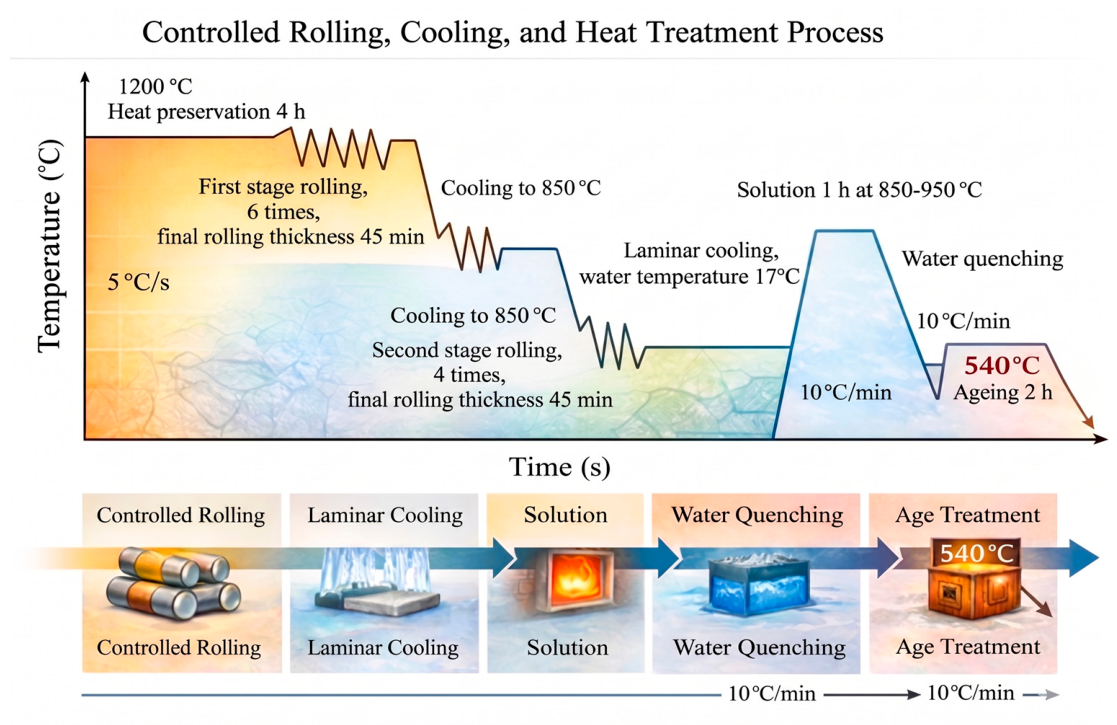
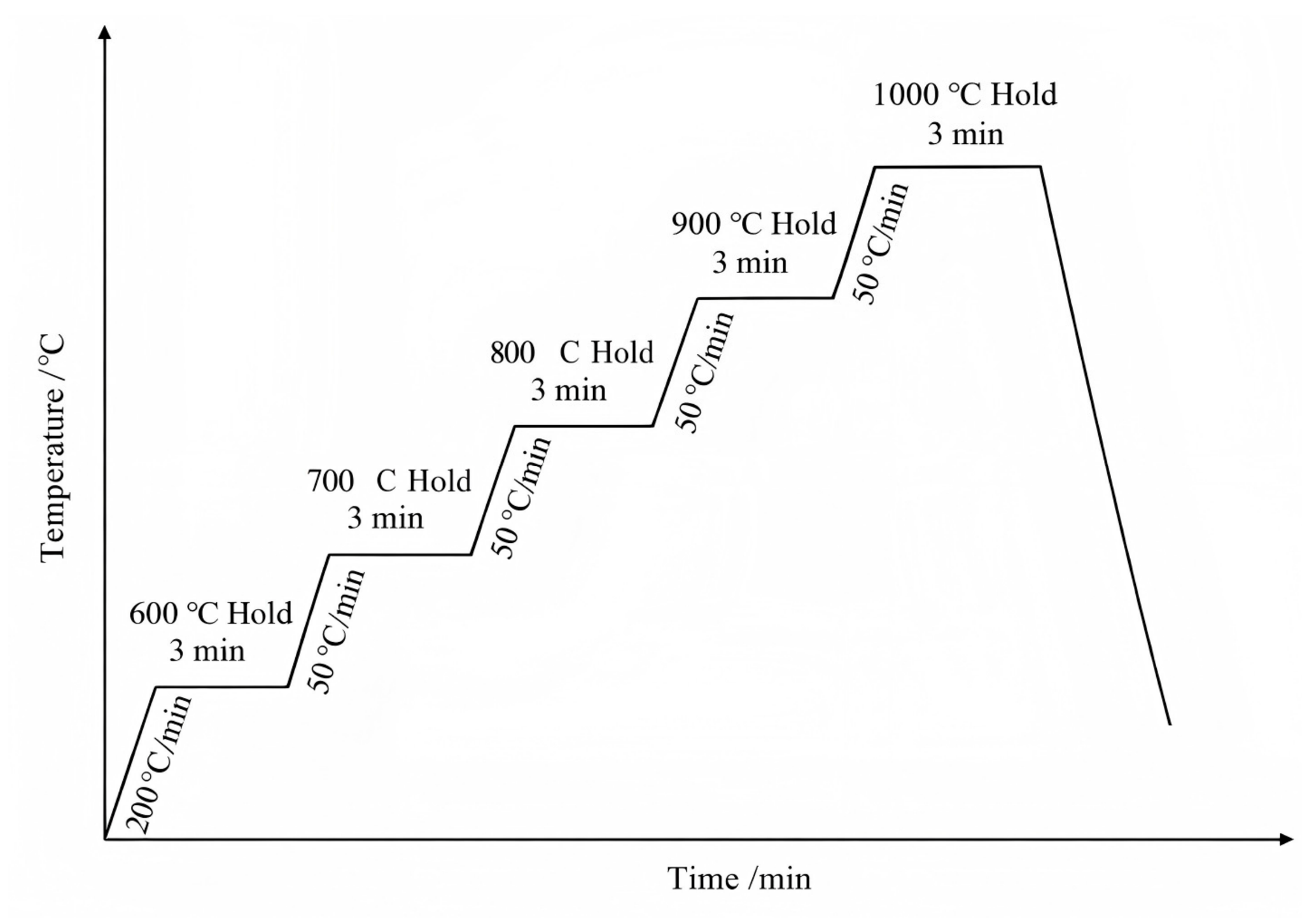
2.2. Experimental Methods
3. Results and Discussion
3.1. Microstructure
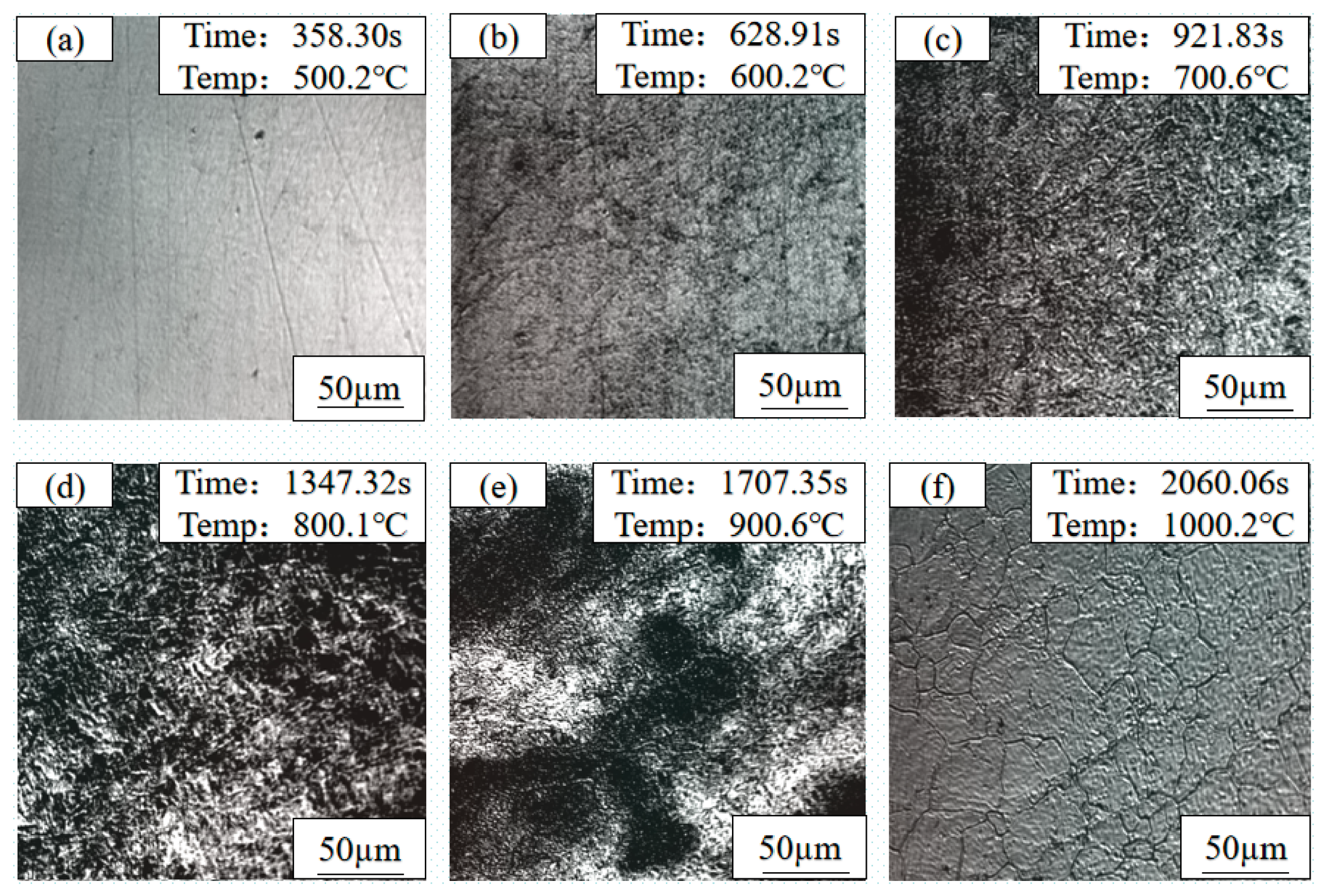
3.1.1. In Situ Observation by High-Temperature Confocal Microscopy
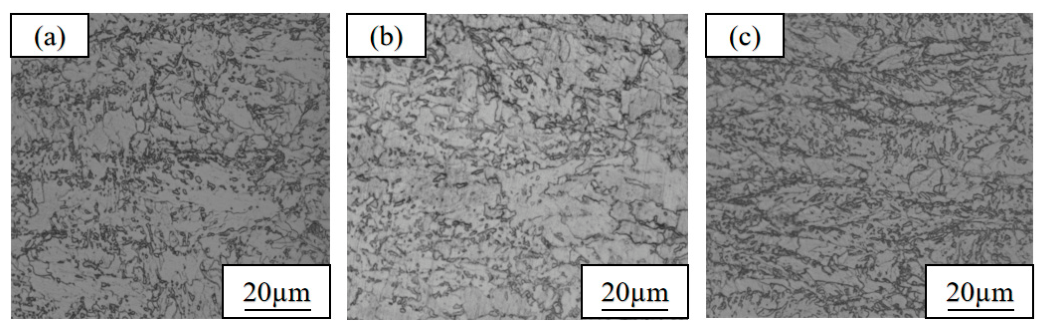
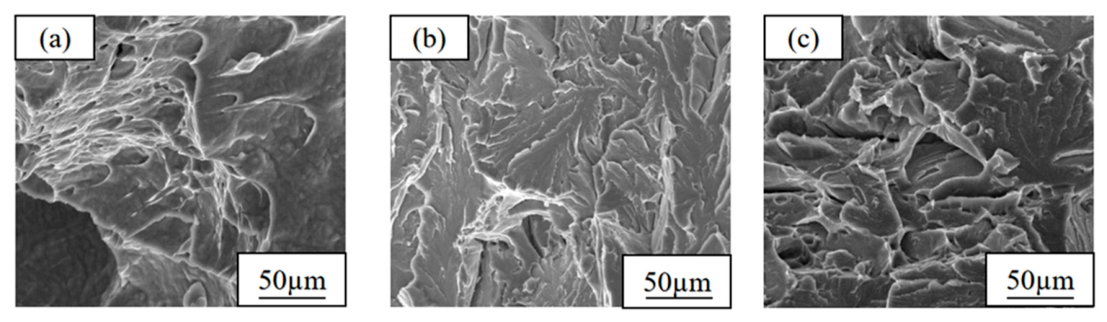
3.1.2. Effect of Different Copper Contents on Microstructure and Properties of As-Rolled Steel
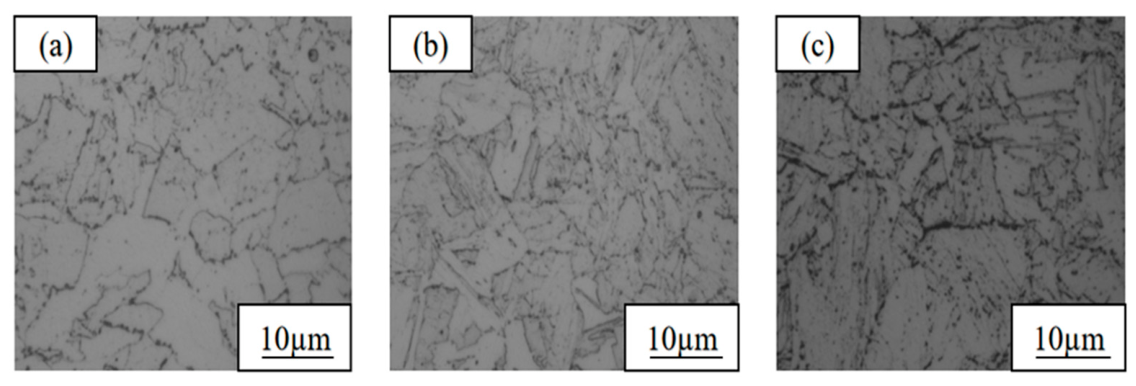
3.2. Microstructure and Mechanical Properties in Heat-Treated State
3.2.1. Conventional Mechanical Properties
3.2.2. Mechanical Property Analysis
3.3. Evolution Law of Microstructure and Properties of CuxNi2.7Mn Steel and Regulation Mechanism of Cu
4. Conclusions
- (1)
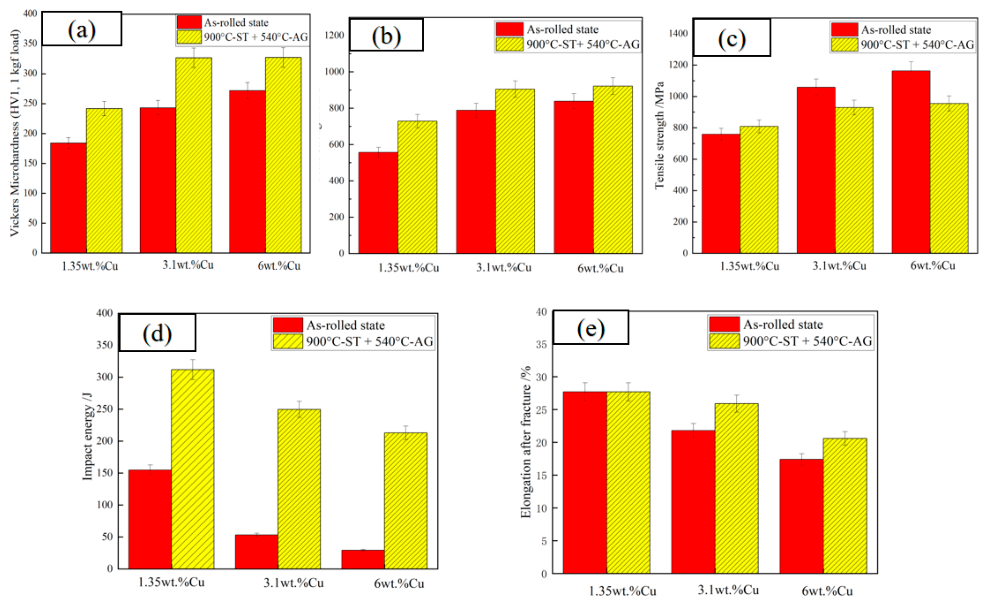
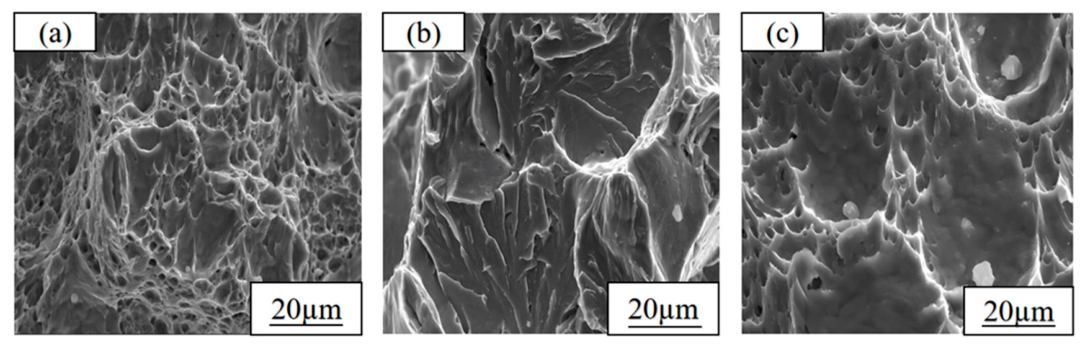
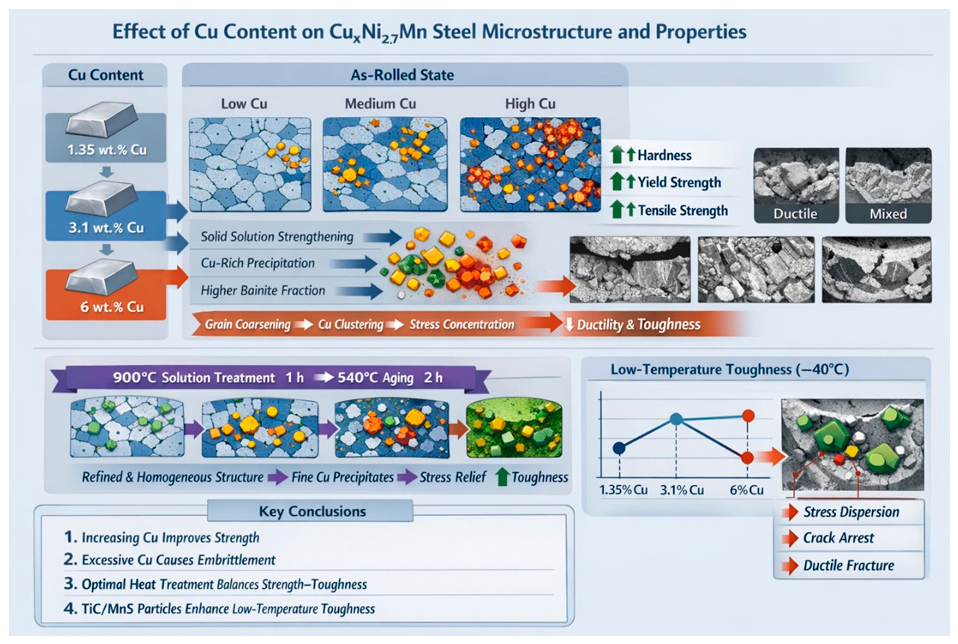
- The strength enhancement of as-rolled CuxNi2.7Mn steels originates from the synergistic effects of Cu solid solution strengthening, precipitation strengthening, and an increased proportion of granular bainite. As the Cu content increased from 1.35 wt.% to 6 wt.%, the yield strength rose from 556.55 MPa to 852.87 MPa, and the tensile strength increased from 758.53 MPa to 1162.59 MPa. Nevertheless, excessive Cu content led to austenite grain coarsening, inhomogeneous aggregation of Cu-rich precipitates, and aggravated banded structure, resulting in significant deterioration of ductility and toughness. The 6 wt.% Cu steel exhibited an elongation of only 17.4% and a room-temperature impact energy of merely 29.2 J, demonstrating typical brittle fracture characteristics.
- (2)
- The optimal heat treatment process for CuxNi2.7Mn steels was determined as solution treatment at 900 °C for 1 h followed by aging at 540 °C for 2 h. This process completely eliminated the as-rolled banded structure, relieved internal stress, refined grains, and promoted uniform and dispersed precipitation of Cu-rich phases. While retaining the Cu strengthening effect and maintaining a continuous increase in strength with rising Cu content, the ductility and toughness were remarkably improved compared with the as-rolled state, realizing the synergistic optimization of strength and toughness.
- (3)
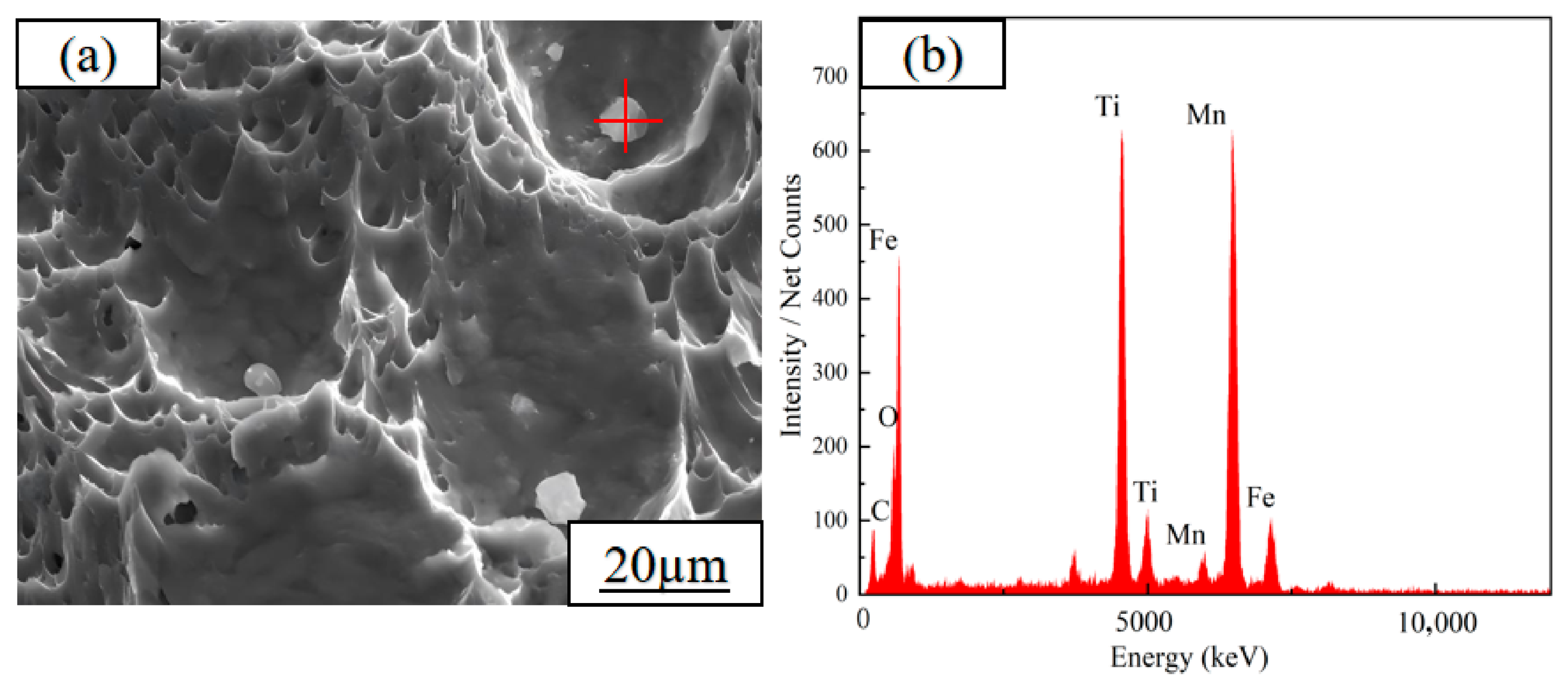
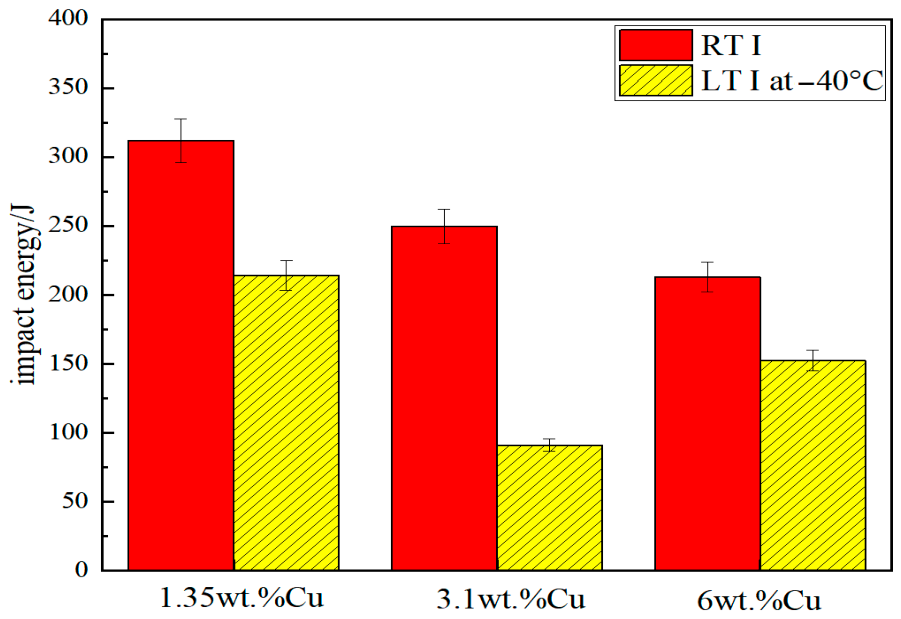
- The low-temperature toughness at −40 °C of heat-treated CuxNi2.7Mn steels varied nonlinearly with Cu content. The 3.1 wt.% Cu steel showed the lowest low-temperature impact energy of 90.8 J. In contrast, the 6 wt.% Cu steel exhibited a rebound in low-temperature impact energy to 152.6 J. This was attributed to the fact that high Cu content weakened the interaction of Ti and Mn with the matrix, facilitating the precipitation of TiC and MnS particles, which effectively dispersed low-temperature stress and hindered crack propagation, revealing the unique low-temperature toughening mechanism of high-copper steels.
- (4)
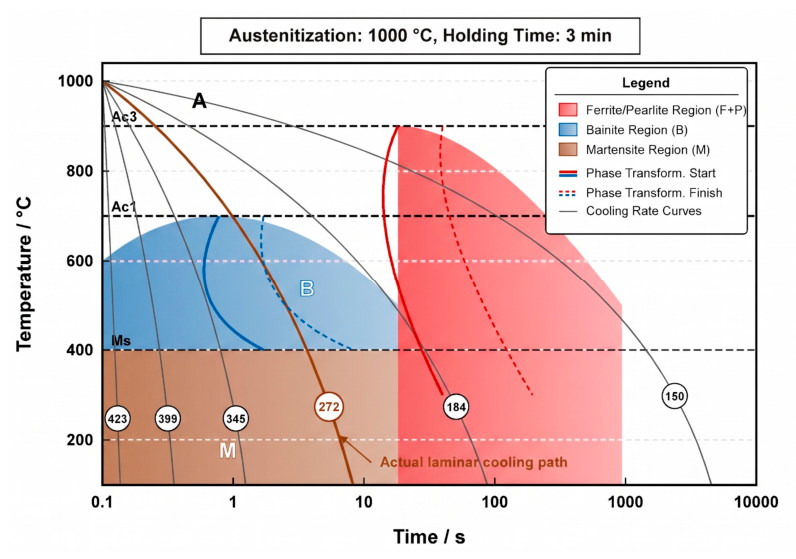
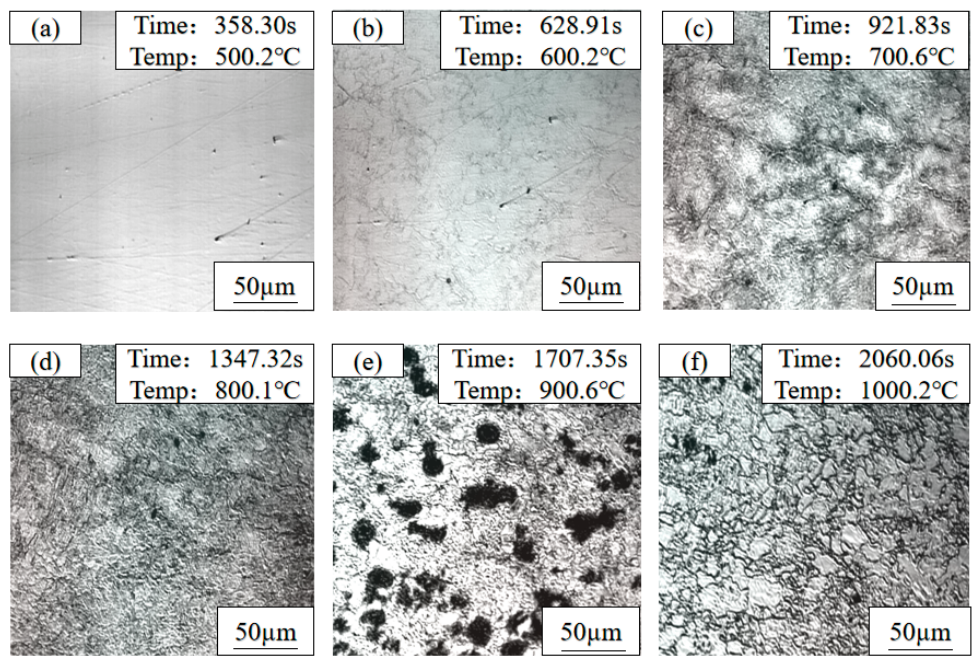
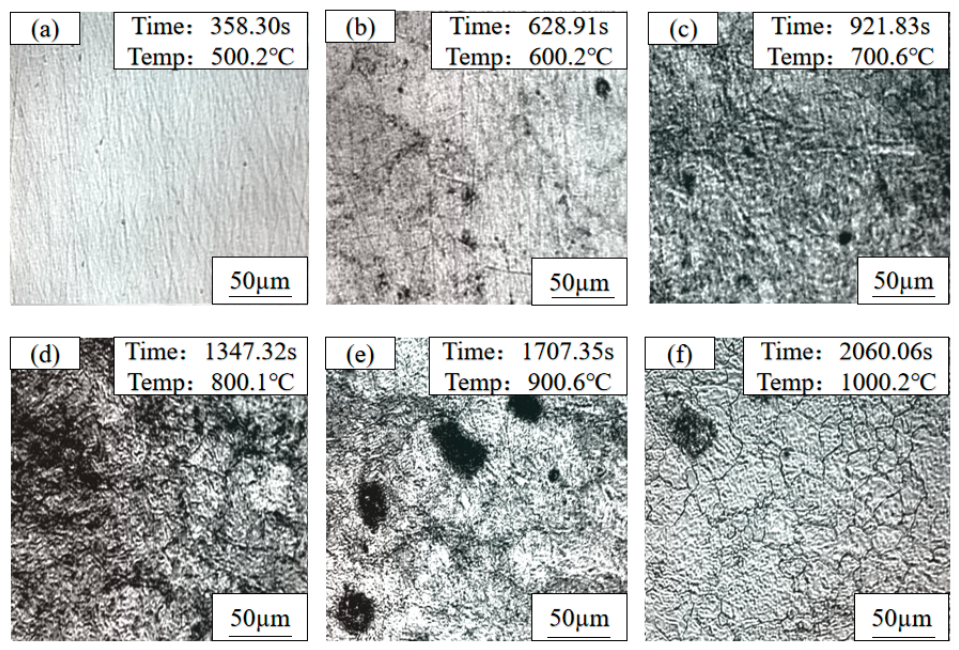
- The CCT curve combined with in situ high-temperature confocal observation accurately reveals the kinetic characteristics of Cu-rich phase precipitation and re-dissolution during heating, which provides a solid kinetic basis for the determination of solution temperature and the optimization of the entire heat treatment system for high-copper marine engineering steels.
- (5)
- After the optimal heat treatment, the CuxNi2.7Mn steel with 6 wt.% Cu possessed the best comprehensive performance, featuring the highest strength, favorable ductility, and excellent low-temperature toughness. It is verified that reasonable heat treatment can circumvent the embrittlement effect induced by high Cu content and fully exploit its strengthening potential, providing a direct basis for composition design and process regulation of high-copper steels for marine engineering applications.
Author Contributions
Funding
Institutional Review Board Statement
Informed Consent Statement
Data Availability Statement
Conflicts of Interest
References
- Misawa, T.; Kyuno, T.; Suetaka, W.; Shimodaira, S. The mechanism of atmospheric rusting and the effect of Cu and P on the rust formation of low alloy steels. Corros. Sci. 1971, 11, 35–48. [Google Scholar] [CrossRef]
- Sakumoto, Y.; Yamaguchi, T.; Ohashi, M.; Saito, H. High-temperature properties of fire-resistant steel for buildings. J. Struct. Eng. 1992, 118, 392–407. [Google Scholar] [CrossRef]
- Shi, X.; Yan, W.; Wang, W.; Shan, Y.; Yang, K. Novel Cu-bearing high-strength pipeline steels with excellent resistance to hydrogen-induced cracking. Mater. Des. 2016, 92, 300–305. [Google Scholar] [CrossRef]
- Chang, T.; Butina, K.; Herting, G.; Rajarao, G.K.; Richter-Dahlfors, A.; Blomberg, E.; Wallinde, I.O.; Leygraf, C. The interplay between atmospheric corrosion and antimicrobial efficiency of Cu and Cu5Zn5Al1Sn during simulated high-touch conditions. Corros. Sci. 2021, 185, 109433. [Google Scholar] [CrossRef]
- Yin, L.; Xu, D.; Yang, C.; Xi, T.; Chen, X.; Yang, K. Ce addition enhances the microbially induced corrosion resistance of Cu-bearing 2205 duplex stainless steel in presence of sulfate reducing bacteria. Corros. Sci. 2021, 179, 109141. [Google Scholar] [CrossRef]
- Xi, X.; Wang, J.; Chen, L.; Wang, Z. Understanding the role of copper addition in low-temperature toughness of low-carbon, high-strength steel. Metall. Mater. Trans. A 2019, 50, 5627–5639. [Google Scholar] [CrossRef]
- Chang, T.E.; Hsiao, T.J.; Liang, S.C.; Tai, C.L.; Lu, S.Y.; You, Y.J.; Chen, C.J.; Su, T.C.; Yang, Y.L.; Chen, C.Y.; et al. Improved solid solution treatment of two different Cu-containing Al-Zn-Mg-Cu alloys. Mater. Sci. Eng. A 2025, 931, 148157. [Google Scholar] [CrossRef]
- Qin, H.; Wen, P.; Feng, Y.; Jiao, Z.; Teng, Y.; Guo, J. The Influence of Copper Content on the Hot Processing Properties of Steel and its Microscopic Mechanism. Steel Res. Int. 2025, 96, 347–361. [Google Scholar] [CrossRef]
- Shen, Q.; Huang, D.; Liu, W.; Li, F.; Lu, Q. Effect of Cu content on the precipitation behavior of Cu-rich and NiAl phases in steel. Mater. Charact. 2022, 187, 111849. [Google Scholar] [CrossRef]
- Patel, N.; Manani, S.; Pradhan, A.K. Influence of copper addition on microstructure, mechanical and thermal properties of Al–12.6% Zn–Mg alloys. Int. J. Met. 2024, 18, 2624–2632. [Google Scholar] [CrossRef]
- Yuan, Z.; Xi, T.; Yang, C.; Zhao, H.; Yang, K. Enhancement of strength and ductility by Cu-rich precipitation in Cu-bearing 304L austenitic stainless steel. Mater. Lett. 2020, 272, 127815. [Google Scholar] [CrossRef]
- Xi, T.; Shahzad, M.B.; Xu, D.; Zhao, J.; Yang, C.; Qi, M.; Yang, K. Copper precipitation behavior and mechanical properties of Cu-bearing 316L austenitic stainless steel: A comprehensive cross-correlation study. Mater. Sci. Eng. A 2016, 675, 243–252. [Google Scholar] [CrossRef]
- Zhang, S.; Shen, S.; Hao, L.; Liu, X.; Yang, K.; Li, J.; Du, J.; Wang, S.; Fu, E. Grain refinement and precipitation strengthening in austenitic steels through Cu addition. MRS Bull. 2025, 50, 52–60. [Google Scholar] [CrossRef]
- Yuan, Y.; Xie, Y.; Ma, K.; Liang, H.; Li, Z.; Liu, Y.; Zuo, T.; Dong, Z.; Yu, H.; Sun, D.; et al. Synergistic effect of Cu-rich precipitate and reversed austenite on mechanical property and corrosion resistance of Fe-13Cr-5Ni-3Cu super martensitic stainless steel. Mater. Charact. 2026, 233, 116034. [Google Scholar] [CrossRef]
- Sun, Z.; Zeng, H.; Chen, J.; Wu, S.; Liu, J.; An, Z.; Zhang, J.; Yang, B. Effect of solid solution process on the structure and properties of Cu-Cr-Mg alloy in the aging state. J. Alloys Compd. 2022, 914, 165274. [Google Scholar] [CrossRef]
- Zhu, Z.; Starink, M.J. Solution strengthening and age hardening capability of Al–Mg–Mn alloys with small additions of Cu. Mater. Sci. Eng. A 2008, 488, 125–133. [Google Scholar] [CrossRef]
- De Mori, A.; Timelli, G.; Fabrizi, A.; Berto, F. Influence of Cu content on the microstructure and high-temperature tensile and fatigue properties of secondary AlSi7Mg0. 3VZr alloys. Mater. Sci. Eng. A 2021, 816, 141310. [Google Scholar] [CrossRef]
- Wang, J.; Chen, Y.; Zhai, K.; Xue, R.; Ban, C. Effect of Cu content on the microstructure and properties of Al-Mg-Si alloys. J. Phys. Conf. Ser. 2025, 3080, 012124. [Google Scholar] [CrossRef]
- Feng, M.; Jin, S.; Wu, Q.; Wang, Z.; An, X.; Liao, X.; Li, J.; Sha, G. Effect of Cu content on HPT-induced grain boundary evolution, decomposition, segregation, and grain refinement in Al-xCu alloys. J. Alloys Compd. 2025, 1016, 178930. [Google Scholar] [CrossRef]
- Surani, K.; Galindo, M.V.; Patel, H.; Velkin, V.I.; Haque Siddiqui, M.I.; Kumar, A.; Giri, J.; Ashraf, I.; Shah, M.A. Effect of copper addition on mechanical properties and microstructures of LM25 cast alloys. AIP Adv. 2024, 14, 045025. [Google Scholar] [CrossRef]
- Ding, L.; Ji, C.; Lu, C.; Zang, R.; Weng, Y.; Liu, Q.; Jia, Z. Study of the precipitate evolution mechanism in an Al-Mg-Si-Cu alloy with Si-rich and low Cu composition. Mater. Charact. 2022, 191, 112167. [Google Scholar] [CrossRef]
- Quan, M.; Yan, Z.; Zou, C. Research on the microstructures and mechanical properties of novel Cu-rich CuxNiTiCr (x = 2, 3, 4, 5) medium-entropy alloys. Mater. Charact. 2024, 212, 113961. [Google Scholar] [CrossRef]
- Ghosh, S.; Haldar, A.; Chattopadhyay, P. Effect of ageing on the mechanical properties of directly quenched copper bearing microalloyed steels. Mater. Chem. Phys. 2010, 119, 436–441. [Google Scholar] [CrossRef]
- Peng, Y.; Jia, Z.; Zhu, X.; Xie, F.; Hua, X. Influence of Cu content on microstructure, mechanical, and tribological properties of Fe-Cu alloy matrices prepared by hot-pressed sintering. Mater. Today Commun. 2025, 50, 114497. [Google Scholar] [CrossRef]
- Xi, T.; Yin, L.; Yang, C.G.; Yang, K. Hot Deformation Behavior and Processing Map of a Cu-Bearing 2205 Duplex Stainless Steel. Acta Metall. Sin. (Engl. Lett.) 2019, 32, 1537–1548. [Google Scholar] [CrossRef]
- Sun, M.; Xu, Y.; Wang, J. Effect of aging time on microstructure and mechanical properties in a Cu-bearing marine engineering steel. Materials 2020, 13, 3638. [Google Scholar] [CrossRef]
- Ning, Y.; Zhang, K.; Ding, L.; Liu, D.; Weng, Y.; Xu, G.; Li, J.; Jia, Z. Influence of minor Zn additions on the precipitation strengthening in Al-Cu-Li alloy with different Cu/Li ratios. J. Alloys Compd. 2025, 94, 185341. [Google Scholar] [CrossRef]
- Xi, T.; Zhang, X.; Yin, X.; Yang, C.; Yang, K. Interfacial segregation and precipitation behavior of Cu-rich precipitates in Cu-bearing 316LN stainless steel after aging at different temperatures. Mater. Sci. Eng. A 2021, 805, 140571. [Google Scholar] [CrossRef]
- Xiao, X.; Huang, J.; Chen, J.; Xu, H.; Li, Z.; Zhang, J. Aging behavior and precipitation analysis of Cu-Ni-Co-Si alloy. Crystals 2018, 8, 435. [Google Scholar] [CrossRef]
- Zhao, L.; Xu, C.; Fang, L.; Tang, H.; Ouyang, Y.; Tao, X. Effect of Cu content on the microstructure, mechanical and corrosion behavior of AlFeNiMnCux high-entropy alloys. J. Alloys Compd. 2025, 1022, 180124. [Google Scholar] [CrossRef]
- He, T.; Chen, W.; Wang, W.; Ren, F.; Stock, H.R. Effect of different Cu contents on the microstructure and hydrogen production of Al–Cu-Ga-In-Sn alloys for dissolvable materials. J. Alloys Compd. 2020, 821, 153489. [Google Scholar] [CrossRef]
- Warski, T.; Wlodarczyk, P.; Polak, M.; Zackiewicz, P.; Radon, A.; Wojcik, A.; Szlezynger, M.; Kolano-Burian, A.; Hawelek, L. Influence of Cu content on structure and magnetic properties in Fe86-xCuxB14 alloys. Materials 2020, 13, 1451. [Google Scholar] [CrossRef]
- Liu, K.; Wang, Z.; Su, L.; Chen, Y.; Yu, H. Effects of copper content on the microstructure and properties of AlCuxCrTiV high-entropy alloys. J. Mater. Res. Technol. 2025, 35, 2973–2983. [Google Scholar] [CrossRef]
- Wang, S.; Wang, Q.; Wang, H.L.; Liu, F.P.; Yao, W.J.; Jiang, F.; Sun, J.; Wang, F.Y. Effects of copper content on microstructure and mechanical properties of powder-forged rod Fe-C-Cu alloys manufactured at elevated temperature. Mater. Sci. Eng. A 2019, 743, 197–206. [Google Scholar] [CrossRef]
- Yu, C.; Jiao, Z.; Guo, J.; Teng, Y.; Chai, J. Research on the Strength and Toughness Mechanism of High-Strength 0Cu6Ni2. 7Mn Steel Based on Thermo-Mechanical Control Processing and Heat Treatment. Steel Res. Int. 2025, 97, 1609–1619. [Google Scholar] [CrossRef]
- GB/T 228.1-2021; Metallic materials—Tensile testing—Part 1: Method of test at room temperature; Administration for Market Regulation. Standardization Administration of the People’s Republic of China: Beijing, China, 2021.
- Yin, H.; Wu, Y.; Huang, Y.; Zhang, G.; Li, X.; Zhang, P.; Zhao, A. The Initial Precipitation Behavior of Copper in Ferritic Stainless Steel. J. Mater. Eng. Perform. 2020, 29, 6494–6502. [Google Scholar] [CrossRef]
- Ustinov, A.I.; Olikhovska, L.O.; Demchenkov, S.O.; Skorodzievskii, V.S.; Polishchuk, S.S.; Melnychenko, T.V. Origin of the formation of isostructural bcc-Fe+ bcc-Cu nanocomposites in Fe–Cu alloy via vacuum co-deposition. AIP Adv. 2025, 15, 015326. [Google Scholar] [CrossRef]
- Lu, Q.; You, Z.; Huang, X.; Hansen, N.; Lu, L. Dependence of dislocation structure on orientation and slip systems in highly oriented nanotwinned Cu. Acta Mater. 2017, 127, 85–97. [Google Scholar] [CrossRef]
- Zhang, Y.; Fang, Y.; Chen, Q.; Zhang, S.; Weng, M.; Wei, H.; Yang, G.; Huang, G.; Cui, C. Fabrication of metastable nanoscale Ag–Cu supersaturated solid solutions and their low-temperature low-pressure interconnect applications. J. Mater. Sci. Technol. 2026, 246, 76–85. [Google Scholar] [CrossRef]
- He, G.; Liu, Z.; Liu, F. Effects of dislocation slip behaviour and second-phase particles on hot rolled texture of an Al-Cu-Mg alloy with a high Cu/Mg ratio. J. Alloys Compd. 2022, 911, 165085. [Google Scholar] [CrossRef]
- Fu, Q.; Li, B.; Fu, H.; Gao, M.; Wang, C.; Fu, Y.; Guan, R. Dislocation behavior and strengthening mechanisms of Cu–Te alloy drawn at room and cryogenic temperatures. J. Mater. Res. Technol. 2023, 26, 6419–6432. [Google Scholar] [CrossRef]
- Ouyang, D.L.; Du, H.M.; Cui, X.; Lu, X.Q.; Dong, X.J. Grain growth behavior of Ti–6.5 Al–3.5 Mo–1.5 Zr–0.3 Si alloy during isothermal β heat treatments. Rare Met. 2019, 38, 233–237. [Google Scholar] [CrossRef]
- Huang, D.; Lian, Z.; Zhao, Z. Isothermal β grain growth kinetics and mechanical properties of Ti-351 titanium alloy. Mater. Today Commun. 2024, 40, 109896. [Google Scholar] [CrossRef]
- Sun, L.; Zhang, S.; Song, R.; Ren, S.; Zhang, Y.; Sun, X.; Dai, G.; Hao, Y.; Huo, W.; Zhao, S.; et al. Effect of V, Nb, and Ti microalloying on low–temperature impact fracture behavior of non–quenched and tempered forged steel. Mater. Sci. Eng. A 2023, 879, 145299. [Google Scholar] [CrossRef]
- Liu, H.; Pan, X.; Sun, P.; Liu, Y.; Qiu, C. Influence of addition of Ti particles and processing condition on microstructure and properties of selectively laser-melted invar 36 alloy. 3D Print. Addit. Manuf. 2024, 11, 24–39. [Google Scholar] [CrossRef] [PubMed]






| Steel | Cu | C | Ni | Mn | Cr | Si | Ti | S | Fe |
|---|---|---|---|---|---|---|---|---|---|
| 1# | 1.35 | 0.027 | 2.71 | 0.97 | 0.48 | 0.19 | 0.012 | 0.0019 | Bal. |
| 2# | 3.1 | 0.021 | 2.72 | 0.95 | 0.48 | 0.18 | 0.011 | 0.0019 | Bal. |
| 3# | 6 | 0.036 | 2.7 | 0.97 | 0.48 | 0.2 | 0.0089 | 0.0012 | Bal. |
| Pass | 1 | 2 | 3 | 4 | 5 | 6 | 7 | 8 |
|---|---|---|---|---|---|---|---|---|
| Above | 35 | 35 | 35 | 35 | 35 | 35 | 35 | 35 |
| Below | 40 | 40 | 35 | 35 | 35 | 40 | 40 | 40 |
| Sample | Vickers Microhardness/HV1 | Yield Strength/MPa | Tensile Strength/MPa | RTI Energy/J | Elongation/% |
|---|---|---|---|---|---|
| 1# | 183.9 ± 4.2 | 556.55 ± 10.3 | 758.53 ± 12.6 | 154.9 ± 5.8 | 27.7 ± 1.1 |
| 2# | 243.1 ± 5.6 | 788.14 ± 13.5 | 1058.01 ± 18.2 | 53.3 ± 2.4 | 21.8 ± 0.9 |
| 3# | 271.9 ± 6.1 | 852.87 ± 14.8 | 1162.59 ± 20.5 | 29.2 ± 1.3 | 17.4 ± 0.7 |
Disclaimer/Publisher’s Note: The statements, opinions and data contained in all publications are solely those of the individual author(s) and contributor(s) and not of MDPI and/or the editor(s). MDPI and/or the editor(s) disclaim responsibility for any injury to people or property resulting from any ideas, methods, instructions or products referred to in the content. |
© 2026 by the authors. Licensee MDPI, Basel, Switzerland. This article is an open access article distributed under the terms and conditions of the Creative Commons Attribution (CC BY) license.
Share and Cite
Zhang, Y.; Guo, J.; Yu, C.; Wen, P.; Li, L. Study on the Microstructure Evolution of CuxNi2.7Mn Steel During Processing with Different Copper Contents. Materials 2026, 19, 1906. https://doi.org/10.3390/ma19091906
Zhang Y, Guo J, Yu C, Wen P, Li L. Study on the Microstructure Evolution of CuxNi2.7Mn Steel During Processing with Different Copper Contents. Materials. 2026; 19(9):1906. https://doi.org/10.3390/ma19091906
Chicago/Turabian StyleZhang, Yingchi, Jing Guo, Chengsheng Yu, Pengyu Wen, and Lili Li. 2026. "Study on the Microstructure Evolution of CuxNi2.7Mn Steel During Processing with Different Copper Contents" Materials 19, no. 9: 1906. https://doi.org/10.3390/ma19091906
APA StyleZhang, Y., Guo, J., Yu, C., Wen, P., & Li, L. (2026). Study on the Microstructure Evolution of CuxNi2.7Mn Steel During Processing with Different Copper Contents. Materials, 19(9), 1906. https://doi.org/10.3390/ma19091906