Self-Propagating High-Temperature Synthesis as an Enabling Route for High-Entropy MAX Phases



Abstract
1. Introduction
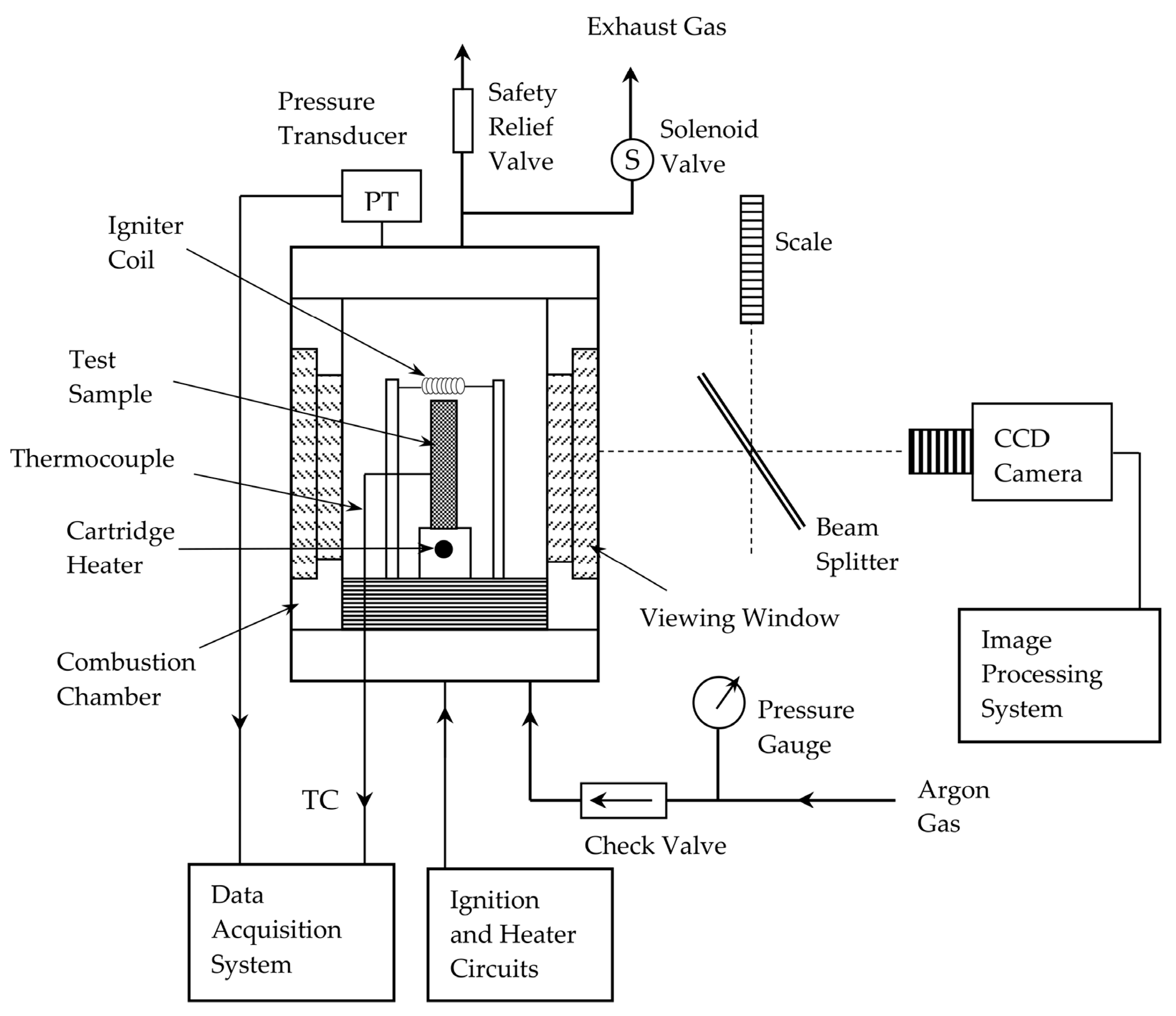
2. Fundamentals of SHS for MAX Phases
2.1. Principles of SHS
2.2. Thermodynamic Considerations
2.3. Kinetic and Microstructural Design Principles
2.4. Compositional Design
3. Advantages and Challenges of SHS for HE-MAX Synthesis
4. Perspectives and Applications
4.1. Scalability for Bulk and Coatings
4.2. Integration into Derivative Phases (MXenes)
4.3. Potential Functional Properties
5. Conclusions and Outlook
Author Contributions
Funding
Institutional Review Board Statement
Informed Consent Statement
Data Availability Statement
Acknowledgments
Conflicts of Interest
References
- Alam, M.S.; Chowdhury, M.A.; Khandaker, T.; Hossain, M.S.; Islam, M.S.; Islam, M.M.; Hasan, M.K. Advancements in MAX phase materials: Structure, properties, and novel applications. RSC Adv. 2024, 14, 26995–27041. [Google Scholar] [CrossRef] [PubMed]
- Oses, C.; Toher, C.; Curtarolo, S. High-entropy ceramics. Nat. Rev. Mater. 2020, 5, 295–309. [Google Scholar] [CrossRef]
- Nemani, S.K.; Zhang, B.; Wyatt, B.C.; Hood, Z.D.; Manna, S.; Khaledialidusti, R.; Hong, W.; Sternberg, M.G.; Sankaranarayanan, S.K.; Anasori, B. High-entropy 2D carbide mxenes: TiVNbMoC3 and TiVCrMoC3. ACS Nano 2021, 15, 12815–12825. [Google Scholar] [CrossRef] [PubMed]
- Das, P.; Dong, Y.; Wu, X.; Zhu, Y.; Wu, Z.-S. Perspective on high entropy MXenes for energy storage and catalysis. Sci. Bull. 2023, 68, 1735–1739. [Google Scholar] [CrossRef]
- Cao, L.; Zhang, Q.; Du, L.; Fu, S.; Wan, D.; Bao, Y.; Feng, Q.; Hu, C. Synthesis and characterization of high entropy (TiVNbTaM)2AlC (M = Zr, Hf) ceramics. J. Adv. Ceram. 2024, 13, 237−246. [Google Scholar] [CrossRef]
- Seong, H.W.; Lee, M.S.; Ryu, H.J. First-principles study for discovery of novel synthesizable 2D high-entropy transition metal carbides (MXenes). J. Mater. Chem. A 2023, 11, 5681–5695. [Google Scholar] [CrossRef]
- Zhou, J.; Tao, Q.; Ahmed, B.; Palisaitis, J.; Persson, I.; Halim, J.; Barsoum, M.W.; Persson, P.O.; Rosen, J. High-entropy laminate metal carbide (MAX phase) and its two-dimensional derivative MXene. Chem. Mater. 2022, 34, 2098–2106. [Google Scholar] [CrossRef]
- Che, L.; Bao, M.; Sun, Z.; Cao, Y. Synthesis, Reaction Process, and Mechanical Properties of Medium-Entropy (TiVNb)2AlC MAX Phase. Crystals 2025, 15, 903. [Google Scholar] [CrossRef]
- Zhang, J.; Jia, R.; Tan, K.; Li, J.; Xu, S. A review of MAX series materials: From diversity, synthesis, prediction, properties oriented to functions. Nano-Micro Lett. 2025, 17, 173. [Google Scholar] [CrossRef]
- Yeh, C.; Lai, K. Effects of excess Si and Al on synthesis of Ti3SiC2 by self-sustaining combustion in the Ti-Si–C-Al system. J. Aust. Ceram. Soc. 2024, 60, 959–969. [Google Scholar] [CrossRef]
- Zurnachyan, A.; Ginosyan, A.; Ivanov, R.; Hussainova, I.; Aydinyan, S. Self-Propagating High-Temperature Synthesis of High-Entropy Composite in a Ti–Cr–Mn–Co–Ni–Al–C System. Ceramics 2025, 8, 137. [Google Scholar] [CrossRef]
- Yeh, C.-L.; Chen, Y.-T. Effects of TiC, TiH2, Al, and Carbon on Production of Ti3AlC2 by Self-Sustaining Combustion Synthesis. Materials 2025, 18, 1293. [Google Scholar] [CrossRef]
- Aydinyan, S. Combustion synthesis of MAX phases: Microstructure and properties inherited from the processing pathway. Crystals 2023, 13, 1143. [Google Scholar] [CrossRef]
- Ma, G.; Zhang, A.; Wang, Z.; Wang, K.; Zhang, J.; Xu, K.; Xu, Y.; Zhou, S.; Wang, A. MAX phase coatings: Synthesis, protective performance, and functional characteristic. Mater. Horiz. 2025, 12, 1689–1710. [Google Scholar] [CrossRef]
- Bai, D.; Wang, Q.; Deng, B.; Li, Y.; Huang, A.; Cheng, Z.; Zhao, Y.; Li, J.; Yao, W.; Xu, J. Liquid metal assistant self-propagating high-temperature synthesis of S-containing high-entropy MAX-phase materials. J. Mater. Sci. Technol. 2025, 209, 1–8. [Google Scholar] [CrossRef]
- Melkonyan, S.; Zakaryan, M.; Grigoryan, Y.; Kharatyan, S.; Hussainova, I.; Chabanais, F.; Saffar Shamshirgar, A.; Persson, P.O.Å.; Rosen, J.; Aydinyan, S. Phase and microstructure evolution patterns at combustion synthesis of high-entropy M2AlC (M = Ti/Ta/V/Nb/Cr) MAX phase. J. Mater. Res. Technol. 2025, 39, 5800–5807. [Google Scholar] [CrossRef]
- Yeh, C.-L.; Chen, C. In situ formation of titanium diboride/magnesium titanate composites by magnesiothermic-based combustion synthesis. Processes 2024, 12, 459. [Google Scholar] [CrossRef]
- Mukasyan, A.S.; Rogachev, A.S. Combustion synthesis of ultra-high temperature ceramics. Int. J. Appl. Ceram. Technol. 2025, 22, e70044. [Google Scholar] [CrossRef]
- Yeh, C.-L.; Lai, K.-L. Effects of TiC, Si, and Al on combustion synthesis of Ti3SiC2/TiC/Ti5Si3 composites. Materials 2023, 16, 6142. [Google Scholar] [CrossRef] [PubMed]
- Zhang, Z.; Duan, X.; Jia, D.; Zhou, Y.; van der Zwaag, S. On the formation mechanisms and properties of MAX phases: A review. J. Eur. Ceram. Soc. 2021, 41, 3851–3878. [Google Scholar] [CrossRef]
- Hosseinizadeh, S.A.; Pourebrahim, A.; Baharvandi, H.; Ehsani, N. Synthesis of nano-layered Ti3SiC2 MAX phase through reactive melt infiltration (RMI): Metallurgical and thermodynamical parameters. Ceram. Int. 2020, 46, 22208–22220. [Google Scholar] [CrossRef]
- Gubarevich, A.V.; Tamura, R.; Yoshida, K. Combustion synthesis of high yield Ti3SiC2 from TiC0.67 with induction heating assistance. Ceram. Int. 2023, 49, 23887–23892. [Google Scholar] [CrossRef]
- Kayan, G.O.; Akin, I. MAX phases and their spark plasma sintered composites—Review. Adv. Compos. Hybrid Mater. 2025, 8, 284. [Google Scholar] [CrossRef]
- Guo, M.; Cao, G.; Pan, H.; Guo, J.; Chen, C.; Zhang, B.; Hu, J. Recent progress in synthesis of MAX phases and oxidation & corrosion mechanism: A review. Mater. Res. Lett. 2024, 12, 765–796. [Google Scholar] [CrossRef]
- Dixit, P.; Maiti, T. A facile pot synthesis of (Ti3AlC2) MAX phase and its derived MXene (Ti3C2Tx). Ceram. Int. 2022, 48, 36156–36165. [Google Scholar] [CrossRef]
- Edrisi, A.; Aghajani, H.; Seyedein, S.H.; Tabrizi, A.T. Synthesis of high purity Ti2AlC MAX phase by combustion method through thermal explosion mode: Optimization of process parameters & evaluation of microstructure. Ceram. Int. 2024, 50, 50846–50854. [Google Scholar]
- Thomas, T.; Bowen, C. Effect of particle size on the formation of Ti2AlC using combustion synthesis. Ceram. Int. 2016, 42, 4150–4157. [Google Scholar] [CrossRef]
- Mandegari, M.; Nasouri, K.; Ghasemi-Mobarakeh, L. Synthesis of low-cost Ti3AlC2-Ti2AlC dual MAX phase with high-electrical conductivity using economical raw materials and novel compositions. Mater. Today Commun. 2023, 36, 106868. [Google Scholar] [CrossRef]
- Potanin, A.; Loginov, P.; Levashov, E.; Pogozhev, Y.; Patsera, E.; Kochetov, N. Effect of mechanical activation on Ti3AlC2 MAX phase formation under self-propagating high-temperature synthesis. Eurasian Chem.-Technol. J. 2015, 17, 233–242. [Google Scholar] [CrossRef]
- Hendaoui, A.Y.; Vrel, D.; Amara, A.; Langlois, P.; Andasmas, M.; Guerioune, M. Synthesis of high-purity polycrystalline MAX phases in Ti–Al–C system through mechanically activated self-propagating high-temperature synthesis. J. Eur. Ceram. Soc. 2010, 30, 1049–1057. [Google Scholar] [CrossRef]
- Yeh, C.L.Z.; Shen, Y.G. Effects of TiC and Al4C3 addition on combustion synthesis of Ti2AlC. J. Alloys Compd. 2009, 470, 424–428. [Google Scholar] [CrossRef]
- Seplyarskii, B.; Kochetkov, R.; Lisina, T. Structural Macrokinetics of Combustion of Ti-Based Mixtures with Titanium Particles of Different Sizes. Int. J. Self-Propagating High-Temp. Synth. 2023, 32, 233–238. [Google Scholar] [CrossRef]
- Khoptiar, Y.; Gotman, I. Ti2AlC ternary carbide synthesized by thermal explosion. Mater. Lett. 2002, 57, 72–76. [Google Scholar] [CrossRef]
- Liu, Z.; Yang, J.; Zhang, H.; Liu, Z.; Li, H.; Li, M.; Qian, Y.; Xu, J. Thermal stability and decomposition behavior of Cr2TiAlC2 at elevated temperature. Ceram. Int. 2023, 49, 12034–12041. [Google Scholar] [CrossRef]
- Gonzalez-Julian, J. Processing of MAX phases: From synthesis to applications. J. Am. Ceram. Soc. 2021, 104, 659–690. [Google Scholar] [CrossRef]
- Yeh, C.-L.; Liu, K.-T. Synthesis of TiB2/TiC/Al2O3 and ZrB2/ZrC/Al2O3 composites by low-exotherm thermitic combustion with PTFE activation. J. Compos. Sci. 2022, 6, 111. [Google Scholar] [CrossRef]
- Tan, X.; Su, X.; Yan, Y.; Uher, C.; Zhang, Q.; Tang, X. New criteria for the applicability of combustion synthesis: The investigation of thermodynamic and kinetic processes for binary Chemical Reactions. J. Alloys Compd. 2021, 860, 158465. [Google Scholar] [CrossRef]
- Du, Z.; Wu, C.; Chen, Y.; Cao, Z.; Hu, R.; Zhang, Y.; Gu, J.; Cui, Y.; Chen, H.; Shi, Y. High-entropy atomic layers of transition-metal carbides (MXenes). Adv. Mater. 2021, 33, 2101473. [Google Scholar] [CrossRef]
- Qu, J.; Buckingham, M.A.; Lewis, D.J. High-entropy materials for electrochemical energy storage devices. Energy Adv. 2023, 2, 1565–1590. [Google Scholar] [CrossRef]
- Liu, G.; Chen, K.; Li, J. Combustion Synthesis: Processing and Materials; Elsevier: Amsterdam, The Netherlands, 2024. [Google Scholar]
- Yunus, M.; Kumar, R.; Maji, B.C.; Krishnan, M. An optimized method for synthesizing phase-pure Ti3AlC2 MAX-phase through spark plasma sintering. J. Eur. Ceram. Soc. 2022, 42, 354–363. [Google Scholar] [CrossRef]
- Duong, T.C.; Talapatra, A.; Son, W.; Radovic, M.; Arróyave, R. On the stochastic phase stability of Ti2AlC-Cr2AlC. Sci. Rep. 2017, 7, 5138. [Google Scholar] [CrossRef]
- Kaya, F.; Dizdar, K.C.; Aliakbarlu, S.; Selimoğlu, G.İ.; Derin, B. Self-propagating high-temperature synthesis of AlxCoCrFeNiMoy high-entropy alloys: Thermochemical modelling, microstructural evaluation and high temperature oxidation behaviour. Mater. Chem. Phys. 2024, 318, 129304. [Google Scholar] [CrossRef]
- Kaya, F.; Aliakbarlu, S.; Dizdar, K.C.; Selimoğlu, G.İ.; Derin, B. Thermochemical Modeling-Assisted Synthesis of AlxCoCrFeNiMn (0.5 ≤ x ≤ 3) High-Entropy Alloys via Combustion Method for Soft Magnetic Applications. Min. Metall. Explor. 2025, 42, 465–477. [Google Scholar] [CrossRef]
- Liu, Z.; Xu, J.; Xi, X.; Luo, W.; Zhou, J. Molten salt dynamic sealing synthesis of MAX phases (Ti3AlC2, Ti3SiC2 et al.) powder in air. Ceram. Int. 2023, 49, 168–178. [Google Scholar] [CrossRef]
- Kozhakhmetov, Y.; Skakov, M.; Kurbanbekov, S.; Uazyrkhanova, G.; Kurmantayev, A.; Kizatov, A.; Mussakhan, N. High-Entropy Alloys: Innovative Materials with Unique Properties for Hydrogen Storage and Technologies for Their Production. Metals 2025, 15, 100. [Google Scholar] [CrossRef]
- Liu, S.-Y.; Zhang, C.; Zhang, H.; Gong, W.; Liu, S.; Li, D.; Liu, Y.; Li, Y.; Wang, S. High-entropy metallic ceramics with quaternary MAX phases: Stability and mechanical properties of ()2AlC. Ceram. Int. 2025, 51, 8465–8471. [Google Scholar] [CrossRef]
- Dahlqvist, M.; Rosen, J. The rise of MAX phase alloys–large-scale theoretical screening for the prediction of chemical order and disorder. Nanoscale 2022, 14, 10958–10971. [Google Scholar] [CrossRef]
- Xiao, H.; Zhao, S.; Zhang, J.; Zhao, S.; Li, Y.; Chen, K.; Cao, L.; Wang, Y.; Huang, Q.; Wang, C. Distinct amorphization resistance in high-entropy MAX-phases (Ti, M)2AlC (M= Nb, Ta, V, Zr) under in situ irradiation. Npj Comput. Mater. 2024, 10, 196. [Google Scholar] [CrossRef]
- Lei, X.; Lin, N. Structure and synthesis of MAX phase materials: A brief review. Crit. Rev. Solid State Mater. Sci. 2022, 47, 736–771. [Google Scholar] [CrossRef]
- Baumler, K.J.; Adams, O.S.; Schaak, R.E. One-step topochemical transformation of MoAlB into metastable Mo2AlB2 using a metal chloride salt reaction. Chem. Commun. 2023, 59, 4814–4817. [Google Scholar] [CrossRef]
- Gorshkov, V.; Miloserdov, P.; Khomenko, N.Y.; Sachkova, N. Production of cast materials based on the Cr2AlC MAX phase by SHS metallurgy using coupled chemical reactions. Russ. J. Non-Ferr. Met. 2020, 61, 362–367. [Google Scholar] [CrossRef]
- Gorshkov, V.A.; Miloserdov, P.A.; Khomenko, N.Y.; Miloserdova, O.M. High-temperature synthesis of composite materials based on (Cr, Mn, V)–Al–C MAX phases. Ceram. Int. 2021, 47, 25821–25825. [Google Scholar] [CrossRef]
- Aydinyan, S.; Kharatyan, S.; Hussainova, I. SHS-derived powders by reactions’ coupling as primary products for subsequent consolidation. Materials 2021, 14, 5117. [Google Scholar] [CrossRef]
- Vershinnikov, V.I.; Kovalev, D.Y. Formation of V2AlC MAX phase by SHS involving magnesium reduction of V2O5. Ceram. Int. 2023, 49, 6063–6067. [Google Scholar] [CrossRef]
- Tsyganov, A.; Vikulova, M.; Zotov, I.; Grapenko, O.; Vlasenko, V.; Bainyashev, A.; Gorokhovsky, A.; Gorshkov, N. Thermal behavior of the dielectric response of composites based on poly (vinylidene fluoride) filled with two-dimensional V2CTx MXenes. Nanoscale 2024, 16, 15208–15218. [Google Scholar] [CrossRef] [PubMed]
- Wozniak, J.; Jastrzębska, A.; Olszyna, A. Challenges and opportunities in tailoring MAX phases as a starting materials for MXenes development. Mater. Technol. 2022, 37, 1639–1650. [Google Scholar] [CrossRef]
- Stoll, J.L.; Paul, M.; Pritchett, L.; Snover, A.; Woods, L.; Antony Jose, S.; Menezes, P.L. Tribology of MXene Materials: Advances, Challenges, and Future Directions. Materials 2025, 18, 4767. [Google Scholar] [CrossRef] [PubMed]
- Chlubny, L.; Lis, J.; Chabior, K.; Chachlowska, P.; Kapusta, C. Processing and properties of MAX phases–based materials using SHS technique. Arch. Metall. Mater. 2015, 60, 859–863. [Google Scholar] [CrossRef]
- Lu, Y.; Shi, S.; Chen, K.; Ye, X.; Yang, L.; Hou, M.; Guo, S. Self-propagating high-temperature synthesis of Ti3SiC2/diamond composites in a microwave field with the assistance of Ni-Al powders. Arab. J. Chem. 2025, 18, 2762024. [Google Scholar] [CrossRef]
- Gotman, I.; Gutmanas, E.Y. Reactive Forging—Pressure Assisted Thermal Explosion Mode of SHS for Processing Dense In Situ Composites and Structural Parts: A Review. Adv. Eng. Mater. 2018, 20, 1800376. [Google Scholar] [CrossRef]
- Seplyarskii, B.; Kochetkov, R.; Lisina, T.; Abzalov, N.; Vasilyev, D. Combustion of Ti–Si–C Mixtures: Impact of Medium Structure and Impurity Gas Release. Int. J. Self-Propagating High-Temp. Synth. 2023, 32, 258–263. [Google Scholar] [CrossRef]
- Khoptiar, Y.; Gotman, I.; Gutmanas, E.Y. Pressure-assisted combustion synthesis of dense layered Ti3AlC2 and its mechanical properties. J. Am. Ceram. Soc. 2005, 88, 28–33. [Google Scholar] [CrossRef]
- Wu, X.; Wang, Y.; Wu, Z.-S. Recent advancement and key opportunities of MXenes for electrocatalysis. Iscience 2024, 27, 108906. [Google Scholar] [CrossRef] [PubMed]


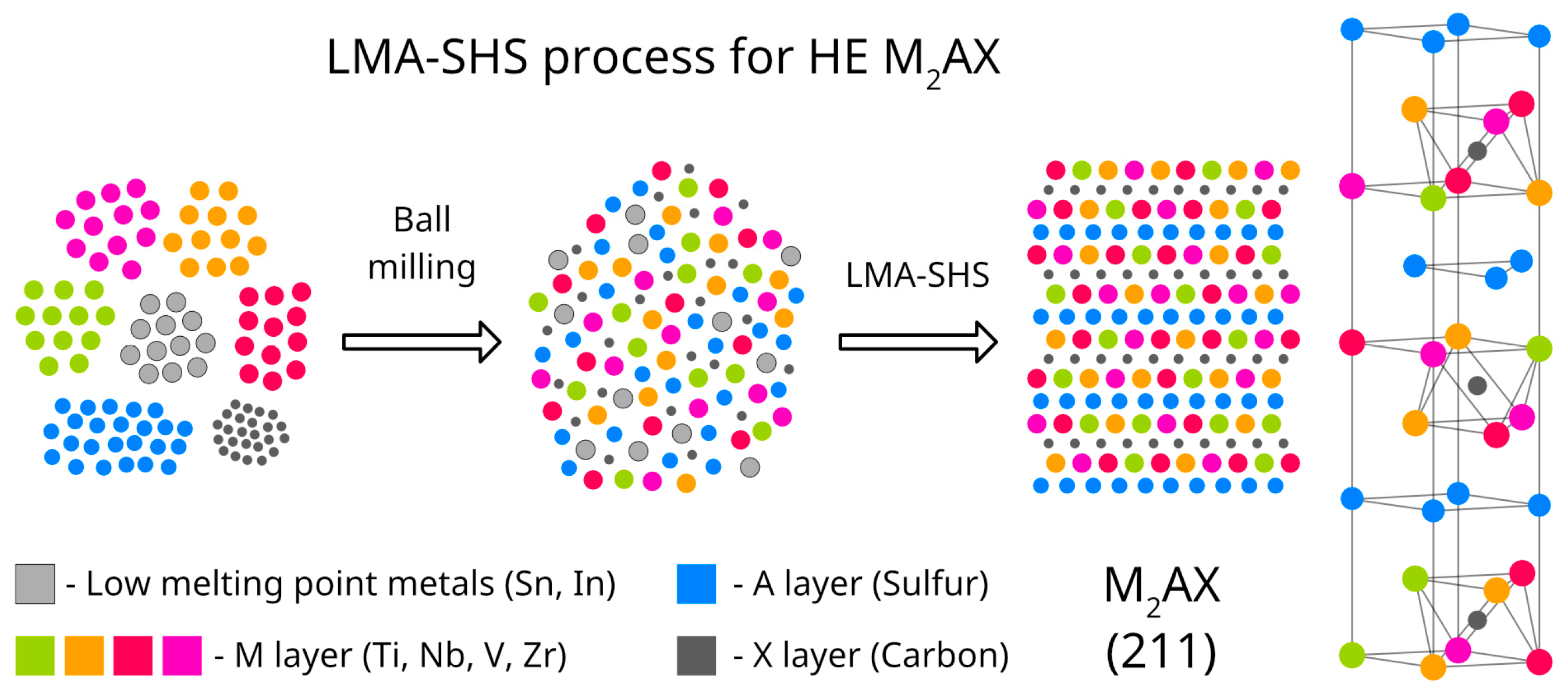
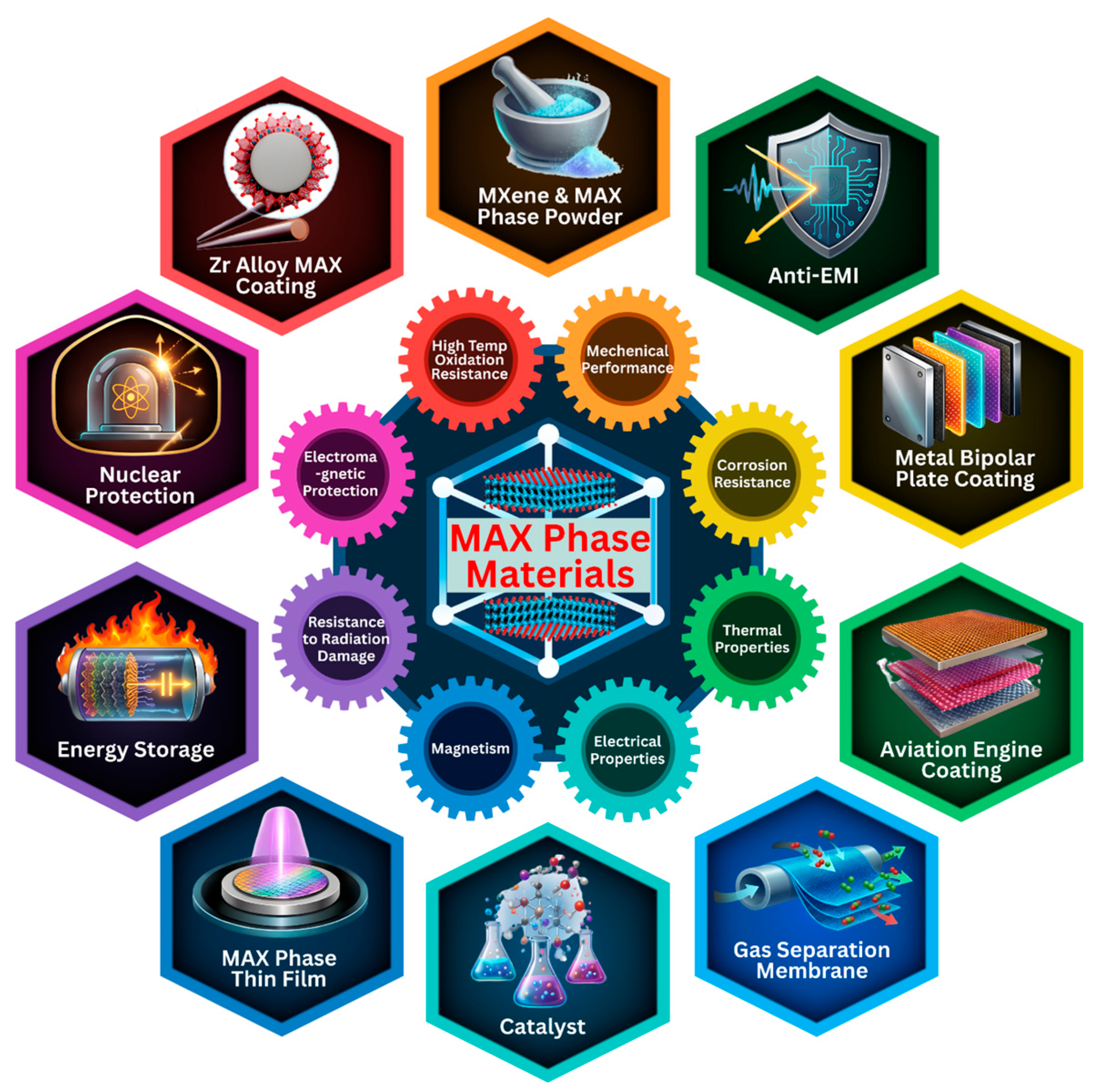

| Processing Variable | Low/Insufficient | Optimal Window | Excessive/Destabilizing |
|---|---|---|---|
| Effective exothermicity (Tad) | No ignition or quenched front due to heat losses | Self-sustaining SHS or controlled TE enabling MAX/HE-MAX formation | Overheating, decomposition, A-site evaporation |
| Diluent fraction/intermediate reactants | Poor ignition, incomplete reaction | Moderated combustion temperature and stable propagation | Excess heat sink, front extinction |
| A-site content (e.g., Al) | Off-stoichiometry, TiC-rich products | 5–20% A-site excess compensates volatility | Excess liquid, segregation, secondary phases |
| Green density/particle size | Poor particle contact/percolation, unstable front | Stable propagation with controlled heat extraction | Difficult ignition, arrested propagation |
| Atmosphere (vacuum/inert gas pressure) | Enhanced A-site loss, surface decomposition | Controlled volatility and reaction kinetics | Suppressed propagation or altered kinetics (system-dependent) |
| Combustion mode | No propagation/partial reaction | Propagating SHS or thermal explosion (TE) | Uncontrolled runaway |
| Mechanical pressure (if applied) | Porous products | Reactive forging/post-front densification | Premature quenching if applied too early |
| Cooling rate | Slow cooling → decomposition | Rapid quench preserves MAX/HE-MAX | Incomplete conversion/retained intermediates (system-dependent) |
| Outcome | Mixed phases, high porosity | High-purity, fine-grained MAX/HE-MAX | Decomposition, loss of target phase |
| Control Parameter | Practical Guideline | Consequence if Violated |
|---|---|---|
| Adiabatic temperature (Tad) | Ensure Tad-heat losses ≥ propagation threshold | No ignition or quenched front |
| Preheating/trigger reactions | Use for borderline systems | Poor ignition reliability |
| Powder size and dispersion | Fine, well-mixed powders | Diffusion-limited reactions, mixed phases |
| Green density | Intermediate (contact without excessive heat sink) | Excess heat loss or poor propagation |
| Diluents/modifiers | Introduce conservatively; optimize via Tc and velocity | Quenched propagation, low yield |
| A-site stoichiometry | 5–20% excess to offset volatility | A-site loss, carbide dominance |
| C/metal ratio | Near stoichiometric (slight deficiency only if justified) | Reduced heat release, low conversion |
| Atmosphere/sealing | Inert gas, partial sealing for scale-up | A-site evaporation, instability |
| Pressure assistance | Apply during/after combustion for densification | Premature quenching if applied early |
| Liquid-metal assistance | Use for volatile/complex HE-MAX systems | Poor homogenization, impurity phases |
Disclaimer/Publisher’s Note: The statements, opinions and data contained in all publications are solely those of the individual author(s) and contributor(s) and not of MDPI and/or the editor(s). MDPI and/or the editor(s) disclaim responsibility for any injury to people or property resulting from any ideas, methods, instructions or products referred to in the content. |
© 2026 by the authors. Licensee MDPI, Basel, Switzerland. This article is an open access article distributed under the terms and conditions of the Creative Commons Attribution (CC BY) license.
Share and Cite
Bhalli, A.H.; Aydinyan, S.; Ivanov, R.; Hussainova, I. Self-Propagating High-Temperature Synthesis as an Enabling Route for High-Entropy MAX Phases. Materials 2026, 19, 1829. https://doi.org/10.3390/ma19091829
Bhalli AH, Aydinyan S, Ivanov R, Hussainova I. Self-Propagating High-Temperature Synthesis as an Enabling Route for High-Entropy MAX Phases. Materials. 2026; 19(9):1829. https://doi.org/10.3390/ma19091829
Chicago/Turabian StyleBhalli, Ali Haider, Sofiya Aydinyan, Roman Ivanov, and Irina Hussainova. 2026. "Self-Propagating High-Temperature Synthesis as an Enabling Route for High-Entropy MAX Phases" Materials 19, no. 9: 1829. https://doi.org/10.3390/ma19091829
APA StyleBhalli, A. H., Aydinyan, S., Ivanov, R., & Hussainova, I. (2026). Self-Propagating High-Temperature Synthesis as an Enabling Route for High-Entropy MAX Phases. Materials, 19(9), 1829. https://doi.org/10.3390/ma19091829