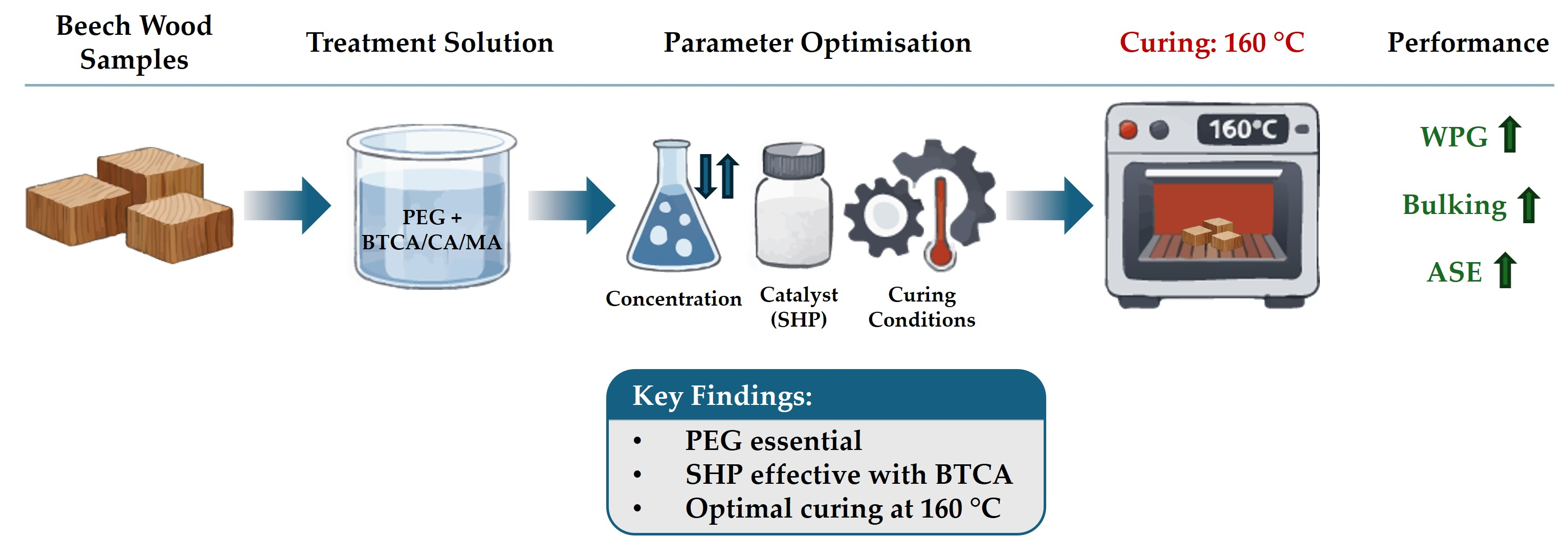
Influence of Treatment Parameters on Beech Wood (Fagus sylvatica) Modified with Polyethylene Glycol and Various Carboxylic Acids

Abstract
1. Introduction
2. Materials and Methods
2.1. Treatment
2.2. Measurement of the pH Value
2.3. Anti-Swelling Efficiency (ASE) Leaching Experiments
3. Results and Discussion
- BTCA and combinations of BTCA/PEG400 in the molar ratio of 2:1.
- CA and combinations of CA/PEG400 in the molar ratio of 2:1.
- MA/PEG400 in the molar ratio of 2:1.
3.1. BTCA and BTCA/PEG400
3.1.1. Effect of Catalyst
3.1.2. Optimisation of the Curing Conditions
3.1.3. Influence of the Concentration of the Impregnation Solutions
3.2. CA and CA/PEG400
3.2.1. Effect of Catalyst
3.2.2. Influence of the Concentration of the Impregnation Solution

| Parameter and Formulation | 0 | Cycle 1 | Cycle 5 | Cycle 10 | Loss [%] 0/Cycle 1 to Cycle 10 |
|---|---|---|---|---|---|
| ASE [%] (CA_38/PEG400_40) w/o cat. | 54.73 (5.18) | 37.34 (5.39) | 39.46 (2.70) | −27.9 | |
| ASE [%] (CA_38/PEG400_40/SHP_3) | 30.69 (5.18) | 26.10 (5.27) | 20.48 (5.27) | −33.3 | |
| ASE [%] (CA_38) w/o PEG w/o cat. | 54.86 (3.12) | 36.94 (4.29) | 32.53 (1.94) | −40.7 | |
| ASE [%] (CA_38/SHP_3) w/o PEG | 59.09 (1.78) | 43.58 (2.77) | 35.63 (2.52) | −39.7 | |
| ASE [%] (CA_19/PEG400_20) w/o cat. | 65.54 (3.23) | 41.29 (3.79) | 31.23 (3.84) | −52.3 | |
| Bulking [%] (CA_38/PEG400_40) w/o cat. | 20.58 (1.20) | 18.60 (1.32) | 17.21 (1.48) | 16.80 (1.53) | −18.4 |
| Bulking [%] (CA_38/PEG400_40/SHP_3) | 14.10 (2.04) | 12.78 (1.98) | 12.32 (2.11) | 11.39 (2.19) | −19.2 |
| Bulking [%] (CA_38) w/o PEG w/o cat. | 12.76 (0.40) | 8.70 (0.51) | 6.40 (0.54) | 5.25 (0.62) | −58.9 |
| Bulking [%] (CA_38/SHP_3) w/o PEG | 12.78 (0.56) | 10.73 (0.57) | 9.07 (0.55) | 7.25 (0.48) | −43.3 |
| Bulking [%] (CA_19/PEG400_20) w/o cat. | 15.52 (0.40) | 11.03 (0.66) | 10.44 (0.69) | 9.69 (0.78) | −37.6 |
| WPG [%] (CA_38/PEG400_40) w/o cat. | 59.74 (7.50) | 42.91 (1.53) | 38.63 (1.39) | 36.95 (1.31) | −38.1 |
| WPG [%] (CA_38/PEG400_40/SHP_3) | 57.12 (5.35) | 48.48 (4.66) | 43.02 (4.42) | 40.60 (4.34) | −28.9 |
| WPG [%] (CA_38) w/o PEG w/o cat. | 35.26 (2.26) | 25.47 (1.22) | 17.91 (0.94) | 13.14 (1.01) | −62.7 |
| WPG [%] (CA_38/SHP_3) w/o PEG | 31.22 (1.14) | 24.91 (0.75) | 18.88 (0.70) | 14.75 (0.59) | −52.8 |
| WPG [%] (CA_19/PEG400_20) w/o cat. | 35.68 (3.14) | 27.56 (2.50) | 23.61 (2.23) | 21.97 (2.19) | −38.4 |
3.2.3. Optimisation of the Curing Conditions
3.3. MA/PEG400
3.3.1. Effect of Catalyst
3.3.2. Effect of the Concentration of Chemicals in Solution
3.3.3. Optimisation of the Curing Conditions
4. Conclusions
Author Contributions
Funding
Institutional Review Board Statement
Informed Consent Statement
Data Availability Statement
Acknowledgments
Conflicts of Interest
Abbreviations
| PEG | Polyethylene glycol |
| BTCA | 1,2,3,4-butanetetracarboxylic acid |
| CA | Citric acid |
| MA | Malic acid |
| WPG | Weight percentage gain |
| ASE | Anti-swelling efficiency |
| SHP | Sodium hypophosphite monohydrate |
| DMDHEU | 1,3-dimethylol-4,5-dihidroxyethylene urea |
| cat. | Catalyst |
| w/o | Without |
| RT | Room temperature |
References
- Despot, R.; Hasan, M.; Jug, M.; Šefc, B. Biological durability of wood modified by citric acid. Drv. Ind. 2008, 59, 55–59. Available online: https://www.researchgate.net/publication/26522120_Biological_durability_of_wood_modified_by_citric_acid (accessed on 17 March 2026).
- Mubarok, M.; Militz, H.; Dumarçay, S.; Géradin, P. Beech wood modification based on in situ esterification with sorbitol and citric acid. Wood Sci. Technol. 2020, 54, 479–502. [Google Scholar] [CrossRef] [Scilit]
- Schneider, A. Beiträge zur Dimensionsstabilisierung des Holzes mit Polyäthylenglykol—Erste Mitteilung: Grundlegende Untersuchungen zur Dimensionsstabilisierung des Holzes mit Polyäthylenglykol. Holz Als Roh-Und Werkst. 1969, 27, 209–224. Available online: https://link.springer.com/article/10.1007/BF02612917 (accessed on 17 March 2026). [CrossRef] [Scilit]
- Hasan, M.; Despot, R.; Šefc, B.; Ištok, I.; Lacic, R. Optimisation of Modification of Beech Wood by Citric Acid. In Proceedings of the Sixth European Conference on Wood Modification, Ljubljana, Slovenia, 16–18 September 2012; pp. 63–71. Available online: https://www.researchgate.net/publication/304348537_Optimisation_of_Modification_of_Beech_Wood_by_Citric_Acid (accessed on 17 March 2026).
- Dingels, C.; Schömer, M.; Frey, H. Die vielen Gesichter des Poly(ethylenglykol)s. Chem. Unserer Zeit 2011, 45, 338–349. [Google Scholar] [CrossRef] [Scilit]
- Stamm, A.J. Dimensional Stabilization of Wood with Carbowaxes. For. Prod. J. 1956, 6, 201–204. Available online: https://www.semanticscholar.org/paper/Dimensional-stabilization-of-wood-with-carbowaxes-Stamm/667c7afaaa17695606a4a83b1a577c8a6bdda53c (accessed on 17 March 2026).
- Stamm, A.J. Effect of Polyethylene Glycol On the Dimensional Stability Of Wood. For. Prod. J. 1959, 9, 375–381. Available online: https://www.fpl.fs.usda.gov/documnts/pdf1959/stamm59a.pdf (accessed on 17 March 2026).
- Meints, T.; Hansmann, C.; Gindl-Altmutter, W. Suitability of Different Variants of Polyethylene Glycol Impregnation for the Dimensional Stabilization of Oak Wood. Polymers 2018, 10, 81. [Google Scholar] [CrossRef] [Scilit]
- Kollmann, F.; Côté, W.A. Principles of Wood Science and Technology: I Solid Wood; Springer: New York, NY, USA, 1968; Volume 1, Solid Wood. [Google Scholar] [CrossRef] [Scilit]
- Bischof Vukusic, S.; Katovic, D.; Schramm, C.; Trajkovic, J.; Sefc, B. Polycarboxylic acids as non-formaldehyde anti-swelling agents for wood. Holzforschung 2006, 60, 439–444. [Google Scholar] [CrossRef] [Scilit]
- Šefc, B.; Hasan, M.; Trajković, J.; Despot, R.; Jug, M.; Katović, D.; Bischof Vukušić, S. Selected Properties of Beech Wood Modified by Citric Acid. In Proceedings of the 4th European Conference on Wood Modification, Stockholm, Sweden, 27–29 April 2009; pp. 425–428, ISBN 978-91-86319-36-6. [Google Scholar]
- Feng, X.; Xiao, Z.; Sui, S.; Wang, Q.; Xie, Y. Esterification of wood with citric acid: The catalytic effects of sodium hypophosphite (SHP). Holzforschung 2014, 68, 427–433. [Google Scholar] [CrossRef] [Scilit]
- Kurkowiak, K.; Emmerich, L.; Militz, H. Wood chemical modification based on bio-based polycarboxylic acid and polyols—Status quo and future perspectives. Wood Mater. Sci. Eng. 2021, 17, 1040–1054. [Google Scholar] [CrossRef] [Scilit]
- Kiljunen, S.; Koski, A.; Kunttu, M.; Valkonen, T. Impregnation of Chemicals into Wood. EP 2 485 880 B1, 26 December 2018. Available online: https://patentimages.storage.googleapis.com/4a/d4/f2/8f749660a8c986/EP2485880B1.pdf (accessed on 25 April 2026).
- de Cuadro, P.; Belt, T.; Kontturi, K.S.; Reza, M.; Kontturi, E.; Vuorinen, T.; Hughes, M. Cross-linking of cellulose and poly(ethylene glycol) with citric acid. React. Funct. Polym. 2015, 90, 21–24. [Google Scholar] [CrossRef] [Scilit]
- Welch, C.M. Tetracarboxylic Acids as Formaldehyde-Free Durable Press Finishing Agents. Text. Res. J. 1988, 58, 480–486. [Google Scholar] [CrossRef] [Scilit]
- Šauperl, O.; Stana-Kleinschek, K.; Ribitsch, V. Cotton Cellulose 1, 2, 3, 4 Buthanetetracarboxylic Acid (BTCA) Crosslinking Monitored by some Physical—Chemical Methods. Text. Res. J. 2009, 79, 780–791. [Google Scholar] [CrossRef] [Scilit]
- Wang, H.; Zhang, C.; Chu, X.; Zhu, P. Mechanism of Antiwrinkle Finishing of Cotton Fabrics Using Mixed Polycarboxylic Acids. Int. J. Polym. Sci. 2020, 2020, 3876595. [Google Scholar] [CrossRef] [Scilit]
- Lund, K.; Brelid, H. 1,2,3,4-Butanetetracarboxylic Acid Cross-Linked Softwood Kraft Pulp Fibers for Use in Fluff Pulp Applications. J. Eng. Fibers Fabr. 2014, 9, 142–150. [Google Scholar] [CrossRef] [Scilit]
- Bischof Vukusic, S.; Katovic, D.; Grgac, S.F.; Trajkovic, J.; Voncina, B. Study of the wood modification process with polycarboxylic acids and microwave tratment. Wood Res. 2010, 55, 121–130. Available online: https://www.researchgate.net/publication/282716323_Study_of_the_wood_modification_process_with_polycarboxylic_acids_and_microwave_tratment (accessed on 17 March 2026).
- Schramm, C.; Bischof Vukusic, S.; Katovic, D. Non-formaldehyde durable press finishing of dyed fabrics: Evaluation of cotton-bound polycarboxylic acids. Rev. Prog. Color. Relat. Top. 2002, 118, 244–249. [Google Scholar] [CrossRef] [Scilit]
- Šefc, B.; Trajković, J.; Hasan, M.; Katović, D.; Frančić, M. Dimensional stability of wood modified by citric acid using different catalysts. Drv. Ind. 2009, 60, 23–26. Available online: https://www.researchgate.net/publication/26594837_Dimensional_stability_of_wood_modified_by_citric_acid_using_different_catalysts (accessed on 17 March 2026).
- Yang, C.Q.; Wang, X.; Kang, I.-S. Ester Crosslinking of Cotton Fabric by Polymeric Carboxylic Acids and Citric Acid. Text. Res. J. 1997, 67, 334–342. [Google Scholar] [CrossRef] [Scilit]
- Kim, B.-H.; Jang, J.; Ko, S.-W. Durable press finish of cotton fabric using malic acid as a crosslinker. Fibers Polym. 2000, 1, 116–121. [Google Scholar] [CrossRef] [Scilit]
- Yang, C.Q. Infrared spectroscopy studies of the effects of the catalyst on the ester cross-linking of cellulose by poly(carboxylic acids). J. Appl. Polym. Sci. 1993, 50, 2047–2053. [Google Scholar] [CrossRef] [Scilit]
- Chabert, A.J.; Fredon, E.; Rémond, R. Improving the stability of beech wood with polyester treatment based on malic acid. Holzforschung 2021, 76, 268–275. [Google Scholar] [CrossRef] [Scilit]
- Flaig, N.; Christ, M.; Müller, M. Influence of wood modification with polyethylene glycol and various carboxylic acids on the dimensional stability of beech wood (Fagus sylvatica). Int. Wood Prod. J. 2023, 14, 120–134. [Google Scholar] [CrossRef] [Scilit]
- L’Hostis, C.; Thévenon, M.-F.; Fredon, E.; Gérardin, P. Improvement of beech wood properties by in situ formation of polyesters of citric and tartaric acid in combination with glycerol. Holzforschung 2018, 72, 291–299. [Google Scholar] [CrossRef] [Scilit]
- Samani, A.; Ganguly, S.; Hom, S.K. Effect of chemical modification and heat treatment on biological durability and dimensional stability of Pinus roxburghii Sarg. N. Z. J. For. Sci. 2021, 51, 1–10. [Google Scholar] [CrossRef] [Scilit]
- He, X.; Xiao, Z.; Feng, X.; Sui, S.; Wang, Q.; Xie, Y. Modification of poplar wood with glucose crosslinked with citric acid and 1,3-dimethylol-4,5-dihydroxy ethyleneurea. Holzforschung 2016, 70, 47–53. [Google Scholar] [CrossRef] [Scilit]
- Guo, W.; Xiao, Z.; Wentzel, M.; Emmerich, L.; Xie, Y.; Militz, H. Modification of Scots pine with activated glucose and citric acid: Physical and mechanical properties. BioResources 2019, 14, 3445–3458. [Google Scholar] [CrossRef] [Scilit]
- Hudson, R.B.; Dolan, M.J.; Grayson, M. (Eds.) Phosphoric acids and phosphates. In Kirk-Othmer Encyclopedia of Chemical Technology; John Wiley & Sons: New York, NY, USA, 1980; pp. 471–477. [Google Scholar]
- Essoua, G.; Blanchet, P.; Landry, V.; Beauregard, R. Pine wood treated with a citric acid and glycerol mixture: Biomaterial performance improved by a bio-byproduct. BioResources 2016, 11, 3049–3072. [Google Scholar] [CrossRef] [Scilit]
- Hasan, M.; Despot, R.; Jug, M. Modification of wood with citric acid for increasing biological durability of wood. In Proceedings of the New Technologies and Materials in Industries Based on the Forestry Sector, International Symposium, Zagreb, Croatia, 19 October 2007; pp. 85–89. [Google Scholar]
- Buche—Technische Eigenschaften. Available online: https://holzvomfach.de/fachwissen-holz/holz-abc/buche/ (accessed on 19 March 2026).
- Welch, C.M.; Kottes-Andrews, B.A. Ester crosslinks: A route to high performance nonformaldehyde finishing of cotton. Text. Res. J. 1989, 21, 13–17. [Google Scholar]
- Morris, C.E.; Catalano, E.A.; Kottes-Andrews, B.A. FT-IR determination of degree of esterification in polycarboxylic acid cross-link finishing of cotton. Cellulose 1995, 2, 31–39. [Google Scholar] [CrossRef] [Scilit]
- Widsten, P.; Dooley, N.; Parr, R.; Capricho, J.; Suckling, I. Citric acid crosslinking of paper products for improved high-humidity performance. Carbohydr. Polym. 2014, 101, 998–1004. [Google Scholar] [CrossRef] [Scilit]
- GESTIS Stoffdatenbank (Ed.) Safety Data Sheet Malic Acid. Available online: https://gestis.dguv.de/data?name=034290&lang=en (accessed on 18 March 2026).
- Zoldners, J.; Kiseleva, T. Modification of hemicelluloses with polycarboxylic acids. Holzforschung 2013, 67, 567–571. [Google Scholar] [CrossRef] [Scilit]
- Beall, F.C.; Eickner, H.W. Thermal Degradation of Wood Components: A Review of the Literature; No. FPL 130; United States Forest Products Laboratory: Madison, WI, USA, 1970. Available online: https://www.fpl.fs.usda.gov/documnts/fplrp/fplrp130.pdf (accessed on 18 March 2026).
- Shafizadeh, F.; Chin, P.P.S. Wood technology: Chemical aspects. A symposium sponsored by the cellulose. In Proceedings of the Paper and Textile Division at the 172nd Meeting of the American Chemical Society, San Francisco, CA, USA, 31 August–2 September 1976; Goldstein, I.S., Ed.; ACS Symposium Series, 43; American Chemical Society: Washington, DC, USA, 1976; pp. 1–372. [Google Scholar]
- Hill, C.A.S. Wood Modification: Chemical, Thermal and Other Processes; John Wiley & Sons, Ltd.: Chichester, UK, 2007. [Google Scholar]
- Morris, C.E.; Morris, N.M.; Trask-Morrell, B.J. Interaction of meso-1,2,3,4-butanetetracarboxylic acid with phosphorus-containing catalysts for esterification cross-linking of cellulose. Ind. Eng. Chem. Res. 1996, 35, 950–953. [Google Scholar] [CrossRef] [Scilit]
- Ji, B.; Tang, P.; Yan, K.; Sun, G. Catalytic actions of alkaline salts in reactions between 1,2,3,4-butanetetracarboxylic acid and cellulose: II. Esterification. Carbohydr. Polym. 2015, 132, 228–236. [Google Scholar] [CrossRef] [Scilit]
- Ji, B.; Qi, H.; Yan, K.; Sun, G. Catalytic actions of alkaline salts in reactions between 1,2,3,4-butanetetracarboxylic acid and cellulose: I. Anhydride formation. Cellulose 2016, 23, 259–267. [Google Scholar] [CrossRef] [Scilit]
- Welch, C.M.; Andrews, B.K. Catalysts and Processes for Formaldehyde-Free Durable Press Finishing of Cotton Textiles with Polycarboxylic Acids. 1990. Publication Number: 4,936,865. Available online: https://patents.google.com/patent/US4936865A/en (accessed on 18 March 2026).
- Yang, C.Q. FTIR spectroscopy study of ester crosslinking of cotton cellulose catalyzed by sodium hypophosphite. Text. Res. J. 2001, 71, 201–206. [Google Scholar] [CrossRef] [Scilit]
- Wei, W.; Yang, C.Q. Predicting the performance of durable press finished cotton fabric with infrared spectroscopy. Text. Res. J. 1999, 69, 145–151. [Google Scholar] [CrossRef] [Scilit]
- Kurkowiak, K.; Emmerich, L.; Militz, H. Sorption behavior and swelling of citric acid and sorbitol (SorCA) treated wood. Holzforschung 2021, 75, 1136–1149. [Google Scholar] [CrossRef] [Scilit]
- Christ, M.; Flaig, N.; Müller, M. Influence of polyethylene glycol and various carboxylic acids on the physical and mechanical properties of beech wood (Fagus sylvatica) and Scots pine wood (Pinus sylvestris). Wood Mater. Sci. Eng. 2024, 20, 361–381. [Google Scholar] [CrossRef] [Scilit]
- Xie, Y.; Fu, Q.; Wang, Q.; Xiao, Z.; Militz, H. Effects of chemical modification on the mechanical properties of wood. Eur. J. Wood Wood Prod. 2013, 71, 401–416. [Google Scholar] [CrossRef] [Scilit]
- Larnøy, E.; Karaca, A.; Gobakken, L.R.; Hill, C.A.S. Polyesterification of wood using sorbitol and citric acid under aqueous conditions. Int. Wood Prod. J. 2018, 9, 66–73. [Google Scholar] [CrossRef] [Scilit]
- Welch, C.M.; Peters, J.G. Malic acid as a nonformaldehyde DP finishing agent activated by BTCA and polymer additives. Text. Res. J. 1997, 20, 33–37. [Google Scholar]
- Welch, C.M.; Peters, J.G. Mixed polycarboxylic acids and mixed catalyst in formaldehyde-free durable press finishing. Text. Res. J. 1997, 29, 22–27. [Google Scholar]
- Berovic, M.; Legisa, M. Citric acid production. Biotechnol. Annu. Rev. 2007, 13, 303–343. [Google Scholar] [CrossRef] [Scilit] [PubMed]
| Formulation | n (Acid) [mmol] | n (PEG400) [mmol] | n (Cat.) [mmol] |
|---|---|---|---|
| BTCA_10 w/o PEG w/o cat. | 213.5 | ||
| BTCA_10/SHP_3 w/o PEG | 213.5 | 144.3 | |
| BTCA_10/PEG400_8.5 w/o cat. | 213.5 | 106.8 | |
| BTCA_10/PEG400_8.5/SHP_3 | 213.5 | 106.8 | 144.3 |
| BTCA_5/SHP_1.5 w/o PEG | 64.1 | 43.3 | |
| BTCA_5/PEG400_4.3/SHP_3 | 64.1 | 32.0 | 86.6 |
| BTCA_5/PEG400_4.3/SHP_1.5 | 64.1 | 32.0 | 43.3 |
| CA_38 w/o PEG w/o cat. | 1665.6 | ||
| CA_38/SHP_3 w/o PEG | 1041.0 | 144.3 | |
| CA_38/PEG400_40 w/o cat. | 600.0 | 300.0 | |
| CA_38/PEG400_40/SHP_3 | 1000.0 | 500.0 | 144.3 |
| CA_19/PEG400_20 w/o cat. | 1200.0 | 600.0 | |
| MA_27/PEG400_40 w/o cat. | 600.0 | 300.0 | |
| MA_27/PEG400_40/SHP_3 | 1000.0 | 500.0 | 144.3 |
| MA_13.4/PEG400_20 w/o cat. | 350.0 | 175.0 |
| Formulation | pH (Demin. Water and Wood) |
|---|---|
| Control | 5.1 5.1 |
| BTCA_10/PEG400_8.5/SHP_3 | 4.8 4.8 |
| CA_19/PEG400_20 w/o cat. | 3.4 3.4 |
| MA_13.4/PEG400_20 w/o cat. | 3.1 3.1 |
| Parameter and Formulation | 0 | Cycle 1 | Cycle 5 | Cycle 10 | Loss [%] 0/Cycle 1 to Cycle 10 |
|---|---|---|---|---|---|
| ASE [%] (BTCA_10/PEG400_8.5) w/o cat. | 48.85 (5.34) | 41.12 (2.98) | 37.43 (3.69) | −23.4 | |
| ASE [%] (BTCA_10/PEG400_8.5/SHP_3) | 49.02 (2.54) | 41.97 (2.97) | 36.91 (3.34) | −24.7 | |
| ASE [%] (BTCA_10) w/o PEG w/o cat. | 38.54 (5.32) | 27.78 (5.00) | 25.32 (5.06) | −34.3 | |
| ASE [%] (BTCA_10/SHP_3) w/o PEG | 49.27 (4.90) | 42.28 (3.30) | 37.26 (2.74) | −32.2 | |
| Bulking [%] (BTCA_10/PEG400_8.5) w/o cat. | 6.89 (0.82) | 4.28 (0.74) | 5.47 (0.50) | 5.36 (0.56) | −22.2 |
| Bulking [%] (BTCA_10/PEG400_8.5/SHP_3) | 8.11 (0.79) | 7.26 (0.95) | 7.31 (0.90) | 6.37 (0.93) | −21.5 |
| Bulking [%] (BTCA_10) w/o PEG w/o cat. | 4.15 (0.56) | 1.87 (0.38) | 2.80 (0.61) | 2.32 (0.61) | −44.1 |
| Bulking [%] (BTCA_10/SHP_3) w/o PEG | 4.87 (0.89) | 3.44 (0.50) | 3.42 (0.64) | 2.97 (0.82) | −39.0 |
| WPG [%] (BTCA_10/PEG400_8.5) w/o cat. | 17.15 (1.22) | 13.76 (1.15) | 12.01 (1.08) | 10.76 (1.02) | −37.7 |
| WPG [%] (BTCA_10/PEG400_8.5/SHP_3) | 18.33 (1.10) | 15.33 (0.88) | 13.84 (0.90) | 12.68 (0.74) | −30.8 |
| WPG [%] (BTCA_10) w/o PEG w/o cat. | 8.98 (0.83) | 5.46 (0.61) | 3.97 (0.59) | 2.97 (0.64) | −66.9 |
| WPG [%] (BTCA_10/SHP_3) w/o PEG | 11.74 (0.92) | 8.19 (0.80) | 6.52 (0.68) | 5.28 (0.73) | −55.0 |
| Parameter and Formulation | 0 | Cycle 1 | Cycle 5 | Cycle 10 | Loss [%] 0/Cycle 1 to Cycle 10 |
|---|---|---|---|---|---|
| ASE [%] (BTCA_10/PEG400_8.5/SHP_3) 5 h/120 °C | 49.02 (2.54) | 41.97 (2.97) | 36.91 (3.34) | −24.7 | |
| ASE [%] (BTCA_10/PEG400_8.5/SHP_3) 5 h/140 °C | 50.35 (2.82) | 47.32 (2.68) | 41.12 (2.94) | −22.4 | |
| ASE [%] (BTCA_10/PEG400_8.5/SHP_3) 3 h/160 °C | 52.41 (1.98) | 46.36 (3.17) | 42.10 (2.05) | −19.7 | |
| ASE [%] (BTCA_10/PEG400_8.5/SHP_3) 5 h/160 °C | 53.66 (2.15) | 46.10 (2.68) | 40.90 (1.98) | −23.8 | |
| ASE [%] (BTCA_10/PEG400_8.5/SHP_3) 7 h/160 °C | 54.17 (2.66) | 47.77 (3.42) | 43.20 (2.62) | −25.4 | |
| ASE [%] (BTCA_10/PEG400_8.5/SHP_3) 9 h/160 °C | 52.74 (2.36) | 48.35 (3.11) | 43.81 (5.05) | −16.9 | |
| ASE [%] (BTCA_10/PEG400_8.5/SHP_3) 5 h/180 °C | 60.06 (2.39) | 52.01 (3.92) | 45.97 (3.11) | −30.7 | |
| Bulking [%] (BTCA_10/PEG400_8.5/SHP_3) 5 h/120 °C | 8.11 (0.79) | 7.26 (0.95) | 7.31 (0.90) | 6.37 (0.93) | −21.5 |
| Bulking [%] (BTCA_10/PEG400_8.5/SHP_3) 5 h/140 °C | 8.62 (0.98) | 8.36 (0.92) | 7.84 (1.04) | 7.87 (1.08) | −8.7 |
| Bulking [%] (BTCA_10/PEG400_8.5/SHP_3) 3 h/160 °C | 9.13 (0.44) | 8.29 (0.37) | 8.13 (0.62) | 7.72 (0.60) | −15.4 |
| Bulking [%] (BTCA_10/PEG400_8.5/SHP_3) 5 h/160 °C | 8.64 (0.55) | 8.67 (0.70) | 8.24 (0.47) | 8.04 (1.02) | −6.9 |
| Bulking [%] (BTCA_10/PEG400_8.5/SHP_3) 7 h/160 °C | 9.43 (0.70) | 8.55 (0.91) | 8.45 (0.48) | 7.95 (---) | −15.7 |
| Bulking [%] (BTCA_10/PEG400_8.5/SHP_3) 9 h/160 °C | 9.03 (0.59) | 8.51 (0.63) | 8.41 (0.46) | 7.07 (0.41) | −21.7 |
| Bulking [%] (BTCA_10/PEG400_8.5/SHP_3) 5 h/180 °C | 7.17 (0.80) | 7.31 (0.82) | 6.21 (0.56) | 6.16 (0.84) | −14.1 |
| WPG [%] (BTCA_10/PEG400_8.5/SHP_3) 5 h/120 °C | 18.33 (1.10) | 15.33 (0.88) | 13.84 (0.90) | 12.68 (0.74) | −30.8 |
| WPG [%] (BTCA_10/PEG400_8.5/SHP_3) 5 h/140 °C | 17.85 (0.40) | 15.57 (0.49) | 14.04 (0.28) | 13.01 (0.40) | −27.1 |
| WPG [%] (BTCA_10/PEG400_8.5/SHP_3) 3 h/160 °C | 17.30 (0.53) | 16.78 (0.80) | 15.01 (0.58) | 13.63 (1.05) | −21.2 |
| WPG [%] (BTCA_10/PEG400_8.5/SHP_3) 5 h/160 °C | 16.31 (0.51) | 15.68 (0.60) | 13.87 (0.61) | 12.81 (0.60) | −21.5 |
| WPG [%] (BTCA_10/PEG400_8.5/SHP_3) 7 h/160 °C | 17.18 (0.59) | 16.70 (0.53) | 15.23 (0.56) | 13.64 (1.82) | −20.6 |
| WPG [%] (BTCA_10/PEG400_8.5/SHP_3) 9 h/160 °C | 16.79 (0.69) | 16.39 (0.63) | 14.97 (0.48) | 13.35 (0.74) | −20.5 |
| WPG [%] (BTCA_10/PEG400_8.5/SHP_3) 5 h/180 °C | 15.66 (1.44) | 15.23 (1.48) | 13.38 (1.40) | 12.00 (1.34) | −23.4 |
| Parameter and Formulation | 0 | Cycle 1 | Cycle 5 | Cycle 10 | Loss [%] 0/Cycle 1 to Cycle 10 |
|---|---|---|---|---|---|
| ASE [%] (BTCA_10/PEG400_8.5/SHP_3) | 53.66 (2.15) | 46.10 (2.68) | 40.90 (3.69) | −23.8 | |
| ASE [%] (BTCA_5/PEG400_4.3/SHP_1.5) | 41.19 (2.19) | 32.68 (2.96) | 29.74 (3.82) | −27.8 | |
| ASE [%] (BTCA_5/SHP_1.5) w/o PEG | 41.70 (1.15) | 31.11 (2.62) | 23.23 (1.68) | −44.3 | |
| Bulking [%] (BTCA_10/PEG400_8.5/SHP_3) | 8.64 (0.55) | 8.67 (0.70) | 8.24 (0.47) | 8.04 (1.20) | −7.5 |
| Bulking [%] (BTCA_5/PEG400_4.3/SHP_1.5) | 4.61 (0.37) | 3.71 (0.30) | 3.21 (0.36) | 3.15 (0.38) | −31.7 |
| Bulking [%] (BTCA_5/SHP_1.5) w/o PEG | 1.85 (0.17) | 1.46 (0.27) | 1.37 (0.36) | 0.93 (0.41) | −49.7 |
| WPG [%] (BTCA_10/PEG400_8.5/SHP_3) | 16.31 (0.51) | 15.68 (0.60) | 13.87 (0.61) | 12.81 (0.60) | −21.5 |
| WPG [%] (BTCA_5/PEG400_4.3/SHP_1.5) | 7.69 (0.55) | 7.54 (0.54) | 5.67 (0.77) | 5.32 (0.48) | −30.8 |
| WPG [%] (BTCA_5/SHP_1.5) w/o PEG | 4.53 (0.44) | 4.16 (0.29) | 2.80 (0.20) | 1.32 (0.25) | −70.9 |
| Parameter and Formulation | 0 | Cycle 1 | Cycle 5 | Cycle 10 | Loss [%] 0/Cycle 1 to Cycle 10 |
|---|---|---|---|---|---|
| ASE [%] (CA_19/PEG400_20) w/o cat. 5 h/120 °C | 65.54 (3.23) | 41.29 (3.79) | 31.23 (3.84) | −52.3 | |
| ASE [%] (CA_19/PEG400_20) w/o cat. 5 h/140 °C | 56.73 (3.26) | 39.77 (3.07) | 37.65 (3.74) | −33.6 | |
| ASE [%] (CA_19/PEG400_20) w/o cat. 5 h/160 °C | 63.29 (2.28) | 50.43 (3.04) | 43.12 (4.38) | −31.9 | |
| ASE [%] (CA_19/PEG400_20) w/o cat. 5 h/180 °C | 58.68 (1.43) | 46.63 (2.17) | 42.19 (1.28) | −28.1 | |
| Bulking [%] (CA_19/PEG400_20) w/o cat. 5 h/120 °C | 15.52 (0.40) | 11.03 (0.66) | 10.44 (0.69) | 9.69 (0.78) | −37.6 |
| Bulking [%] (CA_19/PEG400_20) w/o cat. 5 h/140 °C | 15.98 (0.65) | 14.10 (0.61) | 12.75 (0.59) | 12.63 (0.64) | −21.0 |
| Bulking [%] (CA_19/PEG400_20) w/o cat. 5 h/160 °C | 13.97 (0.98) | 13.56 (1.01) | 12.23 (0.90) | 11.72 (0.98) | −16.1 |
| Bulking [%] (CA_19/PEG400_20) w/o cat. 5 h/180 °C | 10.53 (1.11) | 9.91 (1.14) | 8.33 (0.92) | 7.98 (1.08) | −24.2 |
| WPG [%] (CA_19/PEG400_20) w/o cat. 5 h/120 °C | 35.68 (3.14) | 27.56 (2.50) | 23.61 (2.23) | 21.97 (2.19) | −38.4 |
| WPG [%] (CA_19/PEG400_20) w/o cat. 5 h/140 °C | 31.46 (1.02) | 28.52 (0.95) | 25.58 (0.86) | 23.74 (1.03) | −24.5 |
| WPG [%] (CA_19/PEG400_20) w/o cat. 5 h/160 °C | 33.16 (3.55) | 32.08 (3.49) | 29.72 (3.46) | 28.10 (3.35) | −15.3 |
| WPG [%] (CA_19/PEG400_20) w/o cat. 5 h/180 °C | 26.13 (2.95) | 25.08 (3.04) | 22.90 (2.77) | 21.41 (2.79) | −18.1 |
| Parameter and Formulation | 0 | Cycle 1 | Cycle 5 | Cycle 10 | Loss [%] 0/Cycle 1 to Cycle 10 |
|---|---|---|---|---|---|
| ASE [%] (MA_27/PEG400_40) w/o cat. | 74.09 (1.31) | 39.05 (3.19) | 34.51 (3.39) | −53.4 | |
| ASE [%] (MA_27/PEG400_40/SHP_3) | 71.10 (3.55) | 36.02 (3.39) | 23.80 (5.14) | −66.5 | |
| ASE [%] (MA_13.4/PEG400_20) w/o cat. | 68.67 (6.29) | 33.24 (6.21) | 28.56 (5.18) | −58.4 | |
| Bulking [%] (MA_27/PEG400_40) w/o cat. | 21.84 (1.14) | 16.62 (0.75) | 12.44 (0.72) | 11.55 (0.72) | −47.1 |
| Bulking [%] (MA_27/PEG400_40/SHP_3) | 18.37 (0.89) | 13.90 (0.77) | 10.31 (0.83) | 7.93 (0.83) | −56.8 |
| Bulking [%] (MA_13.4/PEG400_20) w/o cat. | 14.13 (0.83) | 8.07 (1.00) | 5.35 (0.82) | 4.34 (0.60) | −69.3 |
| WPG [%] (MA_27/PEG400_40) w/o cat. | 59.63 (5.11) | 32.95 (1.06) | 23.64 (0.72) | 20.15 (0.63) | −66.2 |
| WPG [%] (MA_27/PEG400_40/SHP_3) | 60.64 (3.52) | 33.60 (2.08) | 25.88 (2.02) | 20.66 (2.07) | −65.9 |
| WPG [%] (MA_13.4/PEG400_20) w/o cat. | 33.10 (4.39) | 18.62 (2.55) | 13.62 (2.23) | 10.98 (1.92) | −66.8 |
| Parameter and Formulation | 0 | Cycle 1 | Cycle 5 | Cycle 10 | Loss [%] 0/Cycle 1 to Cycle 10 |
|---|---|---|---|---|---|
| ASE [%] (MA_13.4/PEG400_20) w/o cat. 5 h/120 °C | 68.67 (6.29) | 33.24 (6.21) | 28.56 (5.18) | −58.4 | |
| ASE [%] (MA_13.4/PEG400_20) w/o cat. 5 h/140 °C | 64.41 (1.17) | 32.94 (2.71) | 29.43 (3.61) | −54.3 | |
| ASE [%] (MA_13.4/PEG400_20) w/o cat. 5 h/160 °C | 62.38 (1.47) | 39.69 (3.40) | 28.48 (3.55) | −54.3 | |
| ASE [%] (MA_13.4/PEG400_20) w/o cat. 5 h/180 °C | 60.52 (1.59) | 38.98 (3.11) | 30.26 (3.74) | −50.0 | |
| Bulking [%] (MA_13.4/PEG400_20) w/o cat. 5 h/120 °C | 14.13 (0.83) | 8.07 (1.00) | 5.35 (0.82) | 4.34 (0.60) | −69.3 |
| Bulking [%] (MA_13.4/PEG400_20) w/o cat. 5 h/140 °C | 15.03 (0.74) | 10.43 (0.78) | 7.54 (0.64) | 8.13 (0.98) | −45.9 |
| Bulking [%] (MA_13.4/PEG400_20) w/o cat. 5 h/160 °C | 14.58 (1.08) | 12.19 (0.92) | 9.91 (0.70) | 9.63 (0.67) | −34.0 |
| Bulking [%] (MA_13.4/PEG400_20) w/o cat. 5 h/180 °C | 10.73 (0.88) | 7.99 (0.80) | 5.30 (0.62) | 4.45 (0.95) | −58.5 |
| WPG [%] (MA_13.4/PEG400_20) w/o cat. 5 h/120 °C | 33.10 (4.39) | 18.62 (2.55) | 13.62 (2.23) | 10.98 (1.92) | −66.8 |
| WPG [%] (MA_13.4/PEG400_20) w/o cat. 5 h/140 °C | 27.15 (0.87) | 17.45 (0.60) | 12.90 (0.42) | 10.91 (0.61) | −59.8 |
| WPG [%] (MA_13.4/PEG400_20) w/o cat. 5 h/160 °C | 25.56 (1.22) | 19.87 (0.81) | 15.87 (0.65) | 13.52 (0.71) | −47.1 |
| WPG [%] (MA_13.4/PEG400_20) w/o cat. 5 h/180 °C | 21.74 (1.94) | 18.44 (1.72) | 14.18 (1.47) | 11.51 (1.51) | −47.1 |
Disclaimer/Publisher’s Note: The statements, opinions and data contained in all publications are solely those of the individual author(s) and contributor(s) and not of MDPI and/or the editor(s). MDPI and/or the editor(s) disclaim responsibility for any injury to people or property resulting from any ideas, methods, instructions or products referred to in the content. |
© 2026 by the authors. Licensee MDPI, Basel, Switzerland. This article is an open access article distributed under the terms and conditions of the Creative Commons Attribution (CC BY) license.
Share and Cite
Flaig, N.; Christ, M.; Müller, M. Influence of Treatment Parameters on Beech Wood (Fagus sylvatica) Modified with Polyethylene Glycol and Various Carboxylic Acids. Materials 2026, 19, 1827. https://doi.org/10.3390/ma19091827
Flaig N, Christ M, Müller M. Influence of Treatment Parameters on Beech Wood (Fagus sylvatica) Modified with Polyethylene Glycol and Various Carboxylic Acids. Materials. 2026; 19(9):1827. https://doi.org/10.3390/ma19091827
Chicago/Turabian StyleFlaig, Nicole, Melissa Christ, and Marcus Müller. 2026. "Influence of Treatment Parameters on Beech Wood (Fagus sylvatica) Modified with Polyethylene Glycol and Various Carboxylic Acids" Materials 19, no. 9: 1827. https://doi.org/10.3390/ma19091827
APA StyleFlaig, N., Christ, M., & Müller, M. (2026). Influence of Treatment Parameters on Beech Wood (Fagus sylvatica) Modified with Polyethylene Glycol and Various Carboxylic Acids. Materials, 19(9), 1827. https://doi.org/10.3390/ma19091827