
Article

Modulation of Microstructure, Magnetic, and Magnetocaloric Properties in La0.80Ag0.20MnO3 via Eu/Pb Co-Doping


1
School of Materials Science and Engineering, Anhui University of Technology, Ma’anshan 243002, China
2
Advanced Ceramics Research Center, School of Materials Science and Engineering, Anhui University of Technology, Ma’anshan 243002, China
*
Author to whom correspondence should be addressed.
Materials 2026, 19(9), 1755; https://doi.org/10.3390/ma19091755
Submission received: 1 April 2026 / Revised: 17 April 2026 / Accepted: 20 April 2026 / Published: 25 April 2026
(This article belongs to the Section Advanced and Functional Ceramics and Glasses)

Highlights

  • Eu3+ replacing La3+ shirinks lattice, lengthening ⟨dMn-O⟩ and lowering ⟨θMn-O-Mn⟩.
  • Whereas the replacement of Pb2+ for Ag+ induces the opposite effect.
  • Eu doping suppresses crystallization ability, while Eu/Pb co-doping avoids this.
  • Eu doping lowers TC by weakened DE, Pb doping raises TC by enhanced DE.
  • Co-doping optimizes TC (299.3 K) and achieves highest |ΔSMmax| (3.90 J·kg−1·K−1).

Abstract
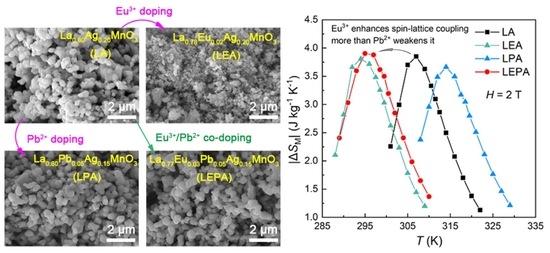
Four perovskite manganite samples, La0.80Ag0.20MnO3 (LA), La0.78Eu0.02Ag0.20MnO3 (LEA), La0.80Pb0.05Ag0.15MnO3 (LPA), and La0.77Eu0.03Pb0.05Ag0.15MnO3 (LEPA), were prepared by the Pechini sol–gel method. The samples were characterized by X-ray diffraction, scanning electron microscopy, energy-dispersive spectroscopy, X-ray photoelectron spectroscopy, and a magnetic property measurement system. A systematic investigation was conducted into the individual effects of Eu and Pb doping, as well as their co-doping, on the microstructural, magnetic and magnetocaloric properties of the materials. The results show that all samples are mainly composed of a rhombohedral perovskite phase with the R 3 ¯ c space group, accompanied by a trace amount of Ag. Addition of Eu3+ and Pb2+ induces lattice contraction and expansion, respectively. Under the same processing conditions, the average crystallite and particle sizes of the LEA sample (45.3 nm and 0.18 μm) are smaller than those of the other three samples (69.6~80.6 nm and 0.38~0.44 μm), indicating that the introduction of Eu alone suppresses crystallization ability, which can be avoided through Eu/Pb co-doping. All samples undergo a second-order ferromagnetic–paramagnetic transition, and the Curie temperature TC shifts to either lower or higher temperatures upon the introduction of Eu or Pb alone (from 310.8 K to 298.0 K or 318.0 K, respectively), which is attributed to the variation of the Mn3+/Mn4+ double-exchange (DE) interaction resulting from the ionic size mismatch and lattice distortion. In the LPA sample, an additional contribution arises from the altered Mn3+/Mn4+ ratio and enhanced DE interaction caused by the substitution of Pb2+ for Ag+. By modifying the Eu/Pb ratio, the TC of the LEPA sample was tuned to 299.3 K, and its maximum magnetic entropy change was enhanced to 3.90 J·kg−1·K−1 ( H = 2 T). These results indicate that multicomponent synergistic regulation can improve the magnetocaloric performance of La-based perovskite manganites, providing a useful strategy for the development of room-temperature magnetic refrigeration materials.

Graphical Abstract

1. Introduction

As global energy consumption continues to rise and natural resources become increasingly depleted, magnetocaloric refrigeration, driven by the magnetocaloric effect (MCE), has attracted considerable interest as a promising alternative to conventional vapor compression technology. Its advantages include zero greenhouse gas emissions, high efficiency (20–50% higher than that of conventional vapor compression), and a compact system design (with solid refrigerant) [1]. Magnetic refrigeration technology has been practically applied in the low-temperature regime, particularly in the successful use of adiabatic demagnetization refrigerators in the sub-Kelvin region (<1 K) for scenarios such as space science missions and low-temperature physics laboratory research [2]. However, room-temperature magnetic refrigeration still faces several challenges, primarily related to material properties, heat transfer efficiency, magnet design and system cost, among other factors [3].
Gd metal serves as the benchmark material for room-temperature magnetic refrigerators. It has a Curie temperature TC of about 293 K and achieves a specific entropy change of 13.22 J·kg−1·K−1 under a 7 T magnetic field. However, Gd suffers from poor corrosion resistance and a limited operating temperature range [4]. Researchers have been dedicated to developing more cost-effective magnetocaloric materials since the discovery of the giant magnetocaloric effect in Gd5(Ge1−xSix)4 compounds in the late 1990s. So far, three classes of materials have emerged as potential alternatives to Gd-based alloys: R1−xAxMnO3 manganites, La(Fe, Mn, Co, Si)13−xSixHy hydrides, and MnFe(P, As, Si, Ge) compounds [5]. Among these, first-order phase transition materials (e.g., La-Fe-Si-based and Mn-Fe-P-Ge-based alloys) exhibit excellent magnetocaloric performance in laboratory settings but suffer from pronounced magnetic and thermal hysteresis, as well as insufficient mechanical stability for practical device applications [3]. By contrast, perovskite materials, especially the manganites (La,R)1−xMxMnO3 (where R represents trivalent rare earth ions and M stands for divalent or monovalent cations), have become ideal substitutes for Gd. They offer low-cost, facile preparation, tunable TC, good chemical stability, small thermal hysteresis, and superior magnetocaloric effect [4]. Studies show that La2/3(Ca,Sr)1/3MnO3 achieves a cooling power of 35 W·kg−1 at room temperature, much higher than the 16 W·kg−1 of Gd plates under the same conditions [6].
A-site doping is an effective method for tuning the magnetic and magnetocaloric properties of manganites. Doping with trivalent ions primarily alters lattice distortion, while divalent or monovalent doping can further adjust the Mn valence state (Mn3+/Mn4+). Through these effects, A-site doping regulates the double-exchange (DE) interaction between Mn3+-O2−-Mn4+ and modulates spin–lattice coupling, thereby influencing the magnetic transition and magnetocaloric response [7]. For instance, in La0.7−xEuxSr0.3MnO3, increasing Eu3+ content decreases TC from 357 to 228 K, while maximum magnetic entropy change ( S M max ) increases from 3.43 to 4.55 J·kg−1·K−1 under the field change of 5 T. This behavior is mainly attributed to the Eu3+-substitution-induced reduction in A-site ionic radius, which increases lattice distortion and decreases the Mn-O-Mn bond angle, thereby weakening the DE interaction and lowering TC, while enhancing spin–lattice coupling to improve the magnetic entropy change and refrigeration capacity [8]. Bouzid et al. found that Pb2+ substitution shifts the magnetic transition toward a higher temperature and simultaneously improves the magnetocaloric response; in La0.9K0.1MnO3 and La0.8K0.1Pb0.1MnO3, TC increases from 178 to 289 K, while S M max increases from 3.04 to 5.5 J·kg−1·K−1 under 5 T. The co-substitution of Pb2+ and K+ for La3+ optimizes the Mn3+/Mn4+ ratio for the DE interaction, thus increasing both TC and saturation magnetization. Meanwhile, Pb doping promotes grain growth and densification, optimizing the magnetic ordering network. Consequently, the La0.8K0.1Pb0.1MnO3 exhibits a second-order phase transition with the TC close to room temperature (289 K) and enhanced magnetocaloric performance [9].
Among perovskite manganites for near-room-temperature magnetic refrigeration, La1−xAgxMnO3 features a tunable TC and favorable magnetocaloric performance [10,11]. More specifically, La0.80Ag0.20MnO3 shows a TC of 308 K and S M max of 3.20 J·kg−1·K−1 under a field change of 2 T [12]. In the present study, this composition was used as the base material, and La0.80Ag0.20MnO3, La0.78Eu0.02Ag0.20MnO3, La0.80Pb0.05Ag0.15MnO3 and La0.77Eu0.03Pb0.05Ag0.15MnO3 samples were prepared using the sol–gel method. The individual and combined effects of Eu and Pb doping on the microstructural, magnetic, and magnetocaloric properties of the materials were systematically investigated. The results indicate that, compared with individual Eu3+ or Pb2+ doping, Eu3+/Pb2+ co-doping enhances the magnetocaloric effect while bringing TC closer to room temperature, providing a reference for the performance study of magnetocaloric materials.

2. Materials and Methods

The La0.80Ag0.20MnO3 (LA), La0.78Eu0.02Ag0.20MnO3 (LEA), La0.80Pb0.05Ag0.15MnO3 (LPA) and La0.77Eu0.03Pb0.05Ag0.15MnO3 (LEPA) manganites were synthesized using the Pechini sol–gel method. Stoichiometric amounts of La(NO3)3·6H2O (Ourchem, Guangzhou, China, 99.0%), Eu(NO3)3·6H2O (Ourchem, 99.0%), Pb(NO3)2 (SCR, 99.0%), AgNO3 (SCR, 99.8%), and Mn(NO3)2·4H2O (Ourchem, 97.5%) were dissolved in 30 mL of distilled water under continuous stirring to form a homogeneous aqueous solution. Subsequently, appropriate amounts of citric acid and ethylene glycol were added as chelating agents. The resulting solution was maintained in a water bath at 100 °C for 2–3 h, until a yellow viscous polymeric gel (resin) was formed, and then cooled to room temperature for 30 min. To ensure complete removal of residual organic species, the resin was further heated at 300 °C for 30 min. The obtained precursor was then ground thoroughly and calcined at 1100 °C for 6 h to yield the final perovskite manganite powders.
The phase structure of the samples was analyzed using X-ray diffraction (XRD, Rigaku Ultima IV, Rigaku Corporation, Tokyo, Japan) with Cu-Kα radiation (λ = 1.5406 Å) over a 2θ range of 20–80°. Crystallographic parameters were refined using the Rietveld method with the FULLPROF program [13]. The microstructure and elemental composition were characterized using scanning electron microscopy (SEM, FEI NANO SEM430, FEI Company, Hillsboro, OR, USA) coupled with energy-dispersive X-ray spectroscopy (EDX). The elemental chemical states and surface compositions were examined using X-ray photoelectron spectroscopy (XPS, Nexsa G2, Thermo Fisher Scientific, Waltham, MA, USA) with Al Kα radiation. Magnetic measurements were carried out with a superconducting quantum interference device (SQUID) integrated into a magnetic property measurement system (MPMS, Quantum Design MPMS3, Quantum Design, San Diego, CA, USA). Temperature-dependent dc magnetization (M-T) curves were recorded during the heating process after zero-field cooling (ZFC) under an applied field of 0.05 T. Isothermal magnetization (M-H) curves were measured in the field range of 0–2 T at selected temperatures, with the temperature interval of 1 K and 2 K in vicinity of and far away from the Curie temperature.

3. Results and Discussion

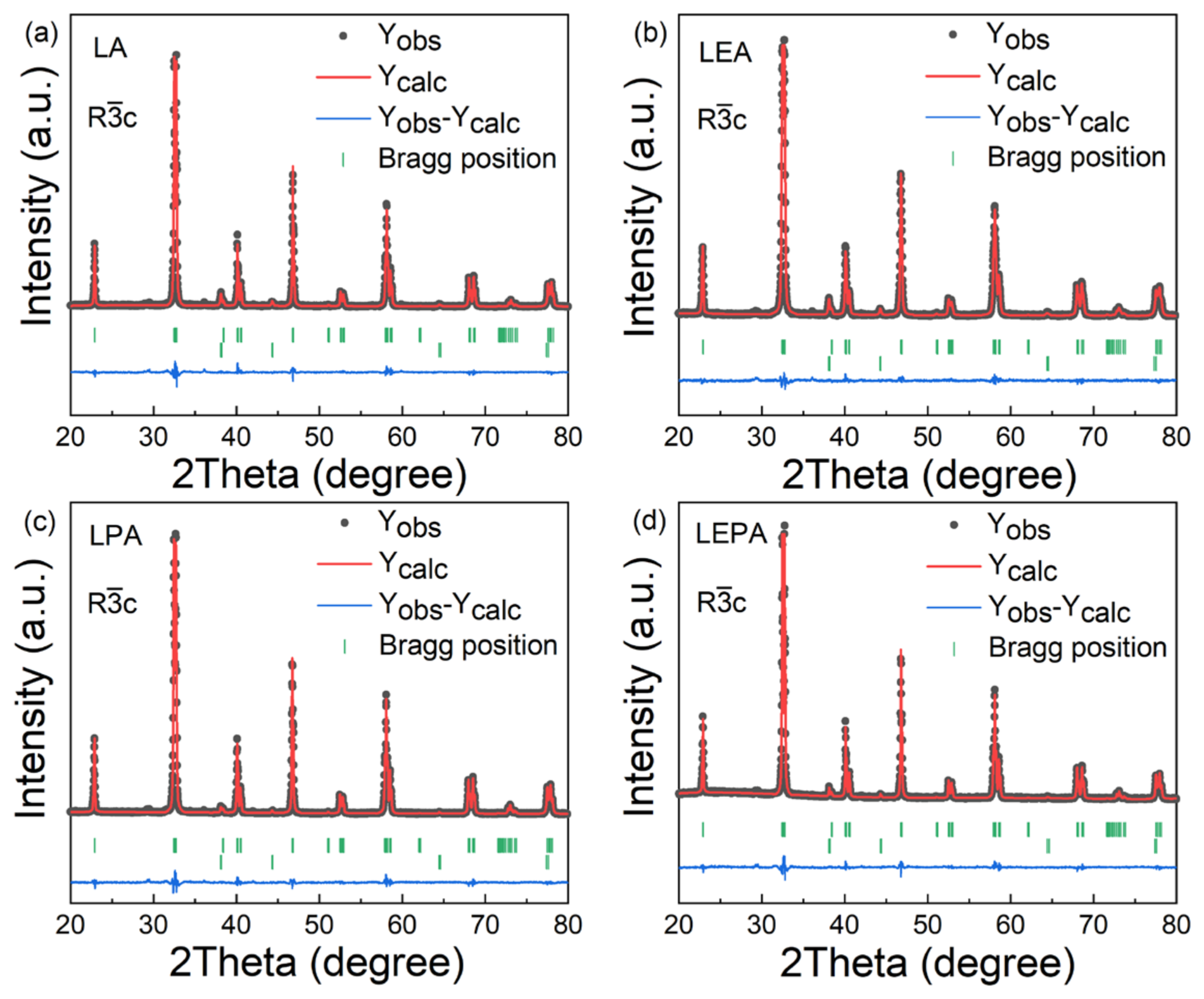
Figure 1 and Figure 2 present the X-ray diffraction (XRD) patterns of the samples and their Rietveld refinement results, respectively. All samples were identified as having a rhombohedral perovskite structure with the space group R 3 ¯ c , together with a small amount of metallic Ag impurity phase, which is attributed to the very limited solubility of Ag in LaMnO3 [14]. Structural parameters, including the lattice constants (a, b, c), unit cell volume (V), Mn-O bond length (〈 d Mn - O 〉), and Mn-O-Mn bond angle (〈 θ Mn - O - Mn 〉), were obtained by Rietveld refinement of the XRD data. The relevant results are summarized in Table 1. Substitution of smaller Eu3+ for La3+ tends to cause lattice contraction, which enhances MnO6 octahedral tilting [15], leading to an increase in 〈 d Mn - O 〉 and a decrease in 〈 θ Mn - O - Mn 〉, whereas the replacement of larger Pb2+ for Ag+ induces the opposite effect, i.e., lattice expansion, shortening of Mn-O bonds and increasing Mn-O-Mn bond angles.
The stability of the perovskite structure is determined by the Goldschmidt tolerance factor 〈t〉, which reflects the degree to which the crystal structure deviates from the ideal cubic perovskite structure. The 〈t〉 value is calculated using the following equation [16]:
t   =   r A   +   r O 2 r B   +   r O
where 〈rA〉, rB, and rO represent the average ionic radii of the A, B, and O sites in perovskite manganites, respectively. In this study, the following ionic radii were used [17,18,19]: for A-site cations (CN = 12), r La 3 + = 1.36 Å, r Eu 3 + = 1.226 Å, r Pb 2 + = 1.49 Å, r Ag + = 1.46 Å; for B-site cations (CN = 6), r Mn 3 + = 0.645 Å, r Mn 4 + = 0.53 Å; for O anions, r O 2 = 1.40 Å. According to Equation (1), the 〈t〉 values for the four samples range from 0.9797 to 0.9834, consistent with the 0.96 < t < 1 range, which indicates stable rhombohedral perovskite structures [1]. Moreover, Pb2+ doping leads to a larger deviation of t from 1 than Eu3+ doping, indicating a greater distortion from the ideal cubic geometry and thus a more pronounced average lattice distortion [20]. The variance of the A-site ionic radius, σ2, can be used to quantify the degree of lattice disorder caused by doping different metal ions at the A-site. Its calculation is as follows [21]:
σ 2   =   y i r i 2 r A 2
where ri is the ionic radius of each A-site ion and yi is its occupancy. In this system, Eu3+ doping with a higher σ2 value has a greater influence on the local deformation of the MnO6 octahedra than Pb2+ doping [22].
Given that 〈 d Mn - O 〉 and 〈 θ Mn - O - Mn 〉 determine the electron transfer pathway in manganites, the bandwidth (W) derived from these structural parameters reflects the degree of Mn3d-O2p orbital overlap and the effective hopping capability of eg electrons. W is given by the following equation [21]:
W   =   c o s [ ( π θ M n - O - M n ) 2 ] ( d M n - O ) 3.5
As discussed above, Eu3+ and Pb2+ doping exert different influences on the 〈 d Mn - O 〉 and 〈 θ Mn - O - Mn 〉. Compared with the LA sample, LEA and LPA exhibit smaller and larger W, with the corresponding weaker and stronger Mn3d-O2p orbital overlap and DE interaction, which usually results in lower and higher TC, respectively [16].
The Scherrer equation was used to estimate the average crystallite size (DSC) of the samples [23]:
D SC   =   0.89   ×   λ β   × cos θ
where λ is the X-ray wavelength, β is the full width at half maximum (FWHM) of the diffraction peak, and θ is the Bragg angle of the diffraction peak. The DSC of the LA, LEA, LPA and LEPA samples were observed to be 74.3, 45.3, 69.6 and 80.6 nm, respectively. Scherrer’s method only considers particle size effect on XRD peak broadening, ignoring lattice microstructure. In contrast, the Williamson–Hall (W-H) method accounts for microstrain-induced peak broadening. The W-H method is given by Equation (5), and the average particle size DW-H and microstrain ε are determined as follows [24]:
β cos θ   =   K λ D W - H   +   4 ε sin θ
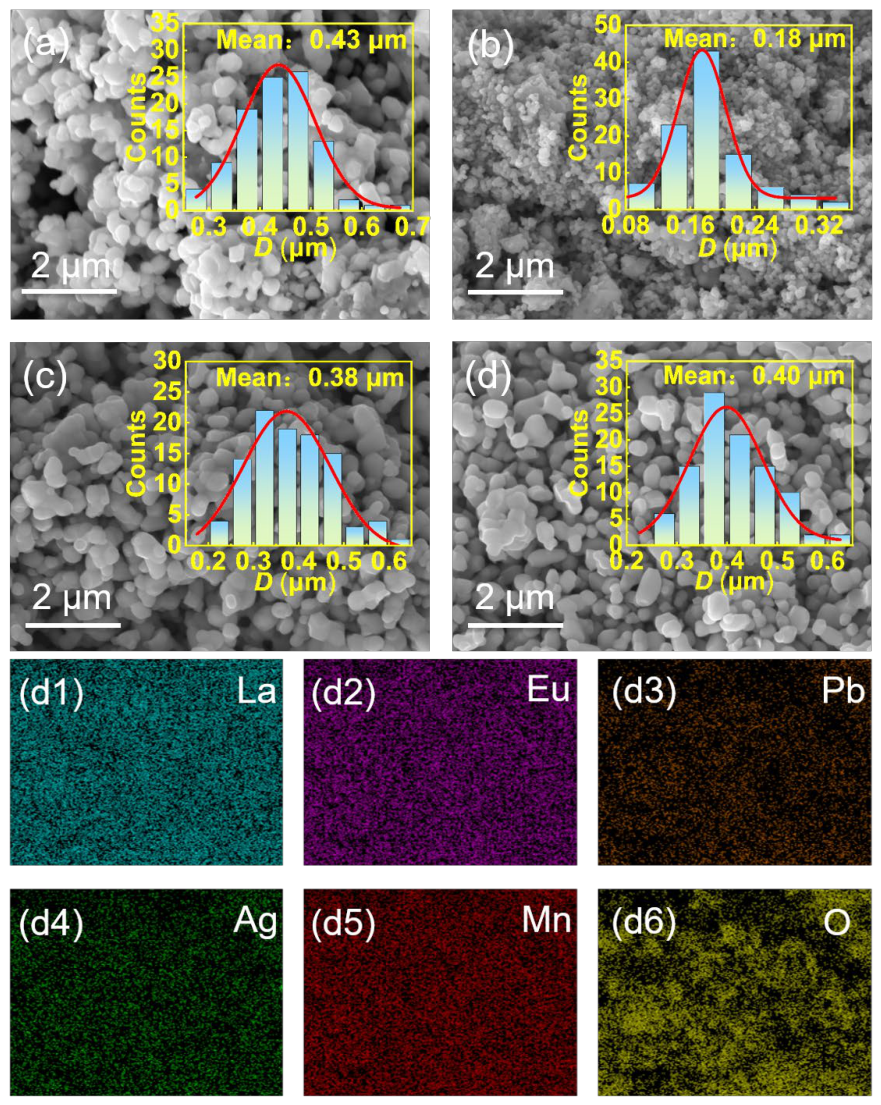
The related results are summarized in Table 1. The crystallite sizes calculated by the W-H model are larger than the Scherrer-derived values because the strain contribution is eliminated, confirming the peak broadening arises from both small crystallite size and deformation. Among all samples, LEA exhibits the smallest DW-H, indicating that its reduced crystallite size is not merely due to strain broadening. The higher microstrain in LEA can be ascribed to its reduced crystallite size. As the crystallite size decreases, the ratio of surface atoms to volume atoms increases, generating more broken bonds on the crystallite surface and thereby enhancing the microstrain [25]. Figure 3 shows the scanning electron microscope (SEM) images of all the samples, with the EDX mapping of the LEPA sample (Figure 3(d1–d6)) as a representative. Each sample exhibits a morphology composed of nearly spherical and randomly dispersed particles. Gaussian fitting of the particle size histograms yields the average particle sizes (DSEM) of 0.44, 0.18, 0.38 and 0.40 μm for LA, LEA, LPA, and LEPA, respectively. The DSEM is larger than the DSC owing to each particle consisting of multiple crystallites. The agglomeration degree can be evaluated by the DSEM/DW-H ratio [21], and the values for LA, LEA, LPA, and LEPA are 3.6, 2.4, 3.3, and 3.0, respectively. This ratio approximately represents the average number of crystallites in a single particle. The lower ratio of LEA implies a relatively lower degree of agglomeration than that of the other samples. Notably, the DW-H and DSEM of LEA are smaller than those of the other samples, suggesting that Eu3+ doping alone suppresses crystallization ability, whereas Eu/Pb co-doping avoids this issue.
Table 2 lists the actual compositions of all the samples determined by EDX analysis. The results confirm that Eu and Pb were incorporated into the samples, with their contents in good agreement with the nominal values. The lower Ag content is consistent with the presence of a small amount of metallic Ag phase observed in the XRD results.
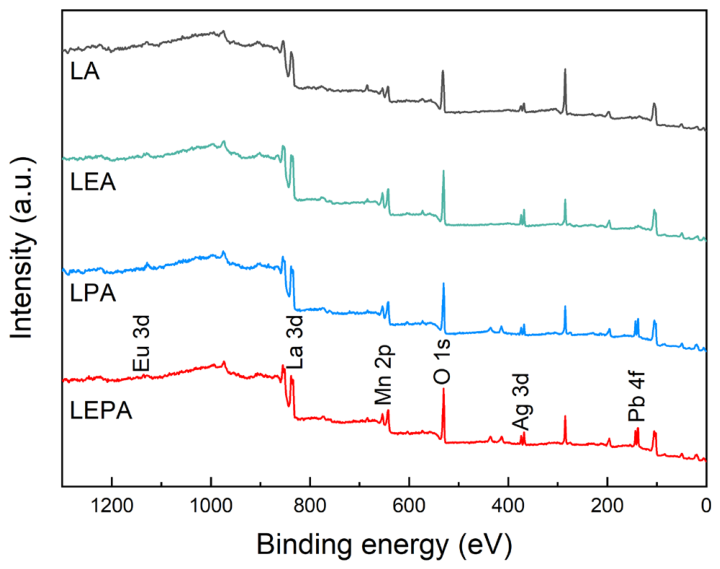
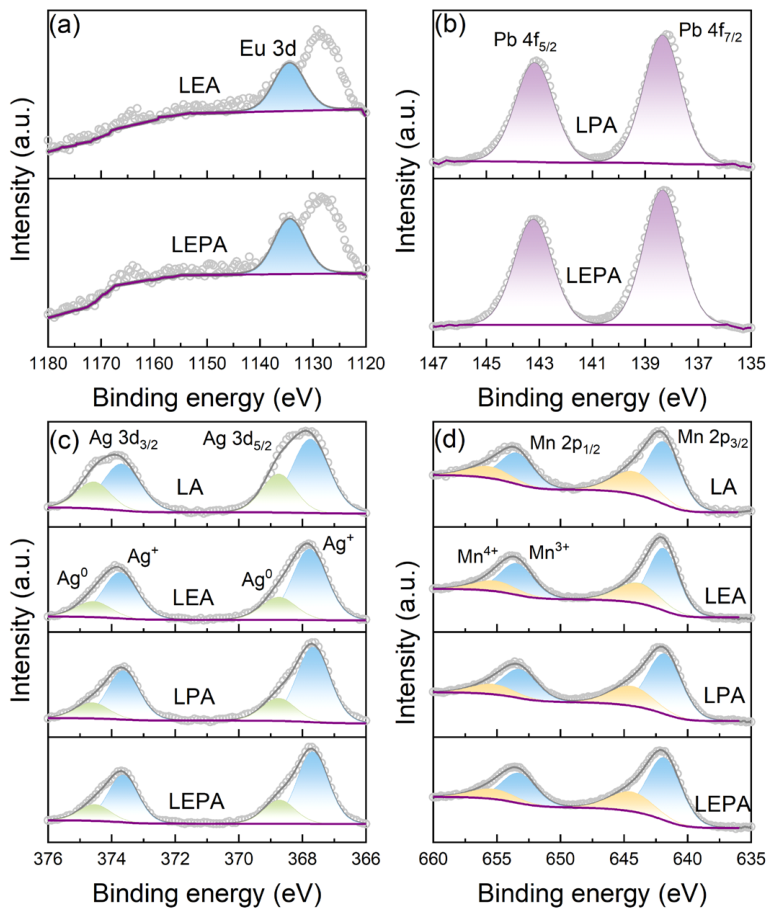
X-ray photoelectron spectroscopy (XPS) was used to analyze the cationic chemical states and surface elemental composition of the perovskite manganite samples in the present work. Figure 4 displays the survey XPS spectra, where core levels of La 3d, Eu 3d, Pb 4f, Ag 3d, Mn 2p, and O 1s were detected on the sample surfaces. Figure 5a presents the characteristic peak of the Eu 3d orbital located at 1134.2 eV, indicating that the Eu element in LEA and LEPA mainly exists as Eu3+ [26]. Figure 5b reveals the high-resolution Pb 4f spectra of the LPA and LEPA samples, where two distinct peaks are observed at approximately 138.4 eV and 143.2 eV, corresponding to Pb 4f7/2 and Pb 4f5/2, with a spin–orbit splitting of about 4.8 eV. This result is consistent with the binding energy range reported for Pb2+ in the literature, suggesting that Pb primarily exists as Pb2+ [27]. The high-resolution Ag 3d spectrum (Figure 5c) features two main peaks at approximately 374.1 eV and 368.1 eV, assigned to Ag 3d3/2 and Ag 3d5/2. Peak fitting resolves two sets of sub-peaks, with higher binding energy peaks corresponding to metallic Ag (Ag0) and lower binding energy to Ag+ [28,29]. This result confirms the presence of both Ag0 and oxidized Ag, consistent with the XRD results, which detected a small amount of metallic Ag phase.
Figure 5d shows the high-resolution Mn 2p XPS spectra of the four samples with peak analysis results. Two main peaks appear at approximately 641.8 eV and 653.4 eV, corresponding to Mn 2p3/2 and Mn 2p1/2. The binding energies align well with literature ranges for Mn3+ and Mn4+, indicating a mixed valence state [30]. The coexistence of Mn3+ and Mn4+ is a crucial prerequisite for the DE interaction, where magnetism depends on electron transfer from Mn3+ ions ( t 2 g 3 e g 1 ) to adjacent Mn4+ ions ( t 2 g 3 e g 0 ) [31]. From these spectra, the Mn3+/Mn4+ molar ratio and Mn3+ content for each sample were calculated and are summarized in Table 3. The experimentally obtained Mn3+ ratio is generally higher than the theoretical value. This deviation, combined with the XRD detection of metallic Ag and the Ag 3d XPS results, is primarily due to the actual Ag content being lower than the theoretical value. Additionally, partial substitution of Pb2+ for Ag+ also contributes to the increased Mn3+ content in LPA and LEPA.
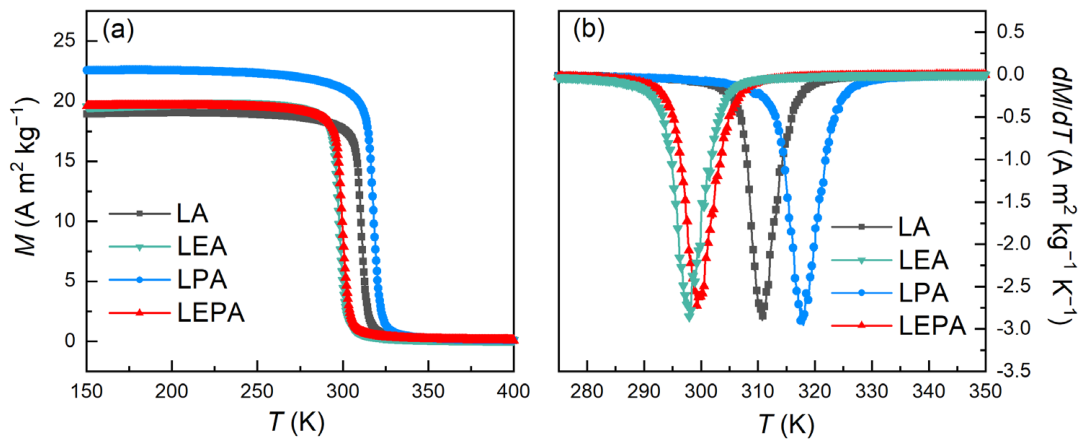
Figure 6a reveals the M-T curves for the LA, LEA, LPA and LEPA manganites under the applied magnetic field of 0.05 T. All the samples exhibit typical ferromagnetic (FM)–paramagnetic (PM) transition behavior, with magnetization gradually decreasing as temperature increases. In this work, the TC were determined by identifying the minima in the dM/dT-T curves, as shown in Figure 6b. The values of TC for LA, LEA, LPA and LEPA are 310.8, 298.0, 318.0 and 299.3 K, respectively. Eu3+ doping alone leads to the increase in 〈 d Mn - O 〉 and the decrease in 〈 θ Mn - O - Mn 〉, resulting in the reduction of the bandwidth W and overlap between Mn3d and O2p orbitals, which consequently weakens the DE interaction and lowers the TC. In contrast, the partial substitution of Pb2+ for Ag+ induces the opposite changes in 〈 d Mn - O 〉 and 〈 θ Mn - O - Mn 〉 and alters the Mn3+/Mn4+ ratio, both of which contribute to enhancing the DE interaction and increasing the TC. Relative to single-doped samples, the TC of LEPA lies between those of LEA and LPA, suggesting synergistic regulation of magnetic properties by Eu3+/Pb2+ co-doping.
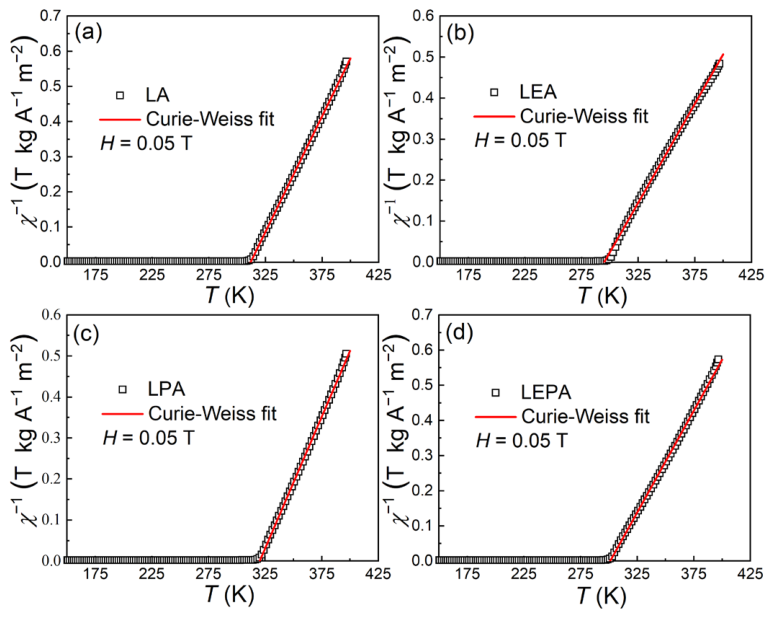
Generally, for ferromagnetic materials, the inverse magnetic susceptibility (χ−1) in the paramagnetic region follows the Curie–Weiss law [32]:
χ 1   =   T   θ P C
where θP and C represent the paramagnetic Curie–Weiss temperature and the Curie constant. Figure 7 illustrates the χ−1 vs. T curves for the present samples under a 0.05 T magnetic field. The red line depicts the linear fits to the Curie–Weiss law, and the derived θP values for LA, LEA, LPA and LEPA are 311.8, 294.8, 320.0 and 301.3 K, respectively. The experimental effective paramagnetic moment ( μ eff exp ) can be calculated using the expression C   =   N ( μ eff exp μ B ) 2 / 3 k B , where N = NA/Mm is the number of magnetic ions per unit mass (NA = 6.023 × 10²³ mol−1 the Avogadro constant and Mm the molar mass), kB = 1.38016 × 10⁻¹⁶ erg K−1 the Boltzmann constant and μB = 9.274 × 10⁻²¹ emu the Bohr magneton [33]. The theoretical effective paramagnetic moment is calculated as:
μ eff theo   =   x μ eff Eu 3 + 2   +   0.6 + y μ eff theo Mn 3 + 2   +   0.4 y μ eff theo Mn 4 + 2
here, x and y denote the nominal doping concentrations of Eu and Pb, respectively, with μ eff (Eu3+) = 3.4 μB [34], μ eff theo (Mn3+) = 4.9 μB and μ eff theo (Mn4+) = 3.87 μB [35]. The μ eff exp values for the samples are 5.36, 6.27, 5.48 and 5.77 μB, much higher than the μ eff theo values of 4.52, 4.54, 4.62 and 4.65 μB. This discrepancy probably arises from the strong spin–orbit coupling in these samples, which drives the gyromagnetic factor above 2 [36].
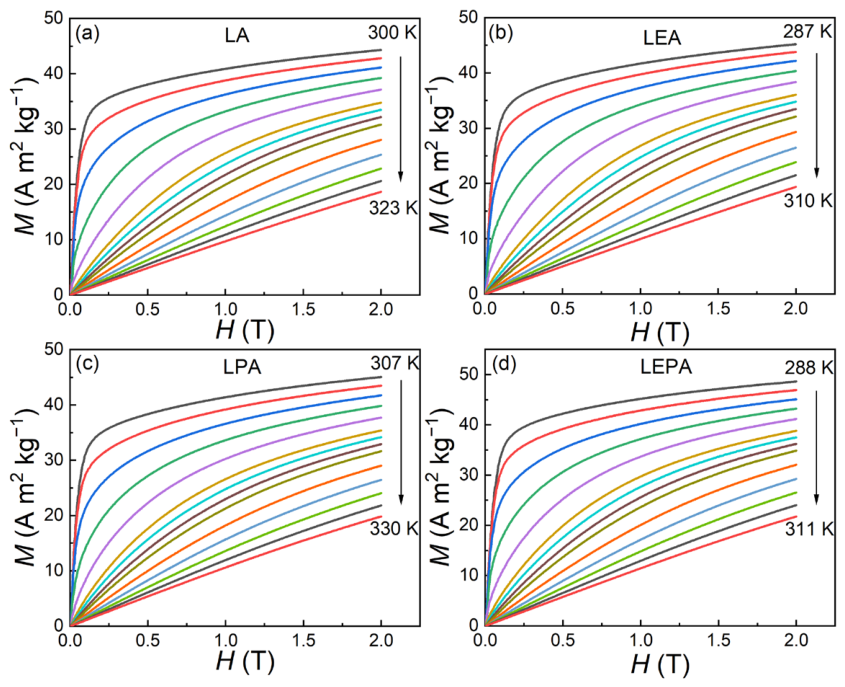
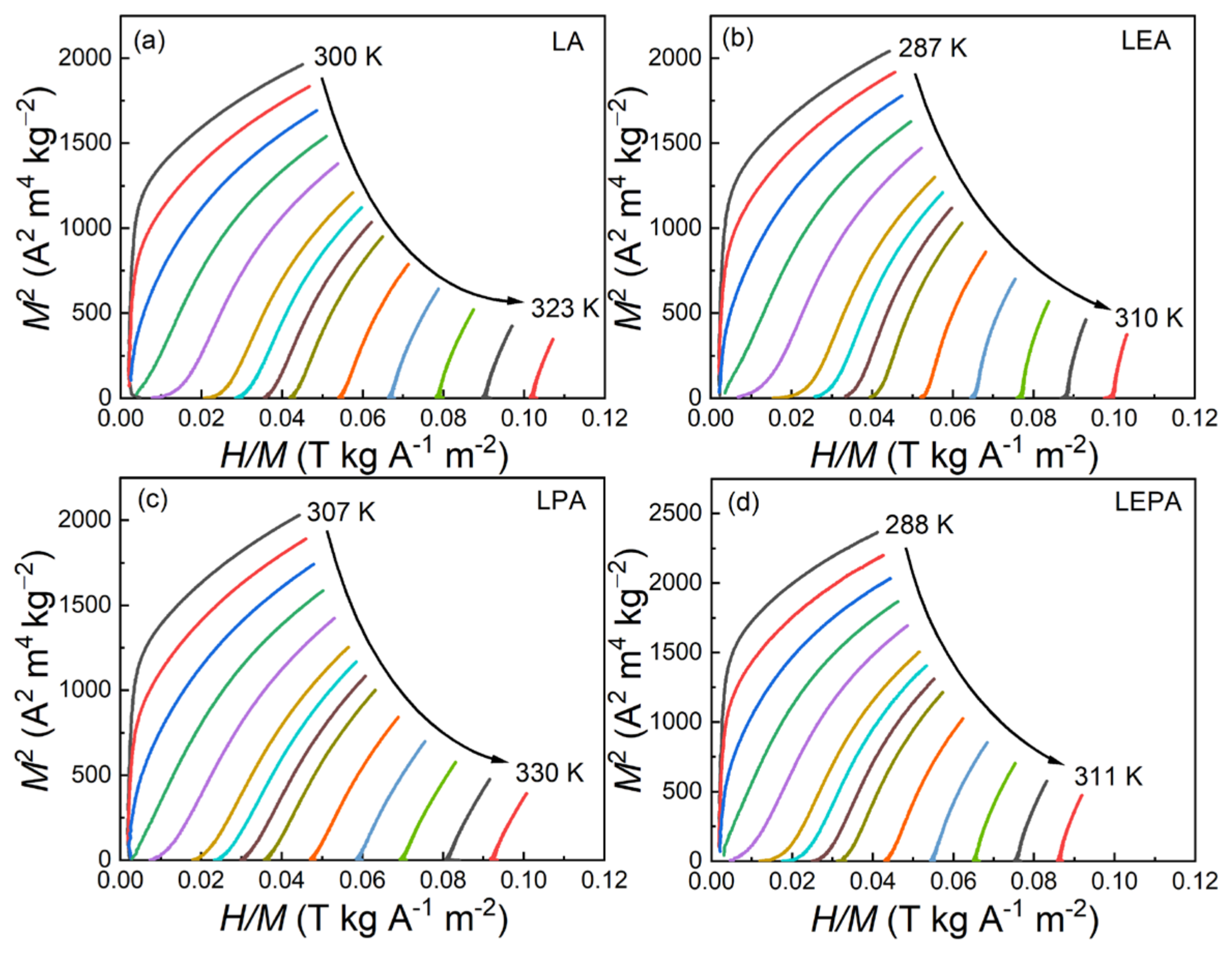
Figure 8 displays the isothermal magnetization (M-H) curves for the LA, LEA, LPA, and LEPA samples measured near their TC under the applied magnetic field of 0–2 T. At temperatures below TC, the magnetization increases rapidly with the magnetic field and tends to saturate, demonstrating typical ferromagnetic behavior. As the temperature rises, the magnetization gradually decreases, and the M-H curves become linear in the high-temperature region, indicating a transition from FM to PM states. To further characterize the nature of the magnetic phase transition, the corresponding Arrott plots (M2-H/M) are constructed from the M-H data, as shown in Figure 9. According to the Banerjee criterion [30], the positive slope of the Arrott plots for all the samples confirms the second-order FM-PM phase transitions. Compared with first-order magnetic phase transition materials, second-order counterparts exhibit negligible magnetic and thermal hysteresis, making them more favorable for practical magnetic refrigeration cycles, despite their smaller magnetic entropy changes [37].
In this work, the MCE of the samples is characterized by the isothermal magnetic entropy change |ΔSM|. Based on the thermodynamic Maxwell relation, the |ΔSM| can be expressed as [38]:
Δ S M T , Δ H   =   0 H max   M T H d H
In practical measurements, for magnetization data obtained at discrete magnetic field and temperature intervals, Equation (8) can be approximated as [38]:
Δ S M   =   i   M i M i + 1 T i + 1 T i Δ H i
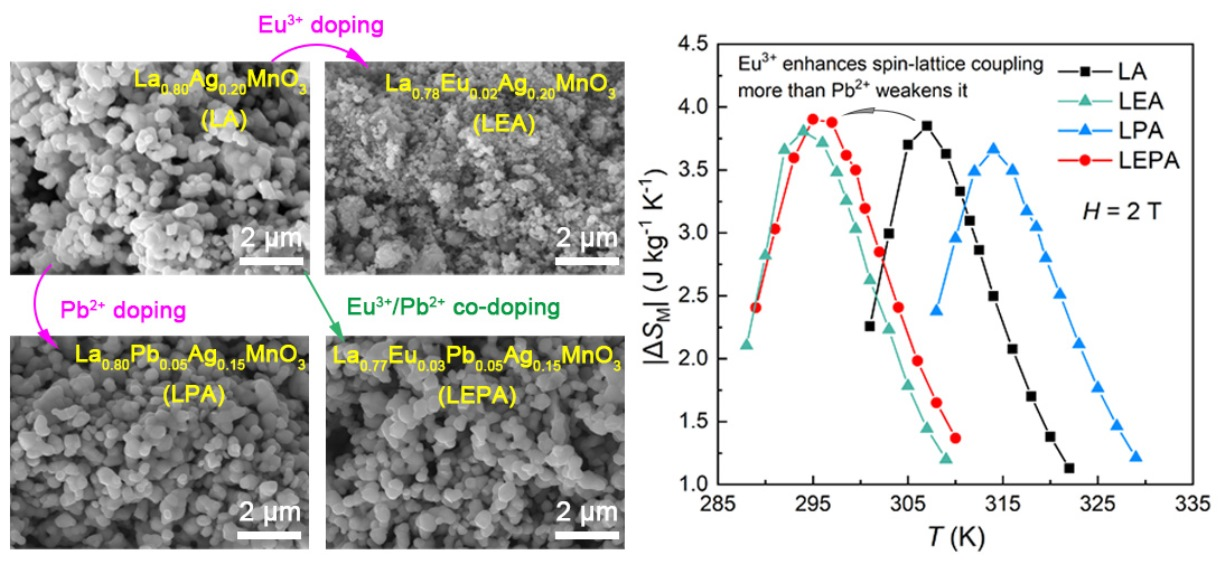
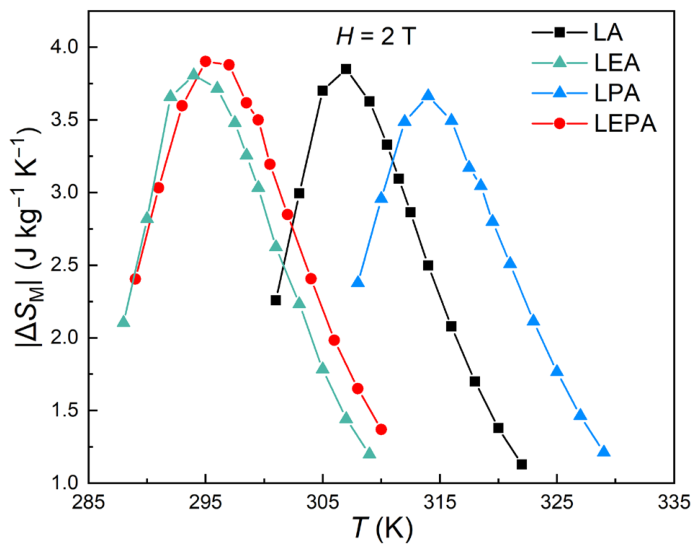
where Mi and Mi+1 are the magnetization values at the adjacent temperatures Ti and Ti+1 within the corresponding magnetic field change intervals. Figure 10 presents the |ΔSM|-T curves of the four samples under a field change of 2 T. The maximum magnetic entropy change S M max is obtained in the vicinity of TC, with values of 3.85, 3.81, 3.66, and 3.90 J·kg−1·K−1 for LA, LEA, LPA, and LEPA, respectively. The MCE in perovskite manganites is usually affected by both the DE interaction and spin–lattice coupling [39]. Compared with the LA and LPA samples, the introduction of Eu3+ leads to a decrease in S M max for LEA and an increase for LEPA. Previous studies on the La0.7−xEuxSr0.3MnO3 and La0.7−xEuxBa0.3MnO3 systems [8,40] have shown that increasing Eu content enhances lattice distortion and weakens the DE interaction, resulting in a decrease in TC, while simultaneously strengthening the spin–lattice coupling, which in turn increases S M max . Therefore, it is inferred that the introduction of Eu3+ in LEA and LEPA exerts similar effects. The slightly lower S M max of LEA compared to LA is more likely attributable to its smaller particle size, as reducing particle size generally suppresses both TC and S M max [41]. As discussed above, for the LPA sample, Pb2+ doping enhances the DE interaction. Therefore, the lower S M max of LPA compared with LA may be attributed to weakened spin–lattice coupling [42]. Similar behavior has been reported in the La0.78Ca0.22−xPbxMnO3 system, where TC increases with Pb2+ doping, while S M max decreases [43].
Relative cooling power (RCP) is a key parameter for evaluating the overall performance of magnetocaloric materials, typically representing the amount of heat that can be transferred between the cold and hot reservoirs in an ideal refrigeration cycle. The equation for its calculation is as follows [38]:
R C P   =   | Δ S M max |   ×   δ T FWHM
where δTFWHM is the full width at half maximum of the |ΔSM|-T curve. The RCP values for LA, LEA, LPA and LEPA are 64.65, 64.48, 68.24 and 73.42 J·kg−1, respectively, with LEPA possessing the highest value, indicating a combination of large |ΔSM| and good refrigeration performance.
For comparison, Table 4 lists the magnetocaloric parameters of selected magnetocaloric materials with TC near room temperature. As shown, although the magnetocaloric performance of the present samples is inferior to that of Gd, it outperforms many La-based perovskite manganites with similar TC.
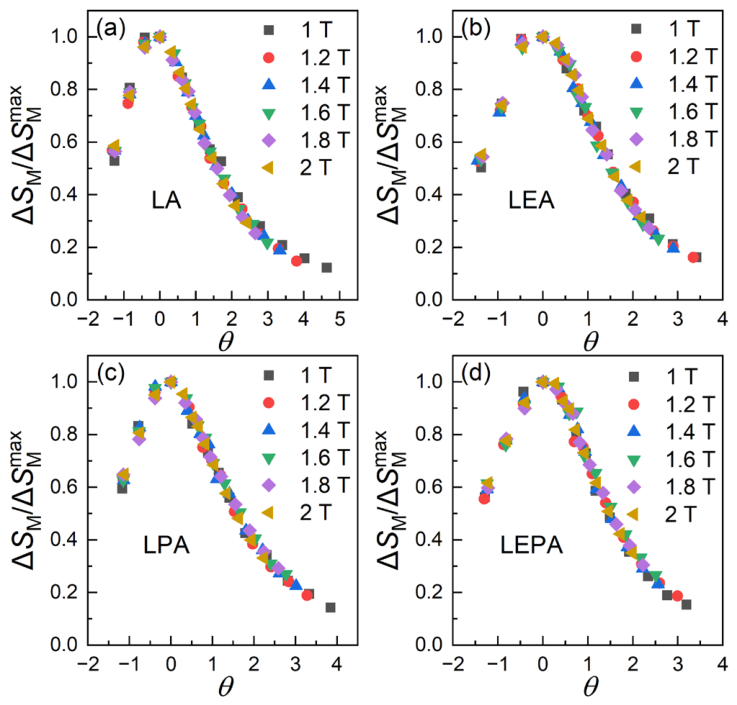
To examine the field-dependent scaling behavior of the magnetocaloric response, a universal curve model was employed [49]. In this approach, the |ΔSM| curves measured under different magnetic fields were rescaled using the reduced temperature θ:
θ   =   T T C T 1 T C ,   T     T C T T C T 2 T C ,   T   >   T C
In this expression, θ denotes the rescaled temperature, while T1 and T2 satisfy ΔSM(T1)/ΔSM(max) = ΔSM(T2)/ΔSM(max) = 0.7. As presented in Figure 11, the normalized |ΔSM| curves of all samples collapse well onto a single master curve in the vicinity of TC. This behavior demonstrates good scaling consistency of the magnetocaloric response under different magnetic fields, confirming the field-dependent scaling behavior. This collapse, which is expected for a second-order transition, provides complementary support for the transition type indicated by the Arrott plots, in contrast to the scattered distribution characteristic of first-order transitions [50].

4. Conclusions

In this work, Eu3+ doping, Pb2+ doping, and Eu3+/Pb2+ co-doping were adopted to modulate microstructural, magnetic and magnetocaloric properties of La0.80Ag0.20MnO3-based manganites prepared by the Pechini sol–gel method. All samples retained a rhombohedral perovskite structure. Eu3+ doping resulted in much smaller particle size, indicating that the introduction of Eu alone suppresses crystallization ability, which can be avoided through Eu3+/Pb2+ co-doping.
Eu3+ and Pb2+ doping induce lattice contraction and expansion, respectively, and exert opposite effects on Mn-O bond lengths and Mn-O-Mn bond angles. Specifically, Eu3+ doping lengthens Mn-O bonds and decreases Mn-O-Mn bond angles, which weakens Mn3d-O2p orbital overlap and the DE interaction, shifting TC from 310.8 K to 298.0 K. In contrast, Pb2+ doping shortens Mn-O bonds and increases Mn-O-Mn bond angles, which enhances the orbital overlap and DE interaction, raising TC to 318.0 K. Compared with single doping, Eu3+/Pb2+ co-doping exhibits a synergistic modulation effect, resulting in the TC of 299.3 K for the LEPA sample.
All samples undergo second-order FM-PM phase transitions, with the magnetic entropy change peaks appearing near TC. Compared with LA, the decrease in S M max for LPA with Pb2+ doping may be attributed to weakened spin–lattice coupling, while the slight reduction for LEA with Eu3+ doping is likely due to its smaller particle size. Among the four samples, LEPA exhibits the highest S M max (3.90 J·kg−1·K−1) and the largest RCP under the 2 T field, which can be ascribed to the enhancement of spin–lattice coupling by Eu3+ outweighing the weakening effect of Pb2+.
In summary, this study demonstrates that rational multicomponent A-site design is an effective strategy for tailoring TC and the magnetocaloric response in La-based perovskite manganites, providing a valuable basis for the compositional optimization of room-temperature magnetocaloric materials.

Author Contributions

Conceptualization, H.Z.; Methodology, H.Z.; Validation, H.Z. and F.Z.; Formal analysis, H.Z., H.L. and F.Z.; Investigation, H.Z., F.Z., Y.X. and Y.C.; Resources, H.Z.; Data curation, H.Z., F.Z. and Y.C.; Writing—original draft, F.Z.; Writing—review and editing, H.Z., H.L., Z.L., J.L., A.X. and W.G.; Visualization, H.Z., F.Z., Y.X., Y.C., Z.W. and X.H.; Supervision, H.Z.; Project administration, H.Z., W.G., J.L., Z.L. and A.X.; Funding acquisition, X.H., W.G. and A.X. All authors have read and agreed to the published version of the manuscript.

Funding

This research was funded by the National Natural Science Foundation of China (Grant No. 52272263), the University Natural Science Research Project of Anhui Province (Grant No. 2024AH050145), the Youth Foundation of Anhui University of Technology (Grant No. QZ202303), and the Innovation and Entrepreneurship Training Program for College Students of Anhui Province (Grant No. S202410360178).

Institutional Review Board Statement

Not applicable.

Informed Consent Statement

Not applicable.

Data Availability Statement

The original contributions presented in this study are included in the article. Further inquiries can be directed to the corresponding author.

Conflicts of Interest

The authors declare no conflicts of interest.

References

  1. Ram, N.R.; Prakash, M.; Naresh, U.; Kumar, N.S.; Sarmash, T.S.; Subbarao, T.; Kumar, R.J.; Kumar, G.R.; Naidu, K.C.B. Review on Magnetocaloric Effect and Materials. J. Supercond. Nov. Magn. 2018, 31, 1971–1979. [Google Scholar] [CrossRef]
  2. Jeong, S. AMR (Active Magnetic Regenerative) refrigeration for low temperature. Cryogenics 2014, 62, 193–201. [Google Scholar] [CrossRef]
  3. Lucia, U.; Grisolia, G. Magnetocaloric Refrigeration in the Context of Sustainability: A Review of Thermodynamic Bases, the State of the Art, and Future Prospects. Energies 2024, 17, 3585. [Google Scholar] [CrossRef]
  4. Žužić, A.; Ressler, A.; Macan, J. Perovskite oxides as active materials in novel alternatives to well-known technologies: A review. Ceram. Int. 2022, 48, 27240–27261. [Google Scholar] [CrossRef]
  5. Balli, M.; Jandl, S.; Fournier, P.; Kedous-Lebouc, A. Advanced materials for magnetic cooling: Fundamentals and practical aspects. Appl. Phys. Rev. 2017, 4, 021305. [Google Scholar] [CrossRef]
  6. Bahl, C.R.H.; Velázquez, D.; Nielsen, K.K.; Engelbrecht, K.; Andersen, K.B.; Bulatova, R.; Pryds, N. High performance magnetocaloric perovskites for magnetic refrigeration. Appl. Phys. Lett. 2012, 100, 121905. [Google Scholar] [CrossRef]
  7. Zhong, W.; Au, C.-T.; Du, Y.-W. Review of magnetocaloric effect in perovskite-type oxides. Chin. Phys. B 2013, 22, 057501. [Google Scholar] [CrossRef]
  8. Vadnala, S.; Asthana, S. Magnetocaloric effect and critical field analysis in Eu substituted La0.7−xEuxSr0.3MnO3 (x = 0.0, 0.1, 0.2, 0.3) manganites. J. Magn. Magn. Mater. 2018, 446, 68–79. [Google Scholar] [CrossRef]
  9. Ait Bouzid, S.; Elhamouchi, N.; Sajieddine, M.; Aitmellal, O.; Kuncser, V.; Galca, A.; Iacob, N.; Enculescu, M.; Essoumhi, A. Magnetocaloric properties of La0.9K0.1MnO3 and La0.8K0.1Pb0.1MnO3 bulk perovskite manganites. J. Mater. Sci. Mater. Electron. 2024, 35, 2138. [Google Scholar] [CrossRef]
  10. Tang, T.; Gu, K.; Cao, Q.; Wang, D.; Zhang, S.; Du, Y. Magnetocaloric properties of Ag-substituted perovskite-type manganites. J. Magn. Magn. Mater. 2000, 222, 110–114. [Google Scholar] [CrossRef]
  11. Phan, M.-H.; Yu, S.-C. Review of the magnetocaloric effect in manganite materials. J. Magn. Magn. Mater. 2007, 308, 325–340. [Google Scholar] [CrossRef]
  12. Amano, M.; Betancourt, I.; Arellano-Jimenez, M.; Sánchez-Llamazares, J.; Sánchez-Valdés, C. Magnetocaloric response of submicron (LaAg)MnO3 manganite obtained by Pechini method. J. Sol-Gel Sci. Technol. 2016, 78, 159–165. [Google Scholar] [CrossRef]
  13. Rodríguez-Carvajal, J. Recent advances in magnetic structure determination by neutron powder diffraction. Physica B 1993, 192, 55–69. [Google Scholar] [CrossRef]
  14. Kucharczyk, B.; Tylus, W. Partial substitution of lanthanum with silver in the LaMnO3 perovskite: Effect of the modification on the activity of monolithic catalysts in the reactions of methane and carbon oxide oxidation. Appl. Catal. A-Gen. 2008, 335, 28–36. [Google Scholar] [CrossRef]
  15. Hwang, H.Y.; Cheong, S.W.; Radaelli, P.G.; Marezio, M.; Batlogg, B. Lattice Effects on the Magnetoresistance in Doped LaMnO3. Phys. Rev. Lett. 1995, 75, 914–917. [Google Scholar] [CrossRef]
  16. Xia, W.; Leng, K.; Tang, Q.; Yang, L.; Xie, Y.; Wu, Z.; Yi, K.; Zhu, X. Structural characterization, magnetic and optical properties of perovskite (La1−xLnx)0.67Ca0.33MnO3 (Ln= Nd and Sm; x = 0.0-0.5) nanoparticles synthesized via the sol-gel process. J. Alloys Compd. 2021, 867, 158808. [Google Scholar] [CrossRef]
  17. James, G.S. Lange’s Handbook of Chemistry, 17th ed.; McGraw-Hill Education: Columbus, OH, USA, 2005; pp. 167–172. [Google Scholar]
  18. Canu, G.; Bottaro, G.; Buscaglia, M.T.; Costa, C.; Condurache, O.; Curecheriu, L.; Mitoseriu, L.; Buscaglia, V.; Armelao, L. Ferroelectric order driven Eu3+ photoluminescence in BaZrxTi1−xO3 perovskite. Sci. Rep. 2019, 9, 6441. [Google Scholar] [CrossRef]
  19. Miller, V.; Tidrow, S. Perovskites:“Effective” temperature and coordination dependence of 38 ionic radii. Integr. Ferroelectr. 2015, 166, 30–47. [Google Scholar] [CrossRef]
  20. Attfield, J.P. A simple approach to lattice effects in conducting perovskite-type oxides. Chem. Mater. 1998, 10, 3239–3248. [Google Scholar] [CrossRef]
  21. Elghoul, A.; Krichene, A.; Boudjada, N.C.; Boujelben, W. Rare earth effect on structural, magnetic and magnetocaloric properties of La0.75Ln0.05Sr0.2MnO3 manganites. Ceram. Int. 2018, 44, 12723–12730. [Google Scholar] [CrossRef]
  22. Rodriguez-Martinez, L.M.; Attfield, J.P. Cation disorder and size effects in magnetoresistive manganese oxide perovskites. Phys. Rev. B 1996, 54, R15622–R15625. [Google Scholar] [CrossRef]
  23. Venkataiah, G.; Prasad, V.; Reddy, P.V. Influence of A-site cation mismatch on structural, magnetic and electrical properties of lanthanum manganites. J. Alloys Compd. 2007, 429, 1–9. [Google Scholar] [CrossRef]
  24. Aarif Ul Islam, S.; Ikram, M. Structural stability improvement, Williamson Hall analysis and band-gap tailoring through A-site Sr doping in rare earth based double perovskite La2NiMnO6. Rare Metals 2019, 38, 805–813. [Google Scholar] [CrossRef]
  25. Souifi, K.; Rejaiba, O.; Amorri, O.; Nasri, M.; Alzahrani, B.; Bouazizi, M.L.; Khirouni, K.; Khelifi, J. Detailed investigation of structural, morphology, magnetic, electical and optical properties of the half-doped perovsikteNd0.5Ba0.5FeO3. J. Inorg. Organomet. Polym. Mater. 2022, 32, 4515–4531. [Google Scholar] [CrossRef]
  26. Xie, Y.; Guo, J.; Ding, S.; Deng, X.; Tan, S.; Chen, Q.; Li, Y.; Zhang, H. Enhancing the temperature coefficient of resistance and magnetoresistance properties of La0.7−xEuxCa0.3MnO3 ceramics by Eu3+ doping. J. Am. Ceram. Soc. 2025, 108, e70012. [Google Scholar] [CrossRef]
  27. Liu, S.; Xu, X.; He, C.; Liu, Z.; Li, Y. Biosorption of Pb2+, Cd2+ and Zn2+ from aqueous solutions by Agrobacterium tumefaciens S12 isolated from acid mine drainage. Sustain. Environ. Res. 2024, 34, 27. [Google Scholar] [CrossRef]
  28. Nadig, P.R.; Toulemonde, O.; Alagarsamy, P.; Murari, M.S.; Daivajna, M.D. Multifaceted roles of Ag+ ions within and outside La-Ca-MnO3 Perovskite Manganites: Unveiling the room temperature magnetocaloric effect. J. Phys. Chem. C 2024, 128, 12686–12703. [Google Scholar] [CrossRef]
  29. Fang, S.; Chen, P.; He, W.; Yu, X.; Yang, Y.; Wang, Q.; Luo, H.; Yang, T. Effect of A-site ionic disorder on structure, magnetic and magnetocaloric properties of La0.85−xNdxAg0.15−yKyMnO3 manganites. Physica B 2023, 670, 415349. [Google Scholar] [CrossRef]
  30. Xie, Z.; Zou, Z.; Jiang, X.; Zhang, W. Effects of A, B-site multiple ion co-doping on the structure, magnetic, magnetocaloric effect, and critical behavior of La0.7−xNd0.1Sr0.2KxMn0.95Ni0.05O3 ceramics. Ceram. Int. 2023, 49, 32663–32678. [Google Scholar] [CrossRef]
  31. Yin, L.; Wang, C.; Shen, Q. Role of oxygen content in thickness dependent phase transition temperatures in La0.9Sr0.1MnO3 films. Appl. Surf. Sci. 2021, 539, 148261. [Google Scholar] [CrossRef]
  32. Iqbal, M.; Khan, M.N.; Khan, A.A.; Zafar, N. Structural, magnetic, magnetocaloric and critical properties of La0.9Ba0.1MnO3 manganite. J. Alloys Compd. 2018, 769, 766–776. [Google Scholar] [CrossRef]
  33. Phan, T.-L.; Dang, N.; Ho, T.; Manh, T.; Thanh, T.; Jung, C.; Lee, B.; Le, A.-T.; Phan, A.D.; Yu, S. First-to-second-order magnetic-phase transformation in La0.7Ca0.3−xBaxMnO3 exhibiting large magnetocaloric effect. J. Alloys Compd. 2016, 657, 818–834. [Google Scholar] [CrossRef]
  34. Kittel, C. Introduction to Solid State Physics, 8th ed.; Wiley: New York, NY, USA, 2005; pp. 305–307. [Google Scholar]
  35. Xie, Z.; Zou, Z.; Mao, Z.; Jiang, X.; Zhang, W. Room-temperature structure, magnetic, and magnetocaloric properties of (La0.8−xNdx)Sr0.2MnO3 (0 ≤ x ≤ 0.2). J. Mater. Res. Technol. 2022, 21, 2778–2796. [Google Scholar] [CrossRef]
  36. Tozri, A.; Dhahri, E. Structural and magnetotransport properties of (La, Pr)-Ba manganites. J. Alloys Compd. 2019, 783, 718–728. [Google Scholar] [CrossRef]
  37. Mellari, S. Introduction to magnetic refrigeration: Magnetocaloric materials. Int. J. Air-Cond. Refri. 2023, 31, 5. [Google Scholar] [CrossRef]
  38. Xie, Z.; Feng, M.; Zou, Z.; Xu, C.; Zhong, S. Effects of Europium ion doping on the microstructure, magnetic and magnetocaloric effect of La0.8Sr0.2MnO3 manganites. J. Sol-Gel Sci. Technol. 2025, 116, 535–551. [Google Scholar] [CrossRef]
  39. Thanh, T.D.; Linh, D.C.; Tuyen, N.T.U.; Phan, T.-L.; Yu, S.-C. Magnetic and magnetocaloric properties in Ba-doped La0.7Ca0.3MnO3 nanoparticles. J. Alloys Compd. 2015, 649, 981–987. [Google Scholar] [CrossRef]
  40. Dhahri, J.; Dhahri, A.; Dhahri, E. Structural, magnetic and magnetocaloric properties of La0.7−xEuxBa0.3MnO3 perovskites. J. Magn. Magn. Mater. 2009, 321, 4128–4131. [Google Scholar] [CrossRef]
  41. Ehsani, M.; Kameli, P.; Ghazi, M.; Razavi, F.; Taheri, M. Tunable magnetic and magnetocaloric properties of La0.6Sr0.4MnO3 nanoparticles. J. Appl. Phys. 2013, 114, 223907. [Google Scholar] [CrossRef]
  42. Anwar, M.S.; Ahmed, F.; Lee, S.R.; Danish, R.; Koo, B.H. Study of A-Site disorder dependent structural, magnetic, and magnetocaloric properties in La0.7−xSmxCa0.3MnO3 manganites. Jpn. J. Appl. Phys. 2013, 52, 10MC12. [Google Scholar] [CrossRef]
  43. Messaoui, I.; Kumaresavanji, M.; Riahi, K.; Koubaa, W.C.; Koubaa, M.; Cheikhrouhou, A. Investigation on magnetic and magnetocaloric properties in the Pb-doped manganites La0.78Ca0.22−xPbxMnO3 (x = 0, 0.05 and 0.1). J. Alloys Compd. 2017, 693, 705–718. [Google Scholar] [CrossRef]
  44. Messaoui, I.; Kumaresavanji, M.; Riahi, K.; Koubaa, W.C.; Koubaa, M.; Cheikhrouhou, A. Magnetic, magnetocaloric and critical behavior study of La0.78Pb0.22MnO3 manganite near room-temperature. Ceram. Int. 2017, 43, 498–506. [Google Scholar] [CrossRef]
  45. Tarhouni, S.; Mleiki, A.; Chaaba, I.; Khelifa, H.B.; Cheikhrouhou-Koubaa, W.; Koubaa, M.; Cheikhrouhou, A.; Hlil, E. Structural, magnetic and magnetocaloric properties of Ag-doped Pr0.5Sr0.5−xAgxMnO3 manganites (0.0 ≤ x ≤ 0.4). Ceram. Int. 2017, 43, 133–143. [Google Scholar] [CrossRef]
  46. Ehsani, M.; Azizi, S. Magneto-caloric properties of La0.8−xSmxSr0.2MnO3 (x = 0.0, 0.05, 0.1, and 0.15). Ceram. Int. 2021, 47, 25304–25313. [Google Scholar] [CrossRef]
  47. Issaoui, H.; Gharbi, S.; Issaoui, F.; Hcini, S.; Alzahrani, B.; Bouazizi, M.; Al Robei, H. Study of the doping of Sr by Ag in manganites La0.57Nd0.1Sr0.33−xAgxMnO3 (0.00-0.15) on assessment structural, magneticand Magnetocaloric at room temperature. J. Mol. Struct. 2022, 1253, 132282. [Google Scholar] [CrossRef]
  48. Gottschall, T.; Skokov, K.P.; Fries, M.; Taubel, A.; Radulov, I.; Scheibel, F.; Benke, D.; Riegg, S.; Gutfleisch, O. Making a cool choice: The materials library of magnetic refrigeration. Adv. Energy Mater. 2019, 9, 1901322. [Google Scholar] [CrossRef]
  49. Franco, V.; Blázquez, J.; Conde, A. Field dependence of the magnetocaloric effect in materials with a second order phase transition: A master curve for the magnetic entropy change. Appl. Phys. Lett. 2006, 89, 222512. [Google Scholar] [CrossRef]
  50. Zhang, Y.; Zhao, J.; Zhang, T.; Li, Q.; Xu, J.; Ma, H.; Jin, X.; Yang, X.; Pan, X. Investigation on the Influence of High-Pressure Heat Treatment Temperature Parameters on the Magnetocaloric Effect and Critical Behavior of La0.65Ca0.25Ba0.1MnO3. J. Alloys Compd. 2026, 1050, 185853. [Google Scholar] [CrossRef]
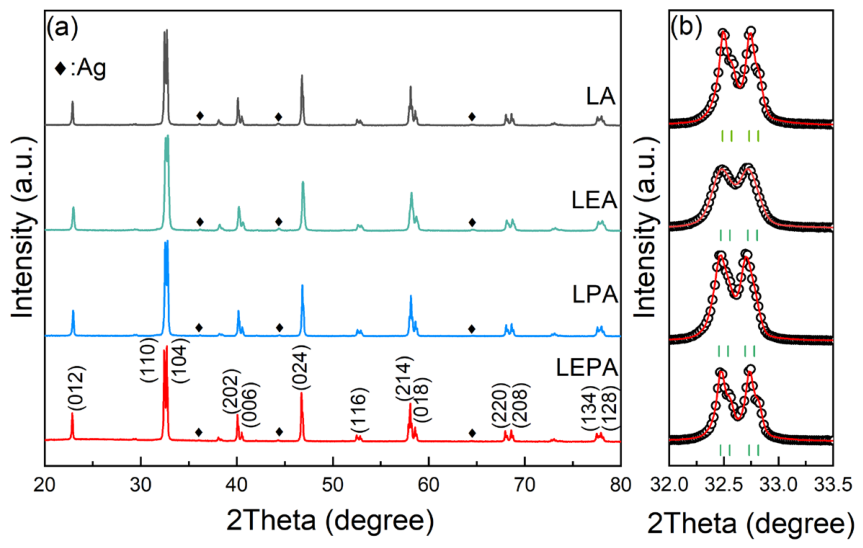
Figure 1. (a) XRD patterns of the LA, LEA, LPA, and LEPA samples and (b) the zoom of XRD patterns between 32 and 33.5 degree (black circles) with Rietveld profile fitting (red lines). The vertical solid lines indicate the Bragg-reflection positions corresponding to R 3 ¯ c phase.
Materials 19 01755 g001
Figure 2. XRD Rietveld refinement patterns of the (a) LA, (b) LEA, (c) LPA, and (d) LEPA samples.
Materials 19 01755 g002
Figure 3. SEM images of the (a) LA; (b) LEA; (c) LPA; and (d) LEPA samples; The insets show the particle size distribution histograms and the red lines are the normal distribution fitting curves; (d1d6) are the EDX elemental mapping of the LEPA sample.
Materials 19 01755 g003
Figure 4. XPS survey spectra of the LA; LEA; LPA; and LEPA samples.
Materials 19 01755 g004
Figure 5. Experimental (light grey open circles) and deconvoluted (dark grey solid lines) high-resolution XPS spectra of the perovskite manganites in the present work: (a) Eu 3d, (b) Pb 4f, (c) Ag 3d and (d) Mn 2p.
Materials 19 01755 g005
Figure 6. (a) ZFC M-T curves for the LA; LEA; LPA; and LEPA samples measured at 0.05 T; (b) Corresponding dM/dT-T curves.
Materials 19 01755 g006
Figure 7. χ−1-T curves of (a) LA, (b) LEA, (c) LPA and (d) LEPA samples. The solid lines denote the Curie–Weiss law fitting results.
Materials 19 01755 g007
Figure 8. Isothermal magnetization curves of the (a) LA, (b) LEA, (c) LPA and (d) LEPA samples.
Materials 19 01755 g008
Figure 9. Arrott (M2-H/M) curves for the (a) LA, (b) LEA, (c) LPA and (d) LEPA samples.
Materials 19 01755 g009
Figure 10.SM|-T curves measured for the LA; LEA; LPA; and LEPA samples under 2 T magnetic fields.
Materials 19 01755 g010
Figure 11. Universal curves of the (a) LA, (b) LEA, (c) LPA and (d) LEPA samples.
Materials 19 01755 g011
Table 1. Refined structural parameters of the LA, LEA, LPA, and LEPA samples.
CompoundLALEALPALEPA
Space group R 3 ¯ c R 3 ¯ c R 3 ¯ c R 3 ¯ c
a (Å) = b (Å)5.5072(5)5.5064(1)5.5125(9)5.5102(2)
c (Å)13.3438(7)13.3400(9)13.3599(9)13.3410(5)
V3)350.49(6)350.28(9)351.59(9)350.79(9)
d Mn - O 〉 (Å)1.960(3)1.962(7)1.956(0)1.957(3)
θ Mn - O - Mn 〉 (°)163.5(2)162.4(5)164.5(3)165.0(6)
DSC (nm)74.345.369.680.6
DW-H (nm)120.375.3115.2134.4
Microstrain (10−4)3.745.733.593.64
rA〉 (Å)1.38001.37731.38151.3775
t0.98340.98240.98110.9797
σ2 × 1031.602.061.882.58
W0.09380.09330.09470.0945
Rp (%)3.202.713.073.09
Rwp (%)4.163.554.013.94
χ23.312.192.942.42
Table 2. Compositions of the LA; LEA; LPA; and LEPA samples obtained from EDX statistics.
ElementContent (at%) in Samples
LALEALPALEPA
LaNominal1615.61615.4
Actual16.4615.1616.1314.14
EuNominal00.400.6
Actual00.3800.49
PbNominal0011
Actual000.980.94
AgNominal4433
Actual2.522.502.032.20
MnNominal20202020
Actual18.5119.3718.4517.16
ONominal60606060
Actual62.5162.5962.4165.07
Table 3. The fitting parameters of the Mn 2p peaks for LA, LEA, LPA, and LEPA samples.
SamplesCore SpectraMn StatesPeak PositionMn3+ ConcentrateMn3+/Mn4+
LAMn 2p3/2Mn3+641.8867.87%2.11
Mn4+644.23
Mn 2p1/2Mn3+653.42
Mn4+655.60
LEAMn 2p3/2Mn3+641.8968.87%2.21
Mn4+643.87
Mn 2p1/2Mn3+653.44
Mn4+655.14
LPAMn 2p3/2Mn3+641.8070.35%2.37
Mn4+644.41
Mn 2p1/2Mn3+653.21
Mn4+655.31
LEPAMn 2p3/2Mn3+641.8370.70%2.41
Mn4+644.42
Mn 2p1/2Mn3+653.27
Mn4+655.32
Table 4. Magnetocaloric properties (TC, S M max and RCP) of selected magnetocaloric materials with TC close to room temperature.
SamplesTC (K)H (T) S M max (J·kg−1·K−1)RCP (J·kg−1)Ref.
LA310.823.8564.65This work
LEA298.023.8164.48This work
LPA318.023.6668.24This work
LEPA299.323.9073.42This work
La0.80Ag0.20MnO330823.264[12]
La0.75Sm0.05Sr0.20MnO331021.8074.30[21]
La0.78Pb0.22MnO329222.0592.53[44]
Pr0.50Sr0.30Ag0.20MnO330521.3458.2[45]
La0.75Sm0.05Sr0.20MnO329721.6592[46]
La0.57Nd0.10Sr0.18Ag0.15MnO331022.9775.33[47]
Gd29225.20226.90[48]
Disclaimer/Publisher’s Note: The statements, opinions and data contained in all publications are solely those of the individual author(s) and contributor(s) and not of MDPI and/or the editor(s). MDPI and/or the editor(s) disclaim responsibility for any injury to people or property resulting from any ideas, methods, instructions or products referred to in the content.