Transfer Learning from Homogeneous to Heterogeneous: Fine-Tuning a Pretrained Interatomic Potential for Multicomponent Mo Alloys with Localized Substitutional Alloying


Abstract
1. Introduction
2. Methods and Datasets
2.1. Fine-Tuning Dataset of Doped Mo Alloys
2.2. Model Training Protocols and Evaluation Metrics
- (1)
- Model settings
- (2)
- Data-splitting and evaluation protocols
- (3)
- Loss functions and evaluation metrics
3. Results and Discussion
3.1. Construction of Fine-Tuned Models with Randomly Partitioned Datasets
3.2. Verification of Fine-Tuned Models with Leave-One-Dopant-Out Partitioned Datasets
3.3. Transferability of Fine-Tuned Models to Unknown Alloying Elements
4. Conclusions
Supplementary Materials
Author Contributions
Funding
Data Availability Statement
Acknowledgments
Conflicts of Interest
References
- Xu, H.; Cui, T.; Tang, C.; Ma, J.; Zhou, D.; Li, Y.; Gao, X.; Gong, X.; Ouyang, W.; Zhang, S.; et al. Evidential Deep Learning for Interatomic Potentials. Nat. Commun. 2025, 17, 937. [Google Scholar] [CrossRef]
- Yang, Z.; Wang, X.; Li, Y.; Lv, Q.; Chen, C.Y.-C.; Shen, L. Efficient Equivariant Model for Machine Learning Interatomic Potentials. npj Comput. Mater. 2025, 11, 49. [Google Scholar] [CrossRef]
- Ran, N.; Yin, L.; Qiu, W.; Liu, J. Recent Advances in Machine Learning Interatomic Potentials for Cross-Scale Computational Simulation of Materials. Sci. China Mater. 2024, 67, 1082–1100. [Google Scholar] [CrossRef]
- Su, T.; Hu, S.; Wu, Y.; Oyang, R.; Wang, X.; Li, M.; Reimers, J.; Zhang, T.-Y. DeePAW: A Universal Machine Learning Model for Orbital-Free Ab Initio Calculations. arXiv 2026, arXiv:2603.18650. [Google Scholar] [CrossRef]
- Chen, Z.; Yang, D.; Li, X.; Li, J.; Yuan, H.; Cui, J. Machine-Learning-Assisted Multi-Element Optimization of Mechanical Properties in Spinel Refractory Materials. Materials 2025, 18, 1719. [Google Scholar] [CrossRef]
- Behler, J.; Parrinello, M. Generalized Neural-Network Representation of High-Dimensional Potential-Energy Surfaces. Phys. Rev. Lett. 2007, 98, 146401. [Google Scholar] [CrossRef]
- Bartók, A.P.; Payne, M.C.; Kondor, R.; Csányi, G. Gaussian Approximation Potentials: The Accuracy of Quantum Mechanics, without the Electrons. Phys. Rev. Lett. 2010, 104, 136403. [Google Scholar] [CrossRef]
- Bartók, A.P.; Kondor, R.; Csányi, G. On Representing Chemical Environments. Phys. Rev. B 2013, 87, 184115. [Google Scholar] [CrossRef]
- Thompson, A.P.; Swiler, L.P.; Trott, C.R.; Foiles, S.M.; Tucker, G.J. Spectral Neighbor Analysis Method for Automated Generation of Quantum-Accurate Interatomic Potentials. J. Comput. Phys. 2015, 285, 316–330. [Google Scholar] [CrossRef]
- Shapeev, A.V. Moment Tensor Potentials: A Class of Systematically Improvable Interatomic Potentials. Multiscale Model. Simul. 2016, 14, 1153–1173. [Google Scholar] [CrossRef]
- Drautz, R. Atomic Cluster Expansion for Accurate and Transferable Interatomic Potentials. Phys. Rev. B 2019, 99, 014104. [Google Scholar] [CrossRef]
- Schütt, K.; Kindermans, P.-J.; Sauceda Felix, H.E.; Chmiela, S.; Tkatchenko, A.; Müller, K.-R. SchNet: A Continuous-Filter Convolutional Neural Network for Modeling Quantum Interactions. In Advances in Neural Information Processing Systems; Curran Associates, Inc.: New York, NY, USA, 2017; Volume 30. [Google Scholar]
- Gasteiger, J.; Groß, J.; Günnemann, S. Directional Message Passing for Molecular Graphs. arXiv 2022, arXiv:2003.03123. [Google Scholar] [CrossRef]
- Gasteiger, J.; Becker, F.; Günnemann, S. Gemnet: Universal Directional Graph Neural Networks for Molecules. Adv. Neural Inf. Process. Syst. 2021, 34, 6790–6802. [Google Scholar]
- Schütt, K.; Unke, O.; Gastegger, M. Equivariant Message Passing for the Prediction of Tensorial Properties and Molecular Spectra. In Proceedings of the International Conference on Machine Learning, Virtual Event, 18–24 July 2021; pp. 9377–9388. [Google Scholar]
- Batzner, S.; Musaelian, A.; Sun, L.; Geiger, M.; Mailoa, J.P.; Kornbluth, M.; Molinari, N.; Smidt, T.E.; Kozinsky, B. E(3)-Equivariant Graph Neural Networks for Data-Efficient and Accurate Interatomic Potentials. Nat. Commun. 2022, 13, 2453. [Google Scholar] [CrossRef]
- Batatia, I.; Kovacs, D.P.; Simm, G.; Ortner, C.; Csányi, G. MACE: Higher Order Equivariant Message Passing Neural Networks for Fast and Accurate Force Fields. Adv. Neural Inf. Process. Syst. 2022, 35, 11423–11436. [Google Scholar]
- Gasteiger, J.; Shuaibi, M.; Sriram, A.; Günnemann, S.; Ulissi, Z.; Zitnick, C.L.; Das, A. GemNet-OC: Developing Graph Neural Networks for Large and Diverse Molecular Simulation Datasets. arXiv 2022, arXiv:2204.02782. [Google Scholar] [CrossRef]
- Chen, C.; Ong, S.P. A Universal Graph Deep Learning Interatomic Potential for the Periodic Table. Nat. Comput. Sci. 2022, 2, 718–728. [Google Scholar] [CrossRef]
- Deng, B.; Zhong, P.; Jun, K.; Riebesell, J.; Han, K.; Bartel, C.J.; Ceder, G. CHGNet as a Pretrained Universal Neural Network Potential for Charge-Informed Atomistic Modelling. Nat. Mach. Intell. 2023, 5, 1031–1041. [Google Scholar] [CrossRef]
- Batatia, I.; Benner, P.; Chiang, Y.; Elena, A.M.; Kovács, D.P.; Riebesell, J.; Advincula, X.R.; Asta, M.; Avaylon, M.; Baldwin, W.J.; et al. A Foundation Model for Atomistic Materials Chemistry. J. Chem. Phys. 2025, 163, 184110. [Google Scholar] [CrossRef]
- Yang, H.; Hu, C.; Zhou, Y.; Liu, X.; Shi, Y.; Li, J.; Li, G.; Chen, Z.; Chen, S.; Zeni, C.; et al. MatterSim: A Deep Learning Atomistic Model Across Elements, Temperatures and Pressures. arXiv 2024, arXiv:2405.04967. [Google Scholar] [CrossRef]
- Ma, J.; Fu, X.; Xie, W.; Hu, P. From Pretrained to Precision: Fine-Tuning Universal Interatomic Potentials for Accurate Catalytic Reaction Simulations. J. Chem. Theory Comput. 2026, 22, 1920–1930. [Google Scholar] [CrossRef]
- Zhang, L.; Han, J.; Wang, H.; Car, R.; E, W. Deep Potential Molecular Dynamics: A Scalable Model with the Accuracy of Quantum Mechanics. Phys. Rev. Lett. 2018, 120, 143001. [Google Scholar] [CrossRef]
- Musaelian, A.; Batzner, S.; Johansson, A.; Sun, L.; Owen, C.J.; Kornbluth, M.; Kozinsky, B. Learning Local Equivariant Representations for Large-Scale Atomistic Dynamics. Nat. Commun. 2023, 14, 579. [Google Scholar] [CrossRef]
- Chanussot, L.; Das, A.; Goyal, S.; Lavril, T.; Shuaibi, M.; Riviere, M.; Tran, K.; Heras-Domingo, J.; Ho, C.; Hu, W.; et al. Open Catalyst 2020 (OC20) Dataset and Community Challenges. ACS Catal. 2021, 11, 6059–6072. [Google Scholar] [CrossRef]
- Tran, R.; Lan, J.; Shuaibi, M.; Wood, B.M.; Goyal, S.; Das, A.; Heras-Domingo, J.; Kolluru, A.; Rizvi, A.; Shoghi, N.; et al. The Open Catalyst 2022 (OC22) Dataset and Challenges for Oxide Electrocatalysts. ACS Catal. 2023, 13, 3066–3084. [Google Scholar] [CrossRef]
- Kirklin, S.; Saal, J.E.; Meredig, B.; Thompson, A.; Doak, J.W.; Aykol, M.; Rühl, S.; Wolverton, C. The Open Quantum Materials Database (OQMD): Assessing the Accuracy of DFT Formation Energies. npj Comput. Mater. 2015, 1, 15010. [Google Scholar] [CrossRef]
- Radova, M.; Stark, W.G.; Allen, C.S.; Maurer, R.J.; Bartók, A.P. Fine-Tuning Foundation Models of Materials Interatomic Potentials with Frozen Transfer Learning. npj Comput. Mater. 2025, 11, 237. [Google Scholar] [CrossRef]
- Smith, J.S.; Nebgen, B.T.; Zubatyuk, R.; Lubbers, N.; Devereux, C.; Barros, K.; Tretiak, S.; Isayev, O.; Roitberg, A.E. Approaching Coupled Cluster Accuracy with a General-Purpose Neural Network Potential through Transfer Learning. Nat. Commun. 2019, 10, 2903. [Google Scholar] [CrossRef]
- Wu, Z.; Zhou, L.; Hou, P.; Liu, Y.; Wang, R.; Guo, T.; Liu, J.-C. A Machine Learning Interatomic Potential Data Set and Model for Catalysis with Local Fine-Tuning to Chemical Accuracy. JACS Au 2025, 5, 6151–6161. [Google Scholar] [CrossRef]
- Kulichenko, M.; Nebgen, B.; Lubbers, N.; Smith, J.S.; Barros, K.; Allen, A.E.A.; Habib, A.; Shinkle, E.; Fedik, N.; Li, Y.W.; et al. Data Generation for Machine Learning Interatomic Potentials and Beyond. Chem. Rev. 2024, 124, 13681–13714. [Google Scholar] [CrossRef]
- Wang, G.; Wang, C.; Zhang, X.; Li, Z.; Zhou, J.; Sun, Z. Machine Learning Interatomic Potential: Bridge the Gap between Small-Scale Models and Realistic Device-Scale Simulations. iScience 2024, 27, 109673. [Google Scholar] [CrossRef]
- Deng, B.; Choi, Y.; Zhong, P.; Riebesell, J.; Anand, S.; Li, Z.; Jun, K.; Persson, K.A.; Ceder, G. Systematic Softening in Universal Machine Learning Interatomic Potentials. npj Comput. Mater. 2025, 11, 9. [Google Scholar] [CrossRef]
- Liu, Y.; Mo, Y. Learning from Models: High-Dimensional Analyses on the Performance of Machine Learning Interatomic Potentials. npj Comput. Mater. 2024, 10, 159. [Google Scholar] [CrossRef]
- Li, Y.; Xiao, B.; Tang, Y.; Liu, F.; Wang, X.; Yan, F.; Liu, Y. Center-Environment Feature Model for Machine Learning Study of Spinel Oxides Based on First-Principles Computations. J. Phys. Chem. C 2020, 124, 28458–28468. [Google Scholar] [CrossRef]
- Tang, Y.; Xiao, B.; Chen, S.; Qian, Q.; Liu, Y. Predefined Attention-Focused Mechanism Using Center-Environment Features: A Machine Learning Study of Alloying Effects on the Stability of Nb5Si3 Alloys. Digit. Discov. 2025, 4, 1870–1883. [Google Scholar] [CrossRef]
- Tang, Y.; Xiao, B.; Chen, J.; Chen, S.; Li, Y.; Liu, F.; Du, W.; Shen, Y.; Fan, X.; Qian, Q.; et al. Machine Learning with Center-Environment Attention Mechanism for Multi-Component Nb Alloys. Trans. Nonferrous Met. Soc. China 2025, 35, 3813–3823. [Google Scholar] [CrossRef]
- Siddiqui, A.; Hine, N.D.M. Machine-Learned Interatomic Potentials for Transition Metal Dichalcogenide Mo1−xWxS2−2ySe2y Alloys. npj Comput. Mater. 2024, 10, 169. [Google Scholar] [CrossRef]
- Liu, Y.; Mo, Y. Assessing the Accuracy of Machine Learning Interatomic Potentials in Predicting the Elemental Orderings: A Case Study of Li-Al Alloys. Acta Mater. 2024, 268, 119742. [Google Scholar] [CrossRef]
- Ramakrishnan, R.; Dral, P.O.; Rupp, M.; von Lilienfeld, O.A. Quantum Chemistry Structures and Properties of 134 Kilo Molecules. Sci. Data 2014, 1, 140022. [Google Scholar] [CrossRef]
- Jain, A.; Ong, S.P.; Hautier, G.; Chen, W.; Richards, W.D.; Dacek, S.; Cholia, S.; Gunter, D.; Skinner, D.; Ceder, G.; et al. Commentary: The Materials Project: A Materials Genome Approach to Accelerating Materials Innovation. APL Mater. 2013, 1, 011002. [Google Scholar] [CrossRef]
- Saal, J.E.; Kirklin, S.; Aykol, M.; Meredig, B.; Wolverton, C. Materials Design and Discovery with High-Throughput Density Functional Theory: The Open Quantum Materials Database (OQMD). JOM 2013, 65, 1501–1509. [Google Scholar] [CrossRef]
- Tang, Y.; Xiao, B.; Chen, J.; Liu, F.; Du, W.; Guo, J.; Liu, Y.; Liu, Y. Multi-Component Alloying Effects on the Stability and Mechanical Properties of Nb and Nb–Si Alloys: A First-Principles Study. Met. Mater. Trans. A 2023, 54, 450–472. [Google Scholar] [CrossRef]
- Guo, J.; Xiao, B.; Li, Y.; Zhai, D.; Tang, Y.; Du, W.; Liu, Y. Machine Learning Aided First-Principles Studies of Structure Stability of Co3(Al, X) Doped with Transition Metal Elements. Comput. Mater. Sci. 2021, 200, 110787. [Google Scholar] [CrossRef]
- Horton, M.K.; Huck, P.; Yang, R.X.; Munro, J.M.; Dwaraknath, S.; Ganose, A.M.; Kingsbury, R.S.; Wen, M.; Shen, J.X.; Mathis, T.S.; et al. Accelerated Data-Driven Materials Science with the Materials Project. Nat. Mater. 2025, 24, 1522–1532. [Google Scholar] [CrossRef]
- Kresse, G.; Furthmüller, J.; Hafner, J. Theory of the Crystal Structures of Selenium and Tellurium: The Effect of Generalized-Gradient Corrections to the Local-Density Approximation. Phys. Rev. B 1994, 50, 13181–13185. [Google Scholar] [CrossRef]
- Perdew, J.P.; Burke, K.; Ernzerhof, M. Generalized Gradient Approximation Made Simple. Phys. Rev. Lett. 1996, 77, 3865–3868. [Google Scholar] [CrossRef]
- Ko, T.W.; Ong, S.P. Recent Advances and Outstanding Challenges for Machine Learning Interatomic Potentials. Nat. Comput. Sci. 2023, 3, 998–1000. [Google Scholar] [CrossRef]
- Jacobs, R.; Morgan, D.; Attarian, S.; Meng, J.; Shen, C.; Wu, Z.; Xie, C.Y.; Yang, J.H.; Artrith, N.; Blaiszik, B.; et al. A Practical Guide to Machine Learning Interatomic Potentials—Status and Future. Curr. Opin. Solid State Mater. Sci. 2025, 35, 101214. [Google Scholar] [CrossRef]
- Yu, H.; Zhong, Y.; Hong, L.; Xu, C.; Ren, W.; Gong, X.; Xiang, H. Spin-Dependent Graph Neural Network Potential for Magnetic Materials. Phys. Rev. B 2024, 109, 144426. [Google Scholar] [CrossRef]
- Yu, H.; Liu, B.; Zhong, Y.; Hong, L.; Ji, J.; Xu, C.; Gong, X.; Xiang, H. Physics-Informed Time-Reversal Equivariant Neural Network Potential for Magnetic Materials. Phys. Rev. B 2024, 110, 104427. [Google Scholar] [CrossRef]
- Gilmer, J.; Schoenholz, S.S.; Riley, P.F.; Vinyals, O.; Dahl, G.E. Neural Message Passing for Quantum Chemistry. In Proceedings of the International Conference on Machine Learning, Sydney, NSW, Australia, 6–11 August 2017; pp. 1263–1272. [Google Scholar]
- Satorras, V.G.; Hoogeboom, E.; Welling, M. E(n) Equivariant Graph Neural Networks. In Proceedings of the International Conference on Machine Learning, Virtual Event, 18–24 July 2021; pp. 9323–9332. [Google Scholar]
- Thomas, N.; Smidt, T.; Kearnes, S.; Yang, L.; Li, L.; Kohlhoff, K.; Riley, P. Tensor Field Networks: Rotation- and Translation-Equivariant Neural Networks for 3D Point Clouds. arXiv 2018. [Google Scholar] [CrossRef]
- Fuchs, F.; Worrall, D.; Fischer, V.; Welling, M. Se(3)-Transformers: 3d Roto-Translation Equivariant Attention Networks. Adv. Neural Inf. Process. Syst. 2020, 33, 1970–1981. [Google Scholar]
- Geiger, M.; Smidt, T. E3nn: Euclidean Neural Networks. arXiv 2022. [Google Scholar] [CrossRef]
- Kresse, G.; Furthmüller, J. Efficient Iterative Schemes for Ab Initio Total-Energy Calculations Using a Plane-Wave Basis Set. Phys. Rev. B 1996, 54, 11169–11186. [Google Scholar] [CrossRef]
- Kresse, G.; Furthmüller, J. Efficiency of Ab-Initio Total Energy Calculations for Metals and Semiconductors Using a Plane-Wave Basis Set. Comput. Mater. Sci. 1996, 6, 15–50. [Google Scholar] [CrossRef]
- Blöchl, P.E. Projector Augmented-Wave Method. Phys. Rev. B 1994, 50, 17953–17979. [Google Scholar] [CrossRef]
- Kresse, G.; Joubert, D. From Ultrasoft Pseudopotentials to the Projector Augmented-Wave Method. Phys. Rev. B 1999, 59, 1758–1775. [Google Scholar] [CrossRef]


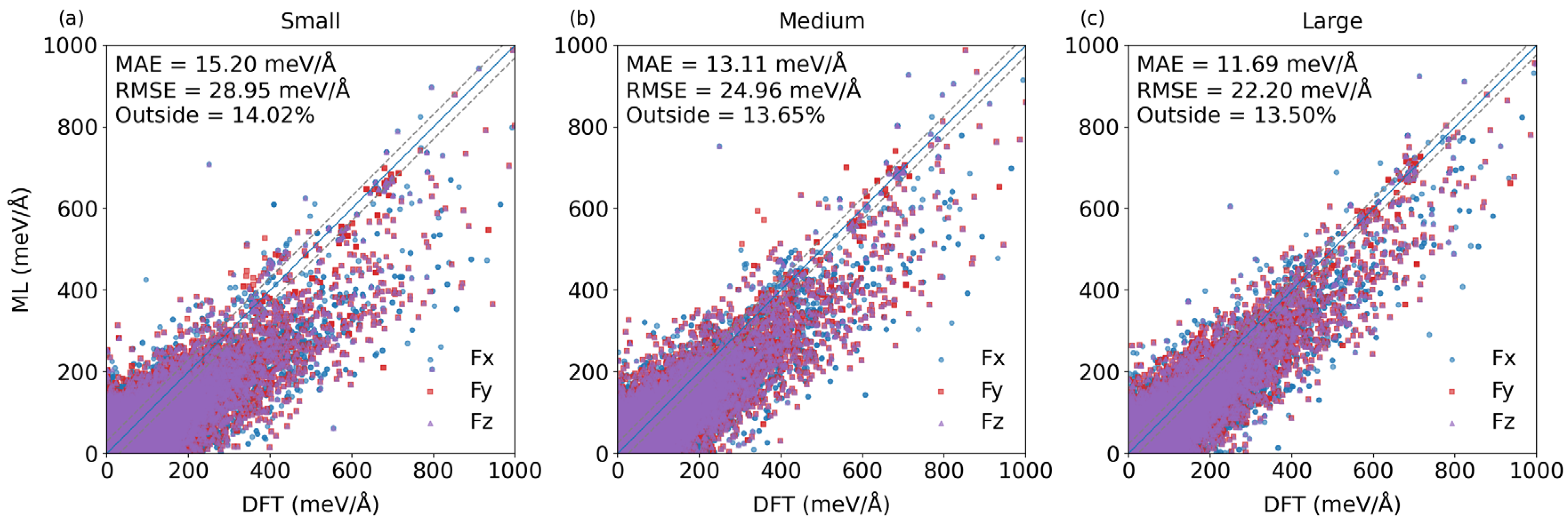
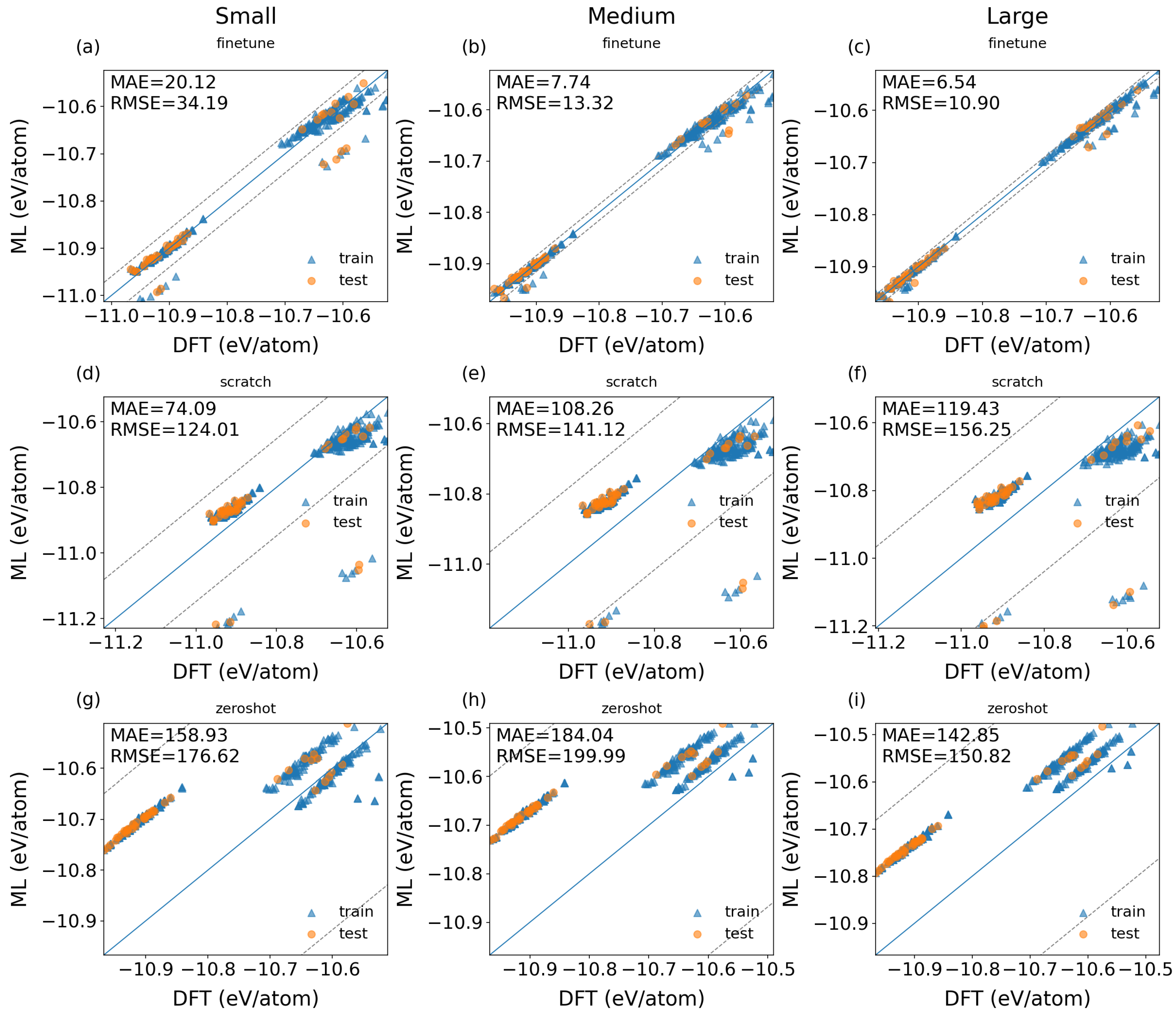

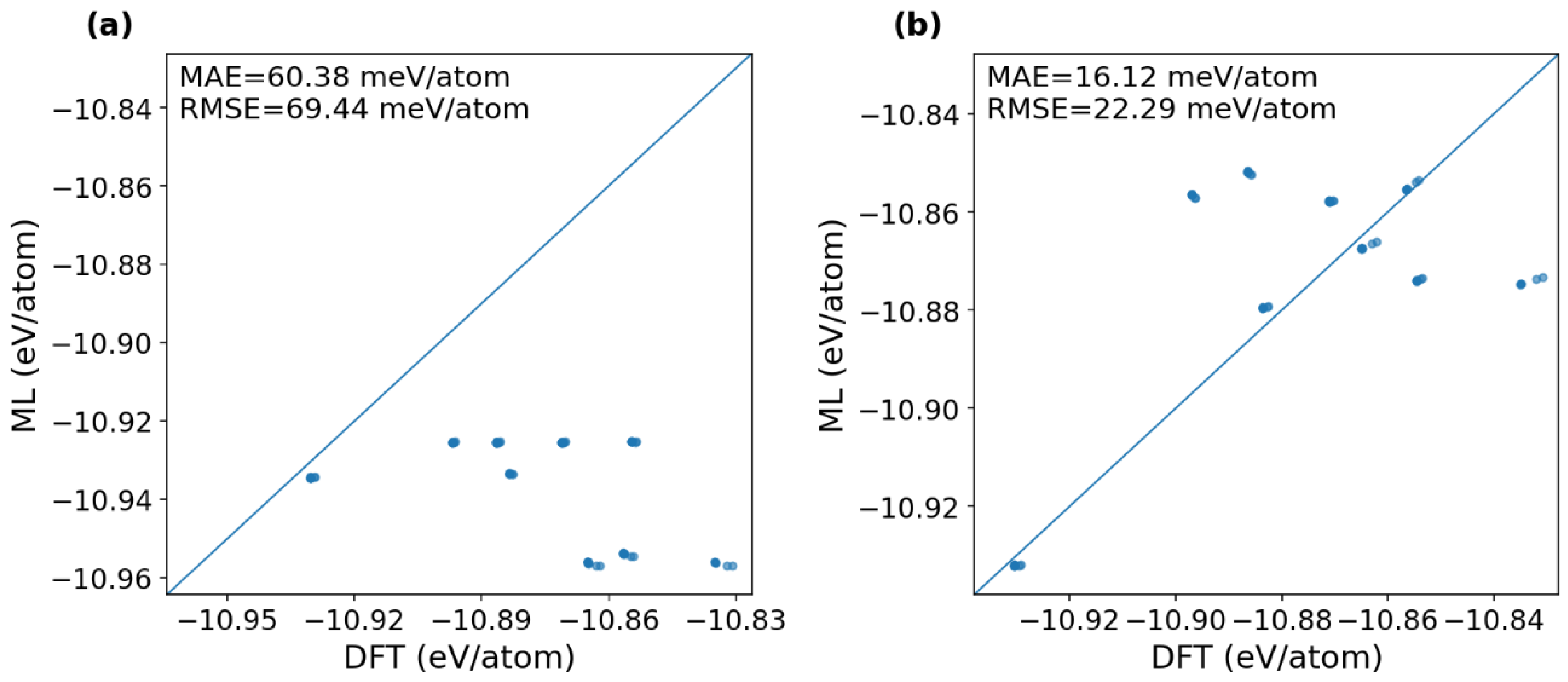

| ML Models | Energy <MAE> (meV/Atom) | Energy <RMSE> (meV/Atom) | Force <MAE> (meV/Å) | Force <RMSE> (meV/Å) |
|---|---|---|---|---|
| FT-E(S) | 17.1 ± 4.7 | 30.3 ± 11.4 | 11.0 ± 0.8 | 22.8 ± 1.7 |
| FT-E(M) | 8.1 ± 1.4 | 12.5 ± 2.8 | 11.1 ± 0.7 | 22.3 ± 1.7 |
| FT-E(L) | 7.3 ± 1.7 | 13.2 ± 4.0 | 13.0 ± 1.2 | 26.3 ± 2.6 |
| FT-E_NE(S) | 5.6 ± 0.1 | 7.5 ± 0.5 | 18.3 ± 0.3 | 31.6 ± 0.8 |
| FT-E_NE(M) | 3.5 ± 0.1 | 5.0 ± 0.8 | 15.7 ± 0.2 | 27.3 ± 0.6 |
| FT-E_NE(L) | 2.3 ± 0.1 | 3.8 ± 0.9 | 13.8 ± 0.2 | 24.3 ± 0.5 |
| FT-E_NE (S_group_split) | 6.0 ± 0.9 | 8.1 ± 0.9 | 18.9 ± 1.4 | 32.9 ± 2.3 |
| FT-E_NE (M_group_split) | 3.7 ± 1.3 | 5.4 ± 1.9 | 16.1 ± 1.4 | 28.4 ± 2.3 |
| FT-E_NE (L_group_split) | 1.9 ± 0.1 | 3.4 ± 1.0 | 13.3 ± 0.1 | 24.0 ± 0.5 |
| FT-E_NE (S_size-match) | 12.3 ± 2.1 | 16.1 ± 3.0 | 24.8 ± 2.2 | 45.6 ± 8.7 |
| FT-E_NE (M_size-match) | 7.9 ± 1.3 | 10.4 ± 1.7 | 22.7 ± 1.8 | 43.0 ± 8.6 |
| FT-E_NE (L_size-match) | 5.0 ± 1.3 | 7.7 ± 2.4 | 21.6 ± 1.8 | 40.8 ± 6.3 |
| Scratch-E(S) | 75.0 ± 22.0 | 124.6 ± 28.0 | 17.1 ± 3.0 | 31.2 ± 5.6 |
| Scratch-E(M) | 112.0 ± 11.9 | 144.4 ± 20.9 | 11.3 ± 2.5 | 21.0 ± 4.6 |
| Scratch-E(L) | 121.5 ± 8.6 | 153.4 ± 18.8 | 3.6 ± 1.1 | 5.9 ± 1.9 |
| Zero-shot-E(S) | 159.2 ± 6.9 | 176.5 ± 4.6 | 69.4 ± 5.5 | 146.1 ± 7.9 |
| Zero-shot-E(M) | 184.4 ± 7.0 | 200.0 ± 5.0 | 50.3 ± 3.5 | 100.6 ± 4.8 |
| Zero-shot-E(L) | 143.9 ± 4.4 | 151.5 ± 3.4 | 44.6 ± 3.3 | 88.6 ± 4.6 |
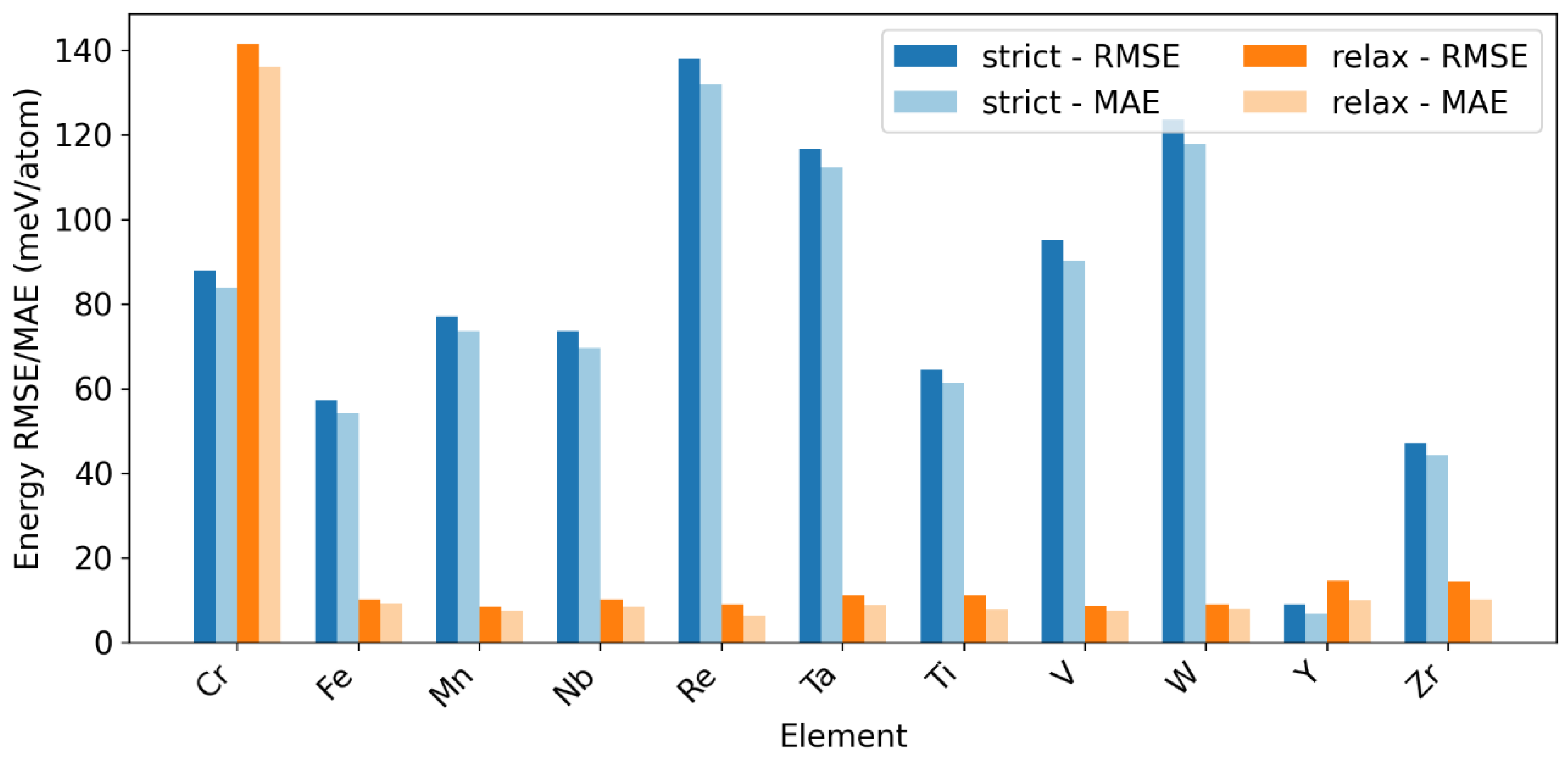
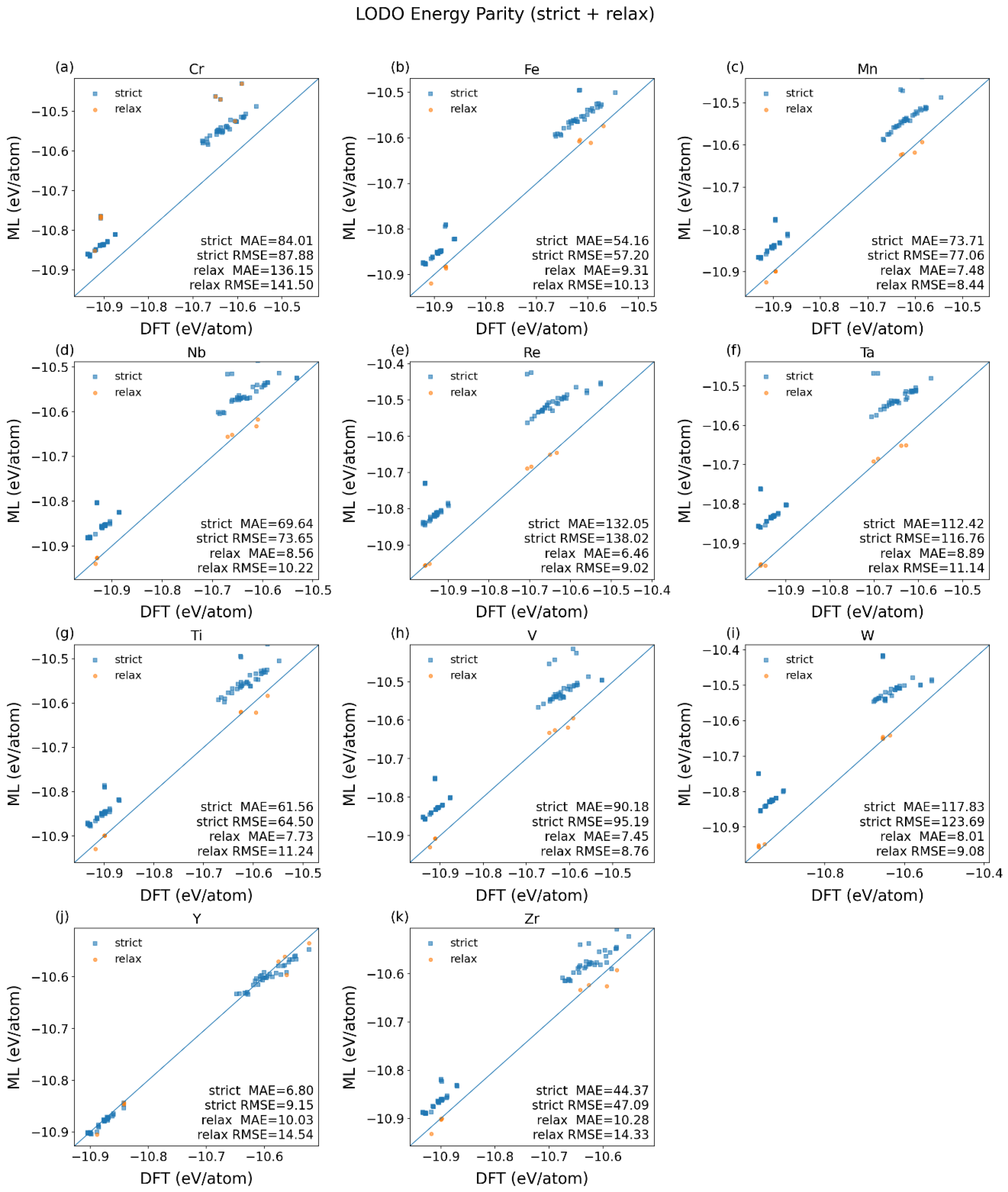
| Element | Strict-LODO | Relaxed-LODO | ||||||
|---|---|---|---|---|---|---|---|---|
| Energy MAE | Energy RMSE | Force MAE | Force RMSE | Energy MAE | Energy RMSE | Force MAE | Force RMSE | |
| Fe | 54.16 | 57.20 | 50.3 | 108.8 | 9.31 | 10.13 | 17.8 | 41.9 |
| Mn | 73.71 | 77.06 | 45.5 | 93.4 | 7.48 | 8.44 | 15.3 | 29.6 |
| Nb | 69.64 | 73.65 | 36.2 | 74.4 | 8.56 | 10.22 | 9.0 | 14.8 |
| Re | 132.05 | 138.02 | 40.9 | 69.3 | 6.46 | 9.02 | 12.1 | 23.8 |
| Ta | 112.42 | 116.76 | 28.0 | 60.8 | 8.89 | 11.14 | 11.0 | 19.1 |
| Ti | 61.56 | 64.50 | 31.4 | 69.6 | 7.73 | 11.24 | 10.2 | 19.3 |
| V | 90.18 | 95.19 | 34.6 | 71.8 | 7.45 | 8.76 | 11.8 | 23.6 |
| W | 117.84 | 123.69 | 49.4 | 118.9 | 8.01 | 9.09 | 9.9 | 18.8 |
| Y | 6.80 | 9.15 | 43.7 | 74.8 | 10.03 | 14.54 | 18.5 | 32.4 |
| Zr | 44.37 | 47.09 | 37.1 | 71.2 | 10.28 | 14.33 | 13.9 | 24.3 |
| Cr | 84.01 | 87.88 | 54.1 | 126.8 | 136.15 | 141.50 | 77.4 | 177.2 |
| MeanNC | 76.27 | 80.23 | 39.71 | 81.30 | 8.42 | 10.69 | 12.95 | 24.76 |
| MeanAll Std. | 76.98 ± 36.05 | 80.93 ± 37.18 | 41.0 ± 8.3 | 85.4 ± 22.8 | 20.03 ± 38.53 | 22.58 ± 39.49 | 18.8 ± 19.7 | 38.6 ± 46.6 |
Disclaimer/Publisher’s Note: The statements, opinions and data contained in all publications are solely those of the individual author(s) and contributor(s) and not of MDPI and/or the editor(s). MDPI and/or the editor(s) disclaim responsibility for any injury to people or property resulting from any ideas, methods, instructions or products referred to in the content. |
© 2026 by the authors. Licensee MDPI, Basel, Switzerland. This article is an open access article distributed under the terms and conditions of the Creative Commons Attribution (CC BY) license.
Share and Cite
Fang, L.; Qin, L.; Zhang, L.; Zhou, H.; He, X.; Ren, Z.; Zhang, T.; Liu, Y. Transfer Learning from Homogeneous to Heterogeneous: Fine-Tuning a Pretrained Interatomic Potential for Multicomponent Mo Alloys with Localized Substitutional Alloying. Materials 2026, 19, 1715. https://doi.org/10.3390/ma19091715
Fang L, Qin L, Zhang L, Zhou H, He X, Ren Z, Zhang T, Liu Y. Transfer Learning from Homogeneous to Heterogeneous: Fine-Tuning a Pretrained Interatomic Potential for Multicomponent Mo Alloys with Localized Substitutional Alloying. Materials. 2026; 19(9):1715. https://doi.org/10.3390/ma19091715
Chicago/Turabian StyleFang, Lixin, Liqin Qin, Limin Zhang, Hao Zhou, Xudong He, Zekun Ren, Tongyi Zhang, and Yi Liu. 2026. "Transfer Learning from Homogeneous to Heterogeneous: Fine-Tuning a Pretrained Interatomic Potential for Multicomponent Mo Alloys with Localized Substitutional Alloying" Materials 19, no. 9: 1715. https://doi.org/10.3390/ma19091715
APA StyleFang, L., Qin, L., Zhang, L., Zhou, H., He, X., Ren, Z., Zhang, T., & Liu, Y. (2026). Transfer Learning from Homogeneous to Heterogeneous: Fine-Tuning a Pretrained Interatomic Potential for Multicomponent Mo Alloys with Localized Substitutional Alloying. Materials, 19(9), 1715. https://doi.org/10.3390/ma19091715