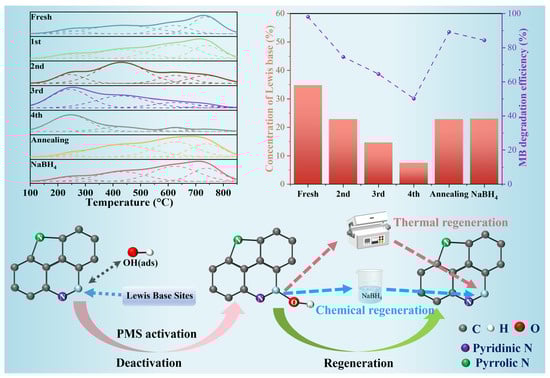
Deactivation and Regeneration of Lewis Basic Sites Following Reversible Chemical Adsorption and Desorption of Hydroxyl Groups in Contaminant Degradation by Advanced Oxidation


Abstract
1. Introduction
2. Experimental Section
2.1. Materials
2.2. Preparation and Characterization of Catalysts
2.3. Experimental Procedure
3. Results and Discussion
3.1. Catalysts Characterization
3.2. Evaluation of Catalytic Activity
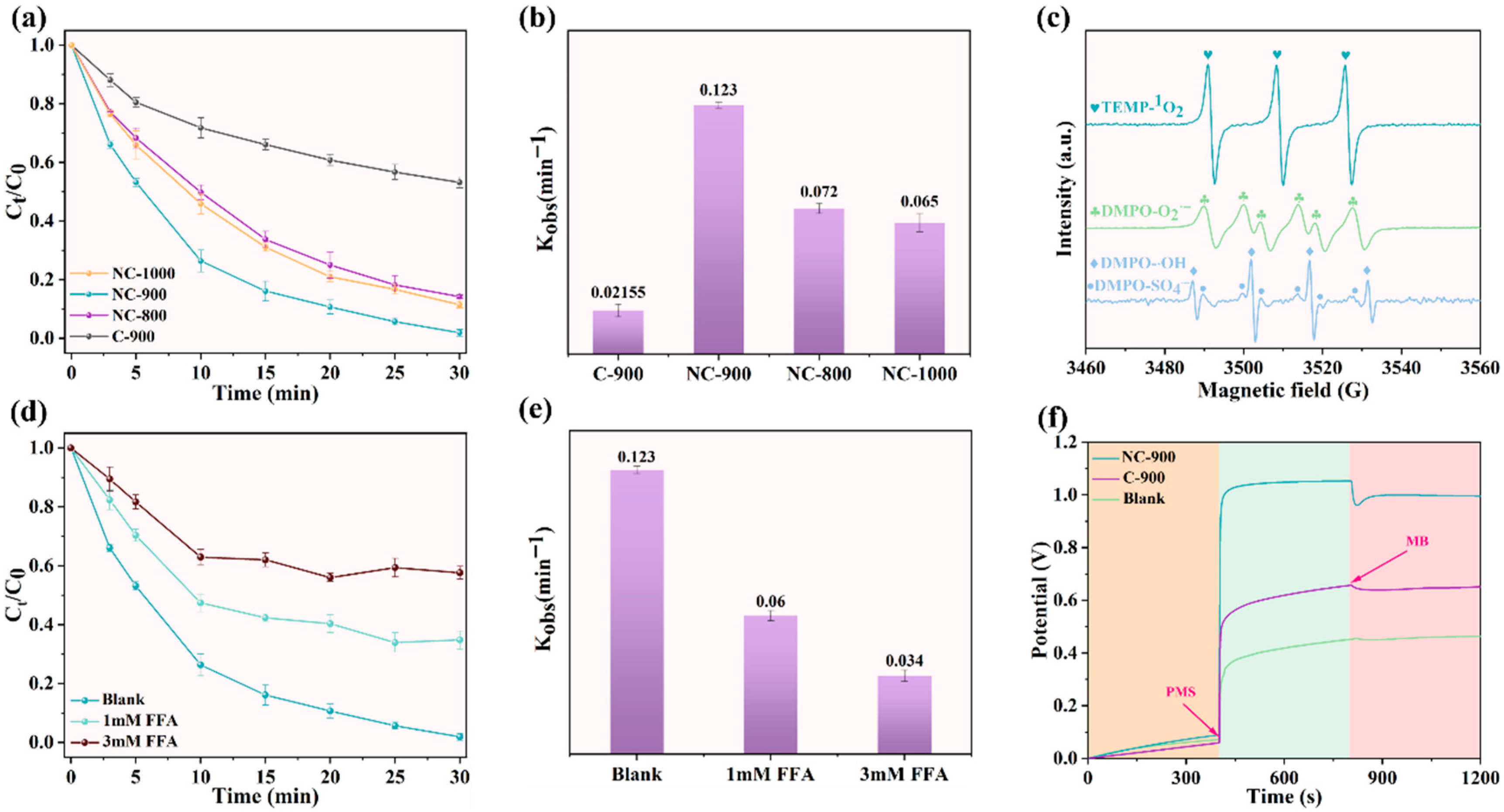
3.3. Identification of Reactive Species
3.4. Determination of the Active Sites
3.5. Catalyst Activation Recovery
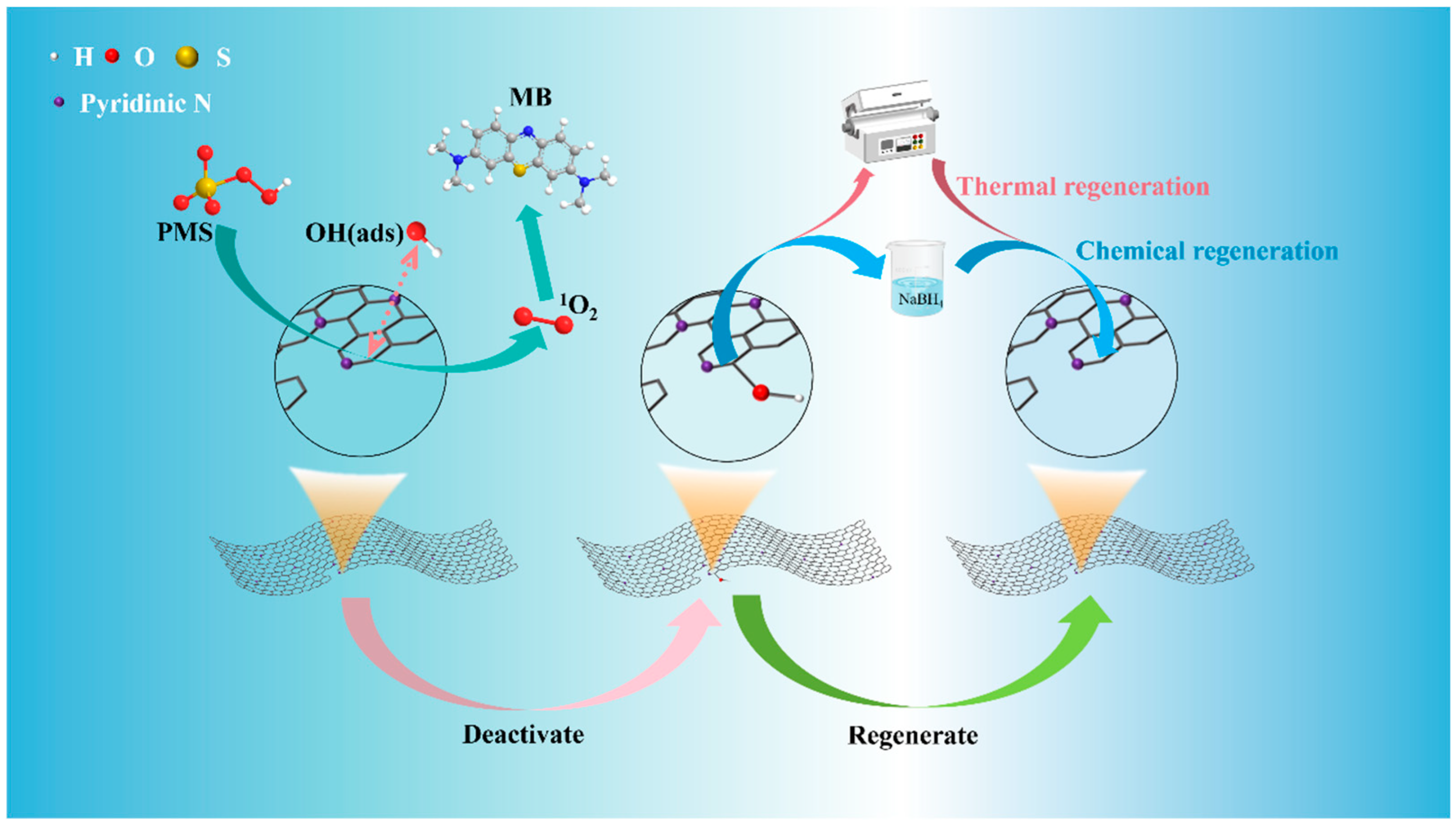
3.6. Reaction Mechanism
3.7. The Influence of Reaction Parameters
3.8. Possible Degradation Pathways and Toxicological Analysis of MB
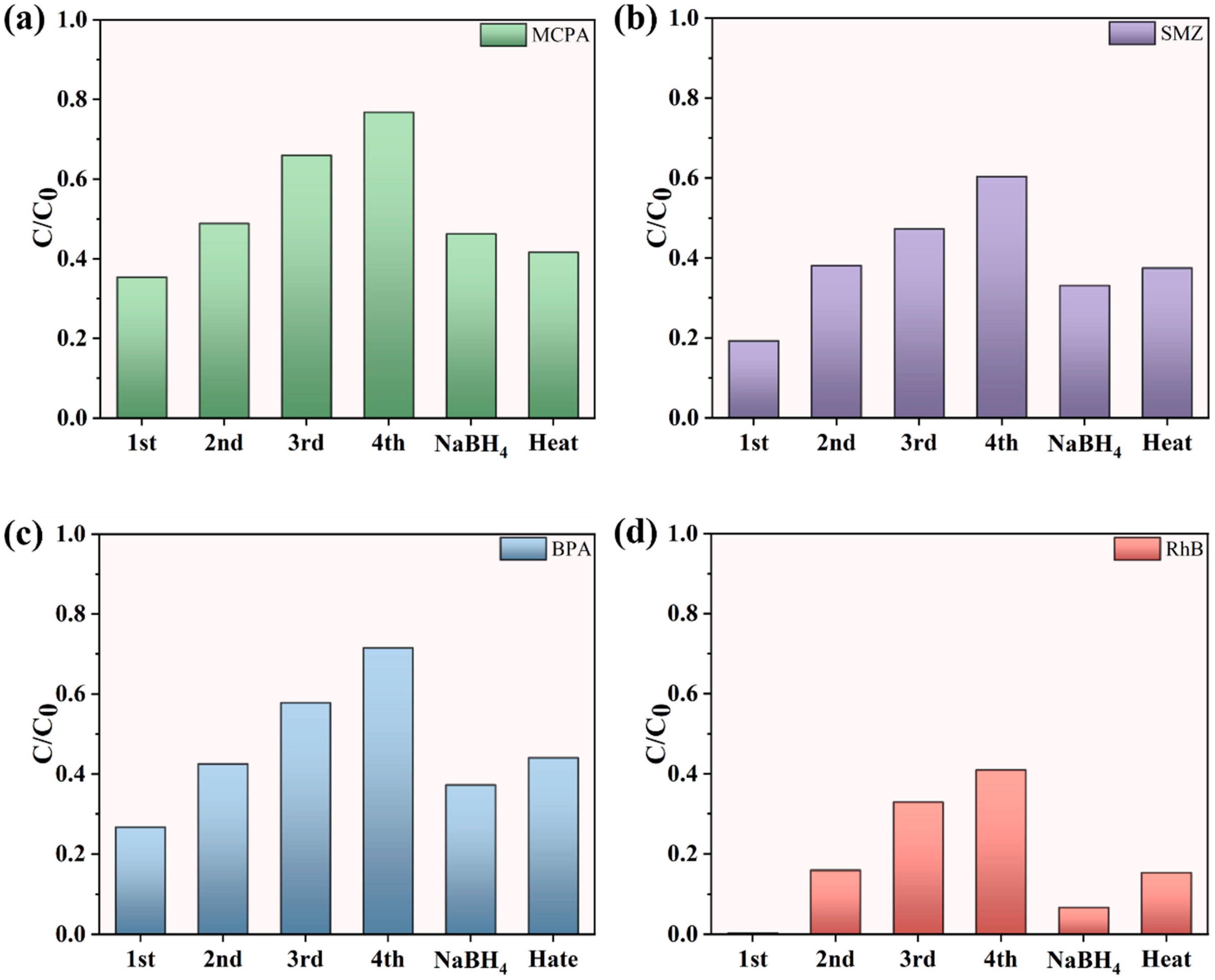
3.9. Universality of Active Site Deactivation and Regeneration Mechanisms
3.10. Limitations and Future Work
4. Conclusions
Supplementary Materials
Author Contributions
Funding
Data Availability Statement
Conflicts of Interest
References
- Ma, H.; Yu, L.; Yang, L.; Yao, Y.; Shen, G.; Wang, Y.; Li, B.; Meng, J.; Miao, M.; Zhi, C. Graphene oxide composites for dye removal in textile, printing and dyeing wastewaters: A review. Environ. Chem. Lett. 2024, 23, 165–193. [Google Scholar] [CrossRef]
- Sun, C.; Li, M.; Wang, Q.; Liu, R.; Li, M.; Chen, F.; Xu, S.; Wang, G. Enhanced degradation of rhodamine B by UV/Co3O4@BC/PMS system: Performance and mechanism. J. Water Process Eng. 2025, 73, 107719. [Google Scholar] [CrossRef]
- Liu, K.; Guo, X.; Liu, Y.; Wang, X.; Wang, J.; Wang, X.; Zhang, L.; Zhu, Y.; Yang, D. White LED driven {010}-faceted BiVO4 mediated electron transfer enables efficient peroxymonosulfate activation for norfloxacin degradation. Adv. Powder Mater. 2026, 5, 100363. [Google Scholar] [CrossRef]
- Meng, H.; Zhou, J.; Zhang, Y.; Cui, J.; Chen, Y.; Zhong, W.; Chen, Y.; Jia, C.Q. Single-atom Co-N3 sites induce peroxymonosulfate activation for acetaminophen degradation via nearly 100% internal electron transfer process. Appl. Catal. B Environ. Energy 2025, 366, 125038. [Google Scholar] [CrossRef]
- Chen, T.; Zhang, G.; Sun, H.; Hua, Y.; Yang, S.; Zhou, D.; Di, H.; Xiong, Y.; Hou, S.; Xu, H.; et al. Robust Fe-N4-C6O2 single atom sites for efficient PMS activation and enhanced FeIV = O reactivity. Nat. Commun. 2025, 16, 2402. [Google Scholar] [CrossRef]
- Sheng, B.; Huang, X.; Zhao, Q.; Zhang, Z.; Duan, R.; Zhang, J.; Chen, C.; Zhao, J.; Sheng, H. Discriminative Peroxymonosulfate Activation on Iron Carbides for Redox-Neutral Singlet Oxygen Generation. Angew. Chem. Int. Ed. Engl. 2025, 64, e202519774. [Google Scholar] [CrossRef] [PubMed]
- Li, Z.; Zhang, X.; Xue, M.; Wei, M.; Chen, S.; Lu, Q.; Guo, E.; Han, X.; Si, C. Enhanced peroxymonosulfate activation in organic degradation by modulating cationic doping of BaxSr1-xCoyFe1-yO3-δ perovskites: DFT calculations and mechanism study. Appl. Catal. B Environ. Energy 2025, 377, 125502. [Google Scholar] [CrossRef]
- Wang, F.; Gao, Y.; Fu, H.; Liu, S.-S.; Wei, Y.; Wang, P.; Zhao, C.; Wang, J.-F.; Wang, C.-C. Almost 100% electron transfer regime over Fe−Co dual-atom catalyst toward pollutants removal: Regulation of peroxymonosulfate adsorption mode. Appl. Catal. B 2023, 339, 123178. [Google Scholar] [CrossRef]
- Liang, X.; Zhao, Y.; Liu, B.; Li, J.; Cui, L.; Wang, C.; Yang, Q. Phosphorus doped magnetic biochar activated PMS for effective degradation of pesticide in water: Targeted regulation of interfacial charge transfer by phosphorus doping. Sep. Purif. Technol. 2024, 340, 126739. [Google Scholar] [CrossRef]
- Wang, Y.; Zhang, Z.; Yin, Z.; Liu, Z.; Liu, Y.; Yang, Z.; Yang, W. Adsorption and catalysis of peroxymonosulfate on carbocatalysts for phenol degradation: The role of pyrrolic-nitrogen. Appl. Catal. B 2022, 319, 121891. [Google Scholar] [CrossRef]
- Yang, M.; Liu, W.; Liu, Q.; Chen, Z.; Cao, J.; Luo, J.; Xing, M. Constrained Heterogeneous CoFe2O4/ZnO/PMS Fenton-Like System for Industrial Wastewater Remediation with Recyclability and Zero Metal Loss. Angew. Chem. Int. Ed. Engl. 2025, 64, e202421797. [Google Scholar] [CrossRef]
- Di, L.; Wang, T.; Lu, Q.; Lu, J.; Zhang, Y.; Zhou, Y.; Zhou, Y. Efficient PMS activation toward degradation of bisphenol A by metal-free nitrogen-doped hollow carbon spheres. Sep. Purif. Technol. 2024, 339, 126740. [Google Scholar] [CrossRef]
- Zou, L.; Yang, K.; Hu, Y.; Guo, X.; Li, X.; Lv, Y.; Liu, Y.; Ye, X.; Lin, C.; Liu, M. Nitrogen-doped cobalt oxide via atmospheric modulation activates PMS for rapid degradation of organic pollutants: Role of nitrogen fraction on sulfapyridine elimination. J. Water Process Eng. 2024, 67, 106207. [Google Scholar] [CrossRef]
- Yang, M.; Wang, W.; Ma, H.; Chen, L.; Ma, H.; Shi, F. Efficient tetracycline hydrochloride degradation via peroxymonosulfate activation by N doped coagulated sludge based biochar: Insights on the nonradical pathway. Environ. Res. 2025, 266, 120554. [Google Scholar] [CrossRef]
- Huang, L.; Zhang, X.; Wang, L.; Liu, T.; Li, D.; Sheng, T.; Sun, C.; Li, L. Boosting catalytic performance of N doped porous carbon derived from coal tar pitch: The role of N species and the contribution of 1O2. J. Water Process Eng. 2025, 72, 107426. [Google Scholar] [CrossRef]
- Zheng, K.; Xiao, L. Iron and nitrogen co-doped porous carbon derived from natural cellulose of wood activating peroxymonosulfate for degradation of tetracycline: Role of delignification and mechanisms. Int. J. Biol. Macromol. 2022, 222, 2041–2053. [Google Scholar] [CrossRef]
- Chen, F.; Zhao, R.; Zhao, H.; Liu, Q.; Zhao, S.; Li, N.; Shen, Z.; Bu, X.H. Axial Co-O-Cu Pairs Enable Superexchange Interaction for Efficient CoIV=O Formation toward Water Purification. J. Am. Chem. Soc. 2025, 147, 43086–43097. [Google Scholar] [CrossRef]
- Liu, S.; Zhang, Z.; Huang, F.; Liu, Y.; Feng, L.; Jiang, J.; Zhang, L.; Qi, F.; Liu, C. Carbonized polyaniline activated peroxymonosulfate (PMS) for phenol degradation: Role of PMS adsorption and singlet oxygen generation. Appl. Catal. B 2021, 286, 119921. [Google Scholar] [CrossRef]
- Byambaa, B.; Seid, M.G.; Song, K.G.; Kim, E.J.; Lee, D.; Lee, C. Insight into disparate nonradical mechanisms of peroxymonosulfate and peroxydisulfate activation by N-doped oxygen-rich biochar: Unraveling the role of active sites. Chemosphere 2024, 346, 140563. [Google Scholar] [CrossRef] [PubMed]
- Bao, Y.; Liu, W.; Cao, J.; Zhang, J.; Xing, M. Self-Neutralized Conditions Constructed by Amphoteric Zinc in Cobalt-Induced Peroxymonosulfate Activation for Sustainable Degradation of Organic Pollutants. ACS ES&T Eng. 2023, 3, 1956–1965. [Google Scholar] [CrossRef]
- Xing, P.; Wang, Y.; Fan, X.; Li, X.; Wang, P.; Zhang, Q.; Du, Q.; Xie, Y.; Yin, R.; Gan, W. Rapid Synthesis and Recycling of Carbonized Wood Catalyst Decorated with Co Nanoparticles for High-Efficiency Degradation of Rhodamine B. Adv. Funct. Mater. 2025, 35, 2420933. [Google Scholar] [CrossRef]
- Li, X.; Min, X.; Hu, X.; Jiang, Z.; Li, C.; Yang, W.; Zhao, F. In-situ synthesis of highly dispersed Cu-CuxO nanoparticles on porous carbon for the enhanced persulfate activation for phenol degradation. Sep. Purif. Technol. 2021, 276, 119260. [Google Scholar] [CrossRef]
- Rao, R.; Huang, Y.; Zhang, H.; Hu, C.; Dong, X.; Fang, W.; Zhou, Q.; Chen, Z.; Fang, S.; Jin, D.; et al. A simple melamine-assisted cellulose pyrolysis synthesis of magnetic and mesoporous N-doped carbon composites with excellent adsorption of Congo red. Sep. Purif. Technol. 2024, 347, 127678. [Google Scholar] [CrossRef]
- Leng, L.; Xu, S.; Liu, R.; Yu, T.; Zhuo, X.; Leng, S.; Xiong, Q.; Huang, H. Nitrogen containing functional groups of biochar: An overview. Bioresour. Technol. 2020, 298, 122286. [Google Scholar] [CrossRef]
- Amaral, M.S.C.; da Silva, M.A.; Cidade, G.d.S.; Faria, D.N.; Cipriano, D.F.; Freitas, J.C.C.; dos Santos, F.S.; Pietre, M.K.; dos Santos, A.M. Enhanced Ammonium Removal from Wastewater Using FAU-Type and BEA-Type Zeolites and Potential Application on Seedling Growth: Towards Closing the Waste-to-Resource Cycle. Processes 2025, 13, 2426. [Google Scholar] [CrossRef]
- Zhu, Z.S.; Wang, Y.; Duan, X.; Wang, P.; Zhong, S.; Ren, S.; Xu, X.; Gao, B.; Vongsvivut, J.P.; Wang, S. Atomic-Level Engineered Cobalt Catalysts for Fenton-Like Reactions: Synergy of Single Atom Metal Sites and Nonmetal-Bonded Functionalities. Adv. Mater. 2024, 36, e2401454. [Google Scholar] [CrossRef]
- Liu, S.; Du, J.; Wang, H.; Jia, W.; Wu, Y.; Qi, P.; Zhan, S.; Wu, Q.; Ma, J.; Ren, N.; et al. How hetero-single-atom dispersion reconstructed electronic structure of carbon materials and regulated Fenton-like oxidation pathways. Water Res. 2024, 254, 121417. [Google Scholar] [CrossRef]
- Tian, Y.; Xiao, J.; Pan, F.; Yu, S.; Li, Z. One-step activation-graphitization engineering of coal-derived activated carbons with enhanced graphitization for ultrahigh-rate supercapacitors. Chem. Eng. J. 2026, 532, 174647. [Google Scholar] [CrossRef]
- Tang, X.; Dong, T.; Wang, M.; Ma, S.; Xu, S.; Wang, J.; Gao, B.; Huang, Y.; Yang, Q.; Hua, D.; et al. From waste corn straw to graphitic porous carbon: A trade-off between specific surface area and graphitization degree for efficient peroxydisulfate activation. J. Hazard. Mater. 2024, 471, 134422. [Google Scholar] [CrossRef]
- Zhang, H.; Hwang, S.; Wang, M.; Feng, Z.; Karakalos, S.; Luo, L.; Qiao, Z.; Xie, X.; Wang, C.; Su, D.; et al. Single Atomic Iron Catalysts for Oxygen Reduction in Acidic Media: Particle Size Control and Thermal Activation. J. Am. Chem. Soc. 2017, 139, 14143–14149. [Google Scholar] [CrossRef]
- Wen, Q.; Wang, J. Degradation of sulfamethoxazole using peroxymonosulfate activated by nitrogen-doped biochar: Insights into the active sites and activation mechanism. Chem. Eng. J. 2025, 508, 161020. [Google Scholar] [CrossRef]
- Li, O.L.; Prabakar, K.; Kaneko, A.; Park, H.; Ishizaki, T. Exploration of Lewis basicity and oxygen reduction reaction activity in plasma-tailored nitrogen-doped carbon electrocatalysts. Catal. Today 2019, 337, 102–109. [Google Scholar] [CrossRef]
- Zhang, W.; Li, M.; Shang, W.; Wang, M.; Zhang, J.; Sun, F.; Li, M.; Li, X. Singlet oxygen dominated core-shell Co nanoparticle to synergistically degrade methylene blue through efficient activation of peroxymonosulfate. Sep. Purif. Technol. 2023, 308, 122849. [Google Scholar] [CrossRef]
- Mao, Y.; Ma, W.; Zuo, W.; Sun, H.; Tian, Y.; Zhang, J.; Li, L. Breaking planar confinement: Tailoring the curvature of nanoconfined catalysts to activate PMS for efficient 1O2 generation. Appl. Catal. B Environ. Energy 2026, 385, 126266. [Google Scholar] [CrossRef]
- Song, J.; Hou, N.; Liu, X.; Bi, G.; Wang, Y.; Mu, Y. Directional Formation of Reactive Oxygen Species Via a Non-Redox Catalysis Strategy That Bypasses Electron Transfer Process. Adv. Mater. 2024, 36, e2405832. [Google Scholar] [CrossRef] [PubMed]
- Chen, Z.; Zhao, C.; Ma, R.; Yao, Z.; Guo, Z.; Zhao, Z.; Zheng, Y.; Fu, H. Interface and Polarization Engineering of ZIF-67(Co)-Based Heterojunctions for Selective Non-Radical PMS Activation: Simultaneous Generation of 1O2 and Co(IV)=O for Efficient and Safe Water Remediation. Adv. Funct. Mater. 2025, 36, e16474. [Google Scholar] [CrossRef]
- Wang, S.; Xu, L.; Wang, J. Nitrogen-doped graphene as peroxymonosulfate activator and electron transfer mediator for the enhanced degradation of sulfamethoxazole. Chem. Eng. J. 2019, 375, 122041. [Google Scholar] [CrossRef]
- Peng, C.; Wang, Q.; Zhang, X.; Dong, L.; Yuan, Y.; Zhang, M.; Rao, P.; Gao, N.; Deng, J. Efficient degradation of SCP by Co2(OH)2CO3/CuCo2S4-enhanced electron transfer-activated PMS: Dual role of Cu active site. Sep. Purif. Technol. 2025, 362, 131738. [Google Scholar] [CrossRef]
- Chai, Y.; Dai, H.; Zhan, P.; Liu, Z.; Huang, Z.; Tan, C.; Hu, F.; Xu, X.; Peng, X. Selective degradation of organic micropollutants by activation of peroxymonosulfate by Se@NC: Role of Se doping and nonradical pathway mechanism. J. Hazard. Mater. 2023, 452, 131202. [Google Scholar] [CrossRef]
- Luo, M.; Zhang, H.; Zhou, P.; Xiong, Z.; Huang, B.; Peng, J.; Liu, R.; Liu, W.; Lai, B. Efficient activation of ferrate(VI) by colloid manganese dioxide: Comprehensive elucidation of the surface-promoted mechanism. Water Res. 2022, 215, 118243. [Google Scholar] [CrossRef]
- Xing, T.; Zheng, Y.; Li, L.H.; Cowie, B.C.C.; Gunzelmann, D.; Qiao, S.Z.; Huang, S.; Chen, Y. Observation of Active Sites for Oxygen Reduction Reaction on Nitrogen-Doped Multilayer Graphene. ACS Nano 2014, 8, 6856–6862. [Google Scholar] [CrossRef]
- Guo, D.; Shibuya, R.; Akiba, C.; Saji, S.; Kondo, T.; Nakamura, J. Active sites of nitrogen-doped carbon materials for oxygen reduction reaction clarified using model catalysts. Science 2016, 351, 361–365. [Google Scholar] [CrossRef] [PubMed]
- Ganguly, A.; Sharma, S.; Papakonstantinou, P.; Hamilton, J. Probing the Thermal Deoxygenation of Graphene Oxide Using High-Resolution In Situ X-ray-Based Spectroscopies. J. Phys. Chem. C 2011, 115, 17009–17019. [Google Scholar] [CrossRef]
- Xiao, B.; Boudou, J.P.; Thomas, K.M. Reactions of Nitrogen and Oxygen Surface Groups in Nanoporous Carbons under Inert and Reducing Atmospheres. Langmuir 2005, 21, 3400–3409. [Google Scholar] [CrossRef]
- Cheng, J.; Lyu, C.; Chen, H.; Geng, D.; Zheng, J. Strong Lewis acid-base interfacial regulation mechanism to reveal oxygen reduction activity origin of N,S-codoped carbon with PtNi particles. Chem. Eng. J. 2024, 482, 149070. [Google Scholar] [CrossRef]
- Wang, T.; Chen, Z.-X.; Chen, Y.-G.; Yang, L.-J.; Yang, X.-D.; Ye, J.-Y.; Xia, H.-P.; Zhou, Z.-Y.; Sun, S.-G. Identifying the Active Site of N-Doped Graphene for Oxygen Reduction by Selective Chemical Modification. ACS Energy Lett. 2018, 3, 986–991. [Google Scholar] [CrossRef]
- Ficca, V.C.A.; Santoro, C.; D’Epifanio, A.; Licoccia, S.; Serov, A.; Atanassov, P.; Mecheri, B. Effect of Active Site Poisoning on Iron−Nitrogen−Carbon Platinum-Group-Metal-Free Oxygen Reduction Reaction Catalysts Operating in Neutral Media: A Rotating Disk Electrode Study. ChemElectroChem 2020, 7, 3044–3055. [Google Scholar] [CrossRef]
- Liu, S.; Yin, S.; Zhang, Z.; Feng, L.; Liu, Y.; Zhang, L. Regulation of defects and nitrogen species on carbon nanotube by plasma-etching for peroxymonosulfate activation: Inducing non-radical/radical oxidation of organic contaminants. J. Hazard. Mater. 2023, 441, 129905. [Google Scholar] [CrossRef]
- Yang, D.; Velamakanni, A.; Bozoklu, G.; Park, S.; Stoller, M.; Piner, R.D.; Stankovich, S.; Jung, I.; Field, D.A.; Ventrice, C.A.; et al. Chemical analysis of graphene oxide films after heat and chemical treatments by X-ray photoelectron and Micro-Raman spectroscopy. Carbon 2009, 47, 145–152. [Google Scholar] [CrossRef]
- Diallo-Garcia, S.; Osman, M.B.; Krafft, J.-M.; Casale, S.; Thomas, C.; Kubo, J.; Costentin, G. Identification of Surface Basic Sites and Acid–Base Pairs of Hydroxyapatite. J. Phys. Chem. C 2014, 118, 12744–12757. [Google Scholar] [CrossRef]
- Wang, X.; Lu, L.; Wang, B.; Xu, Z.; Xin, Z.; Yan, S.; Geng, Z.; Zou, Z. Frustrated Lewis Pairs Accelerating CO2 Reduction on Oxyhydroxide Photocatalysts with Surface Lattice Hydroxyls as a Solid-State Proton Donor. Adv. Funct. Mater. 2018, 28, 1804191. [Google Scholar] [CrossRef]
- Peng, Y.; Xiao, W.; Wang, H.; Bian, Z. Carbon defect induced electron transfer promotes electrocatalytic activation of molecular oxygen to selectively generate singlet oxygen for pollutants removal. Appl. Catal. B Environ. Energy 2025, 363, 124820. [Google Scholar] [CrossRef]
- Zhao, Z.; Yang, G.; Wang, P.; Yue, S.; Yang, M.; Zhang, T.; Zhan, S. Regulating nonradicals generation through peroxymonosulfate activation via localized dipole to enhance wastewater biodegradability. Nat. Commun. 2025, 16, 5861. [Google Scholar] [CrossRef]
- Wang, X.; Wang, W.; Peng, J.; Wei, P.; Yan, G.; Cao, Z. Boosting effect of oxygen vacancy on peroxymonosulfate activation over CoWO4 for sulfapyridine removal. Sep. Purif. Technol. 2025, 371, 133285. [Google Scholar] [CrossRef]
- Wang, S.; Wang, K.; Cao, W.; Qiao, L.; Peng, X.; Yu, D.; Wang, S.; Li, C.; Wang, C. Degradation of methylene blue by ellipsoidal β-FeOOH@MnO2 core-shell catalyst: Performance and mechanism. Appl. Surf. Sci. 2023, 619, 156667. [Google Scholar] [CrossRef]
- Zhang, H.; Zhou, C.; Zeng, H.; Shi, Z.; Wu, H.; Deng, L. Novel sulfur vacancies featured MIL-88A(Fe)@CuS rods activated peroxymonosulfate for coumarin degradation: Different reactive oxygen species generation routes under acidic and alkaline pH. Process Saf. Environ. Prot. 2022, 166, 11–22. [Google Scholar] [CrossRef]
- Liu, X.; Lu, L.; Zhu, M.; Englert, U. Design and synthesis of three new copper coordination polymers: Efficient degradation of an organic dye at alkaline pH. Dalton Trans. 2021, 50, 13866–13876. [Google Scholar] [CrossRef] [PubMed]




Disclaimer/Publisher’s Note: The statements, opinions and data contained in all publications are solely those of the individual author(s) and contributor(s) and not of MDPI and/or the editor(s). MDPI and/or the editor(s) disclaim responsibility for any injury to people or property resulting from any ideas, methods, instructions or products referred to in the content. |
© 2026 by the authors. Licensee MDPI, Basel, Switzerland. This article is an open access article distributed under the terms and conditions of the Creative Commons Attribution (CC BY) license.
Share and Cite
Zhao, L.; Fan, H.; Zhao, J.; Zhang, X.; Ma, X.; Hu, X.; Ma, Q. Deactivation and Regeneration of Lewis Basic Sites Following Reversible Chemical Adsorption and Desorption of Hydroxyl Groups in Contaminant Degradation by Advanced Oxidation. Materials 2026, 19, 1589. https://doi.org/10.3390/ma19081589
Zhao L, Fan H, Zhao J, Zhang X, Ma X, Hu X, Ma Q. Deactivation and Regeneration of Lewis Basic Sites Following Reversible Chemical Adsorption and Desorption of Hydroxyl Groups in Contaminant Degradation by Advanced Oxidation. Materials. 2026; 19(8):1589. https://doi.org/10.3390/ma19081589
Chicago/Turabian StyleZhao, Lekang, Huailin Fan, Juncheng Zhao, Xixi Zhang, Xiaohang Ma, Xun Hu, and Qingyu Ma. 2026. "Deactivation and Regeneration of Lewis Basic Sites Following Reversible Chemical Adsorption and Desorption of Hydroxyl Groups in Contaminant Degradation by Advanced Oxidation" Materials 19, no. 8: 1589. https://doi.org/10.3390/ma19081589
APA StyleZhao, L., Fan, H., Zhao, J., Zhang, X., Ma, X., Hu, X., & Ma, Q. (2026). Deactivation and Regeneration of Lewis Basic Sites Following Reversible Chemical Adsorption and Desorption of Hydroxyl Groups in Contaminant Degradation by Advanced Oxidation. Materials, 19(8), 1589. https://doi.org/10.3390/ma19081589