Article

Structure and Magnetic Properties of Fe1.95P0.8−xSi0.2Bx Compounds: Pushing Beyond the Orthorhombic Limit

1
College of Physics and Electronic Information, Inner Mongolia Key Laboratory of Applied Condensed Matter Physics, Inner Mongolia Normal University, 81 Zhaowuda Rd, Hohhot 010022, China
2
Université Caen Normandie, ENSICAEN, CNRS, Normandie Univ, CRISMAT UMR6508, F-14000 Caen, France
*
Author to whom correspondence should be addressed.
Materials 2026, 19(8), 1579; https://doi.org/10.3390/ma19081579
Submission received: 13 March 2026 / Revised: 2 April 2026 / Accepted: 9 April 2026 / Published: 15 April 2026
(This article belongs to the Special Issue Advances in Magnetic Materials and Applications)

Abstract

Fe2P compounds have recently attracted significant attention due to their large anisotropy and magnetization, making them promising candidates as hard magnetic materials. However, their relatively low Curie temperature limits practical applications. Previous studies have shown that substituting Si for P or Co for Fe increases the Curie temperature; however, Si substitution induces a hexagonal to orthorhombic structural transformation, while Co substitution reduces saturation magnetization. This work examines the evolution of the crystal structure and magnetic properties upon B substitutions in Fe1.95P0.8−xSi0.2Bx compounds close to the hexagonal/orthorhombic transformation. We show that B can increase the Curie temperature up to 675 K and the saturation magnetization to 139 A·m2·kg−1, while preserving the hexagonal structure beyond the limit allowed by Si substitutions only. X-ray diffraction of magnetically aligned powders confirms a uniaxial easy axis along the c axis and significant room-temperature magnetocrystalline anisotropy. The optimization of the intrinsic magnetic properties based on only metalloid substitutions paves the way for further development of this material family as rare-earth-free permanent magnets.

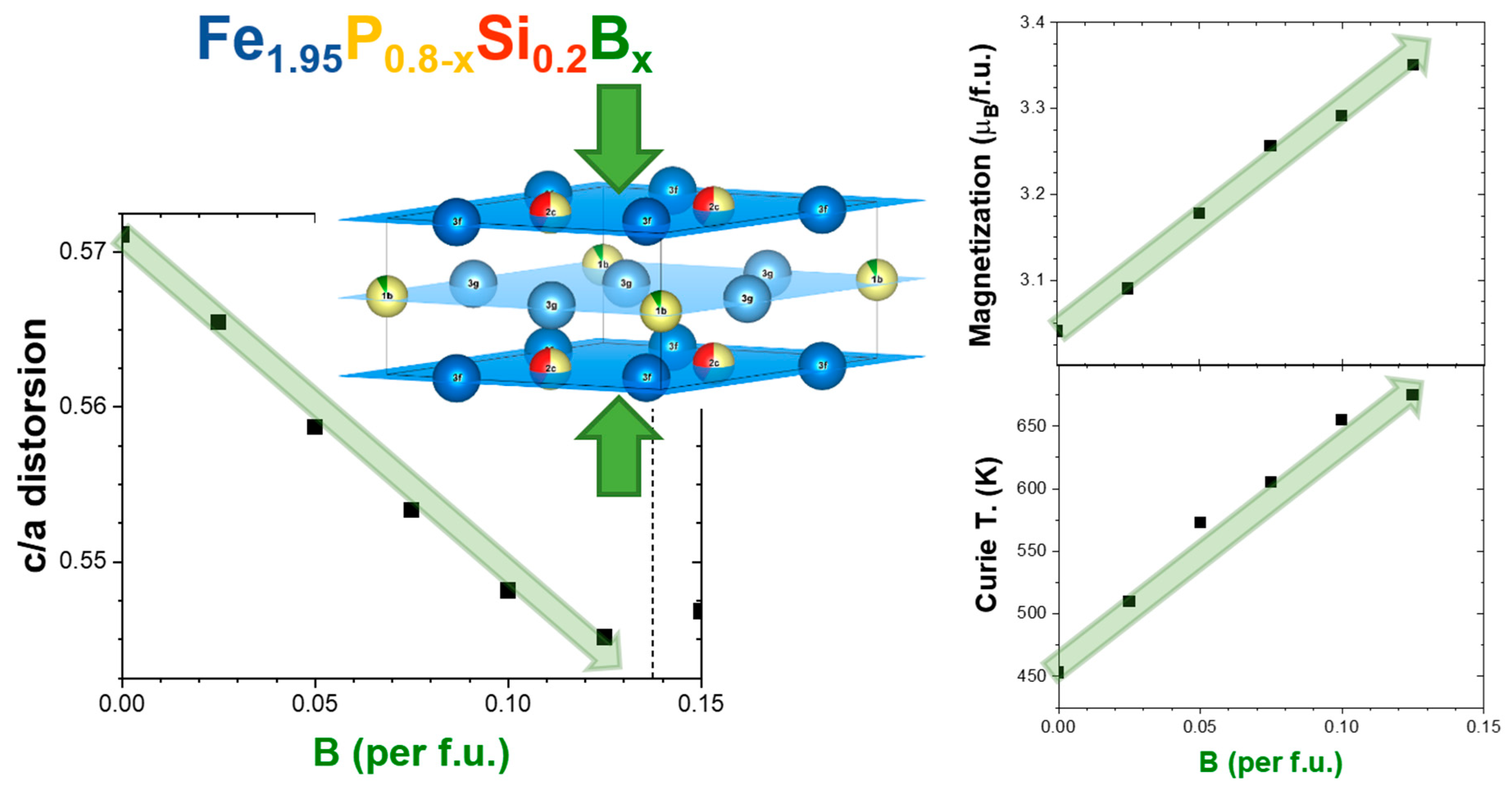
Graphical Abstract

1. Introduction

For two decades, compounds derived from Fe2P have attracted interest, owing to their giant magnetocaloric effect. The original representative example is the (Mn,Fe)2(P,As) system, which exhibits a giant isothermal entropy change associated with a first-order ferromagnetic transition with limited hysteresis [1]. This discovery established the (Mn,Fe)2(P,X) family with X = As, Si, Ge, B as a key class of magnetocaloric materials. In particular, Si-based variants have progressively replaced the toxic As-containing or critical Ge-based analogs as the primary focus of research in this field [2,3]. More recently, the growing interest in developing rare-earth-free permanent magnets has renewed attention toward Fe2P-type compounds, not for their phase transition, but for their unusually large magnetocrystalline anisotropy for a transition-metal-based compound.
Hard magnetic materials are indispensable functional materials and their importance will further increase with the global transition toward cleaner energy technologies. Currently, the market is dominated in volume by low-performance yet cost-competitive ferrites (e.g., BaFe12O19 or SrFe12O19) and in value by rare-earth-based magnets (mainly Nd-Fe-B or Sm-Co alloys), which exhibit particularly high |BH|max energy products. Concerns regarding the environmental impact and economic cost of rare earth elements have stimulated efforts to develop permanent magnets with reduced rare-earth content [4,5,6,7]. Although it remains challenging for rare-earth-free magnets to reach the performance of Nd–Fe–B or Sm–Co materials, one proposed strategy is the development of cost-competitive magnets with intermediate performance [7]. These “gap magnets” should be based on abundant raw materials, while also exceeding the performance of existing ferrite magnets. Several potential material families have been identified, some of which have attracted significant research interest, including Mn-based magnets such as MnAl and MnBi [8,9,10] and Co-based compounds such as Hf–Co and Zr–Co [11,12,13,14,15]. On the Fe-alloy side, most studies focus on α’’-Fe16N2 which offers great promise, in particular in terms of saturation magnetization, but its complex chemistry remains difficult to control [16,17,18]. Among other Fe-based materials, the Fe2P family stands out for its particularly large anisotropy [19]. However, the development of permanent magnets based on Fe2P is still at an early stage of research, due to compositions and preparation methods not yet fully optimized to achieve strong hard magnetic properties.
The Fe2P compound crystallizes in a hexagonal structure (space group P 6 ¯ 2 m ) and contains two inequivalent metal sites, 3f (xf, 0, 0) and 3g (xg, 0, 1/2), located in tetrahedron and pyramidal environments of P atoms, respectively, forming distinctive layers stacked along the c axis. Binary Fe2P is ferromagnetic with high magnetization and an easy magnetization axis along c [20]. However, the Curie temperature of 214 K is too low for permanent magnet applications.
Substitution at the Fe sites with elements like Ni or Co, or at the P sites with elements such as As, Si, or B, can effectively increase the Curie temperature. However, metal site substitutions often result in a reduction in saturation magnetization [21], while substitutions on P face solubility limits or induce the formation of competing crystal structures [22].
Predicted by theory and demonstrated in a preliminary polycrystalline study, simultaneous Co for Fe and Si for P substitutions maintain high saturation magnetization and uniaxial magnetocrystalline anisotropy, while significantly enhancing TC [23,24]. (Fe,Co)2(P,Si) single crystals have confirmed strong magnetocrystalline anisotropy for transition-metal compounds (K1 ≈ 0.9–1.1 MJ m−3 at room temperature) and a theoretical energy product of 165–204 kJ m−3 [25,26]. Submicrometric particles produced by ball milling have shown finite coercivities (HC of the order of 2 kOe) in quaternary (Fe,Co)2(P,Si), ternary Fe2(P,Si) or quaternary (Fe,Co)2(P,Si or B) compounds [24,27,28,29,30]. Despite recent progress, several challenges remain to be addressed. In particular, the preparation method is critically important for observing hard magnetic properties, as is also the case for other rare-earth-free magnets [31]. Such investigations would be facilitated in Fe2P materials if carried out on already optimized compositions.
Si for P substitutions are particularly effective at increasing both the Curie temperature and the saturation magnetization. Unfortunately, the stability window of the hexagonal Fe2P-type phase at room temperature remains limited to Si < 0.25 [28]. In quaternary (Fe,Co)2(P,Si,B), Co for Fe substitutions have been shown to extend the stability of the hexagonal structure toward higher Si contents [24]; however, this approach comes at the cost of reduced saturation magnetization due to the smaller magnetic moment of Co compared with Fe [32,33].
An alternative strategy is explored in the present work: introducing B for P substitutions in a Fe1.95P0.8−xSi0.2Bx composition deliberately selected at the upper Si limit of the hexagonal stability range, just before the hexagonal-to-orthorhombic structural transition occurs. The underlying hypothesis is that B substitution may enhance the Curie temperature without destabilizing the hexagonal structure or sacrificing magnetization of the Fe sites.
Previous studies involving B for P substitutions—whether in parent Fe2P, magnetocaloric MnFe(P,Si,B), or permanent-magnet candidate (Fe,Co)2(P,B)—have consistently reported an increase in Curie temperature [24,34,35]. However, these investigations were performed well within the hexagonal range and did not approach the orthorhombic boundary, where structural instability may critically influence magnetic properties. Therefore, a systematic study near this structural limit is required. In particular, understanding how B substitution affects the crystal structure, Curie temperature, magnetization, and the easy magnetic axis is essential for further developing Fe2(P,Si,B) compounds as rare-earth-free permanent magnets.

2. Materials and Methods

A series of Fe1.95P0.8−xSi0.2Bx (x = 0, 0.025, 0.05, 0.075, 0.10, 0.125, 0.15, and 0.20) compounds were prepared by ball milling followed by a solid-state reaction. The elemental starting materials, Fe powder (>99.9%), P powder (>98.9%), Si lump (>99.999%), and B (>99.5%) pieces (Thermo Scientific Chemicals, Waltham, MA, USA), were ball-milled in a stainless-steel jar using a high-energy planetary mill (Pulverisette 4, Fritsch, Idar-Oberstein, Germany) at 360 rpm, using a sample-to-ball mass ratio of 1:5. The resulting powder was then compacted in a die with an inner diameter of 10 mm and uniaxially pressed into cylindrical pellets under a load of 8 T. The pellets were then sealed in quartz ampoules backfilled with 200 mbar of Ar. The heat treatment consisted of a single annealing step at 1100 °C for 24 h, followed by quenching in water. The annealed samples were manually ground into powders and sieved with a particle size of less than 36 µm for powder X-ray diffraction and magnetic alignment. For the preparation of magnetically aligned samples, the polycrystalline powder was mixed with epoxy resin in a 1:1 mass ratio to form a highly diluted mixture. This mixture was shaped into plates with approximate dimensions of 15 × 30 × 2 mm3, aligned under a magnetic field of μ0H = 1.1 T, with the surface of the plate being perpendicular to the magnetic field direction.
Powder X-ray diffraction (XRD) experiments were performed on a Empyrean diffractometer (PANalytical, Malvern, UK) using Cu-Kα radiation over a 2θ range of 20° to 90°. The Rietveld method, implemented in the FullProf software package (April 2023 version), was employed for structural refinement [36]. Magnetic measurements were carried out using the Quantum Design (San Diego, CA, USA) Versalab and PPMS systems equipped with a vibrating sample magnetometer option. For high-temperature magnetic measurements (T > 400 K), a Lakeshore (Carson, CA, USA) 7407 VSM with a high-temperature furnace attachment was used. Differential scanning calorimetry was conducted on a TA Instruments (New Castle, DE, USA) DSC 2500, equipped with a liquid nitrogen cooling pump and using standard aluminum crucibles.
A second batch of x = 0.05 and 0.10 samples was prepared to check the reproducibility. The characterization of these samples and its comparison with the original main batch can be found in the Supplementary Materials. This second batch of samples confirmed the main dataset, particularly for critically important properties such as Curie temperature and saturation magnetization, showing only a few percent (<3%) difference compared to the first batch.

3. Results and Discussion

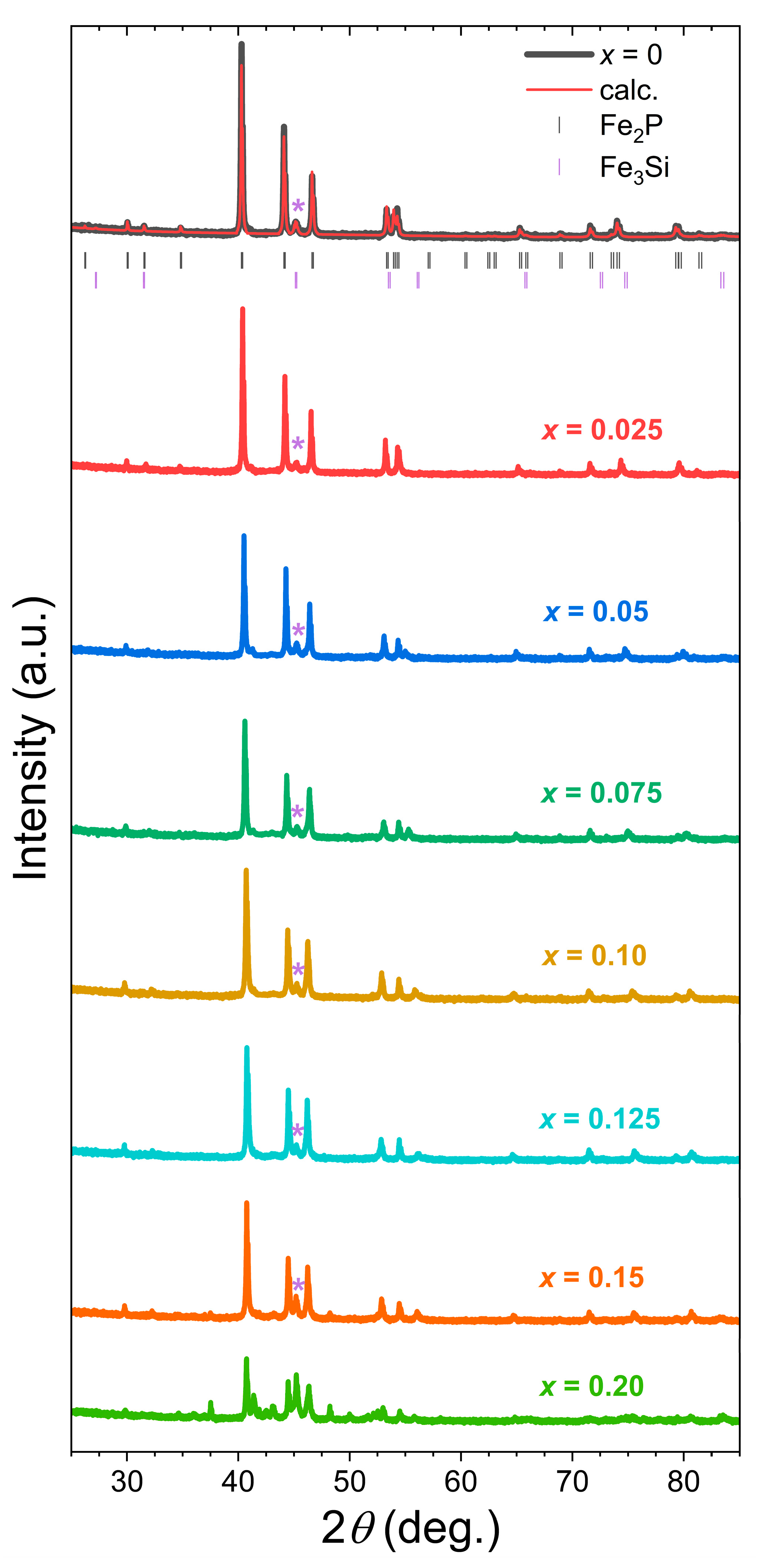
Figure 1 presents powder X-ray diffraction patterns for Fe1.95P0.8−xSi0.2Bx compounds with x = 0, 0.025, 0.05, 0.075, 0.10, 0.125, 0.15, and 0.20 recorded at room temperature. The refinement results confirm that the boron-free sample, Fe1.95P0.8Si0.2, crystallizes in the hexagonal Fe2P-type structure (space group P 6 ¯ 2 m ) , with a limited amount of secondary phase (4.6 (1) wt% of Fe3Si, space group F M 3 ¯ M ) . The main Fe2P-type phase is stable up to x = 0.125, and the Fe3Si phase content remains approximately constant at 4–5 wt% across the range 0 ≤ x ≤ 0.125. A small amount of 3:1 phase is rather common in this material family when prepared by a solid-state reaction and is primarily ascribable to the facilitated formation of Fe3Si around 900 °C. While its content can be minimized by quenching and reducing the nominal metal:metalloid ratio [24], its presence remains difficult to eliminate completely or requires high-rate quenching methods (e.g., drop synthesis or melt spinning) [37]. It is worth noting that while the formation of Fe3Si can reduce the Curie temperature by depleting Si from the main phase, this effect is expected to be limited along our series since the Fe3Si content does not vary within the solid-solution range of B (0 ≤ x ≤ 0.125). Consequently, the observed evolution of the structure and properties can be primarily attributed to the boron substitutions themselves. Starting at x = 0.15 and most particularly noticeable at x = 0.20, one observes the appearance of additional diffraction peaks marking out the appearance of new phases and therefore the solubility limit for B in Fe1.95P0.8−xSi0.2Bx. While a refinement could not be performed for x = 0.20, phase identification suggested the coexistence of hexagonal Fe2P, cubic Fe3Si, hexagonal Fe5Si3 and possibly BCO Fe2P phases. For x ≤ 0.125, upon increasing the B content, the (300) diffraction peak progressively shifts to lower angles (from 53.3° to ~52.8°), while the (002) peak shifts to higher angles (from 53.9° to ~56.2°), indicating a concurrent expansion of the a axis and the most pronounced contraction of the c axis.
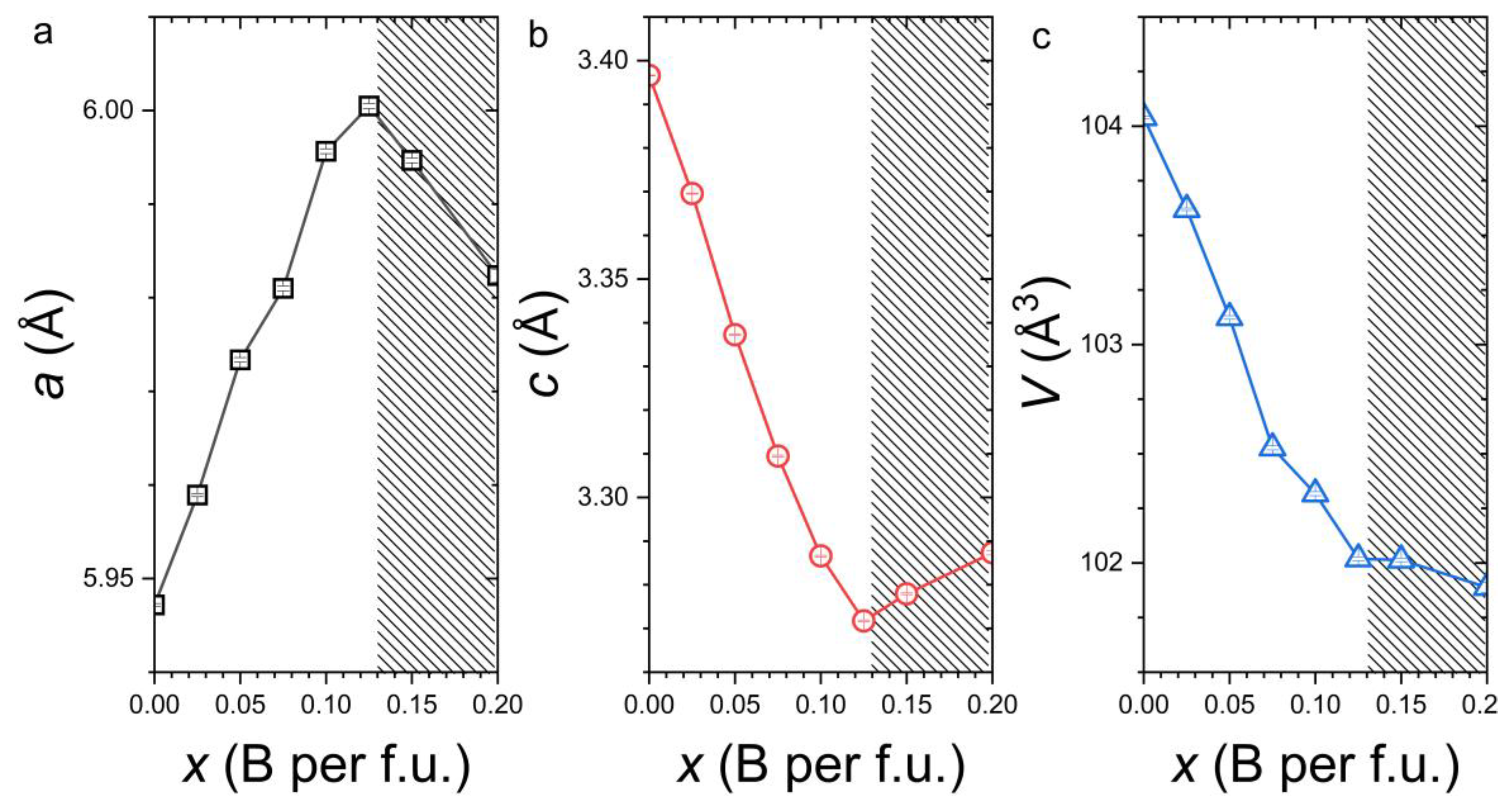
Figure 2 shows the unit cell volume and lattice parameters of the Fe2P-type main phase as determined by Rietveld refinement (presented in the Supplementary Materials). For the boron-free sample (x = 0), the refined lattice parameters differ slightly but remain within the range previously reported for off-stoichiometric Fe1.95P0.8Si0.2 [28].
Upon boron substitution, a progressive decrease in unit cell volume is observed, which directly reflects the smaller radius of B compared to P and indicates that B is effectively incorporated on the P sublattice. We note that while XRD is poorly sensitive to light elements, the possibility of B for P substitutions in the Fe2P-type structure was confirmed by neutron diffraction in MnFe(P,Si,B) magnetocaloric compounds [38]. The volume contraction nearly follows Vegard’s law and aligns with trends reported in related systems, including Fe2(P,B) ternary, MnFe(P,Si,B), and Fe1.8Co0.2(P,B) quaternary compounds [24,34,35]. Despite the significant differences in composition and lattice parameters among these host compounds, the boron solubility limit consistently lies around x ≈ 0.10–0.15. This convergence strongly suggests that the B solubility in Fe2P compounds is not primarily dictated by the host phase, but rather by Hume–Rothery constraints, namely the combined effects of atomic size mismatch and valence differences between B and P.
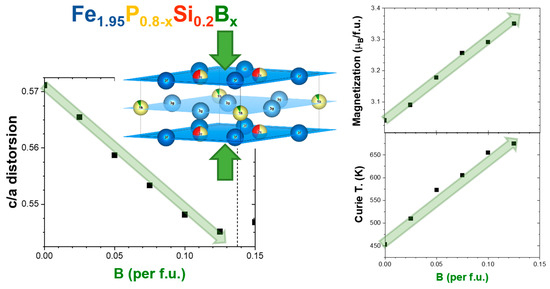
With increasing B content, a pronounced reduction in the c/a ratio is observed, decreasing from 0.571 to 0.545 as x increases from 0 to 0.125. This anisotropic lattice response indicates that boron substitution primarily affects the interlayer spacing along the c direction rather than producing an isotropic contraction of the lattice. Importantly, and in contrast to (Fe,Co)2(P,Si) compounds with Si > 0.2, this reduction in the c/a ratio can be achieved solely through metalloid substitution while preserving the hexagonal Fe2P structure. Such an isostructural evolution effectively brings the Fe 3f and 3g layers closer together.
It is particularly noteworthy that B substitution introduces a larger change in electron count than Si substitution while simultaneously driving the c/a ratio to lower values, yet no hexagonal-to-orthorhombic structural transition occurs. This observation indicates that electronic effects alone cannot account for the stabilization of the orthorhombic phase. Instead, it suggests that an average size factor plays a role in driving the structural instability toward the orthorhombic phase. This interpretation is consistent with the evolution observed in (Fe,Co)2(P,Si), where substitution of the smaller Co atom for Fe compensates the lattice expansion induced by Si and thereby stabilizes the hexagonal structure beyond the stability limit of the ternary Fe2(P,Si) system.
However, a purely size-based argument is insufficient to fully explain the structural behavior of Fe2P-derived systems. In the Fe2(P,As) series, isoelectronic substitution of As for P results in a significantly larger unit cell expansion than that observed in Fe2(P,Si), yet the orthorhombic phase still does not develop [39]. This comparison indicates that the orthorhombic distortion is not triggered solely by lattice expansion. Instead, the emergence of the orthorhombic phase most likely requires the simultaneous fulfillment of two structural conditions: a sufficiently large unit cell volume together with a strongly reduced c/a ratio. Conversely, if either of these conditions is not satisfied, the hexagonal Fe2P structure remains stable, as appears to be the case throughout the present Fe1.95P0.8−xSi0.2Bx series with x < 0.15.
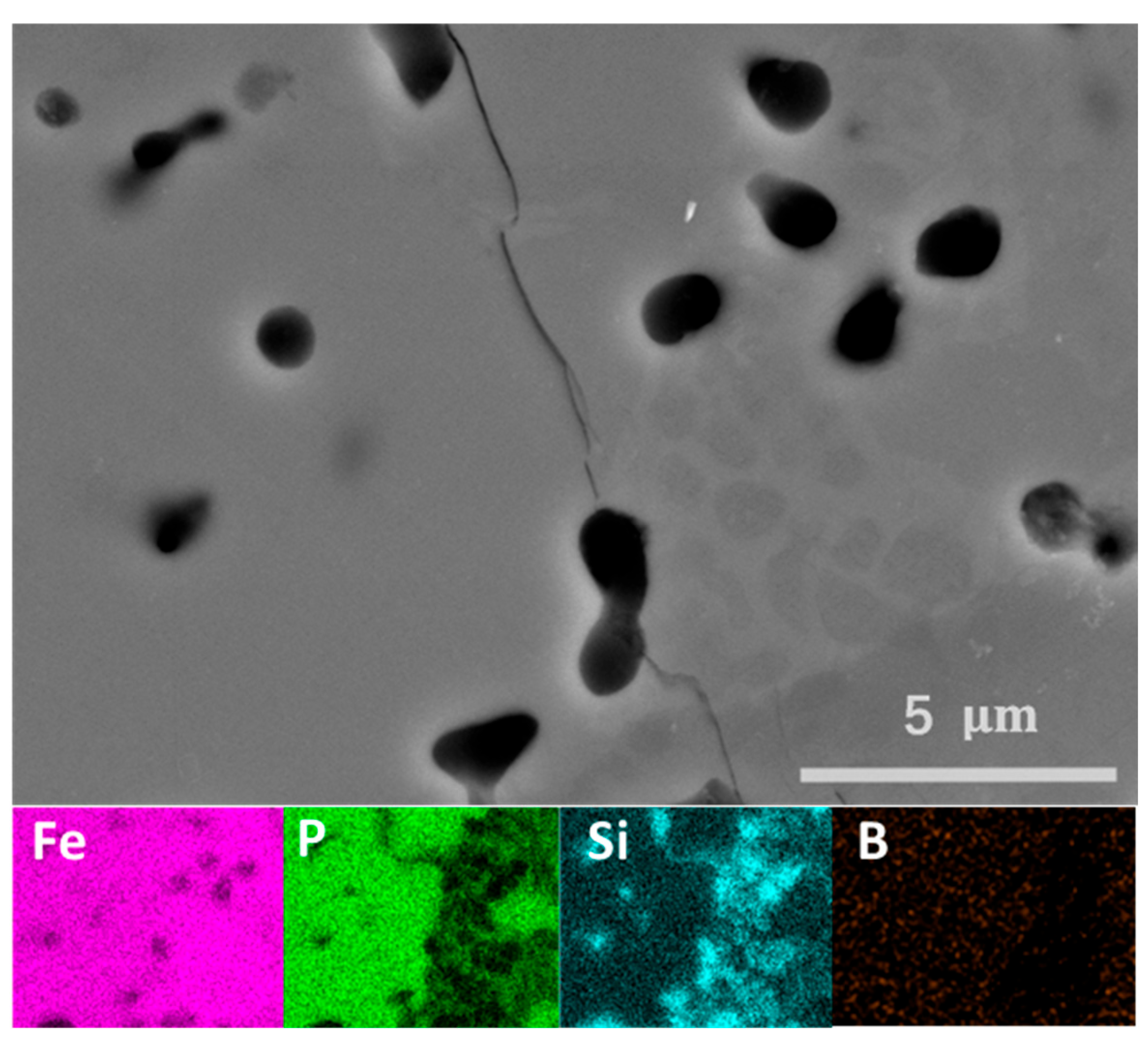
Electron microscopy and energy-dispersive X-ray analyses were carried out for several representative samples of the Fe1.95P0.8−xSi0.2Bx series. Figure 3 illustrates the result for x = 0.05. The effective composition of the main phase presents an experimental Fe:(P,Si) ratio of 2.09, reasonably close to the nominal one of 2.05. Small inclusions of a darker phase are observed and their Fe:(P,Si) ratio of 3.11 is reasonably close to that expected for the Fe3Si secondary phase. SEM/EDX data therefore provides support to the interpretation of the XRD patterns on the presence of a limited secondary phase close to Fe3Si in nature. Elemental mapping for boron shows that it is relatively well distributed within the main phase for x ≤ 0.125. Although boron is detected by EDX, its low fluorescence energy compared to that of P, Si, or Fe prevents reliable quantitative determination of its content. The composition of additional secondary phases appearing for x ≥ 0.15 could not be resolved. Nevertheless, imaging reveals the presence of extra contrast variations, indicating a multiphase nature of the samples above the solubility limit, in agreement with the XRD results.
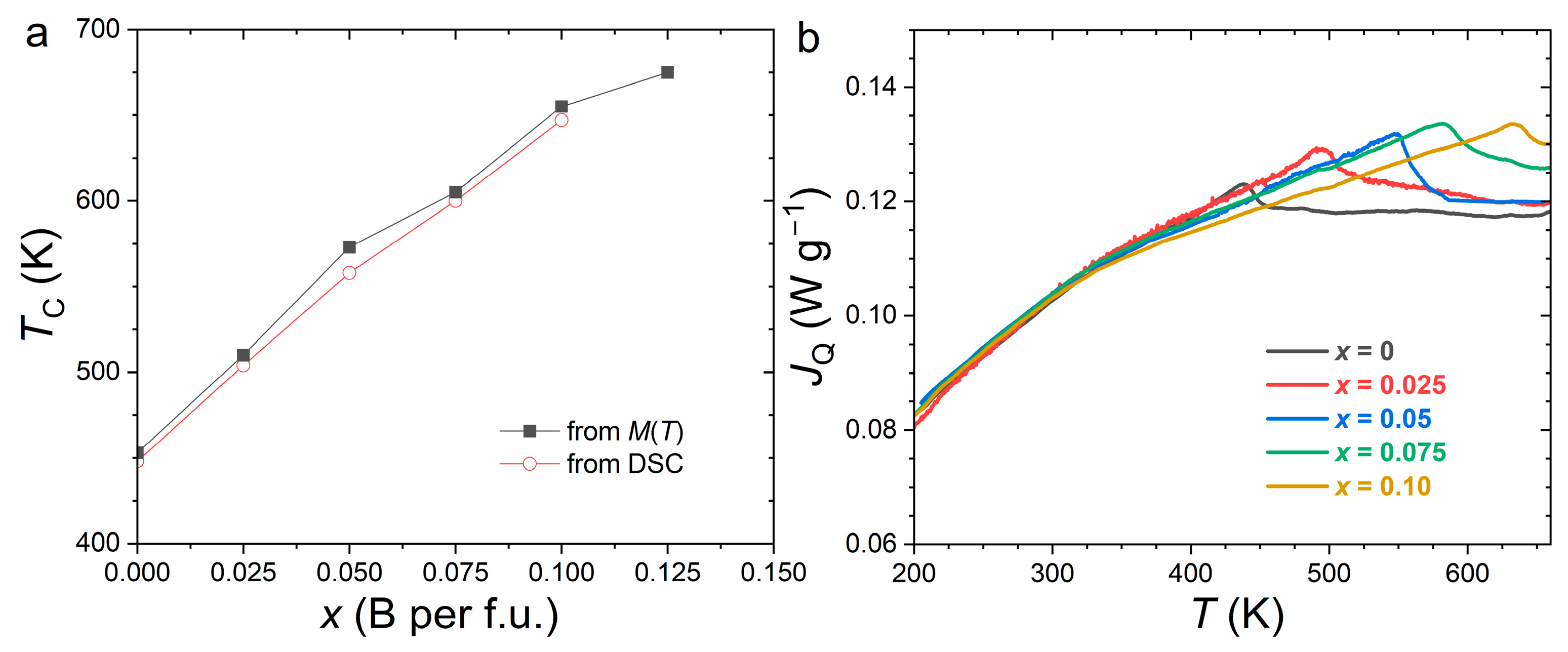
Figure 4 summarizes the evolution of the Curie temperature (TC) determined from isofield magnetization (applied field µ0H = 0.05 T) and DSC (H = 0) measurements carried out as a function of the temperature. Both datasets are in good agreement and consistently indicate a rapid increase in the Curie temperature with increasing B substitution. The nearly constant discrepancy of ~5 K between the two methods can likely be attributed to small differences in the thermal calibration of the respective instruments as well as to the different criteria used to define TC (dM/dT minimum or right-hand side of DSC peak). The thermal anomalies associated with the magnetic transition remain weak and broad, which is characteristic of a second-order magnetic transition in the Ehrenfest classification. Moreover, no additional thermal anomaly—particularly, no strong DSC signal indicative of a temperature-induced structural transition—was detected within the investigated 200–673 K temperature range. The Fe3Si secondary phase is ferromagnetic, with a high Curie temperature (≈805 K) and low magnetic anisotropy; therefore, its presence does not interfere with determining the TC of the primary phase.
With increasing B content, the TC rises from 453 K in the boron-free compound to 675 K at x = 0.125, corresponding to an average rate of increase dTC/dx ≈ +18 K per at.% B. This enhancement of the Curie temperature is comparable to that reported for the ternary Fe2(P,B) system (~+15 K per at.% B) [34], and significantly larger than that observed in quaternary (Fe,Co)2(P,B) (~+6 K per at.% B) [24] and (Mn,Fe)2(P,Si,B) systems (~+10 K per at.% B) [35].
The particularly strong sensitivity of the TC to B substitution can be rationalized by the pronounced anisotropic lattice deformation induced by B incorporation, which primarily reduces the c/a ratio while preserving the hexagonal Fe2P structure. Such a reduction in the interlayer spacing between the 3f and 3g Fe layers is expected to strengthen the interlayer exchange interactions, thereby stabilizing the ferromagnetic state and leading to a substantial increase in the TC [22,32].
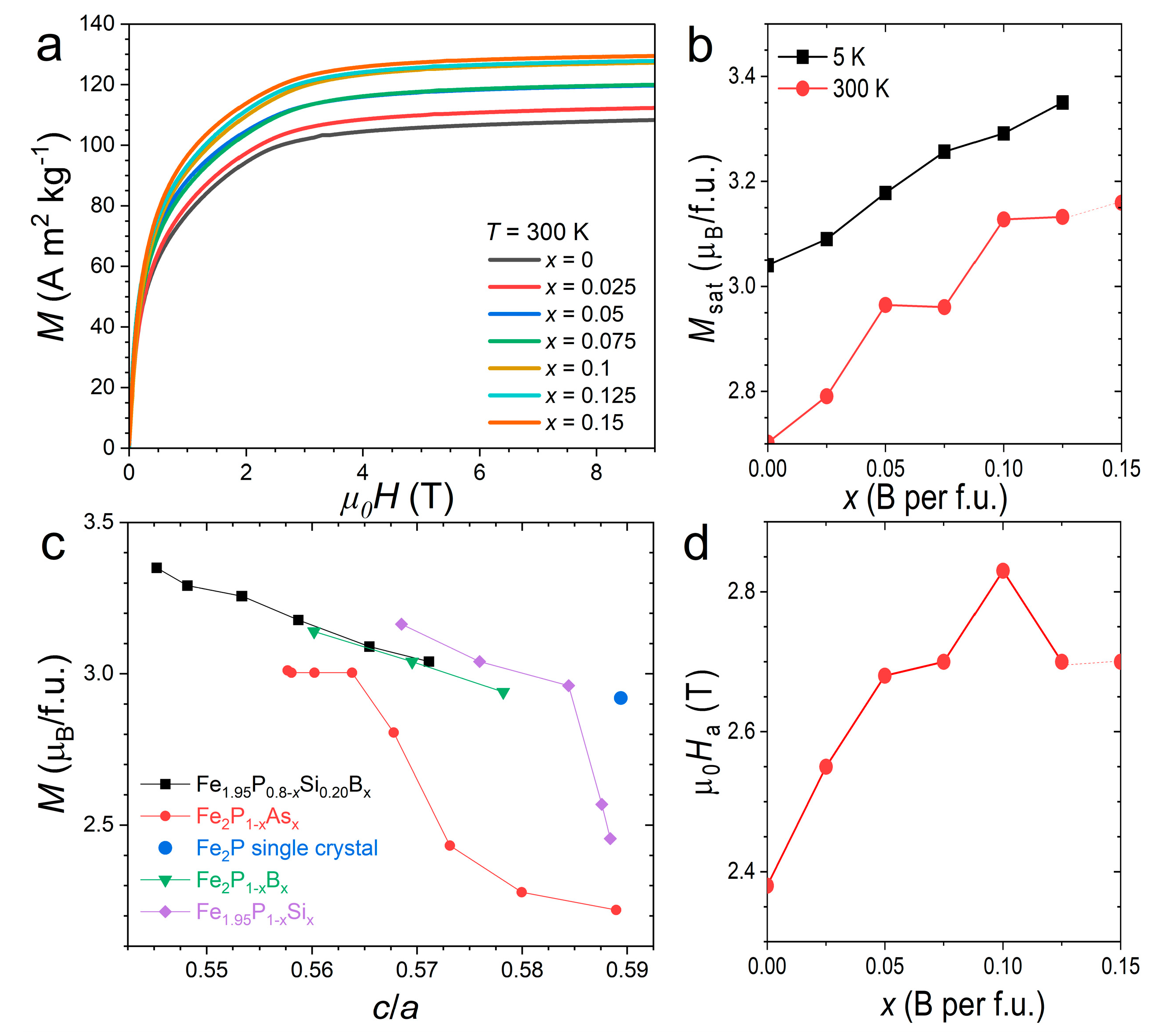
Figure 5 presents isothermal magnetization measurements performed at T = 5 K and 300 K in an applied magnetic field up to µ0H = 9 T. First, a clear increase in saturation magnetization is observed upon B substitution. For the highest B content before reaching the solubility limit (x = 0.125), the magnetization reaches 3.36 µB/f.u., which is significantly larger than that of the parent compound Fe2P (2.92 µB/f.u. [20]). Considering a theoretical density of 6.60, this corresponds to a maximum polarization of J ≈ 1.15 T. When comparing different metalloid substitutions, the Fe1.95P0.8−xSi0.2Bx series follows the usual trend in which smaller c/a ratios stabilize larger magnetic moments, in particular on the 3f site. However, the large dispersion in reported magnetization values, arising from the difficulty of synthesizing pure Fe2P and the limited number of experimental studies focusing solely on metalloid substitutions, makes it difficult to assess a universal scaling relationship between magnetization and structural distortion.
We note that these results confirm the first-principle calculations for Fe2P2/3B1/3, which predict that B substitution leads to an increased magnetic moment [40]. However, this observation partly contrasts with results reported for the magnetocaloric (Mn,Fe)2(P,Si,B) series, where B substitution was reported to preserve the saturation magnetization [35], and where first-principle calculations do not predict an increase in the magnetic moment [41]. This discrepancy is likely related to differences in structural evolution, particularly in the c/a ratio. In the (Mn,Fe)2(P,Si,B) series, B substitution significantly decreases the c/a ratio in the paramagnetic phase, whereas in the present Fe1.95(P,Si,B) series the structure of the ferromagnetic state is primarily affected.
At room temperature, the increase in maximum magnetization at µ0H = 9 T with B is even more noticeable, as it benefits from both the increase in saturation magnetization and the higher Curie temperature. In bulk polycrystalline samples with randomly oriented grains, relatively large magnetic fields are required to saturate the magnetization, which is typical of ferromagnetic materials exhibiting significant magnetocrystalline anisotropy. The anisotropy field (Ha) was estimated using the Single-Point Detection (SPD) method, in which Ha appears as a minimum on the d2M/dH2 curve [42]. An overall increase in Ha is observed with increasing B content. Interestingly, the highest anisotropy at room temperature is obtained for compositions slightly below the solubility limit, suggesting that the anisotropy at finite temperatures results from a compromise between the enhanced Curie temperature and the reduction in the ground-state anisotropy with increasing B content.
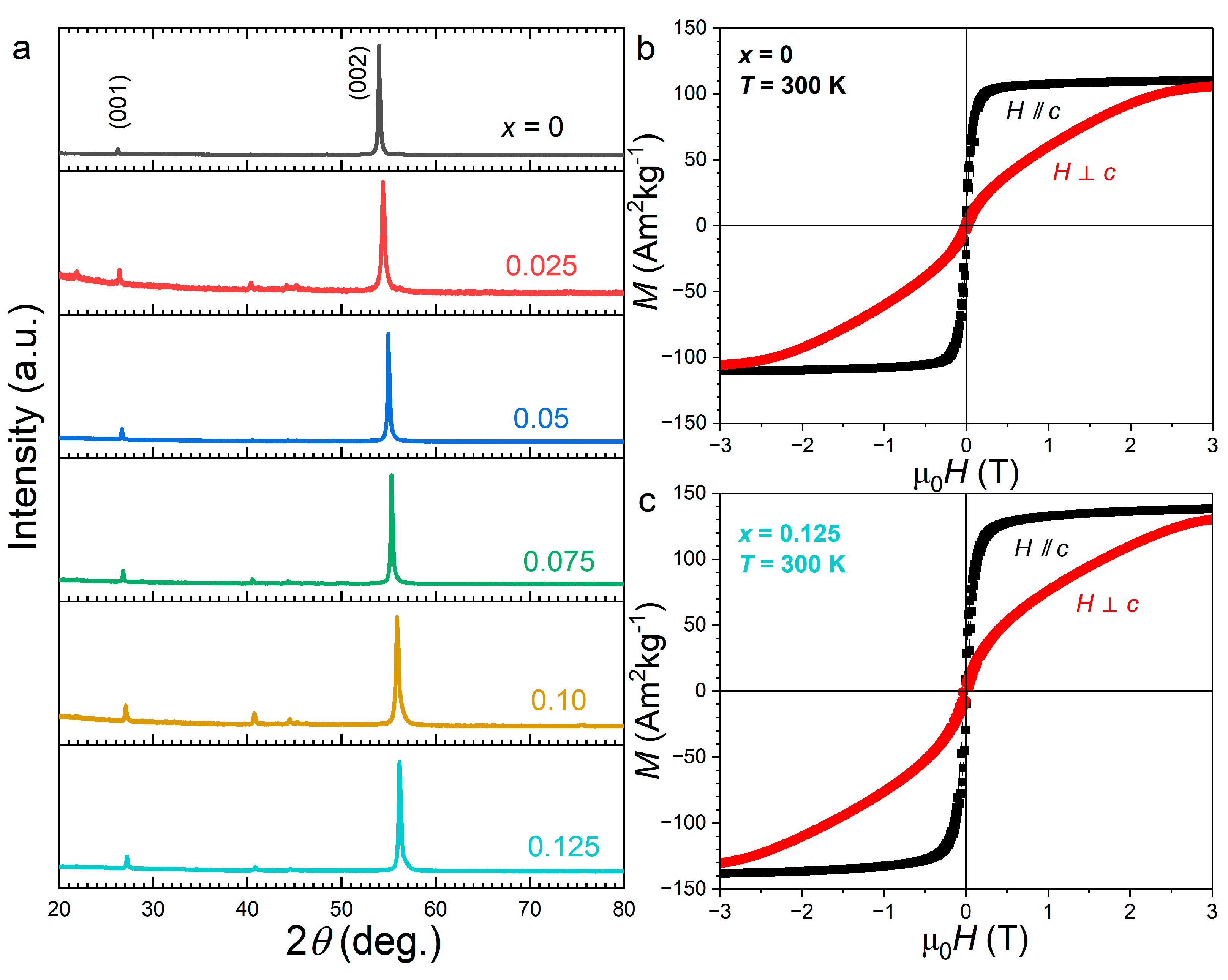
Figure 6 displays room-temperature XRD patterns recorded on magnetically oriented Fe1.95P0.8−xSi0.2Bx powders and embedded in epoxy. The diffractograms present a stark contrast compared to the random powders presented in Figure 1, with the most prominent (001) and (002) diffraction peaks aligned along the direction of the magnetic field used for orientation. This indicates that the c axis is the easy magnetic direction in this Fe1.95P0.8−xSi0.2Bx series, even up to the highest achievable B content before the solubility limit. The clear shift in the (002) peaks to higher angles with B confirms the c axis contraction which is responsible for most of the evolution of the magnetic properties.
Magnetization curves were recorded with the magnetic field applied parallel and perpendicular to the orientation direction, confirming significant magnetic anisotropy. Comparison between the boron-free sample and the x = 0.125 composition confirms the increase in both the room-temperature saturation magnetization and the anisotropy, with the parallel and perpendicular measurements merging near µ0Ha ≈ 2.5 T for x = 0 and 3 T for x = 0.125. The pronounced rounding of the perpendicular magnetization curves, however, suggests that the orientation process was only partial and may also include a contribution from the ferromagnetic Fe3Si secondary phase, which exhibits low anisotropy. Therefore, further quantitative investigations of magnetocrystalline anisotropy will require the growth of single crystals.
Bulk polycrystalline samples and 36 μm-sized powder particles do not exhibit significant magnetic hysteresis. This observation is consistent with previous single-crystal and polycrystalline studies, which showed that specific preparation methods, such as reducing the particle size to the submicrometric scale, are required to observe hysteresis [25]. This possibility was confirmed by milling a Fe1.95P0.675Si0.2B0.125 bulk polycrystalline sample for 5 h into fine particles (details in the Supplementary Materials). The resulting coercive field of about 1 kOe at room temperature is comparable to previous reports [25,27,29]. It remains, however, significantly smaller than the anisotropy field and the low HC/Ha ≈ 3.5% ratio suggests that further microstructural engineering will be required to convert the large magnetization, strong anisotropy, and high Curie temperature into effective hard magnetic properties.

4. Conclusions

The crystal structure and magnetic properties of quaternary Fe1.95P0.8−xSi0.2Bx compounds were systematically investigated. A solubility limit is observed for x > 0.125, which is close to that previously reported in ternary Fe2(P,B) and quaternary (Fe,Co)2(P,B) or quinternary (Mn,Fe)2(P,Si,B) compounds. This suggests that the host Fe2P-type compound has little influence on the solubility limit and that B incorporation is primarily governed by Hume–Rothery considerations, i.e., the size and valence differences between B and P. Even in already Si-substituted Fe1.95P0.8−xSi0.2Bx samples located near the orthorhombic phase boundary, B for P substitutions remain effective in producing a significant reduction in cell volume, which is highly anisotropic with a strongly reduced c/a ratio, significantly influencing magnetic properties.
From the perspective of optimizing the intrinsic properties of Fe2P-based compounds for permanent magnet applications, B substitution increases the Curie temperature up to 675 K at x = 0.125 while preserving the hexagonal structure and the uniaxial easy axis along the c direction. At the same time, the saturation magnetization increases, resulting in enhanced magnetization and magnetic anisotropy at room temperature, which highlights the potential of quaternary Fe1.95P0.8−xSi0.2Bx compounds as rare-earth-free permanent magnets. Importantly, this substitution strategy enables high Curie temperatures while maintaining the hexagonal Fe2P structure without requiring substitutions on the Fe sublattice.
This work also raises new questions that warrant further investigation. While B for P substitutions increase the Curie temperature in both the present Fe1.95(P,Si,B) series and the giant magnetocaloric (Mn,Fe)2(P,Si,B) materials, only in the former is a significant increase in magnetization observed. This difference calls for dedicated theoretical and experimental investigations. A more accurate determination of the magnetocrystalline anisotropy based on single crystals would also be required, particularly to compare the effects of changes in electron count associated with B for P or Co for Fe substitutions on the anisotropy, and to confirm whether a metalloid-only substitution strategy is indeed the most effective. Finally, achieving hard magnetic properties will require the development of specific microstructures and preparation routes, a task that can be advantageously pursued using the optimized compositions identified in this work.

Supplementary Materials

The following supporting information can be downloaded at: https://www.mdpi.com/article/10.3390/ma19081579/s1, Figure S1: XRD Rietveld refinements; Figure S2: Magnetic data for a second independent batch of Fe1.95P0.8−xSi0.2Bx samples with x = 0.05 and 0.10; Figure S3: Magnetic hysteresis of ball milled Fe1.95P0.675Si0.2B0.125 powders.

Author Contributions

Conceptualization, F.G. and H.Y.; methodology, F.G.; investigation, B.D., L.B., B.A., B.W. and Z.S.; resources, F.G., H.Y. and B.W.; data curation, B.D. and F.G.; writing—original draft preparation, B.D.; writing—review and editing, F.G.; visualization, B.D. and F.G.; supervision, B.W., F.G. and H.Y.; funding acquisition, F.G. and H.Y. All authors have read and agreed to the published version of the manuscript.

Funding

This research was funded by the National Natural Science Foundation of China, grant numbers 52461036 and 12464015; by the program for young talents of science and technology in the Universities of Inner Mongolia autonomous region, grant number NJYT23107; by the French government, managed by the Agence Nationale de la Recherche under the France 2030 programme, under the reference ANR-23-EXES-0001; by the Normandy region, AIMFER project; and by a CPJ project.

Data Availability Statement

The original contributions presented in this study are included in the article. Further inquiries can be directed to the corresponding author.

Conflicts of Interest

The authors declare no conflicts of interest.

References

  1. Tegus, O.; Brück, E.; Buschow, K.H.J.; de Boer, F.R. Transition-metal-based magnetic refrigerants for room-temperature applications. Nature 2002, 415, 150–152. [Google Scholar] [CrossRef]
  2. Ho, K.Y.; Zhang, F.Q.; Miao, X.F.; van Dijk, N.H.; Brück, E.; Ren, Y. Recent Progress in Magnetoelastic Fe2P-type Materials for Magnetocaloric Cooling. MetalMat 2025, 2, e70012. [Google Scholar] [CrossRef]
  3. Niu, J.; Zheng, Z.; Wang, H. Improved Wide-Temperature-Range Magnetocaloric Properties of (Mn,Fe)2(P,Si) Alloys by Mg-Co Co-Doping. Magnetochemistry 2026, 12, 17. [Google Scholar] [CrossRef]
  4. Jones, N. Materials science: The pull of stronger magnets. Nature 2011, 472, 22–23. [Google Scholar] [CrossRef]
  5. Gutfleisch, O.; Willard, M.A.; Brück, E.; Chen, C.H.; Sankar, S.G.; Liu, J.P. Magnetic Materials and Devices for the 21st Century: Stronger, Lighter, and More Energy Efficient. Adv. Mater. 2011, 23, 821–842. [Google Scholar] [CrossRef]
  6. Cui, J.; Kramer, M.; Zhou, L.; Liu, F.; Gabay, A.; Hadjipanayis, G.; Balasubramanian, B.; Sellmyer, D. Current progress and future challenges in rare-earth-free permanent magnets. Acta Mater. 2018, 158, 118–137. [Google Scholar] [CrossRef]
  7. Coey, J.M.D. Perspective and Prospects for Rare Earth Permanent Magnets. Engineering 2020, 6, 119–131. [Google Scholar] [CrossRef]
  8. Shafeie, S.; Fang, H.; Hedlund, D.; Nyberg, A.; Svedlindh, P.; Gunnarsson, K.; Sahlberg, M. One step towards MnAl-based permanent magnets—Differences in magnetic, and microstructural properties from an intermediate annealing step during synthesis. J. Solid State Chem. 2019, 274, 229–236. [Google Scholar] [CrossRef]
  9. Jensen, B.A.; Tang, W.; Liu, X.; Nolte, A.I.; Ouyang, G.; Dennis, K.W.; Cui, J. Optimizing composition in MnBi permanent magnet alloys. Acta Mater. 2019, 181, 595–602. [Google Scholar] [CrossRef]
  10. Jia, Y.; Wu, Y.; Xu, Y.; Zheng, R.; Zhao, S.; Skokov, K.P.; Maccari, F.; Aubert, A.; Gutfleisch, O.; Wang, J.; et al. Roadmap towards optimal magnetic properties in L10-MnAl permanent magnets. Acta Mater. 2023, 245, 118654. [Google Scholar] [CrossRef]
  11. Gabay, A.M.; Zhang, Y.; Hadjipanayis, G.C. Cobalt-rich magnetic phases in Zr–Co alloys. J. Magn. Magn. Mater. 2001, 236, 37–41. [Google Scholar] [CrossRef]
  12. Wang, T.; Zhou, C.; Zhang, Z.; Liao, M.; Sun, C. The impacts of operating pressure on the structural and magnetic properties of HfCo7 nanoparticles synthesized by inert gas condensation. Chem. Phys. Lett. 2019, 721, 18–21. [Google Scholar] [CrossRef]
  13. Sewak, R.; Dey, C.C.; Toprek, D. Ferromagnetism in intermetallic Hf6Co23 alloy. J. Magn. Magn. Mater. 2021, 534, 168042. [Google Scholar] [CrossRef]
  14. Oraon, A.; Adhikary, T.; Tirugabathina, M.; Kumar, B.; Ghosh, S.; Aich, S. Microstructure and magnetic properties of Co82–(x+y)Zr13V5BxSiy melt-spun ribbons. J. Alloys Compd. 2023, 965, 171436. [Google Scholar] [CrossRef]
  15. Miranda, A.; Betancourt, I. Magnetic Properties and Coercivity Mechanism of Nanocrystalline Rare-Earth-Free Co74Zr16Mo4Si3B3 Alloys. Magnetochemistry 2025, 11, 78. [Google Scholar] [CrossRef]
  16. Kim, T.K.; Takahashi, M. New Magnetic Material Having Ultrahigh Magnetic Moment. Appl. Phys. Lett. 1972, 20, 492–494. [Google Scholar] [CrossRef]
  17. Saito, T.; Yamamoto, H.; Nishio-Hamane, D. Production of Rare-Earth-Free Iron Nitride Magnets (α″-Fe16N2). Metals 2024, 14, 734. [Google Scholar] [CrossRef]
  18. Grigoras, M.; Lostun, M.; Porcescu, M.; Stoian, G.; Lupu, N. Microstructural and Magnetic Evolution of α″-Fe16N2 Bulk Magnets Consolidated by Spark Plasma Sintering. Crystals 2025, 15, 969. [Google Scholar] [CrossRef]
  19. Mohapatra, J.; Liu, X.; Joshi, P.; Liu, J.P. Hard and semi-hard Fe-based magnetic materials. J. Alloys Compd. 2023, 955, 170258. [Google Scholar] [CrossRef]
  20. Lundgren, L.; Tarmohamed, G.; Beckman, O.; Carlsson, B.; Rundqvist, S. First Order Magnetic Phase Transition in Fe2P. Phys. Scr. 1978, 17, 39–48. [Google Scholar] [CrossRef]
  21. Fruchart, R.; Roger, A.; Senateur, J.P. Crystallographic and Magnetic Properties of Solid Solutions of the Phosphides M2P, M = Cr, Mn, Fe, Co, and Ni. J. Appl. Phys. 1969, 40, 1250–1257. [Google Scholar] [CrossRef]
  22. Delczeg-Czirjak, E.K.; Gercsi, Z.; Bergqvist, L.; Eriksson, O.; Szunyogh, L.; Nordblad, P.; Johansson, B.; Vitos, L. Magnetic exchange interactions in B-, Si-, and As-doped Fe2P from first-principles theory. Phys. Rev. B 2012, 85, 224435. [Google Scholar] [CrossRef]
  23. Zhuravlev, I.A.; Antropov, V.P.; Vishina, A.; van Schilfgaarde, M.; Belashchenko, K.D. Tunable dimensional crossover and magnetocrystalline anisotropy in Fe2P-based alloys. Phys. Rev. Mater. 2017, 1, 051401. [Google Scholar] [CrossRef]
  24. Guillou, F.; Sun, L.; Haschuluu, O.; Ou, Z.Q.; Brück, E.; Tegus, O.; Yibole, H. Room temperature magnetic anisotropy in Fe2P-type transition metal based alloys. J. Alloys Compd. 2019, 800, 403–411. [Google Scholar] [CrossRef]
  25. Yibole, H.; Bao, L.; Xu, J.Y.; Alata, H.; Tegus, O.; Hanggai, W.; van Dijk, N.H.; Brück, E.; Guillou, F. (Fe,Co)2(P,Si) rare-earth free permanent magnets: From macroscopic single crystals to submicron-sized particles. Acta Mater. 2021, 221, 117388. [Google Scholar] [CrossRef]
  26. He, Y.; Adler, P.; Schneider, S.; Soldatov, I.; Mu, Q.; Borrmann, H.; Schnelle, W.; Schaefer, R.; Rellinghaus, B.; Fecher, G.H.; et al. Intrinsic Magnetic Properties of a Highly Anisotropic Rare-Earth-Free Fe2P-Based Magnet. Adv. Funct. Mater. 2022, 32, 2107513. [Google Scholar] [CrossRef]
  27. Uyanga, E.; Ochirkhuyag, T.; Jargalan, N.; Sodkhuu, D.; Zhang, B.; Park, J.H.; Delgermaa, M.; Odbadrakh, K.; Odkhuu, D. Fe2P based alloys as possible rare-earth free permanent magnets. Acta Mater. 2025, 289, 120848. [Google Scholar] [CrossRef]
  28. Surilemu, Z.; Bao, L.L.; Yibole, H.; Erdmann, S.; Sözen, H.İ.; Klüner, T.; Guillou, F. Structure, phase transitions and hard magnetic properties of ternary Fe1.93(P1−xSix) compounds with x ≤ 0.5. Acta Mater. 2025, 291, 120991. [Google Scholar] [CrossRef]
  29. Panagopoulos, V.; Sigalos, A.; Anyfantis, D.I.; Niarchos, D. Substitutions in Fe2P Alloys for Permanent Magnet Applications. Materials 2025, 18, 1085. [Google Scholar] [CrossRef] [PubMed]
  30. Yiderigu, J.; Yibole, H.; Bao, L.; Bao, L.; Guillou, F. Optimizing the Sintering Conditions of (Fe,Co)1.95(P,Si) Compounds for Permanent Magnet Applications. Materials 2024, 17, 2476. [Google Scholar] [CrossRef]
  31. Scheiber, D.; Bachmaier, A. Recent Advancements in Bulk Processing of Rare-Earth-Free Hard Magnetic Materials and Related Multiscale Simulations. Adv. Eng. Mater. 2025, 28, e202502032. [Google Scholar] [CrossRef]
  32. Erdmann, S.; Sözen, H.İ.; Guillou, F.; Yibole, H.; Klüner, T. Theoretical and experimental investigations on Fe2P-type magnets: Effects of Si and Co substitution on physical and magnetic properties. Phys. Rev. Mater. 2024, 8, 094401. [Google Scholar] [CrossRef]
  33. Erdmann, S.; Sözen, H.İ.; Klüner, T. Ab Initio Investigation on the Magnetic Moments, Magnetocrystalline Anisotropy and Curie Temperature of Fe2P-Based Magnets. Magnetism 2025, 5, 14. [Google Scholar] [CrossRef]
  34. Chandra, R.; Bjarman, S.; Ericsson, T.; Häggström, L.; Wilkinson, C.; Wäppling, R.; Andersson, Y.; Rundqvist, S. A Mössbauer and X-ray study of Fe2P1−xBx compounds (x < 0.15). J. Solid State Chem. 1980, 34, 389–396. [Google Scholar] [CrossRef]
  35. Guillou, F.; Yibole, H.; van Dijk, N.H.; Brück, E. Effect of boron substitution on the ferromagnetic transition of MnFe0.95P2/3Si1/3. J. Alloys Compd. 2015, 632, 717–722. [Google Scholar] [CrossRef]
  36. Rodríguez-Carvajal, J.; González-Platas, J.; Katcho, N.A. Magnetic structure determination and refinement using FullProf. Acta Crystallogr. B Struct. Sci. 2025, 81, 302–317. [Google Scholar] [CrossRef] [PubMed]
  37. Höglin, V.; Cedervall, J.; Andersson, M.S.; Sarkar, T.; Hudl, M.; Nordblad, P.; Andersson, Y.; Sahlberg, M. Phase diagram, structures and magnetism of the FeMnP1−xSix-system. RSC Adv. 2015, 5, 8278–8284. [Google Scholar] [CrossRef]
  38. Miao, X.F.; Thang, N.V.; Caron, L.; Yibole, H.; Smith, R.I.; van Dijk, N.H.; Brück, E. Tuning the magnetoelastic transition in (Mn,Fe)2(P,Si) by B, C, and N doping. Scr. Mater. 2016, 124, 129–132. [Google Scholar] [CrossRef]
  39. Catalano, A.; Arnott, R.J.; Wold, A. Magnetic and crystallographic properties of the system Fe2P1−xAsx. J. Solid State Chem. 1973, 7, 262–268. [Google Scholar] [CrossRef]
  40. Gercsi, Z.; Delczeg-Czirjak, E.K.; Vitos, L.; Wills, A.S.; Daoud-Aladine, A.; Sandeman, K.G. Magnetoelastic effects in doped Fe2P. Phys. Rev. B 2013, 88, 024417. [Google Scholar] [CrossRef]
  41. Roy, P.; Torun, E.; de Groot, R.A. Effect of doping and elastic properties in (Mn,Fe)2(Si,P). Phys. Rev. B 2016, 93, 094110. [Google Scholar] [CrossRef]
  42. Asti, G.; Rinaldi, S. Singular points in the magnetization curve of a polycrystalline ferromagnet. J. Appl. Phys. 1974, 45, 3600–3610. [Google Scholar] [CrossRef]
Figure 1. Room-temperature powder XRD patterns for Fe1.95P0.8−xSi0.2Bx compounds. For x = 0, the experimental pattern is compared to Rietveld refinement and the below scatter points mark out the reflections for the main Fe2P-type (top) and secondary Fe3Si phases (bottom marks). The asterisk indicates the most intense and characteristic reflection of the Fe3Si phase. For clarity, for x > 0, only the experimental patterns were provided; the refinements can be found in the Supplementary Materials.
Materials 19 01579 g001
Figure 2. Evolution of the a (a) and c (b) cell parameters and unit cell volume V (c), for Fe1.95P0.8−xSi0.2Bx compounds determined from XRD refinements. The stripe pattern marks out the composition above the solubility limit.
Materials 19 01579 g002
Figure 3. SEM (top) and EDX (bottom) images for Fe1.95P0.75Si0.2B0.05.
Materials 19 01579 g003
Figure 4. (a) Curie temperature as a function of boron content for Fe1.95P0.8−xSi0.2Bx compounds determined from the minima of dM/dT plots on M(T) curves recorded in µ0H = 0.05 T and from DSC curves upon heating (H = 0). (b) DSC heat flow curves upon heating (endothermic).
Materials 19 01579 g004
Figure 5. Isothermal magnetization measurements on Fe1.95P0.8−xSi0.2Bx bulk polycrystalline samples. (a) Room temperature magnetization curves; (b) saturation magnetization at µ0H = 9 T (recorded at T = 5 K and room temperature); (c) saturation magnetization presented as a function of the c/a lattice parameter ratio [20,28,34,39]; (d) room-temperature anisotropy field determined by SPD method.
Materials 19 01579 g005
Figure 6. (a) Room-temperature XRD pattern of magnetically oriented Fe1.95P0.8−xSi0.2Bx powders embedded in epoxy; (b) magnetization curves on the magnetically oriented Fe1.95P0.8Si0.2 sample recorded parallel and perpendicular to the orientation field (normalized with respect to magnetic phase fraction only); (c) same as panel (b) for Fe1.95P0.675Si0.2B0.125.
Materials 19 01579 g006
Disclaimer/Publisher’s Note: The statements, opinions and data contained in all publications are solely those of the individual author(s) and contributor(s) and not of MDPI and/or the editor(s). MDPI and/or the editor(s) disclaim responsibility for any injury to people or property resulting from any ideas, methods, instructions or products referred to in the content.