A High-Fidelity Texture Discretization Method for Polycrystalline Aggregates Considering Grain Size Distributions


Highlights
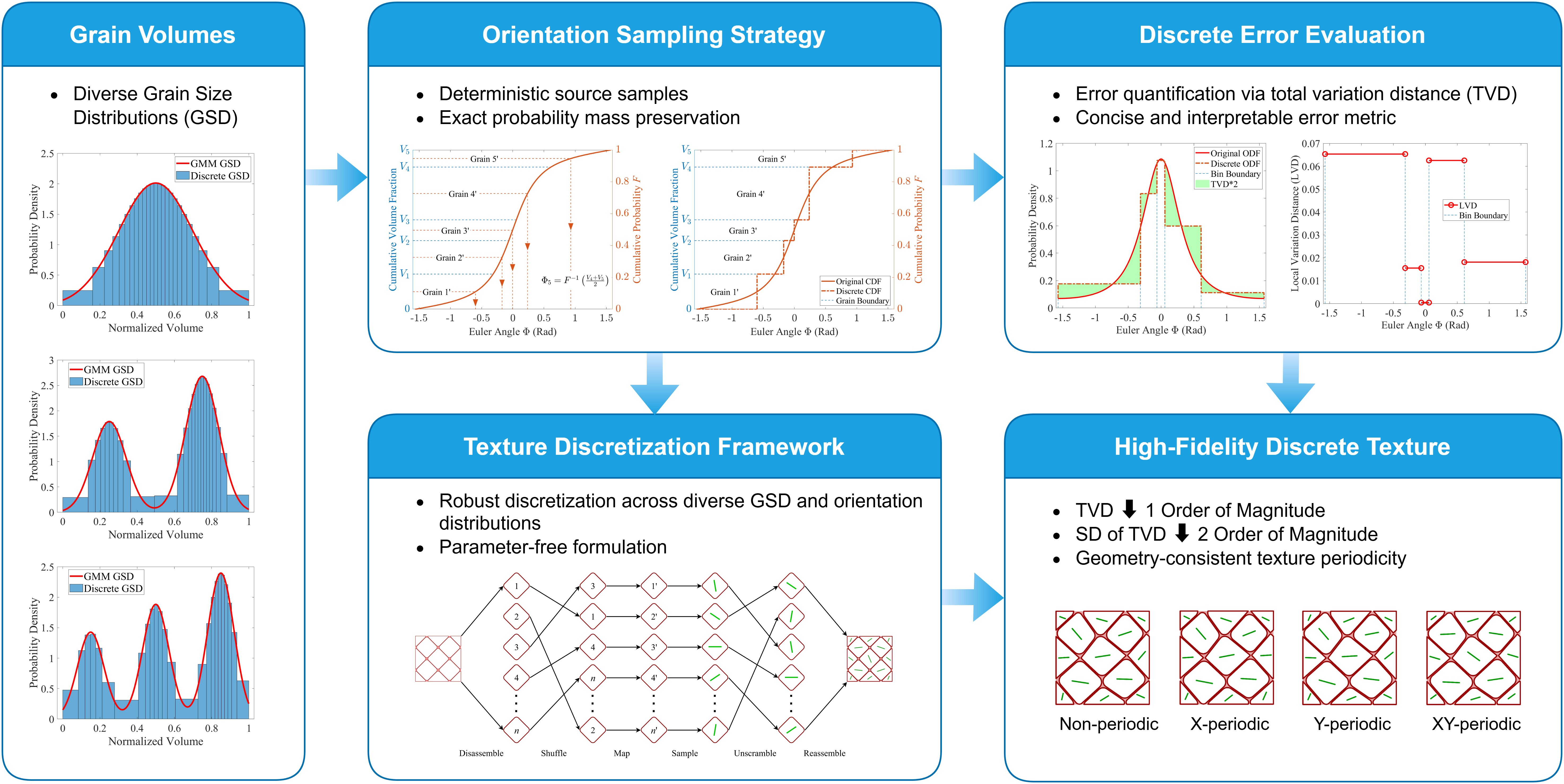
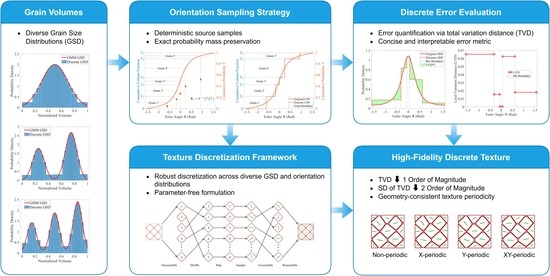
- Robust texture discretization across diverse grain size and orientation distributions.
- Deterministic source samples are reconstructed from cumulative grain volumes.
- Discretized textures preserve probability mass and geometric periodicity.
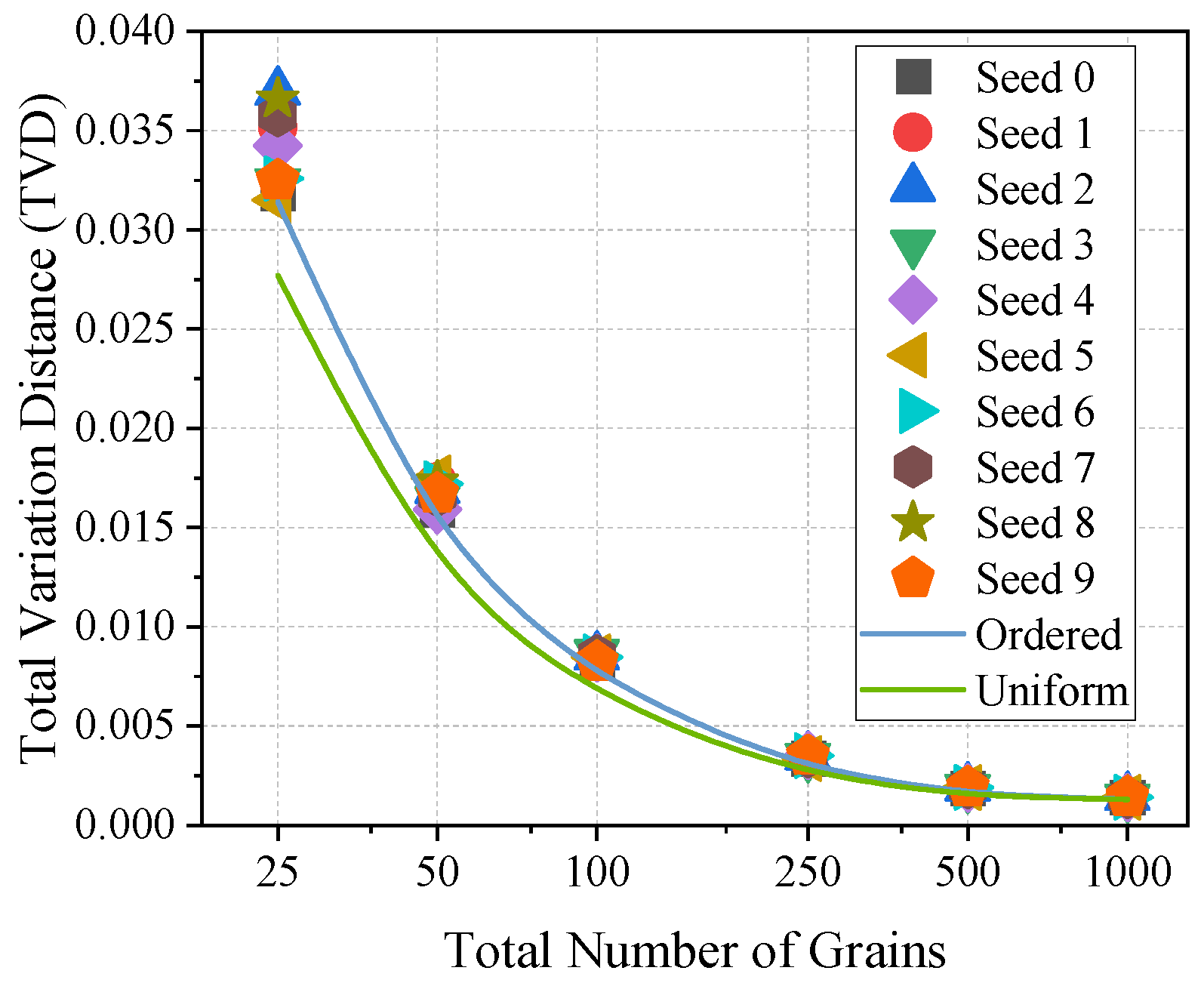
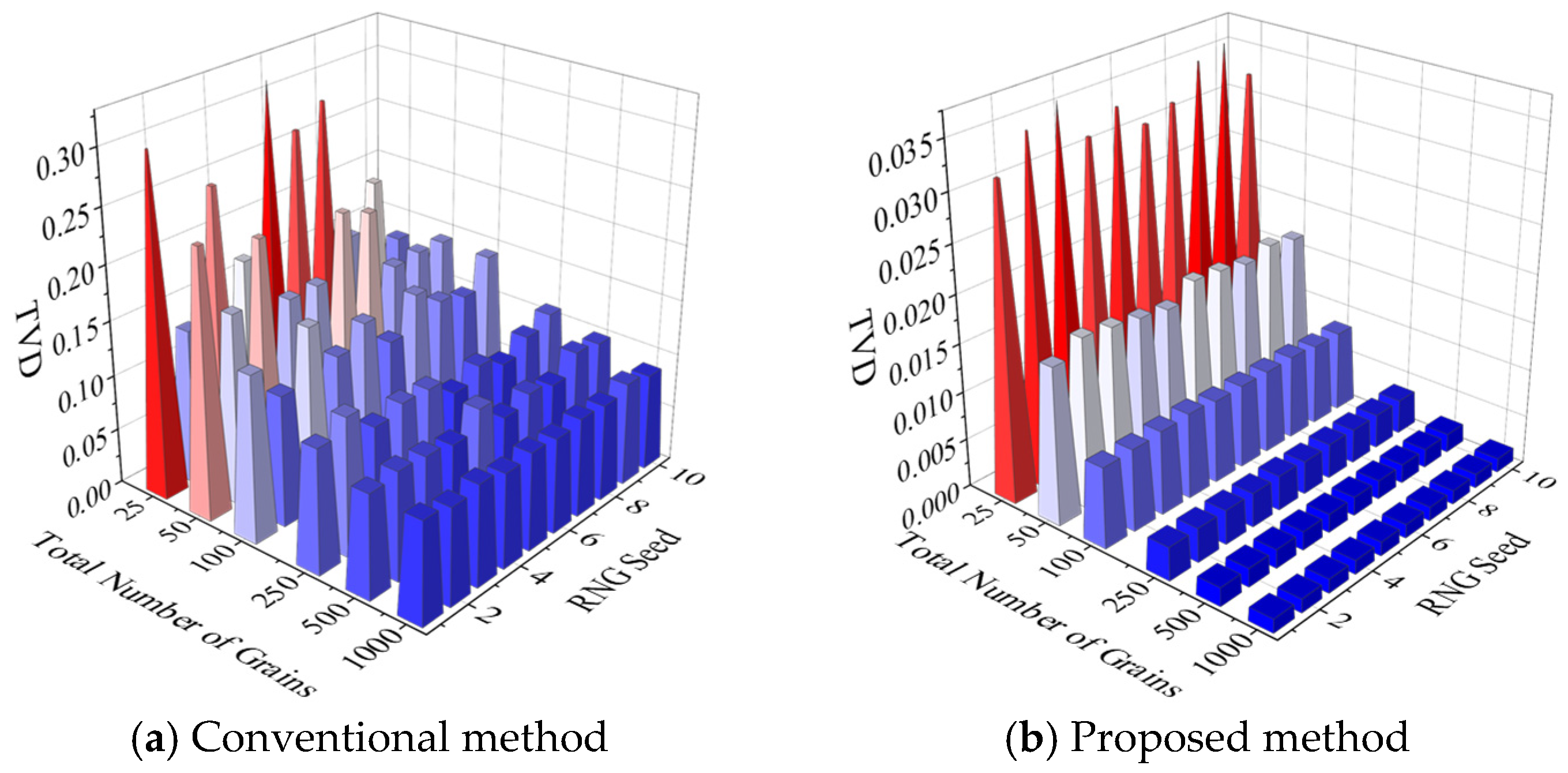
- Discretization error (TVD) is reduced by one order of magnitude.
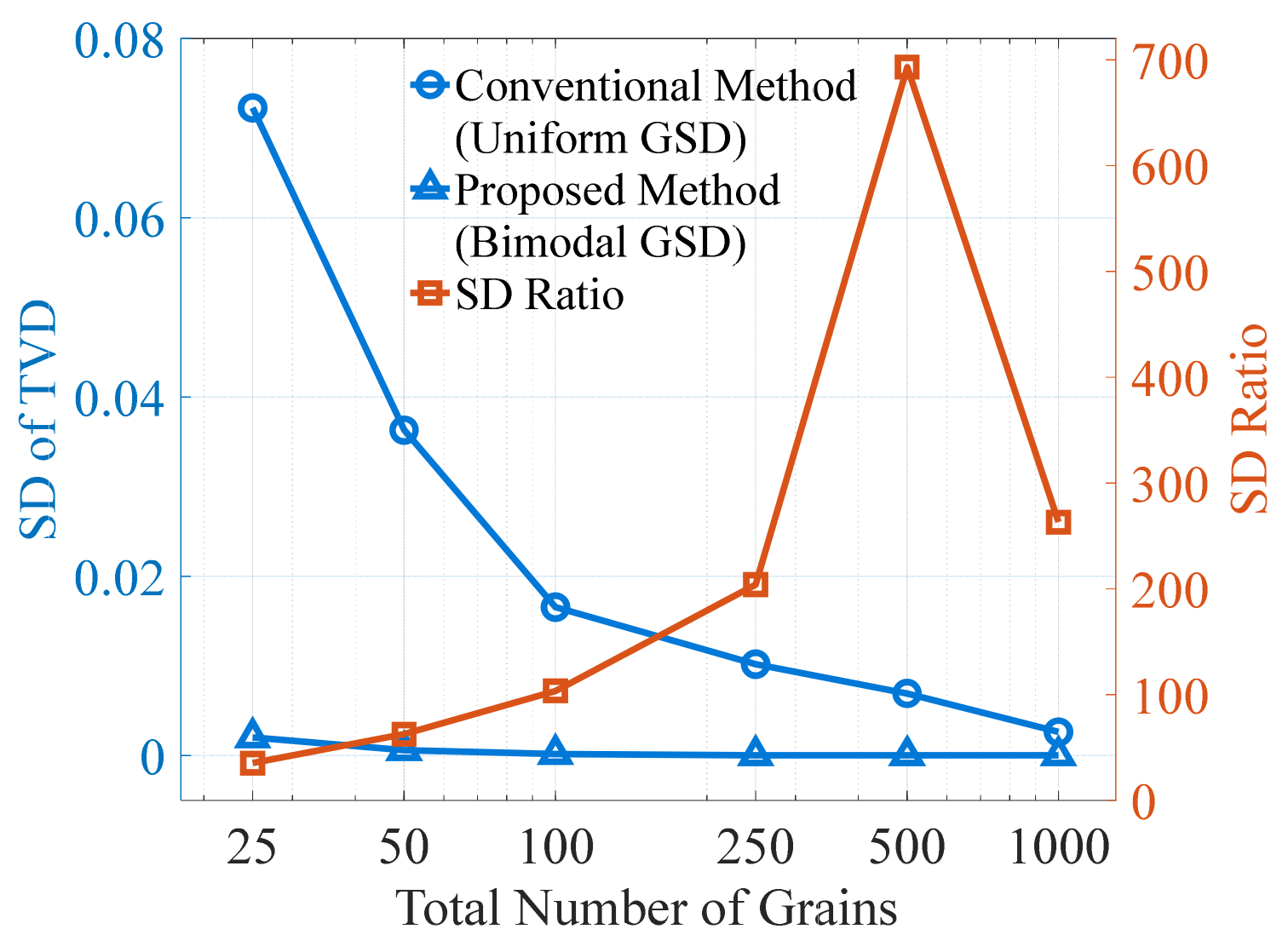
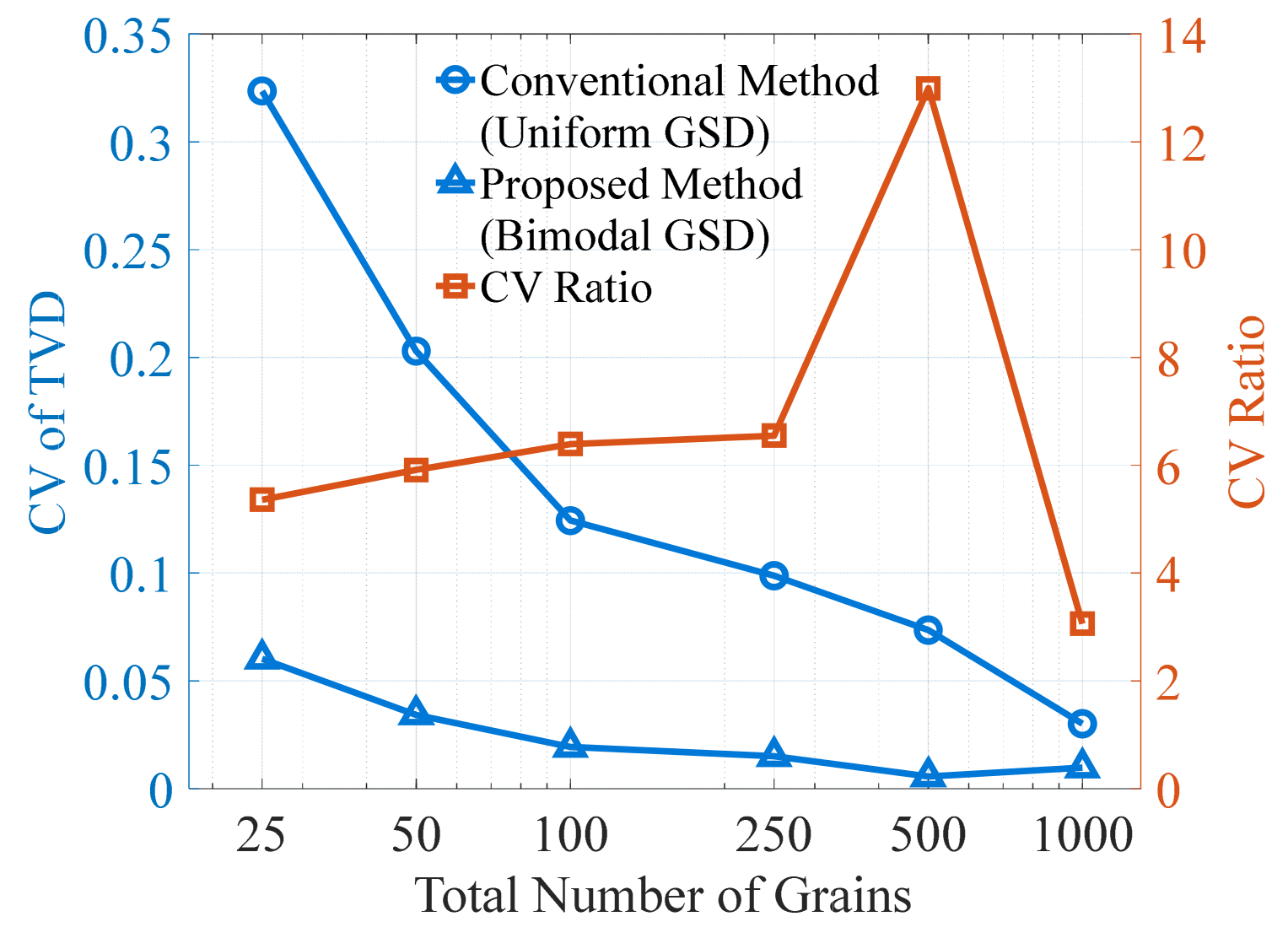
- Standard deviation of TVD is reduced by two orders of magnitude.
Abstract
1. Introduction
2. Methodological Framework
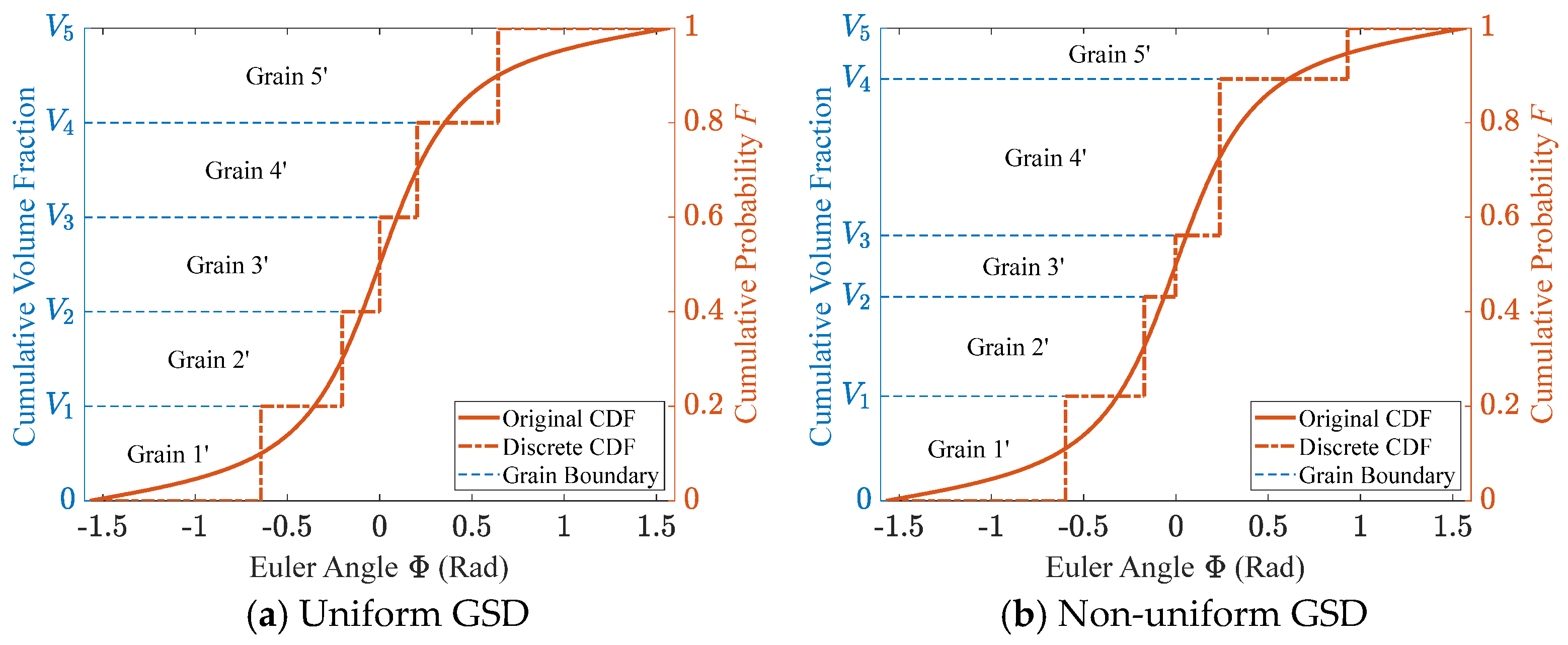
2.1. Overall Workflow
2.2. Sampling Strategy
2.3. Algorithm Implementation
3. Correctness Proof
4. Error Analysis
4.1. Error Characteristics
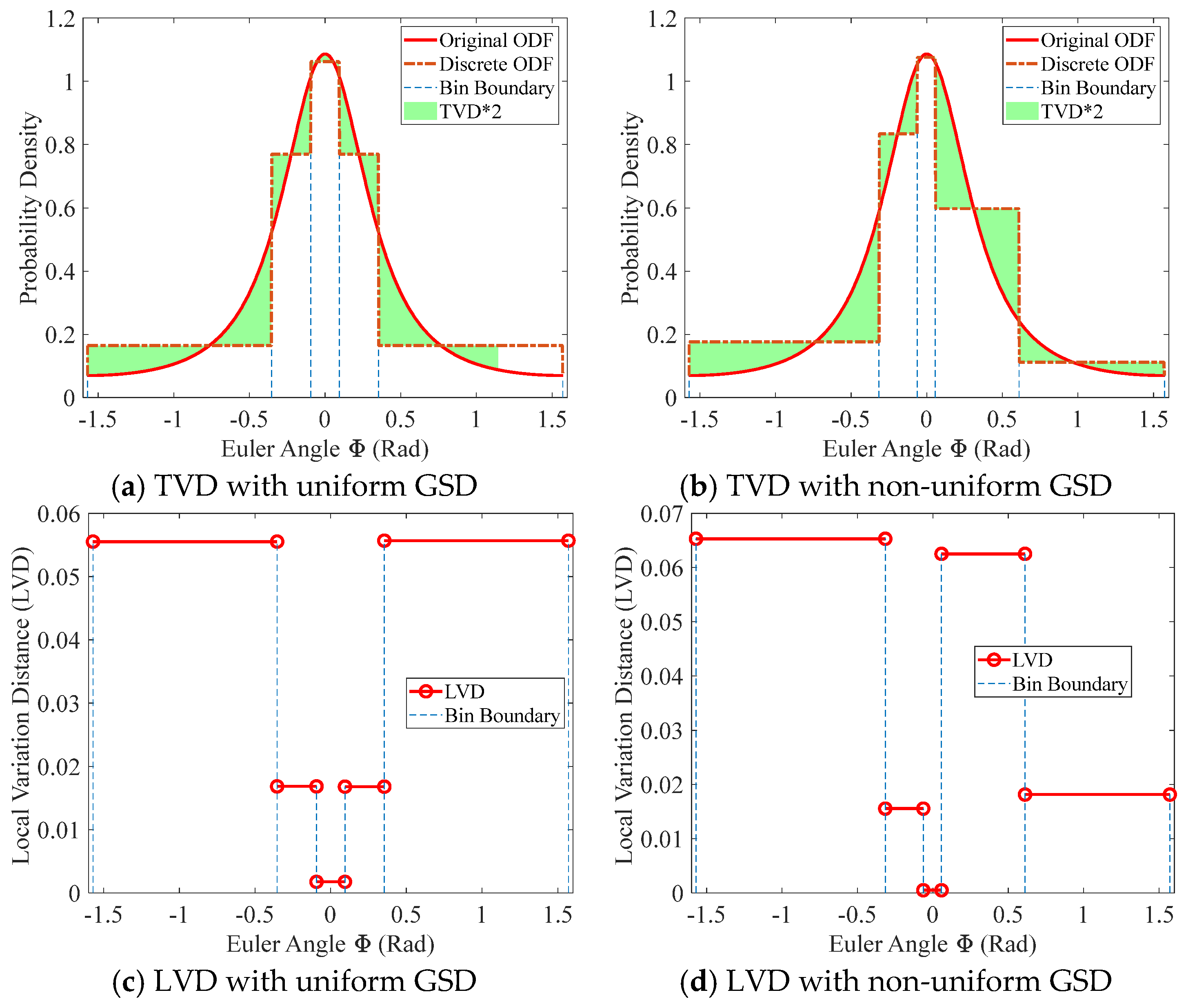
4.2. Evaluation Metrics
4.3. Influencing Factors
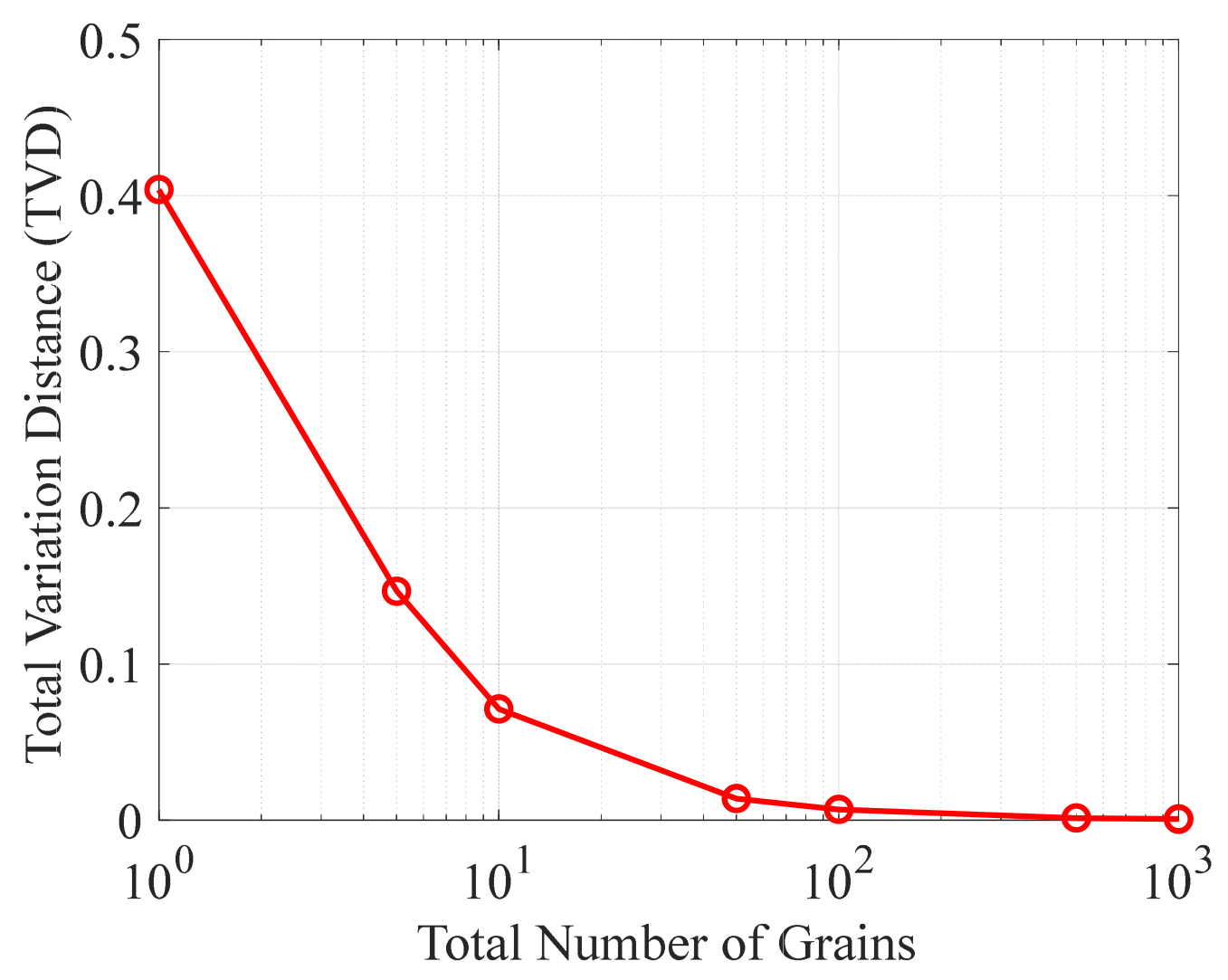
4.3.1. Grain Count
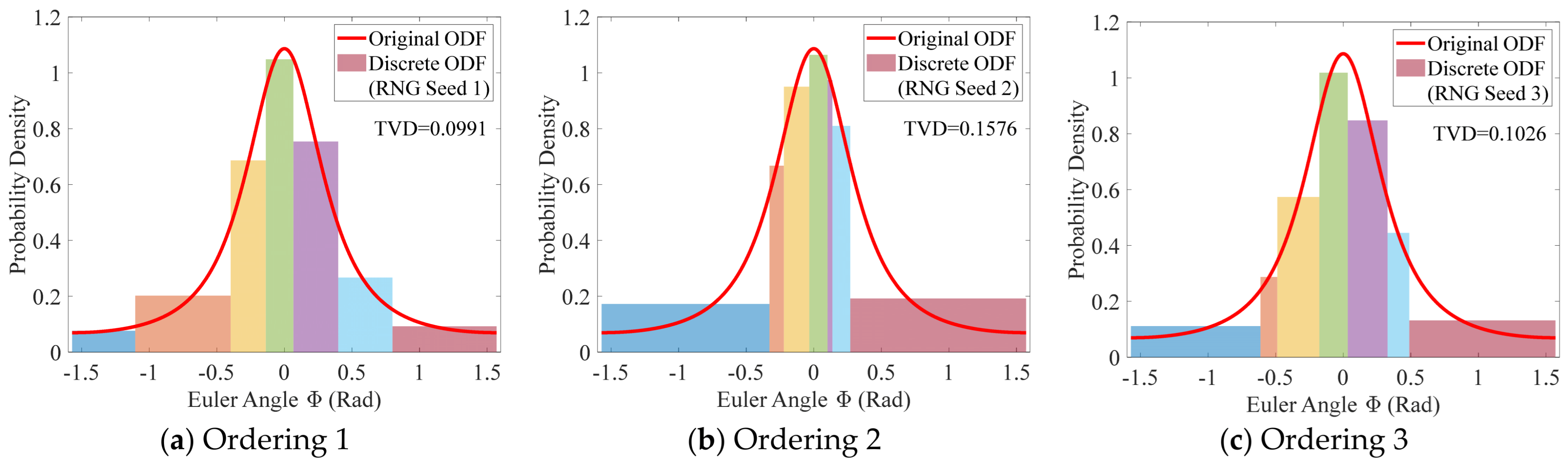
4.3.2. Grain Ordering
4.3.3. Binning Strategy
4.4. Comparison with Conventional Method
4.4.1. Determining the Binning Strategies
4.4.2. Comparative Analysis of TVDs
5. Validation Under Non-Uniform Grains
5.1. Grain Generation
5.2. Texture Discretization Results
5.2.1. Ordered Grain Arrangement
5.2.2. Disordered Grain Arrangement
5.2.3. Fidelity Analysis
6. Discussion
6.1. Influence of Randomness
6.2. Influence of Periodicity
7. Conclusions
Author Contributions
Funding
Data Availability Statement
DURC Statement
Conflicts of Interest
Abbreviations
| ODF | Orientation Distribution Function |
| CDF | Cumulative Distribution Function |
| GSD | Grain Size Distribution |
| TVD | Total Variation Distance |
| LVD | Local Variation Distance |
| PBX | Polymer-Bonded Explosive |
| RNG | Random Number Generator |
| GMM | Gaussian Mixture Model |
| SD | Standard Deviation |
| CV | Coefficient of Variation |
| PBC | Periodic Boundary Condition |
Appendix A. Effect of Bin Count on TVD Estimates with Equal-Interval Binning

References
- Kocks, F.; Tomé, C.; Wenk, H. Texture and Anisotropy: Preferred Orientations in Polycrystals and Their Effect on Material Properties, 2nd ed.; Cambridge University Press: Cambridge, UK, 2000. [Google Scholar]
- Suwas, S.; Ray, R.K. Crystallographic Texture of Materials, 1st ed.; Springer: London, UK, 2014. [Google Scholar]
- Crist, B. Structure of polycrystalline aggregates. In Handbook of Polymer Crystallization, 1st ed.; Piorkowska, E., Rutledge, G.C., Eds.; John Wiley & Sons: Hoboken, NJ, USA, 2013; pp. 73–124. [Google Scholar]
- Luscher, D.J.; Buechler, M.A.; Miller, N.A. Self-consistent modeling of the influence of texture on thermal expansion in polycrystalline TATB. Model. Simul. Mat. Sci. Eng. 2014, 22, 75008. [Google Scholar] [CrossRef]
- Messing, G.L.; Poterala, S.; Chang, Y.; Frueh, T.; Kupp, E.R.; Watson, B.H.; Walton, R.L.; Brova, M.J.; Hofer, A.-K.; Bermejo, R.; et al. Texture-engineered ceramics—Property enhancements through crystallographic tailoring. J. Mater. Res. 2017, 32, 3219–3241. [Google Scholar] [CrossRef]
- Bunge, H.J. Texture Analysis in Materials Science; Butterworth-Heinemann: London, UK, 1982. [Google Scholar]
- Gokcekaya, O.; Ishimoto, T.; Hibino, S.; Yasutomi, J.; Narushima, T.; Nakano, T. Unique crystallographic texture formation in inconel 718 by laser powder bed fusion and its effect on mechanical anisotropy. Acta Mater. 2021, 212, 116876. [Google Scholar] [CrossRef]
- Morais, W.A.; Landgraf, F.J.G. Crystallographic texture configured by laser powder bed fusion additive manufacturing process: A review and its potential application to adjust mechanical properties of metallic products. Tecnol. Metal. Mater. Min. 2023, 20, e2802. [Google Scholar] [CrossRef]
- Wu, J.; Zhang, S.; Li, F. Prospect of texture engineered ferroelectric ceramics. Appl. Phys. Lett. 2022, 121, 120501. [Google Scholar] [CrossRef]
- Hielscher, R.; Mainprice, D.; Schaeben, H. Material Behavior: Texture and Anisotropy. In Handbook of Geomathematics; Freeden, W., Nashed, M.Z., Sonar, T., Eds.; Springer: Berlin/Heidelberg, Germany, 2015; pp. 2149–2188. [Google Scholar]
- Banerjee, B.; Adams, D.O. On predicting the effective elastic properties of polymer bonded explosives using the recursive cell method. Int. J. Solids Struct. 2004, 41, 481–509. [Google Scholar] [CrossRef]
- El Shawish, S.; Hure, J. Intergranular normal stress distributions in untextured polycrystalline aggregates. Eur. J. Mech. A Solids 2018, 72, 354–373. [Google Scholar] [CrossRef]
- Guo, H.; Luo, J.; Shi, P.; Xu, J. Research on the fracture behavior of PBX under static tension. Def. Technol. 2014, 10, 154–160. [Google Scholar] [CrossRef]
- Kang, G.; Ning, Y.; Chen, P.; Ni, K. Meso-structure construction and effective modulus simulation of PBXs. J. Energ. Mater. 2020, 38, 261–282. [Google Scholar] [CrossRef]
- McDowell, D.L.; Dunne, F.P.E. Microstructure-sensitive computational modeling of fatigue crack formation. Int. J. Fatigue 2010, 32, 1521–1542. [Google Scholar] [CrossRef]
- Wang, Z.; Wang, T.; Wang, W.; Zhang, Z. Size of representative elementary volume for heterogeneous rocks evaluated using distinct element method. Acta Geotech. 2023, 18, 1883–1900. [Google Scholar] [CrossRef]
- Wu, Y.Q.; Huang, F.L. A micromechanical model for predicting combined damage of particles and interface debonding in PBX explosives. Mech. Mater. 2009, 41, 27–47. [Google Scholar] [CrossRef]
- Tóth, L.S.; Van Houtte, P. Discretization techniques for orientation distribution functions. Textures Microstruct. 1992, 19, 229–244. [Google Scholar] [CrossRef]
- Kocks, F.; Kallend, J.; Biondo, A. Accurate representations of general textures by a set of weighted grains. Textures Microstruct. 1991, 14–18, 199–204. [Google Scholar] [CrossRef]
- Helming, K.; Tamm, R.; Fels, B. An automated component method. Mater. Sci. Forum 1998, 273–275, 119–124. [Google Scholar] [CrossRef]
- Leffers, T.; Jensen, D.J. Evaluation of the effect of initial texture on the development of deformation texture. Texture Stress Microstruct. 1986, 6, 231–254. [Google Scholar] [CrossRef]
- Xie, C.L.; Nakamachi, E. Investigations of the formability of BCC steel sheets by using crystalline plasticity finite element analysis. Mater. Des. 2002, 23, 59–68. [Google Scholar] [CrossRef]
- Vuppala, A.; Krämer, A.; Lohmar, J. On sampling discrete orientations from XRD for texture representation in aggregates with varying grain size. Crystals 2021, 11, 1021. [Google Scholar] [CrossRef]
- Aslett, L.J.M. Sampling from Complex Probability Distributions: A Monte Carlo Primer for Engineers. In Uncertainty in Engineering: Introduction to Methods and Applications; Aslett, L.J.M., Coolen, F.P.A., De Bock, J., Eds.; Springer: Cham, Switzerland, 2022; pp. 15–35. [Google Scholar]
- Eisenlohr, P.; Roters, F. Selecting a set of discrete orientations for accurate texture reconstruction. Comput. Mater. Sci. 2008, 42, 670–678. [Google Scholar] [CrossRef]
- Melchior, M.A.; Delannay, L. A texture discretization technique adapted to polycrystalline aggregates with non-uniform grain size. Comput. Mater. Sci. 2006, 37, 557–564. [Google Scholar] [CrossRef]
- Roters, F.; Diehl, M.; Shanthraj, P.; Eisenlohr, P.; Reuber, C.; Wong, S.L.; Maiti, T.; Ebrahimi, A.; Hochrainer, T.; Fabritius, H.-O.; et al. DAMASK—the Düsseldorf advanced material simulation kit for modeling multi-physics crystal plasticity, thermal, and damage phenomena from the single crystal up to the component scale. Comput. Mater. Sci. 2019, 158, 420–478. [Google Scholar] [CrossRef]
- Biswas, A.; Vajragupta, N.; Hielscher, R.; Hartmaier, A. Optimized reconstruction of the crystallographic orientation density function based on a reduced set of orientations. J. Appl. Crystallogr. 2020, 53, 178–187. [Google Scholar] [CrossRef]
- Bakhtiari, M.; Seyed Salehi, M. Reconstruction of deformed microstructure using cellular automata method. Comput. Mater. Sci. 2018, 149, 1–13. [Google Scholar] [CrossRef]
- Böhlke, T.; Haus, U.; Schulze, V. Crystallographic texture approximation by quadratic programming. Acta Mater. 2006, 54, 1359–1368. [Google Scholar] [CrossRef]
- Helming, K. Texture approximations by model components. Mater. Sci. Forum 1998, 273–275, 125–132. [Google Scholar] [CrossRef]
- Ivanova, T.M.; Serebryany, V.N. Comparison of two methods for the ODF modeling for magnesium alloy with low symmetry. J. Phys. Conf. Ser. 2017, 788, 12049. [Google Scholar] [CrossRef]
- Kuhn, J.; Schneider, M.; Sonnweber-Ribic, P.; Böhlke, T. Generating polycrystalline microstructures with prescribed tensorial texture coefficients. Comput. Mech. 2022, 70, 639–659. [Google Scholar] [CrossRef]
- Raabe, D.; Roters, F. Using texture components in crystal plasticity finite element simulations. Int. J. Plast. 2004, 20, 339–361. [Google Scholar] [CrossRef]
- Roters, F.; Jeon-Haurand, H.S.; Raabe, D. A texture evolution study using the texture component crystal plasticity FEM. Mater. Sci. Forum 2005, 495–497, 937–944. [Google Scholar] [CrossRef]
- Schaeben, H.; Bachmann, F.; Fundenberger, J. Construction of weighted crystallographic orientations capturing a given orientation density function. J. Mater. Sci. 2017, 52, 2077–2090. [Google Scholar] [CrossRef]
- Dollase, W.A. Correction of intensities for preferred orientation in powder diffractometry: Application of the march model. J. Appl. Crystallogr. 1986, 19, 267–272. [Google Scholar] [CrossRef]
- Devroye, L. Non-Uniform Random Variate Generation; Springer: New York, NY, USA, 1986. [Google Scholar]
- March, A. Mathematische Theorie der Regelung nach der Korngestah bei Affiner Deformation. Z. Krist. Cryst. Mater. 1932, 81, 285–297. [Google Scholar] [CrossRef]
- Bozzolo, N.; Gerspach, F.; Sawina, G.; Wagner, F. Accuracy of orientation distribution function determination based on EBSD data-a case study of a recrystallized low alloyed zr sheet. J. Microsc. 2007, 227, 275–283. [Google Scholar] [CrossRef]
- Levin, D.A.; Peres, Y.; Wilmer, E.L. Markov Chains and Mixing Times, 2nd ed.; American Mathematical Society: Providence, RI, USA, 2019. [Google Scholar]
- Hoffman, D.M. Dynamic mechanical signatures of a polyester-urethane and plastic-bonded explosives based on this polymer. J. Appl. Polym. Sci. 2001, 83, 1009–1024. [Google Scholar] [CrossRef]
- Reaugh, J.E. Grain-Scale Dynamics in Explosives; UCRL-ID-150388; Lawrence Livermore National Laboratory: Livermore, CA, USA, 2002.
- Reaugh, J.E. Shock Initiation of Heterogeneous Explosives; UCRL-PROC-204120; Lawrence Livermore National Laboratory: Livermore, CA, USA, 2004.
- Skidmore, C.B.; Phillips, D.S.; Son, S.F.; Asay, B.W. Characterization of HMX Particles in PBX 9501; LA-UR-97-2596; CONF-970707; Los Alamos National Laboratory: Los Alamos, NM, USA, 1997.
- Souers, P.C.; Lewis, P.; Hoffman, M.; Cunningham, B. Thermal expansion of LX-17, PBX 9502, and ultrafine TATB. Propellants Explos. Pyrotech. 2011, 36, 335–340. [Google Scholar] [CrossRef]
- Messaoud, S.; Bradai, A.; Bukhari, S.H.R.; Quang, P.T.A.; Ahmed, O.B.; Atri, M. A survey on machine learning in internet of things: Algorithms, strategies, and applications. Internet Things 2020, 12, 100314. [Google Scholar] [CrossRef]
- Kittler, J.; Illingworth, J. Minimum error thresholding. Pattern Recognit. 1986, 19, 41–47. [Google Scholar] [CrossRef]
- Reynolds, D.A.; Quatieri, T.F.; Dunn, R.B. Speaker verification using adapted gaussian mixture models. Digit. Signal Process. 2000, 10, 19–41. [Google Scholar] [CrossRef]
- Wang, J.; Jiang, J. Unsupervised deep clustering via adaptive GMM modeling and optimization. Neurocomputing 2021, 433, 199–211. [Google Scholar] [CrossRef]
- Li, S.; Sitnikova, E. An Excursion into Representative Volume Elements and Unit Cells. In Comprehensive Composite Materials II; Beaumont, P.W.R., Zweben, C.H., Eds.; Elsevier: Oxford, UK, 2018; pp. 451–489. [Google Scholar]
- Zienkiewicz, O.C.; Taylor, R.L.; Zhu, J.Z. The Finite Element Method: Its Basis and Fundamentals, 6th ed.; Butterworth-Heinemann: Oxford, UK, 2005. [Google Scholar]
- Shu, W.; Stanciulescu, I. Multiscale homogenization method for the prediction of elastic properties of fiber-reinforced composites. Int. J. Solids Struct. 2020, 203, 249–263. [Google Scholar] [CrossRef]
- Zienkiewicz, O.C.; Taylor, R.L.; Fox, D. The Finite Element Method for Solid and Structural Mechanics, 7th ed.; Butterworth-Heinemann: Oxford, UK, 2014. [Google Scholar]


Disclaimer/Publisher’s Note: The statements, opinions and data contained in all publications are solely those of the individual author(s) and contributor(s) and not of MDPI and/or the editor(s). MDPI and/or the editor(s) disclaim responsibility for any injury to people or property resulting from any ideas, methods, instructions or products referred to in the content. |
© 2026 by the authors. Licensee MDPI, Basel, Switzerland. This article is an open access article distributed under the terms and conditions of the Creative Commons Attribution (CC BY) license.
Share and Cite
Guo, H.; Huang, H.; Luo, J.; He, L.; Huang, X.; Hao, Z. A High-Fidelity Texture Discretization Method for Polycrystalline Aggregates Considering Grain Size Distributions. Materials 2026, 19, 1501. https://doi.org/10.3390/ma19081501
Guo H, Huang H, Luo J, He L, Huang X, Hao Z. A High-Fidelity Texture Discretization Method for Polycrystalline Aggregates Considering Grain Size Distributions. Materials. 2026; 19(8):1501. https://doi.org/10.3390/ma19081501
Chicago/Turabian StyleGuo, Hu, Hui Huang, Jingrun Luo, Liling He, Xicheng Huang, and Zhiming Hao. 2026. "A High-Fidelity Texture Discretization Method for Polycrystalline Aggregates Considering Grain Size Distributions" Materials 19, no. 8: 1501. https://doi.org/10.3390/ma19081501
APA StyleGuo, H., Huang, H., Luo, J., He, L., Huang, X., & Hao, Z. (2026). A High-Fidelity Texture Discretization Method for Polycrystalline Aggregates Considering Grain Size Distributions. Materials, 19(8), 1501. https://doi.org/10.3390/ma19081501