Article

Realizing 303 ps Ultrafast Scintillation Time in 2-Inch CsPbCl3 Single Crystals Grown Under Br2 Overpressure

1
Zhejiang Key Laboratory of Data-Driven High-Safety Energy Materials and Applications, Ningbo Key Laboratory of Special Energy Materials and Chemistry, Laboratory of Advanced Nuclear Materials, Ningbo Institute of Materials Technology and Engineering (NIMTE), Chinese Academy of Sciences, Ningbo 315201, China
2
University of Chinese Academy of Sciences, Beijing 100049, China
3
Qianwan Institute, Ningbo Institute of Materials Technology and Engineering (NIMTE), Ningbo 315336, China
4
State Key Laboratory of Intense Pulsed Radiation Simulation and Effect and Radiation Detection Research Center, Northwest Institute of Nuclear Technology, Xi’an 710024, China
*
Author to whom correspondence should be addressed.
Materials 2026, 19(8), 1479; https://doi.org/10.3390/ma19081479
Submission received: 12 February 2026 / Revised: 30 March 2026 / Accepted: 2 April 2026 / Published: 8 April 2026

Abstract

Large-sized, room-temperature ultrafast scintillator single crystals are highly demanded for fast timing applications such as time of flight–positron emission tomography, high-speed medical imaging, and pulse heavy-ray detection. Sub-nanosecond scintillation was discovered in 16 mm sized CsPbCl3Brx single crystals in our previous research. In this work, the crystal size of CsPbCl3Br0.03 was enlarged to 2 inches (50.8 mm). Meanwhile, by precisely optimizing the vertical Bridgman growth process, we further increased the concentration of Br dopant to realize even faster scintillation decay. In this study, we conducted a series of tests on the grown crystals, including temperature-dependent photoluminescence tests, alpha particle excitation tests, X-ray imaging tests, etc. Via the strategy of the incorporation of Br2, Br dopant introduces highly efficient fast recombination centers in perovskite CsPbCl3Br0.03 crystals, resulting in an unprecedently fast scintillation decay time of 303 ps under 241Am α-particle excitation, which is significantly shorter than that of the pure CsPbCl3 and all other perovskites by at least two orders of magnitude. Benefiting from the excellent optical transparency and high crystalline quality of the CsPbCl3Br0.03 crystal, an X-ray spatial resolution of up to 20 lp/mm is achieved. These results further demonstrate the great potential of large-sized CsPbCl3Brx single crystals for fast timing applications.

1. Introduction

Large-sized, high-quality, and ultrafast scintillation crystals serve as the core sensing materials in radiation detection and play an indispensable role in fast timing fields such as medical imaging (e.g., time of flight–positron emission tomography, TOF-PET [1,2,3]), high-speed X-ray imaging, and pulse neutron detection [4,5,6,7]. Consequently, there is growing interest in the development of novel scintillator materials exhibiting sub-nanosecond decay times. For example, Ouyang and co-workers successfully grew ZnO:Ga crystals via a hydrothermal method, achieving an ultrafast scintillation decay time of 600 ps under α-particle irradiation [8]. Mykhaylyk discovered that, at low temperatures, CsPbBr3 is a very bright scintillator and has a rapid decay time of 1 ns, however, this fast decay occurs at a low temperature of 7 K [9].
Taking advantage of the high defect tolerance and low-cost growth of the perovskite semiconductor CsPbCl3 [10,11,12,13,14,15], our group previously proposed a “Br overdoping” strategy and successfully achieved sub-nanosecond ultrafast scintillation at room temperature on 16 mm sized CsPbCl3Brx single crystals [16]. However, the diameter of CsPbCl3Br0.03 single crystals was only 16 mm. This small crystal size represents a significant drawback, as fast timing applications urgently require larger and low-cost crystals [17,18,19,20]. And the concentration of Br incorporated into the crystal lattice of our group’s earlier research remained relatively low. So, we further increase the concentration of Br incorporated into the crystal lattice, aiming to achieve even faster scintillation decay.
Motivated by these considerations, our present study focuses on the growth of large-sized CsPbCl3Brx single crystals with a diameter of 2 inches, while simultaneously realizing a higher concentration of Br incorporated into the crystal lattice than previous research. However, growing crystals with a large size inevitably introduces technical challenges [21,22,23,24]. To overcome the challenges, our research optimizes the crystal growth conditions. Specifically, compared with our previous research, we employ a smaller temperature gradient and a slower cooling speed in the crystallization process. Furthermore, in this study, we rotated the quartz ampoule during the crystal growth process to improve the crystalline homogeneity. By these improvements, we successfully obtained highly transparent 2-inch CsPbCl3Br0.03 single crystals. As the concentration of Br incorporated into the crystal lattice is further increased, the decay time of the CsPbCl3Brx single crystal is significantly shortened. It was measured through α-particle excitation: the decay time of the CsPbCl3Brx crystal has been significantly reduced from the 630 ps in our group’s previous research to 303 ps in this research, which is significantly shorter than that of the pure CsPbCl3 and all other perovskites by at least two orders of magnitude [13]. In this study, we not only successfully prepared the CsPbCl3Br0.03 single crystal with a diameter of 2 inches but also conducted a systematic characterization and investigated the mechanism of ultrafast scintillation of this material. The research content covers various aspects such as the lattice expansion, carrier transport, photoluminescence properties, light yield, and X-ray imaging performance. The research results indicate that CsPbCl3Br0.03 single crystals possess significant potential in the field of fast timing and large-sized imaging applications.

2. Materials and Methods

2.1. Material Preparation

The chemical reagents used in this research include (1) cesium chloride 99.999%, Aladdin; (2) lead chloride 99.999%, Aladdin; (3) cesium tribromide (synthesized by the chemical reaction of liquid bromine and cesium bromide). The details of the synthesis are elaborated in the SI.

2.2. Crystal Growth

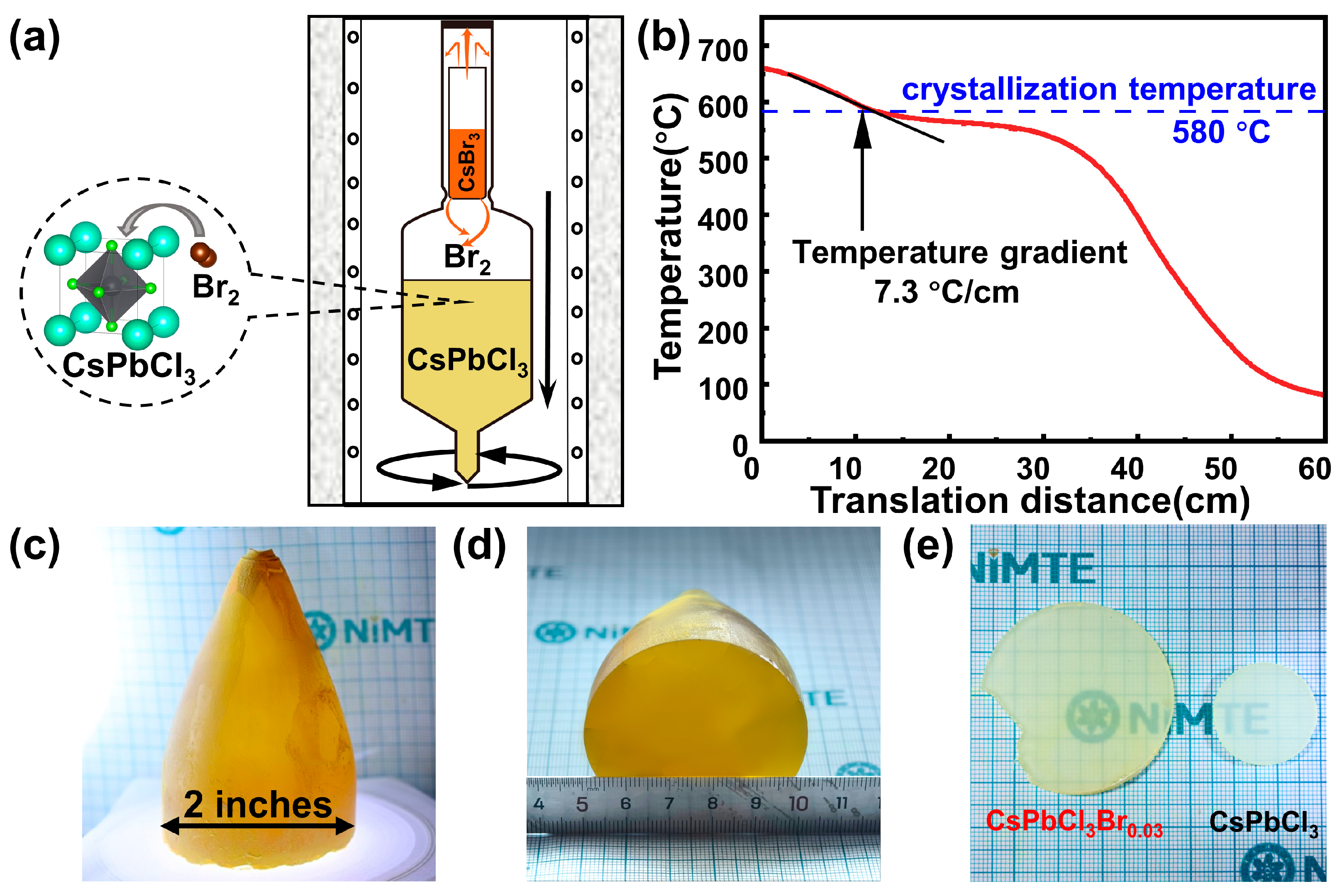
Figure 1a presents a schematic diagram of the vertical Bridgman growth process for CsPbCl3 single crystals grown under Br2 overpressure. We precisely weighed the masses of CsCl and PbCl2 in a glovebox filled with inert gas, in a 1:1 molar ratio, and placed them into a quartz ampoule with an inner diameter of 21 mm and an outer diameter of 25 mm. Subsequently, the ampoule was placed in a tube furnace and reacted at a temperature of 700 °C to synthesize homogeneous polycrystalline CsPbCl3. According to the stoichiometric ratio of CsPbCl3Br0.03, the precisely weighed polycrystalline precursor of CsPbCl3 was placed into a customized quartz ampoule with an inner diameter of 2 inches and a conical tip. Meanwhile, CsBr3 was placed in a small crucible above the raw material, as shown in Figure 1a. When the temperature rises, CsBr3 in the crucible decomposes into CsBr and Br2 vapor. The white powder of the decomposed CsBr still remains in the upper crucible; the Br2 vapor released diffuses in the ampoule and enters the lattice of the CsPbCl3 crystal during its growth process as a dopant.
During the growth process of large-sized crystals, since the crystal size is 2 inches, the thermal conduction of solidification heat would be more difficult. This will result in insufficient cooling at the interface or thermal stress cracking. Therefore, for the growth of large-sized CsPbCl3Br0.03 single crystals, a lower temperature gradient and a slower decreasing rate are required [21,22,23,24]. We heated the three-zone Bridgman furnace at a rate of 2 °C/min, heating each of the three temperature zones of the furnace to the preset temperatures of 670 °C, 570 °C, and 500 °C, respectively. A temperature gradient of 7.6 °C/cm was established near the crystallization region. According to our group’s previous research, the crystallization point of the CsPbCl3Brx single crystals fluctuates between 583 °C and 596 °C [16]. In this research, due to the higher concentration of Br incorporated into the crystal lattice, we precisely set a lower descent rate (0.40 mm/h) starting from 580 °C, as shown in Figure 1b.
The crystal growth process mainly consists of the following steps: firstly, the ampoule is slowly lowered at a rate of 5.0 mm/h for 22 h to ensure that the raw materials are completely melted and the temperature field is stabilized; secondly, at a temperature close to the crystallization point, the crystallization reaction is carried out at a rate of 0.40 mm/h for 350 h; finally, after full crystallization, the crystal is cooled to room temperature at a rate of 2.0 mm/h. Pure and colorless CsPbCl3 crystals are grown under the same growth conditions, as shown in Figure S1. After the crystallization process was completed, there was no remaining red-brown Br2 vapor in the ampoule. This indicates that all the Br2 was fully incorporated into the crystal structure. Based on this complete consumption of Br2, the CsPbCl3 single crystals grown under Br2 overpressure have a nominal composition of CsPbCl3Br0.03. The as-grown 2-inch CsPbCl3Br0.03 ingot is shown in Figure 1c,d, presenting a light-yellow color due to the incorporation of Br dopant. The ingots are further processed into uniformly thick wafers using a diamond wire saw, as shown in Figure 1e. The single crystals grown under Br2 overpressure still exhibit excellent optical transparency.

3. Results and Discussion

3.1. Structural and Optical Characterization

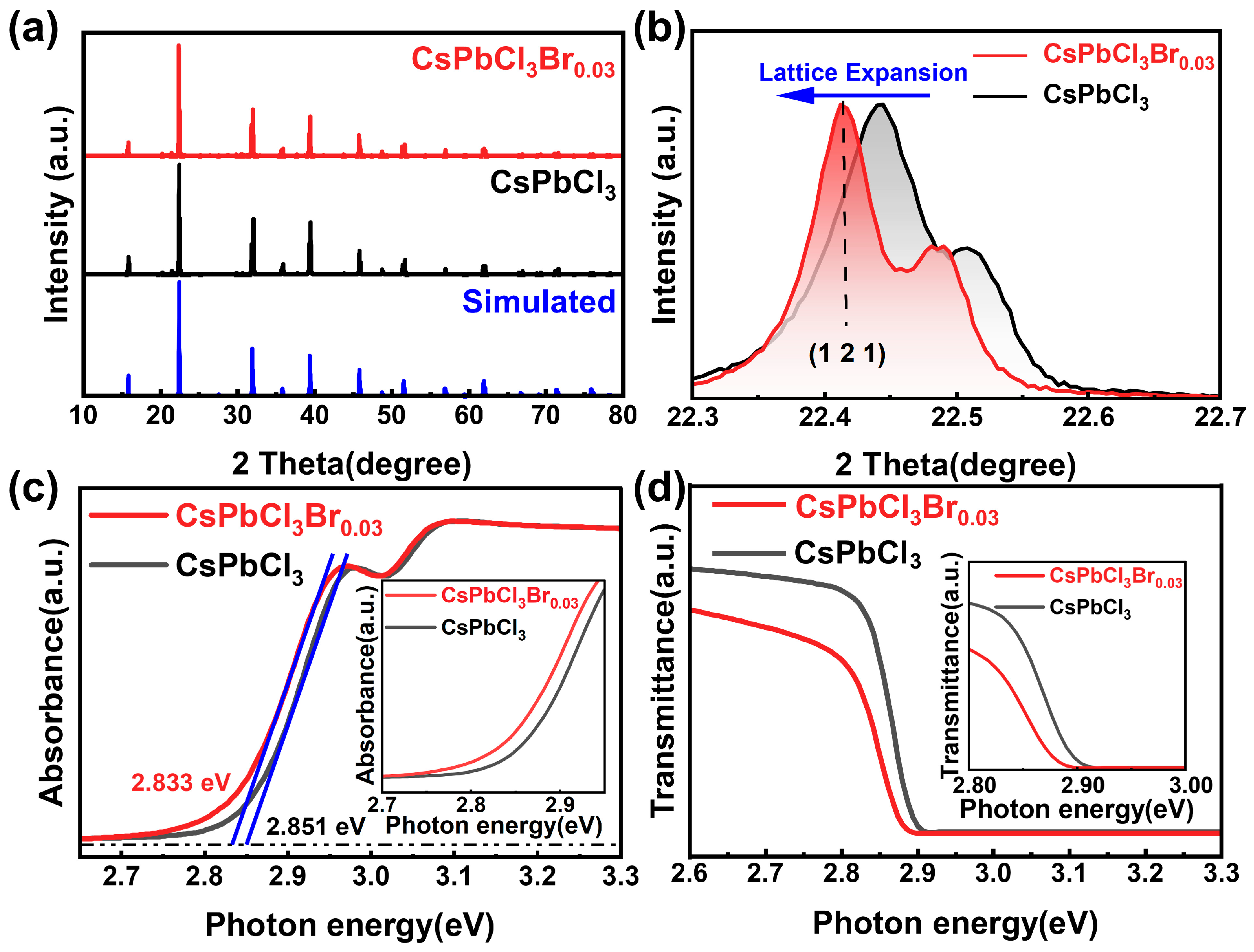
To verify the uniformity of Br distribution across the 2-inch ingot, we performed SEM-EDS elemental mapping on samples taken both from various axial and radial positions. The results demonstrate a highly consistent and uniform distribution of Cs, Pb, Cl, and Br elements throughout the crystal bulk, as shown in Figure S6. The phase compositions of the crystals before and after growth under Br2 overpressure are analyzed using the powder X-ray diffraction (PXRD) technique. As shown in Figure 2a, all the diffraction peaks of the CsPbCl3Br0.03 are in perfect agreement with those of the pure phase CsPbCl3 and the simulated standard diffraction pattern of the room-temperature CsPbCl3 phase. We also conducted PXRD analyses on specimens extracted from different sections of the ingot. These results revealed highly consistent diffraction patterns without peak shift, confirming that the distribution of Br element was uniform throughout the ingot. The PXRD results from other positions are shown in Figure S4. With the incorporation of Br, the diffraction peaks slightly shift to lower angles, such as the position of the (1 2 1) crystal plane diffraction peak, which shifts from 22.445° to a smaller angle of 22.413°, indicating a slight expansion of the lattice, as shown in Figure 2b. The change in bandgap is estimated by comparing the ultraviolet–visible (UV-Vis) optical absorption spectra. To ensure the accuracy of this determination of the bandgap and avoid common misconceptions related to the Urbach tail or defect-level absorption, the tangent lines were applied to the steep linear region corresponding to fundamental band-to-band transitions [25]. The bandgap of CsPbCl3Br0.03 decreased from 2.851 eV in the pure phase CsPbCl3 to 2.833 eV, as shown in Figure 2c. The UV-Vis optical transmittance spectra also reflected the reduction in bandgap after the incorporation of Br2 (Figure 2d). The reduction in bandgap caused by the incorporation of Br2 is due to the expansion of the crystal lattice. The expansion of the lattice increases the distance between atoms, weakens the interaction between atoms, and reduces the overlap of electron wave functions, thereby lowering the energy required for electrons to transition from the valence band to the conduction band and consequently reducing the bandgap of the semiconductor. Therefore, generally speaking, as the lattice expands, the bandgap decreases [26,27,28].

3.2. Charge Transport Property

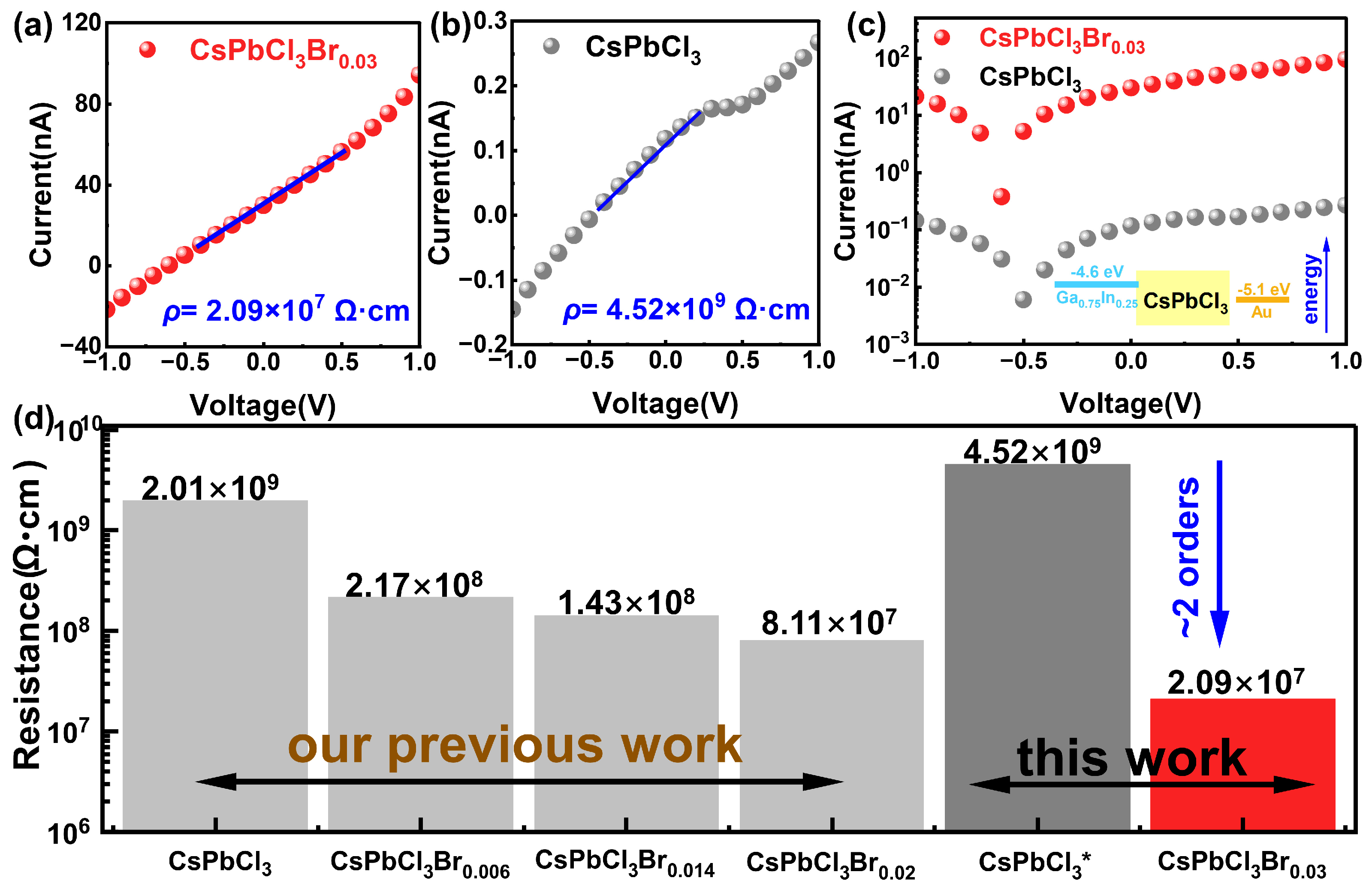
To evaluate the charge transport properties of the CsPbCl3 and CsPbCl3Br0.03 crystals, current-voltage (I-V) characteristics are measured under dark conditions, as shown in Figure 3. An asymmetric electrode structure is employed on both sides of the crystal. Specifically, on the two surfaces of the polished wafer, a thin layer of Au is deposited using magnetron sputtering on one side, while a liquid Ga0.75In0.25 alloy is applied on the other side. The work function difference between these two metal electrodes is approximately 0.5 eV. However, since both resistivity of CsPbCl3 and CsPbCl3Br0.03 are not high enough, a high-quality Schottky junction has not been fabricated [13].
The test results show that the resistivity of the CsPbCl3Br0.03 single crystal with a thickness of 0.98 mm and an electrode area of 10.5 mm2 is 2.09 × 10⁷ Ω·cm. Compared with the CsPbCl3 (4.52 × 10⁹ Ω·cm) with the same thickness and electrode area, its resistivity has decreased by two orders of magnitude. This further reduction in resistivity when compared with similar samples in our group’s previous work indicates that a higher concentration of Br incorporated into the crystal lattice has been achieved in this work [16]. In addition, I-V characteristics were performed at different positions of the crystal, and the results confirmed the uniform incorporation of Br within the crystal, as shown in Figure S7. Considering the theoretical calculations (as shown in Figure S5) [29,30,31,32,33], we believe the significant reduction in resistivity may be due to the excessive Br2 molecules occupying the interstitial sites in the lattice. Due to their strong electronegativity, these Br2 act as effective acceptor centers, capturing electrons from the valence band and introducing a high concentration of holes. This hole concentration far exceeds the intrinsic carrier concentration in the pure state, resulting in a significant increase in the background carrier density [34].

3.3. Steady-State and Time-Resolved Transient Photoluminescence Spectra

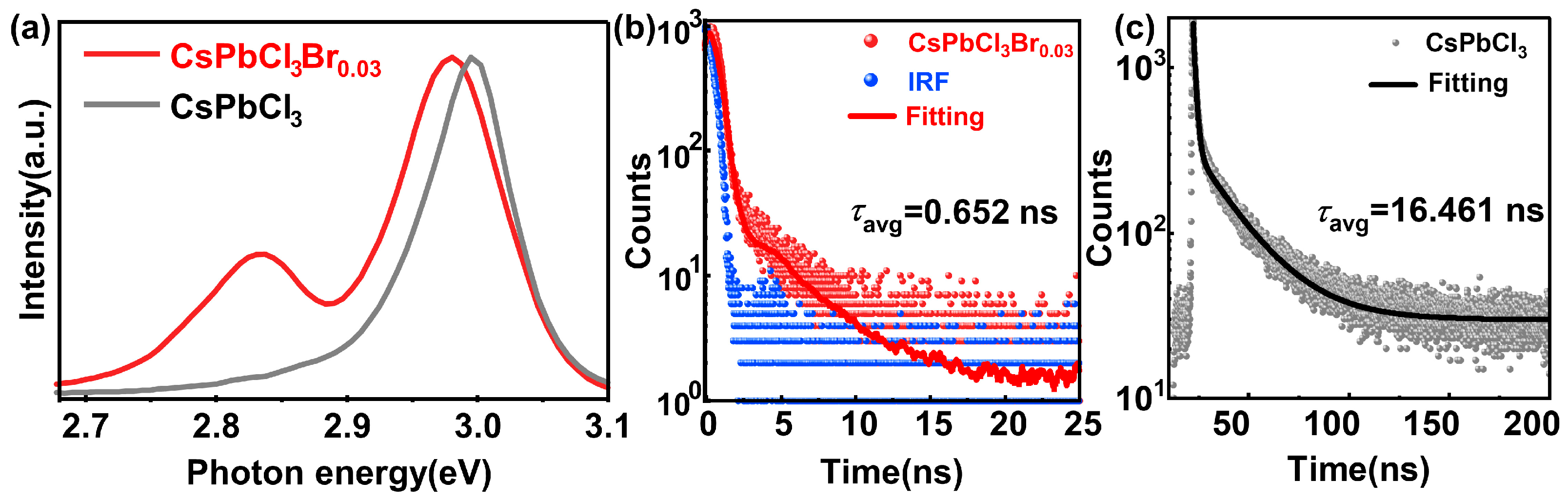
Steady-state and time-resolved transient photoluminescence (PL) spectroscopy techniques are crucial methods for revealing the radiative recombination mechanisms and carrier dynamics in luminescent materials. By using a 375 nm laser as the excitation source, we discovered that incorporation of Br2 would cause significant changes in the emission spectra and decay time of the CsPbCl3 crystals. As shown in Figure 4a, the pure CsPbCl3 crystal has a single emission peak at a position of 2.995 eV. The CsPbCl3Br0.03 crystal exhibits a double peak emission, with the two peaks located at 2.981 eV and 2.831 eV. Based on the test results, we observed that, after the incorporation of Br2, the main emission peak shifted slightly from the original 2.995 eV to 2.981 eV. This is due to the slight lattice expansion caused by excessive Br2. It is worth noting that a distinct, lower-energy emission peak appeared in the CsPbCl3Br0.03 crystal, with the emission peak energy approximately at 2.831 eV. However, this peak was absent in the pure CsPbCl3 crystal. This change in the emission spectrum indicates that the incorporation of Br has created a different luminescent environment, thereby causing alterations in the crystal structure and radiation energy levels.
Under the excitation light of 375 nm, the time-resolved transient photoluminescence decay times of the crystals before and after incorporation of Br2 are shown in Figure 4b and Figure 4c respectively. Compared with the CsPbCl3 crystal, the decay time of the CsPbCl3Br0.03 crystal is significantly shortened. The decay curves are fitted to obtain the photoluminescence decay time [35]. The average photoluminescence decay time of CsPbCl3Br0.03 decreased sharply from the 16.461 ns of CsPbCl3 to 0.652 ns, which is equivalent to a reduction of nearly one order of magnitude. The significant shortening of the decay time is consistent with the fast emission process caused by the bound excitons. This indicates that the Br2 molecules with strong electronegativity have introduced shallow trap centers that can serve as efficient recombination sites, facilitating rapid and efficient radiative recombination processes [36].
Based on the theoretical calculations mentioned earlier, we think that the strong electronegative interstitial Br2 molecules in CsPbCl3Br0.03 bring about two significant impacts. Electrically, they function as effective acceptor centers, capable of capturing electrons from the valence band, thereby generating a large number of holes and significantly reducing the resistivity of the crystal. From a kinetic perspective, this hole-rich environment creates efficient shallow-level defects, which serve as efficient recombination pathways to achieve fast decay. This explanation provides a unified interpretation for both electrical and optical measurements. The sub-nanosecond photoluminescence decay observed in the CsPbCl3Br0.03 crystal highlights its strong potential for fast timing applications.

3.4. Power-Dependent Photoluminescence

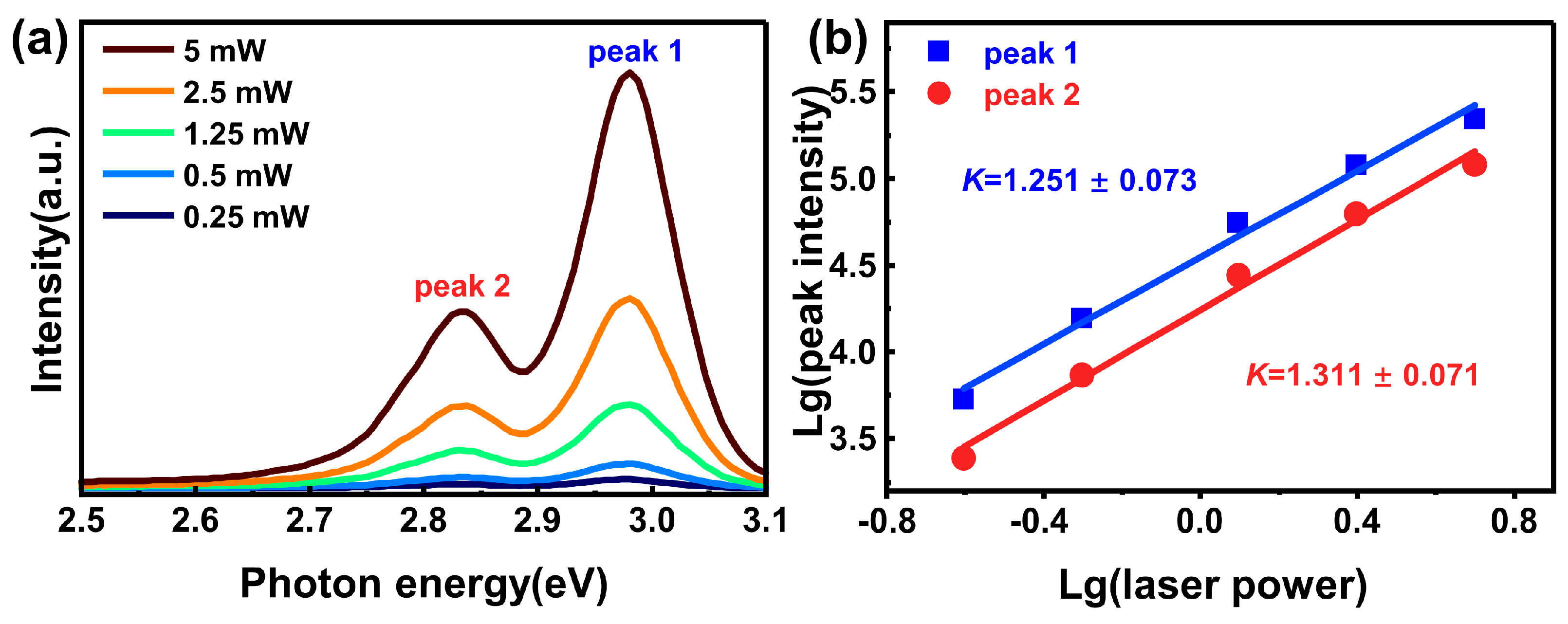
To gain a deeper understanding of the underlying mechanism of faster scintillation decay and radiation transition evolution caused by excessive Br, power-dependent photoluminescence measurements were performed at room temperature. As shown in Figure 5a, as the excitation power increased, the intensity of the photoluminescence peak significantly increased, indicating a direct correlation between excitation power and emission intensity. In general, the emission intensity (I) follows a power-law dependence on the excitation power (L), expressed as I∝Lk, where the exponent k can be used to identify the physical origin of radiative recombination. In the case of 0 < k < 1, the emission band can be ascribed to donor–acceptor pair recombination (DAP) or free-bound radiative recombination. When 1 < k < 2, the emission stems from transitions of free excitons or bound excitons [37,38].
We analyze the power-dependent photoluminescence spectra by using the Gaussian multi-peak fitting method. The results show that CsPbCl3Br0.03 crystal has two overlapping emission peaks. The higher energy peak is labeled as peak 1, while the lower energy peak is labeled as peak 2. As shown in the fitting results in Figure 5b, the values of k fitted for the two emission peaks of the CsPbCl3Br0.03 crystal are 1.251 and 1.311. Both values were within the range of 1 < k < 2, which confirmed that these emissions originated from the exciton recombination process. Based on the energy level structure and kinetic energy characteristics, the bound excitons typically have lower energy states and exhibit a faster decay time compared to those in the free state. Therefore, the high-energy emission peak 1 is attributed to the recombination of free excitons, while the low-energy emission peak 2 is attributed to the emission of bound excitons. This result provides a unified explanation for the observed spectral changes: in the CsPbCl3Br0.03 crystal, the bound excitation peak 2 at 2.831 eV indicates that the incorporation of Br2 effectively introduces shallow-level defects, thereby significantly increasing the probability of excitons being captured and undergoing radiative recombination through the faster bound state.

3.5. Temperature-Dependent Photoluminescence

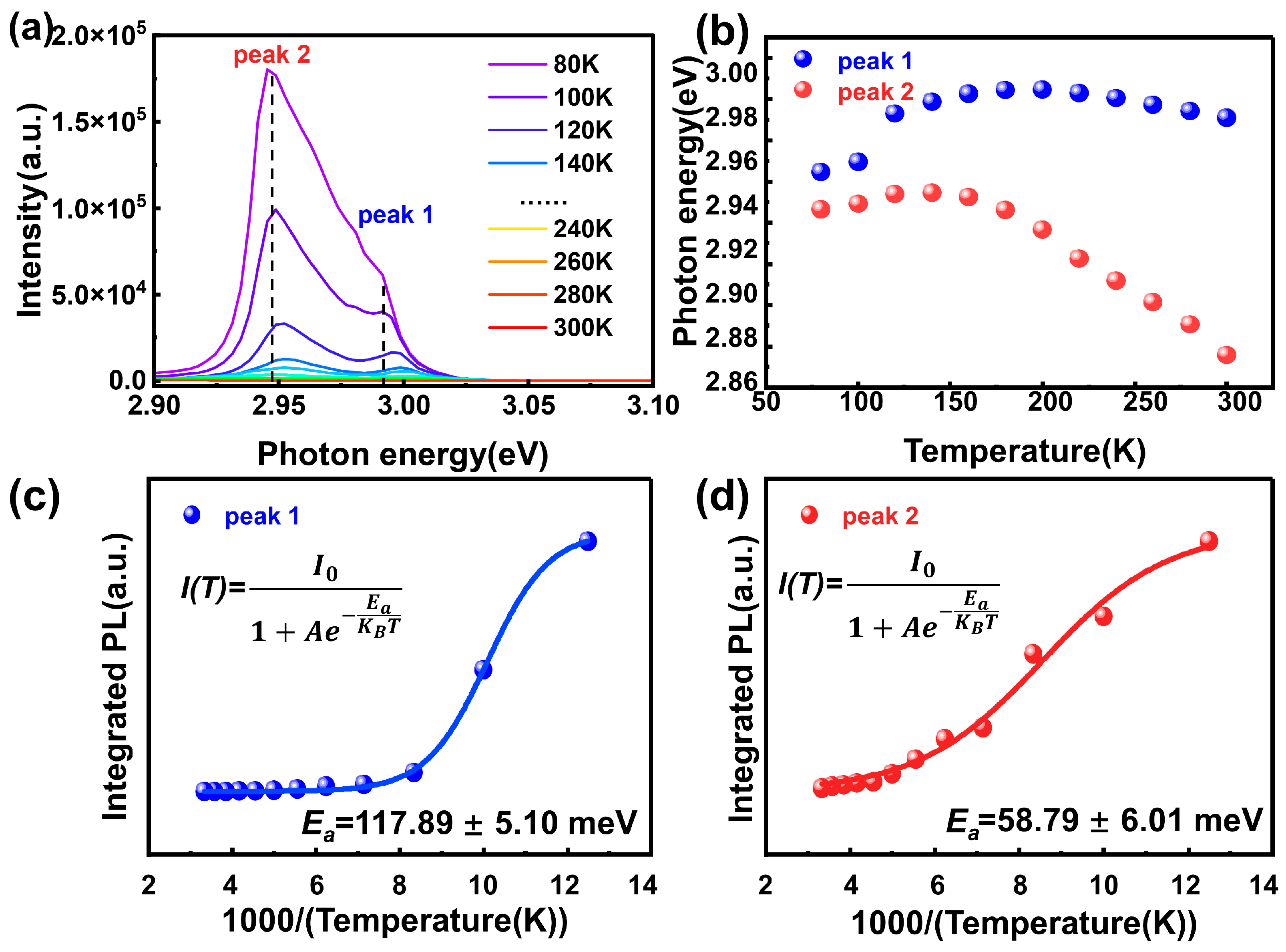
To further investigate the exciton dynamic characteristics in the single crystals grown under Br2 overpressure, we conducted temperature-dependent photoluminescence measurements within the temperature range of 80 to 300 K (with a step size of 20 K), as shown in Figure 6a. Due to the existence of phonon-assisted non-radiative relaxation processes, the overall photoluminescence intensity gradually decreases as the temperature rises [39].
By performing Gaussian multi-peak fitting on the temperature-dependent photoluminescence spectra, two overlapping emission peaks were obtained. This result is consistent with the previous analysis results of the power-dependent photoluminescence. The peak with higher energy is labeled as peak 1, while the peak with lower energy is labeled as peak 2, as shown in Figure 6b. We have meticulously recorded the changes in the integrated intensity and peak positions of these two peaks with temperature.
To gain a deeper understanding of the influence of Br incorporated into the crystal lattice on the luminescence mechanism of CsPbCl3 single crystals, we used the Arrhenius equation to fit the relationship between the integral PL intensity of the two exciton peaks and the temperature:
I ( T ) = I 0 1 + A e E a / K B T
Here, I(T) represents the integrated intensity of the photoluminescence peak at temperature T, and I0 represents the integrated peak intensity at the reference temperature. Ea is the thermal activation energy that needs to be determined, and KB is the Boltzmann constant (8.6 × 10⁻⁵ eV·K−1) [37,40,41].
The fitting results show that the Br incorporated into the crystal lattice has produced an emission peak with an exceptionally high thermal activation energy, a phenomenon that has not been reported before. For the higher energy emission peak 1, the thermal activation energy obtained from Arrhenius fitting is 117.89 eV, as shown in Figure 6c. This value is significantly higher than the theoretically predicted binding energy of the intrinsic exciton in CsPbCl3 (approximately 64–72 meV) [42,43]. We think that the sharp increase in Ea is due to the high electronegativity of the Br2 molecules incorporated into the crystal lattice, which capture electrons from the lattice. Subsequently, the holes in the crystal approach these electrons, and both are tightly captured nearby the Br2 molecules. This strongly binds the electron–hole pair together, and its exciton radius is very small. Due to the small exciton radius, when exposed to external energy, this electron–hole pair will recombine very quickly, exhibiting a very short decay time.
For the low-energy emission peak 2, the thermal activation energy obtained from the Arrhenius fitting is 58.79 eV (Figure 6d), which reflects the decrease in the exciton binding energy after Br is incorporated into the crystal lattice. We think this is because the shallow energy level defects generated after Br is incorporated into the crystal lattice bring many new and rapid radiation recombination sites, thereby causing a significant shortening of the decay time. In summary, the Br incorporation into the CsPbCl3 has significantly changed the exciton recombination situation. On the one hand, the highly electronegative Br2 molecule greatly shortens the exciton radius, thereby significantly reducing the recombination time. On the other hand, the Br incorporated into the crystal lattice brings shallow energy level recombination sites, and the increase in the recombination pathways leads to a decrease in the decay time.

3.6. Alpha Particle Excitation

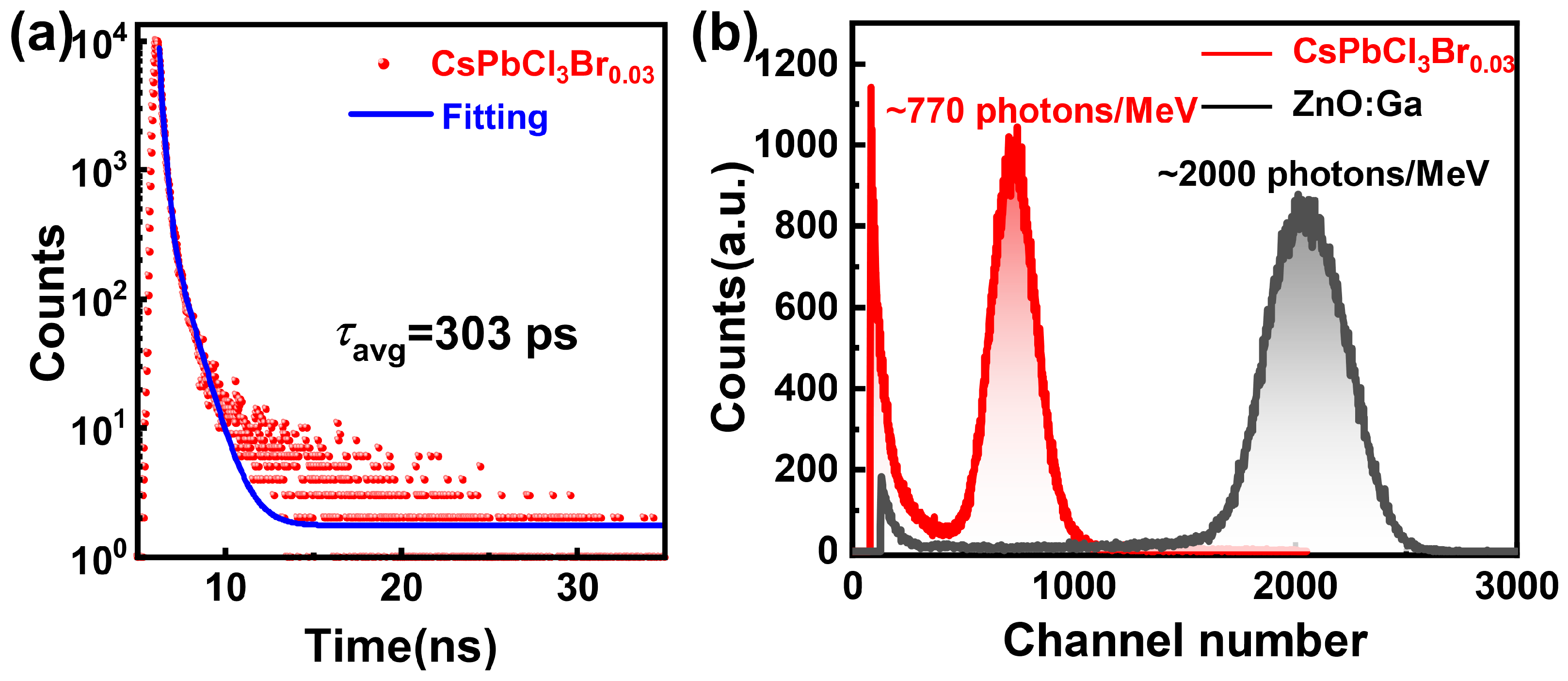
To further verify the fast timing scintillation mechanism of the CsPbCl3Br0.03 crystal under actual high-energy radiation conditions, we use an 241Am α-particle source to excite the sample and measured the corresponding decay curve. As shown in Figure 7a, the average decay time of the CsPbCl3Br0.03 crystal remains in the sub-nanosecond range at 303 ps, which is much shorter than the 652 ps decay time obtained under 375 nm laser excitation. The scintillation rise time is 780 ps, which indicates that the CsPbCl3Br0.03 single crystal possesses excellent fast timing response. Additionally, using the 241Am α-particle source as the source, we obtain the pulse height spectrum of the CsPbCl3Br0.03 crystal, as shown in Figure 7b. Taking the commercial polycrystalline ZnO:Ga scintillator as a reference, the light yield of CsPbCl3Br0.03 crystal is estimated to be approximately 770 photons per MeV, equivalent to 2541 photons MeV−1·ns−1, about 76.23% of ZnO:Ga [8]. The relatively low light yield is due to its strong self-absorption effect. As can be seen from Figure S2, there is a large overlap region between the RL emission spectrum and the optical absorption spectrum of the CsPbCl3Br0.03 single crystal.

3.7. X-Ray Imaging

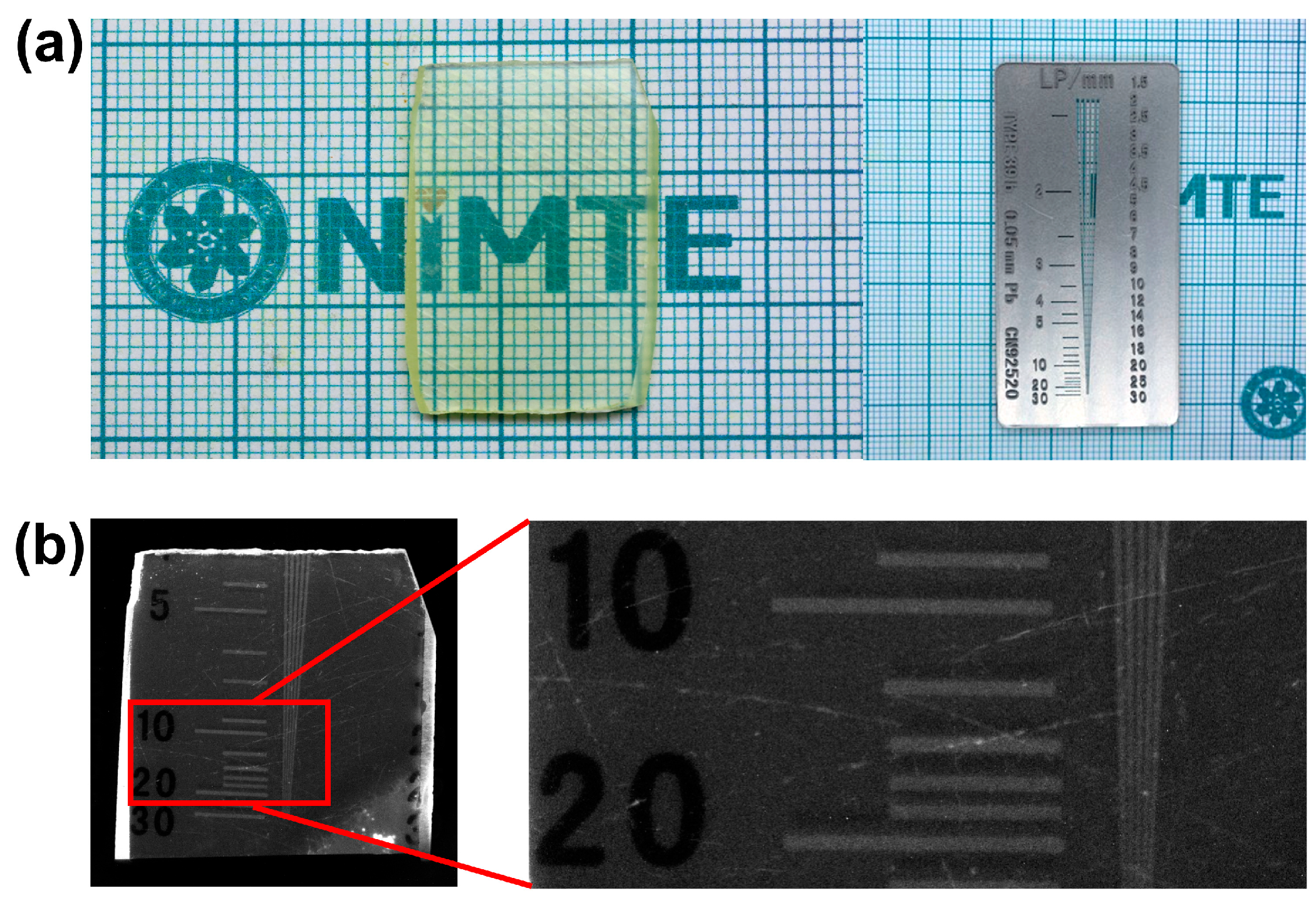
Spatial resolution is a key indicator for evaluating the imaging quality of scintillators under high-energy radiation. We measured the X-ray imaging spatial resolution of the CsPbCl3Br0.03 crystal using the standard line-pair phantom [44]. The crystal used for imaging and the photo of the line-pair phantom employed are shown in Figure 8a. The radiation source used is a tungsten target X-ray tube with a tube voltage of 50 kV and a tube current of 1000 mA. The line-pair phantom (or imaging target) is placed between the X-ray source and a finely polished 1.48 mm CsPbCl3Br0.03 crystal. The X-rays emitted from the X-ray source pass through the line-pair card (or imaging target) and are directed onto the crystal, generating visible lights. The visible lights transmit through an internal optical path to a CMOS camera lens with a 20-million-pixel sensor. Figure S3 shows the schematic diagram of the X-ray imaging principle. The exposure time of the camera is set to 15 s, and the X-ray spatial resolution of the CsPbCl3Br0.03 crystal is measured to be as high as 20 lp/mm, as shown in Figure 8b. This is a significant improvement compared to the best resolution of 4 lp/mm reported in our previous research on similar samples (CsPbCl3Br0.006, thickness 1.81 mm, exposure time 55 s) [16].
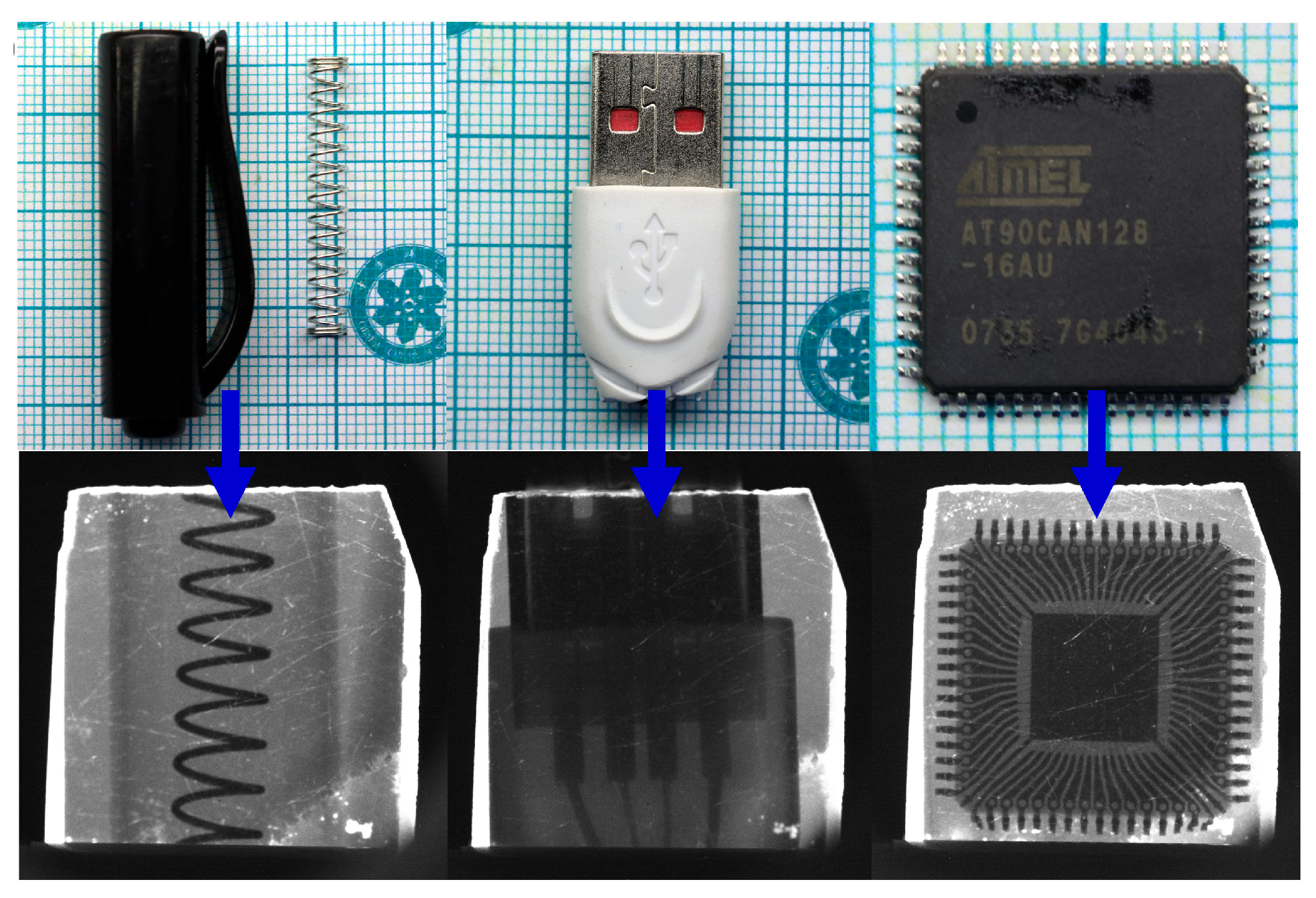
In addition, X-ray imaging is also conducted on actual objects, including a black plastic casing with a metal spring, a USB connector, and a printed circuit board, to evaluate the imaging capability of the actual objects, as shown in Figure 9. The X-ray effectively penetrated the non-metallic casing and clearly displayed the image of the metal spring beneath the plastic casing, the internal wiring of the USB connector, and the intricate circuits within the circuit board. We believe that this significant improvement in X-ray spatial resolution is due to the increased crystallinity and excellent optical transparency of the CsPbCl3Br0.03 crystals grown in this study. The outstanding performance indicates that this material has a possible potential application in X-ray imaging.

4. Conclusions

In this study, by meticulously improving the vertical Bridgman growth process of CsPbCl3 crystals, we successfully grew a 2-inch-diameter CsPbCl3Br0.03 single crystal by the vertical Bridgman method. These single crystals are transparent and have high crystalline quality, and compared with pure CsPbCl3, the lattice slightly expands. The Br in the crystal lattice introduces high-density fast recombination pathways in the CsPbCl3Br0.03 crystal and significantly suppresses the slow radioluminescence component. Under α-particle excitation, the decay time is shortened to 303 ps, which is significantly shorter than that of pure CsPbCl3 and all other perovskites by at least two orders of magnitude. Additionally, the CsPbCl3Br0.03 wafers function as scintillation screens for X-ray imaging, achieving a spatial resolution of 20 lp/mm under the tested conditions, which can clearly display the fine structure inside the printed circuit board. Through computational calculation, we analyze the possible mechanism for this strategy of growth under Br2 overpressure to achieve the fast timing scintillation ability of CsPbCl3Br0.03. These results indicate that CsPbCl3Br0.03 has great potential for conceptual fast timing applications, such as time of flight–positron emission tomography. However, due to its obvious internal self-absorption effect, its light yield is relatively low. Future research should focus on identifying the specific Br-related defect species responsible for the fast carrier recombination channel, improving compositional uniformity of the entire ingot, and reducing self-absorption to increase light output while maintaining fast timing scintillation performance.

Supplementary Materials

The following supporting information can be downloaded at: https://www.mdpi.com/article/10.3390/ma19081479/s1, Figure S1: The photo of the pure-phase and colorless CsPbCl3 crystal grown in this research; Figure S2: Stokes shift of CsPbCl3Br0.03 crystals. It shows a strong self-absorption effect, which accounts for the low light yield of the crystal; Figure S3: Schematic diagram illustrating the principle of X-ray imaging; Figure S4: The PXRD measured at different positions of the single crystal ingot grown under Br2 overpressure; Figure S5. (a) Schematic diagram of the supercell structure of CsPbCl3. (b) Schematic diagram of the supercell structure of CsPbCl3 with Br incorporated in the form of single atoms. (c) Schematic diagram of the supercell structure of CsPbCl3 with Br incorporated in the form of Br2 molecules. The incorporated Br atoms are indicated by red symbols; Figure S6. The SEM-EDS measured at different positions of the single crystal ingot grown under Br2 overpressure; Figure S7. The dark current-voltage (I-V) measured at different positions of the single crystal ingot grown under Br2 overpressure; Table S1. The calculation results of the volume expansion rate and formation energy of the CsPbCl3Br0.03 models. References [29,30,31,32,33] are cited in Supplementary Materials.

Author Contributions

J.Y. designed and accomplished synthesis, crystal growth, characterization, as well as the measurement of optical properties. J.Y. also conducted data analysis and wrote the manuscript. F.W., L.C. conducted measurements on the pulse height spectra and the pulse height spectra of the material. T.B. completed the calculation part. Z.C. reviewed and edited the work. W.L. designed and supervised the project and provided assistance in organizing the entire manuscript. All authors have read and agreed to the published version of the manuscript.

Funding

This research was supported by the National Natural Science Foundation of China (52272171), the Ningbo Yongjiang Talent Introduction Project (2021A-106-G).

Institutional Review Board Statement

Not applicable.

Informed Consent Statement

Not applicable.

Data Availability Statement

The original contributions presented in this study are included in the article/Supplementary Material. Further inquiries can be directed to the corresponding author.

Conflicts of Interest

The authors declare no conflict of interest.

References

  1. Lecoq, P. Pushing the Limits in Time-of-Flight PET Imaging. IEEE Trans. Radiat. Plasma Med. Sci. 2017, 1, 473–485. [Google Scholar] [CrossRef]
  2. Lecoq, P.; Morel, C.; Prior, J.O.; Visvikis, D.; Gundacker, S.; Auffray, E.; Križan, P.; Turtos, R.M.; Thers, D.; Charbon, E.; et al. Roadmap toward the 10 Ps Time-of-Flight PET Challenge. Phys. Med. Biol. 2020, 65, 21RM01. [Google Scholar] [CrossRef] [PubMed]
  3. Silver, C.S.; Beeman, J.; Piccirillo, L.; Timbie, P.T.; Zhou, J.W. Optimization of a Bolometric Neutron Detector. Nucl. Instrum. Methods Phys. Res. Sect. A 2002, 485, 615–623. [Google Scholar] [CrossRef]
  4. Faderl, N. Fast Decay Solid-State Scintillators for High-Speed x-Ray Imaging. In Electro-Optical and Infrared Systems: Technology and Applications XVI; Hickman, D.L., Bürsing, H., Eds.; SPIE: Strasbourg, France, 2019; p. 10. [Google Scholar] [CrossRef]
  5. Valdes, D.J.; Rendon, L.; Miller, S.; Castaneda, J.J.; Leak, C.; Haque, S.; Gunthoti, K.; Wender, S.A.; Winkelbauer, J.; Paneru, S.N.; et al. Gallium Nitride (GaN) Scintillation Response to Fast Neutrons and Flash Gamma Rays and Associated Broadband Photoluminescence. AIP Adv. 2025, 15, 055037. [Google Scholar] [CrossRef]
  6. Kurudirek, M.; Kurudirek, S.V.; Erickson, A.; Sellin, P.J.; Duce, M.; Gouws, J.; Lawrie, B.J.; Melcher, C.L.; Hertel, N.E. Vertically Self-Oriented, Ultrafast 1D ZnO:Li Nanorods as Scintillators for Thermal Neutron Detection. ACS Appl. Nano Mater. 2025, 8, 20697–20712. [Google Scholar] [CrossRef]
  7. Wan, P.; Zhang, A.; Du, X.; Bao, Z.; Zhu, Z.; He, S.; Sui, X.; Han, C.; Niu, G.; Tang, J.; et al. High Spatial Resolution Perovskite Fast Neutron Imaging Screen by35 Cl (n, p) Nuclear Reaction. Small 2025, 21, e02360. [Google Scholar] [CrossRef]
  8. Lin, R.; Zhu, Y.; Chen, L.; Zheng, W.; Xu, M.; Ruan, J.; Li, R.; Li, T.; Lin, Z.; Cheng, L.; et al. Ultrafast (600 ps) α-Ray Scintillators. PhotoniX 2022, 3, 9. [Google Scholar] [CrossRef]
  9. Mykhaylyk, V.B.; Kraus, H.; Kapustianyk, V.; Kim, H.J.; Mercere, P.; Rudko, M.; Da Silva, P.; Antonyak, O.; Dendebera, M. Bright and Fast Scintillations of an Inorganic Halide Perovskite CsPbBr3 Crystal at Cryogenic Temperatures. Sci. Rep. 2020, 10, 8601. [Google Scholar] [CrossRef]
  10. Kang, J.; Wang, L.-W. High Defect Tolerance in Lead Halide Perovskite CsPbBr3. J. Phys. Chem. Lett. 2017, 8, 489–493. [Google Scholar] [CrossRef]
  11. Mosquera-Lois, I.; Huang, Y.-T.; Lohan, H.; Ye, J.; Walsh, A.; Hoye, R.L.Z. Multifaceted Nature of Defect Tolerance in Halide Perovskites and Emerging Semiconductors. Nat. Rev. Chem. 2025, 9, 287–304. [Google Scholar] [CrossRef]
  12. He, Y.; Matei, L.; Jung, H.J.; McCall, K.M.; Chen, M.; Stoumpos, C.C.; Liu, Z.; Peters, J.A.; Chung, D.Y.; Wessels, B.W.; et al. High Spectral Resolution of Gamma-Rays at Room Temperature by Perovskite CsPbBr3 Single Crystals. Nat. Commun. 2018, 9, 1609. [Google Scholar] [CrossRef] [PubMed]
  13. He, Y.; Stoumpos, C.C.; Hadar, I.; Luo, Z.; McCall, K.M.; Liu, Z.; Chung, D.Y.; Wessels, B.W.; Kanatzidis, M.G. Demonstration of Energy-Resolved γ-Ray Detection at Room Temperature by the CsPbCl3 Perovskite Semiconductor. J. Am. Chem. Soc. 2021, 143, 2068–2077. [Google Scholar] [CrossRef] [PubMed]
  14. Pan, L.; Liu, Z.; Welton, C.; Klepov, V.V.; Peters, J.A.; De Siena, M.C.; Benadia, A.; Pandey, I.; Miceli, A.; Chung, D.Y.; et al. Ultrahigh-Flux X-ray Detection by a Solution-Grown Perovskite CsPbBr3 Single-Crystal Semiconductor Detector. Adv. Mater. 2023, 35, 2211840. [Google Scholar] [CrossRef]
  15. Voloshynovskii, A.; Savchyn, P.; Karbovnyk, I.; Myagkota, S.; Cestelli Guidi, M.; Piccinini, M.; Popov, A.I. CsPbCl3 Nanocrystals Dispersed in the Rb0,8Cs0,2Cl Matrix Studied by Far-Infrared Spectroscopy. Solid State Commun. 2009, 149, 593–597. [Google Scholar] [CrossRef]
  16. Zhang, Y.; Shen, M.; Cheng, B.; Ma, W.; Huang, X.; Zhang, L.; Chai, Z.; Lin, W. Ultrafast Scintillation at Room Temperature Achieved in CsPbCl3-Based Single Crystals through Br over-Doping. J. Mater. Chem. C 2024, 12, 7169–7175. [Google Scholar] [CrossRef]
  17. Liu, W.; Peng, X.; Ge, B.; Zhang, X.; Hao, Y.; Tang, J.; Bai, R.; Xu, M.; Jie, W.; Xu, Y. Stoichiometric Engineering for Large-Size CsPbBr3 Crystal Growth and Gamma-Ray Detection Optimization. J. Mater. Chem. C 2026, 14, 3126–3135. [Google Scholar] [CrossRef]
  18. Badawi, R.D.; Shi, H.; Hu, P.; Chen, S.; Xu, T.; Price, P.M.; Ding, Y.; Spencer, B.A.; Nardo, L.; Liu, W.; et al. First Human Imaging Studies with the EXPLORER Total-Body PET Scanner*. J. Nucl. Med. 2019, 60, 299–303. [Google Scholar] [CrossRef]
  19. Shoji, Y.; Kurosawa, S.; Yokota, Y.; Hayasaka, S.; Kamada, K.; Yoshino, M.; Yamaji, A.; Chani, V.; Ohashi, Y.; Sakuragi, S.; et al. Growth and Scintillation Properties of Two-Inch-Diameter SrI2(Eu) Single Crystals. Cryst. Growth Des. 2018, 18, 3747–3752. [Google Scholar] [CrossRef]
  20. Peng, J.; Xu, Y.; Yao, F.; Lin, Q. Thick-Junction Perovskite X-Ray Detectors: Processing and Optoelectronic Considerations. Nanoscale 2022, 14, 9636–9647. [Google Scholar] [CrossRef]
  21. Rudolph, P. (Ed.) Handbook of Crystal Growth; Elsevier: Amsterdam, The Netherlands, 2015. [Google Scholar] [CrossRef]
  22. Derby, J.J. Macroscopic Transport Processes During the Growth of Single Crystals from the Melt. In Science and Technology of Crystal Growth; Van Der Eerden, J.P., Bruinsma, O.S.L., Eds.; Springer: Dordrecht, The Netherlands, 1995; pp. 97–110. [Google Scholar] [CrossRef]
  23. Müller, G. Convection in Melts and Crystal Growth. Adv. Space Res. 1983, 3, 51–60. [Google Scholar] [CrossRef]
  24. Ding, S.; Huang, X.; Yin, Q.; Dong, Y.; Bai, Y.; Wang, T.; Hao, H. Heat Transfer and Its Effect on Growth Behaviors of Crystal Layers during Static Layer Melt Crystallization. Chem. Eng. Sci. 2021, 233, 116390. [Google Scholar] [CrossRef]
  25. Brik, M.G.; Srivastava, A.M.; Popov, A.I. A Few Common Misconceptions in the Interpretation of Experimental Spectroscopic Data. Opt. Mater. 2022, 127, 112276. [Google Scholar] [CrossRef]
  26. Maddalena, F.; Mahyuddin, M.H.; Kowal, D.; Witkowski, M.E.; Makowski, M.; Kuddus Sheikh, M.A.; Mahato, S.; Jȩdrzejewski, R.; Drozdowski, W.; Dujardin, C.; et al. Lattice Expansion in Rb-Doped Hybrid Organic–Inorganic Perovskite Crystals Resulting in Smaller Band-Gap and Higher Light-Yield Scintillators. Inorg. Chem. 2023, 62, 8892–8902. [Google Scholar] [CrossRef]
  27. Huang, X.; Cheng, B.; Ma, W.; Qi, S.; Zhang, Y.; Shen, M.; Bo, T.; Zhang, L.; Lin, W. CsPbBrxCl3–x Solid Solutions: Understanding the Relationship between Lattice Expansion and Optical Properties. Inorg. Chem. 2024, 63, 11924–11929. [Google Scholar] [CrossRef] [PubMed]
  28. Prasanna, R.; Gold-Parker, A.; Leijtens, T.; Conings, B.; Babayigit, A.; Boyen, H.-G.; Toney, M.F.; McGehee, M.D. Band Gap Tuning via Lattice Contraction and Octahedral Tilting in Perovskite Materials for Photovoltaics. J. Am. Chem. Soc. 2017, 139, 11117–11124. [Google Scholar] [CrossRef]
  29. Kresse, G.; Furthmüller, J. Efficient Iterative Schemes for Ab Initio Total-Energy Calculations Using a Plane-Wave Basis Set. Phys. Rev. B 1996, 54, 11169–11186. [Google Scholar] [CrossRef]
  30. Blöchl, P.E. Projector Augmented-Wave Method. Phys. Rev. B 1994, 50, 17953–17979. [Google Scholar] [CrossRef]
  31. Perdew, J.P.; Burke, K.; Ernzerhof, M. Generalized Gradient Approximation Made Simple. Phys. Rev. Lett. 1996, 77, 3865–3868. [Google Scholar] [CrossRef]
  32. Chadi, D.J. Special Points for Brillouin-Zone Integrations. Phys. Rev. B 1977, 16, 1746–1747. [Google Scholar] [CrossRef]
  33. Pela, R.R.; Hsiao, C.-L.; Hultman, L.; Birch, J.; Gueorguiev, G.K. Electronic and Optical Properties of Core–Shell InAlN Nanorods: A Comparative Study via LDA, LDA-1/2, mBJ, HSE06, G0W0 and BSE Methods. Phys. Chem. Chem. Phys. 2024, 26, 7504–7514. [Google Scholar] [CrossRef]
  34. Dou, L.; Wong, A.B.; Yu, Y.; Lai, M.; Kornienko, N.; Eaton, S.W.; Fu, A.; Bischak, C.G.; Ma, J.; Ding, T.; et al. Atomically Thin Two-Dimensional Organic-Inorganic Hybrid Perovskites. Science 2015, 349, 1518–1521. [Google Scholar] [CrossRef]
  35. Gabelloni, F.; Biccari, F.; Andreotti, G.; Balestri, D.; Checcucci, S.; Milanesi, A.; Calisi, N.; Caporali, S.; Vinattieri, A. Recombination Dynamics in CsPbBr3 Nanocrystals: Role of Surface States. Opt. Mater. Express 2017, 7, 4367. [Google Scholar] [CrossRef]
  36. Mykhaylyk, V.B.; Rudko, M.; Kraus, H.; Kapustianyk, V.; Kolomiets, V.; Vitoratou, N.; Chornodolskyy, Y.; Voloshinovskii, A.S.; Vasylechko, L. Ultra-Fast Low Temperature Scintillation and X-Ray Luminescence of CsPbCl3 Crystals. J. Mater. Chem. C 2023, 11, 656–665. [Google Scholar] [CrossRef]
  37. Lin, W.; He, J.; McCall, K.M.; Stoumpos, C.C.; Liu, Z.; Hadar, I.; Das, S.; Wang, H.; Wang, B.; Chung, D.Y.; et al. Inorganic Halide Perovskitoid TlPbI3 for Ionizing Radiation Detection. Adv. Funct. Mater. 2021, 31, 2006635. [Google Scholar] [CrossRef]
  38. Schmidt, T.; Lischka, K.; Zulehner, W. Excitation-Power Dependence of the near-Band-Edge Photoluminescence of Semiconductors. Phys. Rev. B 1992, 45, 8989–8994. [Google Scholar] [CrossRef] [PubMed]
  39. Wright, A.D.; Verdi, C.; Milot, R.L.; Eperon, G.E.; Pérez-Osorio, M.A.; Snaith, H.J.; Giustino, F.; Johnston, M.B.; Herz, L.M. Electron–Phonon Coupling in Hybrid Lead Halide Perovskites. Nat. Commun. 2016, 7, 11755. [Google Scholar] [CrossRef] [PubMed]
  40. Li, J.; Yuan, X.; Jing, P.; Li, J.; Wei, M.; Hua, J.; Zhao, J.; Tian, L. Temperature-Dependent Photoluminescence of Inorganic Perovskite Nanocrystal Films. RSC Adv. 2016, 6, 78311–78316. [Google Scholar] [CrossRef]
  41. Yi, J.; Ge, X.; Liu, E.; Cai, T.; Zhao, C.; Wen, S.; Sanabria, H.; Chen, O.; Rao, A.M.; Gao, J. The Correlation between Phase Transition and Photoluminescence Properties of CsPbX3 (X = Cl, Br, I) Perovskite Nanocrystals. Nanoscale Adv. 2020, 2, 4390–4394. [Google Scholar] [CrossRef]
  42. Baranowski, M.; Plochocka, P.; Su, R.; Legrand, L.; Barisien, T.; Bernardot, F.; Xiong, Q.; Testelin, C.; Chamarro, M. Exciton Binding Energy and Effective Mass of CsPbCl3: A Magneto-Optical Study. Photon. Res. 2020, 8, A50. [Google Scholar] [CrossRef]
  43. Zhang, Q.; Su, R.; Liu, X.; Xing, J.; Sum, T.C.; Xiong, Q. High-Quality Whispering-Gallery-Mode Lasing from Cesium Lead Halide Perovskite Nanoplatelets. Adv. Funct. Mater. 2016, 26, 6238–6245. [Google Scholar] [CrossRef]
  44. Wang, H.; Sun, Q.; Yang, F.; Li, Z.; Sun, L.; Zhang, X.; Zhao, Z.; Hu, W. Ultrahigh Resolution X-Ray Imaging with Thin-Film Scintillators Based on Aggregation-Induced Delayed Fluorescence Luminogens. SmartMat 2025, 6, e70002. [Google Scholar] [CrossRef]
Figure 1. (a) Schematic diagram of the vertical Bridgman growth process for single crystals of CsPbCl3Br0.03 grown under Br2 overpressure. The arrows indicate the downward movement of the ampoule and the rotation of the ampoule during growth. (b) Temperature–position curve of CsPbCl3Br0.03 crystal growth. (c,d) The as-grown 2-inch CsPbCl3Br0.03 single crystal ingots. (e) Comparison photos of wafer samples of CsPbCl3Br0.03 and CsPbCl3 with the same thickness of 2.0 mm.
Materials 19 01479 g001
Figure 2. (a,b) Powder X-ray diffraction (PXRD) patterns of CsPbCl3 and CsPbCl3Br0.03 crystals. (c) UV-Vis optical absorption spectra of CsPbCl3 and CsPbCl3Br0.03 crystals. The blue lines represent the tangent lines applied to the linear region for bandgap determination. (d) UV-Vis optical transmittance spectra of CsPbCl3 and CsPbCl3Br0.03 crystals.
Materials 19 01479 g002
Figure 3. (a,b) The dark current-voltage (I-V) characteristics of CsPbCl3Br0.03 and CsPbCl3 crystals, respectively. (c) Comparison of the dark I-V characteristics of the crystals before and after the incorporation of Br2. (d) Comparison of the resistivity of the crystals grown in this work with that of similar crystals reported in our group’s previous work. The CsPbCl3* denotes the pure CsPbCl3 sample synthesized in this work.
Materials 19 01479 g003
Figure 4. (a) Photoluminescence spectra of CsPbCl3 and CsPbCl3Br0.03 crystals. (b) Time-resolved transient photoluminescence decay time of the CsPbCl3Br0.03 crystal under 375 nm laser excitation (power: 5 mW). (c) Time-resolved transient photoluminescence decay time of the CsPbCl3 crystal under 375 nm laser excitation (power: 5 mW).
Materials 19 01479 g004
Figure 5. (a) Room-temperature steady-state photoluminescence spectra of the CsPbCl3Br0.03 crystal under 375 nm laser excitation at different powers. (b) Graph showing the variation of lg (peak intensity) in CsPbCl3Br0.03 crystal with lg (laser power), along with the corresponding linear fitting curve.
Materials 19 01479 g005
Figure 6. (a) Temperature-dependent photoluminescence spectra of the CsPbCl3Br0.03 crystal under 375 nm laser excitation. (b) The position of the two emission peaks as a function of temperature obtained by Gaussian decomposition. (c,d) Arrhenius plots and fitting curves of the integrated PL intensities for peak 1 and peak 2, respectively, where Ea represents the extracted thermal activation energy.
Materials 19 01479 g006
Figure 7. (a) Single particle time-resolved spectrum of the CsPbCl3Br0.03 crystal excited by the 5.486 MeV α-particle emitted from 241Am. (b) Comparison of pulse height spectra (light yield) between the CsPbCl3Br0.03 crystal and a standard ZnO:Ga scintillator excited by the 5.486 MeV α-particle emitted from 241Am.
Materials 19 01479 g007
Figure 8. (a) Photograph of the CsPbCl3Br0.03 crystal and the standard TYPE 39b line-pair phantom used for spatial resolution measurements. (b) X-ray spatial resolution of the CsPbCl3Br0.03 crystal measured using the line-pair phantom.
Materials 19 01479 g008
Figure 9. Using the CsPbCl3Br0.03 crystal for X-ray imaging of different objects, the imaging objects include: a black plastic casing with a metal spring, a USB connector, and a printed circuit board.
Materials 19 01479 g009
Disclaimer/Publisher’s Note: The statements, opinions and data contained in all publications are solely those of the individual author(s) and contributor(s) and not of MDPI and/or the editor(s). MDPI and/or the editor(s) disclaim responsibility for any injury to people or property resulting from any ideas, methods, instructions or products referred to in the content.