Rectification of Material Model for Fibrous Materials in Compressive Mode





Abstract
1. Introduction
2. Materials and Methods
2.1. Definition of Material Compressive Stiffness Characteristics
2.2. Sample Preparation
2.3. Refinement of Material Model from Experimental Results
3. Results
4. Discussion
5. Conclusions
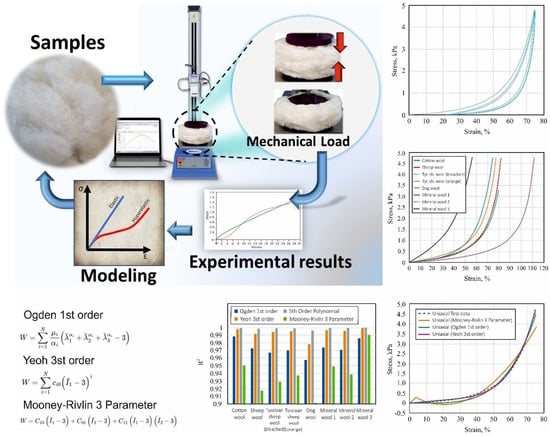
- The investigation results show the following: the decisive factor in the material response to the mechanical compression is not the nature of the material (vegetation, animal, mineral origin) but its structure (in this case, chaotically arranged fibers).
- The application of hyperelastic material models to chaotic fiber structures is not only based on considerations about the analogy of the structures compared to confirmed hyperelastic materials.
- Fibers formed into a cylindrical sample, in this case, responded to compression as hyperelastic materials. The ability to provide detailed information limited the evaluation of how shear deformations work and the influence of fiber orientation on the mechanical samples.
- At the global level, the implementation of waste utilization in the real construction sector is promoted, contributing to the preservation of natural resources and the environment.
- The fibers of living organisms, developed by nature over millions of years, are perfectly adapted to withstand the effects of the atmosphere, and climate challenges have perfectly adapted materials to withstand mechanical loads; you just need to use these materials properly. Sustainability requires more careful use of generated waste. This research and applied mathematical model can serve as a basis for the application of these natural fiber materials in the development of new compositions of materials for different industries.
Author Contributions
Funding
Institutional Review Board Statement
Informed Consent Statement
Data Availability Statement
Conflicts of Interest
References
- Chen, W.; Kumari, J.; Yuan, H.; Yang, F.; Kouwer, P.H.J. Toward Tissue-Like Material Properties: Inducing In Situ Adaptive Behavior in Fibrous Hydrogels. Adv. Mater. 2022, 34, e2202057. [Google Scholar] [CrossRef] [PubMed]
- McLaughlin, P.V.; Batterman, S.C. Limit behavior of fibrous materials. Int. J. Solids Struct. 1970, 6, 1357–1376. [Google Scholar] [CrossRef]
- Chen, X.; Hearle, J.W.S. Number 94 Modelling and Predicting Textile Behavior Part I Modelling the Structure and Behavior of Textiles 1 Structural Hierarchy in Textile Materials: An Overview 3; Woodhead Publishing Series in Textiles; Woodhead Publishing Limited: Cambridge, UK, 2010. [Google Scholar]
- Syerko, E.; Comas-Cardona, S.; Binetruy, C. Models of mechanical properties/behavior of dry fibrous materials at various scales in bending and tension: A review. Compos. Part A Appl. Sci. Manuf. 2012, 43, 1365–1388. [Google Scholar] [CrossRef]
- Arai, K.; Sakamoto, M.; Naito, S.; Takahashi, T. Crosslinking structure of keratin. II. Intermolecular and intramolecular crosslinks in potassium-cyanide-treated wool fibers. J. Appl. Polym. Sci. 1989, 38, 29–44. [Google Scholar] [CrossRef]
- Antunes, E.; Cruz, C.F.; Azoia, N.G.; Cavaco-Paulo, A. Insights on the mechanical behavior of keratin fibrils. Int. J. Biol. Macromol. 2016, 89, 477–483. [Google Scholar] [CrossRef]
- Mahé, F.; Binetruy, C.; Advani, S.; Férec, J.; Eck, B. A revisited compression flow model for concentrated suspensions with fiber-friction interactions. J. Nonnewtonian Fluid Mech. 2023, 319, 105090. [Google Scholar] [CrossRef]
- Chen, H.; Lu, J.; Wang, K.; Ding, G.; Chen, X. Yarn3D-Net: 3D segmentation of wool fabric microstructure using depth-enhanced Swin Transformer and CNN hybrid architecture. Mater. Today Commun. 2025, 46, 112729. [Google Scholar] [CrossRef]
- Israelachvili, J.N. Intermolecular and Surface Forces: Third Edition; Elsevier: Amsterdam, The Netherlands, 2011; pp. 1–676. [Google Scholar] [CrossRef]
- Abbott, G.M.; Grosberg, P.; Leaf, G.A.V. 26—The Elastic Resistance To Bending Of Plain-Woven Fabrics. J. Text. Inst. 1973, 64, 346–362. [Google Scholar] [CrossRef]
- Yin, C.; Feng, L.; Zhang, N.; Cheng, Y. How environmental factors affect the structural properties and biofunctions of keratin: A molecular dynamics study. Mater. Today Commun. 2022, 34, 105254. [Google Scholar] [CrossRef]
- Feughelman, M. Mechanical hysteresis in wool keratin fibers. J. Macromol. Sci. Part B Phys. 1973, 7, 569–582. [Google Scholar] [CrossRef]
- Feughelman, M. Mechanical Properties and Structure of Alpha-Keratin Fibres: Wool, Human Hair, and Related Fibres; University of South Wales Press UNSW Press: Sydney, Australia, 1997. [Google Scholar]
- Hughes, K.; Gozen, B.A. 3D printed soft composites with tunable hyperelastic properties. Compos. B Eng. 2025, 296, 112248. [Google Scholar] [CrossRef]
- Rahimidehgolan, F.; Altenhof, W. Compressive behavior and deformation mechanisms of rigid polymeric foams: A review. Compos. B Eng. 2023, 253, 110513. [Google Scholar] [CrossRef]
- Torres, F.G.; Aragon, C.L. Final product testing of rotational moulded natural fiber-reinforced polyethylene. Polym. Test. 2006, 25, 568–577. [Google Scholar] [CrossRef]
- Koponen, S.; Toratti, T.; Kanerva, P. Modelling longitudinal elastic an shrinkage properties of wood. Wood Sci. Technol. 1989, 23, 55–63. [Google Scholar] [CrossRef]
- Gassan, J.; Chate, A.; Bledzki, A.K. Calculation of elastic properties of natural fibers. J. Mater. Sci. 2001, 36, 3715–3720. [Google Scholar] [CrossRef]
- Shah, D.U.; Schubel, P.J.; Clifford, M.J.; Licence, P. The tensile behavior of off-axis loaded plant fiber composites: An insight on the nonlinear stress–strain response. Polym. Compos. 2012, 33, 1494–1504. [Google Scholar] [CrossRef]
- Islam, S.; Yang, S.; Kim, C.-I. A multiscale continuum model for the mechanics of hyperelastic composite reinforced with nanofibers. Int. J. Solids Struct. 2023, 267, 112168. [Google Scholar] [CrossRef]
- Narayanan, P.; Pramanik, R.; Arockiarajan, A. A hyperelastic viscoplastic damage model for large deformation mechanics of rate-dependent soft materials. Eur. J. Mech.-A/Solids 2022, 98, 104874. [Google Scholar] [CrossRef]
- Bigoni, D. Nonlinear Solid Mechanics–Bifurcation Theory and Material Instability-Davide Bigoni-Google Knygos; Cambridge University Press: Cambridge, UK, 2012. [Google Scholar] [CrossRef]
- Fukada, E. Piezoelectricity as a fundamental property of wood. Wood Sci. Technol. 1968, 2, 299–307. [Google Scholar] [CrossRef]
- Simpson, W.S.; Crawshaw, G. Wool: Science and Technology; Simpson, W.S., Crawshaw, G.H., Eds.; The Textile Institute: Manchester, UK; Woodhead Publishing: Cambridge, UK, 2002. [Google Scholar]
- Alyousef, R.; Alabduljabbar, H.; Mohammadhosseini, H.; Mohamed, A.M.; Siddika, A.; Alrshoudi, F.; Alaskar, A. Utilization of sheep wool as potential fibrous materials in the production of concrete composites. J. Build. Eng. 2020, 30, 101216. [Google Scholar] [CrossRef]
- Nguyen, D.M.; Perré, P.; Phung, T.K.; Tran, V.A. Advanced techniques for testing and characterization of wool composites. In Wool Fiber Reinforced Polymer Composites; Woodhead Publishing: Cambridge, UK, 2022. [Google Scholar] [CrossRef]
- Kabun, K.; Reinhold, K. Improving indoor air quality and mitigating health risks with sheep wool as a sustainable material. Indoor Environ. 2025, 2, 100111. [Google Scholar] [CrossRef]
- Saaidia, R.; Othmane, A.B.; Ayed, L.; Boumediene, N.; Bouabidi, A. Thermal, Acoustic, and mechanical characterization of sheep Wool-Based Bio-Composites for sustainable construction. Energy Build. 2026, 350, 116602. [Google Scholar] [CrossRef]
- Hearle, J.W.S. A critical review of the structural mechanics of wool and hair fibers. Int. J. Biol. Macromol. 2000, 27, 123–138. [Google Scholar] [CrossRef]
- Hearle, J.W.S.; Sparrow, J.T. Mechanics of the extension of cotton fibers. II. Theoretical modeling. J. Appl. Polym. Sci. 1979, 24, 1857–1874. [Google Scholar] [CrossRef]
- Lulevich, V.; Yang, H.Y.; Isseroff, R.R.; Liu, G.Y. Single cell mechanics of keratinocyte cells. Ultramicroscopy 2010, 110, 1435–1442. [Google Scholar] [CrossRef] [PubMed]
- Fiore, V.; Di Bella, G.; Valenza, A. Effect of Sheep Wool Fibers on Thermal Insulation and Mechanical Properties of Cement-Based Composites. J. Nat. Fibers 2020, 17, 1532–1543. [Google Scholar] [CrossRef]
- Ghermezgoli, Z.M.; Moezzi, M.; Yekrang, J.; Rafat, S.A.; Soltani, P.; Barez, F. Sound absorption and thermal insulation characteristics of fabrics made of pure and crossbred sheep waste wool. J. Build. Eng. 2021, 35, 102060. [Google Scholar] [CrossRef]
- Parlato, M.C.M.; Porto, S.M.C. Organized Framework of Main Possible Applications of Sheep Wool Fibers in Building Components. Sustainability 2020, 12, 761. [Google Scholar] [CrossRef]
- Lu, D.; Yu, W. Prediction of wool fiber breaking strength based on acoustic emission signal parameters and combined noise reduction method. Nondestruct. Test. Eval. 2024, 39, 2814–2833. [Google Scholar] [CrossRef]
- Yliniemi, J.; Ramaswamy, R.; Luukkonen, T.; Laitinen, O.; de Sousa, Á.N.; Huuhtanen, M.; Illikainen, M. Characterization of mineral wool waste chemical composition, organic resin content and fiber dimensions: Aspects for valorization. Waste Manag. 2021, 131, 323–330. [Google Scholar] [CrossRef]
- López-García, A.B.; Uceda-Rodríguez, M.; León-Gutiérrez, S.; Cobo-Ceacero, C.J.; Moreno-Maroto, J.M. Eco-efficient transformation of mineral wool wastes into lightweight aggregates at low firing temperature and associated environmental assessment. Constr. Build. Mater. 2022, 345, 128294. [Google Scholar] [CrossRef]
- Grahn, A.; Krepper, E.; Alt, S.; Kästner, W. Implementation of a strainer model for calculating the pressure drop across beds of compressible, fibrous materials. Nucl. Eng. Des. 2008, 238, 2546–2553. [Google Scholar] [CrossRef]
- Chen, Z.; Wang, H.; Ji, R.; Liu, L.; Cheeseman, C.; Wang, X. Reuse of mineral wool waste and recycled glass in ceramic foams. Ceram. Int. 2019, 45, 15057–15064. [Google Scholar] [CrossRef]
- Väntsi, O.; Kärki, T. Mineral wool waste in Europe: A review of mineral wool waste quantity, quality, and current recycling methods. J. Mater. Cycles Waste Manag. 2014, 16, 62–72. [Google Scholar] [CrossRef]
- Piggott, M.R. Mesostructures and their mechanics in fiber composites. Adv. Compos. Mater. 1996, 6, 75–81. [Google Scholar] [CrossRef]
- Subasinghe, A.; Somashekar, A.A.; Bhattacharyya, D. Effects of wool fiber and other additives on the flammability and mechanical performance of polypropylene/kenaf composites. Compos. B Eng. 2018, 136, 168–176. [Google Scholar] [CrossRef]
- Boccaletti, S.; Grebogi, C.; Lai, Y.-C.; Mancini, H.; Maza, D. The Control of Chaos: Theory and Applications. Phys. Rep. 2000, 329, 103–197. [Google Scholar] [CrossRef]
- Amores, V.J.; Millán, F.J.S.; Ben-Yelun, I.; Montáns, F.J. A finite strain non-parametric hyperelastic extension of the classical phenomenological theory for orthotropic compressible composites. Compos. B Eng. 2021, 212, 108591. [Google Scholar] [CrossRef]
- Peng, X.; Guo, Z.; Du, T.; Yu, W.R. A simple anisotropic hyperelastic constitutive model for textile fabrics with application to forming simulation. Compos. B Eng. 2013, 52, 275–281. [Google Scholar] [CrossRef]
- Aimène, Y.; Vidal-Sallé, E.; Hagège, B.; Sidoroff, F.; Boisse, P. A hyperelastic approach for composite reinforcement large deformation analysis. J. Compos. Mater. 2010, 44, 5–26. [Google Scholar] [CrossRef]
- Asadi, A.; Laksari, K. Optimal experimental design for repeatable hyperelastic material characterization. J. Mech. Behav. Biomed. Mater. 2025, 170, 107104. [Google Scholar] [CrossRef]
- Ogden, R.W.; Saccomandi, G.; Sgura, I. Fitting hyperelastic models to experimental data. Comput. Mech. 2004, 34, 484–502. [Google Scholar] [CrossRef]
- Rivlin, R.S. Large Elastic Deformations of Isotropic Materials. II. Some Uniqueness Theorems for Pure, Homogeneous Deformation. Philos. Trans. R. Soc. London Ser. A Math. Phys. Sci. 1948, 240, 491–508. [Google Scholar] [CrossRef]
- Kundu, R.D.; Zhang, X.S. Stress-based topology optimization for fiber composites with improved stiffness and strength: Integrating anisotropic and isotropic materials. Compos. Struct. 2023, 320, 117041. [Google Scholar] [CrossRef]
- Marsden, J.E.; Hughes, T.J.R.; Carlson, D.E. Mathematical Foundations of Elasticity. J. Appl. Mech. 1984, 51, 946. [Google Scholar] [CrossRef]
- Xu, P.; Wu, Y.; Zarei, A.; Ahmed, S.; Pilla, S.; Li, G.; Luo, F. Physically constrained 3D diffusion for inverse design of fiber-reinforced polymer composite materials. Compos. B Eng. 2025, 303, 112515. [Google Scholar] [CrossRef]
- Cheviakov, A.F.; Ganghoffer, J.F. Symmetry properties of two-dimensional Ciarlet–Mooney–Rivlin constitutive models in nonlinear elastodynamics. J. Math. Anal. Appl. 2012, 396, 625–639. [Google Scholar] [CrossRef][Green Version]
- Breslavsky, I.D.; Amabili, M.; Legrand, M. Nonlinear vibrations of thin hyperelastic plates. J. Sound Vib. 2014, 333, 4668–4681. [Google Scholar] [CrossRef]
- Bower, A.F. Applied Mechanics of Solids; CRC Press: Boca Raton, FL, USA, 2009; pp. 1–795. [Google Scholar] [CrossRef]
- Lion, A.; Diercks, N.; Caillard, J. On the directional approach in constitutive modelling: A general thermomechanical framework and exact solutions for Mooney–Rivlin type elasticity in each direction. Int. J. Solids Struct. 2013, 50, 2518–2526. [Google Scholar] [CrossRef]
- Hohenberger, T.W.; Windslow, R.J.; Pugno, N.M.; Busfield, J.J.C. A constitutive model for both low and high strain nonlinearities in highly filled elastomers and implementation with user-defined material subroutines in ABAQUS. Rubber Chem. Technol. 2019, 92, 653–686. [Google Scholar] [CrossRef]
- Soldatos, K.P. On the stability of a compressible Rivlin’s cube made of transversely isotropic material. IMA J. Appl. Math. 2006, 71, 332–353. [Google Scholar] [CrossRef]
- Mangan, R.; Destrade, M.; Saccomandi, G. Strain energy function for isotropic non-linear elastic incompressible solids with linear finite strain response in shear and torsion. Extreme Mech. Lett. 2016, 9, 204–206. [Google Scholar] [CrossRef]
- Saccomandi, G.; Vergori, L. Generalised Mooney–Rivlin models for brain tissue: A theoretical perspective. Int. J. Non. Linear. Mech. 2019, 109, 9–14. [Google Scholar] [CrossRef]
- Mooney, M. A Theory of Large Elastic Deformation. J. Appl. Phys. 2004, 11, 582. [Google Scholar] [CrossRef]
- Alibakhshi, A.; Imam, A.; Haghighi, S.E. Effect of the second invariant of the Cauchy–Green deformation tensor on the local dynamics of dielectric elastomers. Int. J. Non. Linear. Mech. 2021, 137, 103807. [Google Scholar] [CrossRef]
- Ferreira, E.R.; Boulanger, P.; Hayes, M. Superposition of finite-amplitude waves propagating in a principal plane of a deformed Mooney–Rivlin material. Int. J. Non. Linear. Mech. 2012, 47, 144–150. [Google Scholar] [CrossRef]
- Rauter, N.; Lammering, R. Investigation of the Higher Harmonic Lamb Wave Generation in Hyperelastic Isotropic Material. Phys. Procedia 2015, 70, 309–313. [Google Scholar] [CrossRef][Green Version]
- Hosseini, S.; Rahimi, G. Experimental and numerical analysis of hyperelastic plates using Mooney-Rivlin strain energy function and meshless collocation method. Eng. Anal. Bound. Elem. 2023, 150, 199–218. [Google Scholar] [CrossRef]
- Farahmand-Tabar, S.; Aghani, K. Finite deformation and hyperelasticity-ScienceDirect. In Practical Programming of Finite Element Procedures for Solids and Structures with MATLAB; Elsevier: Amsterdam, The Netherlands, 2024. [Google Scholar] [CrossRef]
- Liu, X.; Tian, S.; Tao, F.; Yu, W. A review of artificial neural networks in the constitutive modeling of composite materials. Compos. B Eng. 2021, 224, 109152. [Google Scholar] [CrossRef]
- Jiménez, F.L. Modeling of soft composites under three-dimensional loading. Compos. B Eng. 2014, 59, 173–180. [Google Scholar] [CrossRef]
- Lopez-Pamies, O.; Idiart, M.I. Fiber-reinforced hyperelastic solids: A realizable homogenization constitutive theory. J. Eng. Math. 2010, 68, 57–83. [Google Scholar] [CrossRef]
- Ogden, R.W. Large deformation isotropic elasticity–on the correlation of theory and experiment for incompressible rubberlike solids. Proc. R. Soc. Lond. A Math. Phys. Sci. 1972, 326, 565–584. [Google Scholar] [CrossRef]
- Lloyd, J.G.; Sivaloganathan, J. On the relative energies of the Rivlin and cavitation instabilities for compressible materials. Math. Mech. Solids 2012, 17, 338–350. [Google Scholar] [CrossRef]
- Spencer, A.J.M.; Soldatos, K.P. Finite deformations of fiber-reinforced elastic solids with fiber bending stiffness. Int. J. Non-Linear Mech. 2007, 42, 355–368. [Google Scholar] [CrossRef]
- Tu, W.; Wang, S.; Chen, Q. Continuum damage mechanics-based finite-volume homogenization of unidirectional elastoplastic fiber-reinforced composites. Int. J. Damage Mech. 2023, 32, 549–578. [Google Scholar] [CrossRef]
- Stramigioli, S. The principal bundle structure of continuum mechanics. J. Geom. Phys. 2024, 200, 105172. [Google Scholar] [CrossRef]
- Adkins, J.E. Finite plane deformation of thine elastic sheets reinforced with inextensible cords. Philos. Trans. R. Soc. Lond. Ser. A Math. Phys. Sci. 1956, 249, 125–150. [Google Scholar] [CrossRef]
- Schmidt, M.P.; Couret, L.; Gout, C.; Pedersen, C.B.W. Structural topology optimization with smoothly varying fiber orientations. Struct. Multidiscip. Optim. 2020, 62, 3105–3126. [Google Scholar] [CrossRef]
- Khristenko, U.; Schuß, S.; Krüger, M.; Schmidt, F.; Wohlmuth, B.; Hesch, C. Multidimensional Coupling: A Variationally Consistent Approach to Fiber-Reinforced Materials. Comput. Methods Appl. Mech. Eng. 2021, 382, 113869. [Google Scholar] [CrossRef]
- Islam, S.; Bolouri, S.E.S.; Kim, C.I. Mechanics of hyperelastic composites reinforced with nonlinear elastic fibrous materials in finite plane elastostatics. Int. J. Eng. Sci. 2021, 165, 103491. [Google Scholar] [CrossRef]
- van Wyk, C.M. 20—Note on the compressibility of wool. J. Text. Inst. Trans. 1946, 37, T285–T292. [Google Scholar] [CrossRef]
- Negi, V.; Picu, R.C. Mechanical behavior of cellular networks of fiber bundles stabilized by adhesion. Int. J. Solids Struct. 2020, 190, 119–128. [Google Scholar] [CrossRef]
- Wegst, U.G.K.; Ashby, M.F. The mechanical efficiency of natural materials. Philos. Mag. 2004, 84, 2167–2186. [Google Scholar] [CrossRef]
- Meyers, M.A.; Chen, P.Y.; Lin, A.Y.M.; Seki, Y. Biological materials: Structure and mechanical properties. Prog. Mater. Sci. 2008, 53, 1–206. [Google Scholar] [CrossRef]
- Li, Y.; Luo, Z. An Improved Mathematical Simulation of the Coupled Diffusion of Moisture and Heat in Wool Fabric. Text. Res. J. 1999, 69, 760–768. [Google Scholar] [CrossRef]
- Subramanian, G.; Picu, C.R. Mechanics of three-dimensional, nonbonded random fiber networks. Phys. Rev. E 2011, 83, 056120. [Google Scholar] [CrossRef]
- Alzweighi, M.; Mansour, R.; Lahti, J.; Hirn, U.; Kulachenko, A. The influence of structural variations on the constitutive response and strain variations in thin fibrous materials. Acta Mater. 2021, 203, 116460. [Google Scholar] [CrossRef]
- Kulkarni, S.; Khan, K.A.; Alhammadi, K.; Cantwell, W.J.; Umer, R. A visco-hyperelastic approach to model rate dependent compaction response of a 3D woven fabric. Compos. Part A Appl. Sci. Manuf. 2022, 163, 107229. [Google Scholar] [CrossRef]
- Wakayama, B.K.; Hattori, T. Discussing Van Wyk’s Theory [1] Concerning Compression of a Fibrous Mass. J. Text. Mach. Soc. Jpn. 1959, 5, 25–30. [Google Scholar] [CrossRef][Green Version]
- Ketoja, J.A.; Paunonen, S.; Jetsu, P.; Pääkkönen, E. Compression Strength Mechanisms of Low-Density Fibrous Materials. Materials 2019, 12, 384. [Google Scholar] [CrossRef]
- Beil, N.B.; Roberts, W.W. Modeling and Computer Simulation of the Compressional Behavior of Fiber Assemblies. Text. Res. J. 2002, 72, 341–351. [Google Scholar] [CrossRef]
- Lohr, M.J.; Sugerman, G.P.; Kakaletsis, S.; Lejeune, E.; Rausch, M.K. An introduction to the Ogden model in biomechanics: Benefits, implementation tools and limitations. Philos. Trans. A Math. Phys. Eng. Sci. 2022, 380, 20210365. [Google Scholar] [CrossRef]
- Yeoh, O.H. On the Ogden Strain-Energy Function. Rubber Chem. Technol. 1997, 70, 175–182. [Google Scholar] [CrossRef]
- Patidar, D.; Pal, V.K. Deformation behavior of interconnect encapsulated on functionally graded stretchable substrates. Int. J. Mech. Sci. 2023, 257, 108539. [Google Scholar] [CrossRef]
- Laksari, K.; Shafieian, M.; Darvish, K. Constitutive model for brain tissue under finite compression. J. Biomech. 2012, 45, 642–646. [Google Scholar] [CrossRef] [PubMed]
- Dempsey, S.C.H.; O’Hagan, J.J.; Samani, A. Measurement of the hyperelastic properties of 72 normal homogeneous and heterogeneous ex vivo breast tissue samples. J. Mech. Behav. Biomed. Mater. 2021, 124, 104794. [Google Scholar] [CrossRef]
- Kim, B.; Lee, S.B.; Lee, J.; Cho, S.; Park, H.; Yeom, S. A comparison among Neo-Hookean model, Mooney-Rivlin model, and Ogden model for Chloroprene rubber. Int. J. Precis. Eng. Manuf. 2012, 13, 759–764. [Google Scholar] [CrossRef]
- Wen, P.H.; Hon, Y.C. Geometrically Nonlinear Analysis of Reissner-Mindlin Plate by Meshless Computation. CMES 2007, 21, 177–191. [Google Scholar]
- Mindlin, R.D. High frequency vibrations of crystal plates. Q. Appl. Math. 1961, 19, 51–61. [Google Scholar] [CrossRef]
- Lu, L.; Guo, X.; Zhao, J. On the mechanics of Kirchhoff and Mindlin plates incorporating surface energy. Int. J. Eng. Sci. 2018, 124, 24–40. [Google Scholar] [CrossRef]
- Cen, S.; Shang, Y. Developments of Mindlin-Reissner plate elements. Math. Probl. Eng. 2015, 2015, 1–12. [Google Scholar] [CrossRef]
- Holzapfel, G.A.; Gasser, T.C.; Ogden, R.W. A new constitutive framework for arterial wall mechanics and a comparative study of material models. J. Elast. 2000, 61, 1–48. [Google Scholar] [CrossRef]
- Rassoli, A.; Fatouraee, N.; Zhang, Z.; Guidoin, R. Quantification and comparison of the nonlinear mechanical properties of transcutaneous and human aortic valve leaflets: Experimental and numerical studies. Mech. Mater. 2024, 188, 104872. [Google Scholar] [CrossRef]
- Khaniki, H.B.; Ghayesh, M.H.; Chin, R.; Amabili, M. Hyperelastic structures: A review on the mechanics and biomechanics. Int. J. Non. Linear. Mech. 2023, 148, 104275. [Google Scholar] [CrossRef]
- Pibulchinda, P.; Barocio, E.; Favaloro, A.J.; Pipes, R.B. Influence of printing conditions on the extrudate shape and fiber orientation in extrusion deposition additive manufacturing. Compos. B Eng. 2023, 261, 110793. [Google Scholar] [CrossRef]
- Parlato, M.C.M.; Porto, S.M.C.; Valenti, F. Assessment of sheep wool waste as new resource for green building elements. Build. Environ. 2022, 225, 109596. [Google Scholar] [CrossRef]
- Petek, B.; Logar, R.M. Management of waste sheep wool as valuable organic substrate in European Union countries. J. Mater. Cycles Waste Manag. 2021, 23, 44–54. [Google Scholar] [CrossRef]
- Rajabinejad, H.; Bucişcanu, I.I.; Maier, S.S. Current approaches for raw wool waste management and unconventional valorization: A review. Environ. Eng. Manag. J. 2019, 18, 1439–1456. [Google Scholar] [CrossRef]
- de Marzo, G.; Mastronardi, V.M.; Todaro, M.T.; Blasi, L.; Antonaci, V.; Algieri, L.; Scaraggi, M.; De Vittorio, M. Sustainable Electronic Biomaterials for Body-Compliant Devices: Challenges and Perspectives for Wearable Bio-Mechanical Sensors and Body Energy Harvesters. Nano Energy 2024, 123, 109336. [Google Scholar] [CrossRef]
- Erkmen, J.; Sari, M. Hydrophobic thermal insulation material designed from hazelnut shells, pinecone, paper and sheep wool. Constr. Build. Mater. 2023, 365, 130131. [Google Scholar] [CrossRef]
- Csaki, S.; Masan, V.; Knapek, M.; Burg, P. Valorization of selected horticultural wastes and sheep wool as building materials. Constr. Build. Mater. 2025, 488, 142176. [Google Scholar] [CrossRef]
- Midolo, G.; Del Zoppo, M.; Porto, S.M.C.; Valenti, F. Recycling of wasted wool fibers from sheep shearing for green building components: A review. Case Stud. Constr. Mater. 2024, 21, e03623. [Google Scholar] [CrossRef]
- Zhong, Y.; Pan, X.; Qi, T.; Lu, H.; Wei, S.; Cui, P.; Yang, W.; Hao, W. Converting waste mineral wool to value-added multifunctional composites in a single step. Sustain. Mater. Technol. 2025, 45, e01480. [Google Scholar] [CrossRef]
- Feng, X.; Shi, Z.; Dan, R.; Chen, Q.; Liang, F.; Liang, H.; Tang, C.; Hu, Y.; Shang, X.; Qi, B. Hot-pressing preparation and performance of eco-friendly wool-based solid waste acoustic absorbers with multi-level structure. J. Build. Eng. 2025, 117, 114751. [Google Scholar] [CrossRef]
- Thiétart, R.A.; Forgues, B. Chaos Theory and Organization. Organ. Sci. 1995, 6, 19–31. [Google Scholar] [CrossRef]
- Zhang, W.; Zhao, Z.; Niu, D. Nonlinear Dynamics of a Hyperelastic Cylindrical Shell Composed of the Incompressible Rivlin-Saunders Material. In Proceedings of the Second International Nonlinear Dynamics Conference (NODYCON 2021); Springer: Berlin/Heidelberg, Germany, 2022; pp. 581–591. [Google Scholar] [CrossRef]
- Baden, H.P. Keratin. In Pharmacology of the Skin I; Springer: Berlin/Heidelberg, Germany, 1989; pp. 31–44. [Google Scholar] [CrossRef]
- Murillo, M.; Sánchez, A.; Gil, A.; Araya-Letelier, G.; Burbano-Garcia, C.; Silva, Y.F. Use of animal fiber-reinforcement in construction materials: A review. Case Stud. Constr. Mater. 2024, 20, e02812. [Google Scholar] [CrossRef]
- Ragaišienė, A.; Rusinavičiūtė, J. Comparitive Investigation of Mechanical Indices of Sheep’s Wool and Dog Hair Fiber. FIBERS Text. East. Eur. 2012, 20, 43–47. [Google Scholar]




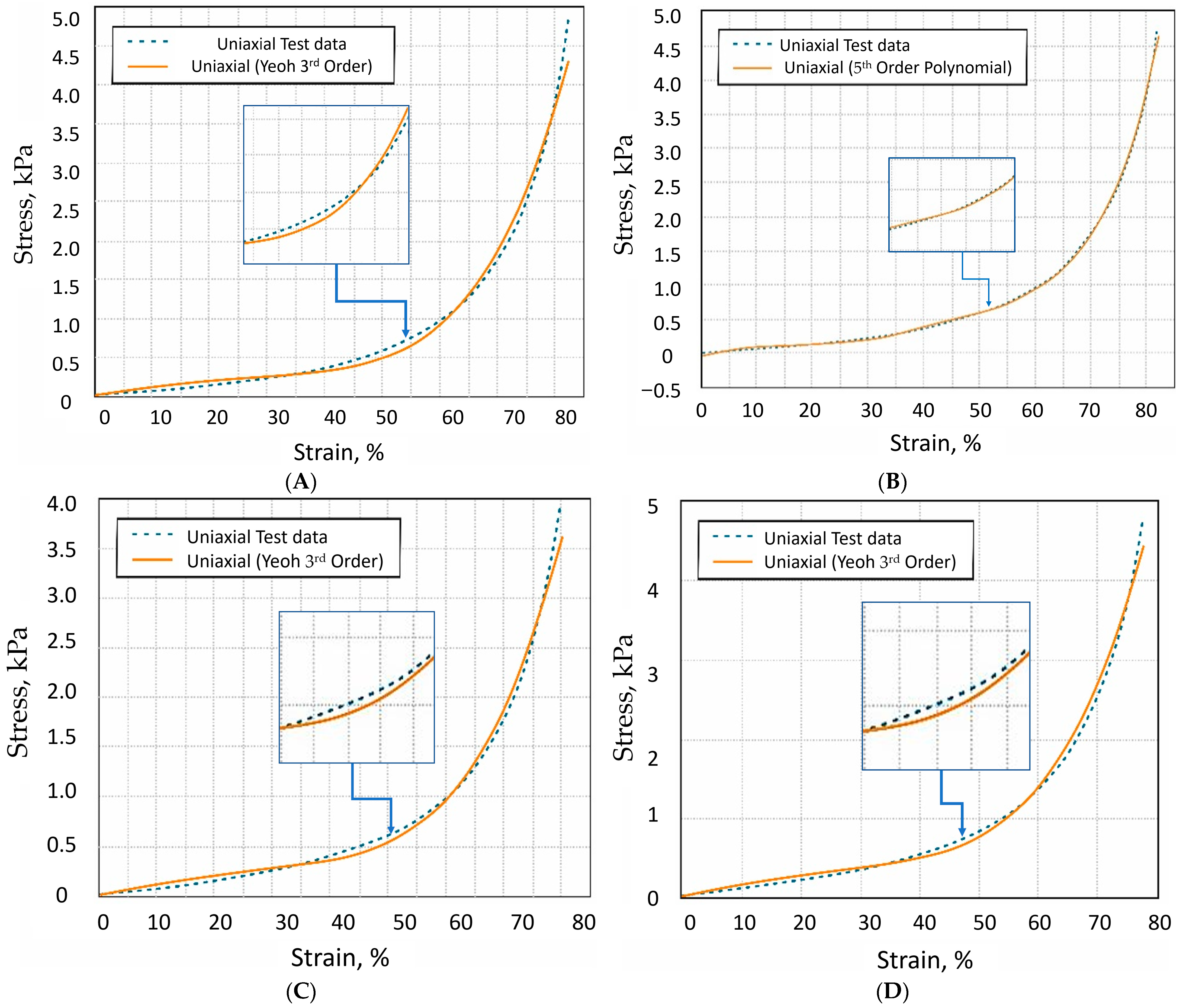
| Material Model | Constants | Fitting Quality (R2) |
|---|---|---|
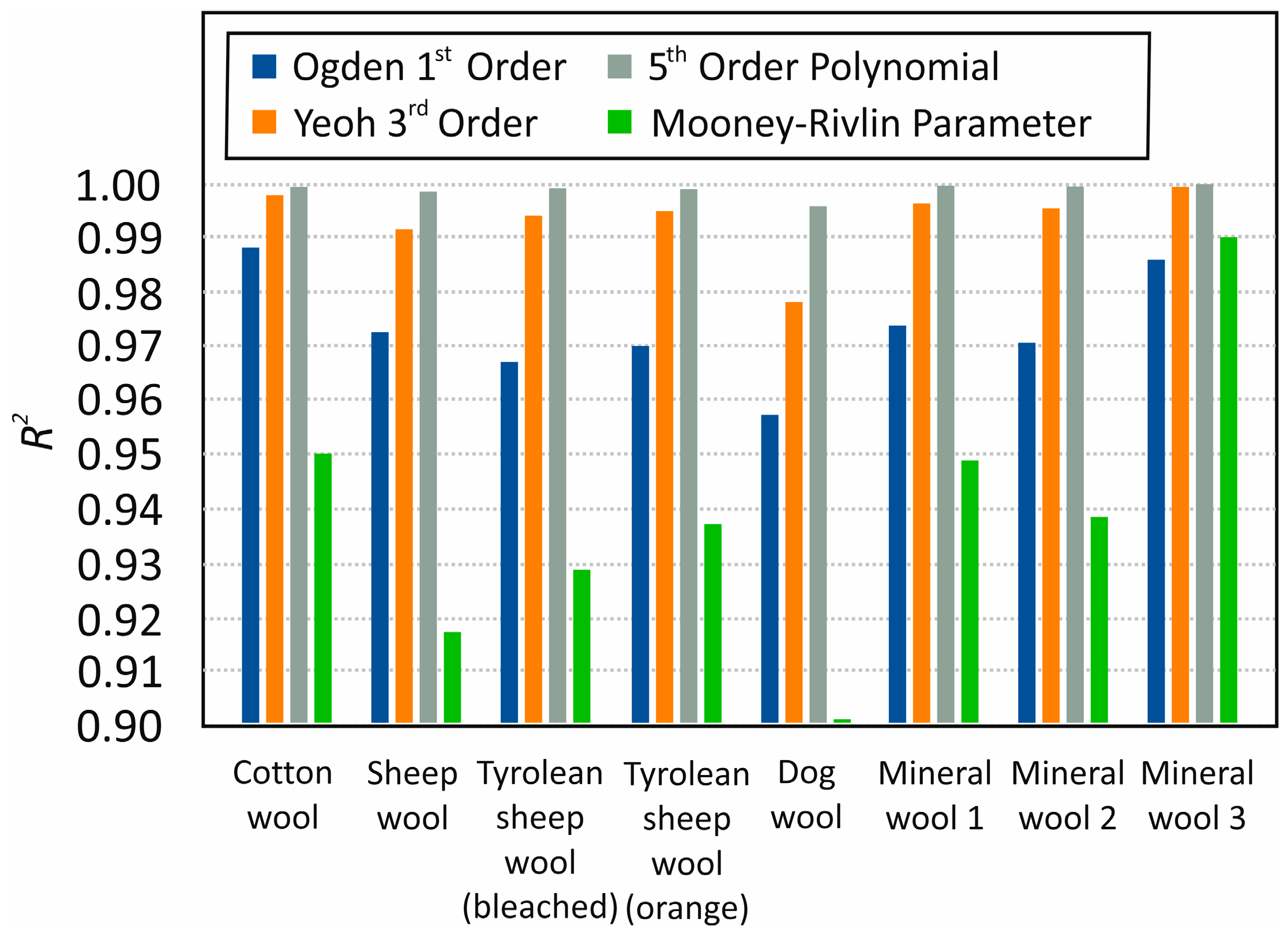
| Ogden 1st order | µ1 = 4.18345 × 10⁻¹¹; α1 = 5.26923 | 0.988663 |
| Yeoh 3rd order | C10 = 4.54629 × 10⁻⁶; C20 = −6.77114 × 10⁻¹⁰; C30 = 3.40742 × 10⁻¹³ | 0.99818 |
| Polynomial of 5th order | a = −2.812 × 10⁻⁵; b = 1.89828 × 10⁻⁵; c = −1.64778 × 10⁻⁶; d = 7.96767 × 10⁻⁸; e = −1.51922 × 10⁻⁹; f = 1.14632 × 10⁻¹¹ | 0.999903 |
| Mooney–Rivlin 3 Parameter | C10 = −2.69902 × 10⁻⁵; C01 = 26.1328 × 10⁻⁵; C11 = 2.15508 × 10⁻⁷ | 0.948827 |
| Material Model | Wool Sort | Constants | Fitting Quality (R2) |
|---|---|---|---|
| Uniaxial Yeoh 3rd order | Fresh harvested | C10 = 5.692; C20 = −0.00116147; C30 = 2.52572 × 10⁻⁷ | 0.991795 |
| Uniaxial 5th Order Polynomial | Fresh harvested | a = −72.0981; b = 39.3651; c = −3.5033; d = 0.140263; e = −0.00231877; f = 1.41536 × 10⁻⁵ | 0.998945 |
| Uniaxial Yeoh 3rd order | Tyrolean sheep wool bleached | C10 = 5.77596; C20 = −0.000966824; C30 = 2.26213 × 10⁻⁷ | 0.994163 |
| Uniaxial Yeoh 3rd order | Tyrolean sheep wool dyed | C10 = 7.11097; C20 = −0.00113851; C30 = 3.05313 × 10⁻⁷ | 0.995447 |
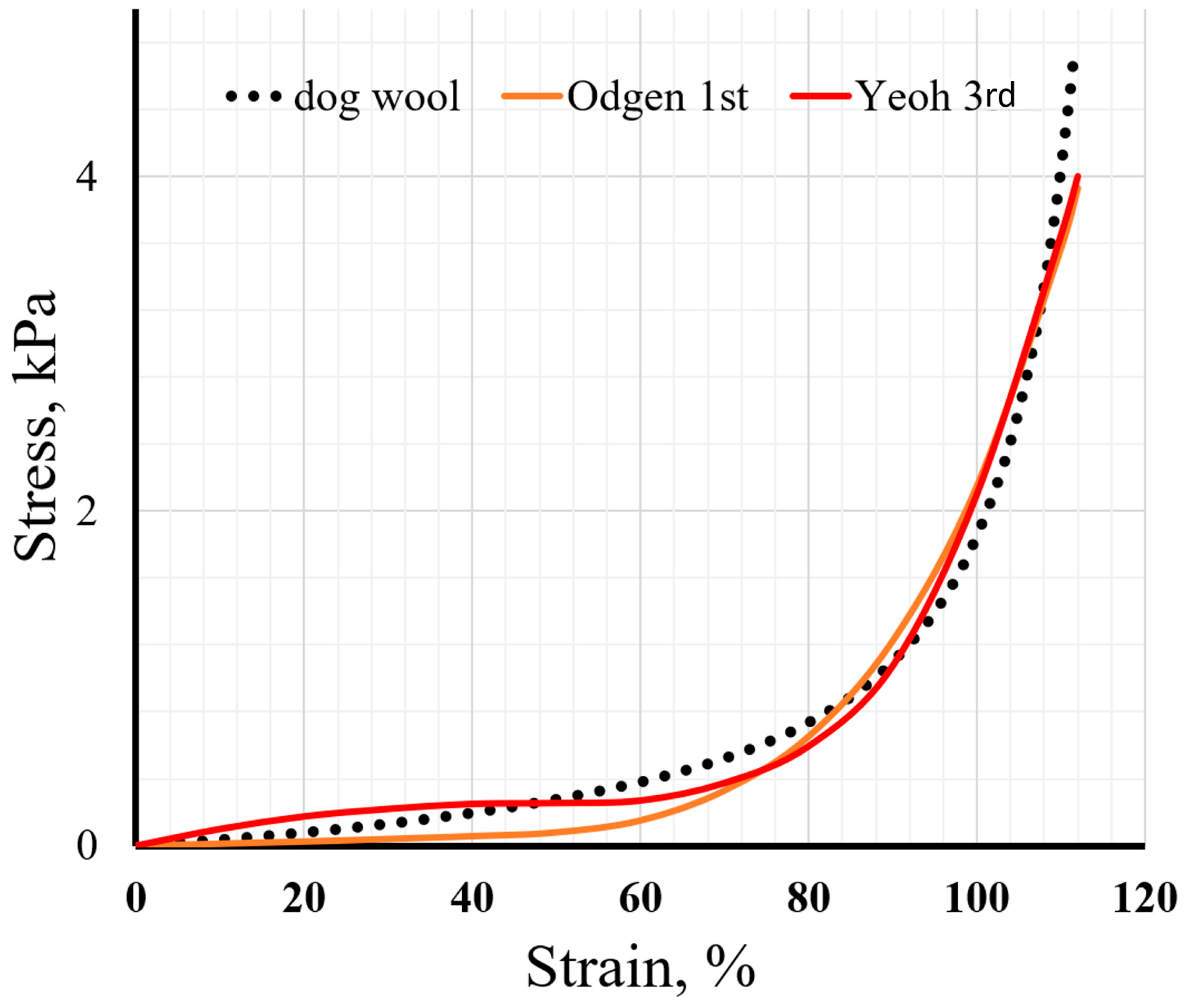
| Material Model | Constants | Fitting Quality (R2) |
|---|---|---|
| Uniaxial Ogden 1st order | µ1 = 1.57546 × 10⁻⁸; α1 = 6.55448 | 0.957496 |
| Uniaxial Yeoh 3rd order | C10 = 4.7873; C20 = −66.9977× 10⁻⁵; C30 = 6.17974 × 10⁻⁸ | 0.978999 |
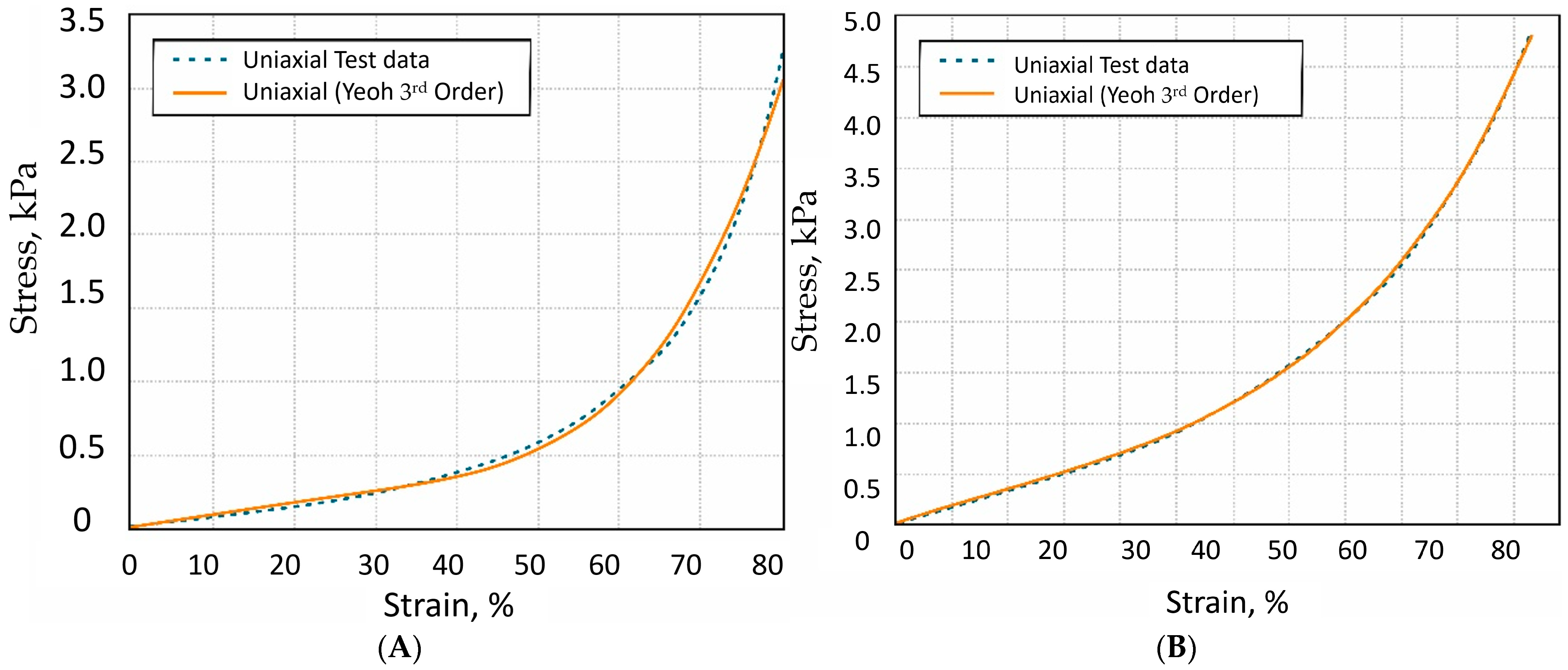
| Type of Mineral Wool | Constants | Fitting Quality (R2) |
|---|---|---|
| Aged mineral wool, stored | C10 = 4.71072; C20 = −0.000529304; C30 = 1.63934 × 10⁻⁷ | 0.996894 |
| Fresh insulating mineral wool | C10 = 15.0101; C20 = 0.00147215; C30 = 5.1852 × 10⁻⁷ | 0.99991 |
Disclaimer/Publisher’s Note: The statements, opinions and data contained in all publications are solely those of the individual author(s) and contributor(s) and not of MDPI and/or the editor(s). MDPI and/or the editor(s) disclaim responsibility for any injury to people or property resulting from any ideas, methods, instructions or products referred to in the content. |
© 2026 by the authors. Licensee MDPI, Basel, Switzerland. This article is an open access article distributed under the terms and conditions of the Creative Commons Attribution (CC BY) license.
Share and Cite
Petronienė, J.J.; Stonkus, R.; Dzedzickis, A.; Bučinskas, V. Rectification of Material Model for Fibrous Materials in Compressive Mode. Materials 2026, 19, 1329. https://doi.org/10.3390/ma19071329
Petronienė JJ, Stonkus R, Dzedzickis A, Bučinskas V. Rectification of Material Model for Fibrous Materials in Compressive Mode. Materials. 2026; 19(7):1329. https://doi.org/10.3390/ma19071329
Chicago/Turabian StylePetronienė, Jūratė Jolanta, Rimantas Stonkus, Andrius Dzedzickis, and Vytautas Bučinskas. 2026. "Rectification of Material Model for Fibrous Materials in Compressive Mode" Materials 19, no. 7: 1329. https://doi.org/10.3390/ma19071329
APA StylePetronienė, J. J., Stonkus, R., Dzedzickis, A., & Bučinskas, V. (2026). Rectification of Material Model for Fibrous Materials in Compressive Mode. Materials, 19(7), 1329. https://doi.org/10.3390/ma19071329