Transient Contact Elastic–Plastic Characteristics Analysis of Rail Welded Joints in Heavy-Haul Railways


Highlights
- Contact state shifts from stick-slip to slip in welded zones, increasing wear susceptibility.
- Plastic deformation initiates at the rail surface due to stress–strain concentration at key damage sites.
- Parametric analysis assesses and ranks parameter effects on damage initiation.
- Guides welded joint material selection and parameter optimization for durability.
- Supports targeted rail surface maintenance and damage-prevention strategies.
- Informs operational adjustments (speed, mass, friction) to reduce plastic deformation.
Abstract
1. Introduction
2. On-Site Investigation and Model Establishment
2.1. On-Site Investigation
2.2. Model Establishment
3. Contact Characteristics Analysis
3.1. Stick-Slip Distribution Characteristics
3.2. Dynamic Response Characteristics
4. Elastic–Plastic Characteristics Analysis
4.1. Stress–Strain Time-Varying Features
4.2. Stress–Strain Spatial Features
5. System Parametric Analysis
6. Conclusions
- (1)
- When the wheel passes through the rail welded joint area, the wheel–rail contact changes from the stick-slip state corresponding to the base material zone to the slip state corresponding to the heat-affected zone and welded bead zone, and then changes back to the stick-slip state. This indicates that stick-slip motion occurs in the wheel during passage through the rail welded joint region. The occurrence of slip reflects that the surface material tends to undergo wear, and the wear range in the heat-affected zone and welded bead zone is relatively larger than that in the base material zone.
- (2)
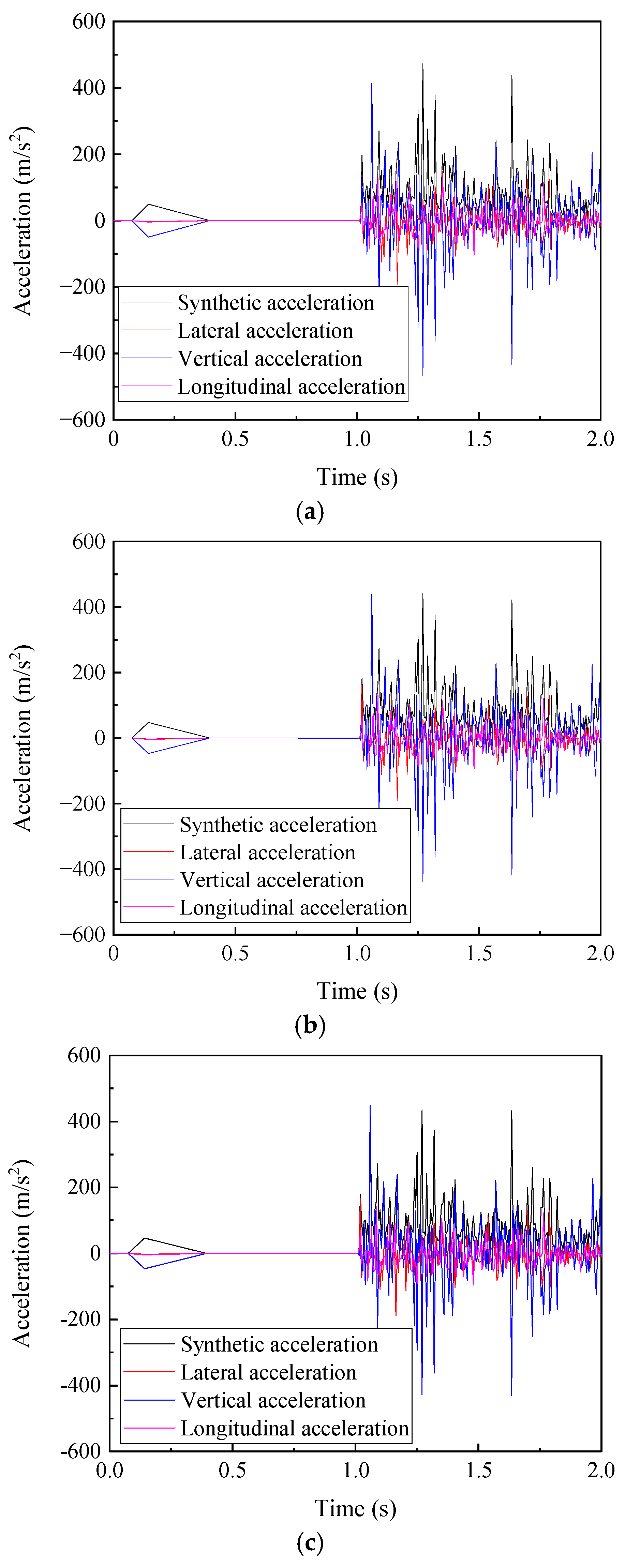
- The acceleration amplitude of the contact nodes in the base material zone is the largest, followed by that in the welded bead zone, and that in the heat-affected zone is the smallest, which is closely related to the material properties of the three zones. The stick-slip distribution characteristics and dynamic response characteristics indicate that instability has occurred in the wheel–rail system, and this instability will further induce the formation of damage on the wheel–rail surfaces.
- (3)
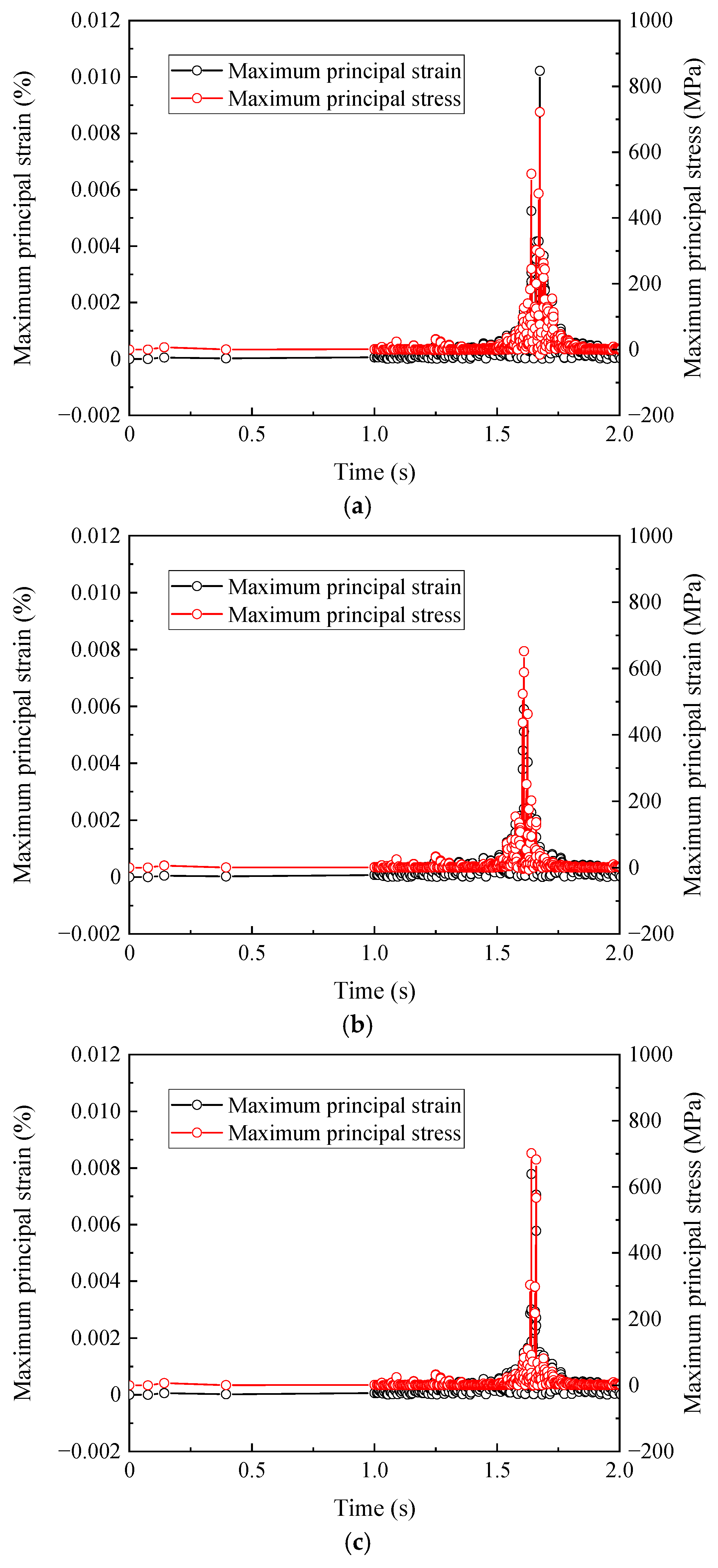
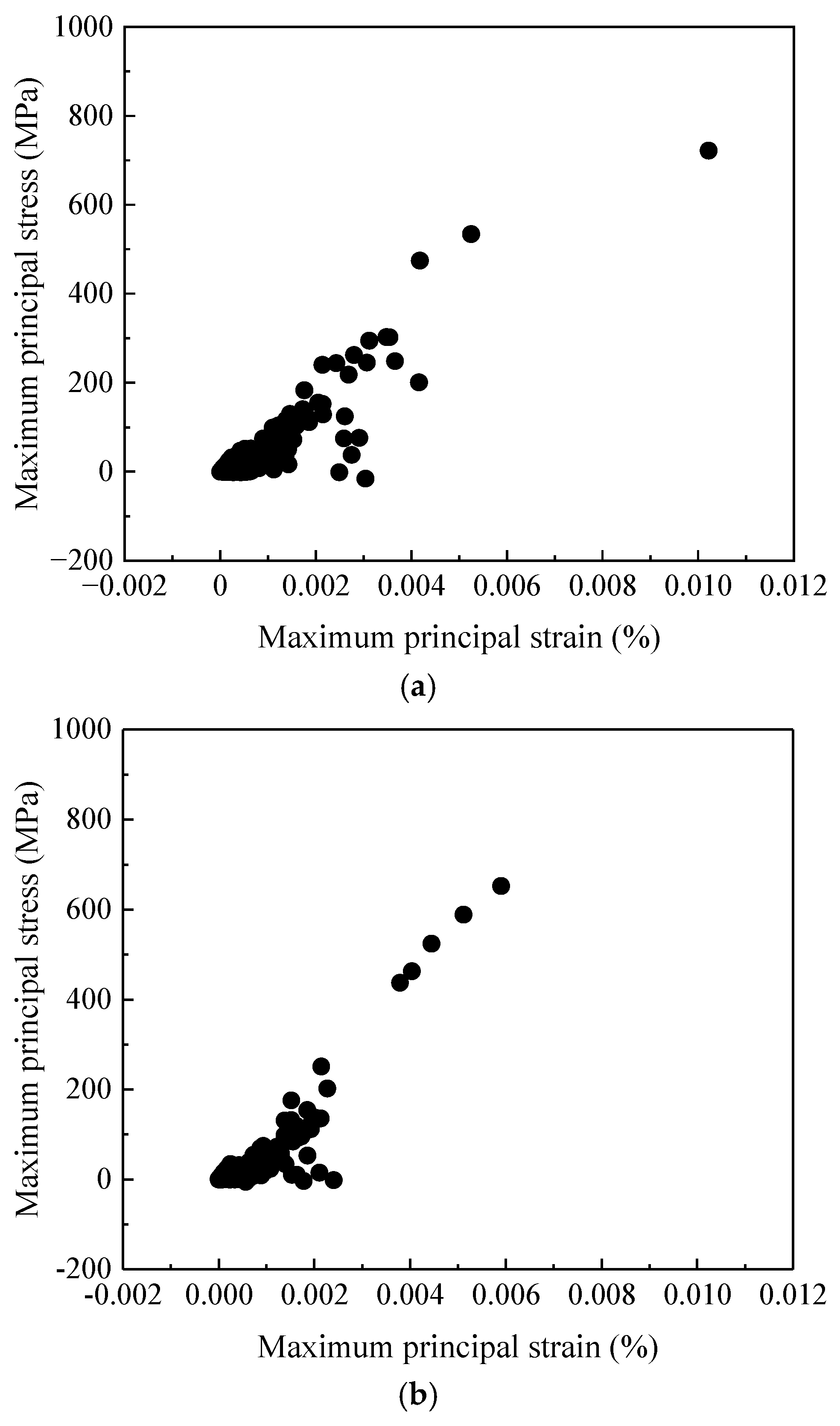
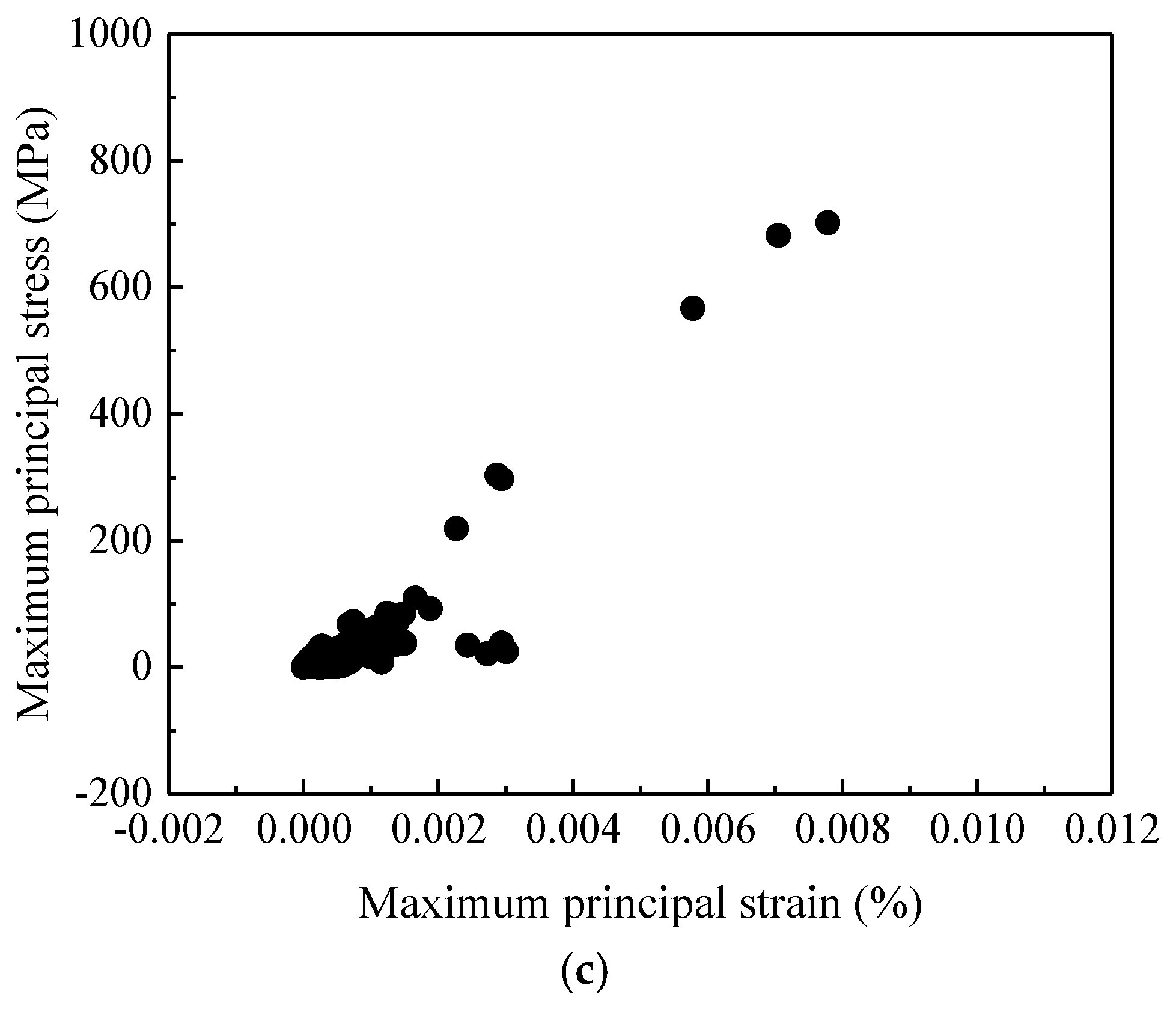
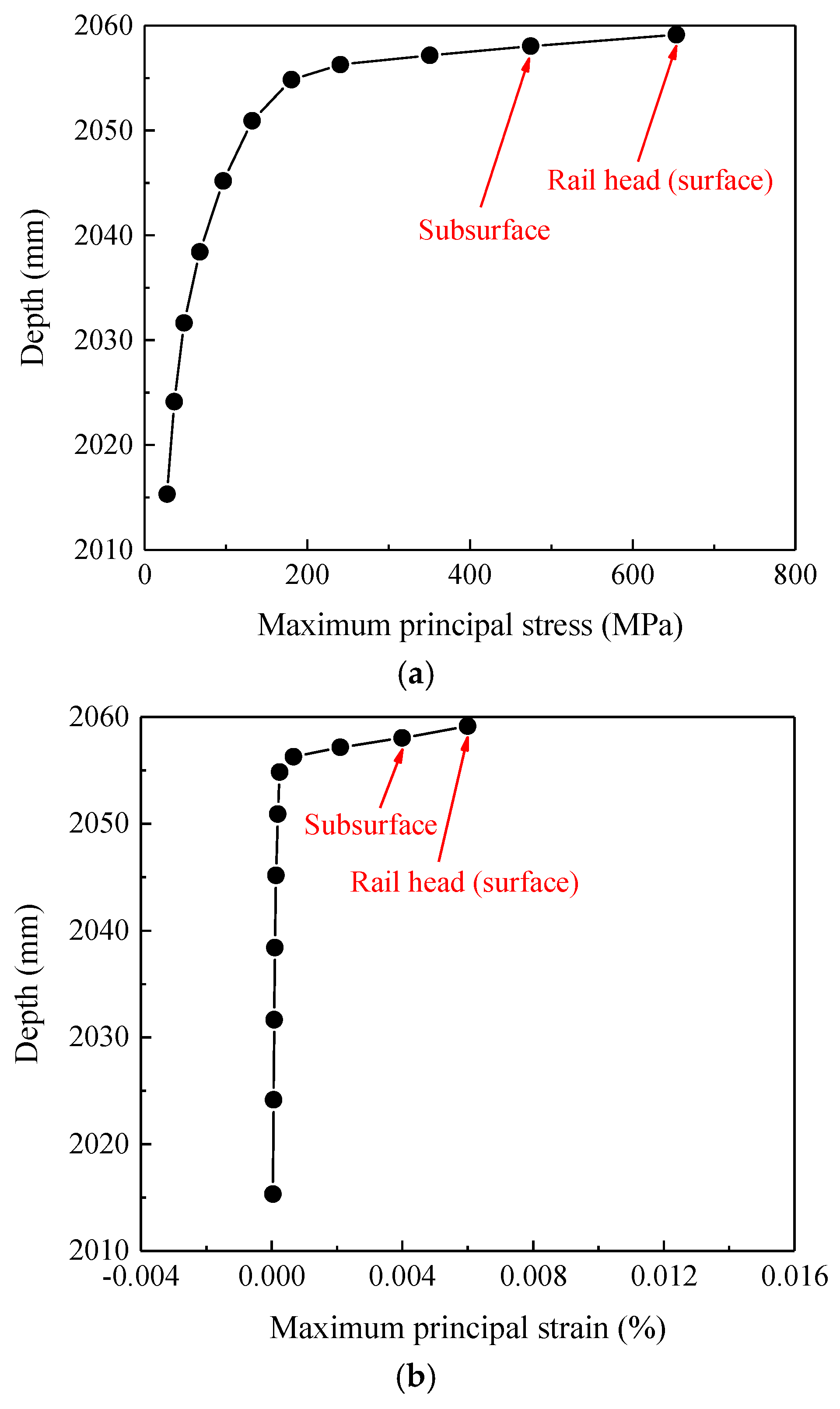
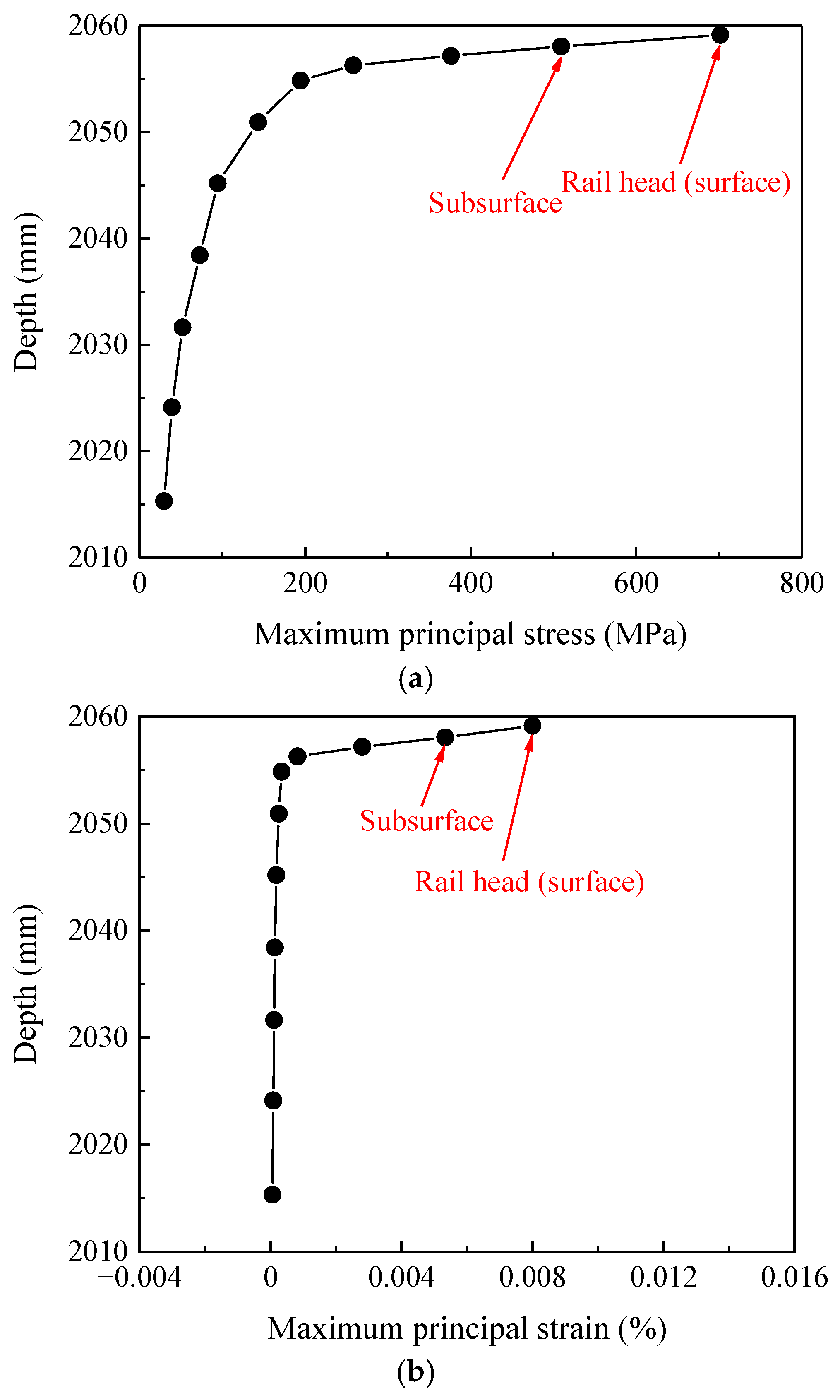
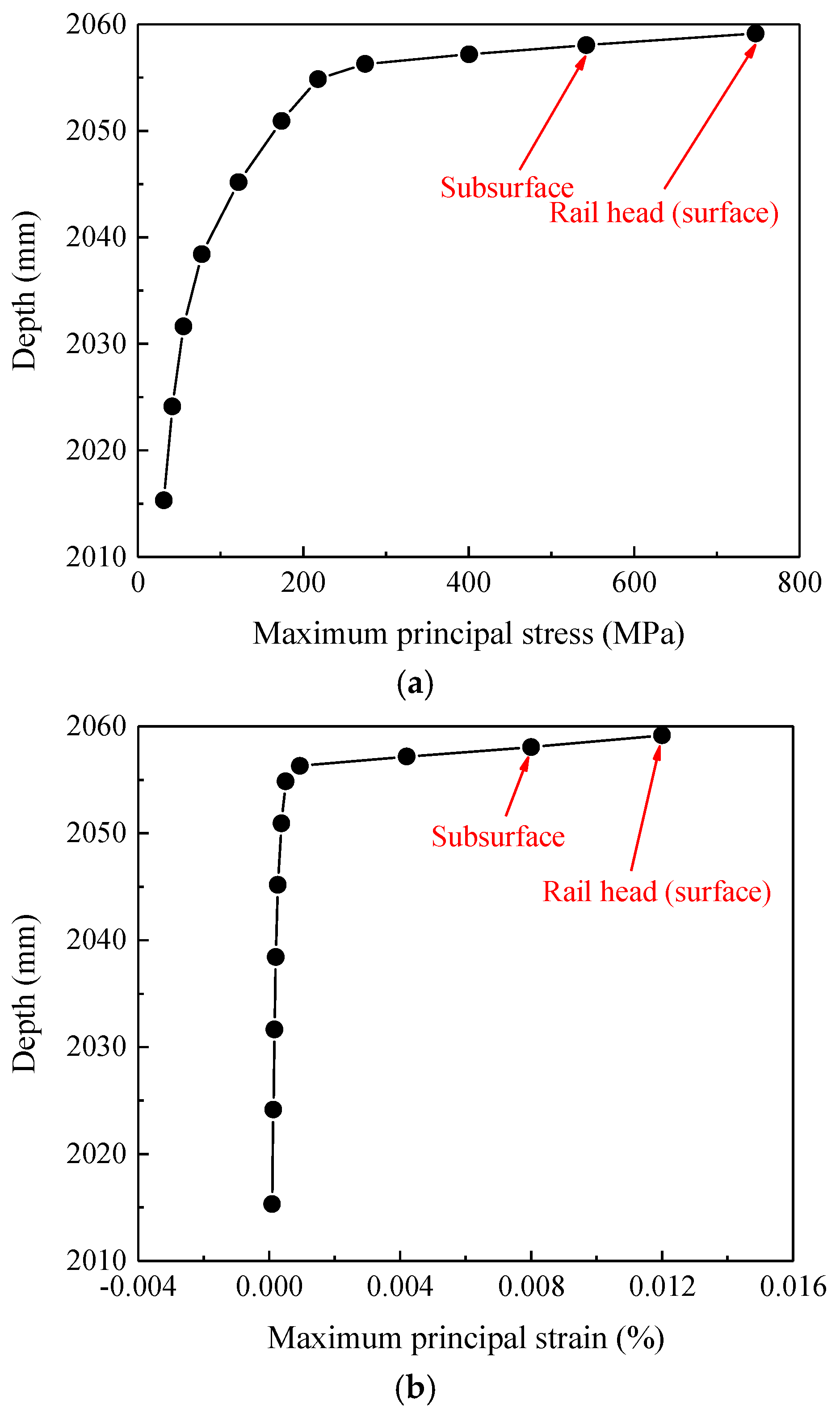
- There is a possibility of plastic deformation occurring in the material on the contact surfaces of the base material zone, heat-affected zone, and welded bead zone of the rail welded joint. Both the maximum principal stress and maximum principal strain of the section where the contact node is located occur on the rail surface; therefore, the probability that rail damage first appears on the contact surface is higher.
- (4)
- Increasing the yield strength and elastic modulus of the material in the rail welded joint area is conducive to controlling the occurrence of plastic deformation in the material; reducing the wheelset velocity, unsprung mass, and wheel–rail interface friction coefficient can effectively inhibit the tendency of plastic deformation. Changing the primary suspension connection parameters and fastener connection parameters has a relatively small effect on controlling the plastic deformation in the rail welded joint area.
Author Contributions
Funding
Data Availability Statement
Conflicts of Interest
References
- Yang, L.S.; Ouyang, Q.; Xue, H.X. Study and practice of high-speed heavy rail weldability of Qinshen dedicated passenger line. J. Railw. Eng. Soc. 2002, 19, 20–25. [Google Scholar]
- Wang, P.J. Research on Transient Impact Behavior of Wheel and Rail at Rail Welded Joints of High SPEED Railway. Master’s Thesis, Southwest Jiaotong University, Chengdu, China, 2021. [Google Scholar]
- Pang, X.; Kan, Q.H.; Zhao, J.Z.; Xu, X.; Zhu, L.Q. Finite element analysis on three-dimensional wheel-rail rolling contact of U75V welded joint. J. Chengdu Univ. (Nat. Sci. Ed.) 2019, 38, 73–77. [Google Scholar] [CrossRef]
- Xu, K.Y.; Wang, Y.; Lu, X.; Ding, H.H.; Cui, X.L.; Liu, Q.Y.; Wang, W.J. Rolling wear and damage properties of three kinds of pearlite rail welded joints. Tribology 2025, 45, 758–769. [Google Scholar] [CrossRef]
- Yang, D.X. Research on development direction of track technology of heavy-haul railway. J. Railw. Eng. Soc. 2012, 29, 41–44. [Google Scholar]
- Zhao, X.; Wen, Z.F.; Wang, H.Y.; Jin, X.S. 3D transient finite element model for high-speed wheel-rail rolling contact and its application. J. Mech. Eng. 2013, 49, 1–7. [Google Scholar] [CrossRef]
- Wang, Z.Q.; Lei, Z.Y. Analysis of causes for rail corrugation on steel spring floating slab tracks of metro small radius curves. China Mech. Eng. 2023, 34, 2899–2908. [Google Scholar] [CrossRef]
- Wang, S.; Wang, K.Y.; Huang, C. Characteristics of wheel-rail dynamic interaction of heavy haul railways due to the rail welding joint. J. Chongqing Univ. Technol. (Nat. Sci.) 2013, 27, 84–87+118. [Google Scholar]
- Q/CR 9130-2018; Code for Design of Railway Track (Limit State Method). China Railway Publishing House Co., Ltd.: Beijing, China, 2019.
- Fu, P.P.; Zhu, Z.M. Finite element modeling and stress analysis of static bending tests for rail welded joints. Weld. Join. 2018, 3, 19–23. [Google Scholar]
- Li, Y.B.; Xie, Z.Q.; Mo, C.L. Finite element analysis technology application to welding technology expert system: Welding technology expert system based on neural network I. Trans. China Weld. Inst. 2005, 26, 28–32. [Google Scholar]
- Romano, S.; Manenti, D.; Beretta, S.; Zerbst, U. Semi-probabilistic method for residual lifetime of aluminothermic welded rails with foot cracks. Theor. Appl. Fract. Mech. 2016, 85, 398–411. [Google Scholar] [CrossRef]
- Sarikavak, Y.; Turkbas, O.S.; Cogun, C. Influence of welding on microstructure and strength of rail steel. Constr. Build. Mater. 2020, 243, 118220. [Google Scholar] [CrossRef]
- Ozakgul, K.; Piroglu, F.; Caglayan, O. An experimental investigation on flash butt welded rails. Eng. Fail. Anal. 2015, 57, 21–30. [Google Scholar] [CrossRef]
- Zhang, H.; Xie, J.Q.; Li, C.A.; Zhu, Z.M. Modelling and numerical analysis for rotatory friction welding of U75V steel rails. Proc. Inst. Mech. Eng. Part L J. Mater.-Des. Appl. 2024, 238, 2158–2169. [Google Scholar] [CrossRef]
- Cascino, A.; Meli, E.; Rindi, A. Design and optimization of a hybrid railcar structure with multilayer composite panels. Materials 2025, 18, 5013. [Google Scholar] [CrossRef]
- Tang, J.; Zhou, Z.; Chen, H.; Wang, S.; Gutiérrez, A. Research on the lightweight design of GFRP fabric pultrusion panels for railway vehicle. Compos. Struct. 2022, 286, 115221. [Google Scholar] [CrossRef]
- Xiao, H.; Chen, X.; Zhao, Y. Analysis of unilateral rail corrugation mechanism based on friction self-excited theory. J. Southwest Jiaotong Univ. 2022, 57, 83–90+119. [Google Scholar] [CrossRef]
- Xiang, P.C.; Jiang, W.J.; Ding, H.H.; Wang, W.J.; Guo, J.; Liu, Q.Y. Investigation on impact wear and damage properties of rail welded joints after two types of heat-treatments. Tribology 2021, 41, 382–392. [Google Scholar] [CrossRef]
- Xu, Y.D.; Zhou, Y. Computer simulation analyses of rail welding joint. J. Tongji Univ. (Nat. Sci.) 2003, 31, 170–173. [Google Scholar]
- Song, X.X.; Zhang, S.Y.; Xu, M.N.; Ding, H.H.; Guo, J.; Zhao, X.; Qi, H.F.; Liu, Q.Y.; Wang, W.J.; Lewis, R. Experimental investigation on dynamic adhesion characteristics of wheel-rail under various media conditions at a large slip ratio range. Wear 2025, 580, 206217. [Google Scholar] [CrossRef]
- Su, H.; Pun, C.L.; Mutton, P.; Kan, Q.H.; Kang, G.Z.; Yan, W.Y. Numerical study on the ratcheting performance of rail flash butt welds in heavy haul operations. Int. J. Mech. Sci. 2021, 199, 106434. [Google Scholar] [CrossRef]
- Su, H.; Pun, C.L.; Mutton, P.; Kan, Q.H.; Yan, W.Y. Numerical study on the ratcheting performance of heavy haul rails in curved tracks. Wear 2019, 436, 203026. [Google Scholar] [CrossRef]
- Wang, Z.Q.; Lei, Z.Y. Mechanism of corrugation on the track with Cologne egg fasteners based on transient contact characteristics. J. Tsinghua Univ. (Sci. Technol.) 2023, 63, 1844–1855. [Google Scholar] [CrossRef]
- Kou, J.; Zhang, J.M.; Zhou, H.C.; Wang, C.P. Wheel-rail wear characteristics of intercity EMUs on curve in worn stages. J. Traffic Transp. Eng. 2021, 21, 279–288. [Google Scholar] [CrossRef]
- Wang, R.H.; Jain, V.K.; Mall, S. A non-uniform friction distribution model for partial slip fretting contact. Wear 2007, 262, 607–616. [Google Scholar] [CrossRef]
- Won, H.I.; Chung, J. Numerical analysis for the stick-slip vibration of a transversely moving beam in contact with a frictional wall. J. Sound Vib. 2018, 419, 42–62. [Google Scholar] [CrossRef]
- Chen, J.J.; Sun, H.W.; Jiao, T.; Liu, Z.G.; Xu, B. Stick-slip vibration analysis and vibration frequency extraction of coke pushing system. Eng. Fail. Anal. 2020, 108, 104325. [Google Scholar] [CrossRef]
- Qu, Y.G.; Xie, F.T.; Su, H.; Meng, G. Numerical analysis of stick-slip induced nonlinear vibration and acoustic responses of composite laminated plates with friction boundaries. Compos. Struct. 2021, 258, 113316. [Google Scholar] [CrossRef]
- Wang, Z.Y.; Wu, B.; Wu, S.; Wen, Z.F. Effects of wheel tread hollow wear on wheel-rail adhesion under wet condition. Tribol. Int. 2025, 211, 110927. [Google Scholar] [CrossRef]
- Silva, J.V.R.S.E.; Strey, N.F.; dos Santos, G.F.M.; Scandian, C. Wheel-rail wear severity prediction using semi-analytical computational method. Wear 2025, 571, 205824. [Google Scholar] [CrossRef]
- Wen, B.G.; Tao, G.Q.; Wen, Z.F. Prediction of locomotive wheel wear evolution considering thermo-mechanical coupling: Wear model and validation. Wear 2025, 571, 205805. [Google Scholar] [CrossRef]
- Afferrante, L.; Ciavarella, M. Corrugation models and the roaring rails enigma: A simple analytical contact mechanics model based on a perturbation of Carter’s solution. J. Mech. Mater. Struct. 2009, 4, 191–209. [Google Scholar] [CrossRef]
- Barber, J.R.; Ciavarella, M.; Afferrante, L.; Sackfield, A. Effect of small harmonic oscillations during the steady rolling of a cylinder on a plane. Int. J. Mech. Sci. 2008, 50, 1344–1353. [Google Scholar] [CrossRef]
- Afferrante, L.; Ciavarella, M. Short-pitch rail corrugation: A possible resonance-free regime as a step forward to explain the “enigma”? Wear 2009, 266, 934–944. [Google Scholar] [CrossRef]
- Ciavarella, M.; Barber, J. Influence of longitudinal creepage and wheel inertia on short-pitch corrugation: A resonance-free mechanism to explain the roaring rail phenomenon. Proc. Inst. Mech. Eng. Part J J. Eng. Tribol. 2008, 222, 171–181. [Google Scholar] [CrossRef]







| Component | Parameters | Value | |
|---|---|---|---|
| Unsprung mass and primary suspension | Unsprung mass [t] | 11.5 | |
| Connection stiffness [MN/m] | 2 | ||
| Connection damping [kNs/m] | 50 | ||
| Rail/wheelset | Elastic modulus [GPa] | 205 | |
| Density [kg/m3] | 7850 | ||
| Poisson’s ratio | 0.3 | ||
| Yield strength [MPa] | 752 | ||
| Fastener | Vertical stiffness [MN/m] | 80 | |
| Longitudinal stiffness [MN/m] | 40 | ||
| Lateral Stiffness [MN/m] | 40 | ||
| Vertical Damping [kNs/m] | 100 | ||
| Longitudinal Damping [kNs/m] | 20 | ||
| Lateral Damping [kNs/m] | 20 | ||
| Spacing/mm | 600 | ||
| Welded joint | Weld bead | Elastic modulus [GPa] | 197 |
| Density [kg/m3] | 7850 | ||
| Poisson’s ratio | 0.28 | ||
| Yield strength [MPa] | 702 | ||
| Heat-affected zone | Elastic modulus [GPa] | 180 | |
| Density [kg/m3] | 7850 | ||
| Poisson’s ratio | 0.25 | ||
| Yield strength [MPa] | 655 | ||
| Sleeper/subgrade | Yield strength [MPa] | 36 | |
| Density [kg/m3] | 2600 | ||
| Poisson’s ratio | 0.17 | ||
| Number | Analysis Variable | Variation Amplitude | Analysis Objective | |
|---|---|---|---|---|
| Maximum Principal Stress [MPa] | Maximum Principal Strain | |||
| 1 | Yield strength of the base material zone [MPa] | 10% ↑ | 4% ↑ (BMZ) | 2% ↑ (BMZ) |
| 10% ↓ | 3% ↓ (BMZ) | 2% ↓ (BMZ) | ||
| 2 | Yield strength of the heat-affected zone [MPa] | 10% ↑ | 5% ↑ (HAZ) | 3% ↑ (HAZ) |
| 10% ↓ | 4% ↓ (HAZ) | 2% ↓ (HAZ) | ||
| 3 | Yield strength of the welded bead zone [MPa] | 10% ↑ | 4% ↑ (WBZ) | 3% ↑ (WBZ) |
| 10% ↓ | 3% ↓ (WBZ) | 2% ↓ (WBZ) | ||
| 4 | Elastic modulus of the base material zone [GPa] | 10% ↑ | 5% ↑ (BMZ) | 4% ↑ (BMZ) |
| 10% ↓ | 5% ↓ (BMZ) | 3% ↓ (BMZ) | ||
| 5 | Elastic modulus of the heat-affected zone [GPa] | 10% ↑ | 8% ↑ (HAZ) | 7% ↑ (HAZ) |
| 10% ↓ | 6% ↓ (HAZ) | 6% ↓ (HAZ) | ||
| 6 | Elastic modulus of the welded bead zone [GPa] | 10% ↑ | 6% ↑ (WBZ) | 6% ↑ (WBZ) |
| 10% ↓ | 6% ↓ (WBZ) | 5% ↓ (WBZ) | ||
| 7 | Wheelset velocity [km/h] | 10% ↑ | 5% ↑ | 2% ↑ |
| 10% ↓ | 4% ↓ | 1% ↓ | ||
| 8 | Unsprung mass [t] | 10% ↑ | 11% ↑ | 9% ↑ |
| 10% ↓ | 12% ↓ | 7% ↓ | ||
| 9 | Wheel–rail interface friction coefficient | 10% ↑ | 3% ↑ | 2% ↑ |
| 10% ↓ | 2% ↓ | 2% ↓ | ||
| 10 | Primary suspension connection stiffness [MN/m] | 10% ↑ | 0.5% ↑ | 0.3% ↑ |
| 10% ↓ | 0.3% ↓ | 0.2% ↓ | ||
| 11 | Primary suspension connection damping [kNs/m] | 10% ↑ | 0.1% ↑ | 0.1% ↑ |
| 10% ↓ | 0.1% ↓ | 0.1% ↓ | ||
| 12 | Vertical stiffness of fastener [MN/m] | 10% ↑ | 0.6% ↑ | 0.5% ↑ |
| 10% ↓ | 0.6% ↓ | 0.6% ↓ | ||
| 13 | Longitudinal stiffness of fastener [MN/m] | 10% ↑ | 0.2% ↑ | 0.1% ↑ |
| 10% ↓ | 0.1% ↓ | 0.1% ↓ | ||
| 14 | Lateral stiffness of fastener [MN/m] | 10% ↑ | 0.1% ↑ | 0.1% ↑ |
| 10% ↓ | 0.1% ↓ | 0.1% ↓ | ||
| 15 | Vertical damping of fastener [kNs/m] | 10% ↑ | 0.3% ↑ | 0.2% ↑ |
| 10% ↓ | 0.1% ↓ | 0.1% ↓ | ||
| 16 | Longitudinal damping of fastener [kNs/m] | 10% ↑ | 0.04% ↑ | 0.01% ↑ |
| 10% ↓ | 0.03% ↓ | 0.01% ↓ | ||
| 17 | Lateral damping of fastener [kNs/m] | 10% ↑ | 0.03% ↑ | 0.01% ↑ |
| 10% ↓ | 0.03% ↓ | 0.01% ↓ | ||
Disclaimer/Publisher’s Note: The statements, opinions and data contained in all publications are solely those of the individual author(s) and contributor(s) and not of MDPI and/or the editor(s). MDPI and/or the editor(s) disclaim responsibility for any injury to people or property resulting from any ideas, methods, instructions or products referred to in the content. |
© 2026 by the authors. Licensee MDPI, Basel, Switzerland. This article is an open access article distributed under the terms and conditions of the Creative Commons Attribution (CC BY) license.
Share and Cite
Liu, C.; Wang, Z. Transient Contact Elastic–Plastic Characteristics Analysis of Rail Welded Joints in Heavy-Haul Railways. Materials 2026, 19, 1246. https://doi.org/10.3390/ma19061246
Liu C, Wang Z. Transient Contact Elastic–Plastic Characteristics Analysis of Rail Welded Joints in Heavy-Haul Railways. Materials. 2026; 19(6):1246. https://doi.org/10.3390/ma19061246
Chicago/Turabian StyleLiu, Chen, and Zhiqiang Wang. 2026. "Transient Contact Elastic–Plastic Characteristics Analysis of Rail Welded Joints in Heavy-Haul Railways" Materials 19, no. 6: 1246. https://doi.org/10.3390/ma19061246
APA StyleLiu, C., & Wang, Z. (2026). Transient Contact Elastic–Plastic Characteristics Analysis of Rail Welded Joints in Heavy-Haul Railways. Materials, 19(6), 1246. https://doi.org/10.3390/ma19061246