Article

A Reusable SERS Substrate with Internal Standard for the Detection of N-Butylamine Gas

1
Key Laboratory of Synthetic and Biotechnology Colloids, Ministry of Education, School of Chemical and Material Engineering, Jiangnan University, Wuxi 214122, China
2
Center of Special Cosmetic Testing (Jiangsu Province), Wuxi Institute of Inspection, Testing and Certification, Wuxi 214101, China
*
Authors to whom correspondence should be addressed.
Materials 2026, 19(6), 1207; https://doi.org/10.3390/ma19061207
Submission received: 11 February 2026 / Revised: 13 March 2026 / Accepted: 16 March 2026 / Published: 19 March 2026
(This article belongs to the Section Optical and Photonic Materials)

Abstract

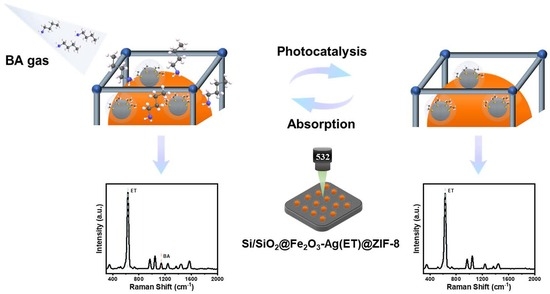
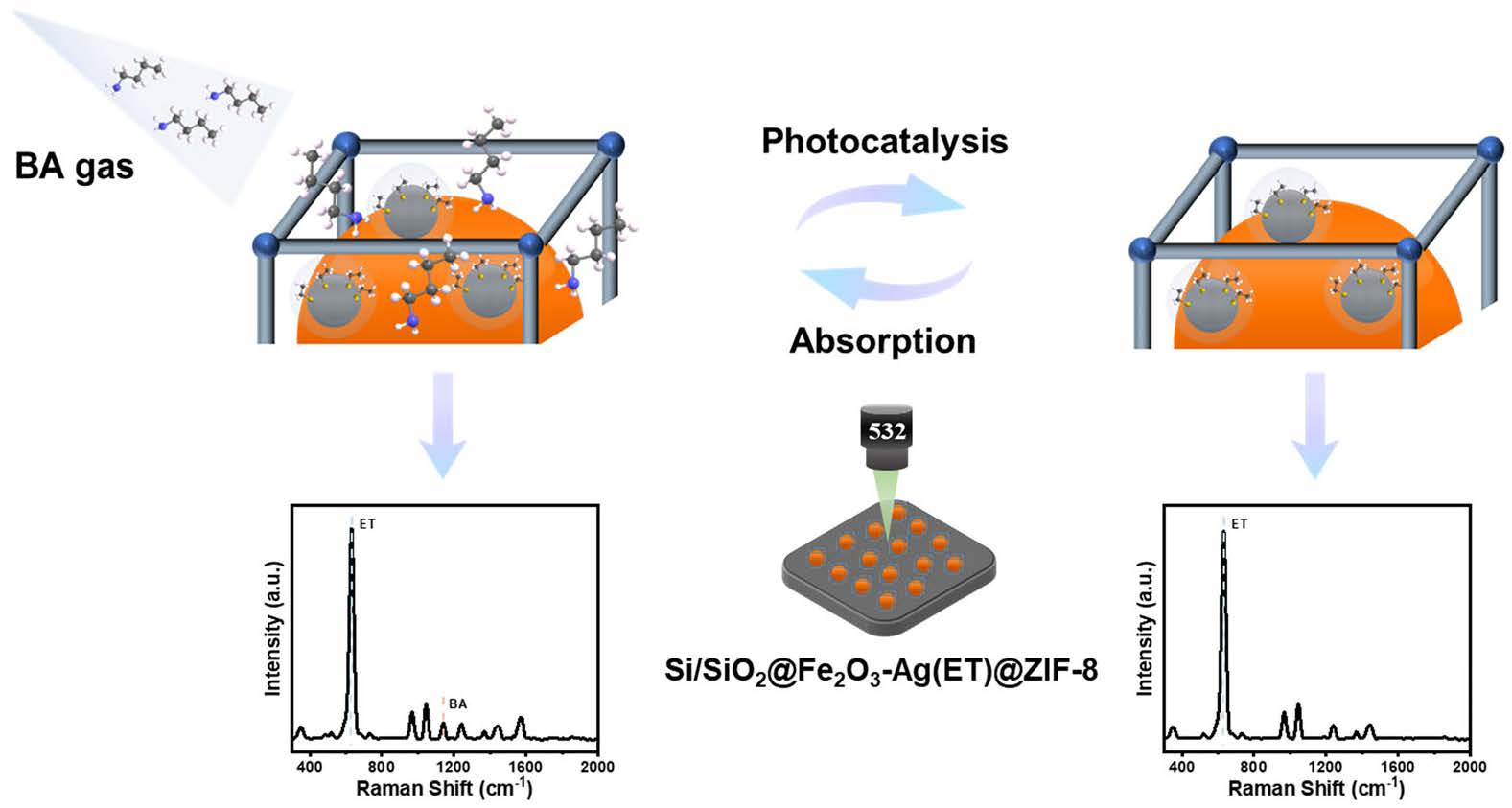
Surface-enhanced Raman scattering (SERS) has become an effective and sensitive analysis tool for the detection of various molecules. Nevertheless, it is a challenge to fabricate reusable SERS substrates for detecting gaseous molecules. Here, a self-calibrated and reusable SERS substrate has been developed for the quantitative analysis of n-butylamine. The obtained substrate enhances gas enrichment capability through the coordination interaction of Fe2O3 with the porous structure of ZIF-8, and strengthens the Raman signal intensity by the localized surface plasmon resonance of Ag nanoparticles. Ethanethiol is employed as an internal standard to enhance analysis accuracy. The substrate exhibits excellent quantitative analysis (linear correlation coefficient, R2 = 0.996), signal uniformity (RSD = 6.3%), and batch reproducibility (RSD = 4.8%). Moreover, the substrate achieves self-cleaning through photocatalysis. After five cycles, the substrate retains high SERS activity (RSD = 3.13%), exhibiting excellent reusability.

Graphical Abstract

1. Introduction

n-Butylamine (BA) is an important organic amine that is widely used in food processing, medical diagnostics, and pharmaceuticals [1,2,3]. However, BA poses significant risks to human health and environmental safety due to its toxicity, volatility, flammability, and corrosiveness [4,5]. Therefore, the rapid and accurate detection of BA is of great importance. To date, various analytical methods have been employed for the quantitative analysis of BA, such as chromatography [6], chemiresistive method [7,8], colorimetry [9,10], and fluorescence spectroscopy [11]. However, these methods often suffer from low sensitivity, and are long time-consuming, which limit their practical applications.
Surface-enhanced Raman scattering (SERS) has garnered significant attention in recent years for its high sensitivity, excellent selectivity, and rapid response [12,13,14]. At present, various SERS substrates have been developed for detecting amine gases. Plasmonic metal nanoparticles (PMNPs) on the substrates leverage the localized surface plasmon resonance (LSPR) effect to generate abundant hotspots, which significantly enhances the Raman signal to improve the detection sensitivity for gas molecules [12,15,16,17]. Owing to the low concentration, weak affinity and rapid diffusion of gas molecules, it remains challenging for PMNP substrates to effectively capture and immobilize gas molecules within hotspot regions [18,19]. To address these challenges, PMNPs have been integrated with porous metal–organic frameworks (MOFs) to fabricate MOF-based composite SERS substrates [14,20,21,22]. MOFs possess large specific surface areas and abundant active sites, which enhance the interaction between gas molecules and the substrate. In addition, their porous structure slows down gas diffusion and captures gas, and then facilitates gas enrichment within hotspots, which realizes the ultrasensitive gas detection [23].
However, these SERS substrates based on noble metal materials cannot be reused after a single use, significantly increasing detection cost and limiting practical application of SERS technology [24,25]. Therefore, developing reusable SERS substrates for BA detection is crucial. Here, a novel SERS substrate with self-calibration and reusability was developed for detecting BA. Fe2O3 captures BA through the coordination interaction, and ZIF-8 enhances the BA capture efficiency through the porous structure. Moreover, ethanethiol linked to Ag NPs by Ag-S bonds is employed as an internal standard to enhance detection performance. In addition, BA can be precisely removed through photocatalysis to realize the reuse of SERS substrates. This work provides a new strategy for developing reusable SERS substrates for gas detection and exhibits great potential for practical applications.

2. Materials and Methods

2.1. Materials

n-Butylamine (BA), tetraethyl orthosilicate (TEOS), ethanol, ferric chloride (FeCl3), ammonia water (25%), silver nitrate (AgNO3), methanol, polyvinylpyrrolidone (PVP), 2-methylimidazole (2-MeIm), and ethanethiol (ET) were purchased from Sinopharm Chemical Reagent Co., Ltd. (Shanghai, China). Urea and 4-aminothiophenol (4-ATP), zinc nitrate hexahydrate (Zn(NO3)2·6H2O) were purchased from Shanghai Aladdin Biochemical Technology Co., Ltd. (Shanghai, China). Si wafers (100) were purchased from Grinm Advanced Materials Co., Ltd. (Nanjing, China).

2.2. Synthesis of SiO2 [26]

TEOS (3.5 mL), ethanol (92 mL), ammonia water (2.5 mL), and water (17.5 mL) were sequentially added to a flask and stirred at 400 rpm for 6 h. The samples were separated by centrifugation and washed alternately with water and ethanol to obtain SiO2 microspheres.

2.3. Synthesis of SiO2@Fe2O3 [27]

SiO2 (0.1 g) was dispersed in water (40 mL), and then the dispersion was transferred to a flask. Urea (30 mg) and FeCl3 (50 mg) were added to the flask. Then, the flask was placed in an oil bath at 95 °C and stirred at 600 rpm for 8 h. After cooling, the samples were separated by centrifugation and washed alternately with water and ethanol to obtain SiO2@Fe2O3.

2.4. Synthesis of SiO2@Fe2O3-Ag [28]

SiO2@Fe2O3 (0.1 g), methanol (10 mL) and AgNO3 solution (10 mL, 0.02 M) were mixed in water (10 mL). The mixture was transferred to a photoreactor and purged with N2 for 30 min to displace oxygen. The photoreactor was placed under UV light of 365 nm for 60 min. The samples were separated by centrifugation and washed alternately with water and ethanol to obtain SiO2@Fe2O3-Ag.

2.5. Synthesis of SiO2@Fe2O3-Ag@ZIF-8 [29]

SiO2@Fe2O3-Ag (0.1 g) and PVP (0.1 g) were mixed in methanol (20 mL). After stirring for 30 min, 2-MeIm solution (10 mL, 0.05 M) was added. After continuing stirring for 10 min, Zn(NO3)2·6H2O solution (10 mL, 0.2 M) was added, and the mixture was stirred at room temperature for 10 h. The samples were separated by centrifugation and washed alternately with ethanol to obtain SiO2@Fe2O3-Ag@ZIF-8.

2.6. Synthesis of Si/SiO2@Fe2O3-Ag(ET)@ZIF-8 Substrate

SiO2@Fe2O3-Ag@ZIF-8 (10 mg) and ET (5 μL) were mixed in ethanol (10 mL). After stirring for 10 h, the samples were separated by centrifugation and washed with ethanol to obtain SiO2@Fe2O3-Ag(ET)@ZIF-8. Then, the product (10 mg) was dispersed in ethanol (10 mL) and then spin-coated (4000 rpm, 20 s) on Si wafer. The substrate was vacuum-dried to obtain Si/SiO2@Fe2O3-Ag(ET)@ZIF-8 substrate.

2.7. Characterization

The surface morphology and elemental composition of the samples were characterized by scanning electron microscopy (SEM, HITACHI S-4800, HITACHI Ltd., Tokyo, Japan) and energy dispersive X-ray spectroscopy (EDS, OCTANE SUPER, AMETEK, Inc., Berwyn, PA, USA). The ultraviolet-visible (UV-vis) absorption spectra were collected by UV-vis spectrophotometer (PERSEE TU-1950, Beijing Purkinje General Instrument Co., Ltd., Beijing, China). The characteristic functional groups of the samples were analyzed by Fourier-transform infrared spectroscopy (FT-IR, Nicolet 6700, Thermo Fisher Scientific, Waltham, MA, USA). The crystal structure of the samples was investigated by X-ray diffractometer (XRD, Bruker AXS D8, Bruker AXS GmbH, Karlsruhe, Germany).

2.8. SERS Measurements

The Si/SiO2@Fe2O3-Ag(ET)@ZIF-8 substrate was placed in a closed detection device, and different concentrations of BA solution (5 μL) were added to the device. The device was then placed on an 80 °C hotplate to generate BA gas. After adsorption for 6 h, the Raman spectra were collected on Si/SiO2@Fe2O3-Ag(ET)@ZIF-8 substrate by micro confocal Raman spectrometer (inVia, Renishaw Trading Ltd., London, UK) Measurement parameters are as follows: excitation wavelength is 532 nm, power is 0.05 mW, integration time is 1 s, and number of acquisitions is 1. The detection device is a cylindrical glass container with a volume of 665.37 mL and is equipped with a fan to enhance gas diffusion. The distance between the BA source and the substrate is 4.5 cm. The gas concentration (Cg, ppb) is calculated according to the following equation [30]: Cg = (Cs × Q × M × Vm)/V × 109. Here, Cs is the solution concentration (M), Q is the solution volume (L), M is the molar mass of the substance (g·mol−1), Vm is the molar volume of gas (22.4 L·mol−1), and V is the volume of the device (L).

3. Results and Discussion

3.1. Fabrication and Characterization of SiO2@Fe2O3-Ag@ZIF-8

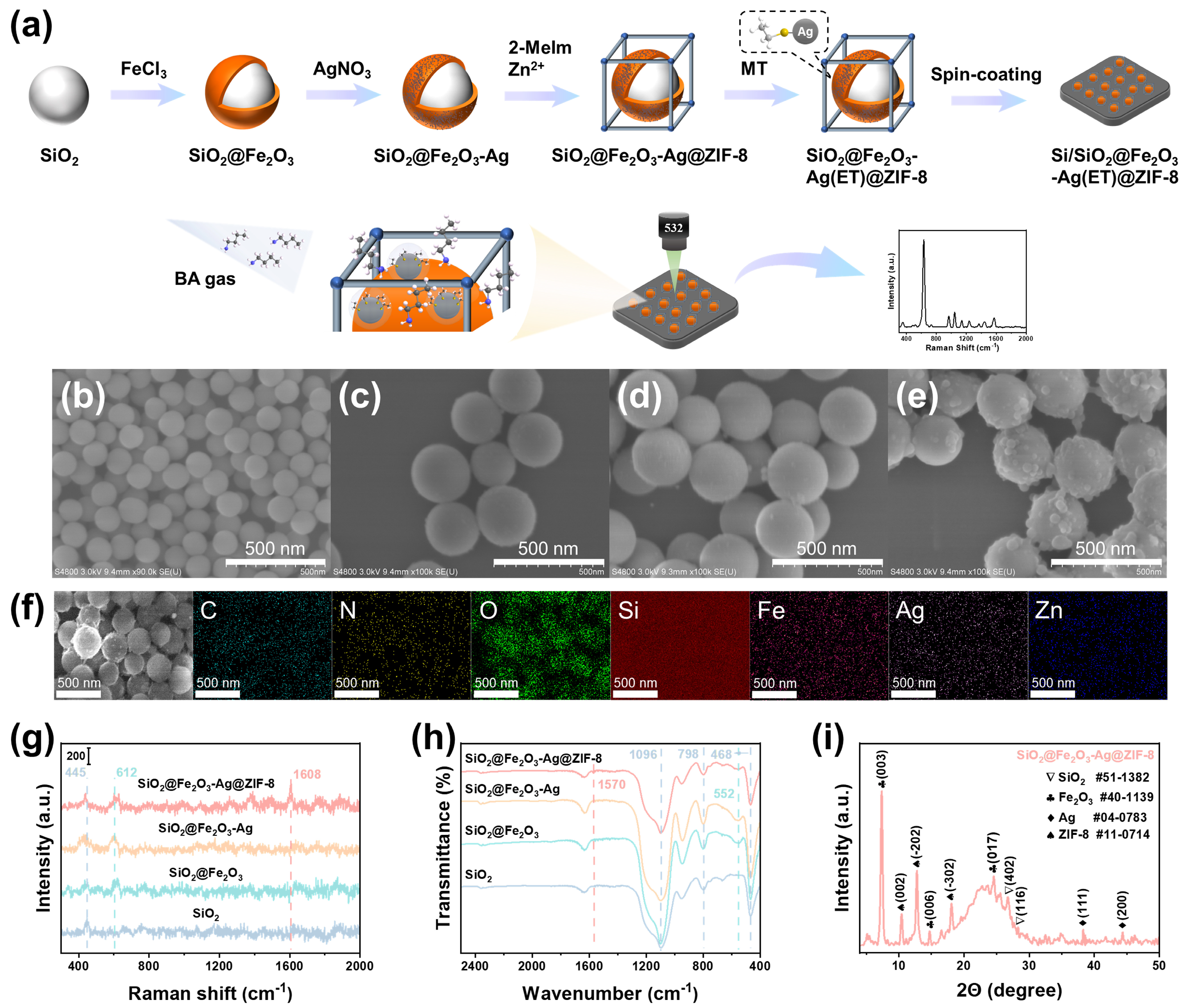
The fabrication process of SiO2@Fe2O3-Ag@ZIF-8 is illustrated in Figure 1a. First, SiO2 microspheres were synthesized by the Stöber method [26,31]. Figure 1b shows the smooth SiO2 microspheres with a diameter of ~200 nm. Subsequently, Fe2O3 was loaded onto the surface of the SiO2 microspheres by the solution-synthesis method to obtain SiO2@Fe2O3 [27]. Figure 1c shows the rough SiO2@Fe2O3 microspheres with a diameter of ~250 nm. To endow the composite with SERS activity, Ag NPs were then deposited onto the SiO2@Fe2O3 by a photochemical reduction method (Figure 1d) [28]. Finally, to enhance enrichment capability toward gas molecules, ZIF-8 was grown on the SiO2@Fe2O3-Ag to obtain SiO2@Fe2O3-Ag@ZIF-8 [29]. As shown in Figure 1e, ZIF-8 forms a continuous coating on the SiO2@Fe2O3-Ag. Figure 1f shows the EDS elemental mapping image of SiO2@Fe2O3-Ag@ZIF-8. The elements O, Si, Fe, and Ag are concentrated in the central region of the microspheres, while the characteristic elements C, N, and Zn of ZIF-8 are distributed on the surface of the microspheres. The above results verify the successful formation of the SiO2@Fe2O3-Ag@ZIF-8. To further investigate the composition of SiO2@Fe2O3-Ag@ZIF-8, the Raman spectra of SiO2, SiO2@Fe2O3, SiO2@Fe2O3-Ag and SiO2@Fe2O3-Ag@ZIF-8 were collected (Figure 1g). In the spectrum of SiO2, the peak at 445 cm−1 is attributed to Si-O-Si stretching vibration [32]. In the spectrum of SiO2@Fe2O3, the new peak at 612 cm−1 is assigned to Fe2O3 [33,34]. In the spectrum of SiO2@Fe2O3-Ag@ZIF-8, besides the above observed peaks, an additional peak at 1608 cm−1 is attributed to methyl bending mode of ZIF-8 [35,36]. These findings indicate the successful fabrication of SiO2@Fe2O3-Ag@ZIF-8. The composition of the samples was also analyzed by FI-IR spectra (Figure 1h). The characteristic absorption bands at 468 cm−1, 798 cm−1, and 1096 cm−1 correspond to the O-Si-O bending vibration, symmetric stretching vibration and asymmetric stretching vibration of SiO2, respectively [30,37]. The absorption band at 552 cm−1 is attributed to the Fe-O stretching vibration of Fe2O3 [27,38]. The absorption band observed at 1570 cm−1 is attributed to the C=N stretching vibrations of ZIF-8 [39]. These findings also verify the successful formation of SiO2@Fe2O3-Ag@ZIF-8. Figure 1i shows the XRD pattern of SiO2@Fe2O3-Ag@ZIF-8. The diffraction peaks of SiO2, Fe2O3, Ag, and ZIF-8 simultaneously appeared in the pattern [34,40], which further confirms the successful fabrication of SiO2@Fe2O3-Ag@ZIF-8.

3.2. Sensing Performance of Si/SiO2@Fe2O3-Ag(ET)@ZIF-8

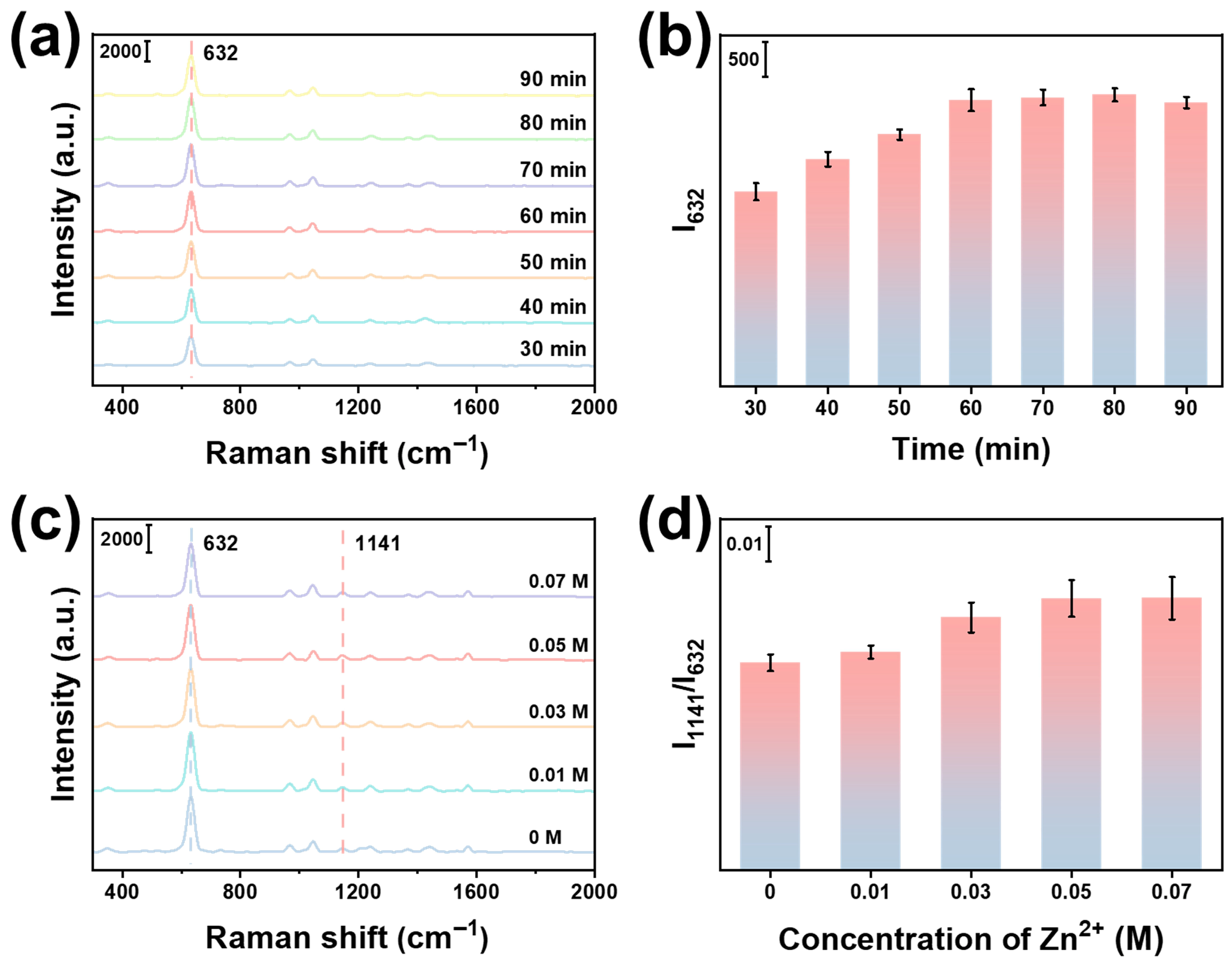
To obtain the strongest Raman signal, the Ag NP loading of the SERS substrate was optimized by adjusting the illumination time during photochemical deposition. The Raman spectra were collected from the Si/SiO2@Fe2O3-Ag adsorbed with ET (Si/SiO2@Fe2O3-Ag(ET)). As shown in Figure 2a,b, the intensity of the characteristic Raman peak of ET at 632 cm−1 (I632) first increases and then decreases with increasing illumination time. When the illumination time is 60 min, the value of I632 reaches maximum. This is because a too-short illumination time will lead to insufficient loading of Ag NPs, resulting in less ET adsorption and reduced hotspot density [41]. In contrast, too long a time will lead to excessive deposition and agglomeration of Ag NPs, which weakens the Raman enhancement and hinders the adsorption of ET molecules on the surface of Fe2O3, thus decreasing the Raman signal intensity of ET [42]. In addition, the porous structure of ZIF-8 plays a crucial role in the enrichment of gas molecules [18]. To achieve optimal enrichment capacity of BA molecules, the loading of ZIF-8 was optimized by changing the concentration of Zn2+ during synthesis. The Raman spectra were collected from the Si/SiO2@Fe2O3-Ag(ET)@ZIF-8 adsorbed with BA (Si/SiO2@Fe2O3(BA)-Ag(ET)@ZIF-8). As shown in Figure 2c,d, the ratio of peak intensity at 1141 cm−1 (I1141) to I632 (I1141/I632) gradually increases with increasing Zn2+ concentration. When the concentration of Zn2+ is 0.05 M, I1141/I632 reaches maximum, indicating that the loading of ZIF-8 is optimal under this condition. The substrate adsorbs a large number of BA molecules in the hotspot region by the gas enrichment effect of ZIF-8, thus exhibiting the maximum I1141/I632.
The Raman signal amplification of the substrate was evaluated by the enhancement factor (EF). The EF calculation equation is as follows [43]:
E F = I S E R S × N R a m a n I R a m a n × N S E R S
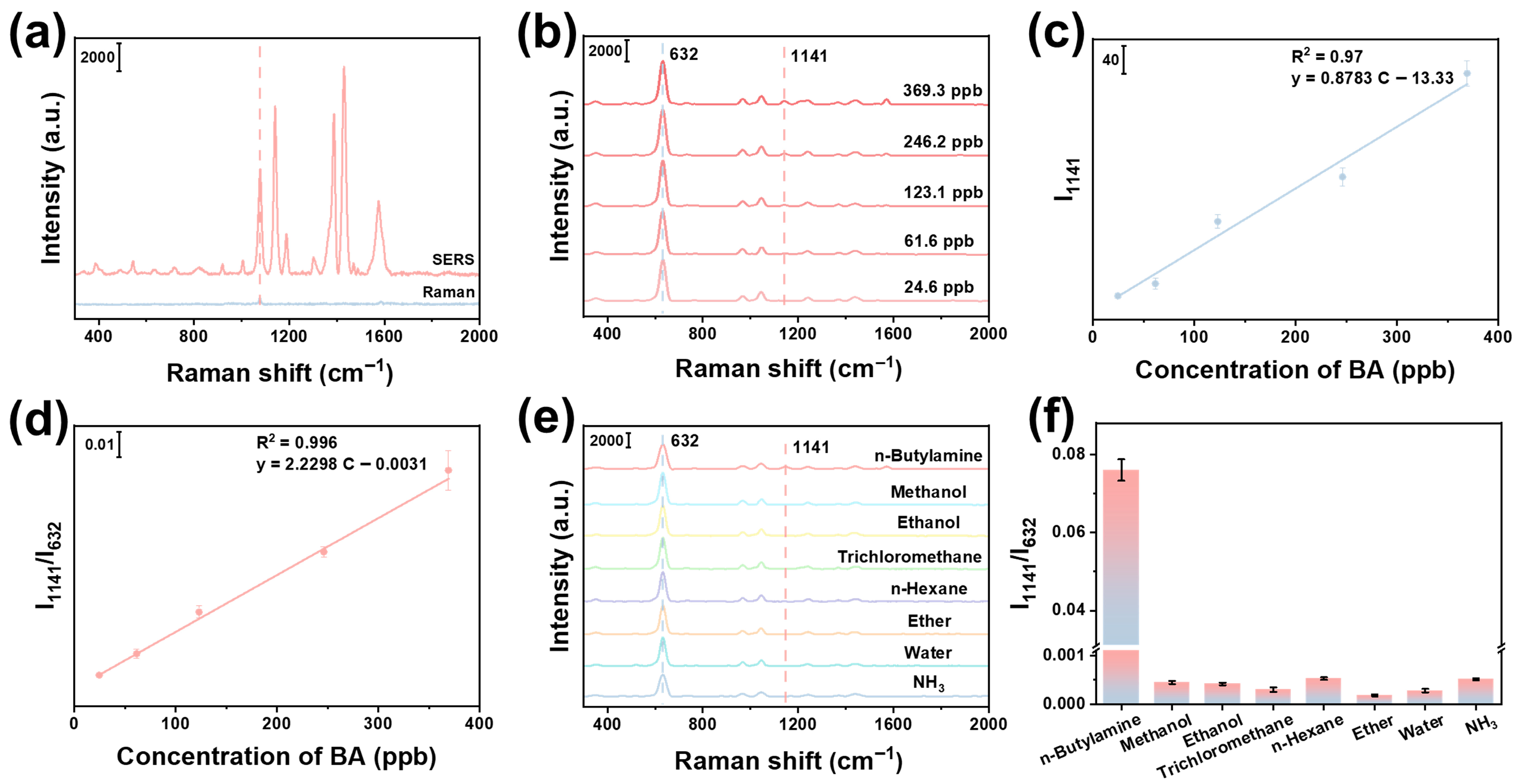
where ISERS and NSERS are the Raman signal intensity and the number of molecules on the SERS substrate, respectively. IRaman and NRaman are the Raman signal intensity and the number of molecules on the blank substrate, respectively. Here, 10 μL of 1 M 4-ATP and 10 μL of 10−4 M 4-ATP were added onto a blank Si wafer and the Si/SiO2@Fe2O3-Ag@ZIF-8 substrate, respectively. As shown in Figure 3a, the Raman peak at 1078 cm−1 was selected for EF calculation. The values of ISERS and IRaman are 7422.6 and 506.9, respectively. Based on the calculation, the EF of the Si/SiO2@Fe2O3-Ag@ZIF-8 substrate is 1.46 × 10⁵.
Quantitative analysis is essential for evaluating SERS substrates [44]. To evaluate the quantitative analysis performance of the developed substrate, the Raman spectra were collected from the Si/SiO2@Fe2O3-Ag(ET)@ZIF-8 adsorbed with different concentrations of BA, namely Si/SiO2@Fe2O3(BA)-Ag(ET)@ZIF-8. As shown in Figure 3b, I1141 increases gradually with increasing BA concentration, while I632 remains basically unchanged. Figure 3c shows a linear relationship between I1141 and BA concentration (y = 0.8783 C − 13.33, R2 = 0.97). To further improve detection reliability, the internal standard method was employed to correct signal fluctuations. There is a good linear relationship between I1141/I632 and BA concentration (y = 2.2298 C − 0.0031, R2 = 0.996), as shown in Figure 3d. According to the equation LOD = 3.3σ/S [45], where σ represents the standard deviation value of the blank sample response (n = 10), and S represents the slope of the calibration curve, the limit of detection (LOD) is 1.6 ppb. The Fe2O3 in the substrate has unsaturated Fe binding sites, while BA has -NH2 groups, and BA can be adsorbed on the surface of Fe2O3 by coordination interaction [46]. In addition, the porous structure of ZIF-8 slows BA gas diffusion and facilitates the entry of gas molecules into the SERS hotspot area [18]. Therefore, the substrate achieves synergistic enhancement of gas enrichment capability, resulting in a low detection limit. These results indicate that the developed substrate has excellent quantitative detection capability for BA, and the sensitivity and accuracy of the developed substrate are effectively improved by the internal standard method. Common gaseous molecules (methanol, ethanol, trichloromethane, n-hexane, ether, water, NH3) were employed as interferents to evaluate the selectivity of the developed substrate for BA. As shown in Figure 3e,f, the developed substrate has no response to the above interferents at 1141 cm−1, which is attributed to the absence of C-N stretching vibration of these interferents and the lack of strong coordination with Fe2O3 [47]. Therefore, the substrate exhibits excellent selectivity for BA. In addition, the performance of the Si/SiO2@Fe2O3-Ag(ET)@ZIF-8 substrate was compared with that of other reported SERS substrate in the field of BA detection. As summarized in Table 1, the developed substrate developed in this study demonstrates superior quantitative analysis capability for BA.
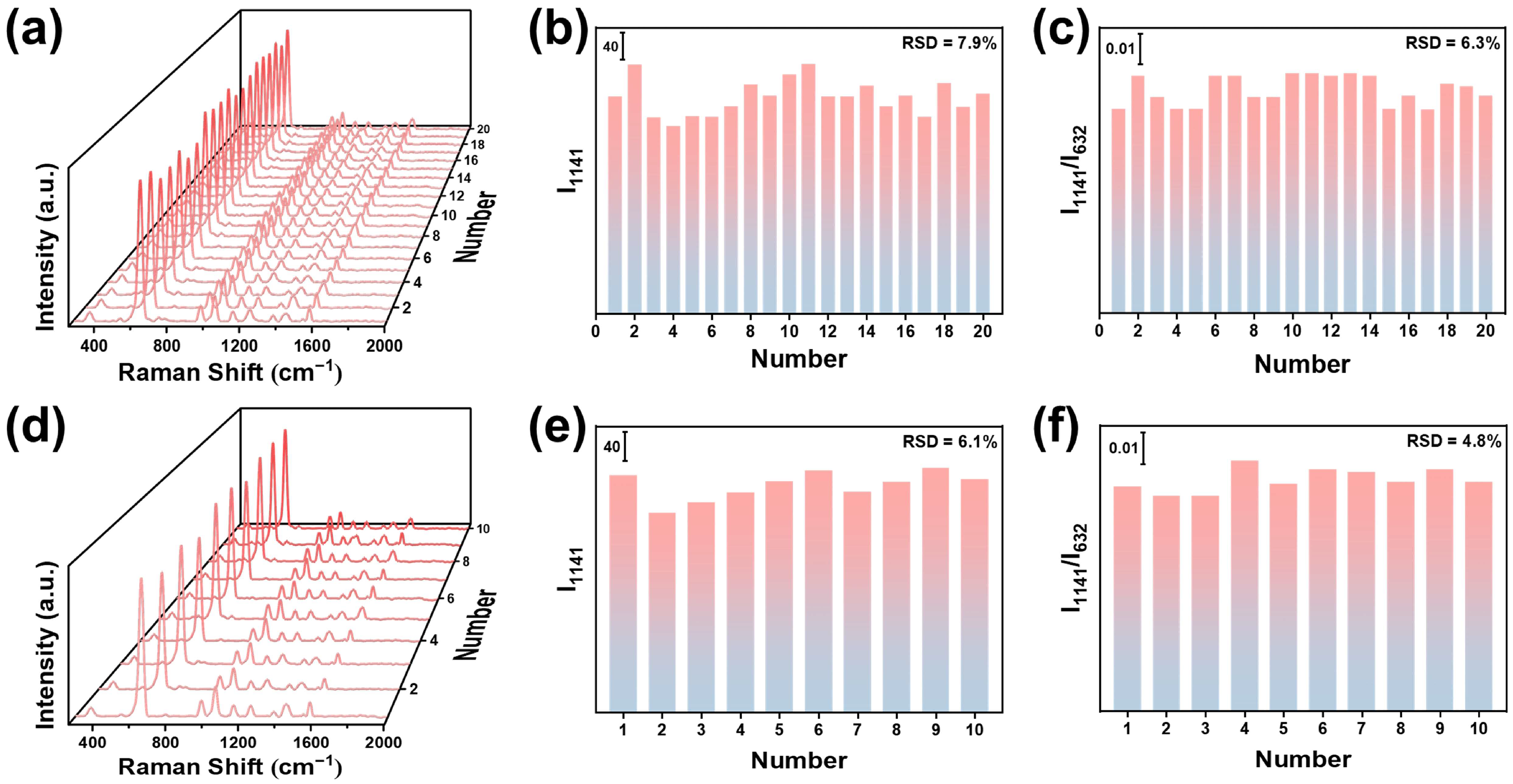
Signal uniformity and batch reproducibility are also crucial for evaluating the performance of SERS substrates. To evaluate signal uniformity, the Raman spectra were collected from 20 randomly selected spots on the same Si/SiO2@Fe2O3(BA)-Ag(ET)@ZIF-8 under the same conditions (Figure 4a). As shown in Figure 4b, the relative standard deviation (RSD) calculated based on I1141 is 7.9%. After the correction through the internal standard method, the signal fluctuations caused by the measurement errors are weakened. The RSD based on I1141/I632 decreases to 6.3% (Figure 4c), indicating that the SERS substrate has excellent signal uniformity. To evaluate batch reproducibility, 10 batches of Si/SiO2@Fe2O3(BA)-Ag(ET)@ZIF-8 substrates were fabricated under the same method, and the Raman spectra were collected under the same conditions (Figure 4d). As shown in Figure 4e, the RSD calculated based on I1141 is 6.1%. After correction through the internal standard method, the RSD based on the I1141/I632 decreases to 4.8% (Figure 4f). The results indicate that the SERS substrate has excellent batch reproducibility.

3.3. Photocatalytic Self-Cleaning Capability of Si/SiO2@Fe2O3-Ag(ET)@ZIF-8

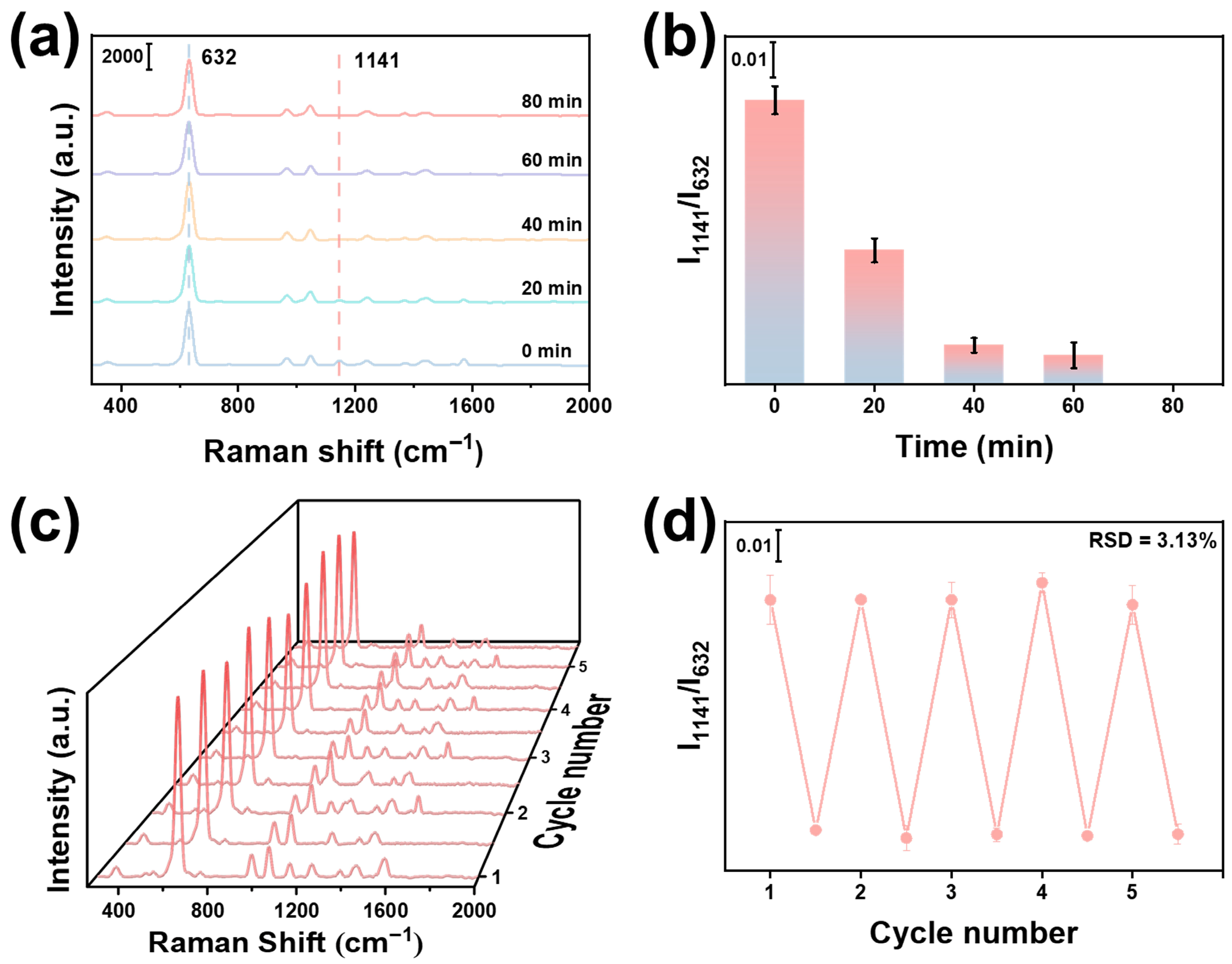
To investigate the optimal UV illumination time for photocatalytic self-cleaning, the Si/SiO2@Fe2O3(BA)-Ag(ET)@ZIF-8 substrate was immersed in water and exposed to UV light (wavelength 365 nm, power density 5 mW·cm−2). The Raman spectra were collected after different illumination times. As shown in Figure 5a, with increasing illumination time, the characteristic Raman peak of BA at 1141 cm−1 gradually decreases, while the peak at 632 cm−1 remains basically unchanged. When the illumination time is 80 min, I1141/I632 completely disappears (Figure 5b), indicating that the BA molecules adsorbed on Fe2O3 have been completely degraded. Therefore, the optimal illumination time for photocatalytic self-cleaning is 80 min. To assess the reusability of the SERS substrate, the Si/SiO2@Fe2O3(BA)-Ag(ET)@ZIF-8 was immersed in water and exposed to UV light for 80 min. Subsequently, the Raman spectra before and after UV exposure were collected. The adsorption and degradation processes were repeated 5 times, accompanied by the appearance and disappearance of the characteristic peaks of BA for 5 times (Figure 5c). Figure 5d shows the variation of I1141/I632 over 5 cycles. Notably, the substrate retains high SERS activity after 5 cycles, and the RSD is 3.13%. These results indicate that the Si/SiO2@Fe2O3-Ag(ET)@ZIF-8 exhibits excellent photocatalytic activity due to the heterostructure of Fe2O3 and Ag. The adsorbed BA can be degraded by photocatalysis to achieve outstanding self-cleaning capability, resulting in its reusability.

4. Conclusions

In conclusion, a self-calibrated and reusable SERS substrate was successfully developed for quantitative detection of BA gas. The substrate consists of SiO2@Fe2O3, Ag NPs and ZIF-8. Fe2O3 captures BA through the coordination interaction, and the porous ZIF-8 enhances gas capture efficiency. In addition, ET is employed as an internal standard to correct signal fluctuations and improve detection accuracy. The substrate exhibited excellent quantitative analysis (LOD = 1.6 ppb, R2 = 0.996), signal uniformity (RSD = 6.3%), and batch reproducibility (RSD = 4.8%). More importantly, the reusability of the substrate can be achieved through photocatalysis, and the high SERS activity after 5 cycles (RSD = 3.13%) still remains. This study designs a reusable SERS substrate for accurate detection of amine gases with promising application prospects.

Author Contributions

Conceptualization, G.S. and X.L.; methodology, G.S. and L.X.; validation, G.S. and Q.W.; formal analysis, M.X. and X.L.; investigation, M.X. and X.L.; resources, Q.W. and G.S.; data curation, M.X. and L.X.; writing—original draft preparation, M.X. and X.L.; writing—review and editing, G.S. and Q.W.; project administration, G.S.; funding acquisition, G.S. and Q.W. All authors have read and agreed to the published version of the manuscript.

Funding

This work was supported by the Jiangsu Provincial Medical Products Administration Research Plan for Regulatory Science (202407).

Data Availability Statement

The original contributions presented in this study are included in the article. Further inquiries can be directed to the corresponding authors.

Acknowledgments

The support received from the Central Laboratory, School of Chemical and Material Engineering, Jiangnan University, is appreciated.

Conflicts of Interest

The authors declare no conflicts of interest.

References

  1. Khatib, M.; Haick, H. Sensors for volatile organic compounds. ACS Nano 2022, 16, 7080–7115. [Google Scholar] [CrossRef]
  2. Chen, S.; Duan, X.; Liu, C.; Liu, S.; Li, P.; Su, D.; Sun, X.; Guo, Y.; Chen, W.; Wang, Z. La-Ce-MOF nanocomposite coated quartz crystal microbalance gas sensor for the detection of amine gases and formaldehyde. J. Hazard. Mater. 2024, 467, 133672. [Google Scholar] [CrossRef] [PubMed]
  3. Andre, R.S.; Mercante, L.A.; Facure, M.H.M.; Sanfelice, R.C.; Fugikawa-Santos, L.; Swager, T.M.; Correa, D.S. Recent progress in amine gas sensors for food quality monitoring: Novel architectures for sensing materials and systems. ACS Sens. 2022, 7, 2104–2131. [Google Scholar] [CrossRef] [PubMed]
  4. Sun, X.; Gao, R.; Wu, Y.; Zhang, X.; Cheng, X.; Gao, S.; Xu, Y.; Huo, L. Novel in-situ deposited V2O5 nanorods array film sensor with enhanced gas sensing performance to n-butylamine. Chem. Eng. J. 2023, 459, 141505. [Google Scholar] [CrossRef]
  5. Attinà, A.; Oliveri, I.P.; Di Bella, S. Detection of volatile primary aliphatic amines: Highly selective and sensitive vapoluminescent sensing of n-butylamine. Sens. Actuators B Chem. 2024, 419, 136414. [Google Scholar] [CrossRef]
  6. Li, C.; Jiang, X.; Hou, X. Dielectric barrier discharge molecular emission spectrometer as gas chromatographic detector for amines. Microchem. J. 2015, 119, 108–113. [Google Scholar] [CrossRef]
  7. Akbarinejad, A.; Ghoorchian, A.; Kamalabadi, M.; Alizadeh, N. Electrospun soluble conductive polypyrrole nanoparticles for fabrication of highly selective n-butylamine gas sensor. Sens. Actuators B Chem. 2016, 236, 99–108. [Google Scholar] [CrossRef]
  8. Kaneti, Y.V.; Liu, M.; Zhang, X.; Bu, Y.; Yuan, Y.; Jiang, X.; Yu, A. Synthesis of platinum-decorated iron vanadate nanorods with excellent sensing performance toward n-butylamine. Sens. Actuators B Chem. 2016, 236, 173–183. [Google Scholar] [CrossRef]
  9. Xu, F.; Luo, Q.; Qian, J.; Lu, Q.; Xia, J. Developing versatile and highly selective chemosensor for amines detection based on bis-thiophene methane containing cyclopalladated compounds. Sens. Actuators B Chem. 2022, 359, 131561. [Google Scholar] [CrossRef]
  10. Rakow, N.A.; Sen, A.; Janzen, M.C.; Ponder, J.B.; Suslick, K.S. Molecular recognition and discrimination of amines with a colorimetric array. Angew. Chem. Int. Ed. 2005, 44, 4528–4532. [Google Scholar]
  11. Xue, P.; Xu, Q.; Gong, P.; Qian, C.; Ren, A.; Zhang, Y.; Lu, R. Fibrous film of a two-component organogel as a sensor to detect and discriminate organic amines. Chem. Commun. 2013, 49, 5838–5840. [Google Scholar] [CrossRef] [PubMed]
  12. Qu, C.; Fang, H.; Yu, F.; Chen, J.; Su, M.; Liu, H. Artificial nose of scalable plasmonic array gas sensor for multi-dimensional SERS recognition of volatile organic compounds. Chem. Eng. J. 2024, 482, 148773. [Google Scholar] [CrossRef]
  13. Jin, X.; Zhu, Q.; Feng, L.; Li, X.; Zhu, H.; Miao, H.; Zeng, Z.; Wang, Y.; Li, Y.; Wang, L.; et al. Light-trapping SERS substrate with regular bioinspired arrays for detecting trace dyes. ACS Appl. Mater. Interfaces 2021, 13, 11535–11542. [Google Scholar] [CrossRef] [PubMed]
  14. Cao, J.; Li, D.; Feng, S.; Liu, X.; Guo, X.; Wen, Y.; Yang, H. Highly specific and sensitive SERS detection of putrescine using Au nanobowls@Cu-MOF embedded in a hydrogel nanoreactor. Small 2025, 21, 2408030. [Google Scholar] [CrossRef]
  15. Benhabib, M.; Kleinman, S.L.; Peterman, M.C. Quantification of amines in refinery process water via surface-enhanced Raman spectroscopy. Energy Fuels 2023, 37, 1881–1886. [Google Scholar] [CrossRef]
  16. Marega, C.; Maculan, J.; Andrea Rizzi, G.; Saini, R.; Cavaliere, E.; Gavioli, L.; Cattelan, M.; Giallongo, G.; Marigo, A.; Granozzi, G. Polyvinyl alcohol electrospun nanofibers containing Ag nanoparticles used as sensors for the detection of biogenic amines. Nanotechnology 2015, 26, 075501. [Google Scholar] [CrossRef]
  17. Wan, Y.; Li, J.; Jiang, G.; Qi, J.; Wang, B.; Ozaki, Y.; Pi, F. Anisotropic growth in three-dimensional plasmonic networks for ultrasensitive and versatile SERS platforms. Anal. Chem. 2025, 97, 18804–18814. [Google Scholar] [CrossRef]
  18. Li, A.; Qiao, X.; Liu, K.; Bai, W.; Wang, T. Hollow metal organic framework improves the sensitivity and anti-interference of the detection of exhaled volatile organic compounds. Adv. Funct. Mater. 2022, 32, 2202805. [Google Scholar] [CrossRef]
  19. Li, M.; He, X.; Wu, C.; Wang, L.; Zhang, X.; Gong, X.; Zeng, X.; Huang, Y. Deep learning enabled SERS identification of gaseous molecules on flexible plasmonic MOF nanowire films. ACS Sens. 2024, 9, 979–987. [Google Scholar]
  20. Gu, Z.; Xu, Q.; Wang, X.; Lin, X.; Duan, N.; Wang, Z.; Wu, S. Food freshness prediction platform utilizing deep learning-based multimodal sensor fusion of volatile organic compounds and moisture distribution. ACS Sens. 2025, 10, 3091–3100. [Google Scholar]
  21. Guo, H.; Li, Y.; Pi, F. Sensitive and reproducible gold nanostar@metal-organic framework-based SERS membranes for the online monitoring of the freshness of shrimps. Analyst 2023, 148, 2081–2091. [Google Scholar] [CrossRef]
  22. Kim, H.; Trinh, B.T.; Kim, K.H.; Moon, J.; Kang, H.; Jo, K.; Akter, R.; Jeong, J.; Lim, E.-K.; Jung, J.; et al. Au@ZIF-8 SERS paper for food spoilage detection. Biosens. Bioelectron. 2021, 179, 113063. [Google Scholar] [CrossRef]
  23. Fu, J.-H.; Zhong, Z.; Xie, D.; Guo, Y.-J.; Kong, D.-X.; Zhao, Z.-X.; Zhao, Z.-X.; Li, M. SERS-active MIL-100(Fe) sensory array for ultrasensitive and multiplex detection of VOCs. Angew. Chem. Int. Ed. 2020, 59, 20489–20498. [Google Scholar] [CrossRef]
  24. Li, X.; Liu, H.; Gu, C.; Zhang, J.; Jiang, T. PDMS/TiO2/Ag hybrid substrate with intrinsic signal and clean surface for recyclable and quantitative SERS sensing. Sens. Actuators B Chem. 2022, 351, 130886. [Google Scholar] [CrossRef]
  25. Hu, M.; Li, K.; Dang, X.; Yang, C.; Li, X.; Wang, Z.; Li, K.; Cao, L.; Hu, X.; Li, Y.; et al. Phase-tunable molybdenum boride ceramics as an emerging sensitive and reliable SERS platform in harsh environments. Small 2024, 20, 2308690. [Google Scholar] [CrossRef] [PubMed]
  26. Plumeré, N.; Ruff, A.; Speiser, B.; Feldmann, V.; Mayer, H.A. Stöber silica particles as basis for redox modifications: Particle shape, size, polydispersity, and porosity. J. Colloid Interface Sci. 2012, 368, 208–219. [Google Scholar] [CrossRef] [PubMed]
  27. Naghdi, S.; Rhee, K.Y.; Jaleh, B.; Park, S.J. Altering the structure and properties of iron oxide nanoparticles and graphene oxide/iron oxide composites by urea. Appl. Surf. Sci. 2016, 364, 686–693. [Google Scholar] [CrossRef]
  28. Chen, L.; Zhang, W.; Wang, J.; Li, X.; Li, Y.; Hu, X.; Zhao, L.; Wu, Y.; He, Y. High piezo/photocatalytic efficiency of Ag/Bi5O7I nanocomposite using mechanical and solar energy for N2 fixation and methyl orange degradation. Green Energy Environ. 2023, 8, 283–295. [Google Scholar] [CrossRef]
  29. Li, X.; Zhao, H.; Huang, J.; Li, Y.; Miao, H.; Shi, G.; Wong, P.K. A high-performance TiO2 protective layer derived from non-high vacuum technology for a Si-based photocathode to enhance photoelectrochemical water splitting. J. Mater. Chem. A 2024, 12, 16605–16616. [Google Scholar] [CrossRef]
  30. Ding, X.; Yang, K.-L. Liquid crystal based optical sensor for detection of vaporous butylamine in air. Sens. Actuators B Chem. 2012, 173, 607–613. [Google Scholar] [CrossRef]
  31. Adamska, E.; Niska, K.; Wcisło, A.; Grobelna, B. Characterization and cytotoxicity comparison of silver- and silica-based nanostructures. Materials 2021, 14, 4987. [Google Scholar] [CrossRef]
  32. Prasad, R.; Crouse, S.H.; Rousseau, R.W.; Grover, M.A. Quantifying dense multicomponent slurries with in-line ATR-FTIR and Raman spectroscopies: A hanford case study. Ind. Eng. Chem. Res. 2023, 62, 15962–15973. [Google Scholar] [CrossRef]
  33. Jubb, A.M.; Allen, H.C. Vibrational spectroscopic characterization of hematite, maghemite, and magnetite thin films produced by vapor deposition. ACS Appl. Mater. Interfaces 2010, 2, 2804–2812. [Google Scholar] [CrossRef]
  34. Kirik, N.; Krylov, A.; Boronin, A.; Koshcheev, S.; Solovyov, L.; Rabchevskii, E.; Shishkina, N.; Anshits, A. The relationship between the structural characteristics of α-Fe2O3 catalysts and their lattice oxygen reactivity regarding hydrogen. Materials 2023, 16, 4466. [Google Scholar] [CrossRef] [PubMed]
  35. Kulkarni, S.; Pandey, A.; Nikam, A.N.; Nannuri, S.H.; George, S.D.; Fayaz, S.M.A.; Vincent, A.P.; Mutalik, S. ZIF-8 nano confined protein-titanocene complex core-shell MOFs for efficient therapy of neuroblastoma: Optimization, molecular dynamics and toxicity studies. Int. J. Biol. Macromol. 2021, 178, 444–463. [Google Scholar] [CrossRef] [PubMed]
  36. Nagpal, R.; Sugihara, M.; Magariu, N.; Tjardts, T.; Meling-Lizarde, N.; Strunskus, T.; Ameri, T.; Ameloot, R.; Adelung, R.; Lupan, O. Humidity-tolerant selective sensing of hydrogen and n-butanol using ZIF-8 coated CuO:Al film. Mater. Chem. Front. 2025, 9, 3425–3442. [Google Scholar] [CrossRef]
  37. Yu, X.; Zhang, J.; Wang, X.; Ma, Q.; Gao, X.; Xia, H.; Lai, X.; Fan, S.; Zhao, T.-S. Fischer-Tropsch synthesis over methyl modified Fe2O3@SiO2 catalysts with low CO2 selectivity. Appl. Catal. B 2018, 232, 420–428. [Google Scholar] [CrossRef]
  38. Yavuz, C.; Erten-Ela, S. Solar light-responsive α-Fe2O3/CdS/g-C3N4 ternary photocatalyst for photocatalytic hydrogen production and photodegradation of methylene blue. J. Alloys Compd. 2022, 908, 164584. [Google Scholar] [CrossRef]
  39. Peng, Y.; Jiang, Y.; Wang, C.; Pang, K.; Li, X.; Zhou, X.; Wang, Z. Ag@Au@4-NPH@ZIF-8 based nucleophilic addition strategy for SERS detection of gaseous acetone. Chem. Eng. J. 2025, 522, 167880. [Google Scholar] [CrossRef]
  40. Sadjadi, S.; Malmir, M.; Heravi, M.M. Preparation of Ag-doped g-C3N4 nano sheet decorated magnetic γ-Fe2O3@SiO2 core-shell hollow spheres through a novel hydrothermal procedure: Investigation of the catalytic activity for A3, KA2 coupling reactions and [3 + 2] cycloaddition. Appl. Organomet. Chem. 2018, 32, e4413. [Google Scholar] [CrossRef]
  41. Hamad, S.; Bharati Moram, S.S.; Yendeti, B.; Podagatlapalli, G.K.; Nageswara Rao, S.V.S.; Pathak, A.P.; Mohiddon, M.A.; Soma, V.R. Femtosecond laser-induced, nanoparticle-embedded periodic surface structures on crystalline silicon for reproducible and multi-utility SERS platforms. ACS Omega 2018, 3, 18420–18432. [Google Scholar] [CrossRef]
  42. Li, S.; Li, D.; Zhang, Q.-Y.; Tang, X. Surface enhanced Raman scattering substrate with high-density hotspots fabricated by depositing Ag film on TiO2-catalyzed Ag nanoparticles. J. Alloys Compd. 2016, 689, 439–445. [Google Scholar] [CrossRef]
  43. Li, Y.; Liu, K.; Li, X.; Jin, X.; Lyu, J.; Xu, Y.; Zhu, H.; Shi, G. Optical SERS sensor with dandelion flower-like Ag/ZnFe2O4 nanotubes on the Si pyramids for detecting trace dyes. Sens. Actuators B Chem. 2025, 424, 136888. [Google Scholar] [CrossRef]
  44. Li, Y.; Song, D.; Liu, B.; Li, X.; Huang, J.; Zhu, H.; Shi, G. A molecularly imprinted SERS sensor with both high-accuracy quantitative analysis and high-stability reuse based on spatial separation of catalytic sites. J. Mater. Chem. A 2025, 13, 32731–32740. [Google Scholar] [CrossRef]
  45. Wang, Y.; Feng, L.; Zhu, H.; Miao, H.; Li, Y.; Liu, X.; Shi, G. Noncontact metal-spiropyran-metal nanostructured substrates with Ag and Au@SiO2 nanoparticles deposited in nanohole arrays for surface-enhanced fluorescence and trace detection of metal ions. ACS Appl. Nano Mater. 2021, 4, 3780–3789. [Google Scholar] [CrossRef]
  46. Wang, D.; Zhang, N.; Yang, T.; Zhang, Y.; Jing, X.; Zhou, Y.; Long, J.; Meng, L. Amino acids and doxorubicin as building blocks for metal ion-driven self-assembly of biodegradable polyprodrugs for tumor theranostics. Acta Biomater. 2022, 147, 245–257. [Google Scholar] [CrossRef]
  47. Gupta, S.; Singh, R.; Bhardwaj, S.; Kuzmin, A.; Thakkur, S.; Garg, S.; Rzhevskii, A.; Vaitla, J.; Baev, A.; Siddhanta, S.; et al. Dramatic enhancement of targeted subcellular Raman imaging via synergetic nanoscale integration of resonance and surface enhanced Raman scattering mechanisms. ACS Photonics 2025, 12, 5074–5086. [Google Scholar] [CrossRef]
  48. Miao, L.; Zhang, B.-L.; Song, W.-T.; Chen, J.; Shi, W.-J.; Wang, R.-H.; Liu, S.; Li, Y.-J.; Zhang, J.-J. Zinc sulfate open frameworks with nonconventional room-temperature phosphorescence for selective amine vapor detection. Inorg. Chem. 2025, 64, 7214–7223. [Google Scholar] [CrossRef]
  49. Rekha, S.M.; Ghuge, R.S.; Vikraman, H.K.; Kiran, M.S.R.N.; Sivalingam, Y.; Bhat, S.V. ZnO/CuI heterojunction UV-photovoltaic gas sensor for self-powered IoT-integrated n-butylamine VOC detection. Adv. Mater. Technol. 2025, 10, 70049. [Google Scholar] [CrossRef]
  50. Cheng, L.; Yuan, Z.; Wu, R.; Li, Z.; Zheng, J.; Song, J. A leapfrog improvement in n-butanol detection achieved through single atom catalysts Co-N-C. Chem. Eng. J. 2025, 519, 164855. [Google Scholar] [CrossRef]
  51. Jamalabadi, H.; Mani-Varnosfaderani, A.; Alizadeh, N. Detection of alkyl amine vapors using PPy-ZnO hybrid nanocomposite sensor array and artificial neural network. Sens. Actuators A Phys. 2018, 280, 228–237. [Google Scholar] [CrossRef]
Figure 1. (a) Schematic illustration of Si/SiO2@Fe2O3-Ag(ET)@ZIF-8 fabrication and quantitative detection of BA. SEM images of (b) SiO2, (c) SiO2@Fe2O3, (d) SiO2@Fe2O3-Ag, and (e) SiO2@Fe2O3-Ag@ZIF-8. (f) EDS mapping images of SiO2@Fe2O3-Ag@ZIF-8. (g) Raman spectra and (h) FT-IR spectra of SiO2, SiO2@Fe2O3, SiO2@Fe2O3-Ag, and SiO2@Fe2O3-Ag@ZIF-8. (i) XRD pattern of SiO2@Fe2O3-Ag@ZIF-8.
Materials 19 01207 g001
Figure 2. (a) Raman spectra and (b) I632 of Si/SiO2@Fe2O3-Ag(ET) with different illumination time. (c) Raman spectra and (d) I1141/I632 of Si/SiO2@Fe2O3(BA)-Ag(ET)@ZIF-8 with different concentrations of Zn2+.
Materials 19 01207 g002
Figure 3. (a) Raman spectra of 1 M 4-ATP on the blank Si wafer and 10−4 M 4-ATP on the Si/SiO2@Fe2O3-Ag@ZIF-8 substrate. (b) Raman spectra of BA with different concentrations. Linear relationship between (c) I1141 and (d) I1141/I632 and the BA concentration. (e) Raman spectra and (f) I1141/I632 of Si/SiO2@Fe2O3-Ag@ZIF-8 adsorbed with different gaseous molecules.
Materials 19 01207 g003
Figure 4. (a) Raman spectra of 20 random spots on the same SiO2@Fe2O3(BA)-Ag(ET)@ZIF-8. (b) I1141 and (c) I1141/I632 derived from (a). (d) Raman spectra of 10 different batches of SiO2@Fe2O3(BA)-Ag(ET)@ZIF-8. (e) I1141 and (f) I1141/I632 derived from (d).
Materials 19 01207 g004
Figure 5. (a) Raman spectra and (b) I1141/I632 of Si/SiO2@Fe2O3(BA)-Ag(ET)@ZIF-8 with different illumination times. (c) Raman spectra and (d) I1141/I632 of Si/SiO2@Fe2O3(BA)-Ag(ET)@ZIF-8 during 5 adsorption–degradation cycles.
Materials 19 01207 g005
Table 1. Comparison of BA detection methods.
Analytical MethodR2LODReference
SERS sensor0.9961.6 ppbThis work
Fluorescence sensor0.97147.2 ppm [48]
Fluorescence sensor0.99652.0 ppm [5]
Photodetector0.956.6 ppm [49]
Chemiresistor0.9816 ppb [50]
Chemiresistor0.99010.42 ppm [7]
Chemiresistor0.9933 ppm [51]
Disclaimer/Publisher’s Note: The statements, opinions and data contained in all publications are solely those of the individual author(s) and contributor(s) and not of MDPI and/or the editor(s). MDPI and/or the editor(s) disclaim responsibility for any injury to people or property resulting from any ideas, methods, instructions or products referred to in the content.