Surface Topography of Hardened Stainless Steel in Dry Finish Turning Using CBN and Cemented Carbide Inserts




Abstract
1. Introduction
2. Materials and Methods
2.1. Material
2.2. Turning Conditions
2.3. Measuring Apparatus
2.4. Design of Experiments
2.5. Experimental Setup
3. Results and Discussion
4. Conclusions
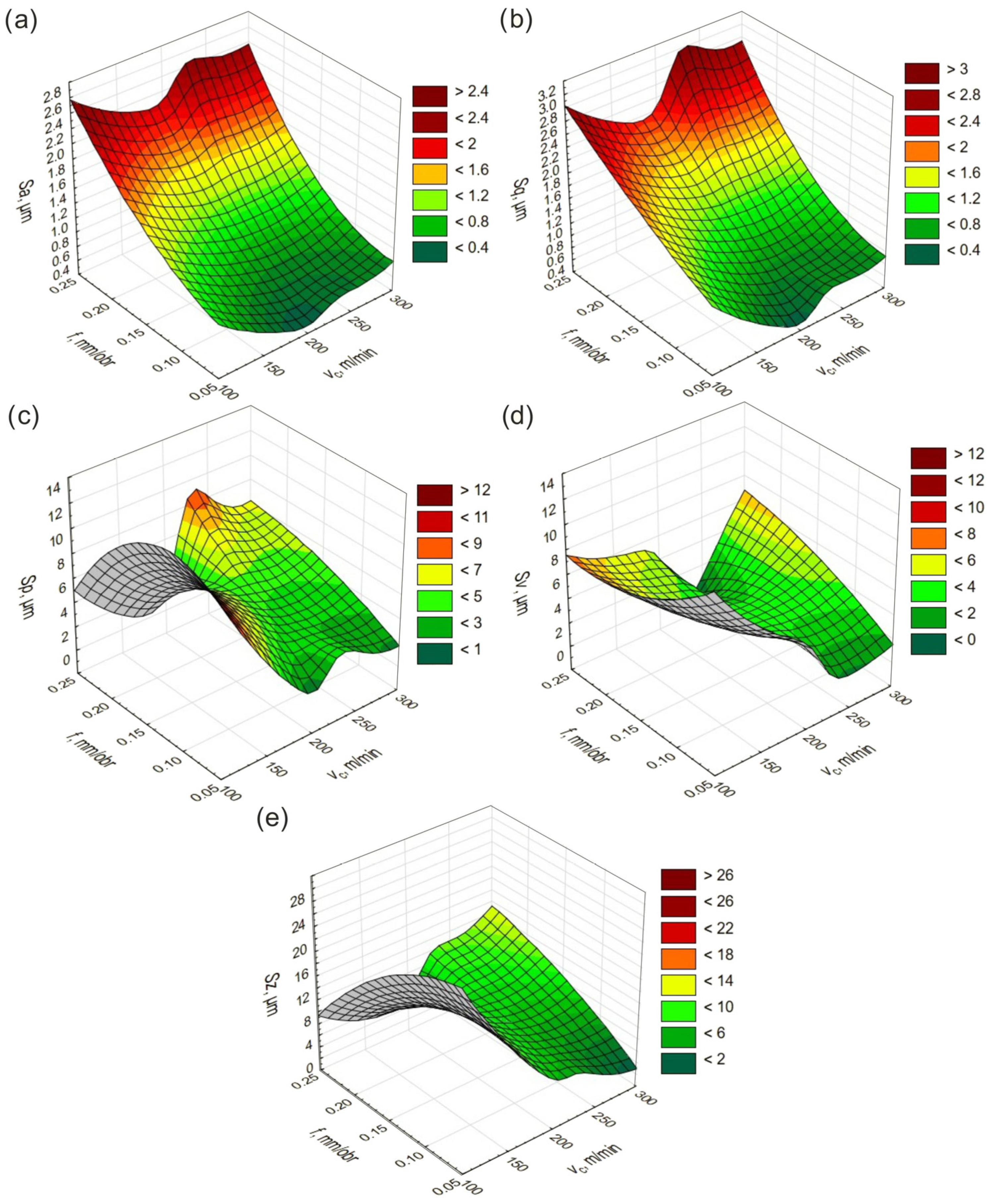
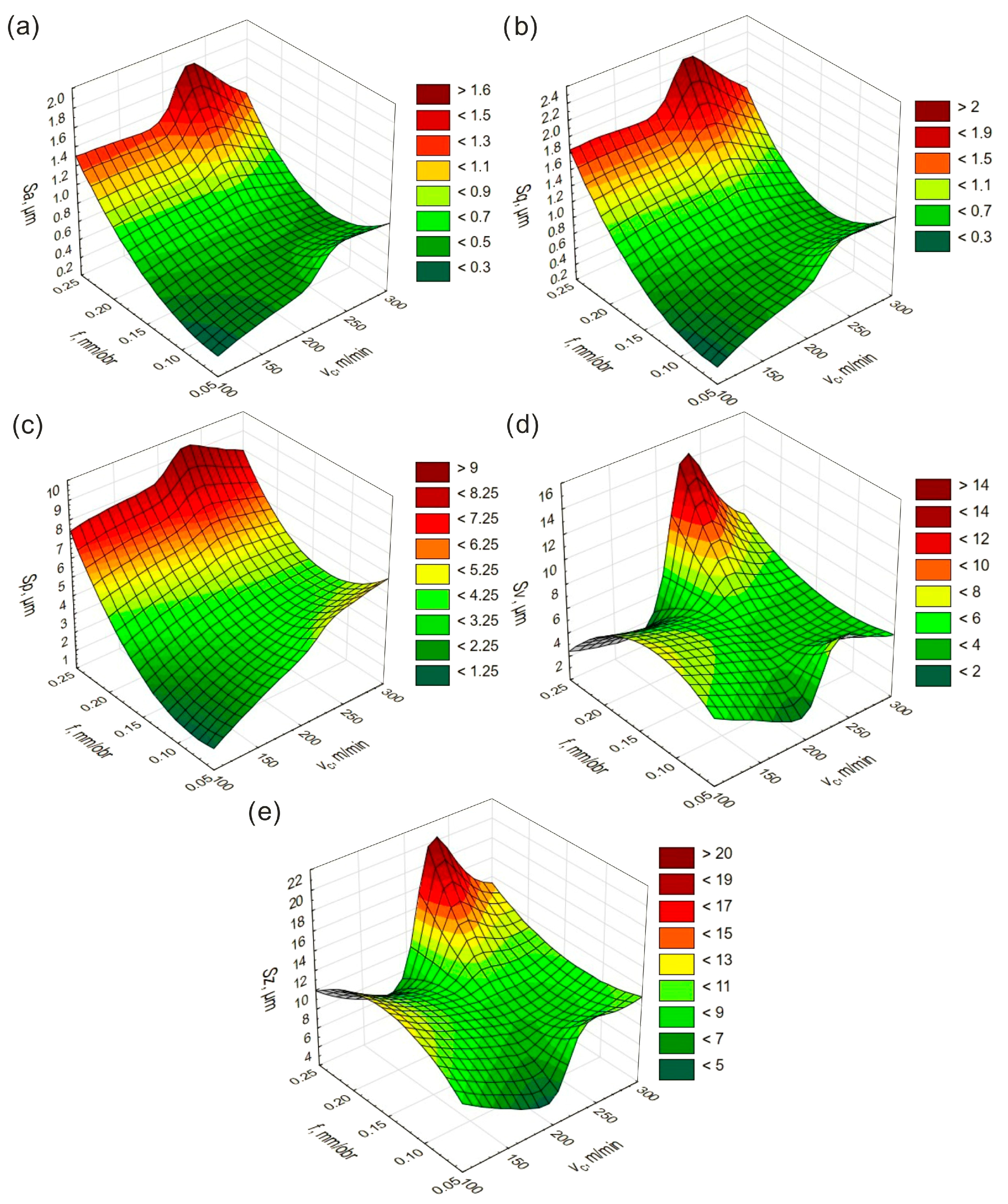
- For both CBN and CC inserts, feed rate is the main factor affecting the overall SR, described by the Sa and Sq parameters. Lower values of these parameters were obtained at smaller feeds (0.05–0.15 mm/rev), while higher values were observed at larger feeds (0.2–0.25 mm/rev), regardless of the tested cutting speed.
- The Sp, Sv, and Sz parameters are influenced by the interaction between feed rate and cutting speed, with their minimum and maximum values occurring at defined combinations of these turning parameters. The effects of feed rate and cutting speed are similar for both types of inserts, suggesting a comparable mechanism for shaping ST, despite differences in tool materials.
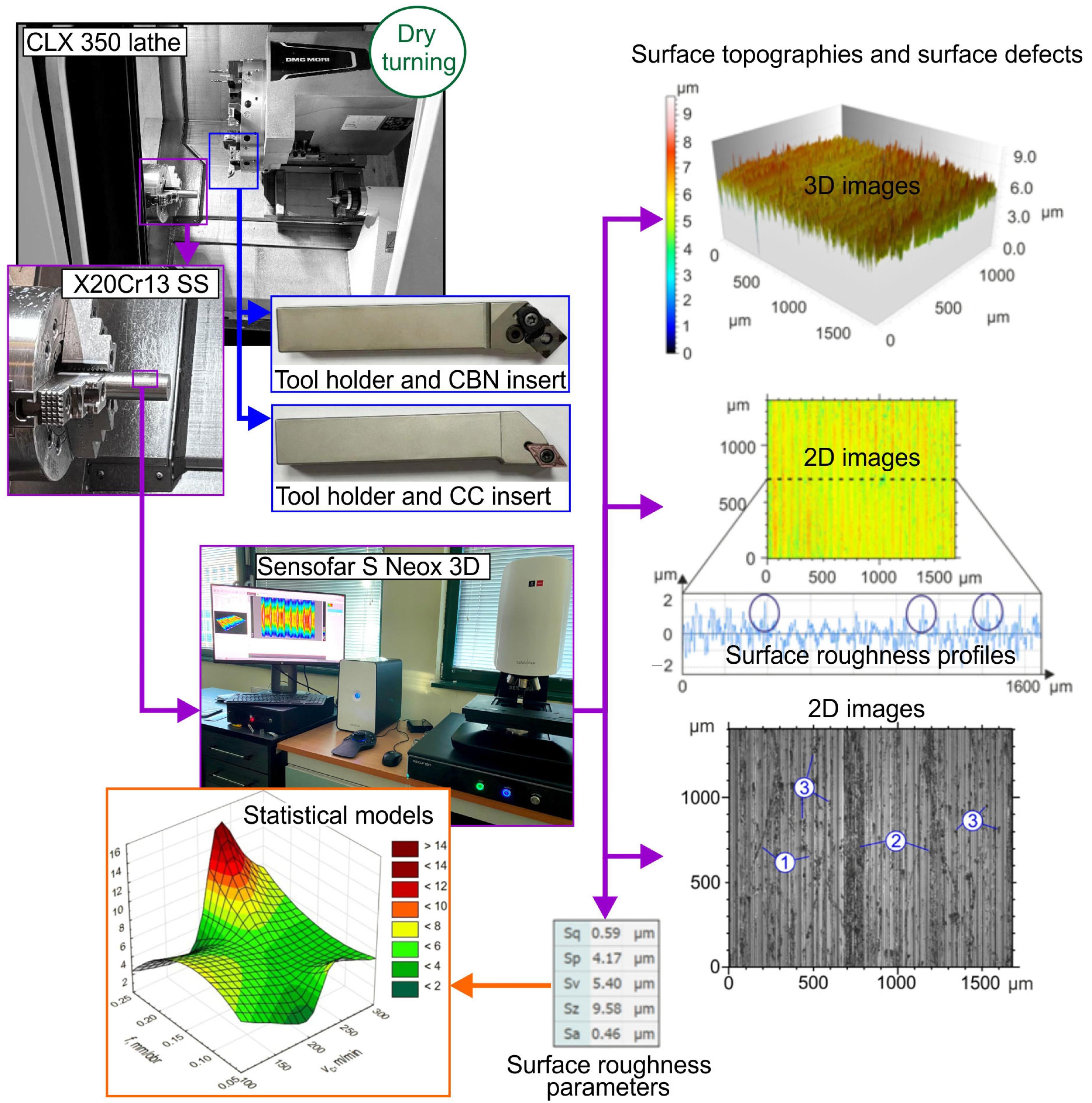
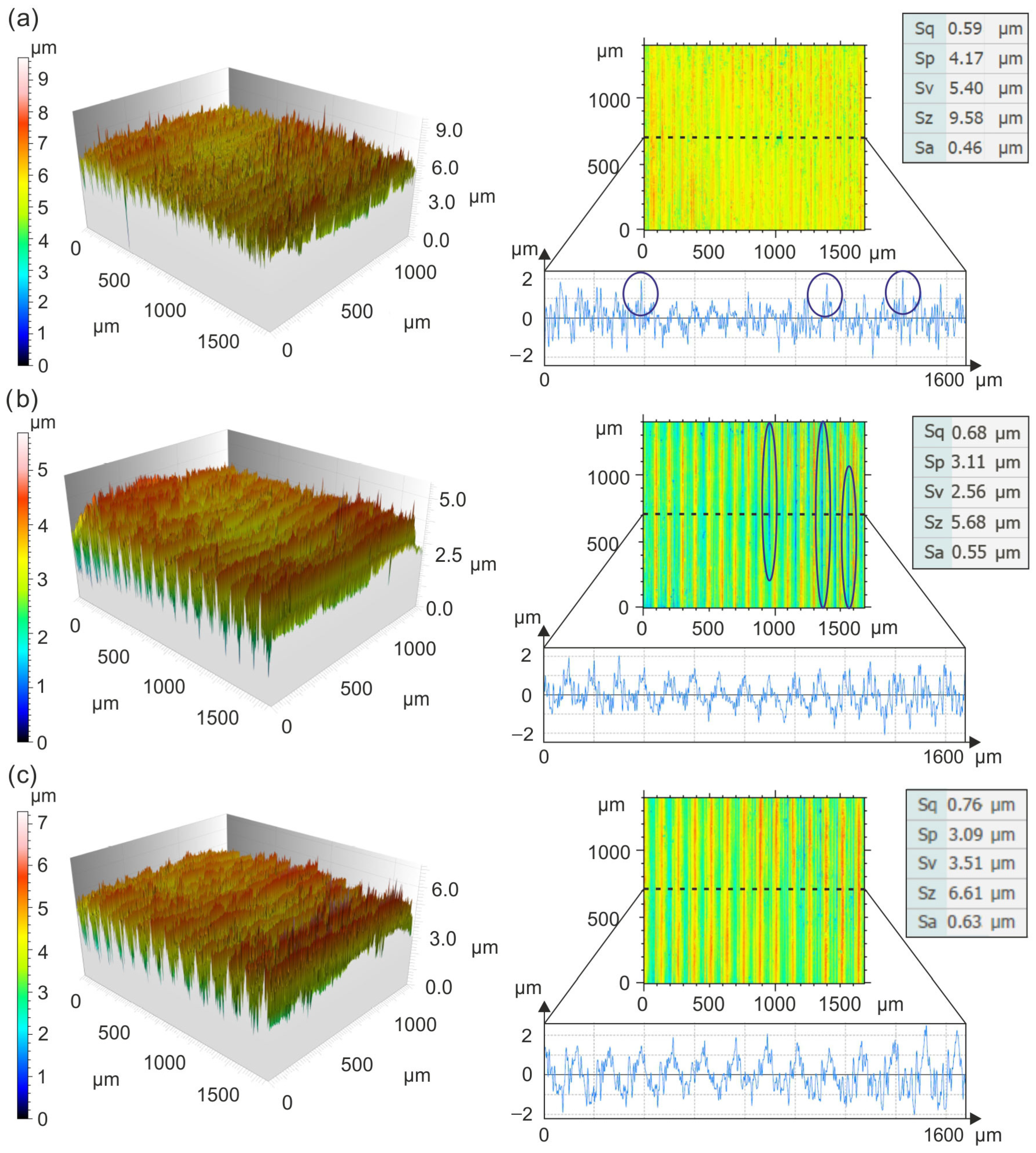
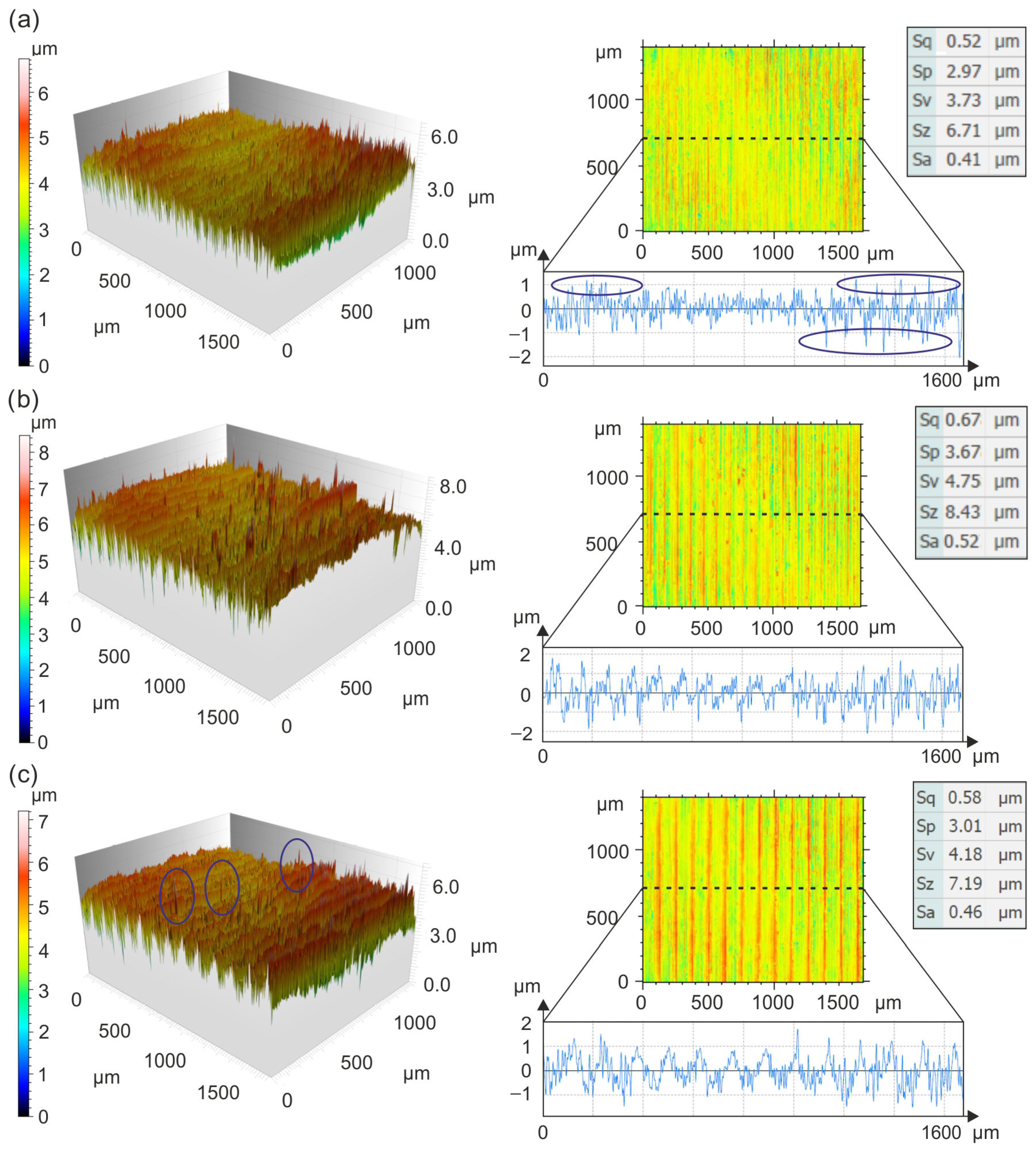
- With appropriately selected cutting parameters, turning with CBN and CC inserts can achieve low Sa values (0.4–0.6 µm), allowing the grinding operation to be omitted. Surfaces machined with CBN inserts were characterized by a more regular distribution of peaks and valleys, whereas CC inserts produced a wavy surface, indicative of intense plastic deformation of the surface layer. Additionally, low Sa values may be accompanied by single peaks, indicating that this parameter does not always fully reflect the presence of extreme surface irregularities.
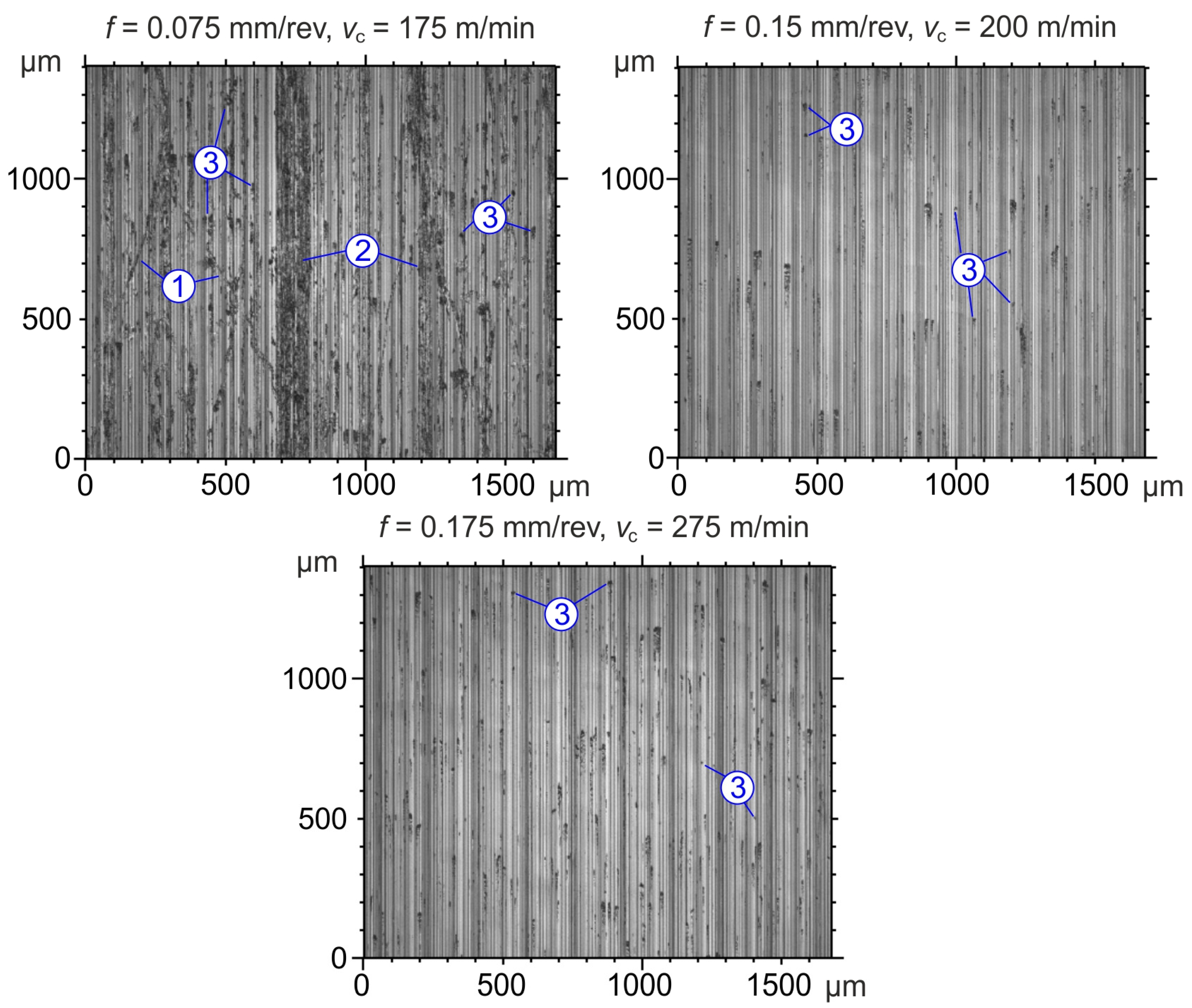
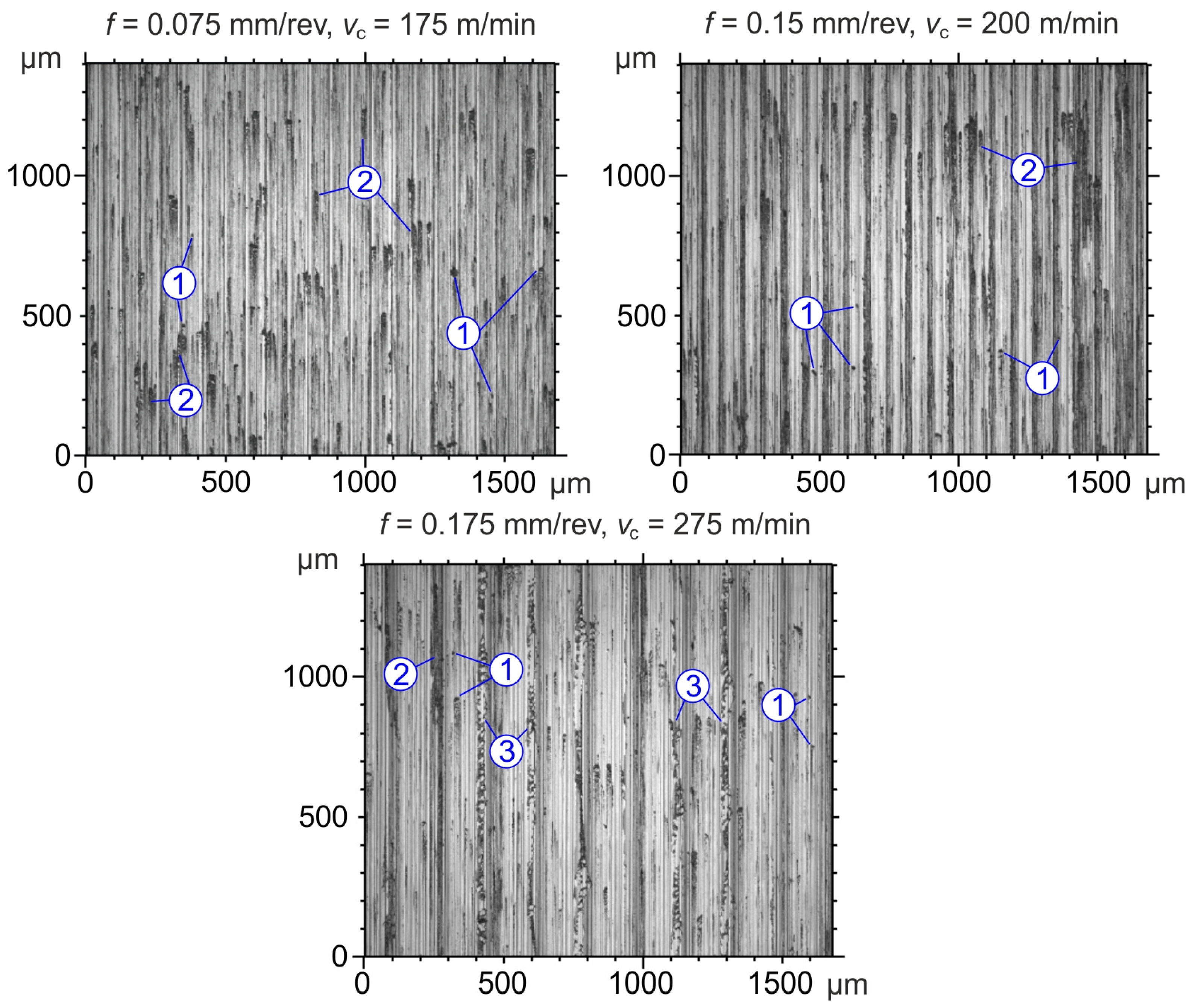
- Local defects were observed on the surfaces machined with both CBN and CC inserts, including adhesive bonds of chips and tool material. For CBN inserts, micro-scratches caused by chip friction were also observed, while turning with CC inserts resulted in a side flow phenomenon associated with intense plastic deformation of the surface layer.
- It was confirmed that the use of CBN inserts in finish turning of hardened SSs is effective and comparable to the results obtained using commonly applied CC inserts with a PVD coating.
Author Contributions
Funding
Data Availability Statement
Conflicts of Interest
Abbreviations
| BuE | Build-up Edge |
| CBN | Cubic Boron Nitride |
| CC | Cemented Carbide |
| CT | Conventional Turning |
| PCBN | Polycrystalline Cubic Boron Nitride |
| PCD | Polycrystalline Diamond |
| PSI | Parameter Space Investigation |
| SCD | Single-Crystal Diamond |
| SiC | Silicon Carbide |
| SR | Surface Roughness |
| SS | Stainless Steel |
| ST | Surface Topography |
| UVT | Ultrasonic Vibration Turning |
References
- Tu, L.; An, Q.; Ming, W.; Chen, M.; Yu, D. Adhesion and diffusion mechanisms of the cBN tools in the high-speed cutting of nickel-based superalloys. Wear 2025, 576–577, 206069. [Google Scholar] [CrossRef]
- Bjerke, A.; Casas, J.; Lenrick, F.; Andersson, J.M.; M’Saoubi, R.; Bushlya, V. On the wear mechanisms of uncoated and coated pcBN tools during turning of 17–4 PH martensitic stainless steel. Int. J. Refract. Met. Hard Mater. 2025, 127, 106984. [Google Scholar] [CrossRef]
- Boing, D.; Martinez, E.N.; Norgren, S.; Hardell, J. Attrition wear in Polycrystalline Diamond cutting tools during interaction with aluminium. Wear 2025, 571, 205781. [Google Scholar] [CrossRef]
- Tian, X.; Gong, S.; Zhou, Q.; Wang, D.; Wang, Q.; Li, L.; Yan, K. Performance of PCBN tools in dry cutting iron-based superalloy. Int. J. Refract. Met. Hard Mater. 2025, 128, 106986. [Google Scholar] [CrossRef]
- Zhang, J.; Yuan, H.; Feng, L.; Zhang, J.; Chen, X.; Xiao, J.; Xu, J. Enhanced machinability of Ni-based single crystal superalloy by vibration-assisted diamond cutting. Precis. Eng. 2023, 79, 300–309. [Google Scholar] [CrossRef]
- Xu, Z.; Zhang, G.; Zhang, J.; Huang, Z.; Zhang, W.; Pan, M. Wear mechanisms of diamond tools and their material basis in machining iron-based materials. Precis. Eng. 2025, 93, 110–152. [Google Scholar] [CrossRef]
- Wang, H.; Wang, C.; Dang, J.; Gao, P.; An, Q.; Zheng, T.; Deng, Y.; Ming, W.; Chen, M.; Wang, T.; et al. Frication behaviors, wear and failure mechanisms of CBN tool and machined surface morphology in high-speed turning of high strength refractory alloy cast steel. J. Manuf. Process. 2025, 138, 186–202. [Google Scholar] [CrossRef]
- He, W.; Guo, Y.; Wang, D.; Ming, W.; Ye, G.; Li, X.; Wang, Y.; Du, J. Wear mechanisms and its effect of CBN tool on surface roughness in machining of metallic glass. Int. J. Refract. Met. Hard Mater. 2025, 128, 107082. [Google Scholar] [CrossRef]
- Thamizhmanii, S.; Karthikeyan, R.; Senthilkumar, J.S.; Adinarayanan. Wear analysis on difficult to cut metals on Titanium and Inconel 718. Mater. Today Proc. 2023, in press. [Google Scholar] [CrossRef]
- Liao, Z.; Schoop, J.M.; Saelzer, J.; Bergmann, B.; Priarone, P.C.; Splettstößer, A.; Bedekar, V.M.; Zanger, F.; Kaynak, Y. Review of current best-practices in machinability evalation and understanding for improving machining performance. CIRP J. Manuf. Sci. Technol. 2024, 50, 151–184. [Google Scholar] [CrossRef]
- Khetre, S.; Bongale, A.; Kumar, S.; Ramesh, B.T. Temperature Analysis in Cubic Boron Nitrate Cutting Tool during Minimum Quantity Lubrication Turning with a Coconut-Oil-Based Nano-Cutting Fluid Using Computational Fluid Dynamics. Coatings 2024, 14, 340. [Google Scholar] [CrossRef]
- Tuan, N.M.; Long, T.T.; Ngoc, T.B. Study of Effects of MoS2 Nanofluid MQL Parameters on Cutting Forces and Surface Roughness in Hard Turning Using CBN Insert. Fluids 2023, 8, 188. [Google Scholar] [CrossRef]
- Özdemir, M.; Rafighi, M.; Al Awadh, M. Comparative Evaluation of Coated Carbide and CBN Inserts Performance in Dry Hard-Turning of AISI 4140 Steel Using Taguchi-Based Grey Relation Analysis. Coatings 2023, 13, 979. [Google Scholar] [CrossRef]
- Zębala, W.; Struzikiewicz, G.; Rumian, K. Cutting Forces and Tool Wear Investigation during Turning of Sintered Nickel-Cobalt Alloy with CBN Tools. Materials 2021, 14, 1623. [Google Scholar] [CrossRef] [PubMed]
- Latosińska, K.; Struzikiewicz, G.; Zębala, W. Method of Data Selection for Turning of Inconel 718 Alloy Obtained by Casting and Laser Sintering Powder. Materials 2022, 15, 1448. [Google Scholar] [CrossRef]
- Zhou, J.; Chen, Z.; Persson, H.; Peng, R.L.; M’Saoubi, R.; Gustasson, D. Comparative Assessment of the Surface Integrity of AD730® and IN718 Superalloys in High-Speed Turning with a CBN Tool. J. Manuf. Mater. Process. 2019, 3, 73. [Google Scholar] [CrossRef]
- Liu, J.; Dong, Z.; Bao, Y.; Kan, R.; Xing, Y.; Yin, S. Material removal mechanism and micro evolution of ultrasonic elliptical vibration cutting of tungsten alloys based on polycrystalline diamond and single crystal diamond tools. Wear 2026, 586, 206468. [Google Scholar] [CrossRef]
- DIN EN 10088-3; Stainless Steels—Part 3: Technical Delivery Conditions for Semi-Finished Products, Bars, Rods, Wire, Sections and Bright Products of Corrosion Resisting Steels for General Purposes. Deutsches Institut für Normung e. V. (DIN): Berlin, Germany, 2014.
- EN ISO 6892-1; Metallic Materials—Tensile Testing—Part 1: Method of Test at Room Temperature. European Committee for Standardization (CEN): Brussels, Belgium, 2019.
- EN ISO 6506-1; Metallic Materials—Brinell Hardness Test—Part 1: Test Method. European Committee for Standardization (CEN): Brussels, Belgium, 2014.
- ISO 25178-2; Geometrical Product Specifications (GPS)—Surface Texture: Areal—Part 2: Terms, Definitions and Surface Texture Parameters. International Organization for Standardization: Geneva, Switzerland, 2021.
- Leksycki, K.; Feldshtein, E. Study of the finish turning process based on the Parameter Space Investigation method. Int. J. Adv. Manuf. Technol. 2023, 126, 5487–5499. [Google Scholar] [CrossRef]
- Liu, G.; Huang, C.; Zhao, B.; Wang, W.; Sun, S. Effect of Machined Surface Integrity on Fatigue Performance of Metal Workpiece: A Review. Chin. J. Mech. Eng. 2021, 34, 118. [Google Scholar] [CrossRef]
- Grzesik, W. Prediction of the Functional Performance of Machined Components Based on Surface Topography: State of the Art. J. Materi. Eng. Perform. 2016, 25, 4460–4468. [Google Scholar] [CrossRef]
- Sarıkaya, M.; Gupta, M.K.; Tomaz, I.; Pimenov, D.Y.; Kuntoğlu, M.; Khanna, N.; Yıldırım, C.V.; Krolczyk, G.M. A state-of-the-art review on tool wear and surface integrity characteristics in machining of superalloys. CIRP J. Manuf. Sci. Technol. 2021, 35, 624–658. [Google Scholar] [CrossRef]
- Abellán-Nebot, J.V.; Pastor, C.V.; Siller, H.R. A Review of the Factors Influencing Surface Roughness in Machining and Their Impact on Sustainability. Sustainability 2024, 16, 1917. [Google Scholar] [CrossRef]
- ISO 286-1; Geometrical Product Specifications (GPS)—ISO Code System for Tolerances on Linear Sizes—Part 1: Basis of Tolerances, Deviations and Fits. International Organization for Standardization: Geneva, Switzerland, 2010.
- Habrat, W. Analysis and Modeling of the Finish Turning of Titanium and Its Alloys; Oficyna Wydawnicza Politechniki Rzeszowskej: Rzeszów, Poland, 2019. (In Polish) [Google Scholar]
- Grzesik, W.; Wanat, T. Surface finish generated in hard turning of quenched alloy steel parts using conventional and wiper ceramic inserts. Int. J. Mach. Tools Manuf. 2006, 46, 1988–1995. [Google Scholar] [CrossRef]
- Gaitonde, V.N.; Karnik, S.R.; Figueira, L.; Davim, J.P. Machinability investigations in hard turning of AISI D2 cold work tool steel with conventional and wiper ceramic inserts. Int. J. Refract. Metal Hard Mater. 2009, 27, 754–763. [Google Scholar] [CrossRef]
- Özel, T.; Karpat, Y.; Figueira, L.; Davim, J.P. Modelling of surface finish and tool flank wear in turning of AISI D2 steel with ceramic wiper inserts. J. Mater. Process. Technol. 2007, 189, 192–198. [Google Scholar] [CrossRef]
- Davim, J.P.; Figueira, L. Comparative evaluation of conventional and wiper ceramic tools on cutting forces, surface roughness, and tool wear in hard turning AISI D2 steel. Proc. Inst. Mech. Eng. Part B J. Eng. Manuf. 2007, 221, 625–633. [Google Scholar] [CrossRef]
- Chou, Y.K.; Evans, C.J.; Barash, M.M. Experimental investigation on CBN turning of hardened AISI 52100 steel. Mater. Process. Technol. 2002, 124, 274–283. [Google Scholar] [CrossRef]
- Pawanr, S.; Gupta, K. Dry Machining of AISI 316 Steel Using Textured Ceramic Tool Inserts: Investigation of Surface Roughness and Chip Morphology. Ceramics 2025, 8, 97. [Google Scholar] [CrossRef]
- Leksycki, K. Effect of turning parameters on surface layer features of 17−4 PH stainless steel under MQCL environment. Int. J. Adv. Manuf. Technol. 2026, 142, 2855–2867. [Google Scholar] [CrossRef]
- Zhuang, G.; Liu, H.; Zong, H.; Ciu, Z. Study on the influence of relative vibration between tool and workpiece on plastic side flow. J. Manuf. Process. 2023, 101, 339–353. [Google Scholar] [CrossRef]



| Point No. | 1 | 2 | 3 | 4 | 5 | 6 | 7 |
|---|---|---|---|---|---|---|---|
| vc, m/min | 200 | 150 | 250 | 275 | 175 | 225 | 125 |
| f, mm/rev | 0.15 | 0.2 | 0.1 | 0.175 | 0.075 | 0.125 | 0.225 |
Disclaimer/Publisher’s Note: The statements, opinions and data contained in all publications are solely those of the individual author(s) and contributor(s) and not of MDPI and/or the editor(s). MDPI and/or the editor(s) disclaim responsibility for any injury to people or property resulting from any ideas, methods, instructions or products referred to in the content. |
© 2026 by the authors. Licensee MDPI, Basel, Switzerland. This article is an open access article distributed under the terms and conditions of the Creative Commons Attribution (CC BY) license.
Share and Cite
Leksycki, K.; Feldshtein, E.; Pawłowski, J. Surface Topography of Hardened Stainless Steel in Dry Finish Turning Using CBN and Cemented Carbide Inserts. Materials 2026, 19, 1103. https://doi.org/10.3390/ma19061103
Leksycki K, Feldshtein E, Pawłowski J. Surface Topography of Hardened Stainless Steel in Dry Finish Turning Using CBN and Cemented Carbide Inserts. Materials. 2026; 19(6):1103. https://doi.org/10.3390/ma19061103
Chicago/Turabian StyleLeksycki, Kamil, Eugene Feldshtein, and Jakub Pawłowski. 2026. "Surface Topography of Hardened Stainless Steel in Dry Finish Turning Using CBN and Cemented Carbide Inserts" Materials 19, no. 6: 1103. https://doi.org/10.3390/ma19061103
APA StyleLeksycki, K., Feldshtein, E., & Pawłowski, J. (2026). Surface Topography of Hardened Stainless Steel in Dry Finish Turning Using CBN and Cemented Carbide Inserts. Materials, 19(6), 1103. https://doi.org/10.3390/ma19061103