Article

Effects of Compositional Ratio of Ti-Al-C on Formation of Ti2AlC by Self-Sustaining Combustion Synthesis


Department of Aerospace and Systems Engineering, Feng Chia University, Taichung 40724, Taiwan
*
Author to whom correspondence should be addressed.
Materials 2026, 19(6), 1100; https://doi.org/10.3390/ma19061100
Submission received: 2 February 2026 / Revised: 4 March 2026 / Accepted: 11 March 2026 / Published: 12 March 2026

Abstract

The formation of Ti2AlC was investigated by self-propagating high-temperature synthesis (SHS) from the elemental Ti-Al-C powder compacts. The compositional ratios of Ti:Al:C varied from 2:1:1 to 2:1.2:0.8 to explore the effects of deficient carbon and excess Al on the combustion kinetics and product formation. For the Ti-Al-C powder compacts, self-sustaining combustion featuring a distinct combustion wave was readily achieved upon ignition. Excess Al caused a decrease in combustion temperature and flame-front velocity, while deficient carbon showed relatively little influence. The synthesized product from the sample with an exact stoichiometry of Ti:Al:C = 2:1:1 was composed of 79.5 wt.% Ti2AlC, 9.8 wt. Ti3AlC2, 10.7 wt.% TiC, and a small amount of Ti3AlC. The addition of excess Al by 20 at.% not only increased the yield of Ti2AlC but avoided the formation of Ti3AlC. A reduction of carbon further improved the evolution of Ti2AlC. The sample with an off-stoichiometric proportion of Ti:Al:C = 2:1.2:0.9 yielded the optimum product composition of 91.9 wt.% Ti2AlC, 4.2 wt.% Ti3AlC2, and 3.9 wt.% TiC. This was attributed to the fact that excess Al and deficient carbon facilitated the formation of TiAl and sub-stoichiometric TiC, both of which acted as the intermediate phases to combine into Ti2AlC. The as-synthesized Ti2AlC grains were in the shape of thin platelets with a size of 4–8 μm and a thickness of about 1.0 μm. A laminated microstructure formed by closely stacked platelets is typical of the MAX carbide.

1. Introduction

MAX phases are a group of layered hexagonal carbides and nitrides and can be designated by a formula of Mn+1AXn with n = 1, 2, and 3, where M corresponds to an early transition metal, A to an A-group element (mainly IIIA and IVA), and X to either C or N [1]. Depending on the value of index n, MAX phases are generally divided into three categories, namely 211, 312, and 413 groups. These materials are of interest because they feature both metallic and ceramic properties. Like metals, they exhibit excellent electrical and thermal conductivity, good machinability, outstanding thermal shock resistance, and plasticity at high temperatures. Their ceramic-like characteristics include low density, good oxidation resistance, low thermal expansion coefficient, high melting point, high modulus and strength, and good thermal stability [1,2,3,4].
The Ti-Al-C system contains three carbides, i.e., Ti2AlC, Ti3AlC, and Ti3AlC2, with melting points of 1625, 1580, and 1360 °C, respectively [5]. Ti2AlC has the highest melting point. Moreover, the low density of 4.11 g/cm3 positions Ti2AlC as the lightest Ti-based 211 MAX phase. Hardness, electrical conductivity, and thermal conductivity of Ti2AlC are 4–5 GPa, (2.7–4.5) × 106 Ω−1·m−1, and 46 W/m·K, respectively [6]. Compressive strength, bending strength, and fracture toughness of Ti2AlC are 670 MPa, 384 MPa, and 7 MPa·m1/2, respectively [7]. Due to its excellent resistance to oxidation at elevated temperatures and mechanical properties, Ti2AlC has been considered as the most practical MAX phase for high-temperature structural applications in the form of bulk and coatings [8,9]. The outstanding oxidation resistance of Ti2AlC is attributed to the formation of an α-Al2O3 layer on the surface at 1000 °C. Especially, close values of the thermal expansion coefficient of Al2O3 and Ti2AlC make it not easy to separate from the substrate and reduce the thermal stress at high temperatures [8,9]. Ti2AlC also demonstrates superior crack self-healing capabilities. It was found that superficial cracks and grooves of a width ≤ 10 μm on Ti2AlC were self-healed after 20 h oxidation at 1200 °C via dense Al2O3 [10]. The self-healing temperature of Ti2AlC coatings was further reduced to below 700 °C by A-site Sn solid solution [11]. Moreover, the defects generated during corrosion could be effectively self-healed by the Al2O3 amorphous phase, thus enhancing the corrosion-resistant properties of Ti2AlC coatings [12,13].
Practical applications of Ti2AlC and other MAX phases like Ti3AlC2 and Cr2AlC include high-temperature coatings for gas turbines, nuclear fuel cladding, electrical contacts, energy storage devices, and catalyst supports [14,15,16,17,18]. The use of Ti2AlC in aerospace and industrial gas turbines is attributed to its excellent oxidation resistance and thermal expansion compatibility with protective ceramic layers [14,15]. Ti2AlC and Ti3AlC2 are potential candidates for accident-tolerant fuel cladding in nuclear reactors because they are resistant to irradiation and corrosion in high-temperature environments [16,17]. Ti2AlC and Ti3AlC2 are suitable for electrical contacts, resistors, and conducting materials due to their high electrical conductivity [14,15,16,17]. Ti2AlC has been primarily used as a source material for etching to produce 2D MXene materials for advanced electronics and energy storage [15,18].
Synthesis routes to produce Ti2AlC have been diverse, and different reactant mixtures and compositional ratios have been adopted. The methods include hot pressing (HP) [19], hot isostatic pressing (HIP) [6], solid–liquid reaction synthesis [20], spark plasma sintering (SPS) [21,22], pressureless sintering [23,24], microwave sintering [25], molten salt synthesis (MS) [9,26], self-propagating high-temperature synthesis (SHS) [27,28,29,30,31], and mechanical-activated thermal explosion [32,33]. Barsoum et al. [6,19] produced bulk polycrystalline Ti2AlC from a Ti-Al4C3-C powder mixture by HIP for 15 h at 1300 °C and 40 MPa and HP for 4 h at 1600 °C and 40 MPa. Wang and Zhou [20] developed a solid–liquid reaction process operating at 1400 °C and 30 MPa for 1 h to fabricate Ti2AlC from a stoichiometric elemental powder compact. By using the SPS technique, Zhou et al. [21] obtained dense Ti2AlC from an Al-excessive powder mixture with a molar ratio of Ti:Al:C = 2:1.2:1 at 1100 °C and 30 MPa for 1 h. With Ti, TiC, and Al4C3 as the precursor materials at a stoichiometry of Ti:TiC:Al4C3 = 7:1:1.3 (i.e., a 30 mol.% excess of Al4C3), Ti2AlC of 90 wt.% purity was synthesized by SPS at a sintering temperature of 1300 °C [22]. Benitez et al. [23] utilized Ti, Al, and TiC as the reactants with a molar ratio of Ti:Al:TiC = 1.00:1.05:0.95 to prepare Ti2AlC by pressureless sintering in a tube furnace at 1400 °C under argon. Gauthier-Brunet et al. [24] produced Ti2AlC from a powder mixture composed of Ti:C:Al4C3 = 8:1:1 by reactive sintering. Three intermediate phases, including TiC, Ti3Al, Ti3AlC, were detected. After sintering at 1300 °C and 1400 °C, the dominant phases were Ti2AlC and TiC [24]. Microwave sintering, a distinctive manufacturing route, offering rapid volumetric heating and effective interfacial interactions, was employed to prepare Ti2AlC from stoichiometric Ti, Al, and TiC powders [25]. By means of the MS method, Badie et al. [9] adopted elemental Ti, Al, and graphite powders with different Ti:Al:C stoichiometries of 2:1:1, 2:1.1:1, 2:1.05:1, 2:1:0.8, 2:1:0.9, and 2:1:0.95 to mix with KBr for the synthesis of Ti2AlC at 950, 1000, and 1050 °C for 1, 5, 10, and 15 h. Results showed that a powder mixture with a carbon-deficient composition of 2:1:0.9 produced the highest yield of Ti2AlC up to 91 wt.%. In addition to Ti2AlC, many secondary phases, such as Ti3AlC2, TiC, TiAl, Ti3Al, and Ti, were present in end products from other reactant mixtures [9]. Using a similar MS technique, Nadimi et al. [26] obtained Ti2AlC at 1100 °C for 1.5 h from reactants made up of elemental Ti, Al, and graphite powders with a molar ratio of 2:1:1 and a mixture of NaCl and KCl salts.
Another promising method for preparing the MAX phases, like Ti2AlC, Ti3SiC2, and Ti3AlC2, is combustion synthesis in the SHS mode, where the exothermic reaction is exploited and many merits are recognized, including energy efficiency, short reaction time, simplicity, and cost effectiveness [34,35]. According to Hashimoto et al. [27], Ti2AlC was fabricated by the SHS technique from a compacted powder mixture consisting of Ti:Al:C = 2:1:1, and the final product was Ti2AlC along with a small amount of TiC0.57 due to the loss of Al during the SHS process. Thomas and Bowen [28,29] studied the effect of the Al amount on the synthesis of Ti2AlC from elemental powder mixtures by SHS and indicated that excess Al of 10–30 at.% reduced the combustion temperature and slowed down the cooling of the sample upon completion of the reaction, thus favoring the formation of Ti2AlC. Effects of TiC and Al4C3 as reactant materials on the synthesis of Ti2AlC by SHS were studied using Ti/Al/C/TiC and Ti/Al/C/Al4C3 powder mixtures, both of which possessed a stoichiometric ratio of Ti:Al:C = 2:1:1 [30]. The addition of TiC facilitated the formation mechanism and enhanced the degree of Ti2AlC evolution to around 90 wt.%. However, Al4C3-added samples reduced the reaction exothermicity and led to a slight decrease in the yield of Ti2AlC [30]. Aydinyan [31] added PTFE of 2 wt.% as a reaction activator into a mixture of 2Ti/1.4Al/0.9C to synthesize Ti2AlC via an activated SHS process. PTFE promoted the reaction and phase conversion. The final product was composed of Ti2AlC and TiC at a weight ratio of 92.2:7.8 [31].
Thermal explosion (TE) is another mode of combustion synthesis and involves uniform heating throughout the entire sample, leading to rapid bulk reactions [36]. Khoptiar et al. [32] synthesized Ti2AlC of 90 wt.% purity from elemental Ti, Al, and C powders via mechanical activation for 3 h, followed by TE with preheating at 800 °C and compressing at 30 MPa. Edrisi et al. [33] conducted TE synthesis to fabricate Ti2AlC with mechanically activated powder mixtures of Ti:Al:C = 2:1:1 at a preheating temperature of 1000 °C. Mechanical activation lowered the formation temperature of Ti2AlC and reduced the secondary phase, thereby producing a synthesized product containing Ti2AlC of 96.1 wt.% [33].
According to the literature reviewed above, initial powder mixtures in off-stoichiometric proportions, i.e., Al-excessive and carbon-deficient compositions, had a positive effect on the formation of Ti2AlC. However, such effects caused by Al excess and carbon reduction on the synthesis of Ti2AlC have not been fully studied by SHS. This study intended to investigate the production of Ti2AlC from elemental powder mixtures by solid state combustion in the SHS mode. The initial stoichiometric ratios of Ti:Al:C varied from 2:1:1 to 2:1.2:0.8 to examine the influence of Al and carbon contents on the phase conversion of Ti2AlC. In this work, the self-sustaining combustion behavior was assessed, and measurement of the combustion wave velocity and reaction temperature was conducted. Analysis of the microstructure and constituent composition of SHS-derived products was performed. Furthermore, the potential reaction steps to form Ti2AlC via the SHS route were proposed.

2. Materials and Methods

In this study, the raw materials included Ti (Alfa Aesar, Ward Hill, MA, USA, <45 μm, and 99.8%), Al (Alfa Aesar, Ward Hill, MA, USA, <45 μm, and 99.7%), and carbon black (Showa Chemical Co., Tokyo, Japan). The composition of the test sample was expressed as Equation (1), where the stoichiometric parameters, x and y, signify the number of moles of Al and carbon, respectively, in the mixture of reactant powders. It should be noted that Equation (1) represents a nominal compositional design rather than a balanced chemical reaction. Values of x equal to 1.0, 1.1, and 1.2 were adopted to investigate the effect of excess Al, i.e., an Al-rich composition. The amount of carbon was studied by considering values of y at 0.8, 0.9, and 1.0 to assess the influence of carbon reduction, i.e., a carbon-lean test condition. In total, green samples with nine initial compositions were prepared.
2 T i + x A l + y C T i 2 A l C
The reactant powders were dry-mixed in a tumbler ball mill. Teflon milling jars were used and were partly filled with raw materials and alumina grinding balls, and the cylindrical jar rotated about the longitudinal axis of the ball mill. Non-sticky Teflon jars have been generally utilized owing to their minimum contamination and easy-to-clean benefits. Alumina grinding balls had a diameter of 1 mm, and the ball-to-powder ratio was 7:1. The speed of the tumbler mill machine was 75 rpm, and the milling time was 4 h. Then, the powder mixture was compressed uniaxially into sample compacts of a cylindrical shape with a diameter of 7 mm, a height of 12 mm, and a relative density of 50%. The Ti-Al-C sample of 50% relative density was easy to compress, and the rigidity of the powder compact was suitable for handling in the experiment. The relative density of 50% for the test specimen was related to the initial elemental mixture. The theoretical density (ρTD) of the test specimen was calculated from the mass fraction (Y) and density (ρ) of each component based on Equation (2).
1 ρ T D = Y T i ρ T i + Y A l ρ A l + Y C ρ C
The SHS experiment was performed in a windowed stainless-steel combustion chamber filled with Ar at 0.25 MPa. A heated tungsten coil was utilized as the igniter to initiate the combustion reaction from the top surface of the power compact. From the recorded time-sequence film images, the propagation velocity of the combustion wave (Vf) was deduced. The combustion temperature of the sample was measured by a bare-wire thermocouple (Pt/Pt-13%Rh). The wire diameter of the thermocouple was 62.5 μm, junction bead size 125 μm, and leg length 40 mm. The thermocouple bead was attached firmly to the surface of the sample at a location about 7 mm below the ignition top plane. This location for combustion temperature measurement was justified by the assumption that self-sustaining combustion would be well developed at this position. The measurement accuracy of a fine-wire thermocouple is influenced by conduction cooling and radiation loss. The heat loss of the thermocouple through conduction depends on the length of wire between the junction and the support. The leg length of the thermocouple used in this study ensured that the measurement would be reasonably unaffected by the conduction cooling. The radiation heat loss from the bead junction is another source of error in the thermocouple measurement. An estimation of the radiation correction was performed by considering a steady state between convective heat transfer and radiation loss from the thermocouple bead junction. The radiation correction for the temperature range of this study was about 15–25 °C, which was more pronounced at higher temperatures. It is believed that the accuracy of the combustion temperature measurement was within ±5 °C after the radiation correction. Details of the experimental methodology have been published elsewhere [37].
The constituent composition of the SHS-derived product was analyzed by an X-ray diffractometer (XRD, Bruker D2 Phaser, Karlsruhe, Germany) with CuKα radiation and wavelength λ = 1.5406 Å. The operating voltage was 40 kV, and the current was 30 mA. The step size was 0.05°, and the scanning speed was 2°/min. The scan range spanned from 5° to 80° (2θ). The microstructure and elemental composition of the final product were examined with a scanning electron microscope (SEM) and an energy dispersive spectrometer (EDS) (Hitachi, S3000H, Tokyo, Japan). A reference intensity ratio method based on the XRD spectrum was utilized to quantitatively characterize the phase composition [38]. Three XRD diffraction peaks were selected to calculate the weight fractions of Ti3AlC2, Ti2AlC, and TiC in the synthesized product according to Equations (3)–(5) [38]:
W a = I a I a + 0.220 I b + 0.084 I c
W b = I b 4.545 I a + I b + 0.382 I c
W c = I c 11.905 I a + 2.619 I b + I c
where Wa, Wb, and Wc are the weight percentages of Ti3AlC2, Ti2AlC, and TiC, respectively. Ia, Ib, and Ic signify the integrated diffraction peak intensities of Ti3AlC2 (002) at 2θ = 9.5°, Ti2AlC (002) at 2θ = 13.0°, and TiC (111) at 2θ = 35.9°; these three signature peaks were not overlapped with those of other phases and were selected to perform the quantitative phase analysis [38].

3. Results

3.1. Combustion Wave Velocity and Combustion Temperature

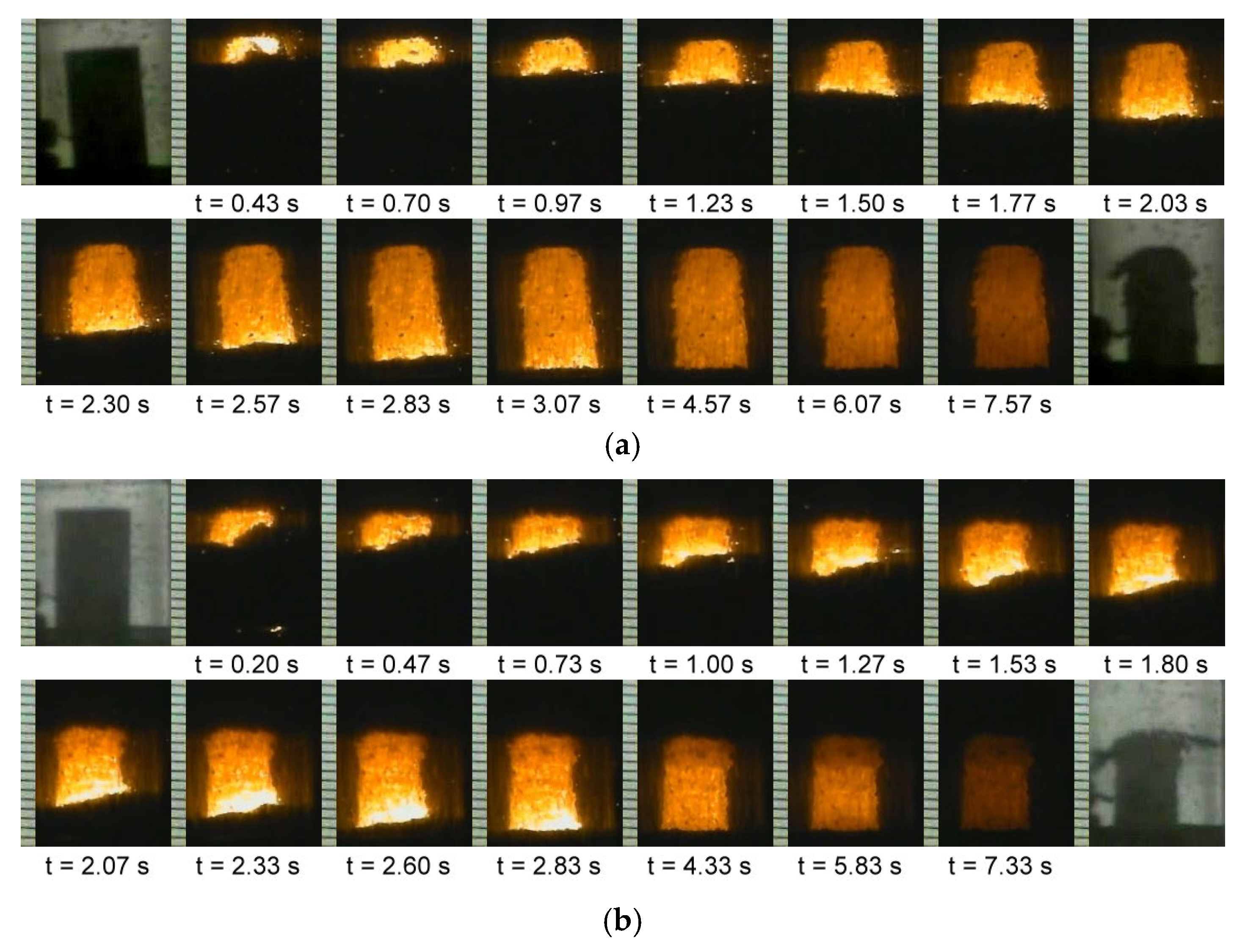
Figure 1a,b illustrate two sequences of the recorded film images displaying the propagation of the combustion wave along the powder compacts with stoichiometric ratios of Ti:Al:C = 2:1:1 and 2:1.2:0.8, respectively. It is evident that upon ignition, a distinct combustion front formed and traversed the entire sample in a self-sustaining manner. This provides proof that the combustion reaction of this study is exothermic enough to maintain its self-sustainability. In the Ti-Al-C reaction system, the reaction of carbon with Ti to form TiC (with the heat of formation, ΔHf = −184.1 kJ/mol) is much more energetic than the reaction between Ti and Al to produce TiAl and Ti3Al (ΔHf = −75.3 and −97.9 kJ/mol) [39,40]. That is, the progression of the combustion wave through the Ti-Al-C powder compact is mainly sustained by the reaction of carbon with Ti.
As reported by Thomas and Bowen [28], the addition of excess Al acting as a diluent caused a decrease in combustion temperature but offered the potential to control the exothermicity of the SHS process. Calculations of the adiabatic temperature (Tad) showed that the stoichiometric powder sample of Ti:Al:C = 2:1:1 had Tad of 2368 K, while a lower value of 2190 K was obtained for the Al-excessive sample of Ti:Al:C = 2:1.3:1 [28]. The adiabatic temperature satisfies the criteria proposed for the combustion reaction to be self-sustaining [41,42]. Experimental evidence in this study confirmed self-propagating combustion.
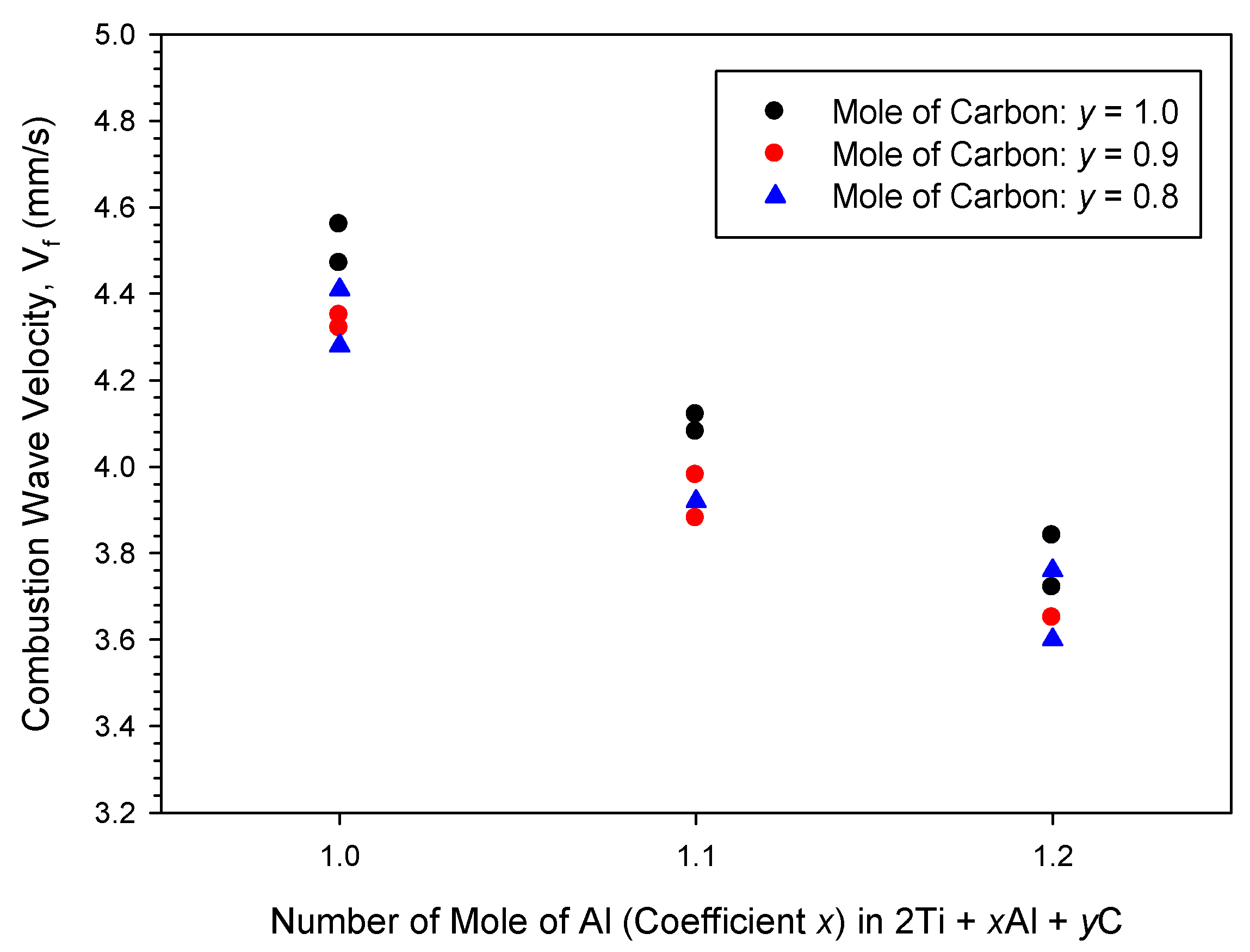
The effects of Al and carbon contents in the reactant mixture on combustion wave velocity are presented in Figure 2. For the powder compacts with stoichiometric carbon of y = 1.0, as revealed in Figure 2, the combustion velocity decreased from 4.6 to 3.7 mm/s as the Al content increased from x = 1.0 to 1.2. Likewise, the combustion front velocity decreased from 4.3 to 3.6 mm/s for the samples with less carbon at y = 0.8. This suggested that excess Al resulted in deceleration of the combustion wave, because of a lower combustion temperature for the Al-excessive sample as reported by Thomas and Bowen [28]. As the content of carbon was reduced from y = 1.0 to 0.8, the combustion velocity varied between 4.6 and 4.3 mm/s for the sample of x = 1.0, and between 3.8 and 3.6 mm/s for the powder compact of x = 1.2. Only a slight decrease in the combustion velocity was observed by reducing carbon content. Namely, the influence of deficient carbon on the combustion velocity was not as pronounced as that of excess Al. This might be because excess Al not only had a cooling impact on combustion but also favored the formation of TiAl instead of Ti3Al. Deficient carbon led to the formation of sub-stoichiometric TiCx′, which was considered as one of the important intermediates [24,27,32], and its formation exothermicity was almost unaffected by a small deviation in carbon content.
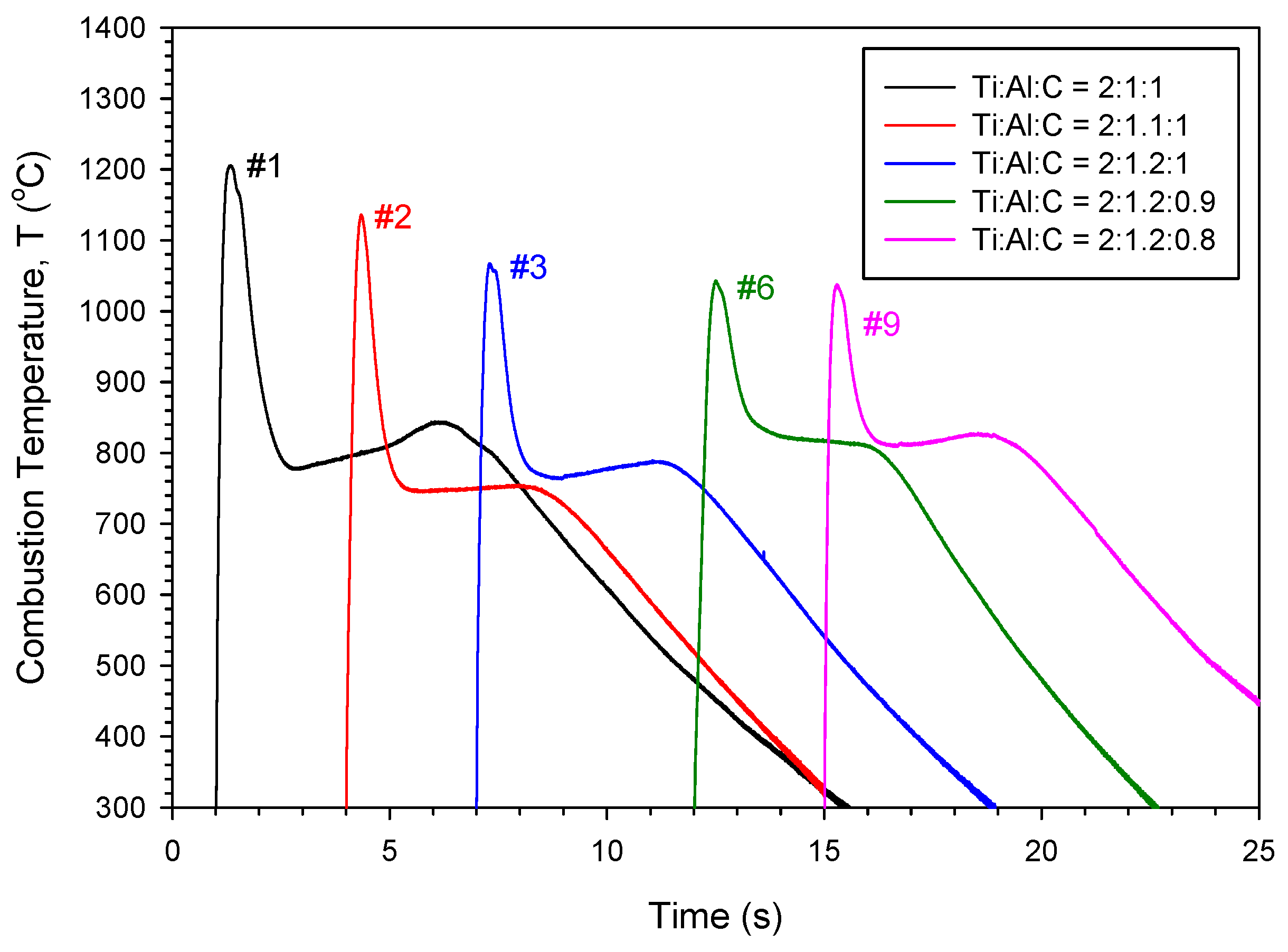
The propagation modes of the combustion wave in the SHS process, such as the planar, spinning, and pulsating modes, are subject to the conduction heat transfer from the reaction zone to unburned section, and hence, the combustion front temperature plays a critical role in the spreading rate of the combustion wave [43,44]. Figure 3 plots five combustion temperature profiles associated with sample compacts of different compositional ratios. The number appearing beside each profile represents the sample number denoted in Table 1. All profiles display an abrupt rise followed immediately by a rapid decline, which is typical of the SHS reaction characterized by a fast combustion wave and a narrow reaction zone. The summit value was regarded as the combustion front temperature (Tc). After passage of the combustion wave, the decrease in temperature was halted by a nearly plateau period, beyond which a slow decrease in temperature continued. The presence of the plateau region in the contour signifies the occurrence of a volumetric reaction after the combustion front. Since it was not easy for the synthesis reaction to finish inside a rapid and narrow combustion zone, the reaction could continue in a bulk fashion.
As indicated in Figure 3, the combustion front temperature of the samples containing stoichiometric carbon of y = 1.0 decreased from 1206 °C (Sample #1) to 1067 °C (Sample #3) as the Al content increased from x = 1.0 to 1.2. This confirms the diluent effect of excess Al on combustion. On the other hand, the increase in Al brough about a change in the intermetallic phase formed during the SHS process from Ti3Al to TiAl. As mentioned above, the heat of formation of TiAl is less than that of Ti3Al [39,40]. Both Ti3Al and TiAl are potential intermediate phases to form Ti2AlC [20,24,29,31]. The combustion front temperatures of two carbon-deficient samples (#6 and #9) were comparable, reaching about 1040 °C, which was slightly lower than that of Sample #3. This provides proof for the slight influence of carbon content between y = 0.8 and 1.0 on the combustion exothermicity. Another important intermediate phase was TiC, which could be in a sub-stoichiometric form TiCx′ (0.8 < x′ < 1.0). The formation of sub-stoichiometric TiCx′ has been specified in the production of Ti2AlC [24,27,32]. Experimental evidence indicated that the variation in combustion front temperature with Al and carbon contents is consistent with that of combustion wave velocity. In addition, the temperature of the plateau region ranged between 760 °C and 820 °C. This plateau period represented the bulk reaction taking place inside the sample rather than on the surface. Because the thermocouple was mounted on the sample surface, the recorded temperature of the plateau region could be lower than the actual reaction temperature.
In general, smaller particles with a larger specific surface area could enhance contact between reactant powders, lower the ignition temperature, increase the combustion wave velocity, and raise the reaction temperature. Moreover, smaller reactant particles could result in finer-grained and more homogeneous product microstructures. The effect of sample density on the reaction temperature and combustion wave velocity has been explored in our previous study [30]. The influence of sample density on the combustion velocity is dependent on two opposing effects. As the sample density increases, the intimate contact between reactant particles is improved and thus enhances the combustion propagation rate. Oppositely, the thermal conductivity of the sample also increases with compaction density, which leads to more conduction heat loss from the reaction zone to the entire sample and hence causes a decrease in the flame spreading speed.

3.2. Phase Composition and Microstructure Analyses of Synthesized Products

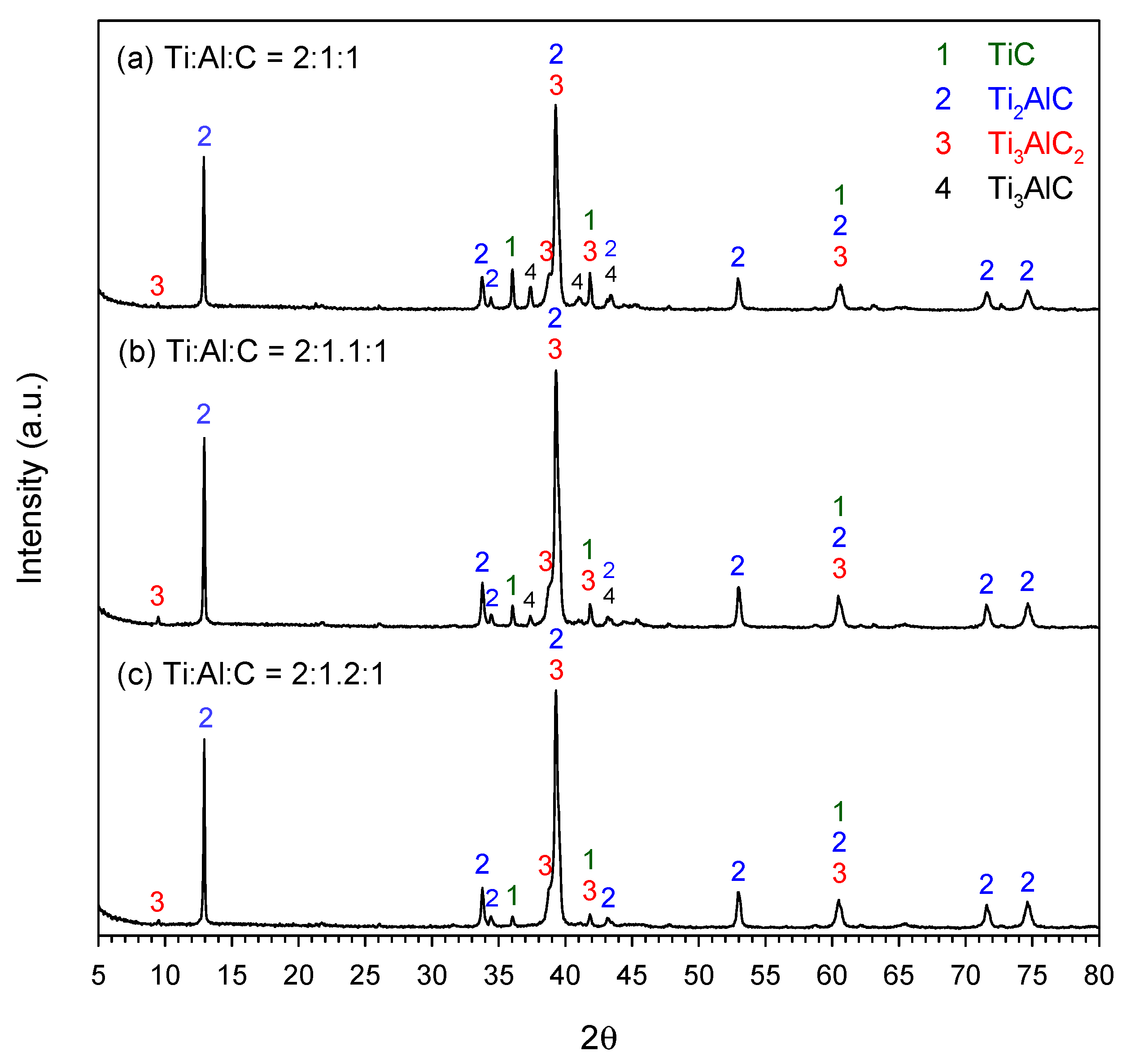
Figure 4a–c present the XRD patterns of synthesized products from elemental powder compacts with compositional ratios of Ti:Al:C = 2:1:1, 2:1.1:1, and 2:1.2:1, respectively. The content of carbon in the samples of Figure 4 was under a stoichiometric amount, i.e., y = 1.0. As revealed in Figure 4, three ternary carbides, Ti3AlC2, Ti3AlC, and Ti2AlC, and one binary carbide, TiC, were identified in the end products. Ti2AlC was the dominant phase. With the addition of excess Al, Ti3AlC was found to decrease in Figure 4b (Ti:Al:C = 2:1.1:1) and finally disappeared in Figure 4c (Ti:Al:C = 2:1.2:1). Moreover, excess Al resulted in a decrease in the peak intensity of TiC and Ti3AlC2. That is, the formation of Ti2AlC was enhanced by the introduction of excess Al.
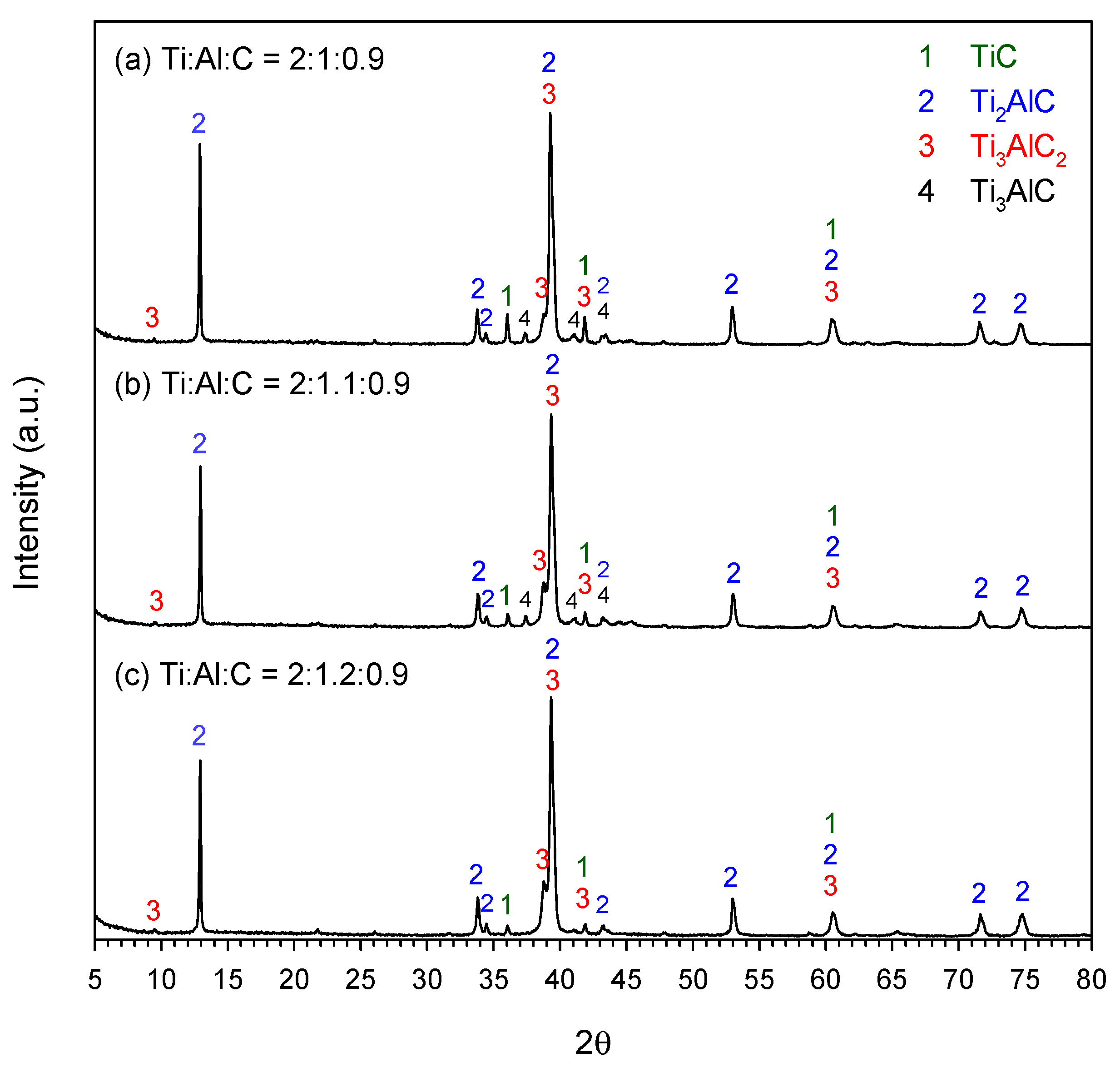
For the samples with carbon content of y = 0.9, Figure 5a–c show three XRD patterns associated with different Al contents. As also observed in Figure 4, Ti2AlC was the dominant carbide, with Ti3AlC2, Ti3AlC, and TiC as the minor phases. It is evident that minor phases were decreased by the addition of excess Al. A comparison between Figure 4 and Figure 5 indicates lower proportions of Ti3AlC2, Ti3AlC, and TiC existing in the end products of carbon-lean samples.
The weight percentages of Ti3AlC2, Ti2AlC, and TiC in the end products of the powder compacts of Equation (1) were determined using Equations (3)–(5) and are summarized in Table 1. For Sample #1 with an exact stoichiometry of Ti:Al:C = 2:1:1, the final product comprised Ti2AlC of 79.5 wt.%, Ti3AlC2 of 9.8 wt.%, and TiC of 10.7 wt.%. The addition of extra Al in Samples 2 and #3 enhanced the evolution of MAX carbides. It should be noted that a small amount of Ti3AlC existed in the products of Samples #1 and #2. An extra amount of Al, by 20 at.% not only increased the yield of Ti2AlC but also prevented the formation of Ti3AlC. A final product consisting of 84.1 wt.% Ti2AlC, 13.0 wt.% Ti3AlC2, and 2.9 wt.% TiC was obtained from the Al-rich sample of Ti:Al:C = 2:1.2:1 (Sample #3).
To estimate the content of Ti3AlC, the diffraction peak of Ti3AlC at 2θ = 37.4° was selected, and the peak intensity was integrated. The weight fraction of Ti3AlC was estimated from the intensity ratio of the integrated value of the Ti3AlC peak to that of Ti2AlC at 2θ = 13.0°, since Ti3AlC was considered as one of the intermediate phases to form Ti2AlC through Equation (10). The estimated weight fractions of Ti3AlC are presented in parentheses in the Ti2AlC column in Table 1. For example, Table 1 indicates that the weight fraction of Ti2AlC is 75.9 wt.% in Sample #1, within which there is about 8.7 wt.% Ti3AlC. Except for Sample #1, the other Ti3AlC-containing products had low fractions of Ti3AlC, of about 2.1–3.6 wt.%.
When compared to the impact of excess Al, the reduction of carbon contributed to greater improvement in the yield of Ti2AlC. Table 1 indicates that high yields of Ti2AlC, of about 87.2 and 87.5 wt.%, were obtained from the carbon-lean test specimen of Ti:Al:C = 2:1:0.9 and 2:1:0.8 (Samples #4 and #7), respectively. A further increase in the formation of Ti2AlC was accomplished from off-stoichiometric samples simultaneously with excess Al and deficient carbon. The highest fraction of Ti2AlC was obtained from the sample compact of Ti:Al:C = 2:1.2:0.9 (Sample #6), which produced 91.9 wt.% Ti2AlC, 4.2 wt.% Ti3AlC2, and 3.9 wt.% TiC. For the sample of Ti:Al:C = 2:1.2:0.8 (Sample #9), the resulting product also contained Ti2AlC of more than 90 wt.%. Moreover, no trace of Ti3AlC was detected in the products of Samples #6 and #9. As listed in Table 1, comparable product compositions were observed for the carbon-lean samples with a carbon reduction of 10 and 20 at.%, i.e., y = 0.9 and 0.8. Based upon the experimental results of this study, the elemental sample containing excess Al by 20 at.% and reduced carbon by 10 at.% is recommended for the synthesis of Ti2AlC by the SHS route.
Many potential reaction steps could be involved in the formation mechanism of Ti2AlC in the Ti-Al-C system via the SHS process. Firstly, the reaction of carbon with Ti producing TiC, as shown in Equation (6), acts as the initiation reaction and is the major heat-releasing step [34], because the SHS process counts on a substantially exothermic reaction to sustain its auto-propagation. Equation (6) features a high reaction heat (ΔHf = −184.1 kJ/mol) and adiabatic temperature (Tad = 3120 K) [34]. By taking advantage of the high exothermicity of Equation (6), the elemental reactions between Ti and Al were triggered and generated Ti3Al and TiAl, as expressed in Equations (7) and (8), respectively. Equation (9) indicates that Ti3Al could further react with carbon to form Ti3AlC [20,24], which explains the presence of Ti3AlC in some of the products. Finally, Equations (10) and (11) signify two possible reaction paths for the formation of Ti2AlC [20,24]. One represents the reaction between TiAl, Ti3AlC, and carbon. The other is the reaction of TiAl with TiC. In addition, according to Equation (12), a certain amount of Ti2AlC and TiC could react at high temperatures to form Ti3AlC2 [20,34].
T i + C T i C
3 T i + A l T i 3 A l
T i + A l T i A l
T i 3 A l + C T i 3 A l C
T i A l + T i 3 A l C + C 2 T i 2 A l C
T i A l + T i C T i 2 A l C
T i 2 A l C + T i C T i 3 A l C 2
It has been proposed that excess Al could compensate for its evaporation loss during the SHS process, due to the high vapor pressure and low melting temperature of Al [45,46]. Another benefit of excess Al is associated with the formation of intermetallic phases. As indicated in the Ti-Al phase diagram [47,48], the TiAl phase has a wide homogeneity range from 46.7 to 66.5 at.% Al. That is, the Al-rich samples (with an extra amount of 10–20 at.%) of this study facilitated the formation of TiAl rather than Ti3Al. Also, the formation Ti3AlC could be avoided when the major intermetallic phase was TiAl.
Many studies [24,27,32] pointed out that TiC produced in Equation (6) is in a sub-stoichiometric form, TiCx′. The Ti-C phase diagram [49] indicates the homogeneity range of TiC being from 32 to 48.8 at.% carbon, which validates the sub-stoichiometric composition. In this study, the carbon-lean samples with carbon reduced by 10–20 at.% fit within the homogeneity range of TiC and are beneficial to the production of sub-stoichiometric TiC. Once the condition favors the production of TiC, the reaction path to produce Ti2AlC could prefer Equation (11) to Equation (10). Therefore, it is proposed that for the elemental sample of Ti:Al:C = 2:1.2:0.9, the formation mechanism of Ti2AlC via SHS is governed by a reaction sequence including Equations (6), (8) and (11).
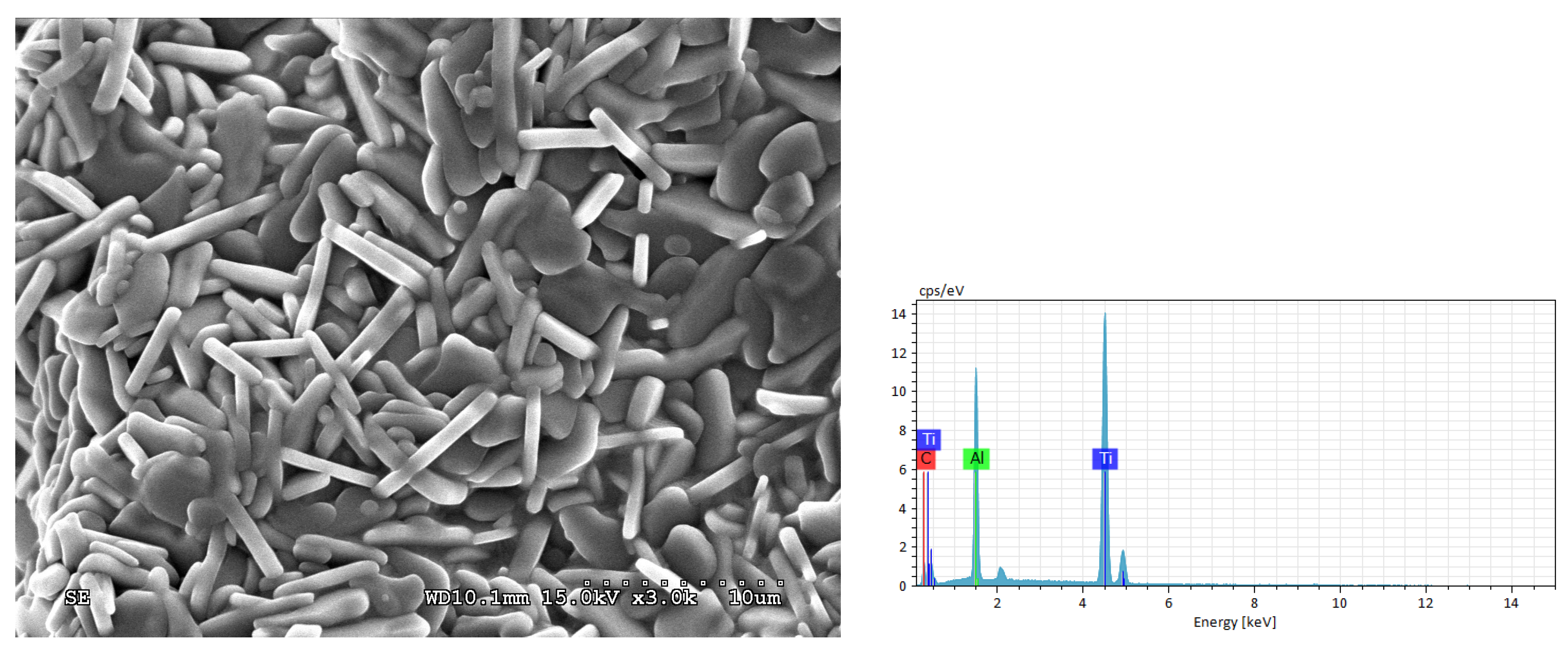
The SEM photo and EDS pattern presented in Figure 6 exhibit the microstructure of fracture surface and the elemental composition of final product obtained from the powder compact of Ti:Al:C = 2:1:1. The SEM image shown in Figure 6 can be considered as the representative microstructure of the entire sample, since almost all the SEM images exhibited a similar morphology. The EDS spectrum was obtained from the full scan of the SEM image of Figure 6. A laminated microstructure, which is typical of the MAX ternary carbide, is noticeable. The product grains are randomly staggered and feature a smooth surface and a platelet shape. Plate-like grains are 4–8 μm in size and around 1 μm in thickness. An atomic ratio of Ti:Al:C = 50.8:22.7:26.5 was determined from the EDS analysis, which implied a mixture composed of Ti2AlC as the dominant phase and Ti3AlC2 as the minor phase. It has been realized that for EDS, the detection of elements like carbon (C), nitrogen (N), and oxygen (O) is difficult due to low X-ray yields and high absorption. The light element error can be lowered to about 1.4 at.%. The elemental concentrations of Ti2AlC products synthesized in this study were 71–73.5 wt.% for Ti, 17.5–18.5 wt.% for Al, and 7.5–8.5 wt.% for carbon. These ranges are within the EDS detection limit, which defines the major element as having content larger than 10 wt.% and the minor element content of 1–10 wt.%.
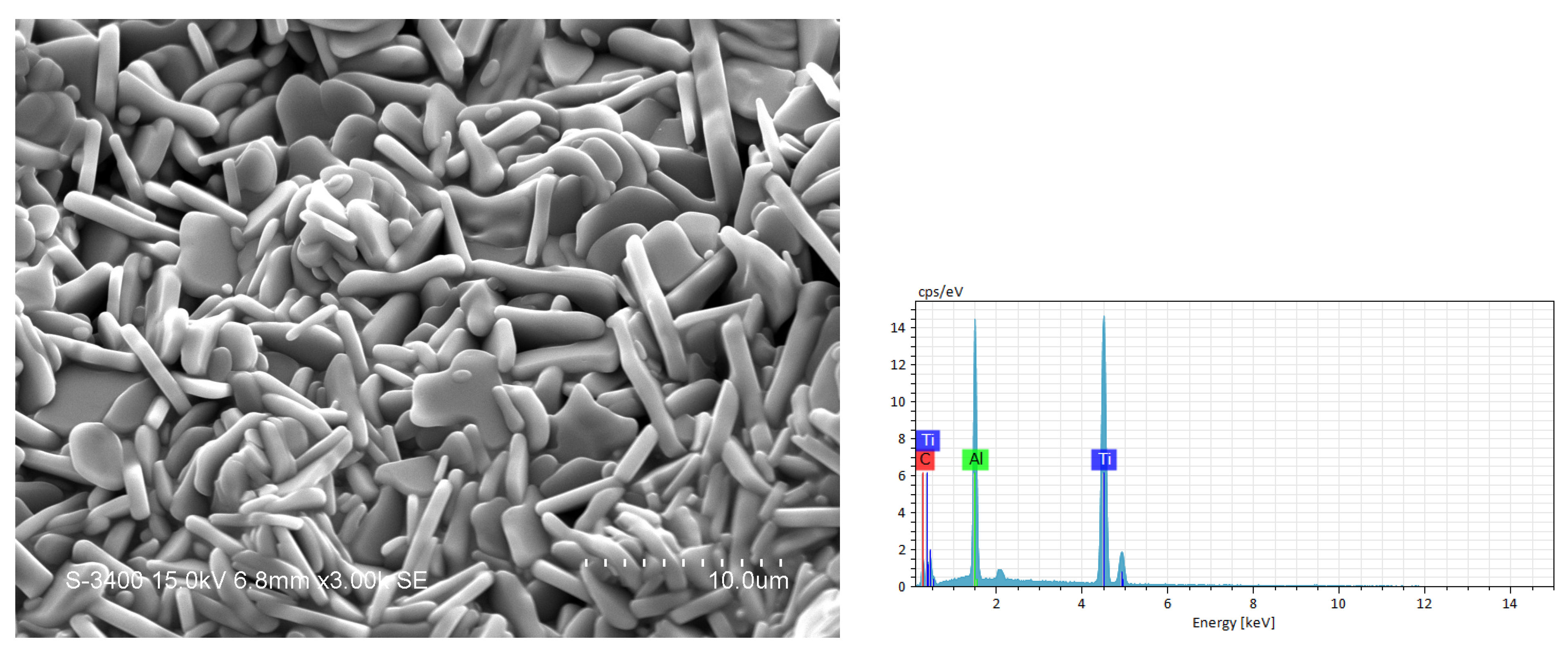
Figure 7 displays the SEM and EDS analyses associated with the end product of the sample of Ti:Al:C = 2:1.2:0.9. The morphology of product grains is similar to that observed in Figure 6. Microstructural characteristics of the MAX phase are evident. It should be noted that the characteristic peak of Al has a stronger intensity in Figure 7 than in Figure 6. Since the EDS spectrum was obtained from the full scan of the SEM image in Figure 7, it could represent a higher Al content within this area. The atomic proportion of Ti:Al:C = 51.8:23.8:24.4 was obtained from the EDS analysis of Figure 7. The elemental composition matched well with Ti2AlC. This result is consistent with the fact that the product synthesized from the sample of Ti:Al:C = 2:1.2:0.9 contained about 92 wt.% of Ti2AlC.

4. Conclusions

The MAX carbide Ti2AlC was fabricated using elemental Ti-Al-C powder compacts via combustion synthesis in the SHS mode. The initial compositional ratios of Ti:Al:C were varied from 2:1:1 to 2:1.2:0.8 to study the effects of excess Al and deficient carbon on the formation of Ti2AlC. Experimental evidence showed that the reaction exothermicity is sufficient to support the self-propagating combustion process. Excess Al by 10–20 at.% decreased the combustion temperature from 1206 °C to 1067 °C and lowered the combustion wave velocity from 4.6 to 3.7 mm/s. This was attributed partly to the dilution effect of Al, and partly to the formation of TiAl as an intermediate instead of Ti3Al. For the samples with carbon reduced by 10–20 at.%, however, the combustion temperature and velocity were relatively little affected. This was probably due to the fact that another intermediate TiC was generated under a sub-stoichiometric form.
From the sample with an exact stoichiometry of Ti:Al:C = 2:1:1, the as-synthesized product consisted of 79.5 wt.% Ti2AlC, 9.8 wt. Ti3AlC2, 10.7 wt.% TiC, and a small amount of Ti3AlC. The addition of excess Al by 20 at.% (Ti:Al:C = 2:1.2:1) increased the yield of Ti2AlC to about 84 wt.% and avoided the formation of Ti3AlC. A decrease in carbon by 10 and 20 at.% (Ti:Al:C = 2:1:0.9 and 2:1:0.8) contributed to greater improvement in the formation of Ti2AlC, and a Ti2AlC fraction of about 87 wt.% was obtained. In this study, the final product with the highest content of Ti2AlC was synthesized from the test specimen of Ti:Al:C = 2:1.2:0.9, which represents an off-stoichiometric composition together with excess Al and deficient carbon. The optimum phase composition was 91.9 wt.% Ti2AlC, 4.2 wt.% Ti3AlC2, and 3.9 wt.% TiC. Because excess Al facilitated the formation of TiAl, and deficient carbon favored the production of sub-stoichiometric TiC, the formation of Ti2AlC from the combination reaction between TiC and TiAl was enhanced. The as-synthesized Ti2AlC grains were in a platelet shape and were stacked tightly into a laminated microstructure, which is typical of the MAX carbide.

Author Contributions

Conceptualization, C.-L.Y.; methodology, C.-L.Y. and Y.-T.C.; validation, C.-L.Y. and Y.-T.C.; formal analysis, C.-L.Y. and Y.-T.C.; investigation, C.-L.Y. and Y.-T.C.; resources, C.-L.Y.; data curation, C.-L.Y. and Y.-T.C.; writing—original draft preparation, C.-L.Y. and Y.-T.C.; writing—review and editing, C.-L.Y. and Y.-T.C.; supervision, C.-L.Y.; project administration, C.-L.Y.; funding acquisition, C.-L.Y. All authors have read and agreed to the published version of the manuscript.

Funding

This research work was funded by the National Science and Technology Council of Taiwan under the grant of NSTC 114-2221-E-035-026-MY3.

Institutional Review Board Statement

Not applicable.

Informed Consent Statement

Not applicable.

Data Availability Statement

The original contributions presented in this study are included in the article. Further inquiries can be directed to the corresponding author.

Conflicts of Interest

The authors declare no conflicts of interest.

References

  1. Barsoum, M.W. MN+1AXN phases: A new class of solids; thermodynamically stable nanolaminates. Prog. Solid State Chem. 2000, 28, 201–281. [Google Scholar] [CrossRef]
  2. Zhang, Z.; Duan, X.; Jia, D.; Zhou, Y.; van der Zwaag, S. On the formation mechanisms and properties of MAX phases: A review. J. Eur. Ceram. Soc. 2021, 41, 3851–3878. [Google Scholar] [CrossRef]
  3. Barsoum, M.W. MAX Phases: Properties of Machinable Ternary Carbides and Nitrides; Wiley-VCH: Weinheim, Germany, 2013. [Google Scholar]
  4. Wang, X.H.; Zhou, Y.C. Layered machinable and electrically conductive Ti2AlC and Ti3AlC2 ceramics: A review. J. Mater. Sci. Technol. 2010, 26, 385–416. [Google Scholar] [CrossRef]
  5. Pietzka, M.A.; Schuster, J.C. Summary of constitutional data on the Al-C-Ti system. J. Phase Equilib. 1994, 15, 392–400. [Google Scholar] [CrossRef]
  6. Barsoum, M.W.; El-Raghy, T.; Ali, M. Processing and characterization of Ti2AlC, Ti2AlN, and Ti2AlC0.5N0.5. Metall. Mater. Trans. A 2000, 31, 1857–1865. [Google Scholar] [CrossRef]
  7. Ping, W.; Mei, B.C.; Hong, X.L.; Zhou, W.B. Synthesis of Ti2AlC by hot pressing and its mechanical and electrical properties. Trans. Nonferrous Metals Soc. China 2007, 17, 1001–1004. [Google Scholar]
  8. Haftani, M.; Heydari, M.S.; Baharvandi, H.R.; Ehsani, N. Studying the oxidation of Ti2AlC MAX phase in atmosphere: A review. Int. J. Refract. Metals Hard Mater. 2016, 61, 51–60. [Google Scholar] [CrossRef]
  9. Badie, S.; Dash, A.; Sohn, Y.J.; Vaßen, R.; Guillon, O.; Gonzalez-Julian, J. Synthesis, sintering, and effect of surface roughness on oxidation of submicron Ti2AlC ceramics. J. Am. Ceram. Soc. 2021, 104, 1669–1688. [Google Scholar] [CrossRef]
  10. Yang, H.J.; Pei, Y.T.; Rao, J.C.; De Hosson, J.T.M. Self-healing performance of Ti2AlC ceramic. J. Mater. Chem. 2012, 22, 8304–8313. [Google Scholar] [CrossRef]
  11. Wang, Z.; Sun, J.; Xu, B.; Liu, Y.; Ke, P.; Wang, A. Reducing the self-healing temperature of Ti2AlC MAX phase coating by substituting Al with Sn. J. Eur. Ceram. Soc. 2020, 40, 197–201. [Google Scholar] [CrossRef]
  12. Wang, Z.; Ma, G.; Li, Z.; Ruan, H.; Yuan, J.; Wang, L.; Ke, P.; Wang, A. Corrosion mechanism of Ti2AlC MAX phase coatings under the synergistic effects of water vapor and solid NaCl at 600 °C. Corros. Sci. 2021, 192, 109788. [Google Scholar] [CrossRef]
  13. Lin, Z.J.; Zhou, Y.C.; Li, M.S.; Wang, J.Y. Hot corrosion and protection of Ti2AlC against Na2SO4 salt in air. J. Eur. Ceram. Soc. 2006, 26, 3871–3879. [Google Scholar] [CrossRef]
  14. Guo, M.; Cao, G.; Pan, H.; Guo, J.; Chen, C.; Zhang, B.; Hu, J. Recent progress in synthesis of MAX phases and oxidation & corrosion mechanism: A review. Mater. Res. Lett. 2024, 12, 765–796. [Google Scholar] [CrossRef]
  15. Suh, M.; Lee, D.H.; Sloof, W.G.; Lee, K.S. Effect of temperature on the healing capacity and mechanical properties of Ti2AlC MAX phase ceramics. Int. J. Appl. Ceram. Technol. 2024, 21, 2757–2770. [Google Scholar] [CrossRef]
  16. Oliveira, F.M.; Amousa, N.; Subramani, A.; Luxa, J.; Senthil, C.; Sofer, Z.; Gonzalez-Julian, J. Maximizing potential applications of MAX phases: Sustainable synthesis of multielement Ti3AlC2. Inorg. Chem. 2024, 63, 14851–14859. [Google Scholar] [CrossRef]
  17. Gonzalez-Julian, J. Processing of MAX phases: From synthesis to applications. J. Am. Ceram. Soc. 2021, 104, 659–690. [Google Scholar] [CrossRef]
  18. Alam, M.S.; Chowdhury, M.A.; Khandaker, T.; Hossain, M.S.; Islam, M.S.; Islam, M.M.; Hasan, M.K. Advancements in MAX phase materials: Structure, properties, and novel applications. RSC Adv. 2024, 14, 26995–27041. [Google Scholar] [CrossRef]
  19. Barsoum, M.W.; Brodkin, D.; El-Raghy, T. Layered machinable ceramics for high temperature applications. Scr. Mater. 1997, 36, 535–541. [Google Scholar] [CrossRef]
  20. Wang, X.H.; Zhou, Y.C. Solid-liquid reaction synthesis and simultaneous densification of polycrystalline Ti2AlC. Int. J. Mater. Res. 2021, 93, 66–71. [Google Scholar] [CrossRef]
  21. Zhou, W.B.; Mei, B.C.; Zhu, J.Q.; Hong, X.L. Rapid synthesis of Ti2AlC by spark plasma sintering technique. Mater. Lett. 2005, 59, 131–134. [Google Scholar] [CrossRef]
  22. Gurin, M.S.; Shtarev, D.S.; Zavidovskiy, I.A.; Kolodeznikov, E.S.; Vyshnevyy, A.A.; Arsenin, A.V.; Bolshakov, A.D.; Syuy, A.V. Spark plasma sintering of pristine and transition metal-doped Ti2AlC MAX Phases. Materials 2025, 18, 1957. [Google Scholar] [CrossRef]
  23. Benitez, R.; Kan, W.H.; Gao, H.; O’Neal, M.; Proust, G.; Radovic, M. Room temperature stress-strain hysteresis in Ti2AlC revisited. Acta Mater. 2016, 105, 294–305. [Google Scholar] [CrossRef]
  24. Gauthier-Brunet, V.; Cabioc’h, T.; Chartier, P.; Jaouen, M.; Dubois, S. Reaction synthesis of layered ternary Ti2AlC ceramic. J. Eur. Ceram. Soc. 2009, 29, 187–194. [Google Scholar] [CrossRef]
  25. Damaceno, M.d.S.D.; Meyer, Y.A.; Ortiz, E.L.; Padilha, G.d.S.; Osório, W.R.; Bortolozo, A.D. Effects of HfB2 content and microwave sintering on the mechanical properties of Ti2AlC composites. Materials 2025, 18, 2693. [Google Scholar] [CrossRef] [PubMed]
  26. Nadimi, H.; Soltanieh, M.; Sarpoolaky, H. Molten salt shielded synthesis and formation mechanism of Ti2AlC in NaCl–KCl medium. Ceram. Int. 2022, 48, 9024–9029. [Google Scholar] [CrossRef]
  27. Hashimoto, S.; Nishina, N.; Hirao, K.; Zhou, Y.; Hyuga, H.; Honda, S.; Iwamoto, Y. Formation mechanism of Ti2AlC under the self-propagating high-temperature synthesis (SHS) mode. Mater. Res. Bull. 2012, 47, 1164–1168. [Google Scholar] [CrossRef]
  28. Thomas, T.; Bowen, C.R. Thermodynamic predictions for the manufacture of Ti2AlC MAX-phase ceramic by combustion synthesis. J. Alloys Compd. 2014, 602, 72–77. [Google Scholar] [CrossRef]
  29. Thomas, T.; Bowen, C.R. Effect of particle size on the formation of Ti2AlC using combustion synthesis. Ceram. Int. 2016, 42, 4150–4157. [Google Scholar] [CrossRef]
  30. Yeh, C.L.; Shen, Y.G. Effects of TiC and Al4C3 addition on combustion synthesis of Ti2AlC. J. Alloys Compd. 2009, 470, 424–428. [Google Scholar] [CrossRef]
  31. Aydinyan, S. Synthesis of Ti2AlC MAX phase and Ti2C MXene by activated combustion. Ceram. Int. 2024, 50, 12263–12269. [Google Scholar] [CrossRef]
  32. Khoptiar, Y.; Gotman, I. Ti2AlC ternary carbide synthesized by thermal explosion. Mater. Lett. 2002, 57, 72–76. [Google Scholar] [CrossRef]
  33. Edrisi, A.; Aghajani, H.; Seyedein, S.H.; Tabrizi, A.T. Synthesis of high purity Ti2AlC MAX phase by combustion method through thermal explosion mode: Optimization of process parameters & evaluation of microstructure. Ceram. Int. 2024, 50, 50846–50854. [Google Scholar]
  34. Yeh, C.L.; Chen, Y.T. Effects of TiC, TiH2, Al, and carbon on production of Ti3AlC2 by self-sustaining combustion synthesis. Materials 2025, 18, 1293. [Google Scholar] [CrossRef]
  35. Yeh, C.L.; Yang, W.J. Formation of MAX solid solutions (Ti,V)2AlC and (Cr,V)2AlC with Al2O3 addition by SHS involving aluminothermic reduction. Ceram. Int. 2013, 39, 7537–7544. [Google Scholar] [CrossRef]
  36. Mukasyan, A.S.; Rogachev, A.S. Combustion synthesis of ultra-high temperature ceramics: Review. Int. J. Appl. Ceram. 2025, 22, 70044. [Google Scholar] [CrossRef]
  37. Yeh, C.L.; Chen, Y.L. An Experimental study on self-propagating high-temperature synthesis in the Ta-B4C system. J. Alloys Compd. 2009, 478, 163–167. [Google Scholar] [CrossRef]
  38. Wang, C.A.; Zhou, A.; Qi, L.; Huang, Y. Quantitative phase analysis in the Ti–Al–C ternary system by X-ray diffraction. Powder Diffr. 2003, 20, 218–223. [Google Scholar] [CrossRef]
  39. Yeh, C.L.; Chan, Y.C. Effects of Ti/Al ratio on formation of Ti-Al intermetallics/TiB2 composites by SHS from Ti-Al-B powder mixtures. Processes 2024, 12, 1237. [Google Scholar] [CrossRef]
  40. Binnewies, M.; Milke, E. Thermochemical Data of Elements and Compounds; Wiley-VCH Verlag GmbH: Weinheim, Germany, 2002. [Google Scholar]
  41. Merzhanov, G.A. The chemistry of self-propagating high-temperature synthesis. J. Mater. Chem. 2004, 14, 1779–1786. [Google Scholar] [CrossRef]
  42. Moore, J.J.; Feng, H.J. Combustion synthesis of advanced materials: Part I. Reaction parameters. Prog. Mater. Sci. 1995, 39, 243–273. [Google Scholar] [CrossRef]
  43. Ivleva, T.P.; Merzhanov, A.G. Three-dimensional spinning waves in the case of gas-free combustion. Dokl. Phys. 2000, 45, 136–141. [Google Scholar] [CrossRef]
  44. Munir, Z.A.; Anselmi-Tamburini, U. Self-propagating exothermic reactions: The synthesis of high-temperature materials by combustion. Mater. Sci. Rep. 1989, 3, 277–365. [Google Scholar] [CrossRef]
  45. Yang, C.; Jin, S.; Liang, B.; Liu, G.; Duan, L.; Jia, S. Synthesis of Ti3AlC2 by spark plasma sintering of mechanically milled 3Ti/xAl/2C powder mixtures. J. Alloys Compd. 2009, 472, 79–83. [Google Scholar] [CrossRef]
  46. Yunus, M.; Kumar, R.; Maji, B.C.; Krishnan, M. An optimized method for synthesizing phase-pure Ti3AlC2 MAX-phase through spark plasma sintering. J. Eur. Ceram. Soc. 2022, 42, 354–363. [Google Scholar] [CrossRef]
  47. Okamoto, H. Al-Ti (aluminum-titanium). J. Phase Equilibria 1993, 14, 120–121. [Google Scholar] [CrossRef]
  48. Lei, C.; Xu, Q.; Sun, Y.Q. Phase orientation relationships in the TiAl–TiAl2 region. Mater. Sci. Eng. A 2001, 313, 227–236. [Google Scholar] [CrossRef]
  49. Okamoto, H. C-Ti (carbon-titanium). J. Phase Equilibria 1998, 19, 89. [Google Scholar]
Figure 1. Time sequences of recorded film images illustrating the self-propagating combustion wave traversing the powder compacts with compositional ratios of (a) Ti:Al:C = 2:1:1 and (b) Ti:Al:C = 2:1.2:0.8.
Materials 19 01100 g001
Figure 2. Effects of Al and carbon contents on combustion front velocity in elemental powder compacts with different compositional ratios.
Materials 19 01100 g002
Figure 3. Combustion temperature profiles of elemental powder compacts with different compositional ratios. (The combustion temperature profiles were horizontally shifted along the time axis to avoid overlapping of the curves).
Materials 19 01100 g003
Figure 4. XRD patterns of the end products of elemental powder compacts with compositional ratios of (a) Ti:Al:C = 2:1:1, (b) Ti:Al:C = 2:1.1:1, and (c) Ti:Al:C = 2:1.2:1.
Materials 19 01100 g004
Figure 5. XRD patterns of the end products of elemental powder compacts with compositional ratios of (a) Ti:Al:C = 2:1:0.9, (b) Ti:Al:C = 2:1.1:0.9, and (c) Ti:Al:C = 2:1.2:0.9.
Materials 19 01100 g005
Figure 6. SEM photo and EDS pattern of the product synthesized from an elemental powder compact with Ti:Al:C = 2:1:1.
Materials 19 01100 g006
Figure 7. SEM photo and EDS pattern of the product synthesized from an elemental powder compact with Ti:Al:C = 2:1.2:0.9.
Materials 19 01100 g007
Table 1. Weight percentages of Ti3AlC2, Ti2AlC, and TiC in the end products of sample compacts of Equation (1) with different compositions.
Sample No.Ti:Al:CWeight Percentage (wt.%)
Ti2AlCTi3AlC2TiC
1 *2:1:179.5 (8.7)9.810.7
2 *2:1.1:182.1 (3.3)13.84.1
32:1.2:184.113.02.9
4 *2:1:0.987.2 (3.5)5.67.2
5 *2:1.1:0.988.7 (2.2)6.84.5
62:1.2:0.991.94.23.9
7 *2:1:0.887.5 (3.6)3.19.4
8 *2:1.1:0.888.5 (2.1)7.83.7
92:1.2:0.891.06.12.9
* In addition to Ti2AlC, Ti3AlC2, and TiC, a small amount of Ti3AlC was present in the product. The values listed in parentheses in the Ti2AlC column represent the weight fractions of Ti3AlC.
Disclaimer/Publisher’s Note: The statements, opinions and data contained in all publications are solely those of the individual author(s) and contributor(s) and not of MDPI and/or the editor(s). MDPI and/or the editor(s) disclaim responsibility for any injury to people or property resulting from any ideas, methods, instructions or products referred to in the content.