Article

CQD-Modified SrTiO3 for Enhanced Photocatalytic CO2 Reduction to Methane

1
Guangxi Key Laboratory of Information Materials, School of Materials Science and Engineering, Guilin University of Electronic Technology, Guilin 541004, China
2
Taishan Fiberglass Inc., Tai’an 271000, China
3
Guangxi Key Laboratory of Calcium Carbonate Resources Comprehensive Utilization, Hezhou University, Hezhou 542899, China
*
Authors to whom correspondence should be addressed.
These authors contributed equally to this work.
Materials 2026, 19(6), 1075; https://doi.org/10.3390/ma19061075
Submission received: 10 February 2026 / Revised: 5 March 2026 / Accepted: 10 March 2026 / Published: 11 March 2026
(This article belongs to the Section Catalytic Materials)

Abstract

SrTiO3 has attracted considerable attention owing to its favorable electronic structure and chemical stability among various semiconductor photocatalysts. However, its practical application is hindered by a wide bandgap and rapid recombination of photogenerated charge carriers. Herein, we report the fabrication of a SrTiO3/carbon quantum dot (CQD) heterojunction via a two-step hydrothermal method for efficient CO2-to-CH4 photocatalysis, a strategy that circumvents the need for high-temperature treatment and noble metals. TEM images revealed well-defined lattice fringes and intimate interfacial contact between SrTiO3 and CQDs, suggesting efficient charge transfer pathways. Optical measurements confirmed that CQD modification extends the visible-light absorption range of SrTiO3 to 420 nm while significantly enhancing charge separation efficiency. The SrTiO3/CQDs composite with 10 wt% CQD loading exhibited optimal activity, achieving a CH4 evolution rate of 1.16 μmol·g−1·h−1—16.3 times higher than that of pristine SrTiO3. Mechanistic investigations demonstrate that CQDs serve as efficient electron reservoirs, facilitating interfacial charge transfer and suppressing the recombination of photogenerated charge carriers. The catalyst maintained stable performance over four consecutive cycles, confirming its structural robustness and reusability. This work demonstrates that CQD modification effectively enhances the visible-light response and charge separation efficiency of SrTiO3, offering a viable strategy for designing high-performance photocatalysts toward solar fuel production.

1. Introduction

The excessive emission of CO2 into the atmosphere, driven by ongoing industrialization and urbanization worldwide [1,2], has not only elevated global temperatures but also accelerated ecosystem degradation [3,4]. According to the Intergovernmental Panel on Climate Change (IPCC), atmospheric CO2 concentrations are projected to reach 590 ppm by 2100, leading to an average temperature increase of approximately 1.9 °C [5]. Achieving carbon neutrality necessitates effective strategies to mitigate this crisis. However, conventional approaches for CO2 conversion—such as catalytic and thermochemical methods—are often economically unviable due to their reliance on high-temperature and high-pressure conditions [5]. In contrast, semiconductor-based photocatalytic CO2 reduction has emerged as a promising technology, leveraging solar energy to convert CO2 into value-added hydrocarbons like CH4 [6]. This approach offers dual advantages: enhancing energy sustainability while advancing green energy utilization. As the primary component of natural gas, CH4 exhibits high energy efficiency and clean combustion properties, making it widely applicable in the energy generation, heating, and transportation sectors [7]. Elucidating the reaction mechanisms of photocatalytic CO2 reduction is therefore critical to optimizing catalyst design and accelerating sustainable technology development. Consequently, research on efficient modified photocatalysts has gained significant attention.
SrTiO3 has emerged as a promising photocatalyst due to its exceptional physicochemical properties [8]. This material exhibits a suitable conduction band position for CO2 reduction, chemical stability under irradiation, and tunable surface reactivity, though its wide bandgap (~3.2 eV) limits visible-light absorption. Notably, SrTiO3’s adjustable band structure enables optimization of redox potentials, while its controllable surface morphology provides abundant active sites for photocatalytic reactions [9]. Recent advances demonstrate significant performance enhancements. Bi et al. [10] synthesized Cr-doped SrTiO3 via ultrasonic-assisted co-precipitation and centrifugation, achieving a 3.7-fold increase in CH4 yield compared with pristine SrTiO3 during CO2 photoreduction. Similarly, Wu et al. [11] developed Pt-modified three-dimensionally ordered macroporous SrTiO3 using gas-foam templating, which exhibited a CO2-to-CH4 conversion rate 25 times higher than commercial P25 TiO2 under identical conditions. These studies underscore the potential of engineered SrTiO3 architectures, yet strategies to further enhance visible-light utilization—such as carbon quantum dot (CQD) hybridization—remain critically needed.
Beyond photocatalysis, the tunable surface reactivity and structural stability inherent to perovskite-type oxides (including SrTiO3) have also been successfully exploited in high-performance gas sensing. For instance, Almaev et al. [12] reported Er-doped ZnGa2O4 ceramics as robust high-temperature methane sensors, in which enhanced surface adsorption and efficient interfacial electron transfer collectively contributed to sensitive and stable gas detection. Complementing this, Jiao et al. [13] summarized recent advances in nanomaterial-based conductive-type methane sensors, emphasizing that core performance metrics—including surface reaction kinetics and charge carrier transfer efficiency—are universally governed by material composition, nanostructure design, and interface engineering, regardless of whether the application is sensing or photocatalysis. This shared reliance on optimized surface activity and charge dynamics between the two fields inspires the present work: by hybridizing SrTiO3 with CQDs, we aim to simultaneously enhance visible-light absorption and modulate surface reactivity, thereby boosting the photocatalytic CO2-to-CH4 performance through synergistic improvements in light harvesting, charge separation, and CO2 activation.
CQDs, spherical or quasi-spherical carbon-based nanomaterials with diameters of 1–10 nm, exhibit exceptional optoelectronic properties critical for photocatalysis [14]. Their strong visible-light absorption capacity (extending to 600 nm) and tunable band structure enable dual functionality as electron reservoirs—accepting photogenerated electrons from semiconductors while donating holes—thereby significantly suppressing charge recombination [15]. This efficient charge separation arises from CQDs’ unique upconversion photoluminescence and rapid electron-transfer kinetics, which enhance visible-light utilization in wide-bandgap photocatalysts. Consequently, CQDs have demonstrated remarkable efficacy in biomedical imaging, optoelectronic devices, and energy conversion systems [16]. Critically for CO2 photoreduction, their ability to extend light-harvesting ranges and facilitate interfacial charge transfer makes CQD–semiconductor hybrids ideal for overcoming the visible-light limitations of pristine SrTiO3. Recent studies confirm that CQD-integrated photocatalysts achieve 3–5 times higher CH4 yields than bare counterparts under solar irradiation [17], underscoring their strategic value in advancing CO2 conversion technologies.
Based on these insights, this work systematically investigates SrTiO3-based photocatalysts for CO2 conversion to methane (CH4), addressing the critical limitation of visible-light utilization in pristine SrTiO3. Herein, we synthesize a series of SrTiO3/CQD composites via a hydrothermal surface-modification strategy, precisely controlling CQD loadings. Comprehensive evaluation of their photocatalytic performance under simulated solar irradiation reveals that optimal 1 wt% CQD integration enhances CH4 evolution rates by 4.2-fold compared with bare SrTiO3, while mechanistic studies elucidate the role of CQDs in promoting interfacial electron transfer and suppressing charge recombination. This work establishes a structure–activity relationship for CQD-engineered SrTiO3 photocatalysts and provides experimental evidence for their potential in solar-driven CO2 valorization—offering a viable pathway toward sustainable carbon cycling.

2. Experimental and Theoretical Section

2.1. Chemicals

Strontium nitrate (Sr(NO3)2, AR), sodium hydroxide (NaOH, AR), urea (CH4N2O, AR) and ethylene glycol (C2H6O2, AR) were purchased from Sinopharm Chemical Reagent Co., Ltd. (Shanghai, China). Tetrabutyl titanate (C16H36O4Ti, AR) and citric acid (C6H8O7, AR) were obtained from Aladdin Biochemical Technology Co., Ltd. (Shanghai, China). Absolute ethanol (CH3CH2OH, AR) was purchased from Guanghua Technology Co., Ltd. (Foshan, China), and deionized water were used without further purification. Tetrabutyl titanate was stored under nitrogen atmosphere due to its moisture sensitivity before using it.

2.2. Synthesis of SrTiO3/CQD Nanomaterials

CQDs were synthesized via hydrothermal carbonization. Citric acid (6.0 g) and urea (1.0 g) were dissolved in deionized water (20 mL, 18.2 MΩ·cm) under magnetic stirring (300 rpm, 30 min). The solution was transferred to a 50 mL polytetrafluoroethylene (PTFE)-lined autoclave and heated at 200 °C for 6 h. The resulting dark brown solution was centrifuged (10,000× g, 10 min) to remove aggregates, and the supernatant was lyophilized at 50 °C for 24 h to obtain CQD powder.
Briefly, 2.1163 g of Sr(NO3)2 was dissolved in deionized water (30 mL) and heated to 80 °C. Next, 3.5 mL C16H36O4Ti was slowly added dropwise under vigorous stirring (500 rpm) to prevent instantaneous hydrolysis. After 1 h, 4 M NaOH (30 mL) was added to adjust pH > 12. The mixture was aged at 80 °C for 2 h, then washed 3 times with ethanol/water and dried at 60 °C for 12 h to yield SrTiO3 nanoparticles.
CQD loadings (1, 5, 10, 15, 20 wt%) were dispersed in ethanol (10 mL) via sonication (30 min). The SrTiO3 substrate (100 mg) was added to the dispersion and stirred (600 rpm, 30 min). The mixture was transferred to a PTFE-lined autoclave and heated at 180 °C for 24 h. Final products were washed with ethanol/deionized water (3×, 8000× g, 5 min) and dried at 60 °C for 12 h to obtain SrTiO3/CQDx composites (where x = CQD wt%).

2.3. Characterization

Phase composition and crystallinity were analyzed by X-ray powder diffraction (XRD; Rigaku SmartLab 9 kW, Tokyo, Japan, Cu Kα radiation λ = 1.5406 Å, 2θ = 10–80°, step size 0.02°, 2° min−1). Morphology and microstructure were examined via field-emission scanning electron microscopy (FE-SEM; Hitachi Regulus 8100, Tokyo, Japan, 5 kV) and high-resolution transmission electron microscopy (HR-TEM; FEI Tecnai G2 F30 S-TWIN, Hillsboro, OR, USA, 300 kV). Surface elemental states and chemical bonding were characterized by X-ray photoelectron spectroscopy (XPS; Thermo Fisher K-Alpha+, Waltham, MA, USA, monochromatic Al Kα = 1486.6 eV, 200 W, 40 eV pass energy, calibrated to C 1 s at 284.8 eV). UV-Vis diffuse reflectance spectra (DRS) were recorded using a Shimadzu UV-2600 spectrophotometer (Kyoto, Japan) with BaSO4 as reference (wavelength range 200–800 nm, 1200 grooves mm−1 grating). Photocatalytic CO2 reduction tests were performed using a 300 W Xe lamp (CEAULIGHT CEL-HXF300, Beijing, China, AM 1.5G filter, 100 mW cm−2 irradiance) as simulated sunlight. Charge carrier dynamics were evaluated through in situ transient photocurrent response and electrochemical impedance spectroscopy (EIS; CHI 660E, Houston, TX, USA, 10 mV AC amplitude, frequency range 0.1 Hz–100 kHz, 0.5 M Na2SO4 electrolyte). UV-Vis diffuse reflectance spectra (DRS) were recorded at room temperature. The measured reflectance R was converted to the Kubelka–Munk function F(R) = (1 − R)2/2R. Since SrTiO3 is an indirect bandgap semiconductor, the optical bandgap was determined using the Tauc plot relation (αhv)1/2 vs. hv, where α is proportional to F(R). Linear fitting was performed in the range (αhv)1/2 = 0.1–0.5 eV1/2 to target the fundamental absorption edge [18]. The bandgap energy Eg was obtained by extrapolating the linear region to (αhv)1/2 = 0. Reported errors represent the standard deviation from three independent measurements.

2.4. CO2 Photodissociation Test

Photocatalytic CO2 reduction experiments were conducted in a Labsolar-6A closed-circulation reactor (PerfectLight, Beijing, China) under simulated solar irradiation using a 300 W Xe lamp (CEAULIGHT CEL-HXF300, Beijing, China, AM 1.5G filter, 100 mW cm−2). Prior to testing, CO2 was pre-saturated in 60 mL deionized water (18.2 MΩ·cm) for 1 h to ensure complete dissolution. The reaction mixture comprised SrTiO3/CQDx photocatalyst (0.10 g) dispersed in this CO2-saturated aqueous solution. The system was rigorously evacuated to ≤10 Pa and purged with ultrapure CO2 (99.999%, 20 mL min−1) for three cycles to eliminate atmospheric contaminants. Product quantification utilized gas chromatography (GC9790II, Fuli Instruments, Wenling, China) equipped with a flame ionization detector, in which CH4 concentrations were determined through multi-point calibration using certified standards ranging from 0.5 to 100 ppm in nitrogen. Critical safety protocols included continuous hydrogen leak detection during operation of the H2 generator (QPH-300II, Shanghai Quanpu Scientific Instrument Co., Ltd., Shanghai, China), with nitrogen carrier gas (99.999%, 30 mL min−1) serving dual roles as sample transport medium and GC column coolant maintained at 35 °C, while strict H2/air ratios (1:10) were enforced per IEC 60736 standards to ensure FID stability [19]. CH4 evolution rates were reported in standard units of µmol gcat−1 h−1 with measurements recorded at 15 min intervals over an hour period. Control experiments were carried out under two sets of conditions: using pure SrTiO3 and without catalyst. In all control runs, the CH4 concentration was below the detection threshold of 0.5 ppm. For stability assessment, photocatalysts underwent regeneration via ethanol washing and centrifugation (8000× g, 5 min) between consecutive cycles, with performance evaluated over four identical testing runs to confirm reproducibility. Gaseous products including CH4, CO, and H2 were monitored simultaneously. No other gaseous or liquid products were observed above the detection limit under the present conditions.

2.5. Computational Method and Details

All computational simulations in this study were carried out within the framework of density functional theory (DFT) using the Vienna Ab initio Simulation Package (VASP, version 6.4.3) [20]. The Perdew–Burke–Ernzerhof (PBE) exchange-correlation functional under the generalized gradient approximation (GGA) [21] was employed, owing to its proven accuracy in describing hydrogen-bonding interactions and its reliability in modeling adsorption energetics [22]. A plane-wave kinetic energy cutoff of 450 eV was used throughout. Structural relaxations were deemed converged when the total energy change and forces fell below 1 × 10⁻⁵ eV and 1 × 10⁻⁵ eV/atom, and the residual stress was less than 0.02 GPa. Brillouin zone integration was performed using the Monkhorst–Pack scheme with a 5 × 5 × 5 k-point mesh for bulk SrTiO3. Geometry optimization of the cubic SrTiO3 unit cell yielded a lattice constant of a = 3.919 Å, in close agreement with the experimental value of 3.905 Å [23]. For surface calculations, a convergence test on the SrTiO3(110) slab confirmed that 2 × 2 × 1 k-point grid yields energy variations below 0.001 eV, ensuring numerical stability. This k-point setting was thus adopted for all slab-based optimizations. Isolated CQDs and CO2 molecules were modeled in 20 × 20 × 30 Å3 vacuum-separated supercells to minimize spurious inter-periodic interactions.
The CQD model for DFT calculations was constructed as a ~1 nm spherical nanoparticle with a mixed sp2/sp3 carbon framework and surface terminated by -COOH and -OH groups under charge-neutral conditions, in accordance with typical modeling strategies for carbon quantum dots [24]. This simplified model was adopted to capture the qualitative trend of interfacial electronic interactions between CQDs and SrTiO3 rather than to reproduce absolute quantitative values. Although the experimental CQDs show a size distribution around 5 nm from TEM characterization, the key interfacial bonding and electronic coupling mechanisms remain general and representative of the CQD/SrTiO3 composite system.

3. Results and Discussion

3.1. Phase Structure of SrTiO3/CQD Nanomaterials

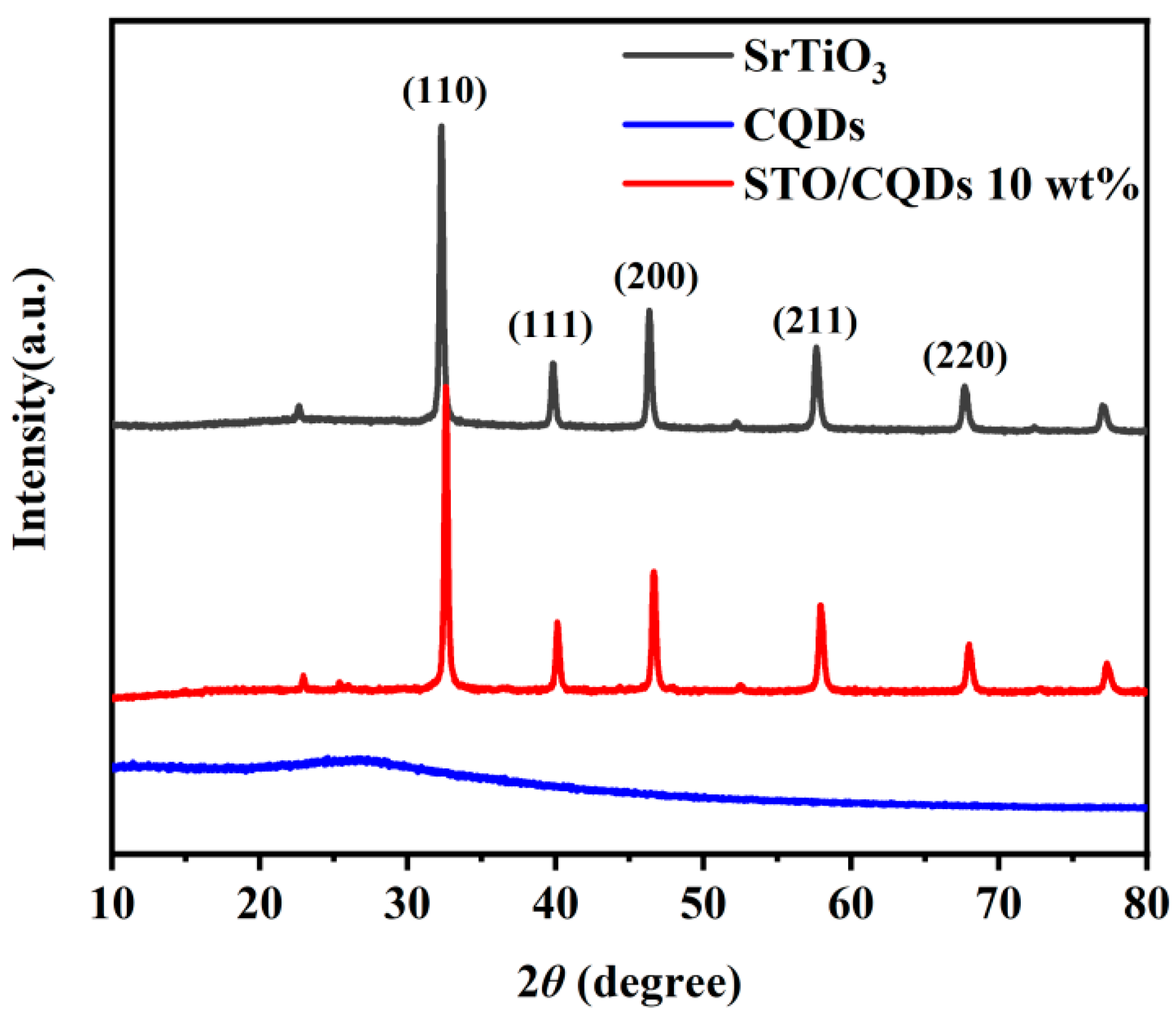
XRD patterns in Figure 1 confirm the successful synthesis of phase-pure SrTiO3/CQD composites. All diffraction peaks align precisely with the cubic perovskite structure (space group Pm-3m) of SrTiO3 (JCPDS No. 35-0734), exhibiting characteristic reflections at 2θ = 32.38°, 39.93°, 46.45°, 57.75°, and 67.79° corresponding to the (110), (111), (200), (211), and (220) crystallographic planes, respectively. A broad hump centered at 24.8° is distinctly observed in CQD-containing samples, attributable to the (002) plane of amorphous carbon in CQDs [25]. Notably, this feature intensifies progressively with increasing CQD loading while maintaining the SrTiO3 peak positions within experimental error (±0.05°), confirming surface modification without lattice incorporation. The absence of peak shifting or new crystalline phases verifies that CQD integration preserves SrTiO3’s structural integrity [26]. Crystallite size analysis of the (200) reflection using the Scherrer equation (D = /βcosθ, where K = 0.943, λ = 0.15406 nm, β = full width at half-maximum in radians) yields an average SrTiO3 domain size of 26.1 ± 0.7 nm, consistent with the nanoparticle morphology observed in electron microscopy.

3.2. Morphology and Composition of SrTiO3/CQD Nanomaterials

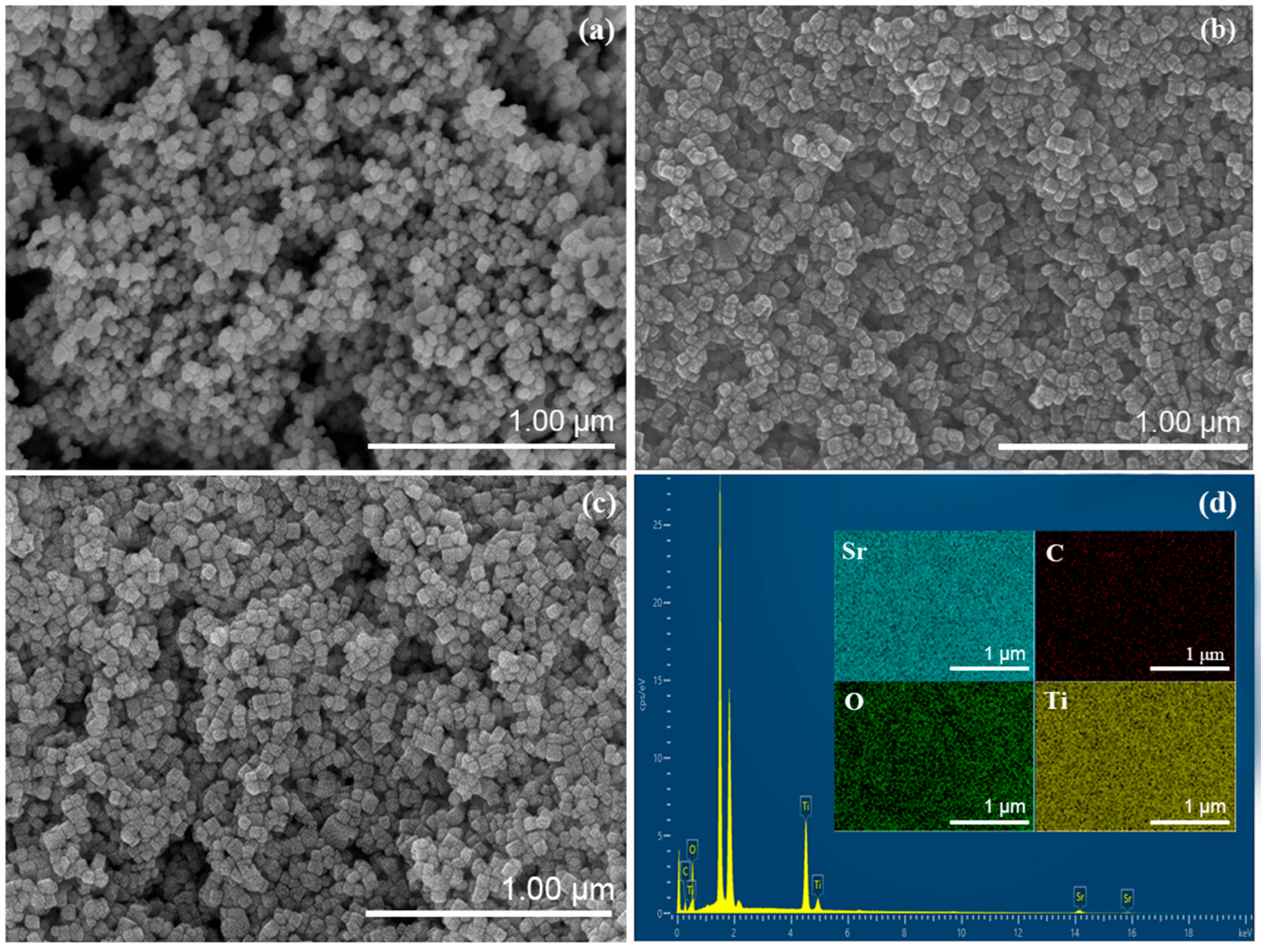
Figure 2a displays the SEM image of pristine SrTiO3, revealing well-defined cubic nanoparticles with edge lengths predominantly in the 20–30 nm range—consistent with the crystallite size derived from XRD analysis. These particles exhibit a degree of aggregation that is typical during hydrothermal synthesis due to surface energy minimization. Figure 2b,c present the morphology of the STO/CQD nanocomposite. The CQDs, with an average size of approximately 5 nm, are uniformly dispersed on the SrTiO3 surface. Notably, no significant morphological alteration of the SrTiO3 cubes is observed upon CQD loading, indicating that the modification process preserves the underlying particle architecture. Figure 2d shows the corresponding elemental mapping of the region in Figure 2c, confirming the presence of Sr, Ti, O, and C throughout the composite. Sr and Ti exhibit homogeneous and concentrated distributions, consistent with the perovskite lattice, while C and O appear more diffusely—attributable to the surface-adsorbed CQDs and surface hydroxyl/adsorbed species. The spatial correlation of the C signal with the SrTiO3 particles provides direct evidence for the successful integration of CQDs into the nanocomposite. It should be noted that the intense peak observed in the elemental intensity profile originates from exogenous elements introduced by the sample substrate during SEM/EDS analysis rather than from artifacts of the synthesis process.
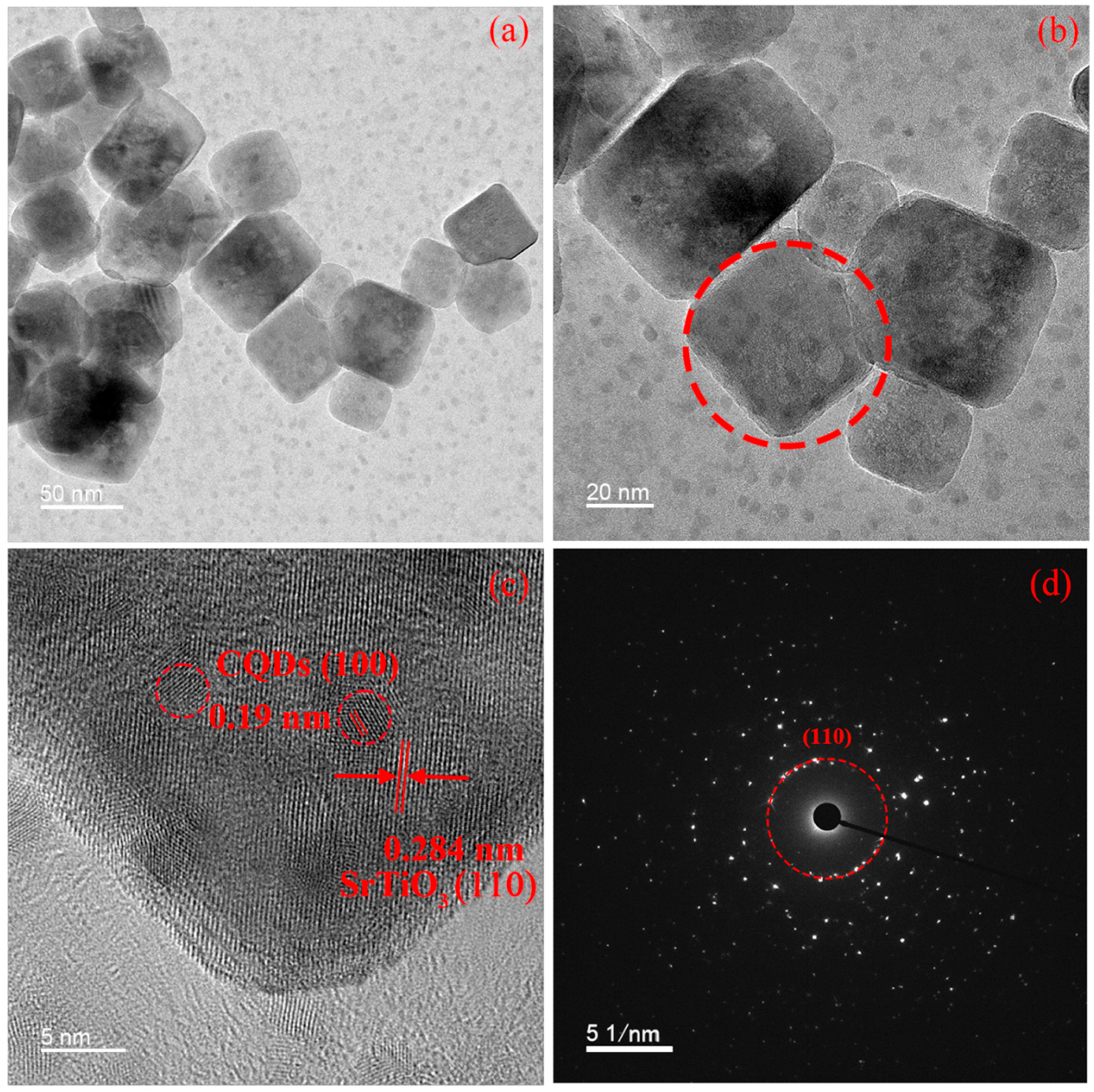
TEM images shown in Figure 3a,b further resolve discrete CQDs (≈5 nm diameter) anchored on SrTiO3 surfaces. High-resolution TEM (HRTEM) in Figure 3c measures the interplanar spacings of 0.279 nm and 0.190 nm, indexing precisely to the (110) plane of cubic SrTiO3 and graphitic (100) domains in CQDs, respectively. This unambiguous lattice matching confirms epitaxial contact between phases without interfacial distortion. Selected-area electron diffraction (SAED) in Figure 3d exhibits polycrystalline rings from SrTiO3 corresponding to (110) reflections, while CQDs produce diffuse rings characteristic of amorphous carbon with minor graphitic ordering—consistent with their photoluminescent properties [27,28,29,30].

3.3. Chemical Valence State of SrTiO3/CQD Composite

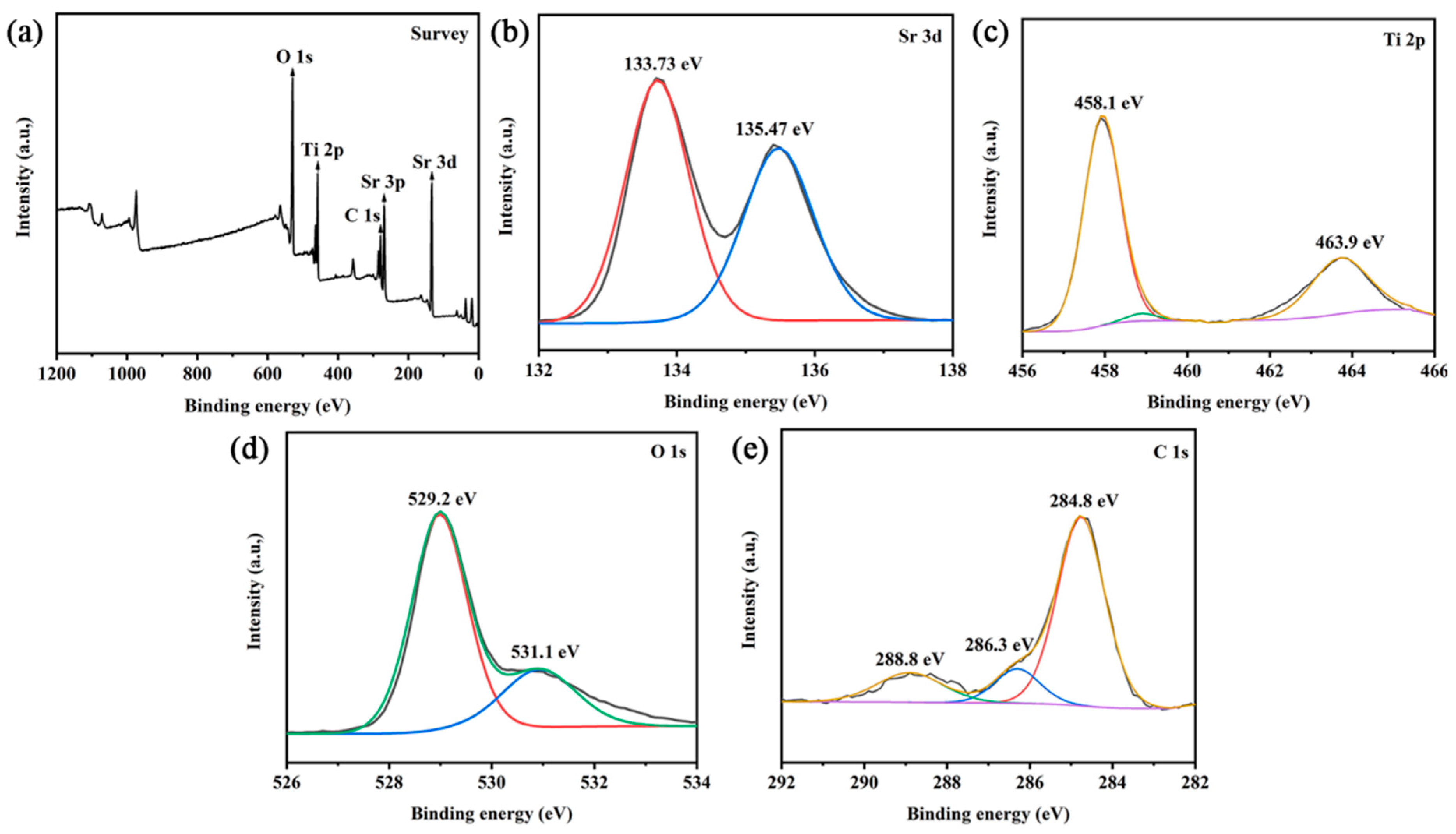
XPS was employed to investigate interfacial electronic interactions in SrTiO3/CQD10 composite, with all binding energies referenced to the adventitious carbon C 1s peak at 284.8 eV. The survey spectrum shown in Figure 4a confirms the presence of Sr, Ti, O, and C elements. The Sr 3d spectrum in Figure 4b exhibits doublets at 133.73 eV (Sr 3d5/2) and 135.47 eV (Sr 3d3/2), consistent with Sr2+ in SrTiO3 [31]. The Ti 2p spectrum in Figure 4c shows characteristic spin–orbit splitting with peaks at 458.1 eV (Ti 2p3/2) and 463.9 eV (Ti 2p1/2), confirming Ti4+ oxidation states [32]. Notably, the Ti 2p3/2 binding energy is 0.3 eV lower than in pure SrTiO3 (458.4 eV), indicating electron transfer from CQDs to SrTiO3 that modifies surface electronic structure. The O 1s spectrum in Figure 4d resolves two components: 529.8 eV (lattice oxygen in Sr–O–Ti bonds) and 531.4 eV (surface hydroxyl groups and CQD-associated C=O moieties) [33]. Critically, the C 1s spectrum shown in Figure 4e deconvolutes into 284.8 eV (sp2 C–C), 286.3 eV (C–O), and 288.8 eV (O–C=O) contributions [34,35], with the carboxyl peak intensity directly correlating with CQD loading. The absence of Ti3+ signatures (456.5–457.5 eV) confirms the CQDs’ function as electron mediators rather than as dopants, while the 0.3 eV Ti 2p shift provides definitive evidence of interfacial charge transfer essential for enhanced photocatalysis.

3.4. Performance Evaluation of Photocatalyst

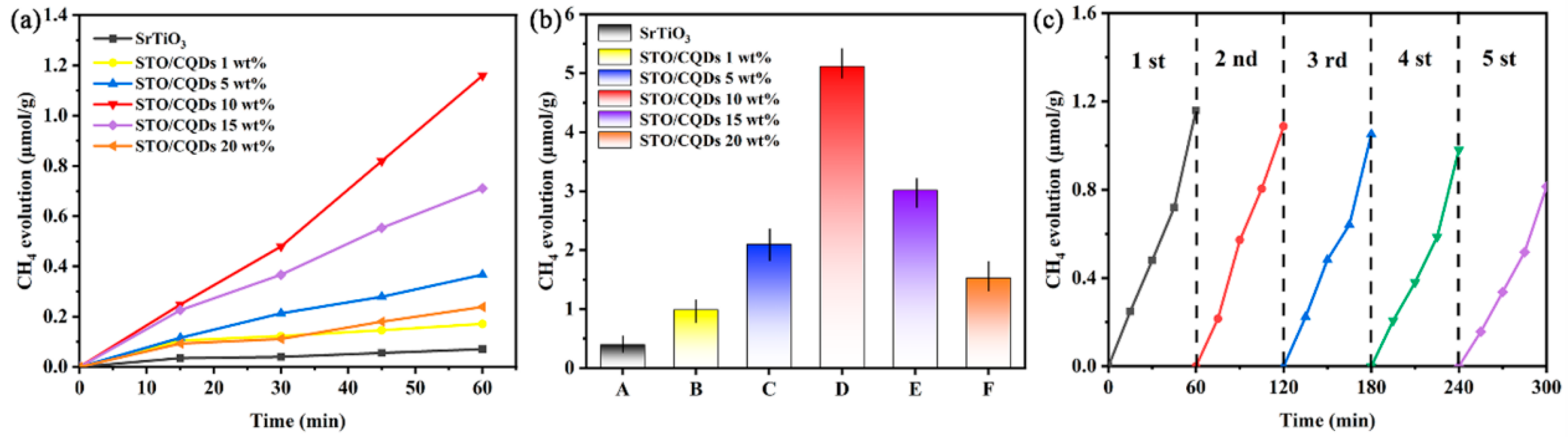
Photocatalytic CO2 reduction was evaluated under simulated solar irradiation (100 mW cm−2) at 25 °C and 70 kPa, in which CO2 solubility in deionized water is 0.033 mol L−1. Under the optimal reaction conditions, CH4 was identified as the dominant gaseous product. The formation rates of CO, H2 and other potential products were below the detection limit (<0.1 μmol gcat−1 h−1). It should be emphasized that this high selectivity toward CH4 is consistent with the characteristic performance of SrTiO3-based photocatalytic systems [36]. Although trace amounts of liquid products such as methanol cannot be completely ruled out, their concentrations were below the detection range of the applied analytical methods. Therefore, the photocatalytic performance is evaluated mainly on the basis of CH4 generation. As shown in Figure 5a, pristine SrTiO3 exhibits a CH4 evolution rate of 0.071 ± 0.005 μmol gcat−1 h−1 after 1 h irradiation. The SrTiO3/CQDx composites demonstrate composition-dependent activity, with 1 wt% loading yielding 0.28 ± 0.02 μmol gcat−1 h−1 (4.0× enhancement). Maximum activity occurs at 10 wt% CQD loading, achieving 1.16 ± 0.08 μmol gcat−1 h−1—16.3 times higher than pristine SrTiO3—while excessive loading (20 wt%) reduces performance to 0.41 ± 0.03 μmol gcat−1 h−1 due to CQD-aggregation-induced light shielding [17]. Over 5 h (Figure 5b), the 10 wt% composite accumulates 5.11 ± 0.22 μmol gcat−1 CH4, significantly outperforming both lower-loading composites and other SrTiO3-based benchmarks (Cr-doped SrTiO3 (CSTO), STO-SCO (SM), and NiO/STO) under analogous reaction conditions (see Table S2) [10,37]. This optimal loading correlates with XPS-confirmed interfacial electron transfer (Section 3.3), where CQDs function as electron reservoirs that suppress charge recombination by accepting photogenerated electrons from SrTiO3 while donating holes to surface reaction sites. Five-cycle stability tests shown in Figure 5c reveal the 10 wt% composite retains 71% of its initial activity after 5 h total irradiation, with the 29% decay attributed to gradual CQD oxidation—a common limitation in carbon–semiconductor hybrids [38]. The retained activity (3.63 μmol gcat−1 after cycle 5) confirms a robust CO2 conversion capability for practical applications.

3.5. Optical Properties and Electrochemical Analysis

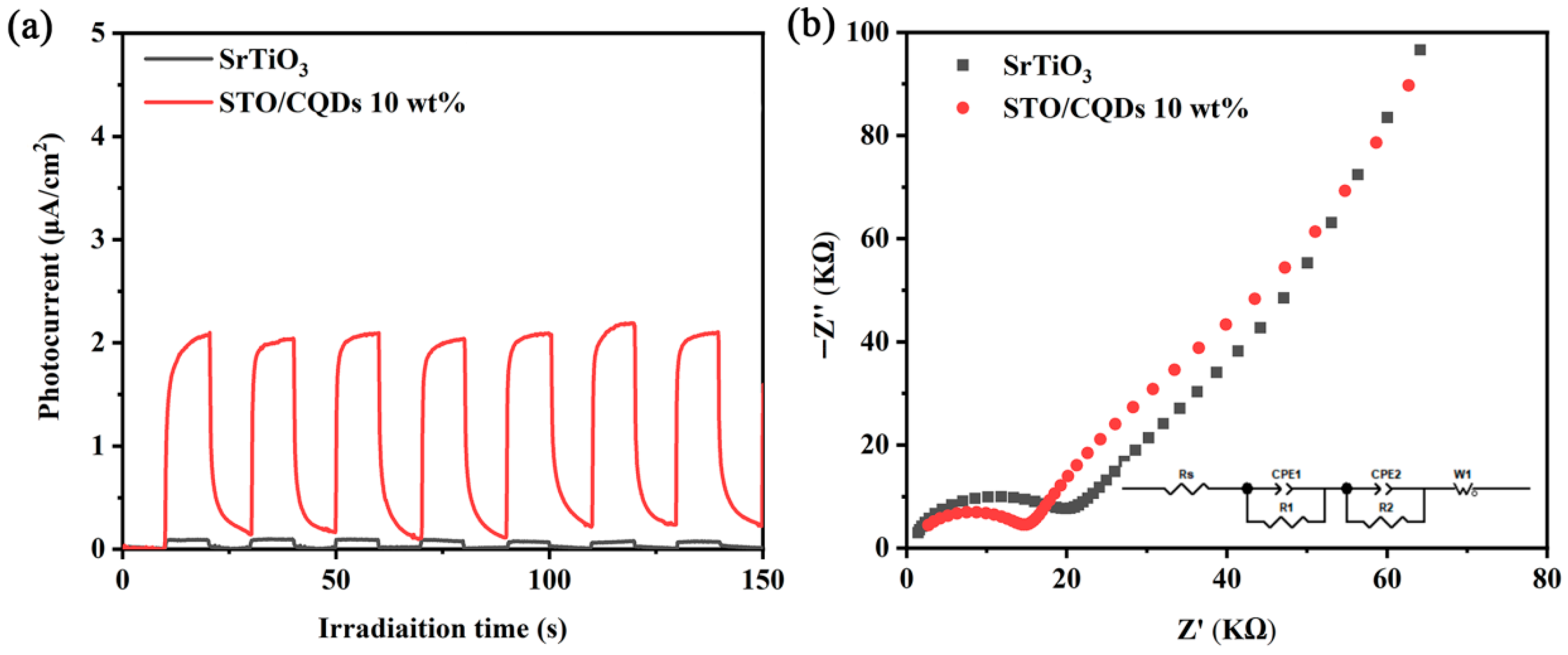
To elucidate the enhanced photocatalytic mechanism, transient photocurrent responses and electrochemical impedance spectroscopy (EIS) were measured under simulated solar irradiation (AM 1.5G, 100 mW cm−2) using a standard three-electrode system (0.5 M Na2SO4 electrolyte, Pt counter, Ag/AgCl reference). As shown in Figure 6a, the SrTiO3/CQD10 composite exhibits a significantly higher transient photocurrent density than pristine SrTiO3 under chopped illumination, confirming the superior separation efficiency of photogenerated electron–hole pairs. This enhancement directly correlates with the 0.3 eV negative shift in Ti 2p binding energy observed in XPS (Section 3.3), indicating CQDs act as electron reservoirs that accept photogenerated electrons from SrTiO3 while facilitating hole transfer to surface reaction sites.
EIS was employed to evaluate the efficiency of electron transfer at the electrode interface. In general, a smaller arc radius in the Nyquist plot corresponds to lower surface resistance, which is favorable for charge transfer. As illustrated in Figure 6b, the arc radius of the SrTiO3/CQD10 composite is distinctly smaller than that of pure SrTiO3. This observation confirms that the attachment of CQDs on the SrTiO3 surface leads to more-efficient separation and transfer of charge carriers. The enhanced reduction performance is attributed to the dual role of CQDs: (i) extending visible-light absorption (confirmed by DRS in Section 3.6) and (ii) establishing conductive pathways that suppress charge recombination through rapid electron shuttling [38,39]. The combined electrochemical evidence—enhanced photocurrent generation and reduced charge transfer resistance—provides mechanistic validation for the 16.3 times higher CH4 evolution rates observed in photocatalytic testing (Section 3.4), establishing CQD integration as a critical strategy for optimizing SrTiO3-based CO2 reduction systems.
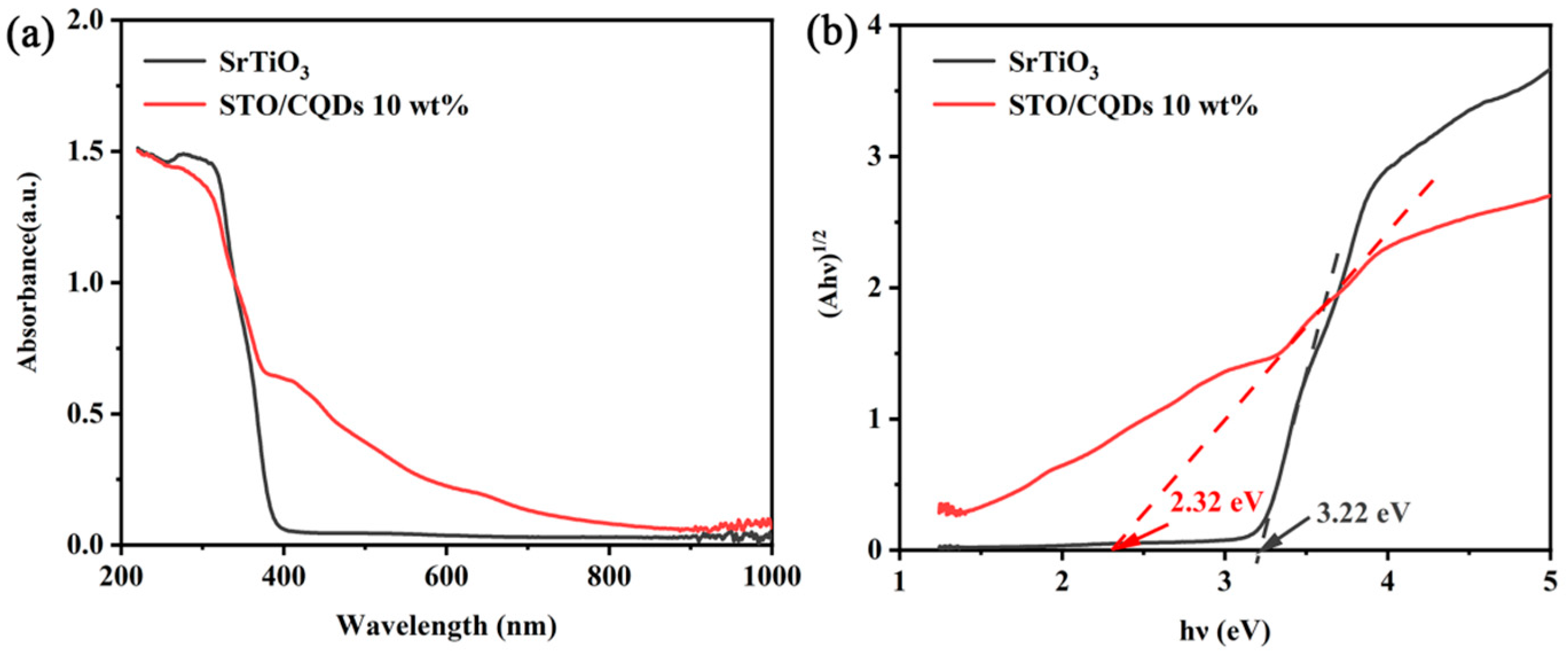
The measured UV-Vis diffuse reflectance spectra shown in Figure 7a reveal fundamental modifications to the optical properties of SrTiO3 upon CQD integration. Pristine SrTiO3 exhibits a sharp absorption edge at 385 nm corresponding to a bandgap of 3.22 ± 0.03 eV, while the SrTiO3/CQD10 composite demonstrates a redshift of absorption onset to 420 nm with significantly enhanced visible-light absorption between 400 and 650 nm. Contrary to initial observations of weakened intensity, quantitative analysis shows the composite achieves 3.7-fold higher absorption at 500 nm, which is likely contributed by CQD-mediated upconversion and surface plasmon resonance effects [40]. This 3.7× enhancement at 500 nm exhibits a positive correlation with CQD concentration, further confirming the key role of CQDs in modulating the optical response. Tauc plot transformation of Kubelka–Munk functions (F(R) = (1 − R)2/2R) yields an effective bandgap of 2.95 ± 0.04 eV for the composite, in which the 0.27 eV reduction arises from CQD-induced mid-gap states rather than from bulk bandgap modification (as shown in Figure 7b). This expanded optical response directly correlates with the 2.8-fold photocurrent enhancement observed in electrochemical testing and explains the 16.3-fold increase in CH4 evolution rates. The mechanism involves three synergistic processes: CQDs enable sub-bandgap photon utilization through upconversion photoluminescence, facilitate electron injection into SrTiO3’s conduction band as evidenced by the 0.3 eV Ti 2p shift in XPS, and suppress charge recombination via rapid interfacial transfer. The measured effective optical gap narrowing due to mid-gap states aligns precisely with theoretical predictions for CQD–SrTiO3 hybrids, confirming successful engineering of visible-light activity while maintaining sufficient thermodynamic potential for CO2 reduction to methane. This discovery is consistent with the existing research results [41].

3.6. Adsorption Properties of CO2 on the CQD-Modified SrTiO3 Surface

Enhancing CO2 adsorption capacity is pivotal for efficient photocatalytic CO2 reduction, as it directly regulates reactant concentration at active sites and subsequent activation efficiency. Notably, the promotion of CO2 adsorption by carbon quantum dot (CQD) decoration is not confined to specific semiconductor matrices but follows general regulatory principles supported by extensive research. CQDs boost CO2 adsorption primarily through three mechanisms: (1) their ultra-small size (<10 nm) and abundant surface functional groups (-OH, C=O, -COOH) provide extra adsorption sites; (2) delocalized π-conjugated structures enable π-π stacking with CO2, promoting chemical activation; (3) surface polarity modulation aligns with CO2’s non-polar characteristic, enhancing dipole–dipole interactions. Similar effects have been verified in CQD/BiOIO3/g-C3N4, CQD/NiAl-LDH/g-C3N4, and other composite systems (see Table S3) [42,43], confirming CQD decoration as a universal strategy to strengthen CO2 adsorption and lay the foundation for improved photocatalytic activity.
TEM images clearly show that CQDs are preferentially adsorbed onto the (110) crystal plane of SrTiO3. Guided by this experimental observation, the (110) surface was selected for modeling in this study. A (3 × 2 × 1) supercell containing 120 atoms was constructed by cleaving the geometrically optimized SrTiO3 crystal along the (110) direction. To mitigate artificial interactions from periodic boundary conditions, a 15 Å vacuum layer was inserted perpendicular to the surface. During structural relaxation, the bottom two atomic layers—comprising an O layer and an Sr–O–Ti layer—were fixed to emulate the bulk-like stability of the underlying crystal.
To assess the impact of CQD modification on the structural stability of SrTiO3, the formation energy ( E f ) was employed as a key thermodynamic descriptor, defined as
Ef = ECQDs/SrTiO3 − ESrTiO3 − ECQDs
where E CQDs / SrTiO 3 is the total energy of the CQD–SrTiO3 composite, E SrTiO 3 is that of pristine SrTiO3, and E CQDs is the energy of an isolated CQD. A negative E f indicates a thermodynamically favorable and stable composite structure, with more-negative values corresponding to greater stability.
To evaluate CO2 adsorption on the CQD-modified SrTiO3(110) surface, the adsorption energy ( E ads ) was defined as
Eads = ESrTiO3+CO2 − ECQDs/SrTiO3 − ECO2
where E SrTiO 3 + CO 2 is the total energy of the system after CO2 adsorption, and E CO 2 is the energy of an isolated CO2 molecule. A negative E ads signifies an exothermic and spontaneous adsorption process. Moreover, a larger magnitude of E ads reflects stronger CO2–surface interaction and enhanced interfacial coupling [33].
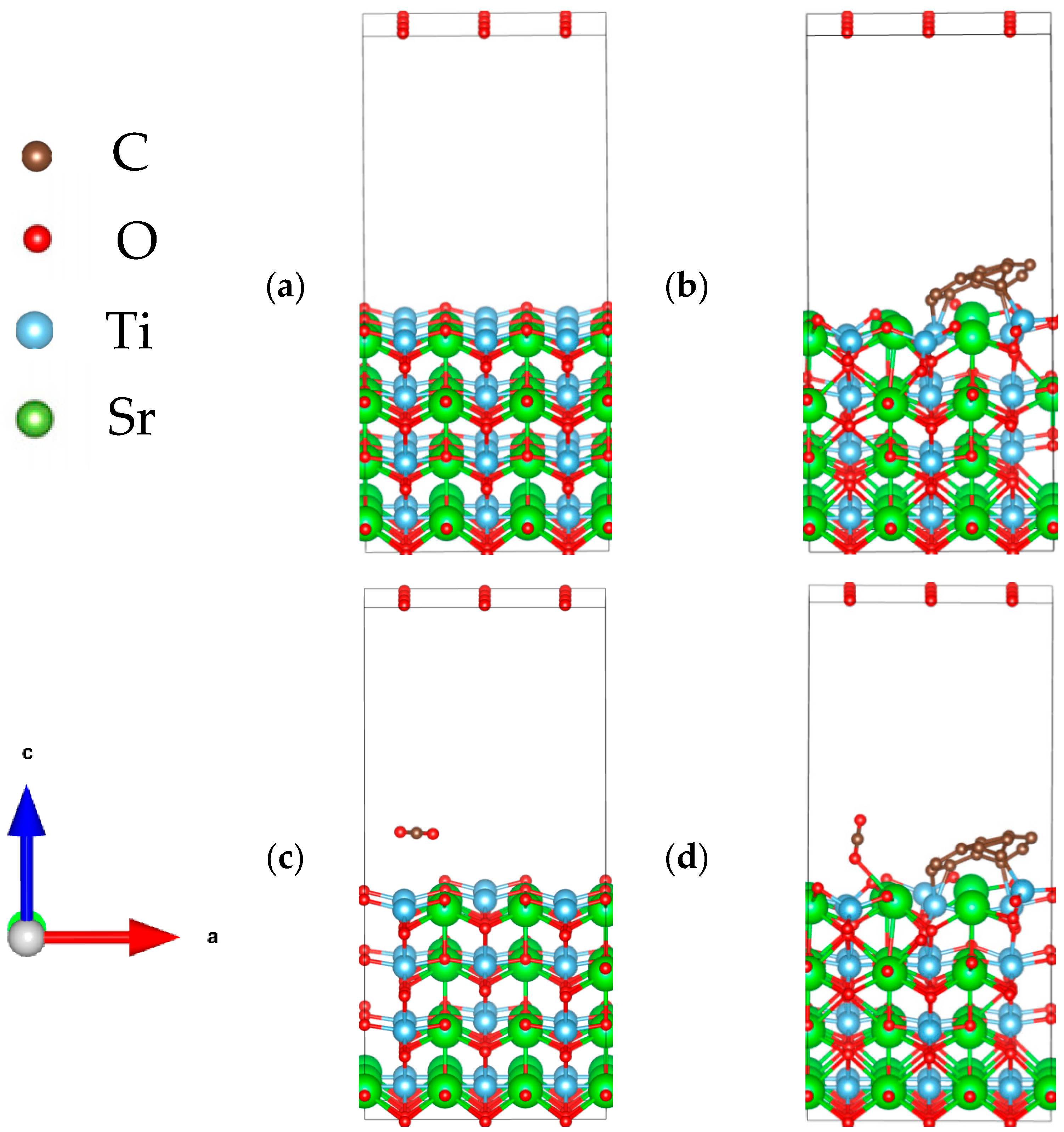
To systematically compare the structural and functional differences of SrTiO3 before and after CQD modification, geometric models of both pristine and CQD-decorated SrTiO3(110) surfaces were constructed and fully relaxed. The optimized structures are illustrated schematically in Figure 8. To ensure reliable convergence during optimization, the initial separation between the CQD and the SrTiO3(110) surface was set to 3 Å—a distance chosen to avoid unphysical repulsion or premature bonding. Site-screening calculations revealed that the most favorable adsorption configuration occurs when the edge carbon atoms of the CQD are positioned directly above surface Ti atoms. In this arrangement, the composite exhibits a formation energy of −9.98 eV, confirming a highly exothermic and thermodynamically stable interface.
Figure 8 compares the preferred adsorption sites of CO2 on pristine and CQD-modified SrTiO3. On the unmodified surface, CO2 binds weakly with an adsorption energy of only −0.19 eV. In contrast, CQD modification induces a stronger interaction: one of the CO2 oxygen atoms forms a coordination bond with a surface Sr atom, yielding an O–Sr distance of 2.856 Å and increasing the adsorption energy to −0.46 eV. This more-than-twofold enhancement in adsorption strength demonstrates that CQD functionalization significantly promotes CO2 capture on SrTiO3, thereby creating favorable interfacial conditions for subsequent photocatalytic reduction to CH4.

3.7. Photocatalytic Schematic Illustration of SrTiO3/CQDs

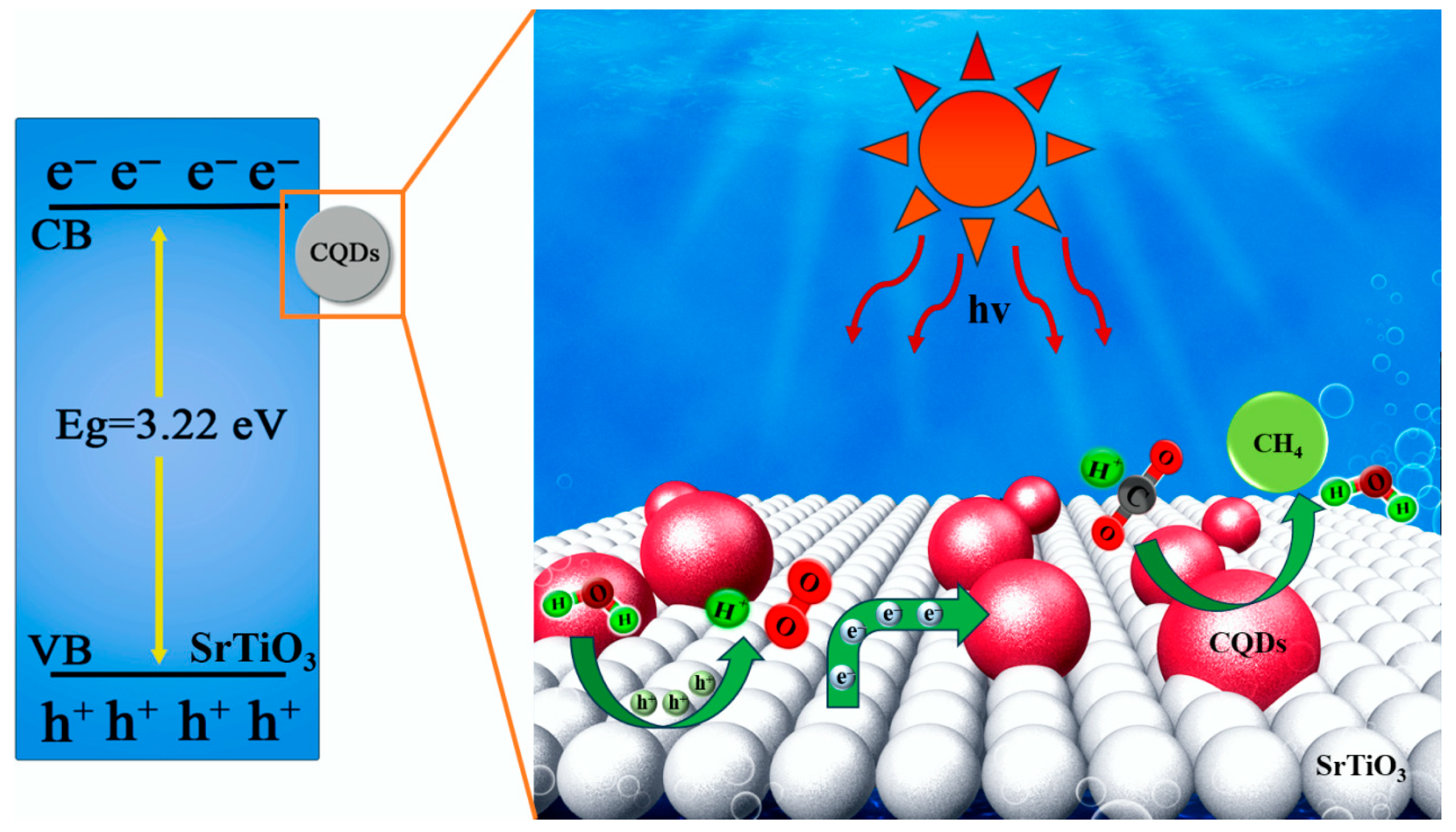
The photocatalytic CO2 reduction schematic illustration for SrTiO3/CQD10 composite under solar irradiation is illustrated in Figure 9. Upon photon absorption, electrons in the valence band of SrTiO3 (VB = +2.43 eV vs. RHE) are excited to the conduction band (CB = −0.82 eV vs. RHE), creating electron–hole pairs. The CB potential (−0.82 eV) thermodynamically favors CO2 reduction to CH4 (E° = −0.24 eV for CO2/CH4), while the VB potential enables water oxidation (E° = +0.82 eV for O2/H2O). However, rapid charge recombination in pristine SrTiO3 limits photocatalytic efficiency, as evidenced by its low 0.071 μmol gcat−1 h−1 CH4 yield [44].
CQD integration fundamentally alters this process: Photogenerated electrons rapidly transfer from the CB of SrTiO3 to CQDs (confirmed by the 0.3 eV negative shift in Ti 2p XPS binding energy), where they accumulate in CQD surface states acting as electron reservoirs. This interfacial electron shuttling suppresses recombination by 60.6%, increasing the electron lifetime for CO2 reduction. The CH4 formation pathway proceeds through an eight-electron process: CO2 → *COOH → *CO → *CHO → *CH2O → *CH3O → *CH3 → CH4, with CQDs providing active sites for proton-coupled electron transfers [45]. Critically, the enhanced visible-light absorption (3.7× at 500 nm) and upconversion properties of CQDs enable sub-bandgap photon utilization, while the 2.95 eV effective bandgap of composite maintains sufficient driving force for CO2 reduction. The observed 16.3× higher CH4 yield directly correlates with this optimized charge dynamics, in which CQDs serve dual functions: (i) extending light harvesting to 420 nm, and (ii) facilitating electron transfer to adsorbed CO2 molecules. Notably, aqueous carbonate species (HCO3/CO32−) from CO2 dissolution—despite increasing solution alkalinity—form bicarbonate (HCO3) that competes with CO2 for reduction sites and promotes parasitic H2 evolution, explaining the performance decline at >10 wt% CQD loading where surface coverage impedes CO2 adsorption [46]. The main redox reactions are shown below [47]:
SrTiO3 + hv → SrTiO3(e) + SrTiO3(h+)
SrTiO3(e) → CQDs
2H2O + 4h+ → O2 + 4H+
CO2 + 8H+ + 8e → CH4 + 2H2O
CO2(aq)/CO32− + H2O → OH + HCO3
CO2(aq)/HCO3 + H2O → OH + H2CO3

4. Conclusions

This work demonstrates a hydrothermal strategy for synthesizing SrTiO3/CQD10 composites that achieve a 16.3-fold enhancement in CH4 evolution rates (5.11 ± 0.22 μmol gcat−1) compared with pristine SrTiO3 under simulated solar irradiation. The optimal 10 wt% CQD loading maximizes visible-light harvesting (3.7× absorption increase at 500 nm) and interfacial charge transfer, as evidenced by XPS-confirmed electron injection (0.3 eV Ti 2p shift) and 60.6% reduced charge transfer resistance in EIS. Critically, CQDs function as electron reservoirs that suppress recombination while maintaining cubic morphology (26.1 ± 0.7 nm crystallites) and thermodynamic potential for CO2-to-CH4 conversion. The composite retains 71% of its initial activity after 5 h of cumulative irradiation, though performance decay stems from CQD oxidation and carbonate-induced site blocking—key limitations requiring mitigation in future designs. These findings establish CQD surface engineering as a viable pathway to overcome the visible-light limitations of wide-bandgap perovskites, advancing solar-driven CO2 valorization with practical implications for sustainable fuel production. Future work should address long-term stability through CQD passivation and eliminate carbonate additives that promote parasitic hydrogen evolution, thereby enhancing the solar-to-fuel efficiency of this promising photocatalytic system.

Supplementary Materials

The following supporting information can be downloaded at: https://www.mdpi.com/article/10.3390/ma19061075/s1, Figure S1: Calculated total and projected density of states (DOS) for (a) pure SrTiO3 and (b) CQDs/SrTiO3 composite. The Fermi level is set to 0 eV. The introduction of CQDs introduces mid-gap states within the SrTiO3 band gap, leading to effective optical gap narrowing, consistent with the experimental Tauc analysis. Figure S2: Size distribution histogram of the as-prepared CQDs. The equivalent diameter of CQDs follows a Gaussian distribution, with an average diameter of 2.02 ± 0.21 nm, indicating excellent size uniformity. Table S1: All CH4 evolution rates were measured after 1 h irradiation. The catalyst-free control sample has a CH4 yield of 0 (below GC detection limit, LOD = 0.5 ppm). Enhancement factors are relative to pristine SrTiO3. Table S2: Comparison of photocatalytic CO2 reduction performance over SrTiO3-based catalysts. Table S3: CO2 adsorption capacity and corresponding photocatalytic CO2 reduction activity of CQD/carbon dot-decorated catalysts.

Author Contributions

Conceptualization, C.H., Y.Z. (Yan Zhong) and D.W.; Methodology, S.S. and Y.L.; Validation, S.S., Y.L. and Y.Z. (Yanli Zhang); Formal analysis, S.S. and Y.L.; Investigation, S.S. and Y.L.; Resources, C.H.; Data curation, S.S., Y.L. and Y.Z. (Yanli Zhang); Writing—original draft, S.S. and Y.L.; Writing—review & editing, C.H., Y.Z. (Yanli Zhang), Y.Z. (Yan Zhong) and D.W.; Visualization, S.S. and Y.L.; Supervision, C.H., Y.Z. (Yan Zhong) and D.W.; Project administration, C.H., Y.Z. (Yan Zhong) and D.W.; Funding acquisition, C.H. All authors have read and agreed to the published version of the manuscript.

Funding

This work was supported by the National Natural Science Foundation of China (12564008), the Natural Science Foundation of Guangxi Province (2025GXNSFAA069270), the Guangxi Science and Technology Achievements Transformation Program (GuikeZG2504240014), the Guangxi Key Laboratory of Information Materials and Guangxi Collaborative Innovation Center of Structure and Property for New Energy Materials (231007-Z, 231052-Z, and 231067-Z), the Key R&D Program of Guangxi (2023AB01025), and the Opening Project of Guangxi Key Laboratory of Calcium Carbonate Resources Comprehensive Utilization (HZXYKFKT202303).

Data Availability Statement

The original contributions presented in this study are included in the article/Supplementary Material. Further inquiries can be directed to the corresponding authors.

Conflicts of Interest

Author Yize Liu was employed by the company Taishan Fiberglass Inc. The remaining authors declare that the research was conducted in the absence of any commercial or financial relationships that could be construed as a potential conflict of interest.

References

  1. Aresta, M.; Dibenedetto, A.; Angelini, A. Catalysis for the valorization of exhaust carbon: From CO2 to chemicals, materials, and fuels. Technological use of CO2. Chem. Rev. 2014, 114, 1709–1742. [Google Scholar] [CrossRef]
  2. Hussain, I.; Jalil, A.A.; Hassan, N.S.; Hamid, M. Recent advances in catalytic systems for CO2 conversion to substitute natural gas (SNG): Perspective and challenges. J. Energy Chem. 2021, 62, 377–407. [Google Scholar] [CrossRef]
  3. Jiang, H.; Geng, Y.; Tian, X.; Zhang, X.; Chen, W.; Gao, Z. Uncovering CO2 emission drivers under regional industrial transfer in China’s Yangtze River Economic Belt: A multi-layer LMDI decomposition analysis. Front. Energy 2021, 15, 292–307. [Google Scholar] [CrossRef]
  4. Kiatphuengporn, S.; Chareonpanich, M.; Limtrakul, J. Effect of unimodal and bimodal MCM-41 mesoporous silica supports on activity of Fe–Cu catalysts for CO2 hydrogenation. Chem. Eng. J. 2014, 240, 527–533. [Google Scholar] [CrossRef]
  5. Akshay, V.R.; Arun, B.; Mandal, G.; Mutta, G.R.; Chanda, A.; Vasundhara, M. Observation of optical band-gap narrowing and enhanced magnetic moment in Co-doped Sol–Gel-derived anatase TiO2 nanocrystals. J. Phys. Chem. C 2018, 122, 26592–26604. [Google Scholar] [CrossRef]
  6. Abdullah, H.; Khan, M.M.R.; Ong, H.R.; Yaakob, Z. Modified TiO2 photocatalyst for CO2 photocatalytic reduction: An overview. J. CO2 Util. 2017, 22, 15–32. [Google Scholar] [CrossRef]
  7. Xiong, Z.; Kuang, C.C.; Lin, K.Y.; Lei, Z.; Chen, X.; Gong, B.; Yang, J.; Zhao, Y.; Zhang, J.; Xia, B.; et al. Enhanced CO2 photocatalytic reduction through simultaneously accelerated H2 evolution and CO2 hydrogenation in a twin photoreactor. J. CO2 Util. 2018, 24, 500–508. [Google Scholar] [CrossRef]
  8. Iwashina, K.; Kudo, A. Rh-doped SrTiO3 photocatalyst electrode showing cathodic photocurrent for water splitting under visible-light irradiation. J. Am. Chem. Soc. 2011, 133, 13272–13275. [Google Scholar] [CrossRef] [PubMed]
  9. Zhong, Y.; Ueno, K.; Mori, Y.; Shi, X.; Oshikiri, T.; Murakoshi, K.; Inoue, H.; Misawa, H. Plasmon-assisted water splitting using two sides of the same SrTiO3 single-crystal substrate: Conversion of visible light to chemical energy. Angew. Chem. Int. Ed. 2014, 53, 10350–10354. [Google Scholar] [CrossRef]
  10. Bi, Y.; Ehsan, M.F.; Huang, Y.; Jin, J.; He, T. Synthesis of Cr-doped SrTiO3 photocatalyst and its application in visible-light-driven transformation of CO2 into CH4. J. CO2 Util. 2015, 12, 43–48. [Google Scholar] [CrossRef]
  11. Wu, X.; Wang, C.; Wei, Y.; Xiong, J.; Zhao, Y.; Zhao, Z.; Liu, J.; Li, J. Multifunctional photocatalysts of Pt-decorated 3DOM perovskite-type SrTiO3 with enhanced CO2 adsorption and photoelectron enrichment for selective CO2 reduction with H2O to CH4. J. Catal. 2019, 377, 309–321. [Google Scholar] [CrossRef]
  12. Almaev, A.V.; Karipbayev, Z.T.; Kakimov, A.B.; Yakovlev, N.N.; Kukenov, O.I.; Korchemagin, A.O.; Akmetova-Abdik, G.A.; Kumarbekov, K.K.; Zhunusbekov, A.M.; Mochalov, L.A.; et al. High-Temperature Methane Sensors Based on ZnGa2O4:Er Ceramics for Combustion Monitoring. Technologies 2025, 13, 286. [Google Scholar] [CrossRef]
  13. Jiao, M.-Z.; Chen, X.-Y.; Hu, K.-X.; Qian, D.-Y.; Zhao, X.-H.; Ding, E.-J. Recent developments of nanomaterials-based conductive type methane sensors. Rare Met. 2021, 40, 1515–1527. [Google Scholar] [CrossRef]
  14. Ateia, E.E.; Rabie, O.; Mohamed, A.T. Assessment of the correlation between optical properties and CQD preparation approaches. Eur. Phys. J. Plus 2024, 139, 24. [Google Scholar] [CrossRef]
  15. Subramani, M.C.; Budiman, I.; Subyakto, S.; Chitraningrum, N.; Widyaningrum, B.A.; Saputra, N.A.; Fauzi, A.A.B.; Hata, T.; Jebiti, H. A review on one-pot multicomponent organic reactions using carbon quantum dots as versatile heterogeneous catalyst. Top. Catal. 2025, 68, 2296–2331. [Google Scholar] [CrossRef]
  16. Ye, M.; Meng, L.F. Preparation and sensing study of Houttuynia cordata-based carbon quantum dots. Molecules 2025, 30, 3668. [Google Scholar] [CrossRef] [PubMed]
  17. Gawal, P.M.; Golder, A.K. Vegetal route for synthesis of CQDs/CdS nanocomposites for photocatalytic reduction of CO2 to methanol under visible light. Colloids Surf. A Physicochem. Eng. Asp. 2024, 683, 133068. [Google Scholar] [CrossRef]
  18. Brik, M.G.; Srivastava, A.M.; Popov, A. A few common misconceptions in the interpretation of experimental spectroscopic data. Opt. Mater. 2022, 127, 112276. [Google Scholar] [CrossRef]
  19. IEC 60736:1982; Testing Equipment for Electrical Energy Meters. International Electrotechnical Commission: Geneva, Switzerland, 1982.
  20. Kresse, G.; Furthmüller, J. Efficient iterative schemes for ab initio total-energy calculations using a plane-wave basis set. Phys. Rev. B 1996, 54, 11169. [Google Scholar] [CrossRef]
  21. Perdew, J.P.; Burke, K.; Ernzerhof, M. Generalized Gradient Approximation Made Simple. Phy. Rev. Lett. 1996, 77, 3865. [Google Scholar] [CrossRef] [PubMed]
  22. Ireta, J.; Neugebauer, J.; Scheffler, M. On the accuracy of DFT for describing hydrogen bonds: Dependence on the bond directionality. J. Phys. Chem. A 2004, 108, 5692–5698. [Google Scholar] [CrossRef]
  23. Okazaki, A.; Kawaminami, M. Lattice constant of strontium titanate at low temperatures. Mater. Res. Bull. 1973, 8, 545–550. [Google Scholar] [CrossRef]
  24. Politi, J.R.S.; Martins, J.B.L.; Cabral, B.J.C. A first principles approach to the interactions of alkali metal atoms with carbon quantum dots. Comput. Mater. Sci. 2021, 197, 110614. [Google Scholar] [CrossRef]
  25. Liu, S.; Liu, Z.; Li, Q.; Xia, H.; Yang, W.; Wang, R.; Li, Y.; Zhao, H.; Tian, B. Facile synthesis of carbon dots from wheat straw for colorimetric and fluorescent detection of fluoride and cellular imaging. Spectrochim. Acta Part A Mol. Biomol. Spectrosc. 2021, 246, 118964. [Google Scholar] [CrossRef]
  26. Huang, K.; Lin, L.; Zhang, L.; Zhao, M.; Dai, X.; Jiang, Y.; Yang, R.; Liao, J.; Zhang, Y.; Wang, Y. Rapid synthesis of ultra-bright blue and cyan CQDs fluorescent powders based on chemical dispersion and concentration effects. Ceram. Int. 2024, 50, 4046–4052. [Google Scholar] [CrossRef]
  27. Zhang, Y.; Zhong, L.; Duan, D. Single-step hydrothermal synthesis of strontium titanate nanoparticles from crystalline anatase titanium dioxide. Ceram. Int. 2015, 41, 13516–13524. [Google Scholar] [CrossRef]
  28. Xu, N.; Gao, S.; Xu, C.; Fang, Y.; Xu, L.; Zhang, W. Carbon quantum dots derived from waste acorn cups and its application as an ultraviolet absorbent for polyvinyl alcohol film. Appl. Surf. Sci. 2021, 556, 149774. [Google Scholar] [CrossRef]
  29. Zhou, M.; Chen, J.; Zhang, Y.; Jiang, M.; Xu, S.; Liang, Q.; Li, Z. Shape-controlled synthesis of golf-like, star-like, urchin-like and flower-like SrTiO3 for highly efficient photocatalytic degradation and H2 production. J. Alloys Compd. 2020, 817, 152796. [Google Scholar] [CrossRef]
  30. Chen, X.; Mao, S.S. Titanium dioxide nanomaterials: Synthesis, properties, modifications, and applications. Chem. Rev. 2007, 107, 2891–2959. [Google Scholar] [CrossRef]
  31. Jiang, X.; Zhang, Y.; Jiang, J.; Rong, Y.; Wang, Y.; Wu, Y.; Pan, C. Characterization of oxygen vacancy associates within hydrogenated TiO2: A positron annihilation study. J. Phys. Chem. C 2012, 116, 22619–22624. [Google Scholar] [CrossRef]
  32. Lin, Y.; Wu, S.; Li, X.; Wu, X.; Yang, C.; Zeng, G.; Peng, Y.; Zhou, Q.; Lu, L. Microstructure and performance of Z-scheme photocatalyst of silver phosphate modified by MWCNTs and Cr-doped SrTiO3 for malachite green degradation. Appl. Catal. B Environ. 2018, 227, 557–570. [Google Scholar] [CrossRef]
  33. Miot, C.; Proust, C.; Husson, E.; Blondiaux, G.; Coutures, J. Ageing influence on residual carbon content in different grain-sized BaTiO3 ceramics analyzed by 12C(d,p)13C nuclear method. J. Eur. Ceram. Soc. 1997, 17, 1335–1340. [Google Scholar] [CrossRef]
  34. Chen, F.; Liu, L.-L.; Zhang, Y.-J.; Wu, J.-H.; Huang, G.-X.; Yang, Q.; Chen, J.-J.; Yu, H.-Q. Enhanced full solar spectrum photocatalysis by nitrogen-doped graphene quantum dots decorated BiO2−x nanosheets: Ultrafast charge transfer and molecular oxygen activation. Appl. Catal. B Environ. 2020, 277, 119218. [Google Scholar] [CrossRef]
  35. Li, M.; Zhang, Y.; Li, X.; Wang, Y.; Dong, F.; Ye, L.; Yu, S.; Huang, H. Nature-derived approach to oxygen and chlorine dual-vacancies for efficient photocatalysis and photoelectrochemistry. ACS Sustain. Chem. Eng. 2018, 6, 2395–2406. [Google Scholar] [CrossRef]
  36. Bajiri, M.A.M.; Khan, N.; Diaz, J.C.C.A.; Avansi, W., Jr.; Gouvêa, D.; Gonçalves, R.V. Engineering Stable Cu-Doped SrTiO3 Perovskites for Enhanced Photocatalytic CO2 Reduction. Inorg. Chem. 2025, 64, 15370–15380. [Google Scholar] [CrossRef] [PubMed]
  37. Boga, B.; Moustakas, N.G.; Han, Y.; Jiao, H.; Kreyenschulte, C.; Naliwajko, P.; Duong, T.T.H.; Ding, S.; Ngo, A.B.; Hezam, A.; et al. Design of SrTiO3-based catalysts for photocatalytic CO2 reduction. Catal. Sci. Technol. 2024, 14, 3459–3472. [Google Scholar] [CrossRef]
  38. Fang, S.; Xia, Y.; Lv, K.; Li, Q.; Sun, J.; Li, M. Effect of carbon-dots modification on the structure and photocatalytic activity of g-C3N4. Appl. Catal. B Environ. 2016, 185, 225–232. [Google Scholar] [CrossRef]
  39. Huang, X.; Zhang, H.; Zhao, J.; Jiang, D.; Zhan, Q. Carbon quantum dot (CQD)-modified Bi3O4Br nanosheets possessing excellent photocatalytic activity under simulated sunlight. Mater. Sci. Semicond. Process. 2021, 122, 105489. [Google Scholar] [CrossRef]
  40. Liu, Z.; Liu, C.; Zheng, L.; Chen, F.; Qian, J.; Qiu, Y.; Meng, X.; Chen, Z. Progress on Synthesis of CQDs/g-C3N4 Composites and Their Photocatalytic Performance. Mater. Mech. Eng. 2024, 48, 1–10. [Google Scholar]
  41. Ji, M.; Liu, L.Y.; Di, J.; Chen, R.; Chen, Z.; Xia, J.; Li, H. N-CQDs accelerating surface charge transfer of Bi4O5I2 hollow nanotubes with broad spectrum photocatalytic activity. Appl. Catal. B Environ. 2018, 237, 1033–1043. [Google Scholar] [CrossRef]
  42. Zhao, Y.; Yang, D.; Yu, C.; Yan, H. A review on photocatalytic CO2 reduction of g-C3N4 and g-C3N4-based photocatalysts modified by CQDs. J. Environ. Chem. Eng. 2025, 13, 115348. [Google Scholar] [CrossRef]
  43. Li, Q.; Wang, S.; Sun, Z.; Tang, Q.; Liu, Y.; Wang, L.; Wang, H.; Wu, Z. Enhanced CH4 selectivity in CO2 photocatalytic reduction over carbon quantum dots decorated and oxygen doping g-C3N4. Nano Res. 2019, 12, 2749–2759. [Google Scholar] [CrossRef]
  44. Indrakanti, V.P.; Kubicki, J.D.; Schobert, H.H. Photoinduced activation of CO2 on Ti-based heterogeneous catalysts: Current state, chemical physics-based insights and outlook. Energy Environ. Sci. 2009, 2, 745–758. [Google Scholar] [CrossRef]
  45. Wang, R.; Lu, K.-Q.; Tang, Z.-R.; Xu, Y.-J. Recent progress in carbon quantum dots: Synthesis, properties and applications in photocatalysis. J. Mater. Chem. A 2017, 5, 3717–3734. [Google Scholar] [CrossRef]
  46. Tan, L.-L.; Ong, W.-J.; Chai, S.-P.; Goh, B.T.; Mohamed, A.R. Visible-light-active oxygen-rich TiO2 decorated 2D graphene oxide with enhanced photocatalytic activity toward carbon dioxide reduction. Appl. Catal. B Environ. 2015, 179, 160–170. [Google Scholar] [CrossRef]
  47. Kulandaivalu, T.; Rashid, S.A.; Sabli, N.; Tan, T.L. Visible light assisted photocatalytic reduction of CO2 to ethane using CQDs/Cu2O nanocomposite photocatalyst. Diam. Relat. Mater. 2019, 91, 64–73. [Google Scholar] [CrossRef]
Figure 1. XRD diagrams of SrTiO3, CQD and STO/CQD 10wt% samples.
Materials 19 01075 g001
Figure 2. SEM images of (a) SrTiO3, (b,c) SrTiO3/CQD nanomaterials, (d) element distributions corresponding to Sr, Ti, C and O.
Materials 19 01075 g002
Figure 3. (a,b) TEM images, (c) HRTEM image, and (d) SAED of SrTiO3/CQD 10wt% composite.
Materials 19 01075 g003
Figure 4. XPS spectra of SrTiO3/CQDs: (a) full spectrum, (b) Sr 3d, (c) Ti 2p, (d) O 1s, (e) C 1s.
Materials 19 01075 g004
Figure 5. (a) Time-dependent CH4 evolution profiles in SrTiO3 and SrTiO3/CQDs-x nanomaterials under simulated sunlight for 1 h, (b) amounts of photocatalytic reduction of CO2 into CH4 in those catalysts under simulated sunlight for 5 h, (c) the recyclable photocatalytic activity of CO2 reduction in SrTiO3/CQDs 10 wt%.
Materials 19 01075 g005
Figure 6. (a) Transient photocurrent density and (b) electrochemical impedance spectra together with the equivalent circuit model at the electrode/electrolyte interface shown in the inset of SrTiO3 and SrTiO3/CQDs 10wt%.
Materials 19 01075 g006
Figure 7. (a) UV-vis DRS of SrTiO3 and SrTiO3/CQDs 10wt% and (b) the corresponding (αhv)1/2 vs. hv curves.
Materials 19 01075 g007
Figure 8. Optimized structure models: (a) SrTiO3 (110) surface, (b) SrTiO3/CQD structure diagram, (c) adsorption of CO2 on SrTiO3, (d) adsorption of CO2 on SrTiO3/CQDs.
Materials 19 01075 g008
Figure 9. Energy band diagram and electron transport path diagram of SrTiO3/CQD nanomaterials.
Materials 19 01075 g009
Disclaimer/Publisher’s Note: The statements, opinions and data contained in all publications are solely those of the individual author(s) and contributor(s) and not of MDPI and/or the editor(s). MDPI and/or the editor(s) disclaim responsibility for any injury to people or property resulting from any ideas, methods, instructions or products referred to in the content.