1. Introduction
Concrete is the most widely used construction material in civil engineering, playing a fundamental role in various infrastructure projects—including bridges, roads, hydraulic structures, high-rise buildings, and underground engineering—due to its low cost, high compressive strength, and excellent durability.
However, concrete is inherently brittle, with a tensile strength approximately one-tenth of its compressive strength. During preparation, construction, and service, concrete is inevitably affected by multiple factors such as material inhomogeneity, construction defects, thermal stresses, humidity variations, and external loads. These factors lead to the formation of initial defects like microcracks and pores. Under external loading, these defects tend to initiate, propagate, and coalesce into macroscopic cracks, ultimately becoming the primary cause of structural damage and failure.
Therefore, understanding the fracture mechanisms of cracked concrete and clarifying how cracks influence concrete failure are of great theoretical and practical significance for infrastructure development.
However, most existing studies have mainly focused on single-crack concrete, lacking systematic and in-depth research on the mesoscale crack formation mechanism of double-crack concrete. In actual engineering, concrete structures often have multiple cracks simultaneously. The interaction between the double cracks makes the redistribution of internal stress more complex, resulting in different cracking behaviors compared to single-crack concrete. At the same time, the nonlinear relationship between the inclination angle of the cracks and the peak strength of the concrete, as well as the differences in the cracking mechanisms of single-crack and double-crack under different inclination angles, have not been clearly quantified. This has created a key research gap in this field.
Research on the cracking mechanisms of concrete primarily encompasses three aspects: experimental studies, theoretical analyses, and numerical simulations. The experimental study applies pressure through a pressure testing machine and combines digital imaging technology to observe the cracks. For example, Fang et al. [
1] employed experimental methods to explore the effects of seawater immersion duration, hydrodynamic parameters, and concrete strength grades on the efficiency of self-excited oscillating cavitation water (SOCW) jets in breaking seawater-corroded concrete. They also analyzed the micro-scale damage mechanisms using scanning electron microscopy (SEM). Grzegorz Ludwik Golewski et al. [
2] combined experimental testing with scanning electron microscopy (SEM) microanalysis to investigate the effects of crushed limestone aggregates of different particle sizes (2–8 mm and 8–16 mm) on the Type II fracture behavior of concrete and the microstructure of the matrix–aggregate interface.
Despite these valuable contributions, experimental approaches are largely limited to observing external characteristics. They fail to capture the dynamic evolution of stress and strain fields at crack tips, the energy dissipation mechanisms during crack propagation, or the mechanical interactions between cracks and internal material phases such as aggregates and interfacial transition zones.
Theoretical research primarily focuses on developing mechanical analysis models for concrete containing pre-existing cracks, quantifying the stress intensity factor and energy release rate at crack tips, and revealing the intrinsic mechanical driving mechanisms behind crack propagation. For example, Lian et al. [
3] employed a three-dimensional concrete printing model—validated experimentally for accuracy—based on computational fluid dynamics (CFD) coupled with the Bingham rheological model to explore how variables such as tilt angle, printing speed, and layer height affect deformation in inclined-angle concrete structures printed in 3D. Zheng Chen et al. [
4] used experimental testing (shear strength tests), micro-characterization (XRD, TGA, FTIR, SEM-EDS), and plastic limit theory modeling. They revealed the mechanism and failure modes. They proposed a mechanical model to predict interfacial shear strength under different casting intervals. Tian et al. [
5] employed sulfate dry–wet cycling tests, shear tests, and nonlinear curve-fitting modeling to examine the effects of interfacial roughness and cycle number on the shear performance of FRP-ECC-concrete composite interfaces subjected to sulfate dry–wet cycling. They elucidated the degradation mechanisms and failure modes of these interfaces and developed a damage model capable of predicting the deterioration of interfacial shear strength.
However, most theoretical models, in order to simplify calculations, often assume concrete to be a homogeneous and isotropic material, neglecting the multiphase, non-homogeneous characteristics of the internal aggregate, mortar, and interfacial transition zone, as well as the irregular morphology and random distribution of natural cracks. As a result, these models significantly underestimate the key factors that actually influence crack propagation.
As a core tool connecting experimental observations with theoretical analysis, numerical simulation has demonstrated unique advantages in the study of crack propagation in concrete with pre-existing cracks. It can effectively overcome the inherent limitations of experimental and theoretical research. It can accurately capture the dynamic distribution of stress and strain fields at the crack tip and the law of energy dissipation, and visually present the entire process from the initiation, convergence of micro-cracks to the macroscopic crack propagation. The current mainstream numerical simulation methods include the finite element method (FEM), the extended finite element method (XFEM), and the smoothed particle hydrodynamics method (SPH). Among them, the FEM has the advantages of simple modeling, good convergence, and high computational efficiency, and is suitable for the fracture analysis of macroscopic structures. It is also easy to combine with existing structural analysis software.
For example, Li et al. [
6] combined the explosion test with the LS-DYNA finite element analysis based on the JHC constitutive model to study the mechanical behavior and failure modes of carbon-fiber-reinforced concrete plates under explosion loads. Wang et al. [
7] used ABAQUS finite element analysis to study the shear resistance of high-strength steel-reinforced ultra-high-performance concrete beams, and clarified the influence mechanism of key parameters. Zhang et al. [
8], based on the finite discrete element method, conducted numerical simulation of the uniaxial compression of concrete before and after freeze–thaw cycles and established a constitutive model including freeze–thaw damage variables.
Furthermore, it is worth noting that, based on the finite element method, many advanced crack propagation frameworks have been derived. These crack propagation frameworks have significant advantages when dealing with complex problems and requiring detailed simulation of crack behavior. Some well-known crack propagation frameworks include the moving grid finite element, PF-CZM, and the VEM phase field formula. For example, Domenico Ammendolea et al. [
9] developed a new finite element (FE) model to simulate the crack propagation mechanism of nano-filler-reinforced ultra-high-performance fiber concrete (UHPFRC, with compressive strength > 150 MPa and tensile strength approximately 10 MPa) structures under general loads. Abedulgader Baktheer et al. [
10] utilized the phase-field cohesive zone method (PF-CZM) to investigate its simulation capability in the fatigue crack propagation of concrete-like quasi-brittle materials and verified the effectiveness of this method through various fatigue behaviors and loading conditions. Liu et al. [
11] utilized explicit time integration and the virtual element method (VEM) to study and propose an efficient phase-field dynamic fracture numerical scheme. They decomposed the problem into two sub-problems, mechanics and damage, and verified the effectiveness of the method through benchmark examples. The results showed that this method outperformed the finite element method (FEM) in terms of memory efficiency and element adaptability.
However, the finite element method requires predefining crack propagation paths, making it difficult to simulate random crack initiation, branching, and penetration processes. Moreover, its accuracy in characterizing stress concentrations at crack tips is insufficient, preventing precise capture of microdamage evolution. The Extended Finite Element Method (XFEM) does not require predefining crack paths and can simulate the dynamic propagation of cracks of arbitrary shapes. It offers high accuracy in characterizing the stress field at crack tips while balancing computational efficiency and analytical precision.
For example, Wang et al. [
12] combined fractal theory with the extended finite element method to establish a finite element model for steel fiber concrete and studied the influence of fiber parameters and aggregate shapes on the damage and failure process. Yang et al. [
13] used the extended finite element method combined with the cohesive crack model and the random aggregate generation algorithm to study the influence of multiple crack interactions and temperature–load coupling on the fracture performance of concrete. Zuo et al. [
14] used the extended finite element method combined with the double K fracture criterion to simulate the fracture process of a three-point bending beam and revealed the size effect laws of factors such as beam width, crack height ratio, and span height ratio. Hu et al. [
15] conducted a numerical simulation of the crack propagation process of a concrete three-point bending beam based on the extended finite element method and verified the reliability of this method.
However, the XFEM’s enrichment function construction is complex, making it challenging to handle multiple cracks and intersecting cracks. Moreover, boundary condition setup is cumbersome, and convergence is easily affected by mesh quality. The Smoothed Particle Hydrodynamics (SPH) method completely avoids mesh distortion issues and is well-suited for analyzing fractures under large deformations, strong fractures, and impact loads. It can precisely simulate free crack propagation and fragment formation processes.
For instance, Yu et al. [
16] improved the traditional SPH method by introducing the fracture marker ξ, and added solid–liquid interaction models, damage particle conversion algorithms, and heat conduction equations, achieving thermal–water–hydrodynamic damage coupling simulation, and studying the influence of initial temperature, thermal expansion coefficient, and other factors on the rock failure process. Yu et al. [
17] combined 3D sand mold printing, uniaxial compression tests, DIC technology, and the improved SPH method to study the cracking patterns, failure mechanisms, and crack propagation laws of injection and non-injection fissure tunnel specimens with different inclination and azimuth angles. Yu et al. [
18] improved the SPH kernel function by introducing the fracture marker ξ, established a numerical model of rock mass with cracks and holes, simulated the progressive failure process under compressive shear stress conditions, and studied the influence of hole shape, crack angle, and other factors on the failure mode and peak strength of the rock mass. Yu et al. [
19] modified the traditional continuity and momentum equations of SPH, proposed a method for generating the microstructure of concrete, introduced aggregate particles and interface transition zone particles, and defined the hydraulic loading method, established an enhanced SPH framework, and simulated the hydraulic fracturing process under different pre-existing crack forms and concrete microstructures.
However, this approach involves enormous computational demands and high time costs; boundary condition handling is complex, prone to particle divergence, and highly sensitive to particle density and interpolation function selection. The discrete element method can naturally simulate the random initiation, propagation, bifurcation, and penetration of cracks, intuitively displaying macroscopic failure patterns and accurately reflecting the discrete damage characteristics of heterogeneous materials.
For example, Zhang et al. [
20] used a novel tunnel-layered 3D printing technique combined with the discrete element method (DEM) to study the failure process of tunnel models containing weak layers, revealing the influence of weak-layer parameters on tunnel deformation, stress distribution, and failure modes, thereby providing methodologies and theoretical foundations for stability studies of tunnel projects involving weak-layered rock masses. Zhu et al. [
21] employed sand 3D printing technology and the discrete element method (DEM) to simulate the cracking mechanisms of cracked-void specimens under compressive-shear conditions. Zhang et al. [
22] used a new layered 3D printing technique. They also used the discrete element method (DEM). They studied the interaction mechanism between cracks and bedding planes in Semi-Circular Bend (SCB) specimens. Zhu et al. [
23] employed sand 3D printing technology, digital image processing techniques, and the discrete element method (DEM) to investigate the interaction mechanism between rock pores and fractures. Zhu et al. [
24] used sand 3D printing experiments combined with DEM simulations to study the failure mechanisms of discontinuous fracture specimens under compressive-shear loading. Sun et al. [
25] utilized sand 3D printing experiments along with DEM simulations to explore the cracking mechanisms of V-shaped fracture-like rock specimens under compressive-shear loading. Zhu et al. [
26] employed sand 3D printing technology and DEM modeling to examine the crack propagation mechanisms of S-shaped fractures in rock-like specimens. Therefore, this paper adopts the discrete element method for numerical simulation.
In conclusion, although previous studies based on finite element methods (FEMs), extended finite element methods (XFEMs), etc., have provided information on the development of concrete cracks, these continuum-based methods often rely on predefined crack paths or simplified homogeneous material assumptions, which may not fully capture the complex, discontinuous initiation and propagation characteristics of cracks in non-homogeneous materials such as concrete. In contrast, the discrete element method (DEM) treats concrete as a collection of independent particles, which can spontaneously generate cracks without assuming a specific path and explicitly considers the multiphase microstructure, including aggregates, mortar, and interface transition zones. This capability is crucial for accurately simulating the random initiation, branching, and merging of cracks under load in the mesoscale.
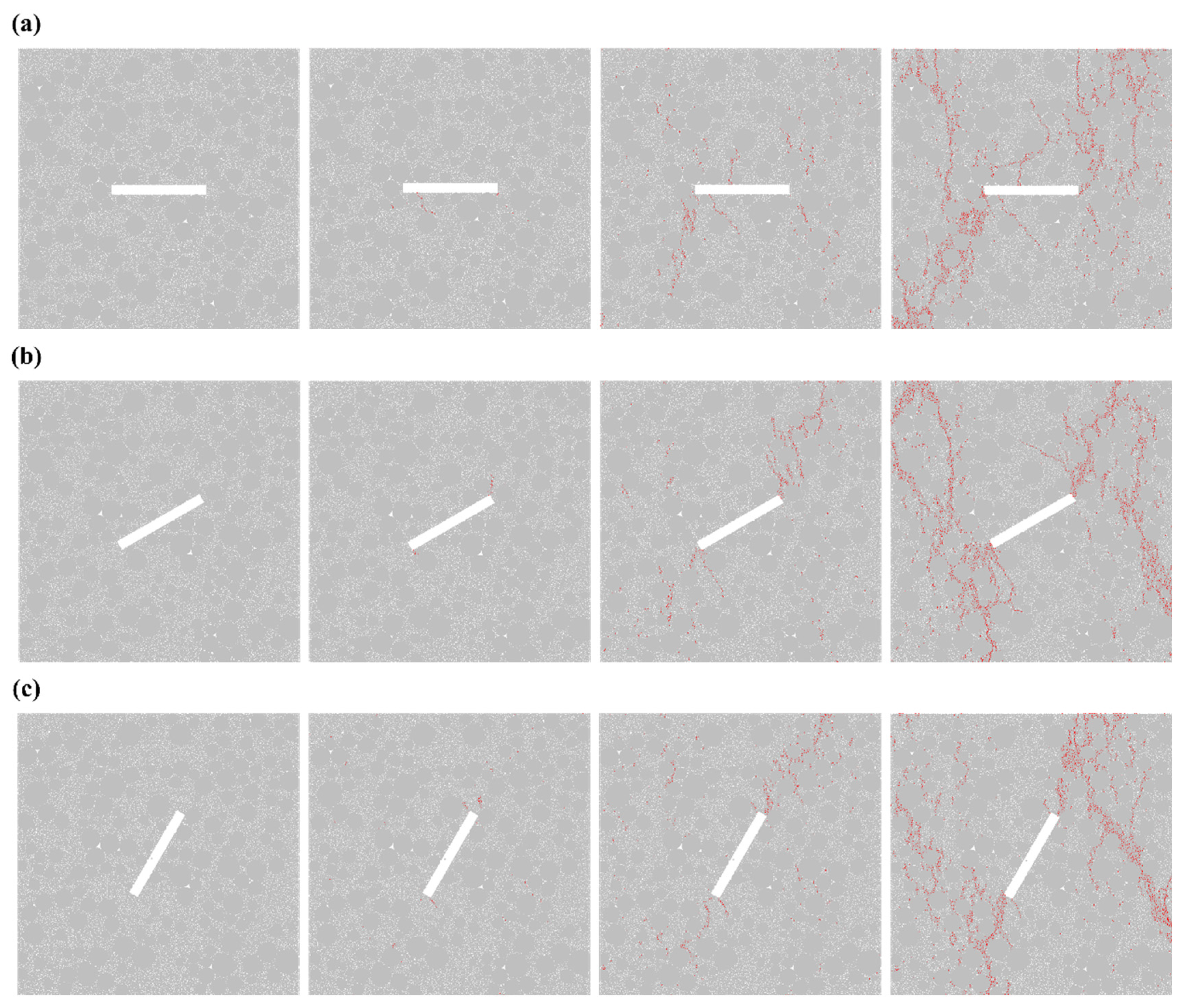
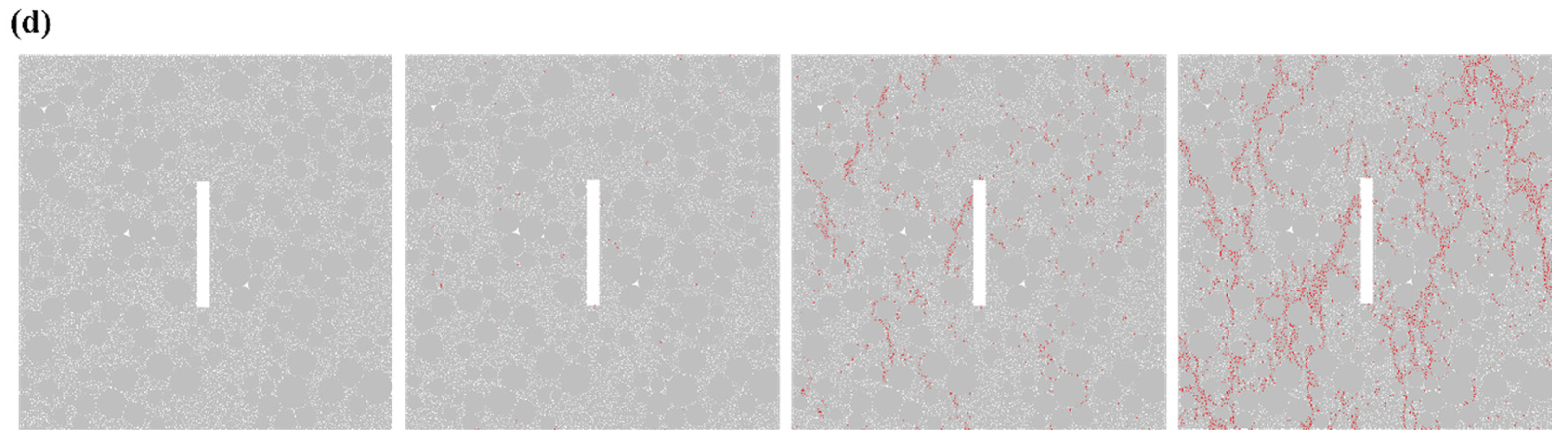
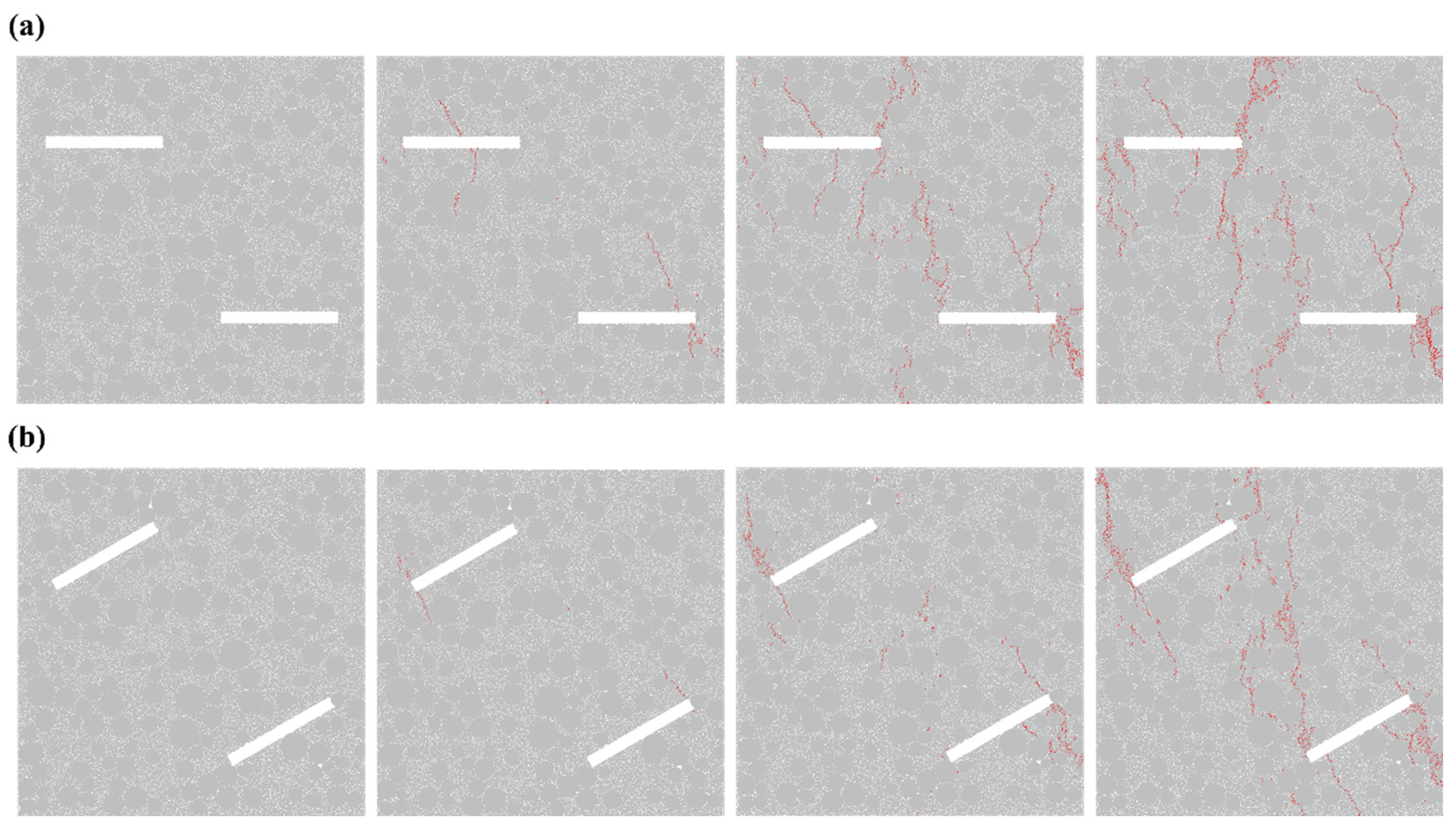
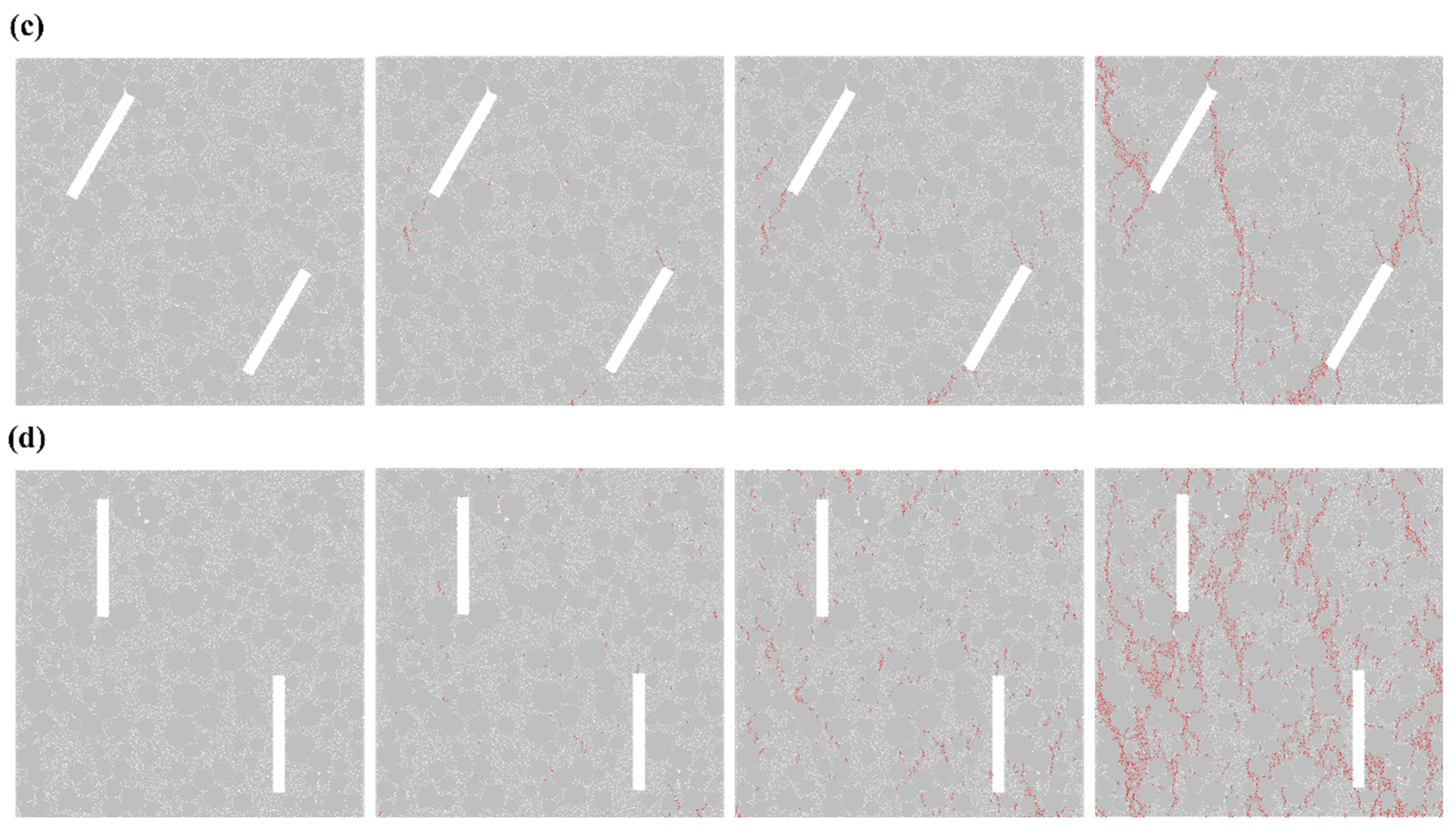
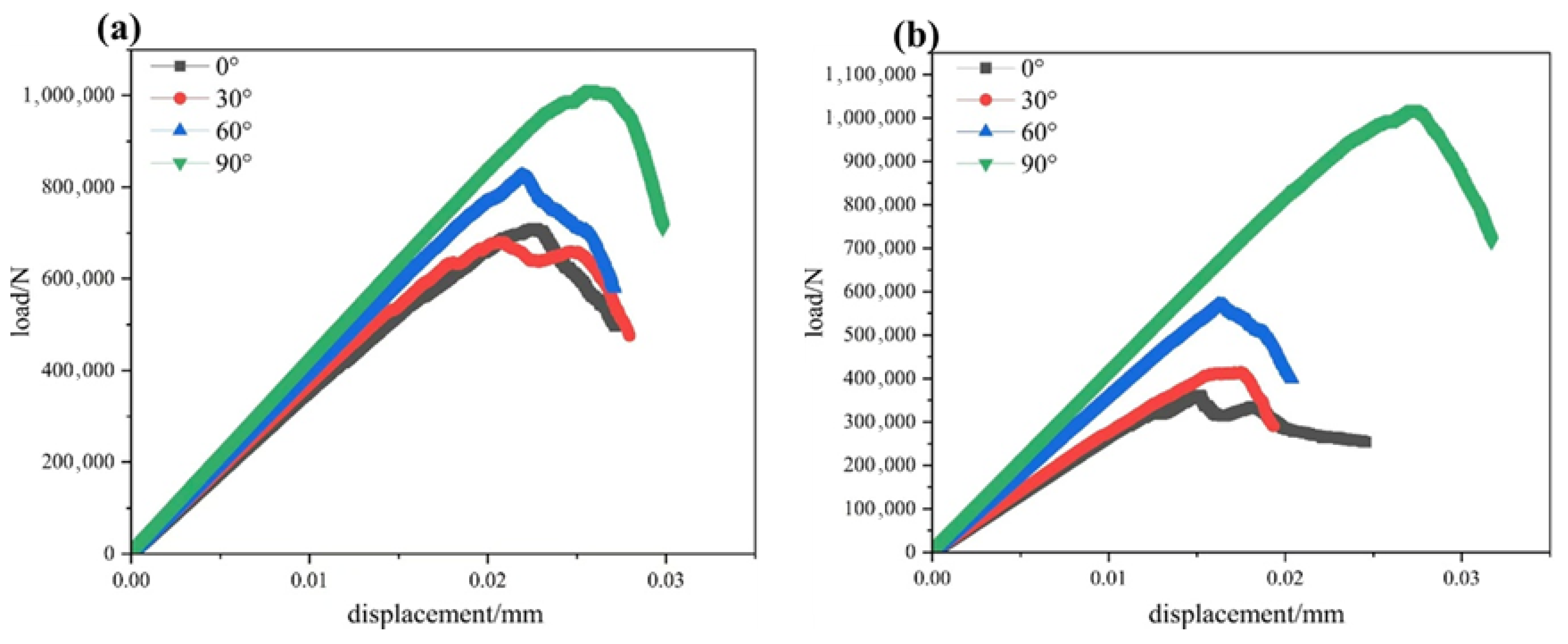
This study systematically explored the effects of crack inclination angles (0°, 30°, 60°, 90°) and crack numbers (single crack and double cracks) on the cracking behavior of concrete at the mesoscale using a Particle Flow Code (PFC) based on the discrete element method, thereby deepening the understanding of the fracture mechanism of concrete. The key innovations of this study lie in (i) quantitatively characterizing the evolution of tensile and shear cracks during loading, revealing the trend of the dominant failure mode as the inclination angle changes; (ii) determining the nonlinear relationship between peak strength and crack angle, with the maximum load-bearing capacity of single-crack and double-crack specimens reaching its maximum at 90°; (iii) demonstrating that double cracks can trigger additional cracking patterns (such as mid-crack cracking at 0°) and change the crack accumulation rate compared to single cracks, which has not been systematically studied in previous continuum simulations. Through providing detailed load–displacement curves, crack development histories, and visualized images of crack propagation, this study offers a new quantitative analysis perspective on the microscale fracture mechanism of pre-cracked concrete, thereby providing a more realistic basis for the safety assessment and design of concrete structures.
6. Variation in Cracks with Calculation Steps
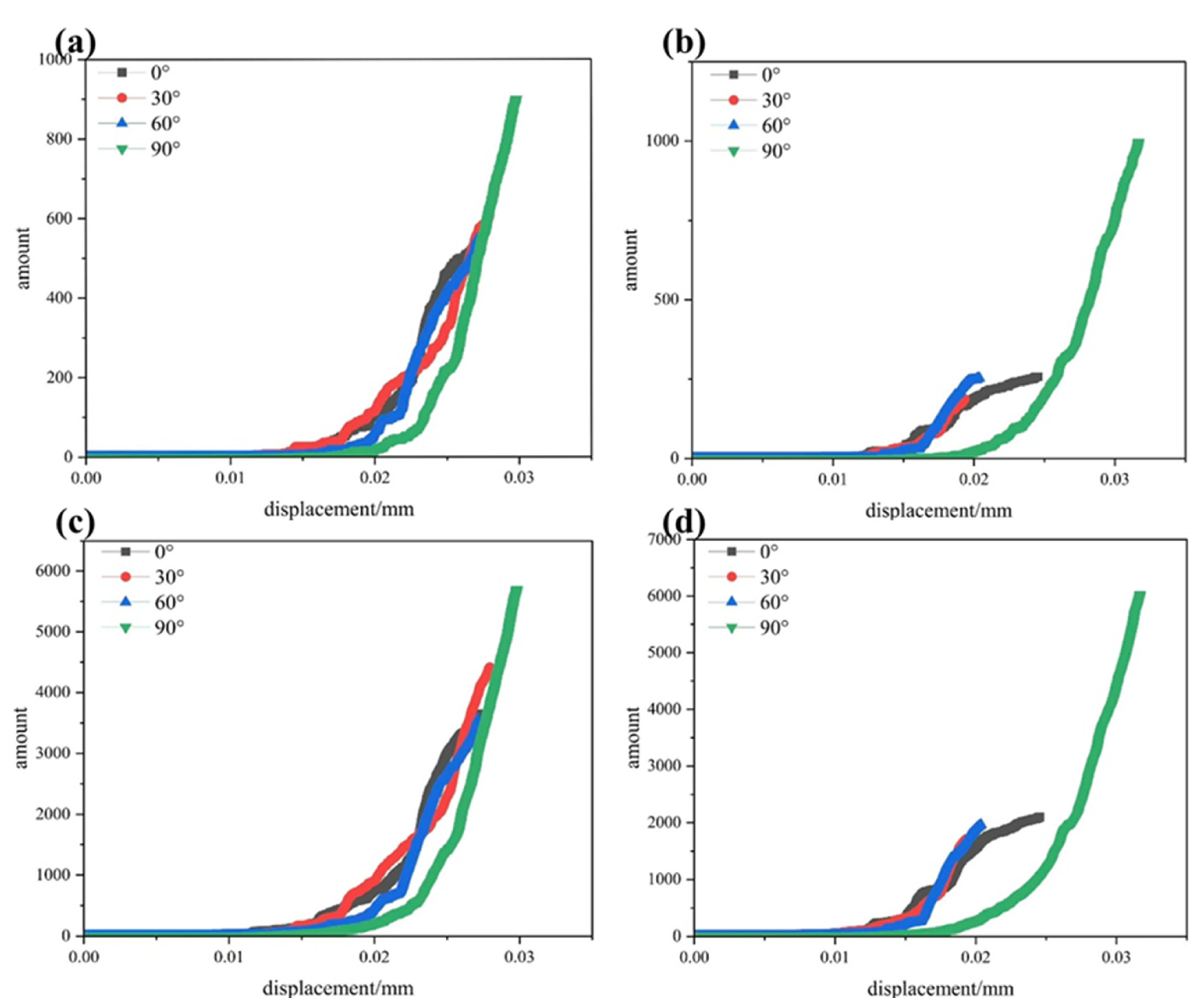
Figure 5a,b shows the evolution of shear cracks under single- and double-fracture conditions as a function of the number of computational steps. As can be seen from the figures, the influence of different pre-existing fractures on shear cracks varies significantly. The entire process can be divided into three distinct stages: the initial stage, the crack propagation stage, and the accelerated propagation stage. In the initial stage, almost no cracks are generated, and the slope of the curve increases extremely slowly. During the crack propagation stage, a small number of cracks nucleate and propagate from the tips of the pre-existing fractures; at this stage, the curve begins to rise gradually, and the differences among fractures with different angles become increasingly pronounced. As the shear load continues to increase, the specimen enters the accelerated propagation stage, during which cracks rapidly expand and eventually penetrate the specimen. For the single-fracture case, when
α = 0°, the specimen develops cracks later than when
α = 30°; however, the peak value of its curve is lower. This is because the failure mode of the vertical fracture is dominated by tensile cracking and through-going failure, resulting in a relatively simple crack propagation path and a smaller cumulative number of cracks. When
α = 30°, the cracks begin to propagate earliest; yet, the duration from the initiation of crack propagation to specimen failure is longer, and the peak value of its curve is higher. At
α = 60°, the specimen develops cracks relatively late, but its curve reaches the lowest peak value. At
α = 90°, the specimen develops cracks the latest, and its curve exhibits the highest peak value. This is because fractures oriented parallel to the loading direction undergo large-scale shear displacements in the later stages, accompanied by the generation and propagation of numerous secondary cracks. Under the single-fracture condition, the timing of specimen failure is relatively concentrated, and the specimens exhibit little variation in their load-bearing capacity. In contrast to the single-fracture case, for the double-fracture configuration, the first crack appears earliest when
α = 0°; the curve peak value is lowest when
α = 30°; and the curve peak value at
α = 90° differs significantly from those of other groups. Consequently, the load-bearing capacities of specimens with different fracture orientations show clear differences.
Figure 5c,d shows the variation in tensile cracks under single- and double-fracture conditions as a function of computational steps. As can be seen from the figures, the influence of different pre-existing fractures on tensile cracks varies significantly. Similarly to shear cracks, the crack evolution can be divided into three stages based on the curve’s behavior: the initial stage, the crack propagation stage, and the accelerated propagation stage. In the initial stage, the number of cracks in the specimen remains nearly unchanged; only the primary fractures already present within the specimen close up. During the crack propagation stage, the curve begins to rise slowly, with cracks nucleating from the tips of the pre-existing fractures and gradually extending. The differences caused by varying angles of the pre-existing fractures become increasingly pronounced. In the accelerated propagation stage, the number of cracks in the specimen increases exponentially, eventually leading to complete fracture of the specimen. For a single fracture, when
α = 0°, the cracks begin to propagate earliest, the curve reaches its peak at the lowest value, and the specimen fails most rapidly. This is because the tensile stress concentration at the tip of a vertical fracture is most significant, causing tensile wing cracks to initiate earliest. When
α = 30°, the cracks start propagating later than at
α = 0°, but their peak value is higher. At
α = 60°, the cracks begin to propagate even later, yet their peak value is lower. At
α = 90°, the cracks start propagating the latest, the specimen remains in normal working condition for the longest time, the curve reaches its highest peak, and the specimen fails the latest. Under single-fracture conditions, the timing of crack propagation is relatively concentrated, and the differences in peak values among curves are not significant. For double fractures, unlike the single-fracture case, except for the curve corresponding to
α = 90°, the peak values of the other curves are lower. Meanwhile, the growth rate of the curve for
α = 90° is much higher than that for other angles, and the final number of cracks is slightly greater than that in single-fracture specimens at the same angle. This indicates that the synergistic effect of double fractures intensifies the shear displacement along parallel fractures, thereby generating more tensile cracks.
8. Conclusions
This study employed the discrete element method (DEM) via Particle Flow Code (PFC) to investigate the mesoscale cracking mechanisms of concrete containing single and double pre-existing fissures under uniaxial compression. The primary objective was to elucidate how fissure inclination angle (0°, 30°, 60°, and 90°) and fissure number influence crack propagation patterns, load–displacement responses, and the evolution of tensile and shear cracks. The numerical results reveal that both the inclination angle and the number of fissures significantly affect the failure behavior and peak strength of concrete specimens. Specifically, the peak strength exhibits a nonlinear increase with inclination angle, reaching its maximum at 90° for both single- and double-fissure configurations. At α = 0°, tensile stress dominates, leading to cracks that propagate perpendicular to the fissure plane with relatively few initiation points. In contrast, at α = 30° and 60°, a combined tensile–shear stress state promotes more numerous internal crack initiation sites and complex crack interactions, ultimately accelerating failure. At α = 90°, shear stress governs the response, resulting in the highest number of internal cracks and the greatest load-bearing capacity. Compared to single-fissure specimens, double-fissure specimens exhibit additional cracking phenomena, such as mid-fissure crack initiation at α = 0°, and generally lower peak strengths except at α = 90°, where the synergistic effect of double fissures generates more tensile and shear cracks during later loading stages. The evolution of both crack types with computational steps consistently shows a three-stage pattern (initial, propagation, and accelerated stages), with the highest cumulative crack numbers observed at α = 90°. These findings demonstrate that DEM-based PFC simulations can realistically capture the entire cracking process—from microcrack initiation to macroscopic failure—and provide quantitative insights into the role of fissure geometry in concrete fracture.
Despite the valuable insights obtained, this study has certain limitations. The numerical model idealizes concrete as a two-phase material composed of particles and parallel bonds, neglecting the full complexity of real aggregate shapes, size distributions, and interfacial transition zone properties. Moreover, only uniaxial compressive loading was considered, and the influence of other stress states (e.g., tension, shear, or cyclic loading) remains unexplored. The model parameters were calibrated based on macroscopic behavior rather than directly measured micromechanical properties, which may introduce uncertainties in quantitative predictions. Additionally, the current simulations are two-dimensional, limiting the representation of out-of-plane crack propagation and interactions.
Future work will address these limitations by extending the model to three dimensions to capture more realistic crack surfaces and spatial interactions. Systematic parameter calibration against experimental data will be performed to enhance predictive accuracy. Further studies will also investigate the effects of different loading conditions—such as cyclic fatigue, dynamic impact, and multi-axial stress states—on crack evolution. Finally, incorporating more detailed microstructural features, including realistic aggregate morphology and random distributions, will improve the fidelity of the simulations and provide deeper insights into the fracture mechanisms of heterogeneous quasi-brittle materials like concrete.