On the Adiabatic Shear Band Sensitivity of Extruded Ti-6Al-4V Alloy Under Dynamic Compression Along the Extrusion and Transverse Directions


Abstract
1. Introduction
2. Materials and Methods
2.1. Materials and Heat Treatment
2.2. Specimen Design and Test Procedures
3. Results
Stress–Strain Response and Strain Field Evolution Under Dynamic Compression
4. CPFEM Simulations of Dynamic Compression in Fiber Texture TC4 Alloy
4.1. Constitutive Law
4.2. Parameters
4.3. Polycrystalline Crystal Plasticity Model and Shear Boundary Conditions
4.4. CPFEM Simulation Results
5. Discussion
5.1. Effect of Texture-Controlled Slip Modes on Flow Stress
5.2. Evolution of Deformation Localization
6. Conclusions
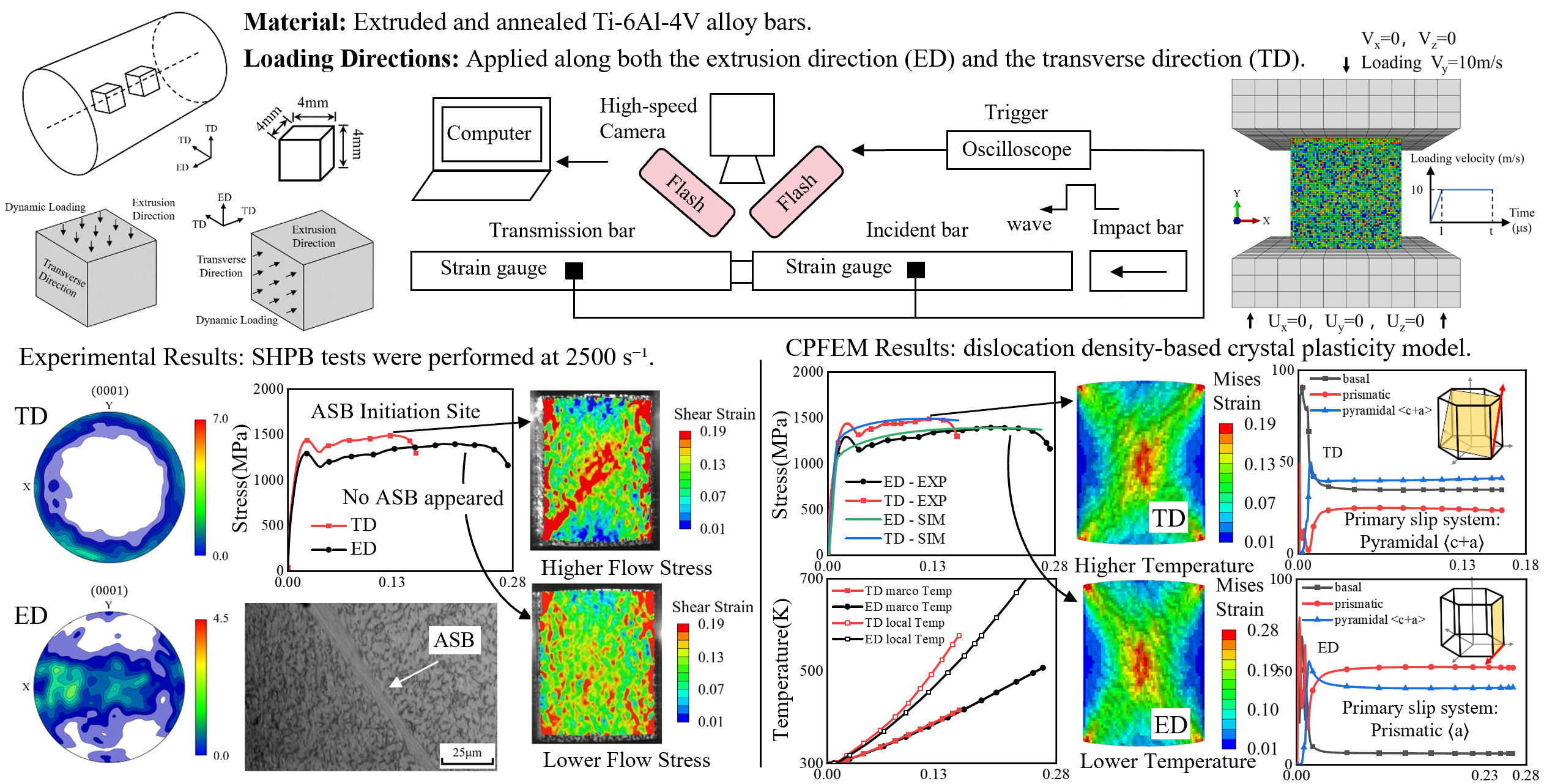
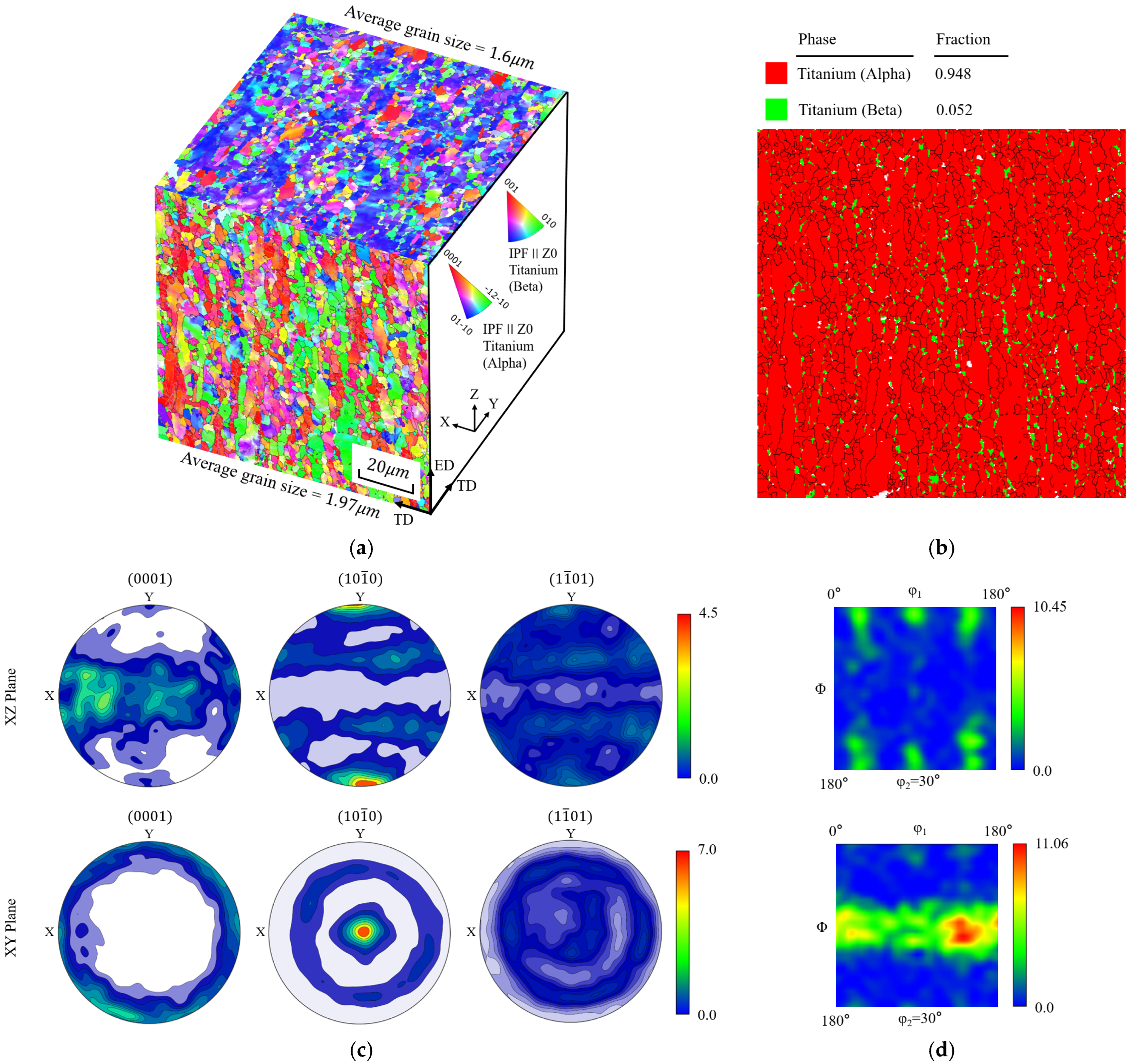
- In extrusion-annealed TC4 alloy rods, the α phase exhibits pronounced texture heterogeneity across different sections. The axial (ED) plane shows a relatively uniform texture, whereas the radial (TD) plane develops a typical prismatic ⟨a⟩ fiber texture.
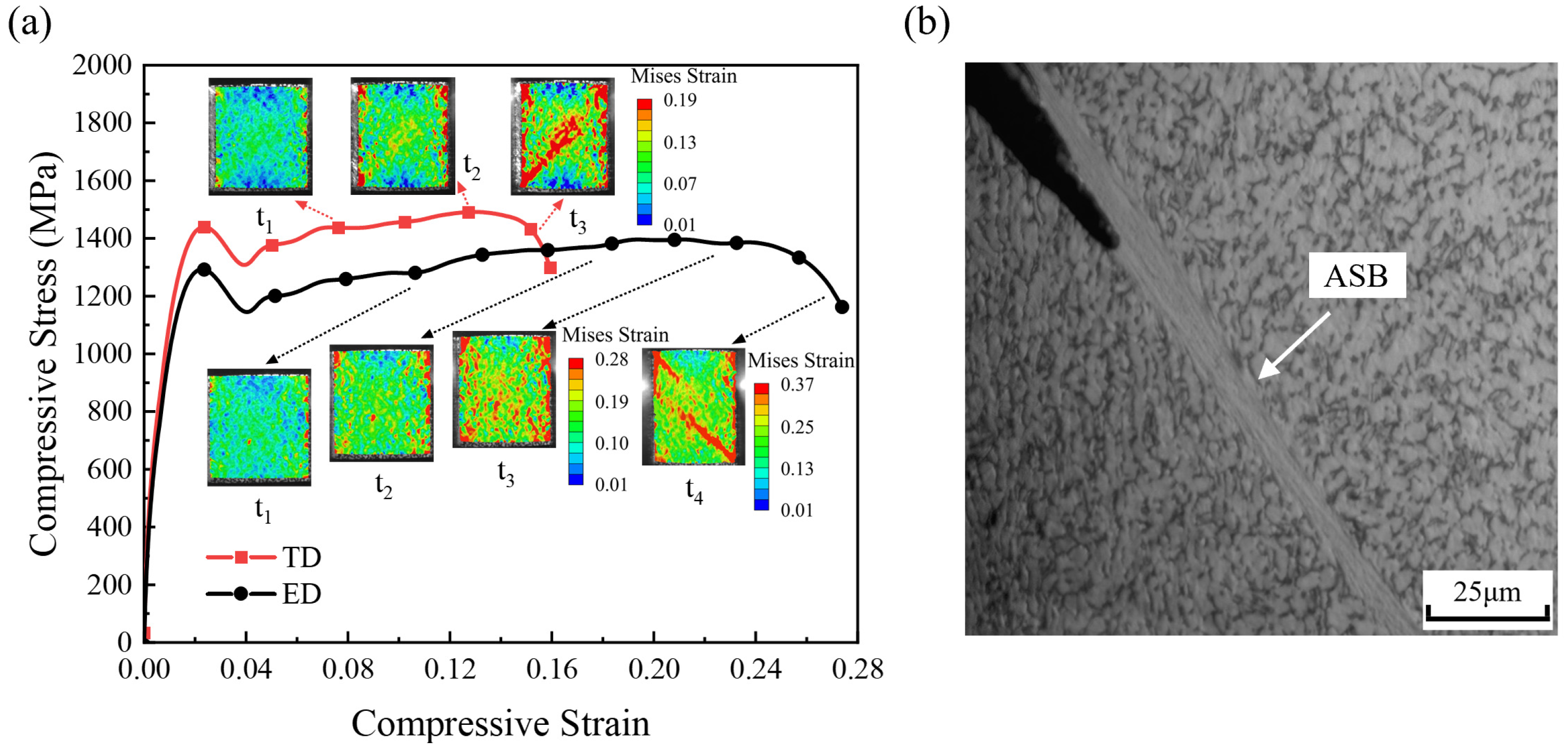
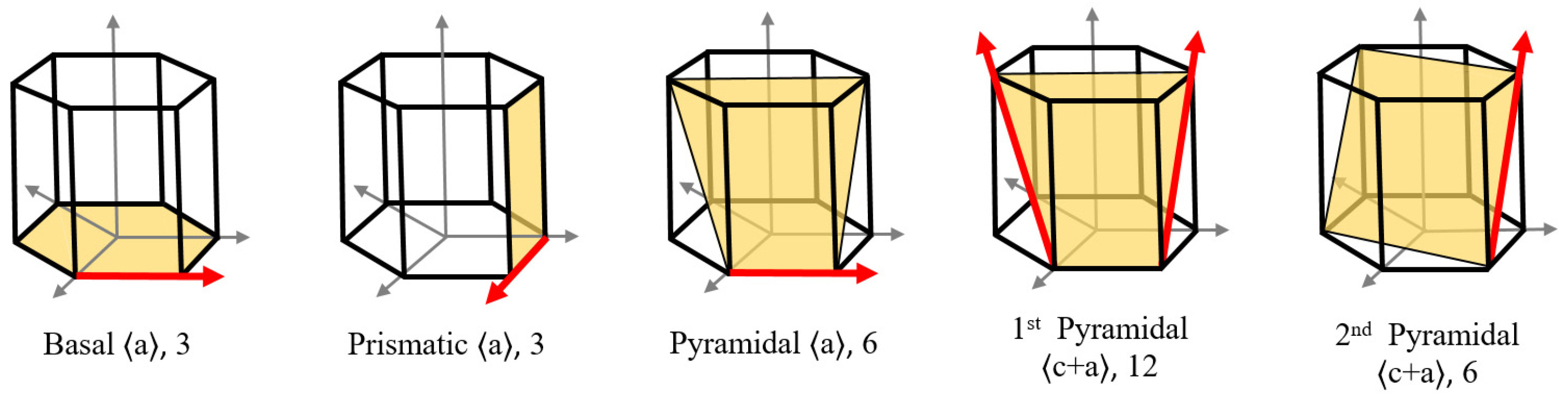
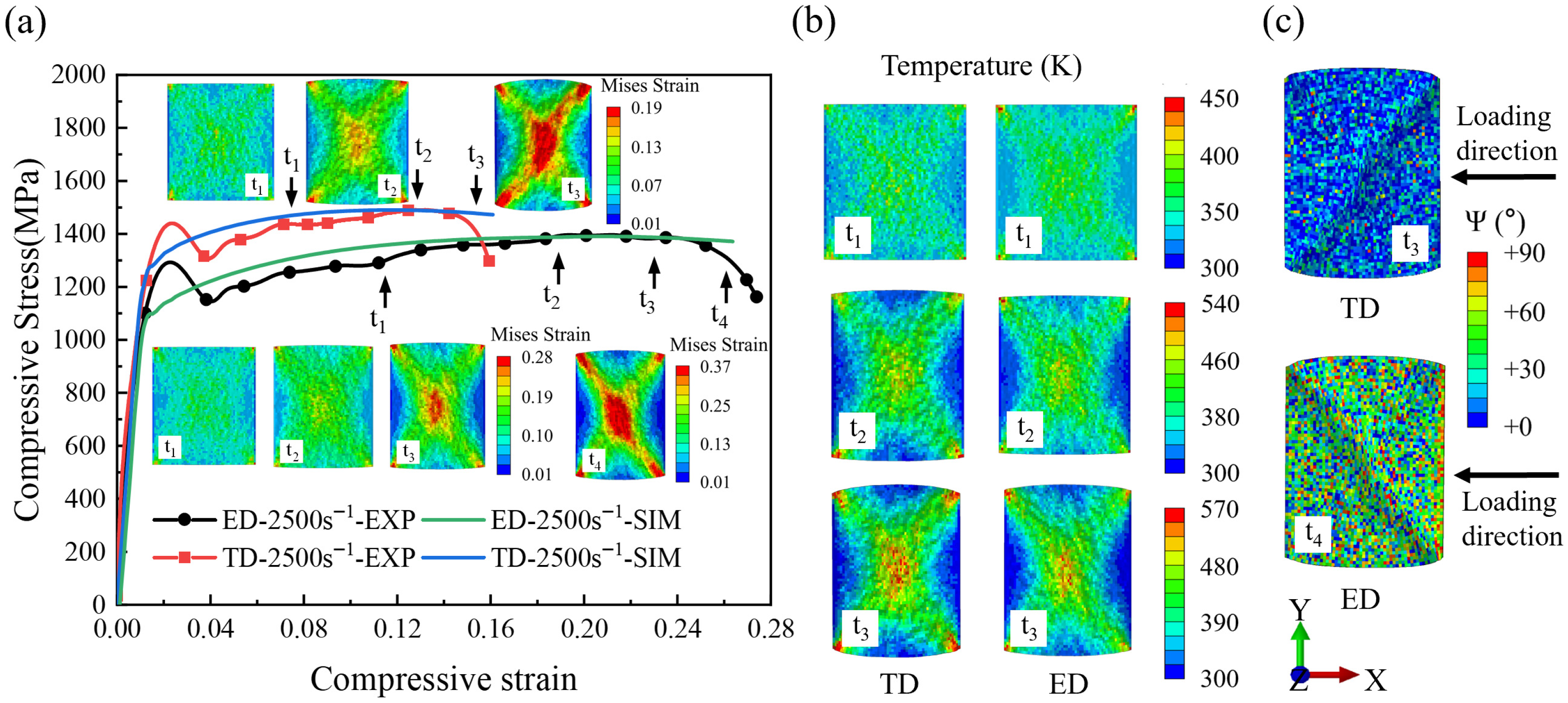
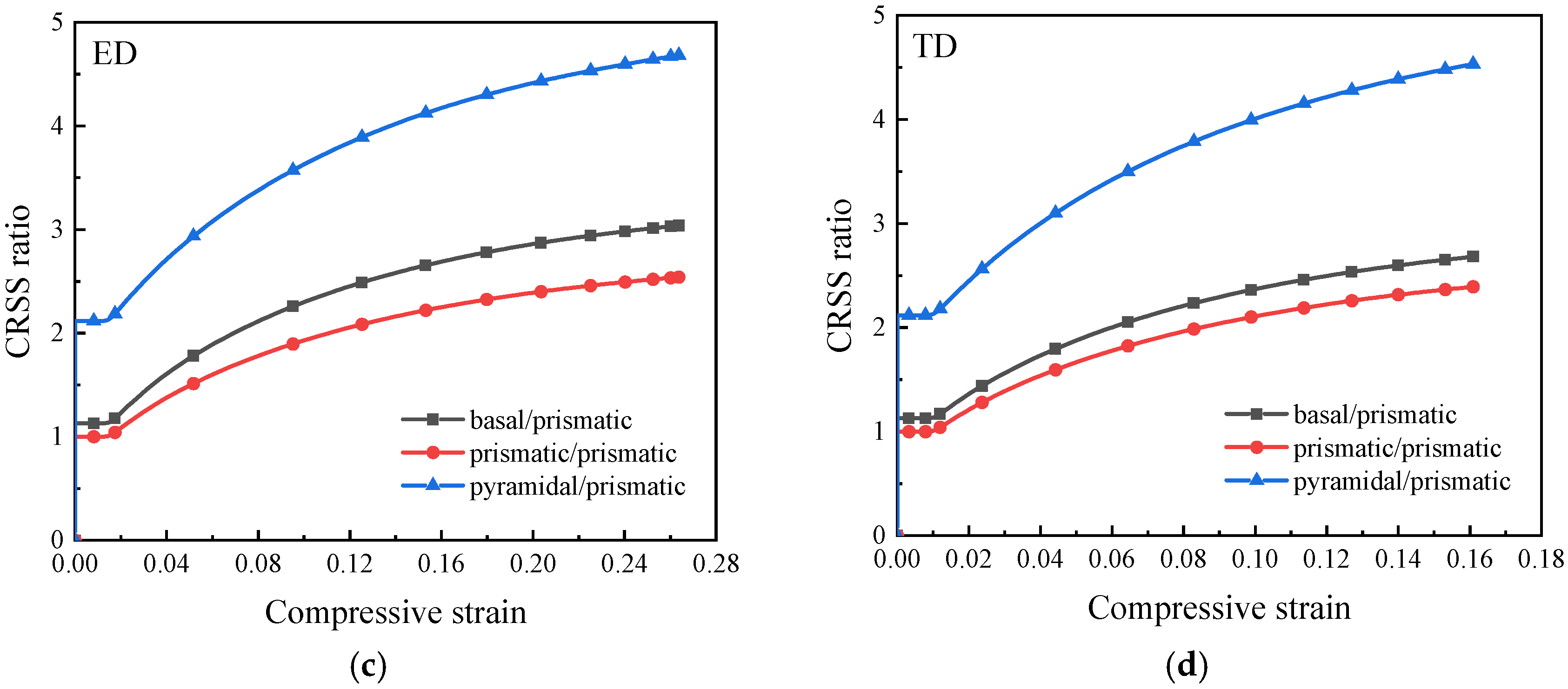
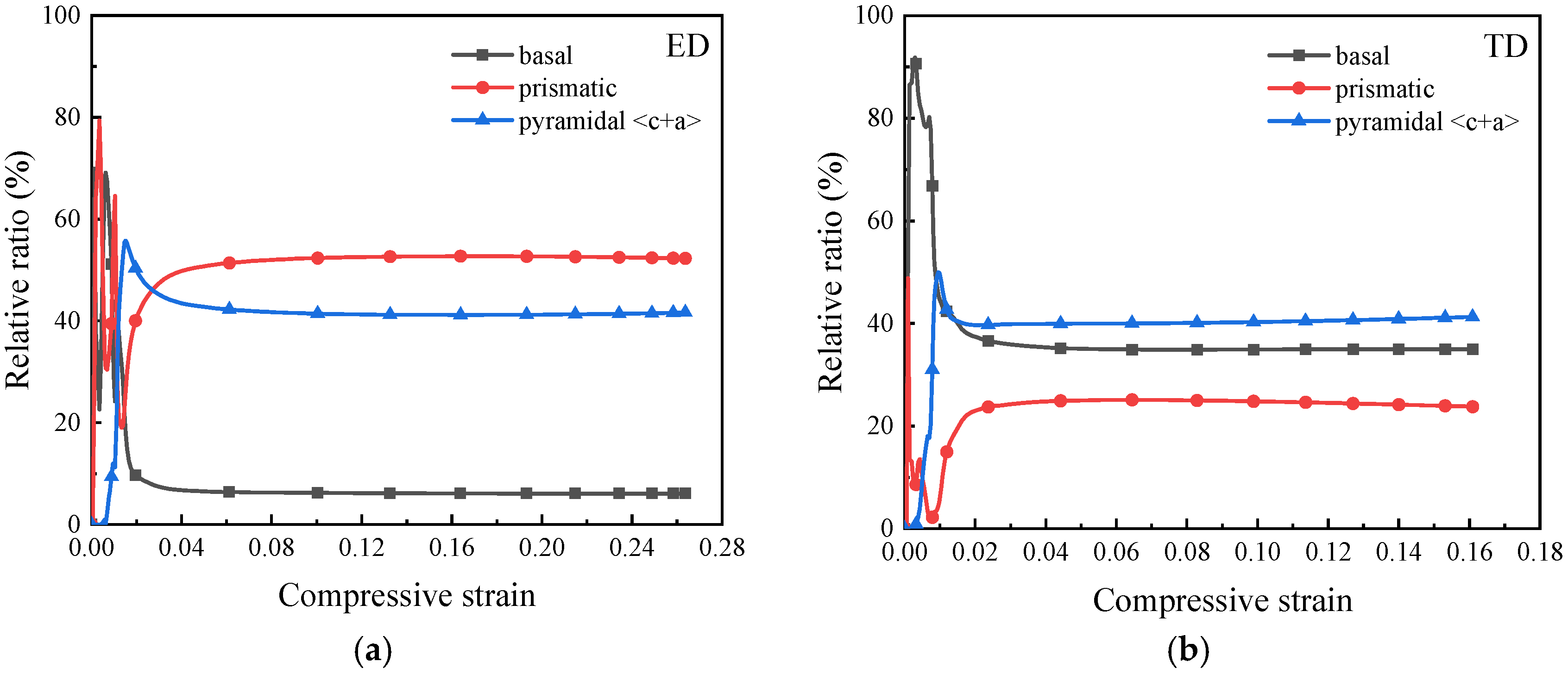
- Under dynamic compression at 2500 s−1, the TD direction exhibits a yield strength approximately 100 MPa higher than that of the ED direction. This anisotropy arises from texture-controlled differences in slip system activation. Specifically, when the c-axis is nearly parallel to the loading direction in the TD orientation, plastic deformation is predominantly accommodated by pyramidal ⟨c + a⟩ slip. Due to its higher critical resolved shear stress (CRSS), this slip mode leads to an elevated macroscopic flow stress.
- For the TC4 alloy investigated herein, adiabatic shear localization in both loading directions initiates near the peak stress. The initial texture significantly influences ASB sensitivity: ASB initiation occurs at a compressive strain of 0.13 in the TD direction, markedly earlier than in the ED direction (0.23), indicating greater ASB sensitivity in the TD orientation.
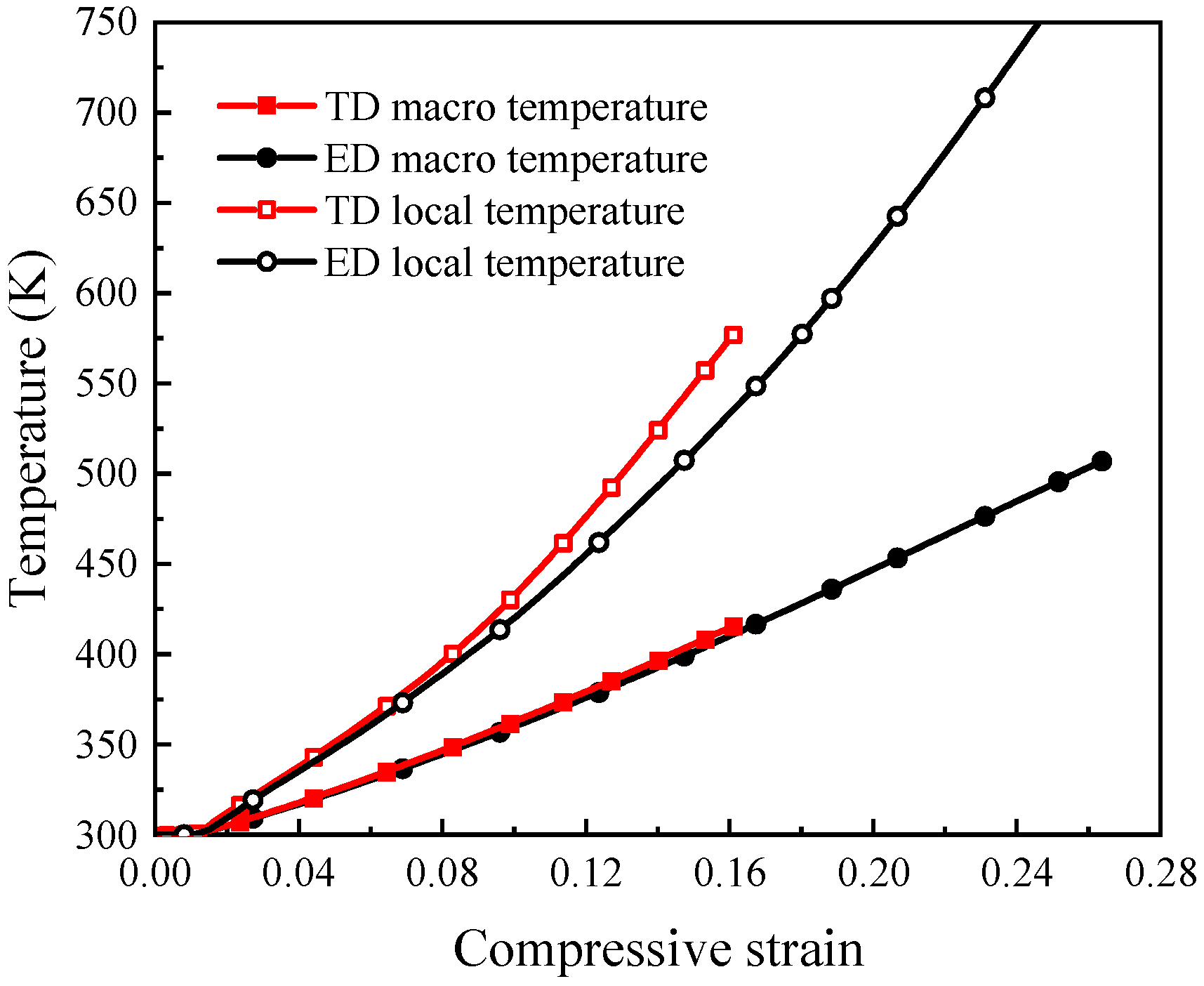
- The enhanced ASB sensitivity in the TD orientation originates from the synergistic interaction between thermomechanical coupling and texture-assisted strain localization. On the one hand, the higher flow stress promotes a more rapid temperature rise and intensified thermal softening, thereby accelerating deformation instability. On the other hand, the concentrated grain orientation distribution facilitates intergranular slip transfer, promoting the formation of continuous shear bands.
- From an engineering perspective, tailoring the microtexture to promote prismatic ⟨a⟩ slip while encouraging spatially dispersed crystallographic orientations represents an effective strategy for mitigating ASB sensitivity in Ti-6Al-4V under high strain-rate loading.
Author Contributions
Funding
Institutional Review Board Statement
Informed Consent Statement
Data Availability Statement
Conflicts of Interest
References
- Duan, C.; Cai, Y.; Wang, M.; Li, G. Microstructural study of adiabatic shear bands formed in serrated chips during high-speed machining of hardened steel. J. Mater. Sci. 2009, 44, 897–902. [Google Scholar] [CrossRef]
- Molinari, A.; Soldani, X.; Miguélez, M. Adiabatic shear banding and scaling laws in chip formation with application to cutting of Ti–6Al–4V. J. Mech. Phys. Solids 2013, 61, 2331–2359. [Google Scholar] [CrossRef]
- Antolovich, S.D.; Armstrong, R.W. Plastic strain localization in metals: Origins and consequences. Prog. Mater. Sci. 2014, 59, 1–160. [Google Scholar] [CrossRef]
- Batra, R.; Kim, C. Effect of thermal conductivity on the initiation, growth and bandwidth of adiabatic shear bands. Int. J. Eng. Sci. 1991, 29, 949–960. [Google Scholar] [CrossRef]
- Bieler, T.R.; Semiatin, S.L. The origins of heterogeneous deformation during primary hot working of Ti–6Al–4V. Int. J. Plast. 2002, 18, 1165–1189. [Google Scholar] [CrossRef]
- Mironov, S.; Murzinova, M.; Zherebtsov, S.; Salishchev, G.; Semiatin, S. Microstructure evolution during warm working of Ti–6Al–4V with a colony-α microstructure. Acta Mater. 2009, 57, 2470–2481. [Google Scholar] [CrossRef]
- Huang, B.; Miao, X.; Luo, X.; Yang, Y.; Zhang, Y. Microstructure and texture evolution near the adiabatic shear band (ASB) in TC17 titanium alloy with starting equiaxed microstructure studied by EBSD. Mater. Charact. 2019, 151, 151–165. [Google Scholar] [CrossRef]
- Chen, H.; Zeng, W.; Luo, H.; Wang, B.; Jia, R.; Xu, B.; Xu, J. The texture evolution near the shear band and corresponding impact on the microvoid nucleation and crack propagation of Ti6242s alloys under high strain rates. Mater. Sci. Eng. A 2024, 915, 147243. [Google Scholar] [CrossRef]
- McDarmaid, D.; Partridge, P. The effect of strain rate, temperature and texture on anisotropic deformation in Ti-6Al-4V. J. Mater. Sci. 1986, 21, 1525–1532. [Google Scholar] [CrossRef]
- Coghe, F.; Rabet, L.; Kestens, L. Deformation mechanisms of a commercial titanium alloy Ti6Al4V as a function of strain rate and initial texture. J. Phys. IV (Proc.) 2006, 134, 845–850. [Google Scholar] [CrossRef]
- Gu, Y.; Nesterenko, V.F. Dynamic behavior of HIPed Ti–6Al–4V. Int. J. Impact Eng. 2007, 34, 771–783. [Google Scholar] [CrossRef]
- Qin, D.; Lu, S.; Li, Y. Influence of Loading Directions on Dynamic Compressive Properties of Mill-Annealed Ti-6Al-4V Thick Plate. Materials 2022, 15, 7047. [Google Scholar] [CrossRef] [PubMed]
- Zhang, Z.; Eakins, D.E.; Dunne, F.P. On the formation of adiabatic shear bands in textured HCP polycrystals. Int. J. Plast. 2016, 79, 196–216. [Google Scholar] [CrossRef]
- Pankow, M.; Attard, C.; Waas, A. Specimen size and shape effect in split Hopkinson pressure bar testing. J. Strain Anal. Eng. Des. 2009, 44, 689–698. [Google Scholar] [CrossRef]
- Bieler, T.; Eisenlohr, P.; Zhang, C.; Phukan, H.; Crimp, M. Grain boundaries and interfaces in slip transfer. Curr. Opin. Solid State Mater. Sci. 2014, 18, 212–226. [Google Scholar] [CrossRef]
- Roters, F.; Diehl, M.; Shanthraj, P.; Eisenlohr, P.; Reuber, C.; Wong, S.L.; Maiti, T.; Ebrahimi, A.; Hochrainer, T.; Fabritius, H.O.; et al. DAMASK—The Düsseldorf Advanced Material Simulation Kit for modeling multi-physics crystal plasticity, thermal, and damage phenomena from the single crystal up to the component scale. Comput. Mater. Sci. 2019, 158, 420–478. [Google Scholar] [CrossRef]
- Ma, A.; Roters, F. A constitutive model for fcc single crystals based on dislocation densities and its application to uniaxial compression of aluminium single crystals. Acta Mater. 2004, 52, 3603–3612. [Google Scholar] [CrossRef]
- Ma, A.; Roters, F.; Raabe, D. A dislocation density based constitutive model for crystal plasticity FEM including geometrically necessary dislocations. Acta Mater. 2006, 54, 2169–2179. [Google Scholar] [CrossRef]
- Ma, A.; Roters, F.; Raabe, D. A dislocation density based constitutive law for BCC materials in crystal plasticity FEM. Comput. Mater. Sci. 2007, 39, 91–95. [Google Scholar] [CrossRef]
- Kocks, U.F.; As, A.; Mf, A. Thermodynamics and kinetics of slip. Prog. Mater. Sci. 1975, 19, 308. [Google Scholar]
- Fan, X.; Yang, H. Internal-state-variable based self-consistent constitutive modeling for hot working of two-phase titanium alloys coupling microstructure evolution. Int. J. Plast. 2011, 27, 1833–1852. [Google Scholar] [CrossRef]
- Nes, E.; Pettersen, T.; Marthinsen, K. On the mechanisms of work hardening and flow-stress saturation. Scr. Mater. 2000, 43, 55–62. [Google Scholar] [CrossRef]
- Bertin, N.; Tomé, C.; Beyerlein, I.; Barnett, M.; Capolungo, L. On the strength of dislocation interactions and their effect on latent hardening in pure Magnesium. Int. J. Plast. 2014, 62, 72–92. [Google Scholar] [CrossRef]
- Blum, W.; Eisenlohr, P. Dislocation mechanics of creep. Mater. Sci. Eng. A 2009, 510, 7–13. [Google Scholar] [CrossRef]
- Lindgren, L.-E.; Domkin, K.; Hansson, S. Dislocations, vacancies and solute diffusion in physical based plasticity model for AISI 316L. Mech. Mater. 2008, 40, 907–919. [Google Scholar] [CrossRef]
- Heldmann, A.; Hoelzel, M.; Hofmann, M.; Gan, W.; Schmahl, W.W.; Griesshaber, E.; Hansen, T.; Schell, N.; Petry, W. Diffraction-based determination of single-crystal elastic constants of polycrystalline titanium alloys. Appl. Crystallogr. 2019, 52, 1144–1156. [Google Scholar] [CrossRef]
- Shi, C.; Li, H.; Zhang, J.; Zhao, H. Optimization and validation of an inverse method for elastic constant estimation in resonant ultrasound spectroscopy. Eng. Optim. 2025, 57, 3736–3756. [Google Scholar] [CrossRef]
- Bacon, D.; Barnett, D.; Scattergood, R.O. Anisotropic continuum theory of lattice defects. Prog. Mater. Sci. 1980, 23, 51–262. [Google Scholar] [CrossRef]
- Huntington, H.B. The elastic constants of crystals. In Solid State Physics; Elsevier: Amsterdam, The Netherlands, 1958; Volume 7, pp. 213–351. [Google Scholar]
- Tang, X.; Peng, L.; Shi, S.; Fu, M. Influence of crystal structure on size dependent deformation behavior and strain heterogeneity in micro-scale deformation. Int. J. Plast. 2019, 118, 147–172. [Google Scholar] [CrossRef]
- Sedighiani, K.; Traka, K.; Roters, F.; Raabe, D.; Sietsma, J.; Diehl, M. Determination and analysis of the constitutive parameters of temperature-dependent dislocation-density-based crystal plasticity models. Mech. Mater. 2022, 164, 104117. [Google Scholar] [CrossRef]
- Johnston, W.G.; Gilman, J.J. Dislocation velocities, dislocation densities, and plastic flow in lithium fluoride crystals. J. Appl. Phys. 1959, 30, 129–144. [Google Scholar] [CrossRef]
- Köppers, M.; Herzig, C.; Friesel, M.; Mishin, Y. Intrinsic self-diffusion and substitutional Al diffusion in α-Ti. Acta Mater. 1997, 45, 4181–4191. [Google Scholar] [CrossRef]
- Kannan, V.; Thomas, G. Dislocation Climb and Determination of Stacking-Fault Energies in Al and Al-1% Mg. J. Appl. Phys. 1966, 37, 2363–2370. [Google Scholar] [CrossRef]
- Tai, Q.; Li, X.; Li, Z.; Liu, Y.; Zhu, Y.; Zeng, W. On the measurement of friction coefficient of Ti-6Al-4V titanium alloy utilizing the hot compression test of ring and FE simulation. J. Mater. Eng. 2011, 1, 23–26. [Google Scholar]
- Ma, Z.; Tang, X.; Mao, Y.; Guo, Y. The Plastic Deformation Mechanisms of hcp Single Crystals with Different Orientations: Molecular Dynamics Simulations. Materials 2021, 14, 733. [Google Scholar] [CrossRef]
- Hémery, S.; Naït-Ali, A.; Smerdova, O.; Tromas, C. Deformation mechanisms in the α phase of the Ti-6Al-2Sn-4Zr-2Mo titanium alloy: In situ experiments and simulations. Int. J. Plast. 2024, 175, 103947. [Google Scholar] [CrossRef]
- Wang, L.; Zheng, Z.; Phukan, H.; Kenesei, P.; Park, J.-S.; Lind, J.; Suter, R.; Bieler, T.R. Direct measurement of critical resolved shear stress of prismatic and basal slip in polycrystalline Ti using high energy X-ray diffraction microscopy. Acta Mater. 2017, 132, 598–610. [Google Scholar] [CrossRef]
- Williams, J.; Blackburn, M. The identification of a Non-Basal slip vector in titanium and Titanium-Aluminum alloys. Phys. Status Solidi (B) 1968, 25, K1–K3. [Google Scholar] [CrossRef]
- Yang, Y.; He, J.; Huang, J. Effect of heat treatment on adiabatic shear susceptibility of Ti–6Al–4V titanium alloy manufactured by selective electron beam melting. Mater. Sci. Eng. A 2022, 851, 143647. [Google Scholar] [CrossRef]
- Taylor, G.I.; Quinney, H. The latent energy remaining in a metal after cold working. Proc. R. Soc. Lond. Ser. A Contain. Pap. A Math. Phys. Character 1934, 143, 307–326. [Google Scholar] [CrossRef]
- Zhou, K.; Wang, H.; Chang, J.; Wei, B. Experimental study of surface tension, specific heat and thermal diffusivity of liquid and solid titanium. Chem. Phys. Lett. 2015, 639, 105–108. [Google Scholar] [CrossRef]
- Wright, T.W.; Batra, R.C. The initiation and growth of adiabatic shear bands. Int. J. Plast. 1985, 1, 205–212. [Google Scholar] [CrossRef]
- Rittel, D.; Wang, Z. Thermo-mechanical aspects of adiabatic shear failure of AM50 and Ti6Al4V alloys. Mech. Mater. 2008, 40, 629–635. [Google Scholar] [CrossRef]





| Element | Ti | Al | V | Fe |
|---|---|---|---|---|
| wt (%) | 89.1 | 6.3 | 4.3 | 0.3 |
| Parameter | Basal ⟨a⟩ | Prismatic ⟨a⟩ | Pyramidal ⟨c + a⟩ | Origin |
|---|---|---|---|---|
| 162.4 | [28,29] | |||
| 92.0 | [28,29] | |||
| 69.0 | [28,29] | |||
| 180.7 | [28,29] | |||
| 46.7 | [28,29] | |||
| 1.8 × 10⁻¹⁹ | 1.8 × 10⁻¹⁹ | 1.8 × 10⁻¹⁹ | [30] | |
| 1.2 × 10¹³ | 1.2 × 10¹³ | 1.2 × 10¹³ | (This Work) | |
| 2.95 × 10⁻¹⁰ | 2.95 × 10⁻¹⁰ | 5.53 × 10⁻¹⁰ | [30] | |
| 0.72 | 0.72 | 0.72 | (Fitted) | |
| 1.04 | 1.04 | 1.04 | (Fitted) | |
| 4.0 × 10³ | 4.0 × 10³ | 4.0 × 10³ | (This Work) | |
| 6.0 × 10⁸ | (This Work) | |||
| 1.38 × 10⁻²³ | - | |||
Disclaimer/Publisher’s Note: The statements, opinions and data contained in all publications are solely those of the individual author(s) and contributor(s) and not of MDPI and/or the editor(s). MDPI and/or the editor(s) disclaim responsibility for any injury to people or property resulting from any ideas, methods, instructions or products referred to in the content. |
© 2026 by the authors. Licensee MDPI, Basel, Switzerland. This article is an open access article distributed under the terms and conditions of the Creative Commons Attribution (CC BY) license.
Share and Cite
Zheng, C.; Fu, W.; Gong, T.; Fu, Y.; Yu, X. On the Adiabatic Shear Band Sensitivity of Extruded Ti-6Al-4V Alloy Under Dynamic Compression Along the Extrusion and Transverse Directions. Materials 2026, 19, 955. https://doi.org/10.3390/ma19050955
Zheng C, Fu W, Gong T, Fu Y, Yu X. On the Adiabatic Shear Band Sensitivity of Extruded Ti-6Al-4V Alloy Under Dynamic Compression Along the Extrusion and Transverse Directions. Materials. 2026; 19(5):955. https://doi.org/10.3390/ma19050955
Chicago/Turabian StyleZheng, Chenxing, Weikang Fu, Tianyuan Gong, Yingqian Fu, and Xinlu Yu. 2026. "On the Adiabatic Shear Band Sensitivity of Extruded Ti-6Al-4V Alloy Under Dynamic Compression Along the Extrusion and Transverse Directions" Materials 19, no. 5: 955. https://doi.org/10.3390/ma19050955
APA StyleZheng, C., Fu, W., Gong, T., Fu, Y., & Yu, X. (2026). On the Adiabatic Shear Band Sensitivity of Extruded Ti-6Al-4V Alloy Under Dynamic Compression Along the Extrusion and Transverse Directions. Materials, 19(5), 955. https://doi.org/10.3390/ma19050955