


Abstract
Recycling spent CO2 absorbents generated from direct air capture (DAC) processes is important for improving the sustainability of carbon capture technologies. This study investigates the feasibility of using a spent alkaline CO2 absorbent as a partial replacement of mixing water in cementitious materials and evaluates its effects on microstructure, strength, and durability. Mortar and concrete mixtures were prepared with replacement ratios of 0–40%. Microstructural and phase evolution were analyzed using scanning electron microscopy, X-ray diffraction, and thermogravimetric analysis, while mechanical performance was assessed through compressive and flexural strength tests. Durability was evaluated by freezing–thawing resistance, chemical resistance in acidic environments, and accelerated carbonation tests. The results show that low replacement ratios (10–20%) improve early-age strength due to CaCO3-induced micro-filling and nucleation effects, while maintaining comparable long-term strength to the reference mixture. In contrast, higher replacement ratios (≥30%) cause excessive carbonation, C–S–H decalcification, increased micro-porosity, and strength reduction. Overall, spent CO2 absorbents can be effectively recycled in cementitious materials within a 10–20% replacement range.
1. Introduction
The global increase in carbon dioxide (CO2) emissions is accelerating climate change, and the resulting extreme weather events have emerged as a top priority for the international community. In response to these issues, the UN established a global cooperation framework by adopting the UN Framework Convention on Climate Change (UNFCCC) [1], and the 2015 Paris Agreement set a collective goal to limit the global average temperature increase to well below 2 °C above pre-industrial levels, and to pursue efforts to limit the increase to 1.5 °C [2]. Since then, each country has established reduction roadmaps and expanded CO2 emission reduction technologies in the energy and industrial sectors.
Recently, clean energy sources that minimize carbon emissions, such as solar, wind, and nuclear power, have rapidly expanded, and simultaneously, Carbon Capture, Utilization, and Storage (CCUS) technology has become a core strategy for mitigating greenhouse gas emissions from large-scale sources [3,4]. Conventional CCUS technology typically targets flue gases emitted from high CO2 concentration points, such as refinery processes or thermal power plants, and the captured CO2 is transported via pipeline or vehicle for utilization or permanent storage [5,6]. However, because these technologies are primarily applied to specific high-concentration emission sources, there is a limitation in fundamentally addressing the global CO2 accumulation problem [7].
To compensate for this limitation, Direct Air Capture (DAC) technology is emerging. DAC is a technology that directly separates low-concentration CO2 (approx. 0.04 vol% from the atmosphere without reliance on specific emission sources, offering fewer geographical constraints and being highly effective in removing residual CO2 that cannot be managed by conventional source-base CCUS technologies [8,9,10]. A DAC system consists of three stages: (1) contact between air and the sorbent, (2) CO2 capture through absorption or adsorption, and (3) sorbent regeneration and CO2 recovery. Since the partial pressure of CO2 in the atmosphere is only about 40 Pa [11], strong alkaline absorbents (such as Ca(OH)2, KOH, NaOH, and so forth) with high CO2 affinity are primarily used in the DAC process [11,12].
These strong alkaline absorbents have the advantage of being inexpensive and mass-producible, recovering CO2 in the form of carbonates (calcium carbonate, sodium carbonate, etc.) after reaction [7]. However, only approximately 20% of the sorbent used in the DAC system can be regenerated and reused, while the remaining 80% reacts with impurities during the CO2 capture process, leading to the problem of being classified as industrial waste [13,14]. Because the regeneration process also involves additional energy consumption and CO2 emissions [14], the importance of DAC sorbent recycling technology is gradually increasing. In this respect, the strategy of recycling spent sorbents into other industries becomes a critical solution that can enhance the circularity of DAC operation and offer an incidental carbon storage effect [15].
Specifically, the cement concrete sector is known to be a high-potential business area capable of accepting alkaline substances and carbonates. However, despite this characteristic, studies systematically analyzing the effects of directly applying spent DAC sorbents to cementitious materials on their strength, durability, and carbonation reaction are very limited.
Therefore, this study aims to evaluate the recyclability of the spent sorbent (recycled CO2 sorbent) generated from the DAC process by applying it as a replacement in cement mortar and concrete. By comprehensively reviewing the effects of the spent sorbent on the hydration reaction, carbonation process, microstructure, strength, and durability characteristics of cementitious materials, this research intends to provide fundamental data for resolving the issue of DAC sorbent disposal and for developing construction materials with CO2 storage capability.
2. Materials and Methods
2.1. Materials
2.1.1. Binder
The binder used in this study consisted of ordinary Portland cement (OPC) complying with ASTM C150 [16] ground granulated blast-furnace slag (GGBS). The physical and chemical properties of the OPC and GGBS used in the experiment are summarized in Table 1 and Table 2.
Table 1.
Physical and chemical properties of OPC [17].
Table 2.
Physical and Chemical properties of GGBS.
2.1.2. Spent CO2 Absorbent
The spent CO2 absorbent used in this study was an alkaline liquid absorbent collected from a DAC device after capturing approximately 99% of atmospheric CO2, at which point it could no longer be regenerated and was designated for disposal. The absorbent retained strong alkalinity after the capture cycle, exhibiting a measured pH of approximately 13.1. In this study, the spent CO2 absorbent was utilized in its original liquid form without any additional pretreatment or processing.
2.1.3. ISO Graded Standard Sand
The sand consisted of rounded particles with a silicon dioxide content of 98% or more, and the particle size complied with the specification of KS L ISO 679 [18] Methods of testing cements—Determination of strength. The particle size distribution of ISO graded standard sand is shown in Table 3.
Table 3.
Particle size distribution of ISO graded standard sand [18].
2.1.4. Aggregate
In this study, fine aggregate with a particle size smaller than 5 mm was utilized, while coarse aggregate consisted of crushed granite with particle sizes ranging from 5 mm to 25 mm, sourced from Chungcheongnam-do Province in South Korea. The physical properties of the fine and coarse aggregates are presented in Table 4 and Table 5, respectively.
Table 4.
Physical properties of fine aggregate [17].
Table 5.
Physical properties of coarse aggregate [17].
2.1.5. Admixture
The high-range AE water-reducing agent of the poly carboxylic acid manufactured by “K” company in France was used as the admixture to improve the dispersion of cement and fine entraining of the air. Table 6 shows the physical properties of the admixture.
Table 6.
Physical properties of admixtures.
2.2. Mix Proportion and Preparation of Mortar Test Specimens
2.2.1. Mix Proportion of Mortar
The mortar mixtures were designed in accordance with ISO 679 [19], using a binder-to-sand ratio of 1:3 and a water-to-binder ratio (W/B) of 50%. The spent CO2 absorbent was incorporated by replacing the mixing water at replacement ratios of 0%, 10%, 20%, 30%, and 40%. The detailed mix proportions are summarized in Table 7.
Table 7.
Mix proportion of Mortar.
2.2.2. Preparation of Mortar Specimens
To measure mortar compressive strength, test specimens of 40 mm × 40 mm × 160 mm were prepared according to ISO 679. After curing for 24 h in a constant temperature and moisture room, the mortar underwent removal of form followed by water curing at 20 °C. Compressive strength was measured for test specimens at varying ages.
2.2.3. Microstructural and Chemical Characterization
The microstructural characteristics of the recycled CO2 sorbent–incorporated mortar were examined using scanning electron microscopy (SEM; secondary electron mode, 10–30 kV) to observe the morphology of hydration products and carbonation-induced microstructural changes. X-ray diffraction (XRD) analysis was conducted to identify crystalline phases such as portlandite, calcite, and aragonite and to evaluate phase evolution associated with CO2 replacement. Thermogravimetric analysis (TGA) was performed under a nitrogen atmosphere to identify characteristic mass-loss ranges associated with dehydration, portlandite decomposition, and CaCO3 decarbonation, allowing quantitative evaluation of the thermal stability and phase composition of the hydration and carbonation products.
2.2.4. Mortar Test Method
The flow test was conducted after mixing of mortar in accordance with American Society for Testing and Materials (ASTM) Standards: C1437 Standard Test Method for Flow of Hydraulic Cement Mortar [20]. The flexural strengths and compressive strength tests were performed according to ISO 679, and measurements were taken at age 3, 7 and 28 days. A universal testing machine (UTM) of 100 tons was used to measure the compressive strength by age.
2.3. Mix Proportion and Preparation of Concrete Test Specimens
2.3.1. Mix Proportion of Concrete
The concrete mixtures were designed with a target compressive strength of 30 MPa and a W/B of 48.6%. The binder consisted of OPC and GGBS, blended at a 50:50 ratio by mass. To evaluate the influence of the spent CO2 absorbent on concrete performance, the absorbent was incorporated as a partial replacement of mixing water at replacement ratios of 0% (Plain), 10%, and 20%. The detailed mix proportions are presented in Table 8. A polycarboxylic acid–based high-range water-reducing admixture was used to achieve a slump of 150 ± 25 mm and an air content of 4.5 ± 1.5%.
Table 8.
Mix proportion of Concrete.
2.3.2. Preparation of Concrete Specimens
Concrete specimens were prepared to evaluate the mechanical performance and durability of mixtures incorporating the Recycled CO2 Sorbent. Two specimen geometries were used depending on the required test: cylindrical specimens (100 mm in diameter and 200 mm in height) for compressive strength and chemical resistance evaluations, and beam specimens (100 × 100 × 400 mm) for flexural strength and accelerated carbonation tests. For each experimental program, approximately 20 specimens were fabricated to ensure statistical reliability and reproducibility of the results. After casting, all specimens were consolidated using an internal vibrator and stored for 24 h in a controlled-temperature chamber (20 ± 2 °C). Subsequently, the molds were removed, and the specimens were water-cured at 20 ± 2 °C until the designated test age.
2.3.3. Compressive and Flexural Strength Test
The compressive strength was measured using a cylindrical specimen with dimensions of ϕ100 × 200 mm as per KS F 2405 “Test Method for Compressive Strength of Concrete” [21]. The specimen was tested using a 100-ton universal testing machine (UTM) after curing under water for 28 days at 20 ± 5 °C.
2.3.4. Flexural Strength Test
The flexural Strength was measured using a rectangle specimen with dimensions of 100 × 100 × 400 mm as per KS F 2408 “Test Method for Flexural Strength for Concrete” [22]. The specimen was tested using a 100-ton universal testing machine (UTM) after curing under water for 28 days at 20 ± 5 °C.
2.3.5. Freezing–Thawing Test
As for freezing–thawing tests, freezing–thawing was evaluated in accordance with method A (rapid underwater freezing–thawing tests) in KS F 2456 “Testing Method for Resistance of Concrete to Rapid Freezing–thawing” [23]. After curing in an underwater environment of 20 ± 2 °C up to the age of 14 days, the relative dynamic modulus of elasticity was measured every 30 cycles by the dynamic modulus of elasticity measurement device. was calculated by using the following Equation (1).
where : relative dynamic modulus of elasticity, after C cycles of freezing and thawing (%), : fundamental transverse frequency at 0 cycles of freezing and thawing, and : fundamental transverse frequency after C cycles of freezing and thawing.
2.3.6. Chemical Resistance Test
Chemical resistance tests were performed in accordance with the test methods in ASTM C267-01 “Standard Test Method for Chemical Resistance of Mortars, Grouts, and Monolithic Surfacings and Polymer Concretes” [24]. After curing in a wet state at 20 ± 2 °C for 28 days, the specimens were immersed for 84 days in a 5% HCl solution and a 5% H2SO4, respectively. After 3, 7, 14, 28, and 56 days, the specimens were taken out, washed with tap water to remove the eroded and scaled parts, and dried in air to measure the mass change rate. was calculated using the following Equation (2).
where C: conditioned weight of the specimen (g), W: weight of specimen after immersion (g).
2.3.7. Accelerated Carbonation Test
The accelerated carbonation resistance tests were performed in accordance with KS F 2584, “Standard Test Method for Accelerated Carbonation of Concrete” [25]. The specimens were demolded after 24 h and cured in water for 4 weeks. After curing, they were stored for an additional 4 weeks in a constant temperature and humidity room with a relative humidity of 65 ± 5% and a temperature of 20 ± 2 °C.
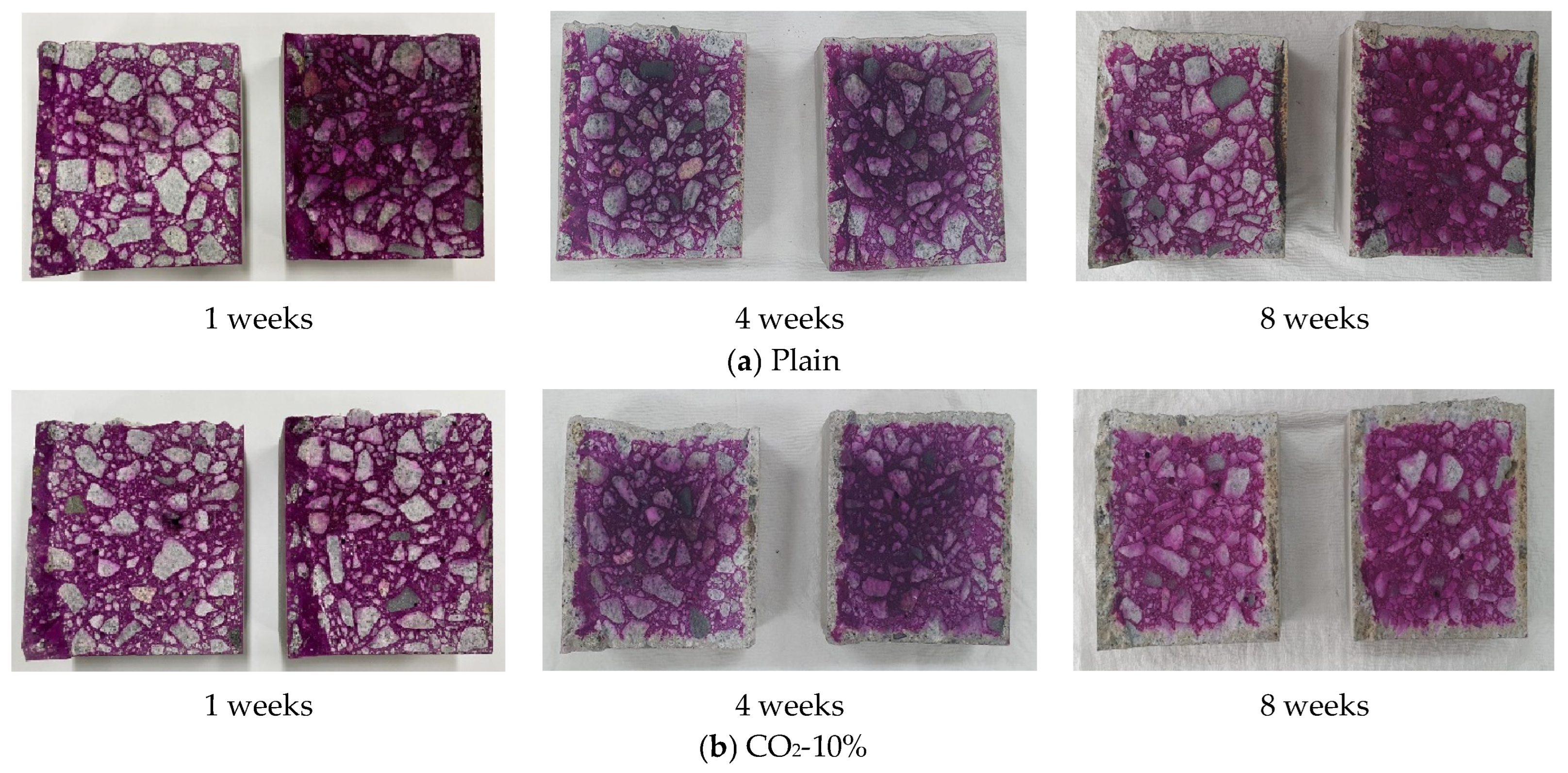
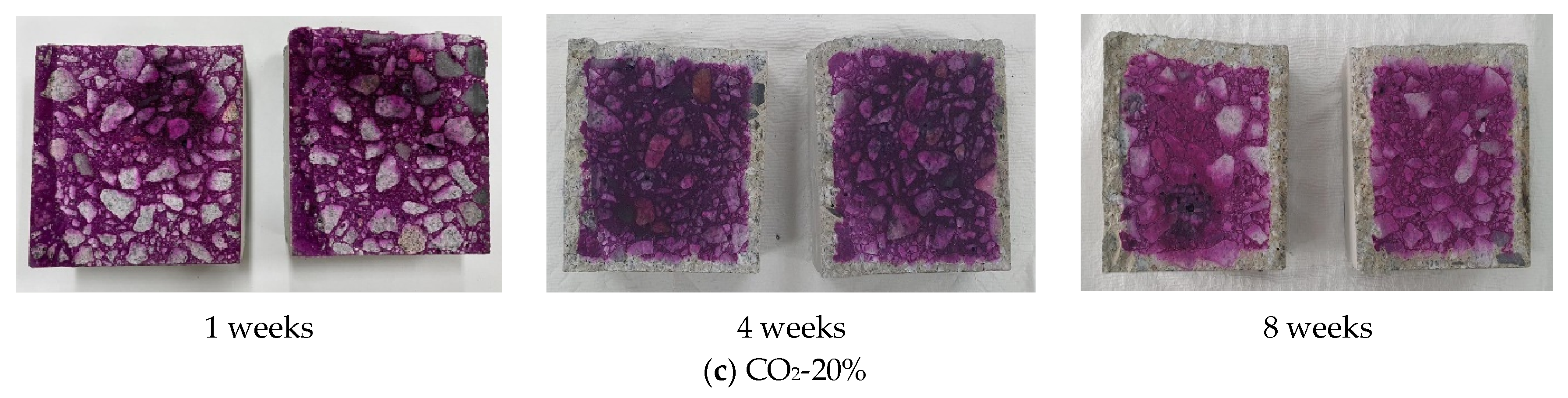
The specimens were then subjected to accelerated carbonation tests at a temperature of 20 °C, a relative humidity of 50%, and a CO2 concentration of 5%. At 1, 4, and 8 weeks, the specimens were split, and a 1% phenolphthalein solution was sprayed on the freshly fractured surface to measure the carbonation penetration depth.
3. Experiment Results and Analysis
3.1. SEM Result
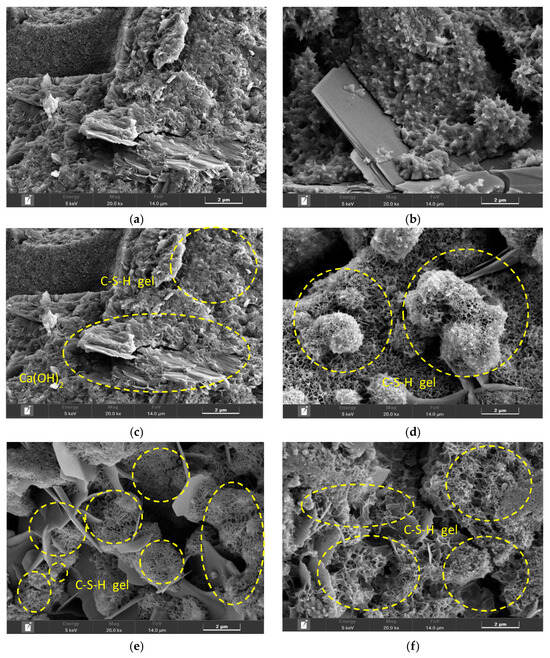
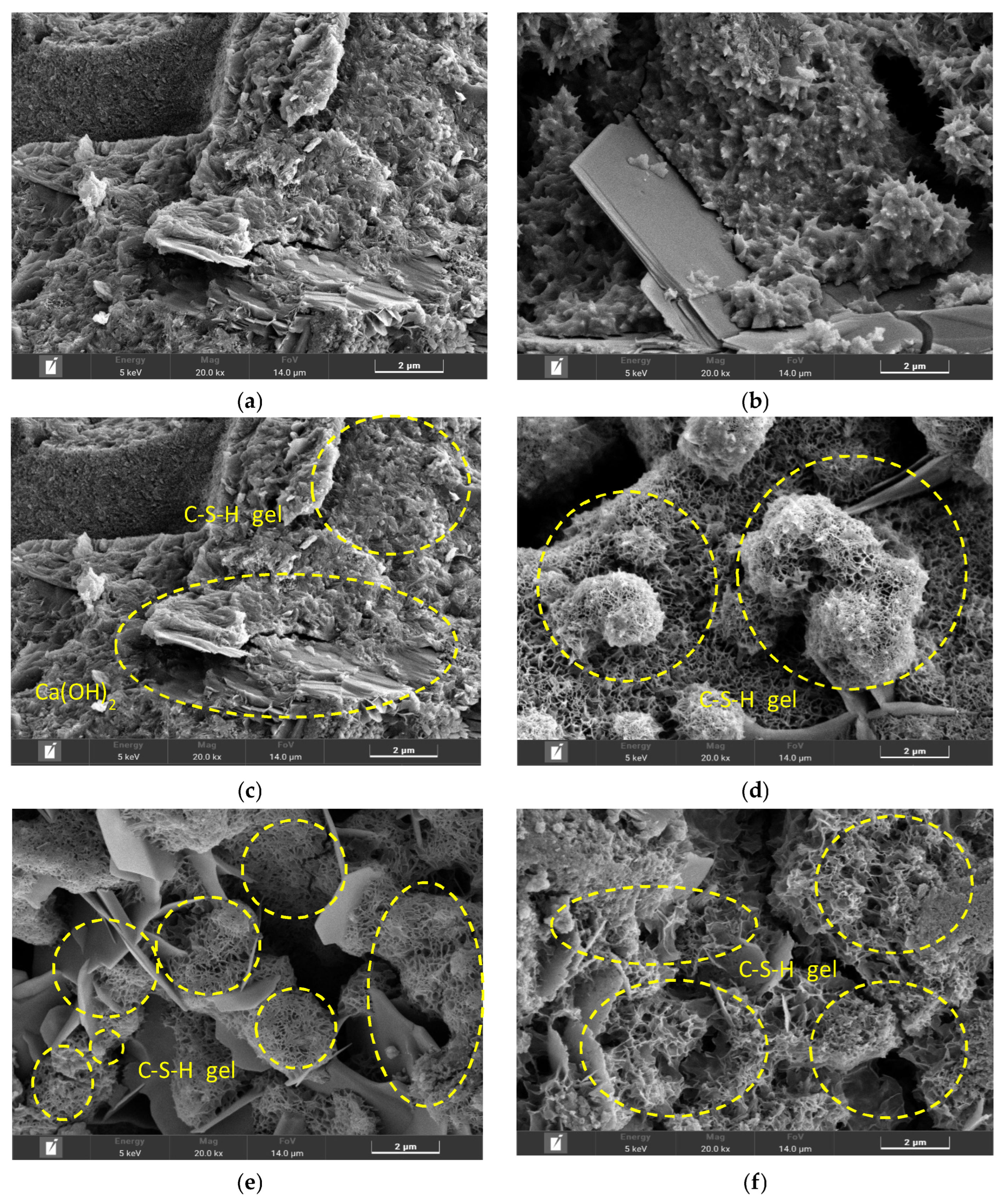
Figure 1 shows the microstructure characteristics of mortar with respect to the CO2 replacement ratio. The Plain specimen exhibited the typical morphology of mortar that underwent normal hydration, with residual ettringite structures (Figure 1a) and dense, amorphous C–S–H gel (Figure 1b) observed. Overall, the matrix maintained a dense and continuous form, suggesting a state with minimal external carbonation influence. In contrast, the CO2-replaced specimens (Figure 1c–f) showed distinct microstructural changes that may be associated with carbonation reactions.
Figure 1.
SEM images of mortar particles (a) Plain-1; (b) Plain-2; (c) CO2-10%; (d) CO2-20%; m (e) CO2-30%; (f) CO2-40%.
As the CO2 content increased, CaCO3 precipitates were increasingly observed on the surface of the cement and slag hydration products, evolving from an initial fine flaky form to an increasingly agglomerated precipitated structure. While this CaCO3 formation appears to increase the apparent solid phase within the matrix, it should be noted that this observation is based on morphological features rather than direct compositional quantification. The CaCO3 formation is therefore interpreted as resulting not from new Ca ingress but from the conversion of existing Ca from C–S–H gel and Ca(OH)2 into carbonates via reaction with CO2 [26].
In cementitious hydrates, Ca(OH)2 directly reacts with CO2 to convert into CaCO3
Ca(OH)2 + CO2 → CaCO3
Furthermore, the degree of decalcification in slag-based C–S–H gel is expected to vary with CO2 concentration, with a larger fraction of Ca potentially converting to carbonate species as the CO2 content increases. This process can be conceptually described by the following reactions:
3CaO · 2SiO2 · 3H2O + CO2 → CaCO3 + 2CaO · 2SiO2 · 3H2O
3CaO · 2SiO2 · 3H2O + 2CO2 → 2CaCO3 + CaO · 2SiO2 · 3H2O
3CaO · 2SiO2 · 3H2O + 3CO2 → 3CaCO3 + 2SiO2 + 3H2O
As illustrated by these reaction schemes, progressive Ca depletion from C–S–H is theoretically expected with increasing CO2 exposure. Consequently, the formation of CaCO3 may be accompanied by the transformation of residual C–S–H into an SiO2-rich skeleton structure, which has been reported in previous studies to reduce gel stability [26,27]. Therefore, although an increased presence of CaCO3 is observed at higher CO2 replacement ratios, this phenomenon is discussed here as a plausible outcome of C–S–H decalcification, rather than a directly quantified change in Ca/Si ratio.
At CO2 replacement ratios of 30% or higher, SEM images show morphological features characterized by reduced apparent continuity of the C–S–H gel and the presence of localized porous regions. These features suggest a possible degradation of the original microstructural integrity, which may be associated with continuous Ca migration and consumption during the carbonation process [28].
3.2. XRD Result
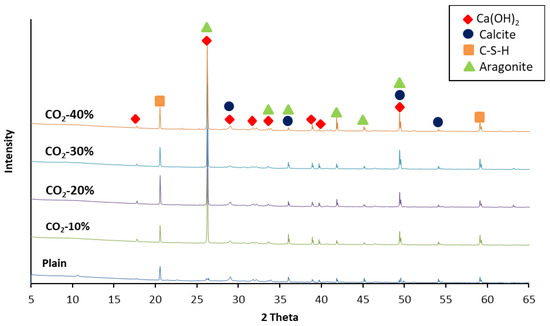
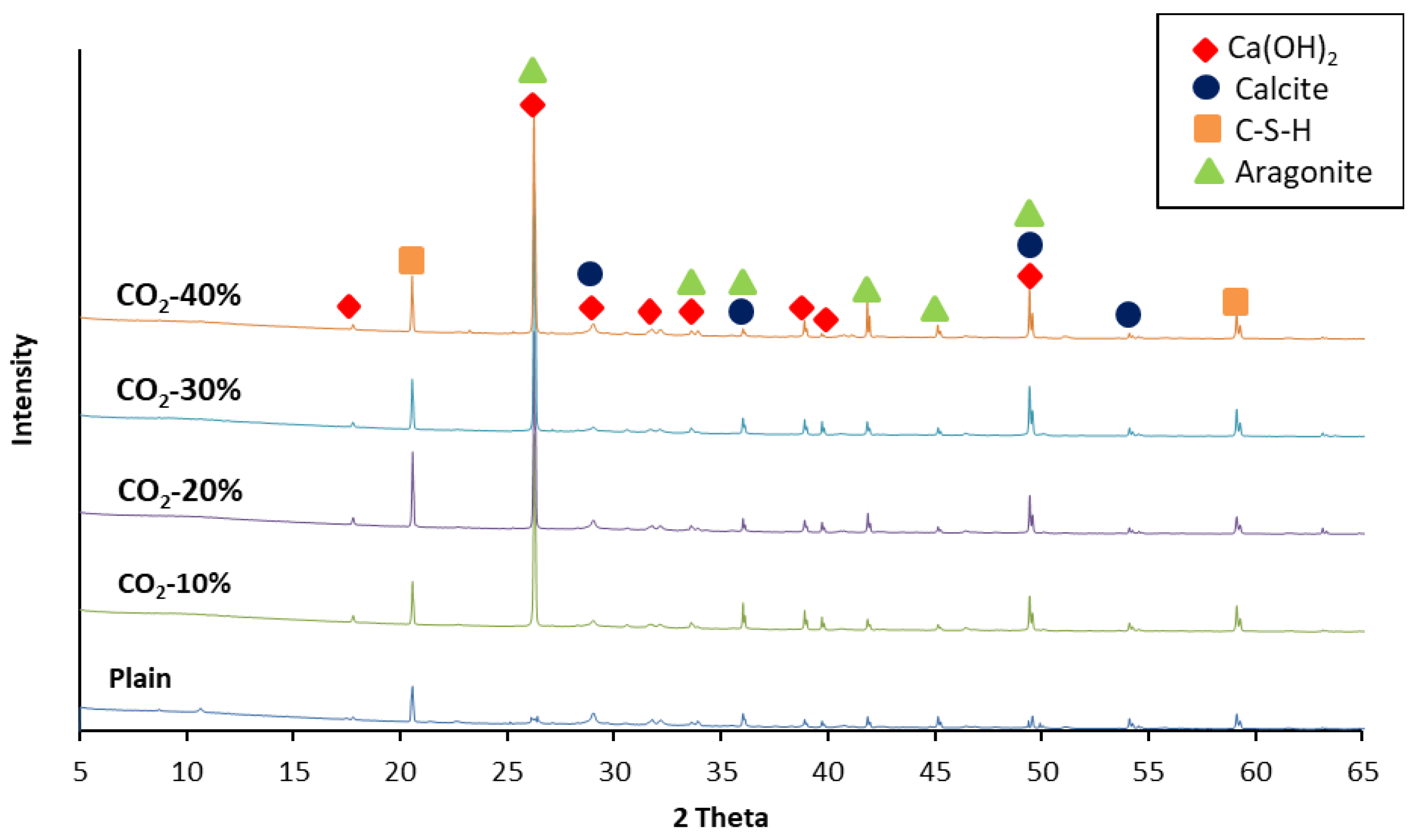
The XRD analysis results (Figure 2) clearly showed phase changes induced by carbonation reactions within the specimens as the CO2 incorporation ratio increased. In the Plain specimen, strong diffraction peaks corresponding to portlandite (Ca(OH)2, PDF No. 44-1481) were observed at 18°, 34°, 47°, and 50°, whereas the diffraction peaks associated with calcium carbonate phases, including calcite (CaCO3, PDF No. 05-0586) and aragonite (CaCO3, PDF No. 41-1475), were very minimal.
Figure 2.
XRD spectra of mortar particles.
This limited presence of CaCO3 phases in the Plain specimen is attributed to slight natural carbonation during mixing, curing, and handling, the presence of carbonate impurities originating from ground granulated blast furnace slag (GGBS), and the partial decomposition of minor calcium-containing hydrates [29].
These results indicate that the hydration reaction proceeded normally in the Plain specimen, leading to well-developed portlandite and C–S–H gel as the primary binding phases.
In specimens with 10–20% CO2 incorporation, the intensity of the portlandite peaks (Ca(OH)2, PDF No. 44-1481) gradually decreased, while faint diffraction peaks corresponding to calcite (29.4°, 39.4°, and 47.5°; PDF No. 05-0586) and aragonite (26.2° and 27.2°; PDF No. 41-1475) began to appear. With 30% CO2 incorporation, these carbonate-related peaks became more distinct, suggesting that active carbonation of portlandite and partial carbonation of C–S–H occurred simultaneously [30]. This observation is consistent with previous studies reporting that accelerated carbonation environments favor the formation of aragonite.
For the specimen with 40% CO2 incorporation, the diffraction peaks of portlandite (PDF No. 44-1481) sharply diminished, while the peaks corresponding to aragonite (PDF No. 41-1475) and calcite (PDF No. 05-0586) distinctly increased and intensified, respectively. This behavior reflects the typical characteristics of high-concentration carbonation reactions, in which rapid carbonation promotes dominant aragonite precipitation, followed by partial transformation into the thermodynamically more stable calcite phase [31,32]. This interpretation is consistent with the TGA results, which showed increased mass loss in the 530–650 °C range associated with aragonite decomposition and a reduced proportion of mass loss above 650 °C corresponding to calcite decomposition.
3.3. TGA Result
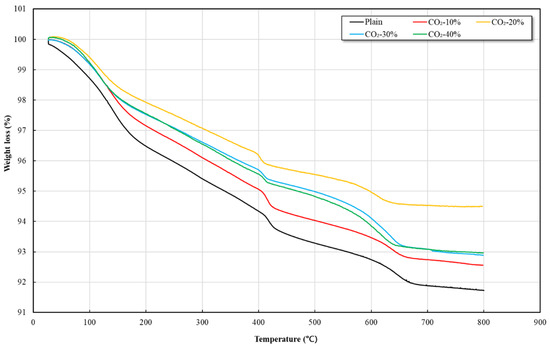
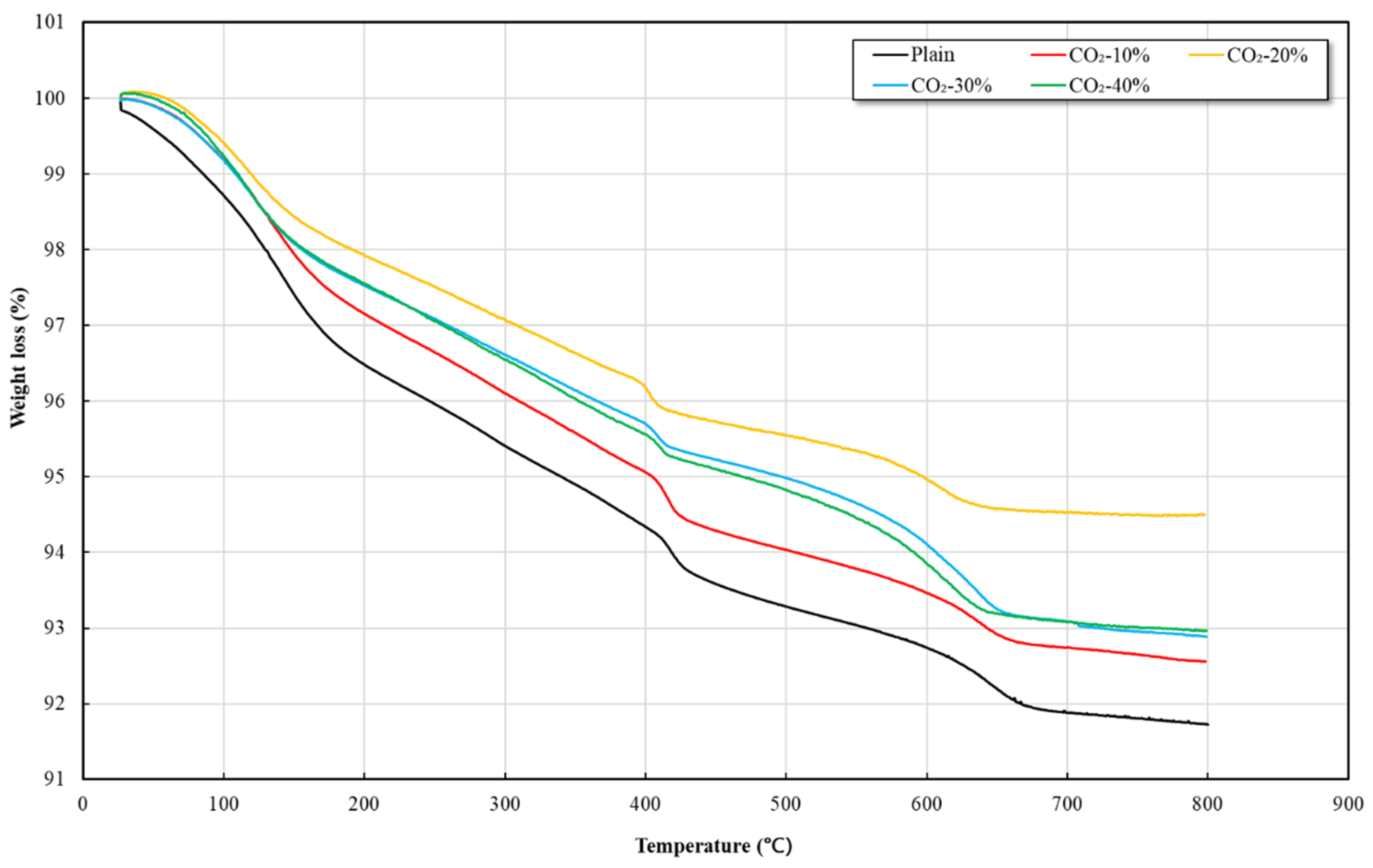
Figure 3 shows the thermogravimetric analysis (TGA) results for each mortar mix, confirming a distinct mass loss pattern separated into three temperature ranges across all specimens. The first range (approximately 100–150 °C) corresponds to the evaporation of free water and weakly bound adsorbed water, including the release of physically bound water from hydrates such as C–S–H gel and ettringite. The second range (approximately 400–430 °C) is mainly associated with the thermal decomposition of Ca(OH)2, and the mass loss in this range shows mix-specific variations depending on the degree of carbonation. The third range (approximately 500–670 °C) is generally associated with the decarbonation of carbonate-containing phases.
Figure 3.
TGA Curves of mortar particles.
CaCO3 exhibits different thermal decomposition behaviors depending on its polymorphic form. Calcite, which is thermodynamically the most stable crystalline phase, typically decomposes at temperatures above approximately 650 °C, whereas aragonite decomposes over a relatively lower temperature range of approximately 530–650 °C. Vaterite, a metastable phase, is rarely observed under typical cementitious conditions due to its tendency to transform into aragonite or calcite at relatively low temperatures.
In the CO2-incorporated mortars investigated in this study, the mass loss observed in the 530–650 °C range was noticeably higher than that of the Plain specimen, while the relative contribution of mass loss at temperatures above 650 °C remained comparatively limited. This trend suggests that carbonate phases decomposing at lower temperatures were more pronounced in the CO2-incorporated specimens, although precise quantification of individual CaCO3 polymorphs cannot be achieved based on TGA data alone.
In the Plain specimen, a gradual mass loss was observed around approximately 600 °C. This behavior is attributed to the combined effects of multiple factors, including the decomposition of small amounts of CaCO3 formed through natural atmospheric carbonation, carbonate impurities originating from GGBS, and the high-temperature decomposition of certain hydration products. Na et al. [33] reported that hydrates such as C–S–H and C–(A)–S–H undergo dehydration and partial decomposition primarily above 600 °C, which is consistent with the gradual mass loss trend observed in the Plain specimen. Accordingly, the mass loss in this temperature range should be interpreted as a combined thermal response of impurity carbonates, amorphous calcium carbonate, and hydrate decomposition rather than as evidence of a dominant crystalline carbonate phase.
The CO2-incorporated specimens consistently exhibited increased mass loss in the 530–650 °C range, which is in agreement with previous studies reporting that aragonite-related carbonation products tend to decarbonate at relatively lower temperatures under accelerated carbonation conditions. Li et al. [34] and Yaseen et al. [35] reported that under high CO2 concentrations, partial carbonation of C–S–H occurs alongside Ca(OH)2 carbonation, often resulting in the initial formation of low-crystallinity aragonite, with subsequent transformation toward calcite over time. The mass loss in the 650–800 °C range, commonly associated with calcite decomposition, remained relatively small, indicating that high-temperature carbonate decomposition was less pronounced within the sensitivity limits of the present TGA, consistent with the findings of Madadi [36].
Overall, the TGA results indicate qualitative differences in the thermal decomposition behavior of carbonated phases between the Plain and CO2-incorporated specimens. These observations suggest that accelerated carbonation conditions favor the formation of carbonate phases that decompose at relatively lower temperatures; however, the relative proportions of individual CaCO3 polymorphs cannot be quantitatively resolved based on TGA data alone. The potential long-term transformation of these phases toward thermodynamically stable calcite remains consistent with existing literature [31,32].
3.4. Mortar Strength Test Result
The flowability of the fresh mortar was evaluated using the flow table test in accordance with ASTM C1437. The reference mixture (Plain) exhibited a flow diameter of 220 mm, indicating adequate workability. As the replacement ratio of the spent CO2 absorbent increased, the flow diameter gradually decreased to 200 mm and 190 mm for the CO2-10% and CO2-20% mixtures, respectively.
A more pronounced reduction in flowability was observed at higher replacement levels, with the flow diameter decreasing to 170 mm for CO2-30% and further to 160 mm for CO2-40%. This abrupt reduction beyond the 30% replacement level may be associated with the disruption of the glassy layer of GGBS, which can accelerate early-age hydration and heat evolution, thereby increasing the viscosity of the fresh mortar.
These results indicate that the spent CO2 absorbent significantly influences mortar workability and should be considered a key process parameter in mixture proportioning, particularly at higher replacement levels.
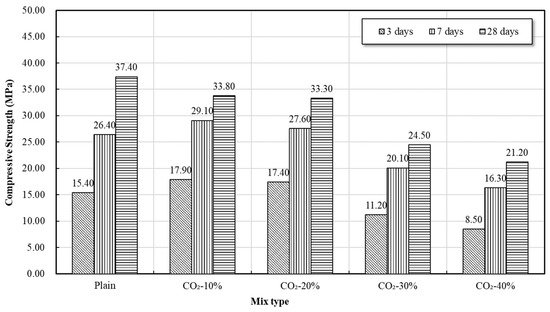
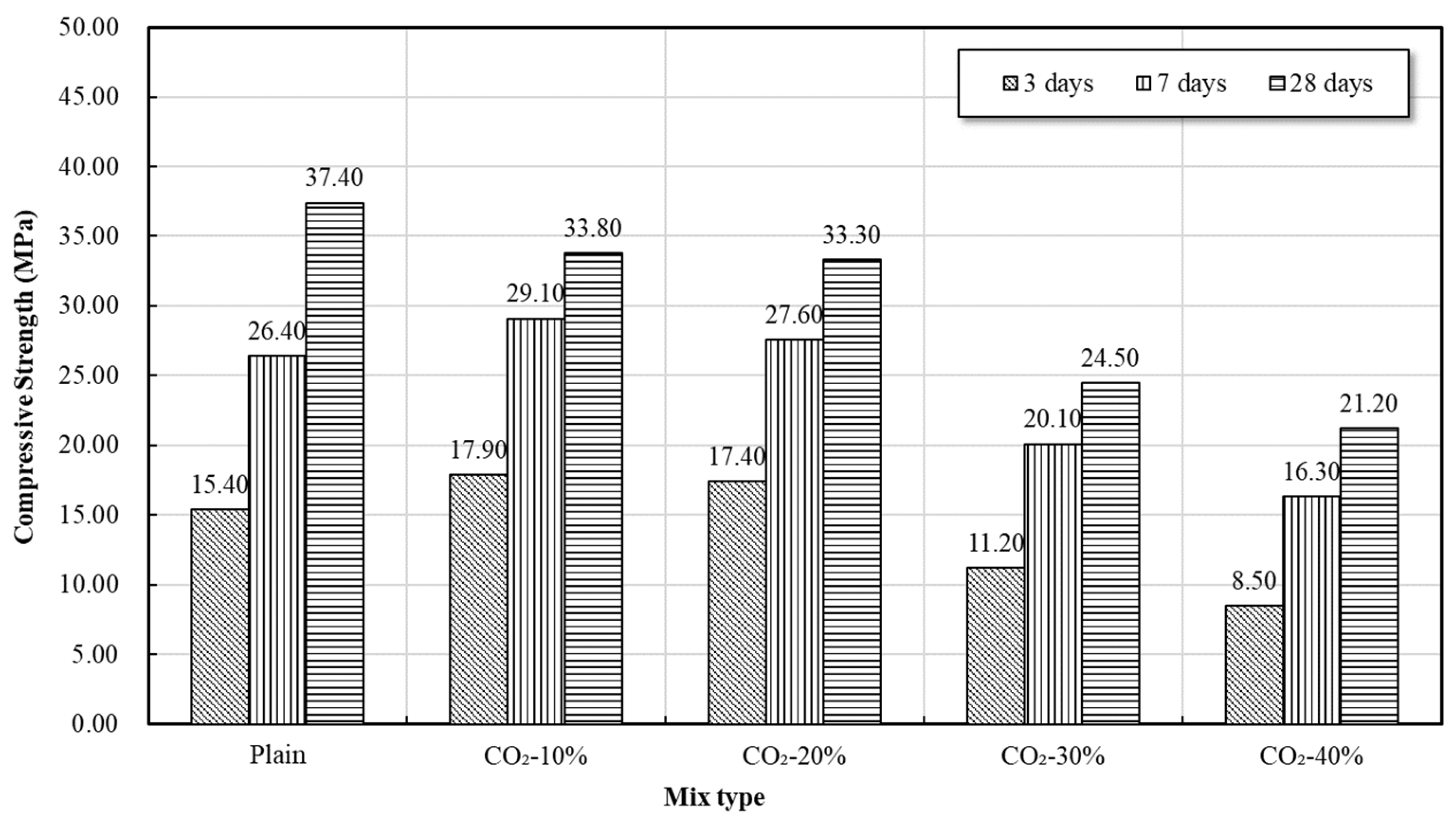
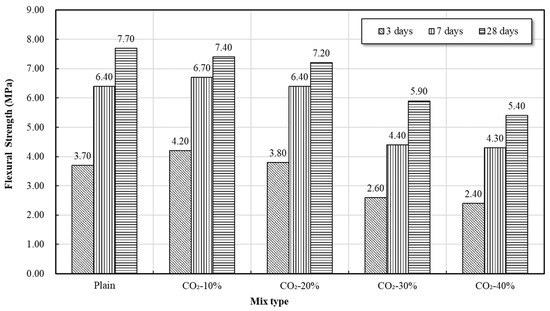
Figure 4 and Figure 5 show the change in compressive and flexural strength of mortar according to the CO2 replacement ratio. Overall, the strength tended to decrease as the CO2 replacement ratio increased, with a sharp drop in strength confirmed particularly at 30% or more CO2 replacement. Conversely, the 10% and 20% replacement mixes showed the characteristic of increased early-age strength (3-day and 7-day) compared to Plain.
Figure 4.
Compressive strength of mortar.
Figure 5.
Flexural strength of mortar.
The CaCO3 formed inside the mortar by CO2 injection simultaneously induces a carbonation reaction with the hydration reaction. Primarily, the two major hydrates, C–S–H (Calcium Silicate Hydrate) and Ca(OH)2 (Calcium Hydroxide), contribute to CaCO3 formation during the carbonation process. While some C3A (Calcium Aluminate) and C4AF (Calcium Aluminoferrite) can also react with CO2 to form CaCO3, their contribution to the total CaCO3 formation is known to be relatively small.
Specifically, the crystalline phase of CaCO3 varies depending on its origin: CaCO3 formed from Ca(OH)2 is generally calcite, while CaCO3 generated by the decalcification of C–S–H is typically formed as aragonite. Based on the XRD patterns and TGA thermal decomposition trends, the intensity of aragonite-related peaks and the mass loss in the 530–650 °C range increased with the CO2 replacement ratio, while the relative contribution of calcite-related decomposition at higher temperatures tended to decrease.
Aragonite tends to grow into needle-like crystals with higher aspect ratios than calcite, which has been reported to potentially disrupt matrix continuity and induce localized microstructural heterogeneity. This interpretation is consistent with the morphological features observed in the SEM images, such as reduced apparent continuity of the C–S–H gel and the presence of localized porous regions. Accordingly, when the CO2 replacement ratio exceeded 30%, the observed reduction in compressive and flexural strength may be associated with cumulative carbonation-related microstructural changes, including Ca(OH)2 consumption, partial decalcification of C–S–H, and the formation of carbonate phases decomposing at relatively lower temperatures.
On the other hand, a tendency of increased early-age strength compared to Plain was observed at CO2 replacement ratios of 10–20%, which is interpreted as a result of the combined physical and chemical effects of carbonation byproducts in a low-concentration CO2 environment.
First, the fine CaCO3 crystals formed through the initial carbonation reaction exert a micro-filling effect by partially filling the pores of the mortar, thereby inducing densification of the matrix. This micro-filling action not only reduces porosity but also contributes to stabilizing the initial load transfer path by increasing the interfacial contact between the C–S–H gel and CaCO3 particles.
Second, in the early stages of CO2 introduction, the temporary rise in pH, accompanied by the formation of carbonate species (HCO3−, CO32−) in the solution, acts as a factor that increases the alkali activation of GGBS. Activated slag forms hydrates such as C–A–S–H more rapidly than conventional OPC-based hydration, accelerating the initial hydration reaction, which consequently improves the early-age strength development.
Third, the fine CaCO3 particles formed during carbonation function as nucleation sites for the formation of hydration products. The CaCO3 surface provides a foundation for the early growth of C–S–H, simultaneously increasing the rate and amount of C–S–H formation during the initial hydration stage, which plays a crucial role in enhancing early-age strength. This nucleation effect was particularly noticeable as a significant increase in 3-day and 7-day strength compared to Plain, demonstrating that CaCO3 acts not merely as a carbonation byproduct but also as an accelerator for the initial hydration reaction.
While these effects led to higher early-age strength in the 10% and 20% CO2-incorporated mortars compared to Plain, at 30% or more, where carbonation progressed excessively, the combined influence of these factors appears to contribute to strength reduction.
In summary, the mortar test results indicate that 10–20% CO2-incorporation is favorable for enhancing early-age strength, whereas CO2 replacement levels of 30% or higher are associated with pronounced strength reduction, likely due to carbonation-induced microstructural alterations. Accordingly, in the concrete production stage of this study, 10% and 20% CO2 replacement mixtures were selected for subsequent strength and durability tests.
3.5. Concrete Strength Test Result
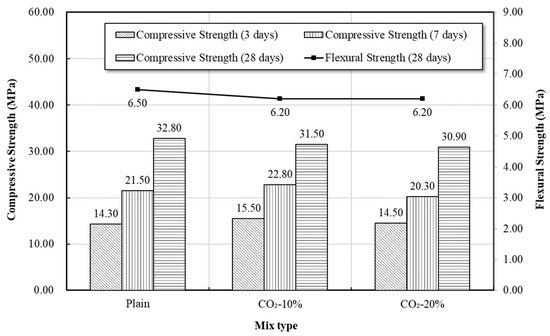
Figure 6 shows the age-dependent compressive strength and 28-day flexural strength of concrete according to the CO2 replacement ratio (0%, 10%, 20%). Overall, the CO2-replaced concrete showed superior performance in early-age strength (3-day and 7-day) compared to Plain, similar to the trend observed in the mortar.
Figure 6.
Compressive and Flexural strength of concrete.
The CO2-10% and CO2-20% mixtures showed higher values of 15.5 MPa and 14.5 MPa in 3-day strength, respectively, compared to Plain (14.3 MPa), and the same trend was maintained in 7-day strength. This early-age strength enhancement may be associated with mechanisms similar to those observed in mortar, including early densification due to fine CaCO3 formation in a low-concentration CO2 environment, enhanced slag reactivity, and the CaCO3-based hydrate nucleation effect. However, due to the aggregate–mortar composite structure of concrete, it does not respond as sensitively as mortar to strength development, and thus the increase in early-age strength was relatively gradual.
In 28-day compressive strength, all three mixes showed similar levels of approximately 30 MPa (Plain: 32.8 MPa, CO2-10%: 31.5 MPa, CO2-20%: 30.9 MPa), and the reduction in long-term strength due to CO2 replacement was not significant. This is likely due to the structural complementary effect between the aggregate skeleton and the matrix in concrete, which mitigates strength reduction even when Ca(OH)2 is partially consumed and C–S–H is partially decalcified by CO2 replacement.
Meanwhile, the 28-day flexural strength did not show a large difference across all mixes, but the CO2-replaced mixes exhibited slightly lower values compared to Plain. This observation may be related to the fact that tensile crack resistance under flexural loading is more sensitive to local matrix continuity and microstructural homogeneity, and that the CaCO3 formed during the initial carbonation process, while contributing to matrix densification under compression, could locally influence crack propagation behavior.
In summary, concrete incorporated with CO2 within the 10–20% range showed superior performance in early-age strength compared to Plain, and maintained a similar level of long-term strength. This implies that low-concentration CO2 incorporation is positive for early strength development in concrete, and the tendency of structural damage observed in high-concentration replacement (based on mortar) is relatively mitigated in concrete.
3.6. Freezing–Thawing Test Result
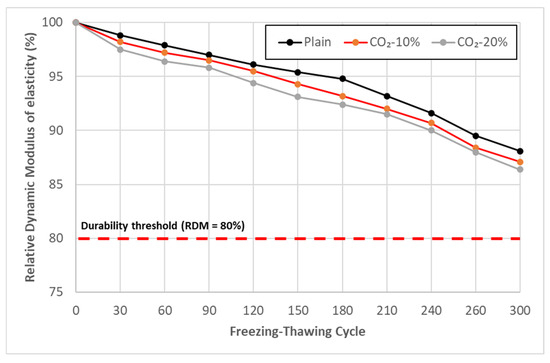
Figure 7 shows the results of the freezing–thawing test performed for 300 cycles according to ASTM C666 Procedure A. The relative dynamic modulus of elasticity (RDM) criterion of 80% or more was stably satisfied for all mixes, and the CO2-10% and CO2-20% mixes showed no significant performance degradation in terms of freezing–thawing resistance compared to Plain.
Figure 7.
Relative dynamic modulus of elasticity versus number of freezing–thawing cycle.
The comparable freezing–thawing performance of the CO2-replaced mixes to Plain may be related to factors associated with the pore structure and saturation level of the concrete.
First, the fine CaCO3 particles generated through the initial carbonation reaction during low-concentration CO2 replacement are likely to contribute to subtle pore refinement by partially filling capillary pores within the concrete. Such pore refinement may help mitigate internal stress development during freezing by limiting water mobility, thereby reducing damage accumulation during freezing–thawing cycles. Furthermore, the CaCO3 crystals formed by CO2 replacement, which exhibit relatively high density and stability, could influence the distribution and mobility of free water within the concrete, potentially mitigating repetitive volumetric expansion during freezing and thawing. Frost resistance is largely governed by factors such as saturation degree, air content, and pore size distribution. The CO2 replacement ratio (10–20%) applied in this study did not appear to induce critical changes in these governing parameters, resulting in freezing–thawing resistance comparable to that of Plain.
Consequently, the RDM reduction trends of the CO2-replaced mixes were similar to those of Plain, suggesting that CO2 incorporation at the investigated replacement levels does not adversely affect freezing–thawing resistance.
3.7. Chemical Resistance Test Result
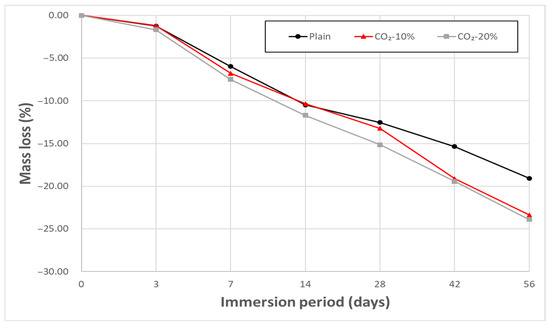
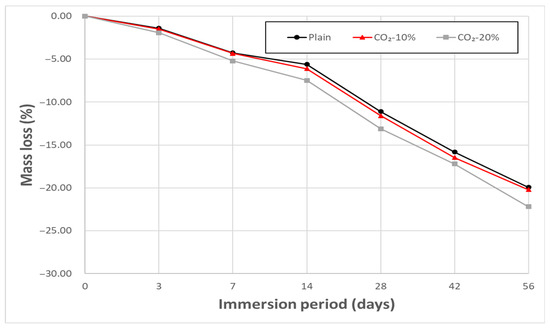
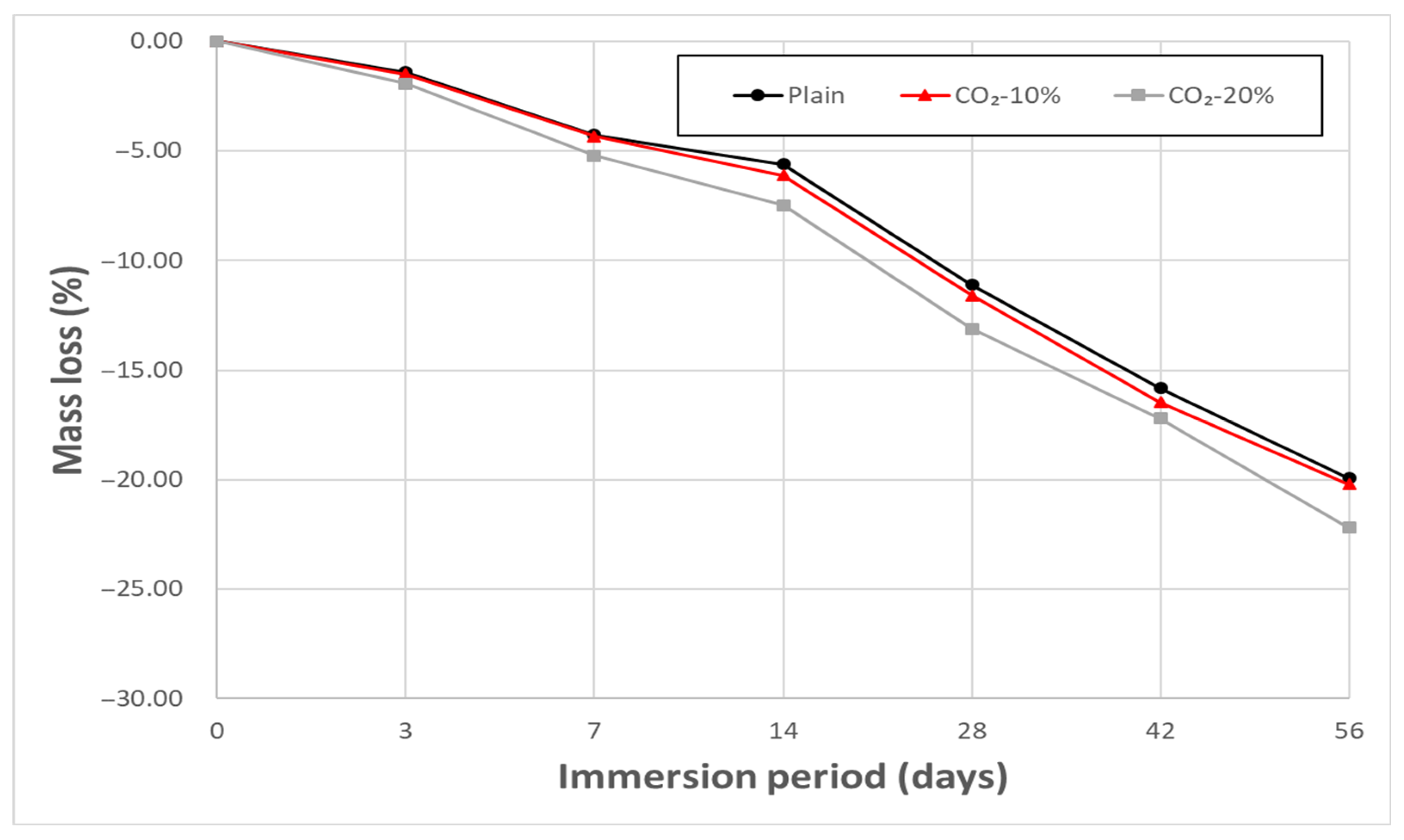
Figure 8 and Figure 9 show the mass loss trend of concrete immersed in 5% HCl and 5% H2SO4 solutions, respectively. In both tests, mass loss progressively increased across all mixes with increasing immersion time, consistent with the typical acid attack mechanism where major alkaline hydration products like Ca(OH)2 and C–S–H dissolve and surface spalling occurs in strong acid environments [37,38].
Figure 8.
Mass loss of porous concrete after immersion in 5% HCl.
Figure 9.
Mass loss of porous concrete after immersion in 5% H2SO4.
Notably, CO2-replaced concrete has an increased CaCO3 content due to prior carbonation, and the CaCO3 itself can react directly with the acid, further accelerating damage. In the HCl environment, CaCO3 dissolves rapidly, producing CaCl2 and CO2 through the following reaction:
CaCO3 + 2HCl → CaCl2 + H2O + CO2↑
The pre-carbonated CO2-replaced mixes may experience enhanced acid dissolution reactions compared to Plain, as CaCO3 also reacts with HCl and H2SO4 to form CaCl2 or CaSO4. This reaction is known to proceed rapidly, which may contribute to the relatively higher mass loss observed in CO2-replaced mixes in the HCl environment. Indeed, the Plain mix showed a 19.6% mass loss after 56 days of immersion, while the CO2-replaced mixes showed a loss of approximately 23.5%, suggesting a higher susceptibility of CO2-replaced concrete to HCl attack under the tested conditions.
The CO2 sorbent used in this study is primarily composed of a Na-based alkaline solution, making it likely that CO2-replaced concrete contains a higher Na+ content compared to Plain [39,40]. These Na+ ions do not significantly affect structural performance under normal conditions, but may readily dissolve under acidic environments, forming NaCl or Na2SO4 [41,42]. These highly soluble salts could act as secondary contributors to degradation by increasing ionic concentration within the pore solution, thereby facilitating leaching of hydration products and surface scaling [43].
In the 5% H2SO4 immersion test of Figure 9, continuous mass loss was also observed in all mixes, which is governed by the characteristic sulfate conversion reaction seen in sulfuric acid attack. H2SO4 first reacts with Ca(OH)2 to produce gypsum (CaSO4·2H2O), and subsequently reacts with C3A to form expansive ettringite (C3A·3CaSO4·32H2O):
Ca(OH)2 + H2SO4 → CaSO4·2H2O
C3A + 3CaSO4 + 32H2O → C3A·3CaSO4·32H2O
Moreover, CaCO3 also reacts with sulfuric acid to convert to CaSO4 and release CO2:
CaCO3 + H2SO4 → CaSO4 + CO2↑ + H2O
Because CO2-replaced concrete contains a higher CaCO3 content, additional CaSO4 can be formed through the above reaction, which may contribute to faster sulfate accumulation and associated expansive damage compared to Plain. Additionally, residual Na+ may react with sulfuric acid to form Na2SO4, potentially increasing sulfate concentration within the pore system and intensifying sulfuric acid attack. In practice, the CO2–20% mix showed a mass loss of 22.2% after 56 days of immersion, indicating higher degradation susceptibility than Plain (19.9%), while the CO2–10% mix maintained a similar level (20.2%) to Plain.
In summary, the chemical resistance of CO2-replaced concrete is governed by the combined effects of acid dissolution reactions and salt formation. Within the 10–20% CO2 replacement range, the overall degradation level was similar to Plain, indicating no pronounced adverse effect on structural stability under the conditions investigated.
3.8. Accelerated Carbonation Test Result
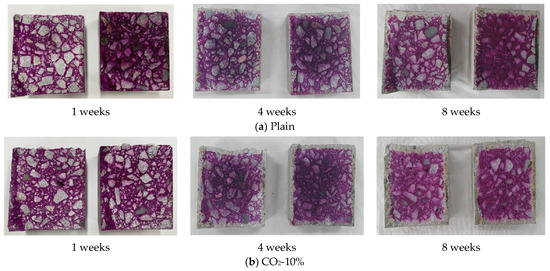
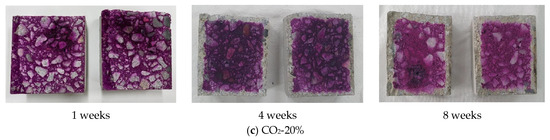
Figure 10 shows the results of the accelerated carbonation test for each mix, where the carbonation penetration depth progressively increased in all specimens with increasing age. At 1 week, the entire surface of all mixes remained red after the application of the phenolphthalein indicator, indicating that sufficient Ca(OH)2 was present to maintain a high-pH environment during the early hydration stage [44].
Figure 10.
Result of penetration depth measurement (a) Plain; (b) CO2-10%; (c) CO2-20%.
Carbonation became apparent in all mixes after 4 weeks, and the average carbonation depth increased in the order of CO2–20% > CO2–10% > Plain. At 8 weeks, the measured carbonation depths were 7.27 mm for the CO2–20% mix, 5.80 mm for the CO2–10% mix, and 4.90 mm for Plain, showing a tendency for carbonation resistance to decrease with increasing CO2 replacement ratio. This tendency is qualitatively consistent with the microstructural observations obtained from SEM, XRD, and TGA analyses in this study.
In the CO2-replaced mixes, the microstructure may be more susceptible to carbonation due to pre-existing carbonation, which reduces the residual Ca(OH)2 content and is accompanied by partial decalcification of the C–S–H gel. Such microstructural changes have been reported to influence the diffusion and penetration behavior of the carbonation front [34,45]. Thiéry et al. [46] also reported that carbonation reaction rates increase under higher CO2 concentrations, which is consistent with the relatively faster carbonation progress observed in the CO2–20% mix in this study.
Previous studies have further indicated that while initial CaCO3 formation at low CO2 replacement levels may provide a micro-filling effect, excessive replacement can potentially disturb the C–S–H gel structure and reduce long-term chemical stability [47]. The characteristics of GGBS-containing systems are also relevant to carbonation susceptibility. According to Lothenbach et al. [48], GGBS reduces Ca(OH)2 formation and produces C–S–H with a lower Ca/Si ratio, which may increase vulnerability to carbonation. In this study, the CO2-replaced mixes exhibited slightly lower strength than Plain, particularly at the 20% replacement level, which could be associated with increased pore connectivity and permeability, thereby facilitating CO2 diffusion.
Taken together, the observed increase in carbonation depth in CO2-replaced concrete may be associated with a combination of reduced Ca(OH)2 availability, partial decalcification of C–S–H, and pore structure characteristics, especially in GGBS-containing mixes. These factors may contribute to the accelerated advancement of the carbonation front, resulting in a slight reduction in carbonation resistance compared to Plain.
Nevertheless, when the CO2 replacement ratio was limited to 10%, the carbonation depth remained comparable to that of Plain, suggesting that durability performance was not critically compromised under the conditions investigated. In contrast, at a 20% replacement level, the carbonation rate increased more noticeably, indicating that careful consideration is required for long-term durability when higher CO2 replacement ratios are applied.
4. Conclusions
This study comprehensively analyzed the microstructure, strength, and durability characteristics of mortar and concrete specimens partially incorporating spent CO2 absorbent, which is generated during the DAC process, as a preliminary investigation for recycling the waste absorbent into cementitious materials.
Key findings are as follows:
- (1)
- CO2 absorbent replacement was observed to be associated with changes in the microstructure, including increased CaCO3 formation due to carbonation and partial decalcification of the C–S–H gel. At replacement ratios of 10–20%, CaCO3-related micro-filling and nucleation effects were found to coincide with a relatively dense pore structure. In contrast, at replacement levels of 30% or higher, SEM observations indicated a higher presence of localized micro-pores and reduced apparent continuity of the gel structure.
- (2)
- Strength evaluation showed that CO2 absorbent replacement at 10–20% was associated with enhanced early-age strength compared to the Plain mixture. This behavior may be related to carbonate-based nucleation effects and the activation of GGBS in the presence of residual alkalinity. Conversely, replacement levels of 30% or higher were accompanied by reductions in compressive and flexural strength, which may be associated with carbonation-related microstructural changes, including partial C–S–H decalcification.
- (3)
- In the durability assessment, CO2-replaced concrete exhibited freezing–thawing resistance comparable to that of the Plain mixture. Accelerated carbonation tests showed a tendency for carbonation resistance to decrease with increasing CO2 replacement ratio; however, at replacement levels of 10–20%, the carbonation depth remained within a range similar to that of Plain. These results suggest that, within this replacement range, durability performance was not critically compromised under the conditions investigated.
- (4)
- Chemical resistance to strong acid solutions (5% HCl and 5% H2SO4) was slightly lower for CO2-replaced concrete compared to Plain. This tendency may be associated with acid dissolution reactions involving CaCO3, as well as the formation of soluble salts such as CaCl2, CaSO4, NaCl, and Na2SO4 originating from carbonation products and Na+ ions in the spent absorbent. Nevertheless, the increase in mass loss remained within a limited range, and mixtures with 10–20% replacement maintained a practically acceptable level of chemical resistance.
- (5)
- Overall, the experimental results indicate that the spent CO2 absorbent can be applied to cementitious materials within a 10–20% replacement range without significant deterioration in mechanical or durability performance. This replacement range may offer potential benefits, including improved early-age strength, pore structure refinement, and the incorporation of carbonated products. While the present findings demonstrate the feasibility of recycling spent DAC absorbents into cementitious materials, further studies are required to quantitatively verify CO2 storage capacity and to evaluate long-term durability under field-relevant exposure conditions.
Author Contributions
Methodology, J.-W.L. and S.-L.Y.; experiment, J.-W.L. and S.-L.Y.; validation, S.-L.Y.; formal analysis, J.-W.L. and S.-L.Y.; investigation, J.-W.L. and S.-L.Y.; data curation, J.-W.L. and S.-L.Y.; writing—original draft preparation, J.-W.L. and S.-L.Y.; writing—review and editing, J.-W.L. and S.-L.Y.; visualization, J.-W.L.; supervision, J.-W.L.; project administration, J.-W.L. All authors have read and agreed to the published version of the manuscript.
Funding
This research was supported by the Major Project of the Korea Institute of Civil Engineering and Building Technology (KICT), funded by the Ministry of Science and ICT of the Republic of Korea (No. 20250116-001), for which the authors express their sincere gratitude.
Data Availability Statement
The original contributions presented in this study are included in the article. Further inquiries can be directed to the corresponding author.
Conflicts of Interest
The authors declare no conflicts of interest.
References
- Hickmann, T.; Widerberg, O.; Lederer, M.; Pattberg, P. The United Nations Framework Convention on Climate Change Secretariat as an Orchestrator in Global Climate Policymaking. Int. Rev. Adm. Sci. 2021, 87, 21–38. [Google Scholar] [CrossRef] [Scilit]
- Falkner, R. The Paris Agreement and the New Logic of International Climate Politics. Int. Aff. 2016, 92, 1107–1125. [Google Scholar] [CrossRef] [Scilit]
- Mon, M.T.; Tansuchat, R.; Yamaka, W. CCUS Technology and Carbon Emissions: Evidence from the United States. Energies 2024, 17, 1748. [Google Scholar] [CrossRef] [Scilit]
- Vishal, V.; Chandra, D.; Singh, U.; Verma, Y. Understanding Initial Opportunities and Key Challenges for CCUS Deployment in India at Scale. Resour. Conserv. Recycl. 2021, 175, 105829. [Google Scholar] [CrossRef] [Scilit]
- Boot-Handford, M.E.; Abanades, J.C.; Anthony, E.J.; Blunt, M.J.; Brandani, S.; Mac Dowell, N.; Fennell, P.S. Carbon Capture and Storage Update. Energy Environ. Sci. 2014, 7, 130–189. [Google Scholar] [CrossRef] [Scilit]
- Bui, M.; Adjiman, C.S.; Bardow, A.; Anthony, E.J.; Boston, A.; Brown, S.; Fennell, P.S.; Fuss, S.; Galindo, A.; Hackett, L.A.; et al. Carbon Capture and Storage (CCS): The Way Forward. Energy Environ. Sci. 2018, 11, 1062–1176. [Google Scholar] [CrossRef] [Scilit]
- Sanz-Pérez, E.S.; Murdock, C.R.; Didas, S.A.; Jones, C.W. Direct Capture of CO2 from Ambient Air. Chem. Rev. 2016, 116, 11840–11876. [Google Scholar] [CrossRef] [Scilit] [PubMed]
- Erans, M.; Sanz-Pérez, E.S.; Hanak, D.P.; Clulow, Z.; Reiner, D.M.; Mutch, G.A. Direct Air Capture: Process Technology, Techno-Economic and Socio-Political Challenges. Energy Environ. Sci. 2022, 15, 1360–1405. [Google Scholar] [CrossRef] [Scilit]
- Kasturi, A.; Gug Jang, G.; Dona-Tella Akin, A.; Jackson, A.; Jun, J.; Stamberga, D.; Custelcean, R.; Sholl, D.S.; Yiacoumi, S.; Tsouris, C. AnEffective Air–Liquid Contactor for CO2 Direct Air Capture Using Aqueous Solvents. Sep. Purif. Technol. 2023, 324, 124398. [Google Scholar] [CrossRef] [Scilit]
- Custelcean, R. Direct Air Capture of CO2 Using Solvents. Annu. Rev. Chem. Biomol. Eng. 2022, 13, 217–234. [Google Scholar] [CrossRef] [Scilit]
- Rackley, S.A. Carbon Capture and Storage; Butterworth-Heinemann: Oxford, UK, 2017. [Google Scholar]
- Mostafa, M.; Antonicelli, C.; Varela, C.; Barletta, D.; Zondervan, E. Capturing CO2 from the Atmosphere: Design and Analysis of a Large-Scale DAC Facility. Carbon Capture Sci. Technol. 2022, 4, 100060. [Google Scholar] [CrossRef] [Scilit]
- Abanades, J.C.; Anthony, E.J.; Wang, J.; Oakey, J.E. Fluidized Bed Combustion Systems Integrating CO2 Capture with CaO. Environ. Sci. Technol. 2005, 39, 2861–2866. [Google Scholar] [CrossRef] [Scilit] [PubMed]
- Keith, D.W.; Holmes, G.; Angelo, D.S.; Heidel, K. A Process for Capturing CO2 from the Atmosphere. Joule 2018, 2, 1573–1594. [Google Scholar] [CrossRef] [Scilit] [PubMed]
- Kaleeckal, B.V.; Gioja, L.; OBrien, K.; Giardinella, S.; Echeto, M.; Prause, S.; Baroi, C.; Larimore, R.; Kenny, M.; Baumeister, A.; et al. Direct Air Capture and Utilization System (DACUS): FEED Study of CarbonCapture Inc. DAC and CarbonCure Utilization Technologies Using United States Steel’s Gary Works Plant Waste Heat. In Proceedings of the 17th Greenhouse Gas Control Technologies Conference (GHGT-17), Zurich, Switzerland, 20–24 October 2024. [Google Scholar] [CrossRef] [Scilit]
- ASTM C150; Standard Specification for Portland Cement. ASTM International: West Conshohocken, PA, USA, 2022.
- Kim, Y.T.; Lee, J.W.; Yang, S.L. Influence of Nano SiO2/Al2O3-TiO2 powder on strength and durability properties of concrete. KSCE J. Civ. Eng. 2026, 30, 100462. [Google Scholar] [CrossRef] [Scilit]
- KS L ISO 679; Methods of Testing Cements—Determination of Strength. Korean Agency for Technology and Standards (KATS): Eumseong County, Republic of Korea, 2022.
- ISO 679; Methods of Testing Cements—Determination of Strength. International Organization for Standardization (ISO): Geneva, Switzerland, 2009.
- ASTM C1437; Standard Test Method for Flow of Hydraulic Cement Mortar. ASTM International: West Conshohocken, PA, USA, 2021.
- KS F 2405; Test Method for Compressive Strength of Concrete. Korean Agency for Technology and Standards (KATS): Eumseong County, Republic of Korea, 2021.
- KS F 2408; Test Method for Flexural Strength of Concrete. Korean Agency for Technology and Standards (KATS): Eumseong County, Republic of Korea, 2021.
- KS F 2456; Testing Method for Resistance of Concrete to Rapid Freezing and Thawing. Korean Agency for Technology and Standards (KATS): Eumseong County, Republic of Korea, 2021.
- ASTM C267-01; Standard Test Method for Chemical Resistance of Mortars, Grouts, and Monolithic Surfacings and Polymer Concretes. ASTM International: West Conshohocken, PA, USA, 2012.
- KS F 2584; Standard Test Method for Accelerated Carbonation of Concrete. Korean Agency for Technology and Standards (KATS): Eumseong County, Republic of Korea, 2020.
- Sevelsted, T.F.; Skibsted, J. Carbonation of C–S–H and C–A–S–H samples studied by 13C, 27Al and 29Si MAS NMR spectroscopy. Cem. Concr. Res. 2015, 71, 56–65. [Google Scholar] [CrossRef] [Scilit]
- Zajac, M.; Hilbig, H.; Bullerjahn, F.; Ben Haha, M. Reactions Involved in Carbonation Hardening of Portland Cement: Effect of Curing Temperature. J. Sustain. Cem.-Based Mater. 2023, 12, 1107–1125. [Google Scholar] [CrossRef] [Scilit]
- Liu, X.; Feng, P.; Cai, Y.; Yu, X.; Liu, Q. Carbonation Behaviors of Calcium Silicate Hydrate (C–S–H): Effects of Aluminum. Constr. Build. Mater. 2022, 325, 126825. [Google Scholar] [CrossRef] [Scilit]
- Moon, E.J.; Kim, S.J.; Park, H.G.; Choi, Y.C. A Study on Cementitious Materials as Carbon Capture Materials—Microstructure Change by Carbonation Curing. J. Korea Inst. Struct. Maint. Insp. 2018, 22, 123–129. [Google Scholar]
- Maddalena, R.; Li, K.; Chater, P.A.; Michalik, S.; Hamilton, A. Direct Synthesis of a Solid Calcium–Silicate–Hydrate (C–S–H). Constr. Build. Mater. 2019, 223, 554–565. [Google Scholar] [CrossRef] [Scilit]
- Stepkowska, E.T.; Blanes, J.M.; Franco, F.; Real, C.; Pérez-Rodríguez, J.L. Calcite, Vaterite and Aragonite Forming on Cement Hydration from Liquid and Gaseous Phase. Cem. Concr. Res. 2003, 33, 191–201. [Google Scholar] [CrossRef] [Scilit]
- Hashim, M.S.; Kaczmarek, S.E. The Transformation of Aragonite to Calcite in the Presence of Magnesium: Implications for Marine Diagenesis. Earth Planet. Sci. Lett. 2021, 574, 117166. [Google Scholar] [CrossRef] [Scilit]
- Na, Y.K.; Moon, J.W.; Oh, T.; Yoo, D.Y. Effect of Calcium Hydroxide Addition on the Promotion of the Pozzolanic Reaction of Excess Silica Fume in Ultra-High Performance Concrete. J. Korean Soc. Hazard Mitig. 2024, 24, 223–229. [Google Scholar] [CrossRef] [Scilit]
- Li, Y.; Liu, W.; Xing, F.; Wang, S.; Tang, L.; Lin, S.; Dong, Z. Carbonation of Synthetic Calcium Silicate Hydrate (C–S–H) under Different CO2 Concentrations: Chemical Phase Analysis and Kinetics. J. CO2 Util. 2020, 35, 303–313. [Google Scholar] [CrossRef] [Scilit]
- Yaseen, S.A.; Yiseen, G.A.; Li, Z. Elucidation of Calcite Structure of Calcium Carbonate Formation Based on Hydrated Cement Mixed with Graphene Oxide and Reduced Graphene Oxide. ACS Omega 2019, 4, 10160–10170. [Google Scholar] [CrossRef] [Scilit]
- Madadi, A.; Wei, J. Characterization of Calcium Silicate Hydrate Gels with Different Calcium-to-Silica Ratios and Polymer Modifications. Gels 2022, 8, 75. [Google Scholar] [CrossRef] [Scilit]
- Kahlouche, R.; Badaoui, A.; Criado, M. Fresh, Hardened and Durability Properties of Sodium Carbonate-Activated Algerian Slag Exposed to Sulfate and Acid Attacks. Mater. Constr. 2023, 73, e321. [Google Scholar] [CrossRef] [Scilit]
- Liang, Q.; Huang, X.; Zhang, L.; Yang, H. A Review on Research Progress of Corrosion Resistance of Alkali-Activated Slag Cement Concrete. Materials 2024, 17, 5065. [Google Scholar] [CrossRef] [Scilit]
- Jang, J.G.; Kim, H.J.; Park, S.M.; Lee, H.K. The Influence of Sodium Hydrogen Carbonate on the Hydration of Cement. Constr. Build. Mater. 2015, 94, 746–749. [Google Scholar] [CrossRef] [Scilit]
- Andrew, O.T.; Omotayo, O.O.; Arum, C.; Ikumapayi, C.M. Effects of Sodium Carbonate Admixture and Mix Design Ratios on the Compressive Strength of Concrete. Niger. J. Technol. 2023, 42, 185–190. [Google Scholar] [CrossRef] [Scilit]
- Zhang, F.; Hu, Z.; Wei, F.; Wen, X.; Li, X.; Dai, L.; Liu, L. Study on Concrete Deterioration in Different NaCl–Na2SO4 Solutions and the Mechanism of Cl− Diffusion. Materials 2021, 14, 5054. [Google Scholar] [CrossRef] [Scilit]
- Yoshida, N.; Nakayama, K. Impact of NaCl on Deterioration of Hardened Cement Paste due to Sulfuric Acid Attack. ce/papers 2023, 6, 1295–1304. [Google Scholar] [CrossRef] [Scilit]
- Azar, P.; Samson, G.; Patapy, C.; Cussigh, F.; Frouin, L.; Idir, R.; Cyr, M. Durability of Sodium Carbonate Alkali-Activated Slag Concrete Assessed by a Performance-Based Approach. Constr. Build. Mater. 2024, 423, 135873. [Google Scholar] [CrossRef] [Scilit]
- Papadakis, V.G.; Vayenas, C.G.; Fardis, M.N. Fundamental Modeling and Experimental Investigation of Concrete Carbonation. ACI Mater. J. 1991, 88, 363–373. [Google Scholar] [CrossRef] [Scilit]
- Morandeau, A.; Thiery, M.; Dangla, P. Investigation of the Carbonation Mechanism of CH and C–S–H in Terms of Kinetics, Microstructure Changes and Moisture Properties. Cem. Concr. Res. 2014, 56, 153–170. [Google Scholar] [CrossRef] [Scilit]
- Thiery, M.; Villain, G.; Dangla, P.; Platret, G. Investigation of the Carbonation Front Shape on Cementitious Materials: Effects of the Chemical Kinetics. Cem. Concr. Res. 2007, 37, 1047–1058. [Google Scholar] [CrossRef] [Scilit]
- Ngala, V.T.; Page, C.L. Effects of Carbonation on Pore Structure and Diffusional Properties of Hydrated Cement Pastes. Cem. Concr. Res. 1997, 27, 995–1007. [Google Scholar] [CrossRef] [Scilit]
- Lothenbach, B.; Scrivener, K.; Hooton, R.D. Supplementary Cementitious Materials. Cem. Concr. Res. 2011, 41, 1244–1256. [Google Scholar] [CrossRef] [Scilit]

Disclaimer/Publisher’s Note: The statements, opinions and data contained in all publications are solely those of the individual author(s) and contributor(s) and not of MDPI and/or the editor(s). MDPI and/or the editor(s) disclaim responsibility for any injury to people or property resulting from any ideas, methods, instructions or products referred to in the content. |
© 2026 by the authors. Licensee MDPI, Basel, Switzerland. This article is an open access article distributed under the terms and conditions of the Creative Commons Attribution (CC BY) license.