Article

FeSe2-BiSe2-CoSe2 Ternary Heterojunction for Efficient Hydrogen Evolution Reaction Under pH-Universal


1
School of Materials Science and Engineering, Taiyuan University of Science and Technology, Taiyuan 030024, China
2
Shanxi Key Laboratory of Coordinated Management and Control for Environmental Quality, School of Environment and Resources, Taiyuan University of Science and Technology, Taiyuan 030024, China
3
School of Environment and Safety Engineering, North University of China, Taiyuan 030051, China
*
Authors to whom correspondence should be addressed.
Materials 2026, 19(2), 430; https://doi.org/10.3390/ma19020430 (registering DOI)
Submission received: 31 December 2025 / Revised: 17 January 2026 / Accepted: 20 January 2026 / Published: 22 January 2026

Abstract

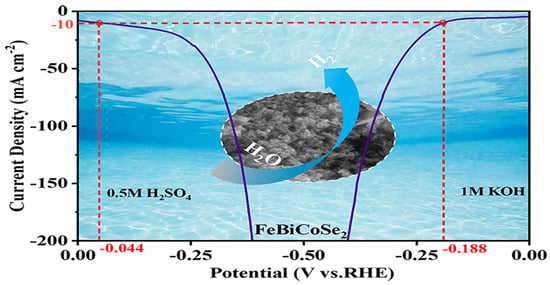
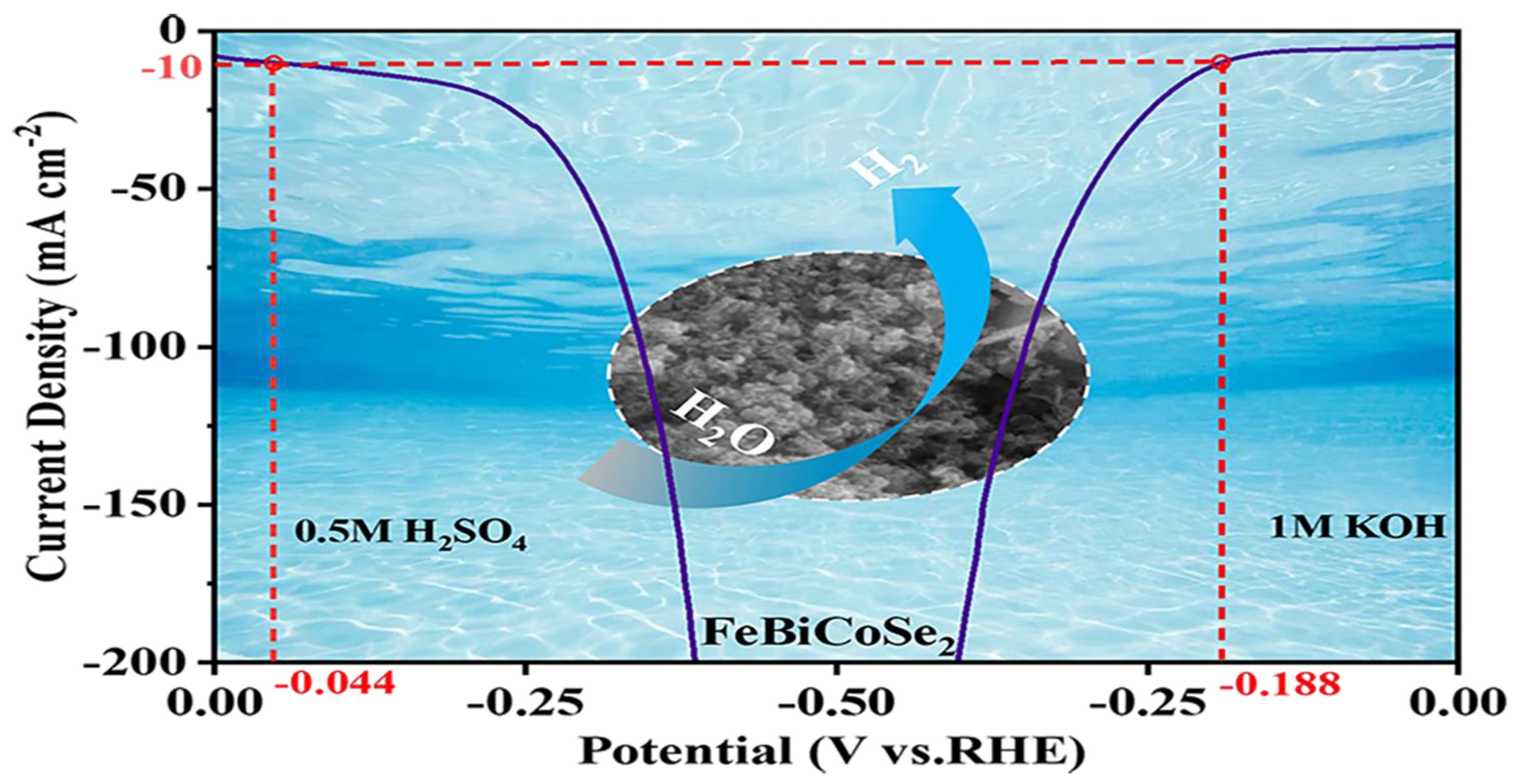
The construction of heterostructures has been recognized as an effective strategy for enhancing material activity and stability. Herein, a ternary heterojunction FeSe2-BiSe2-CoSe2 was synthesized via a hydrothermal selenidation reaction. The significant electronegativity difference between Bi and Fe/Co triggers charge transfer within the FeSe2-BiSe2-CoSe2 lattice. Furthermore, the abundant pore structure of FeSe2-BiSe2-CoSe2 provides efficient pathways for electron diffusion, significantly enhancing the HER catalytic kinetics. Results demonstrate that FeSe2-BiSe2-CoSe2 exhibits outstanding HER activity in both acidic and alkaline media. In 0.5 M H2SO4, it exhibits an overpotential of only 44 mV with a Tafel slope of 108 mV dec−1. In 1 M KOH, the corresponding overpotential is 188 mV, with a Tafel slope of 45 mV dec−1 at 10 mA cm−2. This study constructs electron-rich active sites through electronic structure regulation, providing valuable insights for designing low-cost, high-performance transition metal selenide HER catalysts.

Graphical Abstract

1. Introduction

Humanity currently faces the dual crises of energy scarcity and environmental degradation. As non-renewable resources, the consumption of available fossil fuels far exceeds their production rates. Consequently, developing sustainable clean energy has become a critical research focus for resolving the energy crisis [1,2]. Hydrogen energy, recognized as a green and clean energy source due to its high energy density and low-carbon, pollution-free attributes, is extensively studied as a fossil fuel alternative [3]. Large-scale hydrogen production holds the potential to facilitate a low-carbon transition in energy structures. Electrolytic hydrogen production from water represents a highly promising sustainable hydrogen generation technology [4]. The development of low-cost, high-performance hydrogen evolution catalysts holds significant importance for enhancing the efficiency of water electrolysis [5].
Conducting the HER under pH-universal is crucial for evaluating a catalyst’s practical potential and advancing the real-world application of hydrogen energy technologies. The actual industrial scenarios for water electrolysis hydrogen production are not confined to ideal alkaline or acidic media but are diverse. Therefore, a catalyst that performs excellently only at a single pH value will have its application scope severely limited. Developing HER catalysts with full pH activity means that the same material can adapt to multiple technological pathways. From a scientific perspective, investigating a catalyst’s performance and mechanisms across the entire pH range provides deeper insights into the reaction kinetics and stability mechanisms of its active sites under different species supply environments. This approach offers a more comprehensive evaluation of the catalyst’s intrinsic properties and structural advantages compared to single-pH studies [6].
To date, the most effective HER electrocatalysts have been precious metal Pt-based catalysts. However, precious metals exhibit dissolution, agglomeration, and instability during water splitting, while their cost and scarcity severely constrain their development [7]. Transition metal-based electrocatalysts have garnered significant attention due to their abundant reserves and tunable electronic structures. Among these, binary alloy compounds, such as Fe-, Co-, and Bi-based catalysts, exhibit high intrinsic activity in both acidic and alkaline media [8]. However, issues such as low conductivity and limited active sites require further optimization. Atomic doping (with non-metallic atoms) can effectively modulate the material’s electronic structure, expose active sites, and enhance mass transfer processes, thereby improving catalytic performance [9]. We compared the sulfides [10], selenides [11], oxides [12], nitrides [13], and phosphides [14] of transition metals (Table 1).
Fe, as a multivalent transition metal, possesses flexible electronic configurations and efficient electron donor–acceptor sites, enhancing the semiconductor properties of single selenides and reducing the electron transport energy barrier. Fe-based transition metal diselenides (MSe2, M=Fe, and Co) exhibit diverse chemical properties as metallic three-dimensional electrons increase, with FeSe2 and CoSe2 demonstrating numerous chemical characteristics [15,16]. Hydrothermally synthesized FeSe2 reveals enhanced active sites for ion and electron transfer. Se-rich vacancies in FeSe2 can yield superior HER performance through optimized M-O and M-H bonding. The 2p orbital electron configuration of transition metal Co enables precise regulation of the d-band center position within the catalytic active site [17]. The introduction of Co modulates the d-band center towards the Fermi level through intra-lattice electron interactions, optimizing hydrogen adsorption energy (ΔG*H) and thereby enhancing the intrinsic catalytic activity of the active site. During the HER activity process in CoSe2, the Co cation acts as the hydrogen anion (H) receptor center, while the anion serves as the proton (H+) receptor center. The H2O molecule binds to the locally positively charged Co center, facilitating greater electron localization on the Se atom. This promotes the adsorption of Hads on the Se anion and the conversion of Hads to H2 molecules, thereby enhancing the electron transport rate on the catalyst surface [18].
The electronegativity of Bi exhibits significant differences compared to Fe and Co. This disparity triggers directional charge transfer within the lattice, reducing the electron density around Bi atoms to form electron-deficient sites [19]. Conversely, Fe and Co become electron-rich active sites due to electron enrichment. This accelerates charge separation and transport during catalytic reactions, preventing reaction inhibition caused by electron accumulation at the active sites [20].
Based on the aforementioned theory, this study prepared a ternary heterojunction FeSe2-BiSe2-CoSe2 catalyst via a one-step hydrothermal synthesis method. Results demonstrate that FeSe2-BiSe2-CoSe2 exhibits outstanding HER performance in both acidic and alkaline solutions. In a 1 M KOH alkaline solution and 0.5 M H2SO4 acidic solution, the overpotential at a current density of 10 mA cm−2 is merely 188 and 44 mV, respectively, with corresponding Tafel slopes of 45 and 108 mV dec−1. Its outstanding performance is attributed to the incorporation of Bi, which alters the electronic structure surrounding Fe and Co, transforming it into an electron-rich configuration. This effectively accelerates electron transfer and enhances the material’s electrical conductivity. Furthermore, characterization techniques such as SEM have revealed a substantial porous structure within the ternary heterojunction FeSe2-BiSe2-CoSe2. These richly developed pore structures generate additional active sites for HER initiation and progression, accelerating the kinetics of the catalytic reaction. A method for preparing transition metal-based ternary heterojunction selenides has been proposed.

2. Materials and Methods

We dissolved Co(NO3)2·6H2O, Bi(NO3)2·5H2O, Fe(NO3)2·9H2O (1 mmol each), and surfactants (HO(CH2CH2O)nH and C19H42BrN) in a water–ethanol mixed solvent to form Solution A. We dissolved Se and NaBH4 in the same solvent to form Solution B. After mixing, the reaction was conducted hydrothermally at 200 °C for 16 h. The product was obtained by centrifugation, washing, and drying at 60 °C. For comparison, BiSe2, CoSe2, and FeSe2 were synthesized under identical conditions using only the corresponding single metal salt precursors (Figure 1a).
Electrochemical measurements were performed in an electrochemical workstation (CHI 660E) using a standard three-electrode system with 1 M KOH as electrolytes, carbon rods, and Ag/AgCl and Hg/HgO electrodes as counter electrodes and reference electrodes, respectively.

3. Results

3.1. Characterization

X-ray diffraction (XRD) analysis was employed to investigate the chemical composition of BiSe2, FeSe2, CoSe2, and FeSe2-BiSe2-CoSe2, as shown in Figure 1b,c. The diffraction peaks at 30.21°, 35.01°, 37.03°, 50.83°, and 55.69° in FeSe2 correspond, respectively, to the (020), (111), (200), (002), and (221) crystal planes. Its lattice constants were calculated as a = 4.857 Å, b = 5.786 Å, and c = 3.587 Å (Table S1), which are in close agreement with JCPDS No. 12-0291 (a = 4.815 Å, b = 5.808 Å, and c = 3.599 Å) [21]. For BiSe2, the diffraction signals generated by its (015), (1010), (110), (205), and (1115) crystal planes appear at 29.23°, 40.15°, 43.56°, 53.43°, and 66.54°, respectively, in the XRD pattern. This is essentially consistent with the standard card (JCPDS No. 12-0732). Calculations yielded lattice constants of a = 4.151 Å, b = 4.151 Å, and c = 28.666 Å (Table S2), exhibiting slight deviations from the reference values (JCPDS No. 12-0732, a = b = 4.133 Å and c = 28.620 Å) [22]. In the XRD pattern of CoSe2, a series of characteristic diffraction peaks are observed. The peaks at 33.74°, 45.87°, 51.35°, and 62.91° correspond to the (210), (221), (311), and (400) crystal planes of CoSe2 (JCPDS No. 09-0234), respectively. Its lattice constants a = 5.874 Å, b = 5.874 Å, and c = 5.874 Å (Table S3) are essentially identical to the reference values (JCPDS No. 09-0234, a = 5.858 Å). This indicates the successful synthesis of FeSe2, BiSe2, and CoSe2 via a hydrothermal reaction [23].
With the incorporation of metal ions with differing atomic radii—Fe, Bi, and Co—into the same crystal lattice, atoms of varying sizes experience interdiffusion. Within the XRD pattern of FeSe2-BiSe2-CoSe2 (Figure 1c), diffraction peaks attributable to FeSe2, BiSe2, and CoSe2 can be distinctly observed. The diffraction peaks of FeSe2 at 34.89°, 36.22°, and 48.12° correspond to the (111), (120), and (211) crystal planes, respectively. For CoSe2, peaks at 51.01°, 53.78°, and 71.51° correspond to the (311), (222), and (420) crystal planes. The leftward shift in diffraction peaks corresponding to the FeSe2 (111) and CoSe2 (311) planes results from lattice stretching and broadening of diffraction peaks due to the incorporation of Bi, which possesses a larger atomic radius [24]. The diffraction peaks of BiSe2 at 29.35°, 40.44°, and 43.73° correspond, respectively, to the (015), (1010), and (110) crystal planes. The rightward shift in the diffraction peaks for the (015), (1010), and (110) planes in BiSe2 arises from the substitution of Bi atoms in the original lattice by Fe or Co atoms, which possess smaller atomic radii. Due to the significantly smaller atomic radii of Fe and Co compared to Bi, lattice contraction occurs. According to Bragg’s equation (nλ = 2dsinθ), this subsequently leads to a shift in the diffraction angle. FeSe2 is characterized by lattice parameters of a = 4.857 Å, b = 5.786 Å, and c = 3.587 Å; BiSe2 is characterized by parameters a = b = 4.151 Å and c = 28.666 Å; and CoSe2 is characterized by parameters a = b = c = 5.874 Å, which are essentially identical to their corresponding standard reference values; XRD analysis confirmed the successful formation of FeSe2-BiSe2-CoSe2 [25].
X-ray photoelectron spectroscopy (XPS) was employed to analyze the chemical composition and valence states of the samples via full-spectrum analysis. As depicted in Figures S1 and S2, the full spectra of BiSe2, FeSe2, CoSe2, and FeSe2-BiSe2-CoSe2 reveal the presence of four elements: Bi, Co, Fe, and Se. Figure 1d displays the high-resolution XPS spectra of the Bi 4f orbitals for BiSe2 and FeSe2-BiSe2-CoSe2. The peaks at binding energies of 164.13 and 158.86 eV correspond to the Bi 4f5/2 and Bi 4f7/2 orbitals in BiSe2, respectively, while the peaks at 164.38 and 159.12 eV can be attributed to the Bi 4f5/2 and Bi 4f7/2 orbitals in FeSe2-BiSe2-CoSe2, respectively. Both exhibit characteristics of Bi3+, with binding energies shifted to the left by 0.25 and 0.26 eV, respectively. This indicates a reduction in electron density around Bi, potentially arising from electron transfer due to differences in electronegativity between neighboring atoms within the alloy. This facilitates accelerated electron redistribution during electrocatalytic reactions, thereby enhancing electrocatalytic activity [26].
In Figure 1e, the high-resolution Fe 2p spectra of FeSe2 and FeSe2-BiSe2-CoSe2 reveal characteristic peaks at 731.04 and 714.31 eV in FeSe2, corresponding, respectively, to the 2p1/2 and 2p3/2 orbitals of Fe3+. Relative to FeSe2, the 2p1/2 (730.67 eV) and 2p3/2 (714.05 eV) orbitals of Fe3+ in FeSe2-BiSe2-CoSe2 exhibit rightward shifts of 0.37 and 0.26 eV, respectively. This results in increased electron density and enhanced binding capacity for surrounding electrons. The characteristic peaks of Fe2+ in FeSe2 on the 2p1/2 and 2p3/2 orbitals are located at 725.81 and 710.65 eV, respectively. Compared to FeSe2, the Fe 2p1/2 peak (725.48 eV) corresponding to Fe2+ in FeSe2-BiSe2-CoSe2 exhibits a rightward shift of 0.33 eV; the Fe 2p3/2 peak (710.25 eV) also shifts to the right by 0.40 eV [10]. The increased electron density around the Fe atom reduces its binding energy, confirming a change in the chemical environment surrounding the Fe atom, with a significant increase in its electron cloud density [8].
Figure 1f compares the Se 3d orbitals in different materials. The Se 3d3/2 binding energies in BiSe2, CoSe2, and FeSe2 are 57.79, 58.39, and 58.05 eV, respectively, with corresponding Se 3d5/2 binding energies of 53.73, 54.42, and 54.50 eV, all corresponding to the Se2- state. In FeSe2-BiSe2-CoSe2, the binding energies of Se 3d3/2 and Se 3d5/2 further increase to 59.10 and 54.78 eV, respectively, with a reduction in electron density around Se. Electrons flow towards the transition metals Fe, Bi, and Co. Compared to FeSe2-BiSe2-CoSe2, the Se 3d3/2 and Se 3d5/2 peaks in BiSe2, CoSe2, and FeSe2 exhibit a shift towards lower binding energies, indicating that Se atoms also undergo significant electronic regulation within multivalent alloys. This demonstrates enhanced electron transfer between Fe, Bi, Co, and Se, which favorably contributes to elevated electrocatalytic activity [19].
Figure 1g displays the high-resolution XPS spectra of the Co 2p orbitals for CoSe2 and FeSe2-BiSe2-CoSe2. The characteristic peaks of Co3+ in FeSe2-BiSe2-CoSe2 exhibit shifts of 0.55 and 0.45 eV to the right, relative to those in CoSe2 (Co 2p1/2: 797.03 eV and Co 2p3/2: 780.75 eV). The corresponding binding energies are 796.58 and 780.30 eV. This phenomenon indicates that the electron density around Co increases, enhancing its metallic character and consequently improving the material’s electrical conductivity [27].
In FeSe2-BiSe2-CoSe2, it is not a simple unidirectional charge transfer that occurs, but rather a complex charge rearrangement. Crucially, as part of the matrix, the electron density of Bi and Se decreases, while that of the embedded transition metals Fe and Co increases. Alloying fundamentally alters the chemical environment of Se, whose electronegativity may differ from that in binary selenides, thereby influencing the charge distribution across the entire lattice. Acting as catalytic active centers, Fe and Co receive greater electron feedback from the alloy system, becoming electron-rich centers that facilitate electron redistribution. The electron-rich Fe and Co centers optimize their d-band electronic structure, aiding in the stabilization of certain low-valent intermediates during reactions or modulating redox potentials, thereby enhancing intrinsic activity. The Bi-Se matrix framework, with its tightened electronic structure, enhances the material’s metallic character and conductivity, ensuring rapid charge transport during the catalytic process [28].
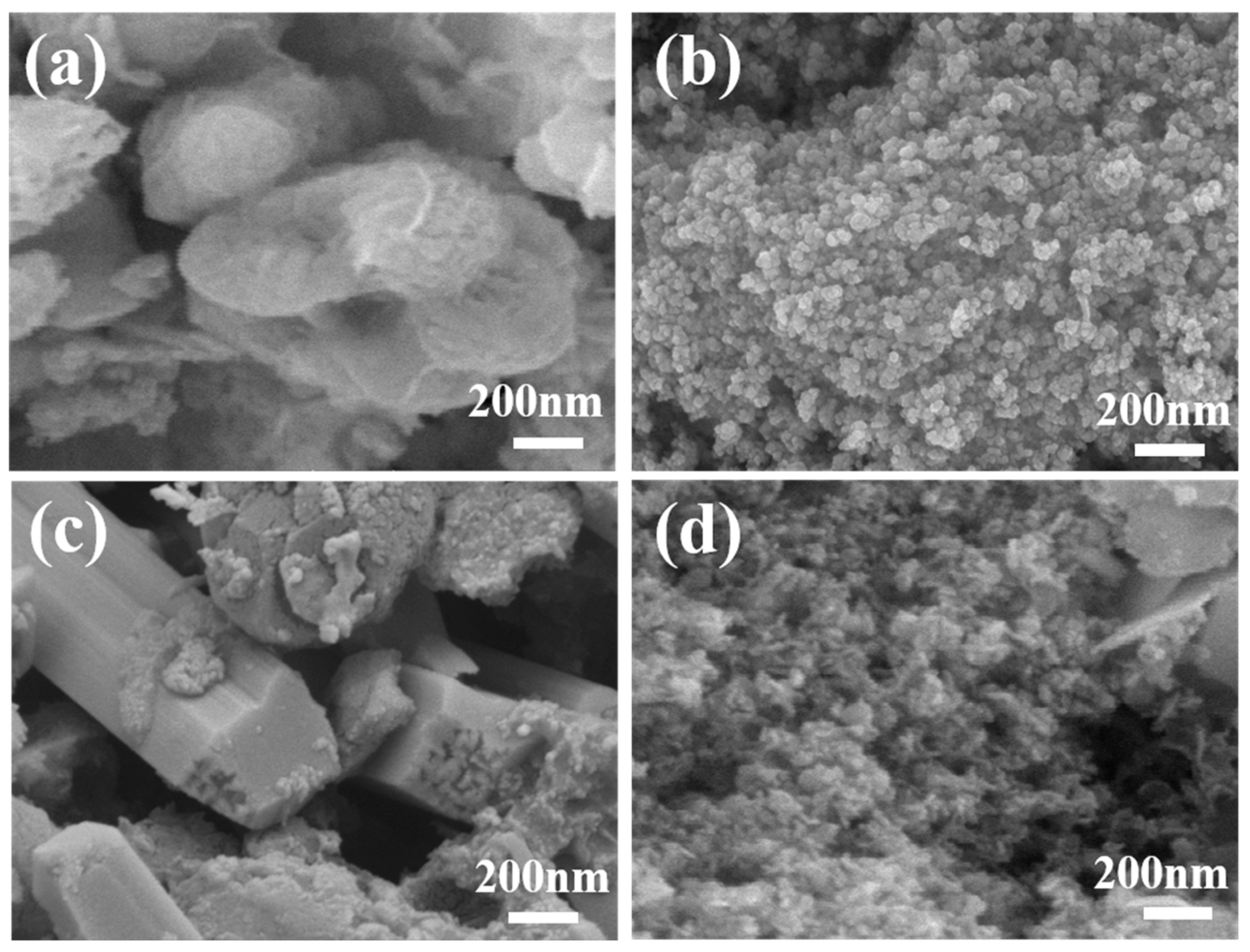
Scanning electron microscopy (SEM) images of various materials reveal the morphology and microstructure of four catalysts: BiSe2, CoSe2, FeSe2, and FeSe2-BiSe2-CoSe2. As shown in Figure 2a and Figure S3a,b, the BiSe2 morphology comprises nanospheres with a relatively smooth surface, each nanosphere being relatively independent and measuring 1.5 μm in diameter. The prepared CoSe2 comprises irregularly shaped, uniformly sized particles with a relatively smooth surface, facilitating uniform electrolyte contact and ion diffusion (Figure 2b and Figure S3c,d). The FeSe2 nanorods synthesized in Figure 2c interconnect to form a relatively regular arrangement, uniformly dispersed across the substrate’s surface. This configuration yields a high specific surface area, providing numerous active sites conducive to the progression of electrocatalytic reactions (Figure 2c and Figure S3e,f). As shown in Figure 2d and Figure S3g,h, BiSe2 nanospheres are attached to FeSe2 nanorods, with CoSe2 nanoparticles present in the gaps between them, thereby forming a ternary FeSe2-BiSe2-CoSe2 heterojunction. The presence of CoSe2 prevents BiSe2 and FeSe2 from forming larger agglomerates, thereby increasing the surface area of the catalyst exposed to the electrolyte.
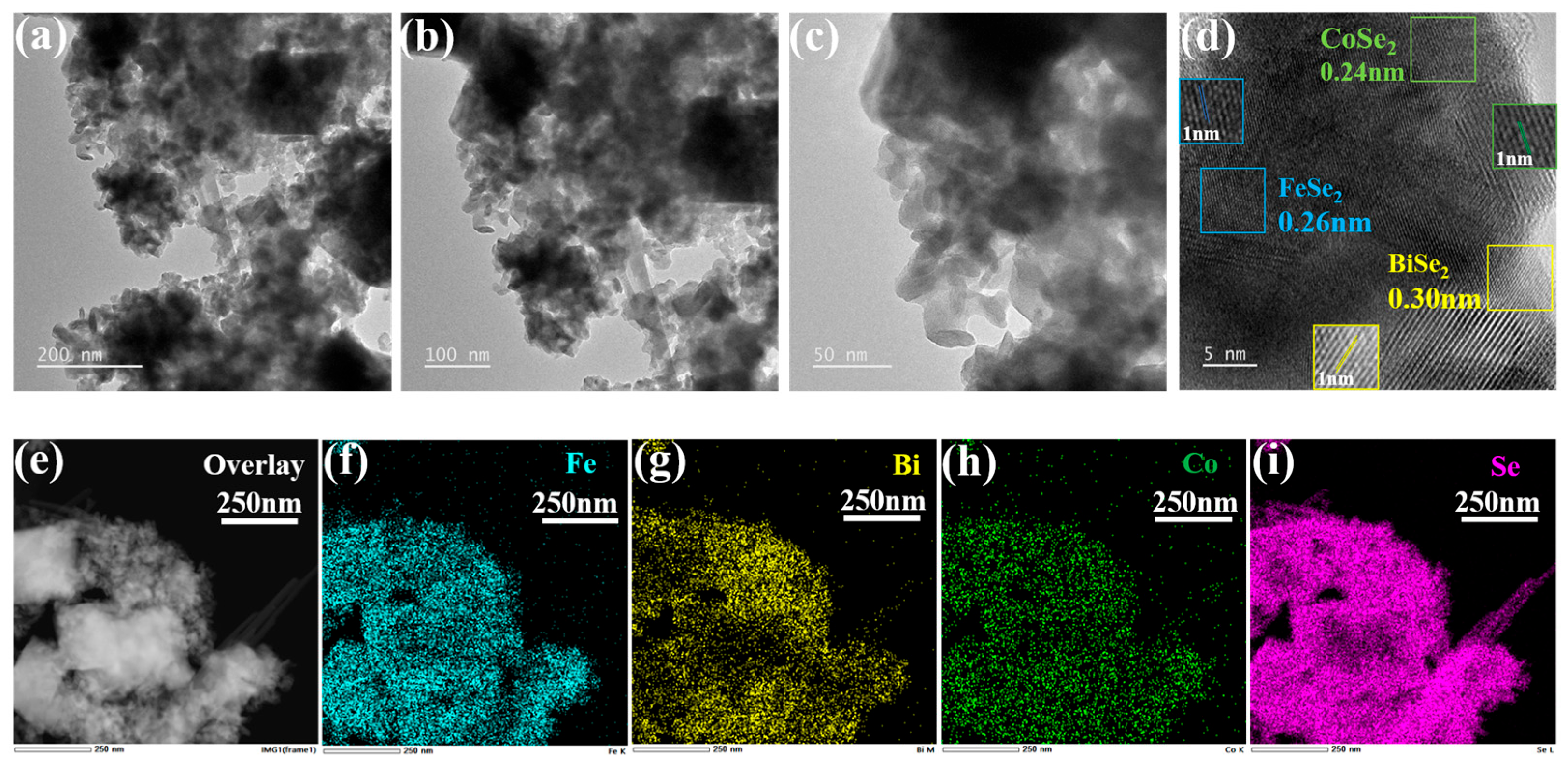
To investigate the polycrystalline properties of FeSe2-BiSe2-CoSe2, detailed analysis of its microstructure was conducted using TEM. Figure 3a–c display transmission electron microscopy images of the FeSe2-BiSe2-CoSe2 composite at different magnifications. Consistent with scanning electron microscopy characterization, this ternary heterojunction clearly shows BiSe2 nanospheres attached to FeSe2 nanorods, with CoSe2 particles visible in the gaps between BiSe2 and FeSe2. This arrangement provides additional active sites for chemical reactions, thereby enhancing the HER activity of FeSe2-BiSe2-CoSe2. The coexistence of multiple crystalline faces enables synergistic catalytic effects, optimizing reaction pathways. Further HRTEM observations (Figure 3d) reveal that the doped phases within the blue, green, and yellow boxes correspond to BiSe2, CoSe2, and FeSe2, respectively. Their lattice stripe interplanar spacings are 0.302 nm, 0.242 nm, and 0.259 nm, corresponding successively to the (110) plane of BiSe2, the (210) plane of CoSe2, and the (200) plane of FeSe2. This aligns with the corresponding crystal planes identified by XRD, confirming the coexistence of these three crystalline phases within the FeSe2-BiSe2-CoSe2 composite material and further corroborating its polycrystalline nature. Furthermore, energy-dispersive spectroscopy (EDS) analysis results, as shown in Figure 3e–i, reveal uniform distribution of Fe, Bi, Co, and Se elements throughout the composite material.

3.2. HER Performance in 0.5 M H2SO4

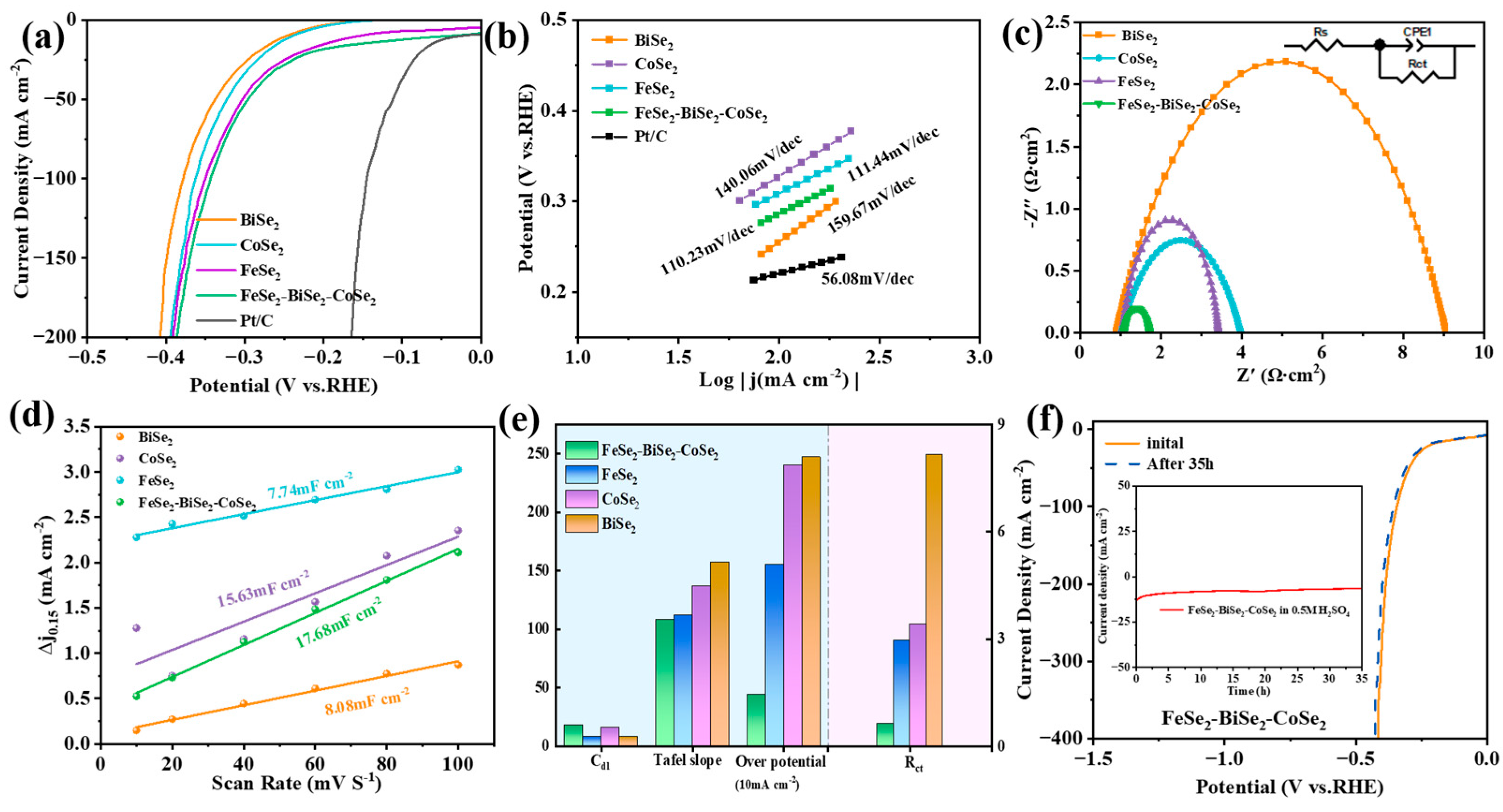
With the structural, compositional, and basic physical profiles of the catalysts established, we then proceeded to evaluate their catalytic performance; the HER performance of FeSe2-BiSe2-CoSe2, BiSe2, CoSe2, FeSe2, and Pt/C was characterized in 0.5 M H2SO4. All electrochemical testing steps were conducted at room temperature. The experimental setup is shown in Figure S4; white wire connects to the reference electrode (Ag/AgCl), red wire connects to the counter electrode (carbon rod), and green wire connects to the working electrode (FeSe2-BiSe2-CoSe2 loaded onto a 1 × 1 cm2 carbon cloth). Figure 4a presents a comparative view of the LSV curves for BiSe2, CoSe2, FeSe2, and FeSe2-BiSe2-CoSe2. The overpotentials for FeSe2, BiSe2, CoSe2, and FeSe2-BiSe2-CoSe2 are 247, 240, 155, and 44 mV, respectively. It can be observed that FeSe2-BiSe2-CoSe2 exhibits favorable HER activity [29], surpassing only Pt/C by 30 mV, but, compared with known catalysts, as shown in Figure S3 and Table S4, FeSe2-BiSe2-CoSe2 also exhibits excellent HER activity in acidic environments [30]. The LSV curve was linearly fitted to obtain the catalyst’s Tafel curve (Figure 4b) for analyzing its acidic HER kinetics. FeSe2-BiSe2-CoSe2 exhibited a Tafel slope of 110.23 mV dec−1, outperforming BiSe2 (159.67 mV dec−1), CoSe2 (140.06 mV dec−1), and FeSe2 (111.44 mV dec−1), and being slightly higher than Pt/C at 56.08 mV dec−1. The lower Tafel value of FeSe2-BiSe2-CoSe2 indicates a faster chemical reaction rate, further demonstrating its excellent HER reactivity [13]. FeSe2-BiSe2-CoSe2 exhibits a Tafel slope ranging from 40 to 120 mV dec−1, which demonstrates that the FeSe2-BiSe2-CoSe2 HER reaction pathway follows the Volmer–Heyrovsky mechanism. In 0.5 M H2SO4, the external circuit transfers electrons to the active sites on the FeSe2-BiSe2-CoSe2 surface, where they combine with H3O+ in the electrolyte to undergo the Volmer reaction, yielding H2O and H* (‘*’ is the active site). Under low H* coverage conditions, H* undergoes the Heyrovsky reaction with the H3O+ ions and electrons in the solution, yielding H2O and H2.
The Rct values of BiSe2, CoSe2, FeSe2, and FeSe2-BiSe2-CoSe2 are 8.16, 3.40, 2.95, and 0.63 Ω, respectively (Figure 4c). Among these, FeSe2-BiSe2-CoSe2 exhibits the smallest Rct value compared to BiSe2, CoSe2, and FeSe2, indicating its faster charge transfer rate. This further demonstrates that alloying accelerates the reaction kinetics of the HER [31]. Figure S4 shows the CV curves. In Figure 4d, the measured Cdl for FeSe2-BiSe2-CoSe2 was 17.68 mF cm−2, substantially exceeding the values recorded for BiSe2 (8.08 mF cm−2), CoSe2 (15.63 mF cm−2), and FeSe2 (7.74 mF cm−2). FeSe2-BiSe2-CoSe2 exhibits an ECSA of 442.0 cm2, while BiSe2, CoSe2, and FeSe2 have ECSA values of 202.0 cm2, 390.75 cm2, and 193.50 cm2 (Table S5). These results indicate that FeSe2-BiSe2-CoSe2 possesses a greater ECSA, providing more catalytic active sites for the HER and enhancing the chemical reaction rate. When calculating the TOF value, we consider all atoms in the catalyst to be active sites [32]. Table S6 shows that the TOF value for FeSe2-BiSe2-CoSe2 (2.2 × 10⁻² s−1) is the highest, surpassing that of the CoSe2 (2.4 × 10⁻³ s−1), FeSe2 (1.9 × 10⁻² s−1), and BiSe2 (1.8 × 10⁻² s−1). Figure 4e shows a performance comparison of the HER in acidic electrolytes for BiSe2, CoSe2, FeSe2, and FeSe2-BiSe2-CoSe2; FeSe2-BiSe2-CoSe2 exhibits outstanding performance across four HER metrics: overpotential (44 mV), Tafel slope (110.23 mV dec−1), Cdl value (17.68 mF cm−2), and Rct (0.63 Ω). This demonstrates that the FeSe2-BiSe2-CoSe2 ternary heterojunction exhibits significantly superior HER performance in acidic environments compared to BiSe2, CoSe2, and FeSe2 [33]. As shown in Figure 4f, during the 35 h stability test, the potential change in FeSe2-BiSe2-CoSe2 exhibited a trend of initially slow decay followed by stabilization. The LSV curve of FeSe2-BiSe2-CoSe2 revealed negligible overpotential variation, fully confirming the excellent stability of FeSe2-BiSe2-CoSe2, even under strong acidic conditions [34,35].

3.3. HER Performance in 1 M KOH

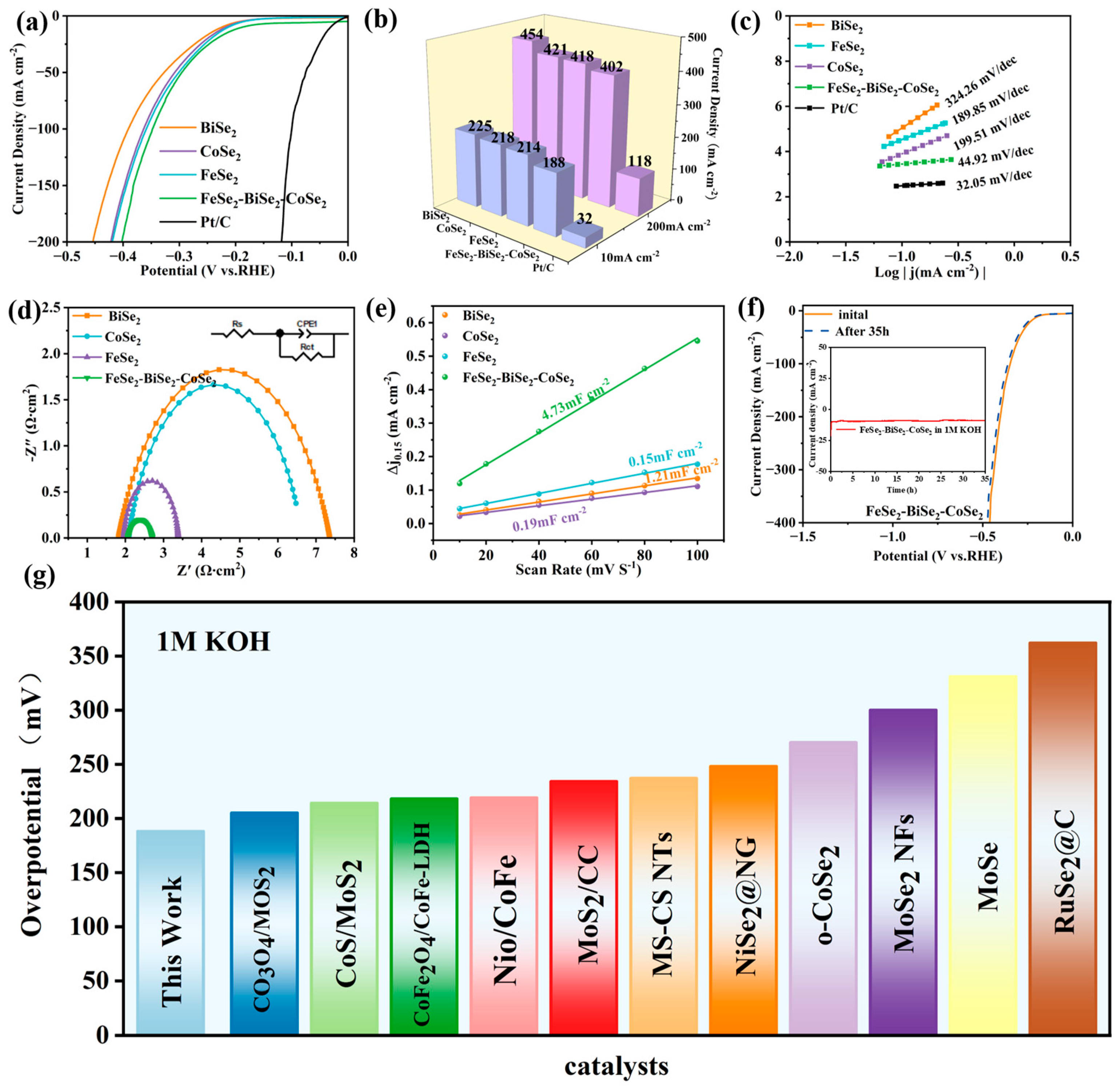
Using the same testing methodology, the HER performance of BiSe2, CoSe2, FeSe2, Pt/C, and FeSe2-BiSe2-CoSe2 was evaluated in an alkaline environment (1 M KOH). The LSV curves for Pt/C, BiSe2, CoSe2, FeSe2, and FeSe2-BiSe2-CoSe2 are shown in Figure 5a. At a current density of 10 and 200 mA cm−2, FeSe2-BiSe2-CoSe2 exhibits an overpotential of 188 and 402 mV, demonstrating superior HER performance compared to BiSe2 (225 and 454 mV), CoSe2 (218 and 421 mV), and FeSe2 (214 and 418 mV), only higher than that of Pt/C at the same current density [36]. Figure 5b shows the overpotentials of Pt/C, BiSe2, CoSe2, FeSe2, and FeSe2-BiSe2-CoSe2 at 10 and 200 mA cm−2 under alkaline conditions, indicating that FeSe2-BiSe2-CoSe2 exhibits excellent HER performance in alkaline environments. The Tafel plots derived from the LSV data are depicted in Figure 5c. The Tafel slope of FeSe2-BiSe2-CoSe2 (44.92 mV dec−1) is higher than Pt/C at 32.05 mV dec−1 but markedly lower than those of BiSe2 (324.26 mV dec−1), CoSe2 (199.51 mV dec−1), and FeSe2 (189.85 mV dec−1). The Tafel slope values of FeSe2-BiSe2-CoSe2 ranging between 40 and 120 mV dec−1 indicate adherence to the Volmer–Heyrovsky mechanism [37]. In alkaline media, H2O first adsorbs onto active sites on the FeSe2-BiSe2-CoSe2 surface, undergoing the Volmer reaction with electrons to be reduced into H* and OH. Under conditions of low H* coverage, H* undergoes the Heyrovsky reaction with the H2O and electrons in the solution to form OH and H2 [38]. The Heyrovsky step plays a dominant role. Furthermore, the Rct values for BiSe2, CoSe2, FeSe2, and FeSe2-BiSe2-CoSe2 were 5.54, 4.38, 1.43, and 0.63 Ω, respectively (Figure 5d). Among these, FeSe2-BiSe2-CoSe2 exhibited the lowest Rct value and minimal charge transfer resistance, indicating that FeSe2-BiSe2-CoSe2 possesses a relatively rapid electron transfer rate in alkaline environments [39].
The CV curves for BiSe2, CoSe2, FeSe2, and FeSe2-BiSe2-CoSe2 were measured within the potential range of 0.3–0.9 V and at scan rates of 10–100 mV s−1 (Figure S6). The Cdl values for the four materials were obtained (Figure 5e), with FeSe2-BiSe2-CoSe2 exhibiting the highest Cdl value of 4.73 mF cm−2, significantly exceeding those of BiSe2 (1.21 mF cm−2), CoSe2 (0.19 mF cm−2), and FeSe2 (0.15 mF cm−2) [40]. Calculations of the ECSA based on Cdl values (Table S7) reveal that the electrochemical active areas for BiSe2, CoSe2, FeSe2, and FeSe2-BiSe2-CoSe2 are 30.25 cm2, 4.75 cm2, 3.75 cm2, and 118.25 cm2, respectively. This demonstrates that FeSe2-BiSe2-CoSe2 possesses the largest electrochemical active area. This indicates that the interface contact area between FeSe2-BiSe2-CoSe2 and the electrolyte is substantial, thereby providing more active sites for interaction with H2O. This further accelerates the HER reaction rate under alkaline conditions [33].
Calculations of the TOF for BiSe2, CoSe2, FeSe2, and FeSe2-BiSe2-CoSe2 yielded a TOF of 2.1 × 10⁻² s−1 for FeSe2-BiSe2-CoSe2 (Table S8), significantly higher than that of BiSe2, CoSe2, and FeSe2. This indicates that FeSe2-BiSe2-CoSe2 exhibits superior intrinsic activity [41]. Furthermore, the i-t curve of FeSe2-BiSe2-CoSe2 exhibited negligible current decay after 35 h of continuous testing at a constant potential of 10 mA cm−2 (Figure 5f) [42]. The LSV curves before and after the 35 h stability test exhibit near-perfect overlap, confirming FeSe2-BiSe2-CoSe2’s outstanding structural stability and catalytic durability [43,44]. Compared with the previously reported literature, FeSe2-BiSe2-CoSe2 also exhibits relatively superior HER performance in alkaline environments (Figure 5g and Table S4). In summary, FeSe2-BiSe2-CoSe2 demonstrates excellent electrochemical activity and stability under both acidic and alkaline conditions [45,46].

4. Conclusions

This study successfully synthesized the ternary heterojunction FeSe2-BiSe2-CoSe2 via a one-step hydrothermal method. Its unique electronic restructuring mechanism significantly enhances hydrogen evolution performance in both acidic and alkaline media. Owing to the substantial electronegativity difference between Bi and Fe/Co, directional charge transfer occurs within the lattice. This reduces the electron density of Bi and Se, forming electron-deficient matrices, while Fe and Co become electron-rich active centers. Concurrently, efficient hybridization occurs between Fe’s 2p orbitals and Se’s 3d orbitals, while energy-level matching between Co and Fe’s 2p orbitals further enhances electron coupling. Collectively, this achieves optimized electronic restructuring. The redistributed electrons not only elevate the intrinsic catalytic activity of active sites but also, in conjunction with the material’s abundant pore structure, facilitate electron and reactant transport. Consequently, the compound exhibits outstanding HER performance and stability in both acidic and alkaline environments.

Supplementary Materials

The following supporting information can be downloaded at: https://www.mdpi.com/article/10.3390/ma19020430/s1, Figure S1: Full XPS spectra of FeSe2-BiSe2-CoSe2, CoSe2, FeSe2, and BiSe2; Figure S2: Full XPS spectra of (a) FeSe2-BiSe2-CoSe2, (b) FeSe2, (c) BiSe2, and (d) CoSe2; Figure S3: SEM images of (a,b) BiSe2, (c,d) CoSe2, (e,f) FeSe2, and (g,h) FeSe2-BiSe2-CoSe2; Figure S4: Schematic diagram of a three-electrode HER system; Figure S5: Comparison of the HER overpotentials at 10 mA cm−2 in 0.5 M H2SO4; Figure S6: HER cyclic voltammetry of (a) BiSe2, (b) CoSe2, (c) FeSe2, and (d) FeSe2-BiSe2-CoSe2 in 0.5M H2SO4 at scan rates of 10, 20, 40, 60, 80, and 100 mV s−1, respectively; Figure S7: HER cyclic voltammetry of (a) BiSe2, (b) CoSe2, (c) FeSe2, and (d) FeSe2-BiSe2-CoSe2 in 1M KOH at scan rates of 10, 20, 40, 60, 80, and 100 mV s−1, respectively; Table S1: The lattice constants were calculated by FeSe2 (JCPDS#12-0291, a = 4.815 Å, b = 5.808 Å, and c = 3.599 Å); Table S2: The lattice constants were calculated by BiSe2 (JCPDS #12-0732; a = b = 4.133 Å and c = 28.620 Å); Table S3: The lattice constants were calculated by CoSe2 (JCPDS #09-0234; a = b = c = 5.858 Å); Table S4: Electrochemical HER performance of the present work compared with previous reports; Table S5: ECSA value of HER in 0.5 M H2SO4; Table S6: TOF value from HER at the overpotential of −0.35V vs. RHE for catalytic materials. (0.5M H2SO4); Table S7: ECSA value of HER in 1 M KOH; Table S8: TOF value from HER at the overpotential of −0.35V vs. RHE for catalytic materials in 1M KOH). References [47,48,49,50,51,52,53,54,55,56,57,58,59,60,61] are cited in the Supplementary Materials.

Author Contributions

L.G.: Formal Analysis, Writing—Original Draft, and Writing—Review and Editing; Y.C.: Investigation, Writing—Original Draft, and Formal Analysis; Q.H.: Supervision, K.L.: Conceptualization and Methodology. All authors have read and agreed to the published version of the manuscript.

Funding

This work was Supported by the National Key R&D Program of China (2023YFC3709500) and the Scientific and Technological Innovation Programs of Higher Education Institutions in Shanxi (2022P007).

Institutional Review Board Statement

Not applicable.

Informed Consent Statement

Not applicable.

Data Availability Statement

The original contributions presented in this study are included in the article/Supplementary Material. Further inquiries can be directed to the corresponding authors.

Conflicts of Interest

The authors declare no conflicts of interest.

References

  1. Wu, A.P.; Xie, Y.; Ma, H.; Tian, C.G.; Gu, Y.; Yan, H.J.; Zhang, X.M.; Yang, G.Y.; Fu, H.G. Integrating the active OER and HER components as the heterostructures for the efficient overall water splitting. Nano Energy 2018, 44, 353–363. [Google Scholar] [CrossRef]
  2. Zubair, M.; Ul Hassan, M.M.; Mehran, M.T.; Baig, M.M.; Hussain, S.; Shahzad, F. 2D MXenes and their heterostructures for HER, OER and overall water splitting: A review. Int. J. Hydrogen Energy 2022, 47, 2794–2818. [Google Scholar] [CrossRef]
  3. Zhao, L.S.; Liu, S.Y.; Wei, L.G.; He, H.Y.; Jiang, B.; Zhan, Z.S.; Wang, J.; Li, X.W.; Gou, W.T. One-pot hydrothermal synthesis of bifunctional Co/Mo-rGO efficient electrocatalyst for HER/OER in water splitting. Catal. Lett. 2024, 154, 5294–5302. [Google Scholar] [CrossRef]
  4. Zhang, J.; Cui, R.J.; Gao, C.C.; Bian, L.Y.; Pu, Y.; Zhu, X.B.; Li, X.A.; Huang, W. Cation-modulated HER and OER activities of hierarchical VOOH hollow architectures for high-efficiency and stable overall water splitting. Small 2019, 15, 1904688. [Google Scholar] [CrossRef]
  5. Ran, J.X.; Zhang, Z.F.; Feng, H.; Zhao, H.W.; Chai, D.F.; Huang, X.M.; Zhang, W.Z.; Zhao, M.; Dong, G.H.; Zang, Y.; et al. P-doped Co-based nanoarray heterojunction with multi-interfaces for complementary HER/OER electrocatalysts towards high-efficiency overall water splitting in alkaline. Int. J. Hydrogen Energy 2024, 64, 935–946. [Google Scholar] [CrossRef]
  6. Du, J.H.; Wang, L.P.; Yuan, A.J.; Xie, J.; Liu, H.; Zhang, H.J.; Chen, Y.Y.; Chen, L. Synergistic ternary catalysis: NiCo-LDH/Ni3S2/Co9S8@NiFe-LDH-Ov/NF composite catalyst for high-efficiency HER/OER bifunctional water splitting. J. Alloys Compd. 2025, 1026, 64–73. [Google Scholar] [CrossRef]
  7. Dao, H.T.; Hoa, V.; Sidra, S.; Mai, M.; Zharnikov, M.; Kim, D. Dual efficiency enhancement in overall water splitting with defect-rich and Ru atom-doped NiFe LDH nanosheets on NiCo2O4 nanowires. Chem. Eng. J. 2024, 485, 150054. [Google Scholar] [CrossRef]
  8. Sui, Z.H.; Xu, Q.; Cheng, J.; Zhang, C.; Chen, Y.L.; Liu, K.K.; Lei, S.W.; Zhang, L.X.; Guo, F.B. Coupling interface constructions of clustered Mn-CoFeSe2 derived from CoFe-LDH for efficient overall water splitting. Fuel 2026, 410, 138000. [Google Scholar] [CrossRef]
  9. Guo, F.B.; Cheng, J.; Lei, H.Y.; Sui, Z.H.; Yu, Y.M.; Han, J.L.; Yue, T.J.; Liu, K.K. Transition metal manganese induces structural reorganization of MnxMo1-xSe2 for efficient overall water splitting. J. Colloid Interface Sci. 2026, 703, 139203. [Google Scholar] [CrossRef]
  10. Chen, L.N.; Cheng, Z.F.; He, S.; Wu, Z.P.; Zhang, X.D.; Ren, Z.W.; Zong, D.H.; Deng, K.L.; Xi, M.G. Influence of monolayer MoS2 grain boundaries on MoS2 cluster nucleation during layer-by-layer growth of bilayer MoS2. Appl. Surf. Sci. 2026, 715, 164549. [Google Scholar] [CrossRef]
  11. Li, D.S.; Wang, W.; Shang, X.Y.; Tang, H.; Zulfiqa, S. Solar-driven photocatalytic water oxidation of Ag3PO4/CNTs@MoSe2 ternary composite photocatalyst. Appl. Surf. Sci. 2020, 505, 144613. [Google Scholar] [CrossRef]
  12. Chen, L.; Ren, S.; Xing, X.D.; Yang, J.; Li, J.L.; Yang, J.; Liu, Q.C. Effect of MnO2 crystal types on CeO2@MnO2 oxides catalysts for low-temperature NH3-SCR. J. Environ. Chem Eng. 2022, 10, 108239. [Google Scholar] [CrossRef]
  13. Zhou, C.Y.; Cui, W.; Cui, S.X.; Li, G.C.; Han, L. MOF-derived Co(Fe)OOH slab and Co/MoN nanosheet-covered hollow-slab for efficient overall water splitting. ACS Appl. Mater. Interfaces 2024, 16, 69368–69378. [Google Scholar] [CrossRef]
  14. Qu, P.; Zhao, Z.L. An interfacially engineered Ni2P/Fe2P heterostructure grown on NiFe PBA/NF as a high-efficiency bifunctional electrocatalyst for overall water splitting. Fuel 2026, 413, 138306. [Google Scholar] [CrossRef]
  15. Guo, F.B.; Yu, Y.M.; Sui, Z.H.; Cheng, J.; Li, Y.H.; Wang, X.J.; Duan, J.W.; Lei, S.W.; Liu, K.K. Electronic self-regulation of ternary alloy selenides FeNiCoSe2 for efficient overall water splitting. Fuel 2026, 405, 136679. [Google Scholar] [CrossRef]
  16. Cheng, J.; Yu, Y.M.; Sui, Z.H.; Lei, S.W.; Duan, Q.Y.; Zhao, Y.M.; Liu, K.K.; Zhang, L.X.; Guo, F.B. Transition metal Co-induced phase transition of CoxMo1-x Se2 to promote a hydrogen evolution reaction. ACS Sustain. Chem. Eng. 2025, 13, 2176–2187. [Google Scholar] [CrossRef]
  17. Liu, K.K.; Cheng, J.; Yu, Y.M.; Sui, Z.H.; Guo, F.B.; Lei, S.W.; Zhang, L.X.; Li, M.; Yun, Y.B. Transition metal Co induce CoSe2/NiWSe2 interface structural reorganization for efficient oxygen evolution reaction and urea oxidation reaction. Surf. Interfaces 2024, 45, 103950. [Google Scholar] [CrossRef]
  18. Lee, S.O.; Moon, H.S.; Hong, I.J.; Lakhera, S.K.; Yong, K.J. Hollow SrTiO3 photocatalyst with spatially separated OER and HER cocatalysts for photocatalytic overall water splitting. Appl. Surf. Sci. 2024, 665, 160298. [Google Scholar]
  19. Mane, R.S.; Zaroliwalla, D.; Periyasamy, G.; Jha, N. Leafy ZIF-Derived Bi-metallic phosphate-mxene nanocomposites for overall water splitting. Small 2025, 21, 2503228. [Google Scholar] [CrossRef]
  20. Yu, K.; Zhang, J.Y.; Hu, Y.T.; Wang, L.Q.; Zhang, X.F.; Zhao, B. Ni doped Co-MOF-74 synergized with 2D Ti3C2Tx MXene as an efficient electrocatalyst for overall water-splitting. Catalysts 2024, 14, 184. [Google Scholar] [CrossRef]
  21. Yao, J.; Sui, Z.H.; Guo, F.B.; Guo, X.H.; Lei, S.W.; Liu, K.K. Hollow shell-core heterojunction enhances oxygen evolution reaction and urea oxidation reaction of MOF-NiSe2@MoSe2. Int. J. Hydrogen Energy 2025, 136, 93–101. [Google Scholar] [CrossRef]
  22. Zhang, C.Y.; Du, X.Q.; Zhang, X.S.; Wang, Y.H. Ni3S2/MxSy-NiCo LDH (M = Cu, Fe, V, Ce, Bi) heterostructure nanosheet arrays on Ni foam as high-efficiency electrocatalyst for electrocatalytic overall water splitting and urea splitting. Dalton Trans. 2023, 52, 763–773. [Google Scholar] [CrossRef]
  23. Xu, Q.; Jiu, H.; Zhang, L.X.; Guo, F.B.; Cheng, J.; Yu, Y.M.; Ma, J.F.; Li, H. Vanadium-doped induced multicomponent oxide NiFeVOX@NF with tremella-like structure for efficient overall water splitting. Int. J. Hydrogen Energy 2025, 126, 508–515. [Google Scholar] [CrossRef]
  24. Guo, F.B.; Zhao, X.Y.; Cheng, J.; Liu, K.K.; Zhang, L.X. NiMOF-derived MoSe2@NiSe2 heterostructure with hollow core-shell for efficient hydrogen evolution reaction. J. Alloys Compd. 2023, 947, 169513. [Google Scholar] [CrossRef]
  25. Pan, S.Y.; Li, C.; Xiong, T.T.; Xie, Y.H.; Luo, F.; Yang, Z.H. Hydrogen spillover in MoOXRh hierarchical nanosheets boosts alkaline HER catalytic activity. Appl. Catal. B-Environ. Energy 2024, 341, 123275. [Google Scholar] [CrossRef]
  26. Guo, L.; Bai, X.; Xue, H.; Sun, J.; Song, T.S.; Zhang, S.; Qin, L.; Huang, K.K.; He, F.; Wang, Q. MOF-derived hierarchical 3D bi-doped CoP nanoflower eletrocatalyst for hydrogen evolution reaction in both acidic and alkaline media. Chem. Commun. 2020, 56, 7702–7705. [Google Scholar] [CrossRef]
  27. Sang, Y.; Xue, J.W.; Hu, J.J.; Chen, L.J. High-current density alkaline water/seawater splitting by Mo and Fe co-doped Ni3S2: Invariant active sites with accelerated water dissociation kinetics. Appl. Catal. B-Environ. Energy 2025, 361, 124698. [Google Scholar] [CrossRef]
  28. Zou, X.X.; Zhang, Y. Noble metal-free hydrogen evolution catalysts for water splitting. Chem. Soc. Rev. 2015, 44, 5148–5180. [Google Scholar] [CrossRef]
  29. Chen, Z.W.; Li, J.; Ou, P.F.; Huang, J.E.; Wen, Z.; Chen, L.X.; Yao, X.; Cai, G.M.; Yang, C.C.; Singh, C.V.; et al. Unusual sabatier principle on high entropy alloy catalysts for hydrogen evolution reactions. Nat. Commun. 2024, 15, 359. [Google Scholar] [CrossRef]
  30. Wu, N.T.; He, W.J.; Shi, S.C.; Yuan, X.K.; Li, J.; Cao, J.L.; Yuan, C.Z.; Liu, X.M. Bamboo fiber-derived carbon support for the immobilization of Pt nanoparticles to enhance hydrogen evolution reaction. J. Colloid Interface Sci. 2025, 684, 658–667. [Google Scholar] [CrossRef]
  31. Kuang, P.Y.; Ni, Z.R.; Zhu, B.C.; Lin, Y.; Yu, J.G. Modulating the d-Band Center Enables Ultrafine Pt3Fe Alloy Nanoparticles for pH-Universal Hydrogen Evolution Reaction. Adv. Mater. 2023, 35, 2303030. [Google Scholar] [CrossRef]
  32. Karmakar, A.; Kundu, S. Beyond traditional TOF: Unveiling the pitfalls in electrocatalytic active site determination. J. Mater. Chem. A 2025, 13, 39687. [Google Scholar] [CrossRef]
  33. Ma, W.S.; Zhang, Y.H.; Wang, B.Y.; Wang, J.C.; Dai, Y.N.; Hu, L.W.; Lv, X.W.; Dang, J. Significantly enhanced OER and HER performance of NiCo-LDH and NiCoP under industrial water splitting conditions through Ru and Mn bimetallic co-doping strategy. Chem. Eng. J. 2024, 494, 153212. [Google Scholar] [CrossRef]
  34. Wang, P.; Zheng, J.; Xu, X.; Zhang, Y.Q.; Shi, Q.F.; Wan, Y.; Ramakrishna, S.; Zhang, J.; Zhu, L.Y.; Yokoshima, T.; et al. Unlocking Efficient Hydrogen Production: Nucleophilic Oxidation Reactions Coupled with Water Splitting. Adv. Mater. 2024, 36, 2404806. [Google Scholar] [CrossRef]
  35. Qiang, S.H.; Li, Z.Y.; He, S.Q.; Zhou, H.; Zhang, Y.; Cao, X.; Yuan, A.H.; Zou, J.S.; Wu, J.C.; Qiao, Y.X. Modulating electronic structure of CoS2 nanorods by Fe doping for efficient electrocatalytic overall water splitting. Nano Energy 2025, 134, 110564. [Google Scholar] [CrossRef]
  36. Zhao, J.; Urrego-Ortiz, R.; Liao, N.; Calle-Vallejo, F.; Luo, J.S. Rationally designed Ru catalysts supported on TiN for highly efficient and stable hydrogen evolution in alkaline conditions. Nat. Commun. 2024, 15, 6391. [Google Scholar] [CrossRef] [PubMed]
  37. Liu, S.J.; Wei, Y.; Wang, M.K.; Shen, Y. The future of alkaline water splitting from the perspective of electrocatalysts-seizing today’s opportunities. Coord. Chem. Rev. 2025, 522, 216190. [Google Scholar] [CrossRef]
  38. Ding, X.Y.; Liu, D.; Zhao, P.J.; Chen, X.; Wang, H.X.; Oropeza, F.E.; Gorni, G.; Barawi, M.; García-Tecedor, M.; O’Shea, V.A.D.; et al. Dynamic restructuring of nickel sulfides for electrocatalytic hydrogen evolution reaction. Nat. Commun. 2024, 15, 5336. [Google Scholar] [CrossRef] [PubMed]
  39. Zhang, Y.; Li, Z.Y.; He, S.Q.; Qiao, Y.X.; Yuan, A.H.; Wu, J.C.; Zhou, H. Interfacial engineering of heterostructured CoP/FeP nanoflakes as bifunctional electrocatalyts toward alkaline water splitting. J. Colloid Interface Sci. 2025, 679, 20–29. [Google Scholar] [CrossRef]
  40. Zhang, B.X.; Wang, J.M.; Liu, G.M.; Weiss, C.M.; Liu, D.Q.; Chen, Y.P.; Xia, L.X.; Zhou, P.; Gao, M.X.; Liu, Y.F.; et al. A strongly coupled Ru-CrOx cluster-cluster heterostructure for efficient alkaline hydrogen electrocatalysis. Nat. Catal. 2024, 7, 441–451. [Google Scholar] [CrossRef]
  41. Wei, X.L.; Jiao, Y.; Zou, X.Y.; Guo, Y.C.; Li, W.H.; Ai, T.T. P vacancy-induced electron redistribution and phase reconstruction of CoFeP for overall water splitting at industrial-level current density. Inorg. Chem. Front. 2025, 12, 2678–2690. [Google Scholar] [CrossRef]
  42. Zhang, B.X.; Cui, J.X.; Li, Z.F.; Yang, C.L.; Dong, W.W.; Li, K.; Ma, Y.Y.; Nan, Z. Extraordinary Hydrogen Evolution and Oxygen Evolution Reaction Activity from PPy@FeCo-LDH/NF Bifunctional Electrocatalyst in Alkaline Solution. J. Electrochem. Soc. 2024, 171, 086502. [Google Scholar] [CrossRef]
  43. Wang, X.J.; Huang, Y.; Zhu, J.K.; Zhao, Z.Y.; Zhao, J.B.; Zhang, J.J. Cobalt vanadate nano/microrods as high-efficiency dual-functional electrocatalyst for hydrogen evolution and urea-assisted alkaline oxygen evolution reaction. Int. J. Hydrogen Energy 2024, 88, 78–85. [Google Scholar] [CrossRef]
  44. Huang, T.X.; Cong, X.; Wu, S.S.; Wu, J.B.; Bao, Y.F.; Cao, M.F.; Wu, L.W.; Lin, M.L.; Wang, X.; Tan, P.H.; et al. Visualizing the structural evolution of individual active sites in MoS2 during electrocatalytic hydrogen evolution reaction. Nat. Catal. 2024, 7, 646–654. [Google Scholar] [CrossRef]
  45. Feng, Y.M.; Xie, Y.H.; Yu, Y.J.; Chen, Y.Z.; Liu, Q.T.; Bao, H.F.; Luo, F.; Pan, S.Y.; Yang, Z.H. Electronic Metal-Support Interaction Induces Hydrogen Spillover and Platinum Utilization in Hydrogen Evolution Reaction. Angew. Chem. 2025, 64, 202413471. [Google Scholar]
  46. Sui, Z.H.; Xu, Q.; Cheng, J.; Zhang, C.; Liu, K.K.; Lei, S.W.; Zhang, L.X.; Guo, F.B. Interfacial electronic structure regulation of MoSe2-NiSe2-FeSe2 ternary heterojunction for pH-universal hydrogen evolution reaction. Int. J. Hydrogen Energy 2026, 207, 153520. [Google Scholar] [CrossRef]
  47. Song, M.; Zhao, Y.; Wu, Z.X.; Liu, X.E. MoS2/CoB with Se doping on carbon cloth to drive overall water-splitting in an alkaline electrolyte. Sustain. Energ. Fuels 2020, 4, 5036–5041. [Google Scholar] [CrossRef]
  48. Qin, J.F.; Shen, Q.H.; Du, C.C.; Hong, M.; Yang, Y.X.; Zhang, X.H.; Chen, J.H. Enriched Se vacancies engineering of RuSe2 induced by low-valence Cu doping for promoting hydrogen evolution and coupling power generation. Fuel 2024, 361, 130752. [Google Scholar] [CrossRef]
  49. Wang, Y.Q.; Jian, C.Y.; Hong, W.T.; Cai, Q.; Liu, W. Tuning the electron status of urchin-like CoS2 nanowires by selenium doping toward highly efficient hydrogen evolution reaction. Mater. Lett. 2019, 257, 126673. [Google Scholar] [CrossRef]
  50. Lei, Y.T.; Zhang, L.L.; Zhou, D.N.; Xiong, C.L.; Zhao, Y.F.; Chen, W.X.; Xiang, X.; Shang, H.S.; Zhang, B. Construction of interconnected NiO/CoFe alloy nanosheets for overall water splitting. Renew. Energy 2022, 194, 459–468. [Google Scholar] [CrossRef]
  51. Su, C.; Xiang, J.Y.; Wen, F.S.; Song, L.Z.; Mu, C.P.; Xu, D.Y.; Hao, C.X.; Liu, Z.Y. Microwave synthesized three-dimensional hierarchical nanostructure CoS2/MoS2 growth on carbon fiber cloth: A bifunctional electrode for hydrogen evolution reaction and supercapacitor. Electrochim. Acta 2016, 212, 941–949. [Google Scholar] [CrossRef]
  52. Lin, H.F.; Li, H.Y.; Li, Y.Y.; Liu, J.L.; Wang, X.; Wang, L. Hierarchical CoS/MoS2 and Co3S4/MoS2/Ni2P nanotubes for efficient electrocatalytic hydrogen evolution in alkaline media. J. Mater. Chem. A 2017, 5, 25410–25419. [Google Scholar] [CrossRef]
  53. Muthurasu, A.; Maruthapandian, V.; Kim, H.Y. Metal-organic framework derived Co3O4/MoS2 heterostructure for efficient bifunctional electrocatalysts for oxygen evolution reaction and hydrogen evolution reaction. Appl. Catal. B-Environ. Energy 2019, 248, 202–210. [Google Scholar] [CrossRef]
  54. Tang, Y.; Yang, C.H.; Sheng, M.H.; Yin, X.T.; Que, W.X. Synergistically coupling phosphorus-doped molybdenum carbide with MXene as a highly efficient and stable electrocatalyst for hydrogen evolution reaction. ACS Sustain. Chem. Eng. 2020, 8, 12990–12998. [Google Scholar] [CrossRef]
  55. Li, W.X.; Yu, B.; Hu, Y.; Wang, X.Q.; Yang, D.X.; Chen, Y.F. Core-shell structure of NiSe2 nanoparticles@nitrogen-doped graphene for hydrogen evolution reaction in both acidic and alkaline media. ACS Sustain. Chem. Eng. 2019, 7, 20463–20473. [Google Scholar] [CrossRef]
  56. Zhao, G.Q.; Li, P.; Rui, K.; Chen, Y.P.; Dou, S.X.; Sun, W.P. CoSe2/MoSe2 heterostructures with enriched water adsorption/dissociation sites towards enhanced alkaline hydrogen evolution reaction. Chem.-Eur. J. 2018, 24, 11158–11165. [Google Scholar] [CrossRef]
  57. Chen, P.Z.; Xu, K.; Tao, S.; Zhou, T.P.; Tong, Y.; Ding, H.; Zhang, L.D.; Chu, W.S.; Wu, C.Z.; Xie, Y. Phase-transformation engineering in cobalt diselenide realizing enhanced catalytic activity for hydrogen evolution in an alkaline medium. Adv. Mater. 2016, 28, 7527–7532. [Google Scholar] [CrossRef]
  58. Cheng, L.; Huang, W.J.; Gong, Q.F.; Liu, C.H.; Liu, Z.; Li, Y.G.; Dai, H.J. Ultrathin WS2 nanoflakes as a high-performance electrocatalyst for the hydrogen evolution reaction. Angew. Chem.-Int. Edit. 2014, 53, 7860–7863. [Google Scholar] [CrossRef]
  59. Liang, H.W.; Brüller, S.; Dong, R.H.; Zhang, J.; Feng, X.L.; Müllen, K. Molecular metal-Nx centres in porous carbon for electrocatalytic hydrogen evolution. Nat. Commun. 2015, 6, 8992. [Google Scholar] [CrossRef] [PubMed]
  60. Kang, W.J.; Feng, Y.; Li, Z.; Yang, W.Q.; Cheng, C.Q.; Shi, Z.Z.; Yin, P.F.; Shen, G.R.; Yang, J.; Dong, C.K.; et al. Strain-activated copper catalyst for pH-Universal hydrogen evolution reaction. Adv. Funct. Mater. 2022, 2112367. [Google Scholar] [CrossRef]
  61. Jiang, L.L.; Ji, S.J.; Xue, H.G.; Suen, N.T. HER activity of MxNi1-x (M = Cr, Mo and W; x ≈ 0.2) alloy in acid and alkaline media. Int. J. Hydrogen Energy 2020, 45, 17533–17539. [Google Scholar] [CrossRef]
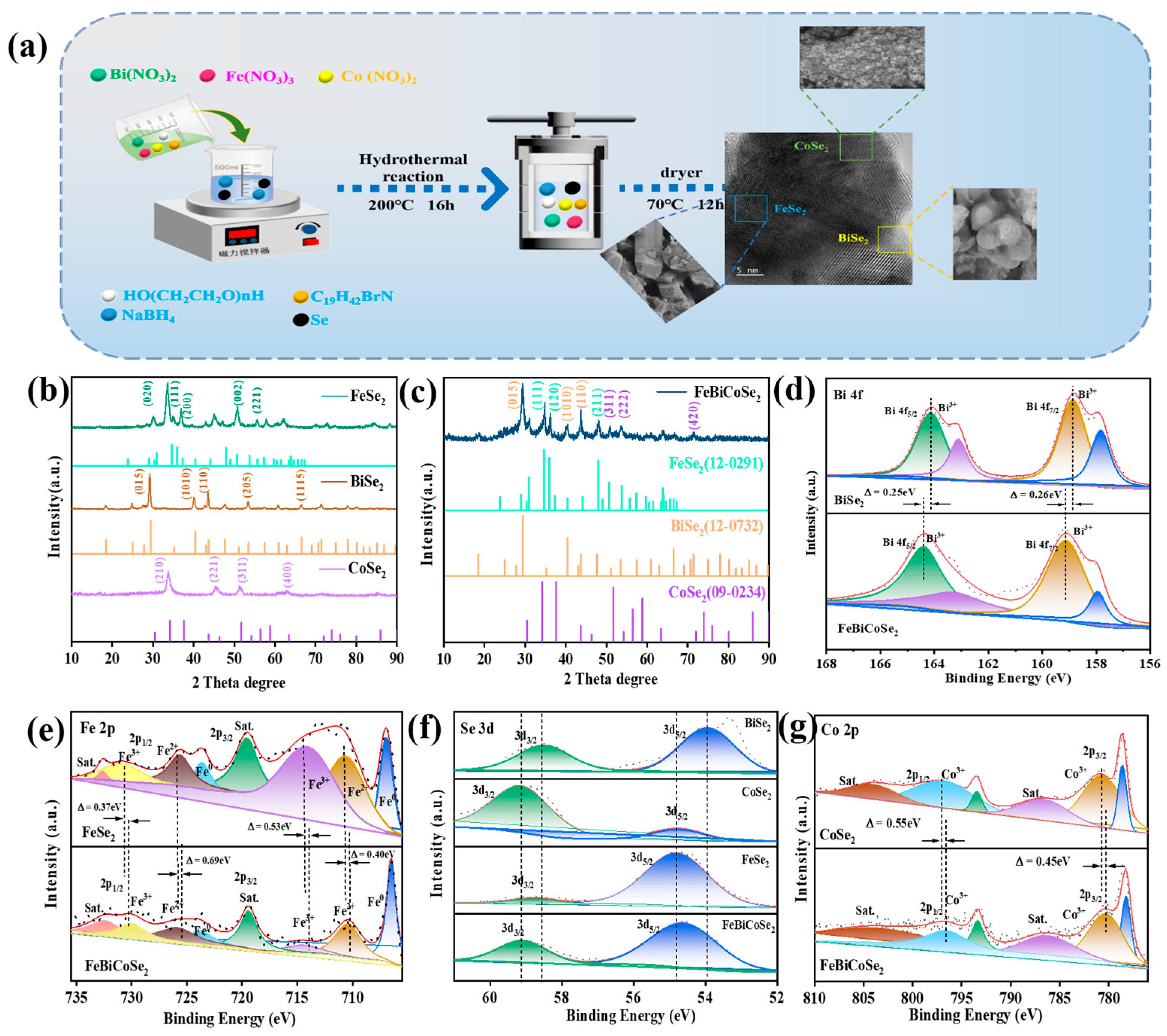
Figure 1. (a) Synthesis of FeSe2-BiSe2-CoSe2, (b) XRD patterns of FeSe2, BiSe2, and CoSe2, (c) XRD pattern of FeSe2-BiSe2-CoSe2. High-resolution XPS spectrum for (d) Bi 4f, (e) Fe 2p, (f) Se 3d, (g) Co 2p of FeSe2, BiSe2, CoSe2, and FeSe2-BiSe2-CoSe2.
Materials 19 00430 g001
Figure 2. SEM images of (a) BiSe2, (b) CoSe2, (c) FeSe2, and (d) FeSe2-BiSe2-CoSe2.
Materials 19 00430 g002
Figure 3. (ac) TEM images, (d) HRTEM image, and (ei) EDS element mapping images of FeSe2-BiSe2-CoSe2.
Materials 19 00430 g003
Figure 4. HER performance of BiSe2, CoSe2, FeSe2, and FeSe2-BiSe2-CoSe2 in 0.5 M H2SO4. (a) LSV curve, (b) Tafel slope, (c) Nyquist plot, (d) Cdl curve, (e) performance comparison bar chart of BiSe2, CoSe2, FeSe2, and FeSe2-BiSe2-CoSe2, and (f) LSV curve of FeSe2-BiSe2-CoSe2 after 35 h operation in 0.5 M H2SO4 and i-t curve during continuous 35 h electrolysis (inset).
Materials 19 00430 g004
Figure 5. HER performance of BiSe2, CoSe2, FeSe2, and FeSe2-BiSe2-CoSe2 in 1 M KOH. (a) LSV curve, (b) overpotentials at 10 mA cm−2 and 200 mA cm−2, (c) Tafel slope, (d) Nyquist plot, (e) Cdl curve, (f) LSV curve of FeSe2-BiSe2-CoSe2 after 35 h operation in 0.5 M H2SO4 and i-t curve during continuous 35 h electrolysis (inset), and (g) catalyst comparison bar chart.
Materials 19 00430 g005
Table 1. Transition metal-based catalysts comparison.
Catalyst CategoryRepresentative MaterialsPrincipal AdvantagesPrincipal Drawbacks
Two-dimensional transition metal dichalcogenideMoS2High intrinsic activity, high stabilityPoor electrical conductivity, limited active sites
Two-dimensional transition metal MSe2MoSe2Highly conductive, intrinsically highly active Relatively poor stability, difficult to prepare
Transition metal oxidesMnO2Non-precious metals are low in cost and diverse in variety.Low specific surface area, poor electrical conductivity
Transition metal nitridesMoNExcellent electrical conductivity, high stabilityThe surface is prone to oxidation and the high-temperature synthesis
conditions are demanding.
Transition metal phosphidesNi2PExcellent electrical conductivity, high HER activityPhosphorus readily leaches or oxidizes during reactions
Disclaimer/Publisher’s Note: The statements, opinions and data contained in all publications are solely those of the individual author(s) and contributor(s) and not of MDPI and/or the editor(s). MDPI and/or the editor(s) disclaim responsibility for any injury to people or property resulting from any ideas, methods, instructions or products referred to in the content.