This is an early access version, the complete PDF, HTML, and XML versions will be available soon.
Article

Predictive Constitutive Modelling of Oxidation-Induced Degradation in 2.5D Woven C/SiC Composites

1
Jiangsu Province Key Laboratory of Aerospace Power System, College of Energy and Power Engineering, Nanjing University of Aeronautics and Astronautics, Nanjing 210016, China
2
Key Laboratory of Fundamental Science for National Defense-Advanced Design Technology of Flight Vehicle, Nanjing University of Aeronautics and Astronautics, Nanjing 210016, China
3
Key Laboratory of Aero-Engine Thermal Environment and Structure, Ministry of Industry and Information Technology, Nanjing 210016, China
4
State Key Laboratory of Mechanics and Control Mechanical Structures, Nanjing University of Aeronautics and Astronautics, Nanjing 210016, China
*
Authors to whom correspondence should be addressed.
Materials 2026, 19(2), 307; https://doi.org/10.3390/ma19020307
Submission received: 10 December 2025 / Revised: 6 January 2026 / Accepted: 9 January 2026 / Published: 12 January 2026
(This article belongs to the Section Advanced Composites)

Abstract

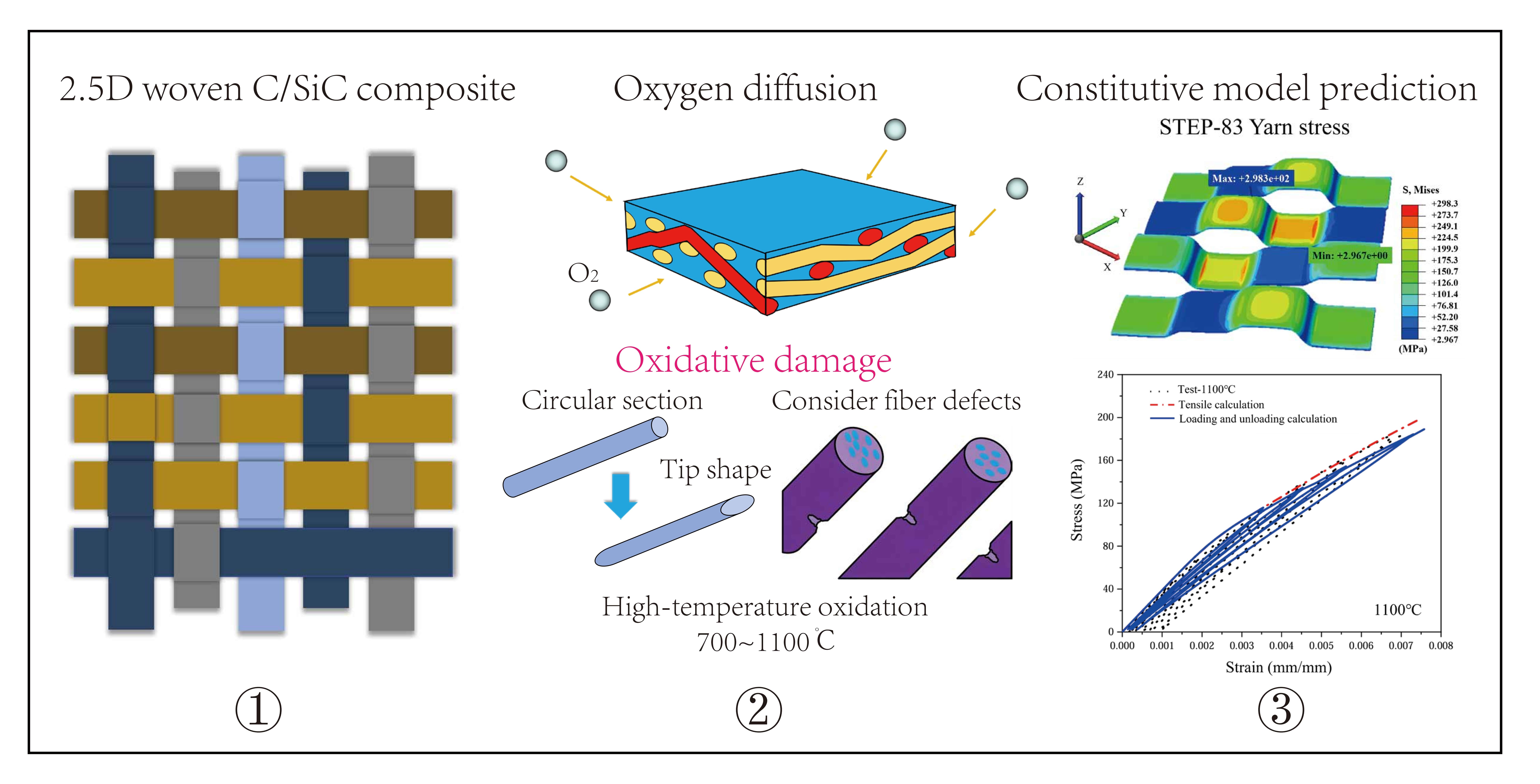
Oxidation can lead to intrinsic degradation and loss in the load-bearing capacity of ceramic matrix composites (CMCs) in high-temperature service, thereby compromising structural integrity and operational safety. To elucidate the mechanism of its oxidation effects, this study predicted the oxygen diffusion coefficient within 2.5D woven C/SiC fibre bundles based on gas diffusion and oxidation kinetics theory, and subsequently constructed a meso-scale constitutive model incorporating oxidation damage and fibre defect distribution. Furthermore, a micro-scale framework for yarns was established by integrating interfacial slip behaviour, and an RVE model for 2.5D woven C/SiC was constructed based on X-ray computed tomography reconstruction of the actual microstructure. Building upon this foundation, an oxidation constitutive model applicable to loading–unloading cycles was proposed and validated through high-temperature oxidation tests at 700 °C, 900 °C, and 1100 °C. Results demonstrate that this model effectively characterizes the strength degradation and stiffness reduction caused by oxidation, enabling prediction of CMCs’ mechanical properties under oxidizing conditions and providing a physics-based foundation for the reliable design and life assessment of C/SiC components operating in oxidizing environments.
Keywords: C/SiC composites; oxidative damage; constitutive model; high-temperature mechanical properties; RVE model C/SiC composites; oxidative damage; constitutive model; high-temperature mechanical properties; RVE model
Graphical Abstract