Study on Mechanical Properties of Adjustable-Ring-Mode Laser Scanning Welding of TA1 Titanium Alloy to 304 Stainless Steel Dissimilar Thin Sheets

Abstract
1. Introduction
2. Materials and Methods
3. Results
3.1. Microhardness
3.2. Bending Properties
3.3. Tensile Properties
3.4. Fractography
4. Discussion
4.1. Effects of ARM Laser on Mechanical Properties
4.2. Mechanism of Laser Scanning on Tensile Property Variations
5. Conclusions
- (1)
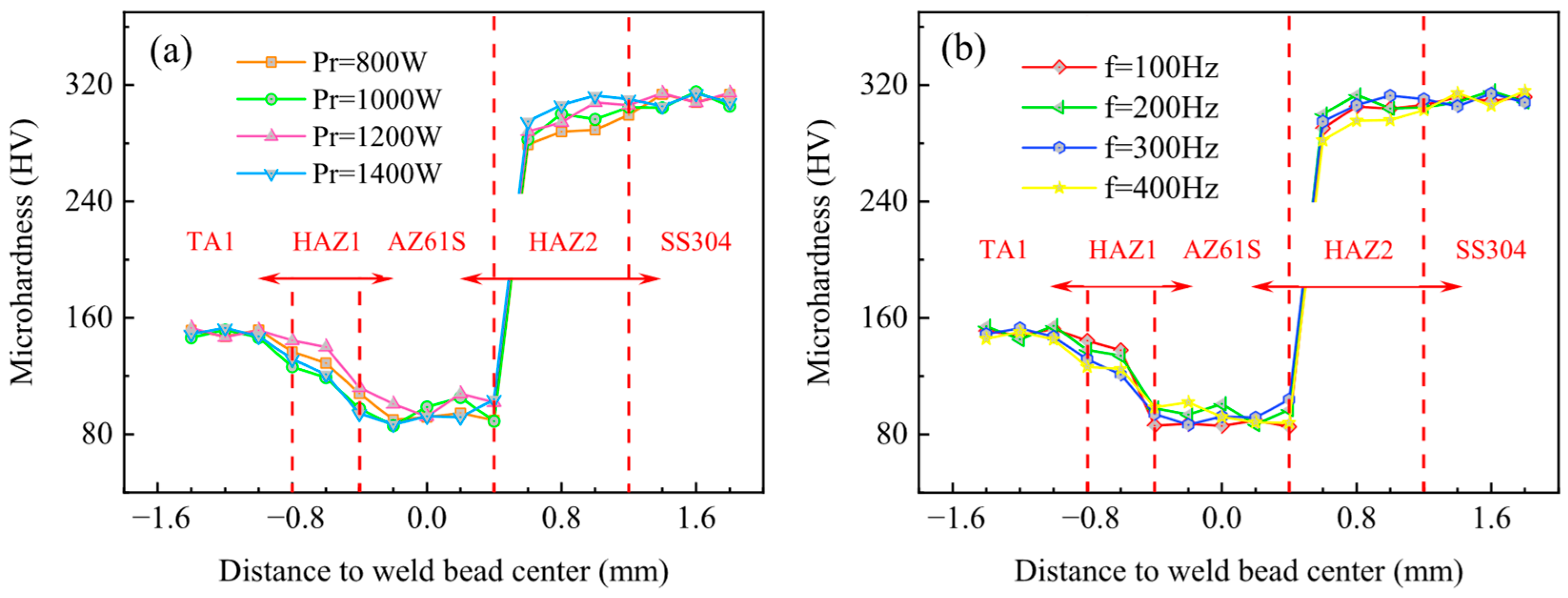
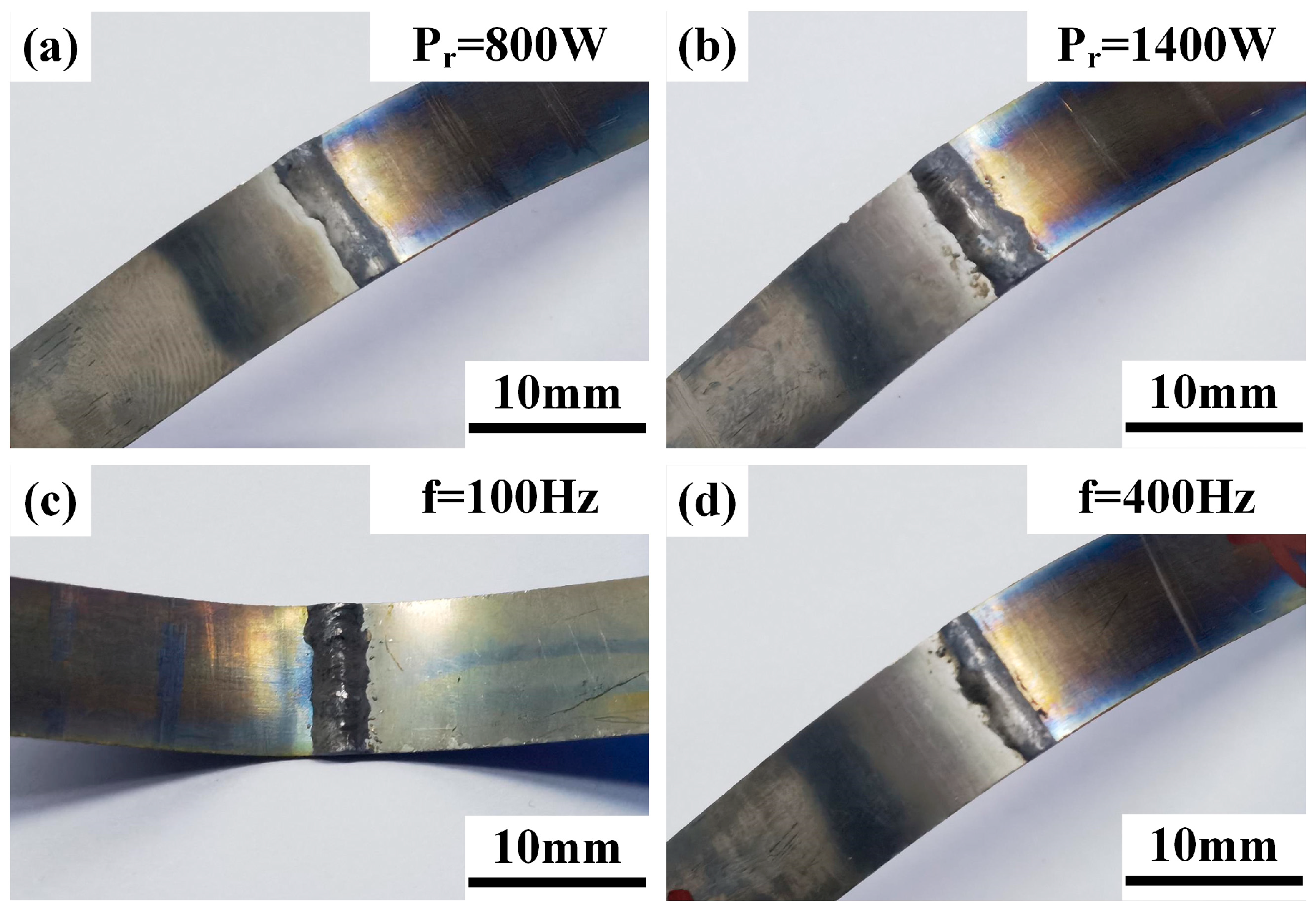
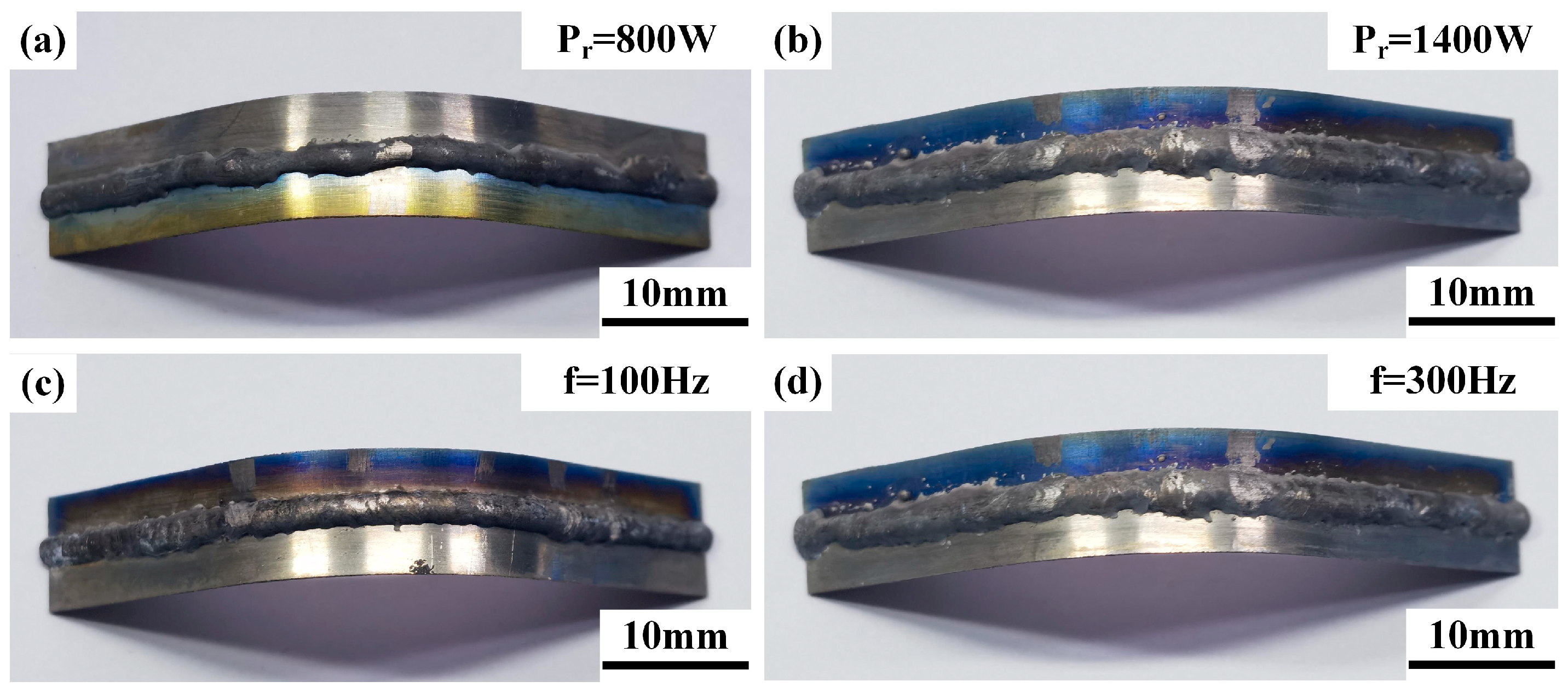
- The microhardness distribution shows a trend of being higher in the base metals on both sides and lower in the middle filling area, which is related to the filling material. Compared with the case where Cu is used as the filling material, the selection of AZ61S as the filling material helps prevent the occurrence of weld brittleness and hardness. Horizontal and axial bending test results of the welded joints indicate that the bending angle of all specimens can reach 108°, and no cracks appear until the bending testing machine stops.
- (2)
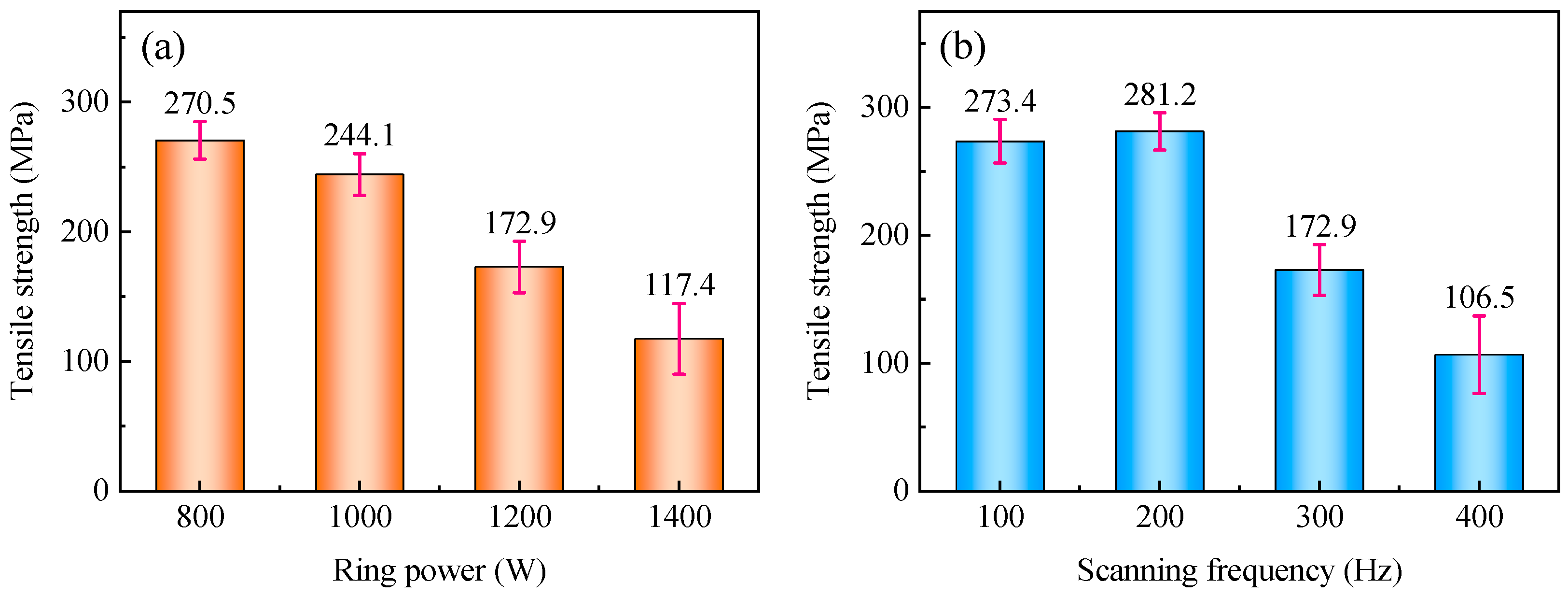
- When the ring power is in the range of 800–1000 W, or the scanning frequency is between 100 and 200 Hz, the average tensile strengths of the welded joints are all higher than 80% of that of AZ61S (approximately 240 MPa); the maximum average value (281.2 MPa) can reach 93.7% of that of AZ61S. As the ring power or scanning frequency further increases, the tensile strength of the joints shows a decreasing trend. Compared with the cases where V, Cu, and AZ31B were used as the filling material, the ratio of the tensile strength of the welded joints to the minimum tensile strength among the base metals and the filling material is increased.
- (3)
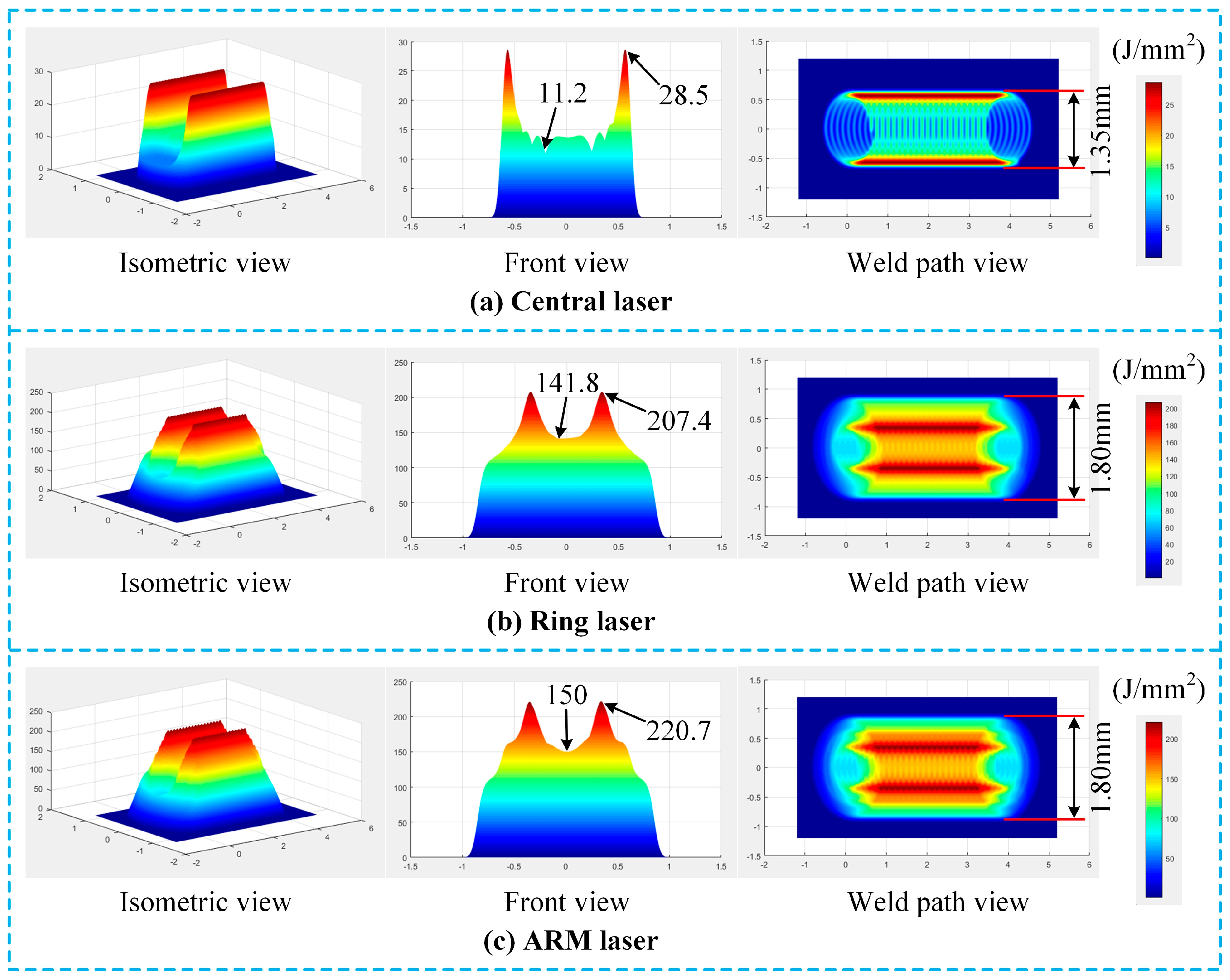
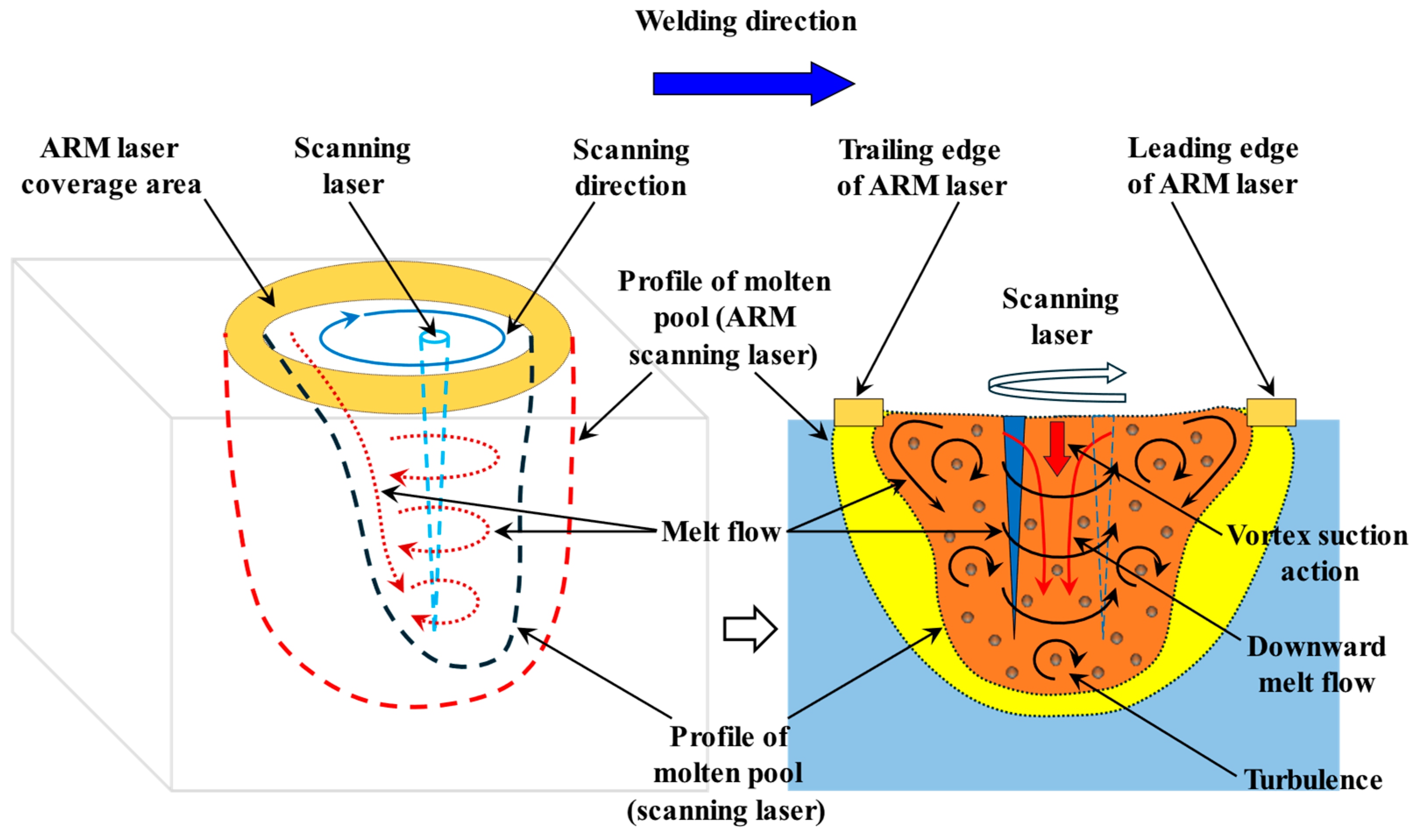
- The remelting effect of the trailing edge of the ARM laser when its energy is relatively high, or the scouring of the turbulent molten flow induced by the scanning laser beam, will damage the newly formed solid–liquid interface and create several micro-gaps at the weak points of the FeAl interface layer. Fe atoms on the surface of the stainless steel continuously dissolve into the molten pool through these micro-gaps, which increases the Fe concentration in the molten pool. Consequently, the grown FeAl interface layer becomes thicker, leading to a decrease in the mechanical properties of the welded joints.
Author Contributions
Funding
Institutional Review Board Statement
Informed Consent Statement
Data Availability Statement
Conflicts of Interest
References
- Li, Y.; Zhou, Z.; He, Y. Tribocorrosion and surface protection technology of titanium alloys: A review. Materials 2024, 17, 65. [Google Scholar] [CrossRef] [PubMed]
- Anwar, M.; Sihabbudin, F.; Chandra, S.; Paristiawan, P.; Amaliyah, F. Characteristics of hot rolled stainless steel-clad plate with and without interlayer: A review. Metall. Res. Technol. 2025, 122, 406. [Google Scholar] [CrossRef]
- Zhou, Q.; Liu, R.; Zhou, Q.; Ran, C.; Fan, K.; Xie, J.; Chen, P. Effect of microstructure on mechanical properties of titanium–steel explosive welding interface. Mat. Sci. Eng. A Struct. 2022, 830, 142260. [Google Scholar] [CrossRef]
- Bi, Y.; Xu, Y.; Luo, Z. Material characterization and mechanical performance of laser diffusion welded joint between titanium alloy and stainless steel. Mater. Lett. 2023, 336, 133927. [Google Scholar] [CrossRef]
- Huo, K.; Han, P.; Wang, W.; Liu, Y.; Zhang, X.; Zheng, P.; Qiao, K.; Qiang, F.; Wang, Q.; Wang, K. Role of intermetallic compounds in the fracture of double-sided friction stir welded titanium-steel clad plates. Mater. Charact. 2025, 221, 114757. [Google Scholar] [CrossRef]
- Xia, Y.; Dong, H.; Li, P. Brazing TC4 titanium alloy/316L stainless steel joint with Ti50−xZrxCu39Ni11 amorphous filler metals. J. Alloys Compd. 2020, 849, 156650. [Google Scholar] [CrossRef]
- Hu, K.; Tian, Y.; Jiang, X.; Yu, H.; Sun, D. Microstructure regulation and performance of titanium alloy coating with Ni interlayer on the surface of mild steel by laser cladding. Surf. Coat. Technol. 2024, 487, 130939. [Google Scholar] [CrossRef]
- Xu, X.; Cui, H.; Shao, C.; Wang, Y.; Lu, F. Double enhancement in porosity suppression and penetration depth during laser welding Al-Mg alloy via high-frequency outward-spiral scanning mode. J. Mater. Process. Technol. 2025, 344, 119035. [Google Scholar] [CrossRef]
- Mei, L.; Lin, L.; Yan, D.; Xie, S.; Liu, Y.; Li, S. Metal spattering in laser scanning welding of T2 copper and welding quality. Opt. Lasers Eng. 2023, 161, 107392. [Google Scholar] [CrossRef]
- Mei, L.; Liang, Y.; Yan, D.; Luo, S.; Zeng, Z.; Dai, Q. Effect of longitudinal alternating magnetic field on the dynamic behaviour and joint properties of laser scanning welding of T2 red copper. Appl. Phys. B Lasers O. 2025, 131, 76. [Google Scholar] [CrossRef]
- Hui, Y.; Fang, L.; Hua, X.; Ke, C. Research on molten pool flow and weld formation of 304L stainless steel by scanning laser overlap welding. Chin. J. Lasers 2022, 49, 2202004. [Google Scholar] [CrossRef]
- Chen, C.; Yin, X.; Liao, W.; Xiang, Y.; Gao, M.; Zhang, Y. Microstructure and properties of 6061/2A12 dissimilar aluminum alloy weld by laser oscillation scanning. J. Mater. Res. Technol. 2021, 14, 2789–2798. [Google Scholar] [CrossRef]
- Li, J.; Wang, Y.; Jiang, P.; Wang, C.; Geng, S. Spatter elimination mechanism and criterion for adjustable ring-mode laser welding of aluminum alloy. Int. J. Heat Mass Tran. 2025, 242, 126812. [Google Scholar] [CrossRef]
- Li, J.; Geng, S.; Wang, Y.; Wang, C.; Jiang, P. Mitigation of porosity in adjustable-ring-mode laser welding of medium-thick aluminum alloy. Int. J. Heat Mass Tran. 2024, 227, 125514. [Google Scholar] [CrossRef]
- Wang, L.; Yao, M.; Gao, X.; Kong, F.; Tang, J.; Kim, M. Keyhole stability and surface quality during novel adjustable-ring mode laser (ARM) welding of aluminum alloy. Opt. Laser Technol. 2023, 161, 109202. [Google Scholar] [CrossRef]
- Tang, J.; Hu, M.; Su, J.; Guo, Q.; Wang, X.; Luo, Z. Deformation control of adjustable-ring-mode (ARM) laser welding for aluminum alloys. Materials 2025, 18, 860. [Google Scholar] [CrossRef] [PubMed]
- Xu, X.; Fu, L.; Wang, Y.; Shao, C.; Cui, H.; Tang, X.; Lu, F. The control of fully equiaxed microstructure in laser welding Al-mg-Er-Zr alloy. Mater. Charact. 2025, 219, 114597. [Google Scholar] [CrossRef]
- Weiss, T.; Hoffmann, P.; Harst, F.; Zaeh, M. Towards high-speed laser beam welding of stainless-steel foils using an adjustable ring mode laser beam source. Opt. Laser Technol. 2025, 192, 113496. [Google Scholar] [CrossRef]
- Liu, H.; Zhao, H.; Zhao, Y.; Peng, Y.; Xu, M.; Chen, X. Interfacial bonding mechanisms in laser welding of 2024 Al alloy and continuous CFR-PEEK via adjustable ring-mode laser beam. J. Manuf. Process. 2025, 153, 757–773. [Google Scholar] [CrossRef]
- Song, X.; An, J. Newly Compiled Handbook of Chinese and Foreign Metal Materials, 2nd ed.; Chemical Industry Press: Beijing, China, 2012; pp. 1236–1243. [Google Scholar]
- Yan, M. Practical Handbook of Engineering Materials, Volume 1: Structural Steel and Stainless Steel, 2nd ed.; Standards Press of China: Beijing, China, 2001; pp. 554–558. [Google Scholar]
- Zeng, Z. Practical Handbook for Selection of Metal Materials; China Machine Press: Beijing, China, 2012; pp. 846–851. [Google Scholar]
- ISO 6507-1:2023; Metallic Materials—Vickers Hardness Test. Part 1: Test Method. ISO: Geneva, Switzerland, 2023.
- ISO 5173:2023; Destructive Tests on Welds in Metallic Materials—Bend Tests. ISO: Geneva, Switzerland, 2023.
- ISO 4136:2022; Destructive Tests on Welds in Metallic Materials—Transverse Tensile Test. ISO: Geneva, Switzerland, 2022.
- ISO 6507-2:2018; Metallic Materials—Vickers Hardness Test. Part 2: Verification and Calibration of Testing Machines. ISO: Geneva, Switzerland, 2018.
- ISO 6507-3:2018; Metallic Materials—Vickers Hardness Test. Part 3: Calibration of Reference Blocks. ISO: Geneva, Switzerland, 2018.
- Xie, M.; Yao, F.; Lv, Z.; Zhang, L.; Ren, X.; Zhang, L. Effect of interlayer material on microstructure and properties of heat-treated TA1/304L laser welded joint. Laser Optoelectron. Prog. 2025, 62, 0114009. [Google Scholar] [CrossRef]
- Zhao, X.; Shi, Z.; Deng, C.; Liu, Y.; Li, X. The effect of laser offset welding on microstructure and mechanical properties of 301L to TA2 with and without Cu intermediate layer. Metals 2020, 10, 1138. [Google Scholar] [CrossRef]
- Harrod, D.; Gold, R. Mechanical properties of vanadium and vanadium-base alloys. Int. Met. Rev. 1980, 25, 163–222. [Google Scholar] [CrossRef]
- Li, Y.; Di, H.; Li, T.; Chen, L.; Wang, X.; Misra, R. Effect of thickness of transition layer on the microstructure and properties of the titanium/stainless steel welds with oscillating laser. J. Mater. Res. Technol. 2022, 18, 210–222. [Google Scholar] [CrossRef]
- Gao, M.; Mei, S.; Wang, Z.; Li, X.; Zeng, X. Characterisation of laser welded dissimilar Ti/steel joint using Mg interlayer. Sci. Technol. Weld. Join. 2012, 17, 269–276. [Google Scholar] [CrossRef]
- Tan, C.; Song, X.; Meng, S.; Chen, B.; Li, L.; Feng, J. Laser welding-brazing of Mg to stainless steel: Joining characteristics, interfacial microstructure, and mechanical properties. Int. J. Adv. Manuf. Technol. 2016, 86, 203–213. [Google Scholar] [CrossRef]
- Xu, C.; Sheng, G.; Wang, H.; Feng, K.; Yuan, X. Tungsten inert gas welding-brazing of AZ31B magnesium alloy to TC4 titanium alloy. J. Mater. Sci. Technol. 2016, 32, 167–171. [Google Scholar] [CrossRef]
- Mott, P.; Roland, C. Limits to Poisson’s ratio in isotropic materials. Phys. Rev. B 2009, 80, 132104. [Google Scholar] [CrossRef]
- Khalid, M.; Friis, J.; Ninive, P.; Marthinsen, K.; Ringdalen, I.; Strandlie, A. Modified embedded atom method potential for Fe-Al intermetallics mechanical strength: A comparative analysis of atomistic simulations. Phys. B 2021, 618, 413157. [Google Scholar] [CrossRef]
- Zhang, H.; Shang, S.; Wang, Y.; Saengdeejing, A.; Chen, L.; Liu, Z. First-principles calculations of the elastic, phonon and thermodynamic properties of Al12Mg17. Acta Mater. 2010, 58, 4012–4018. [Google Scholar] [CrossRef]
- Meng, Y.; Fu, J.; Zhang, S.; Gong, M.; Gao, M.; Chen, H. Laser-arc hybrid welding of AZ31B magnesium alloy by newly-designed beam oscillating pattern. J. Manuf. Process. 2023, 93, 208–218. [Google Scholar] [CrossRef]
- Yang, P.; Jiang, L.; Yu, T.; Zhao, S.; Li, G.; Gao, M. Synergistic enhancement of weld stability and mechanical performance in laser welding of titanium alloy by coupling ring-shaped mode and beam oscillation. J. Mater. Process. Technol. 2025, 345, 119053. [Google Scholar] [CrossRef]
- Mi, G.; Li, P.; Ohapkin, A.; Yu, K.; Sabirzianov, A.; Popel, P. Relationship between liquid structure and property I—Kinematic viscosity of magnesium melt and its relationship with the microstructure. Acta Phys. Sin. 2011, 60, 046601. [Google Scholar] [CrossRef]



| Material | Ti | Fe | Cr | Ni | Mg | Al | Zn | Cu |
| TA1 | Bal. | ≤0.20 | - | - | - | - | - | - |
| SS304 | - | Bal. | 18.0–20.0 | 8.0–11.0 | - | - | - | - |
| AZ61S | - | ≤0.005 | - | ≤0.005 | Bal. | 5.5–6.5 | 0.5–1.5 | ≤0.05 |
| Material | C | N | H | O | Si | Mn | P | S |
| TA1 | ≤0.08 | ≤0.03 | ≤0.015 | ≤0.18 | - | - | - | - |
| SS304 | ≤0.08 | - | - | - | ≤1.00 | ≤2.00 | ≤0.045 | ≤0.030 |
| AZ61S | - | - | - | - | ≤0.10 | 0.15–0.4 | - | - |
| Material | TA1 | SS304 | AZ61S |
|---|---|---|---|
| Microhardness (HV) | ≤150 | ≤310 | ≤100 |
| Tensile strength (MPa) | 426 ± 20.9 | ≥780 | 280–300 |
| Welding Parameters | Variation Ranges | Baseline Values |
|---|---|---|
| Central power, Pc (W) | 800 | 800 |
| Ring power, Pr (W) | 800–1400 | 1400 |
| Scanning frequency, f (Hz) | 100–400 | 300 |
| Scanning amplitude, A (mm) | 0.6 | 0.6 |
| Welding speed, v (m/min) | 2.5 | 2.5 |
| Wire feed rate, vw (m/min) | 6.0 | 6.0 |
| Defocus distance, h (mm) | 0 | 0 |
| Type | Parameters | Bending Angle (Horizontal) | Whether Cracks Occur | Bending Angle (Axial) | Whether Cracks Occur |
|---|---|---|---|---|---|
| Ring power (when f = 300 Hz) | Pr = 800 W | 108° | N | 108° | N |
| Pr = 1000 W | 108° | N | 108° | N | |
| Pr = 1200 W | 108° | N | 108° | N | |
| Pr = 1400 W | 108° | N | 108° | N | |
| Scanning frequency (when Pr = 1400 W) | f = 100 Hz | 108° | N | 108° | N |
| f = 200 Hz | 108° | N | 108° | N | |
| f = 300 Hz | 108° | N | 108° | N | |
| f = 400 Hz | 108° | N | 108° | N |
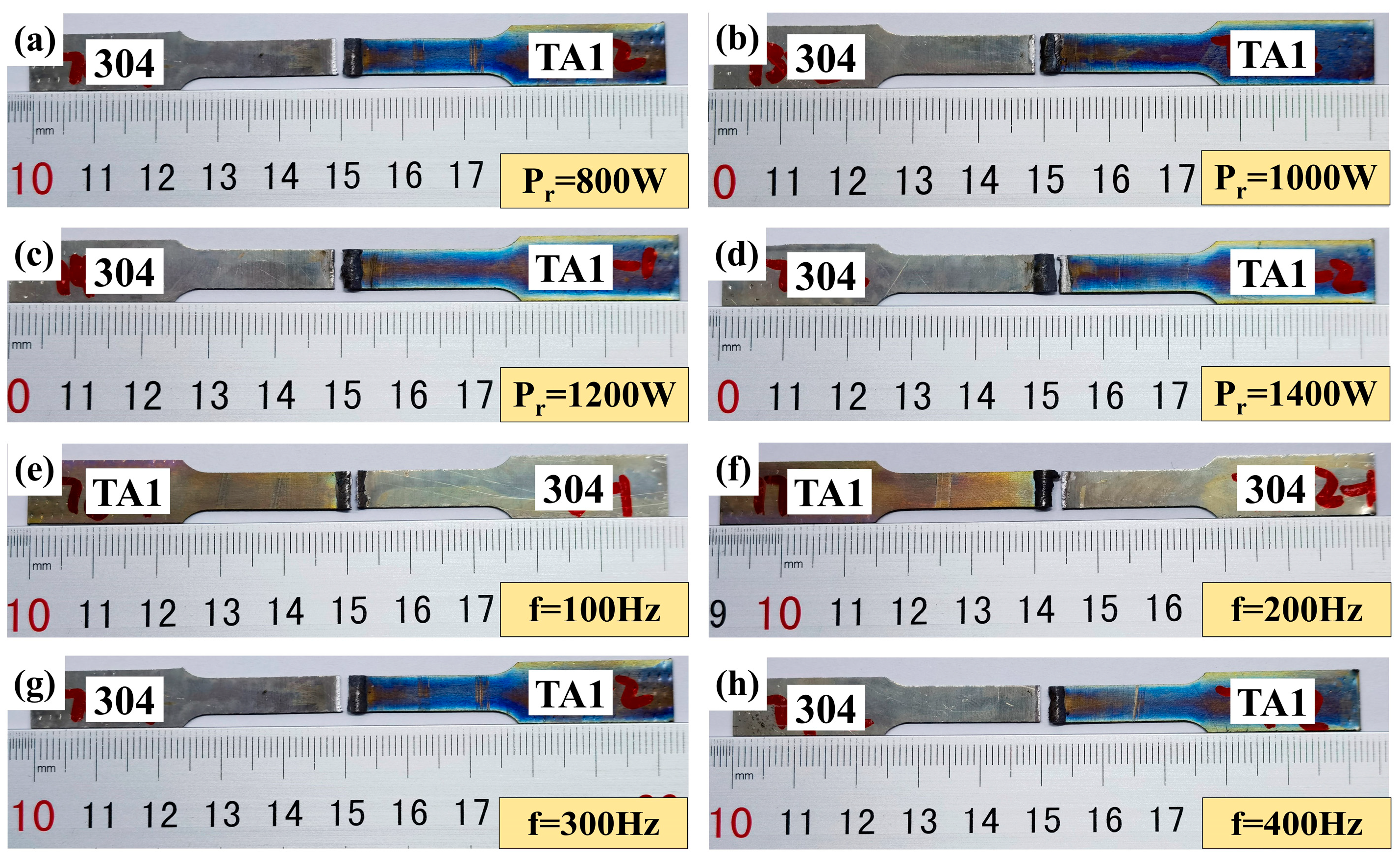
| Parameters (when f = 300 Hz) | Pr = 800 W | Pr = 1000 W | Pr = 1200 W | Pr = 1400 W |
| Fracture positions | SS304/AZ61S | SS304/AZ61S | SS304/AZ61S | AZ61S/TA1 |
| Parameters (when Pr = 1400 W) | f = 100 Hz | f = 200 Hz | f = 300 Hz | f = 400 Hz |
| Fracture positions | SS304/AZ61S | SS304/AZ61S | SS304/AZ61S | SS304/AZ61S |
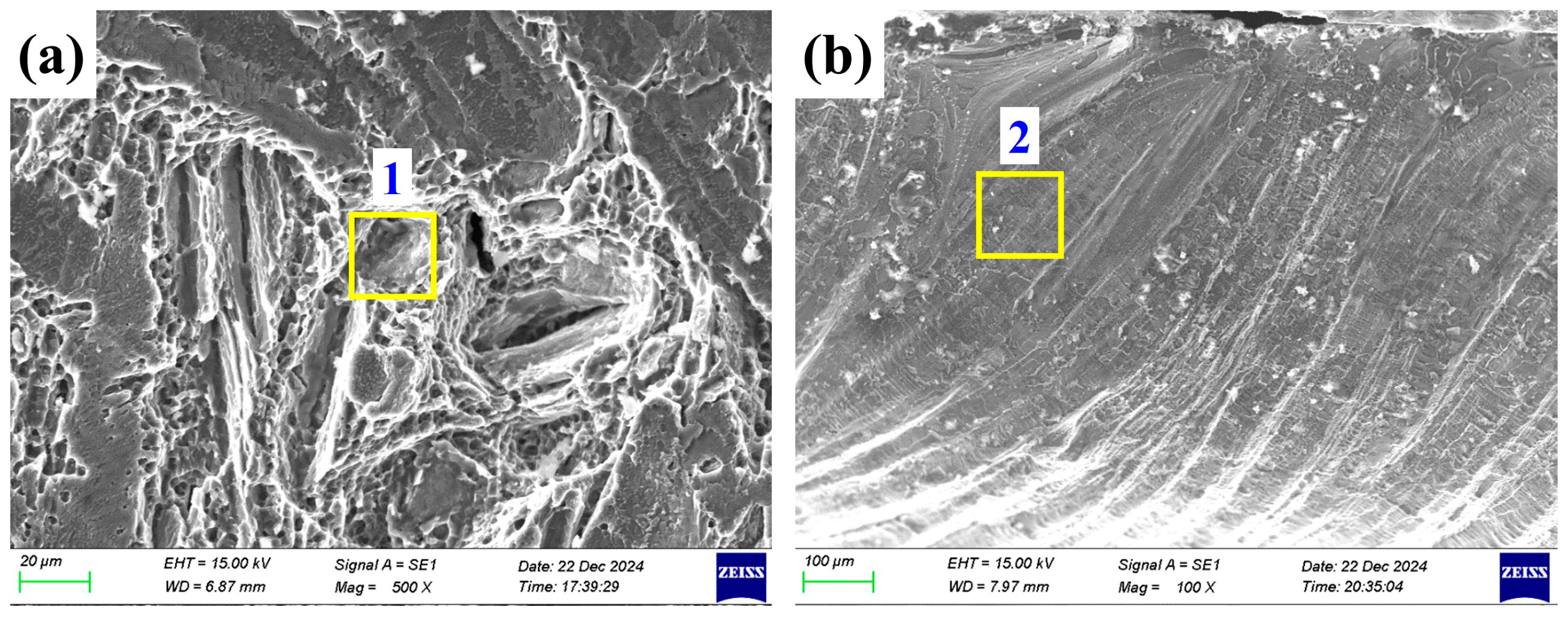
| Area | Type | Chemical Compositions (wt.%) | ||||||
|---|---|---|---|---|---|---|---|---|
| Mg | Ti | Cr | Fe | Ni | Zn | Al | ||
| #1 | SS304/AZ61S interface | 18.53 | 2.26 | 19.26 | 29.6 | 18.95 | 3.72 | 7.68 |
| #2 | AZ61S/TA1 interface | 31.39 | 25.29 | 3.37 | 8.19 | 5.24 | 9.13 | 17.39 |
Disclaimer/Publisher’s Note: The statements, opinions and data contained in all publications are solely those of the individual author(s) and contributor(s) and not of MDPI and/or the editor(s). MDPI and/or the editor(s) disclaim responsibility for any injury to people or property resulting from any ideas, methods, instructions or products referred to in the content. |
© 2026 by the authors. Licensee MDPI, Basel, Switzerland. This article is an open access article distributed under the terms and conditions of the Creative Commons Attribution (CC BY) license.
Share and Cite
Li, G.; Yu, T.; Yang, P.; Zhao, S.; Zhang, S.; Ma, H.; Wu, S.; Li, J.; Gao, M. Study on Mechanical Properties of Adjustable-Ring-Mode Laser Scanning Welding of TA1 Titanium Alloy to 304 Stainless Steel Dissimilar Thin Sheets. Materials 2026, 19, 230. https://doi.org/10.3390/ma19020230
Li G, Yu T, Yang P, Zhao S, Zhang S, Ma H, Wu S, Li J, Gao M. Study on Mechanical Properties of Adjustable-Ring-Mode Laser Scanning Welding of TA1 Titanium Alloy to 304 Stainless Steel Dissimilar Thin Sheets. Materials. 2026; 19(2):230. https://doi.org/10.3390/ma19020230
Chicago/Turabian StyleLi, Geng, Tengyi Yu, Peiqing Yang, Suning Zhao, Shuai Zhang, Honghua Ma, Shang Wu, Ji Li, and Ming Gao. 2026. "Study on Mechanical Properties of Adjustable-Ring-Mode Laser Scanning Welding of TA1 Titanium Alloy to 304 Stainless Steel Dissimilar Thin Sheets" Materials 19, no. 2: 230. https://doi.org/10.3390/ma19020230
APA StyleLi, G., Yu, T., Yang, P., Zhao, S., Zhang, S., Ma, H., Wu, S., Li, J., & Gao, M. (2026). Study on Mechanical Properties of Adjustable-Ring-Mode Laser Scanning Welding of TA1 Titanium Alloy to 304 Stainless Steel Dissimilar Thin Sheets. Materials, 19(2), 230. https://doi.org/10.3390/ma19020230