Article

Influence of Laser Power on the Microstructure, Wear Resistance, and Cavitation-Erosion Behavior of Laser-Clad Fe45Cr25Ni20Ti5Mo5 Multi-Principal-Element Alloy Coatings


1
School of Materials Science and Engineering, Xinjiang University, Urumqi 830017, China
2
Water Machinery and Remanufacturing Technology Engineering Laboratory of Zhejiang Province, Hangzhou River Mechanical and Electrical Equipment Engineering Co., Ltd., Hangzhou 310024, China
3
Key Laboratory of Surface Engineering of Equipment for Hydraulic Engineering of Zhejiang Province, Standard and Quality Control Research Institute, Ministry of Water Resources, Hangzhou 310024, China
4
State Key Laboratory for Advanced Metals and Materials, University of Science and Technology Beijing, Beijing 100083, China
*
Authors to whom correspondence should be addressed.
Materials 2026, 19(18), 3981; https://doi.org/10.3390/ma19183981 (registering DOI)
Submission received: 26 August 2026 / Revised: 16 September 2026 / Accepted: 17 September 2026 / Published: 19 September 2026
(This article belongs to the Section Metals and Alloys)

Abstract

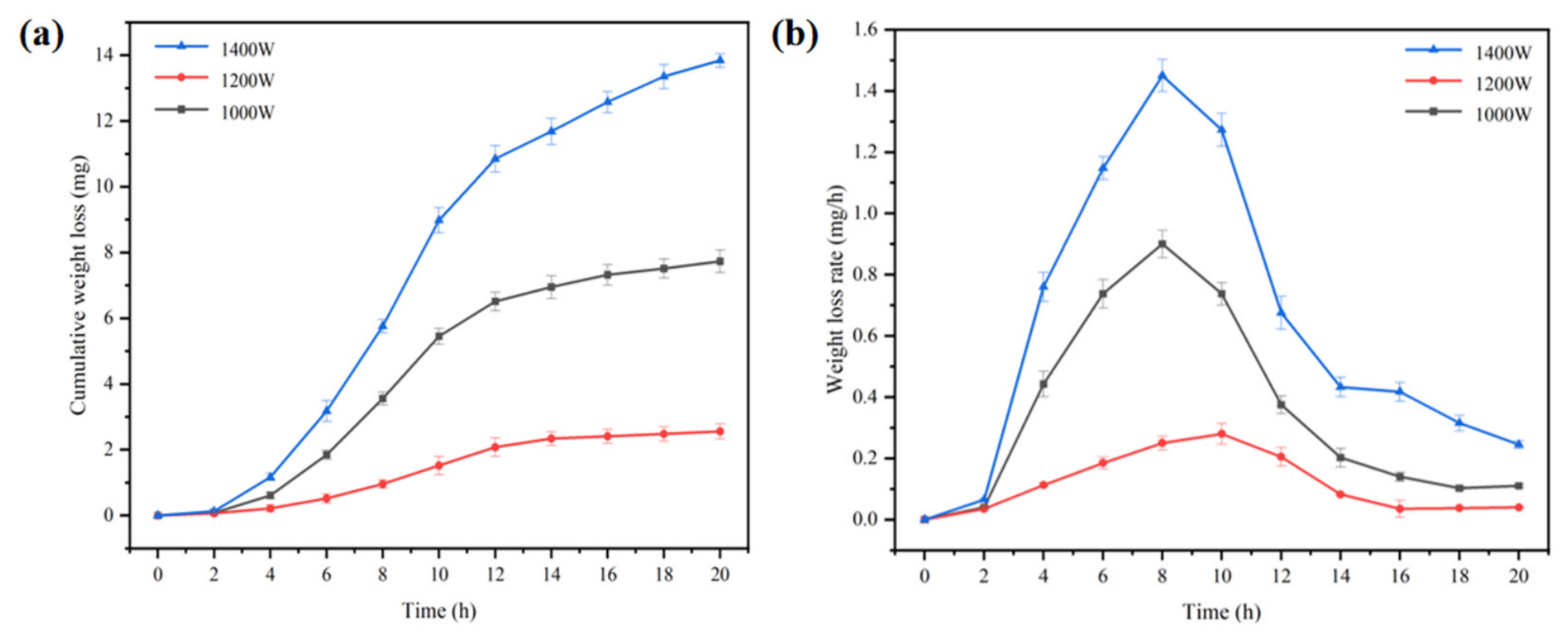
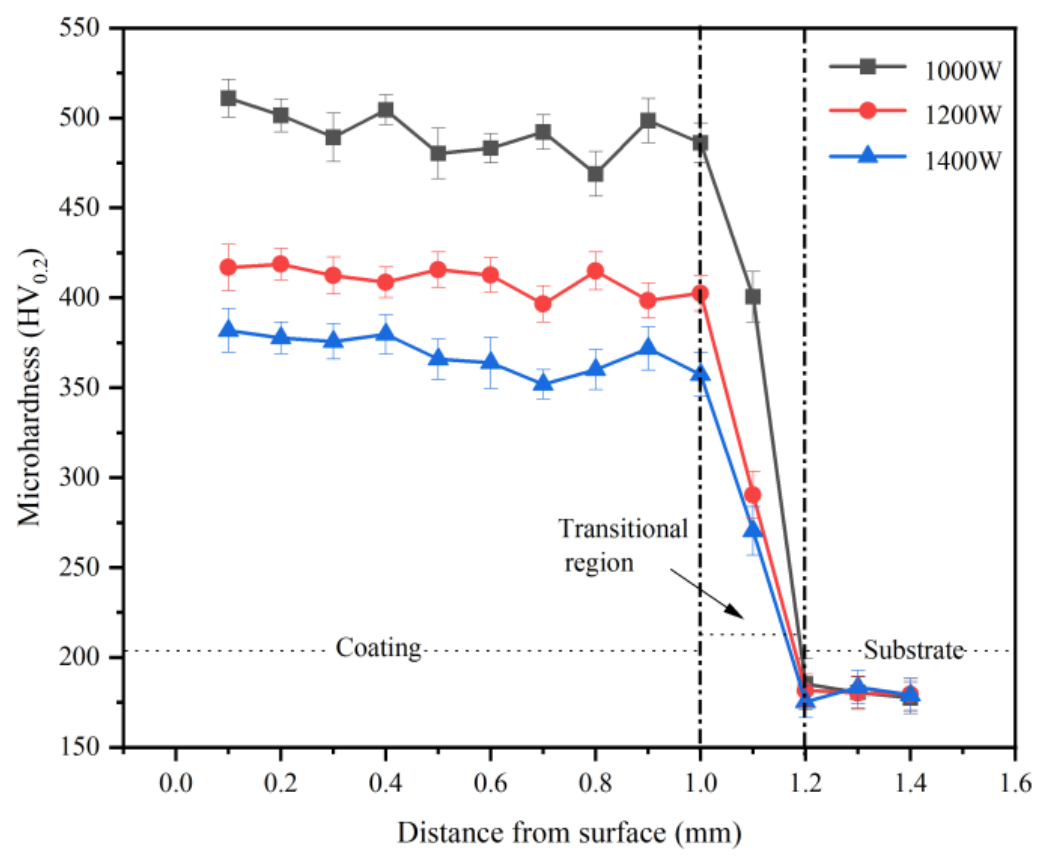
Flow-passing components such as volutes and fixed guide vanes operating in high-velocity liquid flows with high sediment concentrations are subjected to long-term cavitation erosion and sand-particle abrasion, which cause substantial economic losses. To reduce the manufacturing and maintenance costs of mechanical equipment serving such environments, laser cladding was employed to fabricate Fe45Cr25Ni20Ti5Mo5 multi-principal-element alloy coatings on Q235 steel substrate, and the effect of laser power on the microstructure and properties of the coatings was systematically investigated. On the basis of preliminary investigations, the present work elaborately analyzes the wear resistance and cavitation-erosion resistance of coatings fabricated under laser powers of 1000 W, 1200 W and 1400 W. The results reveal that the coating hardness gradually decreases from a maximum value of 485.67 HV0.2 to 363.15 HV0.2 with increasing laser power. When the laser power is 1200 W, the coating prepared under this laser power maintains a good balance between hardness and microstructural integrity. Under identical friction-and-wear test conditions, its wear rate reaches only 3.15 × 10⁻⁵ mm3/(N·m), which is reduced by 19.64%, 27.92% and 39.19% compared with the coatings produced at 1000 W, 1400 W and bare Q235 steel, respectively. After a 20h cavitation-erosion test, the mass loss of this coating is merely 2.56 mg, representing reductions of 72.88%, 81.5% and 96.91% relative to the 1000 W coating, 1400 W coating and Q235 steel substrate. The coating fabricated at 1200 W exhibits outstanding wear resistance and cavitation-erosion resistance. The results indicate that, under the experimental conditions of this study, the wear resistance and cavitation-erosion resistance of the coating can be effectively optimized by adjusting the laser power.
Keywords: laser cladding; multi-principal-element alloy coating; wear resistance; cavitation-erosion resistance laser cladding; multi-principal-element alloy coating; wear resistance; cavitation-erosion resistance