1. Introduction
Organic protective coatings are widely applied to metallic structures, including ships, offshore platforms, and large-scale bridges, to resist corrosion in harsh service environments, especially marine atmospheric and seawater conditions. Nevertheless, long-term exposure to water, oxygen, ultraviolet radiation, temperature cycling, and atmospheric pollutants continuously accelerates the degradation of organic coatings. Premature coating failure further induces substrate corrosion and substantially reduces the service life of metallic structural components. The degradation of organic coatings is dominated by medium penetration-induced failure mechanisms. In corrosive environments, reactive media such as water, oxygen, and corrosive ions gradually penetrate coating micro-pores and inherent defects, causing coating swelling, plasticization, and progressive deterioration of barrier performance. Continuous accumulation of corrosive substances at the coating–substrate interface triggers interfacial adhesion degradation, delamination, and blistering. Once the coating barrier fails, electrochemical corrosion initiates on the metal substrate, eventually leading to coating peeling and structural failure. Such degradation behavior is particularly prominent in marine environments, where high-concentration chloride ions significantly accelerate the overall failure process. Organic coatings exhibit diverse types and complex structural compositions, and their performance evolution is comprehensively governed by intrinsic material properties and external environmental factors. Although accurate evaluation of coating service status is essential for structural safety guarantee and scientific maintenance scheduling, quantitative and precise assessment of coating protective performance remains a challenging task.
Numerous studies have investigated the degradation behaviors and internal failure mechanisms of organic coatings and developed advanced performance evaluation and service life prediction methods. Natural outdoor weathering tests and laboratory-accelerated aging experiments are commonly combined with multiple characterization techniques, including electrochemical measurements (electrochemical impedance spectroscopy (EIS) and open-circuit potential (OCP)), physicochemical tests (gloss retention and adhesion strength measurement), and microscopic analysis (SEM and FTIR), to reveal dynamic degradation processes and establish standardized coating evaluation systems. Among these techniques, EIS is widely recognized as a dominant non-destructive testing method due to its convenient operation and low cost. Impedance spectra are fitted and analyzed to extract characteristic parameters that reflect coating deterioration degrees and substrate corrosion status, which effectively clarify coating failure mechanisms and quantify protective performance.
However, most existing studies are limited to controlled laboratory conditions, while field coating evaluation still relies heavily on subjective visual inspection, including discoloration, chalking, blistering, cracking, and rusting. Such qualitative evaluation criteria are highly empirical and incapable of accurate quantitative characterization. To address this issue, multiple quantitative evaluation indicators have been proposed in previous studies, such as low-frequency impedance modulus (|
Z|
0.01 Hz) [
1,
2], breakpoint frequency (
fb) [
3], single-frequency capacitance [
4], and mid-frequency phase angle (
θ10 Hz) [
5,
6] together with OCP [
7,
8]. In particular, the
θ10 Hz evaluation method proposed by Zuo et al. [
5,
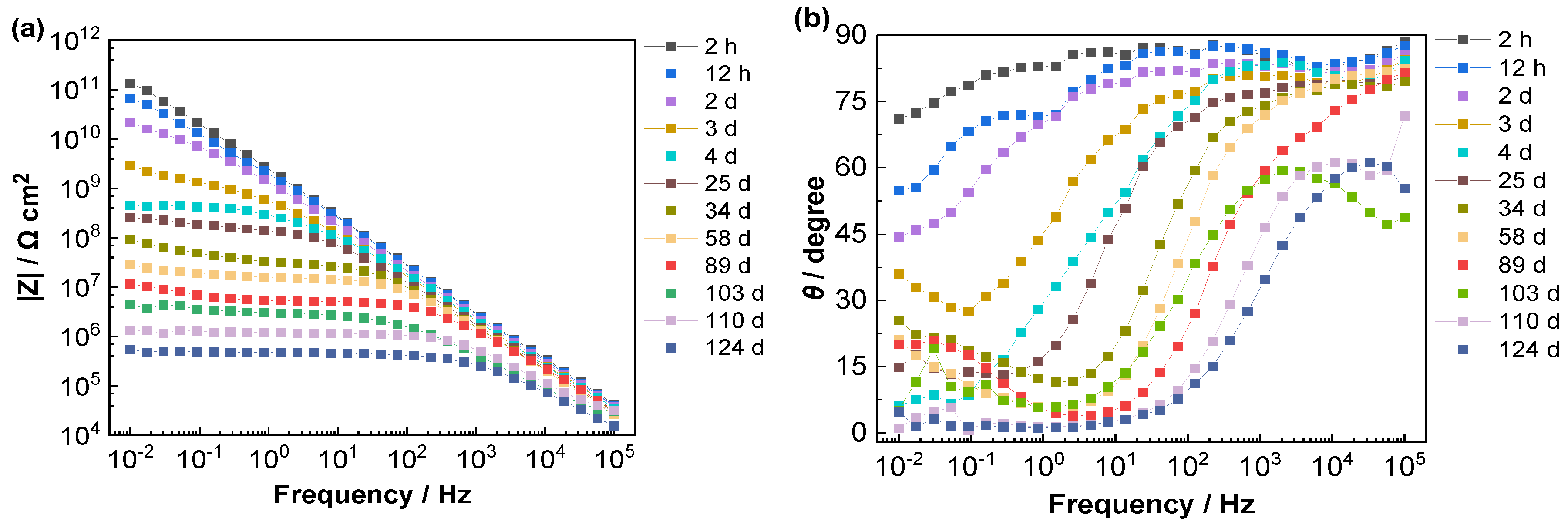
6] exhibits high feasibility for field application. The protective level of organic coatings can be divided into five grades (excellent, very good, good, poor, and failure) based on the empirical correlation between
θ10 Hz and |
Z|
0.01 Hz [
9]. Nevertheless, single-parameter evaluation methods show limited universality for different coating systems, requiring further verification and optimization to improve evaluation reliability. Accordingly, multi-parameter comprehensive evaluation strategies have attracted increasing research attention. The integration of multi-dimensional characteristic indicators enables holistic characterization of coating degradation states and failure behaviors, effectively compensating for evaluation errors inherent in single-parameter methods.
A series of multi-parameter evaluation systems have been established in recent studies. Zhang et al. [
10] constructed a correlation analysis model by synchronously processing electrochemical impedance, open-circuit potential, and Kelvin probe potential, and screened the optimal parameter combination for distinguishing coating degradation levels. Lee et al. [
11] trained an artificial neural network based on theoretical impedance spectra of steel–coating composite systems and realized coating quality classification using breakpoint frequency (
fb) and pore resistance (
Rpo) parameters. Xu et al. [
12] evaluated three typical coating states (intact, intermediate degradation, and complete failure) by extracting low-frequency impedance modulus (|
Z|
0.01 Hz), mid-frequency impedance modulus (lg
Z117 Hz), mid-frequency phase angle (
θ10 Hz) and break-point frequency (
fb) from impedance data. Zhou et al. [
13] established a coating corrosion evaluation system based on rough set theory, assigning weight coefficients to multiple visual and physical indicators, including gloss loss, color change, chalking, cracking, blistering, and peeling, to achieve quantitative classification of coating damage severity.
Furthermore, emerging technologies including digital image processing [
14,
15], electronic speckle pattern interferometry (ESPI) [
16], terahertz (THz) detection [
17,
18] and artificial intelligence (AI) [
19,
20] have provided novel technical approaches for coating degradation monitoring and performance quantification. Advanced testing methods enable high-resolution detection of surface and internal micro-defects in coatings, while intelligent algorithms support automatic mining and analysis of massive experimental datasets. These techniques effectively identify complex nonlinear correlations between coating performance indicators and degradation kinetics, providing objective and reliable technical support for in-service coating performance evaluation [
21].
Recent advances in materials informatics have demonstrated the great potential of well-structured deep-learning pipelines for material-related regression and classification tasks [
22,
23]. These representative works establish elegant standard practices for organizing multi-module workflows and presenting model architecture with high clarity, offering valuable references for data-driven material-performance modeling. However, such structured modeling paradigms have not yet been widely adapted to the quantitative performance evaluation of degradable organic protective coatings under corrosive service conditions.
Despite the significant progress in coating performance evaluation, several critical limitations remain in current research. First, most multi-parameter evaluation models adopt artificially selected characteristic parameters and empirically determined weight coefficients, which greatly restrict model adaptability across diverse coating systems and service environments. Second, the fusion analysis of multi-source heterogeneous data, including electrochemical, physicochemical, and visual indicators, is insufficient. The internal correlations between different parameters and their quantitative contributions to coating degradation remain unclear. Third, although AI-based intelligent evaluation methods show broad application prospects, most existing studies rely on single-modal experimental data or shallow neural network architectures, failing to fully exploit complementary effective information contained in multi-view test data. Therefore, a universal and systematic evaluation framework that can automatically extract hierarchical features from multi-source experimental data, quantify parameter importance, and adapt to various coating–environment systems is still lacking.
To address the above research gaps, multiple typical organic coating systems were tested under various laboratory-accelerated corrosion conditions in this work. A multi-view deep learning framework was developed to establish quantitative correlations between multi-dimensional experimental parameters and coating failure evolution, achieving comprehensive evaluation of coating protective performance. This study provides an efficient data-driven technical approach for predictive evaluation and health monitoring of organic coatings.
The main contributions of this work are summarized as follows:
A five-level quantitative evaluation framework for coating protective performance is proposed, adopting low-frequency impedance |Z|0.01 Hz as the core benchmark, combined with auxiliary indicators including mid-frequency phase angle, open-circuit potential, and adhesion strength.
A multi-view deep learning evaluation architecture is constructed, in which independent single-view sub-models are established for individual indicators, and correlation-weighted voting fusion is implemented to realize automatic multi-parameter joint grading of coating degradation states.
The proposed method is validated across multiple coating–substrate combinations under laboratory-accelerated corrosion scenarios, confirming its reliable prediction accuracy and cross-system generalization capability within the tested dataset range.
4. Development of a Comprehensive Coating Performance Evaluation Model
A multi-parameter integrated evaluation framework coupled with qualitative grading criteria was developed to quantify the protective capacity of organic coatings via systematic statistical analysis of multiple characteristic parameters. Four sequential core procedures were implemented for model construction: (1) Selection of baseline characteristic indicator: The low-frequency impedance modulus (|Z|0.01 Hz) was screened as the baseline metric for qualitative grading of coating protective performance. The reliability of this indicator was validated by abundant accelerated corrosion experimental data, and tiered performance boundaries were defined according to its magnitude intervals. (2) Determination of grading threshold intervals: On the basis of the grading rules of the baseline indicator, synchronous time-series matching was adopted to calibrate the corresponding classification intervals for auxiliary characteristic parameters, including mid-frequency phase angle, open-circuit potential, and adhesion strength. (3) Calculation of parameter weight coefficients: An optimized Pearson correlation analysis method was adopted to quantify the linear correlation between |Z|0.01 Hz and all other characteristic parameters. Weight coefficients were assigned to each parameter in accordance with the magnitude of correlation degrees to reflect their relative correlation strengths with coating degradation evaluation. (4) Construction of multi-view deep learning evaluation architecture: A deep neural network embedded with multi-view feature fusion and weighted voting mechanisms was established. Comprehensive multi-dimensional parameter inputs were imported into the network to realize automatic qualitative tiered judgment of coating protective performance.
4.1. Baseline Indicator
On the basis of previous theoretical investigations and corrosion experimental studies [
2,
5,
29,
30], the low-frequency impedance modulus (|
Z|
0.01 Hz) is widely recognized as a reliable quantitative indicator for characterizing the barrier performance of organic anticorrosive coatings. This metric was thereby selected as the baseline classification indicator for coating performance assessment in the present work. By combining previously reported literature and our own experimental work [
5,
9,
30,
31], a five-tier coating performance grading standard and the corresponding threshold values of|
Z|
0.01 Hz were formulated, as listed in
Table 2.
It is worth noting that, strictly speaking, coating failure criteria are governed by multiple factors including coating material, metallic substrate, exposure environment, and coating thickness. Therefore, an accurate low-frequency impedance threshold for a given coating-environment combination should be established based on substantial corrosion experiments and cross-validation among multiple performance measurements. Nevertheless, supported by the extensive published literature and our preliminary research findings, the value of 1 × 10⁶ Ω·cm2 can serve as an approximate criterion for coating failure or near-failure of ordinary organic protective coatings, such as epoxy coatings free of conductive pigments (e.g., zinc and magnesium powders), under common service environments such as marine conditions.
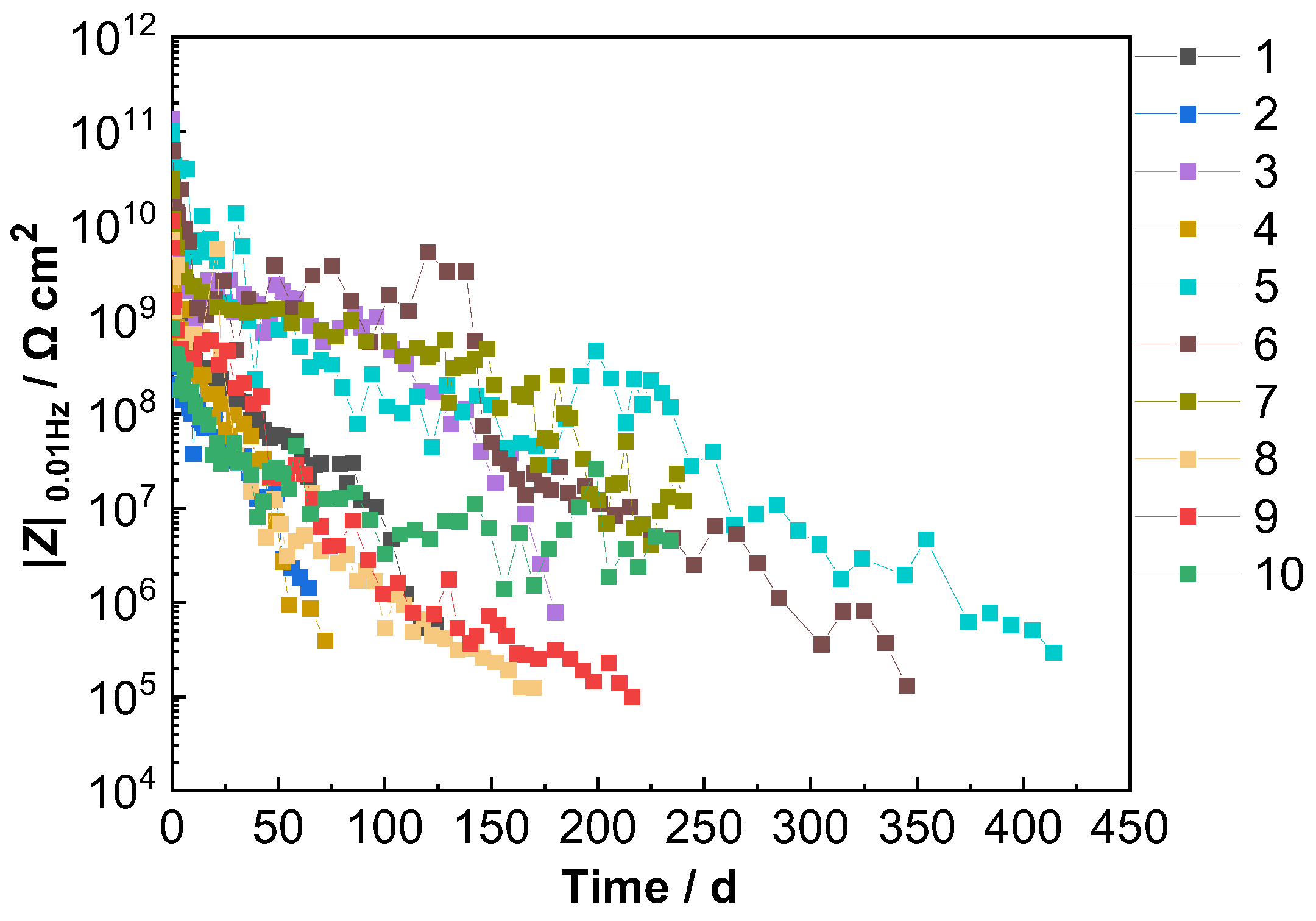
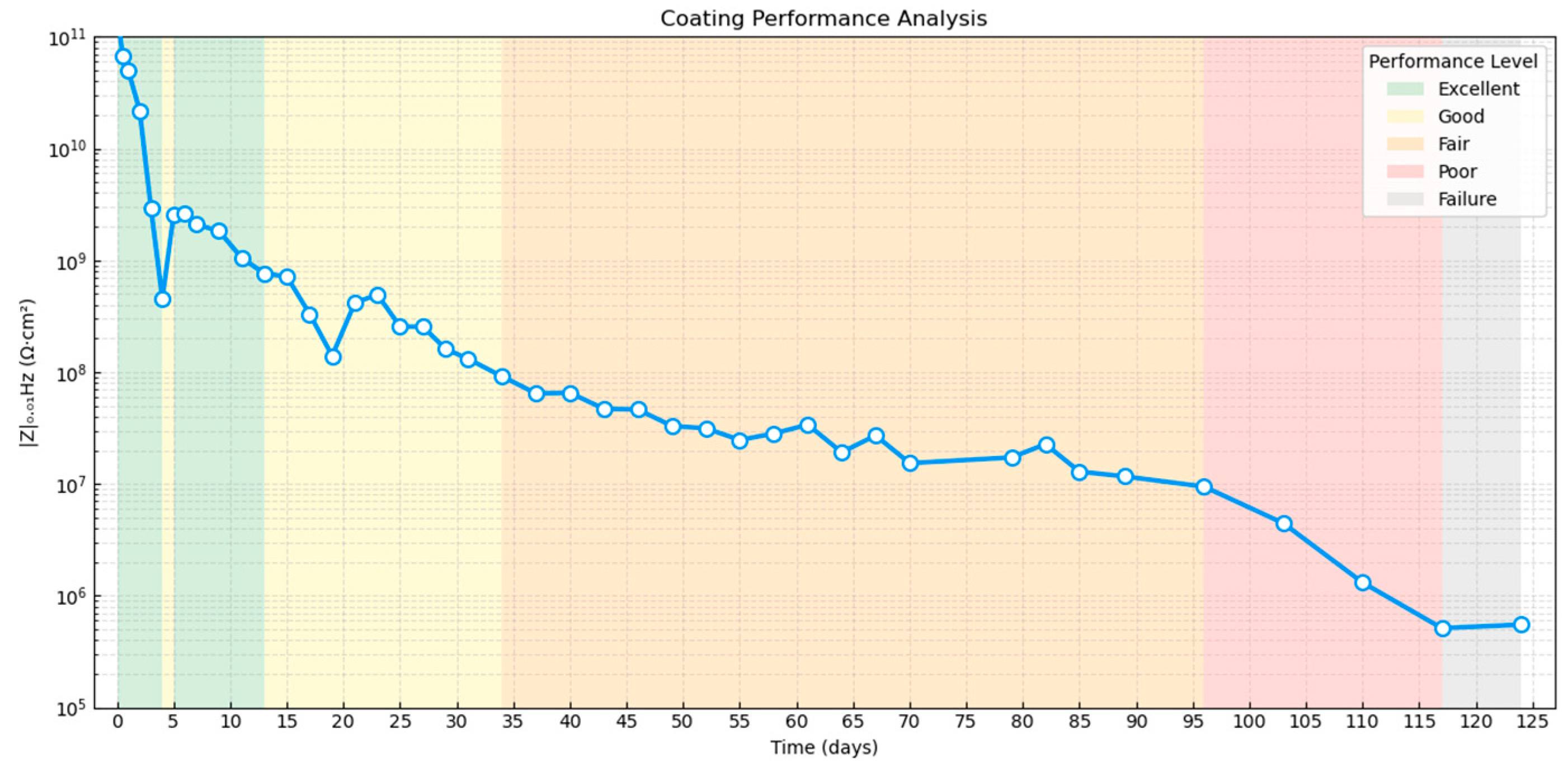
With this grading framework established, as a representative example for Coating System No. 1, the temporal evolution of
|Z|0.01 Hz over exposure time is illustrated in
Figure 5. The impedance curve generally shows a monotonically decreasing trend, and the degradation of coating protective performance is interpreted according to the above-mentioned five-level criteria. Five distinct color labels are used in the figure to denote the five performance tiers: excellent, good, fair, poor, and failure.
4.2. Grading Threshold Intervals for Auxiliary Parameters
Taking |
Z|
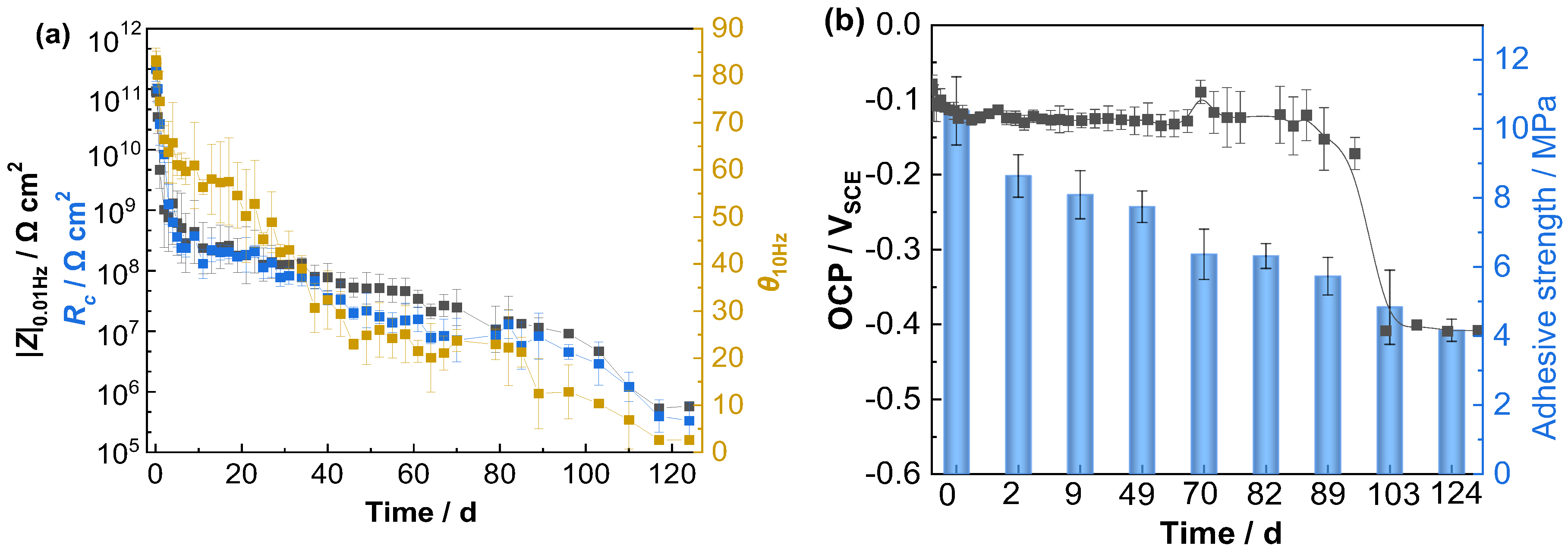
0.01 Hz as the baseline indicator, the unified five-tier performance grading criteria were mapped onto other characteristic parameters via time-axis synchronous alignment to obtain their respective classification thresholds. Coating System No. 1 was selected as a typical case. Time-series curves of |
Z|
0.01 Hz and three auxiliary parameters (mid-frequency phase
θ10 Hz, open-circuit potential OCP and adhesion strength
As) were aligned on a unified time axis. Quantitative correlations between each auxiliary parameter and coating performance tiers were extracted from synchronized degradation timelines. The calibrated threshold intervals for all characteristic parameters are summarized in
Table 3. Threshold analysis from
Table 3 indicated that although individual auxiliary parameters could partially reflect coating degradation, their non-monotonic evolution produced inconsistent linear correlations against the baseline |
Z|
0.01 Hz. This inconsistency manifested as overlapping numerical ranges belonging to different performance grades. Therefore, reliable and unambiguous identification of coating degradation states could not be achieved by relying on any single characteristic parameter alone. Such overlapping-threshold behavior was observed for all tested single-layer coating systems under various accelerated-corrosion environments.
4.3. Weighting Factor Analysis
Curve correlation analysis was performed to quantify the correlation-based weighting factor of each characteristic parameter with respect to coating protective performance. Taking |Z|0.01 Hz as the baseline reference indicator, the weighting factor (λi) for each parameter (i) was calculated from its correlation with |Z|0.01 Hz. This correlation-based calculation strategy evaluates how suitable each parameter is as a quantitative metric for coating-degradation assessment.
Several curve-correlation algorithms were compared in this study. A modified algorithm derived from the Pearson correlation coefficient was finally adopted to compute the correlation-based weighting factor (
λi). Geometrically, the Pearson correlation coefficient quantifies shape similarity between two time-series curves [
32,
33]. Nevertheless, experimental results showed that some characteristic parameters did not follow the monotonically decreasing temporal trend of the baseline |
Z|
0.01 Hz; instead, several indicators exhibited an increasing variation tendency, such as water uptake and porosity of coatings. Consequently, the original Pearson correlation coefficient cannot properly reflect the intrinsic correlation between each parameter and coating protective performance under such divergent trend patterns. An improved Pearson correlation approach was therefore proposed to address this limitation. For each characteristic parameter, Pearson coefficients were computed separately between the |
Z|
0.01 Hz curve a and the original parameter curve, as well as its transformed counterpart. The maximum absolute value of these two coefficients was taken as the final correlation-based weighting factor (
λi). Weighting factors obtained by this method were normalized within [0, 1], where larger values indicate stronger influence on coating degradation.
- (1)
Reciprocal transformation for the parameter curves
For parameters whose trends opposed the monotonically decreasing baseline of |
Z|
0.01 Hz (e.g., water uptake), reciprocal transformation via Equation (1) was applied to align their variation trends with the baseline. A small positive constant
ε = 10
−8 was introduced to prevent division-by-zero numerical singularities.
- (2)
Dual correlation coefficient calculation
Pearson correlation coefficients between the |
Z|
0.01 Hz baseline and the original and reciprocal-transformed parameter curves were calculated using Equations (2) and (3), respectively.
- (3)
Weighting factor extraction
The preliminary weighting factor (
λi′) was defined in Equation (4), which selected the maximum absolute value from the two computed correlation coefficients.
Based on this improved Pearson algorithm, correlation analysis between each core characteristic parameter and coating protective performance was carried out using |
Z|
0.01 Hz as the benchmark. The resulting weighting-factor values for all coating systems are summarized in
Table 4. Key conclusions are listed below:
① The average weighting factor (λ) of adhesion strength (As) exceeded 0.8, indicating a strong correlation between adhesion strength and coating degradation. Adhesion strength was thus identified as a primary evaluation parameter.
② The weighting factors for the mid-frequency phase angle (θ10 Hz) and open-circuit potential (OCP) were mostly higher than 0.6. Although their correlation strengths were slightly lower than that of adhesion strength, they featured short testing durations and non-destructive detection, making them important indicators for on-site field evaluation of coating protective performance.
4.4. Construction of Multi-View Deep Learning Comprehensive Evaluation Model
A multi-view deep-learning integrated evaluation framework was developed to quantitatively grade coating protective performance by jointly analyzing multi-dimensional characteristic parameters. The overall model consisted of three modular components: (1) data preprocessing module, (2) multi-view neural-network training module, and (3) multi-view weighted-voting fusion module.
(1) Data preprocessing module
Time-series data of core characteristic parameters covering full coating-degradation lifecycles were assembled to construct the model-input dataset. Input indicators included the electrochemical mid-frequency phase angle (θ10 Hz), open-circuit potential (OCP), and mechanical adhesion strength (As). These parameters jointly provided multi-perspective characterization of coating performance degradation.
Standardization and normalization were implemented to eliminate numerical discrepancies originating from heterogeneous units and value ranges among different parameters, thus improving training convergence and prediction accuracy. For parameters with wide-ranging values such as impedance-related indices, logarithmic transformation followed by Z-score standardization was applied. Other time-series variables were linearly scaled to the interval [0, 1] using Min–Max scaling. After uniform normalization, all characteristic parameters were converted into comparable numerical scales to stabilize model training and accelerate convergence.
(2) Multi-view neural network training module
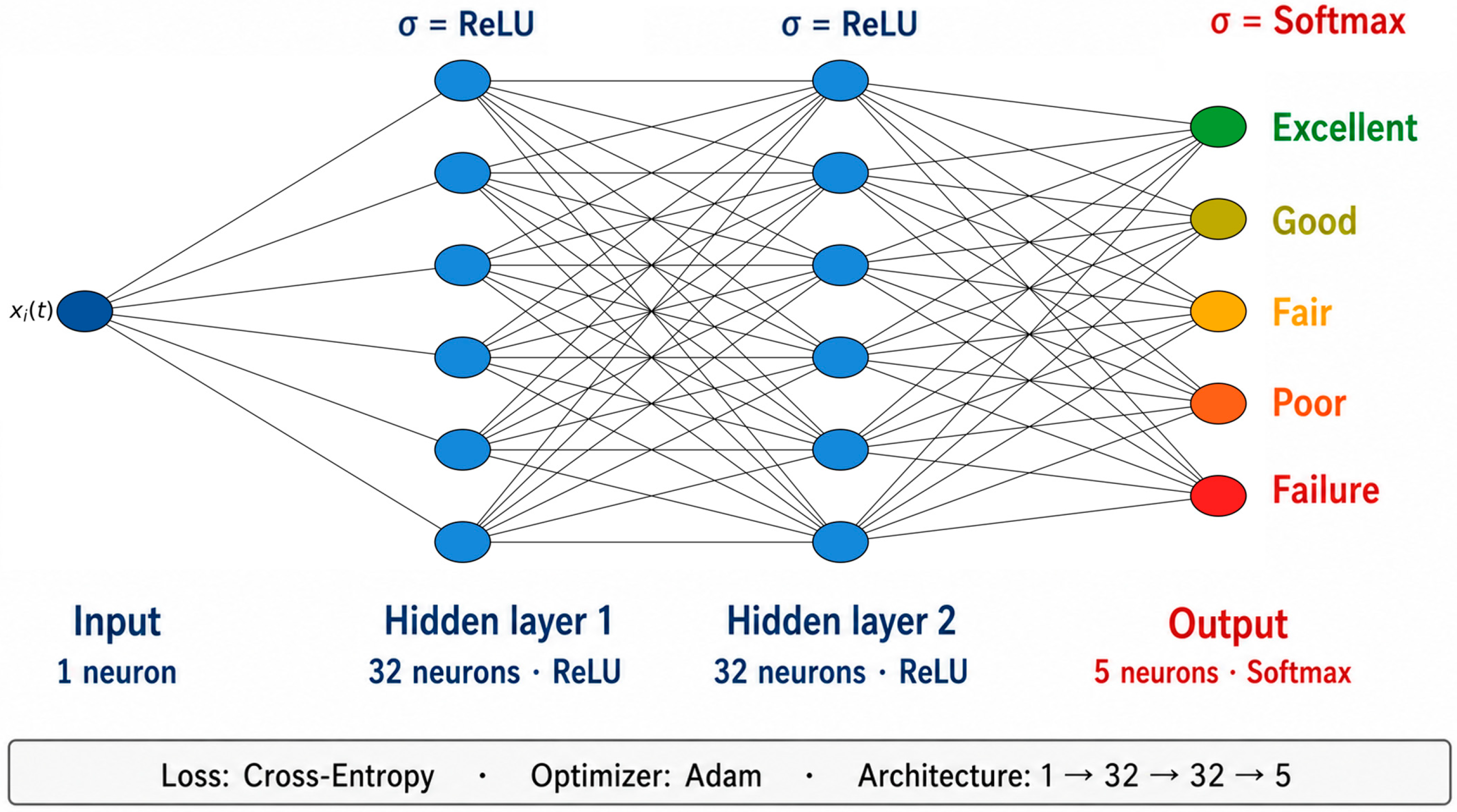
Independent neural-network sub-models were built for each characteristic parameter to enable performance grading based on individual-indicator features. Each sub-model adopted a four-layer multilayer perceptron (MLP) with a 1-32-32-5 topological, as illustrated in
Figure 6. The input layer contained one neuron, which received the measured value of a single characteristic parameter at one measurement instant. Each training sample corresponded to one synchronized parameter-time measurement point. Accordingly, each sub-model learned a point-wise mapping from parameter value to five-tier performance grade across the full degradation process, rather than extracting time-series features from individual samples. Two hidden layers with 32 neurons each were utilized to capture nonlinear degradation relationships from input data. The output layer contained five neurons corresponding to the five coating-performance grades: excellent, good, fair, poor, and failure. The Rectified Linear Unit (ReLU) activation function was employed for all hidden layers to enhance nonlinear fitting capability, whereas the Softmax activation function in the output layer produced probability distributions over performance grades. During training, cross-entropy loss and the Adam optimizer were adopted, both of which are standard deep-learning algorithms [
34,
35]. Backpropagation iteratively updated network weights until stable prediction of coating-degradation grades was attained.
(3) Multi-view weighted voting mechanism module
The multi-view weighted-voting strategy was developed based on ensemble-learning and multi-expert-model fusion theory. Task decomposition mitigated the curse of dimensionality and avoided negative-transfer effects induced by high-dimensional mixed inputs, improving the generalization and anti-noise robustness of the overall evaluation model.
Each parameter-specific MLP sub-model ran independently and output two pieces of information: a predicted coating-performance grade and its corresponding prediction probability. Pre-calculated weighting factors (
λ), derived from the correlation between each parameter and the baseline |
Z|
0.01 Hz, serve as voting coefficients. Parameters with larger
λ values, which reflected stronger correlation with coating protective performance, were endowed with higher voting weights. The comprehensive evaluation grade was determined via the following weighted-fusion procedure. For a given performance grade
g, the comprehensive voting probability
P(
g) was calculated by normalized weighted summation:
where
λi denotes the weighting factor of the
i-th sub-model, and
pi(
g) represents the prediction probability of grade
g output by the
i-th sub-model.
For each predefined performance grade, the prediction probabilities output by individual sub-models were multiplied by their respective weighting factors. The weighted probabilities from all sub-models were summed to compute the comprehensive voting score for that grade. The final coating-performance grade corresponded to the grade with the maximum comprehensive voting score.
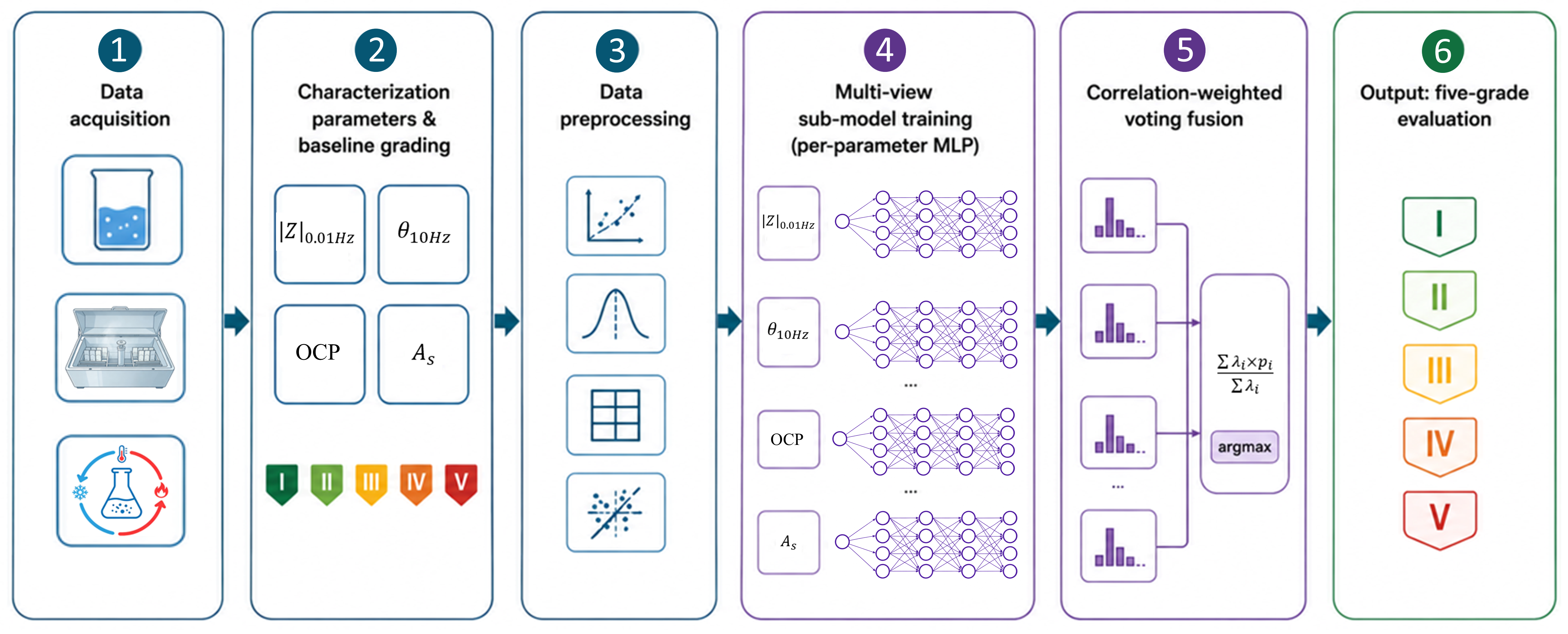
It should be noted that correlation analysis for all impedance-derived parameters yielded high weighting factors for several indicators. Nevertheless, only one most-representative impedance parameter with optimal correlation is recommended for integration into the voting module. This impedance metric is fused with other physicochemical and mechanical parameters to build a stable, high-precision multi-view evaluation model. The complete end-to-end workflow of the multi-view deep-learning-based coating-evaluation approach, covering experimental data acquisition, parameter measurement, data preprocessing, per-parameter sub-model training, correlation-weighted voting fusion, and final five-tier performance prediction, is summarized schematically in
Figure 7.
6. Conclusions
A multi-view deep-learning integrated framework was proposed to construct a comprehensive quantitative evaluation model for organic coating protective performance, based on abundant accelerated corrosion experimental data from various coating systems. This study established a feasible research route and a complete evaluation algorithm suite, providing an effective technical reference for multi-parameter quantitative assessment of coating degradation under laboratory-simulated marine corrosion conditions.
Low-frequency impedance modulus (|Z|0.01 Hz) was selected as the unified benchmark indicator for five-tier grading of coating performance. Open-circuit potential, mid-frequency phase angle, and coating adhesion served as optional auxiliary parameters, adaptable to test conditions and evaluation needs. An improved Pearson correlation algorithm analyzed intrinsic correlations between degradation degree and performance parameters, quantitatively deriving weight coefficients for electrochemical and mechanical indices. A multi-view deep neural network embedded with a weighted-voting fusion mechanism was then constructed to achieve accurate multi-parameter comprehensive grading with satisfactory accuracy across tested coating systems.
The proposed model overcomes the limitations of traditional single-indicator methods and enables multi-dimensional quantitative characterization of coating barrier deterioration. Experimental validation based on laboratory-accelerated test datasets confirmed reliable prediction accuracy and promising cross-system generalization potential within the studied experimental scenarios. Notably, overall evaluation precision heavily relies on data quality; dataset scale and integrity largely determine prediction reliability, and sufficient high-quality samples are essential for stable and credible model outputs.
Future work will expand and optimize this framework by incorporating new evaluation parameters such as quantitative visual indicators of blistering, corrosion degree, glossiness, and color difference, combined with low-frequency impedance data to form a coupled benchmark. Coating water absorption and porosity will be added as auxiliary indexes. Following the same core methodology, future studies will quantify correlations and weights of new parameters and adopt the multi-view weighted-voting fusion strategy for more comprehensive and precise assessments. Continued model optimization will further enhance prediction accuracy and improve its potential practical engineering value.



 ,
,