Article

Multi-View Deep Learning-Based Comprehensive Evaluation Model for Coating Protective Performance


1
Key Laboratory of Carbon Fiber and Functional Polymer, Ministry of Education, Beijing University of Chemical Technology, Beijing 100029, China
2
School of Information Science and Technology, Beijing University of Chemical Technology, Beijing 100029, China
3
Institute of Medical Technology, Peking University Health Science Center, Peking University, Beijing, 100191, China
*
Author to whom correspondence should be addressed.
These authors contributed equally to this work.
Materials 2026, 19(18), 3969; https://doi.org/10.3390/ma19183969 (registering DOI)
Submission received: 29 July 2026 / Revised: 9 September 2026 / Accepted: 11 September 2026 / Published: 18 September 2026
(This article belongs to the Section Materials Simulation and Design)

Abstract

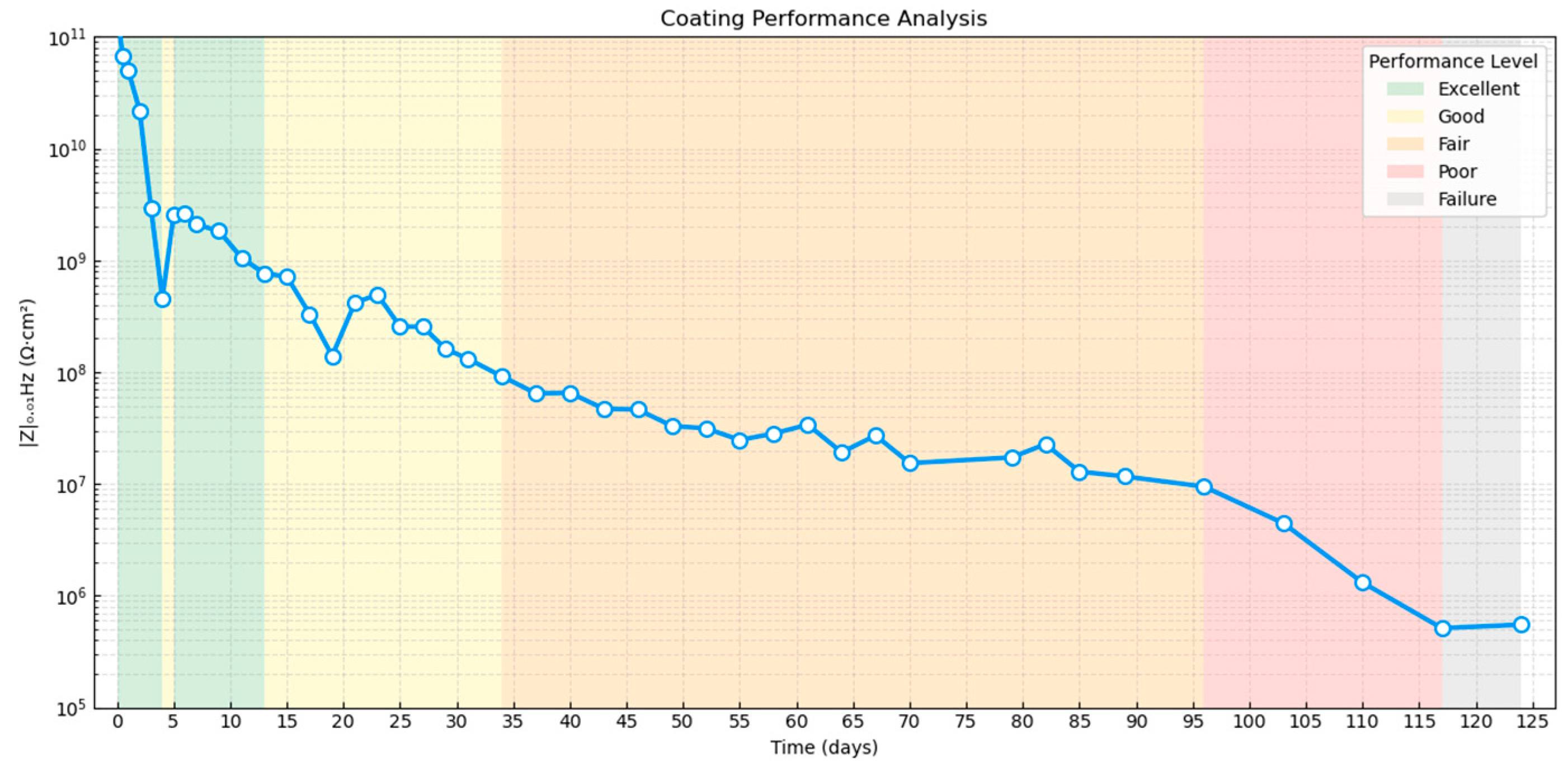
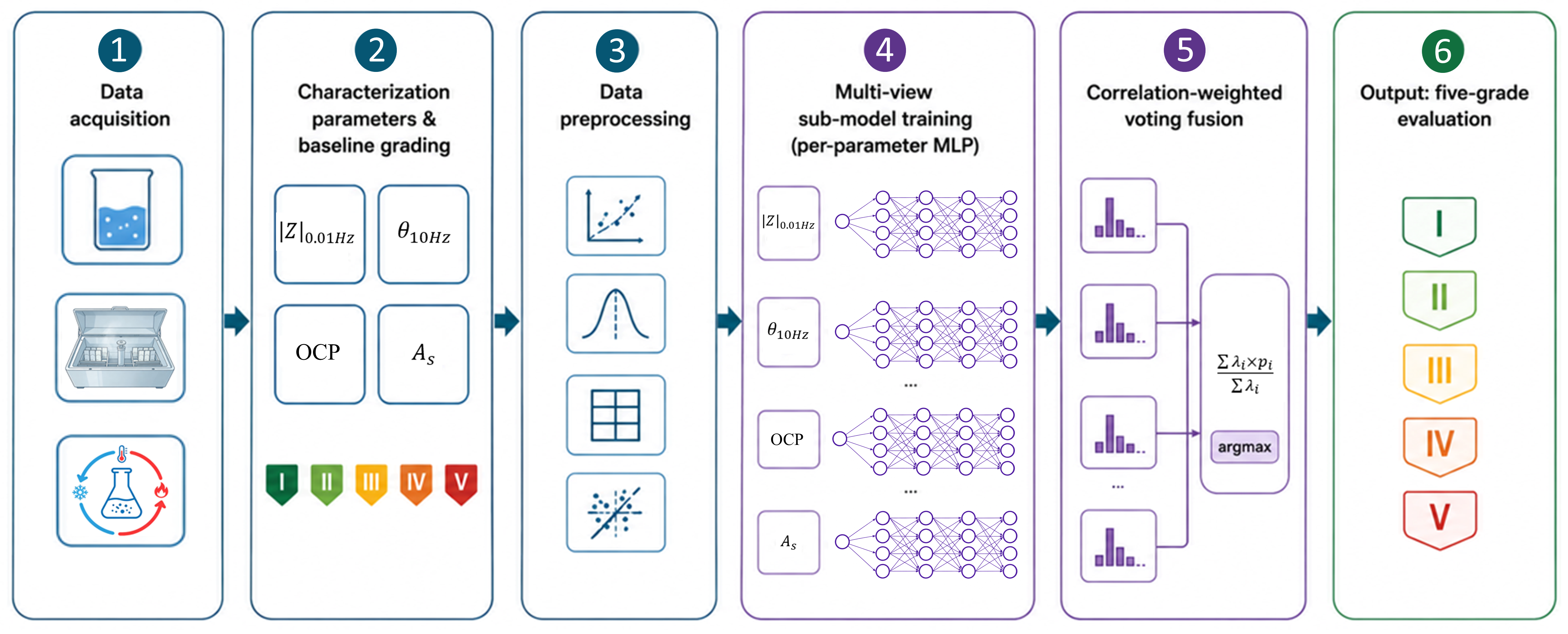
Organic protective coatings are extensively employed to mitigate metal corrosion, yet accurate quantitative evaluation of their performance degradation during service still poses a considerable challenge. This study aims to develop a multi-view deep learning framework for five-grade quantitative assessment of organic coating protective performance using routine electrochemical and mechanical parameters. This study aims to develop a multi-view deep learning framework for five-grade quantitative assessment of organic coating protective performance using routine electrochemical and mechanical parameters. Based on abundant laboratory-accelerated corrosion test data, independent single-view sub-models were constructed for three complementary descriptors, including the mid-frequency phase angle (θ10 Hz), open-circuit potential (OCP), and adhesion strength (As). Prediction outputs from individual sub-models were fused through correlation-weighted voting, where weighting factors were determined by quantitative parameter-degradation correlations across various coating systems. The proposed framework achieves reliable five-level grading (excellent, good, fair, poor, failure) of coating protective performance. This methodology provides an effective data-driven framework for the predictive assessment of organic coating protective performance in practical engineering applications.
Keywords: organic coatings; protective performance; electrochemical impedance; deep learning; comprehensive performance evaluation organic coatings; protective performance; electrochemical impedance; deep learning; comprehensive performance evaluation