Cr-Triggered FCC Ti-Rich Precipitation and Its Effects on the Mechanical and Oxidation Performance of TiVNbTa Refractory High-Entropy Alloys


Abstract
1. Introduction
2. Materials and Methods
3. Results
3.1. Phase Composition and Microstructure Analysis
3.2. Mechanical Properties
3.3. Oxidation Behavior Under High Temperature
4. Discussion
4.1. Cr-Triggered FCC Ti-Rich Precipitation and Microstructure Evolution
4.2. Effect on Mechanical Behavior
4.3. Effect on High-Temperature Oxidation Behavior
5. Conclusions
- (1)
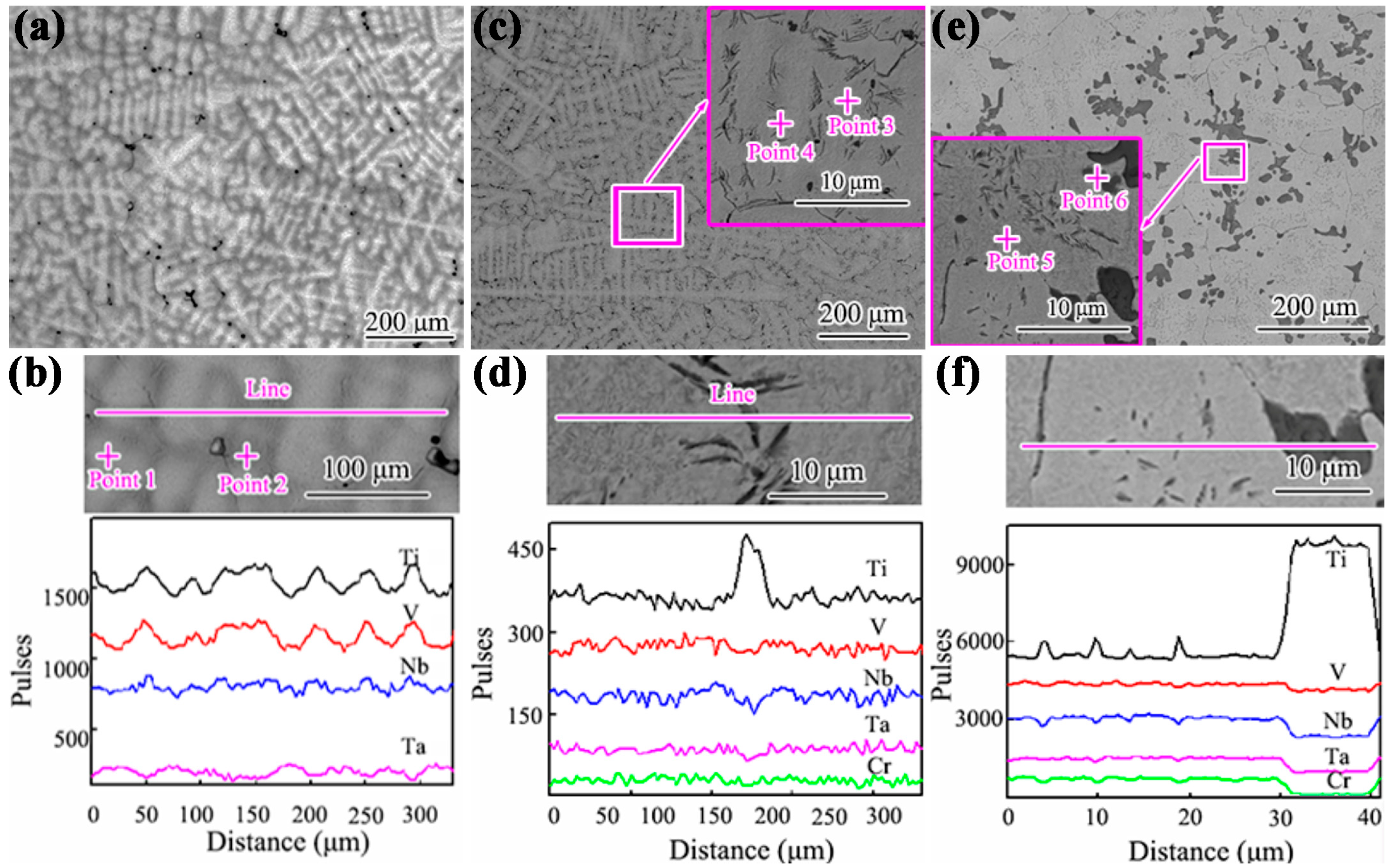
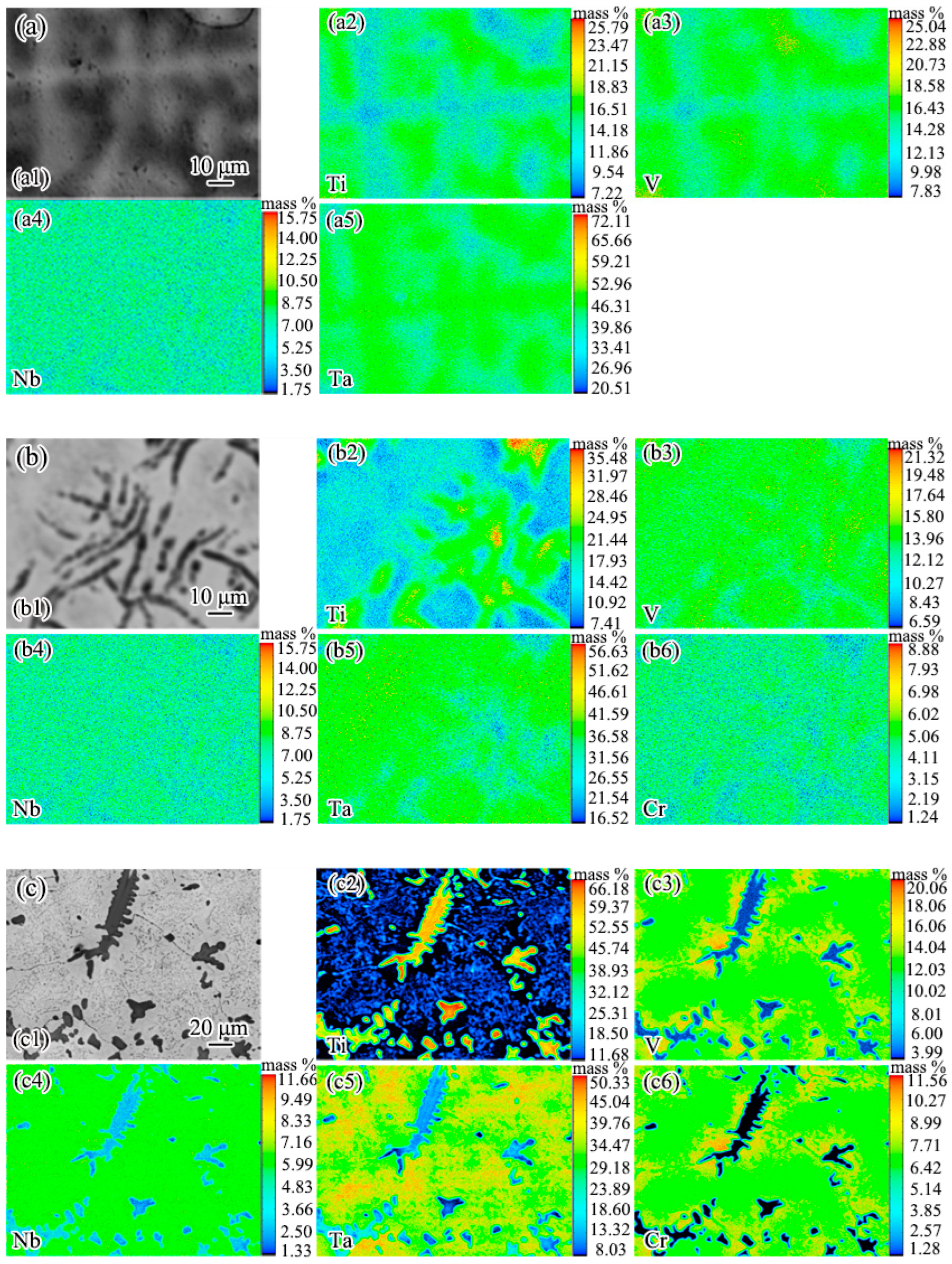
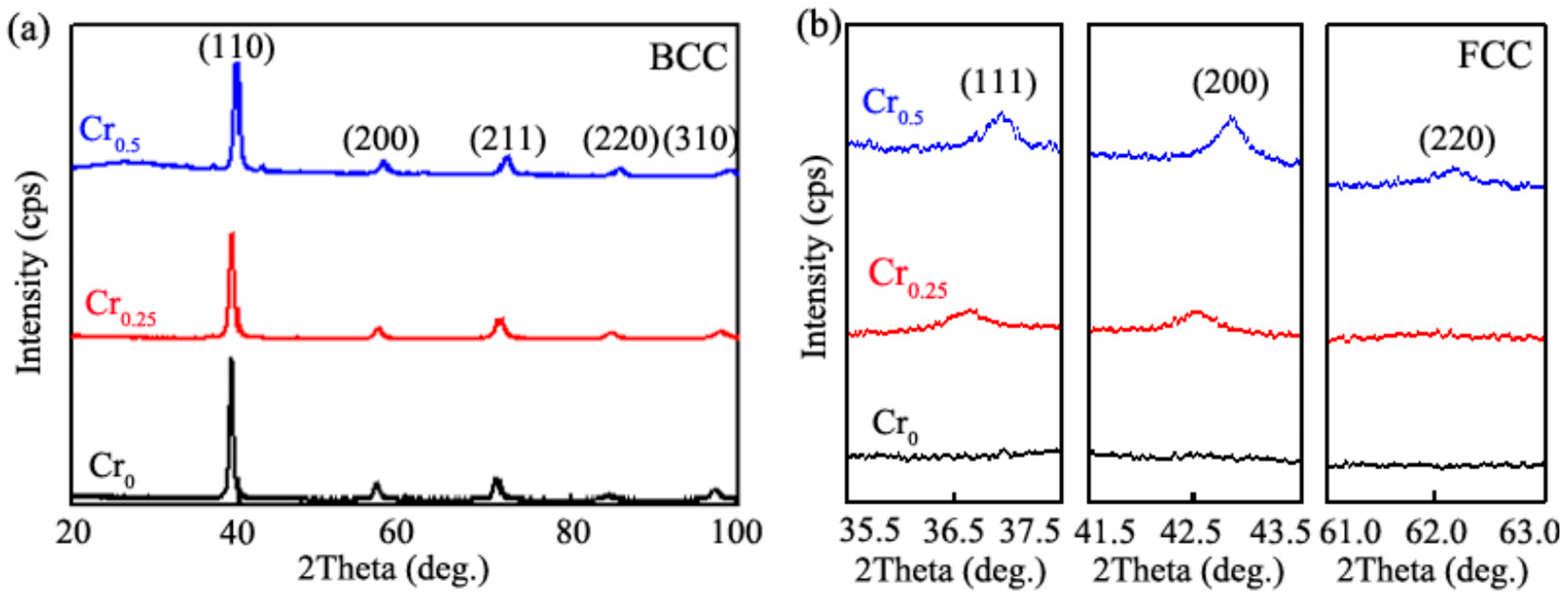
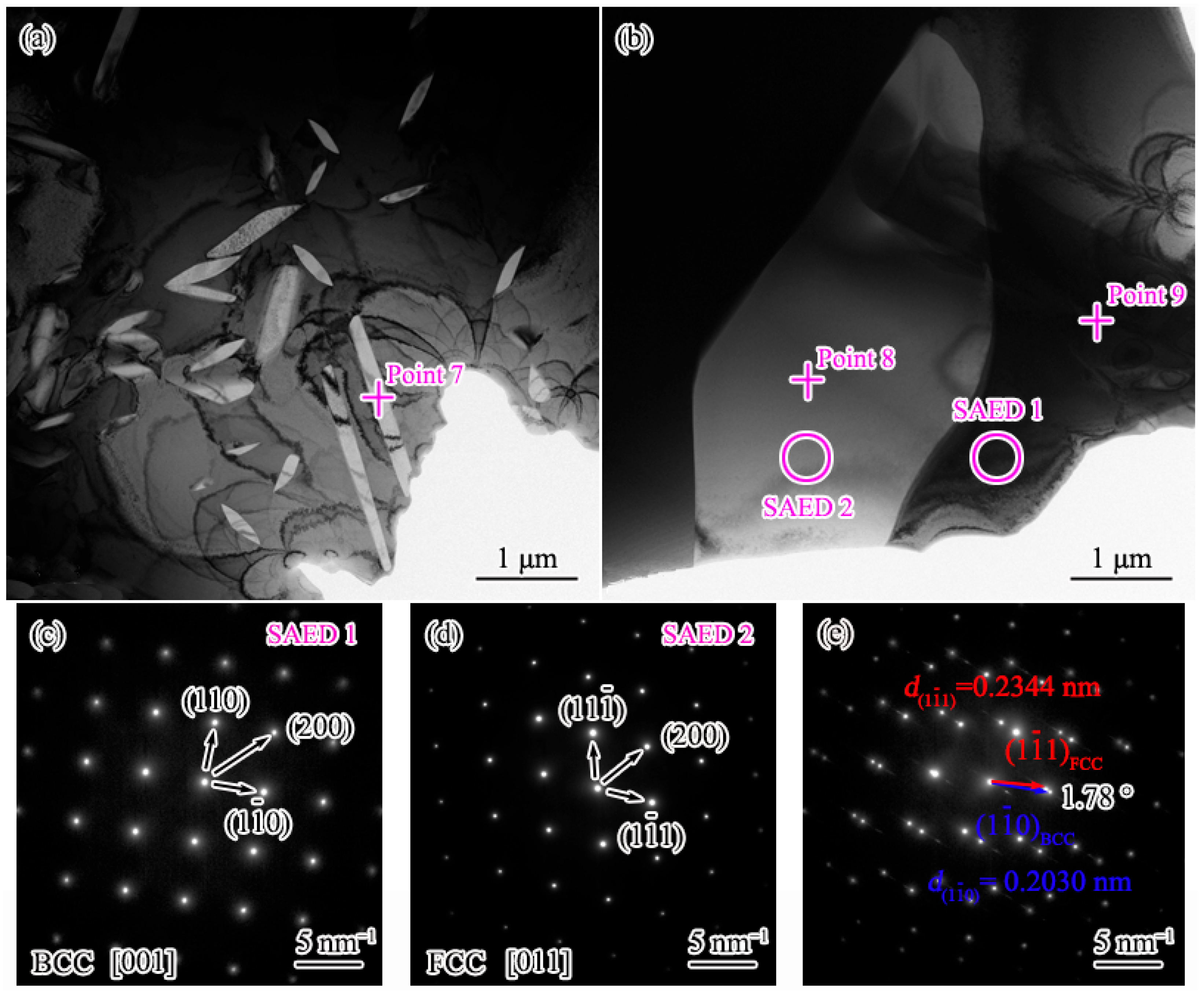
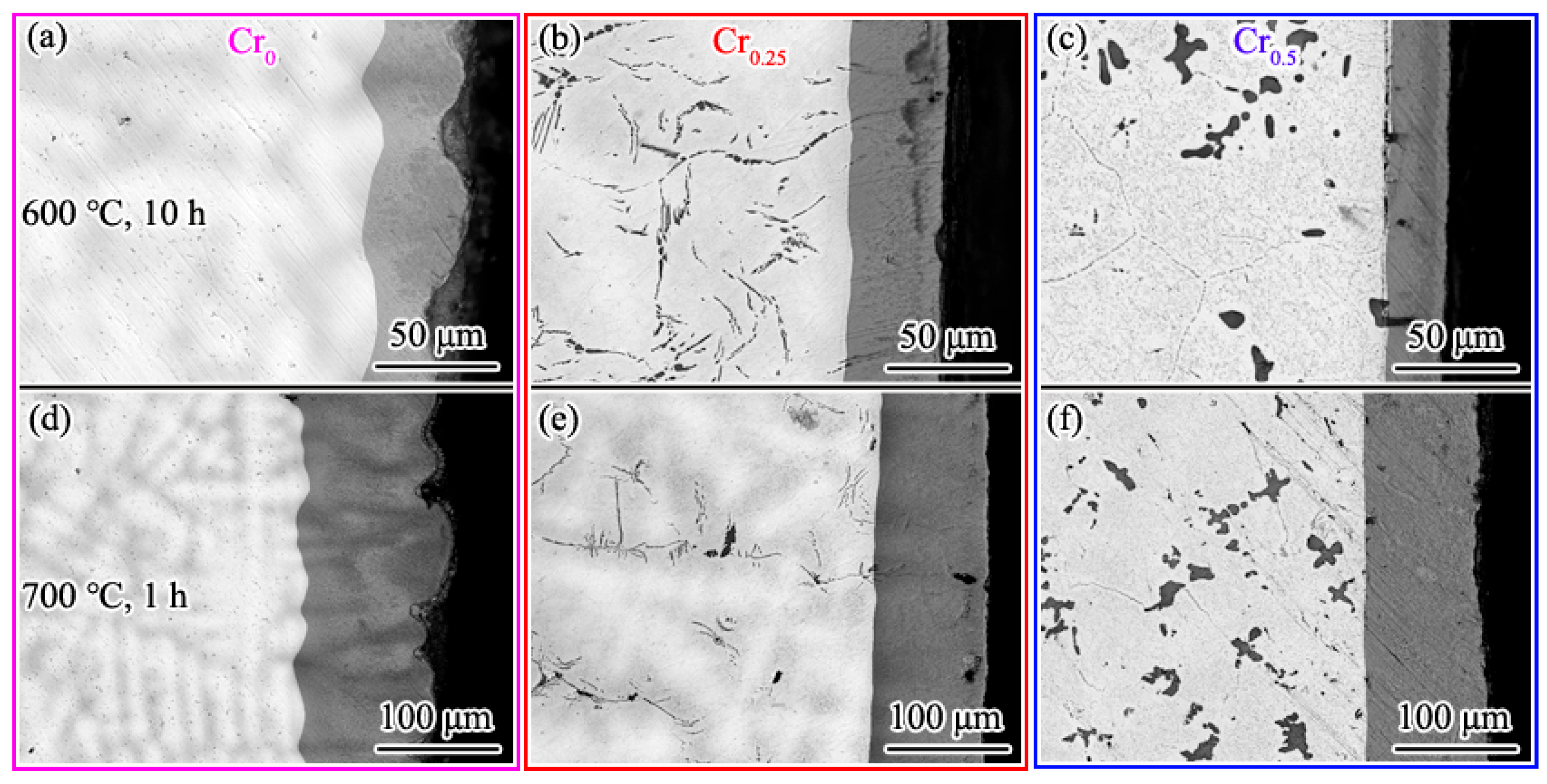
- The TiVNbTaCrx RHEA (x = 0) exhibits a dendritic structure. The addition of Cr alters the solidification pathway of TiVNbTa alloys from a single-phase BCC solid solution to a BCC matrix with FCC Ti-rich precipitates. With Cr addition (x = 0.25, 0.5), the Ti-rich phases precipitate. The volume fraction of this phase increases with Cr content, and its morphology evolves from straw-like to block-like.
- (2)
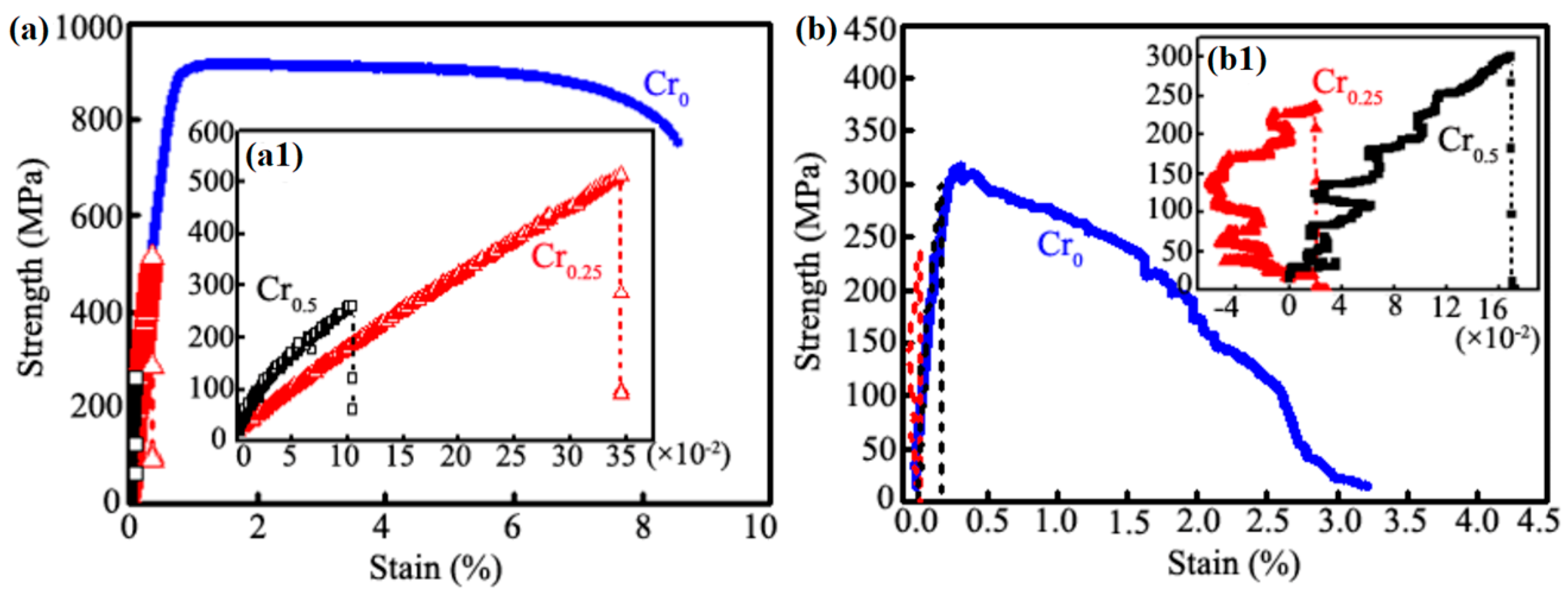
- The TiVNbTa alloy possesses favorable strength and ductility at room temperature (915 MPa/8.56%) and 600 °C (316 MPa/3.22%). The addition of Cr markedly degrades these properties, with the room-temperature tensile strength and elongation decreasing by 44% and 96% for the Cr0.25 alloy and by 71% and 99% for the Cr0.5 alloy, and with extremely low elongations at 600 °C.
- (3)
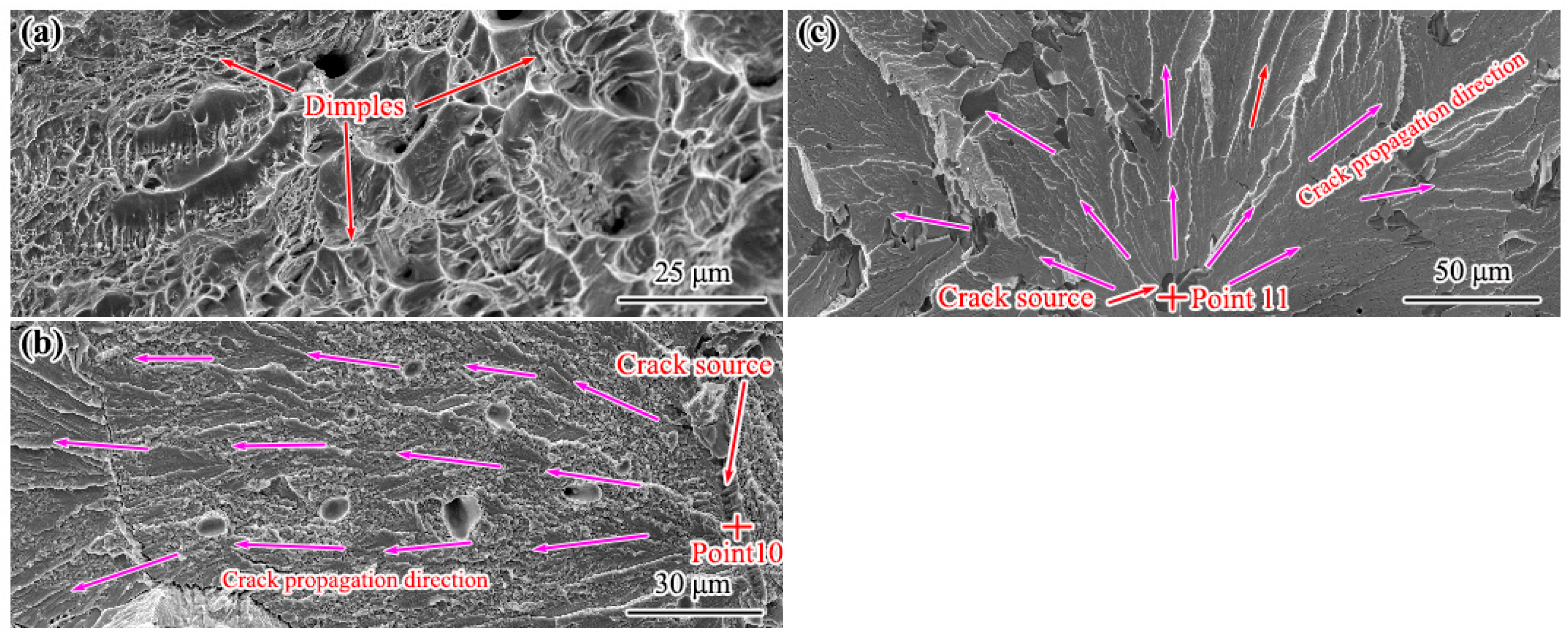
- The FCC Ti-rich phase precipitates predominantly in the interdendritic regions and along grain boundaries, disrupting the continuity of the BCC matrix and weakening grain boundary cohesion, which promotes crack initiation at grain boundaries and leads to a transition from ductile to brittle fracture in the Cr-containing alloys.
- (4)
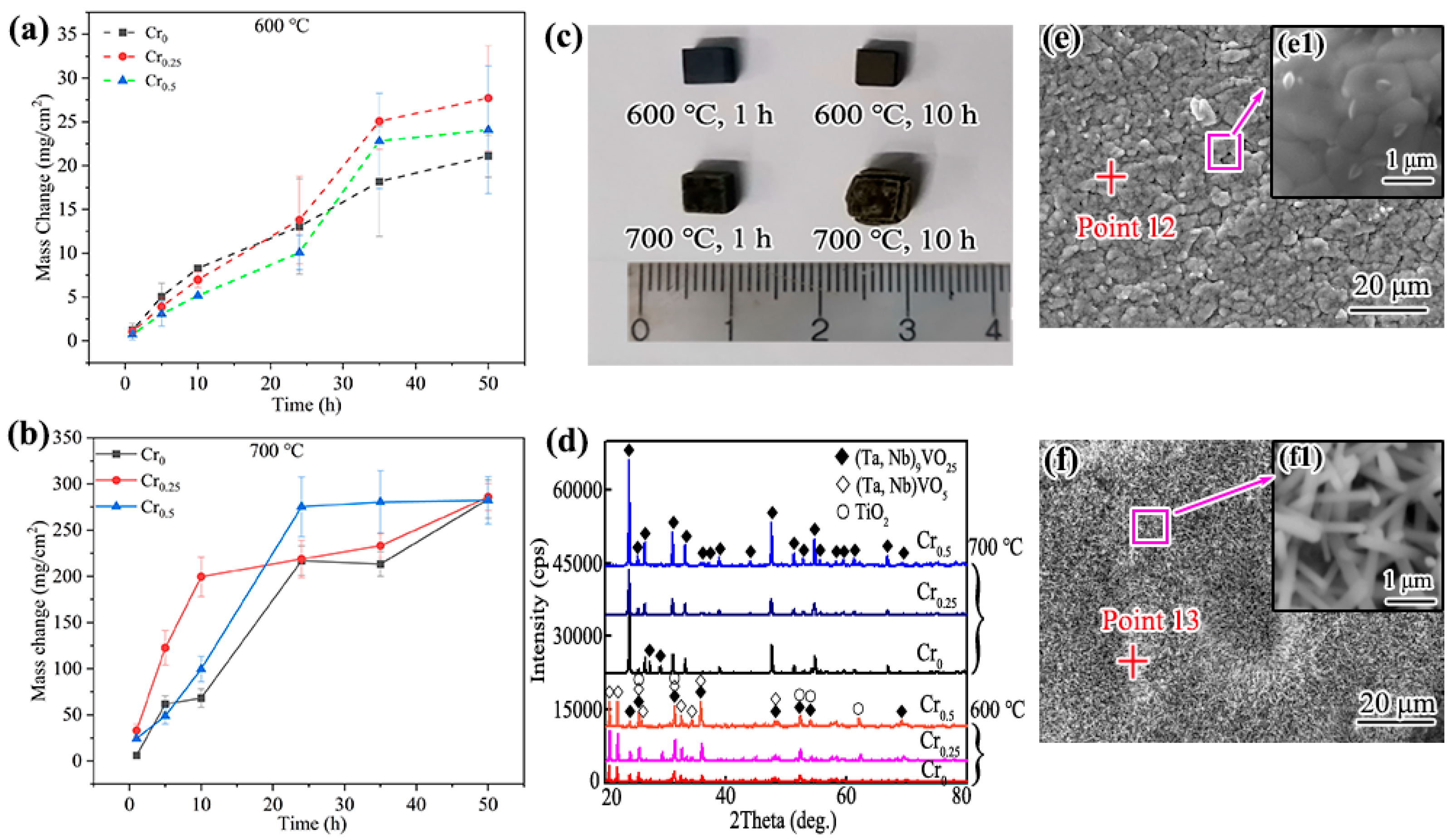
- During oxidation tests at 600–700 °C, Cr addition provides only a marginal beneficial effect during the initial stage (0–10 h at 600 °C), while the Cr-containing alloys continue to gain mass upon prolonged exposure due to the reduced integrity of the oxide film. The oxide scale consists primarily of (Ta,Nb)9VO25, with virtually no Cr detected, and no protective Cr2O3 scale is observed under the present experimental conditions.
Author Contributions
Funding
Institutional Review Board Statement
Informed Consent Statement
Data Availability Statement
Acknowledgments
Conflicts of Interest
References
- Senkov, O.N.; Wilks, G.B.; Miracle, D.B.; Chuang, C.P.; Liaw, P.K. Refractory high-entropy alloys. Intermetallics 2010, 18, 1758–1765. [Google Scholar] [CrossRef] [Scilit]
- Tian, Y.; Zhou, W.; Tan, Q.; Wu, M.; Qiao, S.; Zhu, G.; Dong, A.; Shu, D.; Sun, B. A review of refractory high-entropy alloys. Trans. Nonferrous Met. Soc. China. 2022, 32, 3487–3515. [Google Scholar] [CrossRef] [Scilit]
- Xu, L.; Zong, L.; Luo, C.; Jiao, Z.; Wei, S. Toughening pathways and regulatory mechanisms of refractory high-entropy alloys. Acta Metall. Sin. (Engl. Lett.) 2021, 58, 257–271. [Google Scholar]
- Guo, C.; Xing, Y.; Wu, P.; Qu, R.-T.; Song, K.-X.; Liu, F. Super tensile ductility in an as-cast TiVNbTa refractory high-entropy alloy. Prog. Nat. Sci. Mater. Int. 2024, 34, 1076–1084. [Google Scholar] [CrossRef] [Scilit]
- Lee, C.; Song, G.; Gao, M.C.; Feng, R.; Chen, P.; Brechtl, J.; Chen, Y.; An, K.; Guo, W.; Poplawsky, J.-D.; et al. Lattice distortion in a strong and ductile refractory high-entropy alloy. Acta Mater. 2018, 160, 158–172. [Google Scholar] [CrossRef] [Scilit]
- Gao, N.; Long, Y.; Peng, H.; Zhang, W.; Peng, L. Microstructure and mechanical properties of TiVNbTa refractory high-entropy alloy prepared by powder metallurgy. Cailiao Yanjiu Xuebao 2019, 33, 572–578. [Google Scholar]
- Scales, R.J.; Armstrong, D.; Wilkinson, A.J.; Li, B.-S. On the brittle-to-ductile transition of the as-cast TiVNbTa refractory high-entropy alloy. Materialia 2020, 14, 100940. [Google Scholar] [CrossRef] [Scilit]
- Xu, Z.; Ma, Z.; Tan, Y.; Cheng, X. Designing TiVNbTaSi refractory high-entropy alloys with ambient tensile ductility. Scr. Mater. 2022, 206, 114230. [Google Scholar] [CrossRef] [Scilit]
- Li, X.; Guo, W.; Liu, B.; Fu, A.; Li, J.; Fang, Q.; Liu, Y. Microstructure and mechanical properties of TaNbVTiAlx refractory high-entropy alloys. Entropy 2020, 22, 282. [Google Scholar] [CrossRef] [Scilit] [PubMed]
- Yang, L.; Xiong, K.; Jin, C.; Dai, H.; Wu, H.; Zhang, S.; He, J.; Wang, Y.; Mao, Y. Effects of Ti content on the tensile ductility, lattice distortion and mechanical properties of VNbTaTix refractory high-entropy alloys. J. Mater. Res. Technol. 2024, 30, 3886–3899. [Google Scholar] [CrossRef] [Scilit]
- Huang, W.; Hou, J.; Wang, X.; Qiao, J.; Wu, Y. Excellent room-temperature tensile ductility in as-cast Ti37V15Nb22Hf23W3 refractory high entropy alloys. Intermetallics 2022, 151, 107735. [Google Scholar] [CrossRef] [Scilit]
- Zhang, X.; Cui, X.; Jin, G.; Dong, Y.; Wang, Z.; Qi, Y. Microstructure evolution and performance enhancement of NbTaTiV-(Cr, Zr, W) single-phase refractory high-entropy alloy coatings: Role of additional elements. J. Alloys Compd. 2023, 951, 169918. [Google Scholar] [CrossRef] [Scilit]
- Lv, S.; Kou, Y.; Liu, Y.; Zhang, Y.; Li, Q. Improving strength-ductility synergy of TiNbVTa refractory high-entropy alloys at room temperature by Cr microalloying. Mater. Sci. Eng. A 2025, 946, 149111. [Google Scholar] [CrossRef] [Scilit]
- Chen, Y.; Li, M.; Li, N.; Wang, Y.; Liu, K.; Chang, Y. Microstructure and mechanical properties of TiNbV0.5Ta0.5Crx(x = 0,0.1,0.2,0.5) refractory high-entropy alloys. J. Mater. Sci. Technol. 2025, 211, 254–266. [Google Scholar]
- Liu, J.; Scales, R.J.; Li, B.-S.; Goode, M.; Young, B.A.; Hu, J.; Wilkinson, A.J.; Armstrong, D.E. Controlling microstructure and mechanical properties of Ti-V-Cr-Nb-Ta refractory high entropy alloys through heat treatments. J. Alloys Compd. 2023, 932, 167651. [Google Scholar] [CrossRef] [Scilit]
- Lv, S.; Li, Q.; Liu, Y.; Liu, Y.; Yang, L.; Xu, Y. Achieving strength-ductility synergy in (TiNbVTa)99.65Cr0.35 alloy via recrystallization-induced bimodal grain structure. J. Alloys Compd. 2026, 1065, 188029. [Google Scholar] [CrossRef] [Scilit]
- Long, Y.; Lou, Y.; Liao, K.; Jiang, Z.; Zhu, D. Phase precipitation behavior and mechanical properties of TiVNbTaAlx refractory high-entropy alloys after annealing at medium temperatures. J. Alloys Compd. 2025, 1024, 180099. [Google Scholar] [CrossRef] [Scilit]
- Rivers, K.; Young, B.; Tang, Y.T.; Li, B.-S.; Wilkinson, A.J.; Armstrong, D.E.; Liu, J. Oxidation behaviour of Ti-V-Cr-Nb-Ta and Al-Ti-V-Cr-Ta refractory high entropy alloys: Effects of Nb and Al substitutions. Mater. Des. 2024, 246, 113370. [Google Scholar] [CrossRef] [Scilit]
- Varma, S.; Sanchez, F.; Moncayo, S.; Ramana, C. Static and cyclic oxidation of Nb-Cr-V-W-Ta high entropy alloy in air from 600 to 1400 °C. J. Mater. Sci. Technol. 2020, 38, 189–196. [Google Scholar] [CrossRef] [Scilit]
- Bamisaye, O.S.; Maledi, N.; Van der Merwe, J.; Bodunrin, M.O. Microstructure, hardness, oxidation, and corrosion behavior of TiNbTaVW refractory high entropy alloy in 3.5 wt% NaCl and 1 M H2SO4. J. Alloys Compd. 2024, 983, 173803. [Google Scholar] [CrossRef] [Scilit]
- Shi, M.; Guan, Z.; Qin, L.; Yue, T.; Yang, Z.; Zhao, J. High temperature oxidation behavior of Ta-Nb-Cr-Ti refractory high-entropy alloy coating. Mater. Lett. 2025, 395, 138660. [Google Scholar] [CrossRef] [Scilit]
- GB/T 228.1-2021; Metallic Materials—Tensile Testing—Part 1: Method of Test at Room Temperature. State Administration for Market Regulation/National Standardization Administration. SPC: Beijing, China, 2021.
- Mote, V.; Purushotham, Y.; Dole, B. Williamson-Hall analysis in estimation of lattice strain in nanometer-sized ZnO particles. J. Theor. Appl. Phys. 2012, 6, 6. [Google Scholar] [CrossRef] [Scilit]
- Yang, X.; Zhang, Y.; Liaw, P. Microstructure and compressive properties of NbTiVTaAlx high entropy alloys. Procedia Eng. 2012, 36, 292–298. [Google Scholar] [CrossRef] [Scilit]
- Okamoto, H.; Schlesinger, M.E.; Mueller, E.M. ASM Handbook Volume 3—Alloy Phase Diagrams; ASM International: Novelty, OH, USA, 2016. [Google Scholar] [CrossRef] [Scilit]
- Takeuchi, A.; Inoue, A. Classification of bulk metallic glasses by atomic size difference, heat of mixing and period of constituent elements and its application to characterization of the main alloying element. Mater. Trans. 2005, 46, 2817–2829. [Google Scholar] [CrossRef] [Scilit]
- Guo, S.; Ng, C.; Lu, J.; Liu, C. Effect of valence electron concentration on stability of fcc or bcc phase in high entropy alloys. J. Appl. Phys. 2011, 109, 103505. [Google Scholar] [CrossRef] [Scilit]
- Zhang, Y.; Zhou, Y.; Lin, J.; Chen, G.; Liaw, P.K. Solid-solution phase formation rules for multi-component alloys. Adv. Eng. Mater. 2008, 10, 534–538. [Google Scholar] [CrossRef] [Scilit]
- Yang, X.; Zhang, Y. Prediction of high-entropy stabilized solid-solution in multi-component alloys. Mater. Chem. Phys. 2012, 132, 233–238. [Google Scholar] [CrossRef] [Scilit]
- Wang, Z.; Huang, Y.; Yang, Y.; Wang, J.; Liu, C. Atomic-size effect and solid solubility of multicomponent alloys. Scr. Mater. 2015, 94, 28–31. [Google Scholar] [CrossRef] [Scilit]
- Couzinié, J.-P.; Dirras, G.; Perrière, L.; Chauveau, T.; Leroy, E.; Champion, Y.; Guillot, I. Microstructure of a near-equimolar refractory high-entropy alloy. Mater. Lett. 2014, 126, 285–287. [Google Scholar] [CrossRef] [Scilit]
- Toda-Caraballo, I.; Rivera-Díaz-del-Castillo, P. A criterion for the formation of high entropy alloys based on lattice distortion. Intermetallics 2016, 71, 76–87. [Google Scholar] [CrossRef] [Scilit]
- Zhang, Y.; Wu, H.; Yu, X.; Tang, D. Role of Cr in the high-temperature oxidation behavior of CrxMnFeNi high-entropy alloys at 800 °C in air. Corros. Sci. 2022, 202, 110211. [Google Scholar] [CrossRef] [Scilit]
- Cui, D.; Liu, X.; Yang, Z.; Guo, B.; Wang, Z.; Li, J.; Wang, J.; He, F. Uniting superior mechanical properties with oxidation resistance in a refractory high-entropy alloy via Cr and Al alloying. Scr. Mater. 2024, 244, 116031. [Google Scholar] [CrossRef] [Scilit]





| Alloy (Cr, at.%) | Investigated Content | Findings | Ref. |
|---|---|---|---|
| TiVNbTa (0) | As-cast; room temperature (RT) uniaxial tensile tests | RT tensile yield strength of ~800 MPa/fracture elongation ~40% | [4] |
| TiVNbTa (0) | Homogenization; RT to 900 °C compressive tests with in situ neutron diffraction | RT compressive yield strength (YS) 1273 MPa; 688 MPa at 900 °C; compressive strain ≥ 30% | [5] |
| TiVNbTa (0) | Mechanical alloying combined with spark plasma sintering; sintering temperature (900–1300 °C) and oxygen/nitrogen contents as variables | Compressive yield strength of 1506 MPa; plastic strain 33% (sintered at 1100 °C) | [6] |
| TiVNbTa (0) | Four-point bending tests at multiple temperatures; fracture toughness and activation energy | Brittle-to-ductile transition temperature of −47 to −27 °C; activation energy ~0.52 eV | [7] |
| TiVNbTa (0) | Equimolar TiVNbTa; tensile tests | Tensile yield strength ~720 MPa/elongation ~14% | [8] |
| TiVNbTaSi0.1 (0) | Silicon alloying; as-cast followed by hot rolling; tensile tests and oxidation evaluation | Tensile yield strength of 1250 MPa/elongation 8% after hot rolling | [8] |
| (TiNbVTa)100-xCx (0.35, 0.7) | Cr content gradient (0–0.7 at.%); as-cast; RT tensile tests | 0.35 at.%: YS 903 MPa/elongation 18.7% (optimum); 0.7 at.%: Cr segregation at grain boundaries, property degradation | [13] |
| TiNbV0.5Ta0.5Crx (3.23–12.5) | Cr content gradient (0–12.5 at.%); as-cast and annealed (600–1000 °C, 6 h); RT tensile tests | x = 0.1 optimum: YS 878 MPa/elongation 21.6%; α-Ti (hcp) and C15 Laves phase precipitation after annealing | [14] |
| Ti-V-Cr-Nb-Ta (5, 20) | Cr content (5 vs 20 at.%); as-cast and homogenized (800/1200 °C, 48 h); nanoindentation and microstructural characterization | C15 Laves phase (hardness ~14 GPa); severe embrittlement at 20 at.% Cr | [15] |
| Ti-V-Cr-Nb-Ta (5, 20) | Oxidation at 1000 °C in air; Nb/Al substitution as variable; Thermogravimetric analysis and oxide scale characterization | Complex oxide scales; Al substitution reduces porosity and improves oxidation resistance | [18] |
| TiNbTaVW (0) | Cyclic oxidation at 850 °C and 1050 °C (15 h); oxide scale characterization | Significant mass loss and severe oxide spallation | [20] |
| Point | Ti | V | Nb | Ta | Cr |
|---|---|---|---|---|---|
| 1 | 24.13 | 19.36 | 26.11 | 30.40 | - |
| 2 | 29.68 | 23.96 | 25.04 | 21.32 | - |
| 3 | 24.37 | 23.15 | 25.60 | 21.51 | 5.37 |
| 4 | 63.62 | 10.26 | 15.55 | 10.24 | 0.33 |
| 5 | 20.13 | 21.17 | 25.19 | 22.26 | 11.25 |
| 6 | 82.14 | 3.05 | 7.89 | 6.06 | 0.86 |
| Point | Ti | V | Nb | Ta | Cr |
|---|---|---|---|---|---|
| 7 | 86.45 | 3.31 | 6.34 | 3.42 | 0.48 |
| 8 | 86.76 | 4.71 | 5.41 | 2.58 | 0.54 |
| 9 | 11.82 | 22.74 | 28.55 | 25.87 | 11.02 |
| Alloy | ρ(g/cm3) | Tm(K) | ΔHmix(KJ/mol) | ΔSmix(J K−1 mol−1) | Ω | δr(%) | VEC | γ |
|---|---|---|---|---|---|---|---|---|
| Cr0 | 9.15 | 2540 | −0.25 | 11.56 | 117.4 | 4.0 | 4.75 | 1.122 |
| Cr0.25 | 9.07 | 2516 | −1.49 | 12.71 | 21.4 | 4.7 | 4.82 | 1.188 |
| Cr0.5 | 8.99 | 2495 | −2.47 | 13.15 | 13.3 | 5.3 | 4.89 | 1.189 |
| Temp. | Rb (MPa) | εb (%) | Temp. | Rb (MPa) | εb (%) | ||
|---|---|---|---|---|---|---|---|
| RT | Cr0 | 915 | 8.56 | 600 °C | Cr0 | 316 | 3.22 |
| Cr0.25 | 513 | 0.35 | Cr0.25 | 236 | 0.04 | ||
| Cr0.5 | 261 | 0.1 | Cr0.5 | 300 | 0.18 | ||
| Point | Ti | V | Nb | Ta | Cr |
|---|---|---|---|---|---|
| 10 | 81.20 | 4.41 | 7.75 | 4.95 | 1.68 |
| 11 | 90.28 | 1.32 | 4.86 | 2.32 | 1.22 |
| Point | O | Ti | V | Nb | Ta | Cr |
|---|---|---|---|---|---|---|
| 12 | 62.03 | 3.70 | 13.31 | 12.02 | 8.16 | 0.78 |
| 13 | 69.77 | 2.12 | 4.17 | 15.83 | 8.11 | - |
Disclaimer/Publisher’s Note: The statements, opinions and data contained in all publications are solely those of the individual author(s) and contributor(s) and not of MDPI and/or the editor(s). MDPI and/or the editor(s) disclaim responsibility for any injury to people or property resulting from any ideas, methods, instructions or products referred to in the content. |
© 2026 by the authors. Licensee MDPI, Basel, Switzerland. This article is an open access article distributed under the terms and conditions of the Creative Commons Attribution (CC BY) license.
Share and Cite
Luo, S.; Li, J. Cr-Triggered FCC Ti-Rich Precipitation and Its Effects on the Mechanical and Oxidation Performance of TiVNbTa Refractory High-Entropy Alloys. Materials 2026, 19, 3886. https://doi.org/10.3390/ma19183886
Luo S, Li J. Cr-Triggered FCC Ti-Rich Precipitation and Its Effects on the Mechanical and Oxidation Performance of TiVNbTa Refractory High-Entropy Alloys. Materials. 2026; 19(18):3886. https://doi.org/10.3390/ma19183886
Chicago/Turabian StyleLuo, Shaomin, and Juan Li. 2026. "Cr-Triggered FCC Ti-Rich Precipitation and Its Effects on the Mechanical and Oxidation Performance of TiVNbTa Refractory High-Entropy Alloys" Materials 19, no. 18: 3886. https://doi.org/10.3390/ma19183886
APA StyleLuo, S., & Li, J. (2026). Cr-Triggered FCC Ti-Rich Precipitation and Its Effects on the Mechanical and Oxidation Performance of TiVNbTa Refractory High-Entropy Alloys. Materials, 19(18), 3886. https://doi.org/10.3390/ma19183886