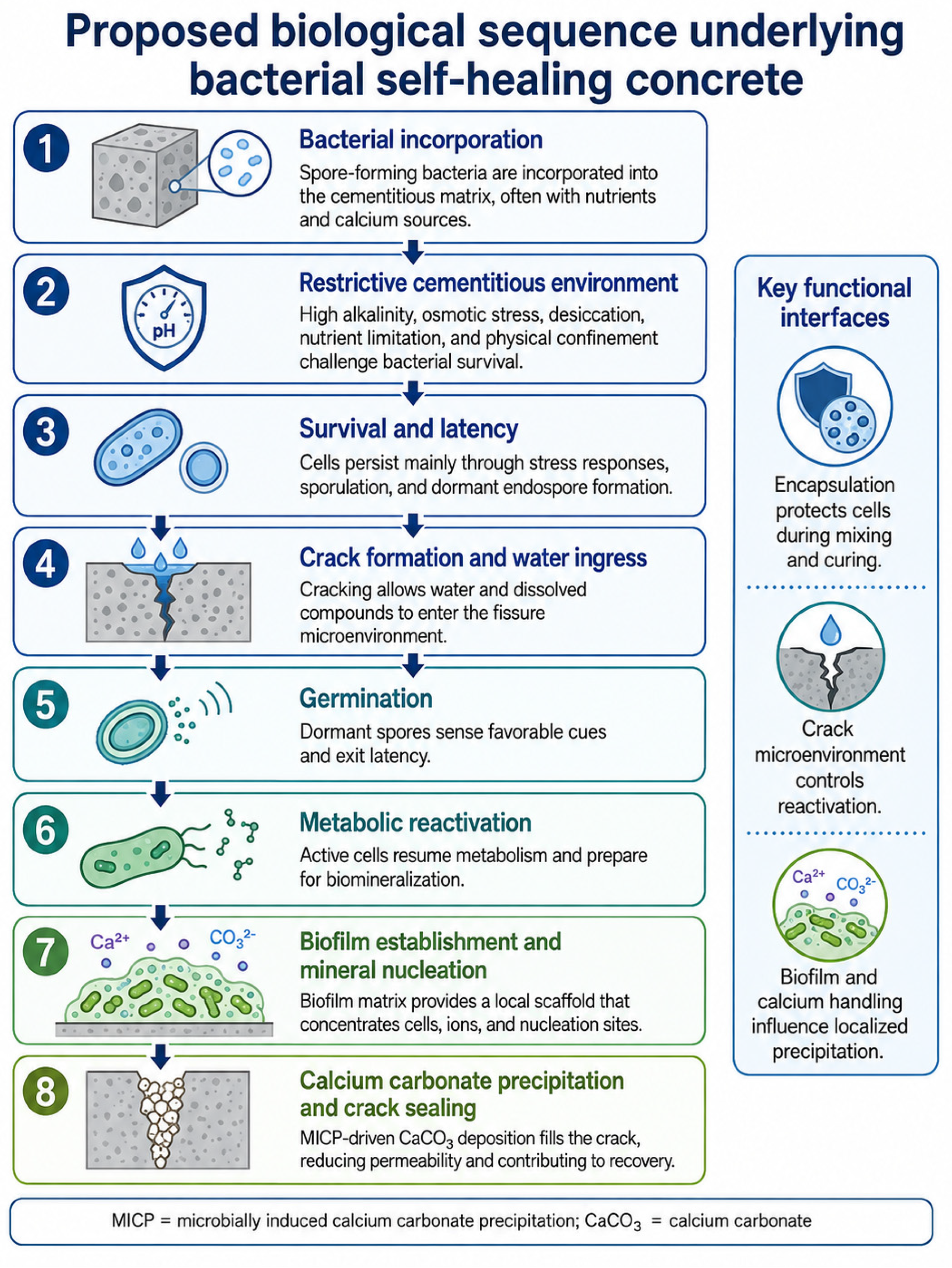
Molecular and Biosafety Perspectives of Bacterial Self-Healing Concrete: From Sporulation and Biomineralization to Public Health Implications
 , ,
, ,
Abstract
1. Introduction
2. Literature Search and Review Approach
2.1. Review Design
2.2. Information Sources and Search Period
2.3. Search Strategy
2.4. Eligibility Criteria
2.5. Study Selection and Evidence Prioritization
2.6. Data Extraction and Thematic Synthesis
2.7. Methodological Limitations
3. Thematic Results of the Literature Synthesis
3.1. Main Thematic Domains Identified in the Literature
3.2. Self-Healing Performance and Limitations in Cementitious Matrices
3.3. Bacterial Survival, Sporulation and Germination Under Concrete-Relevant Stress
3.4. MICP Pathways and Molecular Regulation of Biomineralization
3.5. Biofilms and Encapsulation Systems as Functional Interfaces
3.6. Bacterial Strain Selection: Bacillus, Paenibacillus and Engineered Strains
3.7. Biosafety, Occupational and Environmental Exposure, and Regulatory Considerations

| Life-Cycle Phase | Possible Exposure Route | Main Biosafety Issue | Suggested Monitoring or Mitigation Strategy | Regulatory or Conceptual Reference |
|---|---|---|---|---|
| Strain development and laboratory handling | Laboratory manipulation of viable or engineered microorganisms | Strain identity, genetic stability, containment level | Strain authentication, genome documentation, laboratory risk assessment, contained-use procedures | WHO Laboratory Biosafety Manual; Directive 2009/41/EC [26,27] |
| Concrete formulation and mixing | Aerosols, accidental release, contact with bacterial carriers | Worker exposure and unintended environmental release during preparation | Use of low-risk strains, encapsulation, personal protective equipment (PPE), batch traceability, and contained preparation | WHO risk assessment principles [27] |
| Curing and early material setting | Survival inside alkaline matrix; possible release from surface pores | Persistence of viable cells outside intended matrix | Viability assays, leachate testing, surface sampling | Precautionary risk assessment [24,27] |
| Service life of infrastructure | Water ingress through cracks; runoff after rain or washing | Release or migration of bacteria, spores or DNA fragments | Periodic environmental sampling, qPCR or sequencing-based strain tracking | Cartagena Protocol principles; microbial inoculant monitoring [24,27] |
| Crack formation and self-healing activation | Local bacterial germination and metabolic reactivation | Localized proliferation, HGT in moist microenvironments | Genetic stability testing, monitoring of mobile genetic elements and resistance markers | HGT literature [23,41,42,43,44,45] |
| Interaction with soil or water microbiomes | Runoff, leaching, adjacent soil contact | Alteration of native microbial communities | High-throughput sequencing of soil/water microbiomes before and after deployment | Microbial inoculant safety frameworks [27] |
| Use of additives, nutrients and encapsulants | Chemical leaching or degradation of formulation components | Toxicity, mutation rate changes, HGT modulation | Chemical safety assessment of additives, precursor screening, REACH-based evaluation | REACH; material preservative studies [45,47] |
| Mixing, cutting and demolition (occupational) | Cement dust, respirable crystalline silica, bacterial spores/cells and potentially microbial proteins | Occupational respiratory exposure; sensitization and opportunistic-infection uncertainty | Personal/area air sampling; respirable-silica monitoring; viable spore counts or strain-specific molecular detection; protease activity when relevant; wet methods, local exhaust/dust suppression and appropriate PPE | Occupational silica-control guidance and Directive 2000/54/EC [61,64] |
| Demolition and waste disposal | Dust, fragments, runoff, landfill exposure | Environmental dissemination of viable spores or DNA | Waste classification, dust control, viability testing in debris, disposal protocols | Cartagena Protocol principles; WHO risk assessment [24,27] |
| Life-Cycle Stage | Tier A (Well-Characterized, Non-Engineered) | Tier B (Non-Engineered, Incomplete Characterization) | Tier C (Engineered Strains) | Quantitative Monitoring |
|---|---|---|---|---|
| Preparation and mixing | Identity, viability, batch traceability | Tier A + extended characterization | Tier B + construct stability and specific containment | CFU, strain-specific qPCR; PMA-PCR when viability is required |
| Service life/cracking | Follow-up if release occurs | Periodic persistence monitoring | Construct and genetic-stability monitoring | qPCR/dPCR in runoff, leachate or surface samples |
| Soil and water | Baseline and post-exposure sampling | More frequent follow-up | Strain + construct + potential-recipient tracking | qPCR/dPCR and microbial-community analysis |
| Demolition and waste | Dust control + spore quantification | Tier A + persistence monitoring in waste | Tier B + construct-specific and HGT tracking | Air/dust/debris: culture, qPCR/dPCR; HGT confirmation by isolation/sequencing |
4. Discussion: From Molecular Mechanisms to Responsible Implementation
5. Conclusions and Future Directions
Author Contributions
Funding
Institutional Review Board Statement
Informed Consent Statement
Data Availability Statement
Acknowledgments
Conflicts of Interest
References
- United Nations Environment Programme. Global Status Report for Buildings and Construction 2024/2025: Not Just Another Brick in the Wall; UNEP: Nairobi, Kenya, 2025. [Google Scholar]
- International Energy Agency. Breakthrough Agenda Report 2025: Cement and Concrete; IEA: Paris, France, 2025. [Google Scholar]
- Wong, P.Y.; Mal, J.; Sandak, A.; Luo, L.; Jian, J.; Pradhan, N. Advances in microbial self-healing concrete: A critical review of mechanisms, developments, and future directions. Sci. Total Environ. 2024, 947, 174553. [Google Scholar] [CrossRef] [Scilit]
- Omoregie, A.I.; Wong, C.S.; Rajasekar, A.; Ling, J.H.; Laiche, A.B.; Basri, H.F.; Sivakumar, G.; Ouahbi, T. Bio-based solutions for concrete infrastructure: A review of microbial-induced carbonate precipitation in crack healing. Buildings 2025, 15, 1052. [Google Scholar] [CrossRef] [Scilit]
- Javeed, Y.; Goh, Y.; Mo, K.H.; Yap, S.P.; Leo, B.F. Microbial self-healing in concrete: A comprehensive exploration of bacterial viability, implementation techniques, and mechanical properties. J. Mater. Res. Technol. 2024, 29, 2376–2395. [Google Scholar] [CrossRef] [Scilit]
- Danial, A.W.; Hasan, R.M.M.; Mahmoud, G.A.; Abdel-Basset, R. Assessment of ecofriendly carbon capture using Bacillus subtilis induced calcium carbonate precipitation with focus on applications mechanisms and cost efficiency. Sci. Rep. 2025, 15, 21906. [Google Scholar] [CrossRef] [Scilit]
- Yamasamit, N.; Sangkeaw, P.; Jitchaijaroen, W.; Thongchom, C.; Keawsawasvong, S.; Kamchoom, V. Effect of Bacillus subtilis on mechanical and self-healing properties in mortar with different crack widths and curing conditions. Sci. Rep. 2023, 13, 7844. [Google Scholar] [CrossRef] [Scilit]
- Saito, H.; Kobayashi, H. Bacterial responses to alkaline stress. Sci. Prog. 2003, 86, 271–282. [Google Scholar] [CrossRef] [Scilit]
- Morawska, L.P.; Kuipers, O.P. Antibiotic tolerance in environmentally stressed Bacillus subtilis: Physical barriers and induction of a viable but nonculturable state. Microlife 2022, 3, uqac010. [Google Scholar] [CrossRef] [Scilit]
- Chong, T.N.; Shapiro, L. Bacterial cell differentiation enables population level survival strategies. mBio 2024, 15, e0075824. [Google Scholar] [CrossRef] [Scilit]
- Nagler, K.; Setlow, P.; Reineke, K.; Driks, A.; Moeller, R. Germination of spores of astrobiologically relevant Bacillus species in high-salinity environments. Astrobiology 2016, 16, 500–512. [Google Scholar] [CrossRef] [Scilit]
- Setlow, P. Spore germination. Curr. Opin. Microbiol. 2003, 6, 550–556. [Google Scholar] [CrossRef] [Scilit]
- Barabesi, C.; Galizzi, A.; Mastromei, G.; Rossi, M.; Tamburini, E.; Perito, B. Bacillus subtilis gene cluster involved in calcium carbonate biomineralization. J. Bacteriol. 2007, 189, 228–235. [Google Scholar] [CrossRef] [Scilit]
- Hoffmann, T.D.; Paine, K.; Gebhard, S. Genetic optimisation of bacteria-induced calcite precipitation in Bacillus subtilis. Microb. Cell Fact. 2021, 20, 214. [Google Scholar] [CrossRef] [Scilit]
- Gilmour, K.A.; Ghimire, P.S.; Wright, J.; Haystead, J.; Dade-Robertson, M.; Zhang, M.; James, P. Microbially induced calcium carbonate precipitation through CO2 sequestration via an engineered Bacillus subtilis. Microb. Cell Fact. 2024, 23, 168. [Google Scholar] [CrossRef] [Scilit]
- Oppenheimer-Shaanan, Y.; Sibony-Nevo, O.; Bloom-Ackermann, Z.; Suissa, R.; Steinberg, N.; Kartvelishvily, E.; Brumfeld, V.; Kolodkin-Gal, I. Spatio-temporal assembly of functional mineral scaffolds within microbial biofilms. npj Biofilms Microbiomes 2016, 2, 15031. [Google Scholar] [CrossRef] [Scilit]
- Keren-Paz, A.; Kolodkin-Gal, I. A brick in the wall: Discovering a novel mineral component of the biofilm extracellular matrix. New Biotechnol. 2020, 56, 9–15. [Google Scholar] [CrossRef] [Scilit]
- Kang, S.Y.; Pokhrel, A.; Bratsch, S.; Benson, J.J.; Seo, S.O.; Quin, M.B.; Aksan, A.; Schmidt-Dannert, C. Engineering Bacillus subtilis for the formation of a durable living biocomposite material. Nat. Commun. 2021, 12, 7133. [Google Scholar] [CrossRef] [Scilit]
- Nielsen, S.D.; Koren, K.; Löbmann, K.; Hinge, M.; Scoma, A.; Kjeldsen, K.U.; Røy, H. Constraints on CaCO3 precipitation in superabsorbent polymer by aerobic bacteria. Appl. Microbiol. Biotechnol. 2020, 104, 365–375. [Google Scholar] [CrossRef] [Scilit]
- Srubar, W.V., III. Engineered living materials: Taxonomies and emerging trends. Trends Biotechnol. 2021, 39, 574–583. [Google Scholar] [CrossRef] [Scilit]
- Lu, C.; Huang, Y.; Cui, J.; Wu, J.; Jiang, C.; Gu, X.; Cao, Y.; Yin, S. Toward practical applications of engineered living materials with advanced fabrication techniques. ACS Synth. Biol. 2024, 13, 2295–2312. [Google Scholar] [CrossRef] [Scilit]
- Wang, H.; Li, C.; Wang, Y.; Zhang, H. Bacterial species in engineered living materials: Strategies and future directions. Microb. Biotechnol. 2025, 18, e70164. [Google Scholar] [CrossRef] [Scilit]
- Huang, Q.; Chen, J.; Zhu, J.; Hao, X.; Dao, G.; Chen, W.; Cai, P.; Huang, Q. Divergent bacterial transformation exerted by soil minerals. Sci. Total Environ. 2021, 784, 147173. [Google Scholar] [CrossRef] [Scilit]
- Convention on Biological Diversity. Cartagena Protocol on Biosafety to the Convention on Biological Diversity; Secretariat of the Convention on Biological Diversity: Montreal, QC, Canada, 2000.
- European Parliament and Council. Directive 2001/18/EC on the deliberate release into the environment of genetically modified organisms. Off. J. Eur. Communities 2001, L106, 1–39. [Google Scholar]
- European Parliament and Council. Directive 2009/41/EC on the contained use of genetically modified micro-organisms. Off. J. Eur. Union 2009, L125, 75–97. [Google Scholar]
- World Health Organization. Laboratory Biosafety Manual, 4th ed.; WHO Press: Geneva, Switzerland, 2020. [Google Scholar]
- Baethge, C.; Goldbeck-Wood, S.; Mertens, S. SANRA—A scale for the quality assessment of narrative review articles. Res. Integr. Peer Rev. 2019, 4, 5. [Google Scholar] [CrossRef] [Scilit] [PubMed]
- Page, M.J.; McKenzie, J.E.; Bossuyt, P.M.; Boutron, I.; Hoffmann, T.C.; Mulrow, C.D.; Shamseer, L.; Tetzlaff, J.M.; Akl, E.A.; Brennan, S.E.; et al. The PRISMA 2020 statement: An updated guideline for reporting systematic reviews. BMJ 2021, 372, n71. [Google Scholar] [CrossRef] [Scilit] [PubMed]
- Tricco, A.C.; Lillie, E.; Zarin, W.; O’Brien, K.K.; Colquhoun, H.; Levac, D.; Moher, D.; Peters, M.D.J.; Horsley, T.; Weeks, L.; et al. PRISMA extension for scoping reviews: Checklist and explanation. Ann. Intern. Med. 2018, 169, 467–473. [Google Scholar] [CrossRef] [Scilit] [PubMed]
- Thongchom, C.; Laemthong, T.; Sangkeaw, P.; Yamasamit, N.; Keawsawasvong, S. Evaluation of encapsulated Bacillus subtilis bio-mortars for use under acidic conditions. Sci. Rep. 2024, 14, 25947. [Google Scholar] [CrossRef] [Scilit]
- Gul, S.; Shaheen, N. Influence of Bacillus subtilis-instigated calcite precipitation on damage progression and ionic transport. Materials 2026, 19, 1153. [Google Scholar] [CrossRef] [Scilit]
- Kohlstedt, M.; Sappa, P.K.; Meyer, H.; Maaß, S.; Zaprasis, A.; Hoffmann, T.; Becker, J.; Steil, L.; Hecker, M.; van Dijl, J.M.; et al. Adaptation of Bacillus subtilis carbon core metabolism to simultaneous nutrient limitation and osmotic challenge: A multi-omics perspective. Environ. Microbiol. 2014, 16, 1898–1917. [Google Scholar] [CrossRef] [Scilit]
- Hecker, M.; Völker, U. General stress response of Bacillus subtilis and other bacteria. Adv. Microb. Physiol. 2001, 44, 35–91. [Google Scholar] [CrossRef] [Scilit]
- Paidhungat, M.; Setlow, P. Role of ger proteins in nutrient and nonnutrient triggering of spore germination in Bacillus subtilis. J. Bacteriol. 2000, 182, 2513–2519. [Google Scholar] [CrossRef] [Scilit]
- Hemayati, M.; Nikooee, E.; Habibagahi, G.; Niazi, A.; Afzali, S.F. New non-ureolytic heterotrophic microbial induced carbonate precipitation for suppression of sand dune wind erosion. Sci. Rep. 2023, 13, 5845. [Google Scholar] [CrossRef] [Scilit]
- Harnpicharnchai, P.; Mayteeworakoon, S.; Kitikhun, S.; Chunhametha, S.; Likhitrattanapisal, S.; Eurwilaichitr, L.; Ingsriswang, S. High level of calcium carbonate precipitation achieved by mixed culture containing ureolytic and nonureolytic bacterial strains. Lett. Appl. Microbiol. 2022, 75, 888–898. [Google Scholar] [CrossRef] [Scilit]
- Seidel, M.; Bauer, J.; Geiß, C.; Gebhard, S. Decoding the functional role of the calcium ATPase YloB in microbially induced calcite precipitation and sporulation in Solibacillus silvestris. Microbiology 2026, 172, 001687. [Google Scholar] [CrossRef] [Scilit]
- Nishikawa, M.; Kobayashi, K. Calcium prevents biofilm dispersion in Bacillus subtilis. J. Bacteriol. 2021, 203, e0011421. [Google Scholar] [CrossRef] [Scilit]
- Lin, I.N.; Prince, C.R.; Feaga, H.A. Paenibacillus encodes a membrane-localized Spo0B. J. Bacteriol. 2026, 208, e0036725. [Google Scholar] [CrossRef] [Scilit]
- Danevčič, T.; Dragoš, A.; Spacapan, M.; Stefanic, P.; Dogsa, I.; Mandic-Mulec, I. Surfactin facilitates horizontal gene transfer in Bacillus subtilis. Front. Microbiol. 2021, 12, 657407. [Google Scholar] [CrossRef] [Scilit]
- Stefanic, P.; Belcijan, K.; Kraigher, B.; Kostanjšek, R.; Nesme, J.; Madsen, J.S.; Kovac, J.; Sørensen, S.J.; Vos, M.; Mandic-Mulec, I. Kin discrimination promotes horizontal gene transfer between unrelated strains in Bacillus subtilis. Nat. Commun. 2021, 12, 3457. [Google Scholar] [CrossRef] [Scilit]
- Bourassa, J.S.; Jeannotte, G.; Lebel-Beaucage, S.; Beauregard, P.B. Second-generation transfer mediates efficient propagation of ICEBs1 in biofilms. J. Bacteriol. 2022, 204, e0018122. [Google Scholar] [CrossRef] [Scilit]
- Förster, M.; Rathmann, I.; Yüksel, M.; Power, J.J.; Maier, B. Genome-wide transformation reveals extensive exchange across closely related Bacillus species. Nucleic Acids Res. 2023, 51, 12352–12366. [Google Scholar] [CrossRef] [Scilit]
- Dragoš, A.; Priyadarshini, B.; Hasan, Z.; Strube, M.L.; Kempen, P.J.; Maróti, G.; Kaspar, C.; Bose, B.; Burton, B.M.; Bischofs, I.B.; et al. Pervasive prophage recombination occurs during evolution of spore-forming Bacilli. ISME J. 2021, 15, 1344–1358. [Google Scholar] [CrossRef] [Scilit]
- Dong, L.; Zhang, Z.; Zhu, B.; Li, S.; He, Y.; Lou, Y.; Li, P.; Zheng, H.; Tian, Z.; Ma, X. Research on safety and compliance of imported microbial inoculants using high-throughput sequencing. Front. Med. 2022, 9, 963988. [Google Scholar] [CrossRef] [Scilit]
- European Parliament and Council. Regulation (EC) No 1907/2006 concerning the Registration, Evaluation, Authorisation and Restriction of Chemicals (REACH). Off. J. Eur. Union 2006, L396, 1–849. [Google Scholar]
- Vlamakis, H.; Chai, Y.; Beauregard, P.; Losick, R.; Kolter, R. Sticking together: Building a biofilm the Bacillus subtilis way. Nat. Rev. Microbiol. 2013, 11, 157–168. [Google Scholar] [CrossRef] [Scilit] [PubMed]
- Rivas-Torres, B.R.; Mendoza-Tejada, O.G.; Gamarra-Tuco, R.F.; Ita-Balta, Y.; Farfan-Delgado, F.; Manrique-Sam, C. Effect of Bacillus subtilis and Paenibacillus polymyxa on the Compressive Strength and Self-Healing of Type IP Concrete. Materials 2026, 19, 2277. [Google Scholar] [CrossRef] [Scilit]
- Kearns, D.B.; Chu, F.; Branda, S.S.; Kolter, R.; Losick, R. A master regulator for biofilm formation by Bacillus subtilis. Mol. Microbiol. 2005, 55, 739–749. [Google Scholar] [CrossRef] [Scilit]
- Wang, J.Y.; De Belie, N.; Verstraete, W. Use of silica gel or polyurethane immobilized bacteria for self-healing concrete. Constr. Build. Mater. 2012, 26, 532–540. [Google Scholar] [CrossRef] [Scilit]
- Wiktor, V.; Jonkers, H.M. Quantification of crack-healing in novel bacteria-based self-healing concrete. Cem. Concr. Compos. 2011, 33, 763–770. [Google Scholar] [CrossRef] [Scilit]
- Rawsthorne, H.; Dock, C.N.; Jaykus, L.-A. PCR-based method using propidium monoazide to distinguish viable from nonviable Bacillus subtilis spores. Appl. Environ. Microbiol. 2009, 75, 2936–2943. [Google Scholar] [CrossRef] [Scilit]
- Green Basilisk BV. Material Safety Data Sheet (2018); Green Basilisk BV: Delft, The Netherlands, 2018; Available online: https://basiliskconcrete.com (accessed on 15 August 2026).
- Stahl, M.L.; Ferrari, E. Replacement of the Bacillus subtilis subtilisin structural gene with an in vitro-derived deletion mutation. J. Bacteriol. 1984, 158, 411–418. [Google Scholar] [CrossRef] [Scilit]
- Schweigert, M.K.; Mackenzie, D.P.; Sarlo, K. Occupational asthma and allergy associated with the use of enzymes in the detergent industry—A review of the epidemiology, toxicology and methods of prevention. Clin. Exp. Allergy 2000, 30, 1511–1518. [Google Scholar] [CrossRef] [Scilit]
- Oggioni, M.R.; Pozzi, G.; Valensin, P.E.; Galieni, P.; Bigazzi, C. Recurrent septicemia in an immunocompromised patient due to probiotic strains of Bacillus subtilis. J. Clin. Microbiol. 1998, 36, 325–326. [Google Scholar] [CrossRef] [Scilit]
- Leung, C.C.; Yu, I.T.S.; Chen, W. Silicosis. Lancet 2012, 379, 2008–2018. [Google Scholar] [CrossRef] [Scilit]
- Zhou, X.; Li, R.; Li, J. Lung microbiome: New insights into the pathogenesis of respiratory diseases. Signal Transduct. Target. Ther. 2024, 9, 19. [Google Scholar] [CrossRef] [Scilit]
- Wiktor, V.; Jonkers, H.M. Bacteria-based concrete: From concept to market. Smart Mater. Struct. 2016, 25, 084006. [Google Scholar] [CrossRef] [Scilit]
- European Parliament and Council. Directive 2000/54/EC on the protection of workers from risks related to exposure to biological agents at work. Off. J. Eur. Communities 2000, L262, 21–45. [Google Scholar]
- Green Basilisk BV. Concrete Healing Agent (HA)—Product Data Sheet (2019); Green Basilisk BV: Delft, The Netherlands, 2019; Available online: https://basiliskconcrete.com (accessed on 15 August 2026).
- Choi, S.-K.; Park, S.-Y.; Kim, R.; Kim, S.-B.; Lee, C.-H.; Kim, J.F.; Park, S.-H. Identification of a polymyxin synthetase gene cluster of Paenibacillus polymyxa and heterologous expression of the gene in Bacillus subtilis. J. Bacteriol. 2009, 191, 3350–3358. [Google Scholar] [CrossRef] [Scilit] [PubMed]
- Occupational Safety and Health Administration (OSHA). Respirable Crystalline Silica Standard, 29 CFR 1926.1153; U.S. Department of Labor: Washington, DC, USA, 2016.
- Branda, S.S.; Chu, F.; Kearns, D.B.; Losick, R.; Kolter, R. A major protein component of the Bacillus subtilis biofilm matrix. Mol. Microbiol. 2006, 59, 1229–1238. [Google Scholar] [CrossRef] [Scilit]

| Thematic Domain | Main Evidence Identified | Representative References | Current Limitation | Relevance for Bioconcrete Design |
|---|---|---|---|---|
| Material-level self-healing performance | Bacillus subtilis-based systems can contribute to crack sealing, mechanical recovery and durability-related improvements in mortar or cementitious matrices. | [7,31,32] | Heterogeneous crack widths, curing conditions, formulations and outcome measures limit direct comparison. | Defines the visible endpoint of self-healing: crack closure, permeability reduction and recovery of material performance. |
| Concrete as a restrictive microbial environment | High alkalinity, osmotic stress, desiccation, nutrient limitation and physical confinement can compromise bacterial viability and metabolic activity. | [8,9,33] | Most mechanistic stress studies are not performed directly inside concrete. | Supports the need to evaluate bacterial survival and not only mineral precipitation. |
| Sporulation and germination | Endospore formation enables long-term persistence; germination requires specific molecular triggers and structural remodeling. | [10,11,34,35] | Germination kinetics are rarely tested under real crack microenvironments. | Determines whether dormant spores can reactivate after fissure formation. |
| MICP and molecular biomineralization | Calcium carbonate precipitation involves metabolic pathways, genetic determinants, calcium handling and local physicochemical modulation. | [13,14,15,36,37,38] | MICP is often interpreted chemically, with limited integration of molecular regulation. | Links bacterial metabolism with CaCO3 precipitation efficiency and crack sealing. |
| Biofilms and encapsulation systems | Biofilms may provide mineral nucleation scaffolds; encapsulation protects spores and modulates post-crack access to water, oxygen and nutrients. | [16,17,18,19,39] | Direct evidence inside cementitious cracks remains limited. | Connects microbial physiology with spatially localized biomineralization. |
| Strain selection | Bacillus remains the dominant model; Paenibacillus is promising but less validated in cementitious systems. | [7,13,14,40] | Comparative studies under standardized concrete conditions are scarce. | Guides rational selection based on sporulation, germination, MICP capacity and genetic stability. |
| Biosafety, environmental and occupational exposure | Horizontal gene transfer (HGT), persistence, microbiome interaction and lack of specific regulation require preventive assessment. | [23,24,25,26,27,41,42,43,44,45,46,47] | Few studies evaluate long-term environmental and occupational exposure associated with bacterial self-healing concrete. | Supports traceability, environmental and occupational exposure assessment, monitoring, and risk governance before large-scale implementation. |
| Biological Process | Component or Determinant | Main Function | Organism/Context | Relevance to Bioconcrete | Refs. |
|---|---|---|---|---|---|
| Alkaline stress response | Ionic homeostasis and stress response networks | Preserves membrane function, protein stability and cellular integrity under high pH. | Environmental bacteria; Bacillus spp. | Supports survival in alkaline cementitious matrices. | [8,9,33,34] |
| Sporulation initiation | Spo0A phosphorelay | Integrates stress, nutrient limitation and population signals to initiate sporulation. | Bacillus subtilis | Enables entry into a resistant dormant state before or during concrete service life. | [33] |
| Sporulation regulation | Spo0B localization | Participates in phosphorelay signaling; membrane localization may differ in Paenibacillus. | Paenibacillus spp. | Suggests possible genus-specific sporulation responses under environmental stress. | [40] |
| Germinant recognition | GerA, GerB, GerK receptors | Detects nutrient germinants such as amino acids, nucleosides or related compounds. | Bacillus subtilis spores | Determines whether spores can exit latency after water and nutrients enter cracks. | [34,35] |
| Spore core rehydration | SpoVA proteins | Participates in dipicolinic acid release and early germination events. | Bacillus subtilis spores | Supports transition from dormant spore to metabolically active cell. | [35] |
| Cortex degradation | CwlJ and SleB | Degrades spore cortex peptidoglycan during germination. | Bacillus subtilis spores | Allows spore expansion and vegetative recovery after crack activation. | [35] |
| Biomineralization regulation | Calcium carbonate biomineralization gene cluster | Contributes to biologically regulated CaCO3 precipitation. | Bacillus subtilis | Indicates that MICP is not merely passive chemical precipitation. | [13] |
| Enhanced calcite precipitation | Genetic optimization of MICP-related pathways | Increases bacteria-induced calcite precipitation. | Engineered Bacillus subtilis | Supports strain improvement as a strategy to enhance self-healing efficiency. | [13,14] |
| Calcium transport | YloB calcium ATPase | Participates in calcium handling, calcite precipitation and sporulation. | Solibacillus silvestris | Suggests calcium transport may influence biomineralization efficiency in spore-forming bacilli. | [38] |
| Biofilm establishment | Spo0A; SinI-SinR regulatory system | Regulates the transition toward matrix-producing cells and supports early biofilm development | Bacillus subtilis | May determine whether an organized microbial interface becomes established at the crack surface before mineral nucleation | [48,49] |
| Biofilm matrix formation | Extracellular polysaccharides and TasA | Provides structural organization and cohesion to the bacterial community | Bacillus subtilis biofilms | May promote local cell retention and provide a functional scaffold for subsequent biomineralization | [48,50] |
| Biofilm stability | Calcium-mediated biofilm retention | Prevents biofilm dispersal and stabilizes matrix architecture | Bacillus subtilis biofilms | May favor persistent biomineralizing biofilms at crack interfaces | [39] |
| Mineral nucleation | Biofilm extracellular matrix | Provides scaffold and nucleation sites for mineral deposition. | Bacillus subtilis biofilms | Supports localized CaCO3 precipitation within or near cracks. | [16,17] |
| Encapsulation interface | Water-responsive protective carriers: sodium alginate, polyurethane or porous lightweight reservoirs | Protects spores during mixing and curing while enabling post-crack access to water, oxygen and nutrients | Encapsulated aerobic bacteria | Carrier selection should balance bacterial viability, activation after cracking and mechanical compatibility with the cementitious matrix | [31,51,52] |
| Scheme | Strain | Strain Type | Bacterial Loading/Incorporation | Carrier/Delivery | Crack/Experimental Conditions | Main Outcome | Comparative Limitation |
|---|---|---|---|---|---|---|---|
| Yamasamit et al., 2023 [7] | B. subtilis | Non-engineered | 108 CFU/mL | Direct crack treatment; 2% alginate microencapsulation in parallel bio-mortar | 0.3, 0.5 and 1.0 mm; 7–28 d | 28 d healing ratios: 77.78%, 76.67% and 63.33%, respectively | Surface treatment not directly equivalent to embedded systems |
| Rivas-Torres et al., 2026 [49] | B. subtilis vs. P. polymyxa | Non-engineered | Bacterial solutions; 10%, 15%, 20% water replacement; injection | Bacterial solution | Type IP concrete; 7, 14, 21, 28 d | Up to 335.71 kg/cm2 (+59.9% vs. standard design); P. polymyxa showed higher performance than B. subtilis under several of the evaluated conditions | Variables not equivalent to standardized crack-width/encapsulation protocols |
| Gilmour et al., 2024 [15] | Engineered B. subtilis | Genetically engineered | Recombinant carbonic-anhydrase expression | Not a crack-encapsulated system | MICP/CO2-sequestration; no concrete crack test | CO2 decreased from 3800 to 820 ppm; calcite and vaterite produced | Demonstrates engineered MICP potential but not concrete crack-healing |
Disclaimer/Publisher’s Note: The statements, opinions and data contained in all publications are solely those of the individual author(s) and contributor(s) and not of MDPI and/or the editor(s). MDPI and/or the editor(s) disclaim responsibility for any injury to people or property resulting from any ideas, methods, instructions or products referred to in the content. |
© 2026 by the authors. Licensee MDPI, Basel, Switzerland. This article is an open access article distributed under the terms and conditions of the Creative Commons Attribution (CC BY) license.
Share and Cite
Manrique-Sam, C.; Rivas-Torres, R.; Miranda-Pinto, A.; Sanchez Guillen, J.C.; Apaza-Tosocahua, S.; Farfán-Delgado, F. Molecular and Biosafety Perspectives of Bacterial Self-Healing Concrete: From Sporulation and Biomineralization to Public Health Implications. Materials 2026, 19, 3661. https://doi.org/10.3390/ma19173661
Manrique-Sam C, Rivas-Torres R, Miranda-Pinto A, Sanchez Guillen JC, Apaza-Tosocahua S, Farfán-Delgado F. Molecular and Biosafety Perspectives of Bacterial Self-Healing Concrete: From Sporulation and Biomineralization to Public Health Implications. Materials. 2026; 19(17):3661. https://doi.org/10.3390/ma19173661
Chicago/Turabian StyleManrique-Sam, Cecilia, Ronel Rivas-Torres, Alejandro Miranda-Pinto, Johany Cecilia Sanchez Guillen, Sandra Apaza-Tosocahua, and Fernando Farfán-Delgado. 2026. "Molecular and Biosafety Perspectives of Bacterial Self-Healing Concrete: From Sporulation and Biomineralization to Public Health Implications" Materials 19, no. 17: 3661. https://doi.org/10.3390/ma19173661
APA StyleManrique-Sam, C., Rivas-Torres, R., Miranda-Pinto, A., Sanchez Guillen, J. C., Apaza-Tosocahua, S., & Farfán-Delgado, F. (2026). Molecular and Biosafety Perspectives of Bacterial Self-Healing Concrete: From Sporulation and Biomineralization to Public Health Implications. Materials, 19(17), 3661. https://doi.org/10.3390/ma19173661