Perspective

A Perspective on Mg/Al Laminated Metal Composites

1
National Engineering Research Center for Magnesium Alloy & National Key Laboratory of Advanced Casting Technologies, College of Materials Science and Engineering, Chongqing University, Chongqing 400044, China
2
Mingyue Lake Laboratory, Chongqing 401122, China
3
Lanxi Magnesium Materials Research Institute, Lanxi 321100, China
*
Author to whom correspondence should be addressed.
Materials 2026, 19(15), 3345; https://doi.org/10.3390/ma19153345
Submission received: 30 June 2026 / Revised: 29 July 2026 / Accepted: 3 August 2026 / Published: 6 August 2026

Abstract

Mg/Al laminated metal composites (LMCs) combine the low density of Mg alloys with the good corrosion resistance and formability of Al alloys, showing great application potential in the lightweighting field. However, the difficulty in coordinating deformation between Mg and Al alloys, together with the inevitable formation of brittle Al-Mg intermetallic compounds (IMCs) at the interface when the two metals are directly bonded, severely deteriorates the mechanical properties of Mg/Al LMCs and hinders their transition toward practical engineering applications. This perspective systematically reviews the historical development and primary fabrication routes of Mg/Al LMCs, with a particular focus on the thermodynamics and kinetics of interfacial reactions, the shift from passive IMC suppression to active interfacial-phase design, and the emerging opportunities brought by artificial intelligence. Furthermore, the remaining challenges in process–interface–property correlations, multicomponent interlayer design, database construction for AI-driven design, and closed-loop intelligent manufacturing are identified. The aim is to guide future research through critical insights and perspectives, and to offer valuable references for the development of high-performance lightweight LMCs.

1. Background

As the lightest metal structural materials, magnesium (Mg) alloys have attracted much attention due to their low density, high specific strength [1], good electrical conductivity [2], high thermal conductivity [3] and excellent electromagnetic shielding properties [4]. However, drawbacks such as poor corrosion resistance and low deformability at room temperature severely hinder their further promotion in practical applications. As the most widely used lightweight metal materials to date, aluminum (Al) alloys possess characteristics such as wear resistance, corrosion resistance, and good formability. However, with the rapid development of modern industry, there is an urgent need for even lighter materials to meet the requirements of energy saving and environmental protection. Laminated metal composites (LMCs) combine two materials with complementary advantages, offering a new approach to address the challenge that a single material can hardly meet future application demands [5]. Examples include Al/Mg [6], Al/Cu [7,8], Ti/Steel LMCs [9], and Ti/Ni [10]. Rydz et al. [11]. investigated the plastic forming process of Al1050/AZ31/Al1050 LMCs during rolling, and observed the formation of intermetallic compounds (IMCs) in the bonding zone. Combined with industry data, this study theoretically demonstrated that after using these LMCs for structural components, a significant weight reduction of 60% can be achieved without compromising performance, highlighting its great engineering application value. The Ti/Ni composites produced by explosive welding and rolling achieved ultra-high shear bonding strength, emphasizing the importance of selecting optimal process parameters for difficult-to-deform materials [12]. The Al/Cu LMCs confirmed that slight hardness differences between dissimilar materials can promote uniform plastic deformation across the layers and enhance interfacial bonding strength [13]. Together, these systems indicate that the successful fabrication of LMCs requires the simultaneous control of processing parameters, deformation compatibility of the materials, and the microstructural evolution of the reaction layers.
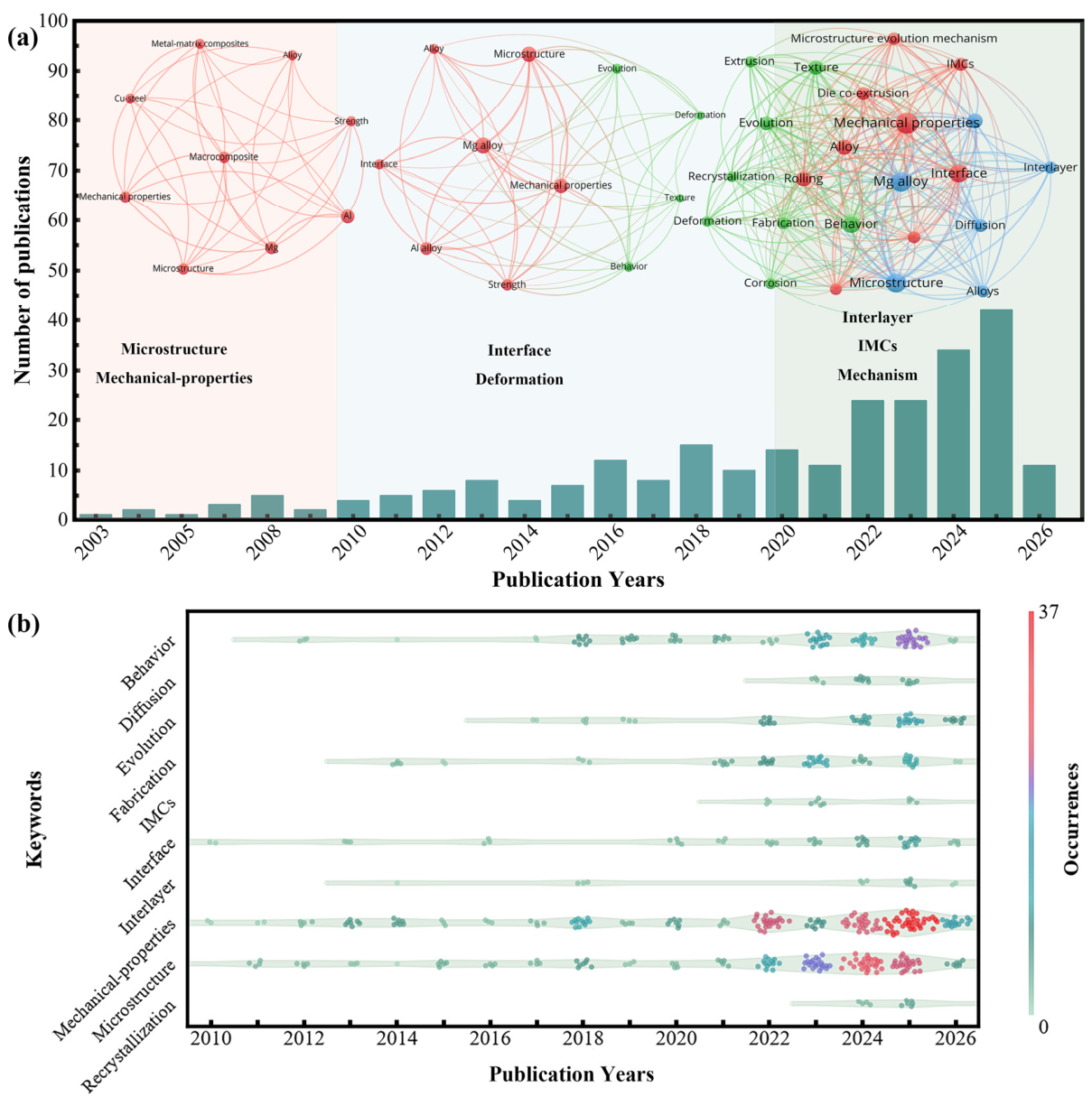
Among these, Mg/Al LMCs integrate the low density and high specific strength of Mg alloys with the corrosion resistance and good formability of Al alloys, showing broad application prospects in aerospace, new energy vehicles, and other fields, and have become a focus of current research [14,15,16]. In 1996, Lesuer et al. [17] made early contributions to the development history, processing, and mechanical behavior of LMCs, during which the focus was primarily on the bonding of steel with other metals. As shown in Figure 1a, after 2000, research on Mg/Al LMCs gradually increased, marking the advent of an important era in the exploration of Mg/Al LMCs. In the early stages, researchers mainly focused on the mechanical properties and microstructure of Mg/Al LMCs. With further research, investigations into bonding strength, deformation behavior, and the interface began to deepen. It was found that IMCs formed at the interface severely degrade the performance of LMCs. Figure 1b presents the frequency of keywords corresponding to publication years. It can be observed that from 2010 to 2019, research on Mg/Al LMCs entered a phase of rapid development, with more processing methods being used to fabricate Mg/Al LMCs. The relationship between fabrication processes, the interface, and interfacial bonding strength gradually gained attention from researchers. In terms of keyword frequency, from 2010 to 2016, research in this field was still predominantly focused on mechanical properties and microstructure. Starting in 2017, the keyword ‘evolution’ newly emerged, while the frequency of the keyword ‘Behavior’ gradually increased, indicating that the field progressively shifted towards mechanistic studies of Mg/Al LMCs.
As shown in Figure 1b, after 2020, the frequencies of the keywords “Evolution,” “Behavior,” “Interface,” and “Fabrication” became more prominent, and an increasing number of preparation methods have been employed to investigate the interface and interfacial evolution behavior of Mg/Al LMCs, which is mainly attributable to advances in processing and microstructural characterization techniques. Compared with previous years, research on the mechanisms governing the performance of Mg/Al LMCs witnessed breakthrough development during this stage. In 2022 and 2023, the new keywords “IMCs” and “Diffusion” emerged, respectively. This is because, with deepening research, the influence of IMCs on the overall performance of LMCs has drawn increasing attention, making it necessary to study the mechanisms of their formation and evolution. The period from 2024 to 2026 has mainly focused on interfacial evolution behavior and the effects of the interlayer on the microstructure and mechanical properties of Mg/Al LMCs.
From the perspective of the different historical stages of Mg/Al LMCs development, this field has gradually evolved from initial studies on microstructure and mechanical properties to in-depth investigations into the mechanisms governing performance, particularly interfacial evolution and control behavior, which is highly beneficial for the research of high-performance lightweight LMCs. Meanwhile, environmental issues arising from conventional energy sources have imposed increasingly stringent requirements on energy conservation and emission reduction. Therefore, replacing traditional materials with lightweight and environmentally friendly materials can yield significant economic benefits while simultaneously saving energy. However, the room-temperature formability of magnesium alloys is extremely limited, and the difficulty in coordinating the deformation between Mg and Al alloys makes the fabrication of Mg/Al LMCs highly challenging. Moreover, the strong chemical affinity between Mg and Al readily induces the nucleation and rapid growth of Mg-Al IMCs, leading to the formation of an IMC layer at the interface, which severely deteriorates the material properties. These issues are insurmountable challenges that must be overcome in the future development of Mg/Al LMCs. This paper provides a comprehensive review of the development history of Mg/Al LMCs since the beginning of the 21st century, and visualizes the research focuses of different periods. Taking the two major challenges facing this field as the main thread, this review links preparation processes, thermodynamics and kinetics of dissimilar metal joining, interface modification, and potential development directions, aiming to provide insights for the development of high-performance LMCs from a unique perspective.

2. Fabrication of Mg/Al LMCs

A variety of processes have been employed to prepare Mg/Al LMCs. Based on the state of the materials before bonding, the bonding process can be classified into solid–solid bonding, solid–liquid bonding, and liquid–liquid bonding, among which the first two are the most widely used. Solid–solid bonding primarily relies on atomic diffusion, mechanical interlocking, and metallurgical bonding. Rolling, as a typical representative of solid–solid bonding, enables large-area bonding of Mg and Al alloys and is considered the most cost-effective method. Liu et al. [18] provided a comprehensive review on the preparation of Mg/Al LMCs by rolling. They pointed out that the rolling bonding process mainly involves matrix deformation and the formation of an interfacial reaction layer, with the latter having a decisive influence on the bonding strength of Mg/Al LMCs. In particular, when the thickness of the diffusion layer exceeds 5 μm, the bonding strength decreases sharply. Solid–liquid bonding primarily involves metallurgical bonding and diffusion bonding. Compound casting [19] typically involves pouring molten Mg alloy onto the surface of solid Al alloy to achieve bonding. Compared to other processes, this method allows the fabrication of components with complex structures. Welding can partially melt the metals, resulting in strong bonding at the interface, and also allows the addition of nanoparticles to form particle reinforcement at the interface, thereby enhancing bonding strength [20]. Explosive welding, as a representative technique, has been employed in research on Ti/Al [21], Ti/Ni [12], and other material systems. It forms a metallurgical bond through high velocity oblique collision, and the plastic flow and jetting effect disrupt surface oxides and create a wavy interface, making it suitable for joining metals with significantly different physical properties [22,23]. However, the interfacial jetting and localized melting can lead to the formation of IMCs in rapidly solidified zones, and subsequent hot rolling or heat treatment may accelerate their growth [24,25]. Therefore, it is essential to jointly optimize the welding parameters and the subsequent thermomechanical and heat treatment processes to control the interfacial morphology and mechanical properties. However, the solid–liquid bonding process is extremely difficult to control, and an excessively thick reaction layer can easily form at the interface, which represents the biggest obstacle to the widespread adoption of this process.
Although significant progress has been made in the research on the preparation processes of Mg/Al LMCs, the process parameters remain difficult to determine. In particular, large deformation processes subject Mg/Al LMCs to complex stresses during forming, which can affect surface quality or cause internal microcracks. Therefore, the optimal processing conditions are mostly determined through trial and error, and there is still a lack of practical methods to guide the forming process. More importantly, current research is still confined to small-scale laboratory samples. However, a recent study on the preparation of Al/Mg/Al LMCs via online heating rolling has achieved a breakthrough in terms of sample size, which is of great significance for promoting the transition of Mg/Al LMCs toward practical industrial applications.

3. Interfacial Thermodynamics and Kinetics in Dissimilar Metal Joining

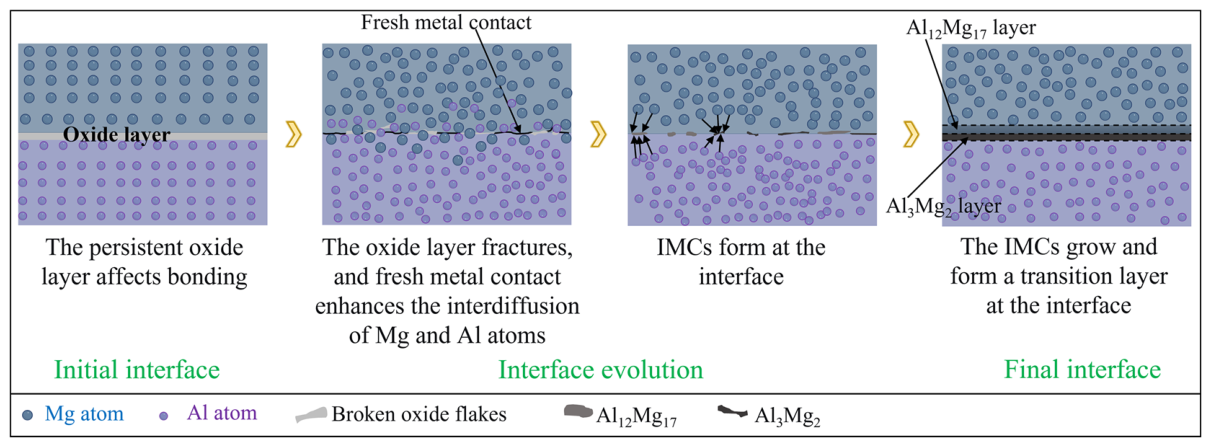
Due to the significant differences in physical and chemical properties, the bonding process between dissimilar metals typically results in the formation of an interfacial transition zone with a certain width. Importantly, the interface serves as a bridge for transferring external loads from one material to the other, and thus plays a critical role in determining the overall performance of the material. The formation of the interface is closely related to the mutual diffusion of atoms and the evolution of IMCs, as shown in Figure 2.
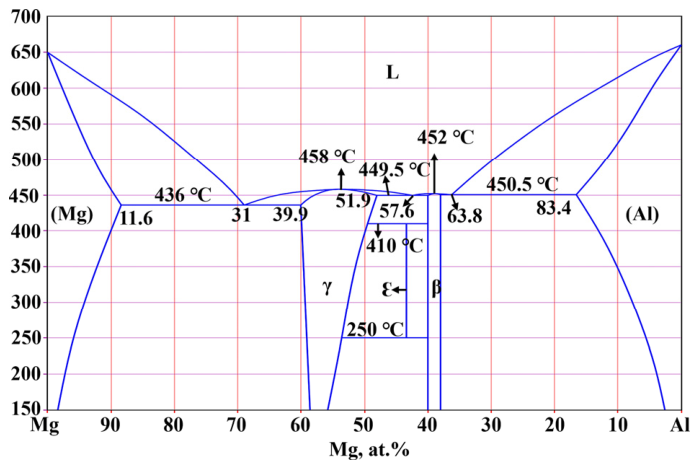
According to the Mg-Al binary phase diagram (Figure 3), when Mg and Al are directly bonded, the γ (Mg17Al12) phase tends to form on the Mg-rich side, while the β (Mg2Al3) phase forms on the Al-rich side. In addition, variations in heat input caused by the preparation process and subsequent heat treatment can also lead to the formation of the non-equilibrium ε (Mg23Al30) phase [26,27]. The formation of IMCs is closely related to the rupture of the oxide film and atomic diffusion, and is governed by the combined constraints of thermodynamics and diffusion kinetics. The rupture of the oxide film on the metal surface exposes the fresh metal, and the sustained heat input intensifies atomic vibrations and promotes interdiffusion, which further leads to the formation of IMCs. Under the combined influence of thermodynamics and kinetics, different IMCs undergo nucleation and growth, gradually forming a continuous transition layer. During solid-state joining, the nucleation of IMCs relies primarily on atomic interdiffusion, whereas during solid–liquid joining, in addition to interdiffusion, the process also involves a stage of solidification nucleation. The growth of IMCs follows a parabolic law with respect to temperature and time, and increase in heat input leads to a thicker layer of IMCs, and the common IMCs at the Mg/Al interface include Al3Mg2 and Al12Mg17. At phase equilibrium, since the Gibbs free energy of Al3Mg2 is always higher than that of Al12Mg17, and solute atoms in the Mg matrix have a higher diffusion coefficient, Al12Mg17 preferentially forms [28,29]. However, during the growth stage, Al3Mg2 exhibits a much faster growth rate than Al12Mg17 because Al3Mg2 has a significantly higher diffusion coefficient at this stage [30]. Since both the Gibbs free energy and enthalpy of formation of the Al-Mg binary system are negative, the formation of Al-Mg IMCs will proceed spontaneously once certain conditions are met. This is the primary reason why the presence of IMCs at the interface is difficult to avoid. However, the differences in thermodynamic energy also offer researchers the possibility of controlling the types of interfacial IMCs. Gao et al. [31] investigated the joining of Mg-Li alloy to Al alloy. Thermodynamic calculations revealed that, owing to the competition between Mg and Li atoms arising from the chemical potential gradient, the types of IMCs formed at the interface transformed into Al12Mg17 and the ternary phase Al2MgLi. However, whether similar findings are applicable to other alloy systems remains to be further investigated. In-depth studies in this direction will open up new avenues for improving the types of interfacial products from the perspective of thermodynamics. Additionally, previous studies have focused on passively suppressing the formation of brittle IMCs. Currently, researchers have attempted to inhibit or prevent the formation of Al-Mg IMCs by adding interlayers, and have achieved promising results. Depending on the state of the materials prior to forming, interlayers can be classified into metallic interlayers and non-metallic interlayers. Metallic interlayers include pure metal interlayers (e.g., Cu foil, Zn foil, Ti foil, Ni foil), alloy interlayers, and multilayer interlayers combining different metals. However, few studies have conducted in-depth investigations into the nucleation and growth of IMCs at the interface, especially regarding the nucleation stage, making it difficult to provide practical guidance for the preparation of Mg/Al LMCs. Therefore, enhancing the understanding of the thermodynamic and growth kinetic mechanisms of IMC formation at the interface is conducive to actively introducing IMCs that are beneficial for enhancing interfacial bonding strength by modifying the composition of the added interlayer.
It is worth noting that the presence of IMCs is not entirely detrimental. Thin and discontinuous IMCs can impede crack propagation and thus be beneficial to the performance of Mg/Al LMCs [33]. Recent studies have pointed out that although Al/Mg/Al LMCs can still achieve relatively high bonding strength even with the presence of an Al-Mg IMCs layer at the interface, this may be attributed to the enhanced metallurgical bonding provided by IMCs with a thickness below 1 μm. However, the main reason for the decrease in bonding strength is considered to be the incompatible deformation between the Mg alloy and the Al alloy [6]. Unfortunately, once IMCs nucleate, they rapidly grow and thicken with the input of external energy, forming a continuous transition layer. An excessively thick IMC transition layer severely degrades material properties. Under external loading, these IMCs generate strong stress concentrations, leading to crack initiation, and subsequently accelerate crack propagation, hastening material failure [34].
The fabrication process and subsequent heat treatment are the main sources of heat input during interfacial evolution. However, systematic studies on the intrinsic relationship and mechanisms between processing parameters and interfacial evolution are still lacking. The formation of the interfacial transition layer generally involves IMCs nucleation and growth. Since the preparation of Mg/Al LMCs often requires sufficient heat to make the Mg layer deformable, IMCs easily undergo rapid growth once nucleated. Therefore, understanding the IMCs formation and evolution mechanisms and intervening in time to curb excessive growth are of great significance. These will help precisely control the interfacial structure and advance the development of Mg/Al LMCs.

4. IMCs from Suppression to Design

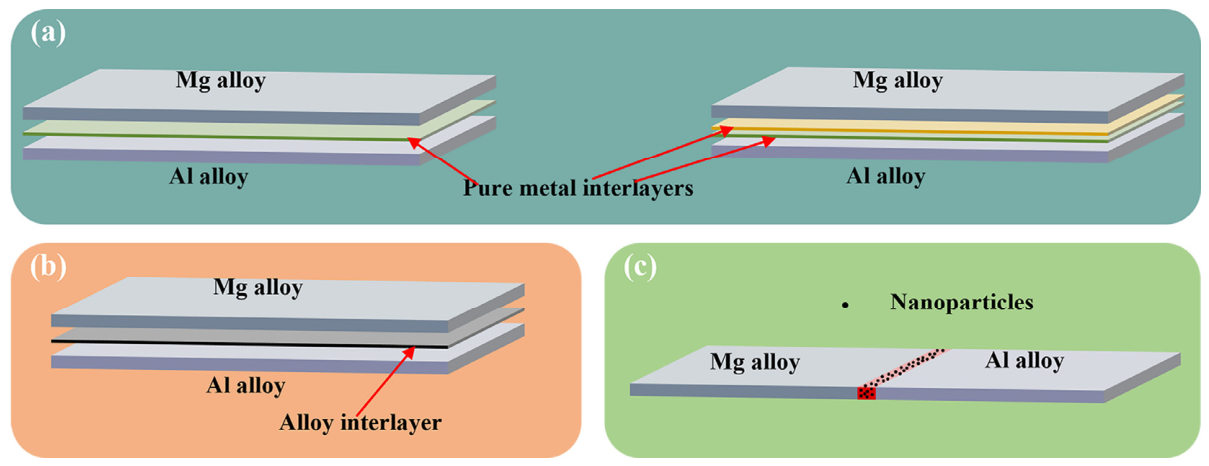
Adding an interlayer can effectively regulate the interfacial IMCs, and the essence of its modification effect is to physically isolate the direct contact between Mg and Al alloys, thereby altering the type of interfacial reaction. Figure 4a–c shows a schematic diagram of Mg/Al LMCs fabricated with different interlayers. Most current studies focus on the addition of pure metal interlayers and the introduction of nanoparticles to increase joint strength. Compared with pure metal interlayers, the introduction of alloy interlayers involves the diffusion and bonding of multiple atoms. This makes the interfacial reaction process more complex. Therefore, fewer studies have been conducted on alloy interlayer addition. However, this also provides researchers with an opportunity to rationally design the IMCs at the interface. In addition, the types of IMCs formed are still constrained by the kind of interlayer added. For example, the addition of a pure Zn interlayer typically leads to the formation of MgZn2 and Al-Mg-Zn ternary IMCs [35,36], while a pure Ni interlayer leads to the formation of Al3Ni2, Mg2Ni and Mg3AlNi2 [37,38]. Studies have shown that even with the same interlayer material, different interlayer states and preparation processes can result in different IMC species. When pure Cu was used as a filler material to prepare Mg/Al LMCs via cold metal transfer welding [39], the main IMCs at the interface were AlCu, Al2Cu, Al4Cu9, and Cu2Mg. In another study, after cold spraying Cu powder onto the surface of a Mg alloy, Mg/Cu/Al LMCs were prepared by single pass hot rolling [40], and the main IMCs at the interface were AlCu, Al4Cu9, AlCuMg, and Al5Cu6Mg2.
It can also be observed that when a single interlayer is used for interfacial regulation, compounds related to that interlayer typically form at the interface. Although this approach can effectively suppress the formation of Al-Mg IMCs, it still has significant limitations. In addition, ultrasonic-assisted rolling of Mg/Cu/Al LMCs with varying ultrasonic amplitudes can lower the Gibbs free energy of the Mg-Al solid solution below that of Al3Mg2 IMCs, thermodynamically demonstrating the feasibility of suppressing the Mg-Al phase transformation solely through process modification [41]. Compared with suppressing Al-Mg IMCs using a single interlayer or process changes alone, a composite interlayer can simultaneously enhance bonding strength. Recently, a novel FeCoNiCrCu/Ni composite interlayer was used to prepare Mg/Al bimetals [42]. At the interface, the originally brittle IMC transition layer was transformed into a continuous AlxFeCoNiCrCu body-centered cubic structure layer, a residual high entropy alloy layer, and a solid solution layer containing a Mg2Ni eutectic structure on the Mg side. This multicomponent diffusion layer increased the shear strength of the Mg/Al bimetals by 132.05%, reaching 73.63 MPa. Therefore, future research on interface strengthening of Mg/Al LMCs can focus on designing suitable interlayers according to the service environment of the material to introduce novel diffusion layers, rather than merely suppressing the formation of brittle IMCs. Of course, whether the formation of a new diffusion layer introduces other adverse factors to the bonding interface must be considered at the initial design stage.

5. AI for Mg/Al LMCs

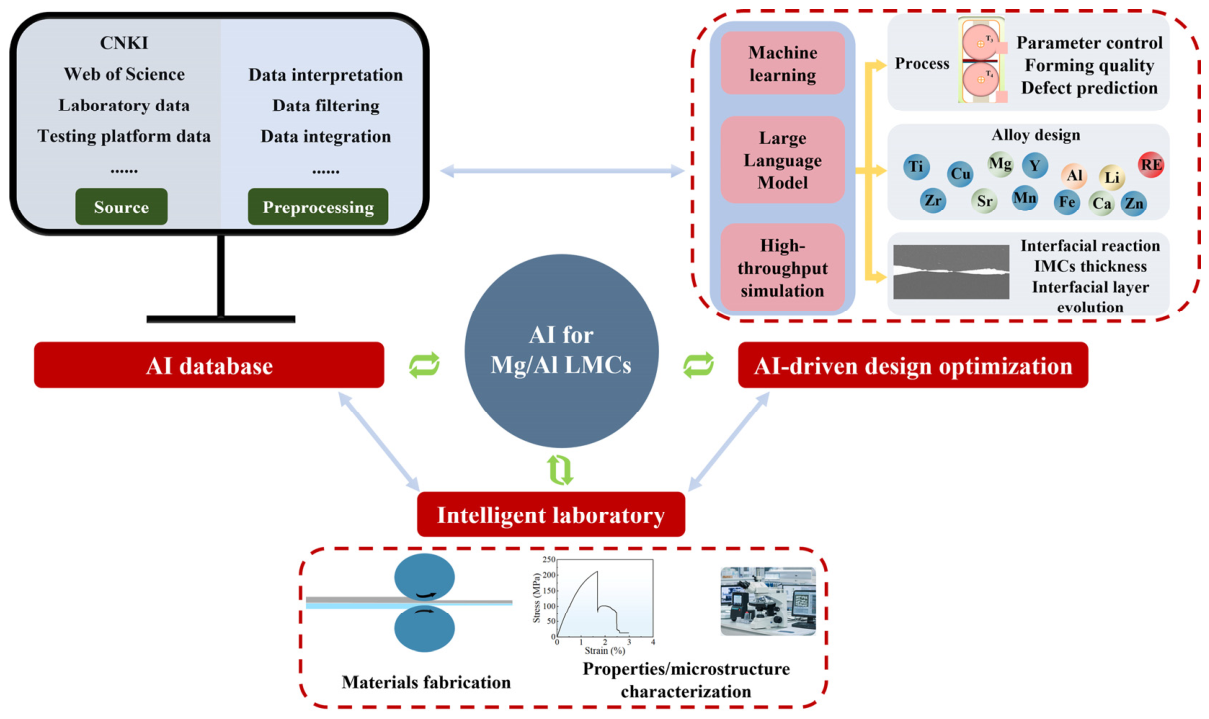
Looking back at the development of scientific research, it can be found that materials research has undergone a transition from early experimental trial-and-error to theoretical guidance and computational simulation. This transition has greatly promoted the development of new high-performance materials. However, a large number of research approaches cannot be carried out one by one. This has become a major obstacle to materials development. With the rapid advancement of artificial intelligence (AI), data-driven machine learning (ML) based on big data has emerged as a powerful method for accelerating the design of high-performance materials. It has already been applied to Mg alloy design [43,44,45,46]. This indicates that AI-assisted materials design and development is no longer a conceptual idea. Some researchers have made preliminary attempts to use ML to guide the fabrication of Mg/Al LMCs. Anne et al. [47] employed decision trees and a multimodal perception model in ML to interpret the effects of process parameters on the mechanical properties of Mg/Al LMCs coated with Ce powder. Zhai et al. [48] used a ML model to quantitatively map the process performance relationship for Mg/Al LMCs fabricated by friction stir welding. The results showed that appropriately reducing the rotational speed and increasing the welding speed within the processing window can effectively enhance the bonding strength of the welded joint. However, the mere application of ML is far from sufficient to demonstrate the full potential of AI-assisted materials design and development. The application of AI in the materials field should form a closed-loop system. This system includes data integration, AI-driven design and optimization, and autonomous verification by intelligent laboratories (IL). The verified data are then fed back into AI design. This process is illustrated in Figure 5.
At present, data scarcity remains the main bottleneck limiting the application of AI in advancing materials design [49]. Research on using AI to design self-improving closed-loop systems for autonomous manufacturing is becoming an urgent issue. This research also aims to accelerate the transition toward intelligent, data-driven production. In addition, in current research, Mg/Al LMCs are mostly fabricated using AZ series Mg alloy. It is well known that alloy composition has a significant impact on formability, and altering the chemical composition of Mg alloys can enhance their forming performance. For example, a Mg-4Li (wt.%) alloy exhibits no cracks on the surface even after 86% thickness reduction by cold rolling at room temperature [50], and a Mg-2Zn-0.8Gd (wt.%) alloy shows no edge cracks at a single-pass cold rolling reduction of 35% [51]. Therefore, the application of AI in Mg/Al LMCs has direct roles in designing process parameters and regulating the interface. In addition, AI can autonomously design Mg alloys with high strength and high formability. This further enhances the overall performance of the LMCs. It also greatly reduces the cost of experimental trial and error while improving work efficiency. In summary, with the advancement of science and technology, AI brings both challenges and opportunities for promoting the development of high-performance Mg/Al LMCs.

6. Conclusions

Mg/Al LMCs provide an effective route to combine the low density and high specific strength of Mg alloys with the corrosion resistance and formability of Al alloys. Studies have shown that their performance depends not only on the selected fabrication method, but more fundamentally on the deformation compatibility between dissimilar materials and the coupled evolution of interfacial reaction products. The formation and growth of interfacial reaction products are closely related to the fabrication process. Thin and discontinuous reaction layers can form metallurgical bonds, whereas thick and continuous interfacial reaction products tend to cause severe stress concentration and cracking tendencies, accelerating material failure. Therefore, the development of Mg/Al LMCs is shifting from empirically suppressing IMCs to actively designing interfacial-phase combinations and structures. Multicomponent or composite interlayers offer greater freedom in controlling diffusion paths and designing interfacial phases, but their long-term stability and potential adverse reactions must be evaluated under practical conditions.
Future research on Mg/Al LMCs can focus on the following priorities:
(1)
Establishing quantitative process temperature time phase property diagrams.
(2)
Combining phase diagram calculations and thermal diffusion models with in situ and multiscale characterization to investigate the nucleation process of early IMCs and the subsequent growth mechanisms of IMCs.
(3)
Designing interlayers under explicit processing, thermal input, and manufacturability constraints.
(4)
Fabricating and validating the performance of large-scale Mg/Al LMCs beyond laboratory-scale small-sample studies, which is expected to promote the transition of Mg/Al LMCs from experimental design to future engineering applications.
(5)
Establishing standardized and traceable datasets for AI-driven design to shorten the research cycle for high-performance materials, and building intelligent experimental platforms to achieve a closed loop from AI design to validation.

Author Contributions

B.L.: Data curation, formal analysis, investigation, visualization, writing—original draft, writing—review and editing. J.T.: Conceptualization, funding acquisition, supervision, writing—review and editing. All authors have read and agreed to the published version of the manuscript.

Funding

This work was supported by Yunnan Key Research and Development Program of China (202503AA080029), the Yunnan Green Aluminum Innovation Center for Technology of China (202405AK340008), the Sichuan Science and Technology Program of China (2025ZNSFSC0388), and Advanced Materials-National Science and Technology Major Project (2025ZD0619700).

Data Availability Statement

The original contributions presented in this study are included in the article. Further inquiries can be directed to the corresponding author.

Conflicts of Interest

The authors declare no conflict of interest.

References

  1. Yuan, Y.; Chen, X.; Xiong, X.; Li, K.; Tan, J.; Yang, Y.; Peng, X.; Chen, X.; Chen, D.; Pan, F. Research advances of magnesium and magnesium alloys globally in 2024. J. Magnes. Alloys 2025, 13, 4689–4732. [Google Scholar] [CrossRef]
  2. Yuan, Q.; Li, B.; Tan, J.; Peng, X.; Lv, H.; Wu, G.; Yu, P.; Chen, X.; Pan, F. Review of electrical conductivity in magnesium alloys: Mechanisms, strategies and applications. J. Magnes. Alloys 2025, 13, 4064–4088. [Google Scholar] [CrossRef]
  3. Lv, H.; Tan, J.; Yuan, Q.; Wang, F.; Zhou, Y.; Dong, Q.; Tang, A.; Eckert, J.; Jiang, B.; Pan, F. Recent advancements in thermal conductivity of magnesium alloys. J. Magnes. Alloys 2024, 12, 1687–1708. [Google Scholar] [CrossRef]
  4. Liu, L.; Chen, X.; Pan, F. A review on electromagnetic shielding magnesium alloys. J. Magnes. Alloys 2021, 9, 1906–1921. [Google Scholar] [CrossRef]
  5. Lei, Y.; Zhan, M.; Xin, H.; Zhao, P.; Wang, Y.; Tuo, L.; Zheng, Z. Plastic deformation and microstructural evolution in rolled Mg/Al laminated composites during tension: Roles of slip, twinning, and interface effects. Mater. Sci. Eng. A 2026, 949, 149424. [Google Scholar] [CrossRef]
  6. Wang, F.; Li, B.; Tan, J.; Tan, X.; Ma, J.; She, J.; Tang, A. Non-monotonic interfacial bonding in Mg/Al laminated composites: Roles of deformation compatibility and reaction-layer integrity. J. Alloys Compd. 2026, 1070, 188665. [Google Scholar] [CrossRef]
  7. Ran, M.; Bian, G.; Zhang, H.; Yan, J.; Wang, W. Electropulsing-enhanced atomic diffusion and recrystallization to optimize mechanical properties of Al/Cu laminated metal composites. J. Manuf. Processes 2024, 119, 224–234. [Google Scholar] [CrossRef]
  8. Rydz, D.; Stradomski, G.; Szarek, A.; Kubik, K.; Kordas, P. The Analysis of Pressed Cups Producing Possibilities from Rolled Bimetallic Al-1050 + Cu-M1E Sheets. Materials 2020, 13, 2413. [Google Scholar] [CrossRef] [PubMed]
  9. Mou, G.; Sheng, H.; Zheng, K.; Xiang, H.; Ren, W.; Ding, Y. Dual-interfacial alloying mechanism in Ti-steel laminated metal composite fabricated by wire-arc directed energy deposition using a Cu-Ni interlayer. J. Alloys Compd. 2025, 1010, 177396. [Google Scholar] [CrossRef]
  10. Zhao, J.; Zhang, B.; Zhao, T.; Zhang, Z.; Lei, Z.; Wang, Z.; Zhang, Z.; Zhan, S.; Dang, L.; Wang, K. Effects of stacking sequence of the layers on deformation behavior and microstructure evolution of Ti/Ni laminated metal composites. J. Mater. Res. Technol. 2025, 34, 2298–2313. [Google Scholar] [CrossRef]
  11. Rydz, D.; Stradomski, G.; Pałęga, M.; Salwin, M.; Opydo, M.; Szarek, A.; Fik, J.; Chmielewski, T. Analysis of Plastic Forming During Rolling of Al1050-AZ31-Al1050 Layered Composites for Transport Purposes. Adv. Sci. Technol. Res. J. 2024, 18, 234–244. [Google Scholar] [CrossRef] [PubMed]
  12. Rydz, D.; Mróz, S.; Szota, P.; Stradomski, G.; Garstka, T.; Dyl, T.C. The Analysis of Plastic Forming in the Rolling Process of Difficult-to-Deform Ti + Ni Layered Composites. Materials 2025, 18, 1926. [Google Scholar] [CrossRef] [PubMed]
  13. Ou, L.; Xiao, Y.-j.; Fan, C.-h.; Liu, J.-w.; Ma, W.-d. 6061 Al/Cu layered composites with high strength and well interfacial bonding prepared by accumulative roll bonding. Trans. Nonferrous Met. Soc. China 2026, 36, 1039–1054. [Google Scholar] [CrossRef]
  14. Lv, X.; Xia, P.; Bai, H.; Cao, M.; Xie, K.; Yan, H. The effect of hot rolling temperature on the interface characteristics and properties of Al/Mg/Al composite plates. J. Alloys Compd. 2026, 1053, 186184. [Google Scholar] [CrossRef]
  15. Peng, P.; Jiang, S.; Jia, Y.; Han, C.; Kang, L.; Zhang, J.; Li, Y.; Lu, Z. In-situ study of deformation and failure mechanics of Mg/Al laminates. J. Magnes. Alloys 2026, 16, 101986. [Google Scholar] [CrossRef]
  16. Qian, L.; Chen, L.; Que, B.; Shen, K.; Zhao, G.; Zhang, C. Nanoscale analysis of interfacial structure and its effects on mechanical properties of Mg/Al laminate reinforced by TiB2 particles. J. Magnes. Alloys 2025, 13, 1310–1324. [Google Scholar] [CrossRef]
  17. Lesuer, D.R.; Syn, C.K.; Sherby, O.D.; Wadsworth, J.; Lewandowski, J.J.; Hunt, W.H. Mechanical behaviour of laminated metal composites. Int. Mater. Rev. 2013, 41, 169–197. [Google Scholar] [CrossRef]
  18. Liu, T.; Song, B.; Huang, G.; Jiang, X.; Guo, S.; Zheng, K.; Pan, F. Preparation, structure and properties of Mg/Al laminated metal composites fabricated by roll-bonding, a review. J. Magnes. Alloys 2022, 10, 2062–2093. [Google Scholar] [CrossRef]
  19. Li, Q.; Jiang, W.; Xu, Y.; Yu, L.; Guo, T.; Liu, K.; Fan, Z. The synergistic influence of cerium addition and ultrasonic vibration on the interfacial microstructures, mechanical properties and fracture behaviors of Al/Mg bimetals by compound casting. J. Alloys Compd. 2025, 1039, 183411. [Google Scholar] [CrossRef]
  20. Bagheri Vanani, B.; Abdollahzadeh, A. Fabrication of reinforced Al–Mg composite by TiC particles via FSW: Microstructure and tribology study. J. Mater. Res. Technol. 2024, 30, 6787–6801. [Google Scholar] [CrossRef]
  21. Bai, L.; Shao, F.; Xie, X.; Gao, L.; He, L.; Zhang, Y.; Hu, Q. Study on Weld Microstructure and Interface of Explosive Composite Titanium/Aluminum Composite Plate Based on Composite Welding. J. Mater. Eng. Perform. 2026, 35, 8240–8250. [Google Scholar] [CrossRef]
  22. Tian, Q.; Liu, Y.; Liang, L.; Chen, S.; Zhou, J.; Luo, N.; Fu, S.; Hu, Y.; Shi, Y.; Wu, J.; et al. High-throughput explosive welding of multimetallic coatings on Mg–Li alloys: Interfacial mechanisms and performance insights. J. Mater. Res. Technol. 2026, 41, 388–399. [Google Scholar] [CrossRef]
  23. Liang, H.; Chen, J.; Luo, N.; Zhou, J.; Liu, Z.; Zhou, X.; Bai, Y.; Lin, Y. Interfacial microstructure and dynamic compressive behavior of explosively welded TA2/AZ31B/7075Al multilayer composites. J. Mater. Res. Technol. 2026, 43, 2706–2718. [Google Scholar] [CrossRef]
  24. Mihara-Narita, M.; Bian, M.; Sato, H.; Watanabe, Y.; Chino, Y. Effects of post-welded hot rolling on the properties of explosively welded Mg alloy/Al alloy cladding plates. J. Mater. Res. Technol. 2025, 37, 4457–4465. [Google Scholar] [CrossRef]
  25. Puchlerska, S.; Paul, H.; Tokarski, T.; Prażmowski, M.; Fatemi, S.M.; Chulist, R.; Petrzak, P. Phase Constitution Near the Interfaces of Multilayer AA1050/AZ31 Composite During Explosive Welding and Post-processing Annealing. Metall. Mater. Trans. A 2026, 57, 149–174. [Google Scholar] [CrossRef]
  26. Fronczek, D.M.; Chulist, R.; Litynska-Dobrzynska, L.; Kac, S.; Schell, N.; Kania, Z.; Szulc, Z.; Wojewoda-Budka, J. Microstructure and kinetics of intermetallic phase growth of three-layered A1050/AZ31/A1050 clads prepared by explosive welding combined with subsequent annealing. Mater. Des. 2017, 130, 120–130. [Google Scholar] [CrossRef]
  27. Wang, C. Microstructure and Mechanical Property of Al 7075/Mg EW75 Composite Prepared by Asymmetric Co-extrusion with Symmetric Die. Metall. Mater. Trans. B 2024, 55, 2948–2959. [Google Scholar] [CrossRef]
  28. Chen, Z.; Shi, L.; Su, H.; Wu, C. Numerical and experimental investigation on intermetallic compounds formation in ultrasonic vibration enhanced friction stir welding of dissimilar Al/Mg alloys. J. Alloys Compd. 2024, 977, 173426. [Google Scholar] [CrossRef]
  29. Zhao, F.; Gao, J.; Wu, C.; Shi, L. Elucidating the morphology difference of intermetallic compounds in Mg-to-Al weld nugget zone via multiphase-field simulation. J. Magnes. Alloys, 2026; in press. [CrossRef]
  30. Zhao, F.; Shi, L.; Gao, J.; Wu, C. Multiphase-field analysis of the intermetallic compounds formation & evolution in friction stir welding of dissimilar Al/Mg alloys. J. Mater. Res. Technol. 2024, 32, 1206–1222. [Google Scholar] [CrossRef]
  31. Gao, Y.; Zuo, Y.; Liu, H.; Huang, Y.; Li, X. Interface evolution and mechanical properties in lightweight Mg–Li/Al dissimilar joints via dynamic support friction stir lap welding. J. Mater. Res. Technol. 2026, 42, 813–828. [Google Scholar] [CrossRef]
  32. Li, B.; Wang, F.; Tan, J.; Lin, Y.; Lv, H.; Tang, A.; Chen, X.; Eckert, J. Advances in Mg/Al laminated metal composites via introducing interlayers: Mechanisms, strategies, and prospects. J. Magnes. Alloys, 2026; in press. [CrossRef]
  33. Yang, F.; Zhao, J.; Zhao, B.; Zhang, J.; Han, L.; Ma, H. Effect of metallic interlayer and ultrasonic vibration on intermetallic compounds in friction stir lap welding of dissimilar Al/Mg alloys. Mater. Charact. 2026, 238, 116573. [Google Scholar] [CrossRef]
  34. Tang, X.; Peng, Q.; Long, J.; Wang, X.; Lin, Y.; Deng, L.; Jin, J.; Gong, P.; Zhang, M.; Lee, M.-G. Recent progress on plastic forming of laminated metal composites: Processes, heterogeneous deformation, and interfacial regulation. J. Mater. Sci. Technol. 2025, 229, 67–91. [Google Scholar] [CrossRef]
  35. Ji, S.; Niu, S.; Liu, J.; Meng, X. Friction stir lap welding of Al to Mg assisted by ultrasound and a Zn interlayer. J. Mater. Process. Technol. 2019, 267, 141–151. [Google Scholar] [CrossRef]
  36. Zhang, Y.; Luo, Z.; Li, Y.; Liu, Z.; Huang, Z. Microstructure characterization and tensile properties of Mg/Al dissimilar joints manufactured by thermo-compensated resistance spot welding with Zn interlayer. Mater. Des. 2015, 75, 166–173. [Google Scholar] [CrossRef]
  37. Jiang, X.; Yang, N.; Yu, J.; Zhang, R.; Zheng, K.; Li, J.; Feng, B.; Feng, X.; Pan, F. Control mechanism of Ni-foil on the interfacial structure and properties of the magnesium alumina laminated composite plate. J. Magnes. Alloys 2025, 13, 4346–4363. [Google Scholar] [CrossRef]
  38. Qie, X.; Zhang, Z.; Li, Q.; Guan, F.; Fan, Z.; Jiang, W. Strengthening of compound casting Al/Mg bimetallic interface with Ni interlayer by vibration assisted treatment. J. Mater. Res. Technol. 2023, 26, 1736–1742. [Google Scholar] [CrossRef]
  39. Shang, J.; Wang, K.; Zhou, Q.; Zhang, D.; Huang, J.; Li, G. Microstructure characteristics and mechanical properties of cold metal transfer welding Mg/Al dissimilar metals. Mater. Des. 2012, 34, 559–565. [Google Scholar] [CrossRef]
  40. Zhang, R.; Yang, N.; She, X.; Xu, S.; Jiang, X.; Zheng, K.h.; Pan, F.s. Effect of annealing on the interfacial structure and properties of Mg/Al composite plate with a Cu powder interlayer. J. Alloys Compd. 2025, 1038, 182346. [Google Scholar] [CrossRef]
  41. Tian, S.; Wu, H.; Liu, X.; Wang, W.; Yang, Y.; Zhang, W.; Cui, Q.; Zhao, Y. Ultrasonic-induced growth inhibition of intermetallic compounds and promotion of interfacial performance in Mg/Al composite plates. J. Alloys Compd. 2025, 1010, 178347. [Google Scholar] [CrossRef]
  42. Guo, T.; Li, Q.; Yu, L.; Yu, X.; Peng, Z.; Jiang, W. Simultaneously overcoming metallurgical bonding and brittle intermetallic compounds of Al/Mg interface produced by compound casting through a novel HEA/Ni coating. J. Mater. Res. Technol. 2026, 41, 2912–2919. [Google Scholar] [CrossRef]
  43. Moses, A.; Xuefeng, W.; Huang, Q.; Li, J.; Wang, B.; Huang, Y.; Albert, B.; Bakesigakyi, U.T.; Tefera, E.T.; Chen, D. A survey of machine learning applications for Mg alloys: A promising prospect for current trends and future directions. Solid State Commun. 2026, 414, 116461. [Google Scholar] [CrossRef]
  44. Wang, T.; Li, Q.; Jin, L.; Zeng, J.; Liu, C.; Wang, F.; Dong, S.; Wang, F.; Dong, J. Synchronously enhancing the strength and ductility of industrial-scale Mg-RE-Zn alloys containing LPSO phase via interpretable machine learning. J. Magnes. Alloys, 2026; in press. [CrossRef]
  45. Zhang, M.; Chen, X.; Li, Q.; Wu, Z.; Xie, J. Machine Learning-Assisted Efficient Design of Mg–Gd–Y Based System Alloys. Met. Mater. Int. 2025, 31, 2823–2836. [Google Scholar] [CrossRef]
  46. Zhu, G.; Du, X.; Sun, D. Machine learning accelerated design of magnesium alloys with high strength and high ductility. Mater. Today Commun. 2025, 44, 111894. [Google Scholar] [CrossRef]
  47. Anne, G.; Bhat, N.; Vishwanatha, H.M.; Sampath, R.; Maruthi Prashanth, B.H.; Sharma, P.; Aditya Kudva, S.; Jagadeesh, C.; Nanjappa, Y. Effect of addition of Ce and accumulative roll bonding on structure-property of the Mg-Ce-Al hybrid composite and its prediction and comparison using artificial neural network (ANN) approach. Mater. Res. Express 2024, 11, 096504. [Google Scholar] [CrossRef]
  48. Zhai, M.; Yin, J.; Yang, C.; Wu, C.; Song, H.; Zhao, W.; Shi, L.; Qiao, J. Investigating the relationship of process parameter, heat-mass transfer and joint strength in Mg/Al friction stir lap welding via experiments, machine learning and numerical analysis. Int. J. Heat Mass Transf. 2025, 247, 127143. [Google Scholar] [CrossRef]
  49. Guo, K.; Xu, S.; Sun, C.; Yan, W.; Yan, J.; Yu, H.; Wang, C.; Xu, W.; Li, J.; Bi, Z.; et al. Challenges and opportunities in machine learning for metal additive manufacturing: Data scarcity and interpretability. Mater. Today 2026, 97, 103371. [Google Scholar] [CrossRef]
  50. Al-Samman, T. Comparative study of the deformation behavior of hexagonal magnesium–lithium alloys and a conventional magnesium AZ31 alloy. Acta Mater. 2009, 57, 2229–2242. [Google Scholar] [CrossRef]
  51. Luo, J.; Yan, H.; Lu, L.W.; Chen, R.S.; Wu, A.R.; Yin, F.C. Cold rollability improvement by twinning and twin–slip synergy in an Mg–Zn–Gd alloy with rare earth texture. J. Alloys Compd. 2021, 883, 160813. [Google Scholar] [CrossRef]
Figure 1. The number of publications retrieved from the Web of Science Core Collection using the topics “Mg/Al laminated metal composites”, “Mg/Al composite plates”, “Mg/Al composite sheets”, and “Mg/Al bimetal”, along with the research focuses of Mg/Al LMCs at different stages: (a) Number of publications. (b) Keywords corresponding to publication years.
Materials 19 03345 g001
Figure 2. Schematic diagram of the fabrication and interfacial evolution of Mg/Al LMCs.
Materials 19 03345 g002
Figure 3. Mg-Al binary phase diagram adapted from Ref. [32].
Materials 19 03345 g003
Figure 4. Mg/Al LMCs reinforced with different interlayers: (a) Pure metal interlayer and multilayer interlayers. (b) Alloy interlayer. (c) Nanoparticle reinforcement for joint strength.
Materials 19 03345 g004
Figure 5. Schematic of the closed-loop system for AI-driven Mg/Al LMCs development: data integration, design and optimization, autonomous verification, and data application.
Materials 19 03345 g005
Disclaimer/Publisher’s Note: The statements, opinions and data contained in all publications are solely those of the individual author(s) and contributor(s) and not of MDPI and/or the editor(s). MDPI and/or the editor(s) disclaim responsibility for any injury to people or property resulting from any ideas, methods, instructions or products referred to in the content.