Review

Sound Absorption Modeling in Porous Materials: A Critical Review of Empirical, Equivalent-Fluid, Poroelastic, Resonant, and Numerical Methods

1
Faculty of Electrical Engineering and Computer Science, VŠB-Technical University of Ostrava, 17. listopadu 2172/15, 708 00 Ostrava-Poruba, Czech Republic
2
Faculty of Mechanical Engineering, VŠB-Technical University of Ostrava, 17. listopadu 2172/15, 708 00 Ostrava-Poruba, Czech Republic
*
Authors to whom correspondence should be addressed.
Materials 2026, 19(15), 3207; https://doi.org/10.3390/ma19153207
Submission received: 26 June 2026 / Revised: 18 July 2026 / Accepted: 24 July 2026 / Published: 27 July 2026

Abstract

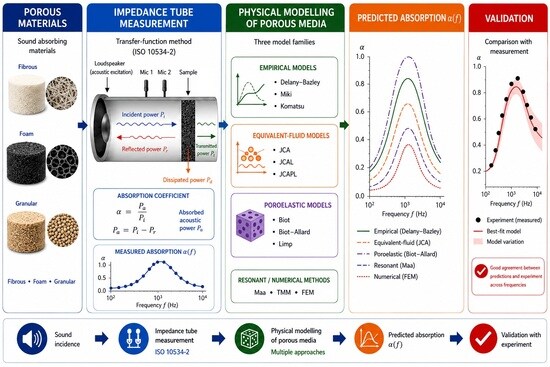
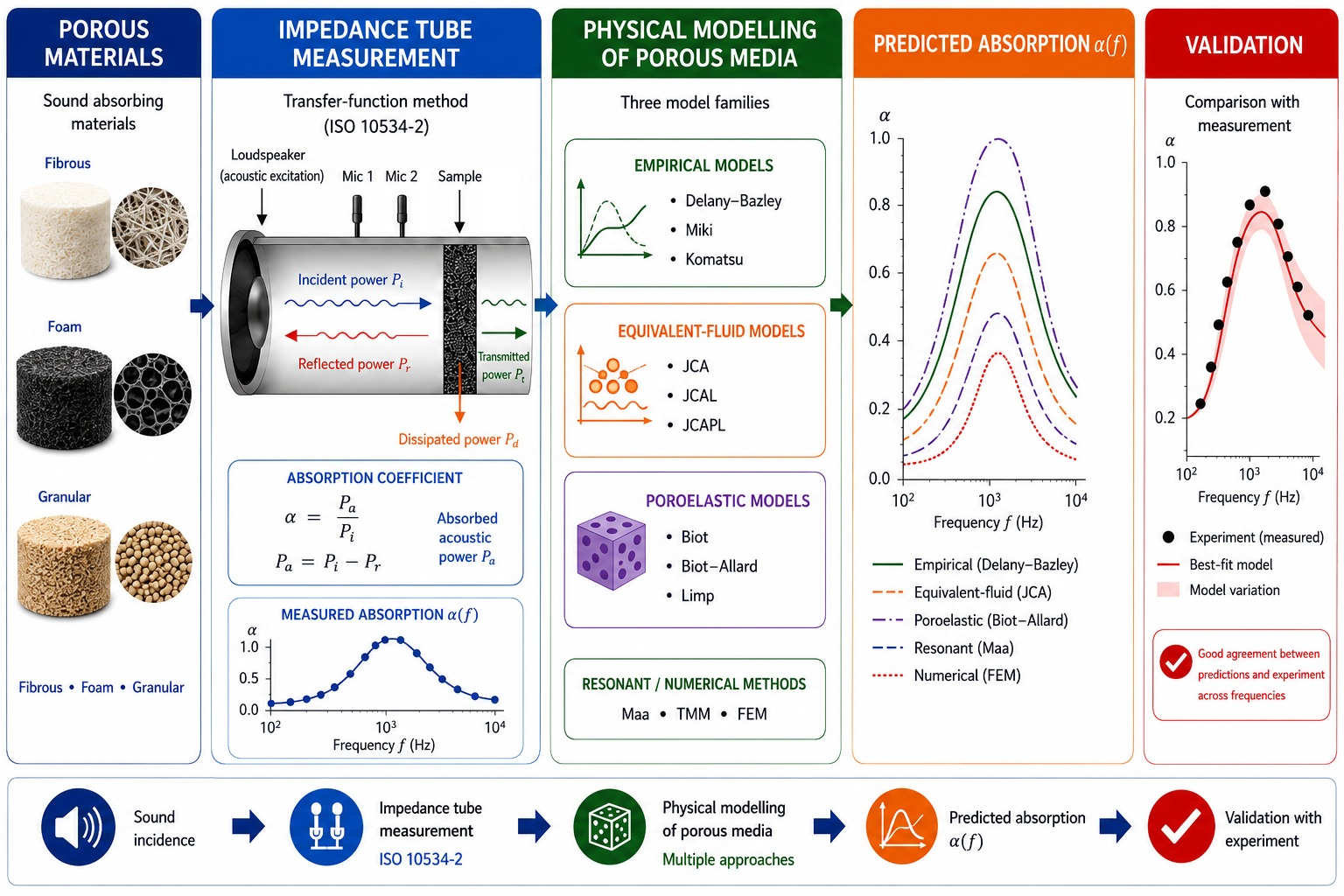
This paper provides a comprehensive overview of the main empirical, equivalent-fluid, poroelastic, resonant, and numerical models used to describe sound absorption in porous materials. Each model is described in detail with regard to its theoretical basis, governing equations, and key physical parameters. Special attention is devoted to the assumptions underlying each model, such as whether the frame is rigid or flexible, the applicable frequency range, and the types of porous media they most accurately represent. The advantages and limitations of the different approaches are critically assessed in terms of prediction accuracy, computational complexity, physical interpretability, and experimental requirements. In addition, this paper summarizes and critically discusses published model–experiment comparisons for representative porous and resonant acoustic materials. These comparisons highlight the strengths and weaknesses of different modeling strategies in various acoustic applications and provide guidance for selecting the most suitable model according to the material properties and target frequency range. The review shows that equivalent-fluid models generally provide the best compromise between prediction accuracy and computational efficiency for rigid-frame porous materials, whereas Biot-type poroelastic models are more suitable when frame motion cannot be neglected.
Keywords: porous materials; sound absorption; acoustic modeling; equivalent-fluid models; empirical models; poroelastic models; Johnson–Champoux–Allard model; Biot theory porous materials; sound absorption; acoustic modeling; equivalent-fluid models; empirical models; poroelastic models; Johnson–Champoux–Allard model; Biot theory
Graphical Abstract