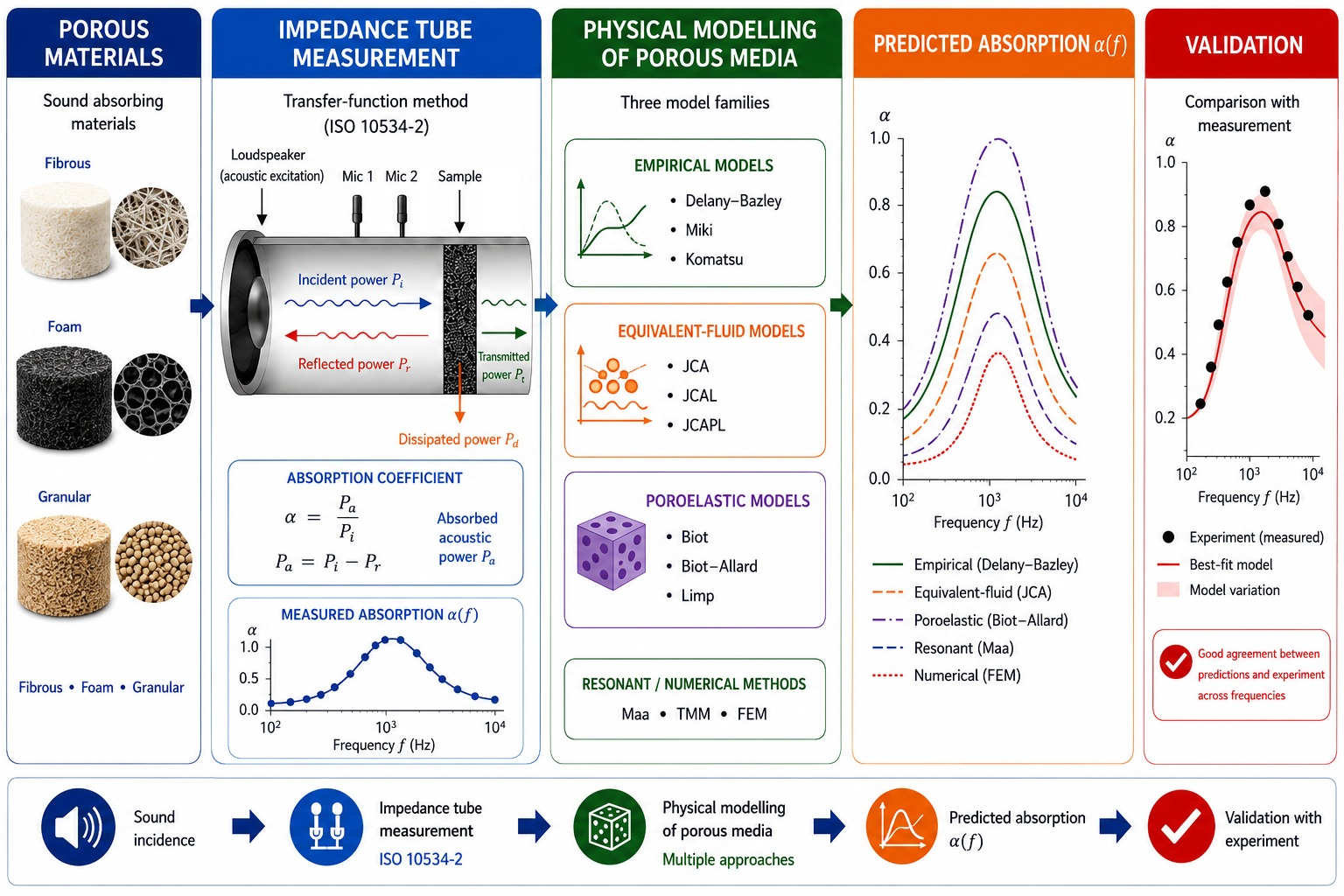
Sound Absorption Modeling in Porous Materials: A Critical Review of Empirical, Equivalent-Fluid, Poroelastic, Resonant, and Numerical Methods



Abstract
1. Introduction
2. Theoretical Background: Definition of the Sound Absorption Coefficient and Its Measurement Methods
2.1. Sound Absorption Coefficient
2.2. Measurement Methods for the Sound Absorption Coefficient
- Acoustics—Measurement of sound absorption in a reverberation room according to ISO 354 [26].
- Acoustics—Determination of sound absorption coefficient and impedance in impedance tubes. Part 1: Method using standing wave ratio according to ISO 10534-1 [27].
- Acoustics—Determination of sound absorption coefficient and impedance in impedance tubes. Part 2: Transfer function method according to ISO 10534-2 [28].
2.2.1. Measurement of Sound Absorption in a Reverberation Room
2.2.2. Measurement of Sound Absorption Coefficient in Impedance Tubes Using Standing Wave Ratio
2.2.3. Measurement of Sound Absorption Coefficient in Impedance Tubes Using Transfer Function Method
3. Mathematical Models for Simulation of Sound Absorption Behavior
3.1. Empirical Models
3.1.1. General Delany–Bazley-Type Empirical Form
3.1.2. Delany–Bazley Model
3.1.3. Mechel Model
3.1.4. Miki Model
3.1.5. Garai–Pompoli Model
3.1.6. Komatsu Model
3.1.7. Voronina Model
3.1.8. Ramis et al. Model
3.1.9. Modified Allard–Champoux Model
3.1.10. Dunn–Davern Model
3.1.11. Yoon Model
3.1.12. Wu Model
3.1.13. Practical Use, Advantages and Limitations of Empirical Models
3.2. Semi-Empirical and Equivalent-Fluid Models
3.2.1. Zwikker–Kosten Model
3.2.2. Attenborough Model
3.2.3. Wilson Model
3.2.4. Johnson–Champoux–Allard Model
3.2.5. Johnson–Champoux–Allard–Lafarge Model
3.2.6. Johnson–Champoux–Allard–Pride–Lafarge Model
3.2.7. Horoshenkov–Swift Model and Related Pore Structure Models
3.2.8. Practical Use, Advantages and Limitations of Semi-Empirical Models
3.3. Poroelastic and Moving-Frame Models
3.3.1. Biot Theory
3.3.2. Biot–Allard Model
3.3.3. Limp-Frame Model
3.4. Resonant Analytical Models for Special Absorbers
3.4.1. Maa’s Model for Microperforated Panels
3.4.2. Maa–Flex Model for Flexible Perforated Panels
3.4.3. Helmholtz Resonators
3.4.4. Panel and Membrane Absorbers
3.5. Computational Frameworks and Inverse Methods
3.5.1. Transfer Matrix Method
3.5.2. Finite-Element and Full-Wave Pressure Formulations
3.5.3. Boundary, Time-Domain, and Periodic Numerical Models
3.5.4. Inverse Identification and Hybrid Optimization
4. Comparison of Model Predictions with Experimental Data
4.1. Comparison of Empirical Models
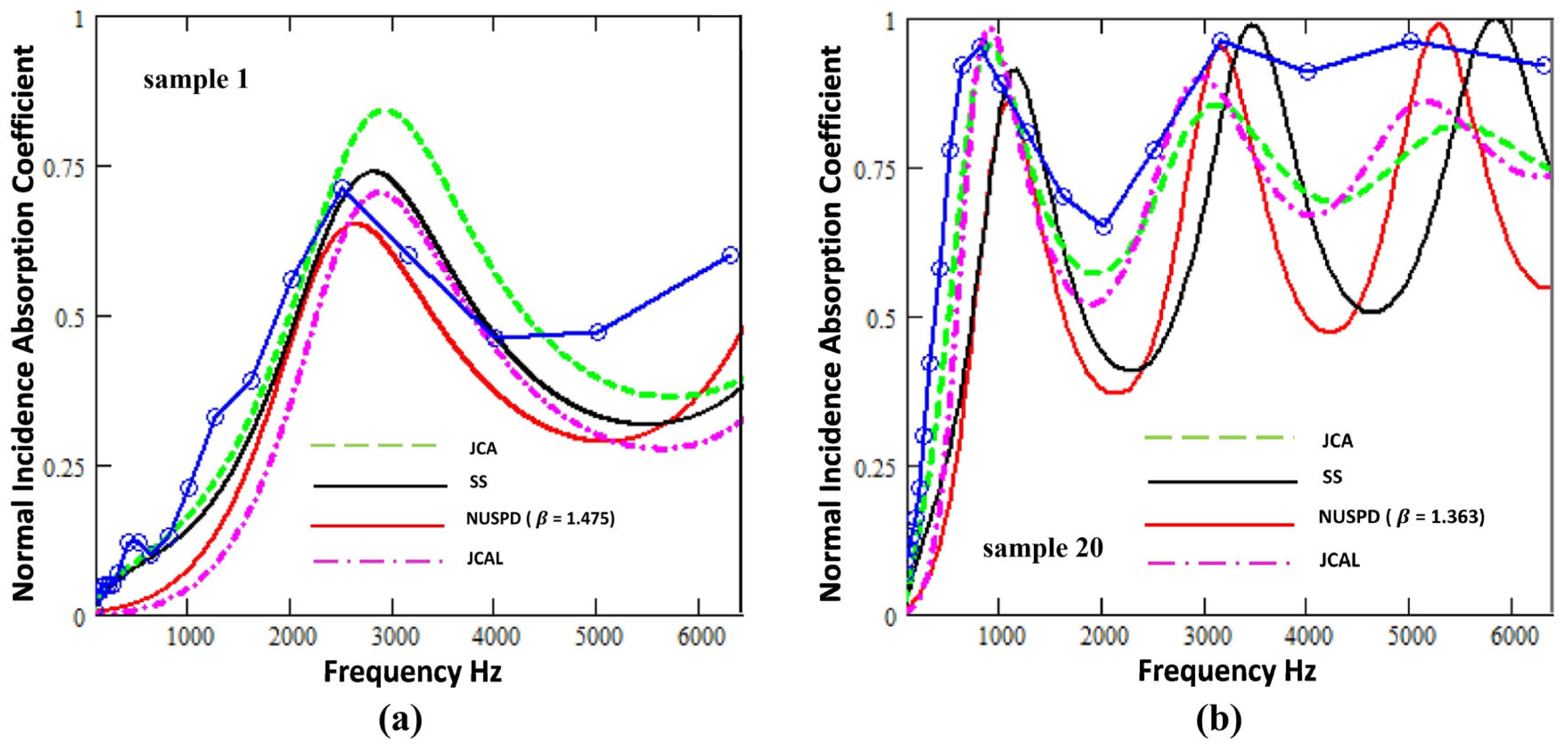
4.2. Comparison of Semi-Empirical Models
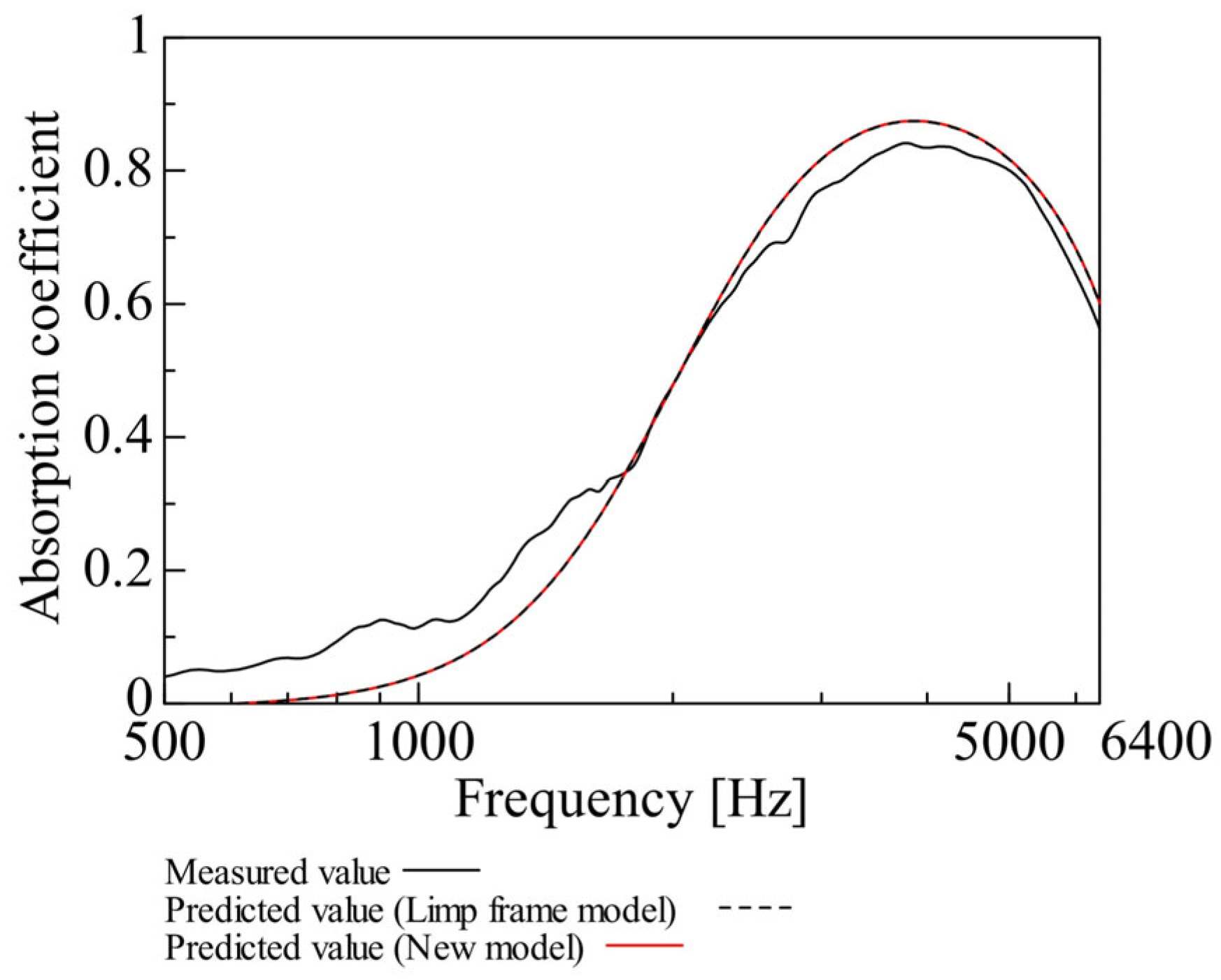
4.3. Comparison of Poroelastic and Moving-Frame Models
4.4. Comparison Across Empirical, Semi-Empirical, and Poroelastic and Moving-Frame Model Families
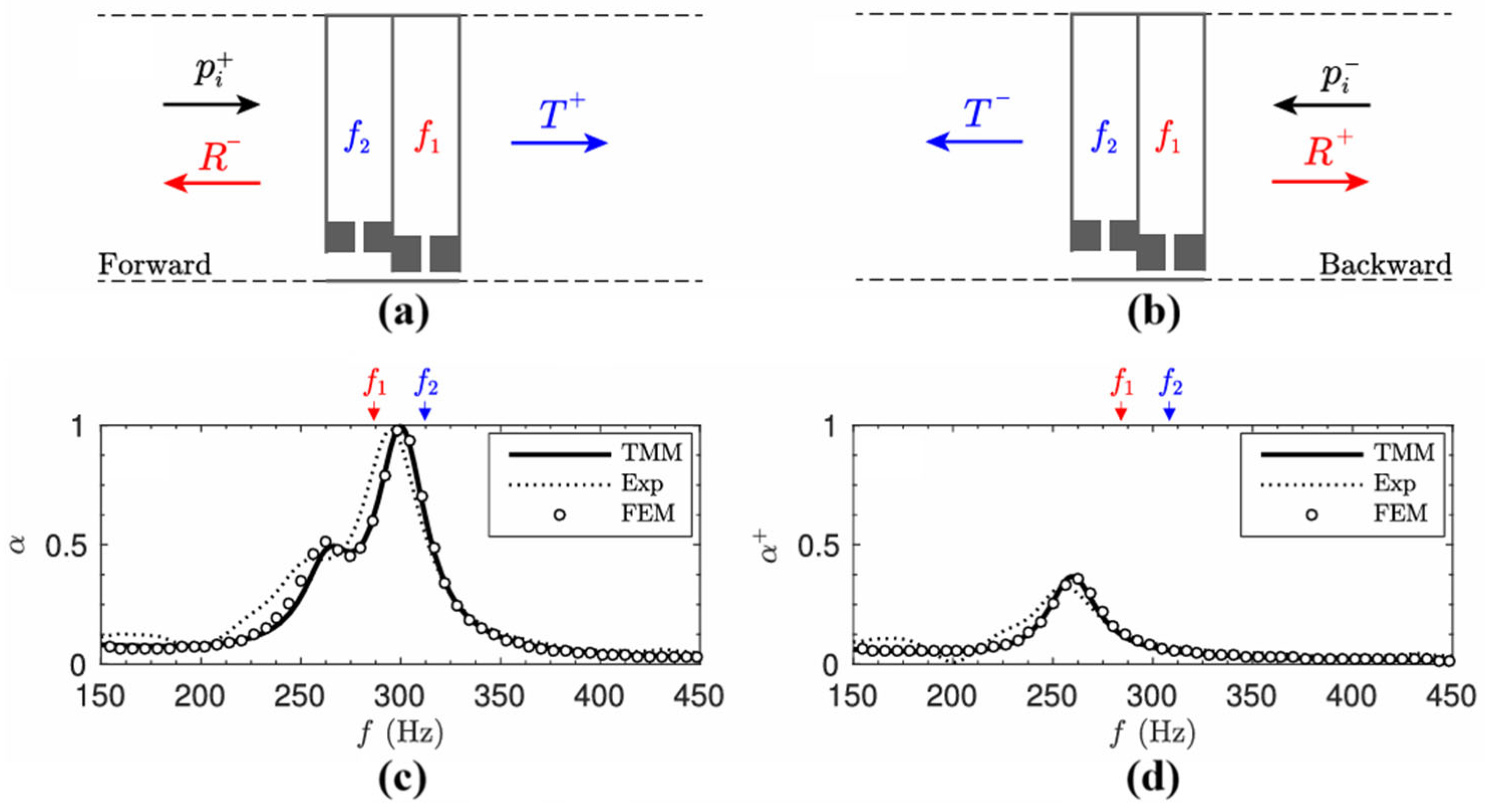
4.5. Comparison of Resonant Analytical Models
5. Comparison by Material Class and Model Recommendations
5.1. Polyurethane and Melamine Foams
5.2. Mineral and Glass Wool
5.3. Natural Fibers
5.4. Clay-Based and Ceramic Materials
5.5. The 3D-Printed Polymer Materials
5.6. Metallic Foams
5.7. Fibrous Composites and Textiles
5.8. Aerogels
5.9. Microperforated Panels (MPP)
5.10. Helmholtz Resonator Panels
6. Summary and Final Recommendations
7. Conclusions
Author Contributions
Funding
Data Availability Statement
Conflicts of Interest
Abbreviations
| AC | Allard–Champoux Model |
| ANC | Active Noise Control |
| BEM | Boundary Element Method |
| DBM | Delany–Bazley Model |
| FDTD | Finite Difference Time Domain |
| FEM | Finite Element Method |
| GPM | Garai–Pompoli Model |
| ISO | International Organization for Standardization |
| JCA | Johnson–Champoux–Allard |
| JCAL | Johnson–Champoux–Allard–Lafarge |
| JCAPL | Johnson–Champoux–Allard–Pride–Lafarge |
| KM | Komatsu Model |
| Maa–Flex | Maa Flexible Panel Model |
| Maa–MPP | Maa Microperforated Panel Model |
| MKM | Miki Model |
| MPP | Microperforated Panel |
| NUPSD | Non-Uniform Pore Size Distribution |
| PNC | Passive Noise Control |
| RMSE | Root Mean Square Error |
| SS | Slanted Parallel Identical Uniform Slits |
| SWR | Standing Wave Ratio |
| TMM | Transfer Matrix Method |
References
- Stansfeld, S.A. Noise effects on health in the context of air pollution exposure. Int. J. Environ. Res. Public Health 2015, 12, 12735–12760. [Google Scholar] [CrossRef] [Scilit] [PubMed]
- Krittanawong, C.; Qadeer, Y.K.; Hayes, R.B.; Wang, Z.; Virani, S.; Zeller, M.; Dadvand, P.; Lavie, C.J. Noise Exposure and Cardiovascular Health. Curr. Probl. Cardiol. 2023, 48, 101938. [Google Scholar] [CrossRef] [Scilit] [PubMed]
- Liu, J.; Zhu, B.; Xia, Q.; Ji, X.; Pan, L.; Bao, Y.; Lin, Y.; Zhang, R. The effects of occupational noise exposure on the cardiovascular system: A review. J. Public Health Emerg. 2020, 4, 12. [Google Scholar] [CrossRef] [Scilit]
- Luo, L.; Sun, J.; Huang, B. A novel feedback active noise control for broadband chaotic noise and random noise. Appl. Acoust. 2017, 116, 229–237. [Google Scholar] [CrossRef] [Scilit]
- Zachos, P.; Moiragias, G.; Mourjopoulos, J. Targeted beamforming active noise control based on disturbance metrics. Acta Acust. 2024, 8, 39. [Google Scholar] [CrossRef] [Scilit]
- Azimi, M. Noise Reduction in Buildings Using Sound Absorbing Materials. J. Arch. Eng. Technol. 2017, 6, 198. [Google Scholar] [CrossRef]
- Cao, L.; Fu, Q.; Si, Y.; Ding, B.; Yu, J. Porous materials for sound absorption. Compos. Commun. 2018, 10, 25–35. [Google Scholar] [CrossRef] [Scilit]
- Berardi, U.; Iannace, G. Acoustic characterization of natural fibers for sound absorption applications. Build. Environ. 2015, 94, 840–852. [Google Scholar] [CrossRef] [Scilit]
- Doutres, O.; Atalla, N.; Dong, K. Effect of the microstructure closed pore content on the acoustic behavior of polyurethane foams. J. Appl. Phys. 2011, 110, 064901. [Google Scholar] [CrossRef] [Scilit]
- Langfeldt, F.; Khatokar, A.J.; Gleine, W. Plate-type acoustic metamaterials with integrated Helmholtz resonators. Appl. Acoust. 2022, 199, 109019. [Google Scholar] [CrossRef] [Scilit]
- Chang, L.; Jiang, A.; Rao, M.; Ma, F.; Huang, H.; Zhu, Z.; Zhang, Y.; Wu, Y.; Li, B.; Hu, Y. Progress of low-frequency sound absorption research utilizing intelligent materials and acoustic metamaterials. RSC Adv. 2021, 11, 37784–37800. [Google Scholar] [CrossRef] [Scilit] [PubMed]
- Jafari, M.J.; Monazam, M.R.; Kazempour, M. Providing an optimal porous absorbent pattern to reduce mid to low-frequency sounds. J. Environ. Health Sci. Eng. 2018, 16, 289–297. [Google Scholar] [CrossRef] [Scilit] [PubMed]
- Karami, F.; Shokri Rad, M.; Karimipour, I. Review on attenuation methods of low−frequency noise in passive silencers. J. Low Freq. Noise Vib. Act. Control 2024, 43, 1679–1695. [Google Scholar] [CrossRef] [Scilit]
- Iannace, G.; Bevilacqua, A.; Trematerra, A.; Amadasi, G. Sound Absorption of Hydroponically Grown Plants. Acoustics 2025, 7, 24. [Google Scholar] [CrossRef] [Scilit]
- Zhang, C.C.; Li, H.Q.; Gong, J.X.; Chen, J.; Li, Z.; Li, Q.; Cheng, M.; Zhang, J. The review of fiber-based sound-absorbing structures. Text. Res. J. 2022, 92, 434–449. [Google Scholar] [CrossRef] [Scilit]
- Sheikhmozafari, M.J.; Ahmadi, A.A.; Hajinejad, S. Enhancing High-Frequency Bandwidth in MPP−Porous Material Composite Absorbers: A Numerical Simulation Approach for Optimal Parameter Selection. J. Occup. Health Epidemiol. 2024, 13, 119–131. [Google Scholar] [CrossRef] [Scilit]
- Liao, G.X.; Luan, C.C.; Wang, Z.W.; Liu, J.P.; Yao, X.H.; Fu, J.Z. Acoustic Metamaterials: A Review of Theories, Structures, Fabrication Approaches, and Applications. Adv. Mater. Technol. 2021, 6, 2000787. [Google Scholar] [CrossRef] [Scilit]
- Hedayati, R.; Lakshmanan, S. Pneumatically-actuated acoustic metamaterials based on Helmholtz resonators. Materials 2020, 13, 1456. [Google Scholar] [CrossRef] [Scilit] [PubMed]
- Cummer, S.; Christensen, J.; Alù, A. Controlling sound with acoustic metamaterials. Nat. Rev. Mater. 2016, 1, 16001. [Google Scholar] [CrossRef] [Scilit]
- Yang, W.; Bai, X.; Zhu, W.; Kiran, R.; An, J.; Chua, C.K.; Zhou, K. 3D Printing of Polymeric Multi-Layer Micro-Perforated Panels for Tunable Wideband Sound Absorption. Polymers 2020, 12, 360. [Google Scholar] [CrossRef] [Scilit]
- Setaki, F.; Tian, F.; Turrin, M.; Tenpierik, M.; Nijs, L.; Van Timmeren, A. 3D−printed sound absorbers: Compact and customisable at broadband frequencies. Arch. Struct. Constr. 2023, 3, 205–215. [Google Scholar] [CrossRef] [Scilit]
- Iannace, G.; Amadasi, G.; Bevilacqua, A.; Cairoli, M.; Trematerra, A. Resonant Acoustic Metamaterials. Appl. Sci. 2024, 14, 5080. [Google Scholar] [CrossRef] [Scilit]
- Chai, J.; Chen, J.; Liang, L.; Xi, J.; Zhang, L.; Cui, Z.; Zhang, Z.; Wang, Z.; Ning, G. Low-Frequency Acoustic Metamaterials: Mechanisms, Designs, and Broadband Absorption Strategies. Adv. Eng. Mater. 2026, 28, e202502352. [Google Scholar] [CrossRef] [Scilit]
- Ortiz, S.; Cuesta, M.; Cobo, P. A Review of Microperforated Panel-Based Structures for Low Frequency Sound Absorption. Acoustics 2026, 8, 35. [Google Scholar] [CrossRef] [Scilit]
- Sgard, F.; Castel, F.; Atalla, N. Use of a Hybrid Adaptive Finite Element/Modal Approach to Assess the Sound Absorption of Porous Materials with Meso−Heterogeneities. Appl. Acoust. 2011, 72, 157–168. [Google Scholar] [CrossRef] [Scilit]
- ISO 354; Acoustics-Measurement of Sound Absorption in a Reverberation Room. International Standards Organization: Geneva, Switzerland, 2003.
- ISO 10534−1; Acoustics-Determination of Sound Absorption Coefficient and Impedance in Impedance Tubes-Part 1: Method Using Standing Wave Ratio. International Standards Organization: Geneva, Switzerland, 1996.
- ISO 10534−2; Acoustics—Determination of Sound Absorption Coefficient and Impedance in Impedance Tubes-Part 2: Transfer−Function Method. International Standards Organization: Geneva, Switzerland, 1998.
- ISO 9613-1; Acoustics. Attenuation of Sound during Propagation Outdoors. Part 1: Calculation of the Absorption of Sound by the Atmosphere. International Standards Organization: Geneva, Switzerland, 1993.
- Jin, J.; Cao, B.; Huang, J.; Jiang, L.; Liu, Z.; Kuang, T.; Wu, W.; Chen, F.; Fei, Y. Slip Boundary-Enabled Multiscale Modeling for Sound Absorption Coefficient of Nanofiber Porous Media with High Fidelity. Nanomaterials 2025, 15, 1696. [Google Scholar] [CrossRef] [Scilit] [PubMed]
- Devi, A.; Gautam, C.; Garg, N. Experimental and Analytical Evaluation of Models for Predicting Sound Absorption Characteristics of Acoustical Materials. Mapan J. Metrol. Soc. India 2025, 40, 557–585. [Google Scholar] [CrossRef] [Scilit]
- Kalauni, K.; Pawar, S.J. Estimation of the Physical Parameters of Grewia Optiva Fibers and Prediction of Sound Absorption Coefficient with Theoretical Models. J. Nat. Fibers 2023, 20, 2162189. [Google Scholar] [CrossRef] [Scilit]
- Tang, X.; Yan, X. Acoustic energy absorption properties of fibrous materials: A review. Compos. Part A Appl. Sci. Manuf. 2017, 101, 360–380. [Google Scholar] [CrossRef] [Scilit]
- Delany, M.E.; Bazley, E.N. Acoustical properties of fibrous absorbent materials. Appl. Acoust. 1970, 3, 105–116. [Google Scholar] [CrossRef] [Scilit]
- Mechel, F.P. Extension to low frequencies of the formulae of Delany and Bazley for absorbing materials. Acta Acust. United Acust. 1976, 35, 210–213. [Google Scholar]
- Miki, Y. Acoustical properties of porous materials. Modifications of Delany−Bazley models. J. Acoust. Soc. Jpn. E 1990, 11, 19–24. [Google Scholar] [CrossRef] [Scilit]
- Garai, M.; Pompoli, F. A simple empirical model of polyester fibre materials for acoustical applications. Appl. Acoust. 2005, 66, 1383–1398. [Google Scholar] [CrossRef] [Scilit]
- Komatsu, T. Improvement of the Delany−Bazley and Miki models for fibrous sound−absorbing materials. Acoust. Sci. Tech. 2008, 29, 121–129. [Google Scholar] [CrossRef] [Scilit]
- Voronina, N. Acoustic properties of fibrous materials. Appl. Acoust. 1994, 42, 165–174. [Google Scholar] [CrossRef] [Scilit]
- Voronina, N. Improved empirical model of sound propagation through fibrous materials. Appl. Acoust. 1996, 48, 121–132. [Google Scholar] [CrossRef] [Scilit]
- Ramis, J.; del Rey, R.; Alba, J.; Godinho, L.; Carbajo, J. A model for acoustic absorbent materials derived from coconut fiber. Mater. Constr. 2014, 64, e008. [Google Scholar] [CrossRef] [Scilit]
- Oliva, D.; Hongisto, V. Sound absorption of porous materials-Accuracy of prediction methods. Appl. Acoust. 2013, 74, 1473–1479. [Google Scholar] [CrossRef] [Scilit]
- Dunn, I.P.; Davern, W.A. Calculation of acoustic impedance of multi−layer absorbers. Appl. Acoust. 1986, 19, 321–334. [Google Scholar] [CrossRef] [Scilit]
- Yoon, G.H. Acoustic topology optimization of fibrous material with Delany–Bazley empirical material formulation. J. Sound Vib. 2013, 332, 1172–1187. [Google Scholar] [CrossRef] [Scilit]
- Qunli, W. Empirical Relations between Acoustical Properties and Flow Resistivity of Porous Plastic Open−Cell Foam. Appl. Acoust. 1988, 25, 141–148. [Google Scholar] [CrossRef] [Scilit]
- Allard, J.; Atalla, N. Propagation of Sound in Porous Media: Modelling Sound Absorbing Materials, 2nd ed.; John Wiley & Sons: Hoboken, NJ, USA, 2009; pp. 111–117. [Google Scholar]
- Zwikker, C.; Kosten, C.W. Sound Absorbing Materials; Elsevier: New York, NY, USA, 1949. [Google Scholar]
- Attenborough, K. Acoustical characteristics of rigid fibrous absorbents and granular materials. J. Acoust. Soc. Am. 1983, 73, 785–799. [Google Scholar] [CrossRef] [Scilit]
- Wilson, K. Relaxation−Matched Modelling of Propagation through Porous Media, Including Fractal Pore Structure. J. Acoust. Soc. Am. 1993, 94, 1136–1145. [Google Scholar] [CrossRef] [Scilit]
- Johnson, D.L.; Koplik, J.; Dashen, R. Theory of dynamic permeability and tortuosity in fluid saturated porous media. J. Fluid Mech. 1987, 176, 379–402. [Google Scholar] [CrossRef] [Scilit]
- Champoux, Y.; Allard, J.F. Dynamic tortuosity and bulk modulus in air-saturated porous media. J. Appl. Phys. 1991, 70, 1975–1979. [Google Scholar] [CrossRef] [Scilit]
- Jaouen, L.; Bécot, F.X.; Chevillotte, F. Characterizations of acoustical porous media: Standardized methods, current trends and challenges. Front. Acoust. 2025, 3, 1543456. [Google Scholar] [CrossRef] [Scilit]
- Lafarge, D.; Lemarinier, P.; Allard, J.F.; Tarnow, V. Dynamic compressibility of air in porous structures at audible frequencies. J. Acoust. Soc. Am. 1997, 102, 1995–2006. [Google Scholar] [CrossRef] [Scilit]
- Biot, M.A. Theory of propagation of elastic waves in a fluid-saturated porous solid. I. Low frequency range. J. Acoust. Soc. Am. 1956, 28, 168–178. [Google Scholar] [CrossRef] [Scilit]
- Biot, M.A. Theory of propagation of elastic waves in a fluid-saturated porous solid. II. Higher frequency range. J. Acoust. Soc. Am. 1956, 28, 179–191. [Google Scholar] [CrossRef] [Scilit]
- Plona, T.J. Observation of a second bulk compressional wave in a porous medium at ultrasonic frequencies. Appl. Phys. Lett. 1980, 36, 259–261. [Google Scholar] [CrossRef] [Scilit]
- Ayadi, M.; Dauchez, N.; Zouari, R.; Segovia, C.; Baffoun, A.; Msahli, S.; Nicolas, B. Natural fiber airlaid nonwoven panels for sound absorption: Measurement and prediction. SSRN 2023. [Google Scholar] [CrossRef] [Scilit]
- Periyasamy, A.P.; Karunakaran, G.; Rwahwire, S.; Kesari, K. Nonwoven Fabrics Developed from Agriculture and Industrial Waste for Acoustic and Thermal Applications. Cellulose 2023, 30, 7329–7346. [Google Scholar] [CrossRef] [Scilit]
- Ehsan Samaei, S.; Berardi, U.; Asilian Mahabadi, H.; Soltani, P.; Taban, E. Optimization and modeling of the sound absorption behavior of polyurethane composite foams reinforced with kenaf fiber. Appl. Acoust. 2023, 202, 109176. [Google Scholar] [CrossRef] [Scilit]
- Mitrevska, M.J.; Mickovski, V.; Samardzioska, T.; Iannace, G. Experimental and Numerical Investigation of Sound Absorption Characteristics of Rebonded Polyurethane Foam. Appl. Sci. 2022, 12, 12936. [Google Scholar] [CrossRef] [Scilit]
- Suo, H.; Xu, J.; Feng, Y.; Liu, D.; Tang, P.; Feng, Y. Experimental Research and Theoretical Analysis of the Coupling Mechanism Between Microstructure and Acoustics in Porous Materials. Appl. Sci. 2025, 15, 3104. [Google Scholar] [CrossRef] [Scilit]
- Lashgari, M.; Taban, E.; SheikhMozafari, M.J.; Soltani, P.; Attenborough, K.; Khavanin, A. Wood chip sound absorbers: Measurements and models. Appl. Acoust. 2024, 220, 109963. [Google Scholar] [CrossRef] [Scilit]
- Liuzzi, S.; Rubino, C.; Stefanizzi, P.; Martellotta, F. Performance Characterization of Broad Band Sustainable Sound Absorbers Made of Almond Skins. Materials 2020, 13, 5474. [Google Scholar] [CrossRef] [Scilit] [PubMed]
- Bécot, F.-X.; Jaouen, L. An Alternative Biot’s Formulation for Dissipative Porous Media with Skeleton Deformation. J. Acoust. Soc. Am. 2013, 134, 4801–4807. [Google Scholar] [CrossRef] [Scilit] [PubMed]
- Song, B.H.; Bolton, J.S. A transfer−matrix approach for estimating the characteristic impedance and wave numbers of limp and rigid porous materials. J. Acoust. Soc. Am. 2000, 107, 1131–1152. [Google Scholar] [CrossRef] [Scilit] [PubMed]
- Sakamoto, S.; Shintani, T.; Hasegawa, T. Simplified Limp Frame Model for Application to Nanofiber Nonwovens (Selection of Dominant Biot Parameters). Nanomaterials 2022, 12, 3050. [Google Scholar] [CrossRef] [Scilit] [PubMed]
- Maa, D.Y. Theory and design of microperforated panel sound-absorbing construction. Sci. Sin. 1975, 18, 55–71. [Google Scholar]
- Maa, D.Y. Potential of microperforated panel absorber. J. Acoust. Soc. Am. 1998, 104, 2861–2866. [Google Scholar] [CrossRef] [Scilit]
- Song, B.; Peng, L.; Fu, F.; Liu, M.; Zhang, H. Experimental and theoretical analysis of sound absorption properties of finely perforated wooden panels. Materials 2016, 9, 942. [Google Scholar] [CrossRef] [Scilit]
- Romero−García, V.; Theocharis, G.; Richoux, O.; Merkel, A.; Tournat, V.; Pagneux, V. Perfect and Broadband Acoustic Absorption by Critically Coupled Sub-Wavelength Resonators. Sci. Rep. 2016, 6, 19519. [Google Scholar] [CrossRef] [Scilit] [PubMed]
- Yang, X.C.; Yang, F.; Shen, X.M.; Wang, E.S.; Zhang, X.N.; Shen, C.; Peng, W.Q. Development of Adjustable Parallel Helmholtz Acoustic Metamaterial for Broad Low-Frequency Sound Absorption Band. Materials 2022, 15, 5938. [Google Scholar] [CrossRef] [Scilit]
- Lee, D.H.; Kwon, Y.P. Estimation of the absorption performance of multiple layer perforated panel systems by transfer matrix method. J. Sound Vib. 2004, 278, 847–860. [Google Scholar] [CrossRef] [Scilit]
- Maderuelo−Sanz, R. Characterizing and modelling the sound absorption of the cellulose acetate fibers coming from cigarette butts. J. Environ. Health Sci. Eng. 2021, 19, 1075–1086. [Google Scholar] [CrossRef] [Scilit] [PubMed]
- Taban, E.; Tajpoor, A.; Faridan, M.; Samaei, S.E.; Beheshti, M.H. Acoustic Absorption Characterization and Prediction of Natural Coir Fibers. Acoust. Aust. 2019, 47, 67–77. [Google Scholar] [CrossRef] [Scilit]
- Taban, E.; Soltani, P.; Berardi, U.; Putra, A.; Mousavi, S.M.; Faridan, M.; Samaei, S.E.; Khavanin, A. Measurement, modeling, and optimization of sound absorption performance of Kenaf fibers for building applications. Build. Environ. 2020, 180, 107087. [Google Scholar] [CrossRef] [Scilit]
- Levi, E.; Sgarbi, S.; Piana, E.A. Acoustic Characterization of Some Steel Industry Waste Materials. Appl. Sci. 2021, 11, 5924. [Google Scholar] [CrossRef] [Scilit]
- Shravage, P.; Bonfiglio, P.; Pompoli, F. Hybrid inversion technique for predicting geometrical parameters of porous materials. J. Acoust. Soc. Am. 2008, 123, 3284. [Google Scholar] [CrossRef] [Scilit]
- Shravage, P. Effect of inverted geometric parameters on normal incidence sound absorption and transmission loss. In Proceedings of the 35th German Annual Conference on Acoustics (DAGA 2009), Rotterdam, The Netherlands, 23–26 March 2009; pp. 155–158. [Google Scholar]
- Kosała, K. Modelling the acoustic properties of baffles made of porous and fibrous materials. Arch. Acoust. 2024, 49, 345–357. [Google Scholar] [CrossRef] [Scilit]
- Sousa, L.; Pereira, L.; Montes−González, D.; Ramos, D.; Amado−Mendes, P.; Barrigón−Morillas, J.M.; Godinho, L. Experimental Analysis and Simulation of a Porous Absorbing Layer for Noise Barriers. Appl. Sci. 2023, 13, 2638. [Google Scholar] [CrossRef] [Scilit]
- Ring, T.P.; Langer, S.C. Design, Experimental and Numerical Characterization of 3D−Printed Porous Absorbers. Materials 2019, 12, 3397. [Google Scholar] [CrossRef] [Scilit] [PubMed]
- Otaru, A.J.; Morvan, H.P.; Kennedy, A.R. Numerical Modelling of the Sound Absorption Spectra for Bottleneck Dominated Porous Metallic Structures. Appl. Acoust. 2019, 151, 164–171. [Google Scholar] [CrossRef] [Scilit]
- Dasyam, A.; Xue, Y.; Bolton, J.S.; Sharma, B. Effect of particle size on sound absorption behavior of granular aerogel agglomerates. J. Non-Cryst. Solids 2022, 598, 121942. [Google Scholar] [CrossRef] [Scilit]
- Liu, Z.; Zhan, J.; Fard, M.; Davy, J. Acoustic properties of multilayer sound absorbers with a 3D printed micro−perforated panel. Appl. Acoust. 2017, 121, 25–32. [Google Scholar] [CrossRef] [Scilit]
- Liu, Z.; Zhan, J.; Fard, M.; Davy, J.L. Acoustic measurement of a 3D printed micro-perforated panel combined with a porous material. Measurements 2017, 1041, 233–236. [Google Scholar] [CrossRef] [Scilit]
- Herrero–Dura, I.; Cebrecos, A.; Pico, R.; Romero–Garcia, V.; Garcia–Raffi, L.M.; Sanchez–Morcillo, V.J. Sound Absorption and Diffusion by 2D Arrays of Helmholtz Resonators. Appl. Sci. 2020, 10, 1690. [Google Scholar] [CrossRef] [Scilit]
- Romero–García, V.; Jimenez, N.; Theocharis, G.; Achilleos, V.; Merkel, A.; Richoux, O.; Pagneux, V. Design of acoustic metamaterials made of Helmholtz resonators for perfect absorption by using the complex frequency plane. Comptes Rendus Phys. 2020, 21, 713–749. [Google Scholar] [CrossRef] [Scilit]
- Pride, S.R.; Morgan, F.D.; Gangi, A.F. Drag forces of porous-medium acoustics. Phys. Rev. B 1993, 47, 4964–4978. [Google Scholar] [CrossRef] [Scilit]
- Horoshenkov, K.V.; Swift, M.J. The acoustic properties of granular materials with pore size distribution close to log−normal. J. Acoust. Soc. Am. 2001, 110, 2371–2378. [Google Scholar] [CrossRef] [Scilit] [PubMed]
- Horoshenkov, K.V.; Hurrell, A.; Groby, J.-P. A three-parameter analytical model for the acoustical properties of porous media. J. Acoust. Soc. Am. 2019, 145, 2512–2517. [Google Scholar] [CrossRef] [Scilit] [PubMed]
- Yang, X.C.; Bai, P.F.; Shen, X.M.; To, S.; Chen, L.; Zhang, X.N.; Yin, Q. Optimal design and experimental validation of sound absorbing multilayer microperforated panel with constraint conditions. Appl. Acoust. 2019, 146, 334–344. [Google Scholar] [CrossRef] [Scilit]
- Gai, X.-L.; Li, X.-H.; Tuo, B.Z.; Zhao, J.-J.; Ma, Z.-H. Experimental study on sound absorption performance of microperforated panel with membrane cell. Appl. Acoust. 2016, 110, 241–247. [Google Scholar] [CrossRef] [Scilit]
- Atalla, N.; Sgard, F. Finite Element and Boundary Methods in Structural Acoustics and Vibration; CRC Press: Boca Raton, FL, USA, 2015. [Google Scholar]
- Xu, X.M.; Lin, P. Parameter identification of sound absorption model of porous materials based on modified particle swarm optimization algorithm. PLoS ONE 2021, 16, e0250950. [Google Scholar] [CrossRef] [Scilit] [PubMed]
- Nikodym, M.; Vašina, M. Sound Absorption Modeling in Porous Materials: A Critical Review of Empirical, Equivalent-Fluid, Poroelastic, Resonant, and Numerical Methods. [Data set]. Zenodo 2026. [Google Scholar] [CrossRef]

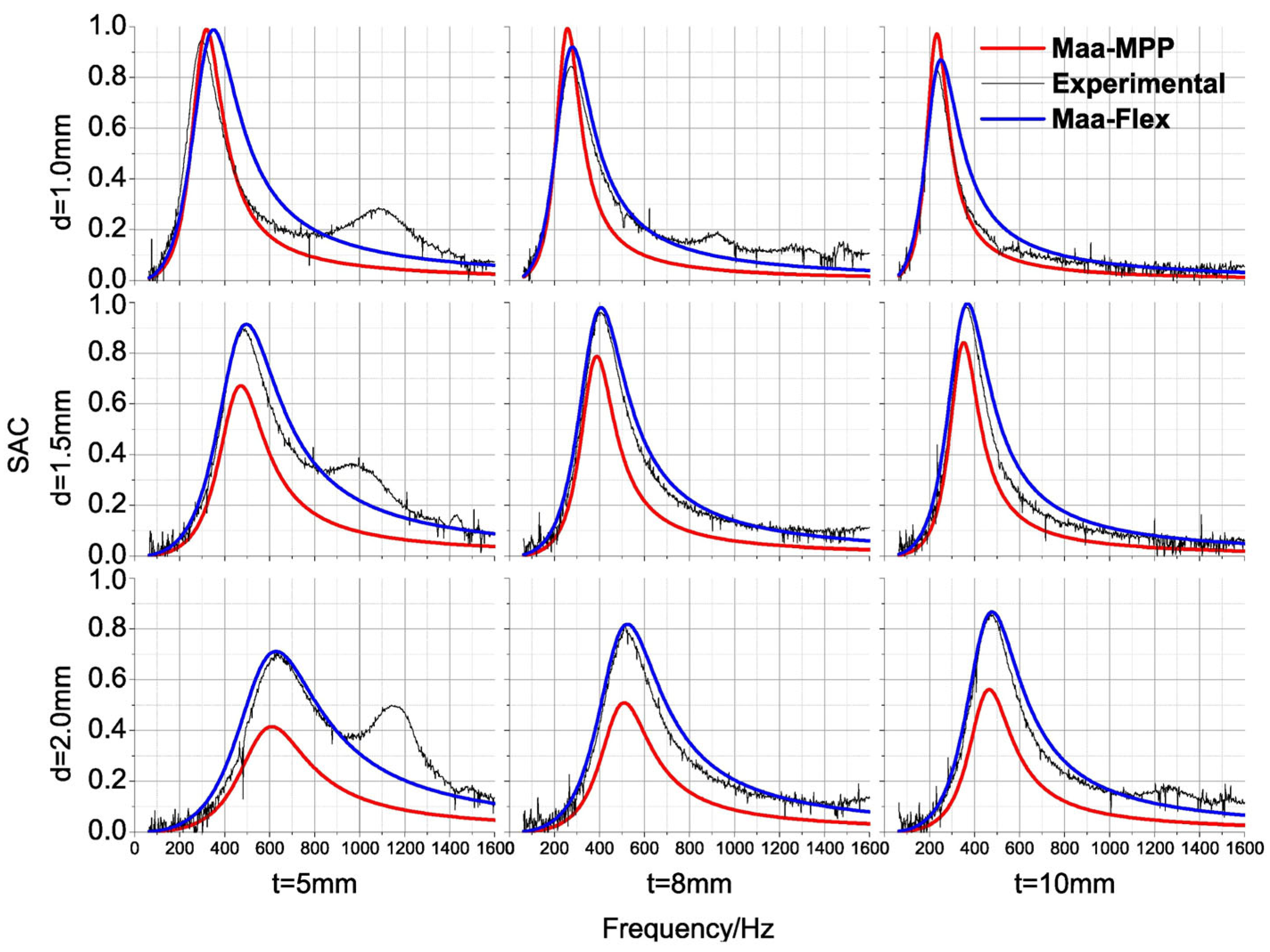

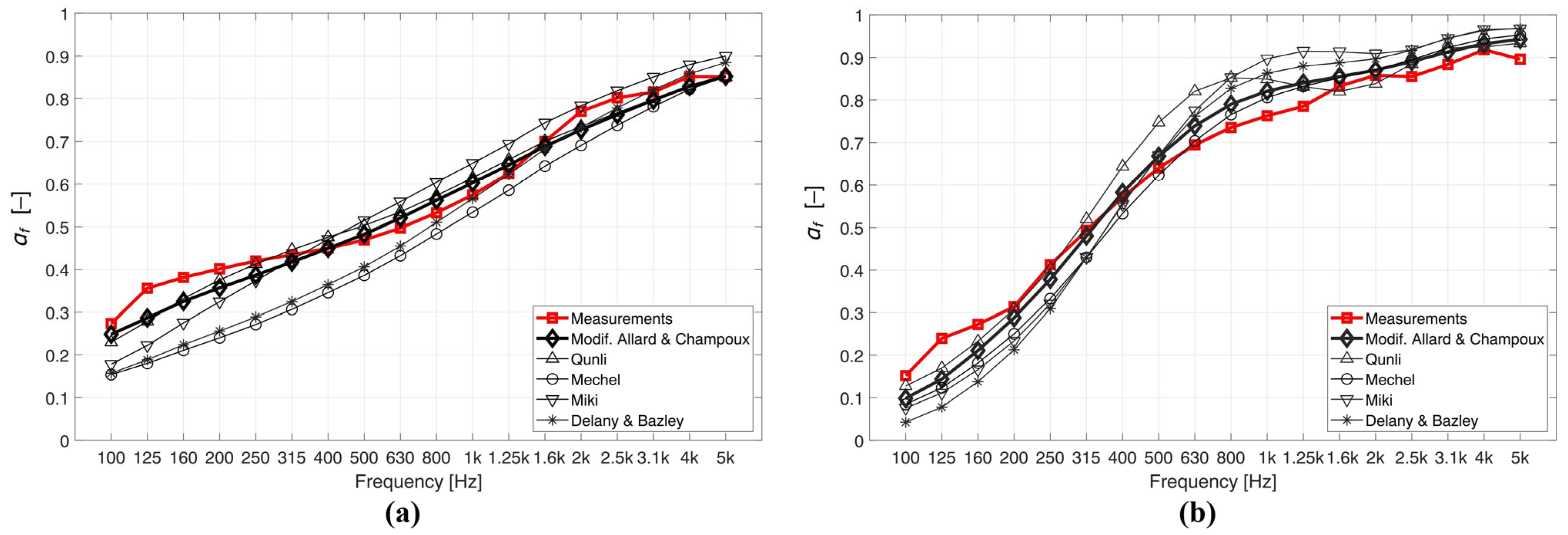
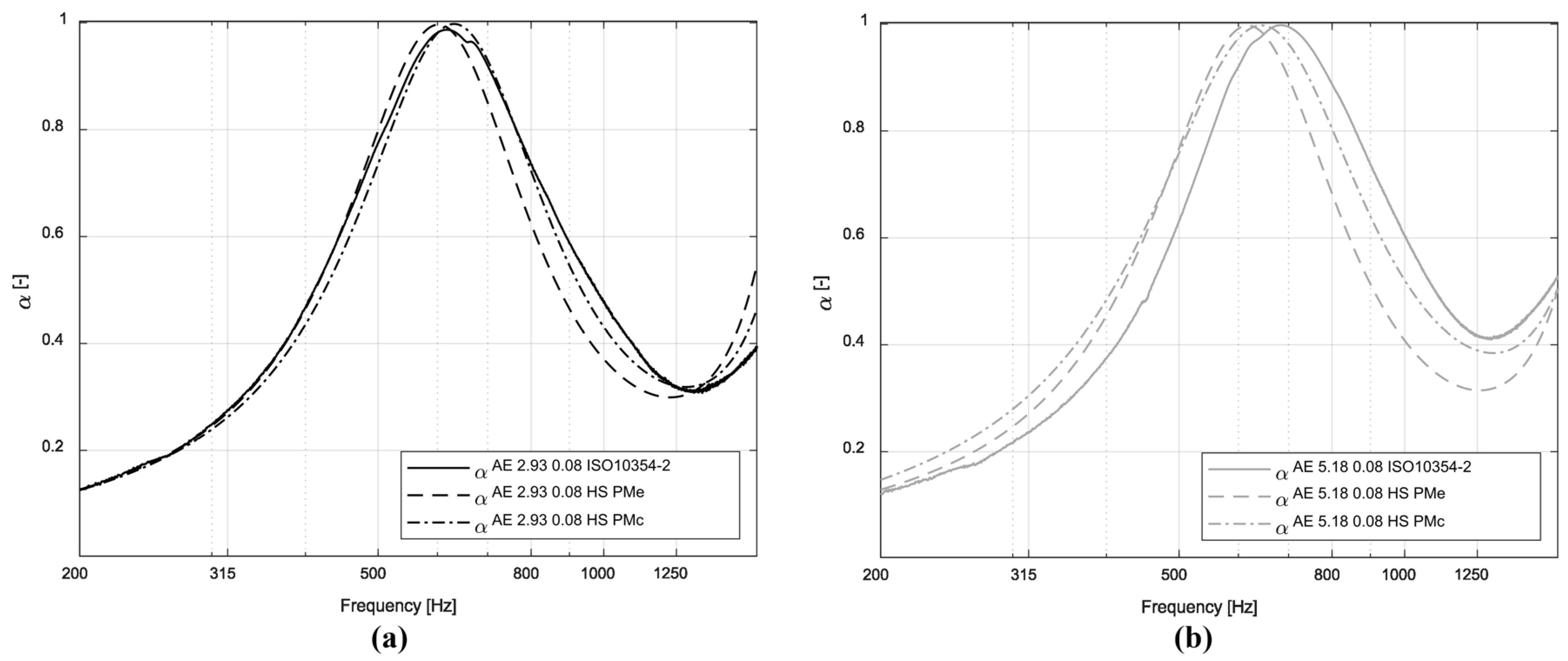
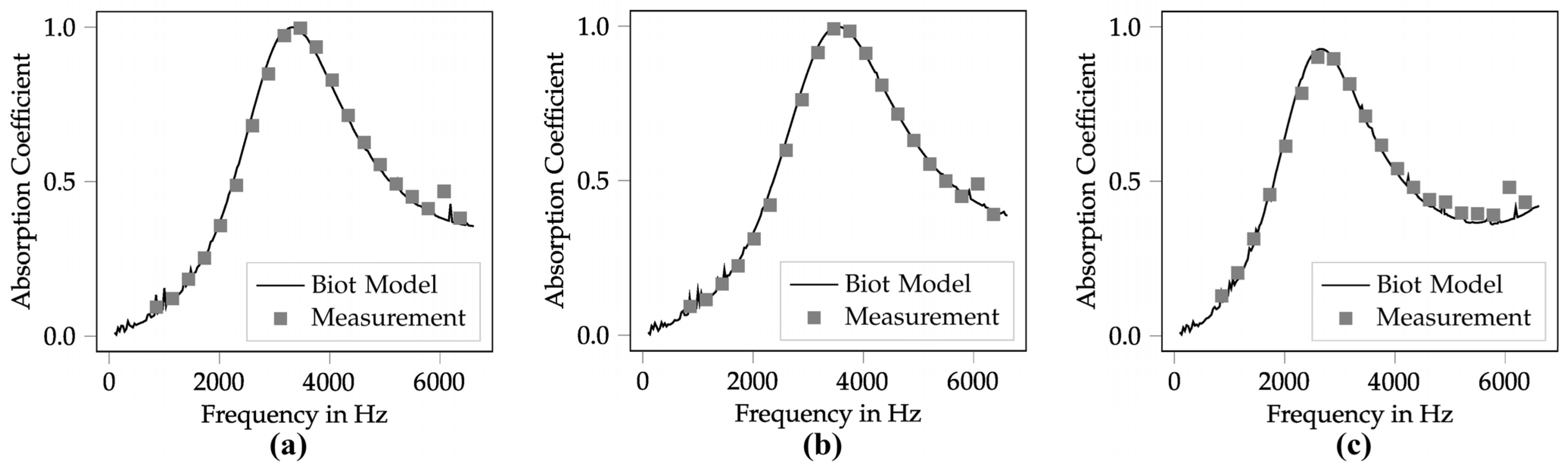



| Model | C1 | C2 | C3 | C4 | C5 | C6 | C7 | C8 |
|---|---|---|---|---|---|---|---|---|
| Delany–Bazley | 0.0571 | −0.754 | 0.087 | −0.732 | 0.0978 | −0.7 | 0.189 | −0.595 |
| Mechel (1/60 < X < 1) | 0.0571 | −0.754 | 0.087 | −0.732 | 0.0978 | −0.7 | 0.189 | −0.595 |
| Mechel (X ≤ 1/60) | 0.0489 | 0.754 | 0.087 | 0.731 | 0.0978 | 0.693 | 0.189 | 0.618 |
| Miki | 0.070 | −0.632 | 0.107 | −0.632 | 0.160 | −0.618 | 0.109 | −0.618 |
| Garai–Pompoli | 0.078 | −0.623 | 0.074 | −0.66 | 0.121 | −0.53 | 0.159 | −0.571 |
| Komatsu [Equations (18) and (19)] | 0.00027 | 6.2 | 0.0047 | 4.1 | 0.0069 | 4.1 | 0.0004 | 6.2 |
| Ramis et al. | 0.0713 | −0.8749 | 0.1216 | −0.4520 | 0.2129 | −0.4857 | 0.0997 | −0.5988 |
| Modified Allard–Champoux | 0.07290 | −0.66228 | 0.18700 | −0.5379 | 0.0982 | −0.685 | 0.288 | −0.526 |
| Dunn–Davern | 0.114 | −0.369 | 0.0985 | −0.758 | 0.168 | −0.715 | 0.136 | −0.491 |
| Yoon | 0.057 | −0.734 | 0.087 | −0.732 | 0.0978 | −0.700 | 0.189 | −0.595 |
| Wu | 0.2090 | −0.5480 | 0.1050 | −0.6070 | 0.1880 | −0.5540 | 0.1630 | −0.5920 |
| Model Family | Required Input Parameters | Typical Application | Advantages | Limitations |
|---|---|---|---|---|
| Delany–Bazley/Mechel/Miki [34,35,36] | Airflow resistivity σ, layer thickness t, and boundary/load conditions (BC or ZL) are required for absorption calculations | Rapid preliminary screening of highly porous fibrous absorbers, especially mineral/glass wool and similar fibrous layers; the Mechel model extends the applicability of DB-type approaches toward lower X values | Very simple, computationally efficient, and directly compatible with surface-impedance or transfer-matrix calculations; the Miki model improves the positive-real behavior of the empirical formulation | Empirical and dependent on the calibration range, with limited low-frequency accuracy and no explicit representation of φ, α∞, Λ, Λ′, pore size distribution, or frame motion |
| Garai–Pompoli/Komatsu [37,38] | Primarily, airflow resistivity σ, layer thickness t, and boundary/load conditions (BC or ZL) are required for final absorption prediction | Garai–Pompoli: polyester fiber blankets; Komatsu: improved DBM/Miki-type predictions for selected fibrous products | More material-class-specific than generic DBM coefficients and able to reduce prediction errors when the material belongs to the calibration family | Still empirical and strongly dependent on the material family. The Komatsu model uses logarithmic equations and must not be included in the generic DBM-type power-law coefficient table |
| Other material-specific empirical variants (Voronina, Ramis, Dunn–Davern, Yoon, Wu) [39,40,41,42,43,44,45] | Airflow resistivity σ and structural descriptors such as porosity φ, fiber diameter d, structural parameter Q or fitted coefficients C1−C8 are used depending on model | Applicable to selected natural fibers, high-porosity fibrous materials, low-density polyurethane foams, and medium-resistivity foams where generic fibrous coefficients are inadequate | Better targeted to a specific morphology or material family than a universal DBM coefficient set | Not universal. Coefficients and sign conventions must be transferred carefully and should not be extrapolated to unrelated morphologies without validation |
| JCA [50,51] | Open porosity φ, airflow resistivity σ, high-frequency tortuosity α∞, viscous characteristic length Λ, and thermal characteristic length Λ′ | Applicable to general rigid-frame porous media, including many open foams, fibrous mats, porous lattices, and rigid porous absorbers, when reliable transport parameters are available | Good balance between physical interpretability, accuracy, and implementability; explicitly includes viscous and thermal characteristic lengths | The model requires several measured or inversely identified parameters and may show reduced low-frequency accuracy because the original JCA model does not include the Lafarge-type low-frequency thermal correction |
| JCAL/JCAPL [53,88] | CA transport parameters plus static thermal permeability for JCAL; JCAPL also uses low-frequency correction parameters such as α0 and | Research-grade equivalent-fluid prediction of rigid-frame porous media when low-frequency accuracy and reliable parameter identification are required | Improves low-frequency dynamic compressibility and/or density behavior compared with the original JCA model | More demanding parameter identification; additional fitted parameters can reduce robustness if experimental data are insufficient or noisy |
| Zwikker–Kosten/Attenborough/Wilson [47,48,49] | Pore geometry or shape factors, capillary radius R or slit width b, porosity φ, flow resistivity σ, tortuosity α∞, and/or relaxation times τvor, τent | Physically interpretable rigid-frame alternatives for capillary, fibrous, granular, and relaxation-dominated porous media | Useful for linking pore geometry, pore shape, and viscous/thermal diffusion to the effective density ρ(ω) and bulk modulus K(ω) | Each model relies on idealized pore geometry or relaxation assumptions; transfer to complex real materials requires parameter validation |
| Horoshenkov-type/SS/NUPSD [62,89,90] | Porosity φ, airflow resistivity σ, tortuosity α∞, and pore-size statistics, e.g., characteristic pore size and standard deviation, or non-uniform pore distribution parameters | Microstructure-informed granular, wood-chip, slit-like, and pore-distribution-dominated porous media | Physically interpretable with fewer parameters than full inversion if pore-size statistics are known or can be estimated | Accuracy depends strongly on whether the assumed pore size distribution, slit geometry, or granular morphology is valid for the tested material |
| Biot/Limp/ Biot–Allard [54,55,64,65] | Transport parameters plus frame density/inertia and elastic properties together with φ, σ, α∞, Λ, and Λ′; simplified limp-frame models focus mainly on inertia and equivalent density | Soft or mobile fibrous layers, trim materials, elastic foams, and nanofiber nonwovens where frame motion contributes to acoustic response | Captures frame motion, coupled air-frame phenomena, and Biot-type poroelastic effects absent in rigidframe equivalent fluids | High parameter burden for full poroelastic modeling and unnecessary for clearly rigid-frame materials; limp assumptions must be validated |
| Maa/Helmholtz/panel–membrane resonators [67,68,69,72,91,92] | Perforation diameter d, panel thickness t, perforation ratio φp, cavity depth D, neck/cavity dimensions S, L, V, panel or membrane impedance Zm | Microperforated panels, Helmholtz resonators, panel/membrane absorbers, hybrid porous–resonant systems, and locally resonant metamaterials | Strong control of tuned low-frequency absorption peaks; bandwidth can be enlarged by porous backing, multiple resonators, graded cavities, or coupled resonant cells | Typically narrow-band as a single resonator and not a substitute for porous constitutive laws in the backing material; requires accurate geometry and loss modeling |
| TMM/FEM/BEM/inverse identification [71,72,93,94] | Constitutive model, geometry, boundary conditions, layer sequence, Zc, kc, t, ZL and, for inverse methods, measured α(f) or Zs(f) plus objective function | Multilayer systems, complex geometries, meso-heterogeneous porous media, resonant structures, and model-parameter identification | Can represent realistic assemblies, coupled porous–resonant systems, and geometry-driven acoustic mechanisms beyond closed-form single-layer formulas | Higher computational cost and strong dependence on parameter quality; inverse identification can be non-unique or unstable without constraints and validation |
| Material Class | Recommended Models | Generally Unsuitable Models |
|---|---|---|
| PUR/melamine foams [31,43,64,65,67] | Use JCA/JCAL for open-cell rigid-frame PUR and melamine foams when ϕ, σ, α∞, Λ and Λ′ are available. Use Dunn–Davern only as a foam-specific empirical screening model for low-density polyurethane foams. Use Biot–Allard only when skeleton deformation contributes to the acoustic response. Use limp-frame formulations only when frame inertia or frame motion is acoustically important. | Do not use generic fibrous empirical coefficient sets as final design models without foam-specific validation. Do not use pure Maa-type panel models for homogeneous foam layers without perforations. |
| Mineral/glass wool [31,34,36,38,53] | Use Delany–Bazley for rapid estimates of fibrous wool absorbers when σ is the main known material parameter. Use Miki as a modified Delany–Bazley-type empirical model for porous/fibrous materials. Use Komatsu when the logarithmic fibrous-material correction is appropriate. Use JCAL for detailed prediction when φ, σ, α∞, Λ and Λ′ are available and low-frequency thermal behavior is important. | Do not use overparameterized poroelastic models when frame elastic properties and damping cannot be identified reliably. Do not transfer foam-specific or natural-fiber empirical coefficients to mineral/glass wool without validation. |
| Natural fibers [31,41,65,75,76] | Use JCA/JCAL for natural coir, kenaf and date-palm fibers when required transport parameters are available. Use JCA for coconut-fiber composites when microstructural parameters are available. Use Ramis-type empirical models for coconut-fiber absorbent materials within their fitted material family. Use limp-frame formulations only when sheet mobility or frame motion affects the response. | Do not directly reuse mineral-wool, glass-wool or polyester empirical coefficients as final models for plant fibers without validation. Do not use pure resonator models when the material behaves primarily as a distributed porous fibrous absorber. |
| Clay-, ceramic-, concrete-, and granular mineral absorbers [31,48,62,89,90] | Use JCA/JCAL for steel slag spheres and similar rigid granular media when measured transport parameters are available. Use Attenborough-type models for rigid fibrous or granular materials where pore-shape factors are physically meaningful. Use Horoshenkov–Swift for granular materials with a pore size distribution close to log-normal. Use the three-parameter Horoshenkov–Hurrell–Groby model when characteristic pore-size statistics can be estimated. | Do not use generic single-parameter fibrous empirical laws as final models for granular, ceramic or concrete pore networks. Do not apply SS/NUPSD-type pore size distribution models without checking that their pore-geometry assumptions are valid. |
| 3D-printed polymers [20,21,31,50,93] | Use JCA-type equivalent-fluid modeling for porous printed networks only after validating transport parameters such as ϕ, σ, α∞, Λ and Λ′. Use FEM when the printed geometry, finite-size effects or coupling cannot be reduced to a homogeneous layer. Use resonant or metamaterial models for printed resonant cavities, labyrinthine structures or locally resonant cells. Use geometry-specific modeling when 3D-printed absorbers exhibit multiple absorption peaks caused by arranged perforations, slits or cavities. | Do not choose the model solely from polymer chemistry, because the printed geometry controls the acoustic mechanism. Do not treat a resonant printed lattice as a homogeneous fibrous blanket. Do not use generic DBM/Miki laws as final models without validation of the printed pore geometry. |
| Metallic foams [31,50,53,88,93] | Use JCA-type equivalent-fluid modeling when metallic foam behaves as a rigid porous medium with validated dynamic permeability/tortuosity parameters. Use JCAL when the low-frequency dynamic compressibility correction is important. Use Pride/JCAPL-type corrections for more complex drag-force or low-frequency visco-inertial effects. Use FEM when structural coupling or geometry-dependent effects must be resolved numerically. | Do not use DBM or Miki as the primary final constitutive model for metallic pore morphology without validation. Do not use pure fibrous empirical laws when distributed porous losses and metallic pore morphology dominate. |
| Textiles/nanofibers [30,31,50,53,65] | Use JCA for thick or sufficiently stiff porous textile mats when ϕ, σ, α∞ and Λ are available. Use JCAL when thermal permeability or low-frequency compressibility corrections are required. Use limp-frame models for mobile fibrous sheets and nanofiber nonwovens where frame motion participates in the response. Use nanofiber-specific multiscale modeling when slip-boundary effects and nanofiber morphology dominate. | Rigid-frame assumptions are unsuitable for compliant or mobile sheets where frame motion is acoustically important. Generic fibrous empirical laws should not be used as final models without validation for the particular textile or nanofiber morphology. |
| Aerogels [31,50,53,83,94] | Use JCA-type modeling when aerogel behavior can be represented by validated equivalent-fluid transport parameters. Use JCAL when low-frequency thermal compressibility must be represented more accurately. Use inverse identification when measured absorption/impedance spectra are available for estimating uncertain porous parameters. Use aerogel-specific validation because aerogel microstructure may fall outside classical fibrous empirical calibration ranges. | Unmodified DBM/Miki/Komatsu laws are generally unsuitable outside their fibrous-material calibration range unless they are validated for the aerogel. Pure resonator models are unsuitable for non-resonant aerogel layers. |
| Microperforated panels [67,68,69,90,93] | Use Maa’s MPP model for rigid microperforated panels with small perforations. Use Maa’s extended MPP formulation for practical microperforated-panel absorber design. Use Maa–Flex when the perforated panel is flexible and panel vibration affects absorption. Use TMM for multilayer panel-cavity assemblies. Use FEM when geometry or coupling effects cannot be reduced to one-dimensional transfer matrices. | Do not use pure porous-medium laws for the perforated panel itself. Do not use DBM/Miki/JCA as if a microperforated panel were a homogeneous fibrous or porous layer. |
| Helmholtz panels and resonant metamaterials [10,17,70,71,93] | Use Helmholtz analytical models for resonators governed by neck inertance and cavity compliance. Use hybrid resonator models when Helmholtz resonators are mounted with microperforated panels. Use critical-coupling or resonant-metamaterial formulations for locally resonant subwavelength absorbers. Use numerical modeling when plate-type resonant metamaterial geometry or coupling is complex. | A single porous constitutive law is unsuitable for the entire resonator system. JCA/JCAL should be used only for porous fillings, backings or hybrid layers, not as the complete resonance mechanism. |
| Material Class | Low Frequencies (20–250 Hz) | Mid Frequencies (250–2000 Hz) | High Frequencies (2–20 kHz) |
|---|---|---|---|
| PUR/melamine foams [9,25,43,53,59,64] | Use JCAL for rigid open-cell foams when transport parameters are known. Use limp-frame or Biot–Allard models when frame inertia or elasticity affects the low-frequency response. | Use JCA or JCAL as the main predictive models. For low-density cross-linked PUR, retain Dunn–Davern only as a foam-specific screening model. | Use JCA/JCAL while the foam remains an acoustically homogeneous open-pore medium. Use FEM or a microstructure-resolved model for closed-pore or meso-heterogeneous foams. |
| Mineral/glass wool [31,35,36,38,51,53] | Prefer JCAL for detailed low-frequency prediction. Mechel can extend a Delany–Bazley-type estimate toward lower values of X, but only within its stated validity range. | Use Delany–Bazley or Miki for rapid estimates when airflow resistivity is known. Use JCA/JCAL when a reliable transport-parameter set is available. | Use Miki or Komatsu within their fibrous-material calibration ranges. Use JCA/JCAL when characteristic lengths and tortuosity are known. |
| Natural fibers [32,41,65,74,75] | Use JCAL for rigid natural-fiber boards. Use limp-frame or Biot-type formulations for compliant mats whose skeleton moves appreciably. | Use JCA/JCAL for coir, kenaf and related fibers. Use the Ramis model only for coconut-fiber materials close to its calibration family. | Use JCA/JCAL with material-specific transport parameters. Retain empirical natural-fiber models only after validation for the actual morphology. |
| Clay, ceramic, concrete, and granular mineral absorbers [25,48,80,89,90] | Use JCAL or Horoshenkov-type pore size distribution models. Use FEM when strong heterogeneity, resonant cavities or frame coupling controls the response. | Use JCA/JCAL for rigid open-pore media, the Attenborough model for physically meaningful pore-shape factors, or Horoshenkov-type models for granular pore networks. | Use pore size distribution or geometry-resolved numerical models when the homogenized equivalent-fluid assumption becomes uncertain. |
| 3D-printed polymers [20,21,50,81,93] | Use geometry-specific resonant models, TMM or FEM for printed cavities and subwavelength cells. Use an equivalent-fluid model only after transport-parameter validation. | Use JCA/JCAL for homogenizable porous lattices and FEM for periodic, anisotropic or finite-size geometries that cannot be reduced to a uniform layer. | Use periodic or full-wave FEM when the wavelength approaches the unit-cell or channel dimensions. Geometry, not polymer chemistry, should govern model selection. |
| Metallic foams [50,82,88,93] | Use JCAL/JCAPL for rigid open-cell foams. Use Wilson or FEM for bottleneck pores and poroelastic modeling when structural coupling is significant. | Use JCA/JCAL for validated rigid-frame morphologies. Wilson-type relaxation modeling may be superior for bottleneck-dominated structures. | Use JCA/JCAL only while homogenization remains valid. Use full-wave or FEM models when pore geometry produces local inertial or wave effects. |
| Textiles/ nanofibers [30,51,53,64,66] | Use limp-frame models for mobile sheets and nanofiber nonwovens. Use full Biot-type modeling when elastic frame stresses or structural resonances are non-negligible. | Use JCA/JCAL for sufficiently stiff textile mats and limp-frame models for compliant layered nonwovens. | Use nanofiber-specific multiscale models with slip-boundary corrections when fiber-scale rarefaction and morphology become important. |
| Aerogels [25,83,94] | Use limp-porous modeling for sufficiently large granular agglomerates. Use poroelastic modeling for finer particles when frame elasticity shifts low-frequency peaks. | Use JCA/JCAL with aerogel-specific parameters and inverse identification when transport properties cannot be measured independently. | Use JCA/JCAL only after validating homogenization. Use microstructure-resolved or hybrid numerical modeling for strongly heterogeneous particle networks. |
| Microperforated panels [16,20,68,69,72,84] | Use Maa’s MPP model for rigid panels and Maa–Flex when panel vibration contributes. Combine the panel model with TMM for the backing cavity. | Use multilayer Maa/TMM formulations. Model any porous backing separately with JCA/JCAL to broaden the absorption band. | Use geometry-specific Maa/viscothermal or FEM models for small perforations and multilayer panels. Use hybrid MPP–porous systems for bandwidth extension. |
| Helmholtz panels and resonant metamaterials [10,70,71,86,93] | Use Helmholtz impedance, critical-coupling, and FEM/TMM models. Use coupled or parallel resonators for broadband low-frequency targets. | Use graded, coupled or array-based resonator models with TMM/FEM to account for resonance interaction, multiple scattering, and finite-size effects. | Use geometry-explicit full-wave/FEM models when cell dimensions are no longer deeply subwavelength. Use JCA/JCAL only for porous fillings or backings. |
Disclaimer/Publisher’s Note: The statements, opinions and data contained in all publications are solely those of the individual author(s) and contributor(s) and not of MDPI and/or the editor(s). MDPI and/or the editor(s) disclaim responsibility for any injury to people or property resulting from any ideas, methods, instructions or products referred to in the content. |
© 2026 by the authors. Licensee MDPI, Basel, Switzerland. This article is an open access article distributed under the terms and conditions of the Creative Commons Attribution (CC BY) license.
Share and Cite
Nikodym, M.; Vasina, M. Sound Absorption Modeling in Porous Materials: A Critical Review of Empirical, Equivalent-Fluid, Poroelastic, Resonant, and Numerical Methods. Materials 2026, 19, 3207. https://doi.org/10.3390/ma19153207
Nikodym M, Vasina M. Sound Absorption Modeling in Porous Materials: A Critical Review of Empirical, Equivalent-Fluid, Poroelastic, Resonant, and Numerical Methods. Materials. 2026; 19(15):3207. https://doi.org/10.3390/ma19153207
Chicago/Turabian StyleNikodym, Marek, and Martin Vasina. 2026. "Sound Absorption Modeling in Porous Materials: A Critical Review of Empirical, Equivalent-Fluid, Poroelastic, Resonant, and Numerical Methods" Materials 19, no. 15: 3207. https://doi.org/10.3390/ma19153207
APA StyleNikodym, M., & Vasina, M. (2026). Sound Absorption Modeling in Porous Materials: A Critical Review of Empirical, Equivalent-Fluid, Poroelastic, Resonant, and Numerical Methods. Materials, 19(15), 3207. https://doi.org/10.3390/ma19153207