Thermally Initiated Structural Transformations in the Temperature Range (624–643) ± 1 K for Amorphous Metal Alloy Al87Y4Gd1Ni8 and Influence on Mechanical Properties
 ,
,  , ,
, ,  and
and
Highlights
- The activation energy of the nucleation, growth and stable crystallization processes calculated for AMA Al87Y4Gd1Ni8 equals to 193 ± 12, 199 ± 30, and 188 ± 18 kJ/mol and the frequency factor (k0) equals to 2.0 × 10¹², 3.53 × 10¹³, and 4.41 × 10¹¹ s −1, respectively.
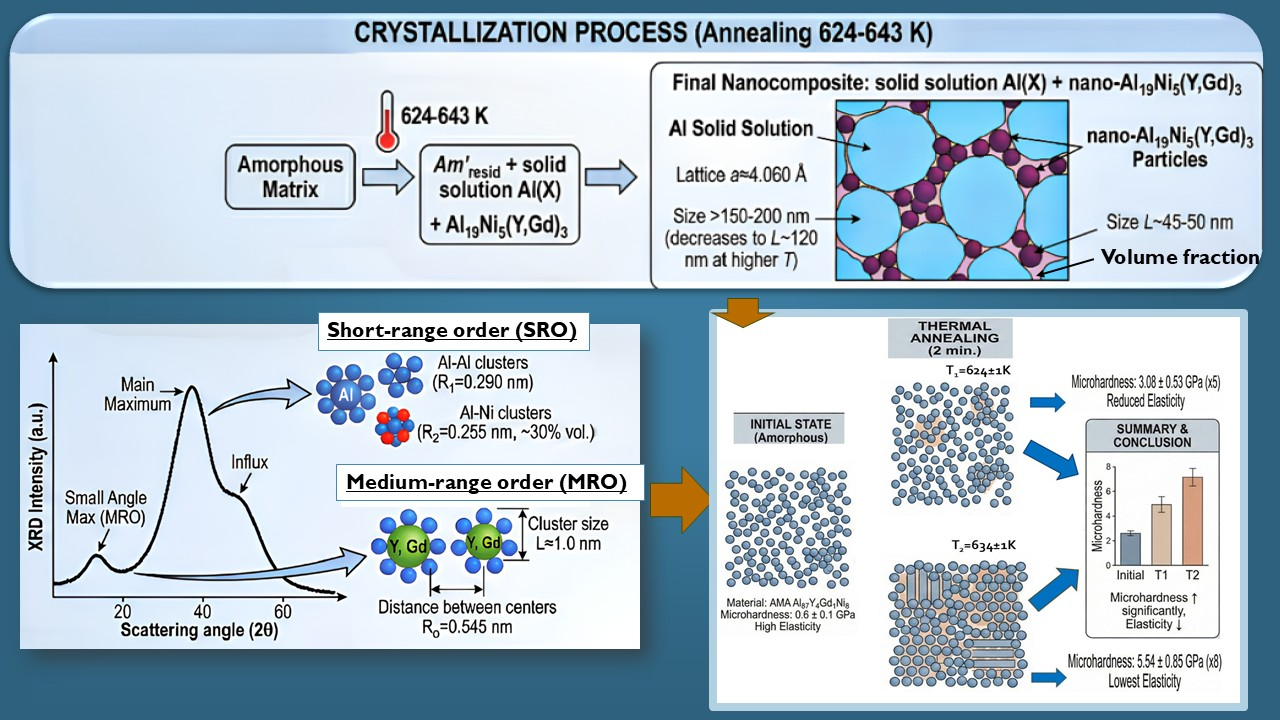
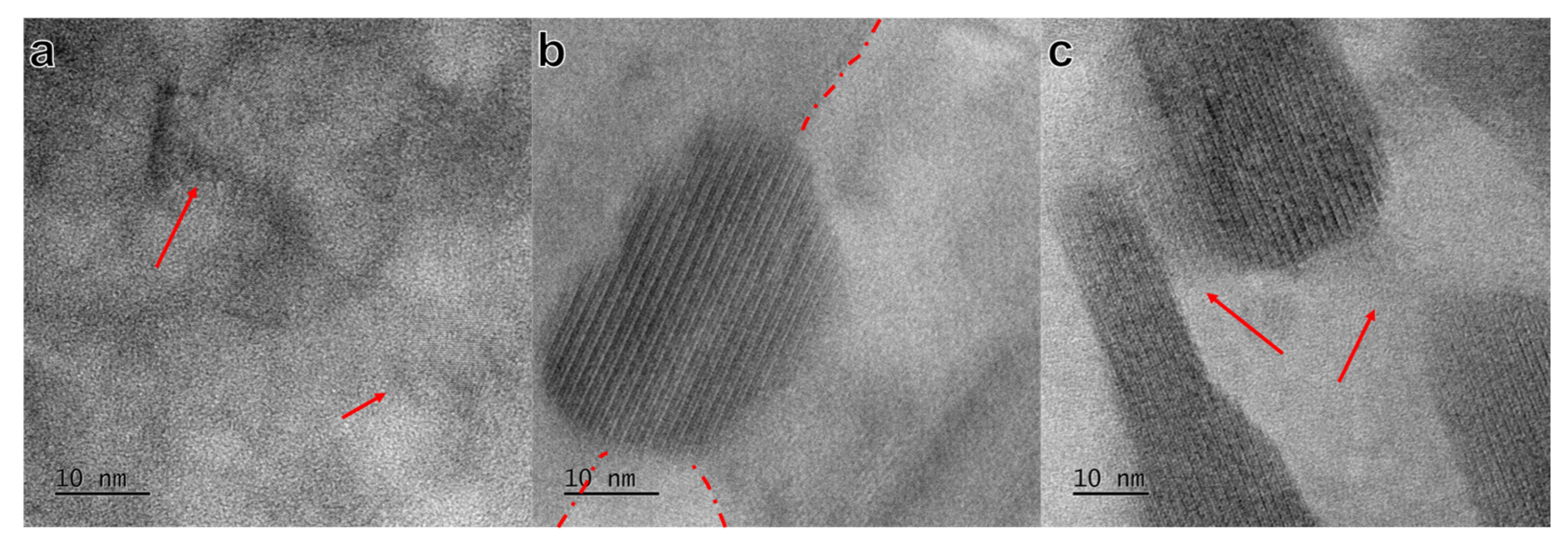
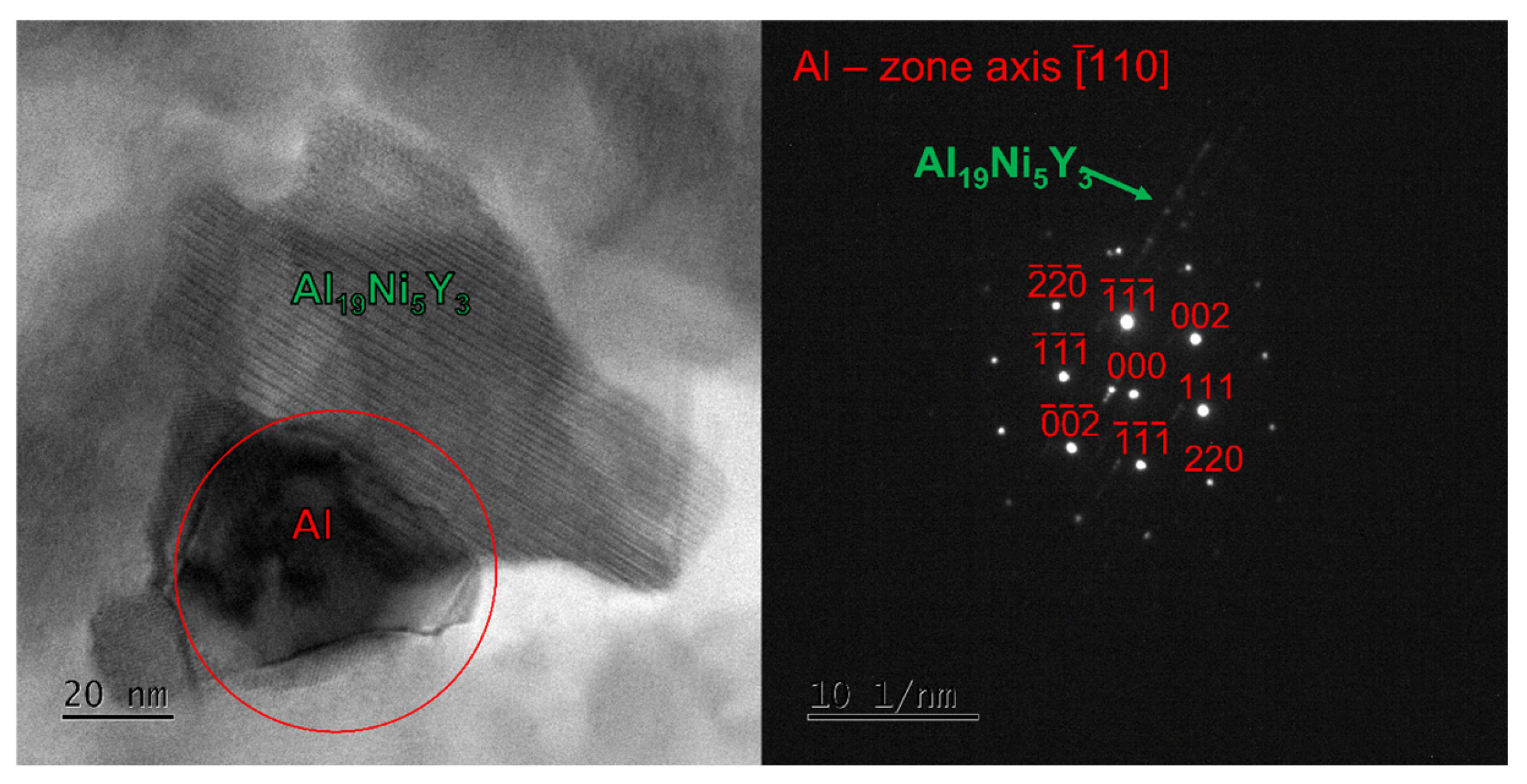
- It has been established that during isothermal annealing in the temperature range of 624–643 K, a thermally stable compound Al19Ni5(Y,Gd)3 is formed.
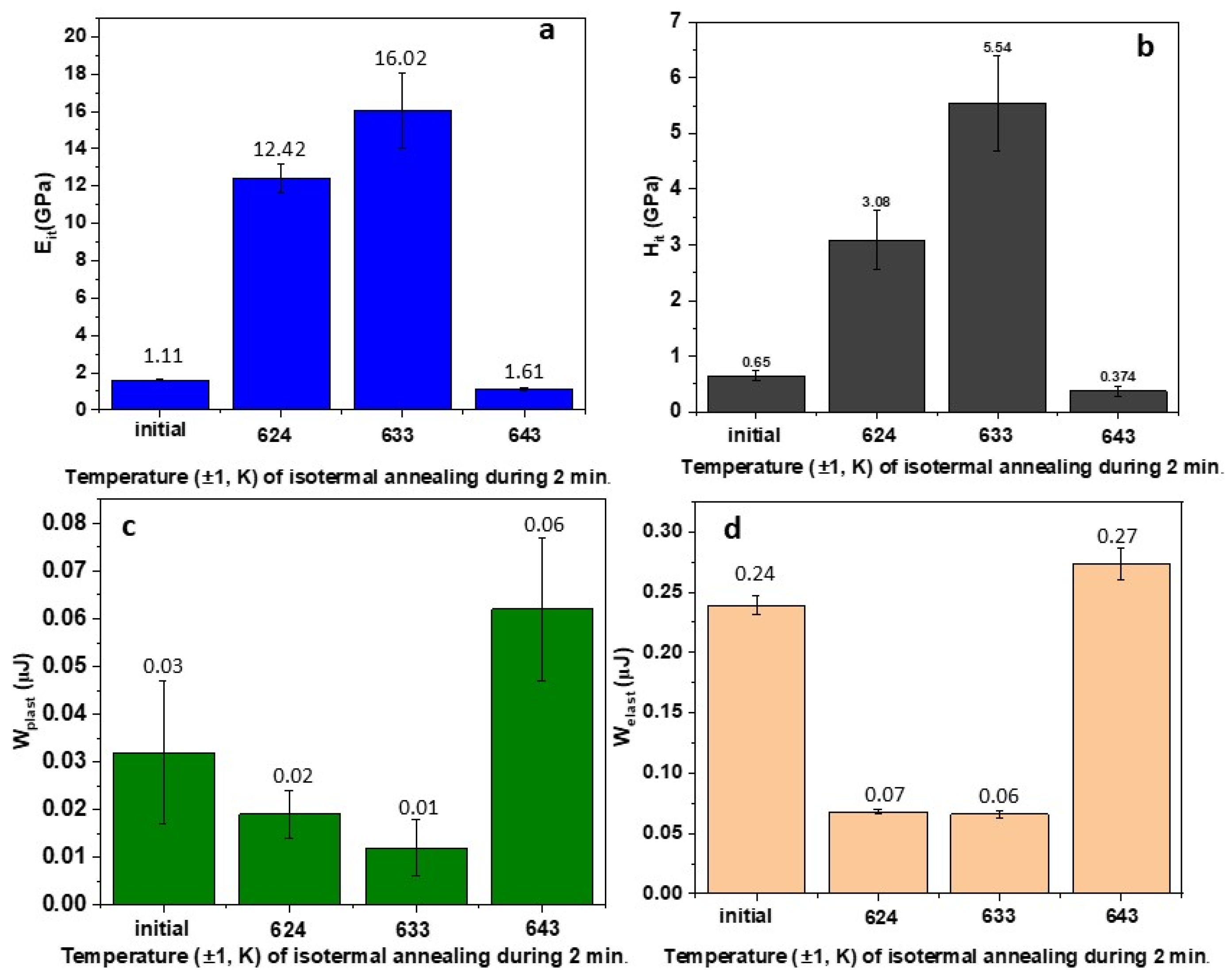
- Mechanical properties are improved by five and nine times after annealing at the temperatures of nucleation (T1 = 624 ± 1 K) and crystal growth (T2 = 633 ± 1 K) compared to the initial state of the amorphous metal sample.
Abstract
1. Introduction
1.1. Types of Crystallization
- (i)
- The temperature limits of crystallization depend on the composition of the AMA, the heating rate, and the energy barrier of the transition [7,8,9,10,11,12,13,14,15]. Thermal crystallization is the most common method for analyzing the stability of the amorphous state [1,6,8,10]. This type of crystallization occurs when heated above the glass transition temperature (Tg), at which atomic mobility increases and the nucleation of a crystalline phase begins. Thermal crystallization usually occurs in two stages:
- Primary crystallization, accompanied by the formation of nanocrystalline nuclei (phases with grain sizes of ~5–20 nm);
- Secondary crystallization, during which grain growth and coalescence occur, forming stable/metastable phases.
- (ii)
- This type of crystallization is local in nature: crystal nuclei may appear in the deformation zone and grow due to mechanical energy. Depending on the intensity of the load and the temperature of the environment, this process may be reversible or lead to a complete transformation of the structure.
- (iii)
- The main mechanism is the lowering of the energy barrier for the nucleation of a new phase under the influence of pressure, which enhances diffusion processes even at relatively low temperatures.
1.2. Influence of Alloying Elements in Al–TM–REM Systems on Crystallization Processes
2. Materials
3. Methods of Investigation
3.1. Differential Scanning Calorimetry Analysis
3.2. X-Ray Diffraction Analysis
3.3. Transmission Electron Microscopy/High-Resolution Electron Microscopy Analysis
3.4. Scanning Electron Microscopy/Energy-Dispersive X-Ray Spectroscopy Analyses
3.5. Mechanical Analysis
4. Results and Discussion
4.1. Kinetics of the Crystallization Process and X-Ray Analysis of Phases Transmition Within the Temperature Range 624–643 ± 2 K
4.2. TEM/HREM Analysis of Phases Transmission Within the Temperature Range (624–643) ± 1 K
4.3. Changes in the Mechanical Properties of the AMA Al87Y4Gd1Ni8 Due to Phase Transition in the Temperature Range (624–643) ± 1 K
5. Conclusions
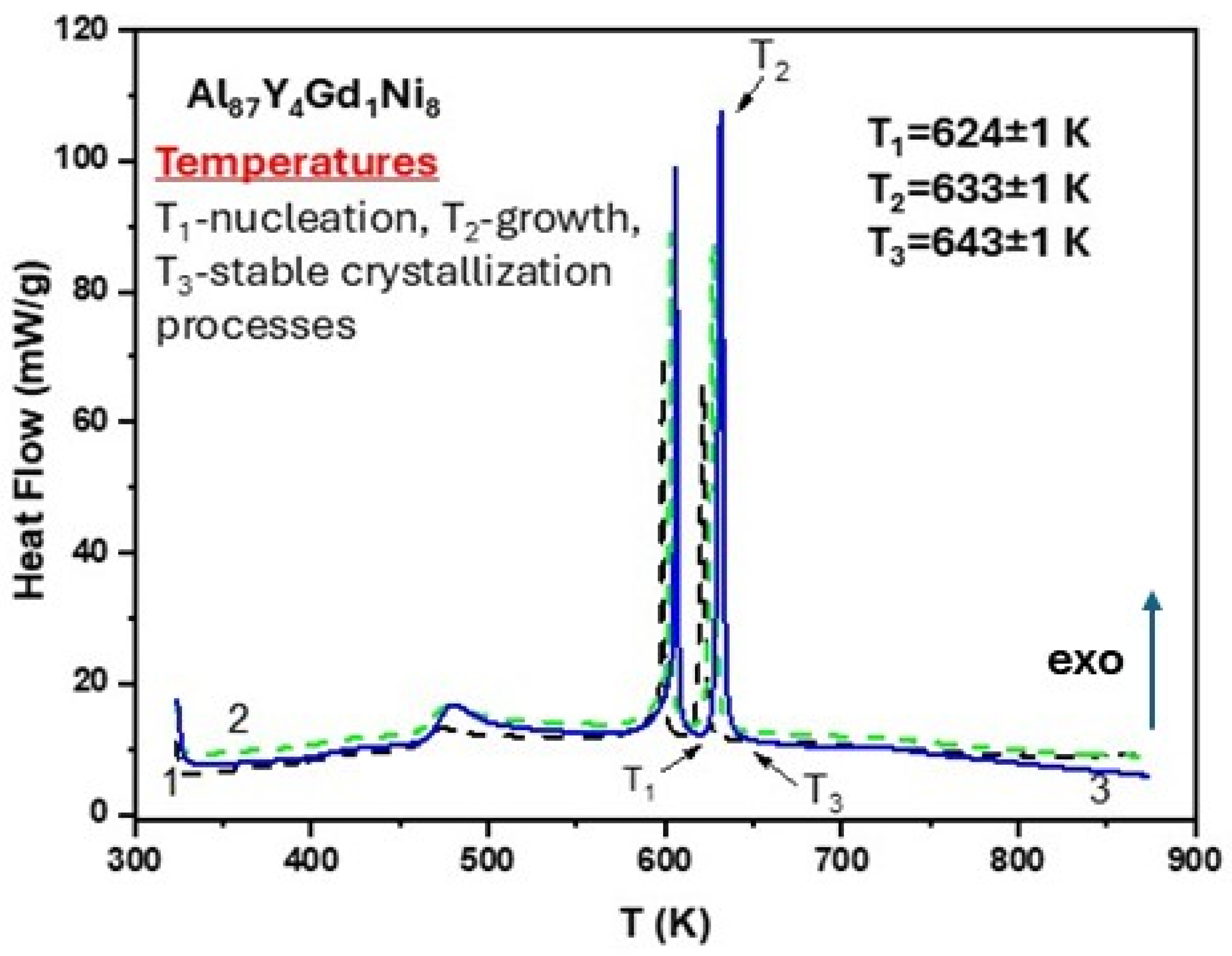
- The activation energy of the nucleation, growth and stable crystallization processes and the frequency factor (k0) were calculated for the AMA Al87Y4Gd1Ni8. The activation energy of the nucleation (T1 = 624 ± 1 K), growth (T2 = 633 ± 1 K) and stable crystallization (T3 = 643 ± 1 K) processes equals to 193 ± 12, 199 ± 30, and 188 ± 18 kJ/mol and the frequency factor equals to 2.0 × 10¹², 3.53 × 10¹³, and 4.41 × 10¹¹ s−1, respectively.
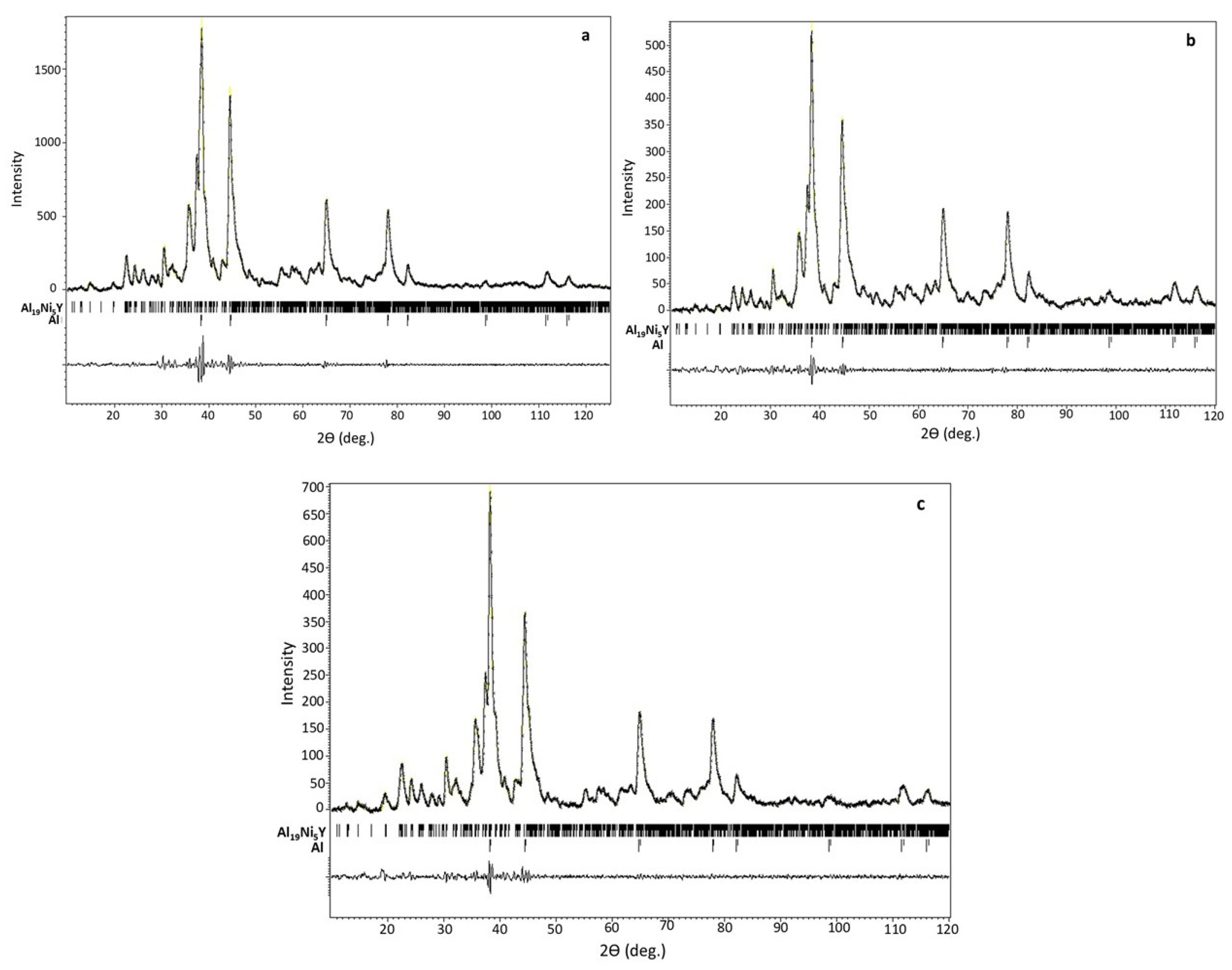
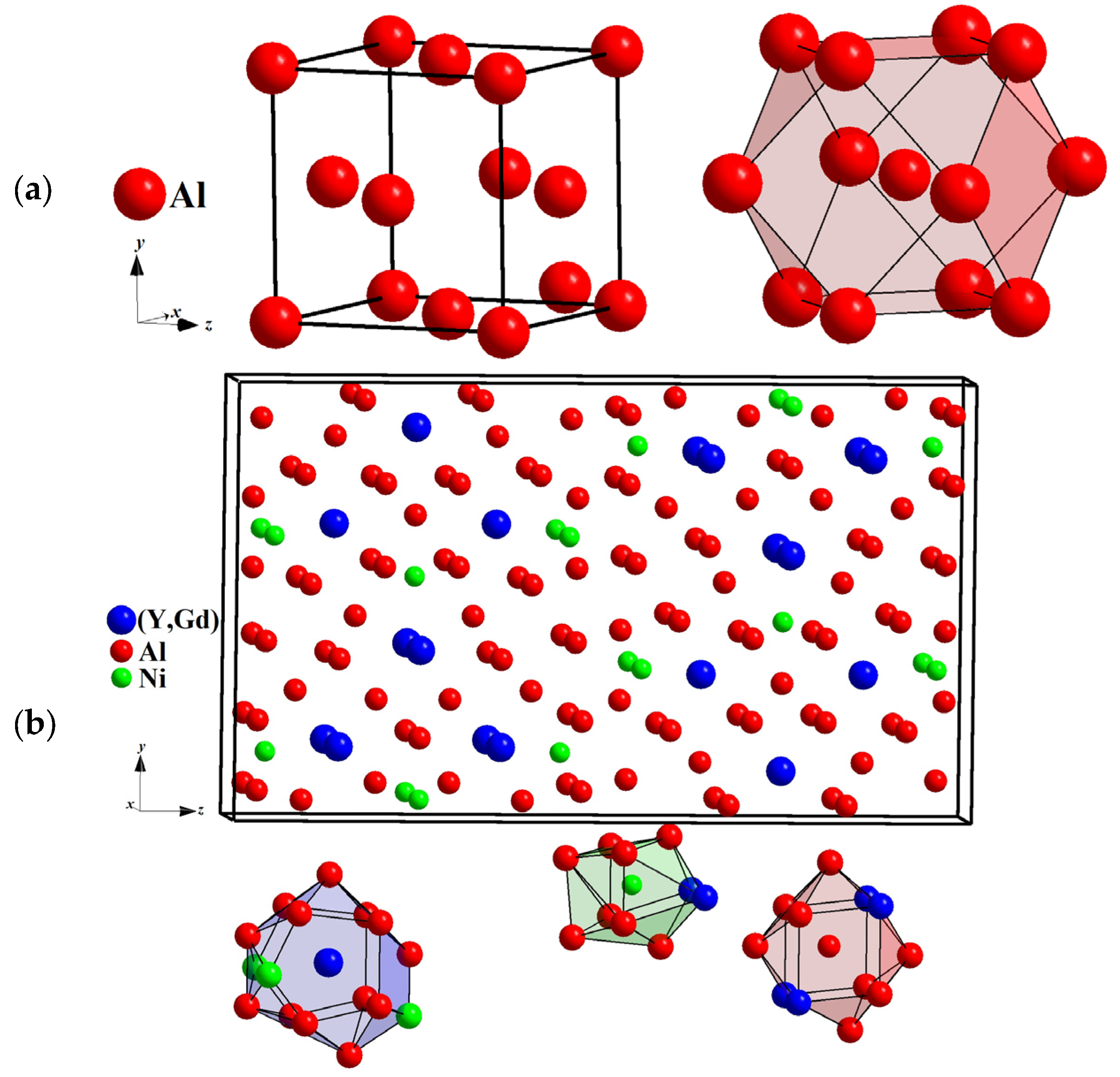
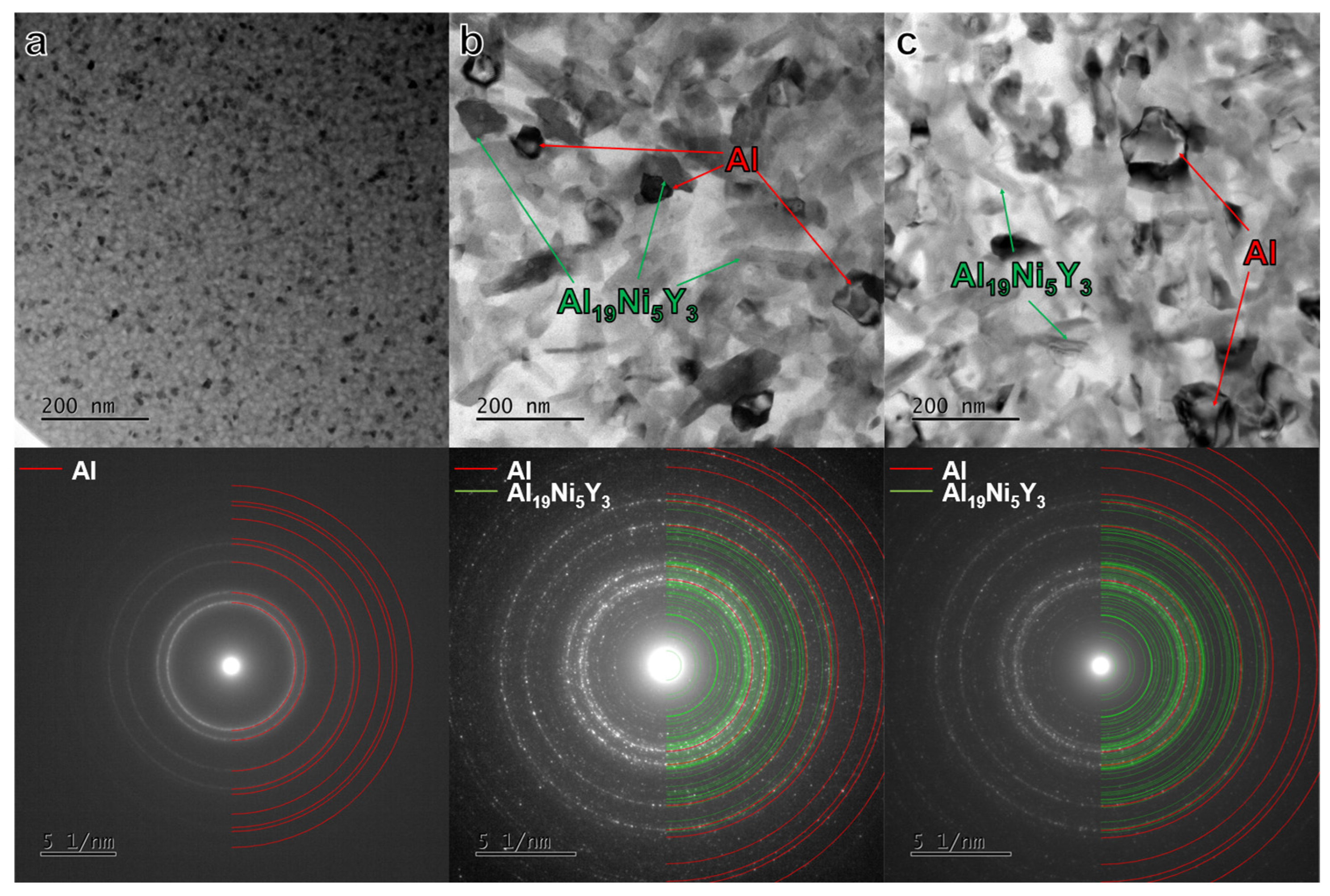
- It was established that during isothermal annealing in the temperature range of 624–643 K, a thermally stable compound Al19Ni5(Y,Gd)3 was formed.
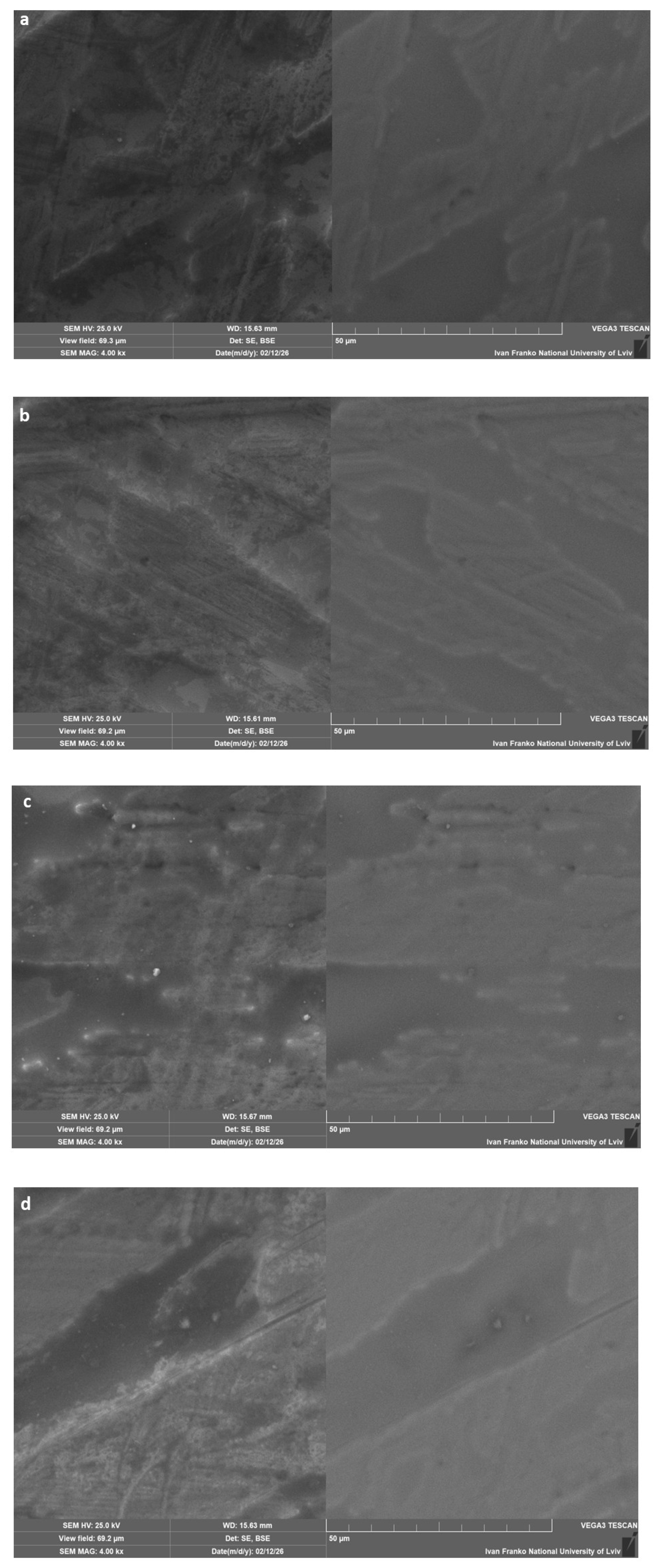
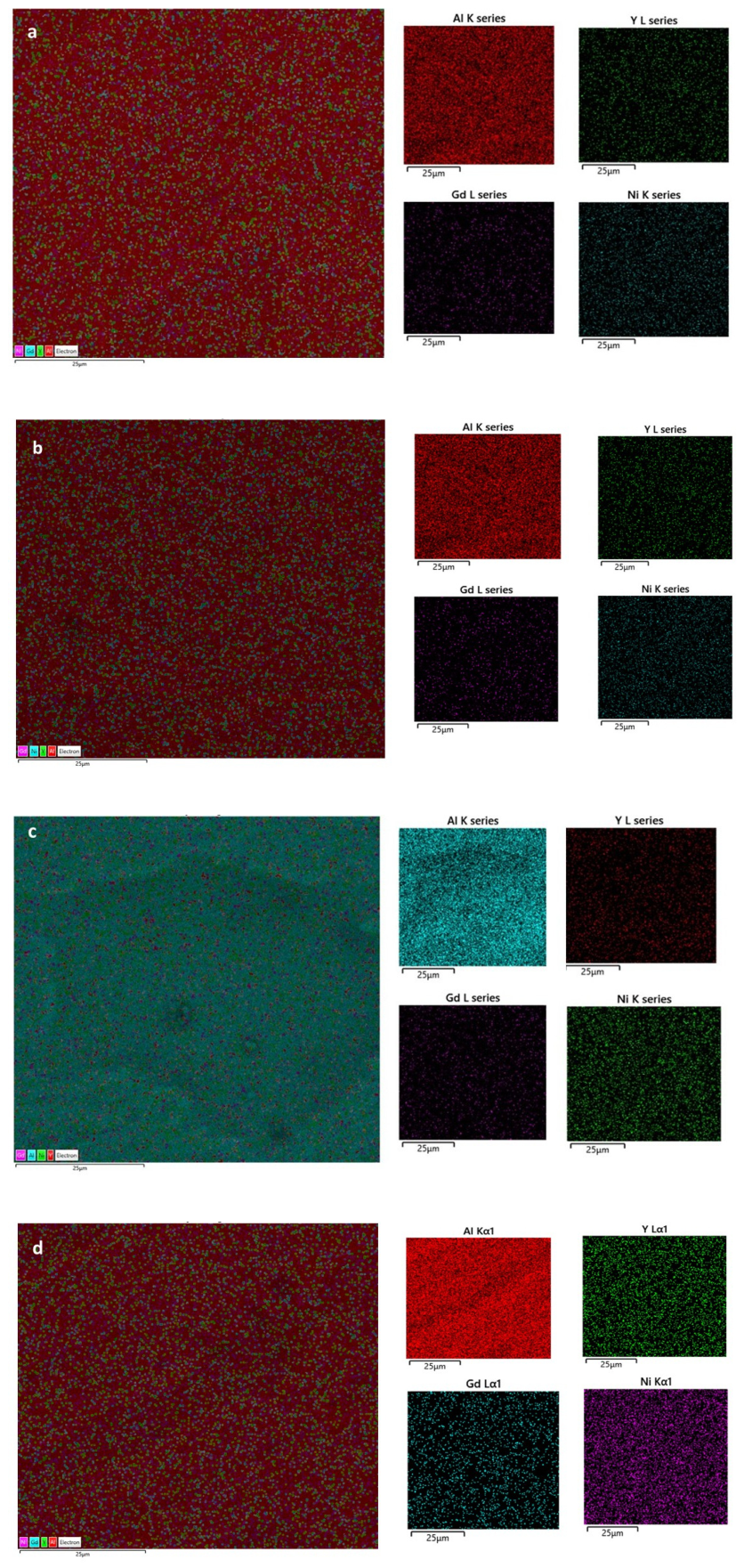
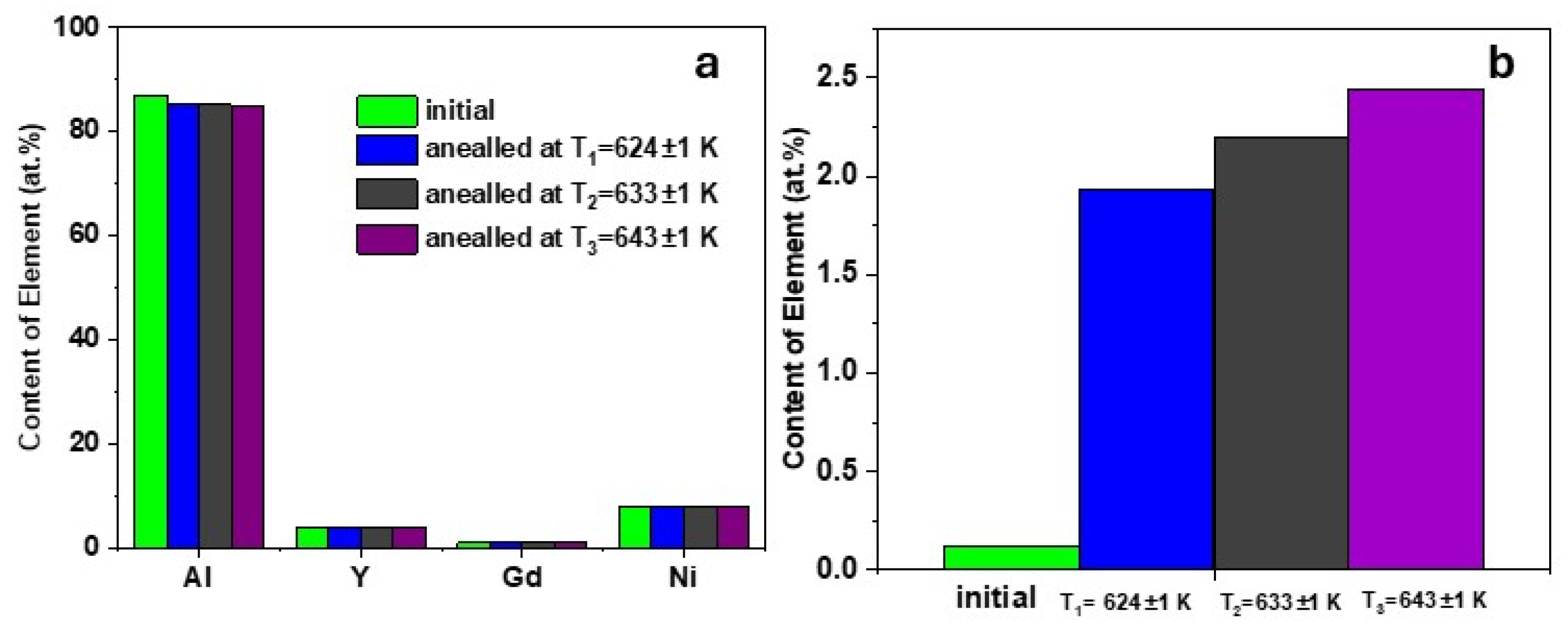
- Using the energy-dispersive spectroscopy method it was determined that as the annealing temperature increases, the oxygen content on the surface of the AMA rises while the aluminum content decreases by ±2 at.%, which may indicate the formation of a heterogeneous amorphous–crystalline oxide film.
- Mechanical properties are improved by five and nine times after annealing at the temperatures of nucleation (T1 = 624 ± 1 K) and crystal growth (T2 = 633 ± 1 K) compared to the initial state of the amorphous metal sample and equal 3.08 ± 0.53 GPa and 5.54 ± 0.85 GPa. Annealing at the temperatures of stable crystallization (T3 = 643 ± 1 K) sharply worsens this property of the material.
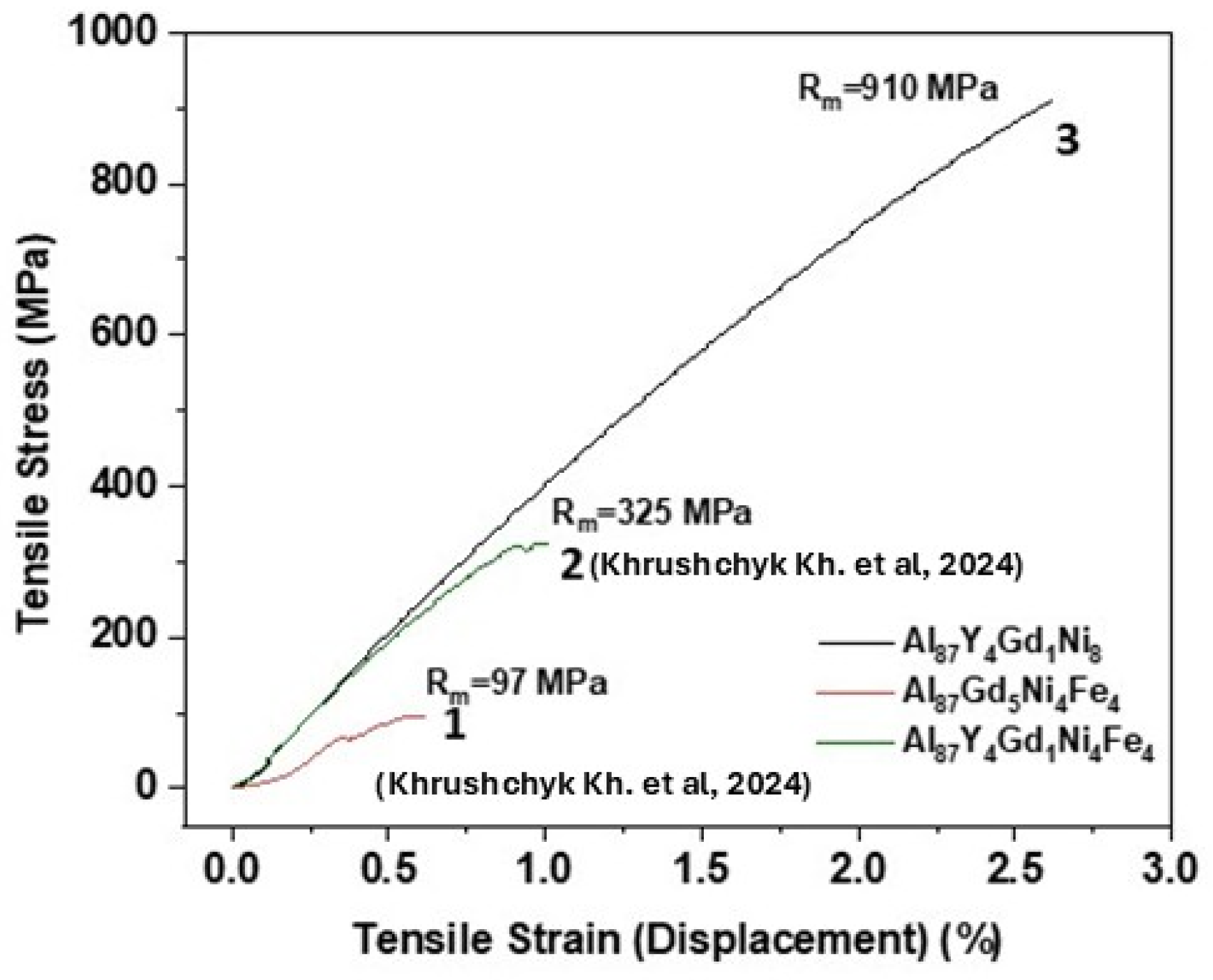
- For the AMA Al87Y4Gd1Ni8 the parameter of tensile strength is 910 MPa, which is three times higher than for the AMA Al87Y4Gd1Ni4Fe4.
Author Contributions
Funding
Data Availability Statement
Conflicts of Interest
Abbreviations
| AMA | Amorphous metal alloys |
| DSC | Differential Scanning Calorimetry |
| XRD | X-ray diffraction |
| TEM | Transmission Electron Microscopy |
| HREM | High-Resolution Electron Microscopy analysis |
| REE | Rare-earth element |
| GFA | Glass-forming ability |
| TM | Transition Metal |
References
- Boichyshyn, L.; Kovbuz, M.; Hertsyk, O.; Nosenko, V.; Kotur, B. Influence of Structurization of Amorphous Metallic Alloys Al87Y5−xGdxNi8−y (x = 0, 1, 5; y = 0, 4) on Their Mechanical Properties. Phys. Solid State 2013, 55, 243–246. [Google Scholar] [CrossRef]
- Mathi, S.; Akhdar, H.; Shetti, R.S.; Alinad, T.; Alodhayb, A.N.; Mondal, K.; Shetti, N.P. Amorphous Electrocatalysts for Oxygen and Hydrogen Evolution Reactions: Advances in Hydrogen Production. Mater. Today Sustain. 2025, 32, 101223. [Google Scholar] [CrossRef]
- Inoue, A. Amorphous, Nanoquasicrystalline and Nanocrystalline Alloys in Al-Based Systems. Prog. Mater. Sci. 1998, 43, 365–520. [Google Scholar] [CrossRef]
- Yang, W.-B.; Zhan, L.; Liu, L.; Meng, F.-X.; Zhang, R.; Tuerxun, K.; Zhao, X.-R.; Dong, B.-X.; Shu, S.-L.; Liu, T.-S.; et al. The Microstructure Regulation Mechanism and Future Application of Aluminum Alloys Manipulated by Nanocrystalline Structures Formed by In Situ Amorphous Crystallization. Materials 2025, 18, 4206. [Google Scholar] [CrossRef] [PubMed]
- Liu, S.; Li, H.; Zhong, J.; Xu, K.; Wu, G.; Liu, C.; Zhou, B.; Yan, Y.; Li, L.; Cha, W.; et al. A Crystal Glass–Nanostructured Al-Based Electrocatalyst for Hydrogen Evolution Reaction. Sci. Adv. 2022, 8, eadd6421. [Google Scholar] [CrossRef] [PubMed]
- Mika, T.; Karolus, M.; Haneczok, G.; Bednarska, L.; Łagiewka, E.; Kotur, B. Influence of Gd and Fe on Crystallization of Al87Y5Ni8 Amorphous Alloy. J. Non-Cryst. Solids 2008, 354, 3099–3106. [Google Scholar] [CrossRef]
- Khrushchyk, K.; Barylski, A.; Aniolek, K.; Karolus, M.; Boichyshyn, L. Mechanical Properties of Amorphous Metal Alloy Al87(Ni,Fe)8(REM)5 System as a Result of Short-Term Annealing. Phys. Chem. Solid State 2024, 25, 178–184. [Google Scholar] [CrossRef]
- Boichyshyn, L.M.; Hertsyk, O.M.; Kovbuz, M.O.; Pereverzeva, T.H.; Kotur, B.Y. Properties of Amorphous Alloys of Al–REM–Ni and Al–REM–Ni–Fe Systems with Nanocrystalline Structure. Mater. Sci. 2013, 48, 555–559. [Google Scholar] [CrossRef]
- Wang, D.B.; Zhang, S.D.; Wang, Q.; Zhang, L.M.; Wang, J.Q. Underlying Mechanism for the Effects of Composition and Microstructure on the Corrosion Resistance of Al-Based Amorphous Alloys: A Review. Crit. Rev. Solid State Mater. Sci. 2024, 49, 1120–1152. [Google Scholar] [CrossRef]
- Mudry, S.I.; Kulyk Yu, O.; Boichyshyn, L.M. Nanocrystallization of Amorphous Alloy Al87Ni8Dy5 Induced by Heat Treatment. Mater. Today Proc. 2022, 62, 5800–5804. [Google Scholar] [CrossRef]
- Zhang, L.; Yang, L.; Leng, J.; Wang, T.; Wang, Y. Alloying Behavior and Properties of Al-Based Composites Reinforced with Al85Fe15 Metallic Glass Particles Fabricated by Mechanical Alloying and Hot Pressing Consolidation. JOM J. Miner. Met. Mater. Soc. 2017, 69, 748–755. [Google Scholar] [CrossRef]
- Sun, C.; Zhou, X.; Lu, J.; Xie, L.; Li, R.; Wu, Y.; Dan, X.; Zhang, M. Formation of Al-Based Metallic Glasses Composites Prepared by Cold Spraying. J. Therm. Spray Technol. 2022, 31, 1844–1859. [Google Scholar] [CrossRef]
- Sahu, A.; Janardhan, N.; Amireddy, K.K.; Chinta, V.S.; Patnaik, L.; Singh, L.K. Aluminum-Based Amorphous Alloys and Composites Synthesized via Powder Metallurgy Route: A Review. Powder Metall. Met. Ceram. 2025, 63, 654–669. [Google Scholar] [CrossRef]
- Yuan, X.-J.; Zhang, Y.-R.; Qu, X.-H.; Yin, H.-Q.; Li, S.; Yan, Z.-W.; Tan, Z.-J.; Hu, S.-M.; Gao, Y.-G.; Guo, P.-Y. A Review of the Preparation and Prospects of Amorphous Alloys by Mechanical Alloying. J. Mater. Res. Technol. 2024, 33, 3117–3143. [Google Scholar] [CrossRef]
- Spoerer, Y.; Boldt, R.; Androsch, R.; Kuehnert, I. Pressure- and Temperature-Dependent Crystallization Kinetics of Isotactic Polypropylene under Process Relevant Conditions. Crystals 2021, 11, 1138. [Google Scholar] [CrossRef]
- Gu, X.J.; Ye, F.; Zhou, F.; Lu, K. Pressure Effect on Crystallization of Mechanically Alloyed Amorphous Al85Fe15 Alloy. Mater. Sci. Eng. A 2000, 278, 61–65. [Google Scholar] [CrossRef]
- Yao, B.; Liu, L.; Liu, S.E.; Ding, B.Z.; Su, W.H.; Li, Y. Effect of Local Pressure on the Crystallization Product of Amorphous Alloys Induced by Mechanical Milling. J. Non-Cryst. Solids 2000, 277, 91–97. [Google Scholar] [CrossRef]
- Yang, S.; Han, L.; Dang, N.; Wei, W. Effect of Aging Temperature on the Crystallization Characteristics of Bulk Fe-Based Amorphous Alloys. Mater. Res. Express 2025, 12, 035201. [Google Scholar] [CrossRef]
- Cao, S.; Liu, G.; Huang, J.; Yu, X.; Luo, Y.; Fan, D. Molecular Dynamics Study of Crystallization Behavior in the Solid State of Zr-Cu Amorphous Alloys. Metals 2023, 13, 1571. [Google Scholar] [CrossRef]
- Yao, B.; Liu, S.-E.; Liu, L.; Si, L.; Su, W.-H.; Li, Y. Mechanism of Mechanical Crystallization of Amorphous Fe–Mo–Si–B Alloy. J. Appl. Phys. 2001, 90, 1650–1654. [Google Scholar] [CrossRef]
- Wang, Q.; Wang, D.B.; Cui, J.P.; Li, T.R.; Emori, W.; Zhang, S.D.; Wang, J.Q. Corrosion Susceptibility of the Nanophases of the Al-Based Amorphous-Nanocrystalline Coatings. Corros. Sci. 2023, 223, 111474. [Google Scholar] [CrossRef]
- Hertsyk, O.; Boichyshyn, L.; Kovbuz, M.; Pandiak, N.; Nestoruk, T. Electrochemical Characteristics of Oligomer-Modified Amorphous Aluminum Alloys in Different Media. Visnyk Lviv. Universytetu. Seriya Khimichna 2022, 63, 355–362. [Google Scholar] [CrossRef]
- Al-Moubaraki, A.H.; Albeladi, M.L. Hydrogen Production via Corrosion of Aluminum Alloys: Influence of Alloy Composition, pH, and Temperature. Int. J. Electrochem. Sci. 2025, 20, 101022. [Google Scholar] [CrossRef]
- Lyu, C.; Loh, A.; Jones, M.; Trudgeon, D.; Corbin, J.; Cao, J.; Zhang, Z.; Connor, P.; Li, X. Electrodeposition and Optimisation of Amorphous NixSy Catalyst for Hydrogen Evolution Reaction in Alkaline Environment. Chem. Eur. J. 2024, 30, e202403030. [Google Scholar] [CrossRef] [PubMed]
- Khrushchyk, K.; Lopachak, M.; Hula, T.; Boichyshyn, L. Microhardness of the Amorphous and Nanostructured Alloys System Al87(Y, Gd)5Ni8 as Electrodes for Hydrogen Evolution. In Proceedings of the 2nd International Scientific Conference “Chemical Technology and Engineering”, Lviv, Ukraine, 24–28 June 2019; pp. 311–316. [Google Scholar] [CrossRef]
- Ogbonna, V.E.; Popoola, O.M.; Popoola, A.P.I. Aluminium-Based Electrode Materials for Green Hydrogen Production through Electrolysis and Hydrolysis: A Review. Discov. Mater. 2025, 5, 185. [Google Scholar] [CrossRef]
- Babilas, R.; Młynarek-Żak, K.; Łoński, W.; Łukowiec, D.; Lis, M.; Kądziołka-Gaweł, M.; Warski, T.; Radoń, A. Influence of Fe, Cr, and Cu Addition on the Microstructure, Hardness, and Anticorrosion Properties of Al–Ni–Y Alloys. Arch. Civ. Mech. Eng. 2022, 22, 82. [Google Scholar] [CrossRef]
- Kuball, A.; Stolpe, M.; Busch, R. Crystallization Behavior of the Al86Ni8Y6 Metallic Glass Forming Alloy upon Rapid Cooling. J. Alloys Compd. 2018, 737, 398–404. [Google Scholar] [CrossRef]
- Styles, M.J.; Sun, W.W.; East, D.R.; Kimpton, J.A.; Gibson, M.A.; Hutchinson, C.R. On the Competition in Phase Formation during the Crystallisation of Al-Ni-Y Metallic Glasses. Acta Mater. 2016, 117, 170–187. [Google Scholar] [CrossRef]
- Babilas, R.; Łoński, W.; Młynarek, K.; Bajorek, A.; Radoń, A. Relationship Between the Thermodynamic Parameters, Structure, and Anticorrosion Properties of Al-Zr-Ni-Fe-Y Alloys. Metall. Mater. Trans. A 2020, 51, 4215–4227. [Google Scholar] [CrossRef]
- Babilas, R.; Młynarek-Żak, K.; Łoński, W.; Łukowiec, D.; Warski, T.; Radoń, A. Study of Crystallization Mechanism of Al-Based Amorphous Alloys by In-Situ High Temperature X-Ray Diffraction Method. Sci. Rep. 2022, 12, 5733. [Google Scholar] [CrossRef] [PubMed]
- Duan, T.; Shen, Y.; Imhoff, S.D.; Yi, F.; Voyles, P.M.; Perepezko, J.H. Nucleation kinetics model for primary crystallization in Al–Y–Fe metallic glass. J. Chem. Phys. 2023, 158, 064504. [Google Scholar] [CrossRef] [PubMed]
- Nguyen, V.H.; Nguyen, O.T.H.; Dudina, D.V.; Le, V.V.; Kim, J.-S. Crystallization kinetics of Al-Fe and Al-Fe-Y amorphous alloys produced by mechanical milling. J. Nanomater. 2016, 2016, 1909108. [Google Scholar] [CrossRef]
- Khrushchyk, K.; Balin, K.; Kordan, V.; Golba, S.; Karolus, M.; Boichyshyn, L. Effect of short heat treatment of amorphous metal alloy on decolorization dye Mendola Blue. J. Ecol. Eng. 2024, 25, 243–252. [Google Scholar] [CrossRef] [PubMed]
- Mudryi, S.I.; Korolyshyn, A.V.; Kotur, B.Y.; Bednars’ka, L.M.; Hertsyk, O.M.; Kovbuz, M.O. Evaluation of the volume fraction of the crystalline phase in amorphous alloys. Mater. Sci. 2005, 41, 427–431. [Google Scholar] [CrossRef]
- Boichyshyn, L.M.; Khrushchyk, K.I.; Kovbuz, M.O.; Hertsyk, O.M.; Hula, T.H. Specific features of the transition of amorphous Al87REM5Ni8(Fe) alloys into the crystalline state under the influence of temperature. Mater. Sci. 2019, 55, 17–26. [Google Scholar] [CrossRef]
- Pierwoła, A.; Lelito, J.; Szucki, M.; Krawiec, H. Different Methods for Calculation of Activation Energies During Non-Isothermal Annealing of Mg72Zn27Pt1 and Mg72Zn27Cu1 Metallic Glasses. Materials 2025, 18, 694. [Google Scholar] [CrossRef] [PubMed]
- Shved, O.; Mudry, S. Icosahedral phases in the melt-spun Al–Fe–V alloys. Mater. Res. Express 2025, 12, 056504. [Google Scholar] [CrossRef]
- Oliver, W.C.; Pharr, G.M. An improved technique for determining hardness and elastic modulus using load and displacement sensing indentation experiments. J. Mater. Res. 1992, 7, 1564–1583. [Google Scholar] [CrossRef]
- ISO 14577-1:2015; Metallic Materials—Instrumented Indentation Test for Hardness and Materials Parameters—Part 1: Test Method. ISO: Geneva, Switzerland, 2015.
- DIN 50359-1 E: 1997; Testing of Metallic Materials—Universal Hardness Testing—Part 1: Test Method. German Institute for Standardisation (Deutsches Institut für Normung): Berlin, Germany, 1997.
- Khrushchyk, K.; Kubisztal, J.; Aniołek, K.; Świec, P.; Karolus, M.; Boichyshyn, L.; Nosenko, A.; Pihel, V. Short-Term Annealing Effect on Hydrogen Evolution Activity of Amorphous Al87Y4Gd1Ni4Fe4. Materials 2026, 19, 901. [Google Scholar] [CrossRef] [PubMed]
- Fan, C.; Liaw, P.K.; Liu, C.T. Atomistic model of amorphous materials. Intermetallics 2009, 17, 86–87. [Google Scholar] [CrossRef]
- Lei, T.; Hessong, E.C.; Gianola, D.S.; Rupert, T.J. Binary nanocrystalline alloys with strong glass forming interfacial regions: Complexion stability, segregation competition, and diffusion pathways. Mater. Charact. 2023, 206, 113415. [Google Scholar] [CrossRef]
- Lei, T.; Shin, J.; Gianola, D.S.; Rupert, T.J. Bulk nanocrystalline Al alloys with hierarchical reinforcement structures via grain boundary segregation and complexion formation. Acta Mater. 2021, 221, 117394. [Google Scholar] [CrossRef]
- Zhao, H.; De Geuser, F.; Da Silva, A.K.; Szczepaniak, A.; Gault, B.; Ponge, D.; Raabe, D. Segregation assisted grain boundary precipitation in a model Al-Zn-Mg-Cu alloy. Acta Mater. 2018, 156, 318–329. [Google Scholar] [CrossRef]
- Zhu, F.; Song, S.; Reddy, K.M.; Hirata, A.; Chen, M. Spatial heterogeneity as the structure feature for structure–property relationship of metallic glasses. Nat. Commun. 2018, 9, 3965. [Google Scholar] [CrossRef] [PubMed]
- Khrushchyk, K.; Kubisztal, J.; Balin, K.; Aniołek, K.; Kordan, V.; Karolus, M.; Boichyshyn, L. The Effect of Short-Term Annealing of the Amorphous Metal Alloy Al87Y4Gd1Ni8 on Surface Morphology and Electrochemical Properties. Materials 2026, 19, 670. [Google Scholar] [CrossRef] [PubMed]
- Wang, L.; Ma, L.; Kimura, H.; Inoue, A. Amorphous forming ability and mechanical properties of rapidly solidified Al–Zr–LTM (LTM=Fe, Co, Ni and Cu) alloys. Mater. Lett. 2002, 52, 47–52. [Google Scholar] [CrossRef]
- Inoue, A.; Ohtera, K.; Tsai, A.P.; Masumoto, T. Aluminum-Based Amorphous Alloys with Tensile Strength above 980 MPa (100 kg/mm2). Jpn. J. Appl. Phys. 1988, 27, L479–L482. [Google Scholar] [CrossRef]
- Li, F.C.; Liu, T.; Zhang, J.Y.; Shuang, S.; Wang, Q.; Wang, A.D.; Wang, J.G.; Yang, Y. Amorphous–nanocrystalline alloys: Fabrication, properties, and applications. Mater. Today Adv. 2019, 4, 100027. [Google Scholar] [CrossRef]
- Kim, S.-Y.; Lee, G.-Y.; Park, G.-H.; Kim, H.-A.; Lee, A.-Y.; Scudino, S.; Prashanth, K.G.; Kim, D.-H.; Eckert, J.; Lee, M.-H. High strength nanostructured Al-based alloys through optimized processing of rapidly quenched amorphous precursors. Sci. Rep. 2018, 8, 1090. [Google Scholar] [CrossRef] [PubMed]

| System of AMA | Ta, K | Number of Phase Transition Stages | Activation Energy, kJ/mol | Identified Phases |
|---|---|---|---|---|
| Al–Y(Gd)–Ni | 615–630 | 1–3 | ~160–200 | Al, Al3Y, Al3Gd, Al3Ni, Al23Ni6Y4, Al19Ni5Y3 |
| Al–Y(Gd)–Ni–Fe | 600–670 | 3–5 | ~150–250 | Al, AlFe, Al3Ni, Al13Fe4, Al23Ni6Y4, Al10Fe2Y, Al19Ni5Y3 Al15Fe9Y2 |
| Amorphous Phase | 2θ, ° | S, nm−1 | I/I0 | FWHM | R, nm | L, nm |
|---|---|---|---|---|---|---|
| Ph1 | 19.5 | 14.0 | 7.7 | 5.87 | 0.550 | 1.1 |
| Ph2 | 38.1 | 27.0 | 100 | 3.96 | 0.290 | 1.6 |
| Ph3 | 43.8 | 31.0 | 33.7 | 5.53 | 0.250 | 1.1 |
| Temperatures of Annealing ± 1, K | Phase Composition | Space Group | Parameters of the Crystalline Cell, Å | L, nm |
|---|---|---|---|---|
| 624 | Al | Fm-3m | 4.0604 ± 0.0005 | >150–200 |
| Al19Ni5(Y,Gd)3 | Cmcm | 4.0713 ± 0.0007 | ~45–50 | |
| 16.007 ± 0.0031 | ||||
| 26.932 ± 0.0058 | ||||
| 633 | Al | Fm-3m | 4.0622 ± 0.0004 | >150–200 |
| Al19Ni5(Y,Gd)3 | Cmcm | 4.0806 ± 0.0004 | ~45–50 | |
| 16.0040 ± 0.0018 | ||||
| 27.0060 ± 0.0035 | ||||
| 643 | Al | Fm-3m | 4.0597 ± 0.0005 | ~120 |
| Al19Ni5(Y,Gd)3 | Cmcm | 4.0787 ± 0.0006 | ~45–50 | |
| 15.9826 ± 0.0023 | ||||
| 26.9840 ± 0.0048 |
| Temperature of Annealed ± 1, K | hmax (µm) |
|---|---|
| initial | 5.324 ± 0.084 |
| 624 | 2.075 ± 0.085 |
| 633 | 1.765 ± 0.100 |
| 643 | 6.511 ± 0.072 |
Disclaimer/Publisher’s Note: The statements, opinions and data contained in all publications are solely those of the individual author(s) and contributor(s) and not of MDPI and/or the editor(s). MDPI and/or the editor(s) disclaim responsibility for any injury to people or property resulting from any ideas, methods, instructions or products referred to in the content. |
© 2026 by the authors. Licensee MDPI, Basel, Switzerland. This article is an open access article distributed under the terms and conditions of the Creative Commons Attribution (CC BY) license.
Share and Cite
Khrushchyk, K.; Świec, P.; Kulyk, Y.; Aniołek, K.; Kordan, V.; Karolus, M.; Boichyshyn, L. Thermally Initiated Structural Transformations in the Temperature Range (624–643) ± 1 K for Amorphous Metal Alloy Al87Y4Gd1Ni8 and Influence on Mechanical Properties. Materials 2026, 19, 3194. https://doi.org/10.3390/ma19153194
Khrushchyk K, Świec P, Kulyk Y, Aniołek K, Kordan V, Karolus M, Boichyshyn L. Thermally Initiated Structural Transformations in the Temperature Range (624–643) ± 1 K for Amorphous Metal Alloy Al87Y4Gd1Ni8 and Influence on Mechanical Properties. Materials. 2026; 19(15):3194. https://doi.org/10.3390/ma19153194
Chicago/Turabian StyleKhrushchyk, Khrystyna, Paweł Świec, Yurii Kulyk, Krzysztof Aniołek, Vasyl Kordan, Małgorzata Karolus, and Lidiya Boichyshyn. 2026. "Thermally Initiated Structural Transformations in the Temperature Range (624–643) ± 1 K for Amorphous Metal Alloy Al87Y4Gd1Ni8 and Influence on Mechanical Properties" Materials 19, no. 15: 3194. https://doi.org/10.3390/ma19153194
APA StyleKhrushchyk, K., Świec, P., Kulyk, Y., Aniołek, K., Kordan, V., Karolus, M., & Boichyshyn, L. (2026). Thermally Initiated Structural Transformations in the Temperature Range (624–643) ± 1 K for Amorphous Metal Alloy Al87Y4Gd1Ni8 and Influence on Mechanical Properties. Materials, 19(15), 3194. https://doi.org/10.3390/ma19153194