Laser Additively Manufactured High-Entropy Alloys via Laser Powder Bed Fusion and Laser-Directed Energy Deposition: Process–Structure–Property Relationships and Design Strategies




Abstract
1. Introduction
2. Fundamentals of HEAs
3. Laser-Based Additive Manufacturing Techniques
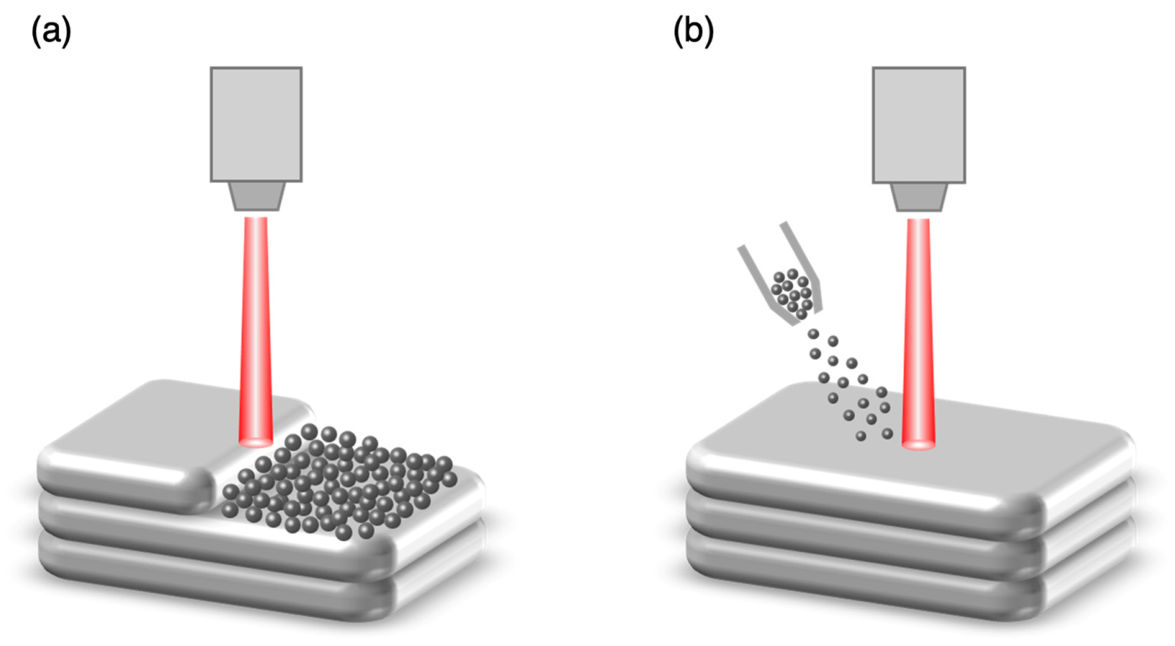
3.1. Laser Powder Bed Fusion (LPBF)
3.2. Laser-Directed Energy Deposition (LDED)
3.3. Process Comparison

| Parameter | LPBF | LDED | Influence on HEAs | Ref. |
|---|---|---|---|---|
| Laser power | 50–400 W [31,54,55,56] | 600–4500 W; up to ~12 kW for some RHEAs [52,57,58] | Melt-pool size, porosity, dilution | [31,52,54,55,56,57,58] |
| Scan speed | 600–1200 mm s−1 [55,56,59,60] | 4–20 mm s−1 [19,52,61] | Cooling rate, LoF/keyhole transition | [19,52,55,56,59,60,61] |
| Layer thickness | 20–50 μm [20,55,62,63] | 0.2–0.8 mm [52,57] | Resolution, thermal accumulation | [20,52,55,57,62,63] |
| Spot size | 50–100 μm [20,46,55] | 1–5 mm [26,52,64] | Build rate, grain size | [20,26,46,52,55,64] |
| Hatch spacing/track overlap | 40–100 μm [55,59,65,66] | 0.5–2.5 mm or 30–50% overlap ratio [64,67,68,69] | Controls inter-track bonding, porosity, residual stress distribution, and microstructural uniformity | [55,59,64,65,66,67,68,69] |
| Powder feed rate | Not applicable | 3–34 g min−1 | Affects deposition rate, powder catchment efficiency, dilution, and compositional stability | [52,58,61,68] |
| Shield/carrier gas | Inert chamber gas, typically Ar, N2 [20,70,71] | Shield gas, usually Ar; carrier gas, usually Ar or He [58,61,72,73] | Influences oxidation, powder delivery stability, spatter behavior, and oxygen pickup in oxygen-sensitive RHEAs | [20,58,61,70,71,72,73] |
| Standoff distance | Not applicable | Typically 10–20 mm | Affects powder stream focusing, catchment efficiency, bead geometry, dilution, and surface quality | [57,67] |
| Feedstock | Powder bed [31,55] | powder/wire feeding [58,67] | Composition flexibility | [31,55,58,67] |
| Typical application | Complex small parts [54,74] | repair/large parts/FGM [45,64,75] | Process selection | [45,54,64,74,75] |
| LPBF Process | LDED Process | Conventional Process | Ref. | |
|---|---|---|---|---|
| Cooling rate (K s−1) | Ultrafast (105~107) | Fast (102~104) | Slow (10−1~101) | [76] |
| Thermal gradient (K m−1) | Extremely high (106~107) | High (104~106) | Low (102~104) | [76] |
| Melt pool size | Microscale | Meso to Macroscale | Macroscale | [31] |
4. Process–Structure Relationships
4.1. Solidification Behavior
4.2. Phase Formation in Laser-Processed HEAs
4.3. Defects and Their Origins
4.3.1. Pores
4.3.2. Cracking
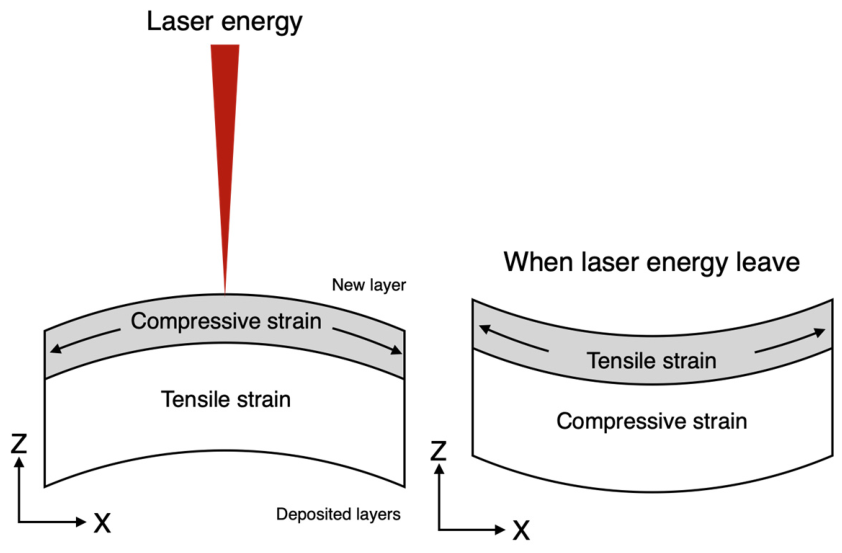
4.3.3. Residual Stress
4.3.4. Interaction Between Defects and Deformation Mechanisms
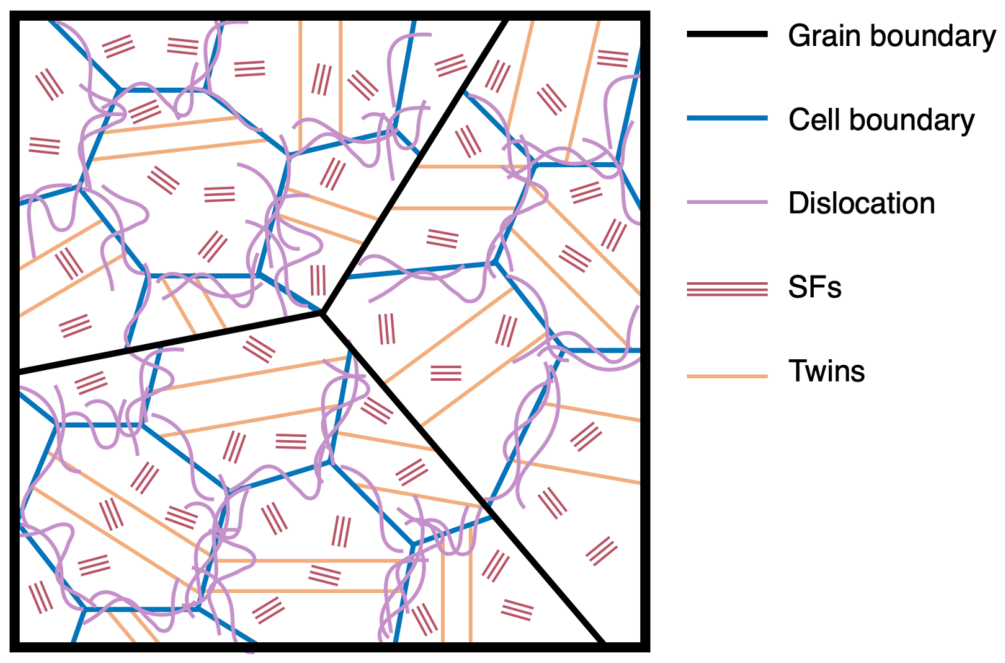
4.4. Microstructural Anisotropy
| Process Parameter | Microstructural Outcome | Typical Defects/Benefits | Ref. |
|---|---|---|---|
| Low VED | Incomplete melting of powder and underlying layers; limited melt-pool fluidity | Irregular LoF defects, unmelted particles, reduced density | [73] |
| High VED | Enlarged melt pool; possible evaporation of low-boiling-point elements such as Mn or Al; local compositional deviation | Keyhole porosity, spatter, rough surface, thermal distortion, increased residual stress, higher cracking tendency | [73] |
| Large hatch spacing | Discontinuous tracks and poor inter-track bonding | Inter-track LoF pores, cracks, reduced density | [73] |
| Small hatch spacing | Excessive melt-pool overlap and local heat accumulation | Residual stress accumulation, rough surface, distortion | [73] |
| Thick layer thickness | Incomplete interlayer bonding; insufficient remelting of prior layer | Large interlayer LoF defects and unmelted powder | [92] |
| Thin layer thickness | Nearly fully dense structure and good surface quality | Significantly reduced production efficiency | [92] |
| Scan rotation strategy | Interrupts continuous epitaxial columnar growth; weakens strong crystallographic texture | Reduces texture-driven anisotropy | [52] |
| Preheating | Lower residual thermal stress; possible grain coarsening at excessive preheating temperature | Suppresses hot cracking and distortion; excessive preheating may promote grain growth or undesired phase precipitation | [93] |
| Remelting | Re-melts unmelted refractory particles; improves elemental homogenization; may partially relax stress through in situ thermal cycling | Reduces LoF defects, unmelted particles, and microsegregation; excessive remelting may increase heat accumulation | [52] |
| Short interlayer dwell time | Possible in situ aging or precipitation | Heat accumulation, residual stress redistribution, possible phase coarsening | [61] |
4.5. Microstructure Comparison Between HEAs and Conventional Alloys Processed by Laser-Based AM
5. Composition Design for Laser-Based AM HEAs
5.1. Printability Criteria
5.2. Alloy Systems Reviewed
| Design Issue | Processing Route | Observed Defects | Dominant Cause | Alloy Class | Mitigation Mechanism | Key Parameter | Property Impact | Limitation | Example | Ref. |
|---|---|---|---|---|---|---|---|---|---|---|
| Solidification cracking | LPBF/LDED | Hot cracks along grain/cell boundaries | Wide freezing range, segregation | FCC/dual-phase | Reduces continuous solute-rich liquid films, narrows freezing range | Carbide inoculation, composition tuning | Suppresses hot cracking and improves printability | Excess carbide formation may reduce ductility | Cr3C2-added Cantor HEA | [96] |
| Unmelted particles | LPBF/LDED | Unmelted refractory particles and LoF pores | High-melting refractory elements | RHEA | Improves melting of high-melting-point elements | Higher energy density, remelting | Improves ductility | Excessive energy input may cause thermal accumulation, evaporation, or microstructural coarsening | Ti–V–Hf–Nb–Mo | [52] |
| Low room-temperature ductility | LPBF/LDED | Intergranular microcracks, brittle fracture | BCC brittleness, oxygen segregation | RHEA | Improves grain-boundary cohesion, suppresses oxygen segregation | C/B microalloying, oxygen control | Enhances crack resistance and damage tolerance | Excess C/B or continuous brittle carbide/boride networks may cause interstitial embrittlement | C-added CrMoNbV | [102] |
| Thermal softening | High-temperature exposure | Strength loss | Dislocation recovery | FCC | Introduces stable strengthening precipitates to compensate for dislocation recovery | Precipitate strengthening | Improves yield strength and thermal stability | Excessive or rapid precipitation may reduce ductility or induce strain-age cracking | L12/B2-strengthened HEA | [55,83] |
| Anisotropy | LPBF/LDED | Direction-dependent properties | Columnar grains, texture | FCC/EHEA | Refines grains, weakens texture, promotes equiaxed grains | Scan strategy, ultrasound, heat treatment | Reduces mechanical anisotropy | Heat treatment may dissolve beneficial cellular structures or reduce strength | CoCrFeMnNi | [59,90] |
6. Mechanical Properties
6.1. Room Temperature Properties

| Crystal Structure | Density (%) | Grain Size | Process | Build Orientation | Test Condition | Strain Rate (s−1) | Specimen Geometry | Yield Strength (MPa) | Tensile Strength (MPa) | Fracture Strain (%) | Ref. | |
|---|---|---|---|---|---|---|---|---|---|---|---|---|
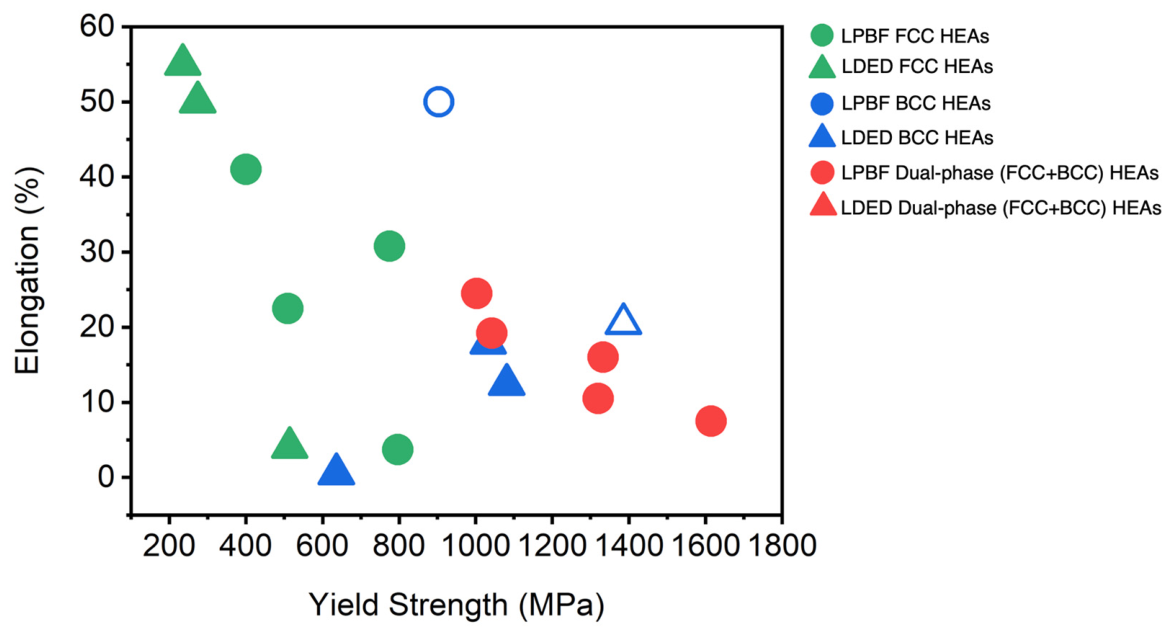
| CoCrFeNi | FCC | 99.5 | 38.5 μm | LPBF | 0° | Tensile | 3.33 × 10⁻⁴ | Dog-bone-shaped, gauge dimension of 25 × 3 × 1.5 mm3 | 509 | 649 | 22.5 | [70] |
| CoCrFeNiTi0.3 | FCC | 99.5 | 30.4 μm | LPBF | 0° | Tensile | 3.33 × 10⁻⁴ | Dog-bone-shaped, gauge dimension of 25 × 3 × 1.5 mm3 | 796 | 905 | 3.7 | [70] |
| CoCrFeNi + SS316L | FCC | - | 9 μm | LPBF | 0° | Tensile | 1 × 10⁻³ | Dog-bone-shaped, gauge dimension of 10 × 2.5 × 3.2 mm3 | 400 | 561 | 41 | [60] |
| CoCrFeMnNi | FCC | - | 6 μm | LPBF | 0° | Tensile | 1 × 10⁻³ | - | 775 | 923 | 31 | [114] |
| CoCrFeMnNi | FCC | 99.57 | 44 μm | LDED | 0° | Tensile | 1 × 10⁻⁴ | - | 274 | - | 50 | [90] |
| CoCrFeMnNi | FCC | 99.57 | 140 μm | LDED | 0° | Tensile | 1 × 10⁻⁴ | - | 235 | - | 55 | [90] |
| AlCoCrFeNiTi | FCC | - | 116 μm | LDED | 0° | Tensile | - | ASTM E8/E8M-18 standard | 514 | 605 | 4 | [73] |
| TiNbTaZrMo | BCC | 99.82 | 4–9 μm | LPBF | 90° | Compressive | 1 × 10⁻³ | Φ 6.5 × 6.5 mm2 | 904 | 2500 | 50 | [104] |
| Ti41V27Hf13Nb13Mo6 | BCC | - | ~130 μm | LDED | 0° | Tensile | 1 × 10⁻³ | gauge dimensions of 4 × 1.5 × 1 mm3 | 636 | - | 0.5 | [52] |
| Ti41V27Hf13Nb13Mo6 | BCC | - | ~150 μm | LDED | 0° | Tensile | 1 × 10⁻³ | gauge dimensions of 4 × 1.5 × 1 mm3 | 1033 | 1093 | 17.9 | [52] |
| Ti41V27Hf13Nb13Mo6 | BCC | - | ~140 μm | LDED | 0° | Tensile | 1 × 10⁻³ | gauge dimensions of 4 × 1.5 × 1 mm3 | 1081 | 1111 | 12.4 | [52] |
| Al0.8Nb0.5Ti2V2Zr0.5 | BCC | - | 44 μm for fine equiaxed grains, 101 μm for columnar grains | LDED | 90° | Compressive | 1 × 10⁻³ | Φ 4 × 6 mm2 | 1386 | 1590 | 20.5 | [47] |
| AlCoCrFeNi2.1 | Dual | >99 | BCC: 51 nm FCC: 181 nm | LPBF | 0° | Tensile | 1 × 10⁻³ | Dog-bone-shaped, gauge dimension of 12 × 2.5 × 1.5 mm3 | 1320 | 1590 | 10.5 | [107] |
| AlCoCrFeNi2.1 | Dual | >99.9 | BCC: 89 nm FCC: 128 nm | LPBF | 90° | Tensile | 5 × 10⁻⁴ | Dog-bone-shaped, gauge dimension of 6 × 2 × 2 mm3 | 1042 | 1380 | 19.2 | [106] |
| AlCoCrFeNi2.1 | Dual | - | - | LDED | 0° | Tensile | 1 × 10⁻³ | Dog-bone-shaped, gauge dimension of 8 × 2.5 × 1 mm3 | 554 | 954 | 24 | [112] |
| AlCoCrFeNi2.1 | Dual | - | - | LDED | 0° | Tensile | 1 × 10⁻³ | Dog-bone-shaped, gauge dimension of 8 × 2.5 × 1 mm3 | 637 | 1091 | 18.1 | [112] |
| AlCoCrFeNi2.1 | Dual | - | - | LDED | 0° | Tensile | 1 × 10⁻³ | Dog-bone-shaped, gauge dimension of 8 × 2.5 × 1 mm3 | 721 | 1105 | 13 | [112] |
| AlCoCrFeNi2.1 | Dual | >99.5 | BCC: 64 nm FCC: 151 nm | LPBF | 0° | Tensile | 2 × 10⁻⁴ | Dog-bone-shaped, gauge dimension of 8 × 2 × 1 mm3 | 1333 | 1640 | 16 | [76] |
6.2. High-Temperature Performance
| Crystal Structure | Density (%) | Grain Size | Process | Build Orientation | Test Condition | Strain Rate (s−1) | Specimen Geometry | Yield Strength (MPa) | Tensile Strength (MPa) | Fracture Strain (%) | Ref. | |
|---|---|---|---|---|---|---|---|---|---|---|---|---|
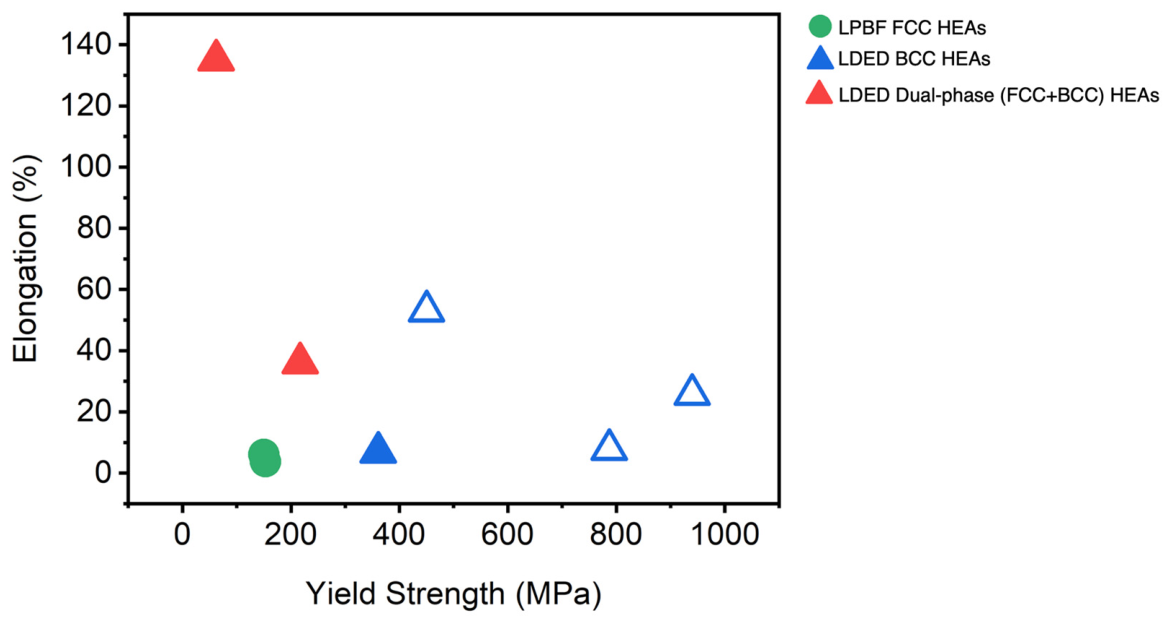
| FeCoCrNi | FCC | - | - | LPBF | 90° | Tensile/800 °C | 5 × 10⁻³ | Φ 5 mm with gauge length of 25 mm | 150 | - | 6.1 | [118] |
| FeCoCrNi | FCC | - | - | LPBF | 90° | Tensile/600 °C | 5 × 10⁻³ | Φ 5 mm with gauge length of 25 mm | 153 | - | 3.7 | [118] |
| Nb40Ta25Ti15Hf15Zr5 | BCC | - | - | LDED | 0° | Tensile/1000 °C | 1 × 10⁻³ | - | 361 | 497 | 6.8 | [57] |
| (Cr25Mo25Nb25V25)99C1 | BCC | - | 46 μm | LDED | 0° | Compressive/1000 °C | 1 × 10⁻³ | Φ 2 × 4 mm2 | 787 | 1377 | 7.7 | [102] |
| Al0.8Nb0.5Ti2V2Zr0.5 | BCC | 99.57 | 44 μm for fine equiaxed grains, 101 μm for columnar grains | LDED | 90° | Compressive/600 °C | 1 × 10⁻³ | Φ 4 × 6 mm2 | 940 | 1558 | 25.7 | [47] |
| Al0.8Nb0.5Ti2V2Zr0.5 | BCC | 99.57 | 44 μm for fine equiaxed grains, 101 μm for columnar grains | LDED | 90° | Compressive/800 °C | 1 × 10⁻³ | Φ 4 × 6 mm2 | 450 | 510 | ~53 | [47] |
| Fe36Ni35Al17Cr10Mo2 | Dual | - | - | LDED | 90° | Tensile/800 °C | 1 × 10⁻³ | Dog-bone-shaped, gauge dimension of 12.5 × 3 × 2 mm3 | ~217 | 217 | ~36 | [69] |
| Ni32Co30Cr10Fe10Al18 | Dual | - | - | LDED | 90° | Tensile/982 °C | 1 × 10⁻³ | - | ~62 | 62 | ~135 | [68] |
6.3. As-Built State Fatigue and Fracture
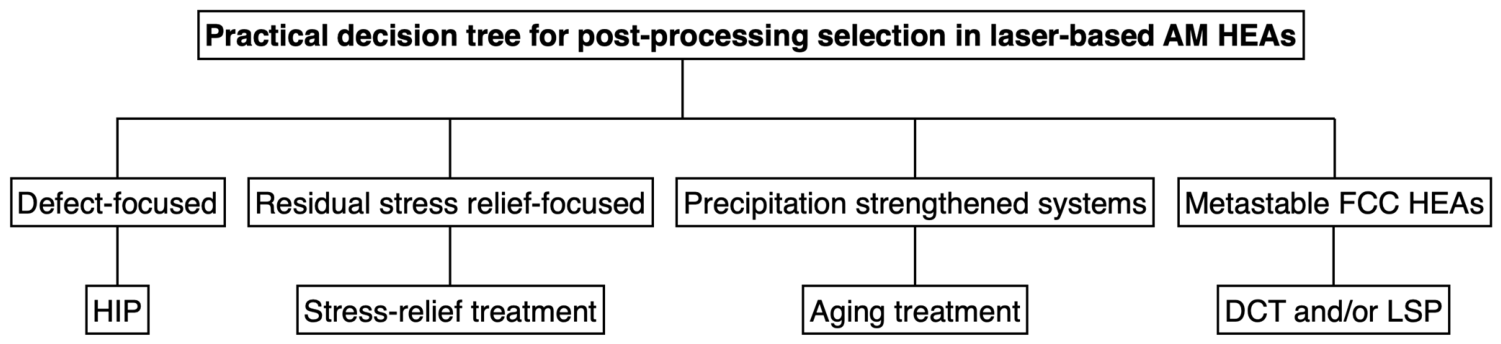
7. Post-Processing and Heat Treatment
| Post-Treatment | Condition | Main Purpose | Affected Alloy Types | Microstructural Effect | Benefit | Risk | Anticipated Property Trade-Off | Ref. |
|---|---|---|---|---|---|---|---|---|
| Stress relief | Low-to-medium temperature, typically 650–700 °C for 2–4 h, followed by air cooling or furnace cooling. | Residual stress reduction | Residual-stress-sensitive AM HEAs | Preserves cells, partial stress relaxation | Crack resistance, ductility improvement | Strength loss | Improves ductility and damage tolerance but may reduce yield strength and hardness. | [129] |
| Homogenization/Solution treatment | High-temperature annealing, typically 1000–1150 °C for 1–4 h. Cooling depends on alloy stability; rapid cooling or water quenching is preferred when brittle precipitation during cooling is a concern. | Segregation removal | HEAs with severe elemental segregation and alloys requiring chemical homogenization before further aging | Dissolves cell segregation | Improves chemical uniformity and ductility | Grain coarsening, strength loss | Improves uniform plasticity and microstructural stability, but often lowers yield strength and hardness. | [78,116,130,131,132,133] |
| aging | Intermediate temperature, commonly 600–800 °C for 4–30 h, usually followed by air cooling. | Precipitate strengthening | Precipitation-strengthened HEAs | L12/B2/Laves formation | High strength | SAC/brittleness | Strongly improves strength, but may reduce ductility if precipitation is excessive. | [55] |
| HIP | High temperature with high isostatic pressure, typically 1000–1150 °C, 100–150 MPa Ar, for 2–4 h. Cooling rate depends on the HIP system. | Pore closure | Broadly applicable to AM HEAs, especially defect-sensitive HEAs | Densification/recrystallization | Fatigue/fracture | Thermal softening | Maximizes densification and fatigue resistance but often sacrifices yield strength and hardness. | [134,135,136,137] |
| Cryo-treatment | Immersion in liquid nitrogen at −196 °C, typically 24–96 h, followed by rewarming to room temperature. | Stress tailoring | Metastable FCC HEAs, dual-phase HEAs | Phase transformation/grain refinement/residual stress reversal | Strength–ductility synergy | Phase instability | Can improve strength and ductility together in suitable metastable alloys, but benefits are limited in highly stable systems. | [58,138,139,140,141] |
| Laser shock peening | RT surface mechanical treatment using pulsed laser-induced shock waves | Conversion of surface tensile residual stress into compressive residual stress, and mitigation of surface-defect sensitivity | HEAs requiring surface treatment | Near-surface gradient deformation layer with ultrafine/nanograins and compressive residual stress | Improves surface hardness and crack-initiation resistance | Limited to surface and subsurface regions; excessive peening may cause surface damage or distortion in thin parts | Enhances surface strength and fatigue resistance but might cause surface damage. | [133,138] |
8. Challenges and Future Perspectives
8.1. Current Limitations
8.2. Research Opportunities
8.3. Industrialization Barriers
8.4. Prioritized Research Directions
Author Contributions
Funding
Data Availability Statement
Conflicts of Interest
References
- Yeh, J.-W.; Chen, S.K.; Lin, S.-J.; Gan, J.-Y.; Chin, T.-S.; Shun, T.-T.; Tsau, C.-H.; Chang, S.-Y. Nanostructured High-Entropy Alloys with Multiple Principal Elements: Novel Alloy Design Concepts and Outcomes. Adv. Eng. Mater. 2004, 6, 299–303. [Google Scholar] [CrossRef] [Scilit]
- Cantor, B.; Chang, I.T.H.; Knight, P.; Vincent, A.J.B. Microstructural development in equiatomic multicomponent alloys. Mater. Sci. Eng. A 2004, 375–377, 213–218. [Google Scholar] [CrossRef] [Scilit]
- Yeh, J. Recent progress in high entropy alloys. Ann. Chim. Sci. Mat. 2006, 31, 633–648. [Google Scholar] [CrossRef] [Scilit]
- Hsu, W.-L.; Tsai, C.-W.; Yeh, A.-C.; Yeh, J.-W. Clarifying the four core effects of high-entropy materials. Nat. Rev. Chem. 2024, 8, 471–485. [Google Scholar] [CrossRef] [Scilit] [PubMed]
- Jiang, H.; Qiao, D.; Lu, Y.; Ren, Z.; Cao, Z.; Wang, T.; Li, T. Direct solidification of bulk ultrafine-microstructure eutectic high-entropy alloys with outstanding thermal stability. Scr. Mater. 2019, 165, 145–149. [Google Scholar] [CrossRef] [Scilit]
- Shkodich, N.; Smoliarova, T.; Ali, H.; Eggert, B.; Rao, Z.; Spasova, M.; Tarasov, I.; Wende, H.; Ollefs, K.; Gault, B.; et al. Effect of high energy ball milling, heat treatment and spark plasma sintering on structure, composition, thermal stability and magnetism in CoCrFeNiGax (x = 0.5; 1) high entropy alloys. Acta Mater. 2025, 284, 120569. [Google Scholar] [CrossRef] [Scilit]
- Kotan, H.; Koç, R.C.; Batıbay, A.B. Remarkable thermal stability of nanocrystalline CoCrFeNi high entropy alloy achieved through the incorporation of rare-earth element samarium. Intermetallics 2025, 178, 108608. [Google Scholar] [CrossRef] [Scilit]
- Dong, B.; Chen, L.; Wu, Z.; Jie, J. Novel insight into the microstructure evolution and defect formation of nano-polycrystalline CoCrFeNi HEA during vacuum hot-pressing sintering. J. Mater. Res. Technol. 2025, 34, 1671–1681. [Google Scholar] [CrossRef] [Scilit]
- Fan, J.; Lu, X.; Ran, H.; Cheng, Q.; Su, W.; Zheng, X.; Yang, B.; Wang, Q.; Fan, G.; Huang, C. Heterostructure and twinning driven enhancement of strength and ductility in CoCrFeNi HEA at the cryogenic temperature. Mater. Sci. Eng. A 2025, 943, 148770. [Google Scholar] [CrossRef] [Scilit]
- Liu, L.; Tang, L.; Huang, S.; Liu, L.; Ji, L.; Xu, G. Achieving excellent strength-ductility synergy in TWIP-assisted Fe25CoxCr25Ni50-x high-entropy alloys via Co/Ni ratio and stacking fault energy manipulation. Mater. Sci. Eng. A 2025, 947, 149180. [Google Scholar] [CrossRef] [Scilit]
- Huo, R.; Du, Z.; Cheng, J.; Sun, B.; Gong, T.; Du, X. Utilizing partial recrystallization to overcome strength ductility trade-off of CoCrFeNi high entropy alloy. Mater. Today Commun. 2025, 42, 111356. [Google Scholar] [CrossRef] [Scilit]
- Akisin, C.J.; Bennett, C.J.; Venturi, F.; Hussain, T. Influence of Annealing Treatment on the Microstructure and Mechanical Properties of Cold-Sprayed CoCrFeNiMn High Entropy Alloy. J. Therm. Spray Technol. 2025, 34, 139–163. [Google Scholar] [CrossRef] [Scilit]
- Gao, B.; Chen, Z.; Ma, G.; Hou, J.; Wu, R. Enhanced strength-ductility synergy of CoCrFeNiMn high-entropy alloy via multiscale heterogeneous structure. Prog. Nat. Sci. 2026, 36, 358–366. [Google Scholar] [CrossRef] [Scilit]
- Li, Q.; Wu, M.; Yan, M.; Xue, L.; Tang, K.; Gao, C.; Yang, Y.; Liu, J. The influence of strain rates on the microstructural characteristics of CoCrFeNiMn high-entropy alloys during compression at elevated temperature. J. Mater. Sci. 2025, 60, 5247–5266. [Google Scholar] [CrossRef] [Scilit]
- Hu, H.; Liang, L.; Xu, J.; Wang, X.; Peng, L. Synergistic integration of heterogeneous structure modulation and TRIP effect via Al/Ti microalloying to achieve superior strength-ductility balance of Fe34Co34Cr20Mn6Ni6 high-entropy alloy. Mater. Charact. 2026, 235, 116331. [Google Scholar] [CrossRef] [Scilit]
- Naseer, H.; Wang, Y.; Soomro, S.A.; Khan, M.A. Effect of alloy empirical design parameters and process methods on refractory high-entropy alloys (RHEA) microstructure and mechanical properties: A review. Arch. Civ. Mech. Eng. 2025, 25, 294. [Google Scholar] [CrossRef] [Scilit]
- Wu, S.; Qiao, D.; Zhao, H.; Wang, J.; Lu, Y. A novel NbTaW0.5 (Mo2C)x refractory high-entropy alloy with excellent mechanical properties. J. Alloys Compd. 2021, 889, 161800. [Google Scholar] [CrossRef] [Scilit]
- Sahragard-Monfared, G.; Belcher, C.H.; Bajpai, S.; Wirth, M.; Devaraj, A.; Apelian, D.; Lavernia, E.J.; Ritchie, R.O.; Minor, A.M.; Gibeling, J.C.; et al. Tensile creep behavior of the Nb45Ta25Ti15Hf15 refractory high entropy alloy. Acta Mater. 2024, 272, 119940. [Google Scholar] [CrossRef] [Scilit]
- Ron, T.; Shirizly, A.; Aghion, E. Additive Manufacturing Technologies of High Entropy Alloys (HEA): Review and Prospects. Materials 2023, 16, 2454. [Google Scholar] [CrossRef] [Scilit] [PubMed]
- Lee, J.-L.; Wang, P.-T.; Lo, K.-C.; Shen, P.-K.; Tsou, N.-T.; Kakehi, K.; Murakami, H.; Tsai, C.-W.; Gorsse, S.; Yeh, A.-C. Effect of serrated grain boundary on tensile and creep properties of a precipitation strengthened high entropy alloy. Sci. Technol. Adv. Mater. 2023, 24, 2158043. [Google Scholar] [CrossRef] [Scilit] [PubMed]
- Lee, M.-Y.; Lee, J.-L.; Chen, T.-W.; Cheng, C.-E.; Chang, K.-C.; Chou, P.-H.; Shen, T.-E.; Tsai, C.-W.; Jen, K.-K.; Ferng, Y.-C.; et al. Influence of NbC addition followed by heat treatments on the microstructure and mechanical properties of a high entropy alloy fabricated by laser powder bed fusion. Mater. Sci. Eng. A 2026, 959, 150026. [Google Scholar] [CrossRef] [Scilit]
- Sun, J.; Wu, Z.; Zhu, Z.; Nai, M.L.S.; An, X. Enhanced thermal stability and mechanical properties of an additively manufactured CoCrNiFeMn high entropy alloy. J. Mater. Sci. Technol. 2025, 237, 115–127. [Google Scholar] [CrossRef] [Scilit]
- Wu, L.; Duan, W.; Zhang, S.; Yang, X.; Li, W.; Shen, X.; Zhang, Y.; Zhou, J. Finite Element Simulation of Crystal Plasticity in the Tensile Fracture Behavior of PBF-LB/M CoCrFeNiMn High Entropy Alloy. Metals 2025, 15, 990. [Google Scholar] [CrossRef] [Scilit]
- Zhao, W.; Han, J.-K.; Kuzminova, Y.O.; Evlashin, S.A.; Zhilyaev, A.P.; Pesin, A.M.; Jang, J.-I.; Liss, K.-D.; Kawasaki, M. Significance of grain refinement on micro-mechanical properties and structures of additively-manufactured CoCrFeNi high-entropy alloy. Mater. Sci. Eng. A 2021, 807, 140898. [Google Scholar] [CrossRef] [Scilit]
- Shi, Q.; Zhao, Y.; Qin, F.; Peng, S.; Tan, C.; Xie, H.; Zhao, Y.; Liu, X.; Zhou, G. Preparation of spherical WMoNbTa refractory high entropy alloy powder by radio frequency plasma and its laser powder bed fusion densification. J. Mater. Res. Technol. 2025, 38, 1539–1551. [Google Scholar] [CrossRef] [Scilit]
- Liang, Y.; Dou, Y.; Chen, C.; Wang, H.; Shi, H. Microstructure and Mechanical Properties of Dual-Phase FeCoCrNiAl0.6 High Entropy Alloys Prepared by Laser Directed Energy Deposition. Adv. Eng. Mater. 2025, 27, 2500802. [Google Scholar] [CrossRef] [Scilit]
- Wu, D.; Ma, S.; Wang, H.; Di, T.; Niu, F.; Ma, G. Molten pool behavior and compressive property improvement mechanism of AlCoCrFeNi prepared by LDED with different energy input modes. Mater. Charact. 2025, 223, 114857. [Google Scholar] [CrossRef] [Scilit]
- Zhang, B.; Li, W.; Zou, S.; Dong, H.; Liang, Q.; Cai, Y. The regulation strategy, heterostructure characteristics, and strengthening-toughening mechanisms of functionally graded high-entropy alloy fabricated by LDED. Mater. Sci. Eng. A 2025, 945, 148981. [Google Scholar] [CrossRef] [Scilit]
- Zhang, B.; Mu, W.; Cai, Y. Design, formability, and strengthening mechanism of CoCrFeNiTix high-entropy alloys fabricated using laser directed energy deposition. Intermetallics 2025, 181, 108725. [Google Scholar] [CrossRef] [Scilit]
- Liu, H.; Wang, B.; Chen, P.; Dong, B.; Fan, Y.; Bian, Y.; Xu, Q.; Yu, G.; He, X. Tailoring strength-ductility synergy in laser directed energy deposited Ni-rich high-entropy alloys through hierarchical precipitation strategy. Mater. Sci. Eng. A 2026, 952, 149670. [Google Scholar] [CrossRef] [Scilit]
- Guo, C.; Li, G.; Li, S.; Hu, X.; Lu, H.; Li, X.; Xu, Z.; Chen, Y.; Li, Q.; Lu, J.; et al. Additive manufacturing of Ni-based superalloys: Residual stress, mechanisms of crack formation and strategies for crack inhibition. Nano Mater. Sci. 2023, 5, 53–77. [Google Scholar] [CrossRef] [Scilit]
- Pickering, E.J.; Jones, N.G. High-entropy alloys: A critical assessment of their founding principles and future prospects. Int. Mater. Rev. 2016, 61, 183–202. [Google Scholar] [CrossRef] [Scilit]
- Onawale, O.T.; Cobbinah, P.V.; Nzeukou, R.A.; Matizamhuka, W.R. Synthesis Route, Microstructural Evolution, and Mechanical Property Relationship of High-Entropy Alloys (HEAs): A Review. Materials 2021, 14, 3065. [Google Scholar] [CrossRef] [Scilit] [PubMed]
- Chen, S.; Tong, Y.; Liaw, P.K. Additive Manufacturing of High-Entropy Alloys: A Review. Entropy 2018, 20, 937. [Google Scholar] [CrossRef] [Scilit] [PubMed]
- Zhu, T.; Chen, W. Mechanical behaviour of additively manufactured metals. Nat. Mater. 2026, 25, 373–385. [Google Scholar] [CrossRef] [Scilit] [PubMed]
- Đorđević, T.; Kalinić, A.; Pjević, D. Static Local Lattice Distortion in BCC Refractory High-Entropy Alloys: A DFT Study of NbTaTiV, TiZrNbMo, and HfZrNbMo. Metals 2026, 16, 412. [Google Scholar] [CrossRef] [Scilit]
- Cao, Z.; Zhao, W.; Kai, M.; Cheng, Z.; Ma, Y.; Wang, X.; Cheng, J.; Hu, Y.; Xu, T.; Song, X.; et al. Superior high-temperature strength induced by solid solution strengthening in light-weight refractory high entropy alloy. Scr. Mater. 2025, 259, 116562. [Google Scholar] [CrossRef] [Scilit]
- Hu, Y.; Wang, X.; Ma, Y.; Chen, J.; Zhao, X.; Cheng, J.; Xu, T.; Zhao, W.; Song, X.; Wu, S.; et al. Strong solid solution strengthening caused by severe lattice distortion in body-centered cubic refractory high-entropy alloys. Scr. Mater. 2025, 263, 116671. [Google Scholar] [CrossRef] [Scilit]
- Chen, Z.; Chen, H.; Chen, K.; Liu, Y.; Wang, Y.; Kosiba, K.; Prashanth, K.G. Strain rate and temperature dependent dynamic response of CoCrFeNi high-entropy alloy fabricated by laser powder bed fusion. Mater. Charact. 2026, 234, 116181. [Google Scholar] [CrossRef] [Scilit]
- Jha, S.; Alla, S.S.; Bhowmick, S.; Mukherjee, S. Temperature dependent small-scale deformation of a refractory high entropy alloy. Mater. Lett. 2025, 379, 137649. [Google Scholar] [CrossRef] [Scilit]
- Wang, K.; Cheng, Z.; Liu, C.; Yu, H.; Ning, Z.; Ramasamy, P.; Eckert, J.; Sun, J.; Huang, Y.; Zhang, Y.; et al. Deformation behavior and strengthening mechanisms of high-entropy alloys under high strain rate across wide temperature ranges. Int. J. Plast. 2025, 189, 104321. [Google Scholar] [CrossRef] [Scilit]
- Wu, P.; Gan, K.; Yan, D.; Li, Z. The Temperature Dependence of Deformation Behaviors in High-Entropy Alloys: A Review. Metals 2021, 11, 2005. [Google Scholar] [CrossRef] [Scilit]
- Savinov, R.; Shi, J. Microstructure, mechanical properties, and corrosion performance of additively manufactured CoCrFeMnNi high-entropy alloy before and after heat treatment. Mater. Sci. Addit. Manuf. 2023, 2, 42. [Google Scholar] [CrossRef] [Scilit]
- Guo, Q.; Li, Z.; Wu, Q.; Luo, S.; Luo, Z. Influence of laser energy density on the microstructure and properties of AlCoCrFeNi2.1-eutectic high entropy alloy by selective laser melting. J. Alloys Compd. 2025, 1037, 182447. [Google Scholar] [CrossRef] [Scilit]
- Liu, C.; Zhao, W.; Gao, X.; Wang, N.; Lv, Y.; Ning, Z.; Sun, J.; Huang, Y. LDED-based additive-subtractive hybrid manufacturing of Inconel 718 superalloy: Evolution of microstructure and residual stress. Virtual Phys. Prototyp. 2024, 19, 2400329. [Google Scholar] [CrossRef] [Scilit]
- Liu, L.-X.; Pan, J.; Zhang, P.-C.; Zhang, C.; Xu, J.-Y.; Guo, R.; Chen, Z.-B.; Chan, K.; Liu, L. Anisotropy in 3D-printed (FeCoNi)86Al7Ti7 high entropy alloy. J. Mater. Res. Technol. 2023, 27, 3151–3160. [Google Scholar] [CrossRef] [Scilit]
- Sun, L.; Wang, L.; Zhao, K.; Guo, L.; Zhang, Y.; Zhang, J.; Li, L.; Zhan, X. Laser directed energy deposited Al0.8Nb0.5Ti2V2Zr0.5 lightweight refractory high entropy alloy: Regionalization of microstructure characteristics and strengthening mechanisms. Mater. Sci. Eng. A 2025, 922, 147610. [Google Scholar] [CrossRef] [Scilit]
- Cai, J.; Zhang, H.; Luo, C.; Sun, X.; Guo, X.; Li, D. Elemental fluctuations in refractory high-entropy alloys for additive manufacturing lead to synergistic enhancement of ultimate strength and plasticity. Int. J. Refract. Met. Hard Mater. 2026, 134, 107463. [Google Scholar] [CrossRef] [Scilit]
- Mooraj, S.; Dong, J.; Xie, K.Y.; Chen, W. Formation of printing defects and their effects on mechanical properties of additively manufactured metal alloys. J. Appl. Phys. 2022, 132, 225108. [Google Scholar] [CrossRef] [Scilit]
- He, Y.; Ma, Y.; Zhang, W.; Wang, Z. Anisotropic tensile and fatigue properties of laser powder bed fusion Ti6Al4V under high temperature. Eng. Fract. Mech. 2022, 276, 108948. [Google Scholar] [CrossRef] [Scilit]
- Shang, C.; Zheng, J.; Hou, X.; Jin, K.; Chu, M.; Zhang, S. Microstructure and tensile performance of Ti-1Al-8V-5Fe alloy produced by laser powder bed fusion versus directed energy deposition. Vacuum 2025, 234, 114114. [Google Scholar] [CrossRef] [Scilit]
- Cui, D.; Zhang, S.; Wang, S.; Bai, X.; Li, C.; Chen, J.; Wei, B.; Hou, K.; Ramamurty, U.; Wang, J.; et al. Processing defects and damage mechanisms in refractory high-entropy alloys additively manufactured via directed energy deposition. J. Mater. Sci. Technol. 2026, 258, 170–186. [Google Scholar] [CrossRef] [Scilit]
- Yu, Y.; Wei, S.; Wang, P.; Ji, K.; Xie, Z.; Feng, K.; Li, Z.; Ramamurty, U. Location-dependent microstructural and mechanical variations in lamellar eutectic high-entropy alloy fabricated by laser-directed energy deposition. J. Alloys Compd. 2025, 1049, 185434. [Google Scholar] [CrossRef] [Scilit]
- Wang, X.; Zhang, D.; Li, A.; Yi, D.; Li, T. A Review on Traditional Processes and Laser Powder Bed Fusion of Aluminum Alloy Microstructures, Mechanical Properties, Costs, and Applications. Materials 2024, 17, 2553. [Google Scholar] [CrossRef] [Scilit] [PubMed]
- Xu, L.; Jia, Y.; Wang, Z.; Wu, S.; Jia, Y.; Geng, C.; Peng, J.; Tan, X.; Wang, G. Dual precipitate simultaneous enhancement of tensile and fatigue strength in (FeCoNi)86Al7Ti7 high-entropy alloy fabricated using selective laser melting. J. Mater. Sci. Technol. 2023, 148, 90–104. [Google Scholar] [CrossRef] [Scilit]
- Liu, X.; Hu, R.; Luo, X.; Yang, C.; Gao, X. A high-strength Ni–Cr–W based superalloy prepared by laser powder bed fusion: Printability, microstructure and tensile properties. Mater. Sci. Eng. A 2022, 853, 143744. [Google Scholar] [CrossRef] [Scilit]
- Guo, C.; Jiao, B.; Jiang, F.; Chen, W.; Wang, W.; Zhang, C.; Zhang, B.; Gao, H.; Dong, T.; Sun, W.; et al. Intrinsic edge dislocations promote high-temperature strength and ductility in additively manufactured refractory high-entropy alloys. Nat. Commun. 2026, 17, 5688. [Google Scholar] [CrossRef] [Scilit] [PubMed]
- Liu, G.; Dang, T.; Hu, N.; Sun, M.; Li, J.; Wei, W.; Hua, L. Effect of deep cryogenic treatment on microstructure and mechanical properties of Fe50Mn30Co10Cr10 high entropy alloy fabricated by laser metal deposition. J. Alloys Compd. 2024, 1005, 176190. [Google Scholar] [CrossRef] [Scilit]
- Lan, L.; Wang, W.; Cui, Z.; Hao, X.; Qiu, D. Anisotropy study of the microstructure and properties of AlCoCrFeNi2.1 eutectic high entropy alloy additively manufactured by selective laser melting. J. Mater. Sci. Technol. 2022, 129, 228–239. [Google Scholar] [CrossRef] [Scilit]
- Yan, S.; He, X.; Krüger, M.; Li, Y.; Jia, Q. Additive manufacturing of a new non-equiatomic high-entropy alloy with exceptional strength-ductility synergy via in-situ alloying. Mater. Des. 2024, 238, 112676. [Google Scholar] [CrossRef] [Scilit]
- Zhou, Q.; Zhang, X.; Song, T.; Lu, S.; Dong, T.; Tang, H.; Qian, M. Laser directed energy deposition of Ti-1Al-8V-5Fe alloy: From zero to significant tensile plasticity. Scr. Mater. 2024, 239, 115814. [Google Scholar] [CrossRef] [Scilit]
- Savinov, R.; Wang, Y.; Wang, J.; Shi, J. Comparison of microstructure and properties of CoCrFeMnNi high-entropy alloy from selective laser melting and directed energy deposition processes. Procedia Manuf. 2021, 53, 435–442. [Google Scholar] [CrossRef] [Scilit]
- Zhang, H.; Li, C.; Shi, Y.; Yao, G.; Zhang, Y. Fatigue and tensile deformation behaviors of laser powder bed fused 304L austenitic stainless steel. Mater. Sci. Eng. A 2022, 849, 143503. [Google Scholar] [CrossRef] [Scilit]
- Li, Y.; Podaný, P.; Salvetr, P.; Brázda, M.; Džugan, J. Building rate effect on microstructure and high temperature mechanical properties of Austenitic 316L stainless steel manufactured by laser directed energy deposition. Opt. Laser Technol. 2024, 172, 110535. [Google Scholar] [CrossRef] [Scilit]
- Zhou, Z.; He, K.; Liu, Q.; Ming, G.; Du, Y.; Gan, Y.; Dong, C.; Fan, B. Effects of LPBF printing parameters on the columnar-to-equiaxed grain transition in FeCoCrNiMn alloys. Sci. Rep. 2025, 15, 21893. [Google Scholar] [CrossRef] [Scilit] [PubMed]
- Park, J.M.; Choe, J.; Park, H.K.; Son, S.; Jung, J.; Kim, T.-S.; Yu, J.-H.; Kim, J.G.; Kim, H.S. Synergetic strengthening of additively manufactured (CoCrFeMnNi)99C1 high-entropy alloy by heterogeneous anisotropic microstructure. Addit. Manuf. 2020, 35, 101333. [Google Scholar] [CrossRef] [Scilit]
- Wang, Z.; Palmer, T.A.; Beese, A.M. Effect of processing parameters on microstructure and tensile properties of austenitic stainless steel 304L made by directed energy deposition additive manufacturing. Acta Mater. 2016, 110, 226–235. [Google Scholar] [CrossRef] [Scilit]
- Chai, Z.; Zhou, K.; Wu, Q.; Wang, Z.; Xu, Q.; Li, J.; Wang, J. Deformation Behaviors of an Additive-Manufactured Ni32Co30Cr10Fe10Al18 Eutectic High Entropy Alloy at Ambient and Elevated Temperatures. Acta Met. Sin. (Engl. Lett.) 2022, 35, 1607–1616. [Google Scholar] [CrossRef] [Scilit]
- Cui, D.; Chai, Z.; Zhou, K.; Li, M.; Chen, D.; Huang, J.; He, X.; Wang, Z.; He, F. Directed energy deposited Fe36Ni35Al17Cr10Mo2 eutectic high entropy alloy: Hierarchical microstructure and tensile properties. Mater. Sci. Eng. A 2025, 921, 147594. [Google Scholar] [CrossRef] [Scilit]
- Li, J.; Ouyang, D.; Wang, Q.; Teng, Q.; Cai, C.; Wei, Q. Achieving superior tensile strength of CoCrFeNiTi0.3 high-entropy alloy via in-situ laser powder bed fusion of CoCrFeNi and Ti. Mater. Sci. Eng. A 2023, 886, 145649. [Google Scholar] [CrossRef] [Scilit]
- Liu, Z.; Tan, Z.; He, D.; Xue, Y.; Shao, W.; Zhou, Z.; Yao, H.; Chen, L.; Yang, Y.; Shao, Y.; et al. High-cycle fatigue behaviors of Al-Cr-Fe-Ni-V high-entropy alloy prepared by laser powder bed fusion: Roles of dislocation cell substructure and multi-precipitates. J. Mater. Sci. Technol. 2026, 253, 25–38. [Google Scholar] [CrossRef] [Scilit]
- Zhou, Z.; Huang, L.; Shang, Y.; Li, Y.; Jiang, L.; Lei, Q. Causes analysis on cracks in nickel-based single crystal superalloy fabricated by laser powder deposition additive manufacturing. Mater. Des. 2018, 160, 1238–1249. [Google Scholar] [CrossRef] [Scilit]
- Jeong, H.-I.; Kim, J.-H.; Lee, C.-M. Manufacturing of Ni-Co-Fe-Cr-Al-Ti High-Entropy Alloy Using Directed Energy Deposition and Evaluation of Its Microstructure, Tensile Strength, and Microhardness. Materials 2024, 17, 4297. [Google Scholar] [CrossRef] [Scilit] [PubMed]
- Raoufi, K.; Haapala, K.R.; Etheridge, T.; Manoharan, S.; Paul, B.K. Cost and environmental impact assessment of stainless steel microscale chemical reactor components using conventional and additive manufacturing processes. J. Manuf. Syst. 2022, 62, 202–217. [Google Scholar] [CrossRef] [Scilit]
- He, Z.; Qiu, X.; Bian, X.; Wu, S.; Yu, X.; Liu, C.; Hu, Z.; Jia, Y.; Zheng, W.; Shi, J.; et al. Laser directed energy deposited eutectic high entropy alloy with tailored lamella structure via interlayer pause strategy. Addit. Manuf. 2024, 94, 104471. [Google Scholar] [CrossRef] [Scilit]
- Ren, J.; Zhang, Y.; Zhao, D.; Chen, Y.; Guan, S.; Liu, Y.; Liu, L.; Peng, S.; Kong, F.; Poplawsky, J.D.; et al. Strong yet ductile nanolamellar high-entropy alloys by additive manufacturing. Nature 2022, 608, 62–68. [Google Scholar] [CrossRef] [Scilit] [PubMed]
- Vikram, R.J.; Verma, S.K.; Dash, K.; Fabijanic, D.; Murty, B.S.; Suwas, S. Mechanism Controlling Elevated Temperature Deformation in Additively Manufactured Eutectic High-Entropy Alloy. Met. Mater. Trans. A 2022, 53, 3681–3695. [Google Scholar] [CrossRef] [Scilit]
- Liu, Z.; Zhang, Y. Tailoring microstructure to achieve exceptional strength-ductility synergy in additively manufactured Al0.75Mn0.25CoCrFeNi eutectic high-entropy alloy via annealing heat treatment. J. Alloys Compd. 2026, 1060, 187343. [Google Scholar] [CrossRef] [Scilit]
- Hsu, W.; Tsai, C.; Yeh, A.; Yeh, J. Development of High-Entropy Materials: A Review of Milestones over the Last 20 Years. Adv. Eng. Mater. 2025, 27, 2500884. [Google Scholar] [CrossRef] [Scilit]
- Liu, H.; Yu, H.; Guo, C.; Chen, X.; Zhong, S.; Zhou, L.; Osman, A.; Lu, J. Review on Fatigue of Additive Manufactured Metallic Alloys: Microstructure, Performance, Enhancement, and Assessment Methods. Adv. Mater. 2024, 36, e2306570. [Google Scholar] [CrossRef] [Scilit] [PubMed]
- Rappaz, M.; Drezet, J.-M.; Gremaud, M. A new hot-tearing criterion. Met. Mater. Trans. A 1999, 30, 449–455. [Google Scholar] [CrossRef] [Scilit]
- Liao, T.; Zhang, C.; Guo, Y.; Liu, Q.; Shang, X.; Jia, Y.; Wang, F.; Zeng, F. Manipulating stacking fault energy and coherent L12 precipitation for suppressing crack initiation in laser additive manufacturing high-entropy alloys. Virtual Phys. Prototyp. 2026, 21, 2658937. [Google Scholar] [CrossRef] [Scilit]
- Wu, S.; Chia, H.Y.; Zhang, T.; Jia, Y.; Mu, Y.; Zhang, Q.; Lek, Y.Z.; Hu, D.; Fan, L.; Yan, W. A precipitation strengthened high entropy alloy with high (Al + Ti) content for laser powder bed fusion: Synergizing in trinsic hot cracking resistance and ultrahigh strength. Acta Mater. 2023, 258, 119193. [Google Scholar] [CrossRef] [Scilit]
- Forsik, S.A.J.; Dicus, A.D.; Colombo, G.A.; Wang, T.; Epler, M.E.; Connolly, E.T.; Srisuriyachot, J.; Lunt, A.J.G.; Zhou, N. Influence of the γ/γ′ Misfit on the Strain-Age Cracking Resistance of High-γ′ Ni and CoNi Superalloys for Additive Manufacturing; Superalloys 2024; Cormier, J., Edmonds, I., Forsik, S., Kontis, P., O’Connell, C., Smith, T., Suzuki, A., Tin, S., Zhang, J., Eds.; Springer Nature: Cham, Switzerland, 2024; pp. 908–917. [Google Scholar]
- Guo, Y.; Su, H.; Gao, H.; Shen, Z.; Liu, Y.; Zhao, D.; Yang, P.; Hu, Q.; Zhang, Z. Cracking behavior of newly-developed high strength eutectic high entropy alloy matrix composites manufactured by laser powder bed fusion. J. Mater. Sci. Technol. 2023, 163, 81–91. [Google Scholar] [CrossRef] [Scilit]
- Kumar, P.; Kim, S.J.; Yu, Q.; Ell, J.; Zhang, M.; Yang, Y.; Kim, J.Y.; Park, H.-K.; Minor, A.M.; Park, E.S.; et al. Compressive vs. tensile yield and fracture toughness behavior of a body-centered cubic refractory high-entropy superalloy Al0.5Nb1.25Ta1.25TiZr at temperatures from ambient to 1200 °C. Acta Mater. 2023, 245, 118620. [Google Scholar] [CrossRef] [Scilit]
- Mercelis, P.; Kruth, J. Residual stresses in selective laser sintering and selective laser melting. Rapid Prototyp. J. 2006, 12, 254–265. [Google Scholar] [CrossRef] [Scilit]
- Guo, J.; Fu, H.; Pan, B.; Kang, R. Recent progress of residual stress measurement methods: A review. Chin. J. Aeronaut. 2021, 34, 54–78. [Google Scholar] [CrossRef] [Scilit]
- Nasajpour-Esfahani, N.; Karimi, S.; Nasseri, S.; Borna, H.; Boostani, A.F.; Gao, R.; Huang, W.; Garmestani, H.; Liang, S.Y. Advancements and applications of digital image correlation to characterize residual stress: A review. Mater. Charact. 2025, 228, 115416. [Google Scholar] [CrossRef] [Scilit]
- Chen, Y.; Zhou, Q. Directed energy deposition additive manufacturing of CoCrFeMnNi high-entropy alloy towards densification, grain structure control and improved tensile properties. Mater. Sci. Eng. A 2022, 860, 144272. [Google Scholar] [CrossRef] [Scilit]
- Qiu, J.; Lu, T.; Yao, N.; Chen, X.; Li, K.; Sun, B.; Chen, Y.; Zhang, X.-C.; Tu, S.-T. New insights into fatigue anisotropy of an additively manufactured medium-entropy alloy: From the perspectives of crack initiation and crack propagation. Virtual Phys. Prototyp. 2024, 19, 2411025. [Google Scholar] [CrossRef] [Scilit]
- Xue, M.; Chen, X.; Ji, X.; Xie, X.; Chao, Q.; Fan, G. Effect of Particle Size Distribution on the Printing Quality and Tensile Properties of Ti-6Al-4V Alloy Produced by LPBF Process. Metals 2023, 13, 604. [Google Scholar] [CrossRef] [Scilit]
- Karkadakattil, A. AI and Metaheuristic Optimization in Additive Manufacturing of Lightweight Alloys: A Critical Review. J. Inst. Eng. Ser. C 2026, 107, 1063–1085. [Google Scholar] [CrossRef] [Scilit]
- Jordan, A.M.; Zhang, Q. Evaluating Thermodynamics-Based Hot-Cracking Models for Various AM Alloys. Integr. Mater. Manuf. Innov. 2026, 15, 74–88. [Google Scholar] [CrossRef] [Scilit]
- Yu, H.; Liang, J.; Bi, Z.; Li, J.; Xu, W. Computational Design of Novel Ni Superalloys with Low Crack Susceptibility for Additive Manufacturing. Met. Mater. Trans. A 2022, 53, 1945–1954. [Google Scholar] [CrossRef] [Scilit]
- Wang, X.; Ji, Z.; Ritchie, R.O.; Okulov, I.; Eckert, J.; Qiu, C. Solving the problem of solidification cracking during additive manufacturing of CrMnFeCoNi high-entropy alloys through addition of Cr3C2 particles to enhance microstructure and properties. Mater. Today Adv. 2023, 18, 100371. [Google Scholar] [CrossRef] [Scilit]
- Kou, S. A criterion for cracking during solidification. Acta Mater. 2015, 88, 366–374. [Google Scholar] [CrossRef] [Scilit]
- Sowards, J.W.; Crabtree, E.; O’Connor, A.; Michael, F.N.; Mireles, O. Solidification cracking of refractory alloys: A computational and machine learning study to investigate composition-dependence for improved weldability and additive manufacturability. Mater. Des. 2026, 263, 115679. [Google Scholar] [CrossRef] [Scilit]
- Wu, H.; Zhou, J.; Huang, L.; Wang, Z.; Tan, L.; Lv, J.; Liu, F. Advances in Crack Formation Mechanisms, Evaluation Models, and Compositional Strategies for Additively Manufactured Nickel-Based Superalloys. Comput. Model. Eng. Sci. 2025, 143, 2675–2709. [Google Scholar] [CrossRef] [Scilit]
- John, J.C.L.; DuPont, N.; Kiser, S.D. Precipitation-Strengthened Ni-Base Alloys, Welding Metallurgy and Weldability of Nickel-Base Alloys; Wiley: Hoboken, NJ, USA, 2009; pp. 157–254. [Google Scholar]
- Andersson, J.-O.; Helander, T.; Höglund, L.; Shi, P.; Sundman, B. Thermo-Calc & DICTRA, computational tools for materials science. Calphad 2002, 26, 273–312. [Google Scholar] [CrossRef] [Scilit]
- Ouyang, D.; Zhang, C.; Chen, R.; Li, N.; Chan, K.; Liu, L. The microcrack inhibition and mechanical properties of an in-situ synthesized refractory high-entropy alloy fabricated by additive manufacturing. Mater. Sci. Eng. A 2024, 913, 147071. [Google Scholar] [CrossRef] [Scilit]
- Wang, B.; Yang, N.; Lu, B.; Tan, C. Thermal evolution and strengthening mechanisms in LPBF CoCrFeMnNi alloy: New insights on correlation between microstructure and mechanics with LAGBs. Mater. Sci. Eng. A 2024, 899, 146387. [Google Scholar] [CrossRef] [Scilit]
- Liu, C.; Wang, Y.; Zhang, Y.; Zhang, L.-C.; Wang, L. Deformation mechanisms of additively manufactured TiNbTaZrMo refractory high-entropy alloy: The role of cellular structure. Int. J. Plast. 2024, 173, 103884. [Google Scholar] [CrossRef] [Scilit]
- Carlucci, G.; Fiocchi, J.; Ferrario, E.; Biffi, C.; Casati, R. Improvement of LPBF processability of equiatomic MoNbTaTiZr RHEA powder by in-situ precipitation of boride particles. Mater. Lett. 2024, 371, 136944. [Google Scholar] [CrossRef] [Scilit]
- Li, Z.; Li, R.; Wang, Y.; Zhang, J.; Zhang, Y.; Gong, W. Nano-lamellar heterostructure modulation in AlCoCrFeNi2.1 eutectic high-entropy alloy via laser powder bed fusion for enhancing strength-ductility synergy. J. Alloys Compd. 2025, 1039, 183394. [Google Scholar] [CrossRef] [Scilit]
- Gao, J.; Yin, Y.; Ma, B.; Liu, J.; Li, K.; Li, D.; Zhao, L.; Yao, J.; Liu, L.; Pan, J. Decoupling tensile ductility and fracture toughness in additively manufactured AlCoCrFeNi2.1 eutectic high entropy alloy. Mater. Sci. Eng. A 2026, 951, 149593. [Google Scholar] [CrossRef] [Scilit]
- Joo, S.-H.; Kato, H.; Jang, M.; Moon, J.; Tsai, C.; Yeh, J.; Kim, H. Tensile deformation behavior and deformation twinning of an equimolar CoCrFeMnNi high-entropy alloy. Mater. Sci. Eng. A 2017, 689, 122–133. [Google Scholar] [CrossRef] [Scilit]
- Shabani, M.; Indeck, J.; Hazeli, K.; Jablonski, P.D.; Pataky, G.J. Effect of Strain Rate on the Tensile Behavior of CoCrFeNi and CoCrFeMnNi High-Entropy Alloys. J. Mater. Eng. Perform. 2019, 28, 4348–4356. [Google Scholar] [CrossRef] [Scilit]
- Huo, W.; Zhou, H.; Fang, F.; Hu, X.; Xie, Z.; Jiang, J. Strain-rate effect upon the tensile behavior of CoCrFeNi high-entropy alloys. Mater. Sci. Eng. A 2017, 689, 366–369. [Google Scholar] [CrossRef] [Scilit]
- Li, C.; Ma, Y.; Yang, X.; Hou, M. New TiTaNbZrMo high-entropy alloys for metallic biomaterials. Mater. Res. Express 2021, 8, 105403. [Google Scholar] [CrossRef] [Scilit]
- Sui, Q.; Wang, Z.; Wang, J.; Yuan, Q.; Mao, S.; Yuan, B.; Xu, S.; Wen, H.; Xiao, T.; Wu, Y.; et al. Strength-ductility balance of AlCoCrFeNi2.1 eutectic high-entropy alloy via additive manufacturing. J. Mater. Res. Technol. 2024, 30, 1992–2003. [Google Scholar] [CrossRef] [Scilit]
- Wu, Q.; Wang, Z.; Hu, X.; Zheng, T.; Yang, Z.; He, F.; Li, J.; Wang, J. Uncovering the eutectics design by machine learning in the Al–Co–Cr–Fe–Ni high entropy system. Acta Mater. 2020, 182, 278–286. [Google Scholar] [CrossRef] [Scilit]
- Kim, Y.-K.; Baek, M.-S.; Yang, S.; Lee, K.-A. In-situ formed oxide enables extraordinary high-cycle fatigue resistance in additively manufactured CoCrFeMnNi high-entropy alloy. Addit. Manuf. 2021, 38, 101832. [Google Scholar] [CrossRef] [Scilit]
- Sun, Z.H.; Zhang, J.; Xin, G.X.; Xie, L.; Yang, L.C.; Peng, Q. Tensile mechanical properties of CoCrFeNiTiAl high entropy alloy via molecular dynamics simulations. Intermetallics 2022, 142, 107444. [Google Scholar] [CrossRef] [Scilit]
- Lin, D.; Xu, L.; Jing, H.; Han, Y.; Zhao, L.; Minami, F. Effects of annealing on the structure and mechanical properties of FeCoCrNi high-entropy alloy fabricated via selective laser melting. Addit. Manuf. 2020, 32, 101058. [Google Scholar] [CrossRef] [Scilit]
- Ming, K.; Li, L.; Li, Z.; Bi, X.; Wang, J. Grain boundary decohesion by nanoclustering Ni and Cr separately in CrMnFeCoNi high-entropy alloys. Sci. Adv. 2019, 5, eaay0639. [Google Scholar] [CrossRef] [Scilit] [PubMed]
- Lin, D.; Xi, X.; Li, X.; Hu, J.; Xu, L.; Han, Y.; Zhang, Y.; Zhao, L. High-temperature mechanical properties of FeCoCrNi high-entropy alloys fabricated via selective laser melting. Mater. Sci. Eng. A 2022, 832, 142354. [Google Scholar] [CrossRef] [Scilit]
- Kim, S.; Kim, Y.-K.; Na, Y.S.; Lee, K.-A. Improved resistance to high-temperature oxidation in a fine-grained CrMnFeCoNi high-entropy alloy additively manufactured by laser powder bed fusion. J. Mater. Res. Technol. 2025, 37, 3303–3313. [Google Scholar] [CrossRef] [Scilit]
- Zhou, Z.; Peng, X.; Lü, W.; Yang, S.; Li, H.; Guo, H.; Wang, J. Ultra-high temperature oxidation resistant refractory high entropy alloys fabricated by laser melting deposition: Al concentration regulation and oxidation mechanism. Corros. Sci. 2023, 224, 111537. [Google Scholar] [CrossRef] [Scilit]
- Lee, J.-L.; Yeh, A.-C.; Murakami, H. Oxidation Properties of Additively Manufactured High Entropy Alloys: A Short Review. High Temp. Corros. Mater. 2024, 101, 1369–1379. [Google Scholar] [CrossRef] [Scilit]
- Kim, Y.; Lim, K.R.; Lee, K. Superior resistance to high–temperature creep in an additively manufactured precipitation–hardened CrMnFeCoNi high–entropy alloy nanocomposite. Mater. Des. 2023, 227, 111761. [Google Scholar] [CrossRef] [Scilit]
- Feng, J.; Wang, B.; Zhang, Y.; Zhang, P.; Liu, C.; Ma, X.; Wang, K.; Xie, L.; Li, N.; Wang, L. High-temperature creep mechanism of Ti-Ta-Nb-Mo-Zr refractory high-entropy alloys prepared by laser powder bed fusion technology. Int. J. Plast. 2024, 181, 104080. [Google Scholar] [CrossRef] [Scilit]
- Agrawal, P.; Haridas, R.S.; Thapliyal, S.; Yadav, S.; Mishra, R.S.; McWilliams, B.A.; Cho, K.C. Metastable high entropy alloys: An excellent defect tolerant material for additive manufacturing. Mater. Sci. Eng. A 2021, 826, 142005. [Google Scholar] [CrossRef] [Scilit]
- Jin, M.; Piglione, A.; Dovgyy, B.; Hosseini, E.; Hooper, P.A.; Holdsworth, S.R.; Pham, M.-S. Cyclic plasticity and fatigue damage of CrMnFeCoNi high entropy alloy fabricated by laser powder-bed fusion. Addit. Manuf. 2020, 36, 101584. [Google Scholar] [CrossRef] [Scilit]
- Chen, Y.; Li, B.; Chen, B.; Xuan, F. High-cycle fatigue induced twinning in CoCrFeNi high-entropy alloy processed by laser powder bed fusion additive manufacturing. Addit. Manuf. 2023, 61, 103319. [Google Scholar] [CrossRef] [Scilit]
- Bajaj, D.; Feng, A.; Qu, S.; Li, D.; Chen, D. Deformation mechanisms of an additively manufactured high-entropy alloy under cyclic loading. J. Mater. Sci. Technol. 2026, 262, 24–39. [Google Scholar] [CrossRef] [Scilit]
- Lee, S.; Pegues, J.W.; Shamsaei, N. Fatigue behavior and modeling for additive manufactured 304L stainless steel: The effect of surface roughness. Int. J. Fatigue 2020, 141, 105856. [Google Scholar] [CrossRef] [Scilit]
- De Baere, D.; Van Cauwenbergh, P.; Bayat, M.; Mohanty, S.; Thorborg, J.; Thijs, L.; Van Hooreweder, B.; Vanmeensel, K.; Hattel, J.H. Thermo-mechanical modelling of stress relief heat treatments after laser-based powder bed fusion. Addit. Manuf. 2021, 38, 101818. [Google Scholar] [CrossRef] [Scilit]
- Zhang, X.; Feng, W.; Jia, F.; Liu, W.; Wang, J.; Zhu, L.; Cai, Y. Investigation of the Microstructural Evolution and Mechanical Properties of the AlCoCrFeNi2.1 EHEA Fabricated by Additive Manufacturing Assisted by Heat Treatment. Materials 2025, 18, 2330. [Google Scholar] [CrossRef] [Scilit] [PubMed]
- Yu, Y.; Zhao, Y.; Feng, K.; Chen, R.; Han, B.; Ji, K.; Qin, M.; Li, Z.; Ramamurty, U. Tuning of the mechanical properties of a laser powder bed fused eutectic high entropy alloy Ni30Co30Cr10Fe10Al18W2 through heat treatment. Mater. Sci. Eng. A 2024, 918, 147469. [Google Scholar] [CrossRef] [Scilit]
- Bardo, R.; Dziurka, R.; Fryzowicz, K.; Cios, G.; Gajewska, M.; Stwora, A.; Bała, P. The influence of heat treatment on precipitation strengthening of high-entropy alloys manufactured using LPBF with elemental powders. Arch. Civ. Mech. Eng. 2026, 26, 122. [Google Scholar] [CrossRef] [Scilit]
- Tong, Z.; Wan, W.; Liu, H.; Zhou, W.; Ye, Y.; Ren, X. Combination of annealing and laser shock peening for tailoring microstructure and mechanical properties of laser directed energy deposited CrMnFeCoNi high-entropy alloy. Addit. Manuf. 2023, 61, 103345. [Google Scholar] [CrossRef] [Scilit]
- Joseph, J.; Hodgson, P.; Jarvis, T.; Wu, X.; Stanford, N.; Fabijanic, D.M. Effect of hot isostatic pressing on the microstructure and mechanical properties of additive manufactured AlxCoCrFeNi high entropy alloys. Mater. Sci. Eng. A 2018, 733, 59–70. [Google Scholar] [CrossRef] [Scilit]
- Fiocchi, J.; Biffi, C.; Elnemr, M.; Shipley, J.; Tuissi, A.; Casati, R. Hot isostatic pressing and heat treatments of LPBFed CoCuFeMnNiTi0.13 high-entropy alloy: Microstructure and mechanical properties. J. Mater. Res. Technol. 2023, 26, 9127–9138. [Google Scholar] [CrossRef] [Scilit]
- Wang, F. Mechanical property study on rapid additive layer manufacture Hastelloy® X alloy by selective laser melting technology. Int. J. Adv. Manuf. Technol. 2012, 58, 545–551. [Google Scholar] [CrossRef] [Scilit]
- Atabay, S.E.; Sarafan, S.; Islam, A.; Bernier, F.; Gholipour, J.; Amos, R.; Patnaik, P.; Wanjara, P.; Brochu, M. Laser Powder Bed Fusion Printing of CoCrFeMnNi High Entropy Alloy: Processing, Microstructure, and Mechanical Properties. High Entropy Alloys Mater. 2024, 2, 129–173. [Google Scholar] [CrossRef] [Scilit]
- Tong, Z.; Zhang, Y.; Wang, Y.; Ye, Y.; Yin, J.; Bao, Y.; Ren, X. Achieving strength-ductility synergy of an additively manufactured metastable high-entropy alloy via deep cryogenic treatment followed by laser shock peening. Int. J. Extrem. Manuf. 2026, 8, 015006. [Google Scholar] [CrossRef] [Scilit]
- Jiang, P.; Feng, Z.; Zou, H.; Cai, Y.; Wang, X. The improvement of heat and cryogenic treatment on microstructures, wear resistance, and mechanical properties of laser powder bed fusion Ti–6Al–4V. Mater. Today Chem. 2025, 50, 103128. [Google Scholar] [CrossRef] [Scilit]
- Zhao, W.; Su, S.; Che, P.; Ning, Z.; Fan, H.; Sun, J.; Huang, Y. Microstructure, corrosion resistance and wear properties of laser directed energy deposited CrCoNi medium-entropy alloy after cyclic deep cryogenic treatment. Virtual Phys. Prototyp. 2024, 19, 2346285. [Google Scholar] [CrossRef] [Scilit]
- Li, H.; Huang, Y.; Zhao, W.; Chen, T.; Sun, J.; Wei, D.; Du, Q.; Zou, Y.; Lu, Y.; Zhu, P.; et al. Overcoming the strength-ductility trade-off in an additively manufactured CoCrFeMnNi high entropy alloy via deep cryogenic treatment. Addit. Manuf. 2022, 50, 102546. [Google Scholar] [CrossRef] [Scilit]
- Cao, B.; Wang, S.; Xu, W.; Jia, Y.; Zhang, W.; Chen, R.; Wang, Y.; Shi, R.; Liu, W.; Zhao, Y.; et al. Laser powder bed fusion of a high-performance high-entropy alloy produced by designed powder blending and tailored post-treatment. J. Alloys Compd. 2025, 1049, 185335. [Google Scholar] [CrossRef] [Scilit]
- Jain, R.; Dewangan, S.K.; Jain, S.; Mohan, M.; Choudhari, M.; Lee, H.; Ahn, B.; Jeon, Y. Additive Manufacturing of Eutectic High-Entropy Alloys: A Comprehensive Review of Processing, Properties, and Machine Learning Approach. Int. J. Precis. Eng. Manuf. 2025, 26, 2489–2514. [Google Scholar] [CrossRef] [Scilit]
- Akbari, M.J. Machine Learning-Driven Design and Discovery of High-Entropy Alloys: A Critical Review of Recent Advances and Future Perspectives. Met. Mater. Int. 2025, 32, 2258–2276. [Google Scholar] [CrossRef] [Scilit]
- Farrag, A.; Yang, Y.; Cao, N.; Won, D.; Jin, Y. Physics-Informed Machine Learning for metal additive manufacturing. Prog. Addit. Manuf. 2025, 10, 171–185. [Google Scholar] [CrossRef] [Scilit]
- Sharma, R.; Guo, Y. Thermo-mechanical physics-informed deep learning for prediction of thermal stress evolution in laser metal deposition. Eng. Appl. Artif. Intell. 2025, 157, 111554. [Google Scholar] [CrossRef] [Scilit]
- Li, H.; Yan, S.; Fu, Y. Data-fusion for in-situ monitoring and molten state identification during LPBF of NiCoCr medium-entropy alloy. Sci. Rep. 2024, 14, 14697. [Google Scholar] [CrossRef] [Scilit] [PubMed]
- Zaman, S.; Mahmud, M.S.; Mollick, A.A.; Lhaden, T.; Dantzler, J.; Arroyo, S.; Goona, N.K.; Mesbah, M.; Ahsan, M.A.; Lin, Y. Artificial intelligence in additive Manufacturing: Advances in smart materials, lattice optimization, and process intelligence. Int. J. Adv. Manuf. Technol. 2026, 144, 3115–3169. [Google Scholar] [CrossRef] [Scilit]
- Radhakrishnan, M.; Kumar, J.; Kumar, K.C.; Sarkar, S.K.; Verma, K.K.; Palaniappan, S.; Dussa, S.; Sharma, S.; Dahotre, N.B. Additive manufacturing of Ti/Zr/Mo/Al lightweight refractory complex concentrated Alloy: Integrated computational material engineering approach. Intermetallics 2025, 184, 108835. [Google Scholar] [CrossRef] [Scilit]
- Abdi, F.; Eftekharian, A.; Huang, D.; Rebak, R.B.; Rahmane, M.; Sundararaghavan, V.; Kanyuck, A.; Gupta, S.K.; Arul, S.; Jain, V.; et al. Grain boundary engineering of new additive manufactured polycrystalline alloys. Forces Mech. 2021, 4, 100033. [Google Scholar] [CrossRef] [Scilit]
- Shen, T.; Li, B.; Zhang, J.; Xuan, F. Integrated computational materials engineering (ICME) for predicting tensile properties of additively manufactured defect-free single-phase high-entropy alloy. Virtual Phys. Prototyp. 2025, 20, e2441947. [Google Scholar] [CrossRef] [Scilit]
- Motaman, S.A.H.; Kies, F.; Köhnen, P.; Létang, M.; Lin, M.; Molotnikov, A.; Haase, C. Optimal Design for Metal Additive Manufacturing: An Integrated Computational Materials Engineering (ICME) Approach. JOM 2020, 72, 1092–1104. [Google Scholar] [CrossRef] [Scilit]
- Lei, Z.; Liu, X.; Wu, Y.; Wang, H.; Jiang, S.; Wang, S.; Hui, X.; Wu, Y.; Gault, B.; Kontis, P.; et al. Enhanced strength and ductility in a high-entropy alloy via ordered oxygen complexes. Nature 2018, 563, 546–550. [Google Scholar] [CrossRef] [Scilit] [PubMed]
- Nariman, R.; Safura, S.; Yaser, M.B. Smart Additive Manufacturing Empowered by a Closed-Loop Machine Learning Algorithm; SPIE: Bellingham, DC, USA, 2019; p. 109690H. [Google Scholar]
- Bhattacharya, M.; Penica, M.; O’Connell, E.; Hayes, M. AI-driven real-time failure detection in additive manufacturing. Procedia Comput. Sci. 2024, 232, 3229–3238. [Google Scholar] [CrossRef] [Scilit]


Disclaimer/Publisher’s Note: The statements, opinions and data contained in all publications are solely those of the individual author(s) and contributor(s) and not of MDPI and/or the editor(s). MDPI and/or the editor(s) disclaim responsibility for any injury to people or property resulting from any ideas, methods, instructions or products referred to in the content. |
© 2026 by the authors. Licensee MDPI, Basel, Switzerland. This article is an open access article distributed under the terms and conditions of the Creative Commons Attribution (CC BY) license.
Share and Cite
Lee, M.-Y.; Kim, H.S.; Yeh, A.-C. Laser Additively Manufactured High-Entropy Alloys via Laser Powder Bed Fusion and Laser-Directed Energy Deposition: Process–Structure–Property Relationships and Design Strategies. Materials 2026, 19, 3190. https://doi.org/10.3390/ma19153190
Lee M-Y, Kim HS, Yeh A-C. Laser Additively Manufactured High-Entropy Alloys via Laser Powder Bed Fusion and Laser-Directed Energy Deposition: Process–Structure–Property Relationships and Design Strategies. Materials. 2026; 19(15):3190. https://doi.org/10.3390/ma19153190
Chicago/Turabian StyleLee, Meng-Yun, Hyoung Seop Kim, and An-Chou Yeh. 2026. "Laser Additively Manufactured High-Entropy Alloys via Laser Powder Bed Fusion and Laser-Directed Energy Deposition: Process–Structure–Property Relationships and Design Strategies" Materials 19, no. 15: 3190. https://doi.org/10.3390/ma19153190
APA StyleLee, M.-Y., Kim, H. S., & Yeh, A.-C. (2026). Laser Additively Manufactured High-Entropy Alloys via Laser Powder Bed Fusion and Laser-Directed Energy Deposition: Process–Structure–Property Relationships and Design Strategies. Materials, 19(15), 3190. https://doi.org/10.3390/ma19153190