Ecological Porous Concrete: A Review of Multi-Scale Pore Structure Engineering for Coupled Mechanical and Ecological Performance



Highlights
- The porosity–strength trade-off is analyzed across micro-, meso-, and macro-scales.
- A micro-strengthening, meso-facilitation, and macro-moderation strategy is proposed.
- Key control points are ITZ, pore throat geometry, and total porosity.
Abstract
1. Introduction
2. Overview of EPC Technology
2.1. Definition and Classification of EPC
2.2. Structural Characteristics of EPC
3. Microscale Pore Structure
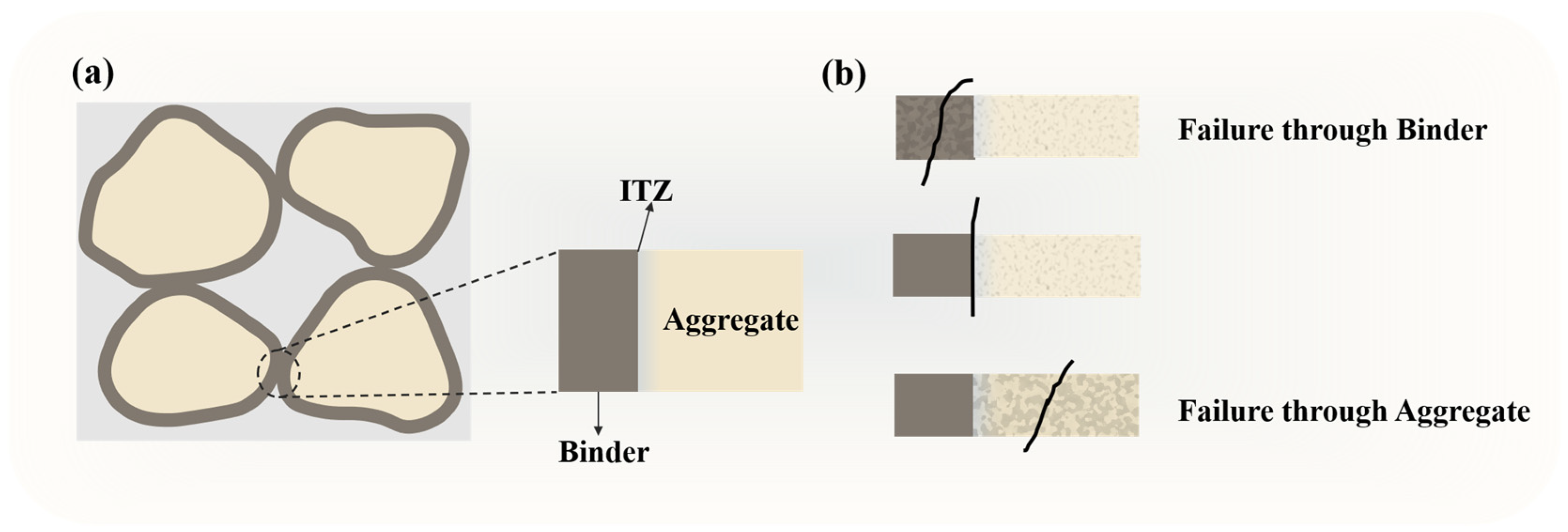
3.1. Formation Mechanism and Failure Modes of ITZ
3.2. Microscale Pores: Strength Effects and Water Retention Mechanisms
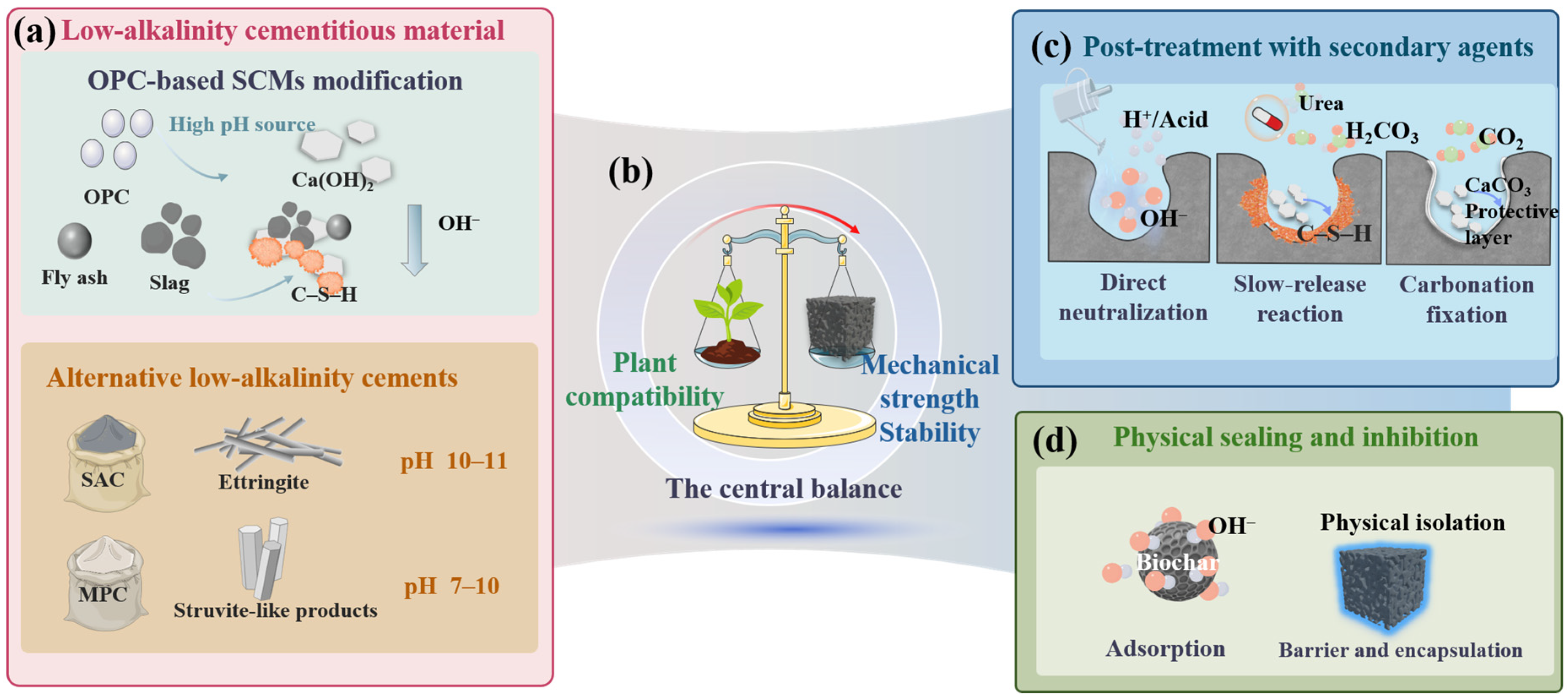
3.3. Alkalinity Control and Alkali Reserve Mechanisms
3.3.1. Low-Alkalinity Cementitious Material Systems
3.3.2. Secondary Alkali-Reducing Agent
3.3.3. Physical Alkali Sealing
3.4. Microscale Deterioration Mechanisms and Control
3.5. Microstructure Optimization Approaches
4. Mesoscopic-Scale Pore Structure
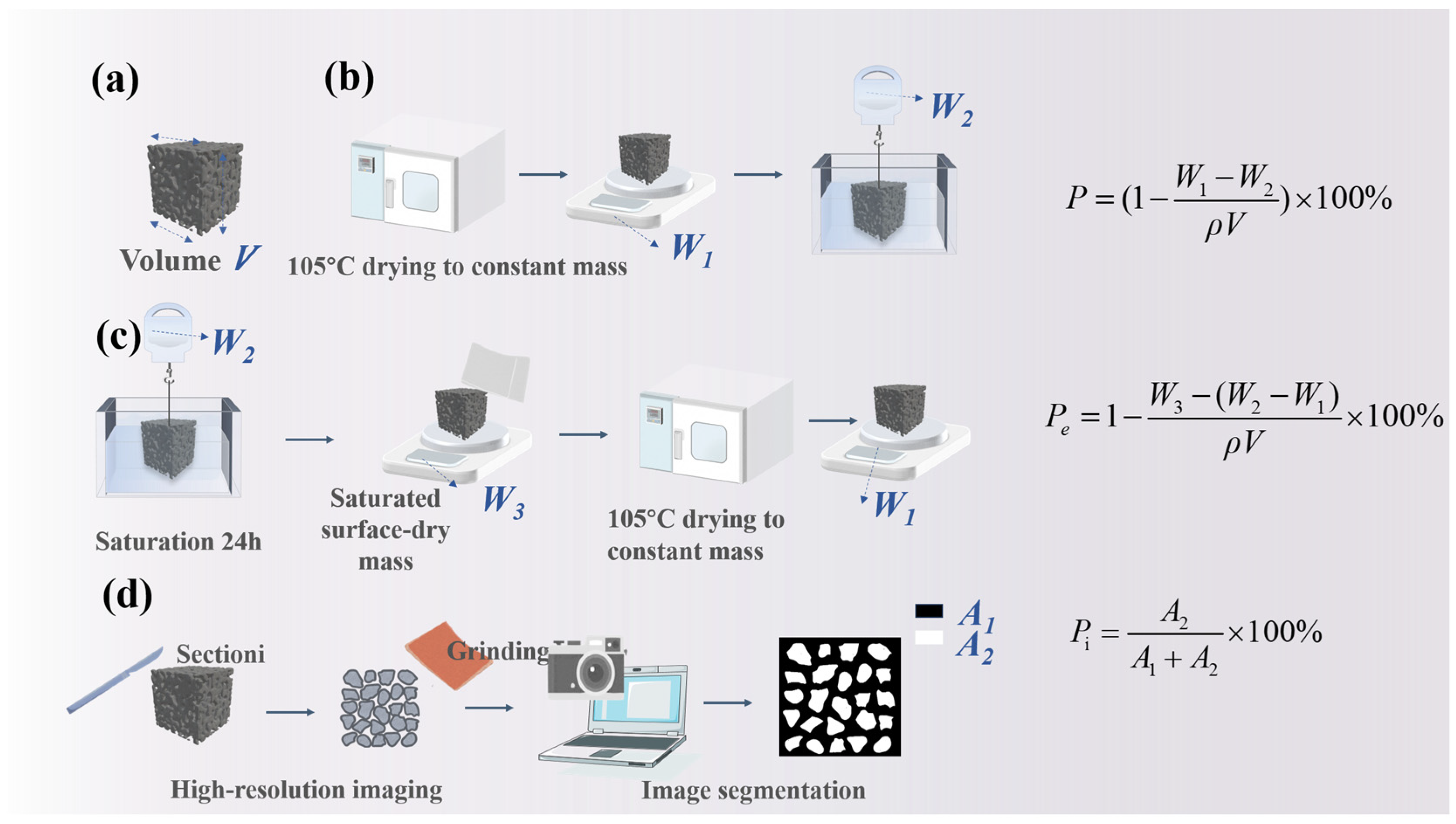
4.1. Connectivity Mechanism Between Aggregates: (Pe) and Total Porosity (P)
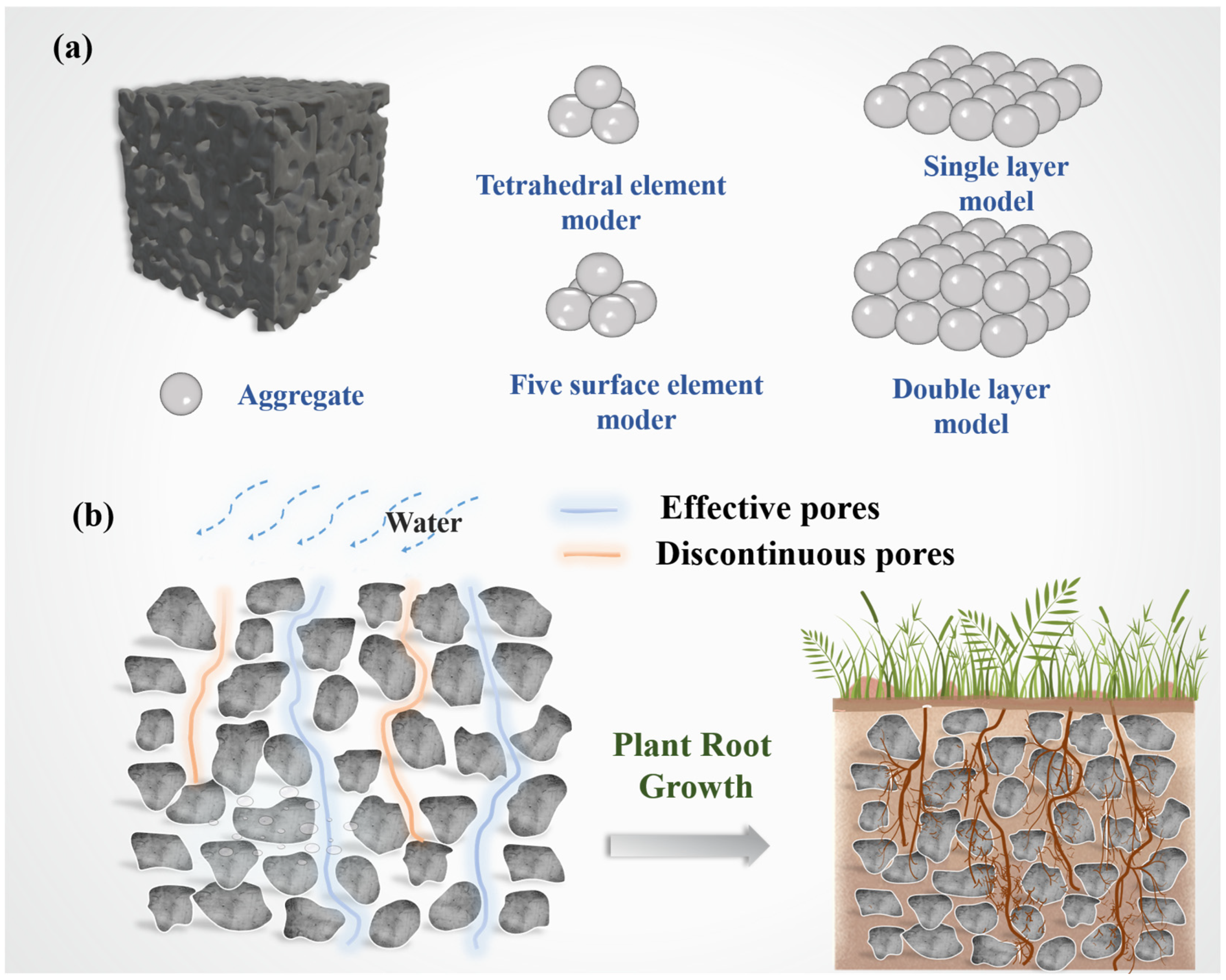
4.2. Pore Space Structural Characteristics: τ, Pore Throat, and Three-Dimensional Networks
4.2.1. τ
4.2.2. Pore Throat
4.3. Fluid Transmission Efficiency
4.3.1. Water Permeability
4.3.2. Mechanical Properties
4.3.3. Prevention and Control of Plant Root Penetration and Blockage

5. Macro-Scale Pore Structure
5.1. Formation Mechanism and Controlling Factors of Macropores
5.2. Ecological Function Realization
5.2.1. Plant Growth Space Support
5.2.2. Hydrological Regulation and Runoff Control
5.2.3. Water Purification Effect
5.2.4. Improvement of Urban Microclimate and Carbon Sequestration Through Greening
5.3. Engineering Safety Performance
5.3.1. Slope Stability and Root Reinforcement Effect
5.3.2. Scour Resistance Performance
5.3.3. Mechanical Performance and Engineering Applicability
5.3.4. Plant Selection and Engineering Application
6. Comprehensive Analysis of Multi-Scale Pore Structures
6.1. Cross-Scale Interactions
6.2. Performance Trade-Off and Synergistic Optimization Mechanism
6.3. Cross-Scale Degradation Evolution Under Environmental Effects
7. Research Gaps and Future Directions
7.1. Limitations of Existing Research
- (1)
- Rheological control of the casting process. The rheological behavior of fresh EPC mixtures significantly influences pore structure formation and uniformity. Excessive paste fluidity leads to paste pooling at the specimen bottom during casting, blocking interconnected pores. Insufficient fluidity prevents uniform aggregate encapsulation, causing particle detachment and severe strength reduction [171]. However, the quantitative relationship between paste rheology and the resulting pore structure remains poorly characterized. This uncertainty, combined with the lack of standardized test methods specifically designed for EPC, forces researchers to rely on extensive trial-and-error approaches to determine appropriate mixture workability for specific raw materials, hindering large-scale engineering applications [172].
- (2)
- Multi-scale performance prediction and optimization. The mechanical, permeability, vegetative, and durability properties of EPC are governed by cross-scale pore structures. Traditional empirical models (e.g., linear regression, power-law fitting) are insufficient for capturing the complex nonlinear interactions among parameters across different scales [173,174]. While machine learning approaches have shown promise [21], their application remains limited by the scarcity of comprehensive datasets that systematically cover microstructural characteristics, mesoscopic pore network parameters, and macro-scale performance indicators. Consequently, mix proportion design remains largely empirical, with limited predictive capability for performance under varying service conditions.
- (3)
- Pore micro-ecosystem response mechanisms. Existing studies have primarily examined the macroscopic dose-effects of cement matrix properties on seed germination and plant growth. The diversity, activity, and functional roles of soil microbial communities within concrete pores, as well as their interactions with plant roots, remain largely unexplored [175]. In particular, the combined effects of high alkalinity, limited organic carbon availability, and restricted pore space on microbial colonization and metabolic activity are still poorly understood, limiting the potential for biologically enhanced EPC performance [176].
- (4)
- Capabilities for simulating and predicting cross-scale damage evolution remain inadequate. The degradation of EPC under environmental actions follows a cross-scale pathway from external action, through mesoscale transport and microscale damage, to macroscopic failure. Currently, computational models capable of bridging nanometers to centimeters are lacking, making precise prediction of long-term service performance difficult.
7.2. Future Research Directions
7.2.1. Deep Learning-Driven Cross-Scale Intelligent Design
7.2.2. Integration of Microecosystem and Microbial Activity
7.2.3. Multi-Scale Computation and Intelligent Technology
7.2.4. Practical Implementation Roadmap
8. Conclusions
- (1)
- The mechanical, permeable, vegetative, and durable properties of EPC are influenced by the multiscale pore structure spanning from micro- to meso- and macro-scales. Traditional single-parameter indicators such as macro-scale porosity fail to fully characterize these complex performance attributes.
- (2)
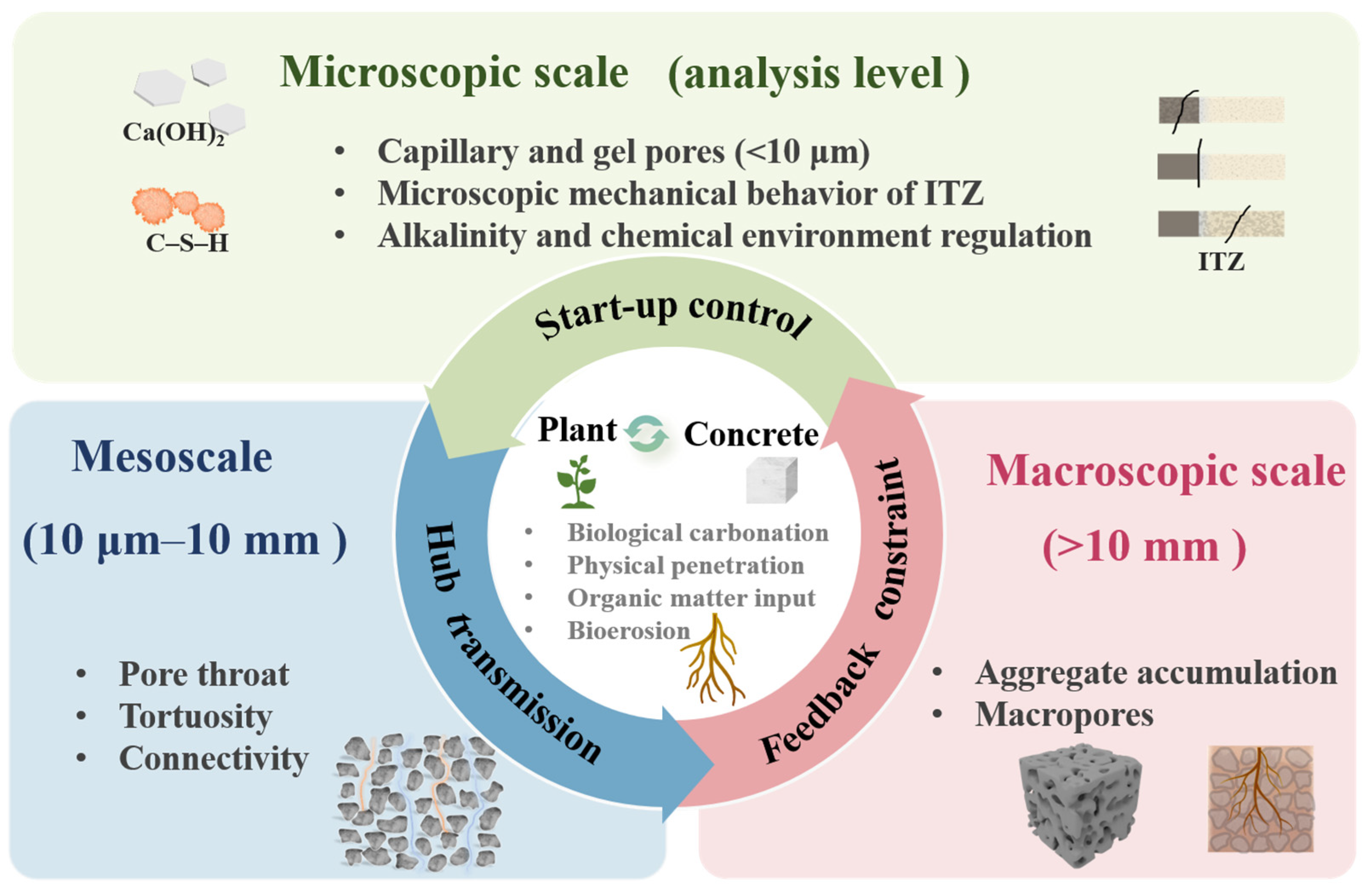
- The cross-scale mechanisms can be summarized as follows: the microscale characteristics of the ITZ and pore solution alkalinity serve as important controlling factors for strength development and vegetation compatibility; the mesoscale connected pore network plays a dominant role in fluid transport efficiency and erosion-induced degradation pathways; and the macro-scale skeletal pore structure contributes significantly to engineering performance and ecosystem service functions. The relative importance of each scale is context-dependent, varying with EPC type, intended application, environmental conditions, and testing methods.
- (3)
- To achieve synergistic optimization of high ecological and structural requirements, it is necessary to consider the regulatory roles of micro- and mesoscale features in addition to macro-scale porosity. Specific measures may include comprehensive design approaches involving aggregate gradation, paste composition, pore morphology, and in situ alkalinity.
- (4)
- Future research should focus on deepening the mechanistic understanding of plant-concrete and microbe–concrete interfaces, introducing multiscale numerical simulation, deep learning-based intelligent prediction, and smart construction monitoring technologies, thereby promoting the standardized, low-carbon, and large-scale application of ecological concrete in Sponge City construction, ecological revetment engineering, and slope restoration.
Author Contributions
Funding
Institutional Review Board Statement
Informed Consent Statement
Data Availability Statement
Conflicts of Interest
References
- Li, S.; Yin, J.; Xu, W.; Liu, S.; Liu, X. Alkalinity regulation and optimization of cementitious materials used in ecological porous concrete. Materials 2024, 17, 1918. [Google Scholar] [CrossRef] [PubMed]
- Li, S.; Yin, J.; Zhang, G. Experimental investigation on optimization of vegetation performance of porous sea sand concrete mixtures by pH adjustment. Constr. Build. Mater. 2020, 249, 118775. [Google Scholar] [CrossRef]
- Chen, J.; Chu, R.; Wang, H.; Zhang, L.; Chen, X.; Du, Y. Alleviating urban heat island effect using high-conductivity permeable concrete pavement. J. Clean. Prod. 2019, 237, 117722. [Google Scholar] [CrossRef]
- Zheng, C.; Zhang, Z.; Huang, Z.; Wang, D.; Zhang, W.; Zhou, Z.; Zhu, Y.; Wang, D.; Wang, H.; Jiang, Z. Review of porous vegetation eco-concrete (PVEC) technology: From engineering requirements to material design. Compos. Part B Eng. 2024, 279, 111442. [Google Scholar] [CrossRef]
- Suhail, M.A.; Shrivastava, S.; Paritosh, K.; Pareek, N.; Kovalev, A.A.; Kovalev, D.A.; Litti, Y.V.; Panchenko, V.; Bolshev, V.; Vivekanand, V. Advances in applications of cereal crop residues in green concrete technology for environmental sustainability: A review. Agriculture 2022, 12, 1266. [Google Scholar] [CrossRef]
- Jiang, H.; Liu, Y. Performance evaluation and field application of prefabricated grass-planting concrete blocks with concave-convex construction for mid-sized and small river revetment projects. Pol. J. Environ. Stud. 2021, 31, 99–110. [Google Scholar] [CrossRef]
- Luo, Y.; Xu, W.; Xu, Q.; Chen, B.; Shi, H.; Ye, J. Assessment of the carbon neutral capacity of ecological slopes: A case study of wet-spraying vegetation concrete ecological river revetment. J. Water Clim. Change 2024, 15, 2429–2445. [Google Scholar] [CrossRef]
- Liu, C.; Xia, Y.; Chen, J.; Huang, K.; Wang, J.; Wang, C.; Huang, Z.; Wang, X.; Rao, C.; Shi, M. Research and application progress of vegetation porous concrete. Materials 2023, 16, 7039. [Google Scholar] [CrossRef] [PubMed]
- Niyomukiza, J.B.; Eisazadeh, A.; Tangtermsirikul, S. Recent advances in slope stabilization using porous vegetation concrete in landslide-prone regions: A review. J. Build. Eng. 2023, 76, 107129. [Google Scholar] [CrossRef]
- Sun, R.; Wang, D.; Cao, H.; Wang, Y.; Lu, Z.; Xia, J. Ecological pervious concrete in revetment and restoration of coastal Wetlands: A review. Constr. Build. Mater. 2021, 303, 124590. [Google Scholar] [CrossRef]
- Dvorkin, L.; Bordiuzhenko, O.; Tracz, T.; Mróz, K. Optimizing porous concrete using granite stone-crushing waste: Composition, strength, and density analysis. Appl. Sci. 2024, 14, 6934. [Google Scholar] [CrossRef]
- Ganapathy, G.P.; Kaliyappan, S.P.; Ramamoorthy, V.L.; Shanmugam, S.; AlObaid, A.; Warad, I.; Velusamy, S.; Achuthan, A.; Sundaram, H.; Vinayagam, M.; et al. Low alkaline vegetation concrete with silica fume and nano-fly ash composites to improve the planting properties and soil ecology. Nanotechnol. Rev. 2024, 13, 20230201. [Google Scholar] [CrossRef]
- Seeni, B.S.; Madasamy, M.; Maheswaran, C.; Nakarajan, A. Towards reduced carbon emission and sustainable performance of industrial waste-derived pervious concrete. J. Traffic Transp. Eng. (Engl. Ed.) 2026, 13, 423–452. [Google Scholar] [CrossRef]
- Mitrosz, O.; Kurpińska, M.; Miśkiewicz, M.; Brzozowski, T. Effect of vibration duration on strength and permeability of pervious concrete with recycled aggregate and low-carbon cements. Sci. Rep. 2025, 15, 35905. [Google Scholar] [CrossRef] [PubMed]
- Ren, H.; Lu, L.; Tang, B.; Li, T. Net carbon sink potential of porous vegetated concrete: A life-cycle assessment. Materials 2026, 19, 2237. [Google Scholar] [CrossRef] [PubMed]
- Liao, K.; Xu, W.; Liu, X.; Ye, J.; Luo, Y. Assessing carbon emissions and reduction potential in ecological and concrete slope protection: Case of huama lake project. Appl. Sci. 2025, 15, 10169. [Google Scholar] [CrossRef]
- Sirangi, B.; Prasad, M.L.V. A low carbon cement (LC3) as a sustainable material in high strength concrete: Green concrete. Mater. Constr. 2023, 73, e326. [Google Scholar] [CrossRef]
- Wang, L.; Liu, Z.; Yan, Y.; Li, S.; Xie, Y. Overview of the application of ecological concrete in sponge city construction. Front. Earth Sci. 2023, 10, 1085419. [Google Scholar] [CrossRef]
- Subramaniam, D.N.; Anburuvel, A. Performance analysis relevant to primary design parameters of pervious concrete: A critical review. Transp. Res. Rec. 2024, 2679, 1183–1208. [Google Scholar] [CrossRef]
- Wang, F.; Sun, C.; Ding, X.; Kang, T.; Nie, X. Experimental study on the vegetation growing recycled concrete and synergistic effect with plant roots. Materials 2019, 12, 1855. [Google Scholar] [CrossRef] [PubMed]
- Dong, G.; Li, S.; Wang, X.; Zheng, Y.; Wang, Q. Optimal design of ecological concrete mix proportion based on AHP-GWO-BP neural network. Int. J. Environ. Res. 2024, 18, 24. [Google Scholar] [CrossRef]
- Yu, F.; Guo, J.; Liu, J.; Cai, H.; Huang, Y. A review of the pore structure of pervious concrete: Analyzing method, characterization parameters and the effect on performance. Constr. Build. Mater. 2023, 365, 129971. [Google Scholar] [CrossRef]
- Liu, Y.; Wang, B.; Qian, Z.; Yu, J.; Shi, T.; Fan, Y.; Zhou, Y.; Ning, Y.; Zhou, X. State-of-the art on preparation, performance, and ecological applications of planting concrete. Case Stud. Constr. Mater. 2024, 20, e03131. [Google Scholar] [CrossRef]
- Mohanty, S.; Sahoo, K.; Samal, K. Progress in sustainable vegetation eco-concrete technology: A review on materials, applications and challenges. J. Build. Eng. 2025, 104, 112354. [Google Scholar] [CrossRef]
- Faiz, H.; Ng, S.; Rahman, M. A state-of-the-art review on the advancement of sustainable vegetation concrete in slope stability. Constr. Build. Mater. 2022, 326, 126502. [Google Scholar] [CrossRef]
- Moretti, L.; Di Mascio, P.; Fusco, C. Porous concrete for pedestrian pavements. Water 2019, 11, 2105. [Google Scholar] [CrossRef]
- Elizondo-Martínez, E.J.; Andrés-Valeri, V.C.; Jato-Espino, D.; Rodriguez-Hernandez, J. Review of porous concrete as multifunctional and sustainable pavement. J. Build. Eng. 2020, 27, 100967. [Google Scholar] [CrossRef]
- Shen, W.; Liu, Y.; Wu, M.; Zhang, D.; Du, X.; Zhao, D.; Xu, G.; Zhang, B.; Xiong, X. Ecological carbonated steel slag pervious concrete prepared as a key material of sponge city. J. Clean. Prod. 2020, 256, 120244. [Google Scholar] [CrossRef]
- Wang, D.; Zhao, Q.; Yang, C.; Chi, Y.; Qi, W.; Teng, Z. Study on frost resistance and vegetation performance of seashell waste pervious concrete in cold area. Constr. Build. Mater. 2020, 265, 120758. [Google Scholar] [CrossRef]
- Li, L.; Zhang, H.; Zhou, X.; Chen, M.; Lu, L.; Cheng, X. Effects of super absorbent polymer on scouring resistance and water retention performance of soil for growing plants in ecological concrete. Ecol. Eng. 2019, 138, 237–247. [Google Scholar] [CrossRef]
- Liu, L.; Ji, J.; Guo, Y.; Chen, J. Use of ecological concrete for nutrient removal in coastal sediment and its effects on sediment microbial communities. Mar. Pollut. Bull. 2021, 162, 111911. [Google Scholar] [CrossRef] [PubMed]
- Kim, H.H.; Park, C.G. Plant growth and water purification of porous vegetation concrete formed of blast furnace slag, natural jute fiber and styrene butadiene latex. Sustainability 2016, 8, 386. [Google Scholar] [CrossRef]
- Wan, J.; Zhou, M.; Yan, G.; Li, Y.; Chen, D.; Yan, C.; Wang, N.; Jia, C.; Wang, Q.; Xing, Y. Root biomass and root morphological traits of three shrub species: Implications for the soil anti-scouring resistance of the ecological slope. PLoS ONE 2023, 18, e0288848. [Google Scholar] [CrossRef] [PubMed]
- Khong, S.C.; Yee, J.J.; Tee, K.F.; Chin, S.C. Permeable concrete: Current state-of-the-art and perspectives. Innov. Infrastruct. Solut. 2024, 9, 427. [Google Scholar] [CrossRef]
- Kia, A.; Wong, H.S.; Cheeseman, C.R. Clogging in permeable concrete: A review. J. Environ. Manag. 2017, 193, 221–233. [Google Scholar] [CrossRef] [PubMed]
- Liu, H.; Luo, G.; Wei, H.; Yu, H. Strength, permeability, and freeze-thaw durability of pervious concrete with different aggregate sizes, porosities, and water-binder ratios. Appl. Sci. 2018, 8, 1217. [Google Scholar] [CrossRef]
- Zhang, S.; Cao, K.; Wang, C.; Wang, X.; Deng, G.; We, P. Influence of the porosity and pore size on the compressive and splitting strengths of cellular concrete with millimeter-size pores. Constr. Build. Mater. 2020, 235, 117508. [Google Scholar] [CrossRef]
- Le, B.; Vu, V.; Seo, S.; Tran, B.; Nguyen-Sy, T.; Le, M.; Vu, T. Predicting the compressive strength and the effective porosity of pervious concrete using machine learning methods. KSCE J. Civ. Eng. 2022, 26, 4664–4679. [Google Scholar] [CrossRef]
- Li, L.; Chen, M.; Zhou, X.; Lu, L.; Wang, Y.; Cheng, X. Evaluation of the preparation and fertilizer release performance of planting concrete made with recycled-concrete aggregates from demolition. J. Clean. Prod. 2018, 200, 54–64. [Google Scholar] [CrossRef]
- Zhang, H.; Gan, Y.; Xu, Y.; Zhang, S.; Schlangen, E.; Šavija, B. Experimentally informed fracture modelling of interfacial transition zone at micro-scale. Cem. Concr. Compos. 2019, 104, 103383. [Google Scholar] [CrossRef]
- Chen, Q.; Zhang, J.; Wang, Z.; Zhao, T.; Wang, Z. A review of the interfacial transition zones in concrete: Identification, physical characteristics, and mechanical properties. Eng. Fract. Mech. 2024, 300, 109979. [Google Scholar] [CrossRef]
- Song, H.; Yao, J.; Xiang, J. The role of aggregate and cement paste in the deterioration of the transitional interface zone of pervious concrete during freeze-thaw cycles. Case Stud. Constr. Mater. 2022, 16, e01086. [Google Scholar] [CrossRef]
- He, S.; Jiao, C.; Li, S. Investigation of mechanical strength and permeability characteristics of pervious concrete mixed with coral aggregate and seawater. Constr. Build. Mater. 2023, 363, 129508. [Google Scholar] [CrossRef]
- Kong, J.; Ni, S.; Guo, C.; Chen, M.; Quan, H. Impacts from waste oyster shell on the durability and biological attachment of recycled aggregate porous concrete for artificial reef. Materials 2022, 15, 6117. [Google Scholar] [CrossRef] [PubMed]
- Lu, C.; Yu, Q.; Wei, J.; Niu, Y.; Zhang, Y.; Lin, C.; Chen, P.; Shi, C.; Yang, P. Influence of interface transition zones (ITZ) and pore structure on the compressive strength of recycled aggregate concrete. Constr. Build. Mater. 2024, 456, 139299. [Google Scholar] [CrossRef]
- Liu, Q.; Cheng, A.; Sun, C.; Chen, K.; Wang, Y.; Li, W. Effects of aggregate’s type and orientation on stress concentration and crack propagation of modeled concrete applied a shear force. J. Build. Eng. 2024, 95, 110340. [Google Scholar] [CrossRef]
- Yang, T.; Yang, S.; Sun, Z.; Wang, S.; Pang, R. Deterioration mechanism of alkali-activated slag and fly ash blended recycled aggregate concrete under freeze-thaw cycles. J. Build. Eng. 2025, 99, 111555. [Google Scholar] [CrossRef]
- Abousnina, R.; Aljuaydi, F.; Benabed, B.; Almabrok, M.H.; Vimonsatit, V. A state-of-the-art review on the influence of porosity on the compressive strength of porous concrete for infrastructure applications. Buildings 2025, 15, 2311. [Google Scholar] [CrossRef]
- Li, Q.; Su, R.; Qiao, H.; Su, L.; Wang, P.; Gong, L. Prediction of compressive strength and porosity of vegetated concrete based on hybrid BP neural networks. Mater. Today Commun. 2025, 44, 112080. [Google Scholar] [CrossRef]
- Huang, J.; Zhang, Y.; Sun, Y.; Ren, J.; Zhao, Z.; Zhang, J. Evaluation of pore size distribution and permeability reduction behavior in pervious concrete. Constr. Build. Mater. 2021, 290, 123228. [Google Scholar] [CrossRef]
- Zhang, X.; Meng, L.; Li, Q.; Wang, Y.; Liu, D.; Wei, K. Pore size distributions and fractal characteristics of basalt fiber-reinforced coral sand concrete. Sci. Rep. 2025, 15, 22253. [Google Scholar] [CrossRef] [PubMed]
- Xiong, D.; Chen, F.; Lv, K.; Tan, X.; Huang, Y. The performance and temporal dynamics of vegetation concretes comprising three herbaceous species in soil stabilization and slope protection. Ecol. Eng. 2023, 188, 106873. [Google Scholar] [CrossRef]
- Zhang, H.; Zhao, Z.; Ma, G.; Sun, L. Quantitative evaluation of soil anti-erodibility in riverbank slope remediated with nature-based soil bioengineering in Liaohe River, Northeast China. Ecol. Eng. 2020, 151, 105840. [Google Scholar] [CrossRef]
- Balasubramaniam, T.; Shen, G.; Esmaeili, N.; Zhang, H. Plants’ response mechanisms to salinity stress. Plants 2023, 12, 2253. [Google Scholar] [CrossRef] [PubMed]
- Wu, C.; Liu, C.; Cheng, G.; Li, J.; Zhang, C.; Jiang, W.; Yang, S.; Wang, X.; Wang, W. Preparation of a low-carbon plant-compatible ecological concrete with fertilizer self-release characteristics based on multi-solid waste co-recycling and its environmental impact. J. Build. Eng. 2023, 76, 107268. [Google Scholar] [CrossRef]
- Ganapathy, G.P.; Alagu, A.; Ramachandran, S.; Panneerselvam, A.S.; Vimal Arokiaraj, G.G.; Panneerselvam, M.; Panneerselvam, B.; Sivakumar, V.; Bidorn, B. Effects of fly ash and silica fume on alkalinity, strength and planting characteristics of vegetation porous concrete. J. Mater. Res. Technol. 2023, 24, 5347–5360. [Google Scholar] [CrossRef]
- Cao, Q.; Zhou, J.; Xu, W.; Yuan, X. Study on the preparation and properties of vegetation lightweight porous concrete. Materials 2024, 17, 251. [Google Scholar] [CrossRef] [PubMed]
- Luo, Y.; Lv, Y.; Wang, D.; Jiang, Z.; Xue, G. The influence of coarse aggregate gradation on the mechanical properties, durability, and plantability of geopolymer pervious concrete. Constr. Build. Mater. 2023, 382, 131246. [Google Scholar] [CrossRef]
- Kim, H.; Son, H.M.; Lee, H.K. Review on recent advances in securing the long-term durability of calcium aluminate cement (CAC)-based systems. Funct. Compos. Struct. 2021, 3, 035002. [Google Scholar] [CrossRef]
- Dabarera, A.; Fernández, R.; Provis, J.L. A systematic review of engineering properties of magnesium potassium phosphate cement as a repair material. Front. Mater. 2024, 11, 1451079. [Google Scholar] [CrossRef]
- Li, P.; Zhang, X.; Zhong, M.; Fan, Z.; Xiong, J.; Zhang, Z. Phosphogypsum-based ultra-low basicity cementing material. Materials 2022, 15, 6601. [Google Scholar] [CrossRef] [PubMed]
- Xiong, F.; Yang, L.; Fang, D.; Wu, Z.; Li, Y.; Sun, G.; Gao, D. Effect of gypsum content on the carbonation of sulfoaluminate cement. J. Build. Eng. 2024, 98, 111512. [Google Scholar] [CrossRef]
- Wang, T.; Medepalli, S.; Zheng, Y.; Zhang, W.; Ishida, T.; Bishnoi, S.; Hou, D.; Shi, Z. Retardation effect of the pozzolanic reaction of low-calcium supplementary cementitious materials on clinker hydration at later age: Effects of pore solution, foreign ions, and pH. Cem. Concr. Res. 2024, 177, 107416. [Google Scholar] [CrossRef]
- Su, R.; Qiao, H.; Li, Q.; Su, L. Study on the performance of vegetation concrete prepared based on different cements. Constr. Build. Mater. 2023, 409, 133793. [Google Scholar] [CrossRef]
- Li, S.; Yin, J.; Liu, J.; Zhang, W.; Chen, Y.; Zhu, Y.; He, S. Synergistic effects of diatomaceous earth, oxalic acid and ferric sulfate on ecological porous concrete: Mechanisms of alkalinity reduction and enhancement. Case Stud. Constr. Mater. 2025, 22, e04697. [Google Scholar] [CrossRef]
- Zhuang, P.; Yan, X.; Wang, X.; Liu, J. Study on the performance optimization of plant-growing ecological concrete. Sustainability 2024, 16, 4575. [Google Scholar] [CrossRef]
- Zhu, S.; Jiao, C.; Li, H.; Chen, X. Mathematical modeling of mechanical and physical properties of ecological pervious concrete containing recycled aggregates. J. Build. Eng. 2024, 92, 109681. [Google Scholar] [CrossRef]
- Zhou, J.; Ji, L.; Gong, C.; Lu, L.; Cheng, X. Ceramsite vegetated concrete with water and fertilizer conservation and light weight: Effect of w/c and fertilizer on basic physical performances of concrete and physiological characteristics of festuca arundinacea. Constr. Build. Mater. 2020, 236, 117785. [Google Scholar] [CrossRef]
- Merino-Lechuga, A.M.; González-Caro, Á.; Fernández-Ledesma, E.; Jiménez, J.R.; Fernández-Rodríguez, J.M.; Suescum-Morales, D. Accelerated carbonation of vibro-compacted porous concrete for eco-friendly precast elements. Materials 2023, 16, 2995. [Google Scholar] [CrossRef] [PubMed]
- Jiang, C.; Xu, J.; Yu, H.; Han, S.; Jiang, Z.; Li, D.; Liu, F.; Wang, Y. CO2 sequestration in pervious concrete and its impact on concrete strength and alkalinity. J. Mater. Eng. Perform. 2025, 34, 23146–23155. [Google Scholar] [CrossRef]
- Bhat, A.H.; Sharma, S.K. Pervious concrete pavements: A comprehensive review of materials, performance, and sustainability. Innov. Infrastruct. Solut. 2025, 10, 326. [Google Scholar] [CrossRef]
- Yang, C.; Fang, Y.; Wei, P.; Zeng, H.; Chen, S.h.e.n.; Jin, Y.a.n.g.; Zhang, H.; Chu, H. Optimization study on alkali-reduction techniques and vegetation performance of planting concrete incorporating phosphogypsum. Constr. Build. Mater. 2025, 482, 141663. [Google Scholar] [CrossRef]
- Fang, Y.; Shi, M.; Zhang, F.; Lao, J.; Gu, Y.; Qian, X.; Chu, H.; Jiang, L. Reconciling strength and alkalinity in cast-in-place ecological concrete via spray-induced phosphate mineralization. Dev. Built Environ. 2026, 27, 100968. [Google Scholar] [CrossRef]
- Shi, M.; Fang, Y.; Zhang, F.; Chu, H.; Jin, W.; Li, W.; Qi, Z.; Jiang, L. A bionic mineral precipitation method to improve the mechanical and vegetative properties of ecological concrete. Constr. Build. Mater. 2025, 476, 141294. [Google Scholar] [CrossRef]
- Yang, Y.; Lei, J.; Wang, Q.; Xu, S.; Zhou, Y. Mechanical and vegetative performance of ecological concrete with nutrient aggregates. Case Stud. Constr. Mater. 2024, 20, e03210. [Google Scholar] [CrossRef]
- Li, S.; Zhang, W.; Liu, J.; Hou, D.; Geng, Y.; Chen, X.; Gao, Y.; Jin, Z.; Yin, B. Protective mechanism of silane on concrete upon marine exposure. Coatings 2019, 9, 558. [Google Scholar] [CrossRef]
- Li, S.; Cui, H.; Wang, H.; Wang, W.; Sui, Y.; Dong, L.; Wang, J. Preparation and performance investigation of epoxy resin-based permeable concrete containing ceramsite. Polymers 2023, 15, 4704. [Google Scholar] [CrossRef] [PubMed]
- Sun, R.; Wang, D.; Wang, Y.; Zhang, L.; Gu, Y. Study on durability against dry-wet cycles and chloride ion erosion of concrete revetment materials at the water-level-fuctuations zone in yellow river delta wetlands. Wetlands 2020, 40, 2713–2727. [Google Scholar] [CrossRef]
- Zhou, C.; Zhu, Z.; Zhu, A.; Zhou, L.; Fan, Y.; Lang, L. Deterioration of mode II fracture toughness, compressive strength and elastic modulus of concrete under the environment of acid rain and cyclic wetting-drying. Constr. Build. Mater. 2019, 228, 116809. [Google Scholar] [CrossRef]
- Wang, Y.; Gong, F.; Zhang, D.; Ueda, T. Estimation of ice formation in mortar saturated with sodium chloride solutions. Constr. Build. Mater. 2017, 144, 238–251. [Google Scholar] [CrossRef]
- Li, L.; Liu, Q.; Tang, L.; Hu, Z.; Wen, Y.; Zhang, P. Chloride penetration in freeze–thaw induced cracking concrete: A numerical study. Constr. Build. Mater. 2021, 302, 124291. [Google Scholar] [CrossRef]
- Luo, G.; Zhang, J.; Zhao, Z.; Sun, M. Fatigue property evaluation of sustainable porous concrete modified by recycled ground tire rubber/silica fume under freeze-thaw cycles. Sustainability 2023, 15, 7965. [Google Scholar] [CrossRef]
- Liu, F.; Zhang, T.; Luo, T.; Zhou, M.; Zhang, K.; Ma, W. Study on the deterioration of concrete under dry-wet cycle and sulfate attack. Materials 2020, 13, 4095. [Google Scholar] [CrossRef] [PubMed]
- Yan, X.; He, Z.; Xia, Q.; Zhao, C.; Zhu, P.; Zong, M.; Hua, M. A new type of self-compacting recycled pervious concrete under sulfate drying-wetting exposure. Materials 2025, 18, 704. [Google Scholar] [CrossRef] [PubMed]
- Wang, W.; Wu, E.; Huang, S.; Xingjiang, S.; Na, L.; Ping, J. Experimental investigation on static and dynamic properties of nanosilica modified cement soil. Constr. Build. Mater. 2024, 412, 134746. [Google Scholar] [CrossRef]
- Xiao, H.; Zhang, F.; Liu, R.; Zhang, R.; Liu, Z.; Liu, H. Effects of pozzolanic and non-pozzolanic nanomaterials on cement-based materials. Constr. Build. Mater. 2019, 213, 1–9. [Google Scholar] [CrossRef]
- Batista, I.L.R.; Cabral, K.C.; de Souza, W.R.M.; de Sousa Fontes, A.É.M.; Martinelli, A.E. Influence of hydroxypropylmethylcellulose (HPMC) on thermal and mechanical performance of cementitious rendering mortars. Mater. Struct. 2024, 57, 25. [Google Scholar] [CrossRef]
- Rodin, H.; Rangelov, M.; Nassiri, S.; Englund, K. Enhancing mechanical properties of pervious concrete using carbon fiber composite reinforcement. J. Mater. Civ. Eng. 2018, 30, 04018012. [Google Scholar] [CrossRef]
- Ben Othman, R.; El Euch Khay, S.; Loulizi, A.; Neji, J. Laboratory evaluation of an ecological pavement construction material: Sand concrete reinforced with polypropylene fibres. Eur. J. Environ. Civ. Eng. 2017, 23, 287–299. [Google Scholar] [CrossRef]
- Zhong, R.; Wille, K. Influence of matrix and pore system characteristics on the durability of pervious concrete. Constr. Build. Mater. 2018, 162, 132–141. [Google Scholar] [CrossRef]
- Liu, D.; Zhang, B.; Yang, Y.; Xu, W.; Ding, Y.; Xia, Z.; Russo, P. Effect of organic material type and proportion on the physical and mechanical properties of vegetation-concrete. Adv. Mater. Sci. Eng. 2018, 2018, 3608750. [Google Scholar] [CrossRef]
- Park, S.-B.; Tia, M. An experimental study on the water-purification properties of porous concrete. Cem. Concr. Res. 2004, 34, 177–184. [Google Scholar] [CrossRef]
- Zhong, R.; Wille, K. Compression response of normal and high strength pervious concrete. Constr. Build. Mater. 2016, 109, 177–187. [Google Scholar] [CrossRef]
- Xie, X.; Zhang, T.; Yang, Y.; Lin, Z.; Wei, J.; Yu, Q. Maximum paste coating thickness without voids clogging of pervious concrete and its relationship to the rheological properties of cement paste. Constr. Build. Mater. 2018, 168, 732–746. [Google Scholar] [CrossRef]
- Yu, F.; Sun, D.; Wang, J.; Hu, M. Influence of aggregate size on compressive strength of pervious concrete. Constr. Build. Mater. 2019, 209, 463–475. [Google Scholar] [CrossRef]
- Chen, J.; Du, W.; Zhao, G.; Shi, M.; Xue, B. Effect of aggregate size and water/cement on compressive strength and physiological performance of planting concrete. Materials 2022, 15, 6685. [Google Scholar] [CrossRef] [PubMed]
- Kayhanian, M.; Anderson, D.; Harvey, J.T.; Jones, D.; Muhunthan, B. Permeability measurement and scan imaging to assess clogging of pervious concrete pavements in parking lots. J. Environ. Manag. 2012, 95, 114–123. [Google Scholar] [CrossRef] [PubMed]
- Chandrappa, A.K.; Biligiri, K.P. Comprehensive investigation of permeability characteristics of pervious concrete: A hydrodynamic approach. Constr. Build. Mater. 2016, 123, 627–637. [Google Scholar] [CrossRef]
- Neithalath, N.; Sumanasooriya, M.S.; Deo, O. Characterizing pore volume, sizes, and connectivity in pervious concretes for permeability prediction. Mater. Charact. 2010, 61, 802–813. [Google Scholar] [CrossRef]
- Zhu, Y.; Fu, H.; Wang, P.; Xu, P.; Ling, Z.; Wei, D. Pore structure characteristics, mechanical properties, and freeze–thaw resistance of vegetation-pervious concrete with unsintered sludge pellets. Constr. Build. Mater. 2023, 382, 131342. [Google Scholar] [CrossRef]
- Kuang, X.; Sansalone, J.; Yingb, G.; Ranieric, V. Pore-structure models of hydraulic conductivity for permeable pavement. J. Hydrol. 2011, 399, 148–157. [Google Scholar] [CrossRef]
- Neithalath, N.; Weiss, J.; Olek, J. Characterizing enhanced porosity concrete using electrical impedance to predict acoustic and hydraulic performance. Cem. Concr. Res. 2006, 36, 2074–2085. [Google Scholar] [CrossRef]
- Sumanasooriya, M.S.; Neithalath, N. Pore structure features of pervious concretes proportioned for desired porosities and their performance prediction. Cem. Concr. Compos. 2011, 33, 778–787. [Google Scholar] [CrossRef]
- Rehder, B.; Banh, K.; Neithalath, N. Fracture behavior of pervious concretes: The effects of pore structure and fibers. Eng. Fract. Mech. 2014, 118, 1–16. [Google Scholar] [CrossRef]
- Ling, S.; Sun, Y.; Sun, D.; Jelagin, D. Pore characteristics and permeability simulation of porous asphalt mixture in pouring semi-flexible pavement. Constr. Build. Mater. 2020, 330, 127253. [Google Scholar] [CrossRef]
- Zhong, R.; Xu, M.; Vieira, R.; Wille, K. Influence of pore tortuosity on hydraulic conductivity of pervious concrete: Characterization and modeling. Constr. Build. Mater. 2016, 125, 1158–1168. [Google Scholar] [CrossRef]
- Shan, J.; Zhang, Y.; Wu, S.; Lin, Z.; Li, L.; Wu, Q. Pore characteristics of pervious concrete and their influence on permeability attributes. Constr. Build. Mater. 2022, 327, 126874. [Google Scholar] [CrossRef]
- Zhang, J.; Ma, G.; Ming, R.; Cui, X.; Li, L.; Xu, H. Numerical study on seepage flow in pervious concrete based on 3D CT imaging. Constr. Build. Mater. 2018, 161, 468–478. [Google Scholar] [CrossRef]
- Zhang, X.; Dong, L.; Yu, W.; Ren, E.; Shi, R. A novel approach to investigate the pore network and clogging of pervious concrete. Case Stud. Constr. Mater. 2025, 22, e04325. [Google Scholar] [CrossRef]
- Deo, O.; Sumanasooriya, M.; Neithalath, N. Permeability reduction in pervious concretes due to clogging: Experiments and modeling. J. Mater. Civ. Eng. 2010, 22, 741–751. [Google Scholar] [CrossRef]
- Deo, O.; Neithalath, N. Compressive behavior of pervious concretes and a quantification of the influence of random pore structure features. Mater. Sci. Eng. A 2010, 528, 402–412. [Google Scholar] [CrossRef]
- Chindaprasirt, P.; Hatanaka, S.; Chareerat, T.; Mishima, N.; Yuasa, Y. Cement paste characteristics and porous concrete properties. Constr. Build. Mater. 2008, 22, 894–901. [Google Scholar] [CrossRef]
- Tan, Y.; Zhu, Y.; Xiao, H. Evaluation of the hydraulic, physical, and mechanical properties of pervious concrete using iron tailings as coarse aggregates. Appl. Sci. 2020, 10, 2691. [Google Scholar] [CrossRef]
- Bhutta, M.A.R.; Tsuruta, K.; Mirza, J. Evaluation of high-performance porous concrete properties. Constr. Build. Mater. 2012, 31, 67–73. [Google Scholar] [CrossRef]
- Zhou, H.; Li, H.; Abdelhady, A.; Liang, X.; Wang, H.; Yang, B. Experimental investigation on the effect of pore characteristics on clogging risk of pervious concrete based on CT scanning. Constr. Build. Mater. 2019, 212, 130–139. [Google Scholar] [CrossRef]
- Kothari, A.; Habermehl Cwirzen, K.; Hedlund, H.; Cwirzen, A. A Review of the mechanical properties and durability of ecological concretes in a cold climate in comparison to standard ordinary portland cement-based concrete. Materials 2020, 13, 3467. [Google Scholar] [CrossRef] [PubMed]
- Gong, X.; Jiang, H.; Liu, Y.; Lu, X.; Wan, L.; Ouyang, J.; Luo, Y. Characterisation and application of plant growth under stress of Grass-planting concrete with alkaline variations. Case Stud. Constr. Mater. 2025, 22, e04517. [Google Scholar] [CrossRef]
- Fang, M.; Park, D.; Singuranayo, J.L.; Chen, H.; Li, Y. Aggregate gradation theory, design and its impact on asphalt pavement performance: A review. Int. J. Pavement Eng. 2018, 20, 1408–1424. [Google Scholar] [CrossRef]
- Chang, Z.; Luo, J.; Tang, Q.; Zeng, L.; Zhang, H.; Li, Y.; Yang, G.; Zhang, L. Ecological protection technology of spraying vegetation concrete on carbonaceous rock slope experimental research and application. Adv. Civ. Eng. 2022, 2022, 2557131. [Google Scholar] [CrossRef]
- Ma, H.; Wu, Z.; Zhang, J.; Yu, H.; Liang, L. Uniaxial compressive properties of ecological concrete: Experimental and three-dimensional (3D) mesoscopic investigation. Constr. Build. Mater. 2021, 278, 121034. [Google Scholar] [CrossRef]
- Chen, W.; Li, J. Effects of different silicon sources on the properties of geopolymer planting concrete mixed with red mud. Sustainability 2023, 15, 4427. [Google Scholar] [CrossRef]
- Kim, H.H.; Park, C.G. Performance evaluation and field application of porous vegetation concrete made with by-product materials for ecological restoration projects. Sustainability 2016, 8, 294. [Google Scholar] [CrossRef]
- Wang, F.; Sun, C. Effect of pore structure on compressive strength and permeability of planting recycled concrete. Constr. Build. Mater. 2023, 394, 132167. [Google Scholar] [CrossRef]
- Gong, C.; Zhou, X.; Dai, W.; Liu, Y.; Lu, L.; Cheng, X. Effects of carbamide on fluidity and setting time of sulphoaluminate cement and properties of planting concrete from sulphoaluminate cement. Constr. Build. Mater. 2018, 182, 290–297. [Google Scholar] [CrossRef]
- Yang, X.; Dong, W.; Zhao, B.; Liu, L.; Xu, Y.; Wu, B.; Li, M. Root-mediated hydraulic performance of fibre-reinforced vegetation concrete (VC): The influence of root architecture, spatiotemporal evolution, and root vitality state. J. Environ. Manag. 2026, 397, 128360. [Google Scholar] [CrossRef] [PubMed]
- Yang, J.; Chen, Y.; Wang, D.; Tam, V.W.Y.; Wan, C.; Guo, T.; Zhang, Q.; Wu, Z.; Li, Z.; Shen, A. Enhancing pervious concrete with recycled brick–concrete aggregates through composite modification under freeze–thaw and sulfate conditions. Constr. Build. Mater. 2025, 503, 144458. [Google Scholar] [CrossRef]
- Fan, M.; Tang, B.; Sun, X.; He, X.; Yuan, L. Experimental study on the water purification performance of carbonated recycled aggregate pervious concrete. Constr. Build. Mater. 2023, 406, 133392. [Google Scholar] [CrossRef]
- Kim, G.M.; Jang, J.G.; Khalid, H.R.; Lee, H.K. Water purification characteristics of pervious concrete fabricated with CSA cement and bottom ash aggregates. Constr. Build. Mater. 2017, 136, 1–8. [Google Scholar] [CrossRef]
- Xie, C.; Yuan, L.; Tan, H.; Zhang, Y.; Zhao, M.; Jia, Y. Experimental study on the water purification performance of biochar-modified pervious concrete. Constr. Build. Mater. 2021, 285, 122767. [Google Scholar] [CrossRef]
- Zhang, Y.; Jia, X.; Yuan, P.; Li, B.; Pan, W.; Liu, J.; Zhao, W. Activated sludge combined with pervious concrete micro-ecosystem for runoff rainwater collection and pollutant purification. Toxics 2024, 12, 838. [Google Scholar] [CrossRef] [PubMed]
- Adab, H.; Abbasi, M. Enhancing runoff treatment using green porous concrete incorporating recycled aggregates. Int. J. Environ. Sci. Technol. 2024, 21, 9853–9866. [Google Scholar] [CrossRef]
- Povedano-Priego, C.; Jroundi, F. Microbial processes in concrete as anthropogenic biogeochemical ecosystems: Biodeterioration mechanisms and biotechnological strategies. Rev. Environ. Sci. Biotechnol. 2026, 25, 30. [Google Scholar] [CrossRef]
- Wang, D.; Guan, F.; Feng, C.; Mathivanan, K.; Zhang, R.; Sand, W. Review on microbially influenced concrete corrosion. Microorganisms 2023, 11, 2076. [Google Scholar] [CrossRef] [PubMed]
- Zhang, M.; Ji, J.; Liu, L.; Guo, Y.; Chen, J. Response of microbial communities to nutrient removal in coastal sediment by using ecological concrete. Environ. Sci. Pollut. Res. 2023, 30, 70817–70826. [Google Scholar] [CrossRef] [PubMed]
- Tan, X.; Huang, Y.; Xiong, D.; Lv, K.; Chen, F. The effect of Elymus nutans sowing density on soil reinforcement and slope stabilization properties of vegetation–concrete structures. Sci. Rep. 2020, 10, 20462. [Google Scholar] [CrossRef] [PubMed]
- Niu, X.; Nan, Z. Roots of Cleistogenes songorica improved soil aggregate cohesion and enhance soil water erosion resistance in rainfall simulation experiments. Water Air Soil Pollut. 2017, 228, 109. [Google Scholar] [CrossRef]
- Xia, L.; Zhao, B.; Luo, T.; Xu, Y.; Guo, S.; Xu, W.; Xia, D. Effects of polyacrylamide, biochar, and palm fiber on soil erosion at the early stage of vegetation concrete slope construction. Sustainability 2023, 15, 5744. [Google Scholar] [CrossRef]
- Chen, Z.; Chen, W.; Li, C.; Pu, Y.; Sun, H. Effects of polyacrylamide on soil erosion and nutrient losses from substrate material in steep rocky slope stabilization projects. Sci. Total Environ. 2016, 554–555, 26–33. [Google Scholar] [CrossRef] [PubMed]
- Aschonitis, V.G.; Yao, Y.; Dai, Q.; Gao, R.; Gan, Y.; Yi, X. Effects of rainfall intensity on runoff and nutrient loss of gently sloping farmland in a karst area of SW China. PLoS ONE 2021, 16, e0246505. [Google Scholar] [CrossRef] [PubMed]
- Contreras Llanes, M.; Romero Pérez, M.; Gázquez González, M.J.; Bolívar Raya, J.P. Construction and demolition waste as recycled aggregate for environmentally friendly concrete paving. Environ. Sci. Pollut. Res. 2021, 29, 9826–9840. [Google Scholar] [CrossRef] [PubMed]
- Wu, S.; Wuda, E.; Liu, Q.; Li, L.; Zhao, C.; Huang, J.; Li, S.; Li, W.; Xie, L.; Luo, L.; et al. The above- and below-ground biomass of alpine meadow on eastern margin of the Tibetan Plateau and their relationships with abiotic and biotic factors. Glob. Ecol. Conserv. 2023, 48, e02701. [Google Scholar] [CrossRef]
- Chen, Y.; Li, S.; Wang, X.; Zheng, Y.; Wang, R.; Dong, G. Study on the purification of pollutants from rainfall runoff by Prefabricated improved multi-aggregate ecological concrete (IMAEC) revetment. Int. J. Environ. Res. 2022, 16, 41. [Google Scholar] [CrossRef]
- Chen, F.; Zhang, J.; Zhang, M.; Wang, J. Effect of Cynodon dactylon community on the conservation and reinforcement of riparian shallow soil in the Three Gorges Reservoir area. Ecol. Process. 2015, 4, 3. [Google Scholar] [CrossRef]
- Xu, Y.; Chen, F. Effects of concrete content in vegetation concrete matrix on seed germination and seeding establishment of cynodon dactylon. Proc. Eng. 2012, 28, 105–109. [Google Scholar] [CrossRef]
- Li, L.; Chen, M.; Zhou, X.; Lu, L.; Li, Y.; Gong, C.; Cheng, X. A case of water absorption and water/fertilizer retention performance of super absorbent polymer modified sulphoaluminate cementitious materials. Constr. Build. Mater. 2017, 150, 538–546. [Google Scholar] [CrossRef]
- Gong, C.; Zhou, X.; Ji, L.; Dai, W.; Lu, L.; Cheng, X. Effects of limestone powders on pore structure and physiological characteristics of planting concrete with sulfoaluminate cement. Constr. Build. Mater. 2018, 162, 314–320. [Google Scholar] [CrossRef]
- MacIvor, J.S.; Sookhan, N.; Arnillas, C.A.; Bhatt, A.; Das, S.; Yasui, S.L.E.; Xie, G.; Cadotte, M.W. Manipulating plant phylogenetic diversity for green roof ecosystem service delivery. Evol. Appl. 2018, 11, 2014–2024. [Google Scholar] [CrossRef] [PubMed]
- Chen, N.; Guo, Z.; Huang, S.; Li, L.; Xiao, H. Study on the improvement of vegetated concrete substrate by biochar and limestone calcined clay cement. Environ. Technol. Innov. 2025, 46, 3610–3622. [Google Scholar] [CrossRef] [PubMed]
- Ntoulas, N.; Nektarios, P.A.; Kotopoulis, G.; Ilia, P.; Ttooulou, T. Quality assessment of three warm-season turfgrasses growing in different substrate depths on shallow green roof systems. Urban For. Urban Green 2017, 26, 163–168. [Google Scholar] [CrossRef]
- Wang, F.; Liang, L.; Ding, Y.; Sun, X.; Cai, J.; Ukrainczyk, N.; Yu, K. Metakaolin-based single-step engineered geopolymer composites: Design and performance characterization. Appl. Clay Sci. 2025, 280, 108055. [Google Scholar] [CrossRef]
- Zhang, T.; Li, T.; Xu, H.; Wang, M.; Lu, L. Preparation and performance study of novel foam vegetation concrete. Materials 2024, 17, 6295. [Google Scholar] [CrossRef] [PubMed]
- Rahman, M.S.; MacPherson, S.; Akbarzadeh, A.; Guerini, A.; Chapelat, J.; Lefsrud, M. A study on heat and mass transfer through vegetated porous concrete for environmental control. J. Clean. Prod. 2022, 366, 132984. [Google Scholar] [CrossRef]
- Yu, Z.; Lau, D. Nano- and mesoscale modeling of cement matrix. Nanoscale Res. Lett. 2015, 10, 173. [Google Scholar] [CrossRef] [PubMed]
- Qin, R.; Hao, H.; Rousakis, T.; Lau, D. Effect of shrinkage reducing admixture on new-to-old concrete interface. Compos. Part B Eng. 2019, 167, 346–355. [Google Scholar] [CrossRef]
- Song, H.; Fan, S.; Wan, K.; Yao, J.; Yin, W.; Lee, Y. Balancing mechanical and permeability properties of pervious concrete through inter-aggregate pore structure optimization. J. Build. Eng. 2025, 106, 112537. [Google Scholar] [CrossRef]
- Zeng, L.; Luo, J.; Yang, Z.; Yu, H.; Wen, W.; Gao, Q.; Zhang, H. Performance evaluation of vegetation concrete with carbonaceous mudstone aggregates in slope protection under wet-dry conditions. Bull. Eng. Geol. Environ. 2024, 83, 356. [Google Scholar] [CrossRef]
- Shu, Q.; Xia, D.; Ma, Y.; Zhang, Y.; Luo, T.; Ma, J.; Liu, F.; Yan, S.; Liu, D. Response of physiological characteristics of ecological restoration plants to substrate cement content under exogenous arbuscular mycorrhizal fungal inoculation. Front. Plant Sci. 2022, 13, 1028553. [Google Scholar] [CrossRef] [PubMed]
- Shayanfar, M.A.; Shahrabadi, H. Investigating the effects of recycled plastic as fibers on bending behavior of green concrete beams exposed to marine environment. Materials 2023, 16, 5912. [Google Scholar] [CrossRef] [PubMed]
- Zhong, R.; Leng, Z.; Poon, C.-S. Research and application of pervious concrete as a sustainable pavement material: A state-of-the-art and state-of-the-practice review. Constr. Build. Mater. 2018, 183, 544–553. [Google Scholar] [CrossRef]
- Yang, J.; Guo, Y.; Tam, V.W.Y.; Tan, J.; Shen, A.; Zhang, J.; Zhang, C.; Lyu, Z. Research on pore-clogging behavior and mechanism in pervious concrete prepared with recycled aggregate. Constr. Build. Mater. 2023, 384, 131420. [Google Scholar] [CrossRef]
- Bian, W.; Liu, W.; Gao, X.; Ma, K.; Rong, Y. Improved mix design method for pervious concrete based on slurry layer thickness. Mag. Concr. Res. 2021, 74, 81–90. [Google Scholar] [CrossRef]
- Li, J.; Xia, J.; Di Sarno, L.; Gong, G. Fiber utilization in pervious concrete: Review on manufacture and properties. Constr. Build. Mater. 2023, 406, 133372. [Google Scholar] [CrossRef]
- Phuyal, K.; Sharma, U.; Mahar, J.; Mondal, K.; Mashal, M. A sustainable and environmentally friendly concrete for structural applications. Sustainability 2023, 15, 14694. [Google Scholar] [CrossRef]
- Bao, X.; Liao, W.; Dong, Z.; Wang, S.; Tang, W. Development of vegetation-pervious concrete in grid beam system for soil slope protection. Materials 2017, 10, 96. [Google Scholar] [CrossRef] [PubMed]
- Chen, Y.; Li, S.; Qin, Y.; Zeng, Y.; Ouyang, Q.; Wu, H.; Yin, J. The alkaline regulation mechanism of SAP, oxalic acid and ferric sulfate on porous vegetation concrete: Compressive strength, water retention performance and vegetation performance. J. Build. Eng. 2026, 118, 114984. [Google Scholar] [CrossRef]
- Liu, L.; Zhang, Q.; Ding, J.; Tan, S.; Liu, F.; Sun, T. Experimental study on the physical-mechanical properties and vegetation performance of ecological concrete made with volcanic rock aggregates. Case Stud. Constr. Mater. 2026, 24, e05756. [Google Scholar] [CrossRef]
- Jiang, W.; Lai, Y.; Hou, J.; Lan, T.; Luo, X.; Han, F.; Yu, F.; Ma, Q. Coupled macro-microscopic properties evolution and deterioration mechanisms of concrete under freeze-thaw action. Case Stud. Constr. Mater. 2026, 24, e05877. [Google Scholar] [CrossRef]
- Cao, X.; Yang, W.; Liu, S.; Fang, L.; Liu, R.; Ma, R. Durability of calcium-rich municipal solid waste incineration fly ash-based geopolymer to sulfate and sulfuric acid. Constr. Build. Mater. 2023, 405, 133389. [Google Scholar] [CrossRef]
- Dhandapani, Y.; Machner, A.; Wilson, W.; Kunther, W.; Afroz, S.; Kim, T.; Zunino, F.; Joseph, S.; Kanavaris, F.; Castel, A.; et al. Performance of cementitious systems containing calcined clay in a chloride-rich environment: A review by TC-282 CCL. Mater. Struct. 2024, 57, 154. [Google Scholar] [CrossRef] [PubMed]
- Gesoğlu, M.; Güneyisi, E.; Khoshnaw, G.; İpek, S. Abrasion and freezing–thawing resistance of pervious concretes containing waste rubbers. Constr. Build. Mater. 2014, 73, 19–24. [Google Scholar] [CrossRef]
- Kim, Y.J.; Cho, B.-Y.; Lee, S.-J.; Hu, J.; Wilde, J.W.; Delgado, J.M.P.Q. Investigation of rheological properties of blended cement pastes using rotational viscometer and dynamic shear rheometer. Adv. Mater. Sci. Eng. 2018, 2018, 6303681. [Google Scholar] [CrossRef]
- Zhang, W.; Yuan, Z.; Li, D.; Zhang, K.; Zhao, L. Mechanical and vegetation performance of porous concrete with recycled aggregate in riparian buffer area. J. Clean. Prod. 2022, 332, 130015. [Google Scholar] [CrossRef]
- Khan, K.; Salami, B.A.; Iqbal, M.; Amin, M.N.; Ahmed, F.; Jalal, F.E. Compressive strength estimation of flyash/slag based green concrete by deploying artificial intelligence models. Materials 2022, 15, 3722. [Google Scholar] [CrossRef] [PubMed]
- Shah, M.I.; Amin, M.N.; Khan, K.; Niazi, M.S.K.; Aslam, F.; Alyousef, R.; Javed, M.F.; Mosavi, A. Performance evaluation of soft computing for modeling the strength properties of waste substitute green concrete. Sustainability 2021, 13, 2867. [Google Scholar] [CrossRef]
- Mak, B.; Francis, R.A.; Chadwick, M.A. Living in the concrete jungle: A review and socio-ecological perspective of urban raptor habitat quality in Europe. Urban Ecosyst. 2021, 24, 1179–1199. [Google Scholar] [CrossRef]
- Liao, H.; Li, C.; Ai, S.; Li, X.; Ai, X.; Ai, Y. A simulated ecological restoration of bare cut slope reveals the dosage and temporal effects of cement on ecosystem multifunctionality in a mountain ecosystem. J. Environ. Manag. 2023, 325, 116672. [Google Scholar] [CrossRef] [PubMed]
- Yu, F.; Chu, W.; Zhang, R.; Gao, Z.; Yang, Y. Predicting the permeability and compressive strength of pervious concrete using a stacking ensemble machine learning approach. Sci. Rep. 2025, 15, 22506. [Google Scholar] [CrossRef] [PubMed]
- Suprakash, A.S.; Karthiyaini, S.; Shanmugasundaram, M. A study on compressive strength of ultrafine graded fly ash replaced concrete and machine learning approaches in its strength prediction. Struct. Concr. 2022, 23, 849–3863. [Google Scholar] [CrossRef]
- Yu, F.; Li, K.; Zhang, H.; Zhang, R.; Gao, Z.; Huang, Y. Pore structure identification method for pervious concrete based on improved UNet and fusion algorithm. KSCE J. Civ. Eng. 2023, 27, 4834–4848. [Google Scholar] [CrossRef]
- Wang, X.; Xiao, Y.; Yang, T.; Meng, W.; Chen, Y.; Li, Z. Quantitative assessment of cement bridges and voids in cement-stabilized permeable base materials using a mask R-CNN-based CT image segmentation strategy. Mater. Des. 2024, 241, 112907. [Google Scholar] [CrossRef]
- Yu, F.; Cai, H.; Zhang, H.; Hu, M.; Zhang, R.; Gao, Z. Automatic identification method for three-phase structure of pervious concrete based on deep learning network of Mask R-CNN. Constr. Build. Mater. 2024, 420, 135534. [Google Scholar] [CrossRef]
- Yang, S.; Mao, L.; Zhou, M.; Chang, X.; Liu, J.; Li, D.; Bai, J. A fine-segmentation algorithm for XCT images of multiphase composite building materials based on deep learning. J. Build. Eng. 2024, 97, 110918. [Google Scholar] [CrossRef]
- Yang, Y.; Liu, G.; Zhang, H.; Zhang, Y.; Yang, X. Predicting the compressive strength of environmentally friendly concrete using multiple machine learning algorithms. Buildings 2024, 14, 190. [Google Scholar] [CrossRef]
- Wang, B.; Yang, B.; Wang, L.; Lian, B.; Wu, X. Experimental study on alkali reduction of film-coated porous ecological concrete by microbial calcium carbonate precipitation technology. Sci. Rep. 2024, 14, 44. [Google Scholar] [CrossRef] [PubMed]
- Deng, X.; Li, Y.; Wang, F.; Shi, X.; Yang, Y.; Xu, X.; Huang, Y.; de Wit, B. Experimental study on the mechanical properties and consolidation mechanism of microbial grouted backfill. Int. J. Min. Sci. Technol. 2022, 32, 271–282. [Google Scholar] [CrossRef]
- Gong, F.; Takahashi, Y.; Maekawa, K. Multi-scale computational modeling for concrete damage by mixed pore pressures—Case of coupled alkali–silica reaction and cyclic freeze/thaw. Eng. Comput. 2018, 35, 2367–2385. [Google Scholar] [CrossRef]
- Ler, K.-H.; Ma, C.-K.; Chin, C.-L.; Ibrahim, I.S.; Padil, K.H.; Ab Ghafar, M.A.I.; Lenya, A.A. Porosity and durability tests on 3D printing concrete: A review. Constr. Build. Mater. 2024, 446, 137973. [Google Scholar] [CrossRef]
- Jiang, H. Digital twin-enhanced MCDM framework for circular construction dynamic lifecycle optimization of hybrid concrete mix design. Decis. Mak. Appl. Manag. Eng. 2025, 8, 53–70. [Google Scholar] [CrossRef]
- Li, T.; Wang, H.; Pan, D.; Tan, J.; Hou, J.; Kong, L.; Liu, J. A machine vision approach with temporal fusion strategy for concrete vibration quality monitoring. Appl. Soft Comput. 2024, 160, 111684. [Google Scholar] [CrossRef]
- Ullah, M.; Plevris, V. A systematic review of computer vision-based assessment of concrete properties. Neural Comput. Appl. 2026, 38, 249. [Google Scholar] [CrossRef]



| Optimization Strategy | Specific Measures | Mechanism | Main Effects | Ref. |
|---|---|---|---|---|
| Matrix densification | Ultrafine fillers (silica fume, nanoparticles) | Filling micro-/nano-pores | Refines harmful capillary pores, improves matrix density | [20,85] |
| Pozzolanic effect | Pozzolanic SCMs (fly ash, slag) | Secondary hydration with Ca(OH)2 | Reduces alkalinity, strengthens interfacial bonding, refines pores | [86] |
| Paste stability control | Superplasticizers, rheology modifier | Optimized w/b ratio, minimized bleeding | Reduces microstructural defects caused by bleeding | [87] |
| Interfacial toughening | Polymer latex, synthetic fibers | Flexible ITZ transition layer, crack bridging | Inhibits microcrack propagation, enhances material toughness | [88,89] |
| Pore structure regulation | Aggregate gradation and paste-to-aggregate ratio | Optimizes pore size distribution while preserving macroporosity | Balances permeability-durability via optimal macro-/micro-pore distribution | [36,90] |
| Functional modification | Agricultural wastes such as straw biochar, wood chips | Alkali adsorption, energy dissipation | Assists dealkalization; rigid-flexible synergy under load | [75,91] |
| Model Name | Mathematical Expression | Key Parameters | Applicable Features and Limitations | Ref. |
|---|---|---|---|---|
| Traditional K–C model | P, τ, S | Based on the ideal parallel capillary assumption | [98] | |
| Modified K–C model | Pe, Se: effective specific surface area | Significantly improve prediction accuracy, with R2 reaching 0.90–0.98 | [100] | |
| Weighted τ correction model | (Le/L)w: weighted τ | Applicable to high porosity (>20%) and heterogeneous pore structures | [101] | |
| Relative aperture correlation | : average pore size (calculated by LPF) da: aggregate particle size | Establish a linear relationship between τ, and relative mean pore size (R2 = 0.995) | [100] |
| Determination Method | Fundamental Principles | Aggregate Particle Size (mm) | P (%) | τ Range | Applicable Scenarios | Ref. |
|---|---|---|---|---|---|---|
| EIS electrochemical method. | Based on the ratio of effective conductivity to pore fluid conductivity | 2.36–9.5 | 15–30 | 1.28–3.45 | Laboratory rapid testing | [99,102,103] |
| CT image tracking method | Perform 3D reconstruction of pore channels and calculate the ratio of actual path length to straight-line distance | 4.75–9.5 | 17–27 | 1.59–2.41 | Microstructure visualization | [104,105] |
| K–C equation inversion | Back-calculation from permeability test data. | 1.19–4.75 | 20–26 | 1.07–5.03 | When penetration data is available. | [106] |
| Simplified geometric model | Theoretical calculation of ideal sphere packing. | ~1.414 | Theoretical estimation | [22] |
| Model Type | Mathematical Expression | Key Parameters | Applicability and Accuracy | Ref. |
|---|---|---|---|---|
| Exponential decay model | P, σ0: theoretical strength at zero porosity | Classical form | [112] | |
| Logarithmic model | Pe | Applicable for porosity range 15–30%, R2 > 0.90 | [113] | |
| Linear model | P | Applicable only for narrow porosity range (14–23%) | [114] | |
| Multi-parameter comprehensive model | dMFS: mean free spacing, dn: number-averaged pore diameter, Sp: specific surface area of pores, Γ3D: 3D pore distribution density | Highest accuracy; requires complex characterization | [111] | |
| Aggregate-pore size correlation model | : mean pore diameter, da: aggregate particle size | Applicable for single-sized aggregate systems | [93] |
| Application Scenario | Target Functions | Recommended P/Pore Size | Compressive Strength Requirement | Aggregate Size | Ref. |
|---|---|---|---|---|---|
| Ecological slope protection | Root anchoring, slope erosion resistance, ecological restoration | >25%/ 2–10 mm | 5–10 MPa | 10–25 mm | [6,8] |
| Permeable pavement (light load) | Rainwater infiltration, urban heat island mitigation, light-load bearing | 15–25%/1.5–3 mm | 15–25 MPa | 5–10 mm | [96,120] |
| Sponge City sidewalk | Rainwater percolation, runoff reduction, pedestrian load | 20–30%/ 2–8 mm | 10–20 MPa | 5–20 mm | [20,121] |
| Coastal wetland revetment | Tidal habitat provision, wave energy dissipation, salt resistance | 20–35%/ 5–10 mm | 10–15 MPa | 10–30 mm | [28,122] |
| Water purification substrate | Nutrient (N/P) removal, microbial attachment, filtration | 20–30%/ 3–8 mm | 5–15 MPa | 10–20 mm | [32,123] |
| Plant Name | Plant Type | Root Characteristics | Pore Size | Stress Tolerance | Applicable EPC Environment | Ref. |
|---|---|---|---|---|---|---|
| Festuca arundinacea | Cool-season herb | Deep (tap + fibrous), penetrating 6–8 cm concrete | 2–5 mm | Drought/cold tolerant; alkali resistant (pH 7–9) | General use; rapid establishment (3 d germination, 60 d coverage) | [9,52] |
| Lolium perenne | Fibrous (dense, shallow, high biomass) | 2–5 mm | Not drought/saline tolerant | Temperate short-term cover; mixed sowing for erosion control | [25,145] | |
| Medicago sativa | Taproot (deep, strong penetration) | 5–10 mm | Highly drought/barren/alkali tolerant; N-fixing | Barren slopes; long-term restoration; N-source when mixed | [2,146,147] | |
| Cynodon dactylon | Warm-season herb | Deep (stolons + taproot), trample-resistant | 2–5 mm | Highly saline-alkali tolerant (pH > 11); not cold/drought tolerant | High-alkali (pH > 10) preferred; humid subtropical wetlands | [25,148] |
| Zoysia japonica | Fibrous (dense network, soil-binding) | 2–5 mm | Highly drought tolerant; barren tolerant | Arid regions; low-maintenance Sponge City areas | [9,149] |
| Parameter | Typical Value | Key Source of Variability | Implications of Deviation |
|---|---|---|---|
| P | 15–30% | Aggregate gradation, compaction effort, w/c ratio | >30%: significant strength loss; <15%: inadequate permeability and root penetration [22,159] |
| Pe | Typically 30–80% of P | Aggregate packing mode, CPT | Low Pe: most pores are isolated, poor permeability; High Pe: excellent drainage but risk of nutrient loss [106,109] |
| Pore size | 2–8 mm | Aggregate gradation, target porosity | <2 mm: roots cannot penetrate, poor plant establishment; >8 mm: substrate instability, reduced strength [71,160] |
| Permeability coefficient | 2–10 mm/s | P; τ; test method | <2 mm/s: inadequate drainage, runoff risk; >10 mm/s: potential nutrient washout, reduced water retention [22,113,161] |
| Compressive strength | 5–25 MPa | P, paste quality, aggregate type, curing regime | <5 MPa: insufficient for structural stability; >30 MPa: often achieved at the expense of permeability (P < 15%) [71,162] |
Disclaimer/Publisher’s Note: The statements, opinions and data contained in all publications are solely those of the individual author(s) and contributor(s) and not of MDPI and/or the editor(s). MDPI and/or the editor(s) disclaim responsibility for any injury to people or property resulting from any ideas, methods, instructions or products referred to in the content. |
© 2026 by the authors. Licensee MDPI, Basel, Switzerland. This article is an open access article distributed under the terms and conditions of the Creative Commons Attribution (CC BY) license.
Share and Cite
Zhao, W.; Li, Y.; Gu, L.; Ren, F.; Miao, M.; Feng, J. Ecological Porous Concrete: A Review of Multi-Scale Pore Structure Engineering for Coupled Mechanical and Ecological Performance. Materials 2026, 19, 2873. https://doi.org/10.3390/ma19132873
Zhao W, Li Y, Gu L, Ren F, Miao M, Feng J. Ecological Porous Concrete: A Review of Multi-Scale Pore Structure Engineering for Coupled Mechanical and Ecological Performance. Materials. 2026; 19(13):2873. https://doi.org/10.3390/ma19132873
Chicago/Turabian StyleZhao, Wenjing, Yalin Li, Linan Gu, Fangzhou Ren, Miao Miao, and Jingjing Feng. 2026. "Ecological Porous Concrete: A Review of Multi-Scale Pore Structure Engineering for Coupled Mechanical and Ecological Performance" Materials 19, no. 13: 2873. https://doi.org/10.3390/ma19132873
APA StyleZhao, W., Li, Y., Gu, L., Ren, F., Miao, M., & Feng, J. (2026). Ecological Porous Concrete: A Review of Multi-Scale Pore Structure Engineering for Coupled Mechanical and Ecological Performance. Materials, 19(13), 2873. https://doi.org/10.3390/ma19132873