Biomechanics of Tooth-Supported Fixed Dental Prostheses: Material Systems, Connector Design, Retainer Design, and Abutment Stress Distribution—A Systematic Review of In Vitro and Finite Element Evidence

 , , , , , ,
Highlights
- FDP behavior depends on both material and design.
- Connector size and shape affect fracture risk.
- Retainer design affects debonding and stress.
- Abutment support changes stress distribution.
- Material choice alone is not enough for FDP design.
- Connector design should be reported in detail.
- Conservative FDPs need careful retainer planning.
- FEA findings need validation before clinical use.
Abstract
1. Introduction
2. Materials and Methods
2.1. Review Design
2.2. PICO Framework
2.3. Eligibility Criteria
2.4. Information Sources
2.5. Search Strategy
2.6. Study Selection
2.7. Data Extraction
2.8. Methodological Appraisal
2.9. Data Synthesis
2.10. Use of Artificial Intelligence and Generative Artificial Intelligence Tools
3. Results
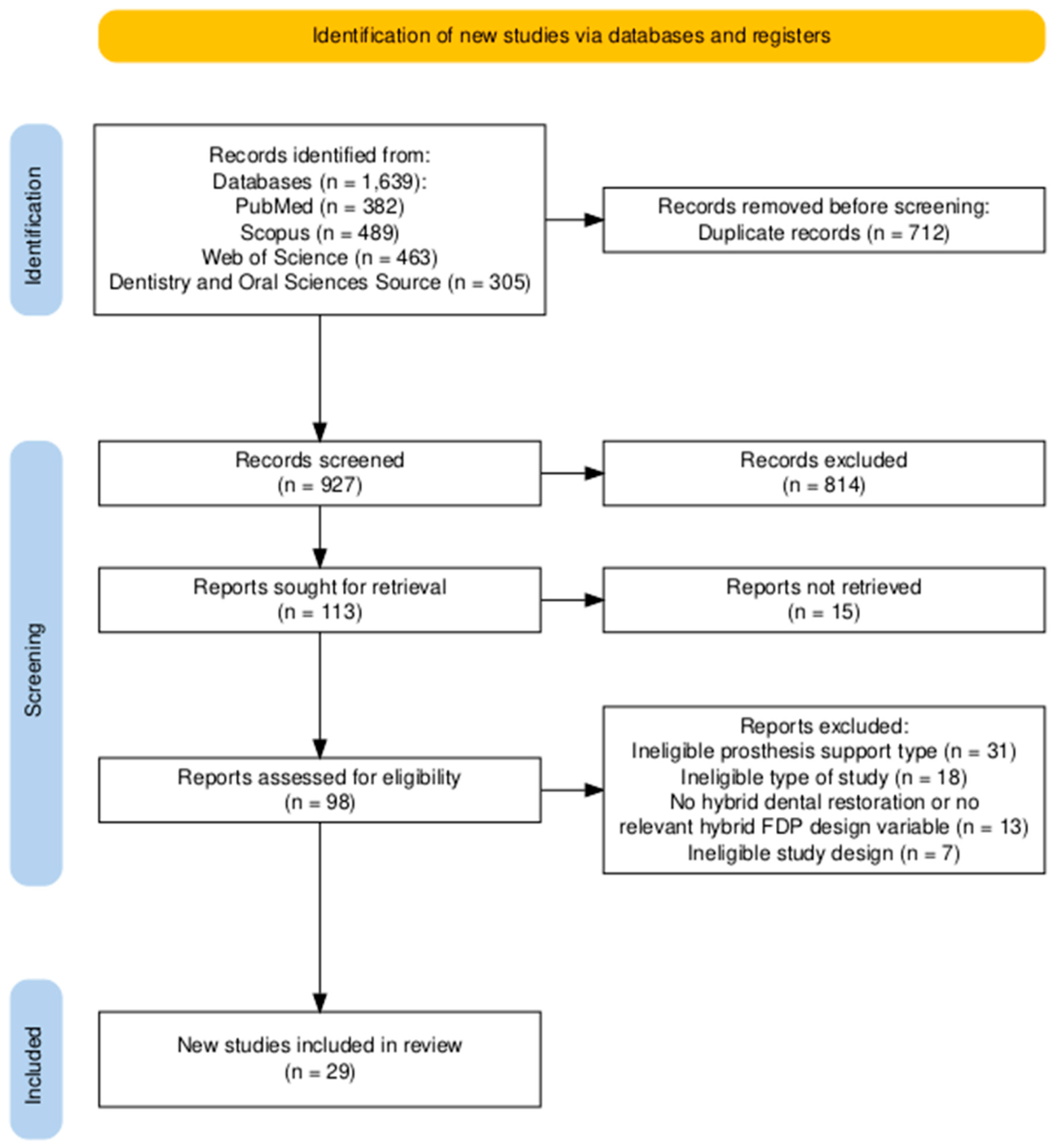
3.1. Search Results
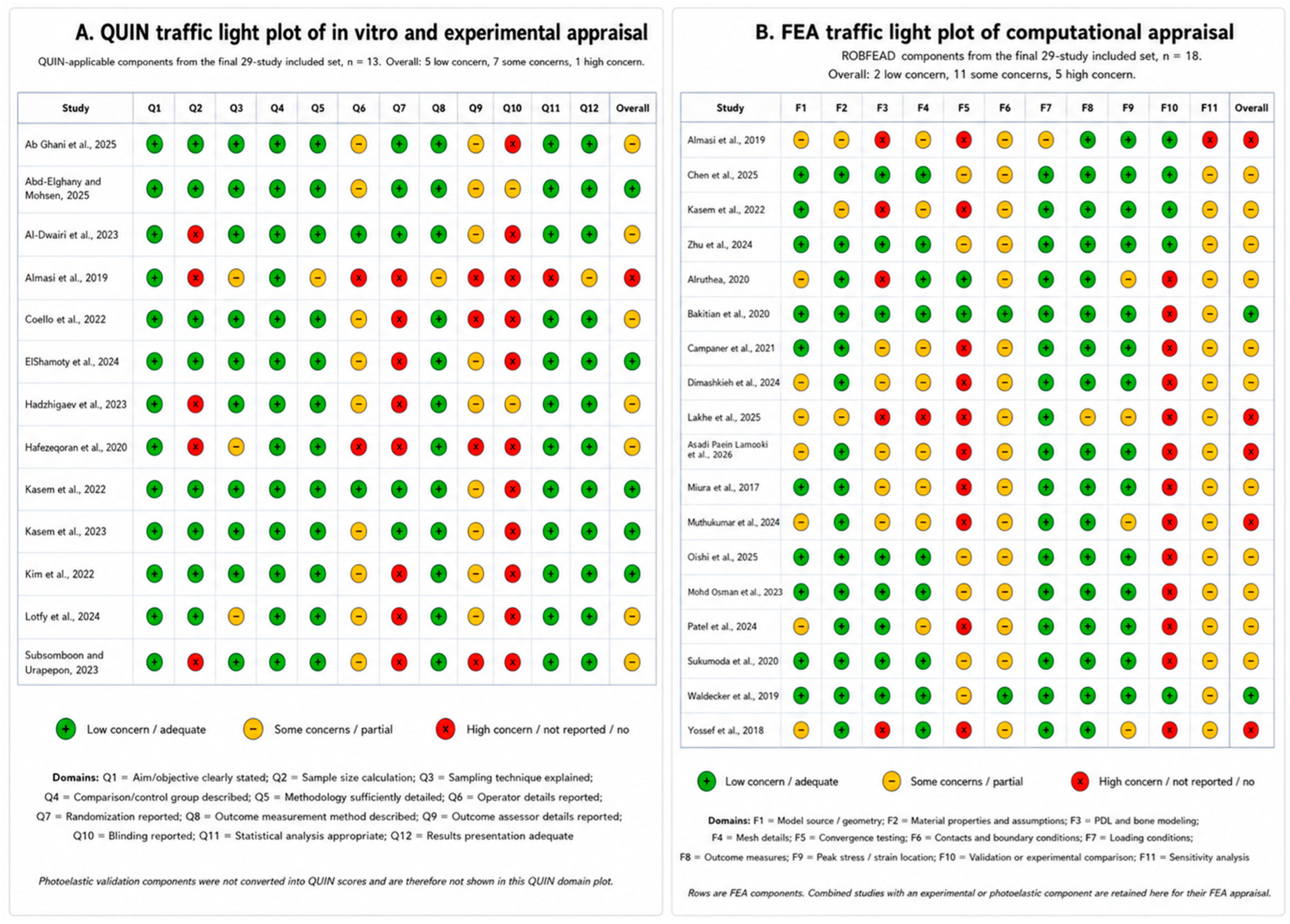
3.2. Methodological Appraisal Results
3.3. Evidence Profile
3.4. In Vitro Mechanical Performance
3.5. Conservative Retainer Findings
3.6. Connector and Framework Biomechanics
3.7. Abutment Stress Distribution
3.8. Evidence Limits
3.9. Synthesis of Biomechanical Findings
4. Discussion
4.1. Main Interpretation of the Results
4.2. Material Systems and Restorative Design
4.3. Conservative Retainer Designs
4.4. Connector, Framework, and Abutment Stress Distribution
4.5. Methodological Interpretation of the Evidence
4.6. Comparison with Prior Literature
4.7. Certainty of the Biomechanical Evidence
4.8. Future Directions
4.9. Strengths, Limitations, and Final Synthesis
5. Conclusions
Supplementary Materials
Author Contributions
Funding
Institutional Review Board Statement
Informed Consent Statement
Data Availability Statement
Acknowledgments
Conflicts of Interest
Abbreviations
| Abbreviation | Full term |
| 3Y-TZP | 3 mol% yttria-stabilized tetragonal zirconia polycrystal |
| 4Y-TZP | 4 mol% yttria-stabilized tetragonal zirconia polycrystal |
| 5Y-PSZ | 5 mol% yttria-stabilized partially stabilized zirconia |
| 5Y-TZP | 5 mol% yttria-stabilized tetragonal zirconia polycrystal |
| AB | Abstract |
| AI | Artificial intelligence |
| CAD | Computer-aided design |
| CAD/CAM | Computer-aided design and computer-aided manufacturing |
| Co-Cr | Cobalt-chromium |
| EBSCO | Elton B. Stephens Company |
| FDP | Fixed dental prosthesis |
| FEA | Finite element analysis |
| FPD | Fixed partial denture |
| FRC | Fiber-reinforced composite |
| Hz | Hertz |
| kN | Kilonewton |
| MEDLINE | Medical Literature Analysis and Retrieval System Online |
| MPa | Megapascal |
| N | Newton |
| PDL | Periodontal ligament |
| PICN | Polymer-infiltrated ceramic network |
| PICO | Population, Intervention, Comparator, Outcome |
| PRISMA | Preferred Reporting Items for Systematic Reviews and Meta-Analyses |
| QUIN | Quality Assessment Tool for In Vitro Studies |
| RBFDP | Resin-bonded fixed dental prosthesis |
| ROBFEAD | Risk-of-bias Framework for Dental Finite Element Analysis |
| SEM | Scanning electron microscopy |
| TI | Title |
| TITLE-ABS-KEY | Title, abstract, and keywords |
| TS | Topic search |
| Y-PSZ | Yttria partially stabilized zirconia |
| Y-TZP | Yttria-stabilized tetragonal zirconia polycrystal |
| ZLS | Zirconia-reinforced lithium silicate |
| ZrO2 | Zirconium dioxide |
| µm | Micrometer |
References
- Romandini, P.; Pjetursson, B.; Pitta, J.; Balet, A.; Ikumi, R.; Sailer, I. A Systematic Review and Meta-Analysis Evaluating the Survival, the Failure and the Complication Rates of Metal-Ceramic, Veneered and Monolithic All-Ceramic Tooth-Supported Multiple- Unit Fixed Dental Prostheses (Fdps). Int. J. Prosthodont. 2026, 1–34. [Google Scholar] [CrossRef] [PubMed]
- Sailer, I.; Makarov, N.; Thoma, D.; Zwahlen, M.; Pjetursson, B. All-ceramic or metal-ceramic tooth-supported fixed dental prostheses (FDPs)? A systematic review of the survival and complication rates. Part I: Single crowns (SCs). Dent. Mater. 2015, 31, 603–623. [Google Scholar] [CrossRef] [PubMed]
- Bilal, M.; Abdulaziz, S.; Amal, A.; Samran, A.; Saleem, A.; Kern, M. Anterior Cantilever Resin-Bonded Fixed Dental Prostheses: A Review of the Literature. J. Prosthodont. 2018, 27, 266–275. [Google Scholar] [CrossRef] [PubMed]
- Tan, K.; Pjetursson, B.; Lang, N.; Chan, E. A systematic review of the survival and complication rates of fixed partial dentures (FPDs) after an observation period of at least 5 years. Clin. Oral Implant. Res. 2004, 15, 654–666. [Google Scholar] [CrossRef] [PubMed]
- Caministeanu, F.; Perieanu, V.S.; Popa, A.S.; Manolescu, L.S.C.; Stetiu, A.A.; Costea, R.C.; Burlibasa, M.; Vorovenci, A.; Costea, R.M.; Serbanescu, C.M.; et al. Assessing the Genotoxic Impact of Ni-Cr Alloys in Dental Prosthodontics: A Preliminary Comparative Analysis with and Without Beryllium. Oral 2025, 5, 32. [Google Scholar] [CrossRef]
- Raigrodski, A.; Hillstead, M.B.; Graham, K.M.; Chung, K. Survival and complications of zirconia-based fixed dental prostheses: A systematic review. J. Prosthet. Dent. 2012, 107, 170–177. [Google Scholar] [CrossRef] [PubMed]
- Stefanescu, C.; Ionita, C.; Nechita, V.; Drafta, S.; Oancea, L.; Petre, A. Survival Rates and Complications for Zirconia-Based Fixed Dental Prostheses in a Period up to 10 Years: A Systematic Review. Eur. J. Prosthodont. Restor. Dent. 2018, 26, 54–61. [Google Scholar] [CrossRef] [PubMed]
- Jie, L.; Shinya, A.; Gomi, H.; Shinya, A. Finite element analysis to compare stress distribution of connector of lithia disilicate-reinforced glass–ceramic and zirconia-based fixed partial denture. Odontology 2011, 100, 96–99. [Google Scholar] [CrossRef] [PubMed]
- Thoma, D.; Sailer, I.; Ioannidis, A.; Zwahlen, M.; Makarov, N.; Pjetursson, B. A systematic review of the survival and complication rates of resin-bonded fixed dental prostheses after a mean observation period of at least 5 years. Clin. Oral Implant. Res. 2017, 28, 1421–1432. [Google Scholar] [CrossRef] [PubMed]
- Sascha, P.; Salman, A.; Avinash, S.B. Clinical outcomes of lithium disilicate single crowns and partial fixed dental prostheses: A systematic review. J. Prosthet. Dent. 2014, 112, 22–30. [Google Scholar] [CrossRef] [PubMed]
- Abdulmohsen, A.; Abdullah, A. Survival of Complete Coverage Tooth-Retained Fixed Lithium Disilicate Prostheses: A Systematic Review. Medicina 2023, 59, 95. [Google Scholar] [CrossRef] [PubMed]
- Junyu, C.; Cai, H.; Lai, S.; Yiyuan, X.; Jian, W.; Wan, Q. A systematic review of the survival and complication rates of inlay-retained fixed dental prostheses. J. Dent. 2017, 59, 2–10. [Google Scholar] [CrossRef] [PubMed]
- Zhu, T.; Chen, J.; Xu, Y.; Zhu, Z.; Wang, J.; Pei, X.; Qiao, M.; Cheng, B.; Li, R.; Wan, Q. Biomechanical behaviour of tilted abutment after fixed partial denture restoration of CAD/CAM materials. BMC Oral Health 2024, 24, 1128. [Google Scholar] [CrossRef] [PubMed]
- Junyu, C.; Cai, H.; Ren, X.; Lai, S.; Pei, X.; Wan, Q. A Systematic Review of the Survival and Complication Rates of All-Ceramic Resin-Bonded Fixed Dental Prostheses. J. Prosthodont. 2018, 27, 535–543. [Google Scholar] [CrossRef] [PubMed]
- Popescu, M.; Malița, M.; Vorovenci, A.; Ștețiu, A.A.; Perieanu, V.Ș.; Costea, R.C.; David, M.; Costea, R.M.; Ștețiu, M.A.; Drăguș, A.C.; et al. Wet vs. Dry Dentin Bonding: A Systematic Review and Meta-Analysis of Adhesive Performance and Hybrid Layer Integrity. Oral 2025, 5, 63. [Google Scholar] [CrossRef]
- Mendes, J.M.; Le Guen Bentata, A.; de Sá, J.; Sérgio Silva, A. Survival Rates of Anterior-Region Resin-Bonded Fixed Dental Prostheses: An Integrative Review. Eur. J. Dent. 2021, 15, 788–797. [Google Scholar] [CrossRef] [PubMed]
- Mohd Osman, M.L.; Lim, T.W.; Chang, H.-C.; Ab Ghani, A.R.; Tsoi, J.K.H.; Ab Ghani, S.M. Structural Integrity of Anterior Ceramic Resin-Bonded Fixed Partial Denture: A Finite Element Analysis Study. J. Funct. Biomater. 2023, 14, 108. [Google Scholar] [CrossRef] [PubMed]
- Page, M.J.; McKenzie, J.E.; Bossuyt, P.M.; Boutron, I.; Hoffmann, T.C.; Mulrow, C.D.; Shamseer, L.; Tetzlaff, J.M.; Akl, E.A.; Brennan, S.E.; et al. The PRISMA 2020 statement: An updated guideline for reporting systematic reviews. BMJ 2021, 372, n71. [Google Scholar] [CrossRef] [PubMed]
- Sheth, V.H.; Shah, N.P.; Jain, R.; Bhanushali, N.; Bhatnagar, V. Development and validation of a risk-of-bias tool for assessing in vitro studies conducted in dentistry: The QUIN. J. Prosthet. Dent. 2024, 131, 1038–1042. [Google Scholar] [CrossRef] [PubMed]
- Mathur, V.P.; Duggal, I.; Atif, M.; Tewari, N.; Rahul, M.; Duggal, R.; Chawla, A. Development and validation of risk of bias tool for the use of finite element analysis in dentistry (ROBFEAD). Comput. Methods Biomech. Biomed. Eng. 2023, 26, 1822–1833. [Google Scholar] [CrossRef] [PubMed]
- Haddaway, N.R.; Page, M.J.; Pritchard, C.C.; McGuinness, L.A. PRISMA2020: An R package and Shiny app for producing PRISMA 2020-compliant flow diagrams, with interactivity for optimised digital transparency and Open Synthesis. Campbell Syst. Rev. 2022, 18, e1230. [Google Scholar] [CrossRef] [PubMed]
- Abd-Elghany, N.F.; Mohsen, C.A. Effect of First Premolar Retainer Design on Tensile Bond Strength in Three-unit Fixed Partial Dentures: An In Vitro Study. J. Contemp. Dent. Pract. 2025, 26, 555–560. [Google Scholar] [CrossRef] [PubMed]
- ElShamoty, Y.K.; Sadeqi, H.A.; Baig, M.R. Effect of connector height and retainer occlusal thickness on the fracture resistance of posterior 4-unit monolithic 5Y-TZP fixed partial dentures after thermomechanical aging. J. Prosthet. Dent. 2024, 131, 933.E1–933.E7. [Google Scholar] [CrossRef] [PubMed]
- Kasem, A.T.; Elsherbiny, A.A.; Abo-Madina, M.; Tribst, J.P.M.; Al-Zordk, W. Biomechanical behavior of posterior metal-free cantilever fixed dental prostheses: Effect of material and retainer design. Clin. Oral Investig. 2022, 27, 2109–2123. [Google Scholar] [CrossRef] [PubMed]
- Kasem, A.T.; Abo-Madina, M.; Tribst, J.P.M.; Al-Zordk, W. Cantilever resin-bonded fixed dental prosthesis to substitute a single premolar: Impact of retainer design and ceramic material after dynamic loading. J. Prosthodont. Res. 2023. [Google Scholar] [CrossRef] [PubMed]
- Kim, Y.-J.; Ko, K.-H.; Park, C.-J.; Cho, L.-R.; Huh, Y.-H. Connector design effects on the in vitro fracture resistance of 3-unit monolithic prostheses produced from 4 CAD-CAM materials. J. Prosthet. Dent. 2022, 128, 1319.e1–1319.e10. [Google Scholar] [CrossRef] [PubMed]
- Ab Ghani, S.M.; Mohd Osman, M.L.; Chang, H.-C.; Ab Ghani, A.R.; Lim, T.W. Investigation of Connector Parameters for Fracture Strength of Zirconia and Lithium Disilicate Resin-Bonded Fixed Dental Prosthesis. Prosthesis 2025, 7, 115. [Google Scholar] [CrossRef]
- Al-Dwairi, Z.N.; Al-Aghbari, L.; Al-Haj Husain, N.; Özcan, M. Durability of cantilever inlay-retained fixed dental prosthesis fabricated from multilayered zirconia ceramics with different designs. J. Mech. Behav. Biomed. Mater. 2023, 137, 105547. [Google Scholar] [CrossRef] [PubMed]
- Coello, R.J.; Aita-Holmes, C.; Dimalanta, W.G.; Wenger, K. An in vitro trial on the effect of arch form on connector size requirements in long span anterior zirconia fixed dental prostheses. J. Prosthodont. 2022, 1–6. [Google Scholar] [CrossRef] [PubMed]
- Hadzhigaev, V.; Vlahova, A.; Mitov, G.; Zlatev, S. Fracture resistance of 3-unit monolithic ZrO2 ceramics FPDs with different preparation designs of the distal abutment: An in-vitro study. Folia Medica 2023, 65, 251–259. [Google Scholar] [CrossRef] [PubMed]
- Hafezeqoran, A.; Koodaryan, R.; Hemmati, Y.; Akbarzadeh, A. Effect of connector size and design on the fracture resistance of monolithic zirconia fixed dental prosthesis. J. Dent. Res. Dent. Clin. Dent. Prospect. 2020, 14, 218–222. [Google Scholar] [CrossRef] [PubMed]
- Lotfy, Y.G.; Mokhtar, A.; Hamza, T.A. Effect of Connector Designs on Flexural Strength of Gradient Versus Translucent Monolithic Zirconia Fixed Dental Prosthesis: An in Vitro Study. J. Fundam. Clin. Res. 2024, 4, 84–95. [Google Scholar] [CrossRef]
- Subsomboon, C.; Urapepon, S. Effect of connector configuration on the fracture load in conventional and translucent zirconia three-unit fixed dental prostheses. J. Adv. Prosthodont. 2023, 15, 171–178. [Google Scholar] [CrossRef] [PubMed]
- Almasi, A.; Antoniac, I.; Focsaneanu, S.; Manole, M.; Ciocoiu, R.; Trante, O.; Earar, K.; Saceleanu, A.; Porumb, A.; Ratiu, C. Design Improvement of Y-TZP Three Unit Bridges by Predicted Stress Concentration Using FEA and Experimental Failure Modes after Three Point Bending Test. Rev. Chim. 2019, 70, 336–342. [Google Scholar] [CrossRef]
- Chen, J.; Zhu, T.; Li, R.; Zhu, Z.; Pei, X.; Xu, Y.; Wan, Q. The effects of restorative material and connector cross-section area on the stress distribution of fixed partial denture: A finite element analysis. Head. Face Med. 2025, 21, 15. [Google Scholar] [CrossRef] [PubMed]
- Bakitian, F.; Papia, E.; Larsson, C.; Vult von Steyern, P. Evaluation of Stress Distribution in Tooth-Supported Fixed Dental Prostheses Made of Translucent Zirconia with Variations in Framework Designs: A Three-Dimensional Finite Element Analysis. J. Prosthodont. 2020, 29, 315–322. [Google Scholar] [CrossRef] [PubMed]
- Waldecker, M.; Rues, S.; Rammelsberg, P.; Bömicke, W. Validation of in-vitro tests of zirconia-ceramic inlay-retained fixed partial dentures: A finite element analysis. Dent. Mater. 2019, 35, e53–e62. [Google Scholar] [CrossRef] [PubMed]
- Alruthea, M.S. Biomechanical Analysis of the Zirconia and Graphene-based CAD-CAM Dental Bridges at Different Pontic Length: A Finite Element Analysis. J. Clin. Diagn. Res. 2020, 14, ZF01–ZF05. [Google Scholar] [CrossRef]
- Campaner, L.M.; Ribeiro, A.d.O.P.; Tribst, J.P.M.; Borges, A.L.S.; Di Lauro, A.E.; Lanzotti, A.; Garcia-Godoy, F.; Ausiello, P. Loading stress distribution in posterior teeth restored by different core materials under fixed zirconia partial denture: A 3D-FEA study. Am. J. Dent. 2021, 34, 157–162. [Google Scholar] [PubMed]
- Dimashkieh, M.R.; Yousief, S.A.; Demachkia, A.M.; Nassani, M.Z.; Samran, A.; Barakat, A.; Singh, Y.P.; Dimashkieh, R.M.; El Sayed, H.M.; Galal, R.M.; et al. Assessment of Stress Distribution Around Traditional and Sleeve Fixed Partial Denture Designs: Finite Element Analysis. Eur. J. Dent. 2024, 19, 667–677. [Google Scholar] [CrossRef] [PubMed]
- Miura, S.; Kasahara, S.; Yamauchi, S.; Egusa, H. Three-dimensional finite element analysis of zirconia all-ceramic cantilevered fixed partial dentures with different framework designs. Eur. J. Oral Sci. 2017, 1–7. [Google Scholar] [CrossRef] [PubMed]
- Oishi, Y.; Nozaki, K.; Nemoto, R.; Yue, Y.; Matsumura, M.; Saleh, O.; Fueki, K. Finite element analysis of stress distribution in cantilever resin-bonded zirconia fixed dental prosthesis and periodontal tissue with alveolar bone loss. J. Prosthodont. Res. 2025, 69, 351–358. [Google Scholar] [CrossRef] [PubMed]
- Patel, S.P.; Patel, I.B.; Solanki, K.M.; Chavda, R.M.; Choksi, R.H.; Rudakia, C.R.; Poonia, P.S. Biomechanical evaluation of four different framework designs of cantilever zirconia resin bonded fixed dental prosthesis: A three-dimensional finite element analysis study. IP Ann. Prosthodont. Restor. Dent. 2024, 10, 22–30. [Google Scholar] [CrossRef]
- Sukumoda, E.; Nemoto, R.; Nozaki, K.; Omori, S.; Noda, M.; Sato, M.; Takita, M.; Miura, H. Increased Stress Concentration in Prosthesis, Adhesive Cement, and Periodontal Tissue with Zirconia RBFDPs by the Reduced Alveolar Bone Height. J. Prosthodont. 2020. [Google Scholar] [CrossRef] [PubMed]
- Lakhe, M.; Bhargava, A.; Gupta, R.K.; Dua, B.; Anmol, C.; Yersong, M. Effect of span length and connector size on fracture resistance of monolithic zirconia FPDs: A finite element analysis. Bioinformation 2025, 21, 2523–2526. [Google Scholar] [CrossRef] [PubMed]
- Asadi Paein Lamooki, S.; Zarrati, S.; Mahmoudi Yamchi, F.; Khoshkhounejad, N. Comparison of Stress Distribution in Fixed Partial Dentures With an Endocrown Abutment Made of Two Ceramic Materials and Different Residual Tooth Structures, Using Finite Element Analysis. Int. J. Dent. 2026, 2026, 8823417. [Google Scholar] [CrossRef] [PubMed]
- Muthukumar, N.; Natarajan, P.; Kumar, S.M.; Natarajan, S. Endocrown-retained fixed partial dentures: Revolutionizing tooth restoration or risky business? A finite element study. J. Conserv. Dent. Endod. 2024, 27, 1234–1239. [Google Scholar] [CrossRef] [PubMed]
- Yossef, S.A.; Galal, R.M.; Alqahtani, W.M.S.; Alluqmani, A.A.; Abdulsamad, M.A.; Alsharabi, O.H.; Smurqandi, E.M. Comparison between Two Materials for the Fabrication of Modified Design for Posterior Inlay-retained Fixed Dental Prosthesis: A Finite Element Study. J. Int. Oral Health 2018, 10, 88–93. [Google Scholar] [CrossRef] [PubMed]
- Van Heumen, C.C.M.; Kreulen, C.M.; Creugers, N.H.J. Clinical studies of fiber-reinforced resin-bonded fixed partial dentures: A systematic review. Eur. J. Oral Sci. 2009, 117, 1–6. [Google Scholar] [CrossRef] [PubMed]
- Pjetursson, B.; Tan, W.C.; Tan, K.; Brägger, U.; Zwahlen, M.; Lang, N. A systematic review of the survival and complication rates of resin-bonded bridges after an observation period of at least 5 years. Clin. Oral Implant. Res. 2008, 19, 131–141. [Google Scholar] [CrossRef] [PubMed]
- Divakar, S.; Rathee, M.; Jain, P.; Malik, S.; Tomar, S.S.; Alam, M. Comparative evaluation of mechanical effects of two designs of immediately placed customized root-analogue zirconia implants in the maxillary and mandibular posterior regions: A finite element analysis. Dent. Med. Probl. 2025, 62, 99–106. [Google Scholar] [CrossRef] [PubMed]
- Vorovenci, A.; Eftene, O.; Burlibașa, M.; Drăguș, A.C.; Malița, M.A.; Gligor, M.R.; Perieanu, V.Ș.; Ionescu, C.; Stănescu, R.; Marcov, E.-C.; et al. Clinical Readiness of Additively Manufactured Dental Ceramics for Crowns, Veneers, and Partial-Coverage Restorations: A Scoping Review and Evidence Map. Appl. Sci. 2026, 16, 3594. [Google Scholar] [CrossRef]



| PICO Element | Operational Definition for This Review |
|---|---|
| Population or model | Tooth-supported fixed dental prosthesis models, including extracted-tooth laboratory models, artificial-tooth laboratory models, and computational models. Eligible models could include abutment teeth, periodontal ligament, alveolar bone, restorative structures, or combinations of these components. |
| Intervention or exposure | Material selection, material combination, connector design, retainer design, framework design, pontic span, prosthesis configuration, abutment configuration, and loading condition in tooth-supported fixed dental prostheses. |
| Comparator | Alternative restorative materials, alternative framework or retainer configurations, different connector dimensions or geometries, different prosthesis designs, different abutment-support conditions, or different loading conditions. Studies without a direct comparator were eligible when they provided usable biomechanical data for an eligible tooth-supported fixed dental prosthesis design. |
| Outcomes | Fracture load, fracture resistance, fatigue behavior, failure mode, chipping, connector fracture, framework fracture, retainer fracture, debonding, retention force, stress distribution, strain distribution, von Mises stress, maximum principal stress, displacement, and stress in abutment teeth, periodontal ligament, or bone. |
| Study designs considered | In vitro mechanical, fatigue, fracture resistance, and finite element analysis studies. Clinical studies were screened using the initial eligibility framework but were not considered primary evidence unless they evaluated an eligible tooth-supported fixed dental prosthesis design and a relevant biomechanical design variable. |
| Review question derived from PICO | In tooth-supported fixed dental prostheses, how do material selection, connector design, retainer design, and prosthesis configuration influence mechanical performance and stress transmission to abutment teeth and supporting tissues? |
| Domain | Inclusion Criteria | Exclusion Criteria |
|---|---|---|
| Population or model | Extracted-tooth laboratory models, artificial-tooth laboratory models, and computational models of tooth-supported fixed dental prostheses. Models could include abutment teeth, periodontal ligament, alveolar bone, restorative structures, or combinations of these components. | Implant-supported prostheses, tooth-implant-supported prostheses, removable prostheses, purely implant-abutment studies, single crowns unless analyzed as fixed dental prosthesis retainers, and material coupon studies without a fixed dental prosthesis design. |
| Prosthesis type | Conventional full-coverage tooth-supported fixed dental prostheses, fixed partial dentures, resin-bonded fixed dental prostheses, inlay-retained fixed dental prostheses, wing-retained fixed dental prostheses, cantilever tooth-supported fixed dental prostheses, and anterior or posterior tooth-supported bridge designs. | Implant-supported full-arch prostheses, implant bars, implant-retained hybrid prostheses, removable partial dentures, overdentures, and orthodontic appliances. |
| Materials | Zirconia, monolithic zirconia, veneered zirconia, partially veneered zirconia, bilayer ceramic systems, lithium disilicate, fiber-reinforced composite, resin composite frameworks, metal-ceramic comparators, and high-performance polymers when used in a tooth-supported fixed dental prosthesis design. | Materials used only in isolated coupon testing without a fixed dental prosthesis design. Materials used only in implant-supported or removable prosthetic designs. |
| Material focus | Focused on zirconia while considering comparators. Non-zirconia materials were eligible when they directly informed the review questions. | Materials with no relevance to tooth-supported fixed dental prosthesis biomechanics. |
| Outcomes | Fracture load, fracture resistance, fatigue behavior, failure mode, chipping, connector fracture, framework fracture, retainer fracture, debonding, retention force, stress distribution, strain distribution, von Mises stress, maximum principal stress, displacement, and stress in abutment teeth, periodontal ligament, or bone. | Studies without a relevant mechanical, fatigue, fracture, retention, or stress-distribution outcome. |
| Study design | In vitro mechanical, fatigue, fracture resistance, and finite element analysis studies. | Clinical studies that did not evaluate an eligible tooth-supported fixed dental prosthesis design or relevant biomechanical design variable, case reports, expert opinion papers, letters, editorials, conference abstracts without sufficient data, narrative reviews as primary evidence, and systematic reviews as primary evidence. |
| Language | English-language full texts. Non-English records could be listed as potentially relevant if identified, but were not extracted unless a reliable translation was available. | Non-English full texts without reliable translation. |
| Year | Published within the defined 10-year search window. |
| Database | Search Field Syntax | Core Search String |
|---|---|---|
| PubMed/MEDLINE | Title/Abstract | ((“fixed dental prosthesis”[Title/Abstract] OR “fixed partial denture”[Title/Abstract] OR bridge*[Title/Abstract] OR “resin-bonded fixed dental prosthesis”[Title/Abstract] OR “resin-bonded bridge”[Title/Abstract] OR “inlay-retained”[Title/Abstract] OR “wing-retained”[Title/Abstract] OR cantilever[Title/Abstract]) AND (“tooth-supported”[Title/Abstract] OR “abutment tooth”[Title/Abstract] OR “abutment teeth”[Title/Abstract] OR “natural teeth”[Title/Abstract]) AND (zirconia[Title/Abstract] OR ceramic[Title/Abstract] OR “lithium disilicate”[Title/Abstract] OR “fiber-reinforced composite”[Title/Abstract] OR FRC[Title/Abstract] OR monolithic[Title/Abstract] OR veneered[Title/Abstract]) AND (biomechanic*[Title/Abstract] OR “stress distribution”[Title/Abstract] OR “finite element”[Title/Abstract] OR fracture[Title/Abstract] OR “fracture resistance”[Title/Abstract] OR connector*[Title/Abstract] OR retainer*[Title/Abstract] OR framework[Title/Abstract])) |
| Scopus | TITLE-ABS-KEY | TITLE-ABS-KEY(“fixed dental prosthesis” OR “fixed partial denture” OR bridge* OR “resin-bonded fixed dental prosthesis” OR “resin-bonded bridge” OR “inlay-retained” OR “wing-retained” OR cantilever) AND TITLE-ABS-KEY(“tooth-supported” OR “abutment tooth” OR “abutment teeth” OR “natural teeth”) AND TITLE-ABS-KEY(zirconia OR ceramic OR “lithium disilicate” OR “fiber-reinforced composite” OR FRC OR monolithic OR veneered) AND TITLE-ABS-KEY(biomechanic* OR “stress distribution” OR “finite element” OR fracture OR “fracture resistance” OR connector* OR retainer* OR framework) |
| Web of Science Core Collection | Topic | TS = (“fixed dental prosthesis” OR “fixed partial denture” OR bridge* OR “resin-bonded fixed dental prosthesis” OR “resin-bonded bridge” OR “inlay-retained” OR “wing-retained” OR cantilever) AND TS=(“tooth-supported” OR “abutment tooth” OR “abutment teeth” OR “natural teeth”) AND TS=(zirconia OR ceramic OR “lithium disilicate” OR “fiber-reinforced composite” OR FRC OR monolithic OR veneered) AND TS=(biomechanic* OR “stress distribution” OR “finite element” OR fracture OR “fracture resistance” OR connector* OR retainer* OR framework) |
| Dentistry and Oral Sciences Source | Title or abstract | (TI “fixed dental prosthesis” OR AB “fixed dental prosthesis” OR TI “fixed partial denture” OR AB “fixed partial denture” OR TI bridge* OR AB bridge* OR TI “resin-bonded fixed dental prosthesis” OR AB “resin-bonded fixed dental prosthesis” OR TI “resin-bonded bridge” OR AB “resin-bonded bridge” OR TI “inlay-retained” OR AB “inlay-retained” OR TI “wing-retained” OR AB “wing-retained” OR TI cantilever OR AB cantilever) AND (TI “tooth-supported” OR AB “tooth-supported” OR TI “abutment tooth” OR AB “abutment tooth” OR TI “abutment teeth” OR AB “abutment teeth” OR TI “natural teeth” OR AB “natural teeth”) AND (TI zirconia OR AB zirconia OR TI ceramic OR AB ceramic OR TI “lithium disilicate” OR AB “lithium disilicate” OR TI “fiber-reinforced composite” OR AB “fiber-reinforced composite” OR TI FRC OR AB FRC OR TI monolithic OR AB monolithic OR TI veneered OR AB veneered) AND (TI biomechanic* OR AB biomechanic* OR TI “stress distribution” OR AB “stress distribution” OR TI “finite element” OR AB “finite element” OR TI fracture OR AB fracture OR TI “fracture resistance” OR AB “fracture resistance” OR TI connector* OR AB connector* OR TI retainer* OR AB retainer* OR TI framework OR AB framework) |
| Database | Search Field Syntax | Supplementary Search String |
|---|---|---|
| PubMed/MEDLINE | Title/Abstract | zirconia[Title/Abstract] AND (“resin-bonded”[Title/Abstract] OR “inlay-retained”[Title/Abstract] OR “wing-retained”[Title/Abstract] OR cantilever[Title/Abstract]) AND (“fixed dental prosthesis”[Title/Abstract] OR “fixed partial denture”[Title/Abstract]) AND (“stress distribution”[Title/Abstract] OR “finite element”[Title/Abstract] OR survival[Title/Abstract] OR success[Title/Abstract] OR fracture[Title/Abstract]) |
| Scopus | TITLE-ABS-KEY | TITLE-ABS-KEY(zirconia) AND TITLE-ABS-KEY(“resin-bonded” OR “inlay-retained” OR “wing-retained” OR cantilever) AND TITLE-ABS-KEY(“fixed dental prosthesis” OR “fixed partial denture”) AND TITLE-ABS-KEY(“stress distribution” OR “finite element” OR survival OR success OR fracture) |
| Web of Science Core Collection | Topic | TS=(zirconia) AND TS=(“resin-bonded” OR “inlay-retained” OR “wing-retained” OR cantilever) AND TS=(“fixed dental prosthesis” OR “fixed partial denture”) AND TS=(“stress distribution” OR “finite element” OR survival OR success OR fracture) |
| Dentistry and Oral Sciences Source | Title or abstract | (TI zirconia OR AB zirconia) AND (TI “resin-bonded” OR AB “resin-bonded” OR TI “inlay-retained” OR AB “inlay-retained” OR TI “wing-retained” OR AB “wing-retained” OR TI cantilever OR AB cantilever) AND (TI “fixed dental prosthesis” OR AB “fixed dental prosthesis” OR TI “fixed partial denture” OR AB “fixed partial denture”) AND (TI “stress distribution” OR AB “stress distribution” OR TI “finite element” OR AB “finite element” OR TI survival OR AB survival OR TI success OR AB success OR TI fracture OR AB fracture) |
| Study | Evidence Stratum | Study Design | Prosthesis Model | Materials and Design Variables | Testing or Modeling Protocol | Outcomes and Reported Findings |
|---|---|---|---|---|---|---|
| Almasi et al., 2019 [34] | Combined | In vitro flexure test plus FEA | Three-unit Y-TZP fixed partial denture framework based on a clinical case for replacement of a right lower molar. Four connector-design groups were evaluated. | Y-TZP frameworks. Connector shape and area were varied: circular and elliptical connectors with 5 mm2 or 9 mm2 cross-sectional area. Sample codes were ZC5, ZE5, ZC9, and ZE9. | Experimental loading used three-point bending to failure. FEA used a 500 N load on the pontic crest, with fixed geometry at the inferior surfaces of the molar and premolar abutments. | Both 5 mm2 connector designs failed below 500 N, whereas the 9 mm2 designs failed at approximately 3 times that load. Approximate failure loads were 0.455 kN for ZC5, 0.345 kN for ZE5, 1.229 kN for ZC9, and 1.450 kN for ZE9. FEA showed more even stress distribution with larger connector cross-sectional area. Stress concentration occurred where the connector joined the cap and where the restoration roof joined the side wall. Experimental fracture origins corresponded to high-stress regions predicted by FEA. |
| Chen et al., 2025 [35] | Combined | FEA with photoelastic validation | Maxillary posterior three-unit fixed partial denture replacing the first molar. Abutments were the maxillary second premolar and second molar. | 3Y-TZP zirconia, lithium disilicate, PICN, and resin composite. Connector cross-sectional areas were 4, 6, 8, 10, and 12 mm2. FPD thickness was 1 mm cervical, 1.5 mm occlusal, and 1 mm middle third. Cement layer thickness was 0.03 mm. | Two 200 N loading modes were simulated: three-point loading on twelve 1 mm2 occlusal areas and pontic loading on three 1 mm2 areas on the pontic central groove. | At a constant connector cross-sectional area of 8 mm2, zirconia produced the lowest abutment tooth stress, 2.4177 MPa. Compared with zirconia, abutment stress increased by 2.37% for lithium disilicate, 7.67% for PICN, and 13.16% for resin composite. Increasing connector cross-sectional area from 4 to 12 mm2 reduced abutment stress by 1.65% in zirconia and 1.54% in PICN, but increased abutment stress by 115.63% in resin composite. At 12 mm2, average PDL stress was 1.2807 MPa for zirconia, 1.2796 MPa for lithium disilicate, 1.2778 MPa for PICN, and 1.2760 MPa for resin composite. Photoelastic results were reported as consistent with FEA. Stress concentration was reported mainly at connectors and occlusal loading areas. Photoelastic analysis showed a larger high-equivalent-stress area for resin composite than for zirconia at the same connector cross-sectional area, and lower equivalent stress as connector cross-sectional area increased for the same material. |
| Kasem et al., 2022 [24] | Combined | In vitro fatigue and fracture testing plus FEA | Posterior cantilever resin-bonded fixed dental prosthesis replacing a mandibular premolar. Reported mandibular molars served as abutments. Two retainer designs were tested: D1 inlay ring retainer and D2 lingual coverage retainer. | Monolithic high-translucency 3Y-TZP zirconia, Katana HT, and fiber-reinforced composite, TriLor. CAD/CAM restorations had a 3 × 3 mm connector, fixed 20 micrometer marginal gap, 60 micrometer internal cement gap, and standardized premolar pontic dimensions. | Aging included storage in distilled water for 24 h, 10,000 thermocycles between 5 and 55 degrees C, then 240,000 cycles at 50 N and 1.6 Hz. Fracture loading used a 5 mm spherical antagonist at 0.5 mm/min until fracture or visible plastic deformation. FEA loads were adjusted to the experimental group failure loads: 505 N for D1Z, 345 N for D1F, 548 N for D2Z, and 375.10 N for D2F. | All specimens survived artificial aging. Failure loads were D1Z 505.00 ± 61.50 N, D1F 345.00 ± 42.33 N, D2Z 548.00 ± 75.63 N, and D2F 375.10 ± 53.62 N. Material had a statistically significant effect on failure load, p = 0.001. Retainer design was not significant, p = 0.060. The material by design interaction was not significant, p = 0.734. FEA showed higher tooth-structure stress in D1 than D2. Dentin stresses were 15.80 MPa for D1Z, 11.00 MPa for D1F, 6.40 MPa for D2Z, and 1.07 MPa for D2F. Enamel stresses were 11.23, 11.00, 4.00, and 0.98 MPa. Luting resin stresses were 9.84, 20.66, 24.09, and 29.01 MPa. D2 showed more favorable failure patterns. Unfavorable failure occurred in 30% of D1Z and 20% of D1F, but 0% of D2Z and D2F. SEM indicated zirconia fractures often started at the occlusal surface, mostly near the connector region, while FRC failures were often at the tooth-restoration interface with fiber cohesive and adhesive failure. |
| Zhu et al., 2024 [13] | Combined | FEA with photoelastic validation | Maxillary posterior three-unit FPD replacing the first molar, with the second premolar and second molar as abutments. The distal abutment, second molar, was modeled with mesial inclination angles of 0, 6, 12, 18, 24, and 30 degrees. | Zirconia, lithium disilicate, PICN, and resin composite. The FPD thickness was 1.5 mm occlusal, 1 mm axial, and 1 mm shoulder. Cement layer thickness was 0.03 mm. The connector was reported as circular. Connector size reporting used inconsistent unit wording. | Two loading conditions were used: 200 N three-point loading on the FPD and 120 N pontic loading. Loading points were 1 mm2 circles distributed according to occlusal anatomy. FEA modeled loading directions at 0, 6, 12, 18, 24, and 30 degrees. | Stress was reported at the FPD connectors, enamel shoulder collar, periapical area, and root bifurcation. Under three-point loading, zirconia showed the largest average equivalent stress on the FPD, 2.81 MPa, followed by lithium disilicate, 2.63 MPa, PICN, 2.31 MPa, and resin composite, 2.07 MPa. For zirconia, average FPD stress increased from 2.81 MPa at 0 degrees to 2.93 MPa at 6 degrees, 3.13 MPa at 12 degrees, 3.28 MPa at 18 degrees, 3.58 MPa at 24 degrees, and 3.88 MPa at 30 degrees. Under pontic loading, resin composite at 30 degrees produced a sudden increase in alveolar bone stress, with maximum equivalent stress of 1754.10 MPa and average equivalent stress of 2.38 MPa. Photoelastic analysis reported similar qualitative patterns. Under pontic loading, stress was mainly concentrated near periapical and root furcation areas, and stress concentration increased as distal abutment inclination increased. |
| Ab Ghani et al., 2025 [27] | In vitro | In vitro fracture-strength study of anterior cantilever RBFDPs | Anterior cantilever resin-bonded fixed dental prosthesis replacing an incisor, with one reported incisal abutment. | Zirconia, IPS e.max ZirCAD Prime, and lithium disilicate, IPS e.max CAD. Connector dimensions: 5 × 4 × 1 mm and 4 × 2 × 1 mm. Retainer thickness 0.5 mm. | 24 h saline storage at 37 degrees C, 5000 thermocycles between 5 degrees C and 55 degrees C. Load applied to the pontic palatal surface at 45 degrees and 0.5 mm/min. | Larger connector dimensions were associated with higher adjusted fracture strength, 224.71 N versus 120.48 N, p = 0.02. Zirconia values were numerically higher than lithium disilicate values, but material was not statistically significant after adjustment, p = 0.096. Reported subgroup values included zirconia 269 ± 27 N and lithium disilicate 180 ± 83 N for larger connectors, and zirconia 237 ± 52 N and lithium disilicate 116 ± 25 N for smaller connectors. Most specimens fractured at the connector with retainers remaining cemented. One zirconia specimen with the larger connector had tooth fracture. Two lithium disilicate specimens with the larger connector decemented. |
| Abd-Elghany and Mohsen, 2025 [22] | In vitro | In vitro tensile bond-strength study | Three-unit fixed partial denture replacing the mandibular second premolar; first premolar and first molar abutments. | BruxZir solid zirconia three-unit bridges. Retainer designs: full coverage on sound tooth, full coverage with fiber post and core, endocrown, and Sharonlay. | Specimens immersed in 4% acetic acid at 80 degrees C for 18 h. Tensile pull-off test at 1 mm/min with a metallic hook beneath the connector/embrasure. | Full coverage reported the highest tensile bond strength, 431.82 ± 18.90 N. Post-and-core full coverage was 212.93 ± 5.84 N, endocrown was 181.97 ± 12.06 N, and Sharonlay was 156.92 ± 10.75 N. Overall difference was significant, p < 0.001, with significant pairwise differences. Outcome was dislodgement/debonding under tensile loading. Detailed adhesive/cohesive failure classification was not reported. |
| Al-Dwairi et al., 2023 [28] | In vitro | In vitro fatigue and fracture study of cantilever inlay-retained FDPs | Cantilever inlay-retained fixed dental prosthesis in a maxillary premolar model. | Two multilayer zirconias, IPS e.max ZirCAD Prime and Zolid Gen-X. Three retainer designs: short wings, long palatal wing, and long palatal wing with occlusal extension. Minimum connector area 12 mm2. | 24 h storage at 37 degrees C, 5000 thermocycles, then 1,200,000 cycles at 49 N and 1.7 Hz. Surviving specimens were loaded vertically on the pontic with a 5 mm ball at 0.5 mm/min. | Final fracture load did not differ significantly by design, material, or interaction. Dynamic fatigue failures differed by material, with ZirCAD Prime reporting more failures during cyclic loading than Zolid Gen-X, p = 0.009. The highest mean failure load was reported for D2GX, 1203.2 ± 1021.0 N, and the lowest for D2ZP, 344.0 ± 84.9 N, but the final load analysis was not significant. D1 had more debonding. D2 tended toward palatal wing fracture and debonding. D3 tended toward abutment tooth fracture. Connector fracture was not observed. |
| Coello et al., 2022 [29] | In vitro | In vitro fatigue study of long-span anterior zirconia FDPs | Canine-to-canine maxillary anterior FDP with four incisor pontics. | 4Y-TZP zirconia, IPS e.max ZirCAD MT Multi. Connector sizes 9 and 12 mm2. Anterior cantilever or pontic spread values of 7, 10, and 13 mm. | Loaded at 135 degrees. Ramp to 165 N, then sinusoidal fatigue cycling from 50 to 280 N at 30 Hz for up to 5 million cycles. | Nine of 42 prostheses fractured before 5 million cycles. Connector size was not significant (p = 1.00). The six-group comparison was not significant (p = 0.2338). A comparison of 7 mm cantilever spread versus 10 mm and 13 mm combined was significant (p = 0.0407). Fractures occurred during fatigue cycling. The detailed fracture origin was not reported. |
| ElShamoty et al., 2024 [23] | In vitro | In vitro thermomechanical aging and fracture-resistance study | Posterior four-unit monolithic 5Y-TZP FDP supported by first premolar and second molar preparations. | Monolithic 5Y-TZP, Ceramill Zolid FX. Connector heights: 4 mm and 2 mm; cross-sectional areas: 12.6 and 6.3 mm2. Retainer occlusal thickness 1 or 2 mm. | One week water storage at 37 degrees C, 400,000 mechanical cycles at 50 N and 1.24 Hz, with 4000 thermocycles between 5 degrees C and 55 degrees C. Static load to failure on molar pontic at 0.5 mm/min. | No failures occurred during aging. Static fracture loads were CH4OT2 1563 ± 229 N, CH4OT1 1443 ± 291 N, CH2OT2 1067 ± 193 N, and CH2OT1 737 ± 111 N. Connector height was significant, p < 0.001. Retainer occlusal thickness was significant, p = 0.002. Interaction was not significant, p = 0.132. The 4 mm connector groups mainly fractured through the molar pontic. The 2 mm connector groups fractured through one or more connectors, and the 2 mm connector with 1 mm occlusal thickness fractured all connectors, resulting in loss of one or both pontics. |
| Hadzhigaev et al., 2023 [30] | In vitro | In vitro fracture-resistance study of distal-abutment preparation design | Three-unit mandibular zirconia FDP replacing the lower right second premolar, with premolar and molar abutments. | Full-contour monolithic ZrO2, DD Bio ZX2. Distal abutment design compared classical shoulder preparation with endocrown preparation and a 2 mm retention cavity. Distal connector 9 mm2 elliptical; mesial connector 9 mm2 circular. | No mechanical or thermal artificial aging. Vertical load to pontic with 5 mm sphere, 1 N preload, then 5 N/s until fracture. | Overall mean fracture resistance was 1099.66 ± 386.98 N. Endocrown preparation reported 1254.3 ± 358.37 N, and classical preparation 954.9 ± 381.54 N. Difference was not statistically significant, reported as p = 0.087 or p = 0.09 depending on text section. Nineteen of 20 fracture lines were located at the distal connector, with one at the mesial connector. |
| Hafezeqoran et al., 2020 [31] | In vitro | In vitro fracture-resistance study of connector size and shape | Three-unit mandibular monolithic zirconia FDP extending from the first premolar to the first molar. | Monolithic zirconia, Sirona inCoris TZI. Connector areas 9 and 12 mm2. Gingival embrasure radius compared round, 0.9 mm, and sharp, 0.25 mm. | Static three-point bending load at pontic center. Thermocycling and dynamic aging were not reported. | Reported fracture resistance values were 1327.4 ± 196.37 N for 9 mm2 round, 1054.4 N for 9 mm2 sharp, 1599.8 ± 167.09 N for 12 mm2 round, and 1440 ± 159.05 N for 12 mm2 sharp. Rounded versus sharp was significant at 9 mm2, p = 0.007, but not at 12 mm2, p = 0.075. A larger area was significant for both round and sharp connector designs. Detailed fracture-mode categories were not reported. |
| Kasem et al., 2023 [25] | In vitro | In vitro fatigue and fracture study of cantilever resin-bonded FDPs | Cantilever resin-bonded FDP replacing a mandibular premolar with a molar abutment. | Zirconia, Katana HT, and zirconia-reinforced lithium silicate (Vita Ambria). Five retainer designs: one wing, two wings, inlay ring, lingual coverage, and occlusal coverage. Connector area standardized at 16 mm2. | Thermal aging and 240,000 cycles of dynamic loading at 50 N and 1.6 Hz, followed by static compressive loading on the pontic at 0.5 mm/min. | Two debondings occurred during aging in the zirconia one-wing group. Reported zirconia failure-load means were OW 124 ± 18.83 N, TW 232.60 ± 15.60 N, IR 505 ± 61.51 N, LC 548 ± 75.64 N. OC 627 ± 153.42 N. Reported ZLS2 means were OW 130.40 ± 19.63 N, TW 151 ± 63.52 N, IR 219 ± 63.92 N, LC 177 ± 20.64 N, and OC 230 ± 40.37 N. Zirconia was higher than ZLS2 except for the one-wing design, where the material comparison was not significant. Connector-region fracture and debonding were common. Some catastrophic tooth fractures were reported in zirconia retainer designs. Exact group attribution was not reported consistently. |
| Kim et al., 2022 [26] | In vitro | In vitro fracture-strength study of the connector aspect ratio and material | Three-unit FDP replacing a mandibular first premolar, supported by canine and second premolar abutments. | Two lithium disilicate materials, IPS e.max CAD and Amber Mill, and two 5Y-PSZ zirconias, 3M Lava Esthetic and Katana UTML. Connector cross-sectional area fixed at 16 mm2, with W = H, W < H, and W > H designs. | 24 h water storage, 10,000 thermocycles, 200,000 mechanical cycles at 50 N and 2 Hz, then static loading at 0.5 mm/min. | Material, connector design, and their interaction significantly affected fracture strength, with p < 0.001, p < 0.001, and p = 0.008. A wider-than-high connector generally reduced fracture strength, except in IPS e.max CAD. For example, Katana UTML decreased from 842 ± 140 MPa in W = H to 543 ± 111 MPa in W > H. Fracture location varied by material and connector design, and distal connector fracture was commonly reported. Detailed fracture-site coding was not reported. |
| Lotfy et al., 2024 [32] | In vitro | In vitro flexural-strength study of zirconia material and connector design | Three-unit posterior zirconia FDP supported by mandibular first premolar and first molar metal dies. | Gradient zirconia, IPS e.max ZirCAD 3Y/5Y, and translucent zirconia, BruxZir Shaded 16 PLUS 4Y. Round and sharp connector designs with a 3 × 3 mm connector size. | Static load applied perpendicularly to the middle of the pontic with a 3 mm steel bar at 0.5 mm/min until failure. Cyclic aging and thermocycling were not reported. | Flexural strength differed among groups (p < 0.0001). BruxZir sharp was 578.77 ± 32.90 MPa, BruxZir round was 709.10 ± 82.27 MPa, ZirCAD sharp was 744.07 ± 67.04 MPa, and ZirCAD round was 964.78 ± 50.99 MPa. Tukey’s test did not show a significant difference between BruxZir sharp and BruxZir round (p = 0.1151) or between BruxZir round and ZirCAD sharp (p = 0.8941). Visual examination of fracture patterns was performed. Exact fracture-mode categories were not reported. |
| Subsomboon and Urapepon, 2023 [33] | In vitro | In vitro fracture-load study of zirconia type and connector configuration | Mandibular posterior three-unit FDP, with prepared second premolar and second molar abutments. | Katana ML 3Y-TZP, Katana STML 4Y-TZP, and Katana UTML 5Y-TZP. Connector configurations 4 × 2.25 mm and 3 × 3 mm, both 9 mm2. | Static vertical load applied with a 5 mm steel ball at the pontic center and 1 mm/min until fracture. Dynamic functional loading and aquatic environmental aging were not used. | 3Y-TZP reported higher fracture loads than 4Y-TZP and 5Y-TZP, p < 0.05. Values were 2740.6 ± 469.2 N and 2718.7 ± 339.0 N for 3Y-TZP, 1868.3 ± 281.6 N and 1663.6 ± 372.7 N for 4Y-TZP, and 1588.0 ± 255.0 N and 1559.1 ± 110.0 N for 5Y-TZP. Connector configuration was not significant (p = 0.44), and the interaction was not significant (p = 0.74). All zirconia bridges showed catastrophic bulk fracture. Fractures initiated from occlusal pontic surfaces and extended to the connector base. Fractures always occurred at the base of the connector. |
| Alruthea, 2020 [38] | FEA | FEA only | Mandibular posterior fixed-fixed bridges. Three-unit and four-unit designs were modeled. | Zirconia and graphene-based CAD/CAM bridge material compared. Material properties were reported for zirconia and graphene. | 600 N vertical force. Three-unit bridge loaded at the central groove of the pontic. Four-unit bridge loaded on the marginal ridges of the pontics. | Graphene-based models showed higher stress, deflection, equivalent elastic strain, and deformation than zirconia models. Three-unit models showed higher values than corresponding four-unit models. Stress concentration was reported at the middle of the bridge and at connectors between pontics and abutments. |
| Bakitian et al., 2020 [36] | FEA | FEA only | Three-unit tooth-supported posterior FDP with first premolar and first molar abutments and a second-premolar pontic. | Translucent zirconia framework and veneering porcelain. Designs included monolithic zirconia, 0.3 mm and 0.5 mm semi-monolithic veneering, cap support, and wave support. | 300 N load applied at 10 degrees oblique direction over six occlusal points. | Framework and veneer design affected stress distribution. Cap-support design showed the smallest maximum principal stress in veneering porcelain. Wave design showed the lowest maximum shear at the zirconia-veneer interface. Maximum stress shifted by design. Some models concentrated stress in veneer, while cap-support and monolithic models concentrated stress in the cervical zirconia framework. |
| Campaner et al., 2021 [39] | FEA | FEA only | Posterior three-unit zirconia FDP with first molar and first premolar abutments and a central pontic. | Zirconia fixed partial denture over different core or substrate conditions: sound dentin, resin composite core, and metal core. Cement layer reported as 100 µm. | 300 N axial load applied at the center of the pontic or occlusal surface of the second premolar. | Metal cores produced the highest tensile stress peak in the FPD, reported as 116.4 MPa. Resin composite cores produced the highest cement-layer stresses in the molar and premolar abutments. Highest tensile stress was reported in connector regions. |
| Dimashkieh et al., 2024 [40] | FEA | FEA only | Three-unit and four-unit mandibular posterior fixed partial denture models. Traditional and sleeve designs were compared. | Zirconia, E-max, and Celtra Duo were compared. Traditional versus sleeve retainer design was the main design variable. | Vertical 300 N and oblique 150 N at 45 degrees. Four-unit loading distributed across pontic regions. | Oblique loading produced cortical bone stresses 12 to 15% higher than vertical loading. Four-unit sleeve designs reduced cortical bone stresses up to 20% compared with traditional designs. Sleeve design also reduced cement-layer stresses. Stress patterns were evaluated in cortical bone, spongy bone, mucosa, cement, roots, and prosthesis bodies. |
| Lakhe et al., 2025 [45] | FEA | FEA only | Mandibular posterior monolithic zirconia FDPs with 3-, 4-, and 5-unit span lengths. | Monolithic 3 mol% Y-TZP zirconia. Connector cross-sectional areas of 12, 15, 18, and 21 mm2 were compared across 9, 16, and 23 mm spans. | Vertical loads of 324 N and 1270 N applied to the central fossa of the pontic over 2 mm2. | Longer spans and smaller connectors increased von Mises stress. For the 9 mm span at 1270 N, reported stresses decreased from 736 MPa at 12 mm2 to 420 MPa at 21 mm2. In the 23 mm span, smaller connectors exceeded the stated zirconia tensile-strength threshold under maximal loading. Highest stress was reported in connector regions. |
| Asadi Paein Lamooki et al., 2026 [46] | FEA | FEA only | Mandibular three-unit FDP replacing the mandibular right first premolar. Canine full-coverage abutment and second premolar endocrown abutment. | Lithium disilicate and zirconia compared. Residual wall height of the endocrown abutment was 3 mm or 4.5 mm. Resin cement thickness reported as 0.12 mm. | Buccal loading at 135 degrees: 140 N on canine and 200 N on premolars. Centric occlusal loading: 200 N on premolars. | Greater residual wall height was reported to reduce stress, and connector regions had the highest stress. Several residual-wall-height comparisons were inconsistent. Highest stresses were reported mainly at connector regions. |
| Miura et al., 2017 [41] | FEA | FEA only | Three-unit cantilever FDP simulating a missing mandibular first molar. First and second premolars were the abutments. | Yttria partially stabilized zirconia and high noble gold alloy frameworks. Abutment materials were dentin and brass. Framework design variables included buccolingual width expansion and occlusal height expansion. | 1 N vertical load applied to the cantilevered pontic at the distal fossa. | Basic design showed the highest maximum principal stress in frameworks. The combined width and height design had about half the maximum principal stress of the basic design and was interpreted by the authors as reducing stress concentration. Abutment stresses were reported at the mesial cervical first premolar and occlusal area of the second premolar. |
| Muthukumar et al., 2024 [47] | FEA | FEA only | Three-unit zirconia fixed partial dentures comparing endocrown-retained and post-and-core or fiber-post-retained designs. | Zirconia FDP, resin cement, enamel, dentin, cortical and cancellous bone, PDL, and fiber post materials. Material properties were reported. | A 150 N occlusal load was simulated. | The endocrown-retained design reported lower von Mises stress than the post-and-core design, 176.35 MPa versus 298.29 MPa, with lower shear stress at the cement interface and lower stress on abutment teeth. Stress endpoints included crown, tooth, and cement interface regions. Exact peak locations were not reported. |
| Oishi et al., 2025 [42] | FEA | FEA only | Maxillary anterior resin-bonded zirconia FDPs. Two-unit cantilever designs and three-unit two-retainer design were compared under different alveolar bone levels. | Y-TZP zirconia framework with adhesive cement. Retainer thickness reported as 0.5 mm. Designs included central incisor or canine single abutment and a two-retainer configuration. | 100 N applied to a point 1 mm below the incisal edge of each abutment from a 45-degree incisal direction. | In models with bone loss of 4 mm or more, two-unit cantilever designs had lower cement shear stress than the three-unit two-retainer design. Framework maximum principal stress was smaller in two-unit designs across models. PDL and trabecular bone strains were greater in the single-abutment designs in reduced bone conditions. Stress and strain endpoints were evaluated in framework, adhesive cement, PDL, cortical bone, and trabecular bone. |
| Mohd Osman et al., 2023 [17] | FEA | FEA only | Anterior cantilever ceramic RBFDP with central incisor abutment and lateral incisor pontic. | Lithium disilicate and zirconia compared. Connector shapes were rectangular and trapezoidal, with different dimensions and volumes. | 100 N, 150 N, and 200 N applied to the palatal surface at 45 degrees. | Higher loads increased maximum equivalent stress. Lithium disilicate connector stresses exceeded material strength at 150 N and 200 N in all tested shapes and dimensions. Zirconia rectangular connectors withstood all tested loads, while smaller trapezoidal zirconia connectors exceeded strength limits. Connector regions were the main stress sites. |
| Patel et al., 2024 [43] | FEA | FEA only | Maxillary anterior cantilever zirconia RBFDP replacing the left lateral incisor. Central incisor and canine abutments were compared. | Y-TZP zirconia. Design variables were abutment tooth, central incisor versus canine, and connector dimensions, 3 × 3 mm versus 3 × 4 mm. | 200 N load applied at 45 degrees to the long axis of the pontic or lateral incisor. | Canine abutment designs had lower framework strain, PDL strain, cement shear stress, and debonding-risk area than central incisor designs. The 3 × 4 mm connector showed lower stress and strain than the 3 × 3 mm connector. Stress and strain endpoints were evaluated in framework, PDL, and cement. |
| Sukumoda et al., 2020 [44] | FEA | FEA only | Maxillary anterior zirconia RBFDP with upper central incisor and canine abutments under different alveolar bone levels. | Zirconia framework, adhesive cement, enamel, dentin, PDL, cortical bone, and cancellous bone. | 200 N applied at 45 degrees from tooth axis to the center of the pontic and palatal side of retainer. | Maximum principal stress in the framework increased from 25.33 MPa at normal bone level to 29.35 MPa at the lowest bone level. Cement shear stress and PDL strain increased with reduced alveolar bone height. Cement stress concentrated at the connector side and cervical central-incisor region as bone level decreased. |
| Waldecker et al., 2019 [37] | FEA | FEA only | Zirconia-ceramic inlay-retained fixed partial dentures. The study validates in vitro test setups against a clinical reference situation. | Zirconia-ceramic inlay-retained FDPs. Variables included abutment tooth material, tooth mobility or resilience, restoration design, load direction, and cement-layer stiffness. | Loading directions and test conditions varied as part of validation analysis. | All tested variables affected calculated fracture resistance. Resin teeth underestimated fracture resistance by up to 57%. Resiliently supported metal abutments provided the closest approximation to clinical conditions, around −6% to +15% compared with the clinical reference. The focus was validation of test condition effects rather than one anatomical peak-stress site. |
| Yossef et al., 2018 [48] | FEA | FEA only | Posterior inlay-retained fixed dental prosthesis replacing a mandibular first molar. | Full zirconia one-piece inlay-retained FDP compared with a modified design using Co-Cr substructure, porcelain coating, and adhesive resin-coated wings. | 400 N compressive load applied to the buccal cusp. | Both alternatives were reported to produce von Mises stress distributions within safe limits. The zirconia prosthesis showed lower stresses in the reported conclusion. Stress was evaluated in prosthesis components and supporting teeth. Exact peak locations were not reported. |
| Biomechanical Factor | Evidence Base | Consistency | Main Methodological Concerns | Certainty for Biomechanical Interpretation | Certainty for Clinical Translation |
|---|---|---|---|---|---|
| Connector dimensions and shape | In vitro and FEA | Moderate consistency | Heterogeneous loading, aging, connector geometry, and outcome definitions | Low to moderate | Low |
| Span length and cantilever extension | In vitro and FEA | Moderate consistency | Different spans, load directions, support conditions, and endpoint definitions | Low to moderate | Low |
| Material class | In vitro and FEA | Mixed | Different materials were tested in different designs and under different loading conditions | Low | Very low |
| Retainer design | In vitro and FEA | Mixed | Adhesive protocols, retainer geometries, and failure definitions varied | Low | Very low |
| Abutment support and periodontal condition | Mainly FEA | Moderate pattern consistency | Model-dependent periodontal ligament and bone assumptions | Low | Very low |
Disclaimer/Publisher’s Note: The statements, opinions and data contained in all publications are solely those of the individual author(s) and contributor(s) and not of MDPI and/or the editor(s). MDPI and/or the editor(s) disclaim responsibility for any injury to people or property resulting from any ideas, methods, instructions or products referred to in the content. |
© 2026 by the authors. Licensee MDPI, Basel, Switzerland. This article is an open access article distributed under the terms and conditions of the Creative Commons Attribution (CC BY) license.
Share and Cite
Babiuc, I.; Drăguș, A.C.; Perieanu, V.Ș.; Vorovenci, A.; Ștețiu, A.A.; Malița, M.A.; Gligor, M.R.; Ștețiu, M.A.; Costea, R.C.; Burlibașa, A.; et al. Biomechanics of Tooth-Supported Fixed Dental Prostheses: Material Systems, Connector Design, Retainer Design, and Abutment Stress Distribution—A Systematic Review of In Vitro and Finite Element Evidence. Materials 2026, 19, 2844. https://doi.org/10.3390/ma19132844
Babiuc I, Drăguș AC, Perieanu VȘ, Vorovenci A, Ștețiu AA, Malița MA, Gligor MR, Ștețiu MA, Costea RC, Burlibașa A, et al. Biomechanics of Tooth-Supported Fixed Dental Prostheses: Material Systems, Connector Design, Retainer Design, and Abutment Stress Distribution—A Systematic Review of In Vitro and Finite Element Evidence. Materials. 2026; 19(13):2844. https://doi.org/10.3390/ma19132844
Chicago/Turabian StyleBabiuc, Iuliana, Andi Ciprian Drăguș, Viorel Ștefan Perieanu, Andrei Vorovenci, Andreea Angela Ștețiu, Mădălina Adriana Malița, Mihaela Romanița Gligor, Maria Antonia Ștețiu, Radu Cătălin Costea, Andrei Burlibașa, and et al. 2026. "Biomechanics of Tooth-Supported Fixed Dental Prostheses: Material Systems, Connector Design, Retainer Design, and Abutment Stress Distribution—A Systematic Review of In Vitro and Finite Element Evidence" Materials 19, no. 13: 2844. https://doi.org/10.3390/ma19132844
APA StyleBabiuc, I., Drăguș, A. C., Perieanu, V. Ș., Vorovenci, A., Ștețiu, A. A., Malița, M. A., Gligor, M. R., Ștețiu, M. A., Costea, R. C., Burlibașa, A., Popescu, M., & Burlibașa, M. (2026). Biomechanics of Tooth-Supported Fixed Dental Prostheses: Material Systems, Connector Design, Retainer Design, and Abutment Stress Distribution—A Systematic Review of In Vitro and Finite Element Evidence. Materials, 19(13), 2844. https://doi.org/10.3390/ma19132844