1. Introduction
Non-ferrous metal alloys with low specific mass, such as those based on aluminum and magnesium, are known, in particular, for their applications in the automotive, aeronautical, military, sports and medical fields. Their extension to the manufacture of parts that work in specific conditions of cavitation hydrodynamics has required the development of research on their behavior under these erosive stresses. If, for aluminum-based alloys used in the manufacture of parts that work in cavitational currents such as boat propellers, pump rotors, pistons and valves of thermal engines, the literature [
1,
2,
3,
4,
5] offers many research results regarding their behavior and resistance to cavitation erosion, for magnesium-based alloys, research in this direction is in its early stages. Most studies related to magnesium-based alloys are due to their biodegradability and use in reconstructive surgery and orthopedic devices [
5,
6,
7,
8,
9,
10,
11,
12,
13,
14,
15,
16,
17,
18,
19,
20].
The expansion of the use of these alloys in cardiac surgery devices (stents, valves), due to the blood network, of the hydraulic network type, requires the need to study them also from the point of view of behavior under stresses generated by cavitation [
21,
22,
23,
24,
25,
26]. These studies aim to identify the mechanism of destruction of the surface structure, at overpressures of the order of tens, even hundreds of GPa, created by the impact with microjets and shock waves produced by the implosion of cavitation bubbles [
27,
28,
29,
30,
31,
32,
33,
34,
35]. Significant is the research carried out by Krelka et al. [
21] who shows that the mechanism of cavitation degradation of pure magnesium and its alloys is ductile fracture. Also, Krella [
23], through the research carried out on the AlMg
2 alloy, highlighted the negative effect of ductile intermetallic compounds, by increasing the speed and depth of the caverns produced by cavitation erosion.
Aquire et al. [
36] conducted a study on the formation of caverns by cavitation in the structure of the AZ61 alloy, finding that the process begins at the grain boundaries, being preceded by a strong plastic deformation and, over time, develops perpendicular to the direction of stress.
Jascionowski et al. [
24] in their research, carried out on the MgAl
2Si alloy, in three stands with different intensities of cavitation destruction (vibrating apparatus, hydrodynamic tunnel and pressurized jet), shows the dependence of the degree of destruction on the type of stand, practically expressing the dependence of erosion on the intensity of the hydrodynamic regime of cavitation. The studies conducted by YE L et al. [
22] on the AZ31B alloy, using a vibrating apparatus with the indirect method (stationary sample), show the effect of the liquid medium (water and kerosene) on the increase in the Vickers hardness of the surface, under the impact of microjets and shock waves, generated by the mechanism of vibratory cavitation. The authors’ conclusions are that cavitation in water increased the Vickers hardness by (23.77–48.19)% compared to that obtained by cavitation in kerosene. It is known that the main purpose of research in the field of cavitation is to increase the service life of parts. The most used technologies for this purpose are volumetric heat treatments, due to the possibilities of varying the parameters of the regime: temperature, holding time, cooling medium. An example in this regard is the research conducted on various structural states of pure zinc [
8,
25,
37,
38,
39,
40,
41,
42,
43] and its alloys ZnMg [
6,
9,
37,
44], ZnCuMg [
8,
10,
45], also targeting applications in cardiovascular surgery. The results of these research studies highlight the effect of the parameters of the artificial aging heat treatment regime through the changes brought to the microstructure (the basic solid solution, the secondary phases and the brittle intermetallic compounds) and the values of the mechanical properties of the alloy. While bulk heat treatments are the most commonly applied methods for tailoring the microstructure and mechanical performance of materials intended for cavitation-exposed components, considerable research efforts have also focused on the application of surface coating technologies as an effective means of improving surface resistance to cavitation erosion [
46,
47,
48].
Through the results reported herein, this study contributes to the growing database of research on biodegradable alloys and offers novel insights into the influence of artificial aging heat treatment regimes conducted at 250 °C for 12 and 24 h on the cavitation erosion behavior and erosion resistance of the AM50 magnesium alloy.
2. The Researched Material: Heat Treatment Regimes
The material studied is the AM50 magnesium-based alloy cast under pressure, in two structural states resulting from the volumetric heat treatment regimes of artificial aging at 250 °C, with holding times of 12 and 24 h. For each regime, cooling was in air. After casting and prior to the artificial aging treatments, the bars from which the cavitation test specimens were machined were subjected to a stress-relief heat treatment at 150 °C for 2 h, followed by slow furnace cooling. The chemical composition of the alloy in the initial condition (as-cast semi-finished product) was: 4.70% Al, 0.32% Mn, 0.13% Zn, 0.002% Fe, 0.001% Ni, 0.004% Cu, 0.03% Si, 0.0014% Be, 94.77% Mg, and 0.005% other elements. This composition, together with the mechanical properties reported in Refs. [
49,
50], was determined in the specialized laboratories of the Politehnica University of Timișoara, Romania.
For simplification, in the presentation of experimental results, discussions and analyses, the notion of state (structural!) and the symbols that suggest the applied heat treatment regime are used, as follows:
250/12 h—structural state resulting from artificial aging heat treatment at 250 °C with a holding time of 12 h;
250/24 h—structural state resulting from artificial aging heat treatment at 250 °C with a holding time of 24 h;
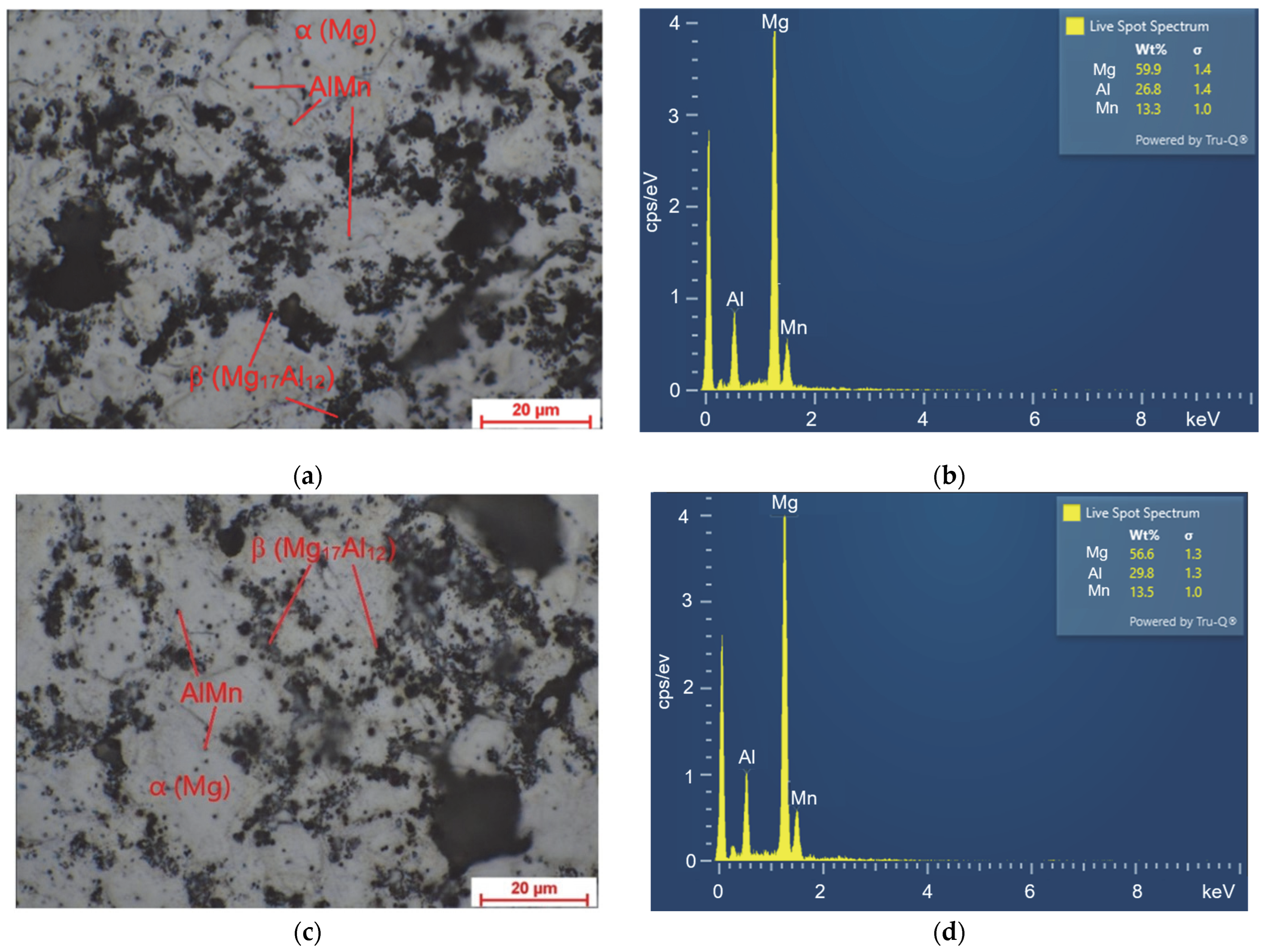
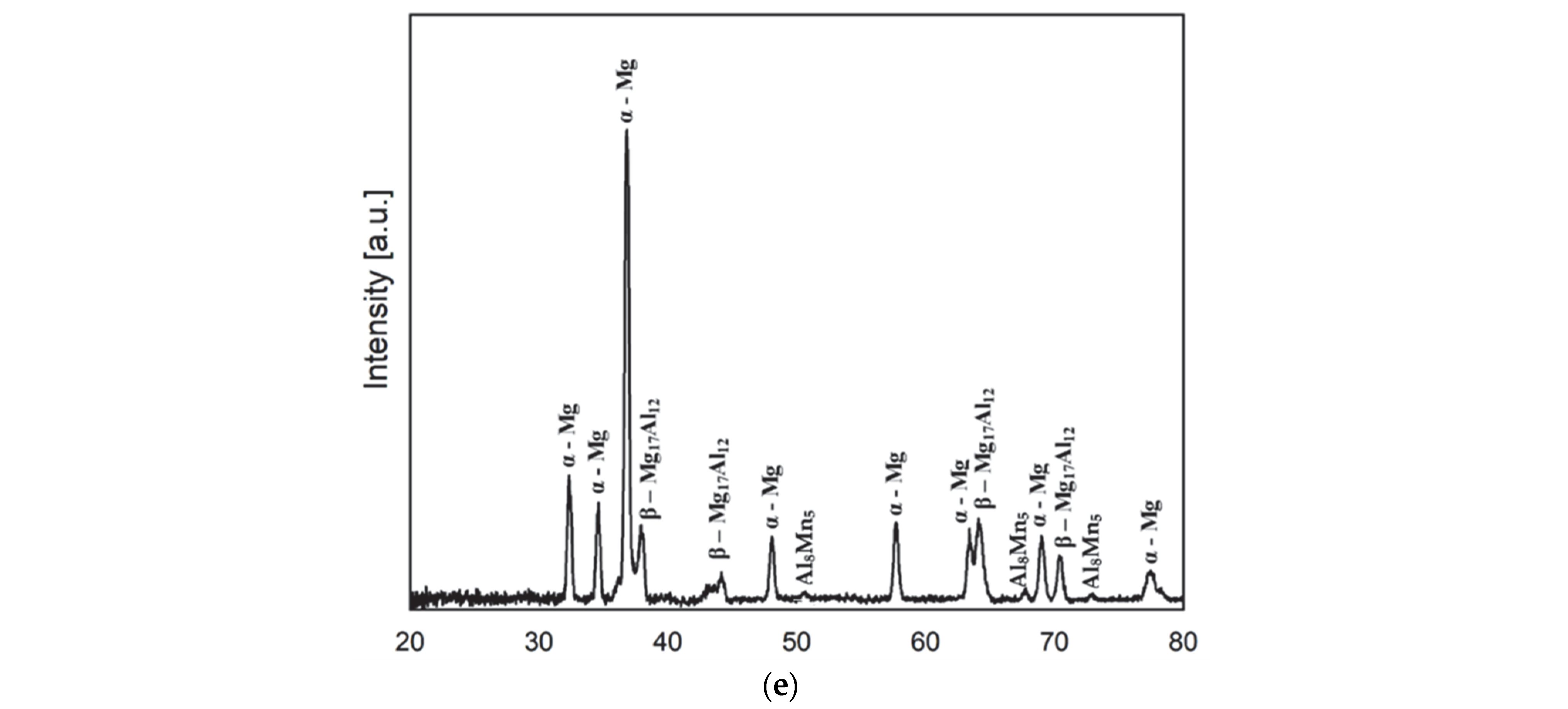
In
Figure 1 are shown the images of the microstructures, energy-dispersive X-ray (EDX) spectrum and X-ray diffraction (XRD) pattern of the investigated surfaces before cavitation exposure, which is identical for both structural states. The microstructural images are obtained with an OLYMPUS metallographic microscope equipped with image processing software (Olympus Corporation, Hamburg, Germany) at the Physical Metallurgy laboratory of the National University of Science and Technology Politehnica Bucharest. For the diffractogram, the PANalytical X’Pert diffractometer (Malvern Panalytical, Bucharest, Romania) with Cu Kα radiation (λ = 1.5406 Å) was used. The angular range 2θ, in which the measurements are made, is between 20° and 80°, at a step of 0.03° and an integration time of 1 s/step. The tube voltage and current were 45 kV and 30 mA.
The EDX spectra presented in
Figure 1b,d allowed the local chemical composition of the β phase in the AM50 alloy to be determined. For both the 250/12 h and 250/24 h aging conditions, the β phase contained approximately 61% Mg, 10 w% Mn, and 29% Al. These results, together with the XRD analysis, confirm the presence of the α(Mg), β(Mg
17Al
12), and Al
8Mn
5 phases in the investigated alloy. As the main objective of the present work is to assess the cavitation erosion behavior and resistance imparted by the applied heat treatment regimes, and because the volume fraction of secondary phases is lower than 3%, a detailed quantitative EDS characterization of the constituent phases was considered beyond the scope of this study.
The microscopic images (SEM), EDX spectra and the diffractogram in
Figure 1 show differences between the concentrations and sizes of the intermetallic compound Al
8Mn
5 and the basic solid solutions α(Mg) and secondary β(Mg
17Al
12). From the diffractogram it is observed that the predominant phase is the basic solid solution α-Mg. There are also low-intensity reflections of the intermetallic phase β-Mg
17Al
12, formed at the boundaries between the grains and peaks of the brittle intermetallic compound Al
8Mn
5.
The fact that the diffractogram is identical for both states results in the conclusion that the significant differences, which also determine differences in their behaviors and resistances to the cyclic stresses of vibratory cavitation, are determined by: structural stability, the distribution of the secondary phase β(Mg17Al12), the intermetallic compound Al8Mn5, the degree of fineness and hardness value. Microscopic analyses show that the 250/24 h structural state presents a more refined microstructure and a higher level of crystalline defects, compared to the 250/12 h state.
From the studies carried out on aluminum-based alloys [
1,
2,
3,
4,
23,
24,
50,
51,
52] and zinc-based alloys [
4,
39,
53] in various structural states, it follows that an important role in the degree of destruction of the structure and its resistance to overpressures of impact with cavitational microjets is played by the intermetallic phases. From our microscopic measurements regarding the dimensions of these phases, slight variations were noted between the two structural states: from 5 μm to 35 μm in the 250/12 h state and from 5 μm to 30 μm for the 250/24 h state. The size of these particles was assessed using optical metallography and SEM analysis. Based on the studies carried out on aluminum-based alloys and zinc-based alloys, we appreciate that these dimensional variations and dispersions are effects of the heat treatment regimes.
Studies by Hobbs [
54], Garcia [
27] and Hammitt [
28] on various ferrous and aluminum alloys show that surface hardness is the mechanical property with the greatest influence on the resistance of the alloy structure to overpressures, of the order of tens/hundreds of GPa [
31,
32,
33,
34,
35], developed by microjets and shock waves upon impact with the surface exposed to cavitation. Therefore, because surface hardness influences the behavior of the surface structure to cavitation attack, and the morphology of destruction by caverns and rupture, eight measurements were made on one sample from each condition with the Zwick 3212 Hardness Tester (Zwick Roell, Germany). The algebraic mean values are: 61 HV
5 (±2.5 HV
5) for the 250/12 h condition and 64 HV
5 (±2 HV
5) for the 250/24 h condition.
3. Research Equipment and Experimental Results
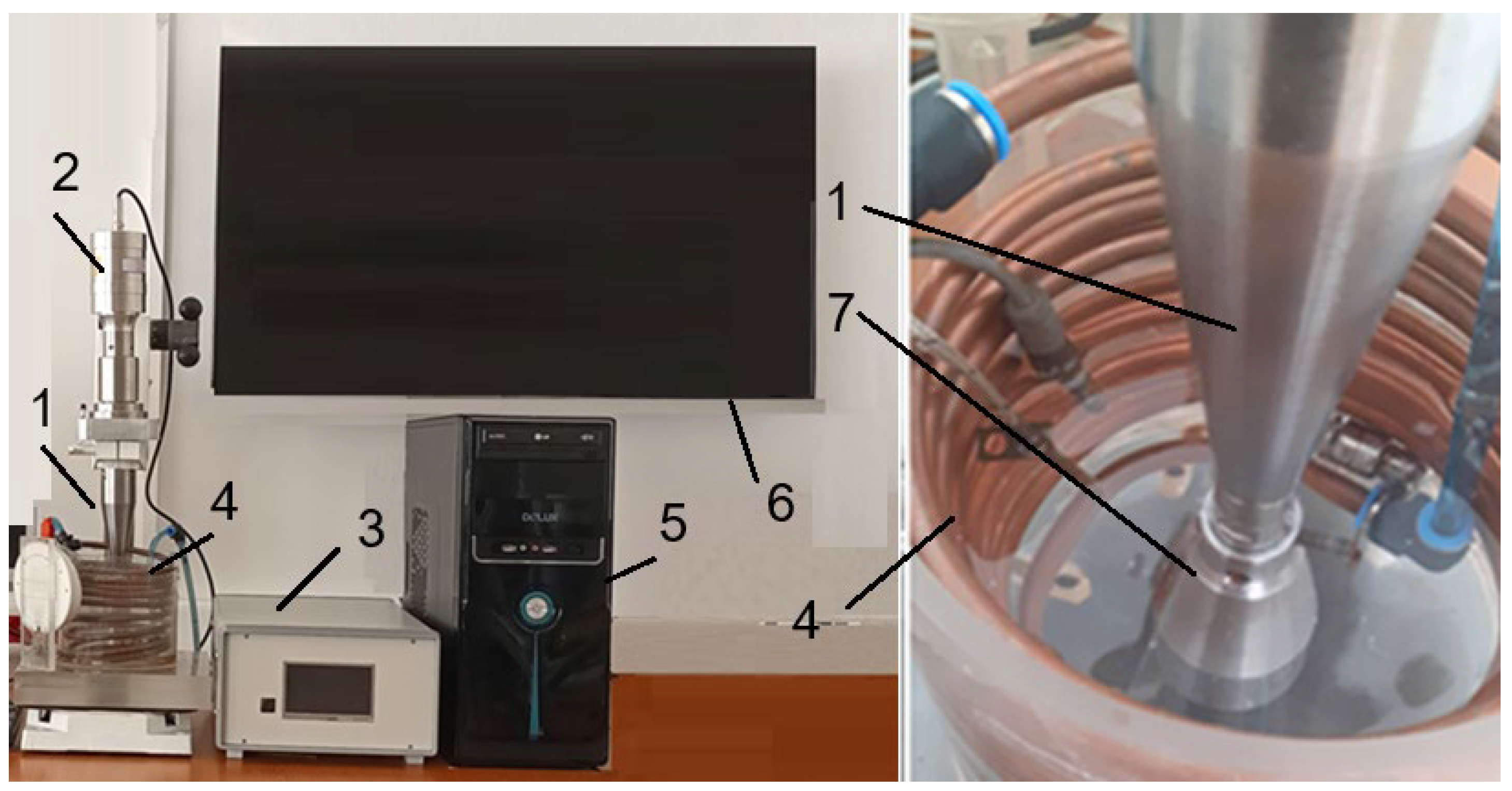
The cavitation tests were carried out in the Cavitation Erosion Research Laboratory of the Politehnica University of Timisoara, on the vibrating device with piezoceramic crystals,
Figure 2. The functional parameters, which dictate the intensity of the cavitation regime, are: power of the electronic ultrasound generator = 500 W, the vibration amplitude = 50 μm, vibration frequency = 20 ± 0.03 kHz, diameter of the surface exposed to cavitation = 15.8 mm, and liquid medium = distilled water at 22 ± 1 °C). The vibrating device is equipped with a computer with software for controlling the functional parameters of the device (vibration amplitude and frequency, power of the electronic ultrasound generator) and a refrigerator for maintaining the water temperature within the allowed limits.
The testing procedure was performed using a stationary sample (indirect method) [
12,
52,
55] which is in accordance with the requirements of the international standard ASTM G32-2016 [
56]. According to the custom in the field, used by most researchers, for certainty, three samples were tested from each condition. The preparation of the samples for testing, the total duration of the attack, the intermediate periods at which determinations of the lost mass are made, the examinations and photographic records of the surface exposed to cavitation, and the recording and processing of experimental data are according to the custom of the laboratory [
55].
For the analysis of the morphology of the surface degradation, by the erosion of vibrating cavitation, after the completion of the test, the scanning electron microscope TESCAN VEGA 3 LMU Bruker EDX Quantax and the computer tomography TESCAN Unitom HR (Tescan, Brno, Czech Republic) were used. For investigations of the degradation evolution, as an extension, at the end of each intermediate cavitation period, the Canon Power Shot A 480 camera was used.
3.1. The Morphology of Structural Degradation
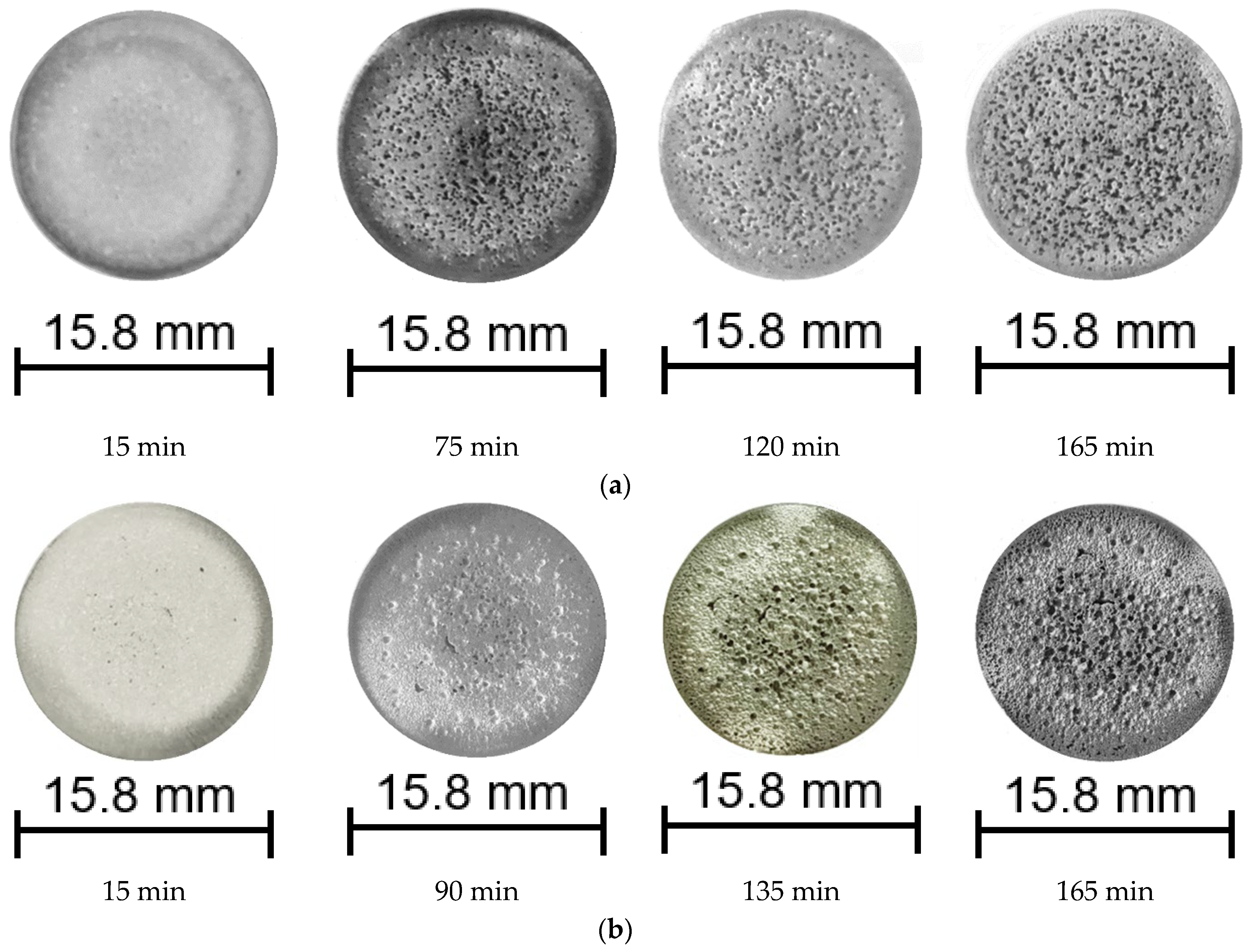
For morphological analysis, macro (photographic) images are presented in
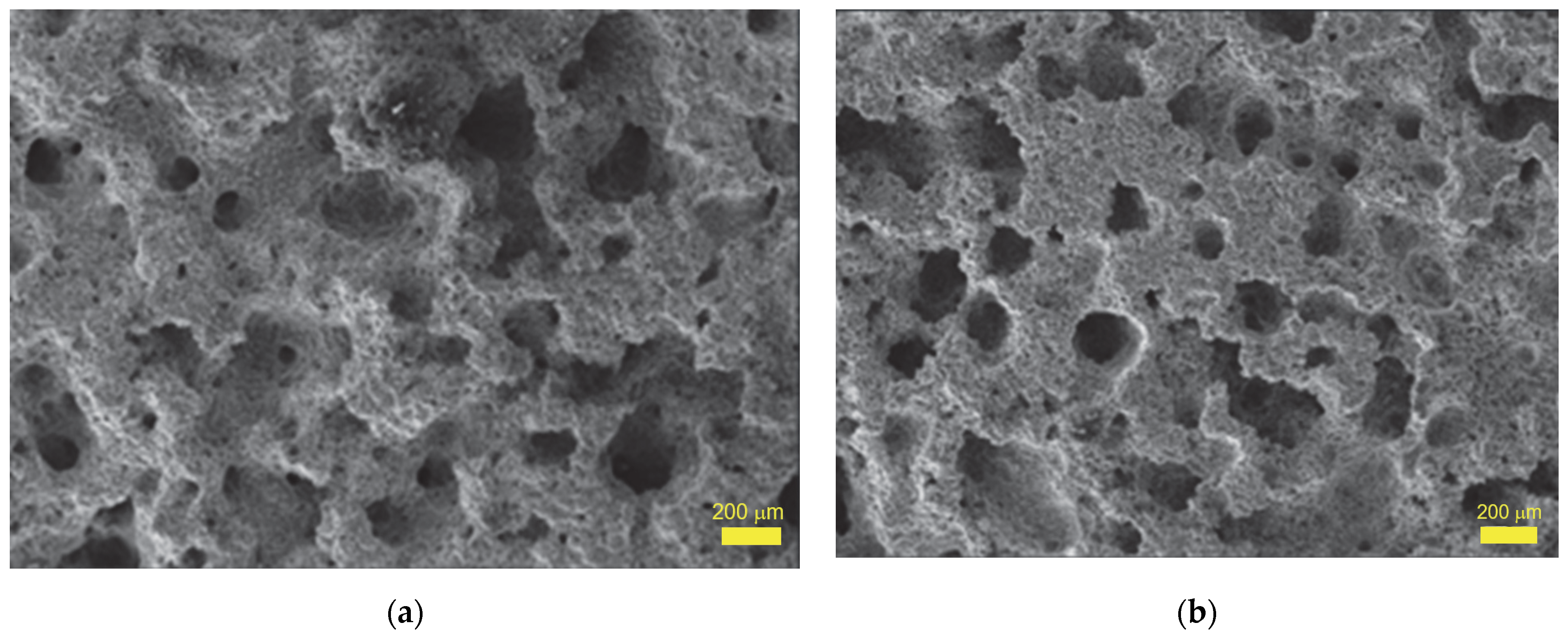
Figure 3 from four significant periods, and SEM images (
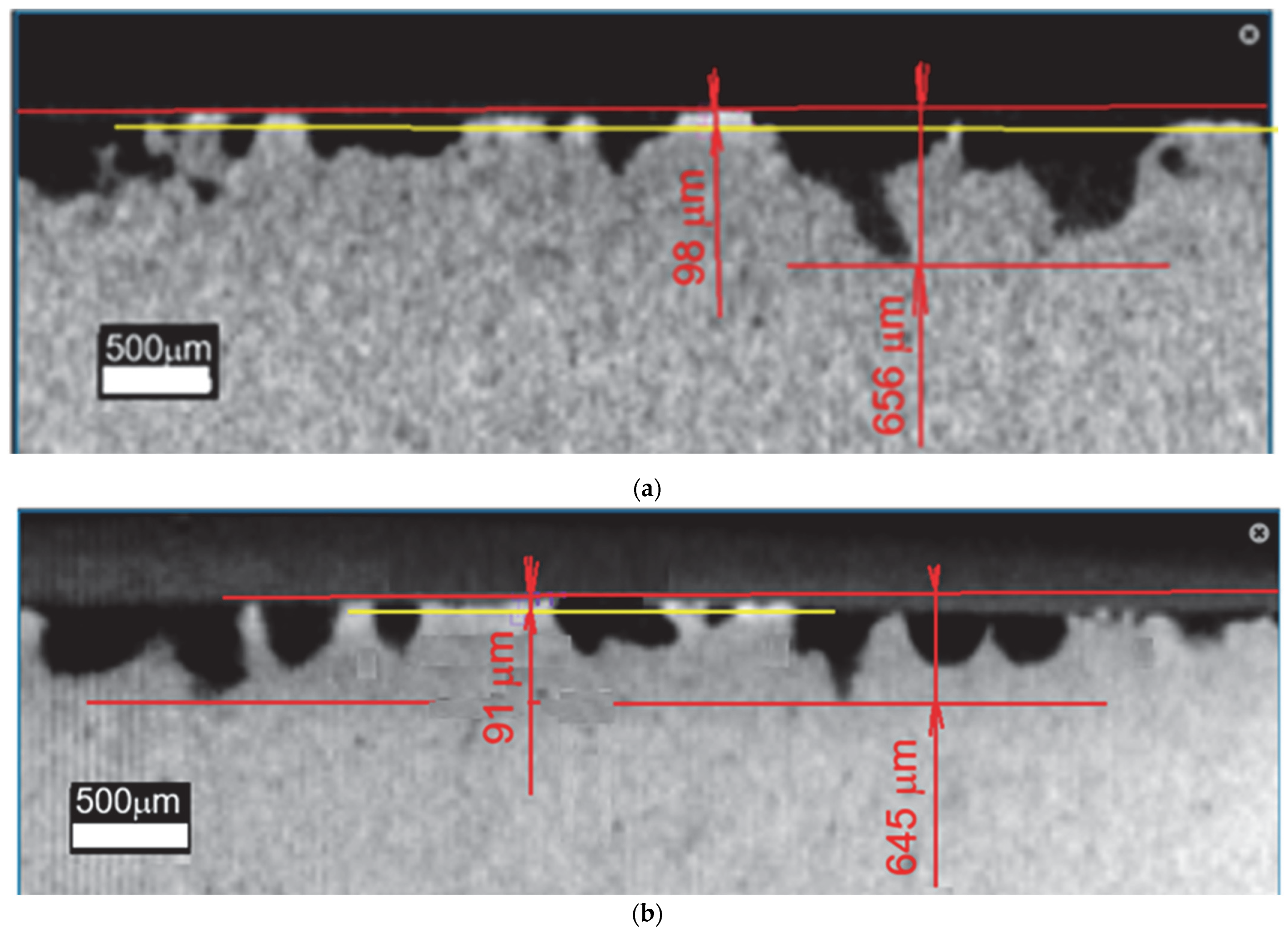
Figure 4) and CT (
Figure 5) after the completion of the cavitation attack (165 min). For microscopic investigation with the acquisition of images in
Figure 4, the TESCAN VEGA 3 LMU Bruker EDX Quantax electron microscope was used. To illustrate the depth of the caverns in
Figure 5, in an arbitrary axial plane (perpendicular to the eroded area), the computer tomography procedure with the Panthera 1.4.4 software and the TESCAN Unitom HR computer tomography were used. The images in
Figure 3 show slightly different evolutions of the cavern formation in the eroded area. These differences are the effect of the heat treatment regime, on the grain sizes of the basic solution α, of the secondary phase β and on the dispersion and sizes of the brittle AlMn compounds, which, according to studies carried out on aluminum alloys [
1,
2,
3,
4,
23,
24,
50,
51,
52], zinc alloys [
6,
7,
8,
42,
45,
49] and on AlMg
2 [
23], are the first to yield to cyclic stresses of the microjets, representing primers for cracks and caverns. It should be noted that visual differences, by the area of the eroded surface, by the shape and number of microcavities, which express a higher resistance of the structure of the 250/24 h state, are noticeable up to 90 min of cavitation stress. After this time, until the end of the test, both structures have identical behavior in terms of the degree of erosion; the formed caverns merge, and the appearance of new ones is slightly slowed down as a result of the mechanical hardening of the impact layer by microjets and/or shock waves [
36] and the damping effect of the water that penetrated the caverns during the compression phase of the sonotrode of the mechanical vibrating system [
3,
55].
The SEM images (
Figure 4) show a mix of caverns from very small to significant sizes, created by brittle and ductile fracture. In both cases, the effect of aluminum alloying is noticeable, through the deformations prior to cracking and fracture. In both situations, the relief of the cavitation-eroded surface is irregular in which large caverns are concentrated in the central area of the surface. Measurements made using the scanning electron microscope and the computer tomography show that the largest length and depth dimensions are at the 250/12 h structural state—up to 400 μm for length and up to 656 μm for depth—compared to the 250/24 h structural state—up to 300 μm for length and up to 645 μm for depth. The space between the red and yellow lines, light in color (towards white) represents the hardened layer, whose dimensions are 98 μm (state 250/12 h) and 91 μm (250/24 h state). These differences, associated with the microstructural refinement, intermetallic particle distribution, and microstructuralstability, confirm the higher resistance to cavitation erosion of the surface structure of the state 250/24 h, as also resulted from the analysis performed based on the photographic images in
Figure 3. This confirms the higher resistance of the 250/24 h state. The fractographic investigation showed that, according to the shape of the caverns, the crack initiators are in the intermetallic compounds Al
8Mn
5, mainly, and the secondary phase β(Mg
17Al
12). According to the shape of the cracks generated in the depth of the surface structure and the ruptures (see images in
Figure 5), it follows that they were preceded by plastic deformations due to the high tenacity of magnesium and its ability to absorb water. It is observed that, regardless of the structural state, the tunnel/cave-like shapes of some caverns, made perpendicular and inclined to the cavitated surface. We consider these shapes to be generated by an explosion-like effect of the water entering the caverns, at the overpressure exerted by the cavitation microjet which expels both groups of grains of the solid solution α, and pieces of grains of intermetallic compounds and of the secondary phase β. In conclusion, we consider that the similarities between the erosion morphologies of the two states are attributed to microstructural refinement, intermetallic particle distribution, and microstructural stability, and the differences are an effect of the microhardness values resulting from the artificial aging heat treatment regime together with the work hardening of the exposed surface layer.
3.2. Diagrams and Specific Parameters for Cavitation Behavior and Resistance
The specific diagrams and parameters used in discussions and evaluations of cavitation behavior are in accordance with the indications of ASTM G32-2016 [
56] and laboratory custom [
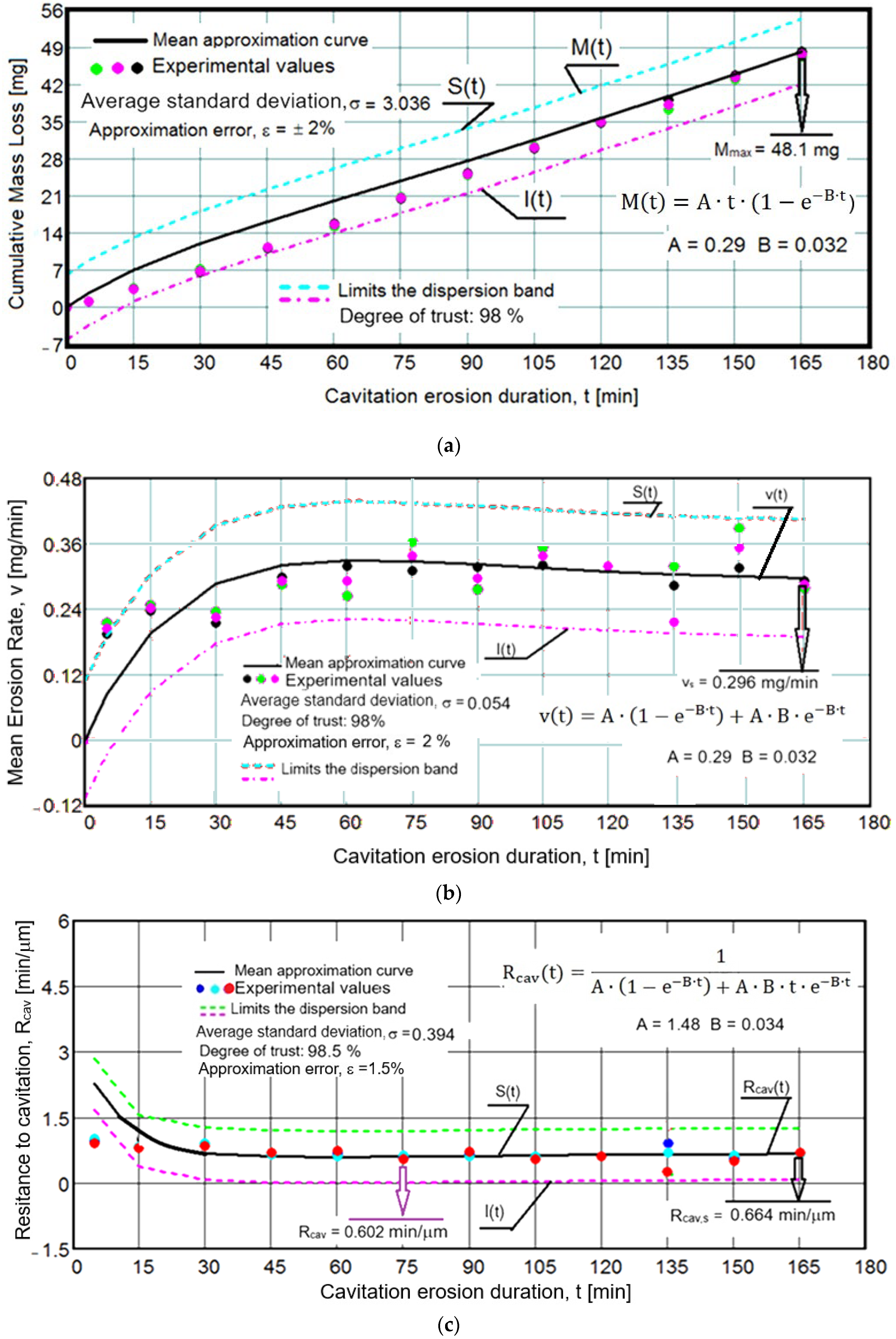
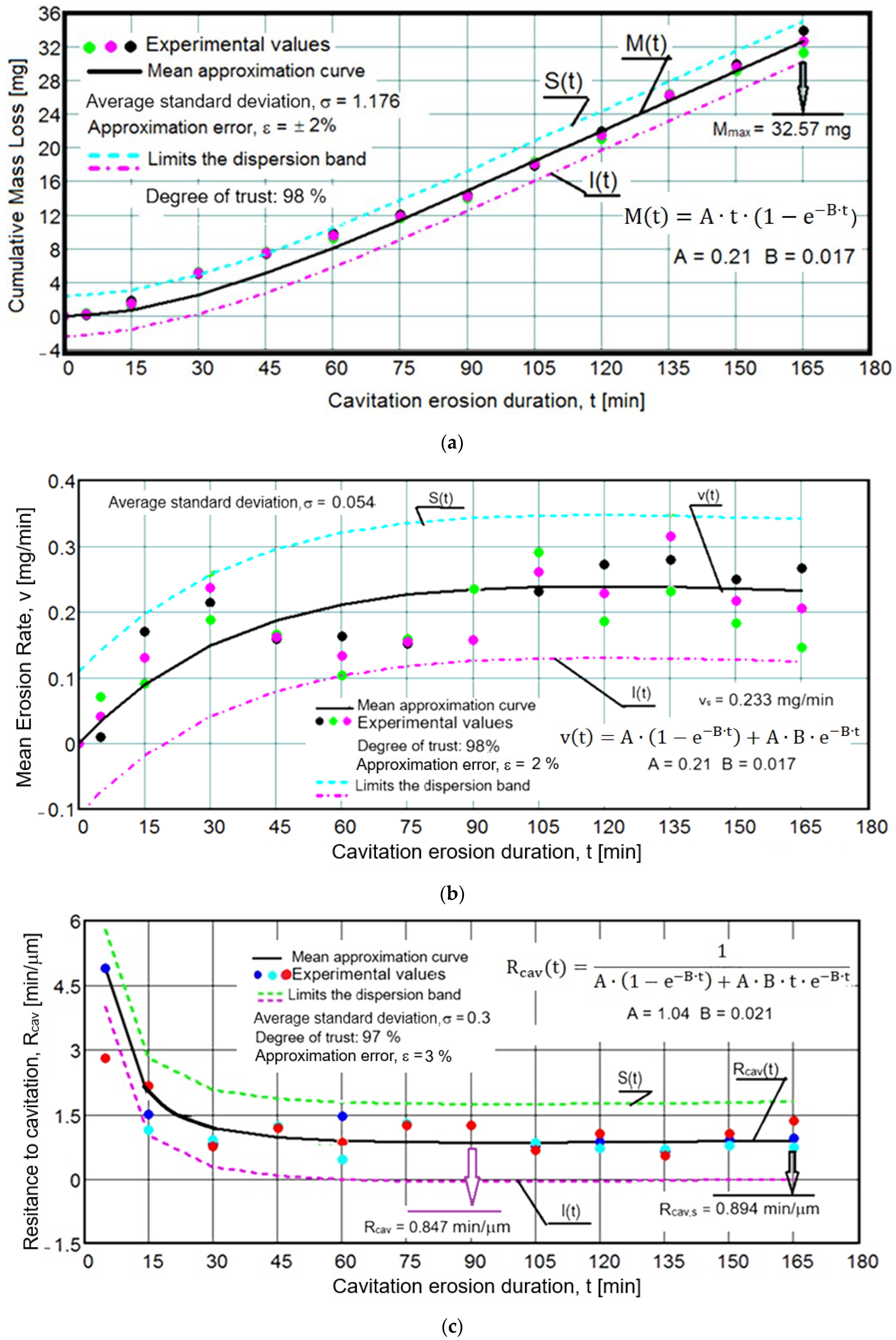
55]. These diagrams are presented in
Figure 6 and
Figure 7 and contain: the experimental values (marked by green, pink and black dots), their averaging curves with the statistical relationships used [
55,
57,
58], the values of the parameters that allow the evaluation of the cavitation resistance of the surface structure and the values of the statistical parameters that provide confidence in the accuracy of the experiment [
55]. The dispersion band of the experimental values, compared to the averaging curve, is delimited by the curves S(t) and I(t) that define the degree of confidence and, respectively, the approximation error ε. These curves are constructed using statistical relationships based on the standard deviation σ and have the forms [
50]:
The form of the calculation relationship for the average standard deviation depends on the parameter being referred to:
Here, Mi is the cumulative mass lost through erosion; v
i is the erosion speed; R
cavi is the resistance to cavitation erosion defined as the inverse of the mean depth erosion rate; and n is the total number of intermediate periods (n = 12). All these are experimental values, calculated based on the mass losses (Δmi) recorded during the intermediate period “i”, as follows:
M(t)i, v(t)i and Rcavi(t) are values defined by the averaging curves at time “i”; = 1730 Kg/m3 is the alloy density.
As can be seen in the legends of these diagrams, the parameter values σ = 0.054 … 3.036 aresuperunitary values for approximating cumulative mass losses and sub-unitary values for approximating erosion velocities and cavitation resistances. These values determined very high confidence levels of 97% … 98.5%, corresponding to cumulative mass loss approximation errors of ±2%, certifying the accuracy of the experiment.
The analysis of the data in the diagrams presented in
Figure 6 and
Figure 7 shows, through similarities and differences, the effects of the microstructure (through the dimensions, number and dispersion of brittle intermetallic compounds and the shape and dimensions of the grains of the solid solution α and the solution of the secondary phase β) and of the hardness of the cavity surface.
The similarities consist in:
The mode of scattering and dispersion of the experimental values with respect to the averaging curves M(t), v(t) and R
cav(t). Correlated with the results published in [
2,
3,
4,
5,
39,
50,
59], we appreciate that this mode is the effect of the alloy structure (solid solution with insertions of brittle intermetallic compounds).
The shape of the averaging curves, also supported by the photographic images in
Figure 4 after 75(90) min, by the research carried out in our laboratory [
2,
3,
49,
50] and by those in the literature [
27,
28,
29,
30,
54,
60], are effects of the microstructure and of the mechanical increase in hardness compared to the initial value, by the impact with shock waves and microjets.
- (a)
Approximately linear increase in cumulative mass losses (M(t)), after the accumulation period 0 … 45(60) min.
- (b)
Asymptotic decrease in the erosion velocities (v(t)) towards the value vs;
- (c)
Exponential decrease followed by a slight linear increase in the cavitation resistances (Rcav(t)).
The differences are between:
The values of the parameters characterizing the surface (structural state 250/24 h), with the highest resistance to cyclic stresses of shock waves and cavitational microjets: Mmax = 32.57 mg, vs = 0.233 mg/min, Rcav,s = 0.894 min/μm. These values reflect the positive effect of the difference in initial hardness (about 5%) on the surface resistance to cavitation erosion (64 HV5 for 250/24 h versus 61 HV5 for the 250/12 h state).
The slopes of the M(t) curves and the durations of the cavitation attack from which the averaging curves v(t) show a maximum, and from which the cavitation resistance R
cav starts to increase: t = 90 min for 250/24 h and t = 75 min for the 250/12 h state. These differences, from our and older studies [
27,
28,
29,
30,
54,
60] show the capacity of structures to absorb energy through plastic deformation and increase in hardness, mechanically through impacts, in addition to the initial one.
The erosion speed and cavitation resistance diagrams (
Figure 6b,c and
Figure 7b,c) show the relationship between erosion speed and the surface resistances to cavitation erosion. The times at which the v(t) curves start to decrease asymptotically towards the v
s values are identical to those at which the R
cav(t) curves start to increase towards the R
cav,s values (75 min for the 250/12 h state and 90 min for the 250/24 h state). This relationship reconfirms the results of experimental studies [
2,
3,
4,
30,
39,
46] regarding the mechanical response of energy-absorbing structures through hardening under the cyclic stresses of vibrating cavitation, after a period of stress. This mechanical hardening is quantifiable through the increases in cavitation resistance ΔR
cav = ((R
cav,s − R
cav,i)∙100/R
cav,i), as shown in
Table 1, and is reflected by the evolution of R
cav(t) curves.
A pronounced increase can be observed at the 250/12 h state and a small one at the 250/24 h state. So, the greatest hardening is achieved in softer surfaces, with lower initial hardness. The findings resulting from the analyses of the specific diagrams in
Figure 6 and
Figure 7 are supported by the macro images in
Figure 3 through the evolution of the caverns after 75 min and 90 min, respectively, in which the v(t) curves decrease approximately linearly towards the v
s value, while the R
cav(t) curves increase slightly towards the R
cav,s value.
4. Cavitation Resistance Evaluation
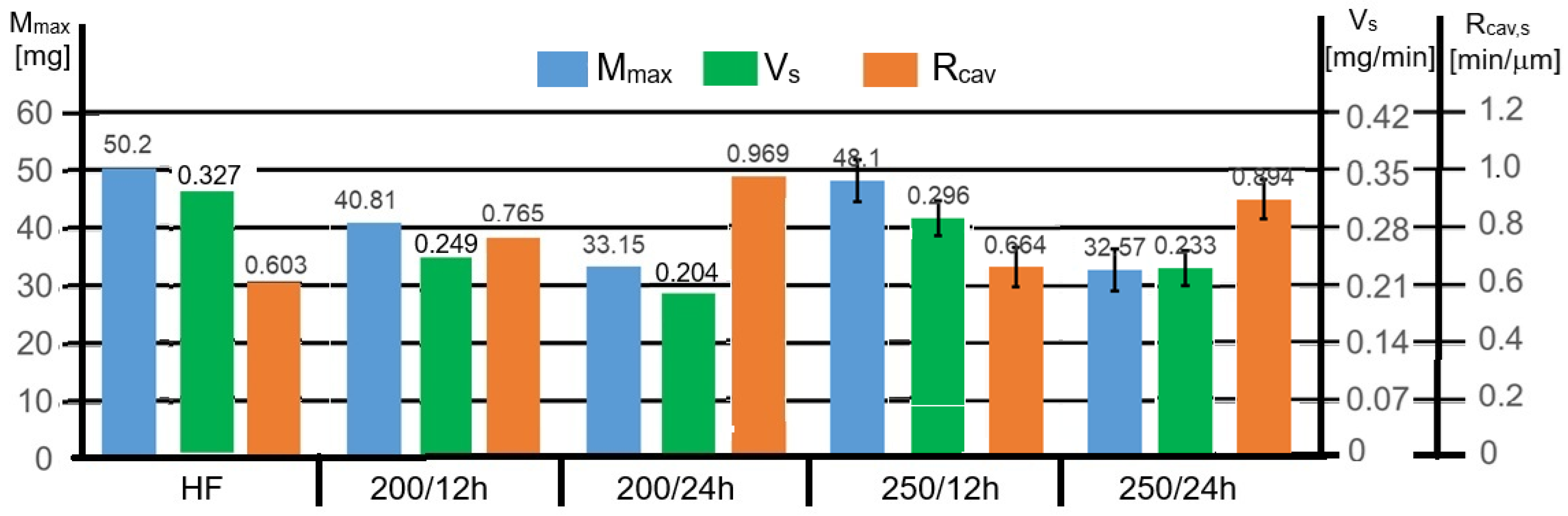
To evaluate the differences in resistance to erosion generated by vibratory cavitation, the histogram in
Figure 8 was constructed, using the values of the parameters recommended by ASTM G32-2016 standards and used in the practice of our research, displayed in the legends of
Figure 6 and
Figure 7 as well as those presented in [
49], obtained for the semi-finished states (SF notation) and the structural states obtained by artificial aging at 200 °C with holding times of 12 and 24 h (symbolization 200/12 h, 200/24 h, respectively) [
61].
The comparative analysis of the histogram data shows:
250/24 compared to SF: Mmax decreases by about 54%, vs speed decreases by about 40%, cavitation resistance Rcav,s increases by about 48%;
250/12 compared to SF: Mmax decreases by about 4%, vs speed decreases by about 10%, cavitation resistance Rcav,s increases by about 10%;
250/24 compared to 250/12: Mmax increases by about 18%, vs speed increases by about 19%, cavitation resistance Rcav,s increases by about 15%;
250/24 compared to 200/24: Mmax decreases by about 2%, vs speed decreases by about 14%, cavitation resistance Rcav,s increases by about 8%;
250/12 compared to 200/12: Mmax increases by about 2.1%, vs speed increases by about 19%, cavitation resistance Rcav,s decreases by about 15%;
These evaluations show that, compared to the semi-finished state (SF), both treatments lead to structures with superior strength. Compared to the 200/24 h structural state, the resistances to erosive cavitation stresses are lower. Compared to the 200/12 h condition, only the 250/24 h condition gives the surface greater resistance.
In relation to temperature and duration, the histogram shows that the temperature of 200 °C is better than that of 250 °C, and as a duration of maintenance at the heat treatment temperature, the 24 h condition offers the best resistance.
5. Conclusions
The artificial aging heat treatments at 250 °C with holding times of 12 h and 24 h, respectively, compared to the SF of elaboration (semi-finished product), according to the values of the reference parameters (Rcav, Mmax, vs) recommended by the ASTM G32-2016 standards, represent a solution for increasing the cavitation resistance of the AM50 alloy structure to cavitation. This is determined by the increase in the surface microhardness value and the reduction in the grain sizes of the solid phases (α and β) and the dispersion and sizes of the hardening phases (AlMn).
The microstructures resulting from the two artificial aging heat treatment regimes (250/12 h and 250/24 h) do not show any significant changes between the grain sizes of the solid solutions (α and β); microscopic analyses showing differences between the dispersion and maximum dimensions of the brittle intermetallic phases (AlMn). For this reason, the cavitation behavior of the surfaces of the two structural states shows some similarities; the differences being given by the resistance to overpressures resulting from the impact with shock waves and cavitational microjets, also influenced by the initial hardness of the surface.
The surface degradation during the attack, through the appearance of caverns, their shape and dimensions (see
Figure 3), expresses the dependence of the surface resistance to cavitation stresses and the alloy’s ability to absorb the pressure energy developed by the impact with the cavitational microjets/shock waves. The tunnel/cave shapes of some of the caverns (
Figure 4 and
Figure 5) suggest an explosion mechanism generated by the compression of the air/water in the caverns at the moment of impact with the cavitational microjets.
In terms of cavitation resistance, the artificial aging heat treatment at 250 °C for 24 h provides a resistance higher by about 15% compared to the 250/12 h state. Compared to the structural condition resulting from the 200 °C temperature regime for 24 h, the cavitation resistances of the 250/24 h and 250/12 h states are lower by (15 … 45)%.
The AM50 alloy heat treated by artificial aging at 250 °C, with durations of 12 and 24 h, is recommended in the manufacture of parts that work in conditions with reduced intensity of cavitation erosion. Such parts can be stents and valves used in cardiac repair surgery, where the blood circulatory system, from the point of view of flow, also has specific cavitation phases.
The study opens new directions of research into the behavior and resistance to cavitation of AM50 alloy with other structural states, resulting from the use of other heat treatment regimes or by hardening with modern remelting methods.
Author Contributions
Conceptualization, I.B. and F.-S.T.; methodology, I.B. and F.-S.T.; software, D.B. and D.-C.S.; validation, I.B. and C.G.; formal analysis, I.B. and C.G.; investigation, C.G. and D.-C.S.; resources, I.B. and F.-S.T.; data curation, I.B. and D.B.; writing—original draft preparation, I.B. and F.-S.T.; writing—review and editing, D.B.; visualization, C.G.; supervision, I.B. and C.G.; project administration, I.B.; funding acquisition, I.B. and F.-S.T. All authors have read and agreed to the published version of the manuscript.
Funding
This research received no external funding.
Data Availability Statement
The original contributions presented in this study are included in the article. Further inquiries can be directed to the corresponding authors.
Conflicts of Interest
The authors declare no conflicts of interest.
References
- Demian, A.-M. Cercetarea Comportării la Eroziunea Cavitațională a Aliajului de Aluminiu Tip 6082 în Corelație cu Diferite Stări Structurale. Doctoral Thesis, Politehnica University of Bucharest, Bucharest, Romania, 2026. [Google Scholar]
- Luca, A.-N. Research Erosion Resistance by Cavitation of Some Aluminum—Based Alloys with Treatment Thermal Aging Artificial. Doctoral Thesis, Politehnica University of Timisoara, Timisoara, Romania, 2024. (In Romanian) [Google Scholar]
- Istrate, D. Influence of Heat Treatments on the Behavior of an Alloy from the Al-Mg System for Maritime Applications. Doctoral Thesis, Politehnica University of Bucharest, Bucharest, Romania, 2023. (In Romanian) [Google Scholar]
- Istrate, D.; Sbârcea, B.G.; Demian, A.M.; Buzatu, A.D.; Salcianu, L.; Bordeasu, I.; Micu, L.M.; Ghera, C.; Florea, B.; Ghiban, B. Correlation between Mechanical Properties—Structural Characteristics and Cavitation Resistance of Cast Aluminum Alloy Type Al-Mg. Crystals 2022, 12, 1538. [Google Scholar]
- Istrate, D.; Bordeasu, I.; Ghiban, B.; Sbarcea, B.G.; Ghera, C.; Luca, A.N.; Odagiu, P.O.; Florea, B.; Gubencu, D. Correlation between Mechanical Properties structural Characteristics and Cavitation Resistance of Rolled Aluminum Alloy Type 5083. Metals 2023, 13, 1067. [Google Scholar] [CrossRef]
- Iordache (Gheorghe), C.M. Correlation Between Structure- Mechanical Characteristics-Biodegradability- Cavitation of Some Biomedical Alloys form the System ZnMg(Fe). Ph.D. Thesis, National University of Science and Technology Politehnica Bucharest, Bucharest, Romania, 2024. (In Romanian) [Google Scholar]
- Zhang, S.; Zhang, X.; Zhao, C.; Li, J.; Song, Y.; Xie, C.; Tao, H.; Zhang, Y.; He, Y.; Jiang, Y.; et al. Research on an Mg–Zn alloy as a degradable biomaterial. Acta Biomater. 2010, 6, 626–640. [Google Scholar] [CrossRef] [PubMed]
- Ciungu, G.; Micu, L.M.; Bordeasu, I.; Iordache, C.M.; Ghiban, B.; Ghera, C. Research of the Cavitation Resistance of a Biodegradable Zn-Cu Alloy. UPB Sci. Bull. Ser. B 2024, 86, 32. [Google Scholar]
- Ghiban, B.; Bordeasu, I.; Antoniac, A.; Antoniac, I.; Gheorghe, C.M.; Bordeasu, D.; Micu, L.M.; Ghera, C.; Salcianu, L.C.; Florea, B.; et al. Influence of Homogenization Heat Treatments on the Mechanical, Structural, Biodegradation, and Cavitation Behavior of Some Alloys in the ZnMg(Fe) System. Crystals 2025, 15, 458. [Google Scholar]
- Ghiban, B.; Antoniac, A.; Bordeasu, I.; Antoniac, I.; Petre, G.; Rau, V.J.; Bordeasu, D.; Micu, L.M. Biodegradability and Cavitation Erosion Behavior of Some Zinc Alloys from the System ZnCuMg. Metalls 2025, 15, 161. [Google Scholar] [CrossRef]
- Sleiman, N.; Pflieger, R.; Hallez, L.; Nikitenko, I.S.; Hihn, J.-Y. Magnesium and magnesium alloy dissolution by high intensity focused ultrasound: Erosion/cavitation vs. Wave propagation. Ultrason. Sonochem. 2024, 104, 106836. [Google Scholar] [CrossRef] [PubMed]
- Tomlinson, W.J.; Matthews, S.J. Cavitation erosion of aluminium alloys. J. Mater. Sci. 1994, 29, 1101–1108. [Google Scholar] [CrossRef]
- Katarivas Levy, G.; Goldman, J.; Aghion, E. The prospects of zinc as a structural material for biodegradable implants—A Review Paper. Metals 2017, 7, 402. [Google Scholar] [CrossRef]
- Zheng, Y.F.; Gu, X.N.; Witte, F. Biodegradable metals. Mater. Sci. Eng. R 2014, 77, 1. [Google Scholar] [CrossRef]
- Timpea, S.A.; Codrean, C.; Sirbu, N.-A.; Dume, A.I.; Cosma, C.; Serban, V.-A. Compressive Behavior of Various BCC Lattice Structure. Nano Hybrids Compos. 2023, 41, 39–45. [Google Scholar] [CrossRef]
- Savu, S.V.; Tarnita, D.; Stefan, I.; Benga, G.C.; Savu, I.D.; Sîrbu, N.A.; Dumitru, I.; Ciungu, M.A.; Ursu, M.; Cosma, C. Research on the Influence of the Defects of Materials on Thermal Runaway in Microwave Hybrid Heating for Sintering Processes. Appl. Sci. 2025, 15, 4115. [Google Scholar] [CrossRef]
- Kabir, H.; Munir, K.; Wen, C.; Li, Y. Recent research and progress of biodegradable zinc alloys and composites for biomedical applications: Biomechanical and biocorrosion perspectives. Mioactive Mater. 2021, 6, 836–879. [Google Scholar] [CrossRef]
- Niinomi, M. Recent metallic materials for biomedical applications. Metall. Mater. Trans. A 2002, 33, 477–486. [Google Scholar] [CrossRef]
- Mitelea, I.; Bordeasu, I.; Salcianu, L.; Craciunescu, C.M. Cavitation Erosion Mechanisms of Solution Treated X5CrNi18-10 Stainless Steels. J. Tribol.-Trans. ASME 2016, 138, 031102. [Google Scholar]
- Meng, X.; Song, F.; Zhou, J.; Lu, J.; Chen, X.; Zhang, H.; Cheng, Z.; Cai, J.; Xue, W.; Lin, K. Enhancing cavitation erosion resistance of Ti6Al4V titanium alloy by dual-pulse laser shock peening. Surf. Coat. Technol. 2025, 503, 131993. [Google Scholar]
- Krella, A.; Erbe, A.; Johanes, M.; Gupta, M. Magnesium Degradation Under Cavitation Erosion Conditions. JOM J. Miner. Met. Mater. Soc. 2026, 78, 5297–5309. [Google Scholar] [CrossRef]
- Ye, L.; Zhu, X.; He, Y.; Song, T.; Hu, W. Surface strengthening and grain refinement of AZ31B magnesium alloy by ultrasonic cavitation modification. Chin. J. Aeronaut. 2021, 34, 508–551. [Google Scholar] [CrossRef]
- Krella, A.-K. Degradation of AlMg2 aluminium alloy caused by cavitation—An effect of cavitation intensity. Mater. Charact. 2017, 130, 219–229. [Google Scholar]
- Jasionowski, R.; Zasada, D.; Polkowski, W. The Evaluation of the Cavitational Damage in MgAl2Si Alloy Using Various Laboratory Stands. Solid State Phenom. 2016, 252, 61–70. [Google Scholar]
- Agarwal, S.; Curtin, J.; Duffy, B.; Jaiswal, S. Biodegradable magnesium alloys for orthopaedic applications: A review on corrosion, biocompatibility and surface modifications. Mater. Sci. Eng. C 2016, 68, 948–963. [Google Scholar] [CrossRef]
- Persaud-Sharma, D.; McGoron, A. Biodegradable magnesium alloys: A review of material development and applications. J. Biomim. Biomater. Tissue Eng. 2012, 12, 25–39. [Google Scholar] [CrossRef] [PubMed]
- Garcia, R. Comprehensive Cavitation Damage Data for Water and Various Liquid Metals Including Correlation with Material and Fluid Properties; Technical Report; University of Michigan: Ann Arbor, MI, USA, 1966; Volume 6. [Google Scholar]
- Hammitt, F.G.; Bhatt, N.R. Cavitation Damage Resistance of Hardened Steels; Technical Report; University of Michigan: Ann Arbor, MI, USA, 1970; pp. 1–36. [Google Scholar]
- Vaidya, S.; Preece, C.M. Cavitation erosion of age-hardenable aluminum alloys. Metall. Trans. A 1978, 9, 299–307. [Google Scholar] [CrossRef]
- Frank, J.-P.; Jean-Louis, K.; Karimi, A.; Fruman, D.-H.; Fréchou, D.; Briançon-Marjollet, L.; Billard, J.-Y.; Belahadji, B.; Avellan, F.; Michel, J.M. Physical Mechanisms and Industrial Aspects; Presses Universitaires de Grenoble: Grenoble, France, 1995. [Google Scholar]
- Brujan, E.-A.; Matsumoto, Y. Collapse of micrometer-sized cavitation bubbles near a rigid boundary. Microfluid Nanofluid 2012, 13, 957–966. [Google Scholar] [CrossRef]
- Brujan, E.A.; Ikeda, T.; Matsumoto, Y. On the pressure of cavitation bubbles. Exp. Therm. Fluid Sci. 2008, 32, 1188–1191. [Google Scholar] [CrossRef]
- Dular, M.; Montalvo, G.E.B.; Hocevar, M.; Novak, L.; Ohl, C.D.; Petkovsek, M. Questioning the ASTM G32-16 (stationary specimen) standard cavitation erosion test. Ultrason. Sonochem. 2024, 107, 106930. [Google Scholar] [CrossRef] [PubMed]
- Merouani, S.; Hamdaoui, O.; Rezgui, Y.; Guemini, M. Theoretical Procedure for the Characterization of Acoustic Cavitation Bubbles. Acta Acust. United Acust. 2014, 100, 823–833. [Google Scholar] [CrossRef]
- Chen, H.; Li, Y.; Chen, D.; Wang, J. Experimental and numerical investigations on development of cavitation erosion pits on solid surface. Tribol. Lett. 2007, 26, 153–159. [Google Scholar] [CrossRef]
- Aguirre, J.V.; Takigawa, Y.; Higash, K. Experimental Investigation of Cavitation Behavior in AZ61 Magnesium Alloy. Mater. Trans. 2005, 46, 626–630. [Google Scholar] [CrossRef][Green Version]
- Karaman, A.; Kremer, A.; Marré, M. Corrosion Behavior of Zinc Wrought Alloy ZnAl15Cu1Mg (ZEP1510) as a Potential Substitute for Brass and Galvanized Steel. Alloys 2025, 4, 9. [Google Scholar]
- Mostaed, E.; Sikora-Jasinska, M.; Mostaed, A.; Loffredo, S.; Demir, A.G.; Previtali, B.; Mantovani, D.; Beanland, R.; Vedani, M. Novel Zn-based alloys for biodegradable stent applications: Design, development and in vitro degradation. J. Mech. Behav. Biomed. Mater. 2016, 60, 581–602. [Google Scholar] [CrossRef] [PubMed]
- Ciungu, G. Experimental Studies on the Cavitation and Biodegradation Behaviour of Some Alloys of the System ZnCu(Mg) System. Ph.D. Thesis, University Politehnica Bucharest, Bucharest, Romania, 2024. (In Romanian) [Google Scholar]
- Mostaed, E.; Sikora-Jasinska, M.; Drelich, J.; Vadeni, M. Zinc-based alloys for degradable vascular stent applications. Acta Biomater. 2018, 71, 1–23. [Google Scholar] [CrossRef] [PubMed]
- Venezuela, J.; Dargusch, M.S. The influence of alloying and fabrication techniques on the mechanical properties, biodegradability and biocompatibility of zinc: A comprehensive review. Acta Biomater. 2019, 87, 1–40. [Google Scholar] [CrossRef] [PubMed]
- Luca, A.-N.; Bordeasu, I.; Iordache, C.-M.; Ciungu, G.; Ghiban, B.; Miculescu, M.; Micu, L.M. Heat Treatment Influence on the Cavitational Erosion Zn-Mg Behavior Used for Biomedical Applications. Tribol. Ind. 2024, 46, 270–282. [Google Scholar] [CrossRef]
- Bowen, P.K.; Shearier, E.R.; Zhao, S.; Guillory, R.J.; Zhao, F.; Goldman, J.; Drelich, J.W. Biodegradable metals for cardiovascularstents: From clinical concerns to recent Zn-alloys. Adv. Healthc. Mater. 2016, 5, 1121–1140. [Google Scholar] [PubMed]
- Werkhoven, R.J.; Sillekens, W.H.; Van Lieshout, J.B.J.M. Processing aspects of magnesium alloy stent tube. In Magnesium Technology; John Wiley & Sons, Inc.: Hoboken, NJ, USA, 2011; pp. 419–424. [Google Scholar]
- Yue, R.; Huang, H.; Ke, G.; Zhang, H.; Pei, J.; Xue, G.; Yuan, G. Microstructure, mechanical properties and in vitro degradation behavior of novel Zn-Cu-Fe alloys. Mater. Charact. 2017, 134, 114–122. [Google Scholar]
- Bakhsheshi-Rad, H.R.; Hamzah, E.; Daroonparvar, M.; Abdul Kadir, M.R.; Kasiri-Asgarani, M.; Staiger, M.P. Enhancement of corrosion resistance and mechanical properties of Mg–1.2Ca–2Bi via a hybrid silicon-biopolymer coating system. Surf. Coat. Technol. 2016, 301, 133–139. [Google Scholar]
- Rao, Y.; Qun Wang, Q.; Chen, J. Chidambaram Seshadri RamachandranAbrasion, sliding wear, corrosion, and cavitation erosion characteristics of a duplex coating formed on AZ31 Mg alloy by sequential application of cold spray and plasma electrolytic oxidation techniques. Mater. Today Commun. 2021, 26, 101978. [Google Scholar]
- Daroonparvar, M.; Yajid, M.A.M.; Yusof, N.M.; Bakhsheshi-Rad, H.R.; Hamzah, E. Microstructural characterisation of air plasma sprayed nanostructure ceramic coatings on Mg–1%Ca alloys (bonded by NiCoCrAlYTa alloy). Ceram. Int. 2016, 42, 357–371. [Google Scholar]
- Pirvulescu, L.-D.; Bordeasu, I.; Ghiban, B. Contributions to the Study of Mechanical and Cavitational behaviors of the Magnesium Alloy Type AM50. UPB Sci. Bull. Ser. B 2026, 88, 301–3016. [Google Scholar]
- Mitelea, I.; Parmanche, R.-S.; Utu, I.-D.; Craciuneascu, C.M.; Bordeasu, I. Evaluation of the Recrystallization Annealing Microstructure of the INCONEL 625 Superalloy Exposed to Cavitation Erosion. Appl. Sci. 2026, 16, 1663. [Google Scholar] [CrossRef]
- Gottardi, G.; Tocci, M.; Montesano, L.; Pola, A. Cavitation Erosion Behaviour of an Innovative Aluminium Alloy for Hybrid Aluminium Forging. Wear 2018, 394–395, 1–10. [Google Scholar] [CrossRef]
- Mitelea, I.; Bordeasu, I.; Frant, F.; Utu, I.-D. Effect of heat treatment on corrosion and ultrasonic cavitation erosion resistance of AlSi10MnMg alloy. Mater. Test. 2020, 62, 921–926. [Google Scholar]
- Li, H.F.; Shi, Z.Z.; Wang, L.N. Opportunities and challenges of biodegradable Zn-based alloys. J. Mater. Sci. Technol. 2020, 46, 136–138. [Google Scholar] [CrossRef]
- Hobbs, J.M. Experience with a 20-KC Cavitations erosion test. In Erosion by Cavitations or Impingement; Technical Report; ASTM STP 408; ASTM: West Conshohocken, PA, USA, 1966; pp. 150–180. [Google Scholar]
- Bordeasu, I. Monografia Laboratorului de Cercetare a Eroziunii prin Cavitație al Universității Politehnica Timișoara (1960–2020); Editura Politehnica Timisoara: Timişoara, Romania, 2020. [Google Scholar]
- ASTM G32-2016; Standard Method of Vibratory Cavitation Erosion Test. ASTM: West Conshohocken, PA, USA, 2016.
- Bordeasu, I.; Patrascoiu, C.; Badarau, R.; Sucitu, L.; Popoviciu, M.O.; Balasoiu, V. New contributions to cavitation erosion curves modeling. FME Trans. 2006, 34, 39–43. [Google Scholar]
- Micu, L.M.; Bordeasu, I.; Popoviciu, M.O. A New Model for the Equation Describing the Cavitation Mean Depth Erosion Rate Curve. Rev. Chim. 2017, 68, 894–898. [Google Scholar] [CrossRef]
- Bordeasu, I.; Ghera, C.; Salcianu, C.-L.; Luca, A.-N.; Parmanche, R.-S. On the Influence of Mechanical Properties of Aluminum Alloys on Their Resistance to Cavitation Erosion. J. Phys. Conf. Ser. 3153 (ICAS) 2025, 3153, 012001. [Google Scholar] [CrossRef]
- Steller, K.; Reymann, Z.; Krzysztoowicz, T. Evaluation of the resistance of materials to cavitational erosion. In Proceedings of the Fifth Conference on Fluid Machinery; Akademia Kiado: Budapest, Hungary, 1975; Volume 2, pp. 1081–1095. [Google Scholar]
- Bordeasu, I.; Bordeasu, D.; Micu, L.-M.; Tatu, F.-S.; Sirbu, N.-A.; Popescu, R.-N.; Ghera, C.; Pirvulescu, L.-D.; Luca, A.-N.; Ghiban, B.; et al. Cavitation Erosion of the Biodegradable AM50 Alloy after artificial aging heat treatment. Metals 2026, 16, 684. [Google Scholar] [CrossRef]
| Disclaimer/Publisher’s Note: The statements, opinions and data contained in all publications are solely those of the individual author(s) and contributor(s) and not of MDPI and/or the editor(s). MDPI and/or the editor(s) disclaim responsibility for any injury to people or property resulting from any ideas, methods, instructions or products referred to in the content. |




 ,
,