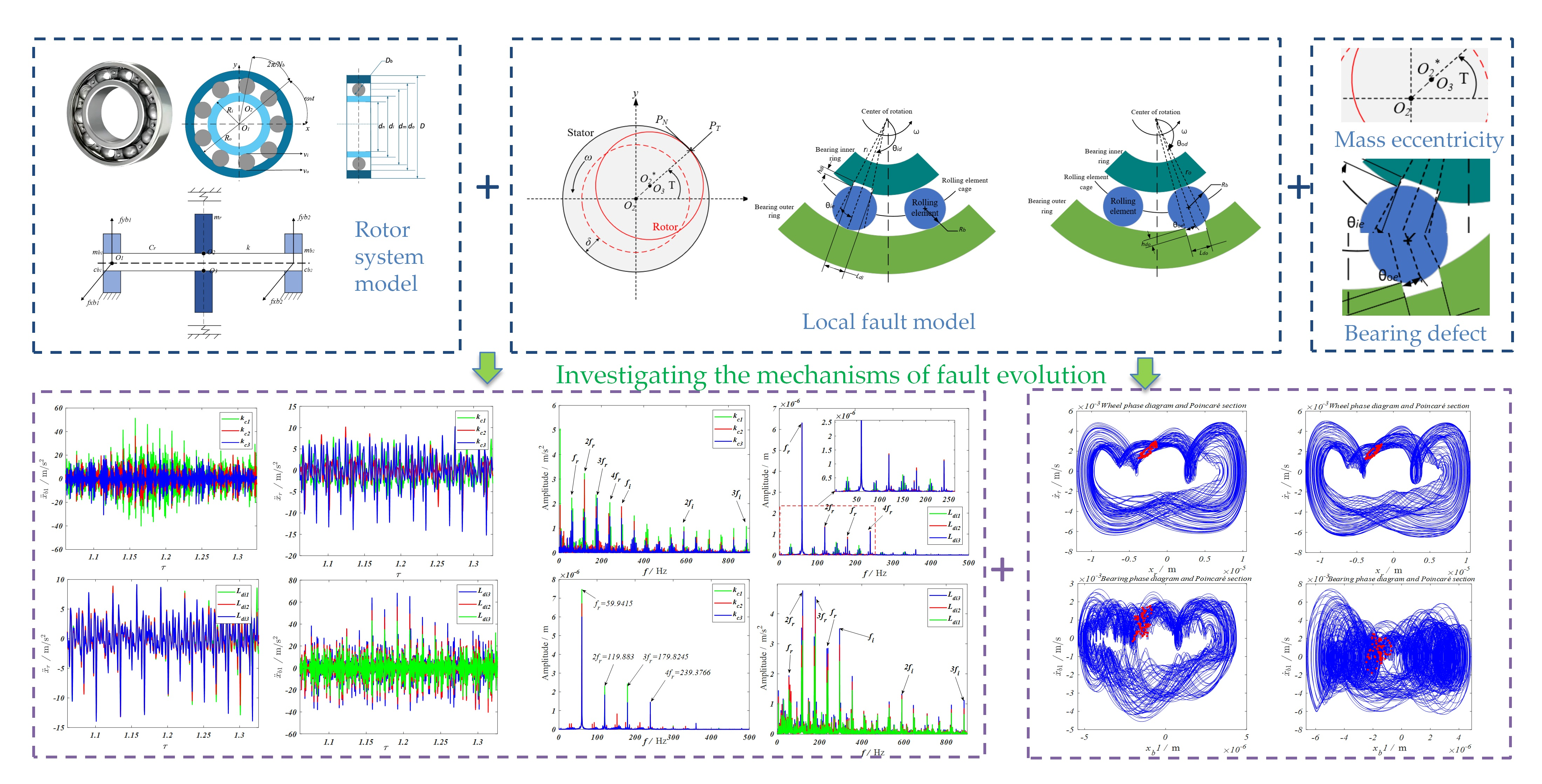
Study on the Dynamic Characteristics of Rub-Impact and Bearing Defect Coupled Faults in a Single-Disk Double-Bearing Rotor System


Abstract
1. Introduction
2. Dynamic Modeling of the Rolling Bearing–Rotor System
2.1. Dynamic Modeling of the Healthy Rolling Bearing–Rotor System
2.2. Dynamic Modeling of a Faulty Rolling Bearing–Rotor System
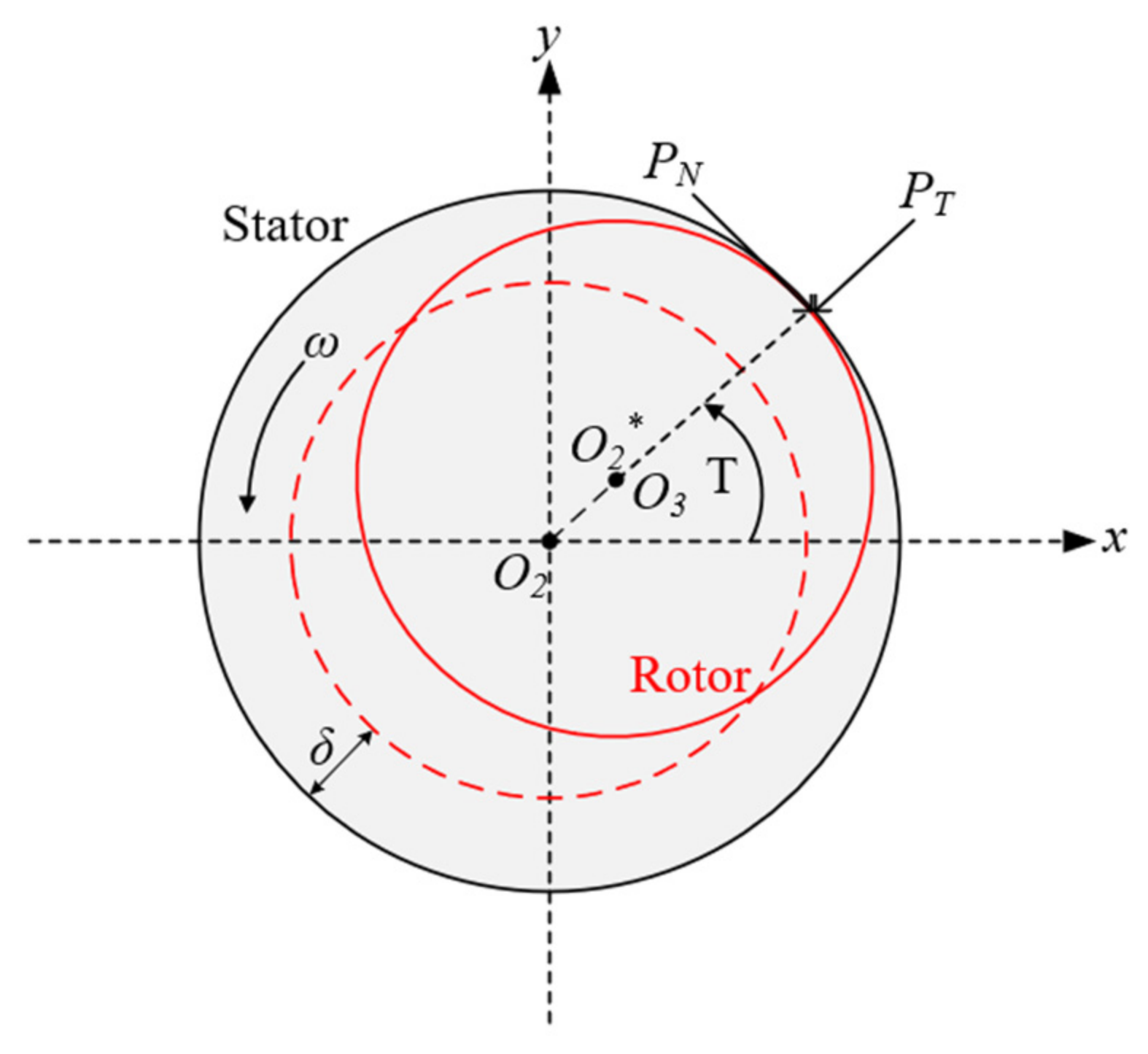
2.2.1. Rub-Impact Fault
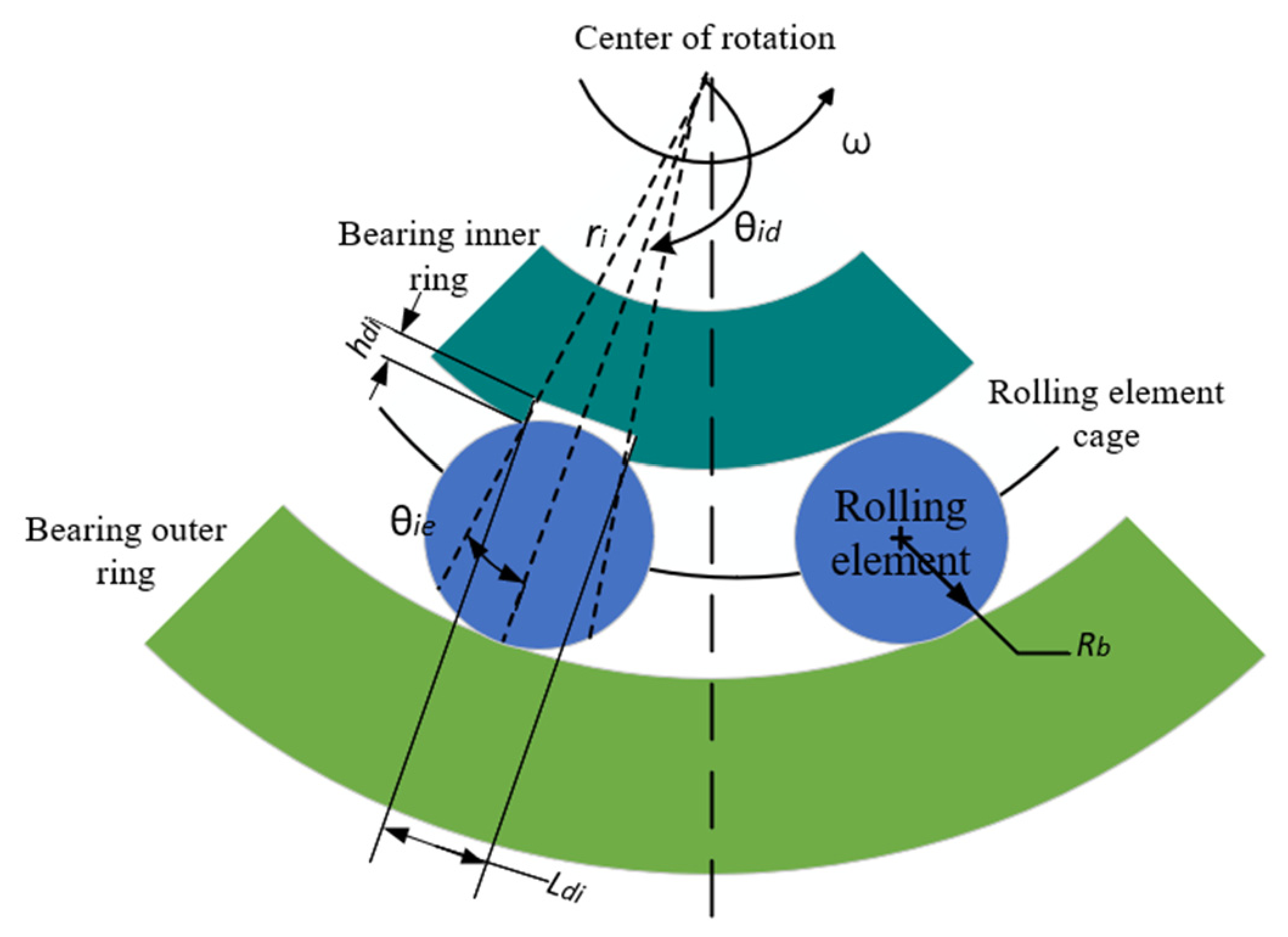
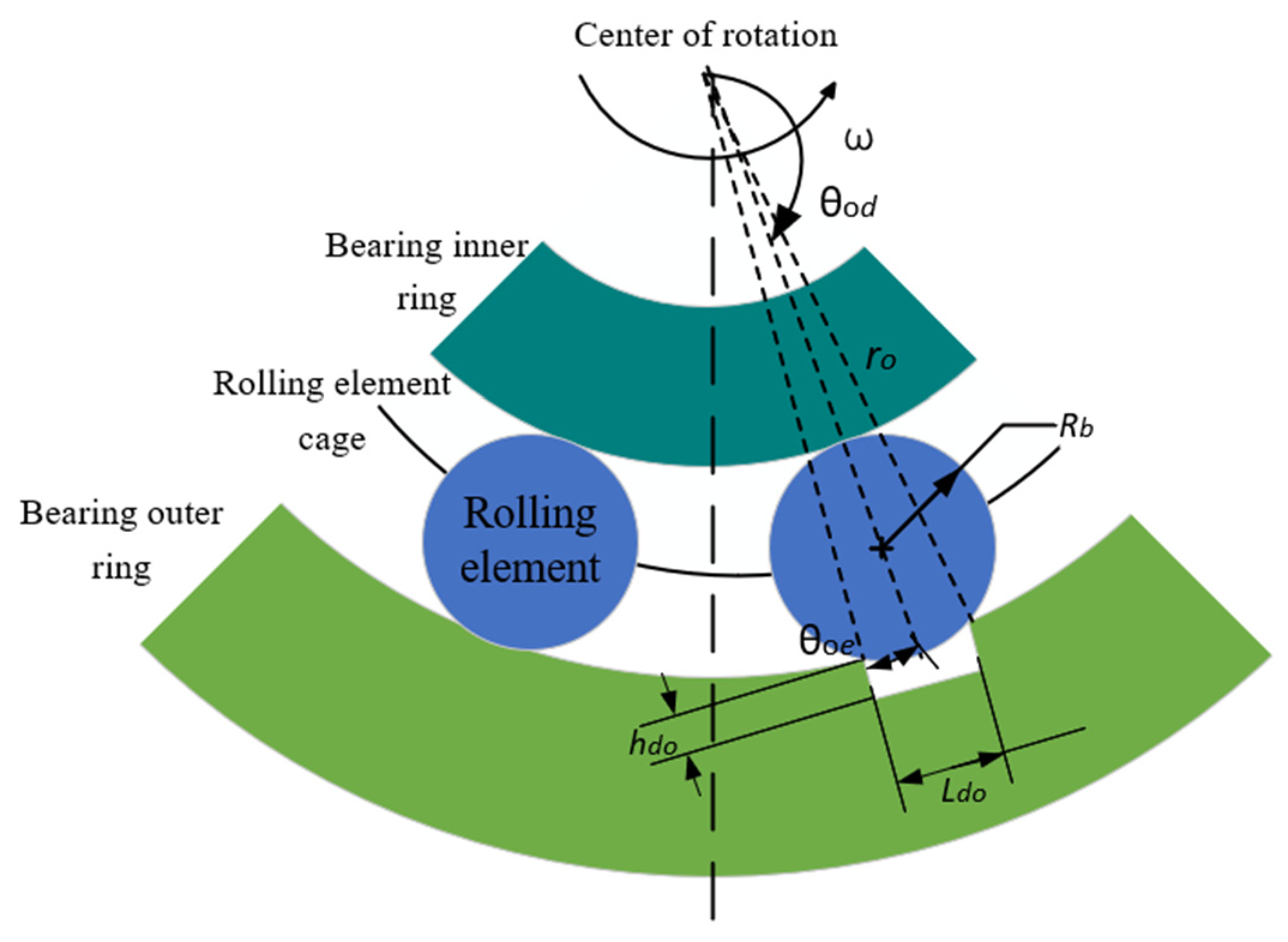
2.2.2. Rub-Impact and Bearing Raceway Compound Faults
3. Dynamic Characteristics Analysis of the Faulty Rolling Bearing–Rotor System
3.1. Dynamic Characteristics Analysis of the Rotor System with a Single Rub-Impact Faul
3.2. Dynamic Characteristics Analysis of the Coupled Rub-Impact and Inner-Race Fault System
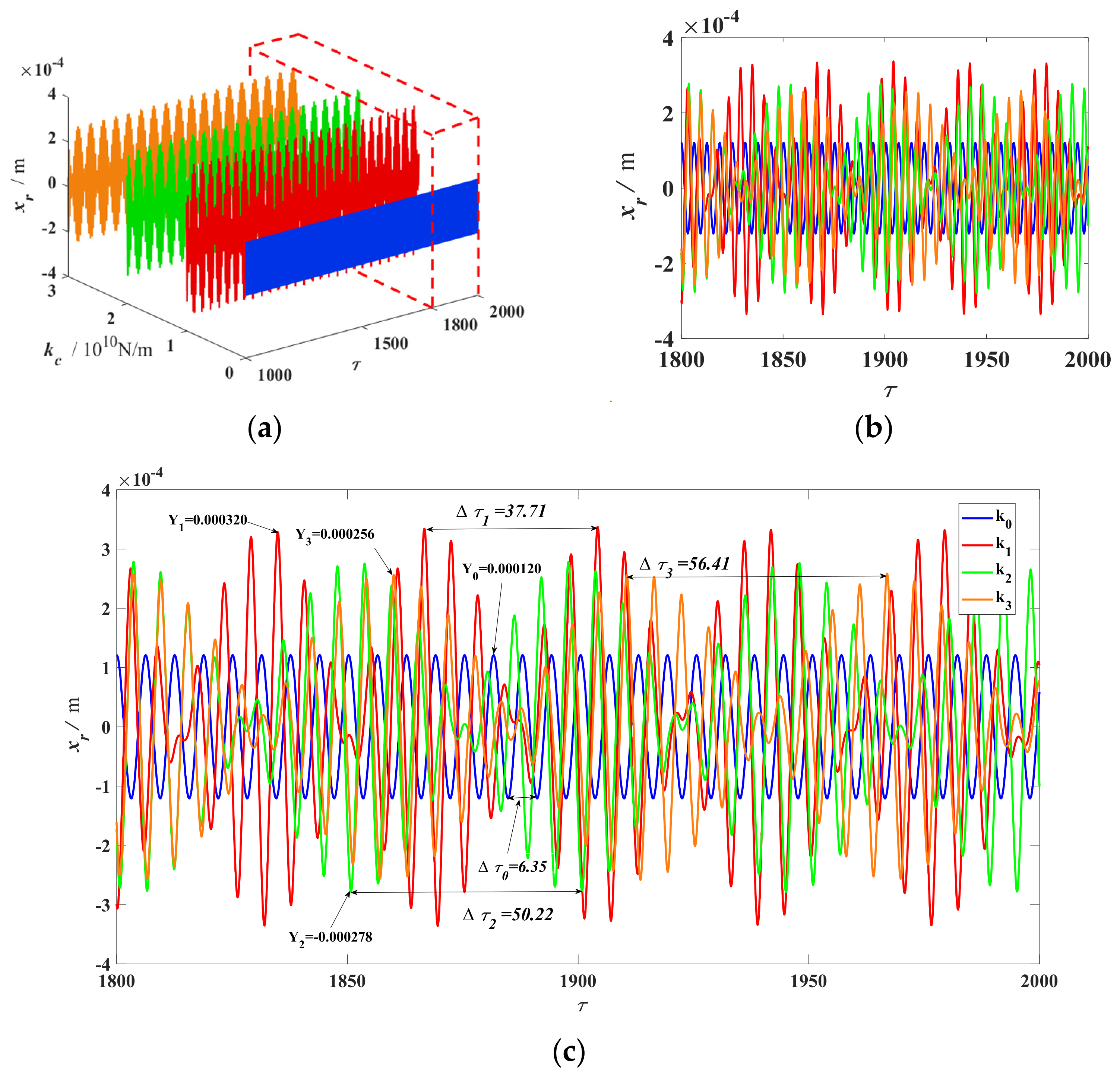
3.2.1. Analysis of the Influence of Rubbing Stiffness Variation on Dynamic Characteristics
3.2.2. Dynamic Analysis of the Influence of Fault Width Variation on System Behavior
3.3. Dynamic Analysis of the Rub-Impact–Outer-Race Compound Fault System
3.3.1. Dynamic Analysis of the Influence of Rub-Impact Stiffness Variation on System Behavior
3.3.2. Dynamic Analysis of the Influence of Fault Width Variation on System Behavior
4. Conclusions
- (1)
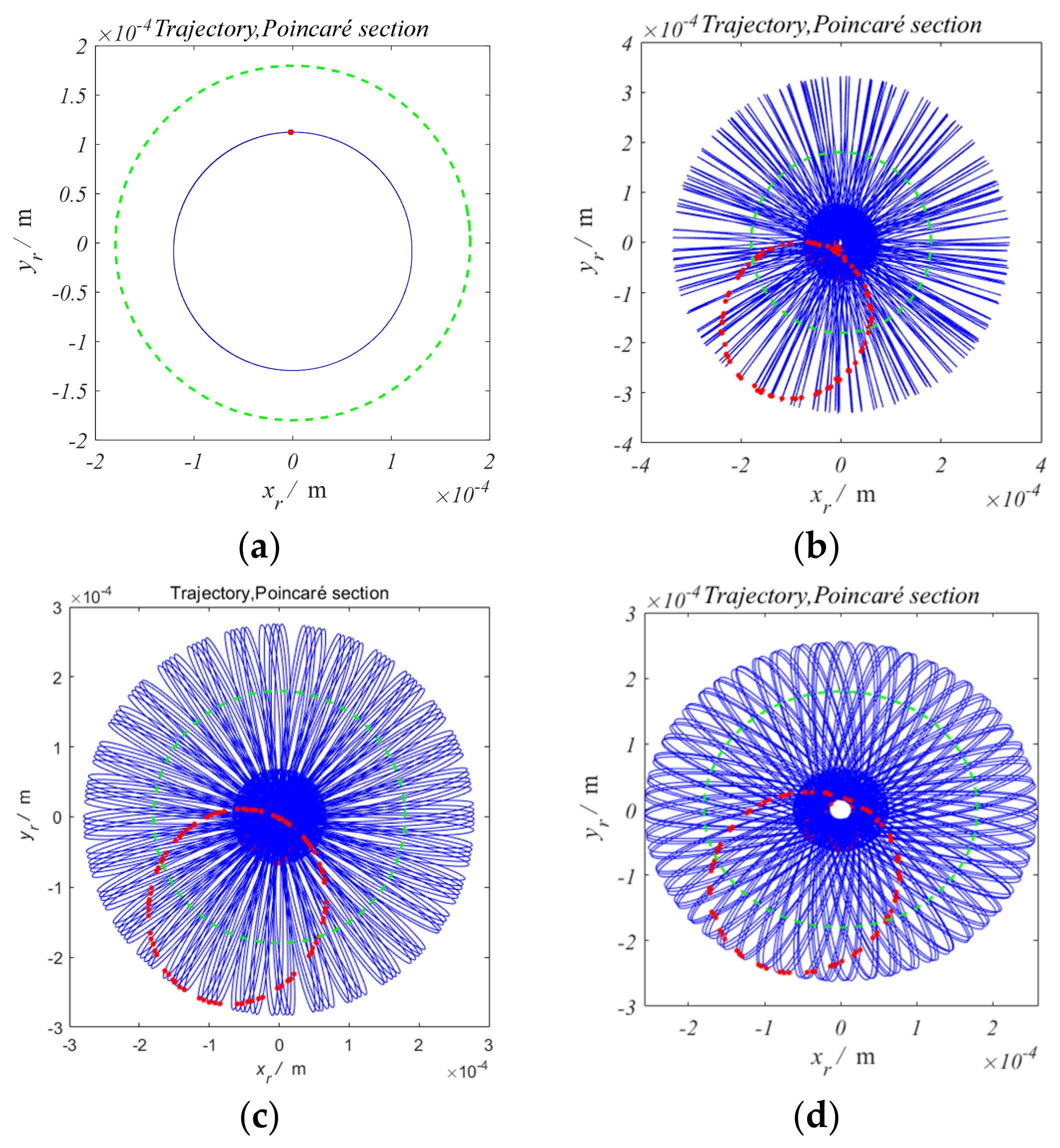
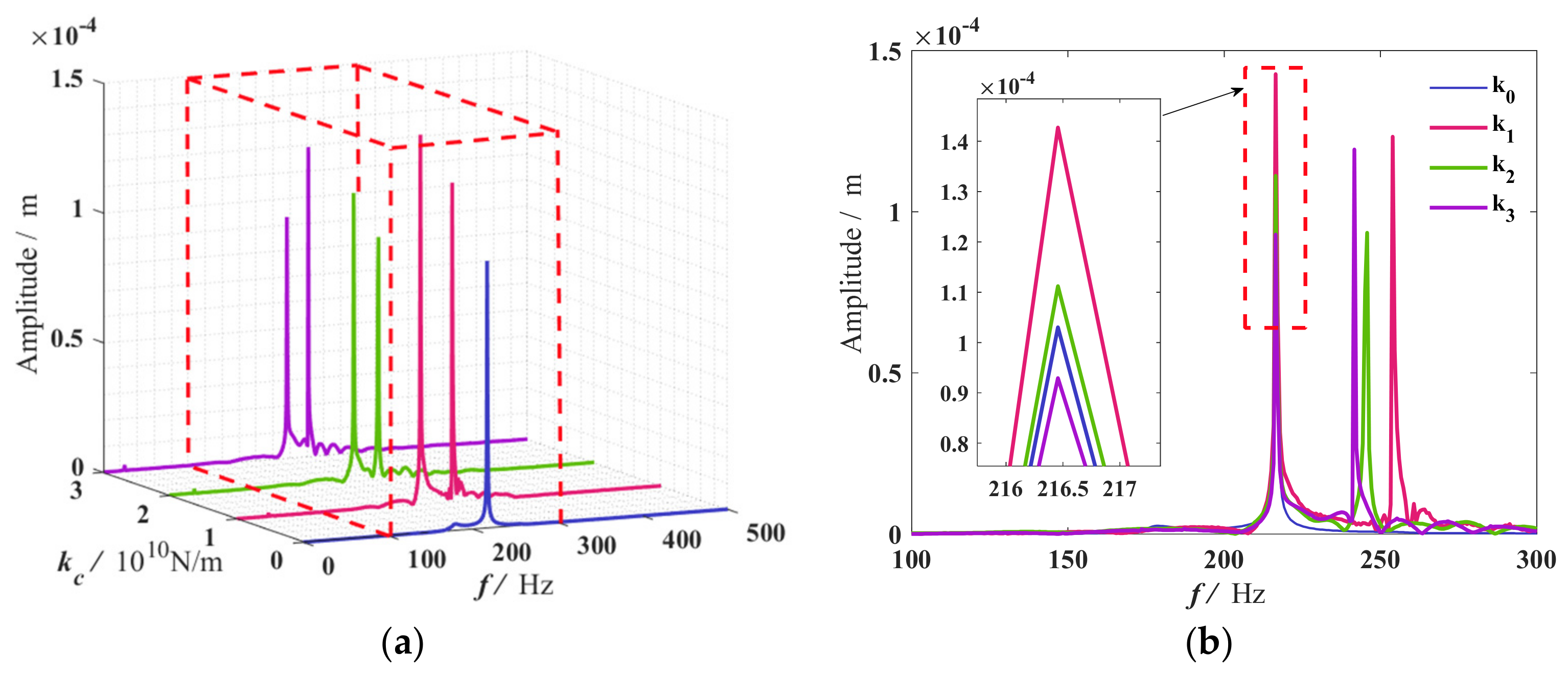
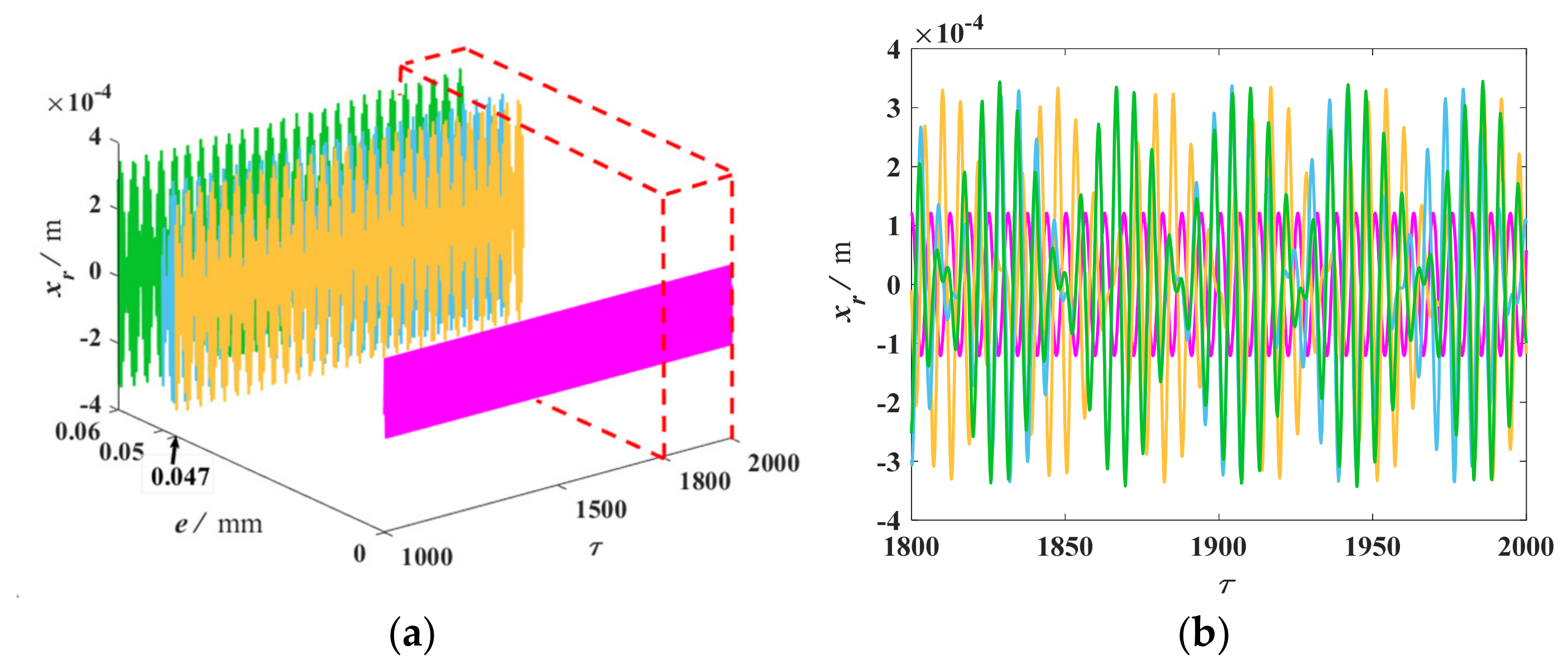
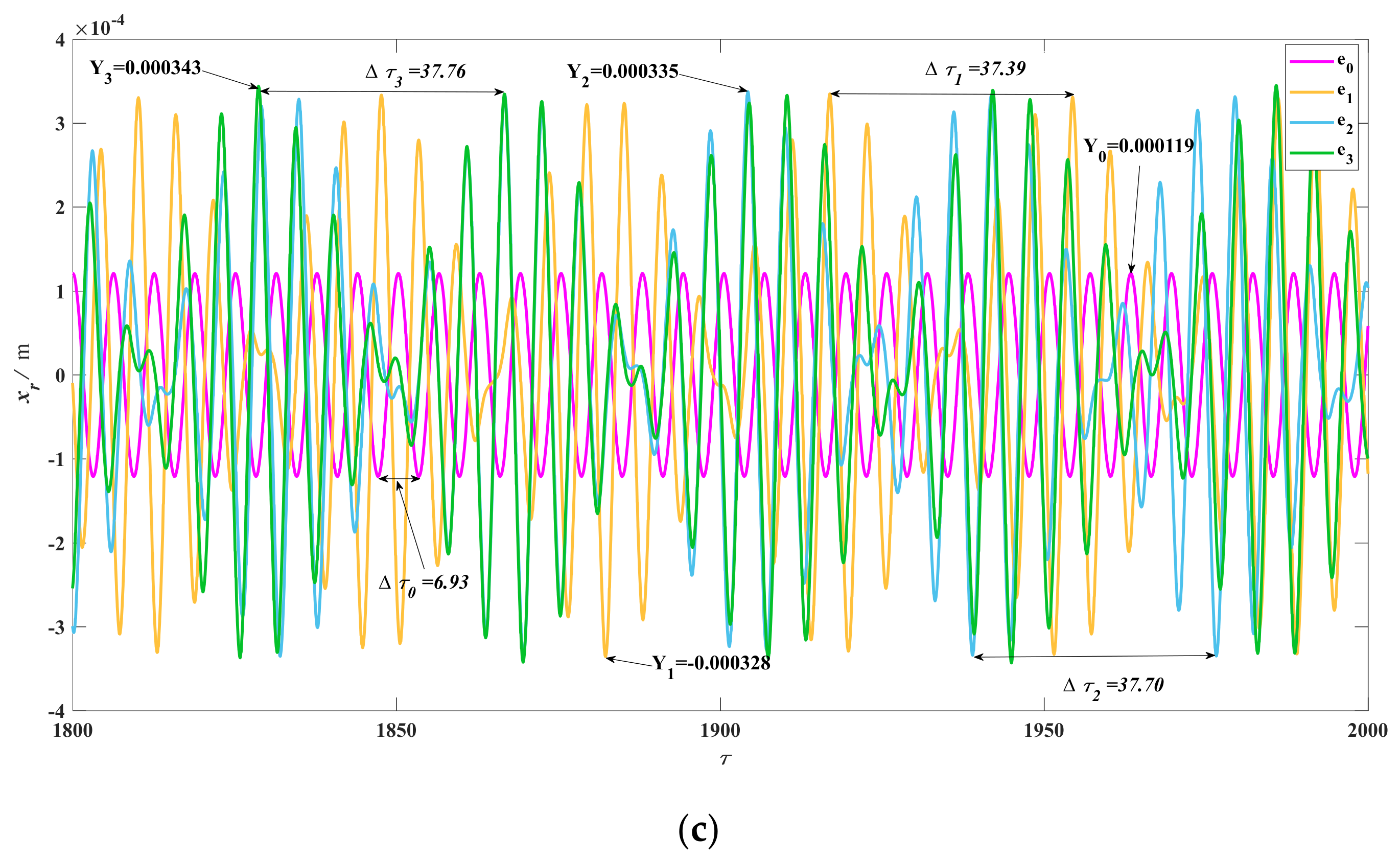
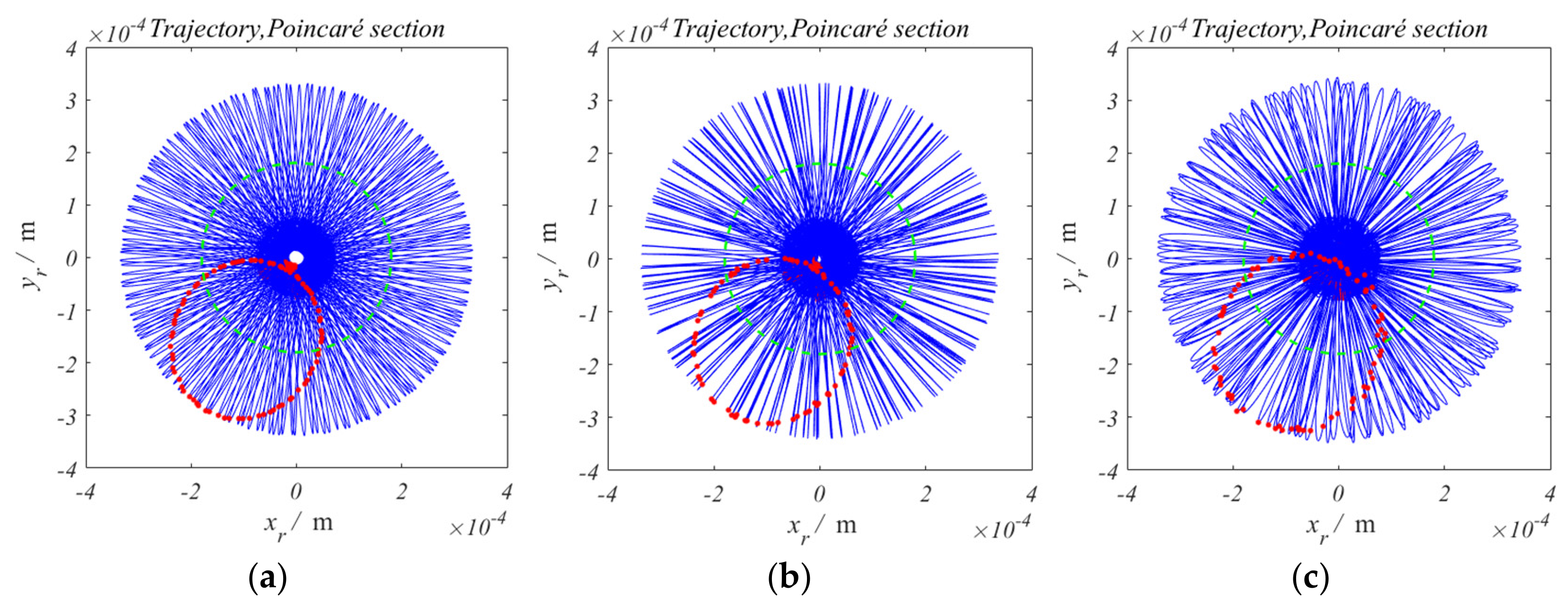
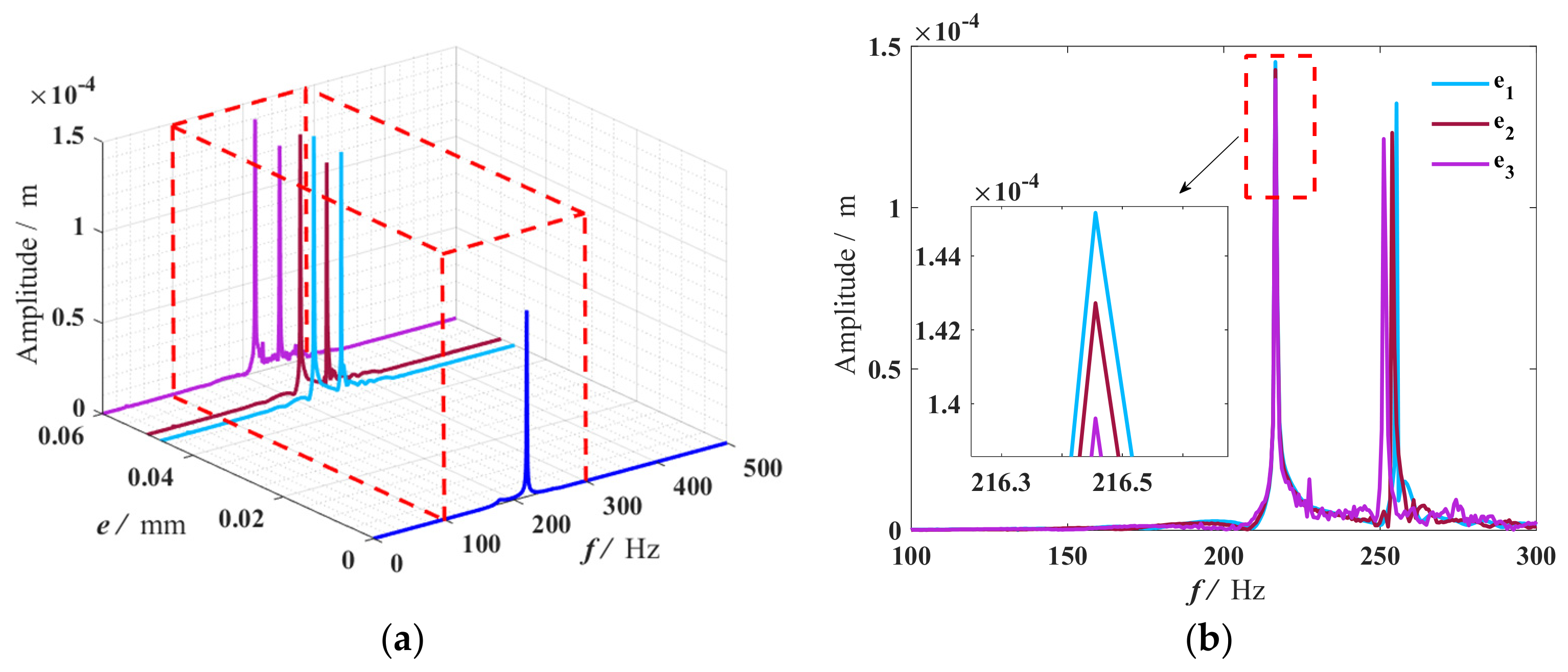
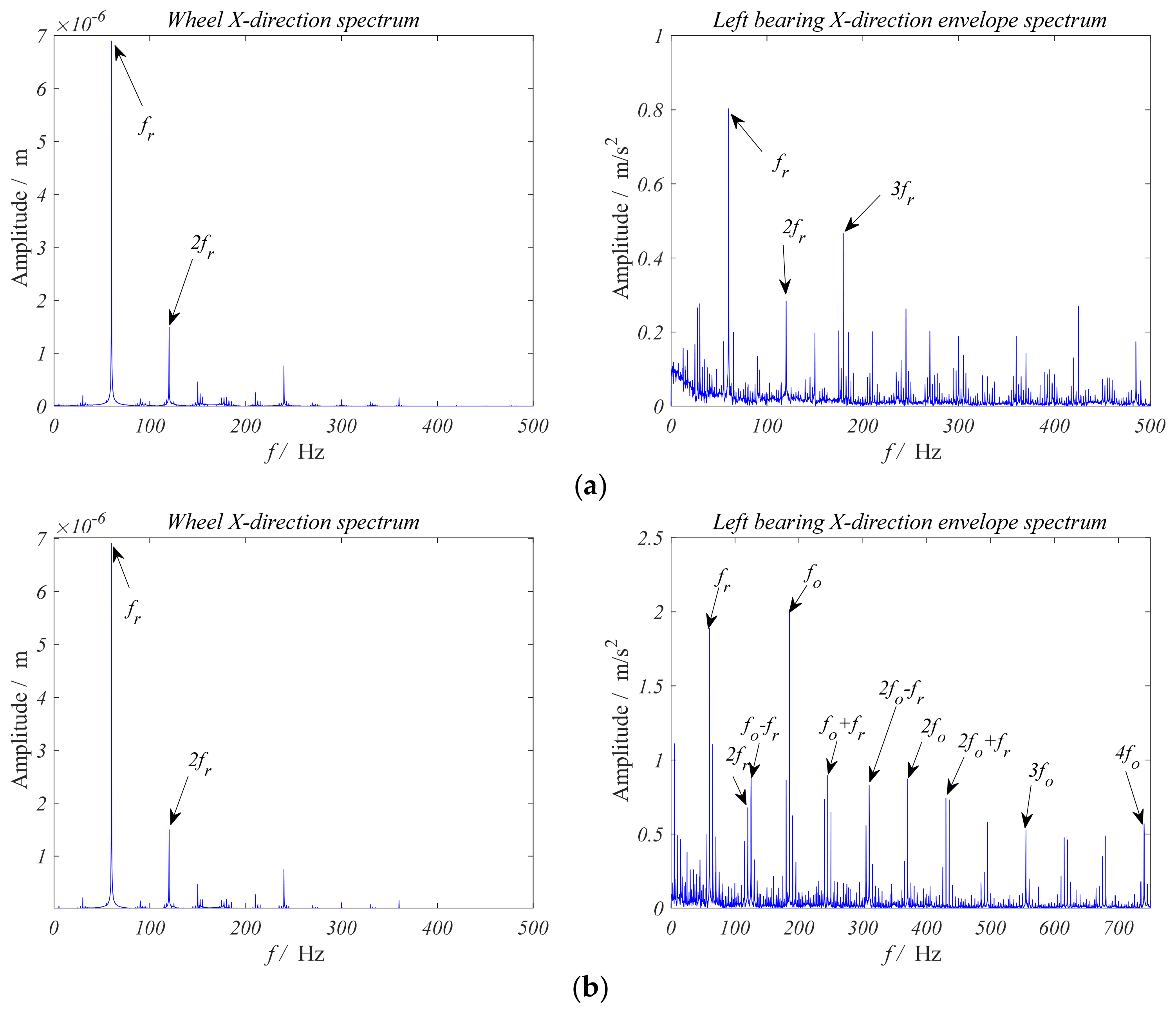
- Rub-impact fault rotor system: as the rubbing stiffness and eccentricity increase, the system non-linear behavior is significantly enhanced. The time-domain response gradually evolves from a regular sinusoidal signal to irregular vibration, while the shaft orbit transforms from a stable ellipse to a typical flower-shaped trajectory and eventually tends toward full annular rubbing. In the frequency spectrum, sideband and subharmonic components progressively increase, whereas the fundamental frequency amplitude decreases, indicating intensified rubbing-induced impacts and enhanced energy transfer toward higher-frequency components. Notably, the increase in rubbing stiffness not only strengthens non-linear impact behavior but also exhibits a certain suppressing effect on rotor imbalance vibration.
- (2)
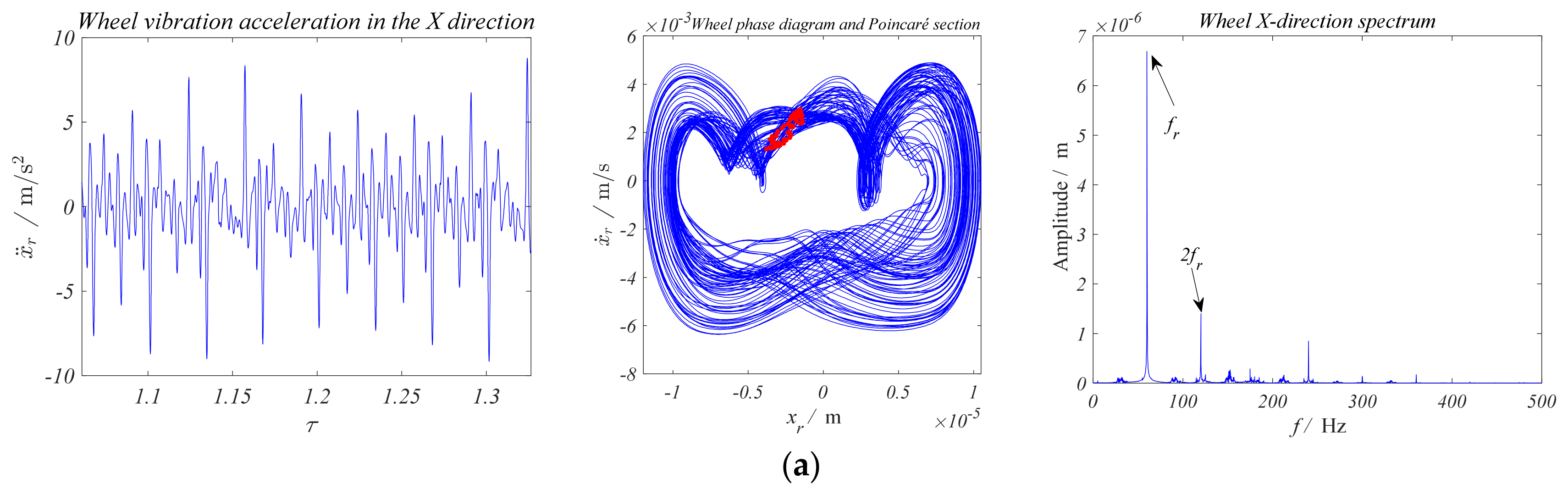
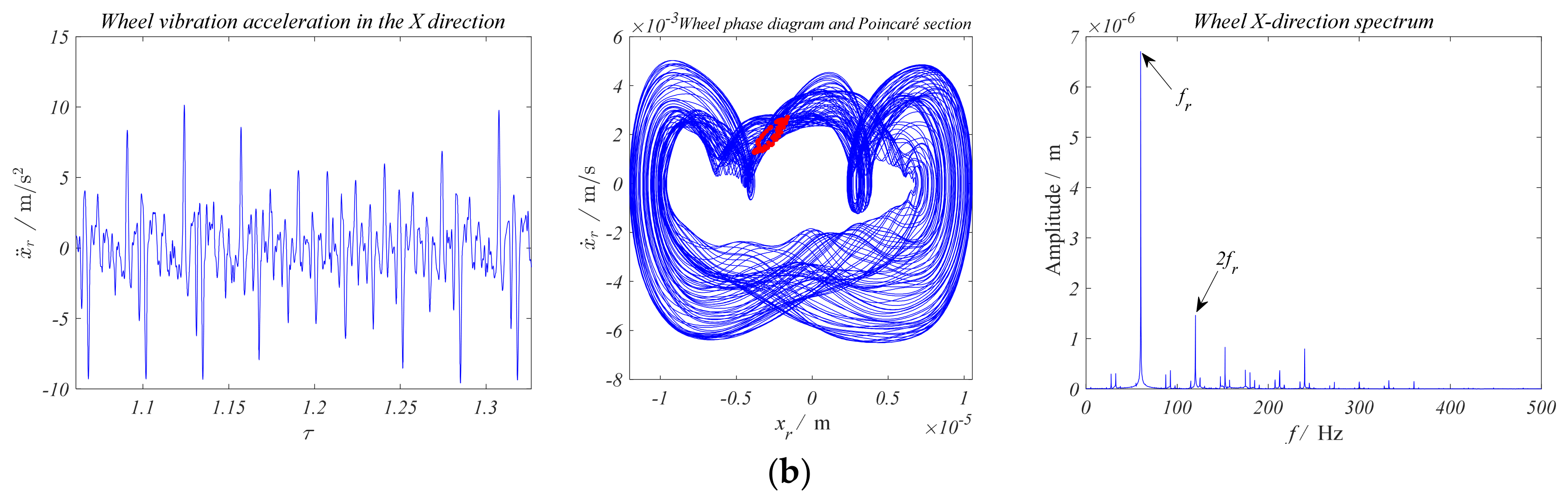
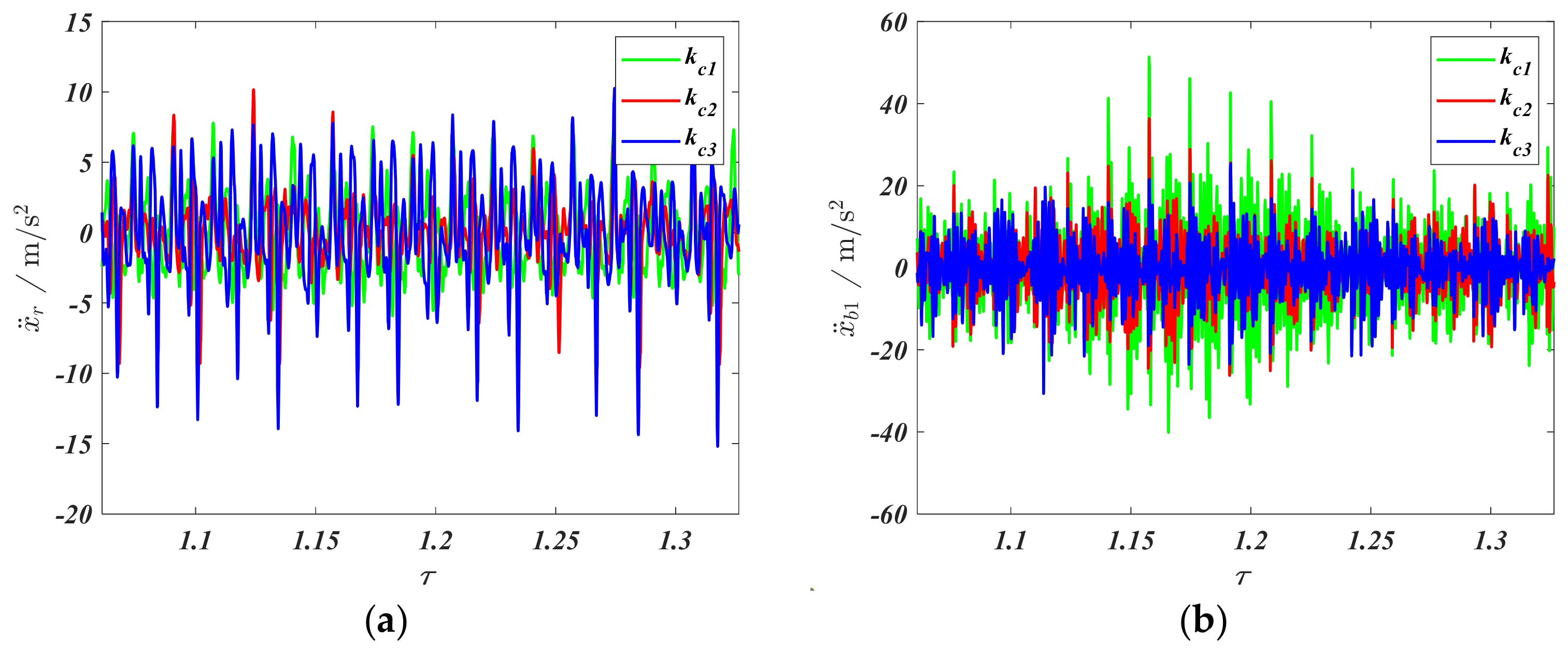
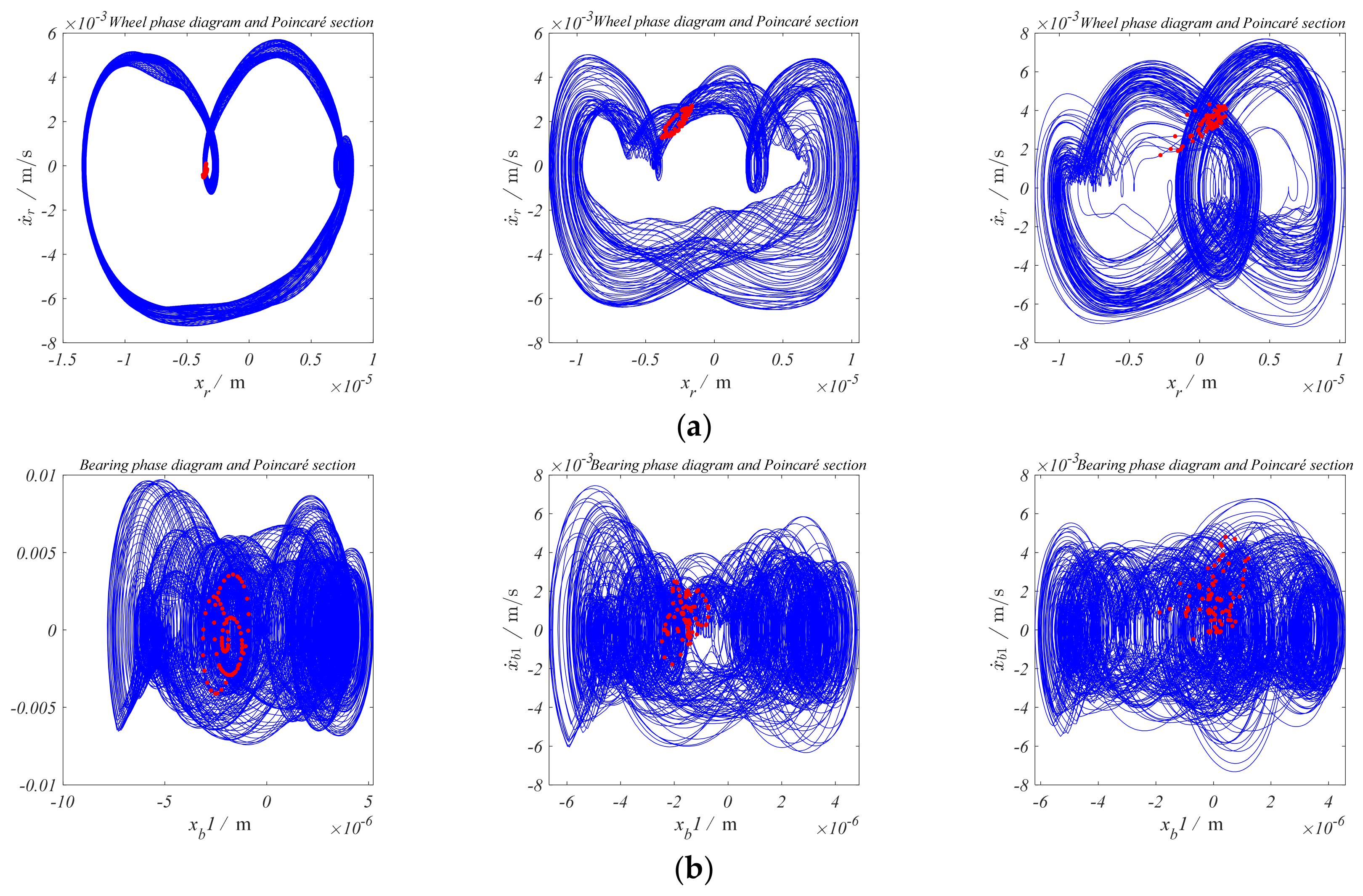
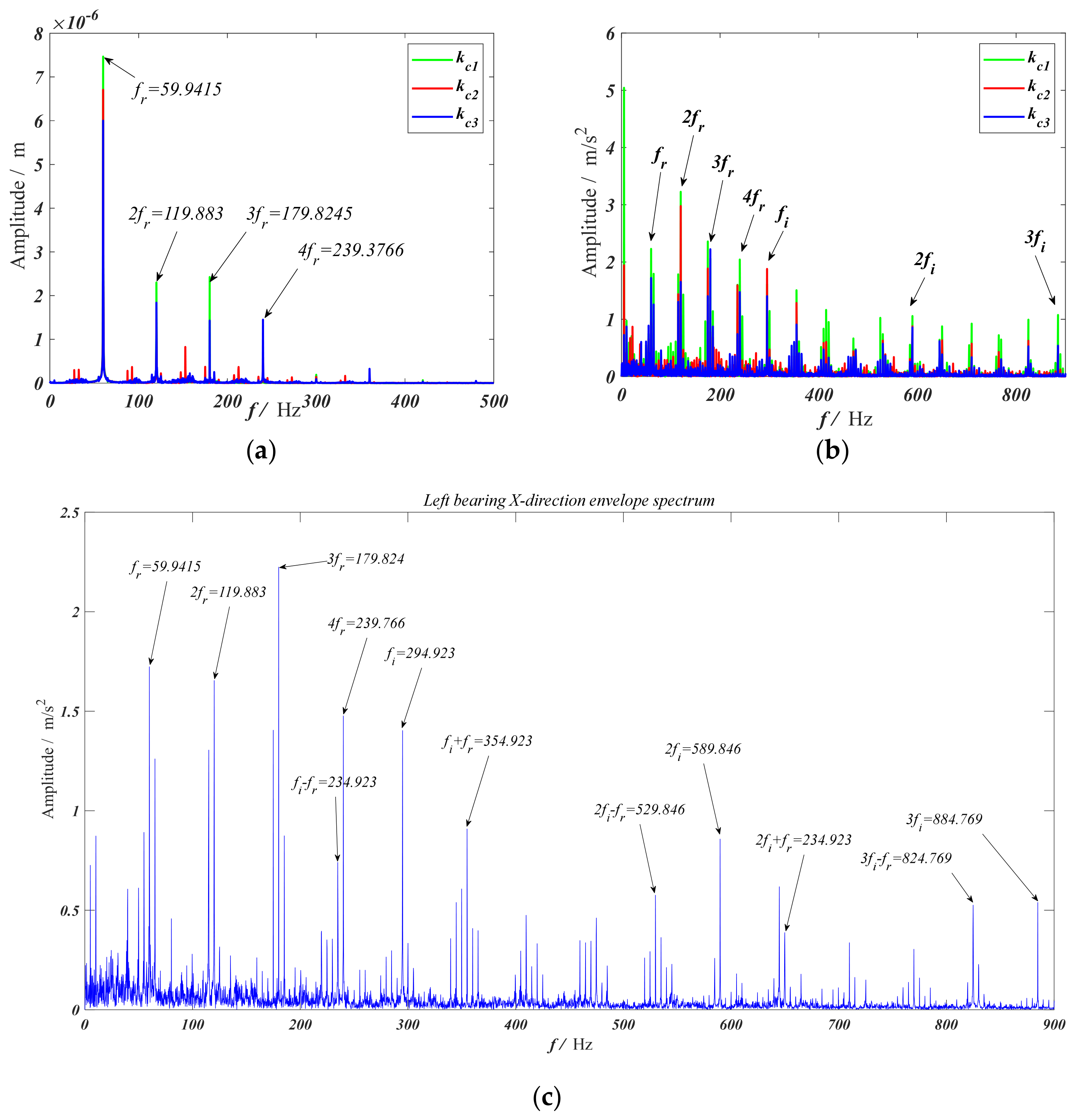
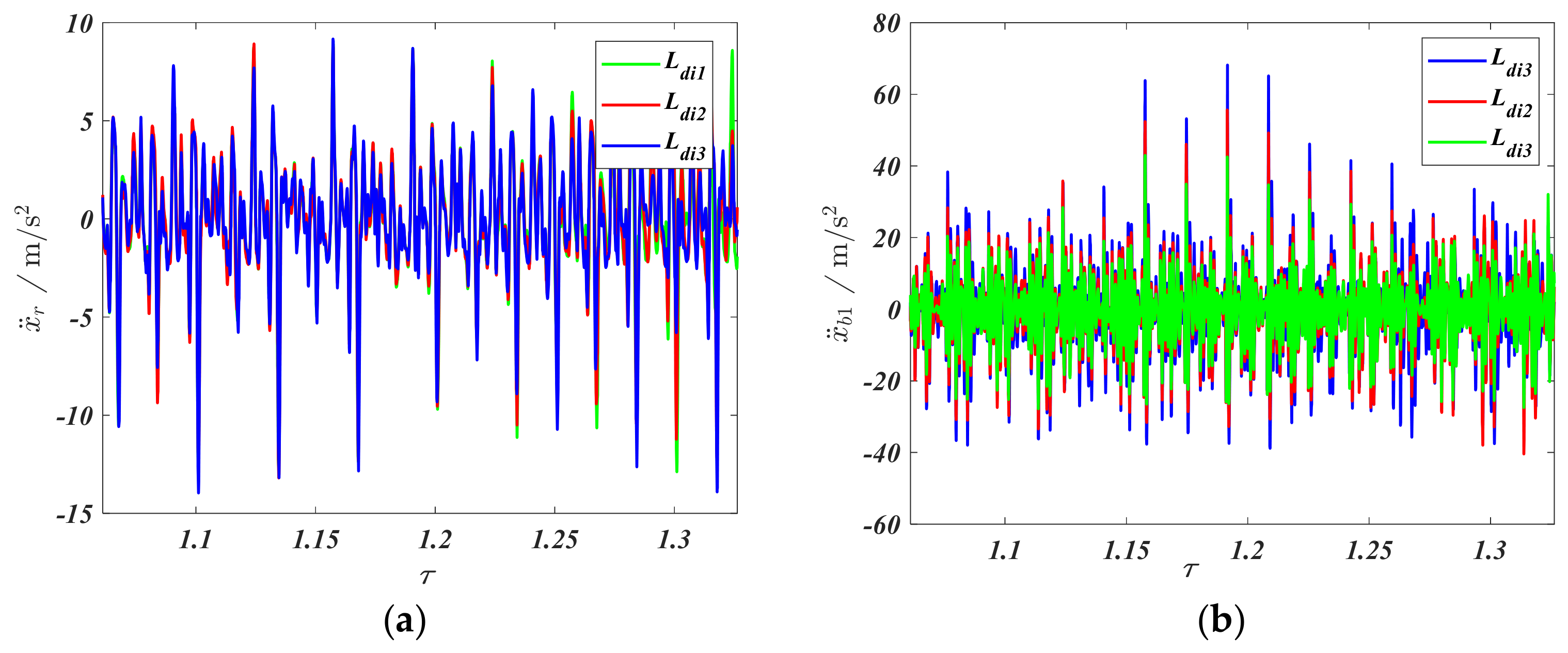
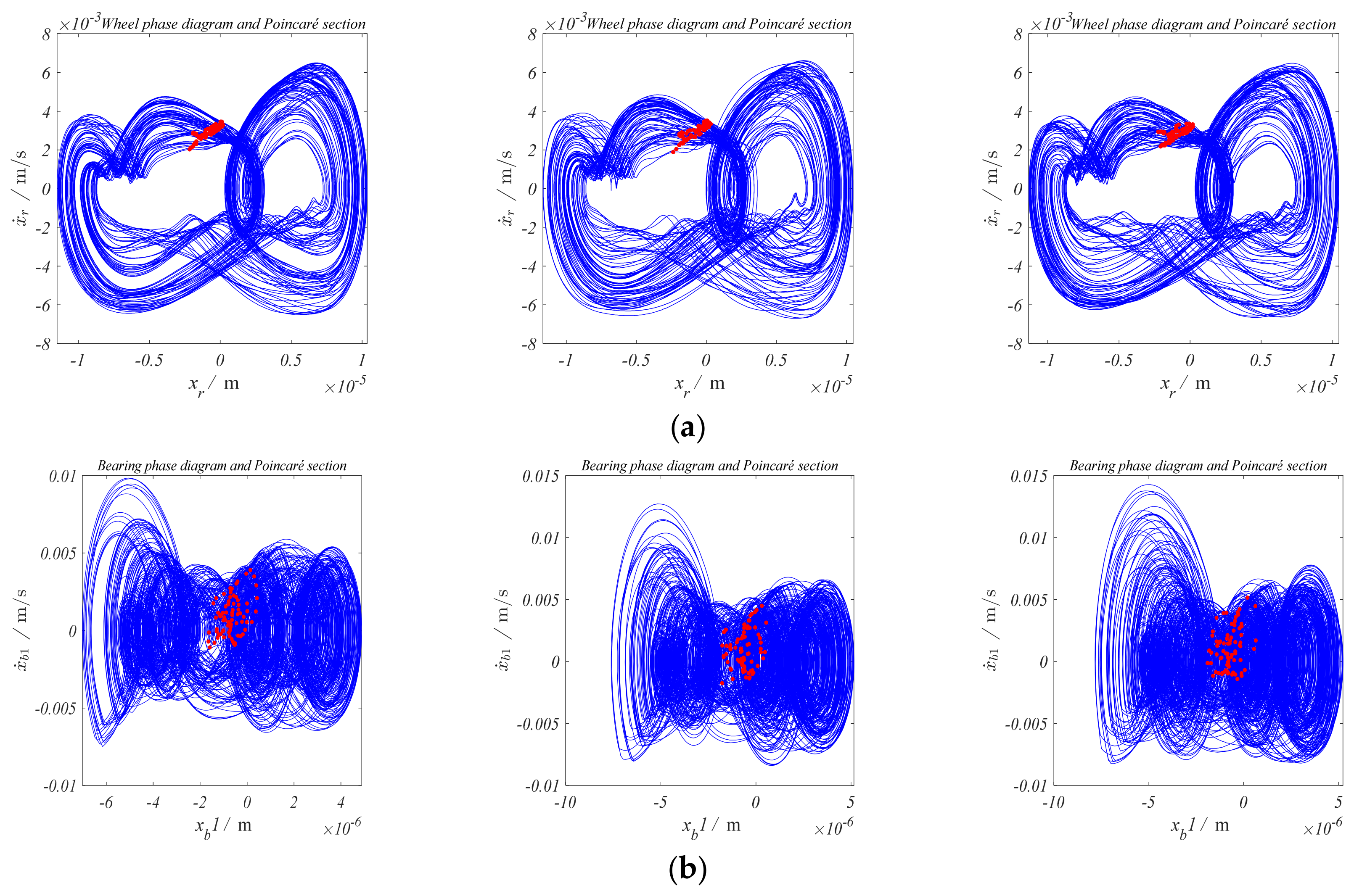
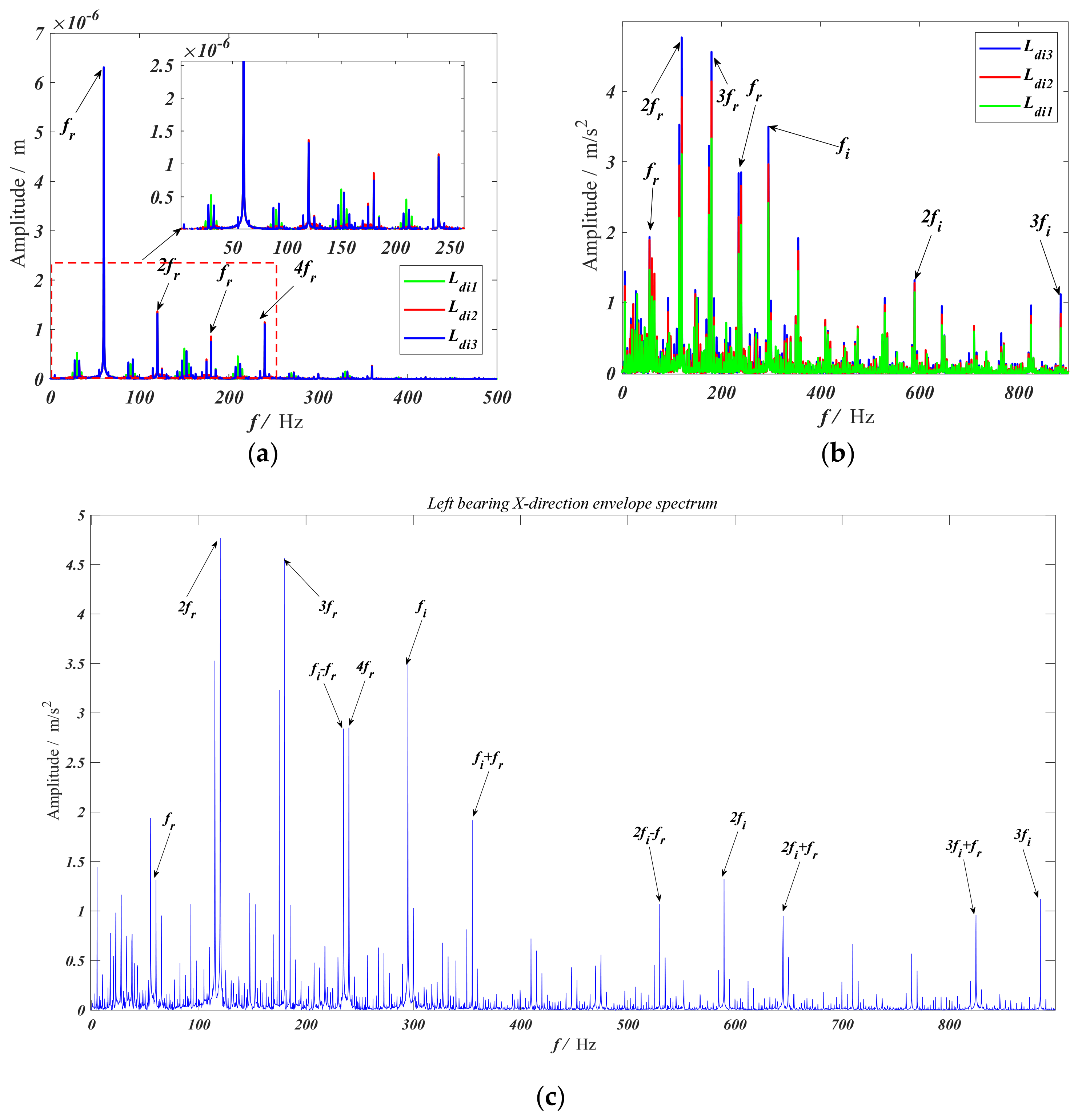
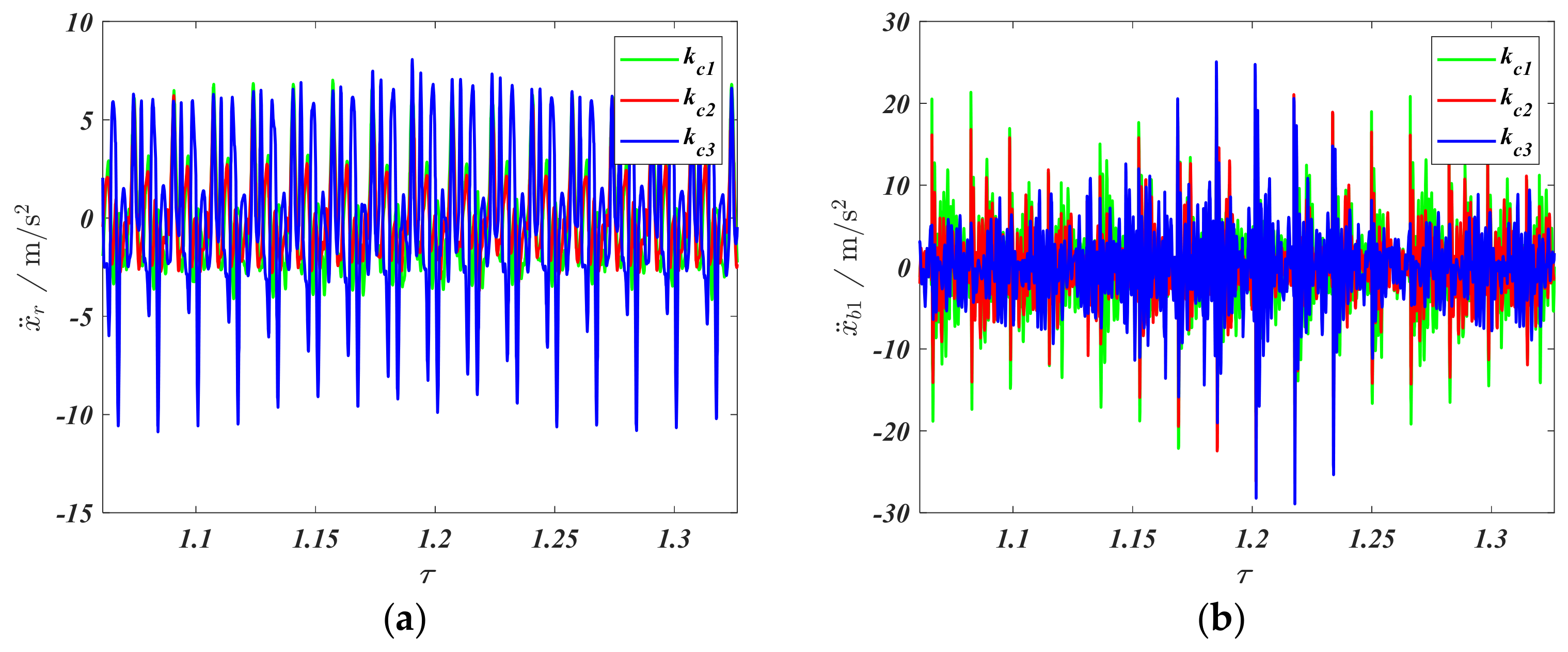
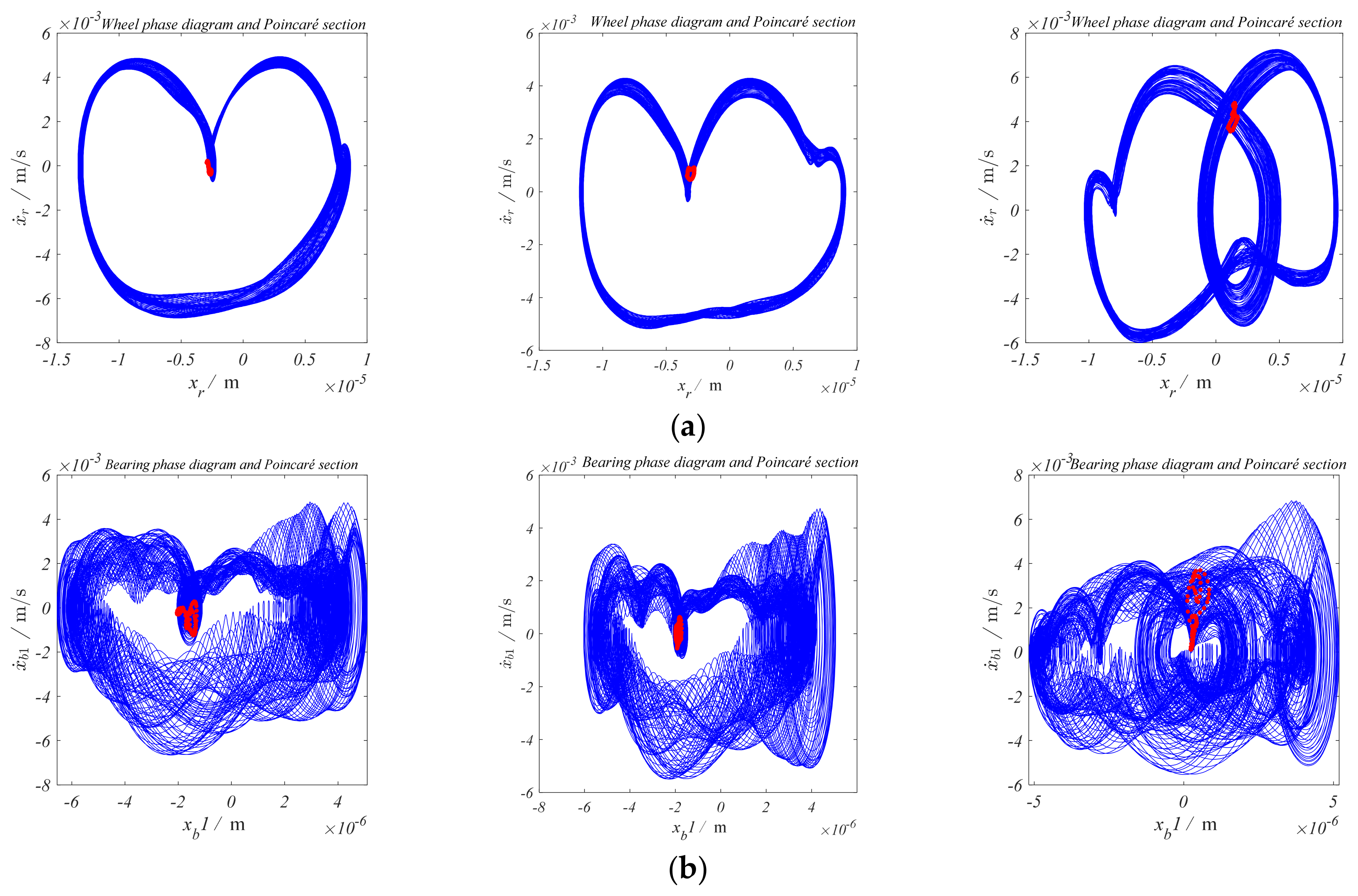
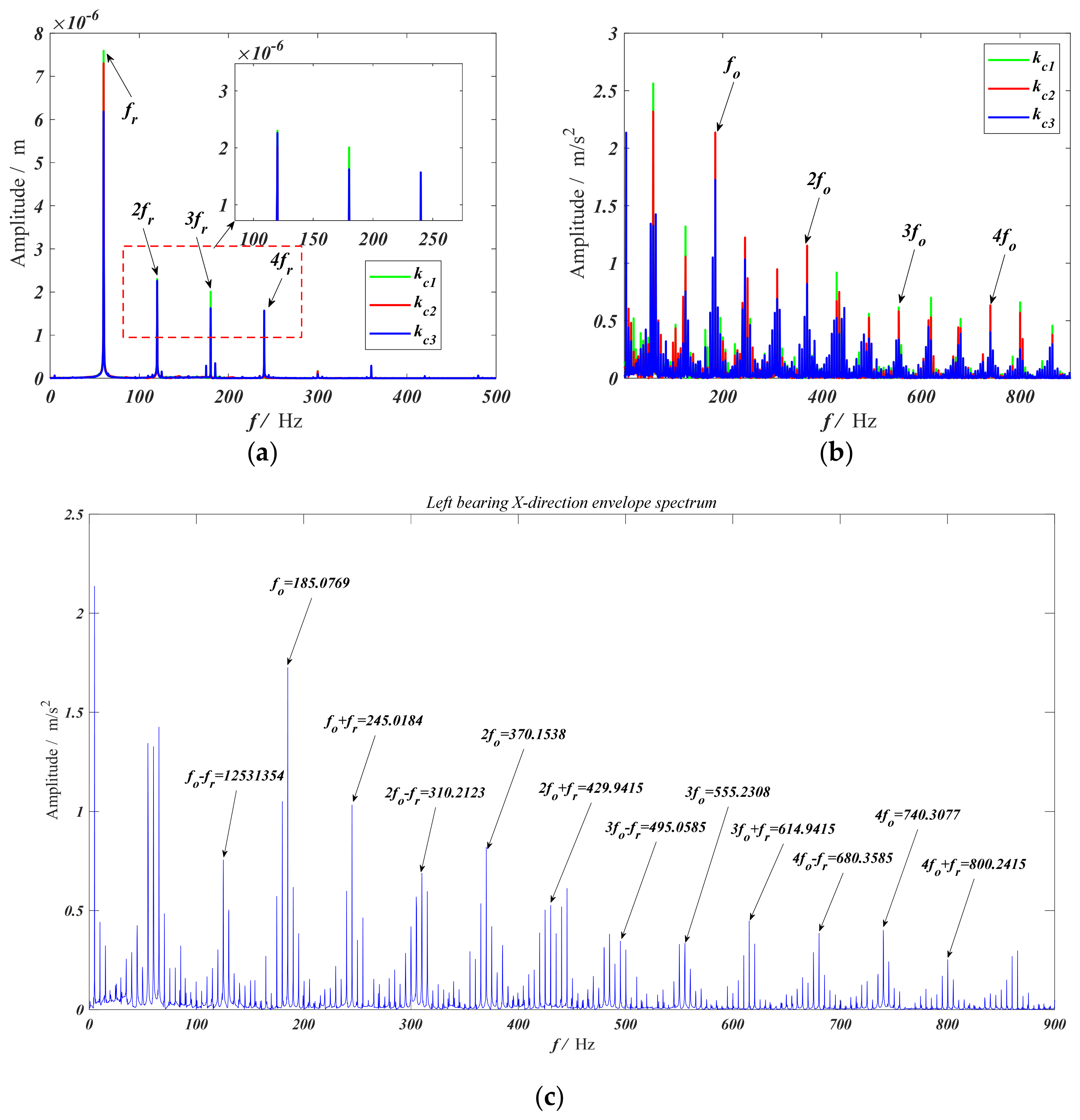
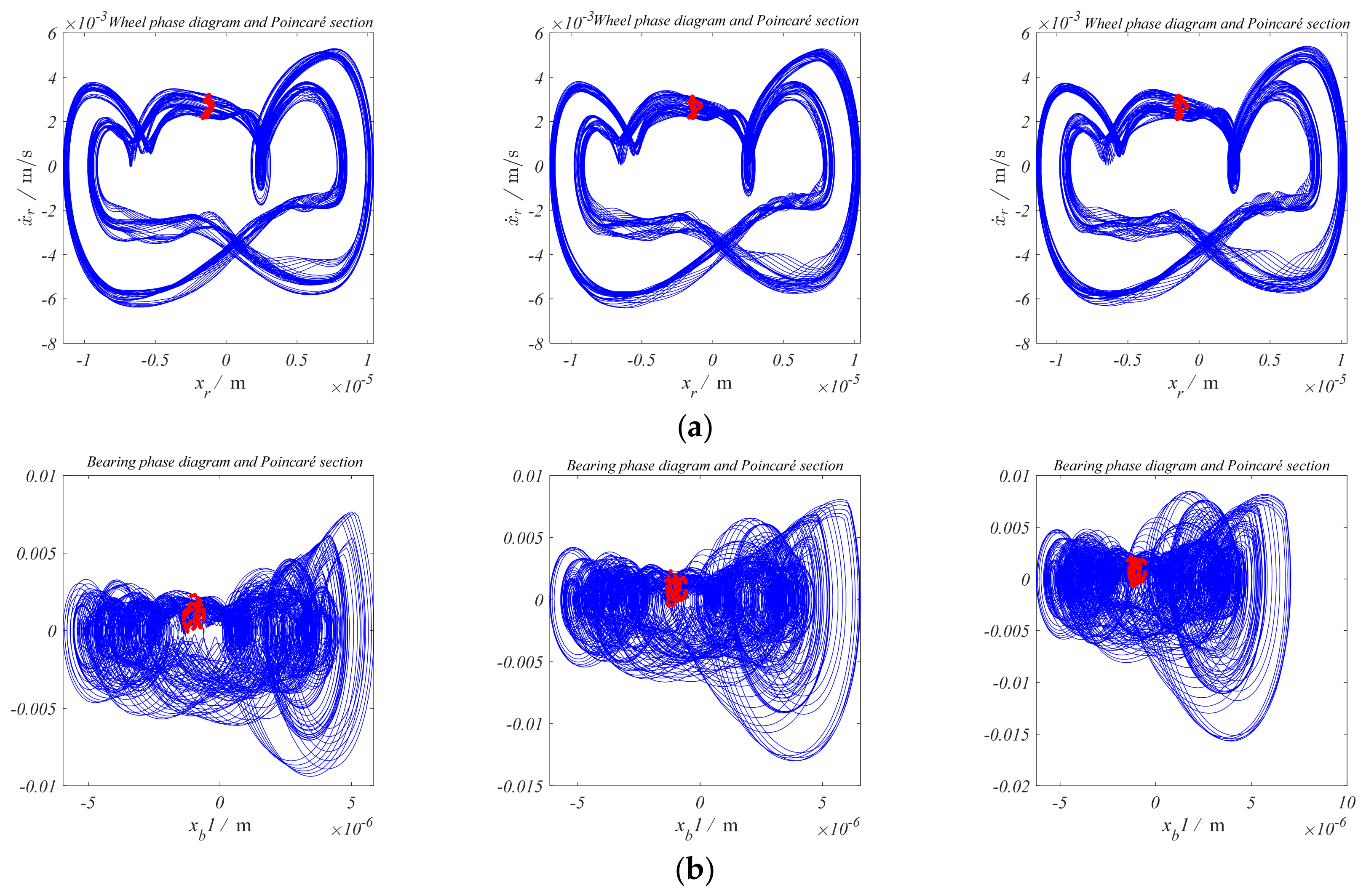
- Under rubbing-bearing compound fault conditions, the system exhibits significant non-linear coupling characteristics. As the rubbing stiffness increases, the disk response remains dominated by rubbing behavior, characterized by enhanced time-domain impacts, more complex phase trajectories, and increased higher-order harmonic components, indicating progressively intensified non-linear collision effects. Meanwhile, the bearing response is simultaneously affected by transmitted rubbing excitation and local defects, resulting in more complex dynamic behavior.
- (3)
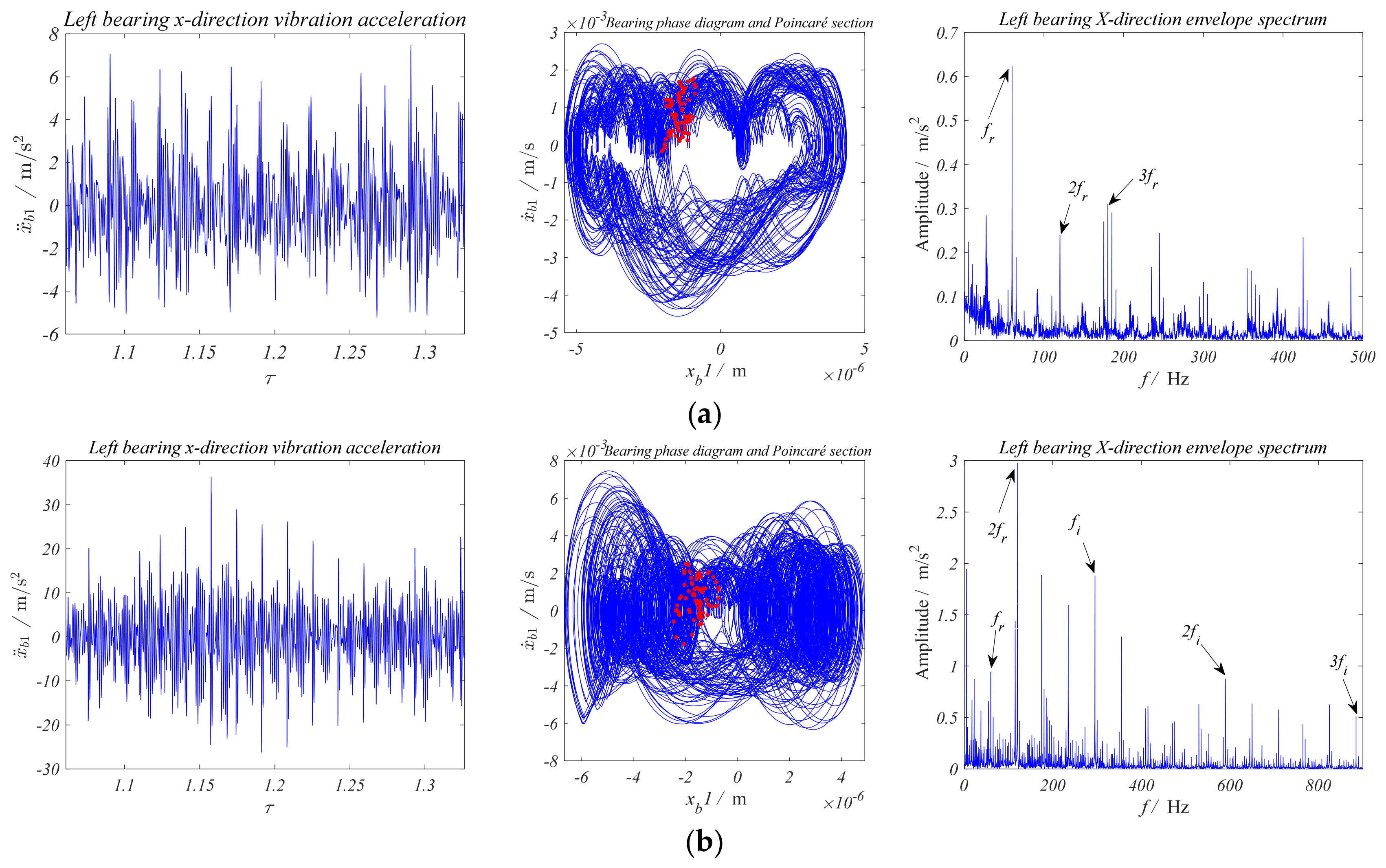
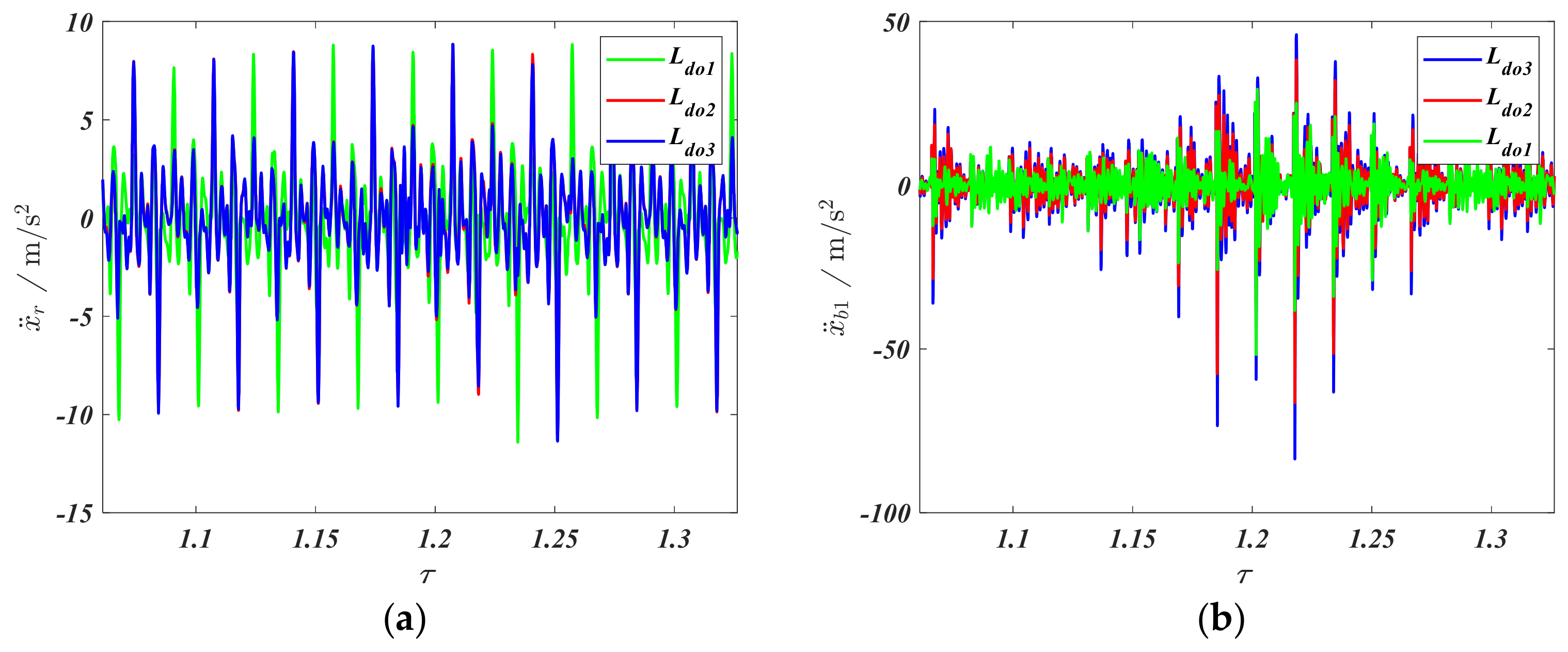
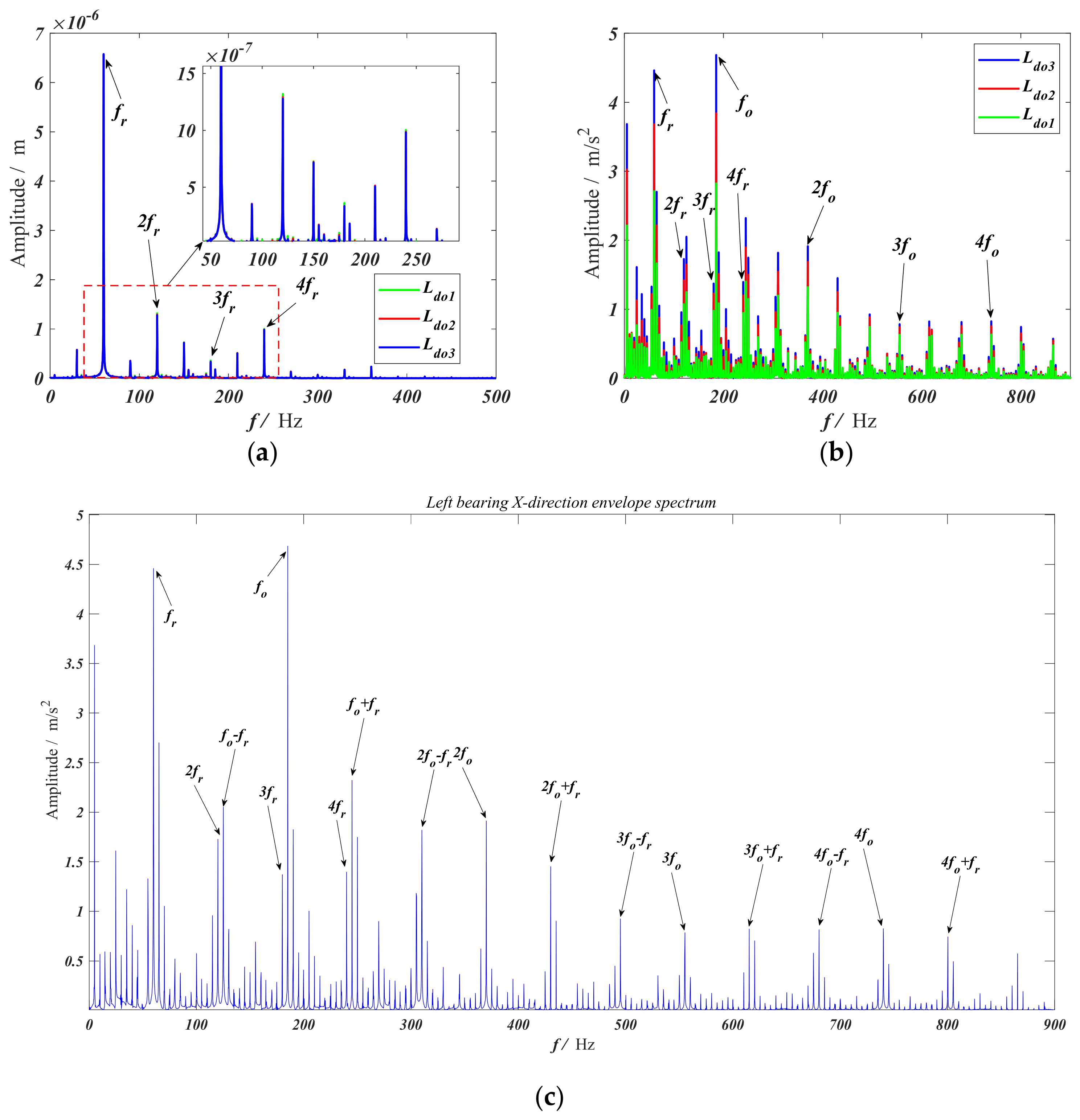
- As the defect widths of the inner and outer races increase, the bearing response exhibits stronger impact amplitudes in the time domain, higher dispersion in the Poincaré section, and enhanced fault characteristic frequencies and their harmonic components in the envelope spectrum, demonstrating high sensitivity to local defects. In contrast, local fault-induced excitations gradually attenuate during transmission to the disk and are easily masked by the dominant rubbing response, indicating that the disk response mainly reflects the global rubbing condition, whereas the bearing response is more suitable for local fault identification.
- (i)
- Designing a dedicated double-bearing single-disk rotor test rig equipped with high-precision eddy-current displacement sensors and housing accelerometers to experimentally validate the simulated structural transmission attenuation and frequency masking thresholds;
- (ii)
- Upgrading the current model into a full spatial multi-body dynamics architecture to incorporate angular movements, axial loads, and the dominant gyroscopic moments;
- (iii)
- Introducing rigorous fluid–structure coupling by accounting for lubricant viscosity, squeeze-film damping, and elastohydrodynamic lubrication (EHL) to explore the interactive friction–wear behaviors under non-continuous contact conditions;
- (iv)
- Upgrading the constant friction model into a velocity–temperature-dependent non-linear formulation where local thermal fields and relative sliding kinematics are coupled to dynamically update the friction coefficient under extreme thermal ablation.
Author Contributions
Funding
Informed Consent Statement
Data Availability Statement
Acknowledgments
Conflicts of Interest
Nomenclature
| Symbol | Description | Value (from Solver) | Unit |
| Linear velocity of the contact between the rolling element and the inner and outer races of the bearing, orbital linear velocity of the cage centroid | Variable | m/s | |
| Angular velocity of the bearing inner-race, angular velocity of the bearing outer race, angular velocity of the cage, rotational speed of the shaft | Variable | Rad/s | |
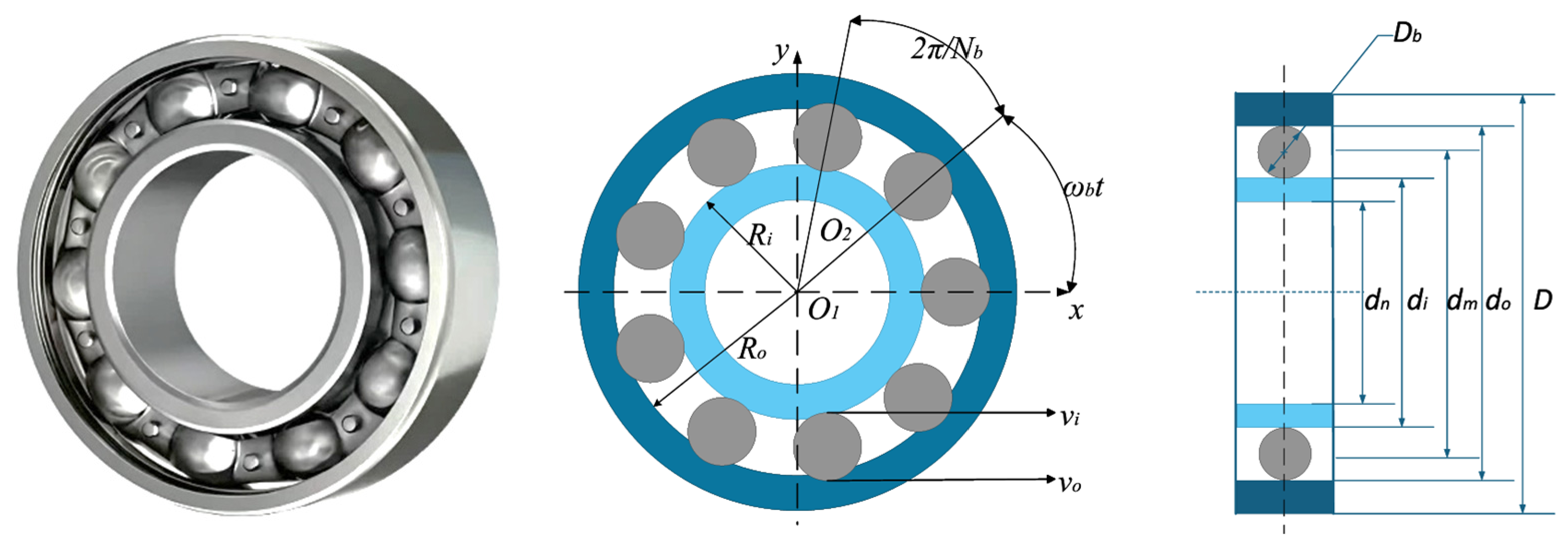
| Rolling element diameter, outer diameter of the bearing outer race | 23.8; 140.0 | mm | |
| Respectively denote the raceway diameters of the inner and outer races, and the pitch circle diameter | 80.2; 127.8; 104.0 | mm | |
| Rotational angle of the i-th rolling element within time t | Variable | rad | |
| Number of rolling elements | 8 | ||
| Angular position of the i-th rolling element | Variable | rad | |
| Ball pass vibration frequency | Variable | Hz | |
| Depends on the Hertzian contact coefficient characterizing the contact surface properties | Calculated internally | N/m1.5 | |
| Young’s modulus | 2.07 × 10⁵ | MPa | |
| Poisson’s ratio | 0.3 | ||
| Sum of the curvature of the contact elements | Calculated internally | mm−1 | |
| Elastic deformation generated by contact between the i-th rolling element and the inner and outer raceways at any time | Variable | μm | |
| Shaft restoring stiffness | 2.5 × 10⁷ | N/m | |
| Equivalent contact stiffness coefficient of the bearing | Calculated | N/m | |
| Equivalent stator rub-impact stiffness coefficient | Variable | N/m | |
| Hertzian total contact force component of the left bearing, Hertzian total contact force component of the right bearing | Variable | N | |
| Resultant Hertzian contact force components in the x- and y-directions of the left and right bearings when an inner-race defect exists only in the left bearing | Variable | N | |
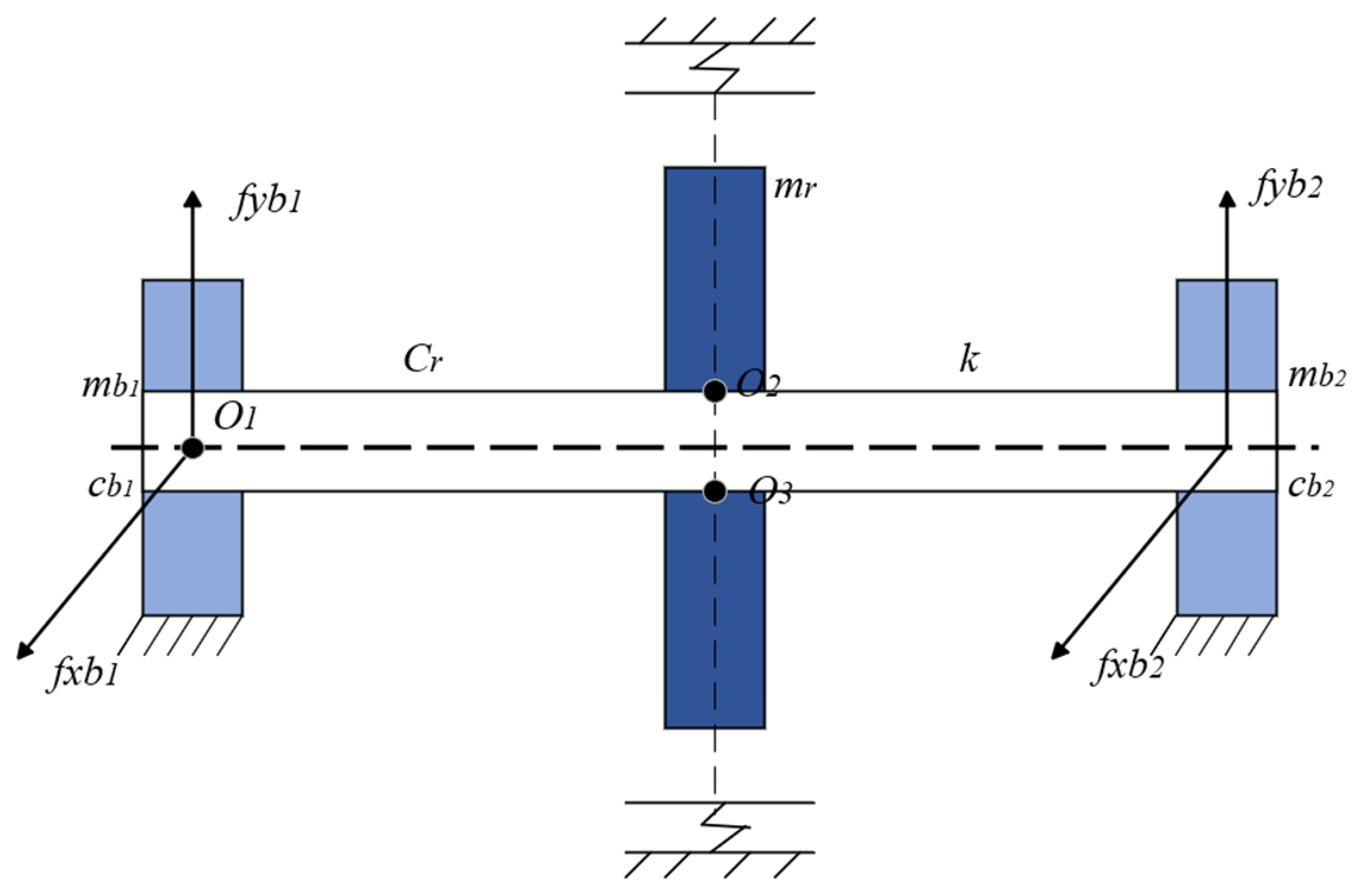
| Geometric center of the bearing, geometric center of the rotor, mass center of the rotor | |||
| Total mass of the rotor; equivalent mass at the left bearing; equivalent mass at the right bearing; disk mass | 32.1; 4; 4 | kg | |
| Damping coefficients at the bearing locations; damping coefficient at the rotor disk; damping coefficient at the left bearing end; damping coefficient at the right bearing end | -; 2100.0; 1050.0; 1050.0 | N∙s/m | |
| Tangential friction force induced by rub-impact; normal contact force induced by rub-impact; rub-impact force in the x-direction; rub-impact force in the y-direction | Variable | N | |
| Shaft center displacement; outer diameter of the inner race; inner diameter of the outer race | |||
| Rub-impact clearance | 9.5 | μm | |
| Friction coefficient | 0.1/0.2 | ||
| Variable | mm | ||
| Outer-race fault frequency, inner-race fault frequency, and ball fault frequency of the rolling bearing; rotational frequency of the rotor | Variable | Hz | |
| Inner-race defect diameter, outer-race defect diameter, inner-race defect depth, outer-race defect depth | Variable | mm | |
| Actual depth of the pit engaged by the rolling element in the inner-race defect region; actual depth of the pit engaged by the rolling element in the outer-race defect region | Variable | mm | |
| Half of the central angle corresponding to the inner-race defect region; rotational angle representing the center of the defect region; half of the central angle corresponding to the outer-race defect region; rotational angle representing the center of the defect region | Variable | rad | |
| Rolling element radius | 11.9 | mm | |
| Dimensionless time constant | Variable | ||
| Dimensionless resultant contact force components of the left and right bearings | Variable | N | |
| Bearing radial clearance | Variable | μm |
References
- Dave, V.; Karsh, P.K.; Soni, U.; Dabhi, V.M.; Zalawadia, K.; Rameshbhai, P.A. A Machine Learning Approach for Bearing Fault Identification Using IFWHT, GLCM, and Feature Ranking. Adv. Eng. Lett. 2026, 5, 1–11. [Google Scholar] [CrossRef]
- Li, J.T.; Lu, H.H.; Feng, K.P.; Liu, Y.; Zhao, Y.L. Research on a New Diagnosis Index for Fixed-Point Rub-Impact of Rotor System. Eng. Fail. Anal. 2021, 125, 105394. [Google Scholar] [CrossRef]
- Nan, G.; Zhou, Y.; Wang, Y.; Qiu, X.; Wang, H. Rubbing Dynamics of Dual-Disk Rotor System Supported by Oil Film Bearing. Shock Vib. 2025, 2025, 5596094. [Google Scholar] [CrossRef]
- Zhu, Z.; Li, Y.; Wen, C.; Luo, Z.; Chen, Y.; Li, B. Rub-Impact Investigation of a Bolted Joint Rotor-Bearing System Considering Hysteresis Behavior at Mating Interface. Mech. Syst. Signal Process. 2025, 224, 112072. [Google Scholar] [CrossRef]
- Wang, J.; Wen, H.; Qian, H.; Guo, J.; Zhu, J.; Dong, J.; Shen, H. Typical Fault Modeling and Vibration Characteristics of the Turbocharger Rotor System. Machines 2023, 11, 311. [Google Scholar] [CrossRef]
- Zhang, X.; Yang, Y.; Shi, M.; Zhang, Y.; Wang, P. An Energy Track Method for Early-Stage Rub-Impact Fault Investigation of Rotor System. J. Sound Vib. 2022, 516, 116545. [Google Scholar] [CrossRef]
- Prabith, K.; Krishna, I.R.P. The Numerical Modeling of Rotor–Stator Rubbing in Rotating Machinery: A Comprehensive Review. Nonlinear Dyn. 2020, 101, 1317–1363. [Google Scholar] [CrossRef]
- Lu, H.; Feng, K.; Liang, H.; Liu, Y.; Li, J.; Zhao, Y. An Improved NOFRFs-Based Fault Feature Extraction Method and Its Application to Quantitative Diagnosis in Rotor Rub-Impact. J. Sound Vib. 2021, 513, 116406. [Google Scholar] [CrossRef]
- Wang, J.; Liu, Y.; Qin, Z.; Ma, L.; Chu, F. Transient State Analysis of a Rub-Impact Rotor System during Maneuvering Flight. Chin. J. Aeronaut. 2024, 37, 236–251. [Google Scholar] [CrossRef]
- Darmo, S.; Bahiuddin, I.; Handoko, P.; Rizki Priatomo, H.; Kuncoro, M.; Priyambodo, S.; Haryanto; Fatah Rahman, N.; Machmuddi Kanosri, A.; Winarno, A. Failure Analysis of Double-Row Tapered Roller Bearing Outer Ring Used in Coal Wagon Wheelset. Eng. Fail. Anal. 2022, 135, 106153. [Google Scholar] [CrossRef]
- Wang, L.; Qin, P.; Du, Z.; Wu, Y. Failure Analysis for Outer Ring Cracking of GCr15 Rolling Bearing. Eng. Fail. Anal. 2024, 157, 107874. [Google Scholar] [CrossRef]
- Hou, X.; Diao, Q.; Liu, Y.; Liu, C.; Zhang, Z.; Tao, C. Failure Analysis of a Cylindrical Roller Bearing Caused by Excessive Tightening Axial Force. Machines 2022, 10, 322. [Google Scholar] [CrossRef]
- Gong, Y.; Fei, J.-L.; Tang, J.; Yang, Z.-G.; Han, Y.-M.; Li, X. Failure Analysis on Abnormal Wear of Roller Bearings in Gearbox for Wind Turbine. Eng. Fail. Anal. 2017, 82, 26–38. [Google Scholar] [CrossRef]
- Liu, C.; Wang, J.; Zhao, S.; Yan, X.; Qi, X. Influence of an Outer Ring End Offset on the Service Life and Eccentric Wear Defects of Self-Lubricating Spherical Plain Bearings. Eng. Fail. Anal. 2023, 143, 106853. [Google Scholar] [CrossRef]
- Takabi, J.; Khonsari, M.M. On the Thermally-Induced Failure of Rolling Element Bearings. Tribol. Int. 2016, 94, 661–674. [Google Scholar] [CrossRef]
- Tahmasbi, D.; Shirali, H.; Sajad Mousavi Nejad Souq, S.; Eslampanah, M. Diagnosis and Root Cause Analysis of Bearing Failure Using Vibration Analysis Techniques. Eng. Fail. Anal. 2024, 158, 107954. [Google Scholar] [CrossRef]
- Dai, Y.; Pang, J.; Rui, X.; Li, W. Study on Thermal Error Modeling of High-Speed Motorized Spindle Considering Bearing Inner Ring Temperature. Case Stud. Therm. Eng. 2024, 58, 104388. [Google Scholar] [CrossRef]
- Zhou, Y.; Zou, R.; Zheng, H.; Zhang, Z.; Dong, Y. Dynamic Response of an Inner Ring Fault Bearing Considering Fluid–Solid Coupled Lubrication under Thermal Environment. Int. J. Non-Linear Mech. 2026, 186, 105338. [Google Scholar] [CrossRef]
- Ma, H.; Yu, T.; Han, Q.; Zhang, Y.; Wen, B.; Chen, X. Time–Frequency Features of Two Types of Coupled Rub-Impact Faults in Rotor Systems. J. Sound Vib. 2009, 321, 1109–1128. [Google Scholar] [CrossRef]
- Lu, K.; Guo, D.; Zhu, W.; Jin, Y.; Cheng, H.; Gu, X.; Fu, C. Nonlinear Dynamic Behavior Analysis of Dual-Rotor-Bearing Systems with Looseness and Rub–Impact Faults. AIAA J. 2023, 61, 5164–5175. [Google Scholar] [CrossRef]
- Lu, X.; Zhang, J.; Ma, L.; Lin, J.; Wang, J.; Wang, J.; Dai, H. Effects of Misalignment on the Nonlinear Dynamics of a Two-Shaft Rotor-Bearing-Gear Coupling System with Rub-Impact Fault. J. Vibroeng. 2017, 19, 5960–5977. [Google Scholar] [CrossRef]
- Luo, Y.-G.; Ren, Z.-H.; Ma, H.; Yu, T.; Wen, B. Stability of Periodic Motion on the Rotor-Bearing System with Coupling Faults of Crack and Rub-Impact. J. Mech. Sci. Technol. 2007, 21, 860–864. [Google Scholar] [CrossRef]
- Zhang, J.H.; Ma, L.; Lin, J.W.; Zhang, G.C. Dynamic Analysis of Flexible Rotor-Ball Bearings System with Unbalance-Misalignment-Rubbing Coupling Faults. Appl. Mech. Mater. 2012, 105–107, 448–453. [Google Scholar] [CrossRef]
- Hu, A.; Hou, L.; Xiang, L. Dynamic Simulation and Experimental Study of an Asymmetric Double-Disk Rotor-Bearing System with Rub-Impact and Oil-Film Instability. Nonlinear Dyn. 2016, 84, 641–659. [Google Scholar] [CrossRef]
- Chang-Jian, C.-W.; Chen, C.-K. Couple Stress Fluid Improve Rub-Impact Rotor-Bearing System—Nonlinear Dynamic Analysis. Appl. Math. Model. 2010, 34, 1763–1778. [Google Scholar] [CrossRef]
- Luo, Y.; Zhang, S.H.; Ren, Z.H.; Wen, B.C. Nonlinear Characteristics of Two-Span Rotor-Bearing System with Three-Coupling Faults. Appl. Mech. Mater. 2011, 52–54, 303–307. [Google Scholar] [CrossRef]
- Shao, J.; Wu, J.; Yang, K.; Zhang, Y. Dynamic Characteristic Analysis of a Twin-Spool Rotor–Casing System with Looseness and Intershaft Rubbing Coupling Faults. J. Mech. Sci. Technol. 2024, 38, 101–120. [Google Scholar] [CrossRef]
- Aljabr, A.; Flashner, H.; Bermejo-Moreno, I. Global Analysis of a Jeffcott Rotor with General Nonlinear Restoring Force. Int. J. Non-Linear Mech. 2026, 186, 105348. [Google Scholar] [CrossRef]
- Liao, P. Non-Linear Vibration and Bifurcation Analysis of Euler-Bernoulli Beam under Parametric Excitation. J. Eng. Appl. Sci. 2024, 71, 85. [Google Scholar] [CrossRef]
- Maharshi, D.; Pratiher, B. Nonlinear Modal Dynamics of Multi-Disk Shafts with Dual-Mode Coupling under Large Deflections and Axial Constraints. Acta Mech. 2026, 237, 2523–2552. [Google Scholar] [CrossRef]
- Miao, J.; Tian, X.; Pu, W. Dynamic Characteristic Analysis of Lubricated Bearing in Flexible Rotor System Using Real-Time Coupled Finite Element Model. Mech. Syst. Signal Process. 2024, 218, 111550. [Google Scholar] [CrossRef]
- Sun, H.; Zhang, H.; Li, X.; Yuan, H. Modeling and Optimization of Parallel Vibration Reduction for Multi-Stage Mistuned Bladed Disk Systems in Aeroengines. Aerosp. Sci. Technol. 2026, 168, 111078. [Google Scholar] [CrossRef]
- Zhang, H.; Yuan, H.; Sun, H. Vibration Reduction Optimization for Mistuned Bladed Disk Based on Reduced Order Modeling Technique. J. Vibroeng. 2021, 23, 385–399. [Google Scholar] [CrossRef]
- Zhang, H.; Li, D.; Wang, H.; Sun, H. Research on Dynamic Characteristics of High-Speed Helical Gears with Crack Faults in Electric Vehicle Deceleration Systems. Appl. Sci. 2025, 15, 12497. [Google Scholar] [CrossRef]
- Alsaleh, A.; Sedighi, H.M.; Ouakad, H.M. Experimental and Theoretical Investigations of the Lateral Vibrations of an Unbalanced Jeffcott Rotor. Front. Struct. Civ. Eng. 2020, 14, 1024–1032. [Google Scholar] [CrossRef]
- Patel, T.H.; Darpe, A.K. Vibration Response of a Cracked Rotor in Presence of Rotor–Stator Rub. J. Sound Vib. 2008, 317, 841–865. [Google Scholar] [CrossRef]

| Ball Pitch Diameter (mm) | Ball Diameter d (mm) | Contact Angle T (°) | Number of Balls Nb |
|---|---|---|---|
| 104 | 23.8 | 0 | 8 |
| Bearing Location | Value |
|---|---|
| outer ring | |
| inner ring |
| Bearing Fault Location | Calculated Value | Fundamental Characteristic Frequency (Hz) | Second Harmonic (Hz) | Third Harmonic (Hz) | Fourth Harmonic (Hz) |
|---|---|---|---|---|---|
| outer-race fault | theoretical value | 184.90 | 369.79 | 554.68 | 739.58 |
| numerical value | 185.10 | 370.21 | 555.31 | 740.22 | |
| inner-race fault | theoretical value | 294.64 | 589.27 | 883.91 | 1178.54 |
| numerical value | 294.99 | 589.80 | 884.79 | 1179.60 |
Disclaimer/Publisher’s Note: The statements, opinions and data contained in all publications are solely those of the individual author(s) and contributor(s) and not of MDPI and/or the editor(s). MDPI and/or the editor(s) disclaim responsibility for any injury to people or property resulting from any ideas, methods, instructions or products referred to in the content. |
© 2026 by the authors. Licensee MDPI, Basel, Switzerland. This article is an open access article distributed under the terms and conditions of the Creative Commons Attribution (CC BY) license.
Share and Cite
Liu, J.; Zhang, H.; Sun, H.; Wang, H.; Chang, Z. Study on the Dynamic Characteristics of Rub-Impact and Bearing Defect Coupled Faults in a Single-Disk Double-Bearing Rotor System. Materials 2026, 19, 2798. https://doi.org/10.3390/ma19132798
Liu J, Zhang H, Sun H, Wang H, Chang Z. Study on the Dynamic Characteristics of Rub-Impact and Bearing Defect Coupled Faults in a Single-Disk Double-Bearing Rotor System. Materials. 2026; 19(13):2798. https://doi.org/10.3390/ma19132798
Chicago/Turabian StyleLiu, Junming, Hongyuan Zhang, Hongyun Sun, He Wang, and Zhuan Chang. 2026. "Study on the Dynamic Characteristics of Rub-Impact and Bearing Defect Coupled Faults in a Single-Disk Double-Bearing Rotor System" Materials 19, no. 13: 2798. https://doi.org/10.3390/ma19132798
APA StyleLiu, J., Zhang, H., Sun, H., Wang, H., & Chang, Z. (2026). Study on the Dynamic Characteristics of Rub-Impact and Bearing Defect Coupled Faults in a Single-Disk Double-Bearing Rotor System. Materials, 19(13), 2798. https://doi.org/10.3390/ma19132798